
Life, 1920-10-07 · page 26 of 56
Life — October 7, 1920 — page 26: what you’re looking at
What you’re looking at
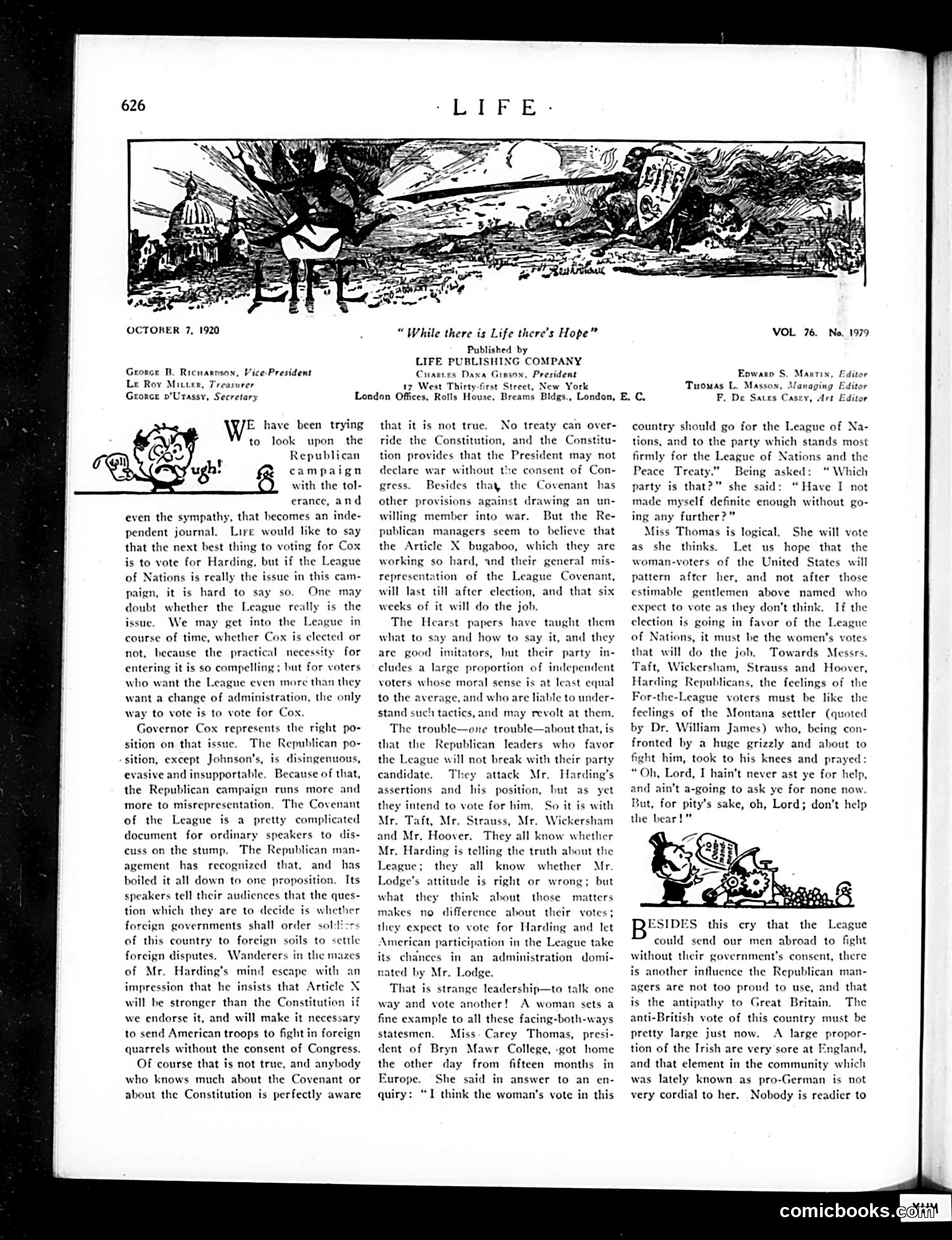
This editorial attacks Republican presidential candidate Warren G. Harding's position on the League of Nations during the 1920 election. Life's editors accuse Republican campaigners of deliberately **misrepresenting Article X** of the League Covenant to voters, claiming it would force American troops into foreign wars without Congressional consent—a charge Life calls false and disingenuous. The satire targets Republican leaders (Taft, Strauss, Wickersham, Hoover) who privately oppose Harding's evasive stance but publicly support him anyway. Life calls this "strange leadership" and contrasts it favorably with women like Carey Thomas, who vote their principles rather than party loyalty. The magazine supports Democrat James Cox's clearer pro-League position, arguing that if voters genuinely want League membership, Cox is the only honest choice.
📄 Transcribed text from this page (OCR, searchable)
Machine-transcribed from the original scan — historical spelling and the odd misread are preserved.
OCTOBER 7, 1920 Geonce R. Ricuarnson, Vice-President Lr Roy Miter, Treasurer Gronct o'Urassy, Secretary E have been trying to look upon the Republican campaign with the tol- erance, and even the sympathy, that becomes an inde- pendent journal, Lire would like to say that the next best thing to voting for Cox is to vote for Harding, but if the League of Nations is really the issue in this cam- paign, it is hard to say so. One may doubt whether the League really is the We may get into the League in course of time, whether Cox is elected or not, because the practical necessity for entering it is so compelling; but for voters who want the League even more than they want a change of administration, the only way to vote is to vote for Cox. Governor Cox represents the right po- sition on that issue. The Republican po- sition, except Johnson's, is disingenuous, evasive and insupportable. Because of that, the Republican campaign runs more and more to misrepresentation, The Covenant of the League is a pretty complicated document for ordinary speakers to dis- cuss on the stump. The Republican man- agement has recognized that, and has boiled it all down to one proposition. Its speakers tell their audiences that the ques- tion which they are to decide is whether foreign governments shall order sol:lizrs of this country to foreign soils to settle foreign disputes. Wanderers in the mazes of Mr. Harding’s mind escape with an impression that he insists that Article X will be stronger than the Constitution if we endorse it, and will make it necessary to send American troops to fight in foreign quarrels without the consent of Congress. Of course that is not true, and anybody who knows much about the Covenant or about the Constitution is perfectly aware issue. “While there is Life there’s Hope” Published by LIFE PUBLISHING COMPANY Cuates Dawa Grason, President 17 West Thirty-first Street, New York London Offices, Rolls House, Breams Bldgs., London, E. C, that it is not true. No treaty can over- ride the Constitution, and the Constitu- tion provides that the President may not declare war without the consent of Con- gress. Besides thay the Covenant has other provisions against drawing an un- willing member into war. But the Re- publican managers seem to believe that the Article X bugaboo, which they are working so hard, and their general mi: representation of the League Covenant, will last till after election, and that six weeks of it will do the job. The Hearst papers have what to ught them and how to say it, and they are good imitators, but their party in- cludes a large proportion of independent voters whose moral sense is at least equal to the average, and who are liable to under- y revolt at them. trouble—about that, is stand suc The trouble—e that the Republican leaders who favor the League will not break with their party candidate. They attack Mr. Harding's assertions and his position, but as yet ics,and n intend to vote for him. So it is with Mr. Taft, Mr. Strauss, Mr. Wickersham and Mr. Hoover. They all know whether Mr, Harding is telling the truth about the League; they all know whether Mr. Lodge’s attitude is right or wrong; but what they think about those matters makes no difference about their votes; they expect to vote for Harding and Ict icipation in the League take in an administration domi- Mr. Lodge. That is strange leadership—to talk one way and vote another! fine example to all these facing-both-ways statesmen. Miss. Carey Thomas, presi- dent of Bryn Mawr College, -got home the other day from fifteen months in Europe. She said in answer to an en- quiry: “I think the woman's vote in this A woman sets a VOL 76. Epwaro S. Mastin, Editor Tuomas L. Masson, Managing Edi F, De Sates C country should go for the League of Na- tions, and to the party which stands most firmly for the League of Nations and the ace Treaty, Being asked: “ Which party is that?” she said: “Have I not made myself definite enough without go- ing any further? Miss Thomas is logical. She will vote as she thinks. Let us hope that the woman-voters of the United States will pattern after her, and not after those estimable gentlemen above named expect to vote as they don’t think. who If the election is going in favor of the League of Nations, it must he the women’s votes that will do the job. Towards Messrs. Taft, Wickersham, Strauss and Hoover, Harding Republicans, the feelings of the r-the-League voters must be like the feclings of the Montana settler (quoted by Dr. William James) who, being con- fronted by a huge grizzly and about to ght him, took to his knees and prayed: “Oh, Lord, I hain’t never ast ye for help, and ain’t a-going to ask ye for none now 3ut, for pity’s sake, oh, Lord; don’t help the bear!” SIDES this cry that the League could send our men abroad to fight without their government's consent, there is another influence the Republican man- agers are not too proud to use, and that is the antipathy to Great Britain. The anti-British vote of this country must be pretty large just now. A large propor- tion of the Irish are very sore at England, and that element in the community which was lately known as pro-German is not very cordial to her. Nobody is readier to comicbooks.