
Life, 1920-10-07 · page 18 of 56
Life — October 7, 1920 — page 18: what you’re looking at
What you’re looking at
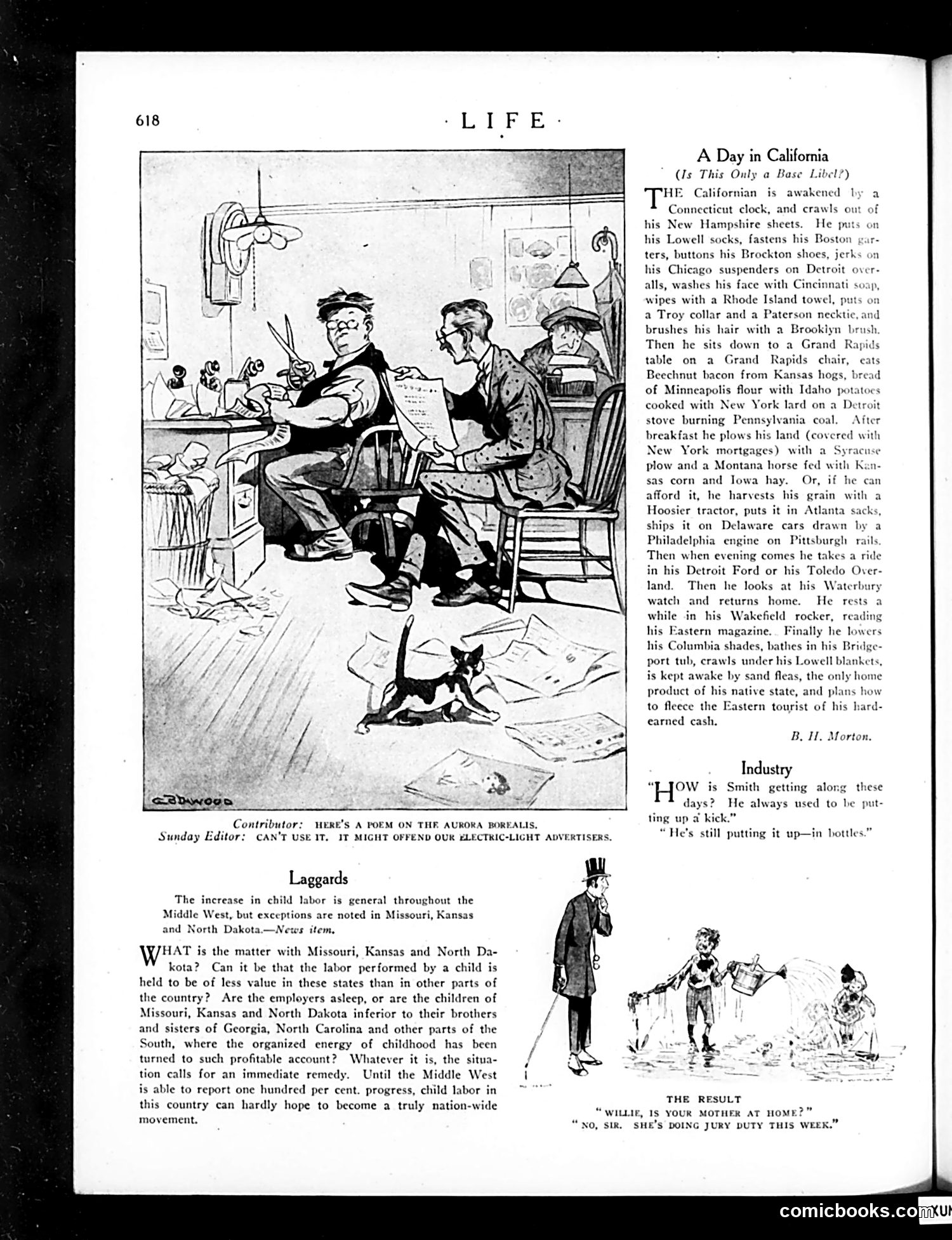
**"A Day in California"** satirizes California's economic dependence on Eastern manufactures. The piece catalogs how a Californian's entire day—from clock to blankets—relies on products from other regions (Connecticut, New Hampshire, Boston, Chicago, etc.), suggesting California produces almost nothing domestically except "sand fleas." The joke: despite California's resources and labor, residents remain economically colonized by the industrialized East, and the state's only authentic product is worthless. **"Industry"** appears to be a brief dialogue joke about someone named Smith still "putting it up—in bottles," likely a prohibition-era reference to illegal alcohol production. **"Laggards"** uses sarcastic commentary to shame Missouri, Kansas, and North Dakota for *not* increasing child labor at the same rate as Southern states. This is savage irony: Life sarcastically celebrates child labor as "progress," exposing how the practice was normalized and competitive among regions during the Progressive Era.
📄 Transcribed text from this page (OCR, searchable)
Machine-transcribed from the original scan — historical spelling and the odd misread are preserved.
A Day in California (Is This Ouly a Base Libel?) HE Californian is awakened ly a Connecticut clock, and crawls out of his New Hampshire sheets. He put his Lowell socks, fastens his Boston ters, buttons his Brockton shoes, jerks his Chicago suspenders on Detroit ov alls, washes his face with Cincinnati wipes with a Rhode Island towel, p a Troy collar and a Paterson necktie brushes his hair with a Brookiyn 1 Then he sits down to a Grand Ra table on a Grand Rapids chair, eats Beechnut bacon from Kansas hogs, bread of Minneapolis flour with Idaho potatoes cooked with New York lard on a Detroit stove burning Pennsylvania coal. After breakfast he plows his land (covered with New York mortgages) with a Syracuse plow and a Montana horse fed with K sas corn and Towa hay. Or, if he afford it, he harvests his grain with a Hoosier tractor, puts it in Atlanta sacks, ships it on Delaware cars drawn by a Philadelphia engine on Pittsburgh rails Then when evening comes he takes a ride in his Detroit Ford or his Toledo Over- land. Then he looks at his Waterbury watch and returns home. He rests a while in his Wakefield rocker, reading his Eastern magazine. Finally he lowers his Columbia shades, bathes in his Bridge- port tub, crawls under his Lowell blankets, is kept awake by sand fleas, the only home product of his native state, and plans how to fleece the Eastern tourist of his hard- earned cash, B, H. Morton. Industry “ OW Smith getting along these days? He always used to be put- Contributor: Wexe's A POEM ON THR AUKORA BOREALIS. TD a te sacs wesame a » Sunday Editor: CAN'T USE IT, 17 MIGHT OFFEND OUR ELECTRIC-LIGHT ADVERTISERS. He's still putting it up—in bottles Laggards The increase in child labor is general throughout the Middle West, but exceptions are noted in Missouri, Kansas and North Dakota.—News item, HAT is the matter with Missouri, Kansas and North Da- kota? Can it be that the labor performed by a child is held to be of less value in these states than in other parts of the country? Are the employers asleep, or are the children of Missouri, Kansas and North Dakota inferior to their brothers and sisters of Georgia, North Carolina and other parts of the South, where the organized energy of childhood has been turned to such profitable account? Whatever it is, the situa- tion calls for an immediate remedy. Until the Middle West is able to report one hundred per cent. progress, child labor in : . . E Es! this country can hardly hope to become a truly nation-wide wine uecad SOUR WOLRER AE) GRAD” movement. “NO, SIR, SHE'S DOING JURY DUTY THIS WEEK.” comicbooks.coma