
Life, 1920-10-07 · page 24 of 56
Life — October 7, 1920 — page 24: what you’re looking at
What you’re looking at
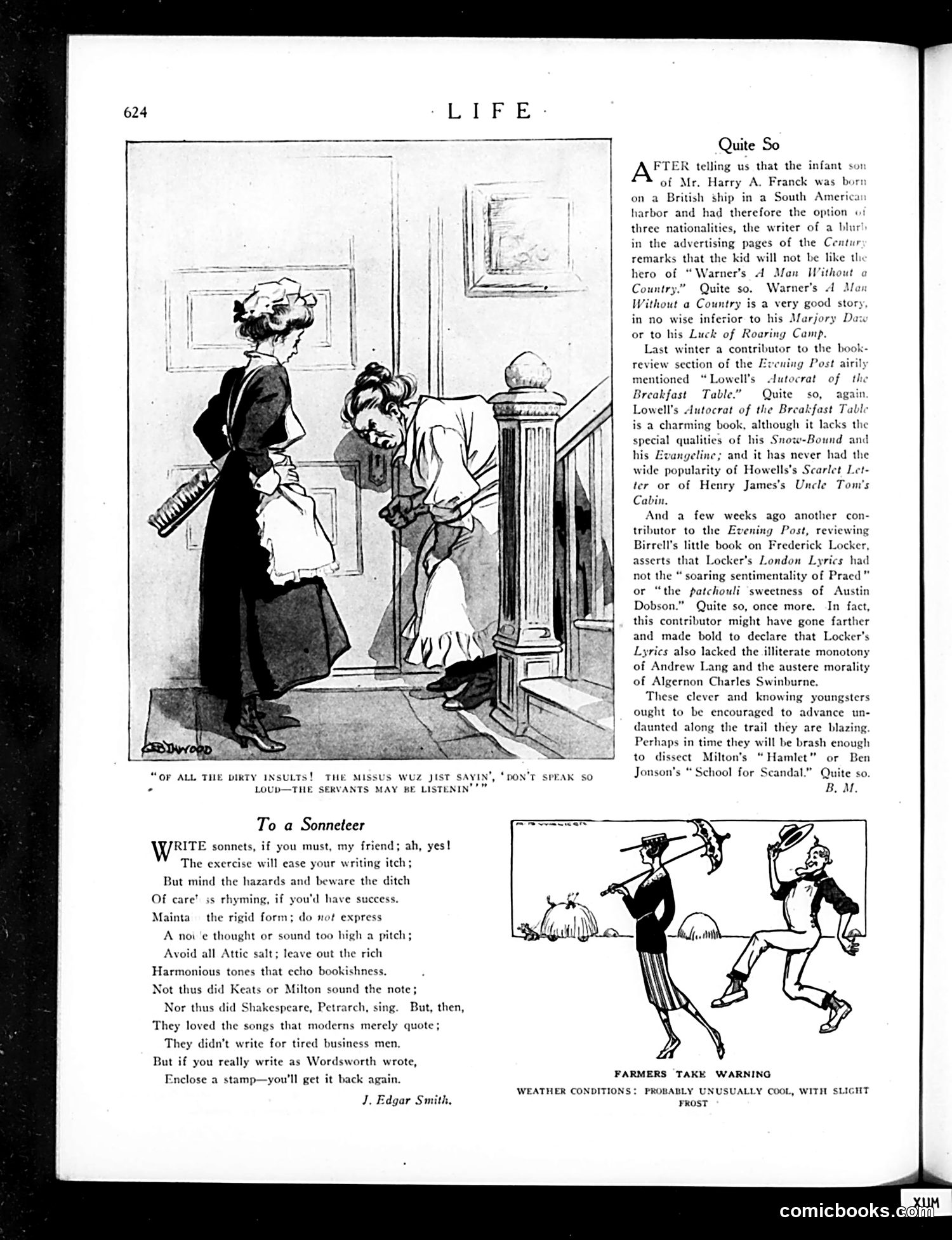
This page mocks young literary critics who make superficially clever observations while missing deeper truths. The article "Quite So" satirizes contributors to publications like the *Evening Post* who authoritatively compare minor works to major ones—claiming Locker's *London Lyrics* lacks the sentimentality of Praed or sweetness of Dobson—as if these comparative judgments demonstrate sophistication. The satire suggests these youngsters are merely being "brash" and pretentious, brazenly issuing dismissive verdicts they're insufficiently learned to justify. The title "Quite So" itself is ironic, sardonically agreeing while implying the critics are callow. The cartoon depicts servants eavesdropping on their employers' conversation, illustrating working-class social commentary. "To a Sonneteer" (by J. Edgar Smith) offers mock-serious advice about sonnet-writing while subtly criticizing modern practitioners: they lack the genius of Keats, Milton, and Shakespeare, and write for "tired business men" rather than from authentic inspiration.
📄 Transcribed text from this page (OCR, searchable)
Machine-transcribed from the original scan — historical spelling and the odd misread are preserved.
Quite So FTER telling us that the infant sor of Mr. Harry A. Franck was bor on a British ship in a South America: harbor and had therefore the option of three nationalities, the writer of a blur in the advertising pages of the Centur remarks that the kid will not be like the hero of “Warner’s A Man Without o Country.” Quite so. Warner's A Man Without a Country is a very good story, in no wise inferior to his Marjory L or to his Luck of Roaring Camp. Last winter a contributor to the book- review section of the Evening Post airily mentioned “Lowell's Autocrat of the Breakfast Table.” Quite so, again Lowell's Autocrat of the Breakfast Tabli is a charming book, although it lacks the special qualities of his Snow-Bound and his Evangeline; and it has never had the wide popularity of Howells’s Scarlet Let- ter or of Henry James's Uncle Tom's Cabin, And a few weeks ago another con- tributor to the Evening Post, reviewing Birrell’s little book on Frederick Locker, asserts that Locker'’s London Lyrics had not the “ soaring sentimentality of Praed” or “the patchouli sweetness of Austin Dobson.” Quite so, once more. In fact, this contributor might have gone farther and made bold to declare that Locker’s Lyrics also lacked the illiterate monotony of Andrew Lang and the austere morality of Algernon Charles Swinburne, These clever and knowing youngsters ought to be encouraged to advance un- daunted along the trail they are bla: Perhaps in time they will be brash enough ———— to dissect Milton’s “Hamlet” or Ben “OF ALL THE DIRTY INSULTS! THE MISSUS WUZ JIST SAYIN’, ‘DON'T SPEAK SO Jonson's “ School for Scandal.” Quite so. - LOUD—THE SERVANTS MAY BE LISTENIN’'” To a Sonneteer RITE sonnets, if you must, my friend; ah, yes! The exercise will ease your writing itch; But mind the hazards and beware the ditch Of care’ ss rhyming, if you'd have success. Mainta the rigid form; do not express A nove thought or sound too high a pitch; Avoid all Attic salt; leave out the rich Harmonious tones that echo bookishness, Not thus did Keats or Milton sound the note; Nor thus did Shakespeare, Petrarch, sing. But, then, They loved the songs that moderns merely quote; They didn’t write for tired business men. But if you really write as Wordsworth wrote, Enclose a stamp—you'll get it back again. FARMERS, TARE ‘WARNING 5 WEATHER CONDITIONS: PROBABLY UNUSUALLY COOL, WITH SLIGHT J. Edgar Smith, FROST comicbooks.