
Life, 1920-10-07 · page 27 of 56
Life — October 7, 1920 — page 27: what you’re looking at
What you’re looking at
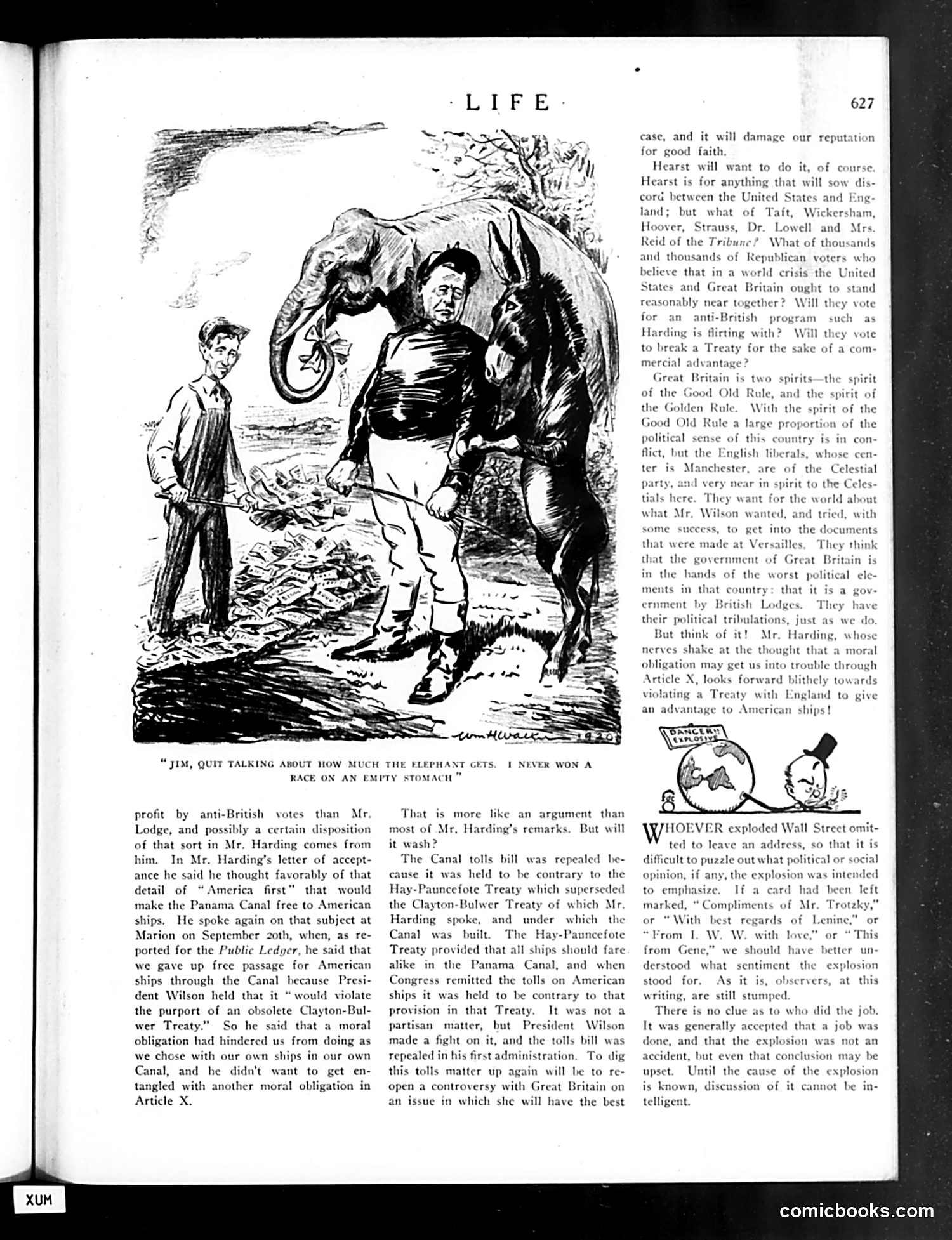
This Clifford Berryman cartoon satirizes Republican nominee Warren Harding's inconsistent positions on the Panama Canal tolls issue during his 1920 campaign. The "elephant" is the Republican Party mascot. The cartoon's caption mocks Harding's focus on economic benefits (tolls revenue) while ignoring moral obligations—specifically, treaty commitments requiring equal canal access for all nations. The accompanying text criticizes Harding for attacking President Wilson's 1914 canal tolls repeal while simultaneously claiming moral objections shouldn't entangle America in international obligations (referencing the League of Nations' Article X). The satire highlights the hypocrisy: Harding wants to violate a treaty with Britain for commercial advantage while opposing other international commitments on moral grounds. The article names prominent Republicans (Taft, Hoover, Lowell, Reid) who would supposedly oppose such treaty-breaking, questioning whether Republican voters supporting closer US-British relations would endorse Harding's anti-British position for mere economic gain.
📄 Transcribed text from this page (OCR, searchable)
Machine-transcribed from the original scan — historical spelling and the odd misread are preserved.
“ JIM, QUIT TALKING ABOUT HOW MUCH THE ELEPHANT GETS. RACE ON AN EMPTY profit by anti-British than Mr. Lodge, and possibly a certain disposition of that sort in Mr. Harding comes from him. In Mr. Harding’s letter of accept- ance he said he thought favorably of that detail of that make the Panama Canal free to American ships. He spoke again on that subject at Marion on September 20th, when, as re- ported for the Public Ledger, he said that we gave up free passage for American ships through the Canal because Presi- dent Wilson held that it “would violate the purport of an obsolete Clayton-Bul- wer Treaty.” So he said that a moral obligation had hindered us from doing as we chose with our own ships in our own Canal, and he didn’t want to get en- tangled with another moral obligation in Article X. votes would 1 NEVER WON A stomacn” argument than But will That is more like an most of Mr, Harding’s remarks. it wash? The Canal tolls bill was repealed be- cause it was held to be contrary to the Hay-Pauncefote Treaty which superseded the Clayton-Bulwer Treaty of which Mr. Harding spoke, which the Canal built. The Hay-Pauncefote Treaty provided that all ships should fare alike in the Panama Canal, and Congress remitted the tolls on American ships it was held to be contrary to that provision in that Treaty. It was not a partisan matter, but Wilson made a fight on it, and the tolls bill was repealed in his first administration. and under was when President To dig this tolls matter up again will be to re- open a controversy with Great Britain on an issue in which she will have the best 627 case, and it will damage our reputation for good faith, Hearst will want to do it, of course. Hearst is for anything that will sow dis- cord between the United States and Eng- land; but Taft, Wickersham, Hoover, Strauss, Dr. Lowell and Mrs. f the Tribune? What of thousands and thousands of Republican voters who believe that in a world crisis the United what of Reid and Great Britain ought to stand reasonably near together? Will tl for an ant cy vote British program such as Will they vote for the sake of a com- Harding is flirting with? to break a Treaty mercial advantage? Great Britain is two spirits—the spirit of the Good Old Rule, the Golden Rule and the spirit of With the spirit of the Good Old Rule a large 1 oportion of the political sense of this country flict, but the English liberals, wh ter is is in con- » cen- Manchester, are of the party, and very near in spirit to the Celes- tials here. at Mr some They want for the world abx Wil succes: om wanted, 1 tried, with 1 to get into the documents that were made at Versailles. that They think ¢ government of Great Britain i in the hands of the worst political ele ments in that country: that it is a gov- ernment by British Lodges. They have their political tribulations, just as we do But think of it! Mr. Harding, nerves shake at the thought that a moral obligation may get us into trouble through Article X, looks forward blithely tow violating a ards reaty with England to give an advantage to American ships! RNCUMN HOEVER exploded Wall Strect omit- ted to leave an address, so that it is difficult to puzzle out what political or soc opinion, if any, the explosion was intended to emphasize. If a ds had left marked, “Compliments of Mr. Trotzky,” or “With best “From 1. W from heen Lenine,” or * This better un- regards of W. with should love,” or Gene,” we have derstood sentiment the explosion this what for. As it is, writing, are still stumped. There is no clue as to who did the job. It was generally accepted that a job was done, and that the explos' stood observers, at was not an accident, but even that conclusion may be upset. Until the cause of the explosion is known, discussion of it cannot be in- telligent. comicbooks.com