
A complete issue · 44 pages · 1920
Life — August 12, 1920
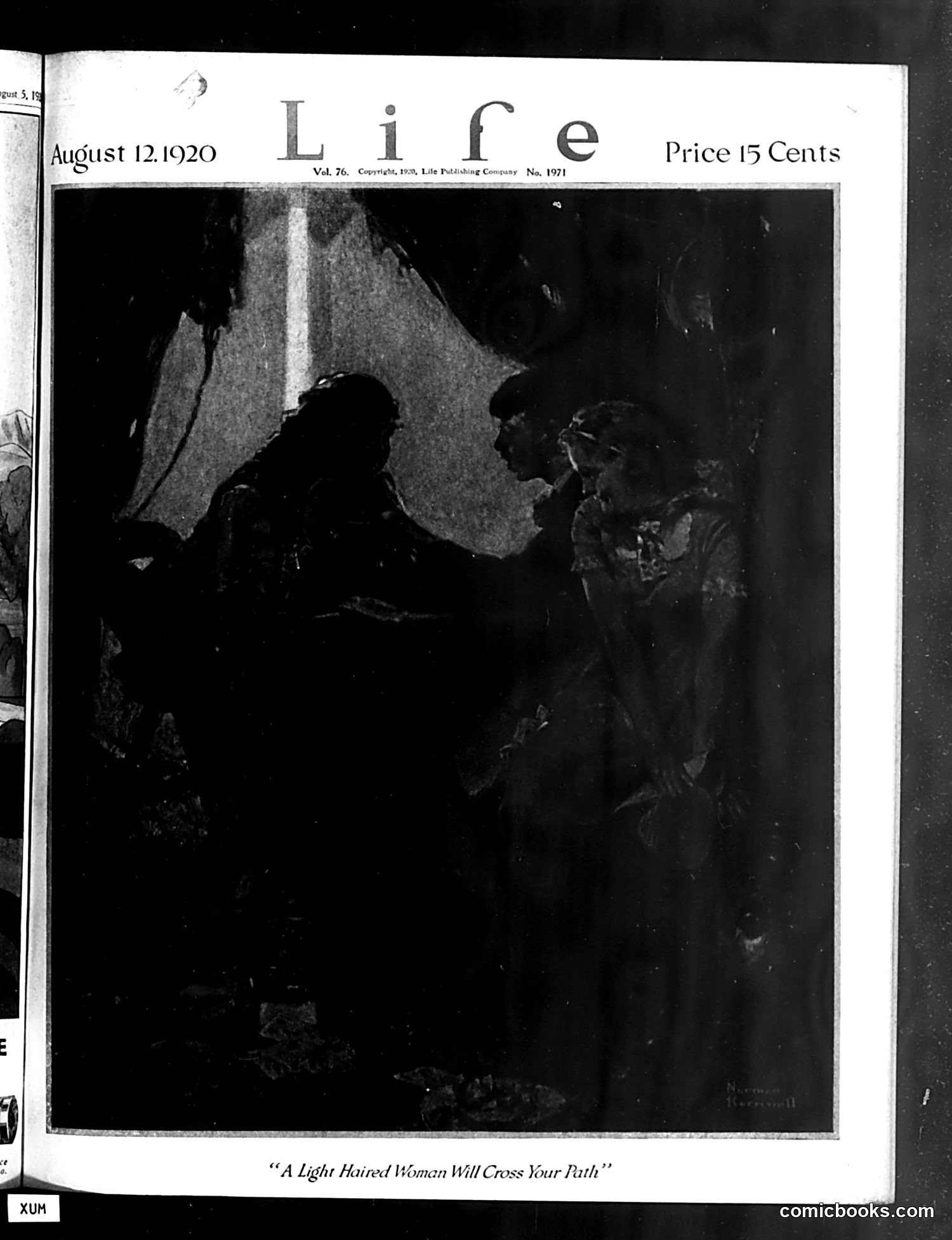
This cover illustrates the superstition "A Light Haired Woman Will Cross Your Path," a common folk belief about luck and fortune. The dramatic silhouetted image shows two figures in what appears to be a darkened interior setting, with a light-haired woman prominently featured in profile. The satire likely plays on the tension between modern, rational early-20th-century attitudes and persistent folk superstitions. By 1920, such beliefs were considered old-fashioned, yet remained widespread. Life magazine frequently mocked lingering superstitions among contemporary Americans as evidence of incomplete modernization. The theatrical, shadowy composition emphasizes the mysterious, almost supernatural atmosphere traditionally associated with fortune-telling and superstitious anxieties—treating the subject with gentle humor rather than harsh ridicule.
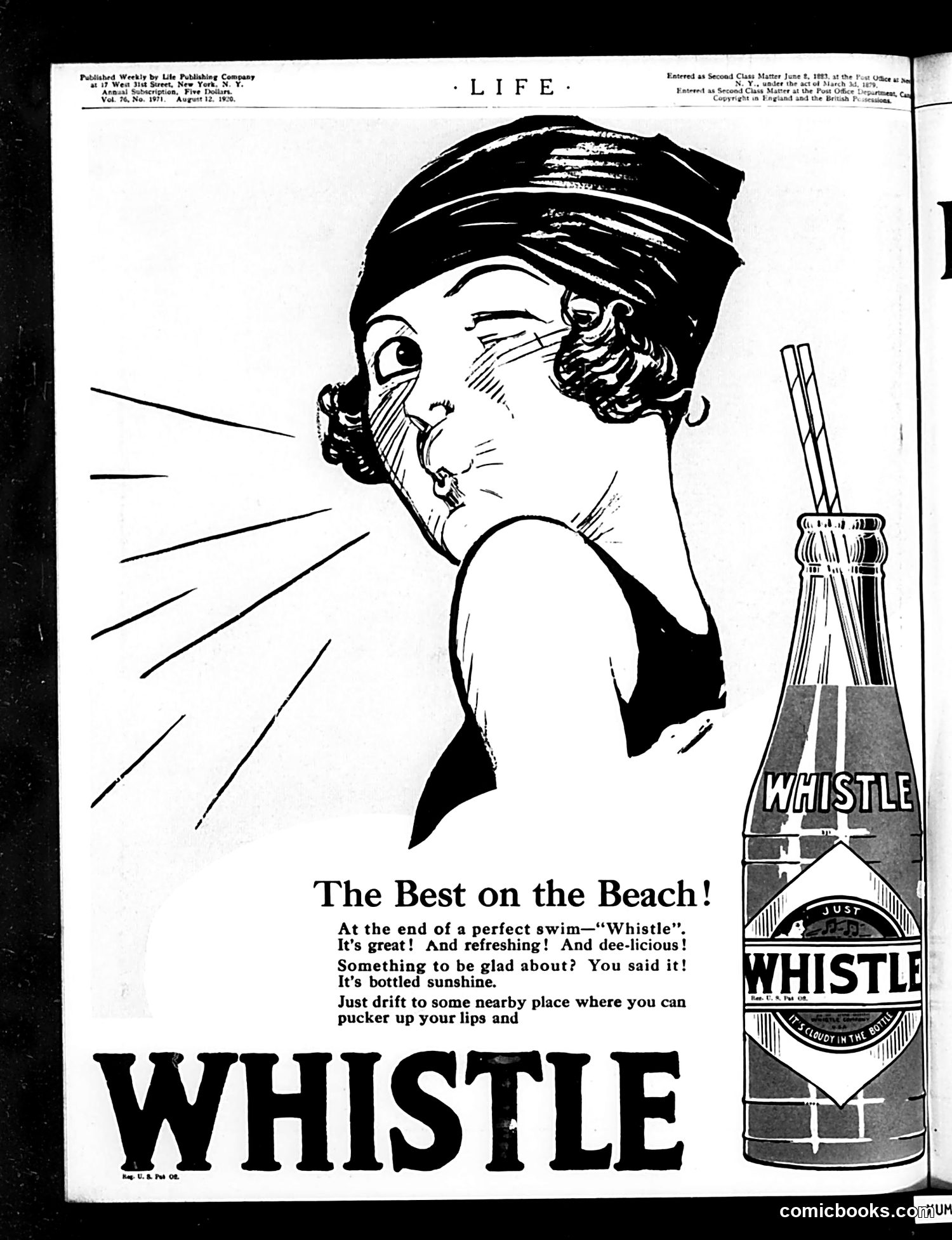
This is a **commercial advertisement**, not political satire. It promotes "Whistle," a soft drink brand, using a beach-themed appeal popular in early 20th-century advertising. The ad features a stylized illustration of a woman in a swimming costume, appearing refreshed after a swim. The sales pitch emphasizes Whistle as an ideal post-beach beverage: "bottled sunshine" that's "great! And refreshing! And dee-licious!" The headline "The Best on the Beach!" and the colloquial language ("pucker up your lips") represent typical advertising rhetoric of the era, using leisure and lifestyle imagery to market consumer products. There is no political commentary or satire—this is straightforward product promotion aimed at beachgoers seeking refreshment.
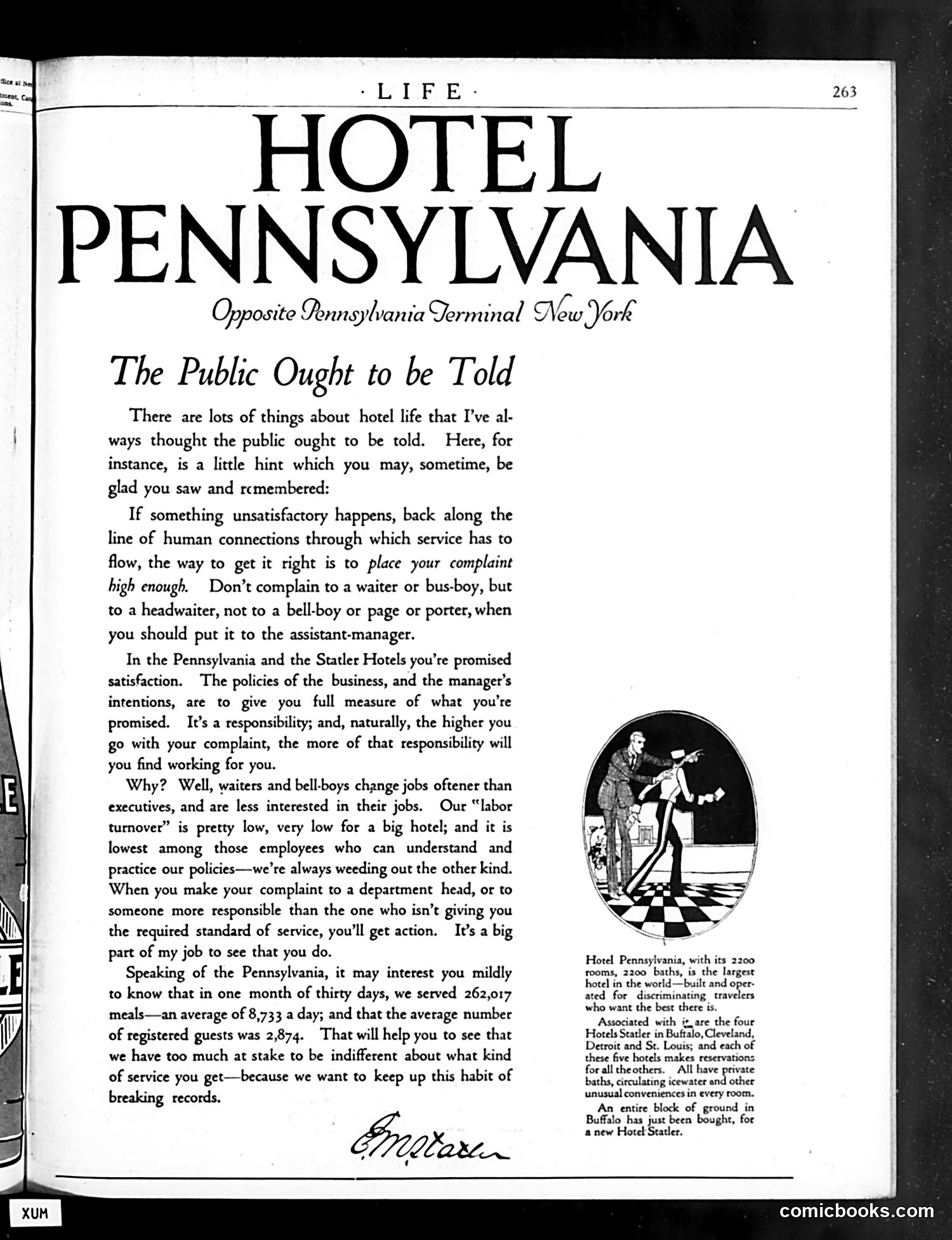
This is primarily a **hotel advertisement**, not satire or political commentary. The page promotes the Hotel Pennsylvania in New York City (opposite Pennsylvania Terminal) through what appears to be a manager's letter to guests. The small illustration on the right shows a **stylized bellhop or hotel staff member** in formal attire—a conventional figure used in early 20th-century hospitality advertising to represent service and professionalism. The text emphasizes the hotel's size (2,200 rooms) and service record (262,017 meals served monthly), attempting to convey reliability and modern efficiency. The manager advises guests on complaint procedures, recommending they escalate issues to supervisory staff rather than lower-level employees. This represents typical **1920s-era corporate hospitality marketing** emphasizing scale, organization, and customer satisfaction.
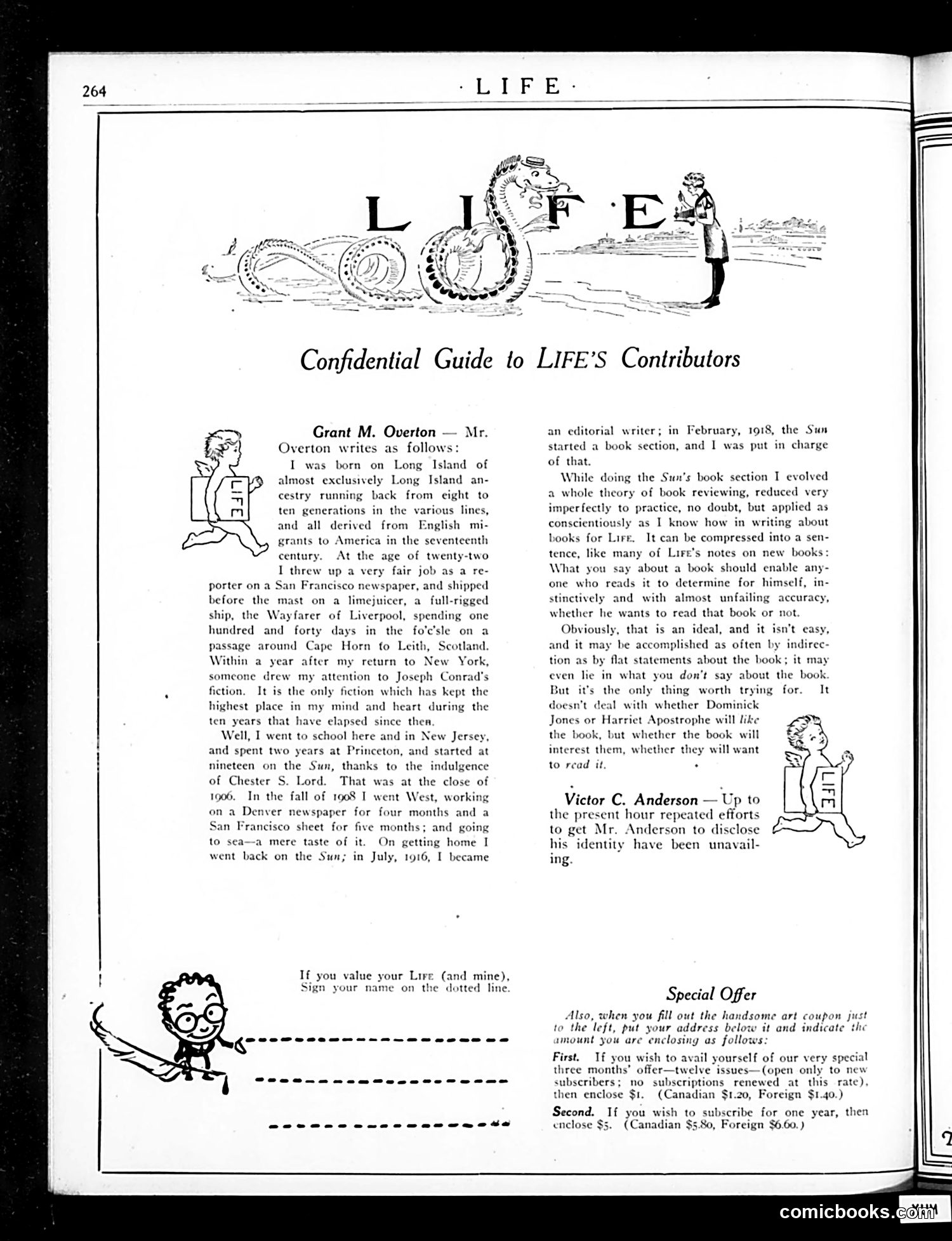
This page is primarily **editorial content rather than satirical cartoons**. It's a "Confidential Guide to LIFE's Contributors" — essentially a masthead introduction to the magazine's writers. The decorative header features a whimsical illustration of life-like figures emerging from gear wheels, a visual pun on the magazine's title. The page introduces **Grant M. Overton** and **Victor C. Anderson** as contributors. Overton's biography describes his journalism background and role developing LIFE's book review section, while Anderson's entry notes repeated unsuccessful attempts to reveal his identity. The small cartoon illustrations of characters running/gesturing are decorative mascots rather than political commentary. The bottom section advertises subscription offers — three months for $1 or one year for $5.
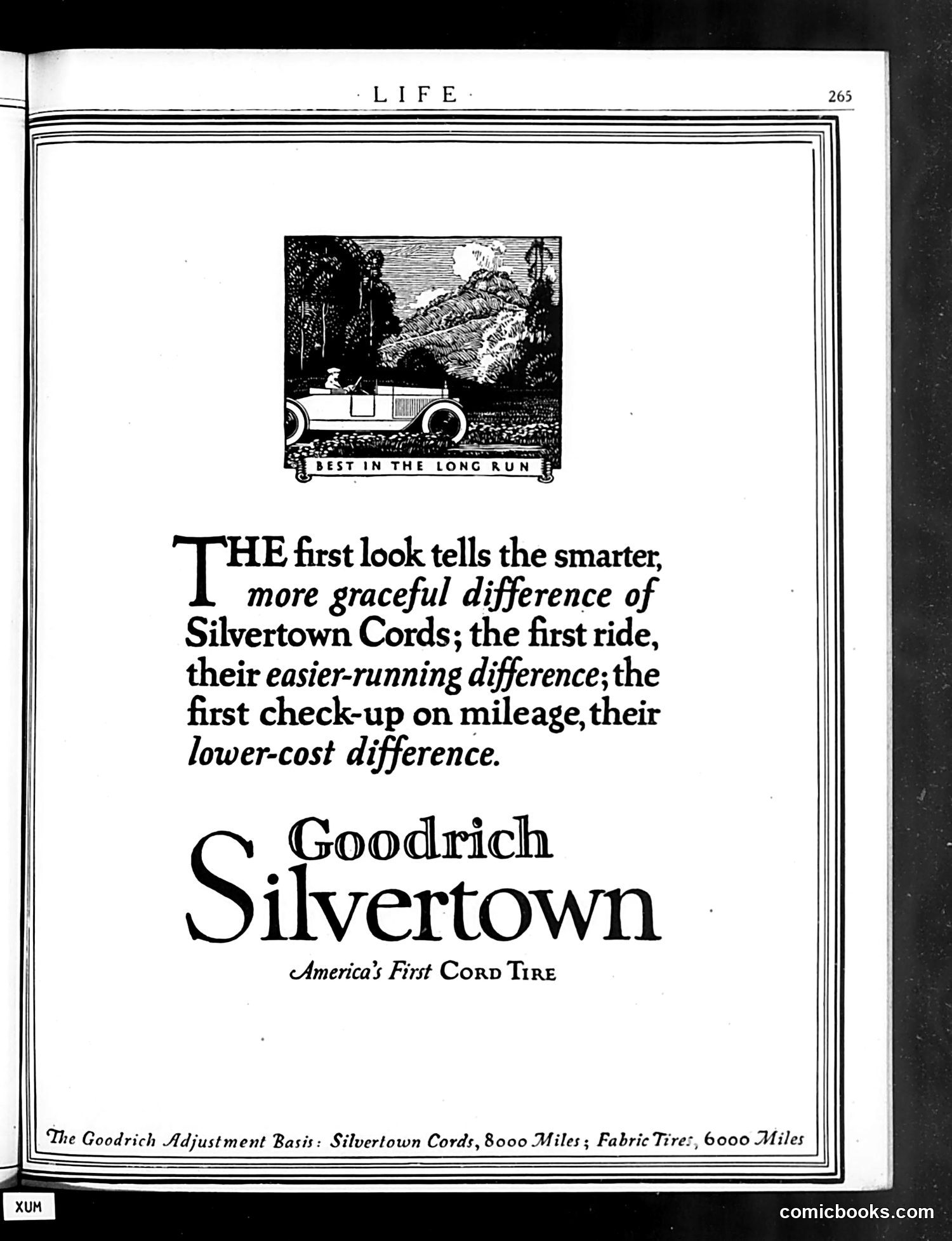
This is a straightforward **product advertisement**, not satire or political commentary. It promotes Goodrich's Silvertown Cord tire, marketed as "America's First Cord Tire." The ad uses a small illustrated vignette of a vintage automobile on a scenic road to appeal to motorists. The tagline emphasizes practical benefits: attractive appearance ("more graceful"), better performance ("easier-running"), and cost savings ("lower-cost"). The fine print at bottom specifies technical specs: Silvertown Cords lasted 8,000 miles versus fabric tires' 6,000 miles—a genuine competitive advantage in the early automobile era when tire durability directly affected ownership costs. This represents early-1920s advertising strategy: combining visual appeal with concrete performance claims to justify premium pricing.
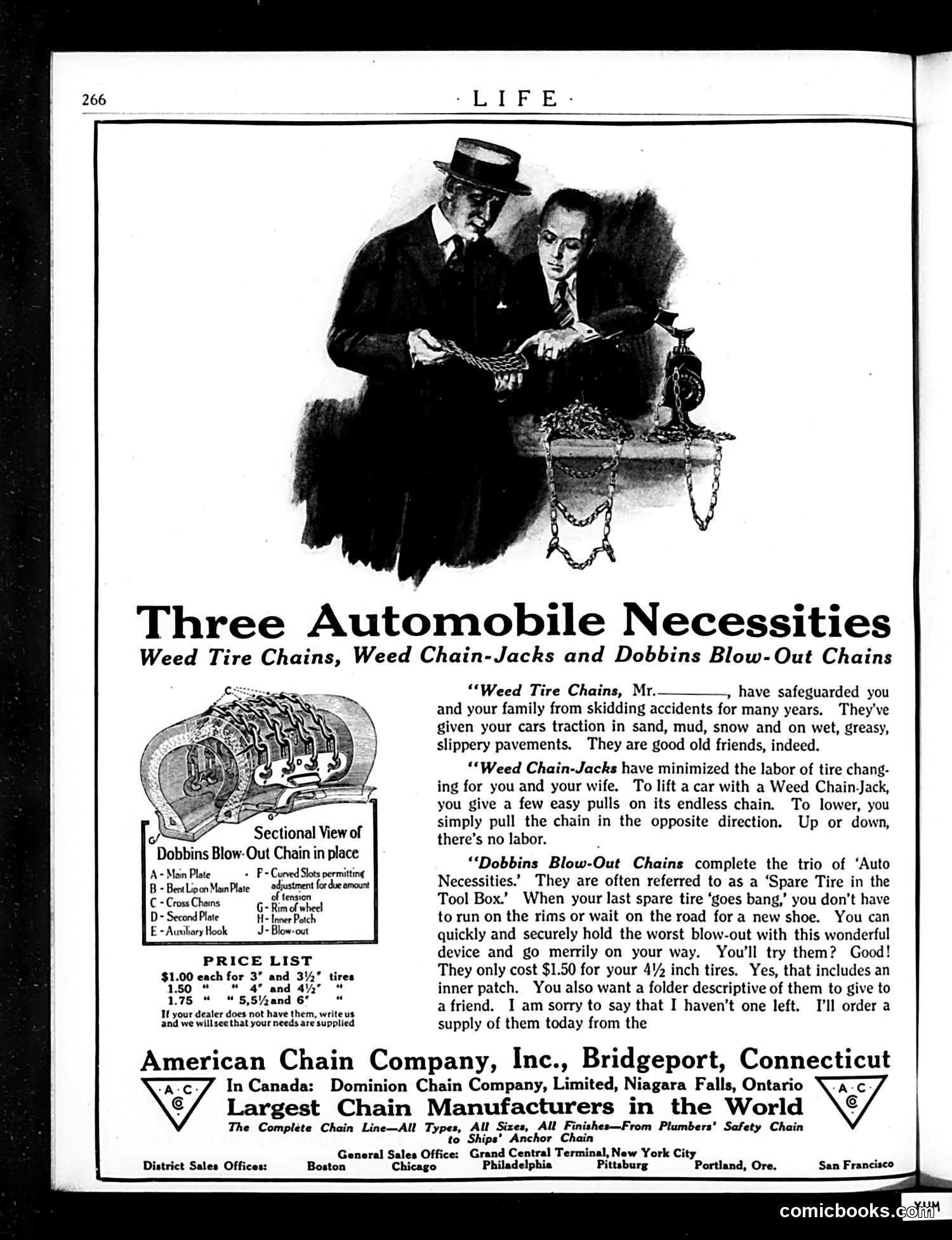
This page is **primarily an advertisement**, not editorial satire. It promotes three automobile accessories manufactured by American Chain Company: tire chains, chain-jacks, and blow-out chains. The illustration at top shows two men in suits examining chains—likely depicting a salesman demonstrating the product's value to a potential customer. This is a standard advertising visual trope of the era (appears to be early 20th century based on styling and typography). The accompanying text uses testimonial-style language ("have safeguarded you and your family") to establish the products as essential safety equipment for motorists. The detailed technical diagram and price list reinforce the advertisement's commercial purpose. There is **no political cartoon or satire present** on this page—it is straightforward product marketing.
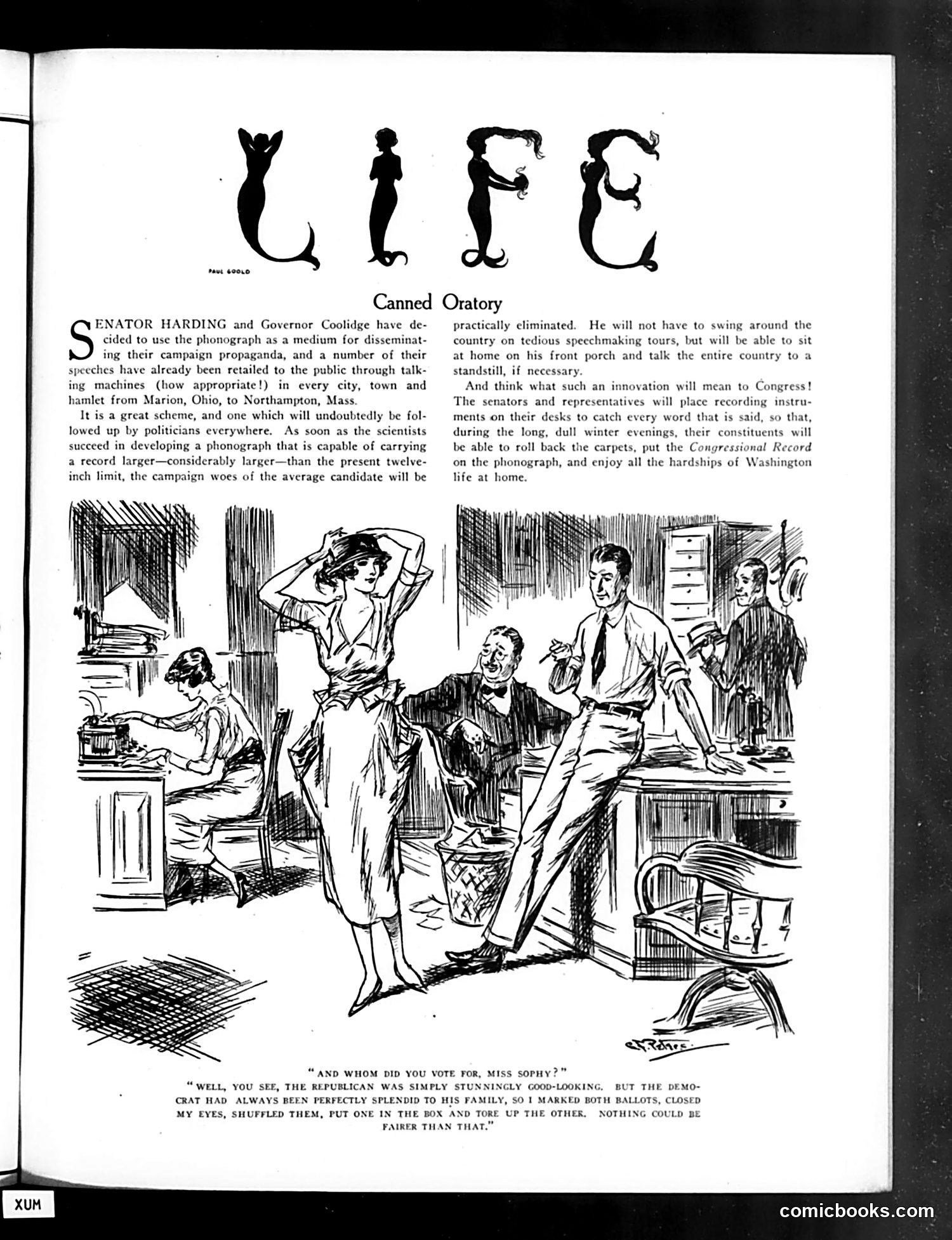
This page satirizes Senator Harding and Governor Coolidge's use of phonographic recordings to disseminate campaign speeches, eliminating the need for extensive speaking tours. The top illustration spells "LIFE" using mermaid silhouettes, likely a magazine masthead or decorative header. The main cartoon depicts a domestic scene where a woman (labeled "Miss Sophy") explains her voting choice to onlookers. She humorously describes marking both Republican and Democratic ballots, then destroying one ballot—suggesting she couldn't decide between candidates based on their policies alone. Instead, she voted for the Republican candidate solely because he was "stunningly good-looking," implying women voters were superficial rather than politically informed. This reflects early 20th-century gender stereotypes about female voters.
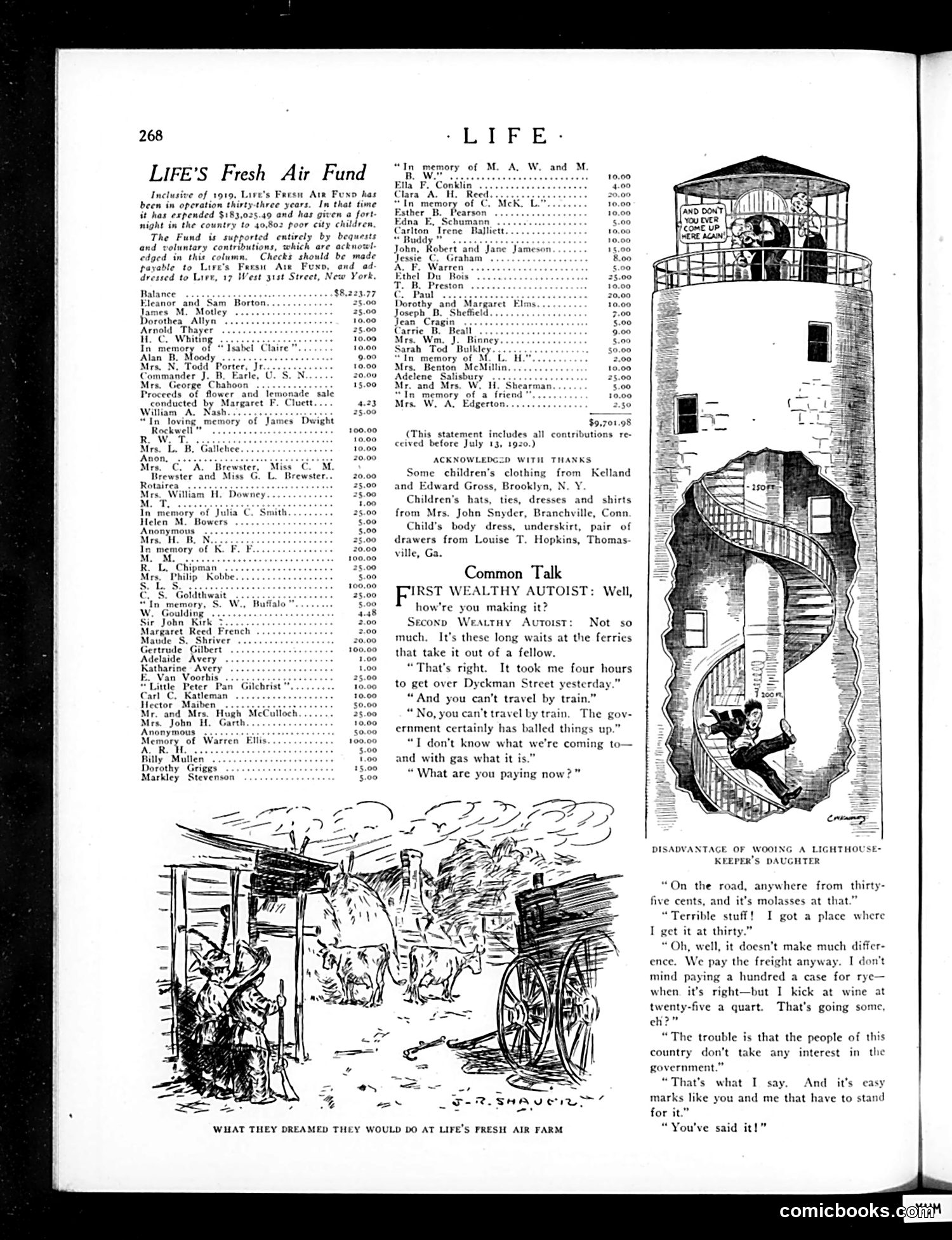
This page contains two distinct elements: **Left side:** A fundraising list for "Life's Fresh Air Fund," showing contributors' names and donation amounts. This was a legitimate charitable program helping poor children access countryside facilities. **Bottom cartoon:** Titled "What They Dreamed They Would Do at Life's Fresh Air Farm," it depicts a humorous scene of animals (appears to be cows or cattle) crowded onto a farm wagon, suggesting the chaotic reality versus the peaceful, restorative experience the fund promised children. The satire mocks the gap between the charitable program's idealistic goals and its practical overcrowded conditions. **Right side:** A "Common Talk" dialogue between two wealthy men discussing economic hardship, wartime transportation restrictions, and government competence—reflecting post-WWI frustrations with ongoing shortages and bureaucratic control.
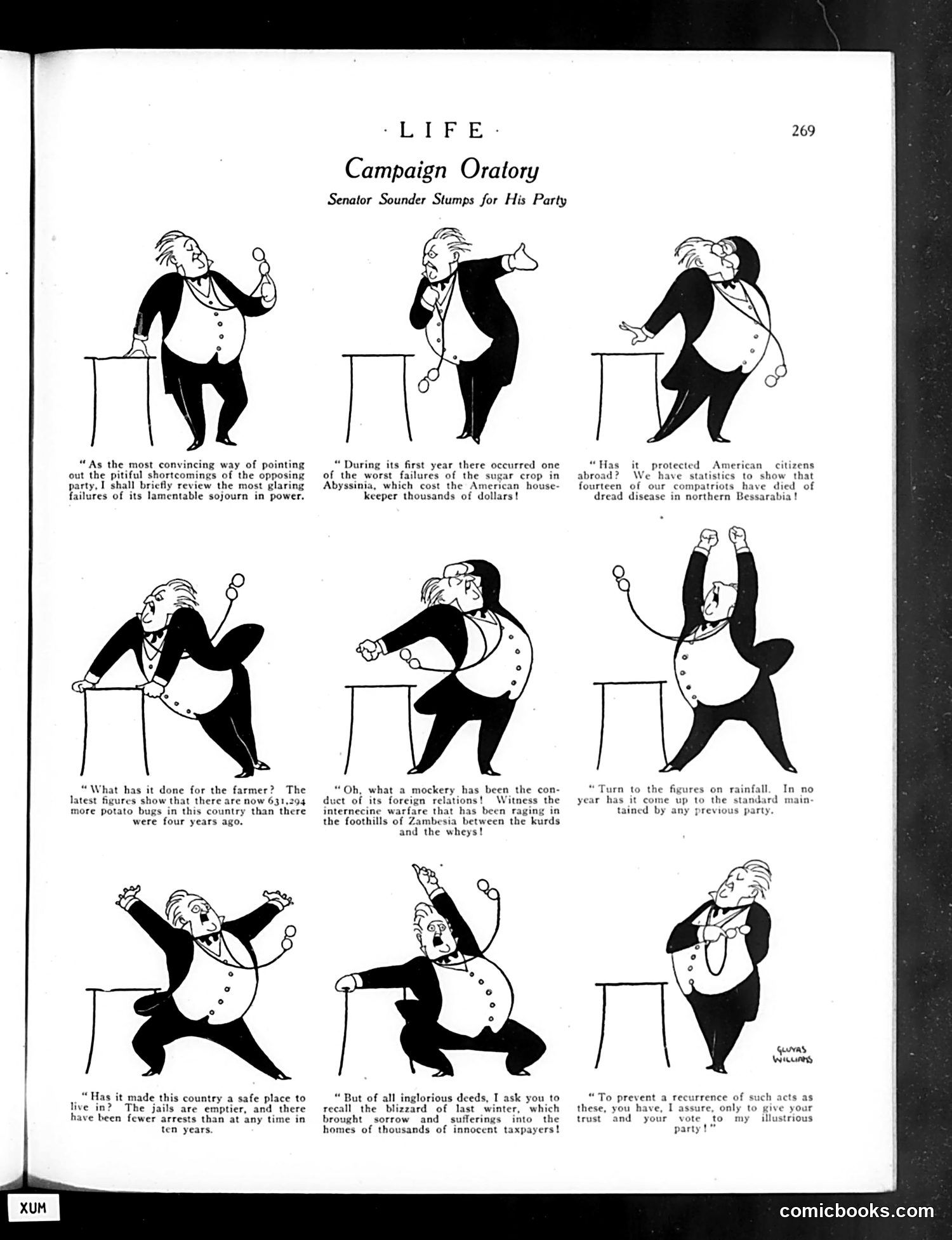
This satirical cartoon mocks a politician's campaign speech through nine sequential panels showing increasingly exaggerated gestures and contortions. The speaker makes contradictory claims—boasting about the party's accomplishments (potato crops, jail populations, rainfall figures) while simultaneously blaming them for failures (disease deaths, agricultural losses, blizzards). The satire targets political hypocrisy: the speaker attempts to credit his party with every positive statistic while deflecting blame for negative outcomes. The exaggerated physical comedy emphasizes the absurdity of such contradictory rhetoric. The cartoonist (signed "Cesare Wilkinson") critiques how politicians twist facts and use theatrical performance to obscure accountability, a timeless political theme.
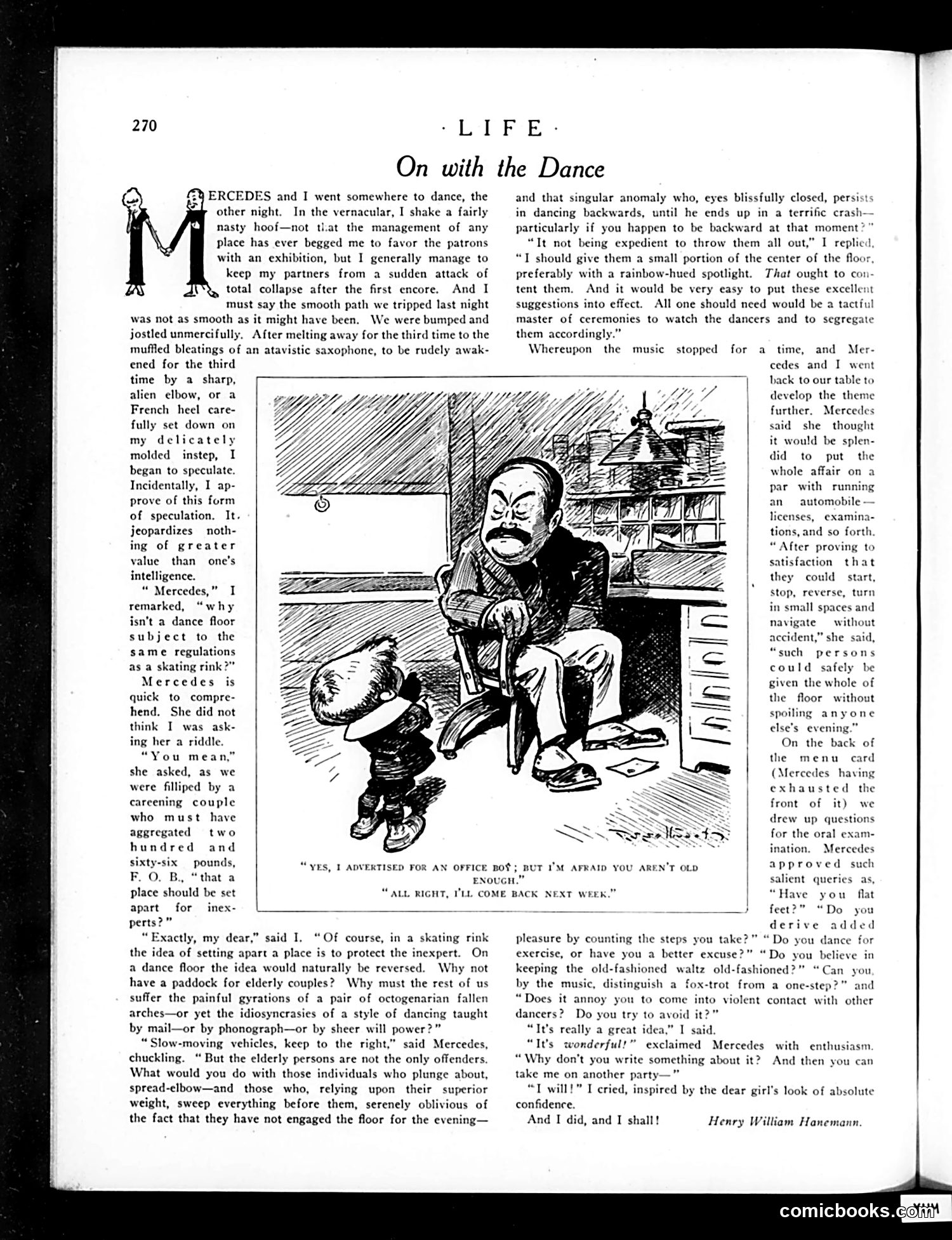
This is a humorous short story by Henry William Hanemann about dance floor etiquette. The accompanying cartoon satirizes a common social problem: overweight or physically unfit dancers who monopolize dance floors and collide with other couples. The caricatured figure depicts a heavyset man dancing awkwardly, illustrating the narrator's complaint that such dancers are "not the only offenders" but notably problematic due to their "superior weight" and inability to navigate properly. The satire targets people who lack self-awareness about their physical limitations yet dominate shared social spaces. Mercedes (a female character in the story) suggests implementing regulations similar to skating rinks—restricting participation to prevent "inexpert" dancers from spoiling everyone's evening. The joke reflects 1920s social anxieties about public behavior and propriety.
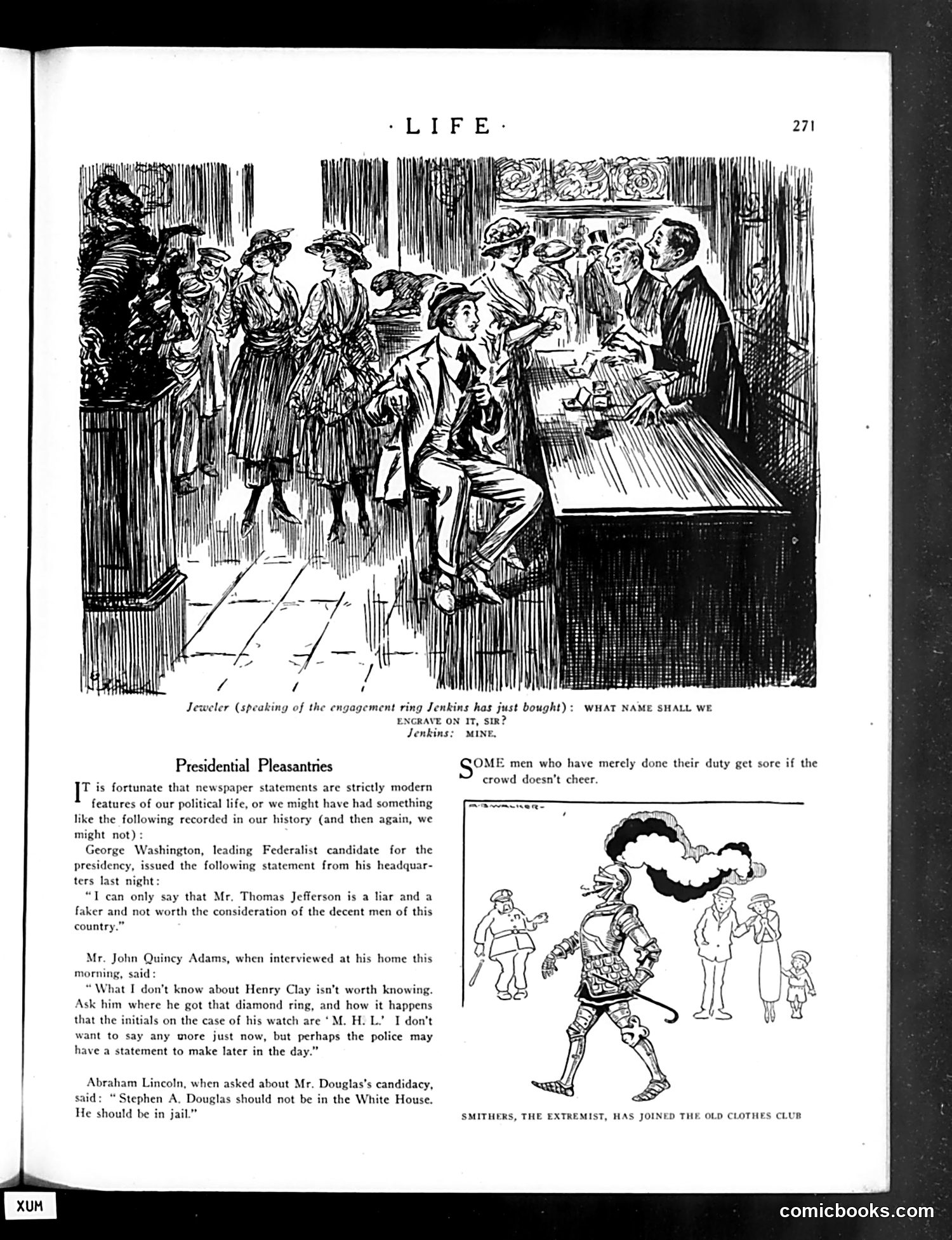
**Top Cartoon:** A jeweler shows an engagement ring to a male customer while female customers crowd around. The caption reveals the joke: when asked what name to engrave on the ring, the customer (Jenkins) wants "Mine" — implying he's buying the ring for himself rather than as an engagement gift, a humorous commentary on male vanity or self-interest. **"Presidential Pleasantries" Section:** This satirizes 19th-century political discourse by presenting harsh insults exchanged between presidential candidates (Washington calling Jefferson a "liar," Adams questioning Clay's worth, Lincoln suggesting Douglas belonged in jail). The point: early American politics involved brutal personal attacks, contrasting with the sanitized "statements" of the satirist's contemporary era. **Bottom Cartoon:** Caption references "Smithers, the Extremist, has joined the Old Clothes Club" — appears to mock an activist or radical who has become conventional.
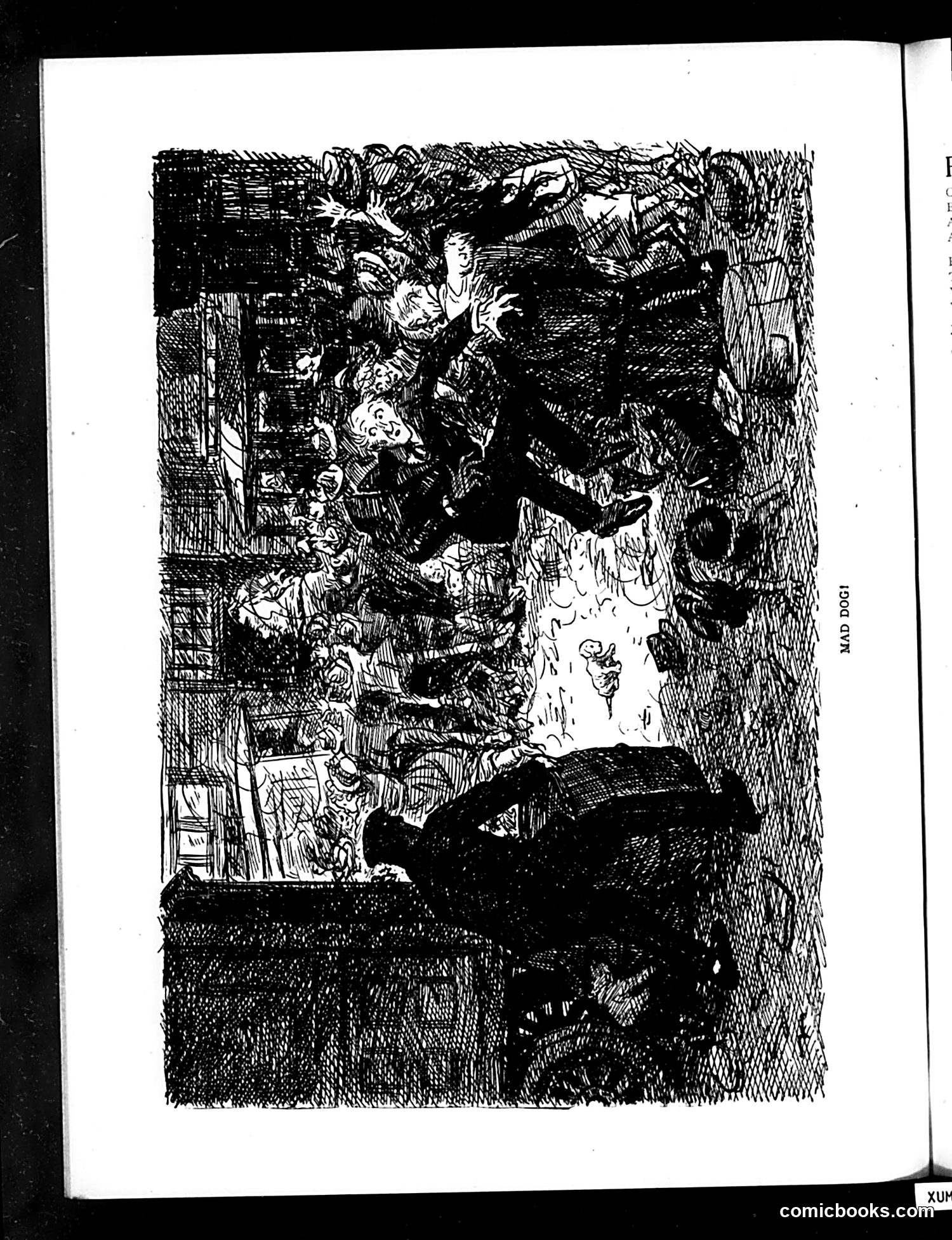
I can see this is a detailed etching or engraving-style illustration, but the OCR text provided is blank, making it difficult to identify specific political figures or references with certainty. The image appears to depict a chaotic interior scene with multiple figures in period clothing, possibly 18th or 19th century based on the artistic style. There's a central figure who seems to be the focus of activity, with numerous other characters surrounding them in what looks like animated, possibly confrontational interaction. Without the accompanying text or caption visible in this reproduction, I cannot reliably identify which specific political figures, events, or satirical points this cartoon addresses. To properly explain the satire to a modern reader, I would need the OCR text to be legible or the original caption to be visible.
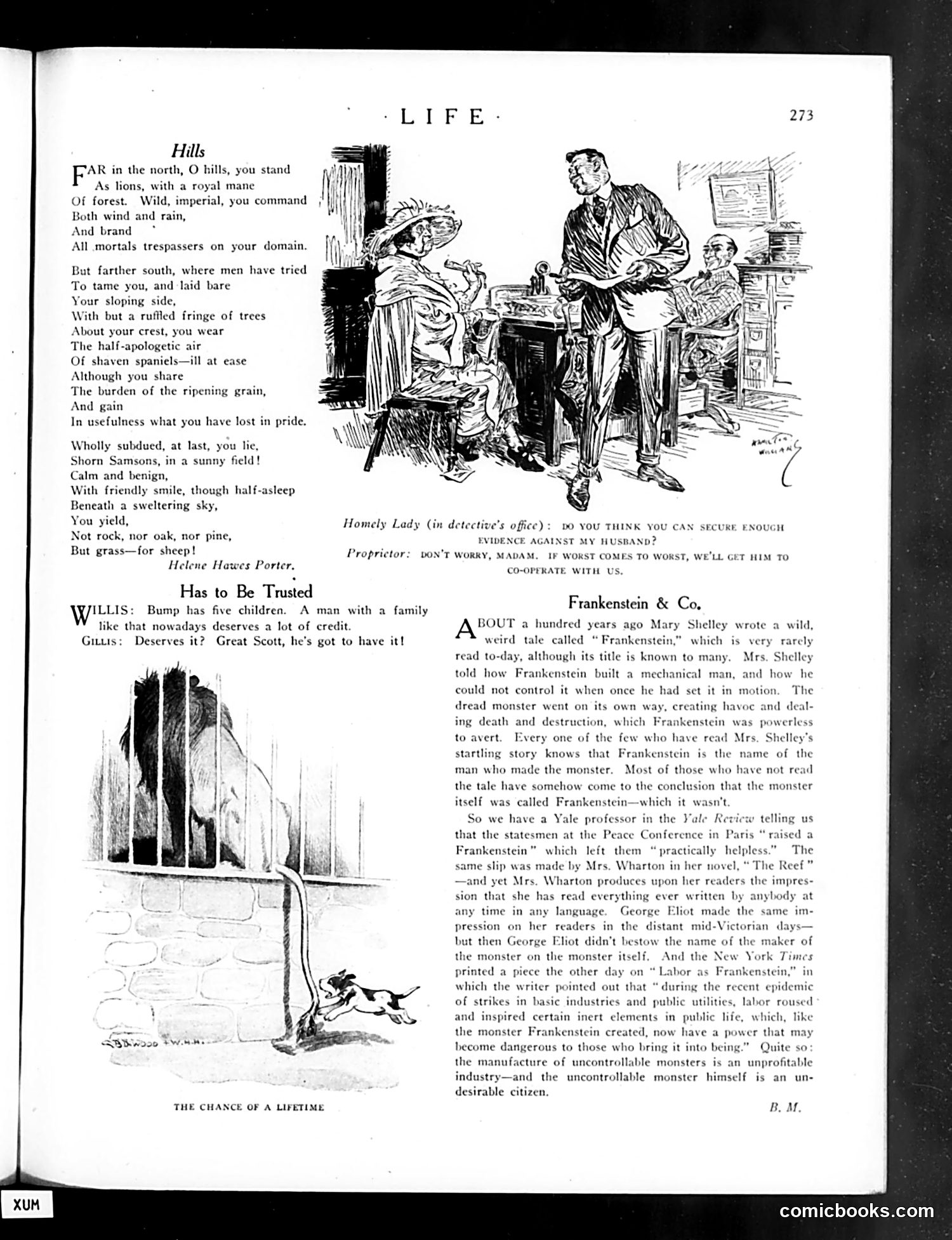
This page contains three distinct pieces: **"Hills" (poem)**: A romantic poem addressing hills, celebrating their wild, untamed nature in the north versus their domestication in the south. **"Has to Be Trusted" (cartoon dialogue)**: A brief comic exchange between Willis and Gillis about someone named Bumph who has five children. The joke appears to be that having a large family deserves credit—a commentary on either responsible parenthood or, less charitably, on overpopulation concerns of the era. **"Frankenstein & Co." (article)**: A literary essay discussing Mary Shelley's *Frankenstein*, noting how various writers have referenced or misinterpreted the novel. The author argues that Frankenstein became cultural shorthand for the monster itself, and discusses contemporary anxieties about uncontrollable technological or industrial forces creating societal danger. The "Chance of a Lifetime" sketch (lower left) appears to show someone with a noose, though its specific meaning is unclear from context alone.
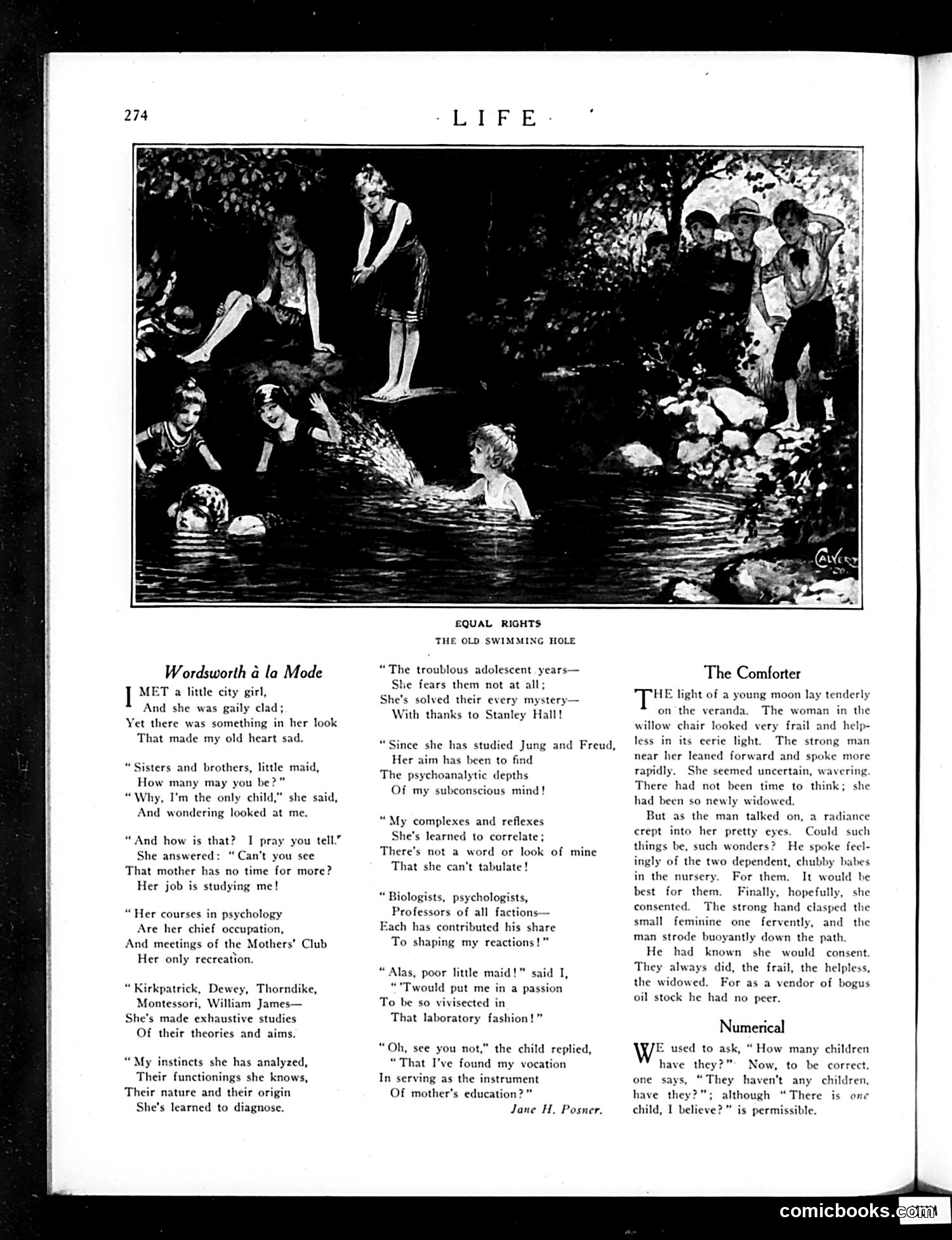
This page presents three poems satirizing early 20th-century women's changing social roles. The illustration shows mixed-gender bathing—a scenario that would have scandalized Victorian society. "Wordsworth à la Mode" mocks an educated woman obsessed with psychology and literary theory (mentioning Jung and Freud), suggesting intellectual pursuits make her unattractive to suitors. "The Comforter" depicts a widowed woman finding comfort from a male visitor, hinting at impropriety or dependence on male companionship. "Numerical" jokes about women claiming to have no children, contrasting modern family-planning attitudes with traditional expectations. The collective title "Equal Rights" suggests ironic commentary: while women gain educational and social freedoms, the poems question whether these changes solve romantic or domestic dilemmas, or create new social awkwardness.
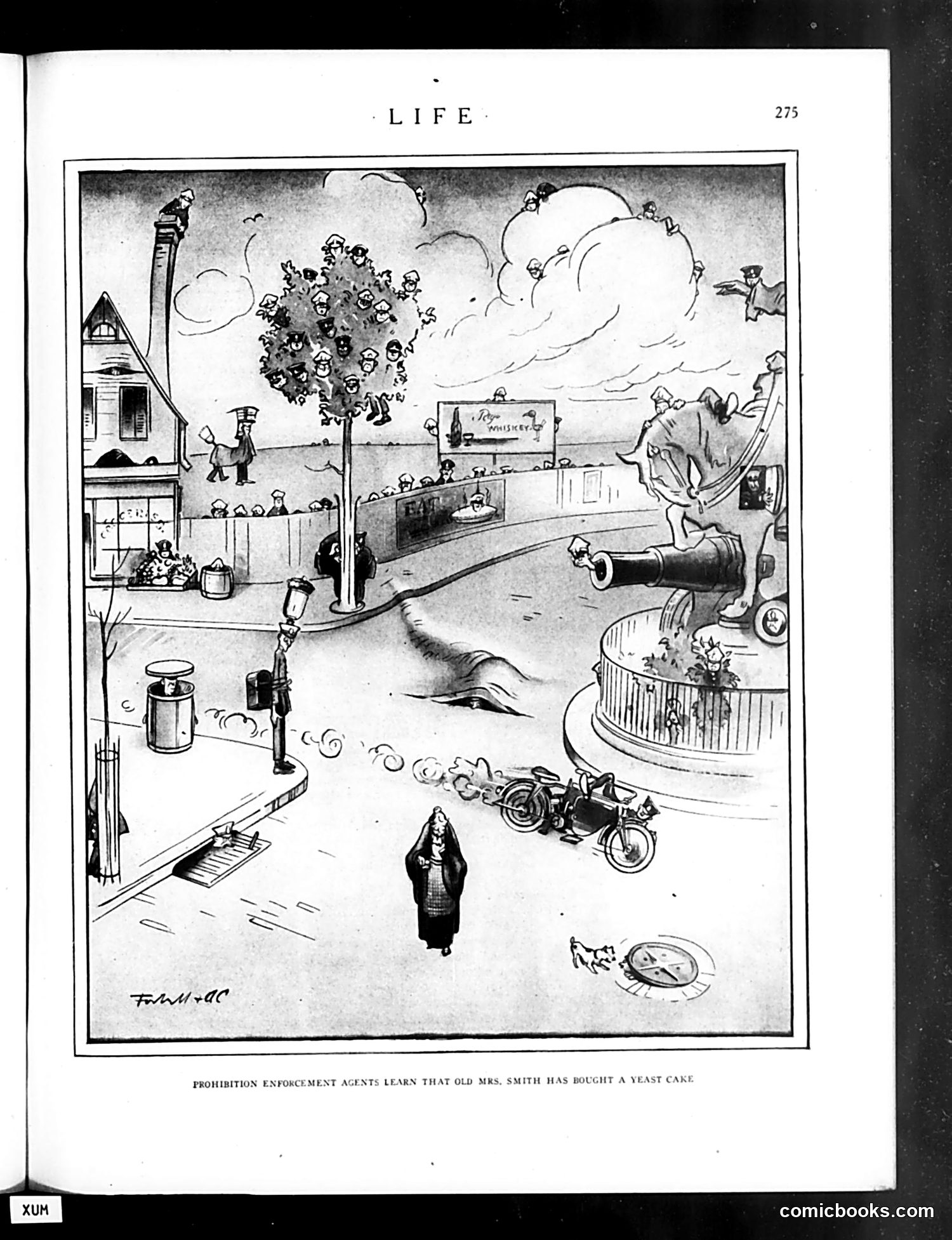
This cartoon satirizes Prohibition enforcement during the 1920s-1930s alcohol ban in America. The caption reads: "PROHIBITION ENFORCEMENT AGENTS LEARN THAT OLD MRS. SMITH HAS BOUGHT A YEAST CAKE." The joke depicts a chaotic government overreaction: federal agents are mobilized with military equipment (cannons, motorcycles, searchlights) and formal procedures to investigate an elderly woman's innocent purchase of yeast—a common baking ingredient that could theoretically be used to ferment alcohol illegally. The satire mocks both the absurd scope of Prohibition enforcement and the paranoia it created, where ordinary household items became suspects. The exaggerated militaristic response to Mrs. Smith's mundane purchase ridicules the government's heavy-handed, disproportionate tactics used to combat illicit alcohol production.
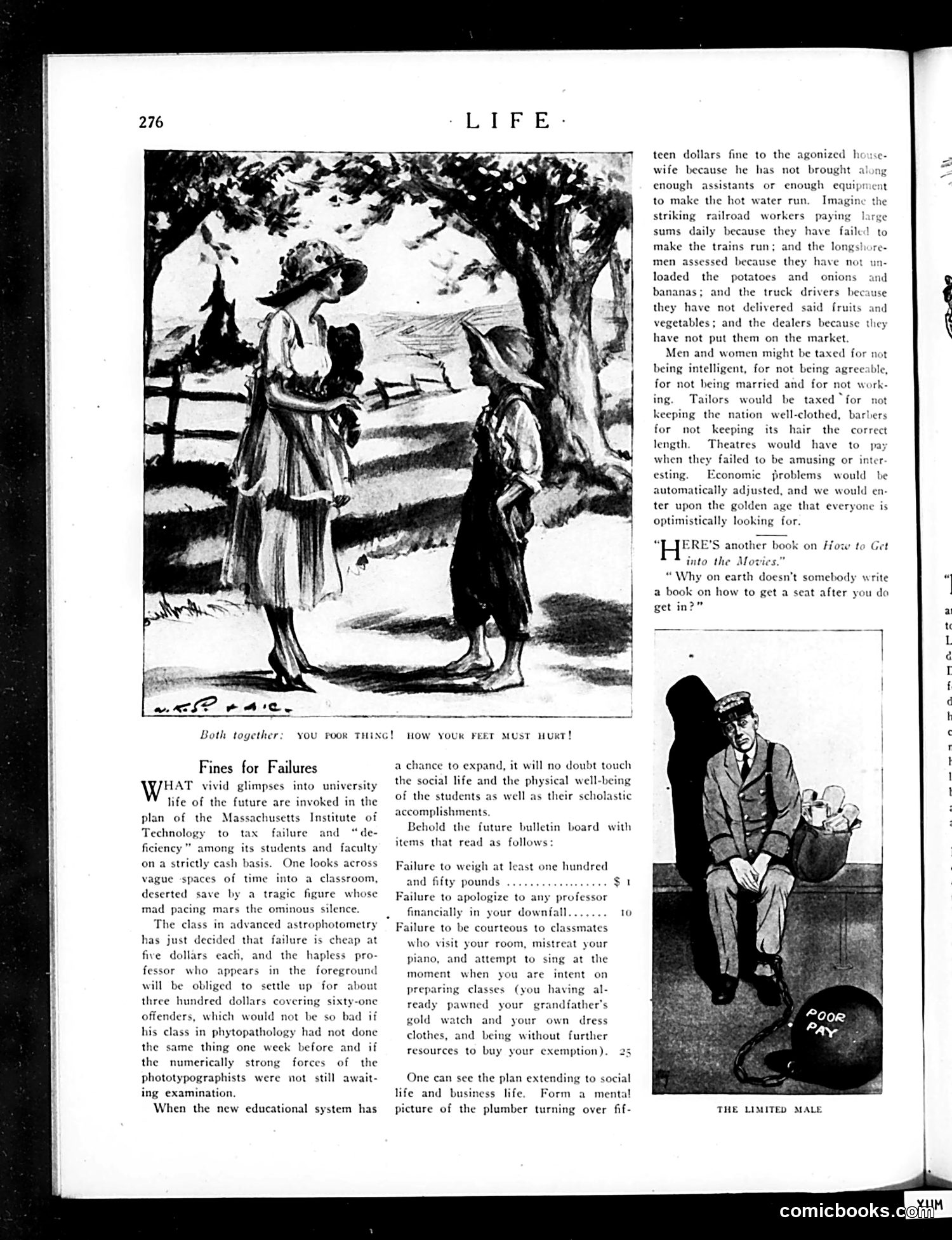
This page satirizes the Massachusetts Institute of Technology's proposal to fine students for academic and social failures. The main article describes a hypothetical system where students would be charged dollars for various infractions: weighing under 150 pounds, failing to apologize to professors, being discourteous to classmates, or singing badly. The cartoon at top shows two figures (likely a woman and child) in conversation, captioned "Both together: you poor thing! how your feet must hurt!" — suggesting the absurdity of the fining scheme affecting ordinary people's daily struggles. The illustration labeled "The Limited Male" depicts a man labeled "Poor Pay," satirizing how financial penalties would burden struggling students or workers. The satire mocks the disconnect between the university's proposed system and real economic hardship.
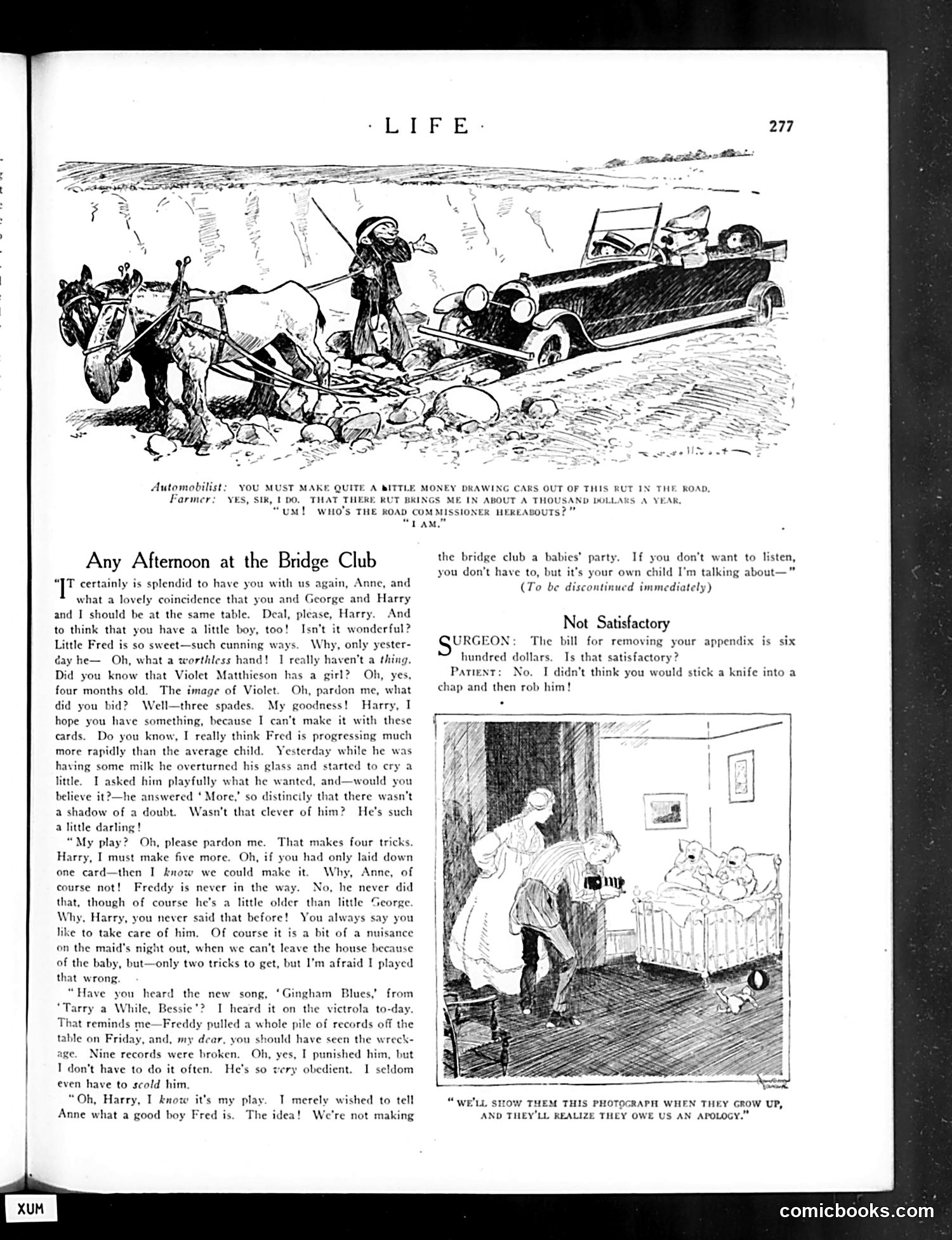
**Top cartoon**: An automobilist asks a farmer why he's making money from pulling cars out of a rut. The farmer reveals he earns about $1,000 yearly from this work—suggesting he deliberately maintains the rut to guarantee business. The joke satirizes rural corruption and poor road maintenance, with an implied jab at the road commissioner's negligence or complicity. **"Any Afternoon at the Bridge Club"**: Mocks upper-class women's social gatherings, particularly their obsessive discussion of their children while playing cards. The unnamed speaker dominates conversation, constantly interrupting the game to brag about her son Fred's minor accomplishments, oblivious to her friends' annoyance. The satire targets maternal self-absorption and frivolous socializing. **"Not Satisfactory"**: A brief joke about a patient resisting a surgeon's $600 appendix removal bill, comparing it to robbery. The humor lies in the patient's blunt accusation that the operation itself is a form of theft.
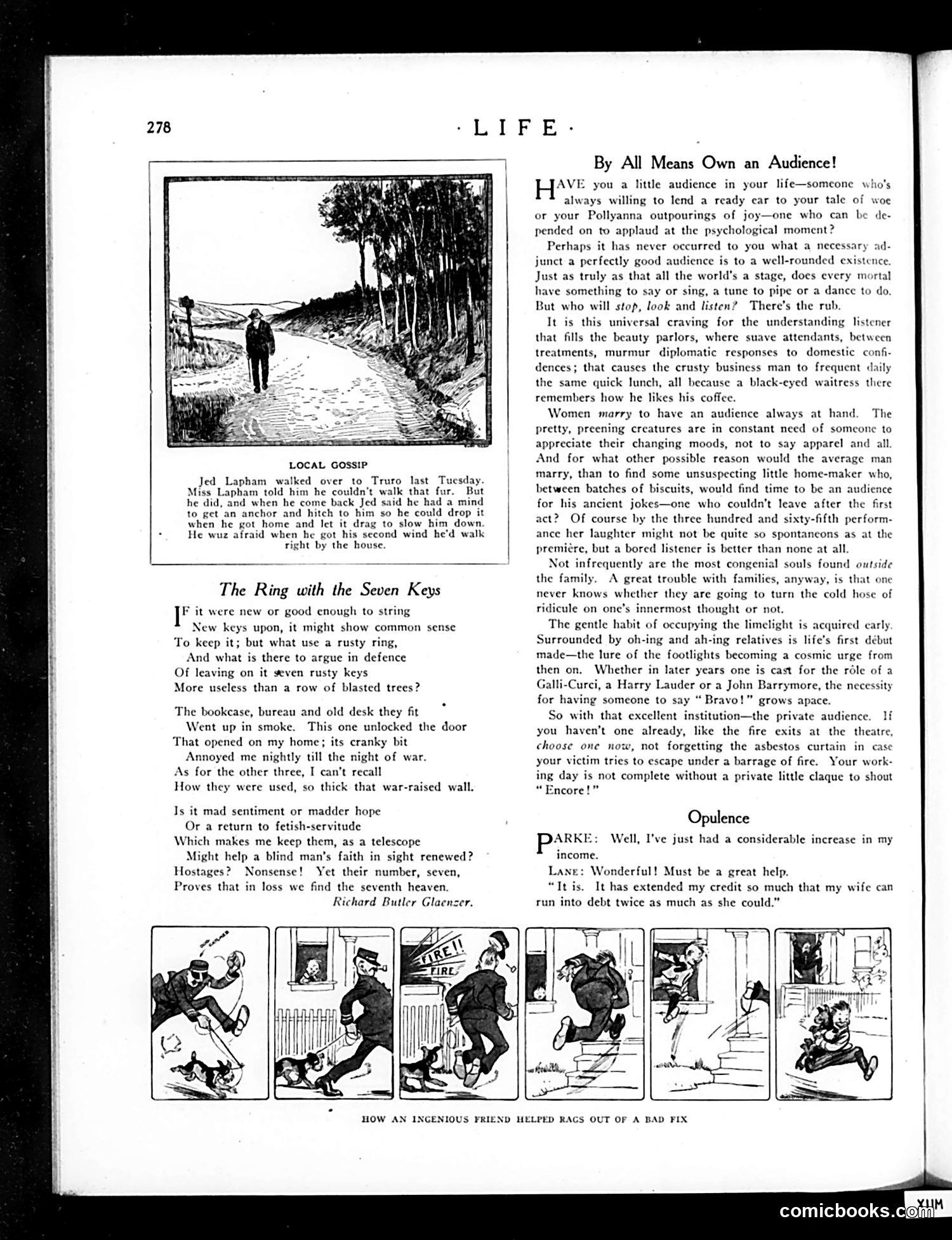
This page satirizes the universal human need for validation and attention. The main essay argues that people—especially women—marry primarily to secure a captive audience for their stories, jokes, and moods. It mocks how businessmen frequent the same lunch counter because a waitress remembers their coffee preference, and how beauty parlor attendants profit by listening to clients' confidences. The satire suggests that having a "private audience" (an attentive listener) has become essential to modern life, comparing it to fire exits in theaters—a necessary escape route. The tone is gently cynical about human nature and relationships, implying that love and companionship are largely transactional arrangements for ego-stroking rather than genuine connection. The comic strip below (captioned "How an Ingenious Friend Helped Rags Out of a Bad Fix") appears unrelated—a slapstick sequence about someone evading trouble.
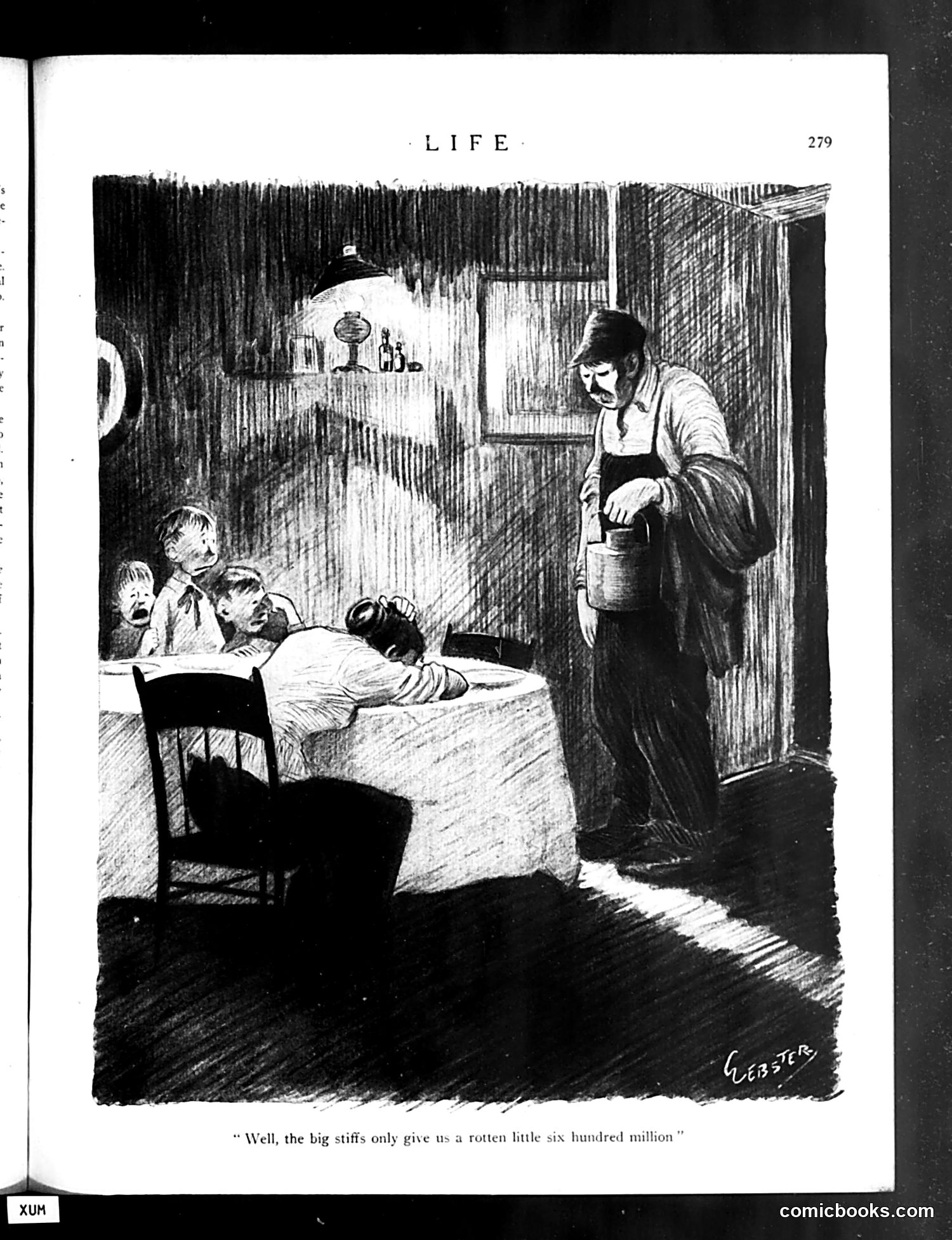
This is a single-panel cartoon satirizing wealth inequality and labor complaints. The scene depicts a working-class family in a modest bedroom—a woman tending to children in bed while a man (appearing to be the father) enters holding a bucket or container, likely returning from work. The caption presents his complaint: "the big stiffs only give us a rotten little six hundred million"—an ironic statement suggesting even massive sums feel inadequate to workers. The satire targets the disconnect between enormous corporate/wealth figures and their perception as insufficient by laborers, likely reflecting Depression-era anxieties about wage disputes, corporate greed, or the disparity between rich industrialists and struggling working families. The cartoonist (signed "Webster") mocks both the absurdity of the complaint and the broader economic inequality of the era.
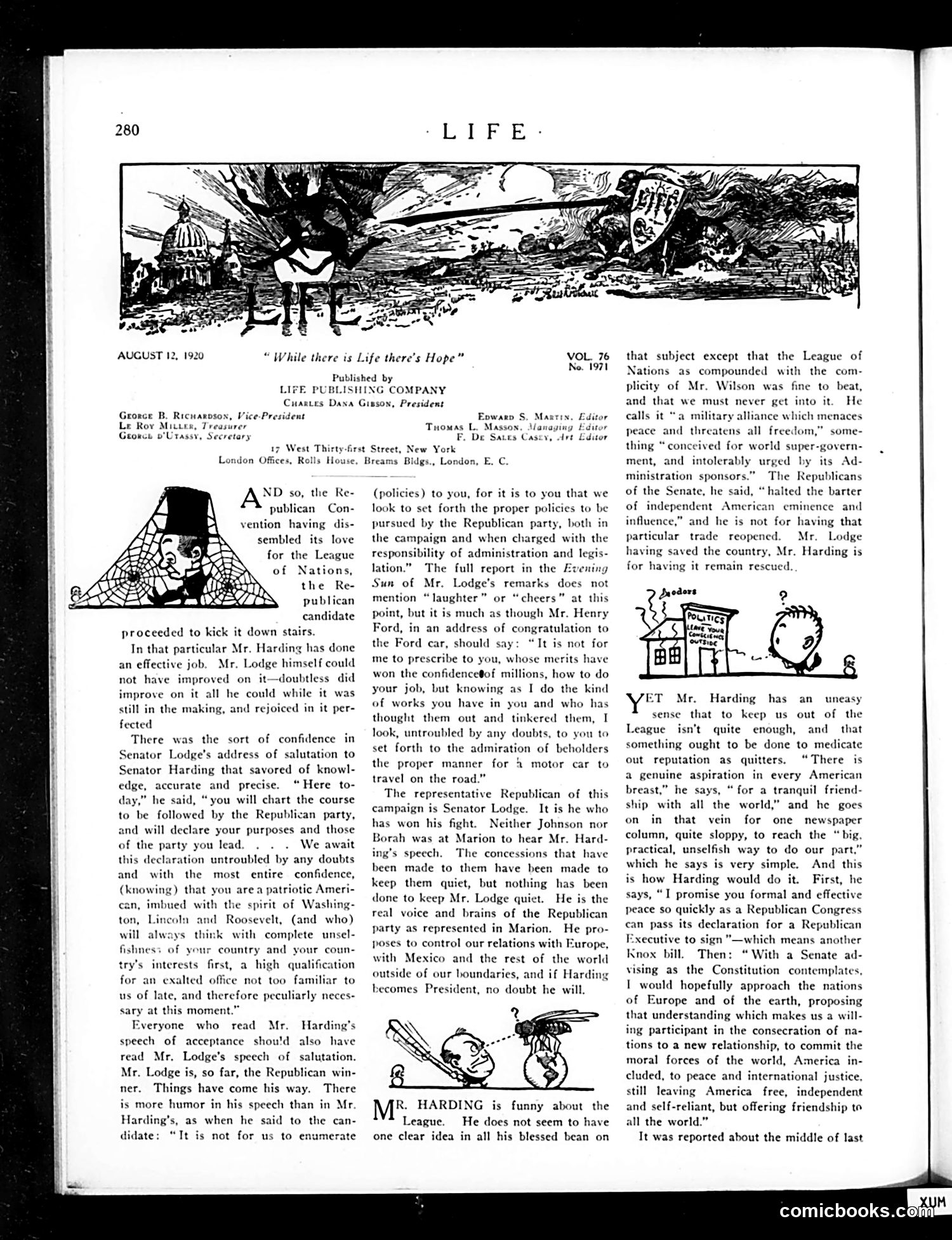
This page satirizes the 1920 Republican Convention and presidential nominee Warren G. Harding's position on the League of Nations. **The Figures:** - Senator Henry Cabot Lodge (identified in text) — the real power broker - Warren G. Harding — the Republican nominee, depicted as manipulated - President Woodrow Wilson — implicit opponent (his League proposal) **The Satire's Point:** The cartoonist mocks Harding as a figurehead. Lodge's ostensibly deferential speech to Harding actually reveals Lodge's control—like a car manufacturer pretending to defer to an employee about how cars work. Lodge orchestrated Harding's anti-League stance by keeping him "quiet," making the nominee merely his mouthpiece. The humor lies in the transparent irony: Lodge publicly claims not to dictate policy while clearly doing exactly that. Harding appears confused about League specifics; he opposes it mainly because it's Wilson's creation. The magazine suggests Lodge, not Harding, will actually direct foreign policy if the Republicans win. This was prescient—Lodge later dominated Harding's actual presidency on foreign affairs.
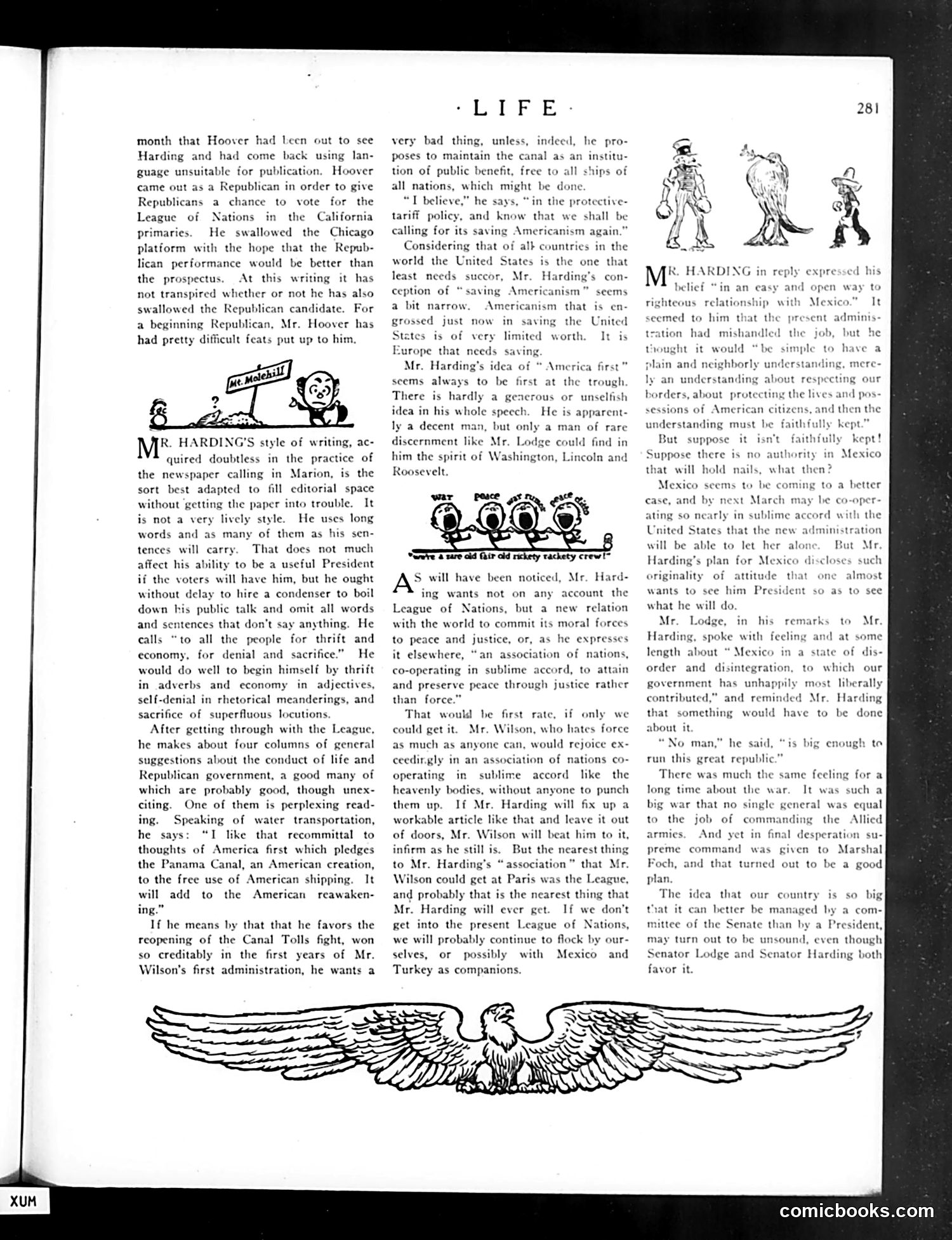
This page critiques President Warren G. Harding's public speeches and political positions circa 1921. **Key Figures:** - **Harding**: The new Republican president, criticized for verbose, wordy writing style inherited from his Marion newspaper days - **Hoover**: Recently became Republican to support League of Nations in California primaries - **Lodge** and **Wilson**: Referenced regarding foreign policy debates **Main Satire:** The cartoons mock Harding's "America First" rhetoric as narrow and hypocritical. The text argues his concept of "saving Americanism" is self-serving, while his vague proposals about international cooperation lack substance. The author particularly attacks his position on the Panama Canal—suggesting reopening tolls debates would undermine Wilson's achievements. **Political Context:** The piece satirizes Harding's tendency toward flowery, noncommittal language that fills space without clarity. It criticizes his isolationist posturing while his administration simultaneously courts international agreements, portraying him as intellectually inconsistent and rhetorically bloated.
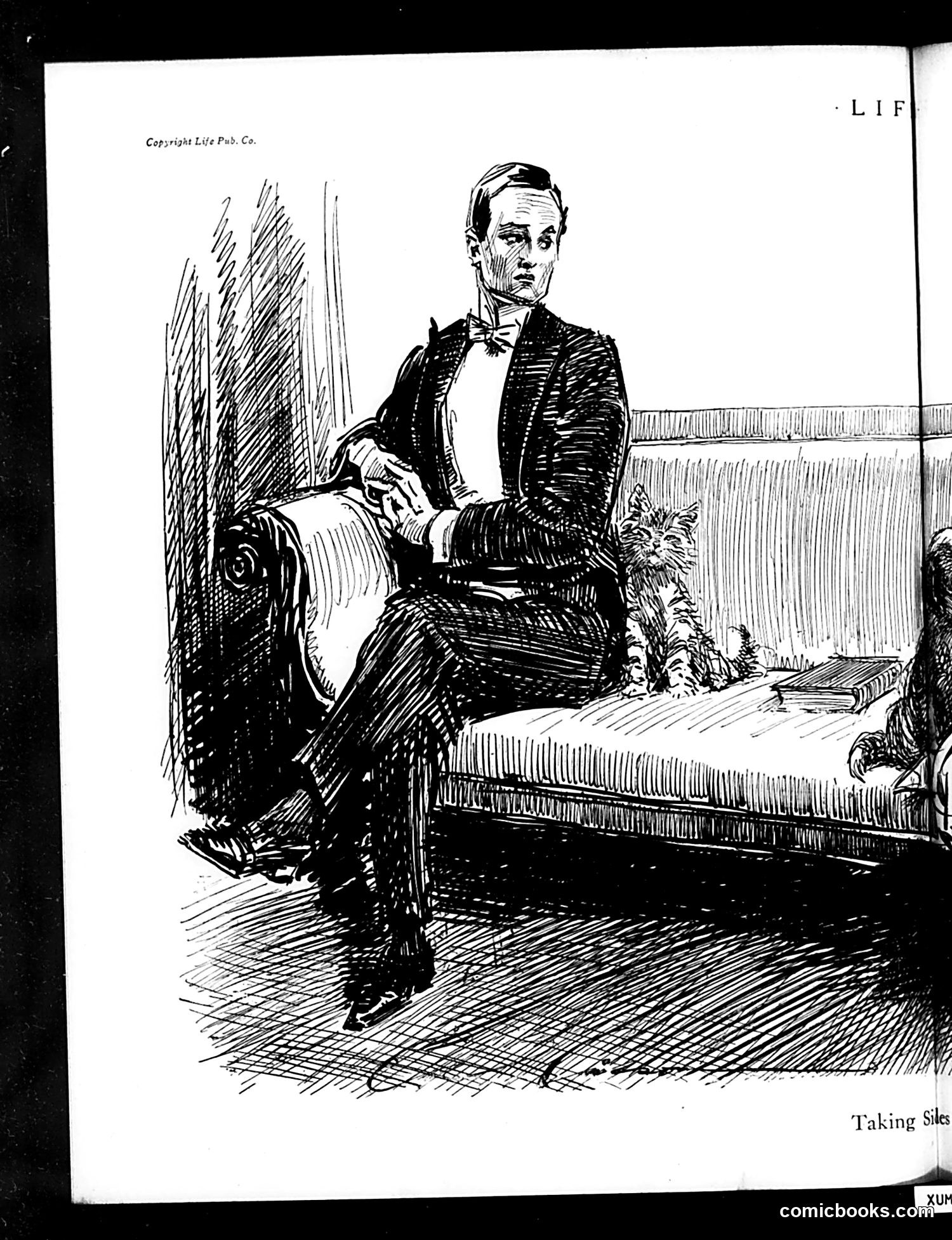
This pen-and-ink illustration depicts a well-dressed man in formal evening attire (tuxedo and bow tie) seated on a couch in what appears to be an elegant interior. The caption reads "Taking Sides." The cartoon likely satirizes upper-class social or political neutrality during a contentious period. The man's composed, detached posture while seated suggests he is remaining aloof from some conflict or debate—"taking sides" ironically by refusing to choose. Without additional context about Life magazine's publication date or contemporary events, the specific political reference remains unclear. However, the satire targets privileged individuals who maintain studied indifference toward important issues while inhabiting spaces of comfort and refinement. The formal setting emphasizes the contrast between this man's insulated world and whatever urgent matter surrounds him.
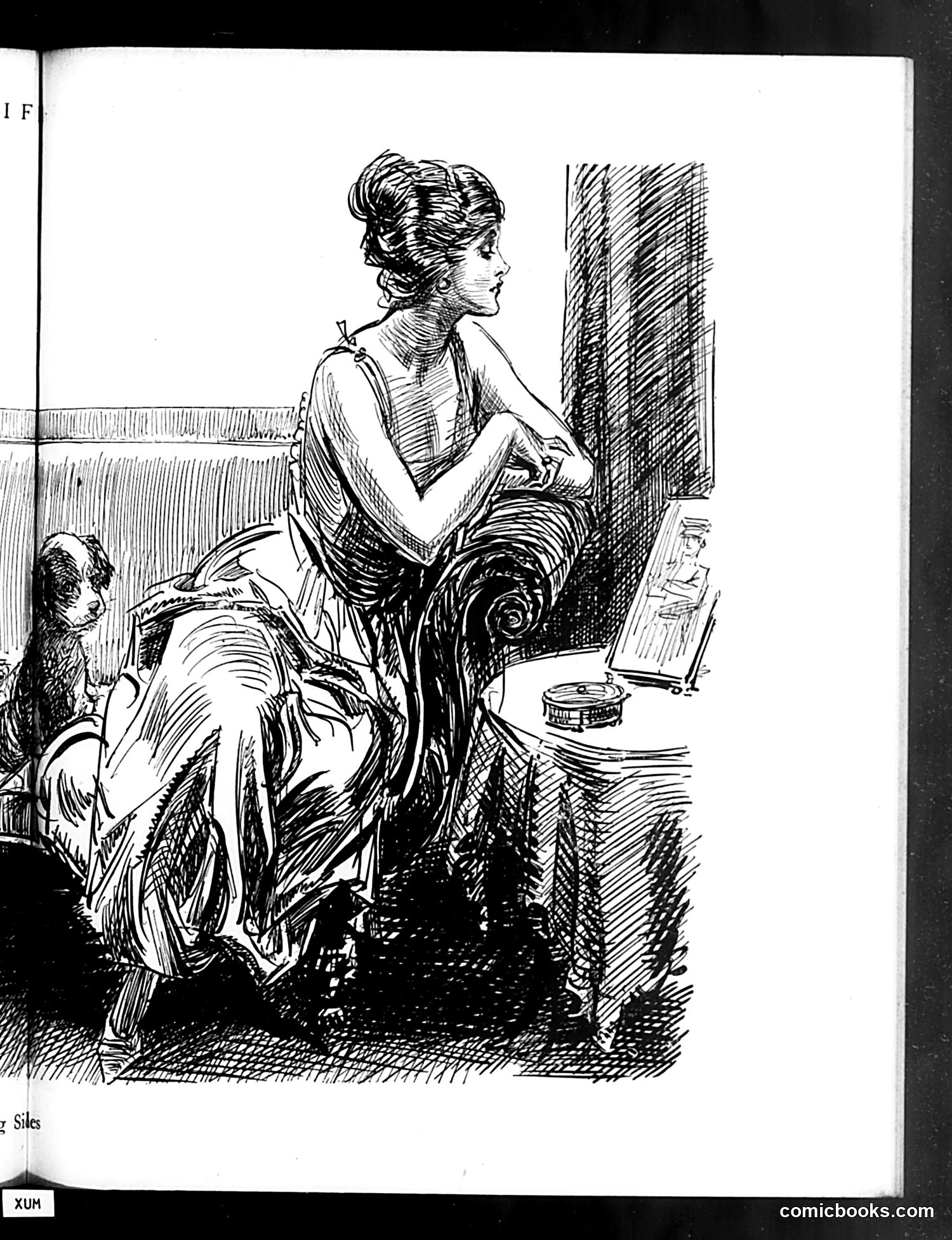
This is a pen-and-ink illustration showing a well-dressed woman seated in an interior setting, looking pensively to the side. She appears to be in a domestic or office space, with furnishings visible and what looks like papers or documents on a nearby surface. A small dog is visible in the lower left corner. The illustration style is characteristic of early 20th-century satirical magazine work, with detailed cross-hatching and line work. However, without additional visible text on the page itself beyond the "comicbooks.com" watermark, I cannot definitively identify the specific political or social satire being referenced, who the figure represents, or what contemporary issue this cartoon addresses. The page appears incomplete or the relevant caption/article text is not visible in this image.
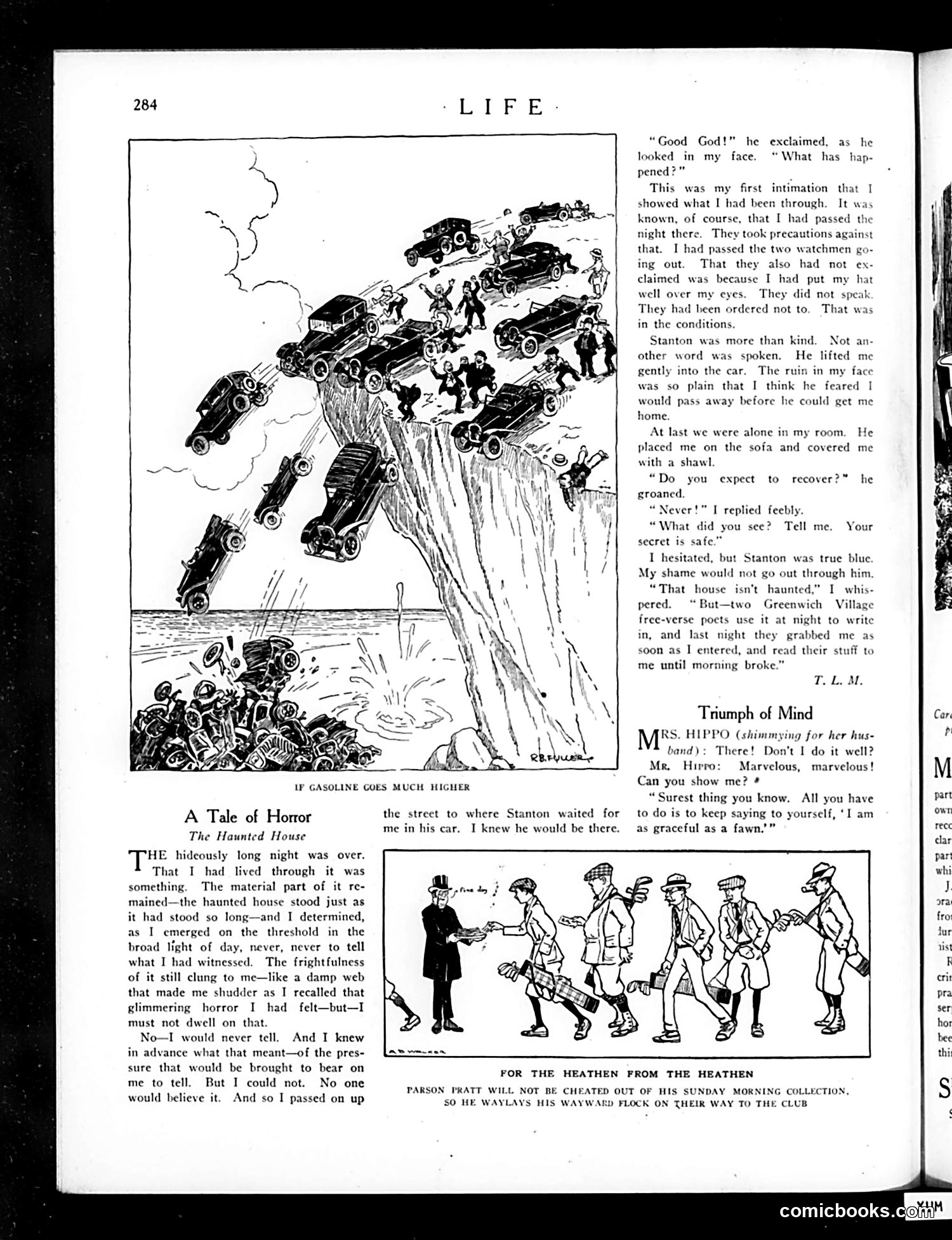
**"If Gasoline Goes Much Higher"** (top cartoon): Shows cars flying off a cliff into water and wreckage—satirizing the anxiety about rising gas prices. The joke: if fuel costs keep climbing, people will literally abandon their vehicles. **"A Tale of Horror"**: A humorous short story where the narrator spent a terrifying night in a "haunted house," only to reveal the real horror was free-verse poets reading their experimental poetry to him until dawn. This mocks the avant-garde poetry movement of the era as genuinely unbearable—worse than supernatural terror. **"Triumph of Mind"**: Mrs. Hippo dances by repeating positive self-talk ("I am graceful as a fawn"), suggesting early pop-psychology about willpower overcoming reality. **"For the Heathen"**: A parson intercepts churchgoers heading to a club on Sunday morning to collect tithes before they spend money elsewhere—satirizing clergy financial desperation. All reflect 1920s-era anxieties and social satire typical of Life magazine's humor.
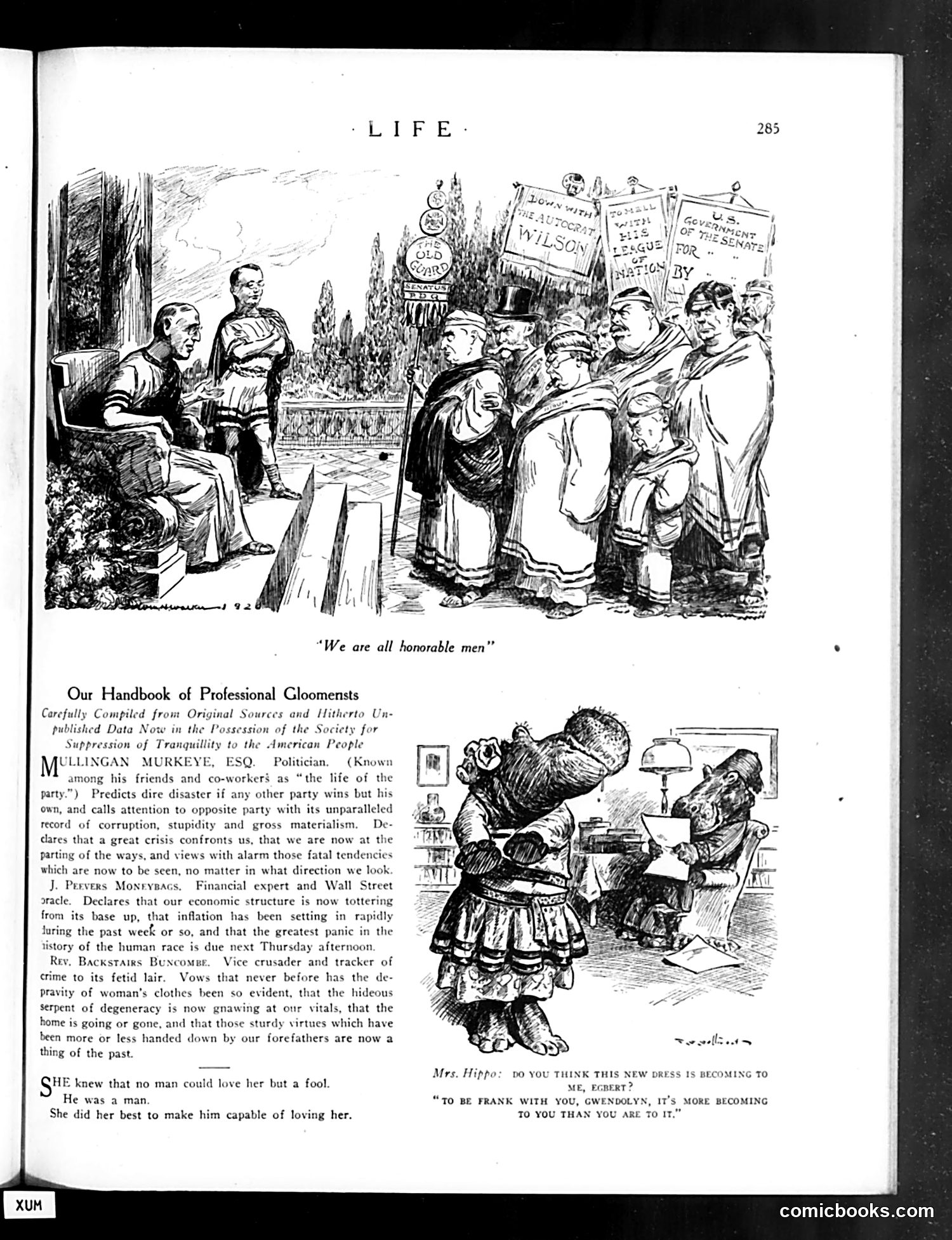
This satirical piece mocks predictable political and social doomsayers of the era. The top cartoon shows various stereotypical figures gathered around signs—appearing to represent political activists or protesters making exaggerated claims. The text below catalogs archetypal "gloomsters": politicians who prophesy disaster if the opposing party wins; financial experts predicting imminent economic collapse; and moralistic crusaders lamenting societal degeneracy and declining family values. The satire lies in exposing these as formulaic, self-serving prophecies of doom repeated regardless of actual circumstances. The lower cartoon featuring "Mrs. Hippo" makes a gentler joke about brutal honesty in marriage—the husband's candid (if insulting) response to his wife's dress question. Overall, Life mocks the predictable alarmism and moral panic that various American figures deployed to frighten the public, suggesting their warnings were performative rather than genuine.
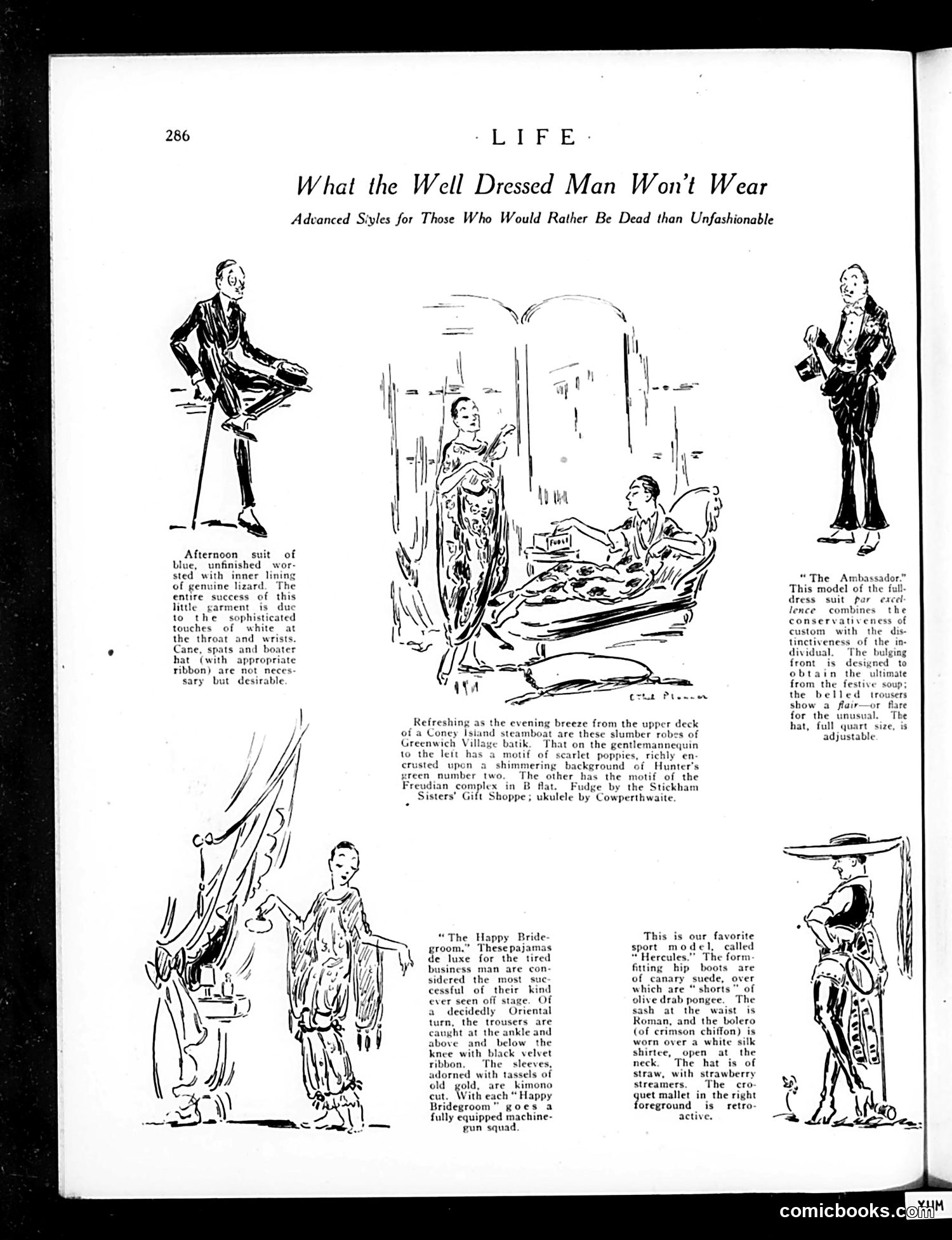
This page satirizes men's fashion absurdity through mock-earnest descriptions of ridiculous garments. The subtitle—"Advanced Styles for Those Who Would Rather Be Dead than Unfashionable"—establishes the joke: exaggerated compliance with fashion trends. The illustrated styles parody exotic and impractical fashions marketed to wealthy men, including ornate robes with Freudian references, pajamas styled as "Happy Bridegroom" costumes with machine guns, and sporting outfits with "shorts" of olive drab pongee. The satire targets 1920s fashion culture's absurdity: designers presenting impractical, ostentatious clothing with pretentious descriptions. By describing these obviously unwearable garments as sophisticated choices, the magazine mocks both fashion designers' overreach and fashionable men's willingness to adopt whatever is deemed trendy—even unto death ("Rather Be Dead").
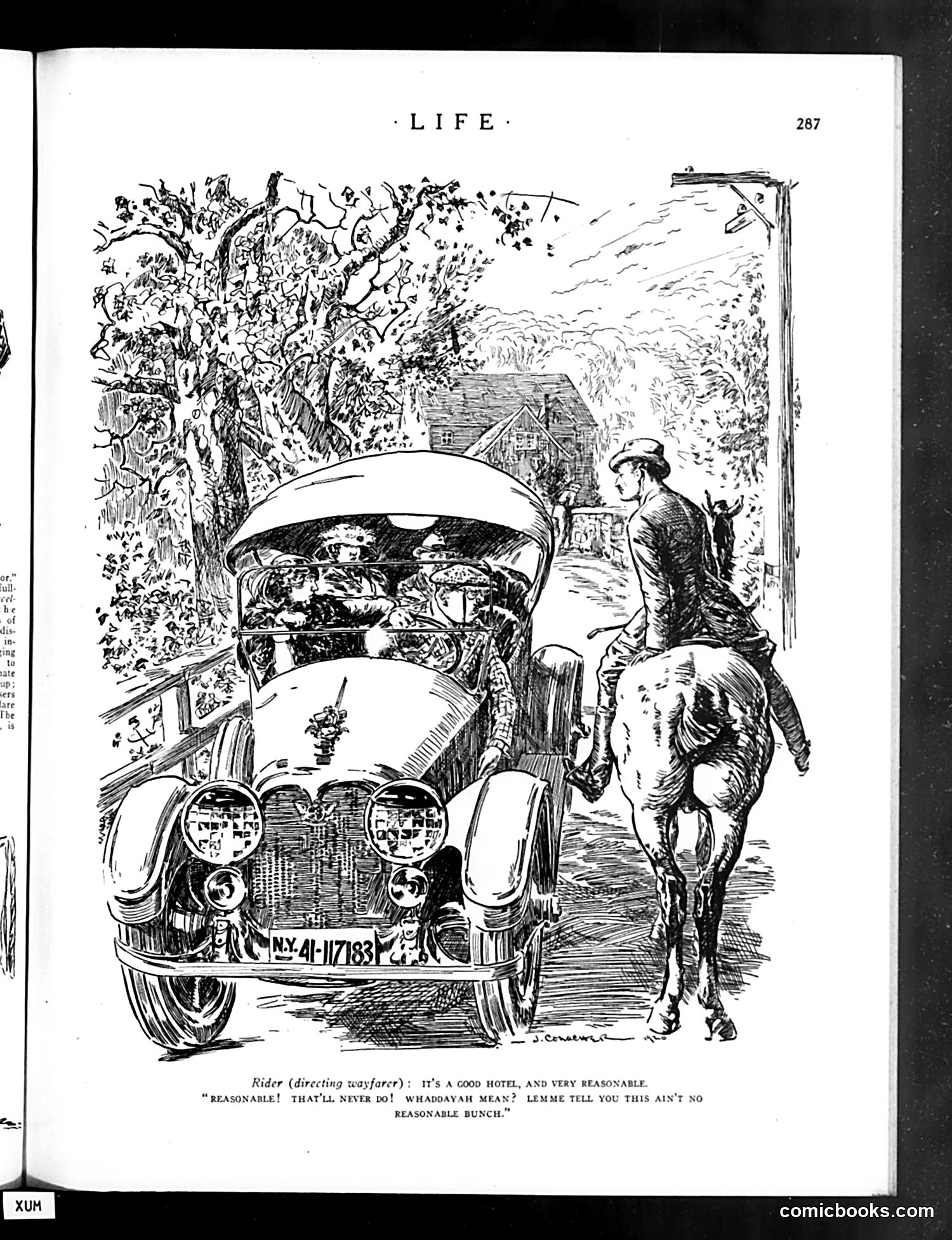
This is a humorous cartoon about American attitudes toward pricing and value. A mounted rider (appearing to be a wayfarer or traveler) directs someone to a hotel, calling it "good" and "very reasonable." The pedestrian responds with mock outrage, essentially saying: "Reasonable prices? That won't work! This isn't a reasonable crowd." The joke satirizes American consumer culture and expectations—suggesting that people *expect* and even *prefer* paying inflated prices, viewing "reasonable" or fair pricing as suspicious or inadequate. It's commentary on the post-war economic boom mentality where extravagance and spending became markers of success and desirability, and thrift seemed un-American. The cartoon pokes fun at this inverted value system through exaggeration and irony.
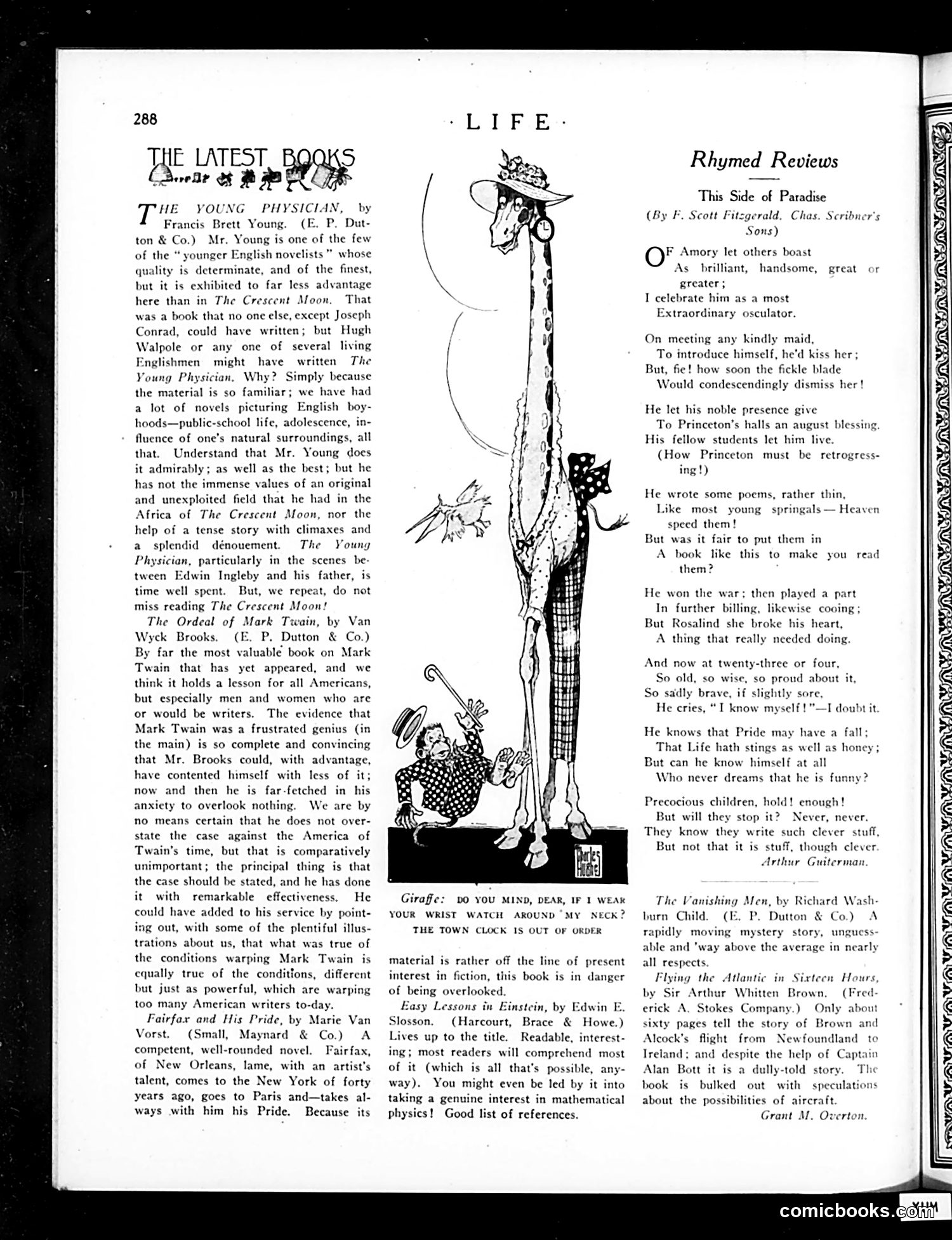
This page is primarily a **book review section** with one cartoon. The main cartoon shows a tall figure (appearing to be a town clock or lamppost) with a small person asking to wear their wristwatch around their neck because "the town clock is out of order." The joke is a **visual pun on timekeeping**: the person proposes using a wristwatch as a substitute public timepiece—an absurdly inadequate solution to a broken town clock. It satirizes either poor civic maintenance or people's tendency to propose ridiculous workarounds for public problems. The page reviews several books, including Van Wyck Brooks's *The Ordeal of Mark Twain* (praised as valuable), F. Scott Fitzgerald's *This Side of Paradise* (humorously critiqued in rhyming verse for its protagonist's excessive kissing and thin poetry), and other contemporary works. The reviews reflect early 1920s literary interests and tastes.
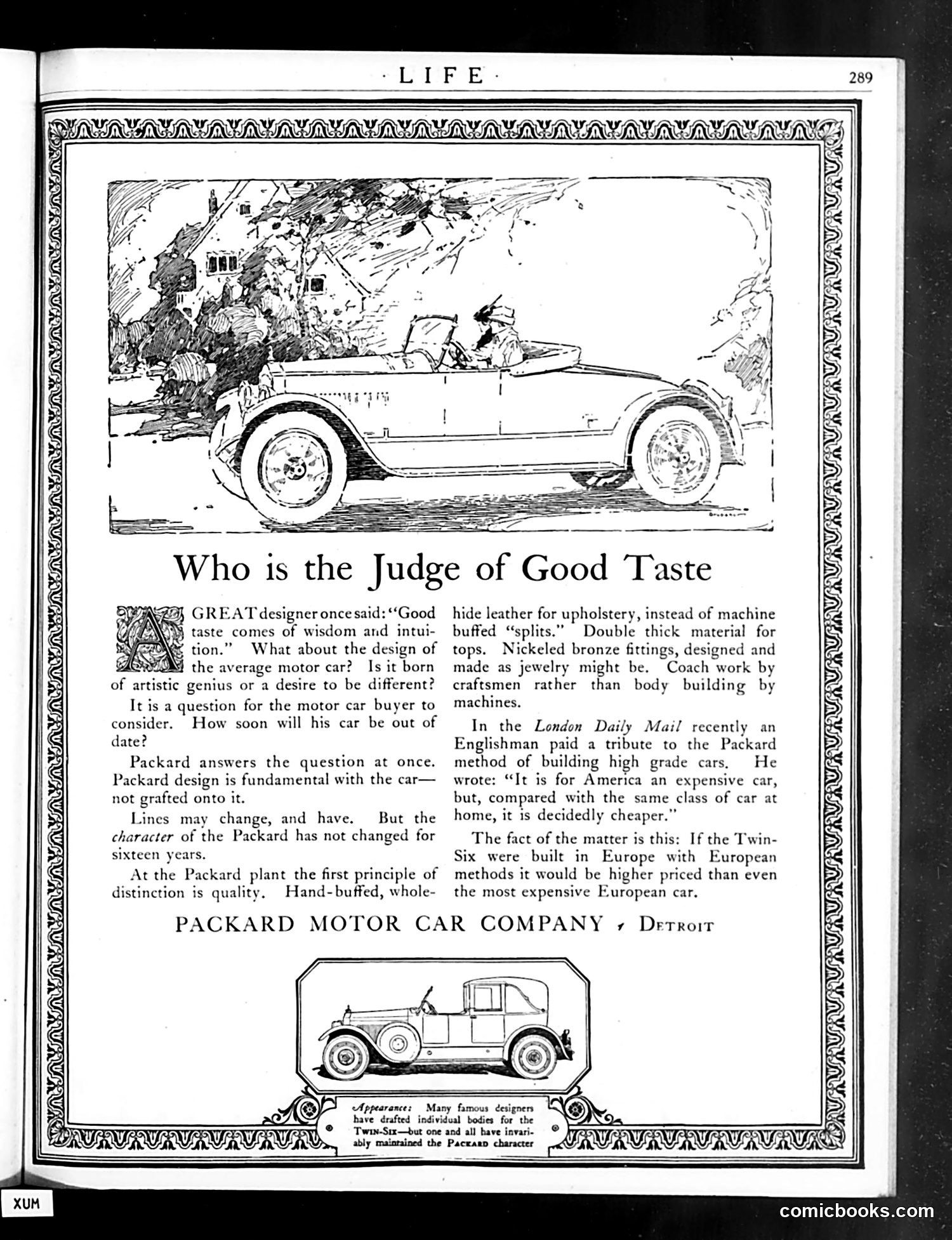
This is **not a cartoon or satire**—it's a **full-page automobile advertisement** for the Packard Motor Car Company of Detroit, disguised within *Life* magazine's editorial layout. The piece uses a rhetorical device: it frames itself as discussing "Who is the Judge of Good Taste?" in automobile design, appearing to debate whether cars reflect artistic genius or mere differentiation. However, this is entirely promotional. The text argues that Packard's design has remained fundamentally unchanged for sixteen years—a claim presented as evidence of superior, timeless quality rather than staleness. The argument emphasizes hand-craftsmanship (hand-buffed leather, nickel fittings, craftsmen rather than machines) and includes a testimonial from the *London Daily Mail* suggesting Packard offers better value than comparable European luxury cars. The illustrations show a Packard automobile from two angles. This is standard early-20th-century *Life* advertising: luxury car makers purchased prominent editorial-style space to position their products as markers of refined taste and judgment.
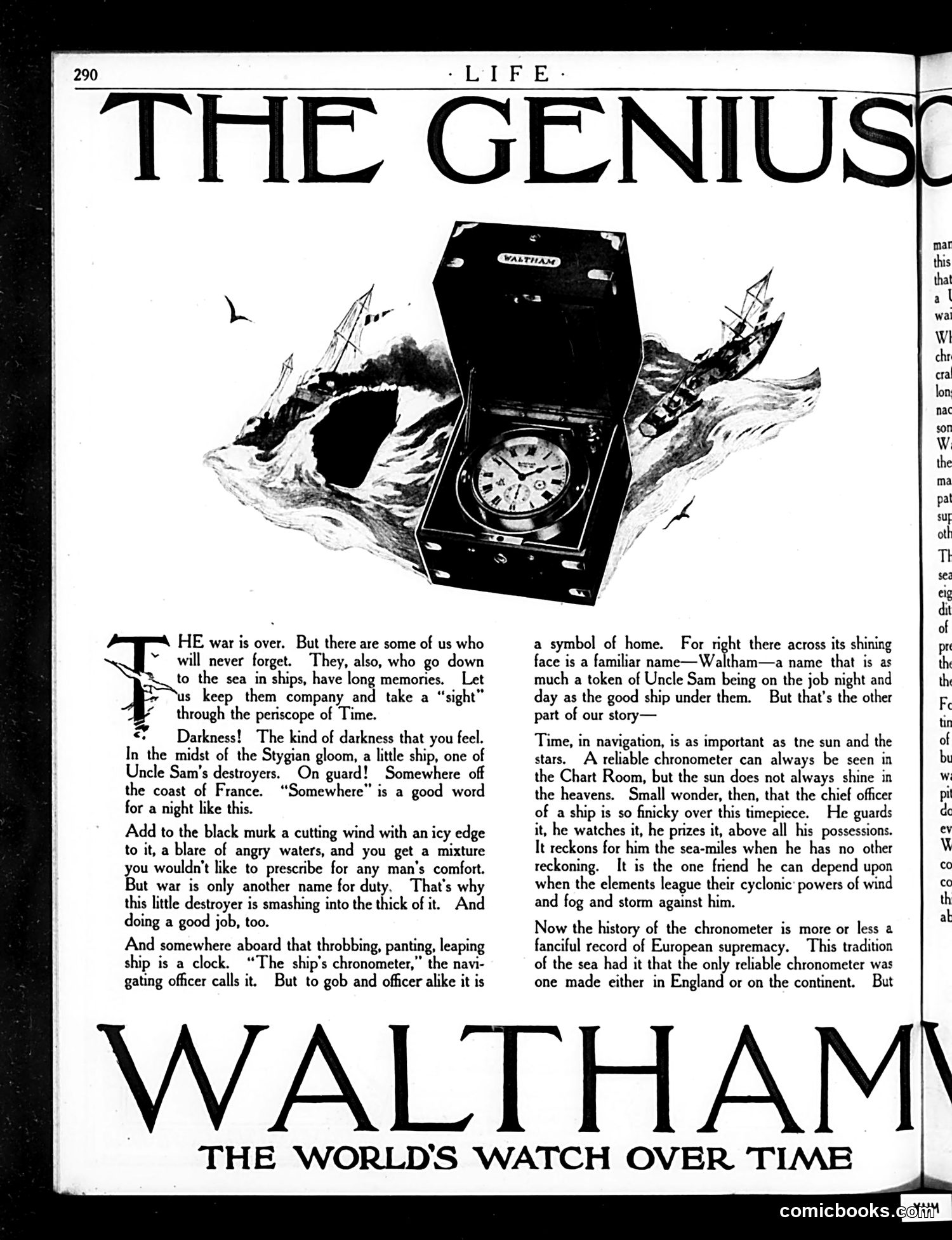
This is primarily a **World War I-era advertisement** disguised as patriotic narrative, not satire. The text celebrates a Waltham chronometer aboard a U.S. Navy destroyer operating off France. The "genius" referenced is the Waltham watch's reliability for naval navigation. The passage romanticizes wartime duty while establishing that American-made Waltham chronometers rival European (British and continental) instruments traditionally trusted at sea. The central image shows a Waltham pocket watch displayed against a dramatic illustration of naval vessels in rough waters, emphasizing the watch's importance to sailors' safety and America's military capability. The advertisement's genius is rhetorical: it wraps commercial messaging in patriotic language about American sailors protecting democracy, suggesting that choosing Waltham is itself a patriotic act. The piece conflates product quality with national honor during wartime.
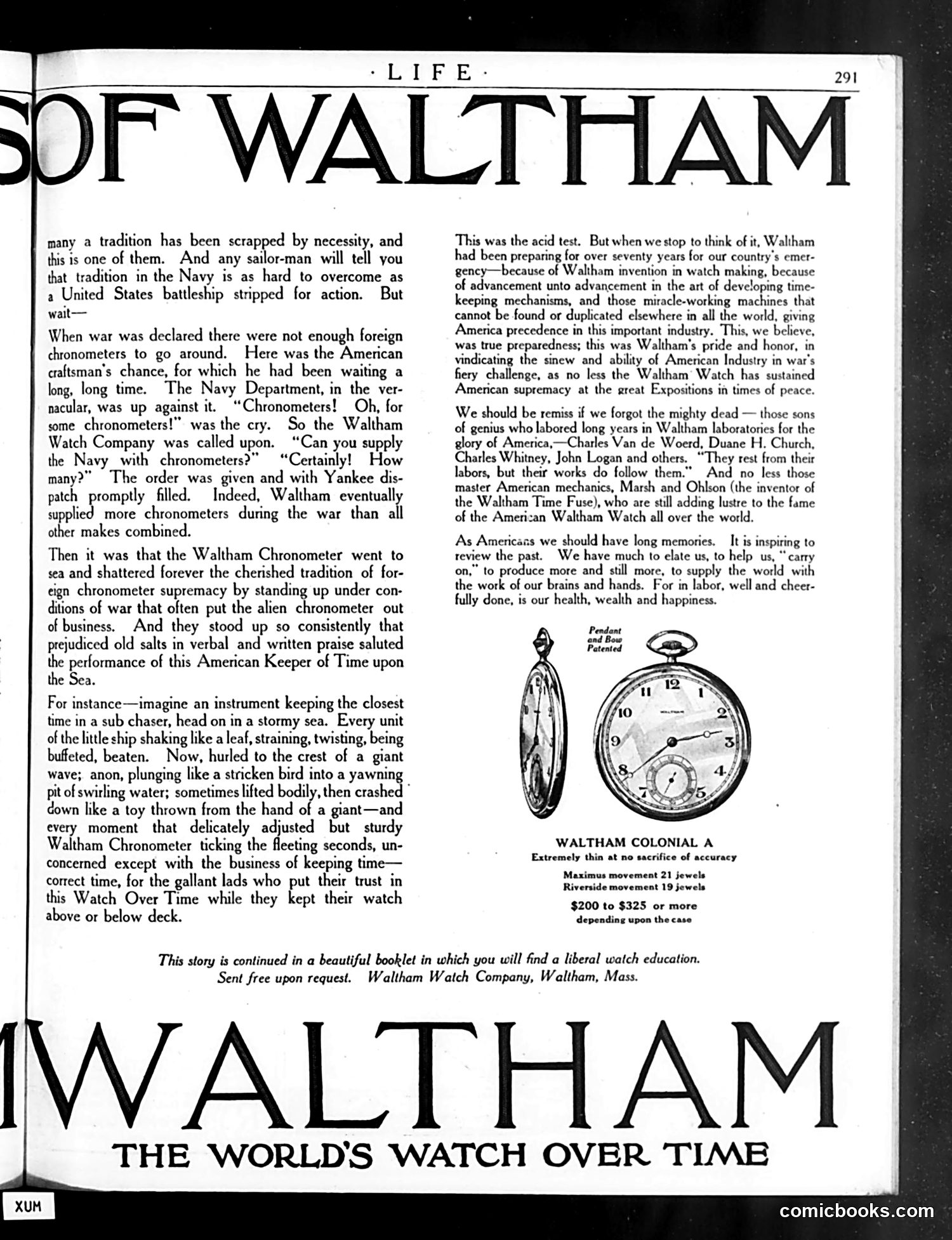
This is primarily a **corporate advertisement**, not satire or political cartoon. The page celebrates the Waltham Watch Company's patriotic contribution during World War I. **The narrative:** When the Navy needed chronometers for warships and submarines, foreign timepieces were unavailable. Waltham answered the call, ultimately supplying more chronometers than all competitors combined. The text emphasizes how American-made watches proved superior to foreign ones—even under extreme naval combat conditions (sub-chasers in storms, constant vibration). **The propaganda angle:** This is celebratory messaging about American industrial capability and superiority, positioning Waltham as a patriotic company that supported the war effort while advancing American manufacturing prestige. The article honors deceased Waltham inventors and current mechanics as contributors to national strength. **The product pitch:** A "Waltham Colonial A" watch is displayed, priced $200-$325, positioned as the result of 70+ years of American innovation. This represents post-WWI corporate advertising leveraging wartime service to build brand prestige.
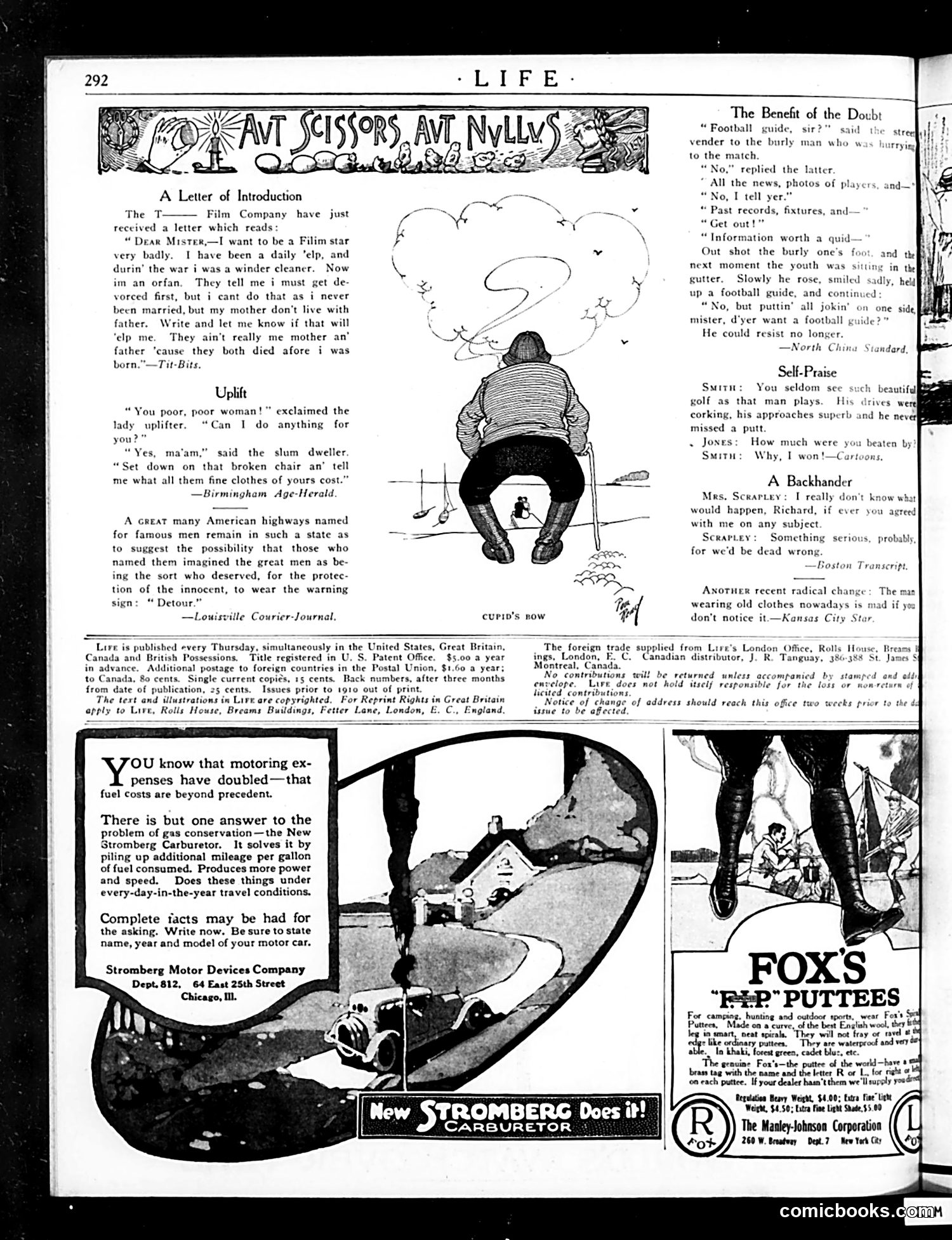
This page contains several brief humorous anecdotes and advertisements typical of Life's satirical format. **"Cupid's Row"** (main cartoon): Shows a man bent over, viewing a woman through his legs. The caption plays on the crude visual gag—the perspective creates an optical illusion. This reflects early 20th-century magazine humor's reliance on physical comedy. **"The Benefit of the Doubt"** and other short jokes mock working-class characters and their speech patterns ("d'yer," "puttin' all jokin'"), a common satirical target of the era. One anecdote depicts a laborer violently rejecting a football guide vendor, satirizing both commerce and masculine aggression. **Social commentary** appears in pieces like "A Backhander," suggesting marital discord, and references to "old clothes" becoming fashionable during economic hardship—likely post-WWI austerity. The page is dominated by advertisements for the **Stromberg Carburetor** and **Fox's Puttees** (military leg wraps), reflecting the magazine's commercial function. Overall, this represents Life's blend of class-based humor, slapstick, and period-specific social observations.
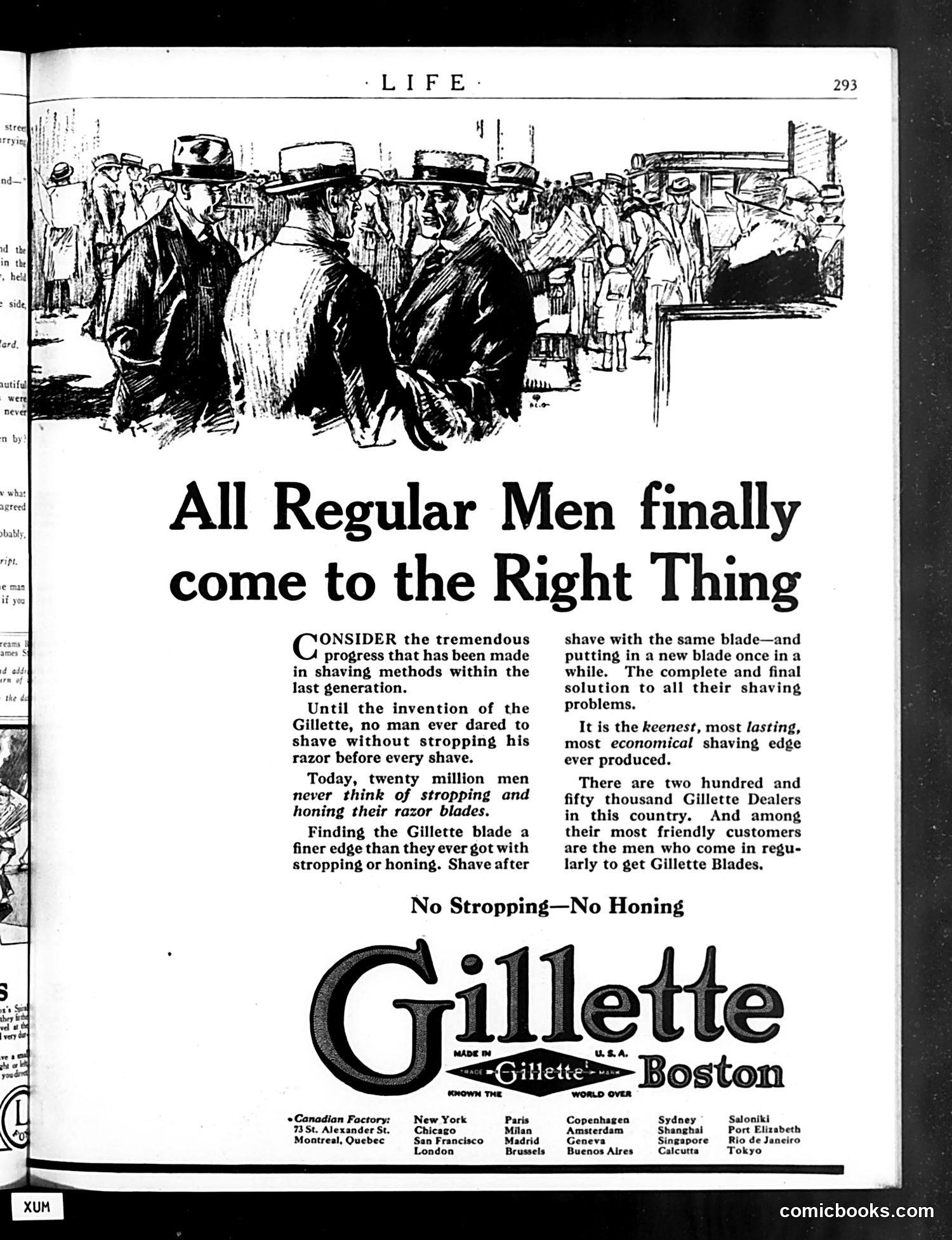
This is primarily a **product advertisement**, not political satire. The sketch at the top depicts a crowd of men, likely representing "regular men" adopting the new Gillette safety razor. **The "joke"** is a mild play on the headline's phrasing: "All Regular Men finally come to the Right Thing"—meaning they've adopted Gillette blades. The ad emphasizes the revolutionary convenience: previously, men needed to manually sharpen ("strop" and "hone") straight razors before each shave. Gillette's disposable blade eliminates this tedious maintenance. **Historical context**: This represents early 20th-century advertising celebrating modern convenience and efficiency—themes that resonated with consumers tired of labor-intensive grooming rituals. The extensive international dealer list indicates Gillette's global market dominance. The page contains no political commentary or social satire—it's straightforward marketing dressed in Life magazine's characteristic visual style.
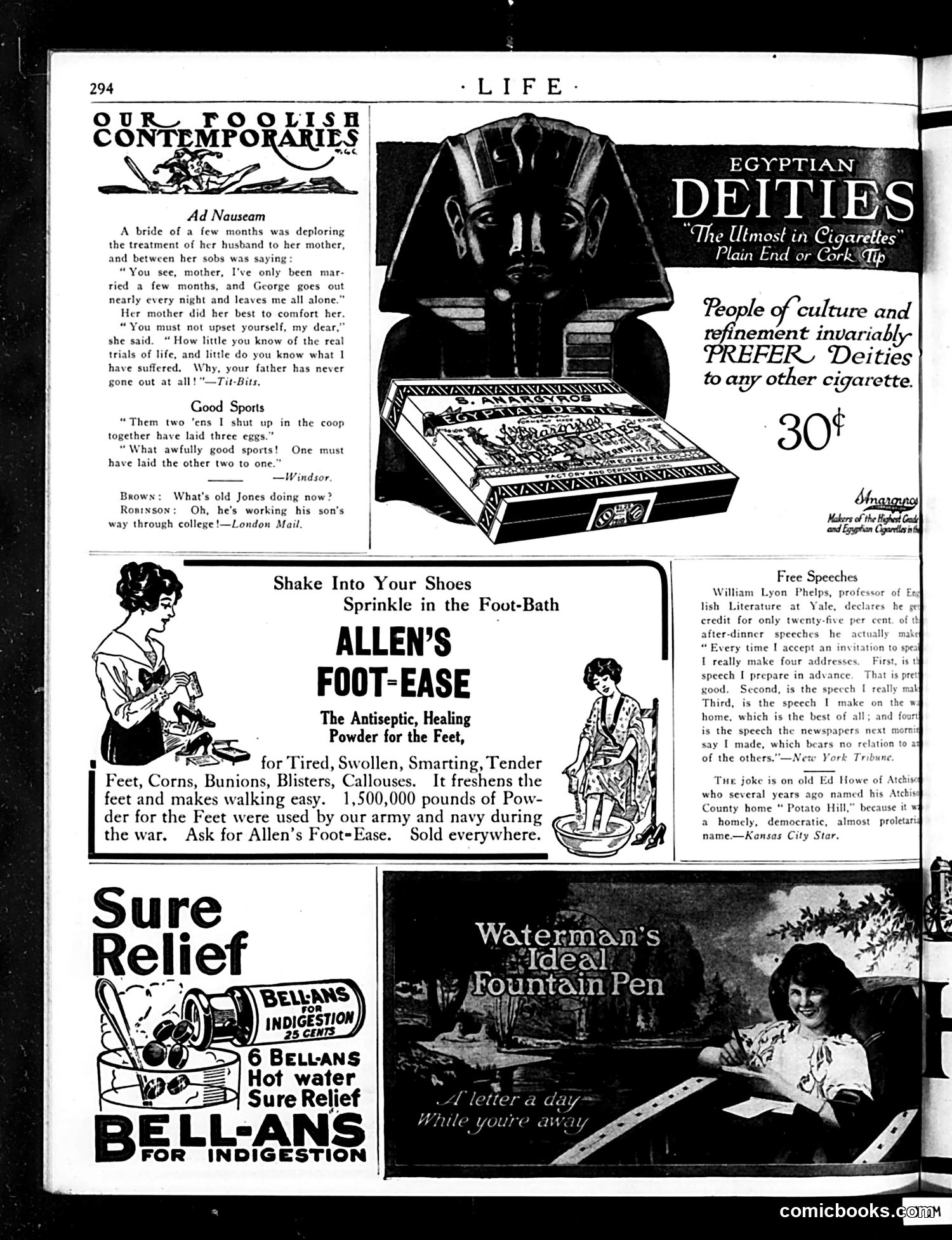
This page from *Life* magazine is primarily **advertising** interspersed with brief satirical humor pieces typical of the publication's style. The main content includes: **"Ad Nauseam" column**: Short jokes mocking contemporary social situations—a newlywed complaining her husband goes out nightly, her mother countering that she's never had this "problem"; absurdist humor about hens laying eggs; a joke about a father sending his son to college "the hard way." **Advertisements**: Egyptian Deities cigarettes (30¢), Allen's Foot-Ease powder, Bell-Ans indigestion remedy, Waterman's Ideal Fountain Pen. **"Free Speeches" item**: Humorously quotes Professor William Lyon Phelps distinguishing between speeches he prepares, delivers, actually gives, and what newspapers report—satirizing the gap between intent and public perception. The page reflects early 20th-century concerns: foot ailments (from WWI), digestive issues, and the reliability of public communication. The humor is genteel, domestic-focused, and relies on recognizable social conventions rather than political commentary.
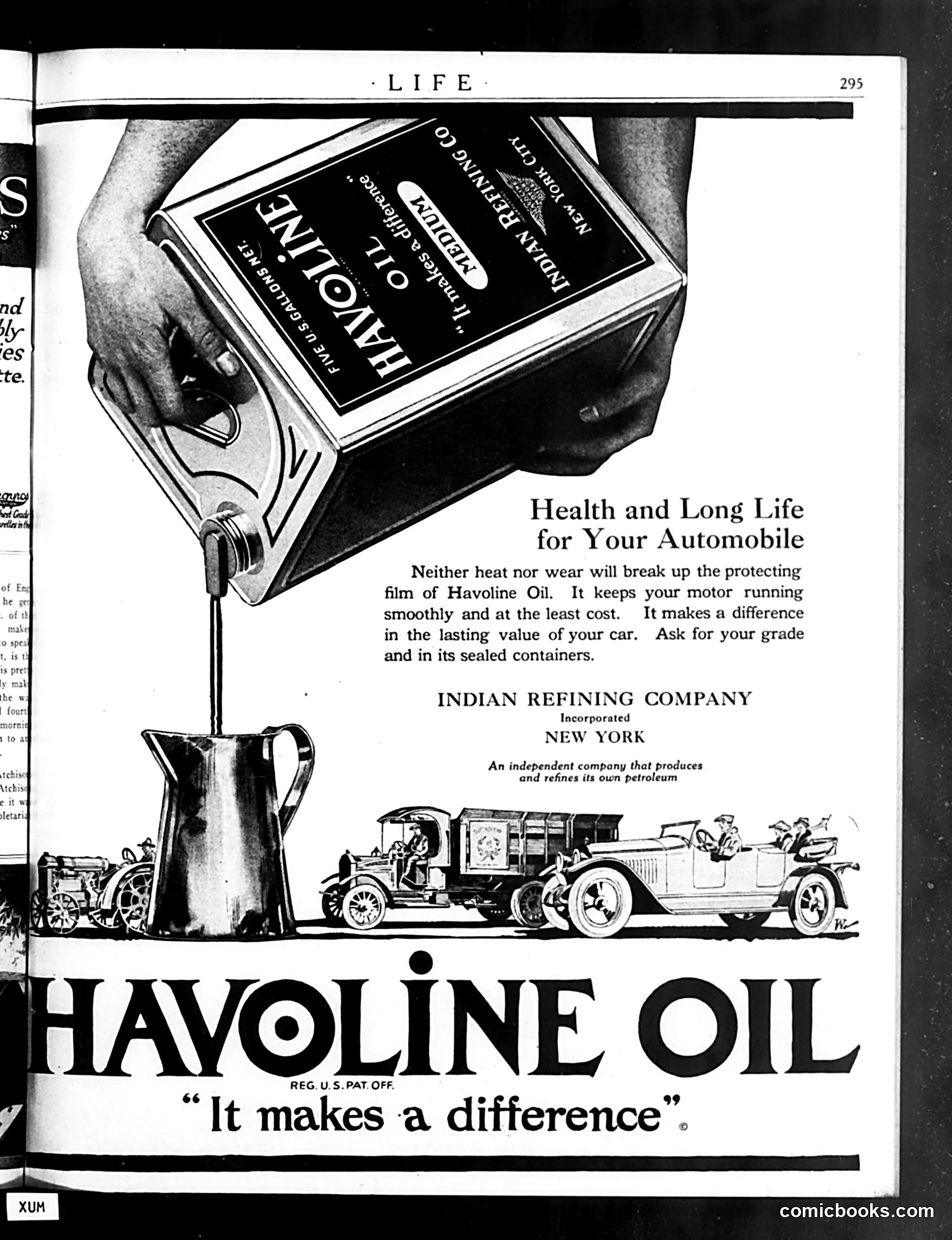
This is a straightforward **product advertisement**, not political satire. It promotes Havoline Oil, manufactured by Indian Refining Company (New York), as essential motor oil for automobiles. The visual shows oil being poured from a large container into a pitcher, illustrating the product's use. Below are early automobiles representing the vehicles that would benefit from the oil. The advertisement's appeal is practical: Havoline Oil protects engines from heat and wear, keeps motors running smoothly, and reduces costs—thus extending a car's lifespan. The tagline "It makes a difference" emphasizes the product's superiority. This appears in *Life* magazine's advertising section, typical of early-to-mid 20th century automotive marketing that emphasized mechanical care and longevity during an era when regular oil changes were becoming standard maintenance practice.
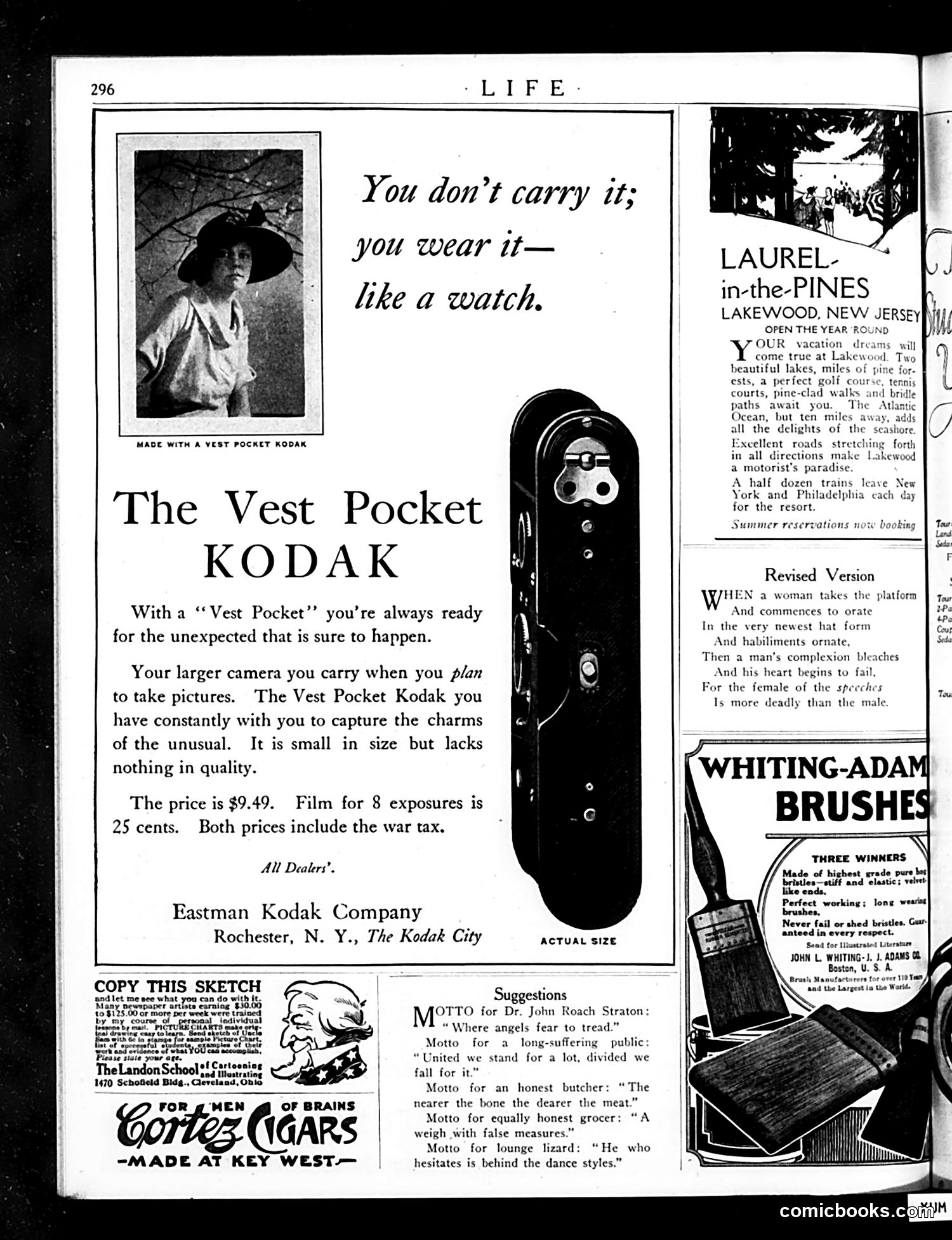
This page is primarily **advertising and filler content**, not political satire. The main feature is a Kodak camera advertisement for the "Vest Pocket Kodak," emphasizing its portability—you "wear it like a watch." The ad targets leisure-class consumers with disposable income for cameras and vacation travel. The page includes a poem titled "Revised Version" mocking women speakers and their fashion choices, reflecting period attitudes. The bottom section offers satirical "mottos" attributed to various professions (Dr. John Roach Straton, butchers, grocers, "lounge lizards"). These are gentle social commentary on dishonesty and hypocrisy in everyday business and leisure activities, typical of Life's humor style. Also featured: advertisements for Whiting-Adam brushes and Cortez cigars. The content reflects 1920s consumer culture and period attitudes toward gender and social propriety rather than serious political commentary.
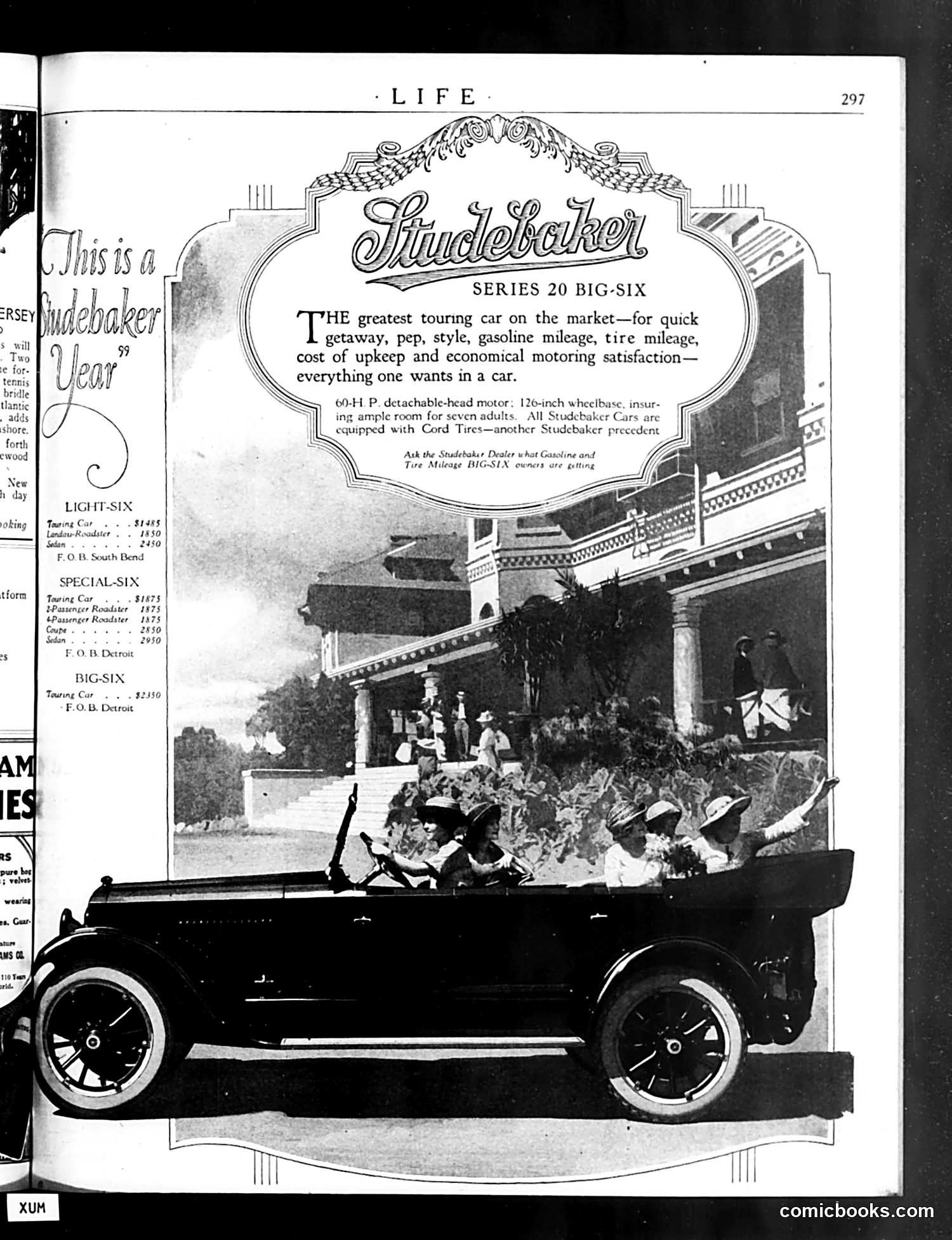
This is primarily a **car advertisement**, not political satire. The page promotes the Studebaker Series 20 Big-Six automobile, claiming it offers "quick getaway, pep, style, gasoline mileage, tire mileage, cost of upkeep and economical motoring satisfaction." The image shows an elegant touring car positioned below a luxurious residential scene with well-dressed people on a columned veranda, suggesting affluence and leisure. The advertisement emphasizes technical specifications (60-H.P. detachable-head motor, 126-inch wheelbase, Cord Tires) to appeal to buyers seeking quality and reliability. The left sidebar lists different Studebaker models with prices, ranging from the Light-Six to the Big-Six. This represents typical 1920s automobile marketing—associating cars with wealth, status, and leisure lifestyle rather than practical transportation.
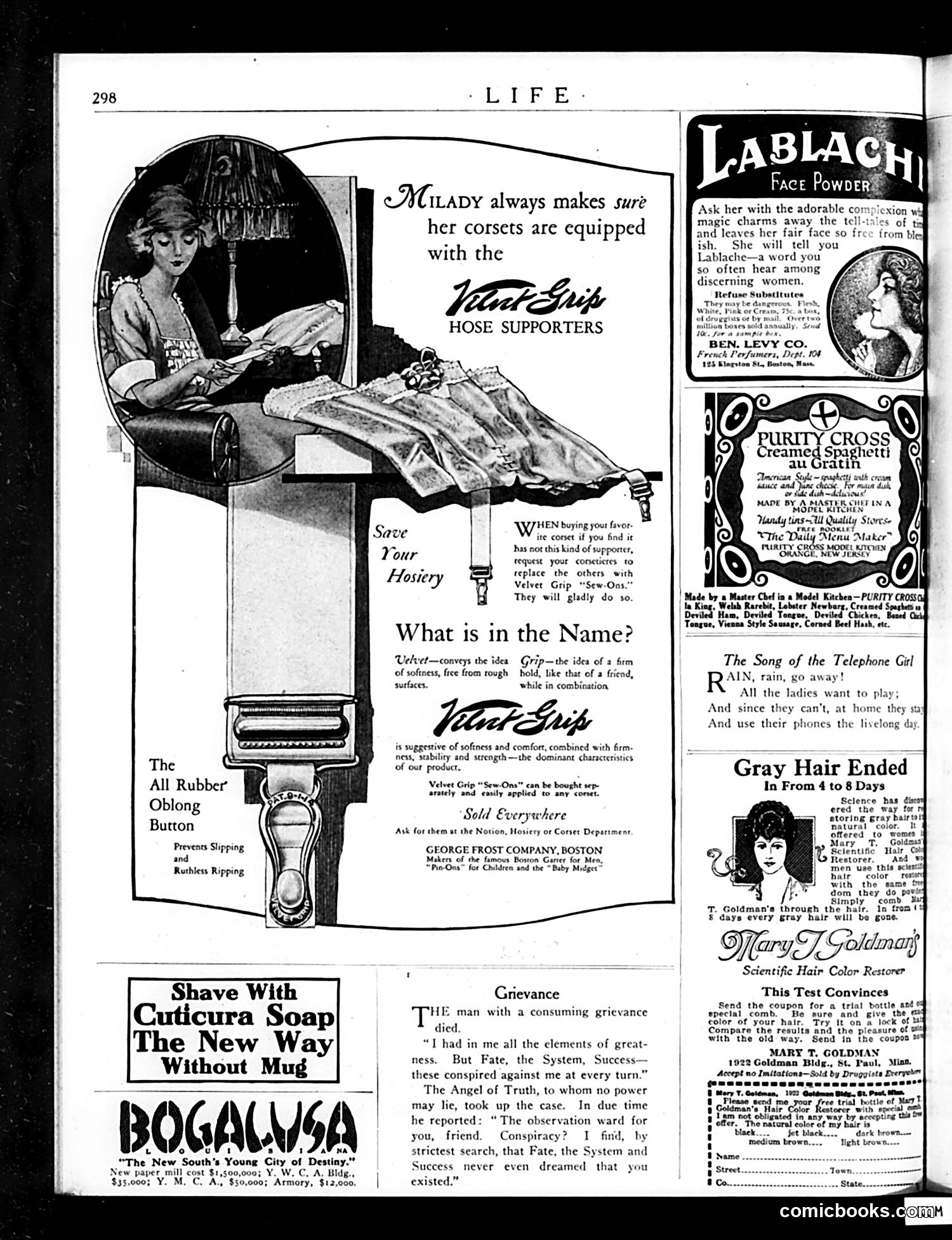
This page is primarily **advertising**, with one short satirical piece. The main content features ads for women's fashion and beauty products typical of the era: corset hose supporters, face powder (Lahlache), canned foods, hair restoration, and soap. These reveal period concerns about appearance and propriety. The only satire appears in the "Grievance" section—a brief morality tale about a man who dies blaming Fate, the System, and Success for his failures. An Angel of Truth investigates and reports these forces never even knew he existed. The joke targets self-pitying complainers who externalize blame rather than accept personal responsibility. It's a common early-20th-century critique of those who blame society rather than themselves for their circumstances. The "Song of the Telephone Girl" is a light verse about bored operators. Overall, this reflects 1920s consumer culture and period attitudes toward personal responsibility and vanity.
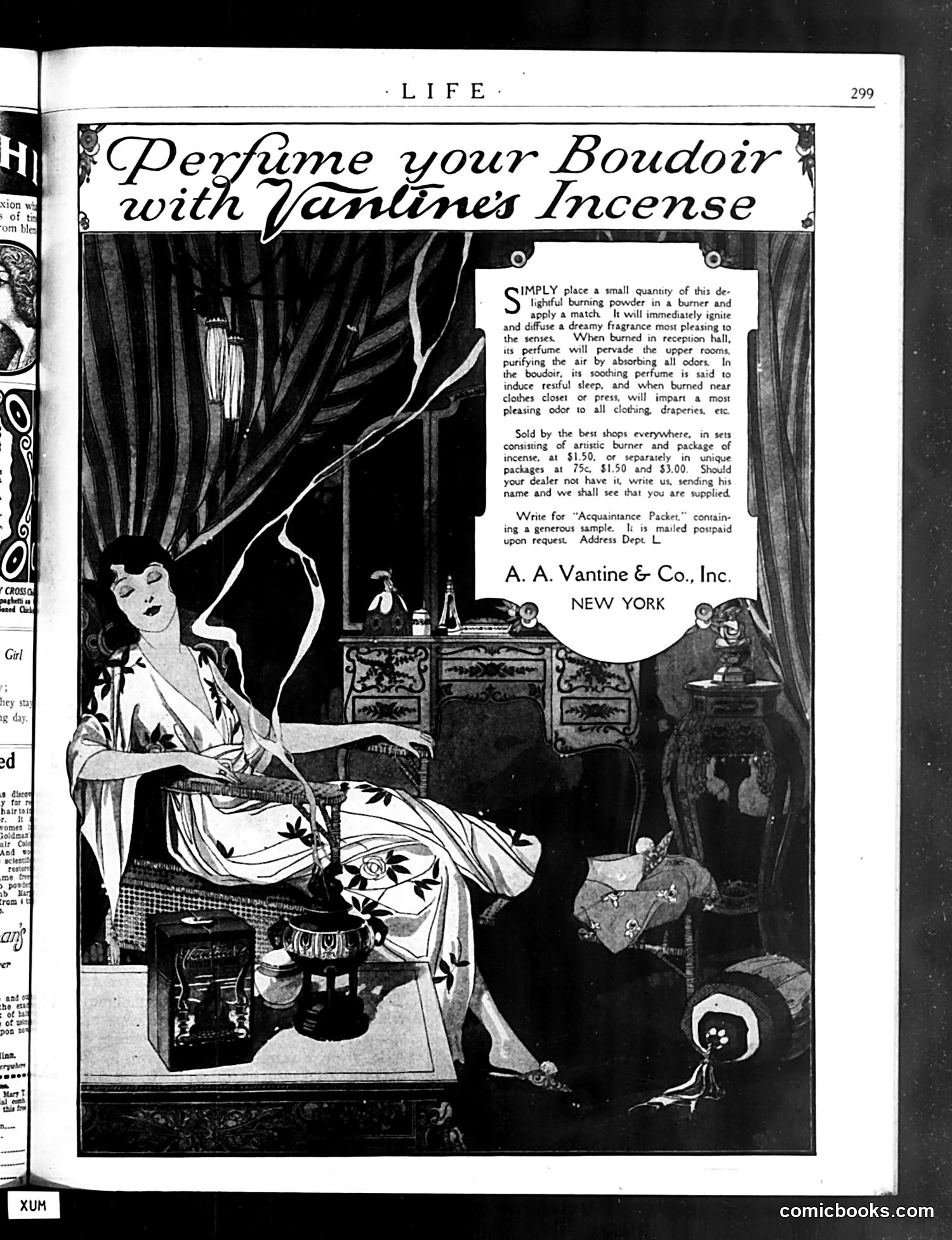
This page is primarily an **advertisement**, not political satire. It promotes Vantine's Incense, a commercial product by A.A. Vantine & Co. of New York. The large illustration depicts a luxurious bedroom scene where an elegant woman in a flowing robe reclines on a boudoir (bedroom/dressing room), while incense smoke rises decoratively around her. The aesthetic is deliberately glamorous and aspirational—typical of 1920s advertising imagery. The product claim is straightforward: burning this incense in bedrooms, reception halls, and clothes closets will perfume spaces and supposedly induce restful sleep. The ad emphasizes availability at quality shops and offers an "Acquaintance Packet" sample. There is **no political or social satire evident**. This is straightforward commercial advertising designed to appeal to middle and upper-class readers with disposable income for luxury home products.
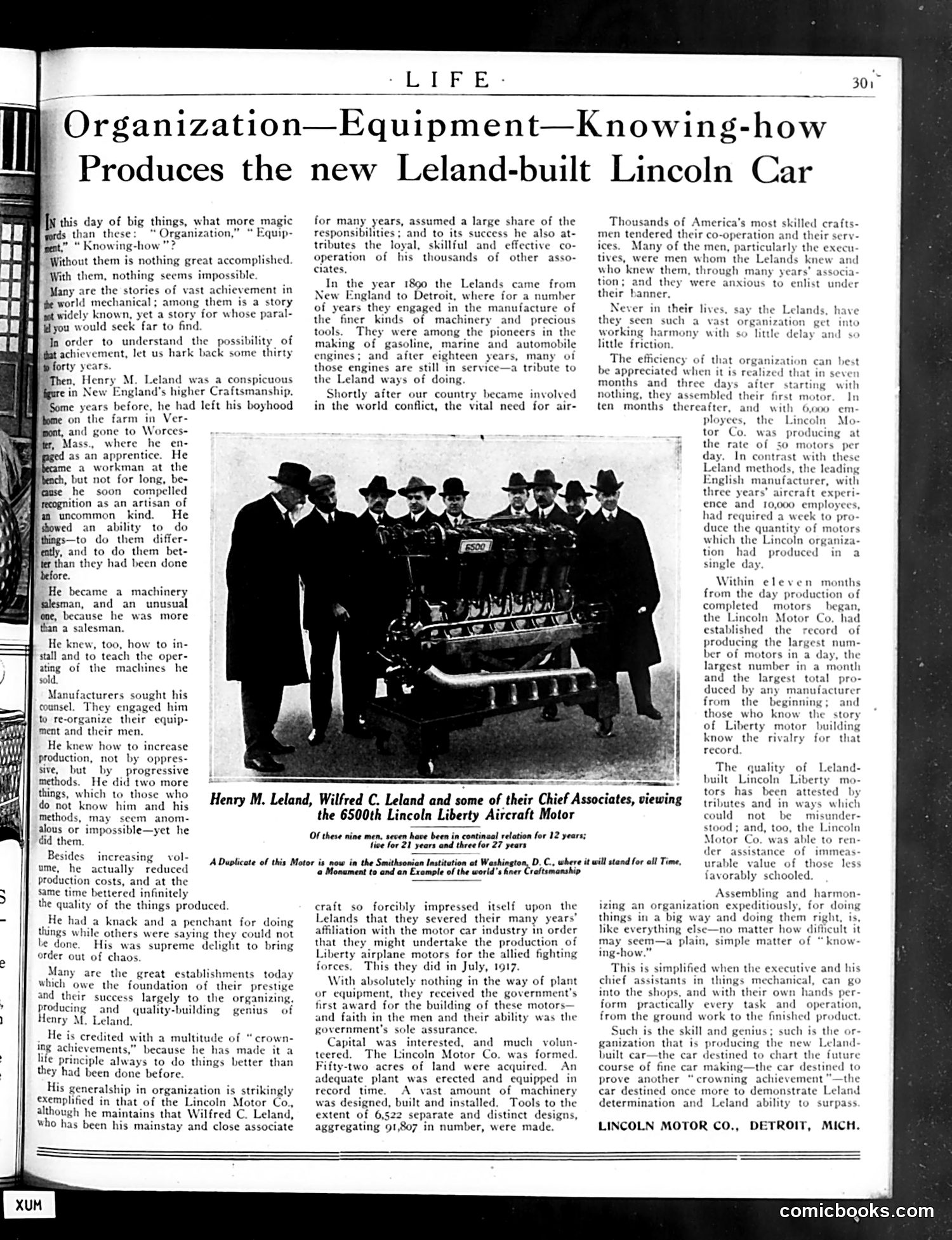
This is **not a political cartoon** but rather a corporate advertisement/profile disguised as journalism, celebrating Henry M. Leland and his Lincoln Motor Company. The photograph shows Leland (center, in bowler hat) and associates displaying the 6500th Lincoln Liberty Aircraft Motor they produced. The text presents Leland as an exemplary American industrialist embodying "Organization—Equipment—Knowing-how." The key context: This celebrates American manufacturing during WWI. The Lelands pivoted from automobile production to manufacture Liberty aircraft engines for Allied forces—presented as patriotic duty. The piece emphasizes efficiency, quality control, and organizational genius as distinctly American virtues. For modern readers: This represents early 20th-century **corporate PR masquerading as editorial content**—a common practice in Life magazine. The hagiographic tone and emphasis on individual greatness reflects period attitudes about industrial leadership and capitalism as naturally progressive forces.
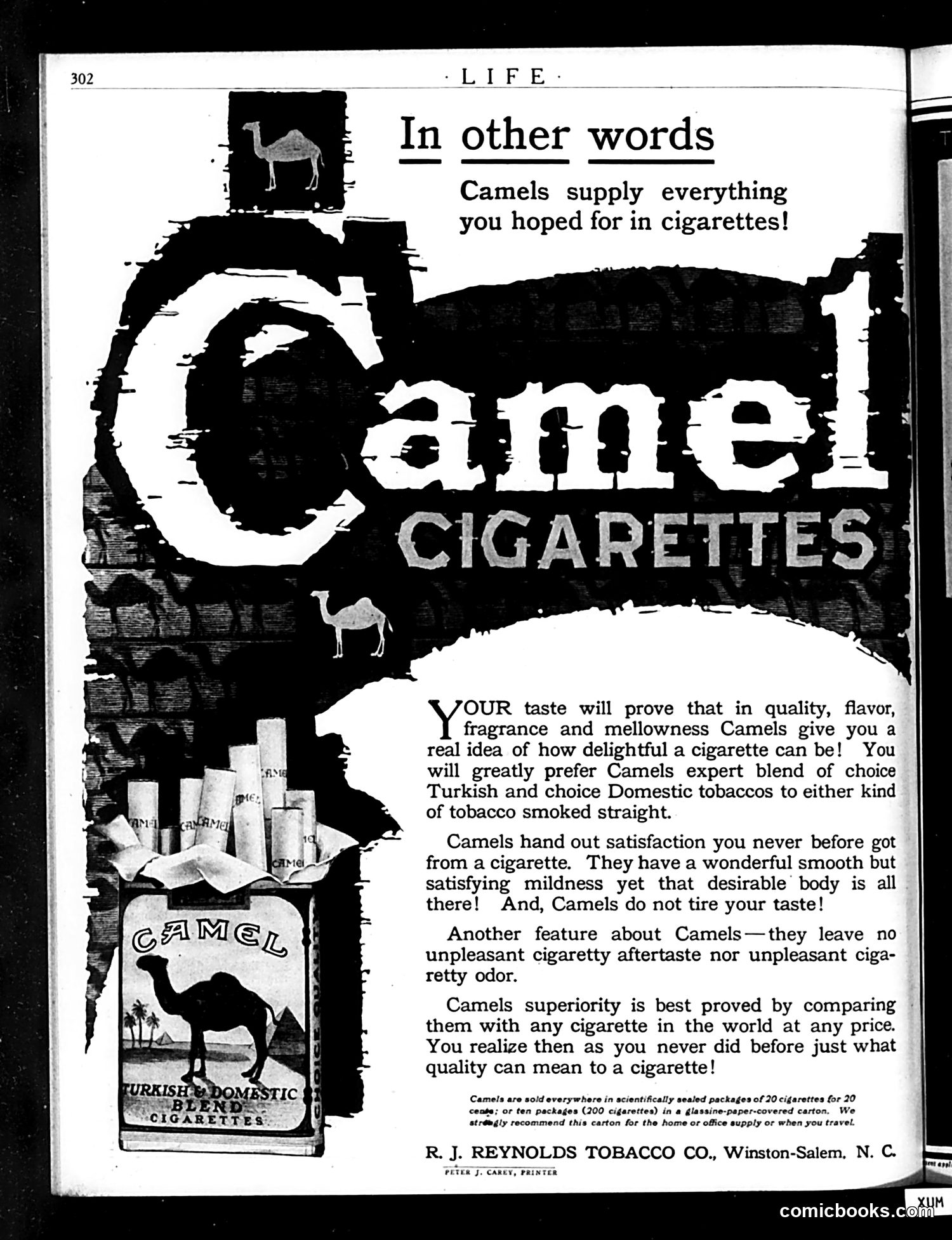
This is a **Camel cigarette advertisement**, not satire or political commentary. The page features promotional copy claiming Camels offer superior quality, flavor, and smoothness compared to competitors. The camel imagery (the brand's mascot) appears throughout—in the logo and decorative elements. The ad emphasizes the tobacco blend of Turkish and domestic varieties and promises benefits like lack of aftertaste and not "tiring" the smoker's taste. For modern readers: this represents **pre-health-warning tobacco advertising** from what appears to be the early-to-mid 20th century. The claims about quality and taste would now be legally prohibited. The casual, confident tone about health benefits ("mildness," "satisfying") reflects an era before cigarettes' dangers were widely acknowledged or regulated. This is straightforward commercial advertising, not editorial commentary.
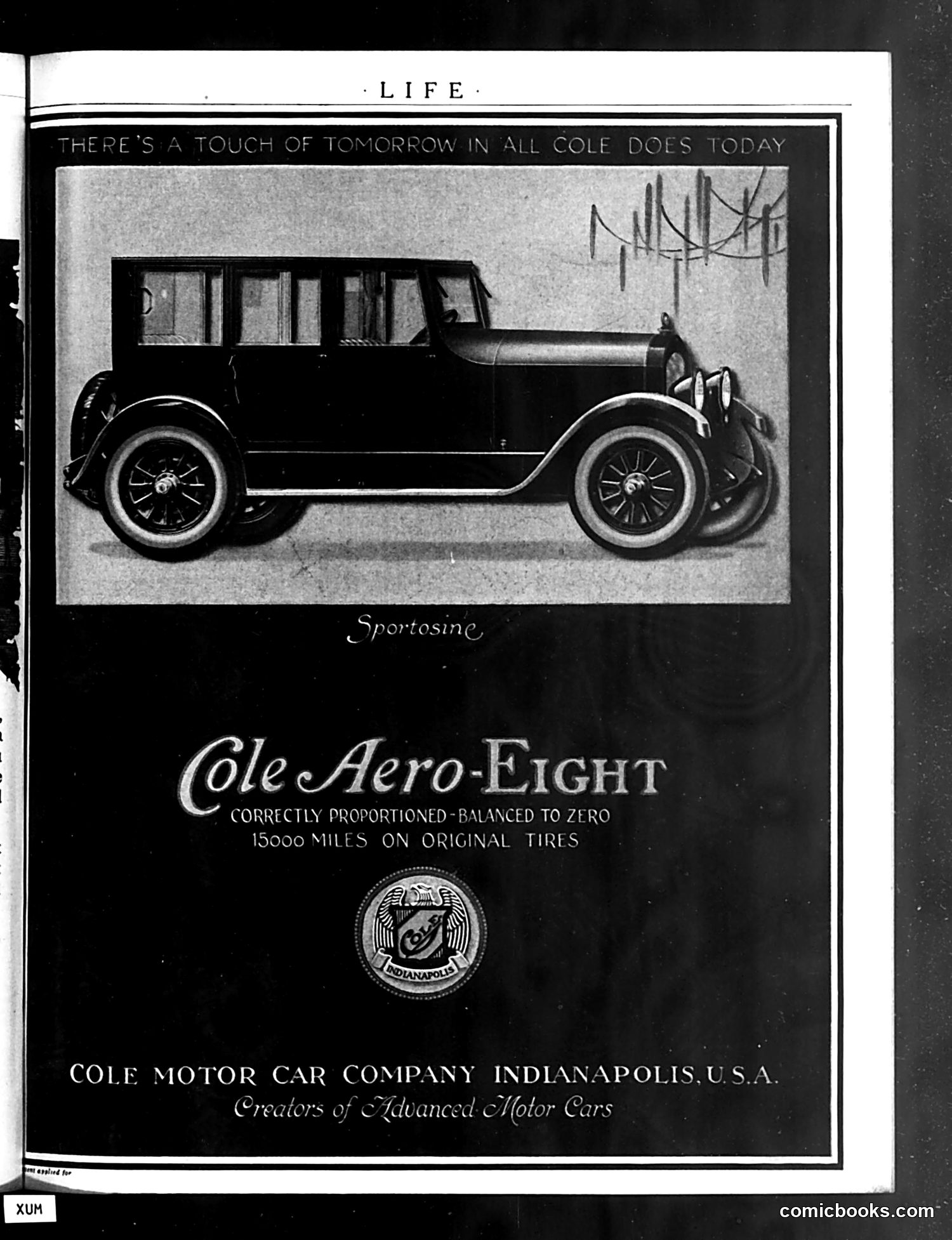
This is a product advertisement, not a political cartoon. It promotes the Cole Aero-Eight automobile, manufactured by Cole Motor Car Company in Indianapolis. The ad features a side-view illustration of a sporty sedan with the tagline "There's a Touch of Tomorrow in All Cole Does Today." The advertisement emphasizes the car's engineering credentials: it's "correctly proportioned" and "balanced to zero," with impressive durability (15,000 miles on original tires). The styling appears modern for its era, with streamlined proportions. The company positions itself as "Creators of Advanced Motor Cars," appealing to buyers interested in automotive innovation. This appears to be from the 1920s automotive industry's competitive golden age, when manufacturers heavily promoted technical specifications and forward-thinking design.
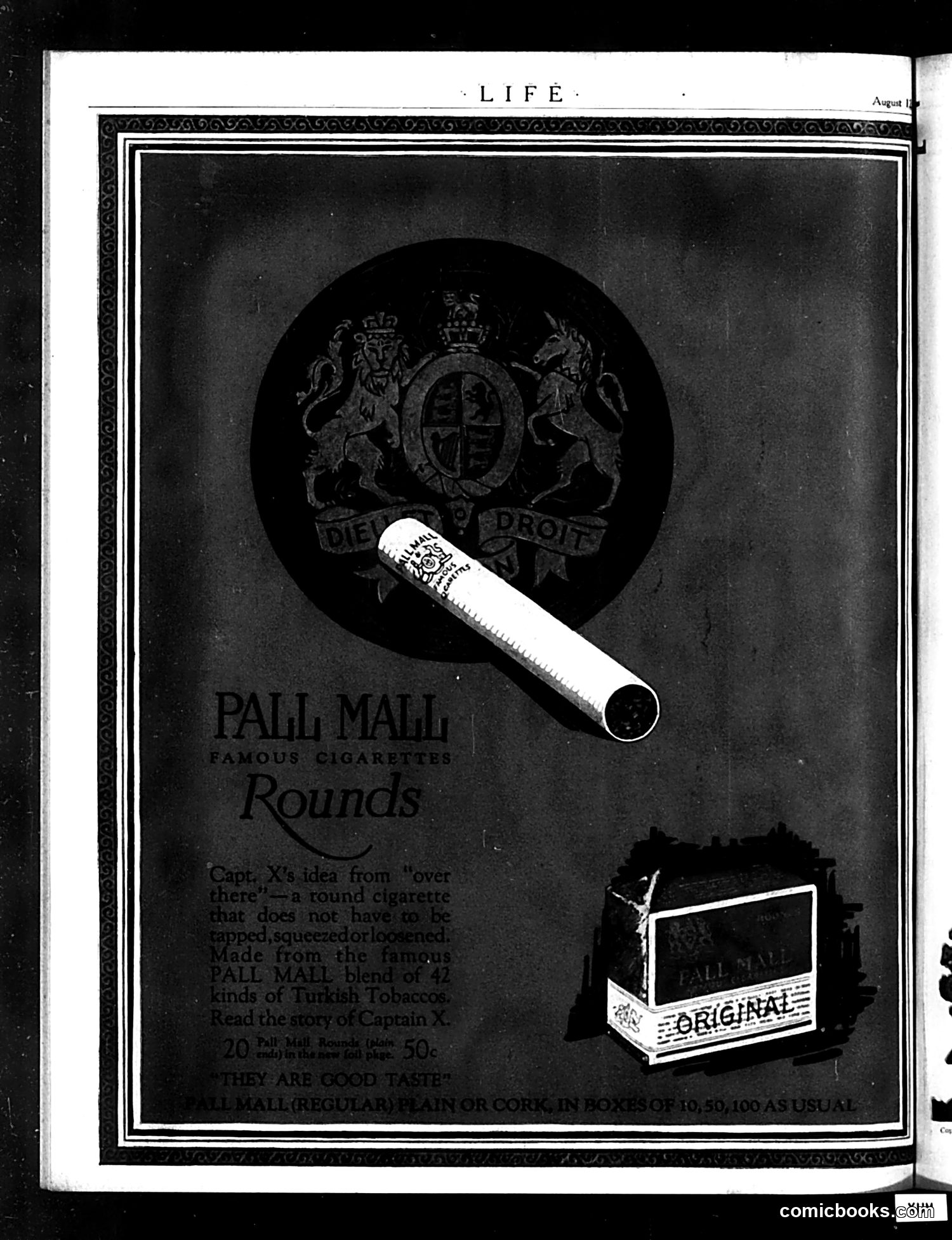
This is a **cigarette advertisement**, not political satire or commentary. The page advertises Pall Mall "Famous Cigarettes" in their "Rounds" style. The ad features: - A royal coat of arms (suggesting British prestige/quality) - A cylindrical cigarette displayed prominently - A product box labeled "PALL MALL ORIGINAL" - Marketing copy claiming the round cigarette won't "have hard way to be capped, squeezed or loosened" The advertisement appeals to quality and tradition through heraldic imagery. The "Captain X" reference in the text appears to be a fictional narrative device to market the product's round shape as an innovation. This represents early-20th-century cigarette marketing before health warnings, when such products were advertised openly in mainstream magazines.