
Life, 1920-08-12 · page 41 of 44
Life — August 12, 1920 — page 41: what you’re looking at
What you’re looking at
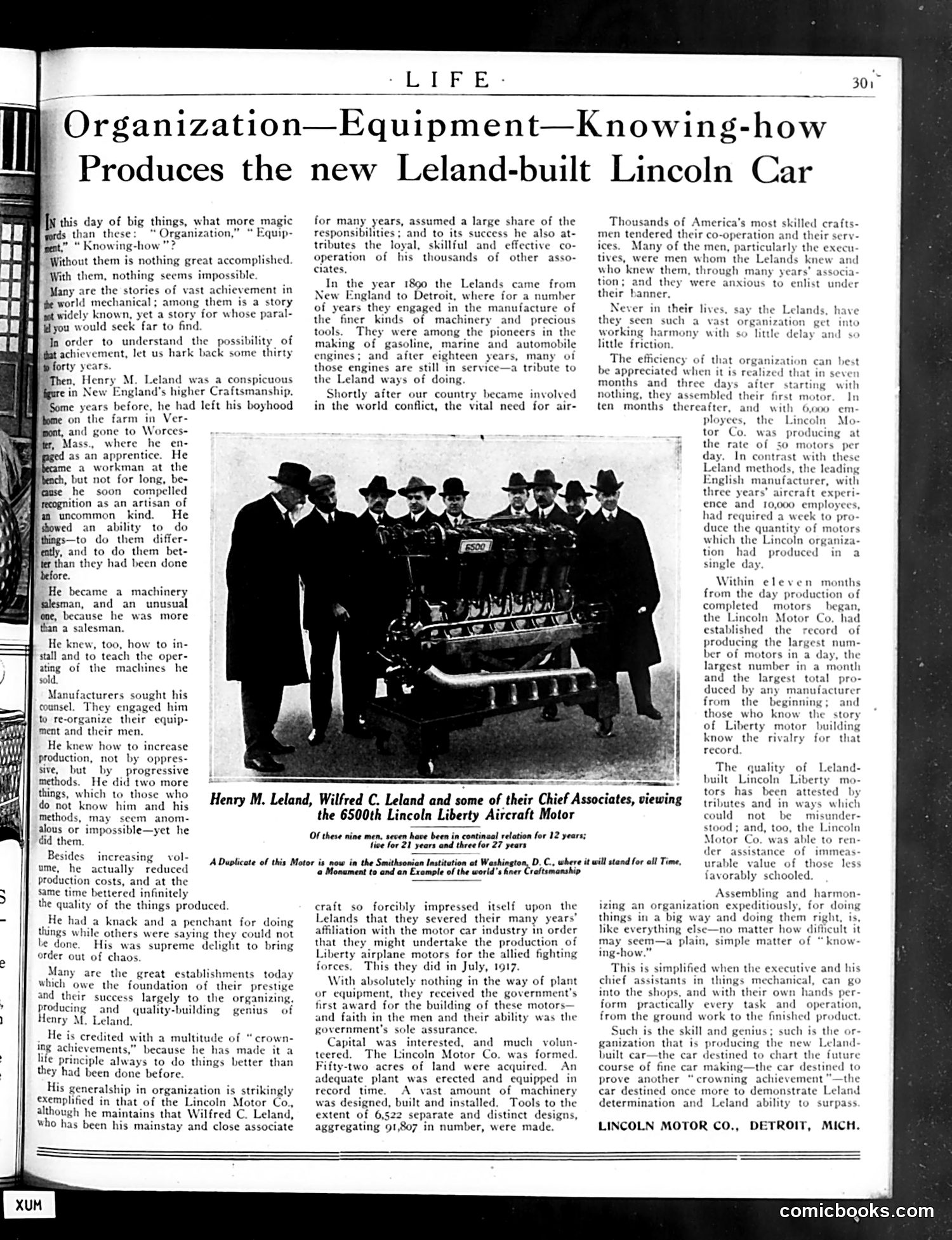
This is **not a political cartoon** but rather a corporate advertisement/profile disguised as journalism, celebrating Henry M. Leland and his Lincoln Motor Company. The photograph shows Leland (center, in bowler hat) and associates displaying the 6500th Lincoln Liberty Aircraft Motor they produced. The text presents Leland as an exemplary American industrialist embodying "Organization—Equipment—Knowing-how." The key context: This celebrates American manufacturing during WWI. The Lelands pivoted from automobile production to manufacture Liberty aircraft engines for Allied forces—presented as patriotic duty. The piece emphasizes efficiency, quality control, and organizational genius as distinctly American virtues. For modern readers: This represents early 20th-century **corporate PR masquerading as editorial content**—a common practice in Life magazine. The hagiographic tone and emphasis on individual greatness reflects period attitudes about industrial leadership and capitalism as naturally progressive forces.
📄 Transcribed text from this page (OCR, searchable)
Machine-transcribed from the original scan — historical spelling and the odd misread are preserved.
| -LIFE: Organization—Equipment—Knowing-how new Leland-built Lincoln Car Produces the - fv this day of big things, what more magic gords than these: “ Organization,” “ Equip- fest,” “ Knowing-how "? Without them is nothing great accomplished With them, nothing seems impossible. Many are the stories of vast achievement in fe world mechanical; among them is a story mt widely known, yet'a story for whose paral- you would seck far to find In order to understand the possibility. of fat achievement, let us hark back some thirty ®forty years. "Then, Henry M. Leland was a conspicuous gore in New Engiand’s higher Craftsmanship. Some years before, he had left his boyhood fome on the farm in Ver- ‘pont, and gone to Worces- ter, Mass. where he en- ipged as an apprentice. He ye a workman at the , but not for long, be- he soon compelled F recognition as an artisan of He do a uncommon kind. showed an ability to ently, and to do them bet- fer than they had been done defore. He became a machinery filesman, and an unusual ‘one, because he was more than a salesman. He knew, too, how to in- stall and to teach the oper- ating of the machines he sold. Manufacturers sought his counsel. They engaged him to re-organize their equip- ment and their men. He knew how to increase production, not by oppres- sive, but by progressive methods. He did two more things, which to those who do not know him and his methods, may seem anom- alous or impossible—yet he did them. Besides increasing vol- ume, he actually reduced production costs, and at the same time bettered infinitely the quality of the things produced. He had a knack and a penchant for doing things while others were saying they could not le done. His was supreme delight to bring order out of chaos. Many are the great establishments today which owe the foundation of their prestige and their success largely to the organizing, producing and quality-building genius of Henry M, Leland. He is credited with a multitude of “crown- ing achievements,” because he has made it a life principle always to do things better than they had been done before. His generalship in organization is strikingly exemplified in that of the Lincoln Motor Co., although he maintains that Wilfred C. Leland, who has been his mainstay and close associate Henry M. Leland, Wilfred C. Leland and some of their A Duplicate of this Motor is now in the Smithsonian Institution ot Washingto: for many years, assumed a large share of the responsibilities; and to its success he also at- tributes the loyal, skillful and effective co- operation of his thousands of other asso- ciates. In the year 1890 the Lelands came from ‘ew England to Detroit, where for a number of years they engaged in the manufacture of the finer kinds of machinery nd precious tools. They were among the pioneers in the making of gasoline, marine and automobile engines; and after eighteen years, many of those engines are still in service—a tribute to the Leland ways of doing. Shortly after our country became involved in the world conflict, the vital need for air- the 6500th Lincoln Liberty Aircraft Motor Of these nine men, seven have been in contineal relation for 12 years; lige for 21 years and three for 27 years @ Monument (0 and an Exomple of the world's Aner Craitsmanship aft so forcibly impressed itself upon the Lelands that they severed their many years’ affiliation with the motor car industry in order that they might undertake the production of Liberty airplane motors for the allied fighting forces. This they did in July, 1917. With absolutely nothing in the way of plant or equipment, they received the government's first award for the building of these motors and faith in the men and their ability was the government's sole assurance. Capital was interested, and teered. The Lincoln Motor Co. was formed. Fifty-two acres of land were acquired. An adequate plant was erected and equipped in record time. A vast amount of_ machinery was designed, built and installed. Tools to the extent of 6,522 separate and distinct designs, aggregating 91,807 in number, were made. much volun- Chief Associates, viewing D.C., where it will stand for all Time, Thousands of America’s most skilled crafts- men tendered their co-operation and their serv- ices. Many of the men, particularly the execu tives, were men whom the Lelands knew an who knew them, through many years’ tion; and they were anxic to enlist their banner, ssocia under ver in their lives, say the | they seen such a vast organizati working harmony with so little little friction The efficiency of that or be appreciated when it is realized that in seve months and three days after starting with nothing, they assembled their first motor. In ten months thereafter, and with oo em ployces, the Linc Mo tor Co. was p gat the rate of 50 motors per day. In contrast with these Leland methods, leading English manufacturer, with three years’ aircraft experi- ence and 10,000 employees, had required 'a week to pro- duce the quantity of motors which the Lincoln organiza- tion had produced ir single day lands, get delay nization can best Within eleven months from the day production of completed motors began, the Lincoln Motor Co, had established the record of producing the largest num- ber of motors in a day, the largest number in a month and the largest total pro- duced by any manufacturer from the beginning; and those who know the story of Liberty motor building know the rivalry for that record. of Leland- 4 built’ Lincoln. Liberty mo- tors has been attested by tributes and in ways which could not be misunder- stood ; and, too, the Lincoln Motor Co. was able to ren der assistance of immeas urable value of those favorably schooled less Assembling and harmon- izing an organization expeditiously, for doing things in a big way and doing them right, is, like everything else—no matter how dificult it may seem—a plain, simple matter of “know- ing-how.” This is simplified when the executive and h chief assistants in things mechanical, can into the shops, and with their own hands per form practically every task and operation, from the ground work to the finished product Such is the skill and genius; such is the or- ganization that is producing the new Leland- built car—the car destined to chart the future course of fine car making—the car destined to prove another “crowning achievement "—the car destined once more to demonstrate Leland determination and Leland ability to surpass LINCOLN MOTOR CO., DETROIT, MICH. comicbooks.com