
Life, 1920-08-12 · page 28 of 44
Life — August 12, 1920 — page 28: what you’re looking at
What you’re looking at
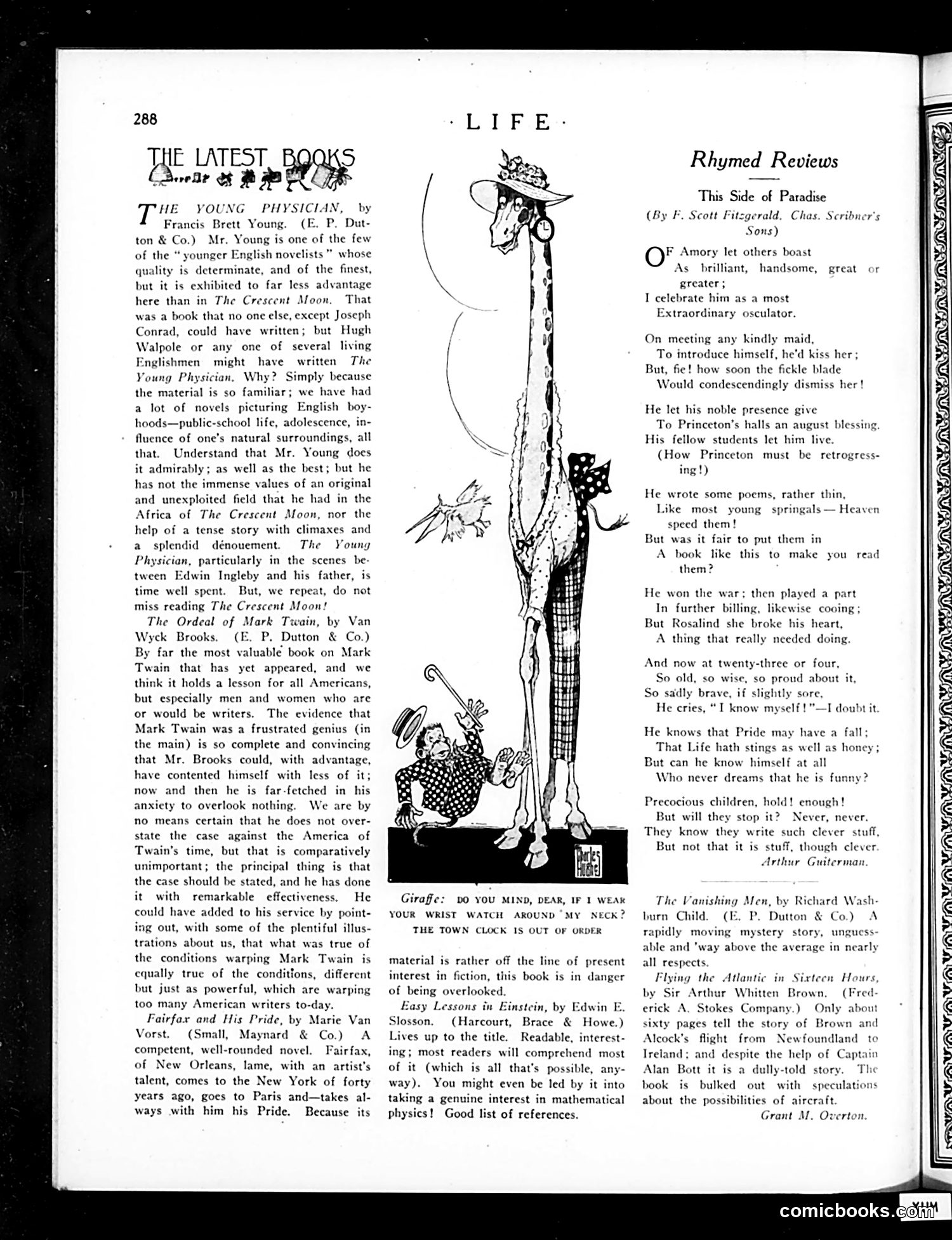
This page is primarily a **book review section** with one cartoon. The main cartoon shows a tall figure (appearing to be a town clock or lamppost) with a small person asking to wear their wristwatch around their neck because "the town clock is out of order." The joke is a **visual pun on timekeeping**: the person proposes using a wristwatch as a substitute public timepiece—an absurdly inadequate solution to a broken town clock. It satirizes either poor civic maintenance or people's tendency to propose ridiculous workarounds for public problems. The page reviews several books, including Van Wyck Brooks's *The Ordeal of Mark Twain* (praised as valuable), F. Scott Fitzgerald's *This Side of Paradise* (humorously critiqued in rhyming verse for its protagonist's excessive kissing and thin poetry), and other contemporary works. The reviews reflect early 1920s literary interests and tastes.
📄 Transcribed text from this page (OCR, searchable)
Machine-transcribed from the original scan — historical spelling and the odd misread are preserved.
288 Ne LATEST, S sree of Hb RB EEL FR HE YOUNG PHYSICIAN, by Francis Brett Young. (E. P. Dut- ton & Co.) Mr. Young is one of the few of the “ younger English novelists" whose quality is determinate, and of the finest, but it is exhibited to far less advantage here than in The Crescent Moon, That was a book that no one else, except Joseph Conrad, could have written; but Hugh Walpole or any one of several living Englishmen might have written The Young Physician. Why? Simply because the material is so familiar; we have had a lot of novels picturing English boy- hoods—public-school life, adolescence, in- fluence of one’s natural surroundings, all that. Understand that Mr. Young does it admirably; as well as the best; but he has not the immense values of an original and unexploited field that he had in the Africa of The Crescent Moon, nor the help of a tense story with climaxes and a splendid dénouement. The Young Physician, particularly in the scenes be- tween Edwin Ingleby and his father, is time well spent. But, we repeat, do not miss reading The Crescent Moon! The Ordeal of Mark Twain, by Van Wyck Brooks. ( P, Dutton & Co.) By far the most valuable book on Mark Twain that has yet appeared, and we think it holds a lesson for all Americans, but especially men and women who are or would be writers. The evidence that Mark Twain was a frustrated genius (in the main) is so complete and convincing that Mr. Brooks could, with advantage, have contented himself with less of it; now and then he is far-fetched in his anxiety to overlook nothing. We are by no means certain that he does not over- state the case against the America of Twain's time, but that is comparatively unimportant; the principal thing is that the case should be stated, and he has done it with remarkable effectiveness. He could have added to his service by point- ing out, with some of the plentiful illus- trations about us, that what was true of the conditions warping Mark Twain is equally true of the conditions, different but just as powerful, which are warping too many American writers to-day. Fairfax and His Pride, by Marie Van Vorst, (Small, Maynard & Co.) A competent, well-rounded no Fairfax, of New Orleans, lame, with an artist's talent, comes to the New York of forty years ago, goes to Paris and—takes al- ways with him his Pride. Because its DO YOU MIND, DEAR, IF I WEAK YOUR WRIST WATCH AROUND “MY NECK? THE TOWN CLOCK IS OUT OF ORDER material is rather off the line of present interest in fiction, this book is in danger of being overlooked. Easy Lessons in E Slosson, (Harcourt, ves up to the title. astein, by Edwin E. Brace & Howe.) Readable, interest- ing; most readers will comprehend most of it (which is all that’s possible, any- way). You might even be led by it into taking a genuine interest in mathematical physics! Good list of references. Rhymed Reviews This Side of Paradise (By F. Scott Fitzgerald. Chas. Scribner's Sons) OF Amory let others boast As brilliant, greate! I celebrate him as a most Extraordinary osculator. handsome, great or On meeting any kindly maid, To introduce himself, he'd kiss her; But, fie! how soon the fickle blade Would condescendingly dismiss her! He let his noble presence give To Princeton's halls an august blessing. His fellow students let him live. (How Princeton must be retrogress- ing!) He wrote some poems, rather thin, Like most speed them! But was it fair to put them in A book like this to make you read them? young springals — Heaven He won the war; then played a part In further billing, likewise cooing ; But Rosalind she broke his heart, A thing that really needed doing. And now at twenty-three or four, So old, so wise, so proud about it, So sadly brave, if slightly sore, He cries, “I know myself !"—I doubt it He knows that Pride may have a fall; That Life hath stings as well as honey; But can he know himself at all Who never dreams that he is funny Precocious children, hold! enough! But will they stop it? N never. They know they write such clever stuff, But not that it is stuff, though clever. Arthur Guiterman The Vanishing Men, by Richard Wash- burn Child. (EE. P. Dutton & Co.) A idly moving mystery story, unguess- able and 'way above the average in nearly all respects. Flying the Atlantic in Sixteen Hours, by Sir Arthur Whitten Brown, (Fred- erick A. Stokes Company.) Only about sixty pages tell the story of Brown and Alcock’s flight from Newfoundland to Ireland; and despite the help of Captain Alan Bott it is a dully-told story. The book is bulked out with speculations about the possibilities of aircraft. Grant M. Overton. comicbooks. TOA NADIA eS Il xv RAY ASSAY AVAUAYAVAYAUYIA