
Life, 1920-08-12 · page 10 of 44
Life — August 12, 1920 — page 10: what you’re looking at
What you’re looking at
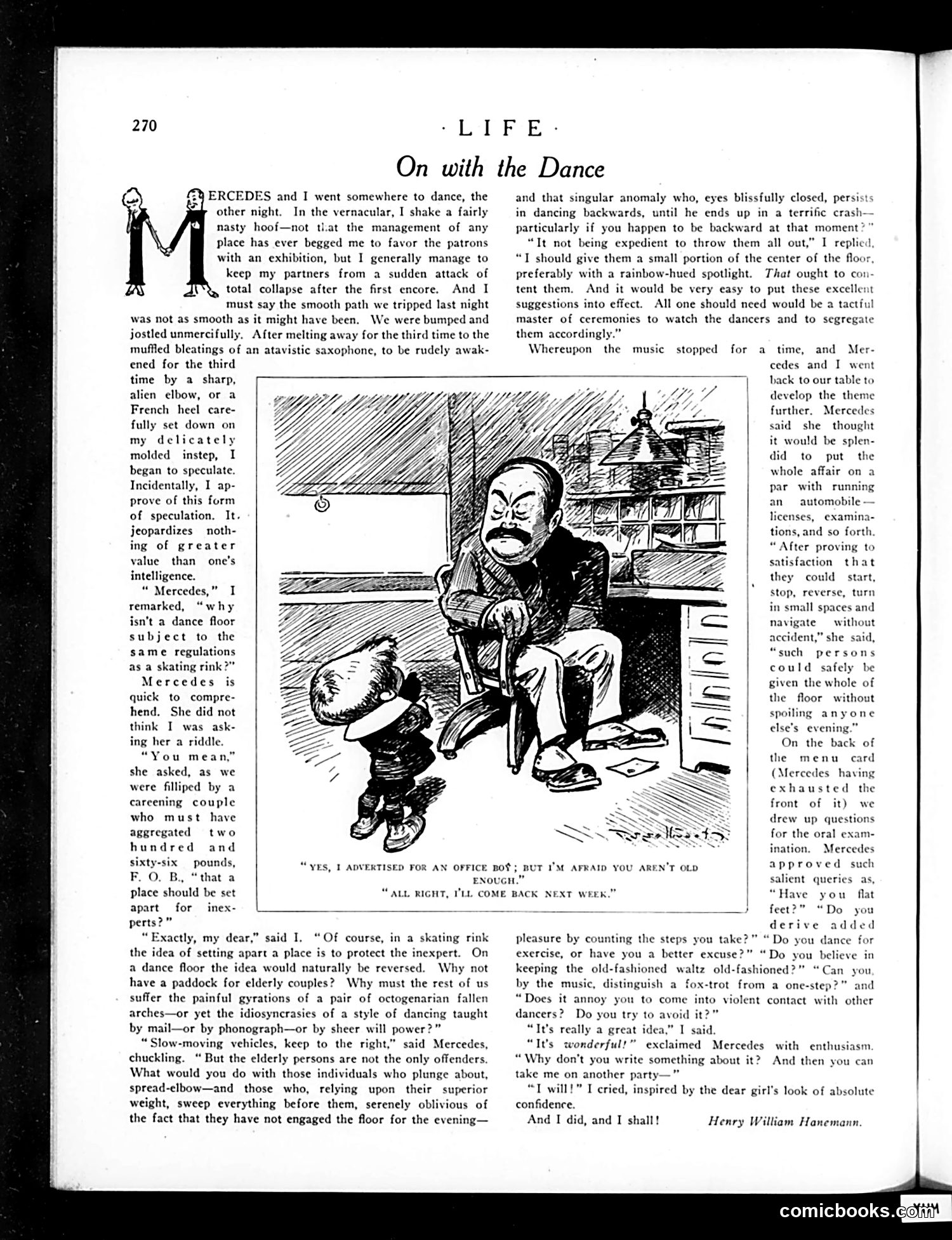
This is a humorous short story by Henry William Hanemann about dance floor etiquette. The accompanying cartoon satirizes a common social problem: overweight or physically unfit dancers who monopolize dance floors and collide with other couples. The caricatured figure depicts a heavyset man dancing awkwardly, illustrating the narrator's complaint that such dancers are "not the only offenders" but notably problematic due to their "superior weight" and inability to navigate properly. The satire targets people who lack self-awareness about their physical limitations yet dominate shared social spaces. Mercedes (a female character in the story) suggests implementing regulations similar to skating rinks—restricting participation to prevent "inexpert" dancers from spoiling everyone's evening. The joke reflects 1920s social anxieties about public behavior and propriety.
📄 Transcribed text from this page (OCR, searchable)
Machine-transcribed from the original scan — historical spelling and the odd misread are preserved.
~-LIFE.- On with the Dance ERCEDES and I went somewhere to dance, the other night. In the vernacular, I shake a fairly nasty hoof—not tat the management of any place has ever begged me to favor the patrons with an exhibition, but I generally manage to keep my partners from a sudden attack of total collapse after the first encore. And I must say the smooth path we tripped last night was not as smooth as it might have been. We were bumped and jostled unmercifully, After melting away for the third time to the muffled bleatings of an atavistic saxophone, to be rudely awak- ened for the third and that singular anomaly who, eyes blissfully closed, persists in dancing backwards, until he ends up in a terrific crash— particularly if you happen to be backward at that moment?” “Tt not being expedient to throw them all out,” I replied “I should give them a small portion of the center of the floor, preferably with a rainbow-hued spotlight. That ought to con- tent them. And it would be very easy to put these excellent suggestions into effect. All one should need would be a tactful master of ceremonies to watch the dancers and to segregate them accordingly.” Whereupon the music stopped for a time, and Mer- cedes and I went time by a sharp, alien elbow, or a French heel care- fully set down on my delicately molded instep, I began to speculate. Incidentally, I ap- prove of this form of speculation. It jeopardizes noth- ing of greater value than one’s intelligence. “ Mercedes,” I remarked, “why isn't a dance floor subject to the same regulations as a skating rink?” Mercedes is quick to compre- hend. She did not think I was ask- ing her a riddle. “You mean,” she asked, as we were filliped by a careening couple who must have aggregated two hundred and sixty-six pounds, F. O. B., “that a ENOUGH.” “ALL RIGHT, I'LL COME BACK NEXT WEEK.” place should be set apart for inex- ew back to our table to develop the theme further. Mercedes said she thought it would be splen- did to put. the whole affair on a par with running an automobile — licenses, examina- tions, and so forth. “After proving to satisfaction that they could. start, stop, reverse, turn in small spaces and navigate without dent,” she said, such persons could safely be given the whole of the floor without spoiling anyone else's evening.” On the back of the menu card (Mercedes having exhausted the front of it) we drew up questions for the oral e ination. Mercedes approved such salient queries as, “Have you flat feet?” “Do you perts?” hi ctly, my dear,” said I, “Of course, in a skating rink the idea of setting apart a place is to protect the inexpert. On a dance floor the idea would naturally be reversed. Why not have a paddock for elderly couples? Why must the rest of us suffer the painful gyrations of a pair of octogenarian fallen arches—or yet the idiosyncrasies of a style of dancing taught by mail—or by phonograph—or by sheer will power?” “Slow-moving vehicles, keep to the right,” said Mercedes, chuckling. “ But the elderly persons are not the only offenders. What would you do with those individuals who plunge about, spread-elbow—and those who, relying upon their superior weight, sweep everything before them, serenely oblivious of the fact that they have not engaged the floor for the evening— derive added pleasure by counting the steps you take?” “Do you dance for exercise, or have you a better excuse?” “Do you believe in keeping the old-fashioned waltz old-fashioned?” “Can you by the music, distinguish a fox-trot from a one-step?” and “Does it annoy you to come into violent contact with other dancers? Do you try to avoid it “It’s really a great idea,” I said. “It's wonderful!” exclaimed Mercedes with enthusiasm. “Why don’t you write something about it? And then you can take me on another party—" “I will!” I cried, inspired by the dear girl's look of absolute confidence. And I did, and I shall! Henry William Hanemann. comicbooks.¢omy