
Life, 1920-08-12 · page 30 of 44
Life — August 12, 1920 — page 30: what you’re looking at
What you’re looking at
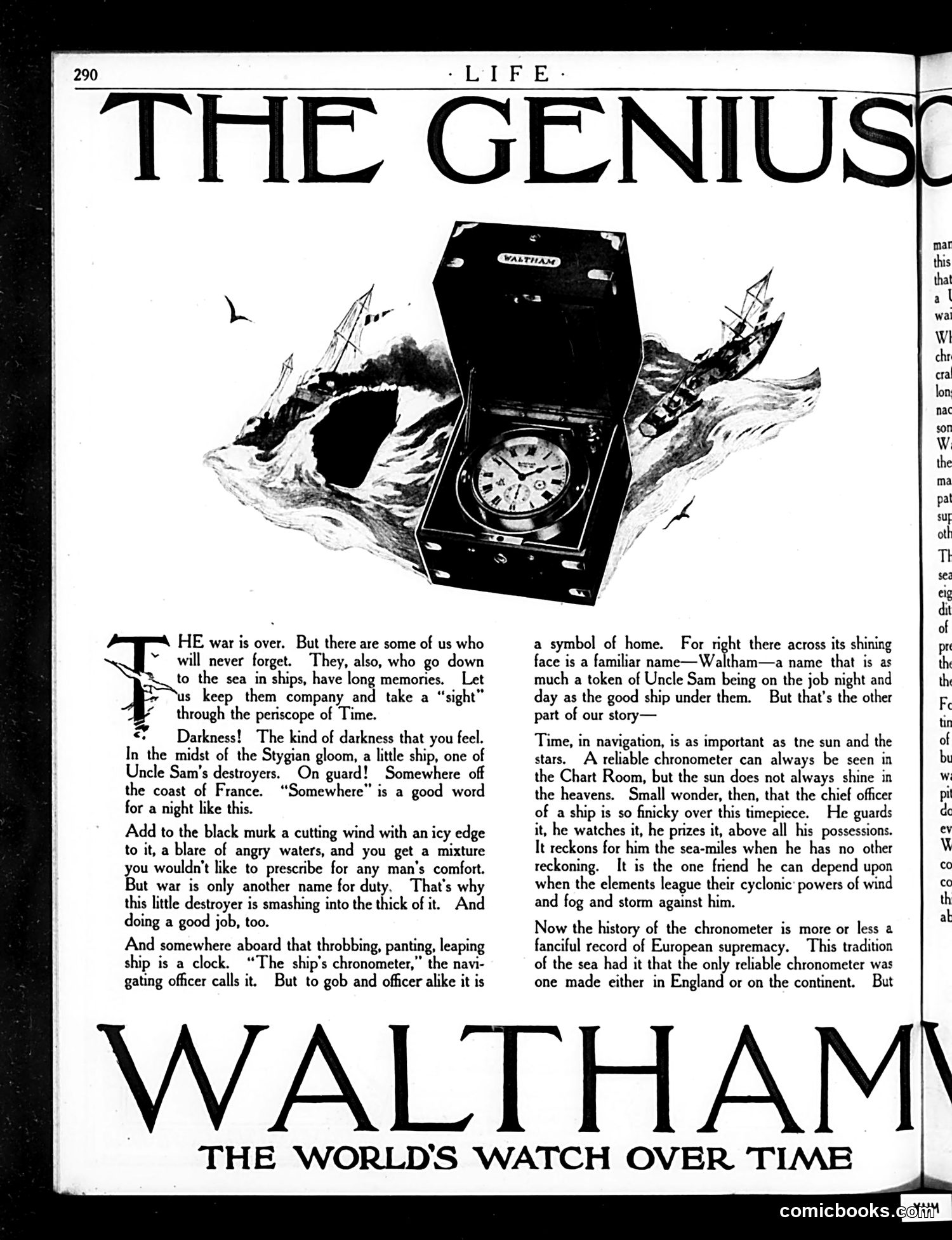
This is primarily a **World War I-era advertisement** disguised as patriotic narrative, not satire. The text celebrates a Waltham chronometer aboard a U.S. Navy destroyer operating off France. The "genius" referenced is the Waltham watch's reliability for naval navigation. The passage romanticizes wartime duty while establishing that American-made Waltham chronometers rival European (British and continental) instruments traditionally trusted at sea. The central image shows a Waltham pocket watch displayed against a dramatic illustration of naval vessels in rough waters, emphasizing the watch's importance to sailors' safety and America's military capability. The advertisement's genius is rhetorical: it wraps commercial messaging in patriotic language about American sailors protecting democracy, suggesting that choosing Waltham is itself a patriotic act. The piece conflates product quality with national honor during wartime.
📄 Transcribed text from this page (OCR, searchable)
Machine-transcribed from the original scan — historical spelling and the odd misread are preserved.
THE GENIU HE war is over. But there are some of us who will never forget. They, also, who go down to the sea in ships, have long memories. Let us keep them company and take a “sight” through the periscope of Time. Darkness! The kind of darkness that you feel. In the midst of the Stygian gloom, a little ship, one of Uncle Sam's destroyers. On guard! Somewhere off the coast of France. “Somewhere” is a good word for a night like this. Add to the black murk a cutting wind with an icy edge to it, a blare of angry waters, and you get a mixture you wouldn’t like to prescribe for any man’s comfort. But war is only another name for duty. That's why this little destroyer is smashing into the thick of it. And doing a good job, too. And somewhere aboard that throbbing, panting, leaping ship is a clock. “The ship’s chronometer,” the navi- gating officer calls it. But to gob and officer alike it is a symbol of home. For right there across its shining face is a familiar name—Waltham—a name that is as much a token of Uncle Sam being on the job night and day as the good ship under them. But that’s the other part of our story— Time, in navigation, is as important as tne sun and the stars. A reliable chronometer can always be seen in the Chart Room, but the sun does not always shine in the heavens. Small wonder, then, that the chief officer of a ship is so finicky over this timepiece. He guards it, he watches it, he prizes it, above all his possessions. It reckons for him the sea-miles when he has no other reckoning. It is the one friend he can depend upon when the elements league their cyclonic: powers of wind and fog and storm against him. Now the history of the chronometer is more or less a fanciful record of European supremacy. This tradition of the sea had it that the only reliable chronometer was one made either in England or on the continent. But WALTHAM THE WORLD'S WATCH OVER TIME comicbooks.