
Life, 1920-08-12 · page 14 of 44
Life — August 12, 1920 — page 14: what you’re looking at
What you’re looking at
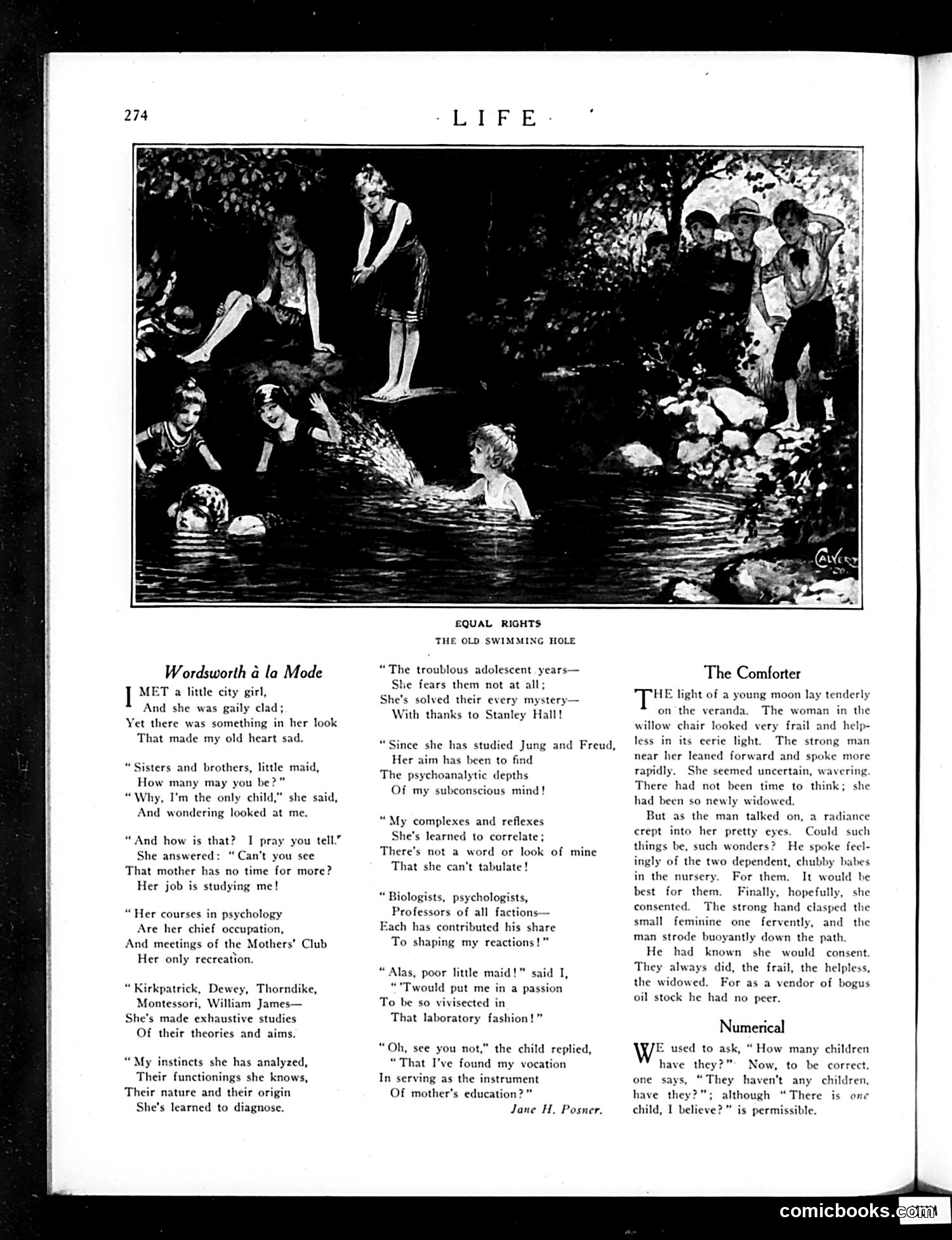
This page presents three poems satirizing early 20th-century women's changing social roles. The illustration shows mixed-gender bathing—a scenario that would have scandalized Victorian society. "Wordsworth à la Mode" mocks an educated woman obsessed with psychology and literary theory (mentioning Jung and Freud), suggesting intellectual pursuits make her unattractive to suitors. "The Comforter" depicts a widowed woman finding comfort from a male visitor, hinting at impropriety or dependence on male companionship. "Numerical" jokes about women claiming to have no children, contrasting modern family-planning attitudes with traditional expectations. The collective title "Equal Rights" suggests ironic commentary: while women gain educational and social freedoms, the poems question whether these changes solve romantic or domestic dilemmas, or create new social awkwardness.
📄 Transcribed text from this page (OCR, searchable)
Machine-transcribed from the original scan — historical spelling and the odd misread are preserved.
Wordsworth a la Mode MET a little city girl, And she was gaily clad; Yet there was something in her look That made my old heart sad. “Sisters and brothers, little maid, How many may you be?” “Why, I'm the only child,” she said, And wondering looked at me. “And how is that? I pray you tell.” She answered: “Can't you see That mother has no time for more? Her job is studying me! “ Her courses in psychology Are her chief occupation, And meetings of the Mothers’ Club Her only recreation. “ Kirkpatrick, Dewey, Thorndike, Montessori, William James— She's made exhaustive studies Of their theories and aims. “My instincts she has analyzed, Their functionings she knows, Their nature and their origin She's learned to diagnose. EQUAL RIGHTS THE OLD SWIMMING HOLE “The troublous adolescent. years— he fears them not at all; She's solved their every mystery— With thanks to Stanley Hall! “Since she has studied Jung and Freud, Her aim has been to find The psychoanalytic depths Of my subconscious mind! “My complexes and reflexes She's learned to correlate; There's not a word or look of mine That she can't tabulate! “ Biologists, psychologists, Professors of all factions— ‘ach has contributed his share To shaping my reactions!” “Alas, poor little maid!” said I, ‘Twould put me in a passion To be so vivisected in That laboratory fashion!” “Oh, see you not,” the child replied, “That I've found my vocation In serving as the instrument Of mother’s education?” Jane H. Posner. The Comforter THe light of a young moon lay tenderly on the veranda. The woman in the willow chair looked very frail and hel less in its eerie light. The strong man near her leaned forward and spoke more rapidly. She seemed uncertain, ering, There had not been time to think; she had been so newly widowed. But as the man talked on, a radiance crept into her pretty eyes. things be, such wonders? He spoke feel- ingly of the two dependent, chubby babes in the nursery. For them, It would be best for them. Finally, hopefully, she consented. The strong hand clasped the small feminine one fervently, and the man strode buoyantly down the path. Could such He had known she would consent They always did, the frail, the helpless, the widowed. For as a vendor of bogus oil stock he had no peer. Numerical E used to ask, “How many children have they?” Now, to be correct, one says, “They haven't any children, have they?"; although “There is one child, I believe?” is permissible. comicbooks.€eni