
A complete issue · 44 pages · 1920
Life — June 10, 1920
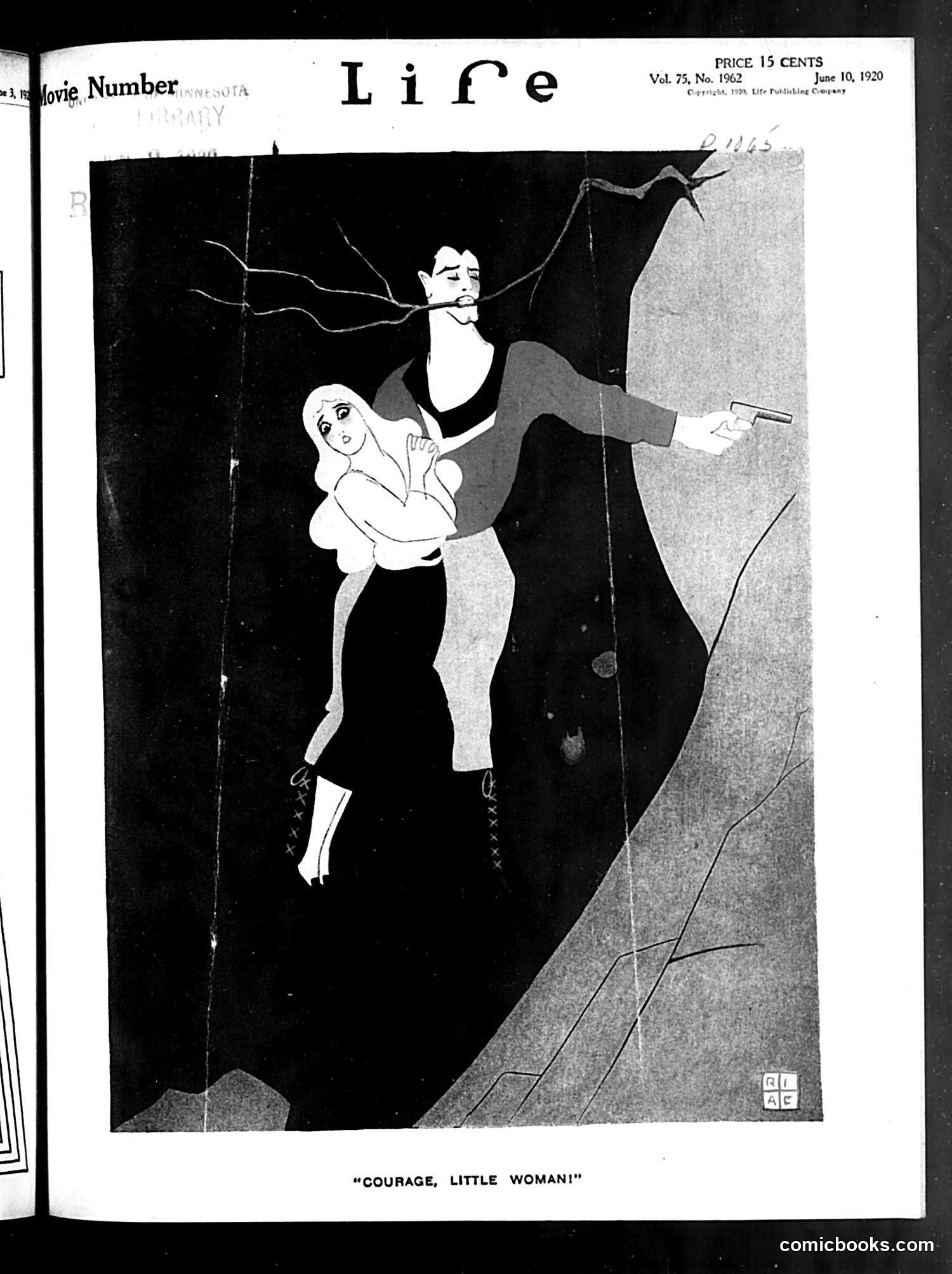
This illustration depicts a dramatic scene of a man in formal dress (appearing menacing, with an exaggerated villainous expression) looming over a frightened woman whom he's carrying away. The caption "Courage, Little Woman!" suggests ironic encouragement to the woman in distress. The 1920 date and style suggest this likely comments on contemporary anxieties about women's safety or autonomy. However, without additional context about specific events or social movements of June 1920, I cannot definitively identify whether this satirizes a particular crime, scandal, or social issue of that moment. The art style is characteristic of Life's satirical approach to contemporary concerns.
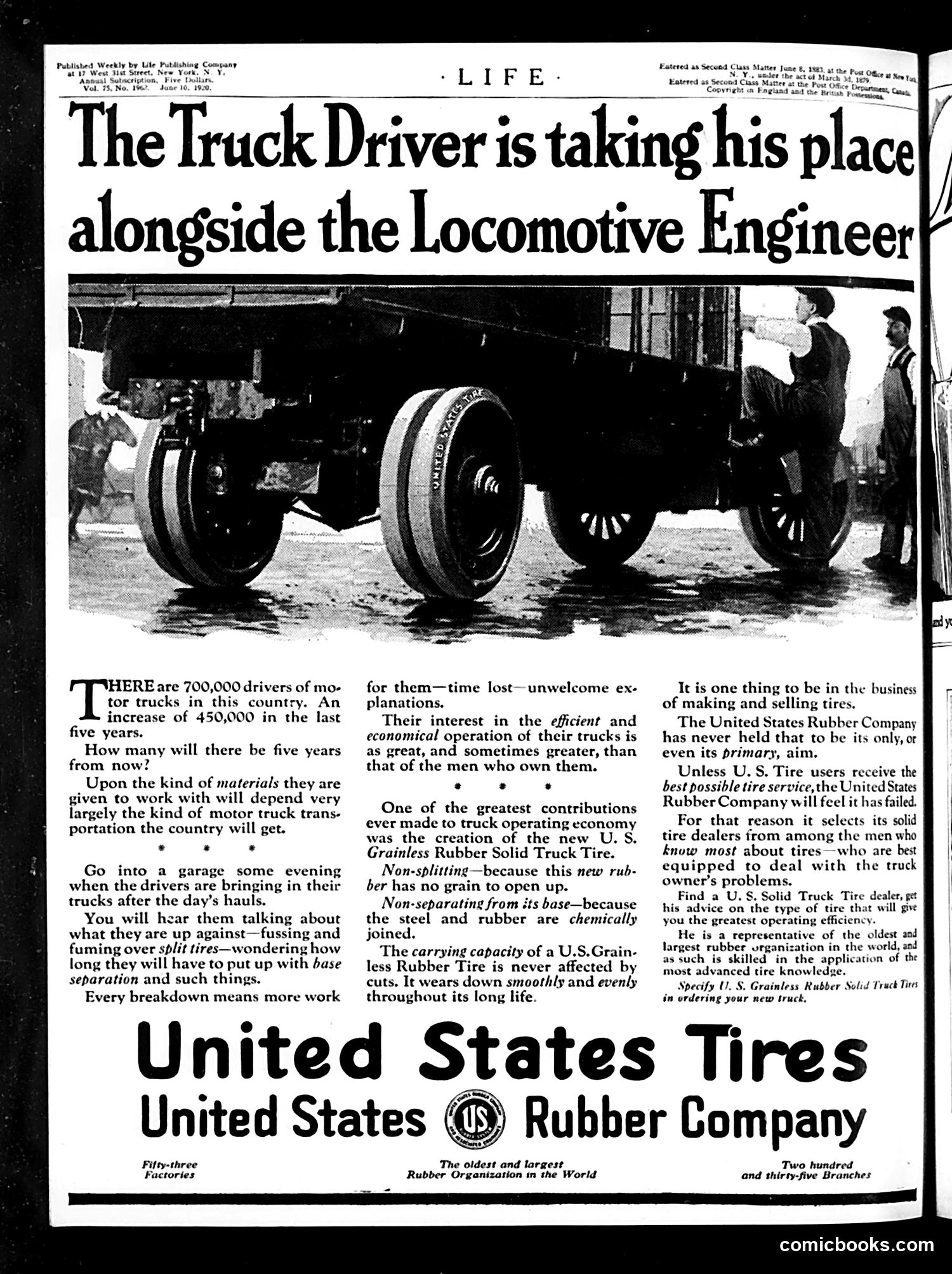
This is primarily a **United States Rubber Company advertisement**, not satirical content. The page promotes U.S. Tires for motor trucks, featuring a photograph of a large commercial truck alongside what appears to be an older locomotive or rail equipment. The headline claims truck drivers are "taking his place alongside the Locomotive Engineer"—suggesting trucks are becoming as important as trains for transportation. The ad emphasizes truck drivers' operational challenges (split tires, breakdowns) and argues U.S. Rubber's "Grainless Solid Truck Tire" solves these problems through non-splitting, non-separating construction. The statistics mention 700,000 truck drivers and project growth, positioning trucking as a modernizing American industry. This reflects genuine 1920s economic shifts toward motorized transportation competing with railways.
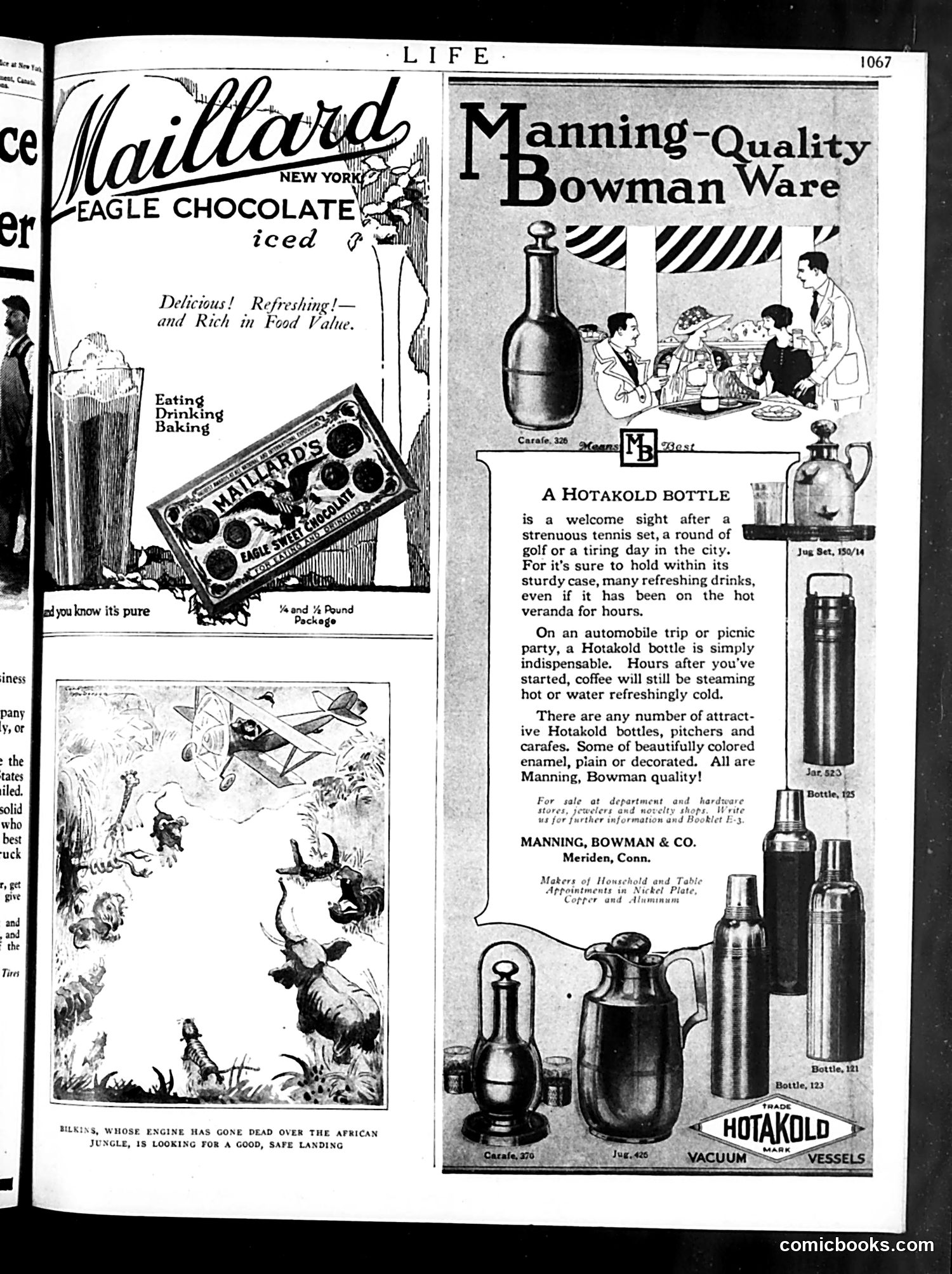
This page is primarily **advertising**, not political satire. The left side features a Maillard Eagle Chocolate advertisement emphasizing the product's purity and versatility ("Eating, Drinking, Baking"). The bottom contains an illustration captioned "SILKS, WHOSE ENGINE HAS GONE DEAD OVER THE AFRICAN JUNGLE, IS LOOKING FOR A GOOD, SAFE LANDING"—this appears to be a narrative cartoon or story illustration rather than political commentary. The right side advertises Manning-Bowman Hotakold vacuum vessels (thermoses and bottles). The ad emphasizes practical benefits for outdoor activities like tennis, golf, and picnics. Both advertisements reflect early 20th-century consumer culture and product marketing rather than satirical commentary on political or social issues.
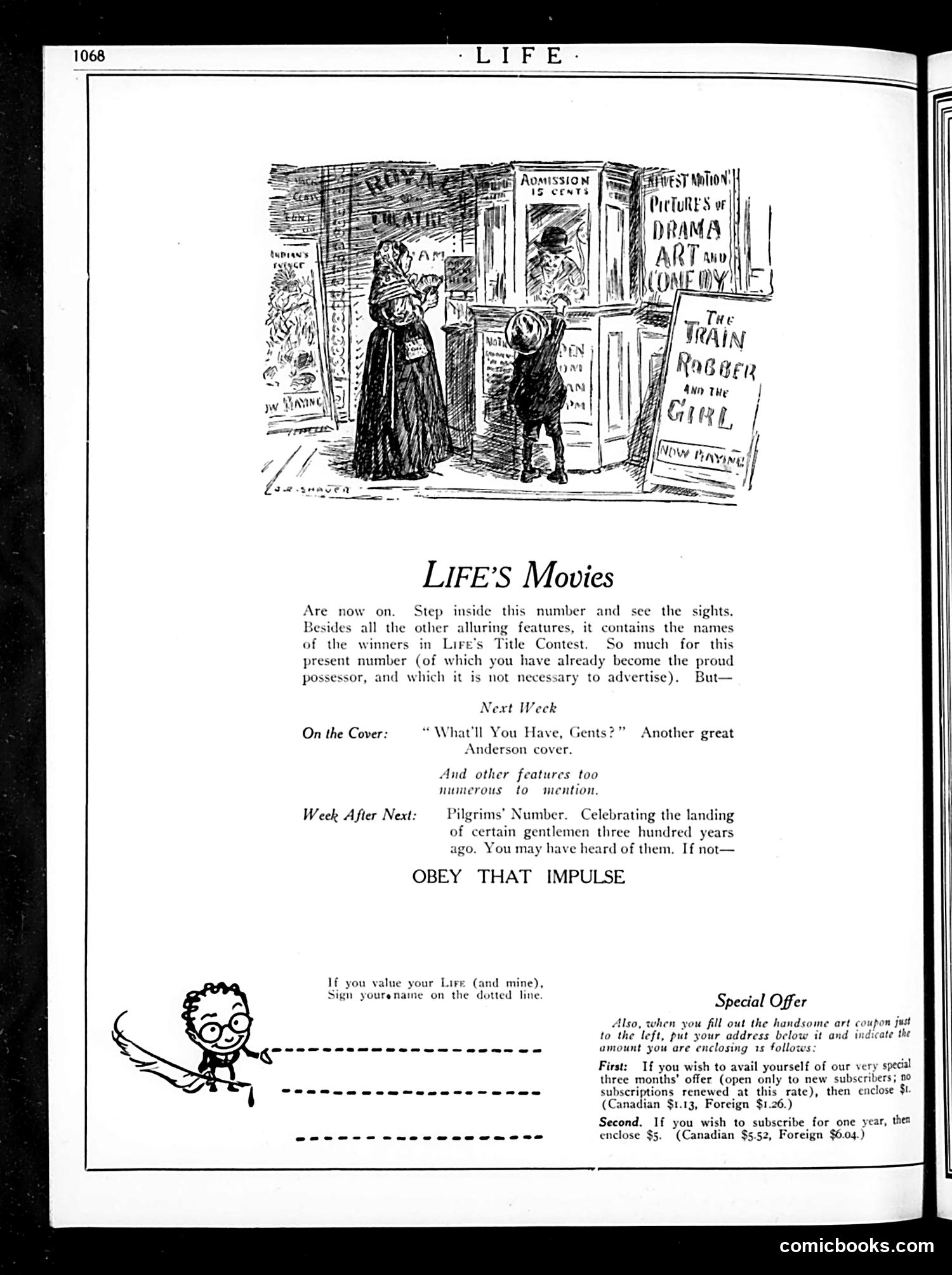
This page is primarily **advertising and promotion** for Life magazine itself, not political commentary. The main illustration shows a theater entrance with multiple movie advertisements and signs, depicting potential patrons considering what film to see. This visualizes Life's claim that "Life's Movies are now on"—promoting their film-related content. The page announces upcoming features: next week's cover will be "What'll You Have, Gents?" (another Anderson illustration), and the week after will feature a "Pilgrims' Number" about the Pilgrims' landing 300 years prior. The bottom section includes a subscription offer with tiered pricing for new and renewal subscriptions. This is essentially a **house advertisement**—Life promoting its own upcoming issues and encouraging reader subscription, not satirizing external political or social issues.
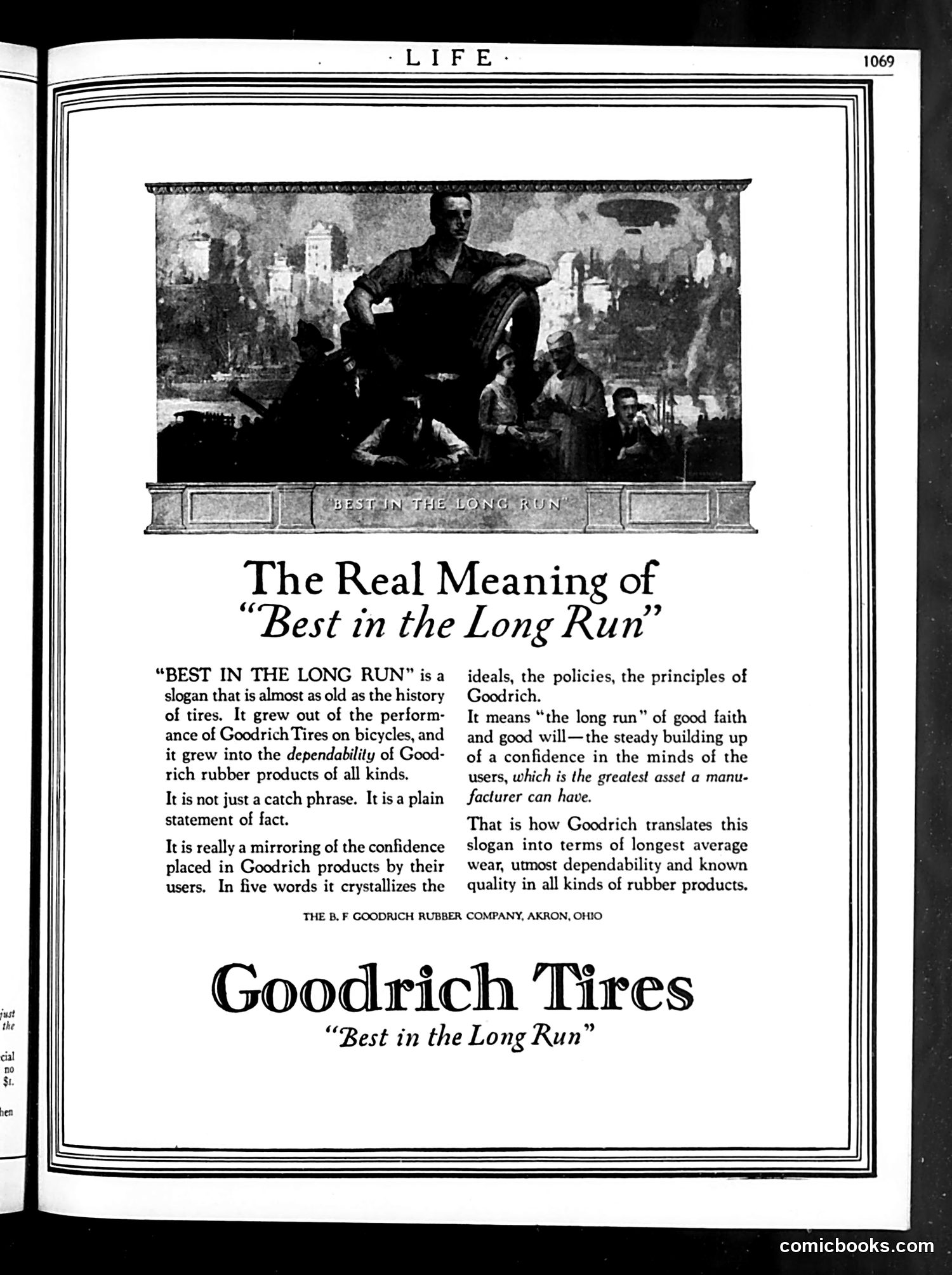
This page is primarily **advertising, not satire or editorial content**. It's a Goodrich Tires advertisement from Life magazine (page 1069). The image shows a dramatic scene with a large central figure and onlookers against a cityscape backdrop, but it serves as promotional imagery rather than political commentary. The ad explains Goodrich's slogan "Best in the Long Run"—a statement about tire durability and reliability rather than a satirical message. The text describes how the phrase reflects consumer confidence in Goodrich products, emphasizing "longest average wear, utmost dependability and known quality." This is straightforward commercial messaging about product quality, not a cartoon with political or social satire to decode.
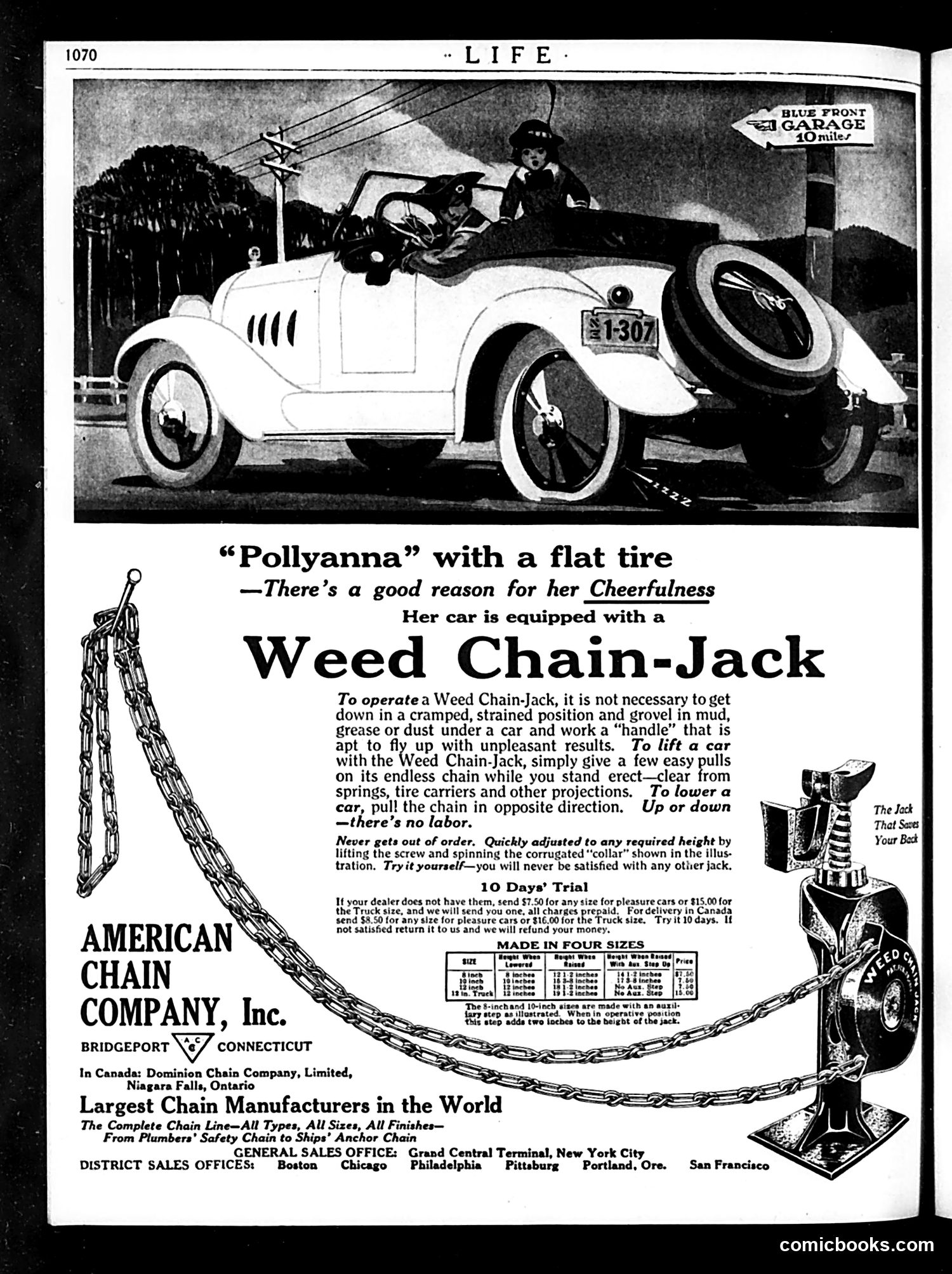
This page is primarily **advertising, not satire or political commentary**. It's a full-page advertisement for the Weed Chain-Jack, a mechanical lifting device manufactured by American Chain Company of Bridgeport, Connecticut. The ad features a character named "Pollyanna" (referencing the famous optimistic literary character) with a flat tire, cheerfully using the chain-jack to lift her car. The humor is gentle and commercial: the ad plays on Pollyanna's characteristically positive attitude, suggesting that even with a flat tire, she remains cheerful because she has this convenient tool. The copy emphasizes the jack's ease of use—no need to crouch in mud or dirt—and promotes its safety and adjustability. This reflects early-20th-century automobile culture when tire repairs were routine roadside tasks.
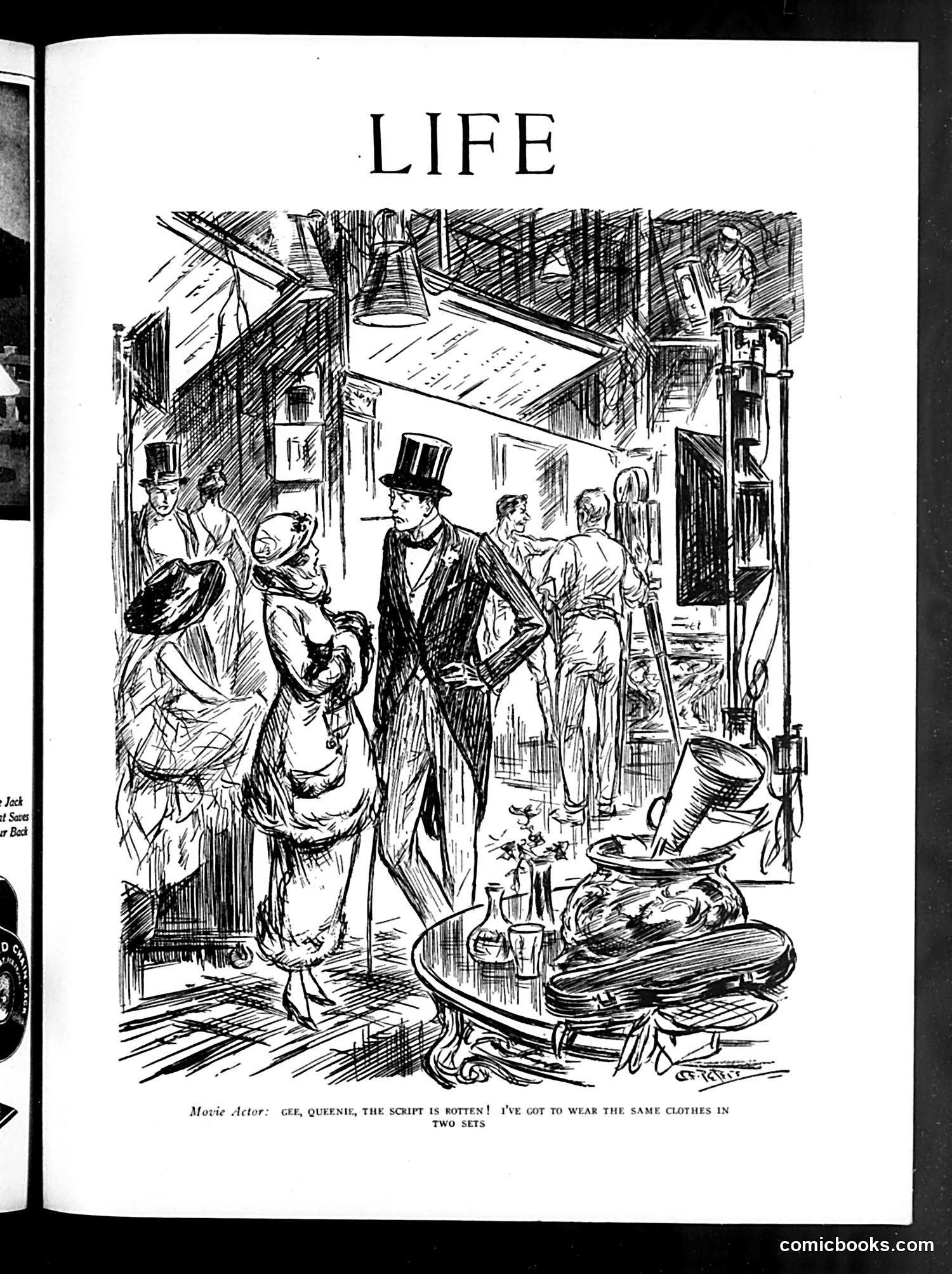
This is a satirical cartoon from *Life* magazine depicting a scene on a movie set. The caption reads: "Movie Actor: GEE, QUEENIE, THE SCRIPT IS ROTTEN! I'VE GOT TO WEAR THE SAME CLOTHES IN TWO SETS" The humor targets the absurdity of early film production constraints. The well-dressed male actor (in top hat) complains to a woman (likely playing a character named "Queenie") about a trivial wardrobe issue—wearing identical costumes across different scenes—as if this is a serious problem despite the script itself being "rotten" (poorly written). The satire mocks actors' priorities: they're concerned with minor costume logistics rather than the fundamental quality of the screenplay. It's commentary on Hollywood's superficiality and the disconnect between production realities and artistic substance. The crowded studio set in the background emphasizes the chaos of early filmmaking.
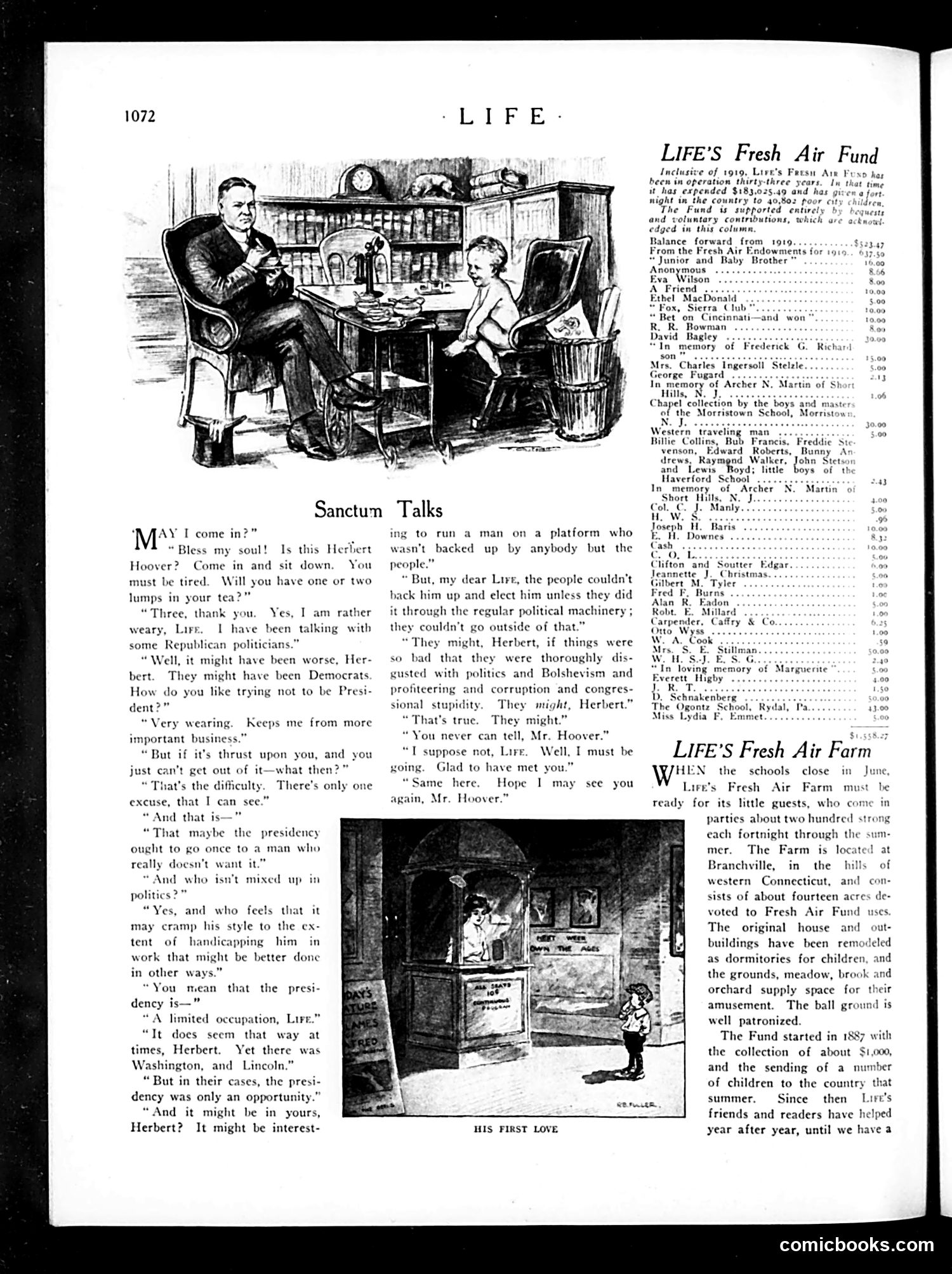
This cartoon depicts a conversation between two figures in an office setting. The dialogue suggests a satirical critique of President Herbert Hoover's political approach and isolation from public concerns. The speaker (likely representing an editor or political commentator) criticizes Hoover for surrounding himself with Republican politicians while remaining disconnected from ordinary people's struggles. The satire targets Hoover's preference for limited political engagement and his reliance on "regular political machinery" rather than direct popular involvement. The cartoon's point: Hoover's presidency operates within narrow political circles disconnected from broader democratic participation and public welfare concerns—a common criticism during the Great Depression era when Hoover's policies faced widespread opposition.
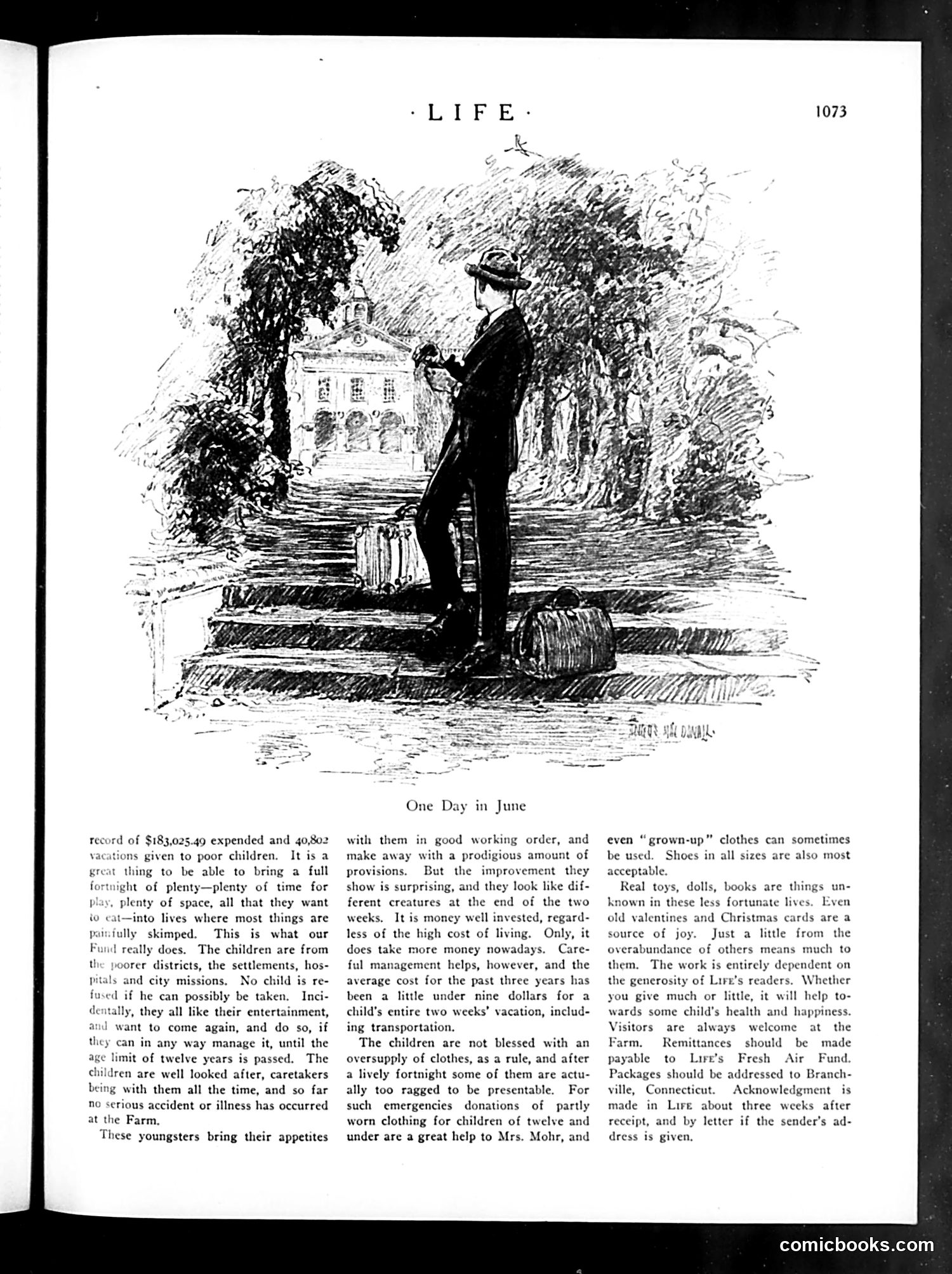
This illustration depicts a well-dressed man in formal attire and hat standing on railroad tracks, gazing toward a distant building (likely an institution or estate) framed by trees. The title "One Day in June" suggests a specific moment of reflection or anticipation. The accompanying text discusses charitable work for impoverished children, mentioning a farm operation that provides clothing, food, and recreation. The passage emphasizes that even modest donations help—children don't need fancy clothes, just practical ones. It references donations of "partly worn clothing" and mentions acknowledgments made through Life magazine, with contributions directed to "Mrs. Mohr" in Branchville, Connecticut. The illustration likely romanticizes charitable giving or institutional care for disadvantaged youth.
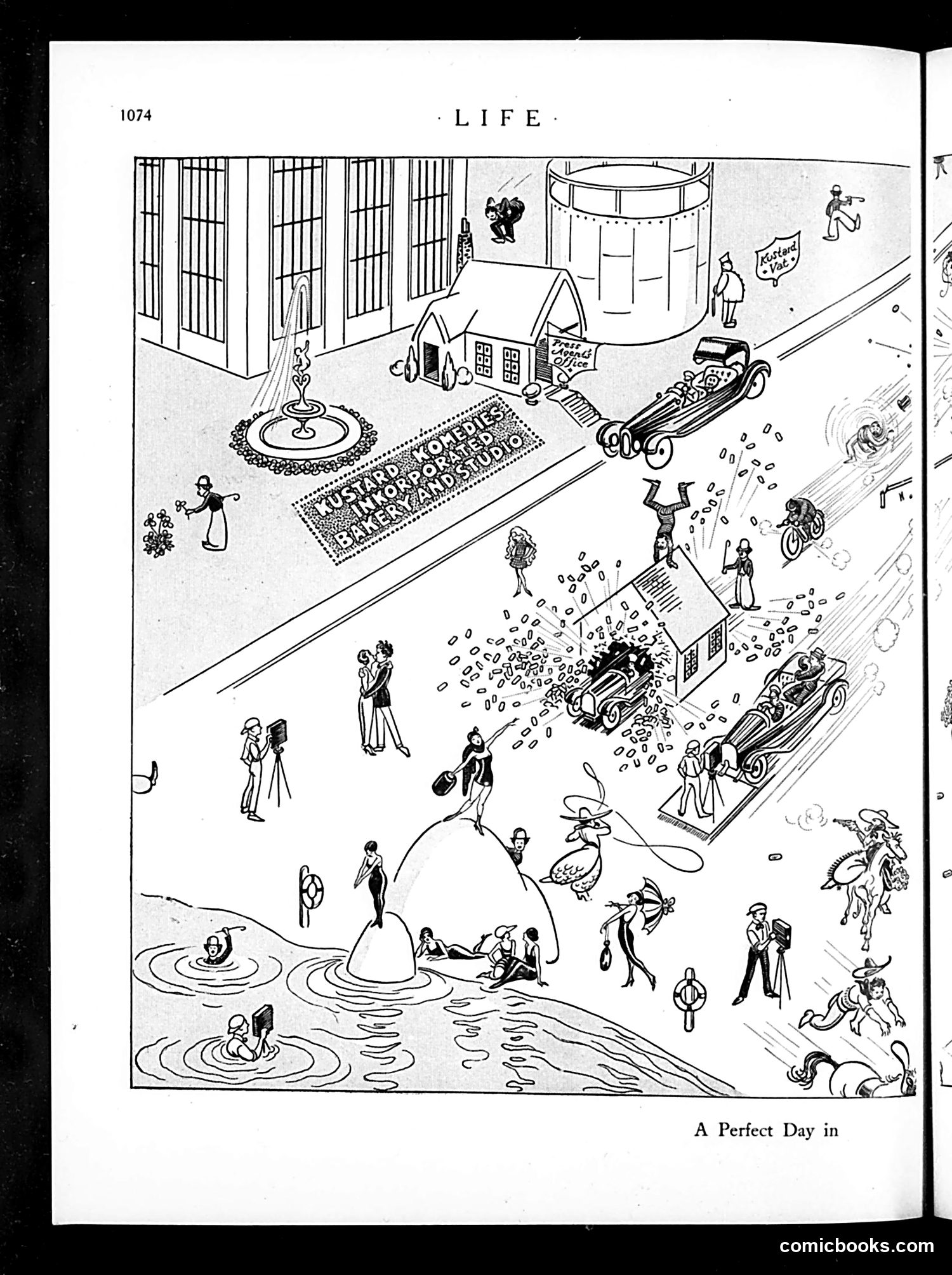
This illustration titled "A Perfect Day in" (title incomplete) depicts an idealized urban leisure scene from what appears to be the 1920s-1930s. The cartoon satirizes modern city life by showing numerous simultaneous recreational activities: people swimming in pools, riding in automobiles and motorcycles, attending entertainment at buildings labeled with signs, playing sports, and various other pastimes. The satire likely critiques the frenetic, consumption-driven nature of American urban leisure culture—the notion that a "perfect day" requires constant activity and participation in multiple commercial entertainments simultaneously. The crowded, chaotic composition emphasizes how modern life demands fitting diverse pleasures into limited time, reflecting contemporary anxieties about speed, commercialism, and the pressure to maximize leisure experiences.
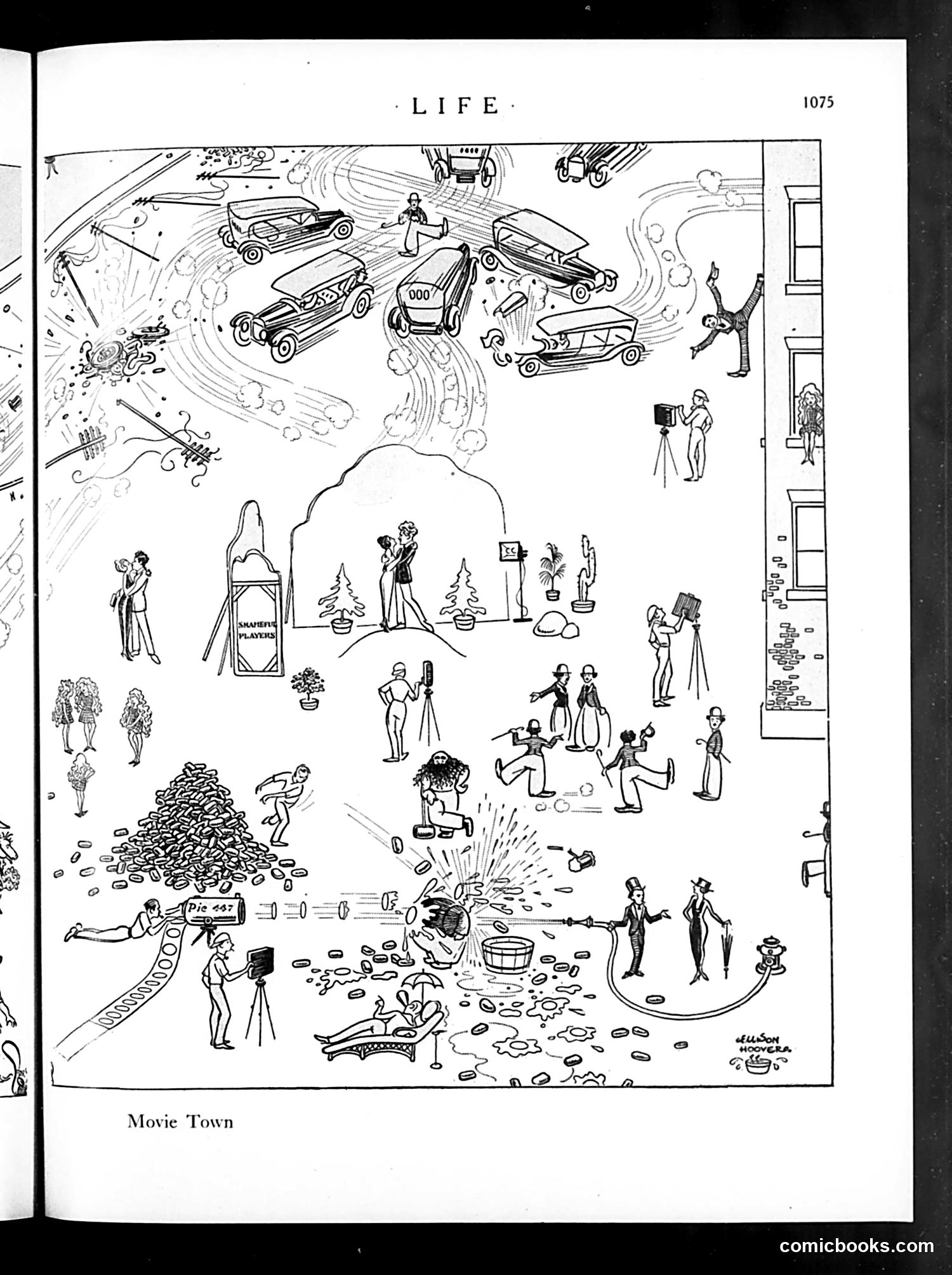
This cartoon satirizes Hollywood film production, depicting a bustling studio backlot or set where multiple movie scenes are simultaneously being filmed. The upper portion shows futuristic or fantastical elements—flying vehicles and elaborate mechanical contraptions—suggesting the kinds of spectacular special effects and imaginative scenarios Hollywood was beginning to produce. The lower section shows more everyday scenes: people engaged in various activities, romantic moments, physical comedy, and dramatic confrontations. The joke appears to mock the artificial, constructed nature of filmmaking itself—the contrast between elaborate movie fantasies and mundane reality. It satirizes how Hollywood creates entire fabricated worlds for entertainment, with numerous crews, cameras, and personnel coordinating to produce what audiences perceive as authentic drama or spectacle.
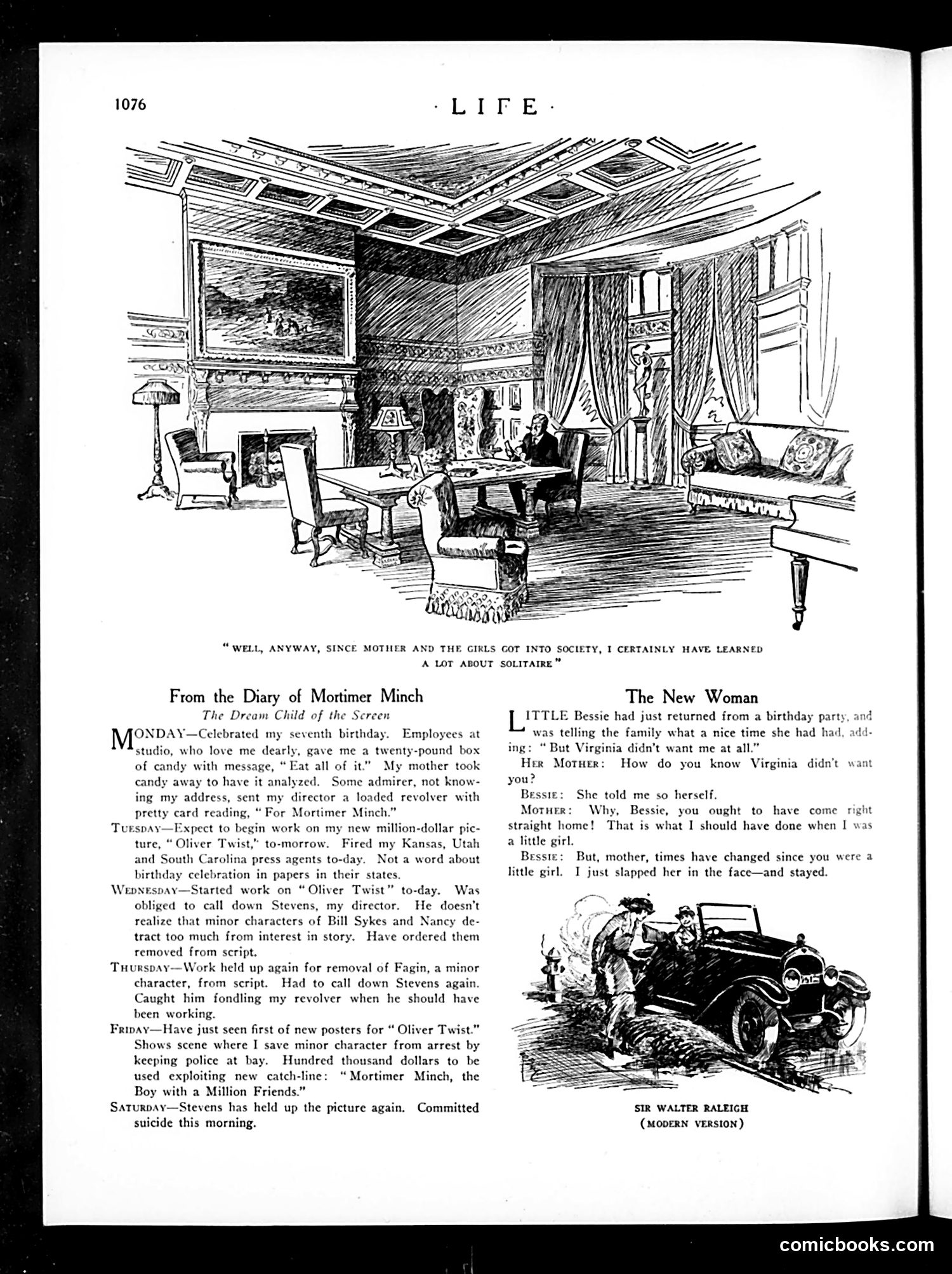
This page contains two distinct pieces: 1. **"From the Diary of Mortimer Minch"** — A satirical diary column documenting a film director's weekly frustrations. It mocks Hollywood production, including removing minor characters from scripts, managing difficult actors, and studio politics surrounding films like "Oliver Twist." 2. **"The New Woman"** — A brief satirical dialogue between a mother and her daughter Bessie, who recently attended a birthday party. The joke hinges on generational conflict: modern girls (the "New Woman") behave differently than their mothers did, with Bessie casually mentioning slapping another girl rather than conforming to expected ladylike behavior. 3. **"Sir Walter Raleigh (Modern Version)"** — A cartoon depicting Raleigh in a car wreck instead of his historical gallant gesture, satirizing how modern versions trivialize historical romance. The overall theme critiques contemporary social changes and modern behavior.
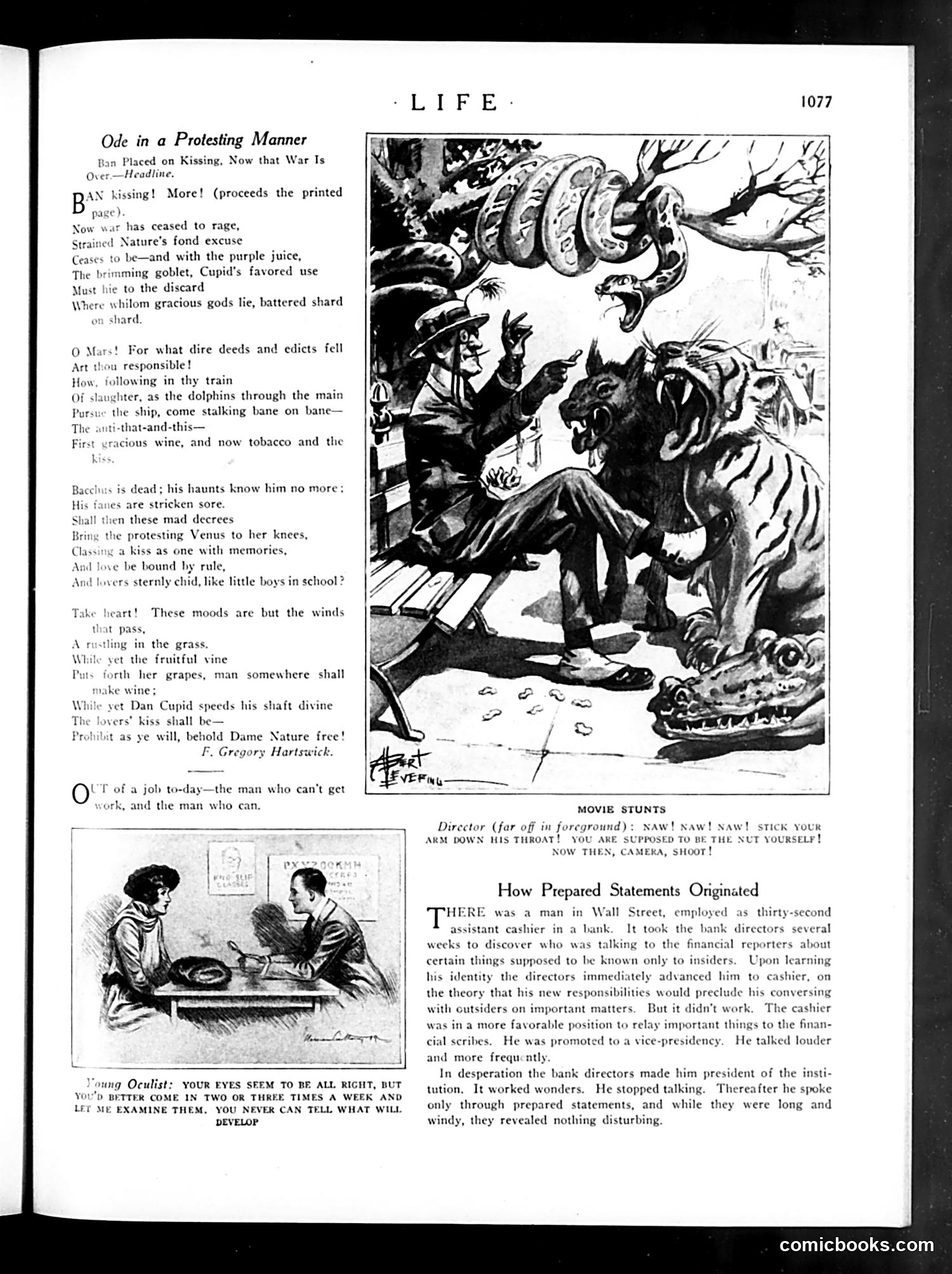
**Main Cartoon ("Ode in a Protesting Manner"):** This satirical poem protests post-WWI conditions, mocking the abandonment of classical values and gods. It critiques the shift toward materialism ("tobacco and the kiss"), the death of idealism ("Bacchus is dead"), and war's brutality. The accompanying illustration shows a man in military uniform confronting serpent-like creatures—likely representing war, chaos, or social corruption—among dead trees and barren landscape. The satire protests what the poet sees as civilization's moral decay following the war. **Lower Section:** "Movie Stunts" features a comedic illustration about film stunt direction, while "How Prepared Statements Originated" is a short prose piece satirizing corporate bureaucracy—specifically how a bank cashier's promotion to vice-president led him to communicate only through prepared statements rather than direct conversation, revealing institutional absurdity.
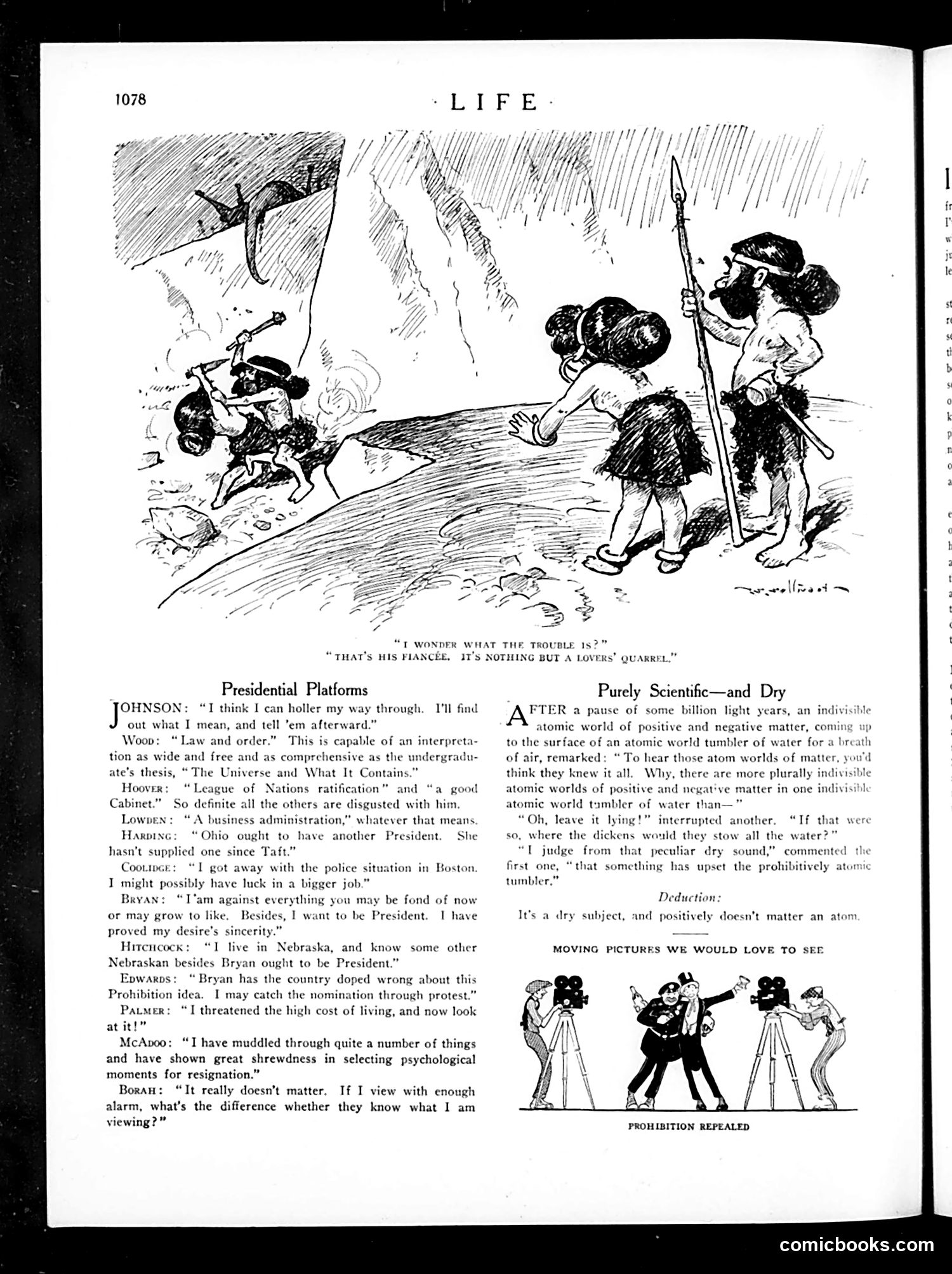
**Top Cartoon**: Depicts primitive figures (one flying, others with spears) in a quarrel. The caption reads: "I wonder what the trouble is? That's his fiancée. It's nothing but a lovers' quarrel." This is a anthropological humor joke playing on the idea that even "primitive" peoples experience romantic conflict—suggesting that relationship disputes are universal across all stages of human development. **"Presidential Platforms"**: A section mocking various presidential candidates' vague or contradictory positions on issues like tariffs, prohibition, and presidential succession. The satire ridicules politicians for speaking in generalities and platitudes rather than substantive policy. **"Prohibition Repealed"**: A small cartoon celebrating the end of Prohibition, depicting film industry celebration with movie cameras.
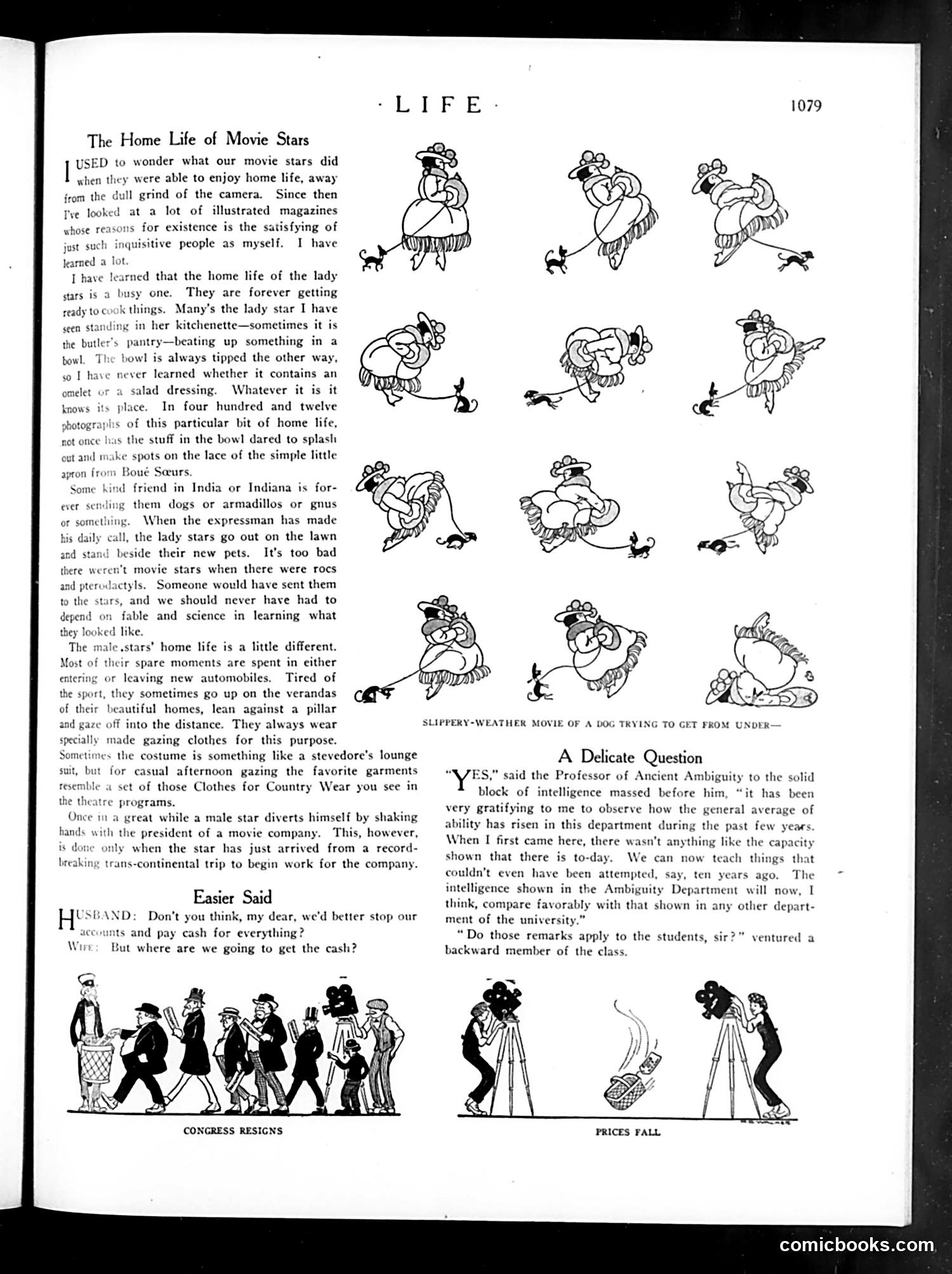
**Main Content: "The Home Life of Movie Stars"** The article discusses the domestic lives of film actors, noting they're constantly busy preparing meals. It contrasts female stars (frequently seen in kitchens) with male stars who spend leisure time in automobiles or relaxing at home. **Cartoon Section: "A Delicate Question"** A professor of "Ancient Ambiguity" presents observations to a class about general intelligence levels in his department. A student asks if these remarks apply to students, creating a self-deprecating academic joke about whether professors or students are less intelligent. **Bottom Cartoons:** "Congress Resigns" and "Prices Fall" are political gags depicting financial/economic concerns—likely Depression-era commentary on economic instability and congressional dysfunction, presented as satirical wish fulfillment.
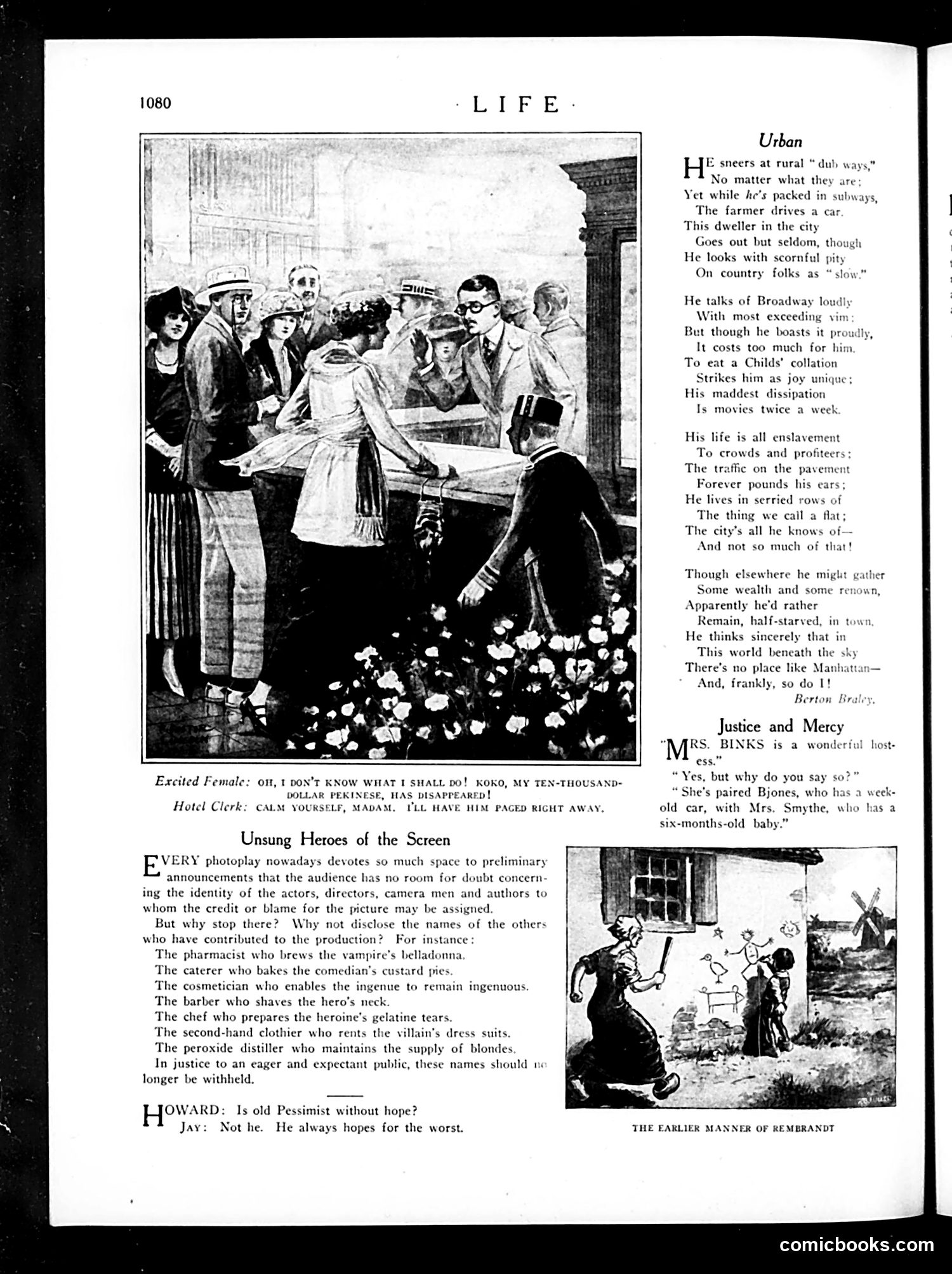
This page satirizes the lifestyle of wealthy urban dwellers during the early 20th century. The main poem "Urban" contrasts city sophistication with rural simplicity—the protagonist boasts about Broadway and expensive entertainments while scorning country people as "slow." The satire lies in exposing his pretensions: he's actually confined to cramped apartments, endures constant noise and crowds, and finances his meager pleasures (cheap movies) through financial strain. The accompanying illustration shows a hotel scene where an excited woman has discovered a lost ten-thousand-dollar diamond. The satire suggests urban life revolves around materialism and status anxiety—everyone's drama centers on wealth and luxury goods rather than genuine contentment. The brief dialogue joke plays on pessimism, reinforcing themes of urban malaise beneath surface glamour.
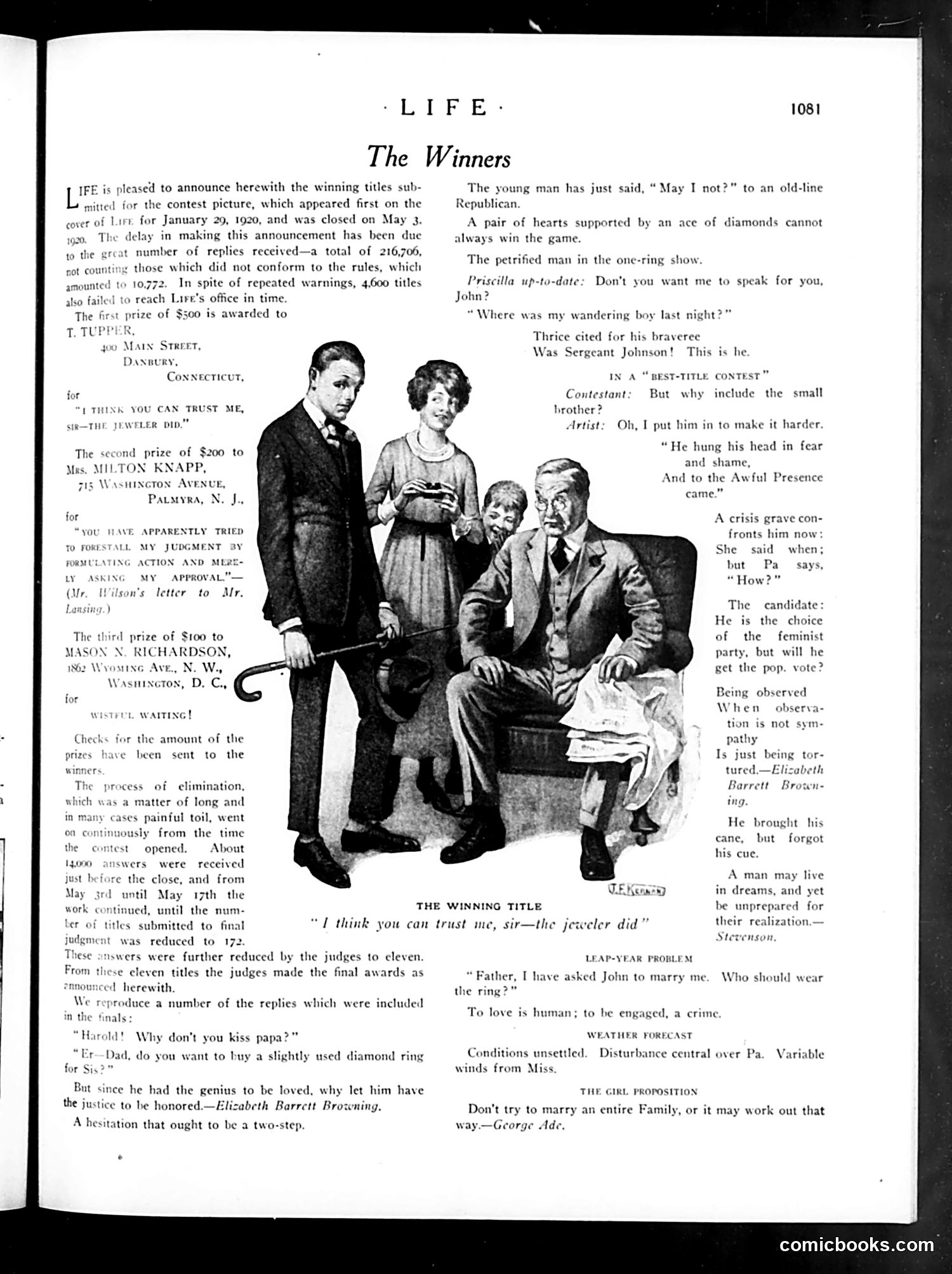
This page announces winners of Life's captioning contest for a cartoon showing a family group with a man displaying a diamond ring. The winning caption—"I think you can trust me, sir—the jeweler did"—appears to be a joke about a salesman or jeweler reassuring a skeptical father about purchasing an engagement ring. The other contestant captions shown are satirical observations on courtship, engagement, and family dynamics typical of 1920s Life magazine humor. References include Woodrow Wilson (a second-prize entry about forestalling judgment), leap-year proposals, feminist political concerns, and general romantic predicaments. The page reflects Life's role as a sophisticated humor magazine featuring wordplay and social commentary rather than just visual gags. The contest drew over 216,000 entries, demonstrating the magazine's substantial readership during this period.
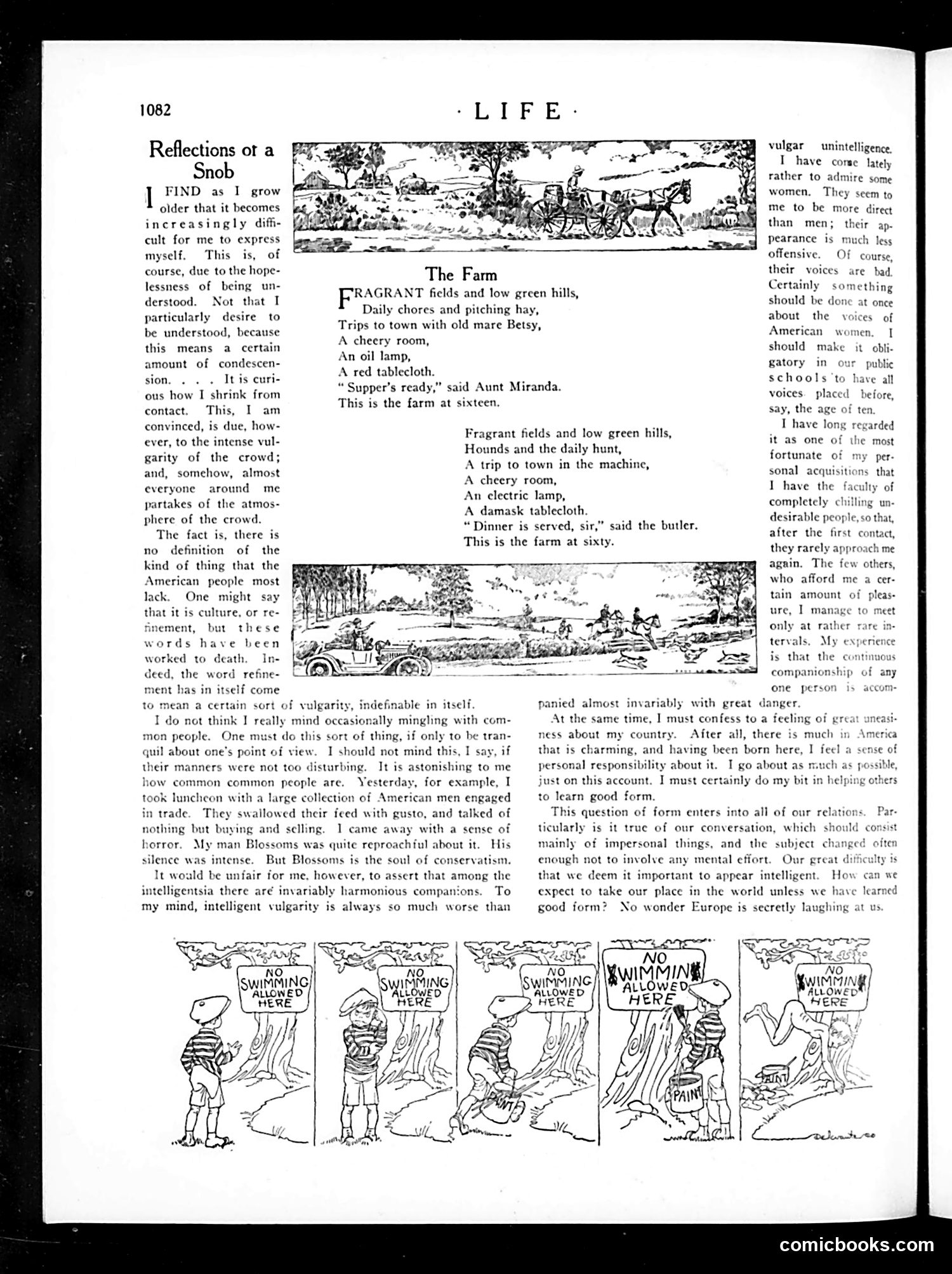
This page contains a satirical essay titled "Reflections of a Snob" mocking upper-class pretension. The unnamed narrator claims intellectual superiority while complaining that common people lack "culture" and "refinement." The irony is intentional—the author is ridiculing the speaker's own snobbery, not endorsing it. The accompanying poem "The Farm" contrasts rural simplicity at age sixteen with wealth and formality at sixty, suggesting that prosperity brings pretension rather than genuine improvement. The bottom cartoon shows a child repeatedly ignoring "No Swimming" signs at a swimming hole, each panel showing escalating consequences (getting caught, being chased, pain). The final panel reads "NO SWIMMING ALLOWED HERE"—the joke being that rules exist precisely because people ignore them. Together, the page satirizes American class anxiety and the obsession with appearing "refined" rather than being genuinely good or honest.
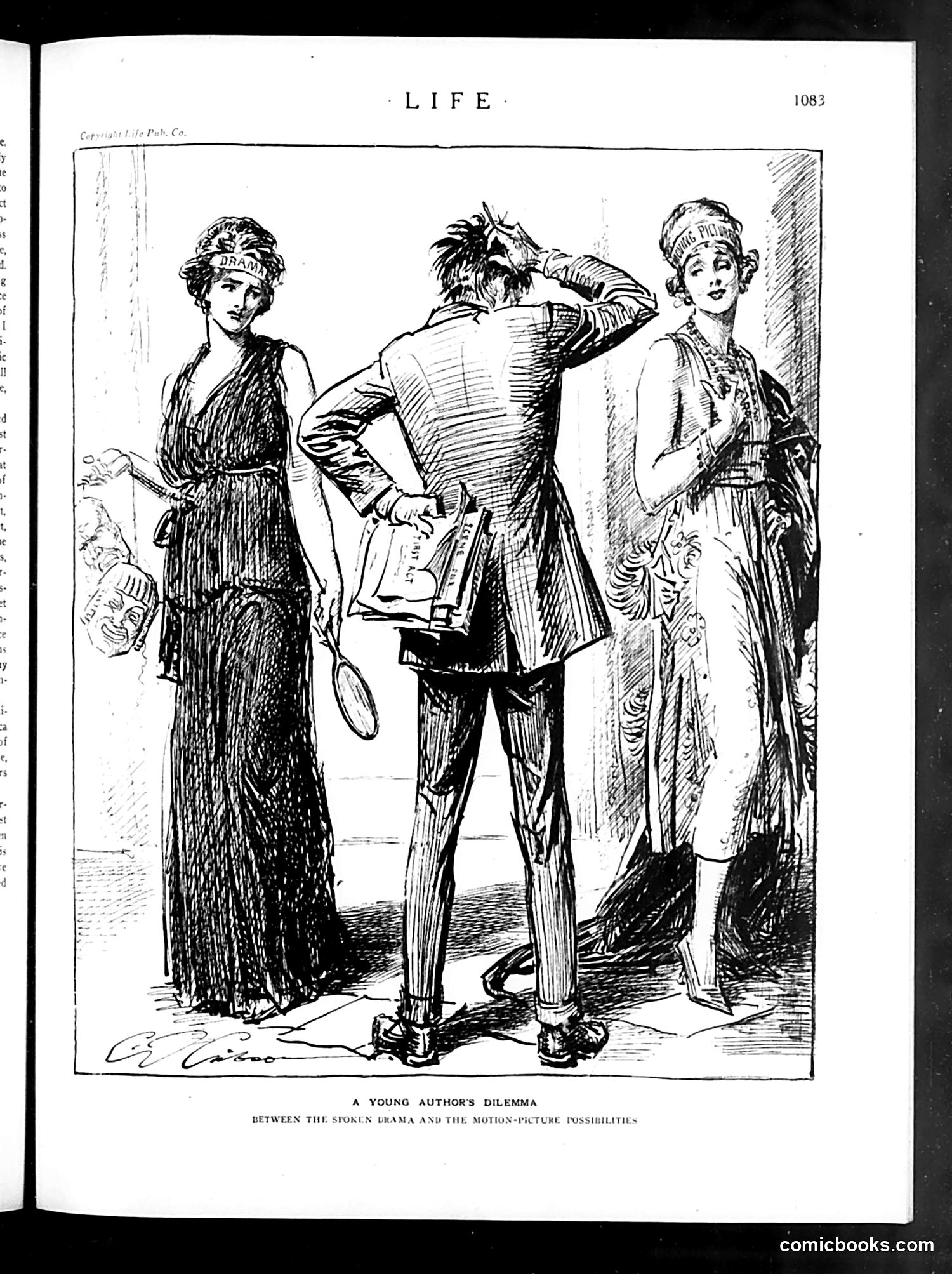
This cartoon satirizes the creative choices facing young playwrights in the early 20th century. A man in formal attire stands between two fashionably dressed women, each labeled with headbands reading "DRAMA" and "MOTION PICTURE" respectively. The caption identifies this as depicting a conflict "between the spoken drama and the motion-picture possibilities." The satire comments on how emerging film technology was tempting writers away from traditional theater toward the lucrative movie industry. The man's indecisive posture—adjusting his hair while looking between both women—humorously portrays the difficult professional choice facing authors of that era. Both entertainment forms are personified as attractive options competing for the writer's loyalty and talent.
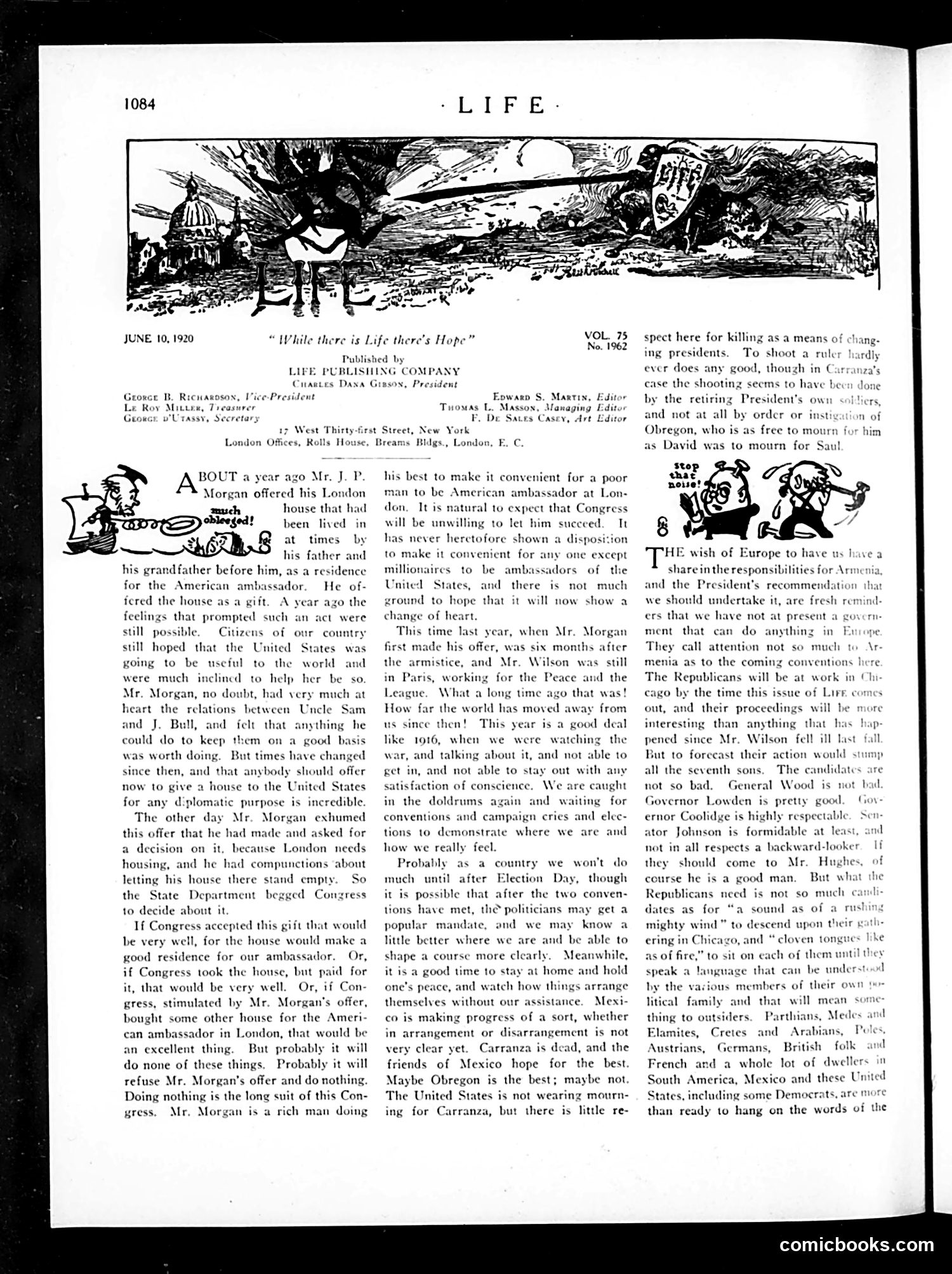
This editorial cartoon satirizes Congressional inaction. The context: J.P. Morgan (the wealthy banker) offered his London mansion as a residence for the American ambassador—a generous gesture to improve U.S.-British relations. The satire targets Congress's chronic inability to act. The editorial presents three reasonable options: accept the gift, accept it but pay Morgan, or buy another house. Yet Life predicts Congress will do nothing, calling inaction "the long suit of this Congress." The cartoon's implicit joke: Morgan (representing private wealth and goodwill) attempts to help a "poor man" become ambassador, but Congress's incompetence will frustrate even the richest man's philanthropic efforts. The piece also references post-WWI weariness—Americans are tired, confused about foreign policy, and waiting for the upcoming 1920 election before taking positions on anything substantial.
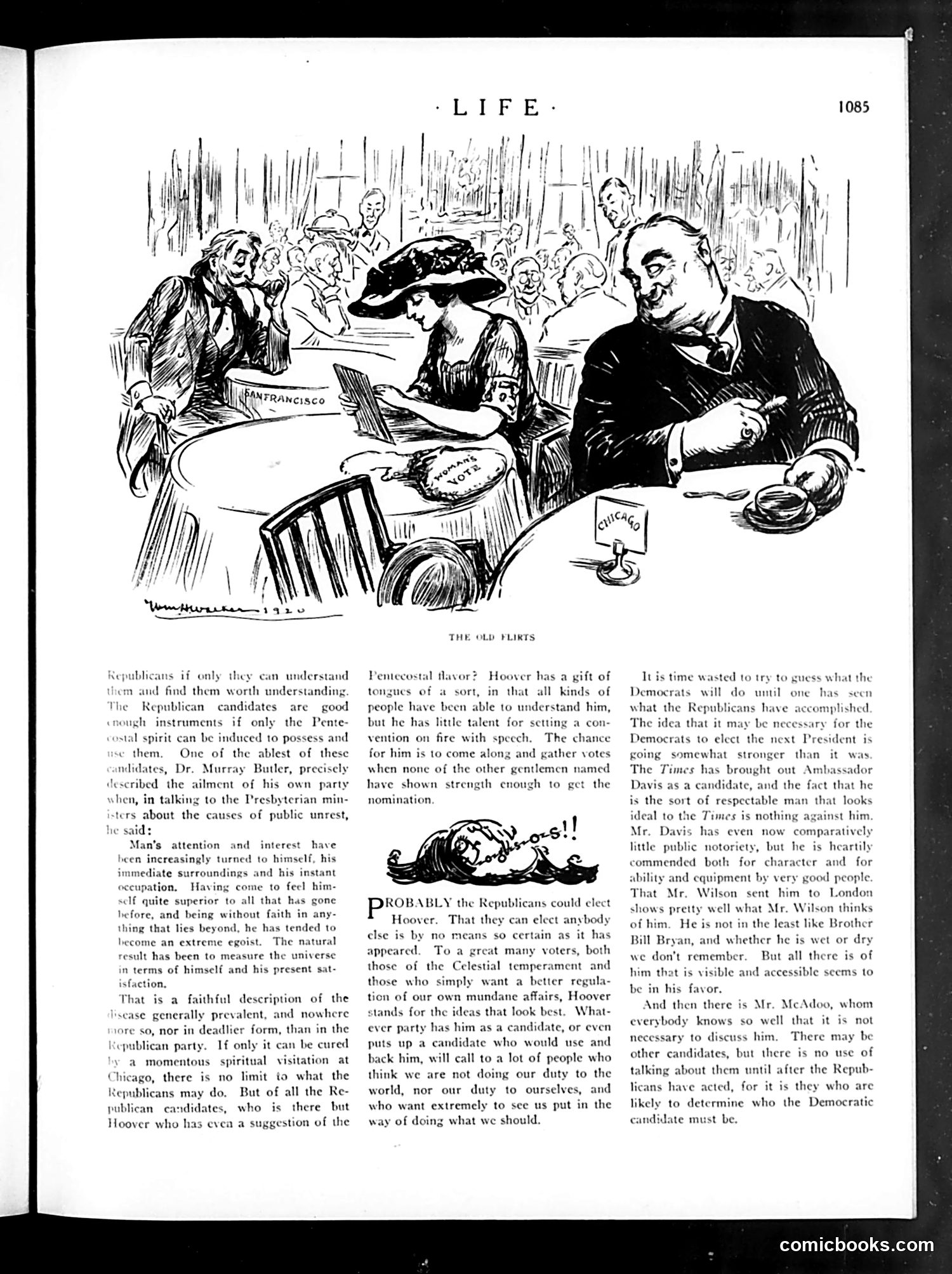
**The Cartoon:** Depicts men and women in a restaurant/social setting labeled "Chicago," with a woman reading a newspaper marked "SAN FRANCISCO" flirting with two men—one portly gentleman on the right holding a drink marked "CHICAGO." **The Satire:** This is commentary on the 1928 U.S. presidential race. The text discusses Republican and Democratic candidates, particularly praising **Herbert Hoover** as the Republican nominee who could appeal to diverse voters. The metaphor of "old flirts" suggests the two parties are essentially interchangeable suitors courting voters. **Key References:** - **Hoover**: Republican candidate praised for his broad appeal ("gift of tongues") - **Ambassador Davis** and **McAdoo**: mentioned as potential Democratic candidates - The article argues Republicans will likely choose the nominee, forcing Democrats to respond **The Point:** Voters (represented by the flirting woman) are being courted by both parties, but the outcome depends on Republican decisions first. The "flirtation" suggests political courtship is superficial—parties compete for attention rather than substantive differences.
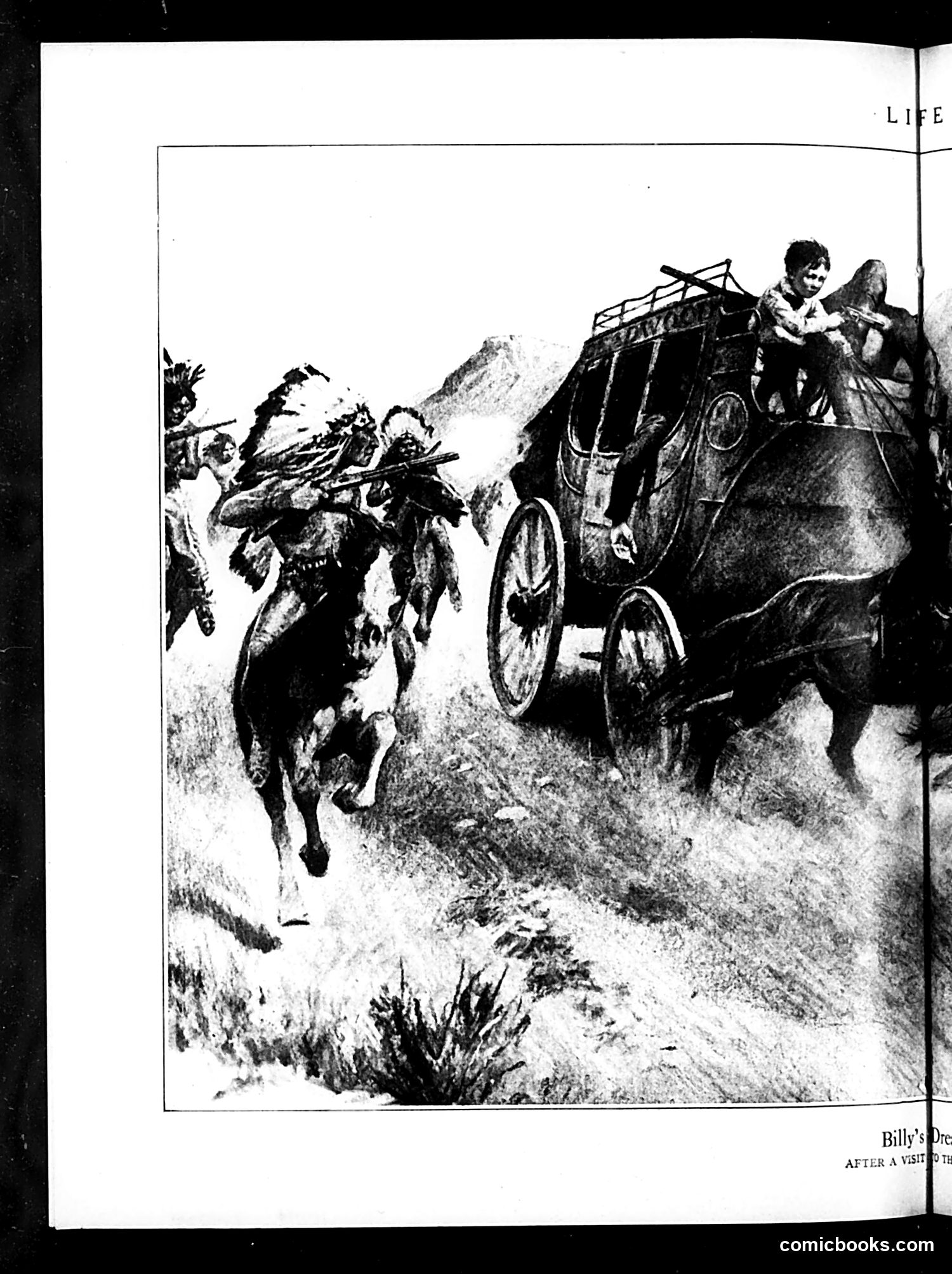
This appears to be an illustration from Life magazine showing a dramatic scene of a horse-drawn carriage on a rural road. Figures on horseback appear to be pursuing or escorting the carriage, which contains passengers including what looks like a woman and child. The incomplete caption reads "AFTER A VISIT TO TH[E]" — the full text is cut off, making it impossible to identify the specific political or social reference with certainty. Without the complete caption or publication date visible, I cannot definitively explain what event or figure this satirizes. The scene suggests either a kidnapping/rescue narrative or commentary on travel/social interaction, but the satire's specific target remains unclear from this page alone.
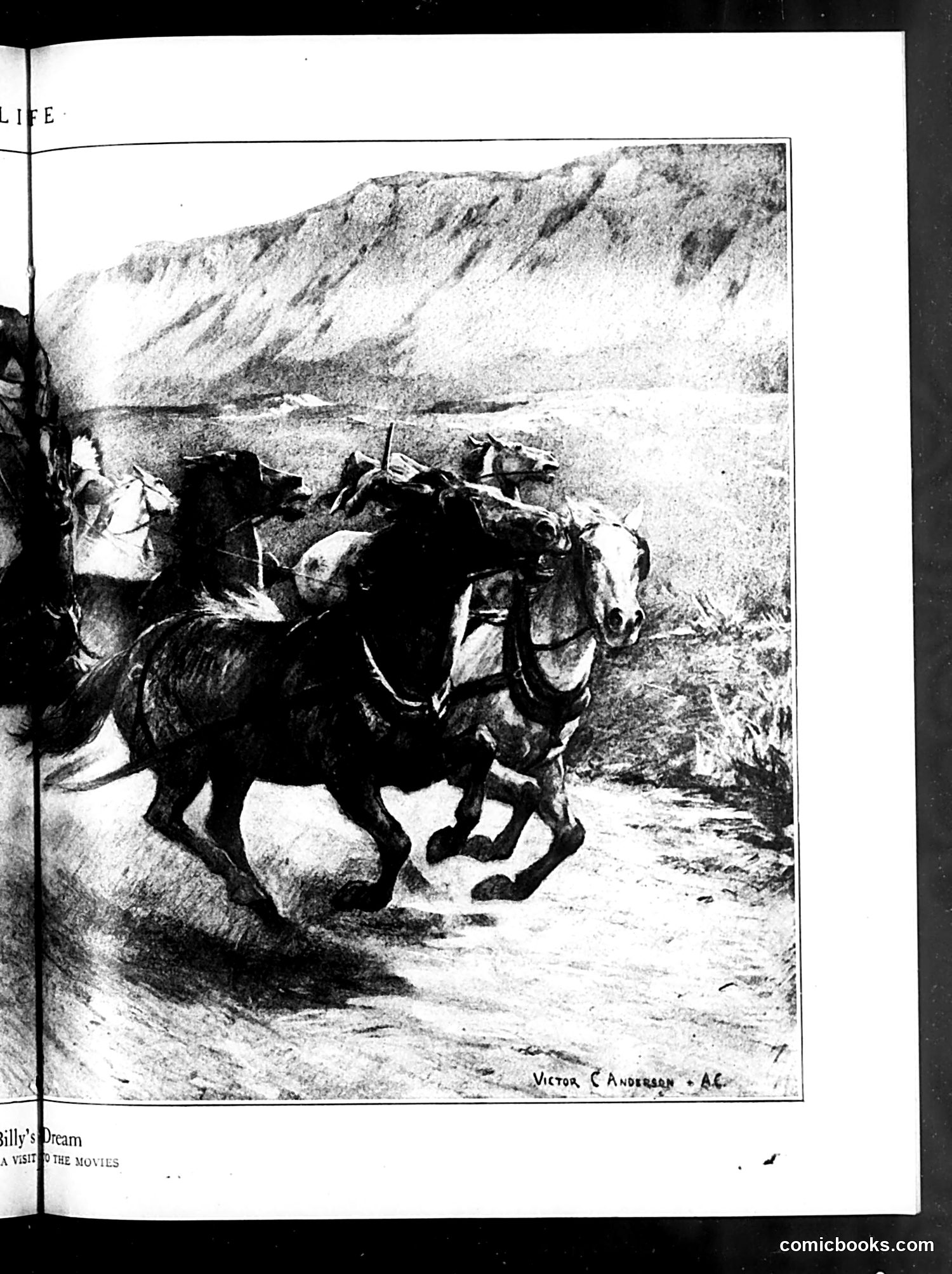
This appears to be a still photograph from an early silent film rather than a political cartoon. The image shows horses pulling a cart or wagon along a desert road with large sand dunes in the background. The credit reads "Victor C Anderson + A.C." The page appears to be from Life magazine's film or entertainment section, likely reviewing or promoting a movie. The partial text visible mentions "Billy's Dream" and "A Visit to the Movies," suggesting this is a film review or commentary page. Without additional context or clearer OCR text, I cannot definitively identify the specific film, its political/social significance, or any satirical intent. The photograph itself appears to be a landscape/action scene rather than a political statement.
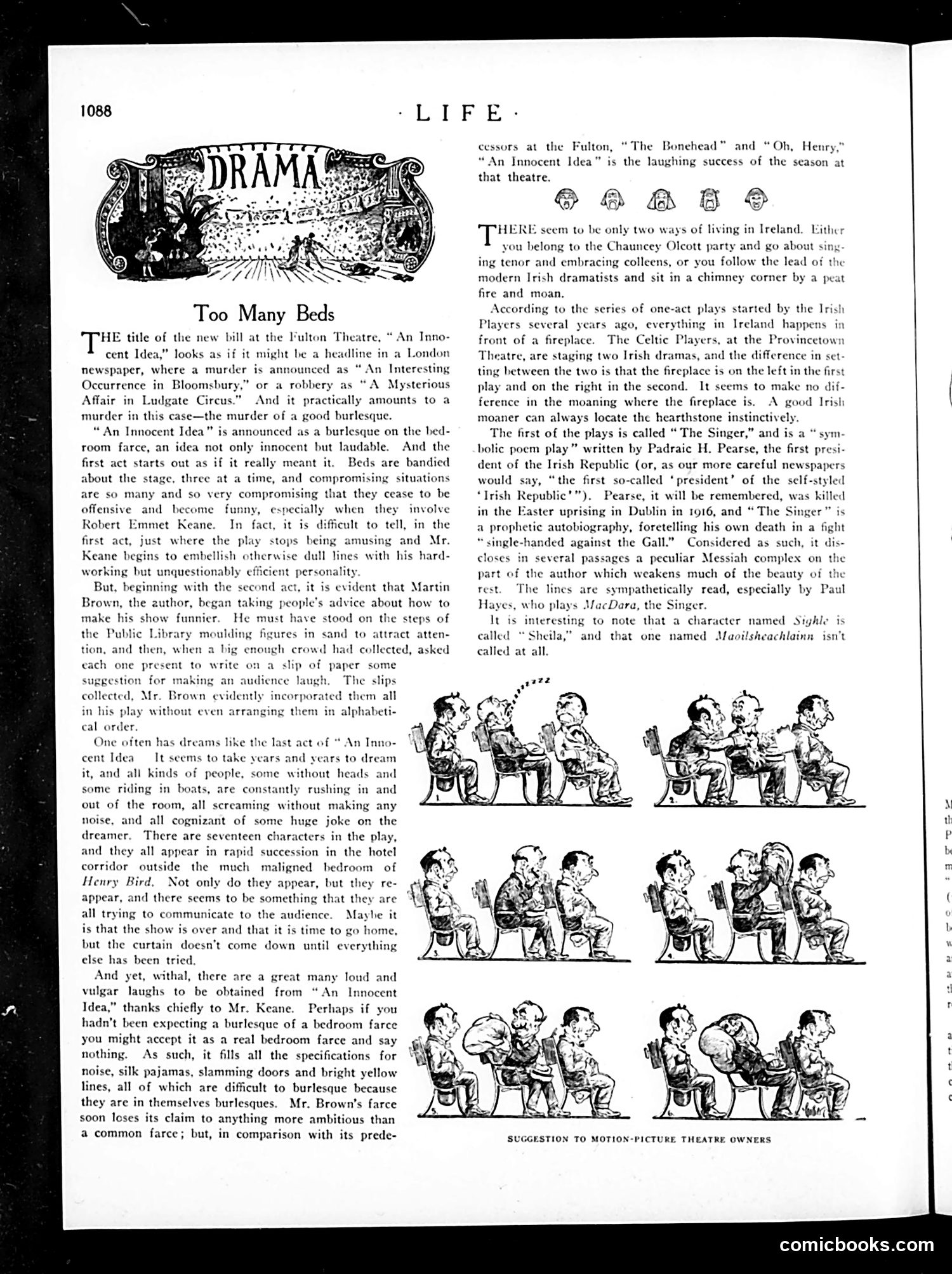
This is a theater review of the burlesque "An Innocent Idea" at the Fulton Theatre, satirizing both the play itself and broader comedic trends. **The Satire:** The reviewer mocks playwright Martin Brown for abandoning his promising premise (a burlesque of bedroom farces) after Act One. Brown apparently solicited joke suggestions from random pedestrians at the Public Library and incorporated them all without organization, creating a chaotic final act. The review compares this to fever dreams—seventeen characters appear and reappear in a hotel corridor, screaming soundlessly, apparently trying to communicate something (possibly that the show should end). **The Point:** The critic argues the play devolves from intentional satire into accidental self-parody. While Robert Emmet Keane's personality keeps it entertaining, Brown's lack of discipline transforms it into exactly what it mocked: a common farce relying on crude elements (slamming doors, bright costumes) that are already inherently absurd. The accompanying illustrations show groups of men in chairs, likely depicting the chaotic ensemble scenes criticized.
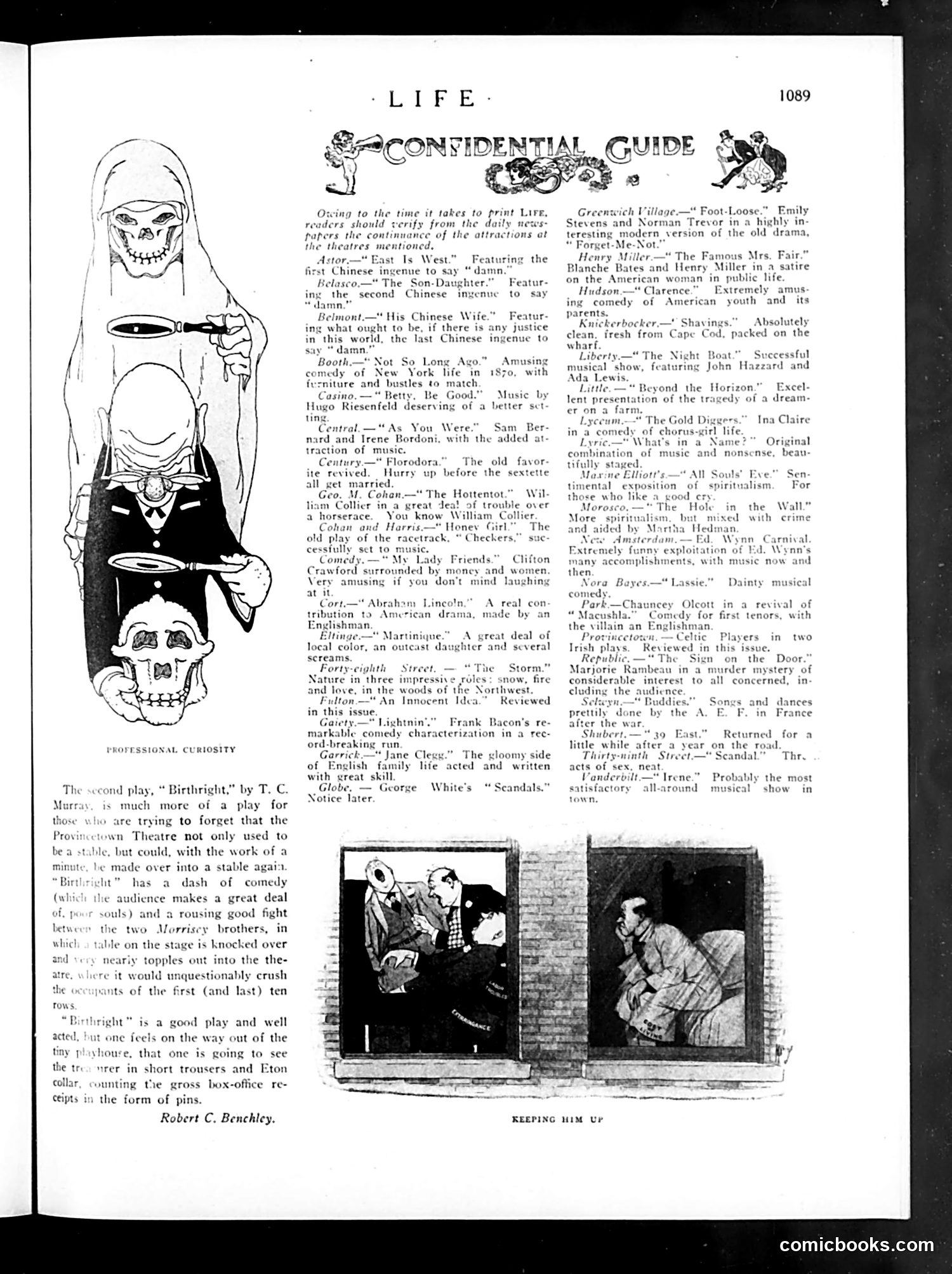
This page is primarily a **theater listings and reviews section** for Life magazine's theater column. The left side contains a brief review of the play "Birthright" by T.C. Murray, with commentary by critic Robert C. Benchley. The main content is the "Confidential Guide"—a comprehensive listing of Broadway shows then running, with brief descriptions and sarcastic commentary. Notable patterns include: - **Three Chinese-themed plays** are sarcastically grouped together, each featuring a "Chinese ingenue" who says "damn" on stage—Life's joke being that this mild profanity was apparently shocking enough to market repeatedly. - References to contemporary hits like Frank Bacon's "Lightnin'" (noted as record-breaking) and George White's "Scandals." - The guide includes both serious dramas and comedies, with Benchley's caustic observations on production quality and entertainment value. **The skull imagery on the left** appears to be decorative, unrelated to specific content—typical of Life's visual style. This reflects 1920s Broadway theater-going culture and the magazine's role as arbiter of theatrical taste for educated urban readers.
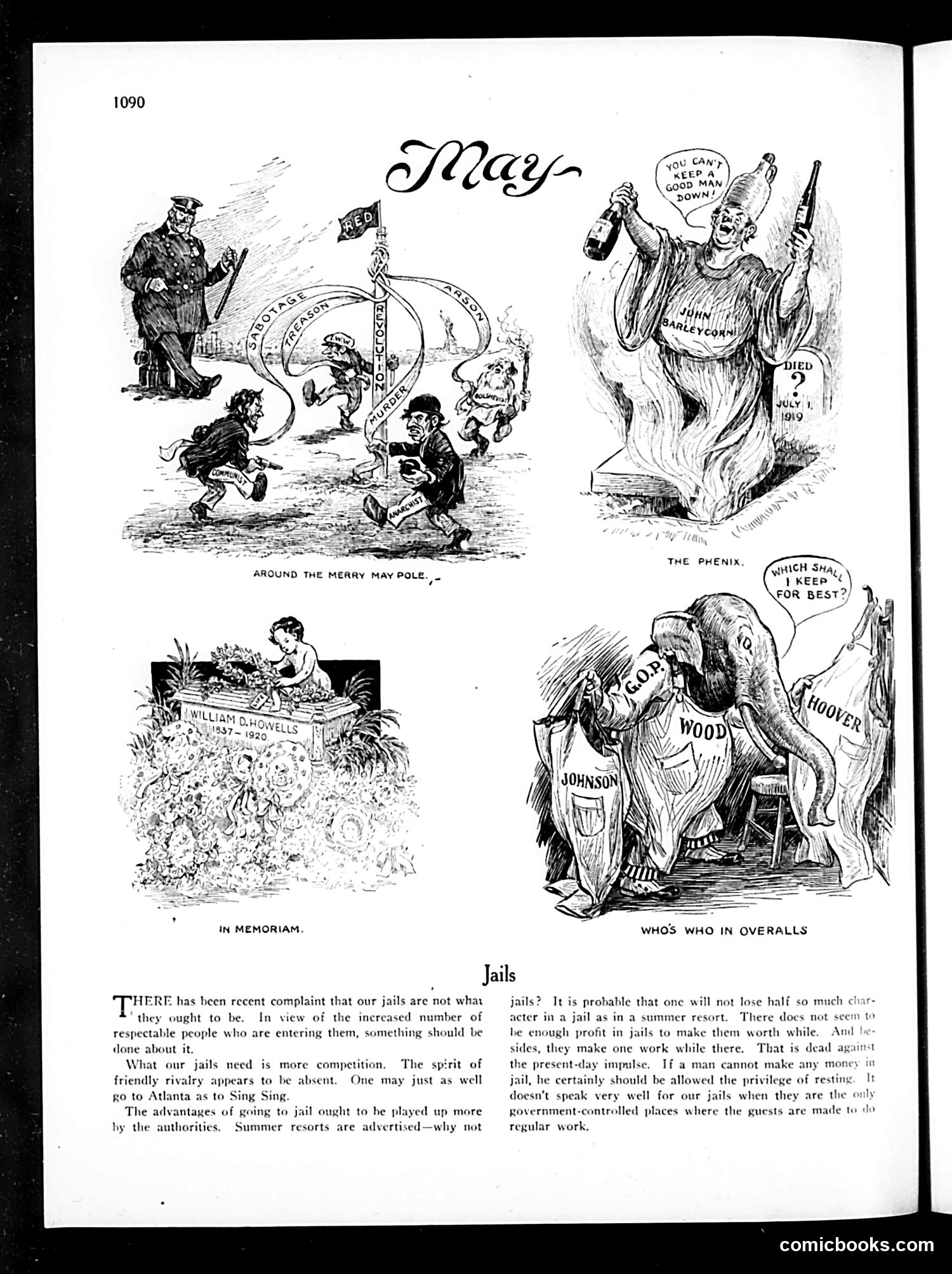
This page satirizes post-WWI American society through several cartoons: **"Around the Merry May Pole"** mocks political figures dancing around scandal (the "May pole" suggests entanglement). **"The Phenix"** depicts a figure rising from flames labeled "John Barleycorn" (Prohibition), holding bottles—satirizing alcohol's supposed death and resurrection despite the 18th Amendment (ratified in 1919). **"Who's Who in Overalls"** shows figures labeled Johnson, Wood, Globe, and Hoover debating which to "keep for best"—likely referencing prominent political/industrial figures of the era. **"In Memoriam"** honors William D. Howells (1837-1920), a prominent American writer. The accompanying article satirically argues jails should be "advertised" like resorts and compete for inmates, mocking both prison conditions and wealthy people's leisure culture. The satire suggests respectable citizens now populate jails, implying criminal conduct among the upper classes.
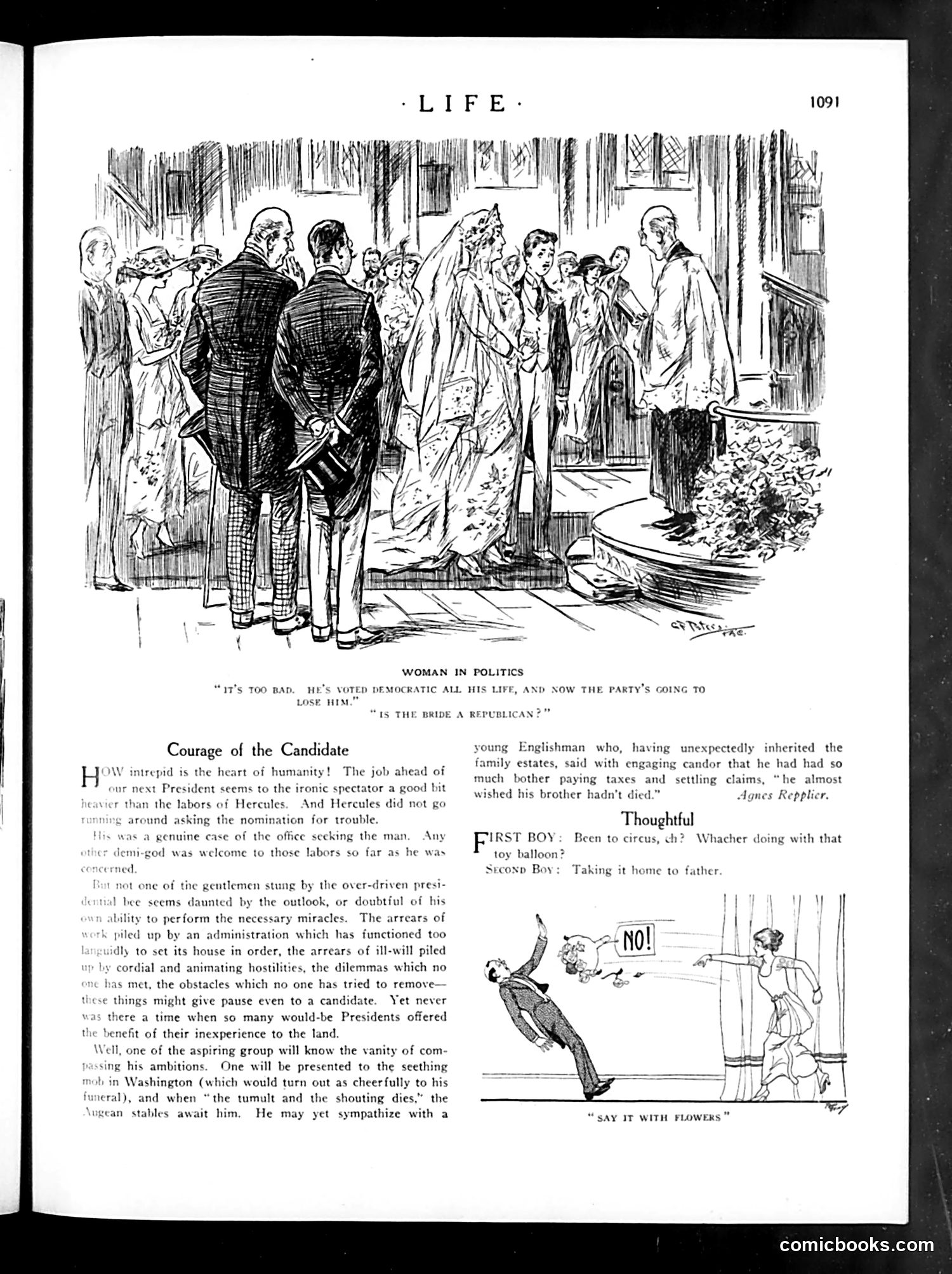
**Top Cartoon - "Woman in Politics":** This depicts a society gathering where a woman's political affiliation causes concern. The caption reveals the anxiety: a man voted Democratic his whole life, but now the party will "lose him"—suggesting he's switching parties, possibly due to a woman's influence. The question "Is the bride a Republican?" implies the newly married woman may convert her husband politically. The satire mocks how women's political involvement and influence was viewed as destabilizing to established party loyalties—reflecting early 20th-century anxieties about female voters and their potential to disrupt male political traditions. **Bottom Cartoon - "Say It With Flowers":** A man attempts to placate an angry woman by giving flowers. She emphatically says "NO!" The joke appears to play on the advertising slogan "Say it with flowers" (a popular florist campaign), suggesting that even flowers cannot resolve serious marital discord—satirizing the inadequacy of romantic gestures to solve real relationship problems. Both pieces reflect contemporary gender and political dynamics of the era.
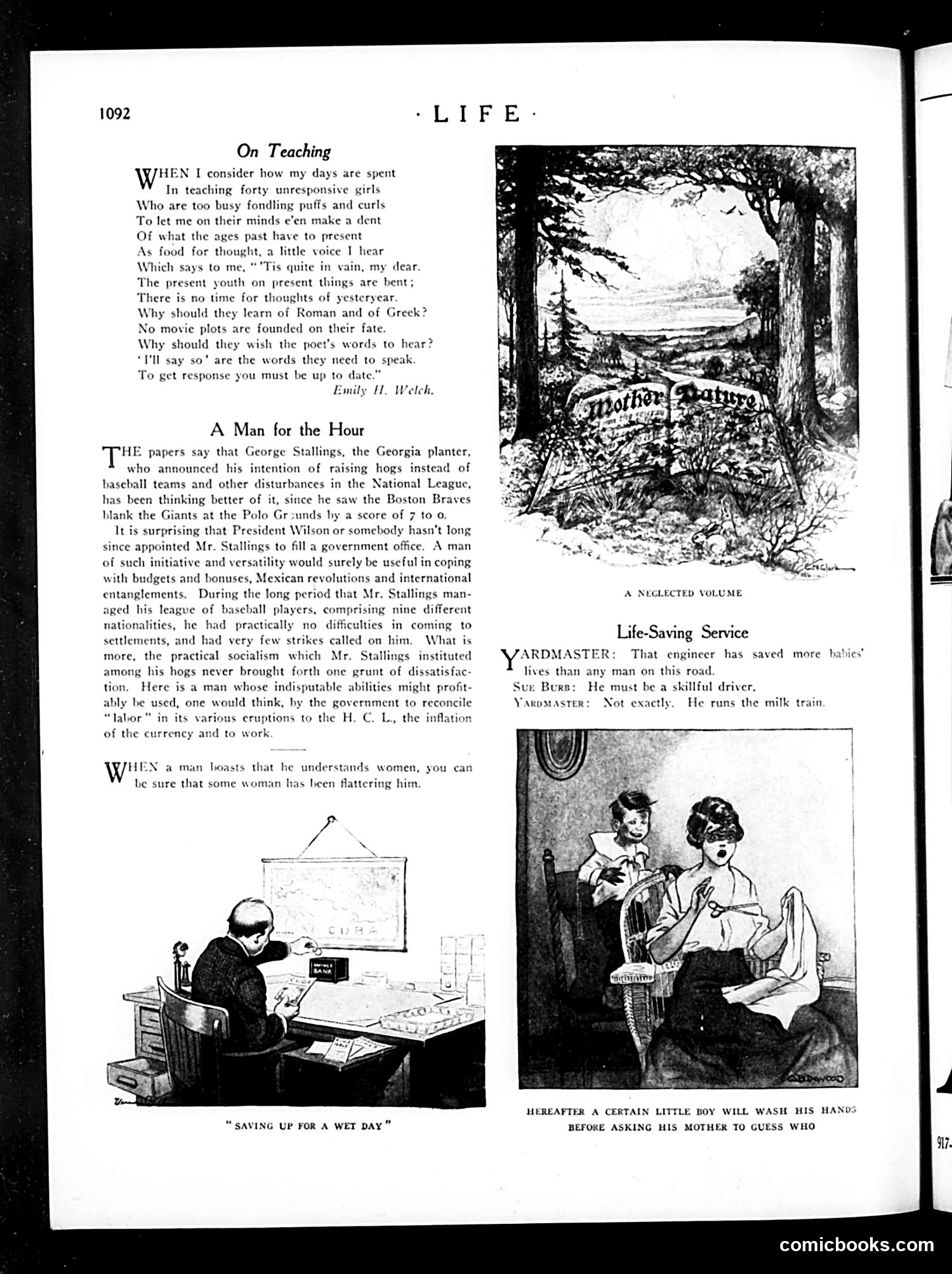
This page contains three distinct satirical pieces: **"On Teaching"** (poem by Emily H. Welch): Satirizes modern education's perceived decline. Teachers lament that 1920s students care only about current fashions ("puffs and curls") and movies, ignoring classical literature, Roman/Greek history, and poetry. The joke is that students allegedly only need modern slang ("I'll say so") rather than intellectual substance. **"A Man for the Hour"**: Mocks George Stallings, a Georgia planter and baseball manager, suggesting President Wilson should hire him for government work since he successfully managed a diverse baseball league and maintained labor peace. The satire critiques both Stallings's sudden farm-pivot and the government's apparent inability to solve contemporary problems (budgets, Mexican unrest, cost-of-living inflation). **"Life-Saving Service"**: A brief joke where a yardmaster credits an engineer with saving lives—but the punchline reveals he simply drives the milk train safely, not through exceptional skill but routine work. The cartoons accompanying these pieces illustrate the themes humorously.
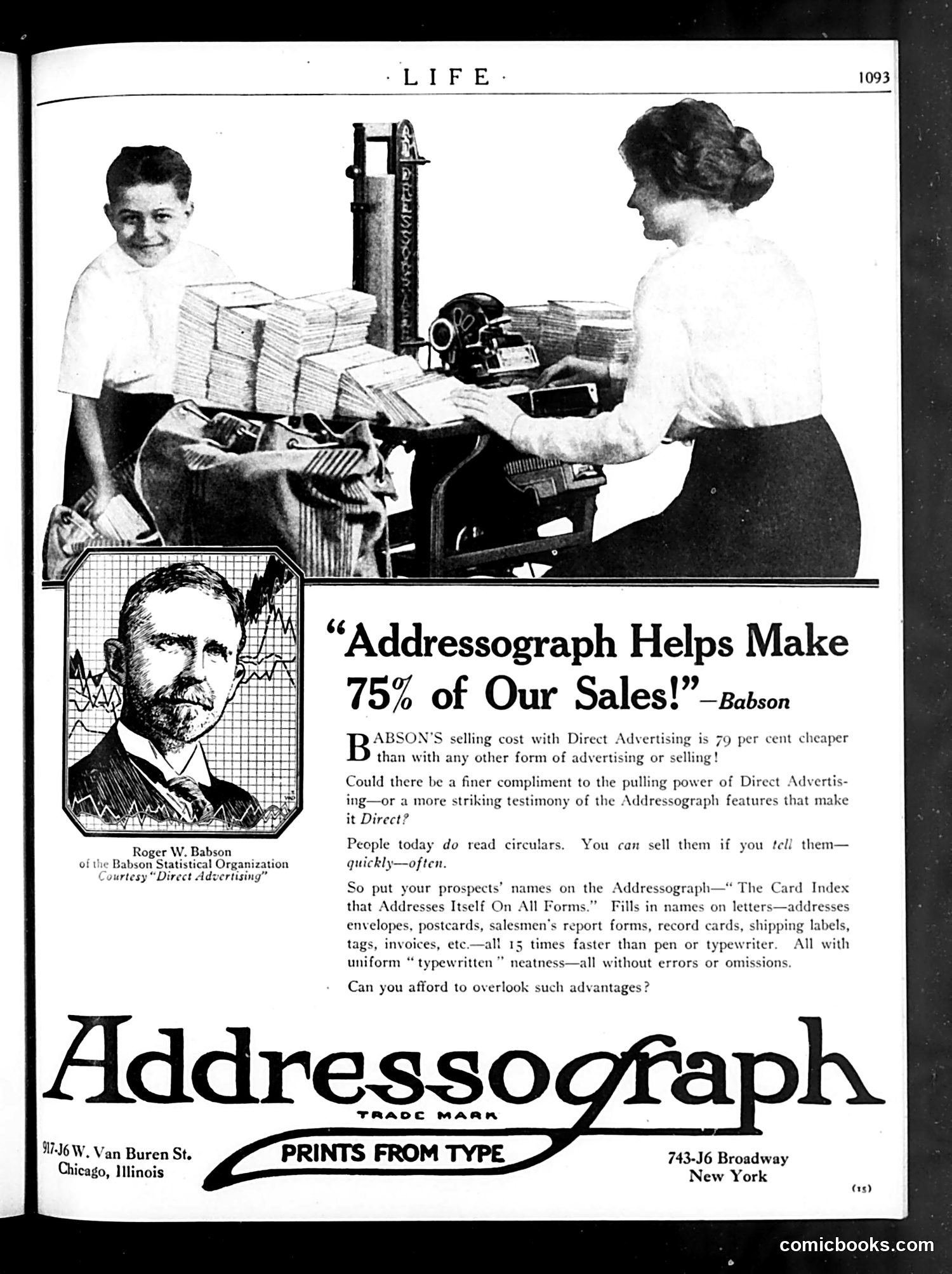
This is a **full-page advertisement**, not satire or cartoon content. It promotes the Addressograph, a mechanical device for printing addresses on mail and forms. The ad features: - **Roger W. Babson**, head of the Babson Statistical Organization, quoted claiming direct advertising via the Addressograph accounts for 75% of his sales and costs 79% less than other advertising methods - **A photograph** showing the machine in use: a woman operating the device while a boy and man observe stacks of addressed materials - **The pitch**: The Addressograph automatically fills names/addresses on letters, envelopes, postcards, and shipping materials 15 times faster than handwriting or typing, with uniform neatness and no errors For modern readers: This represents early **20th-century direct mail marketing technology**—the predecessor to modern mailing lists and bulk mail automation. The ad emphasizes efficiency gains and cost savings that would appeal to businesses doing mass mailings, positioning mechanical addressing as a competitive advantage.
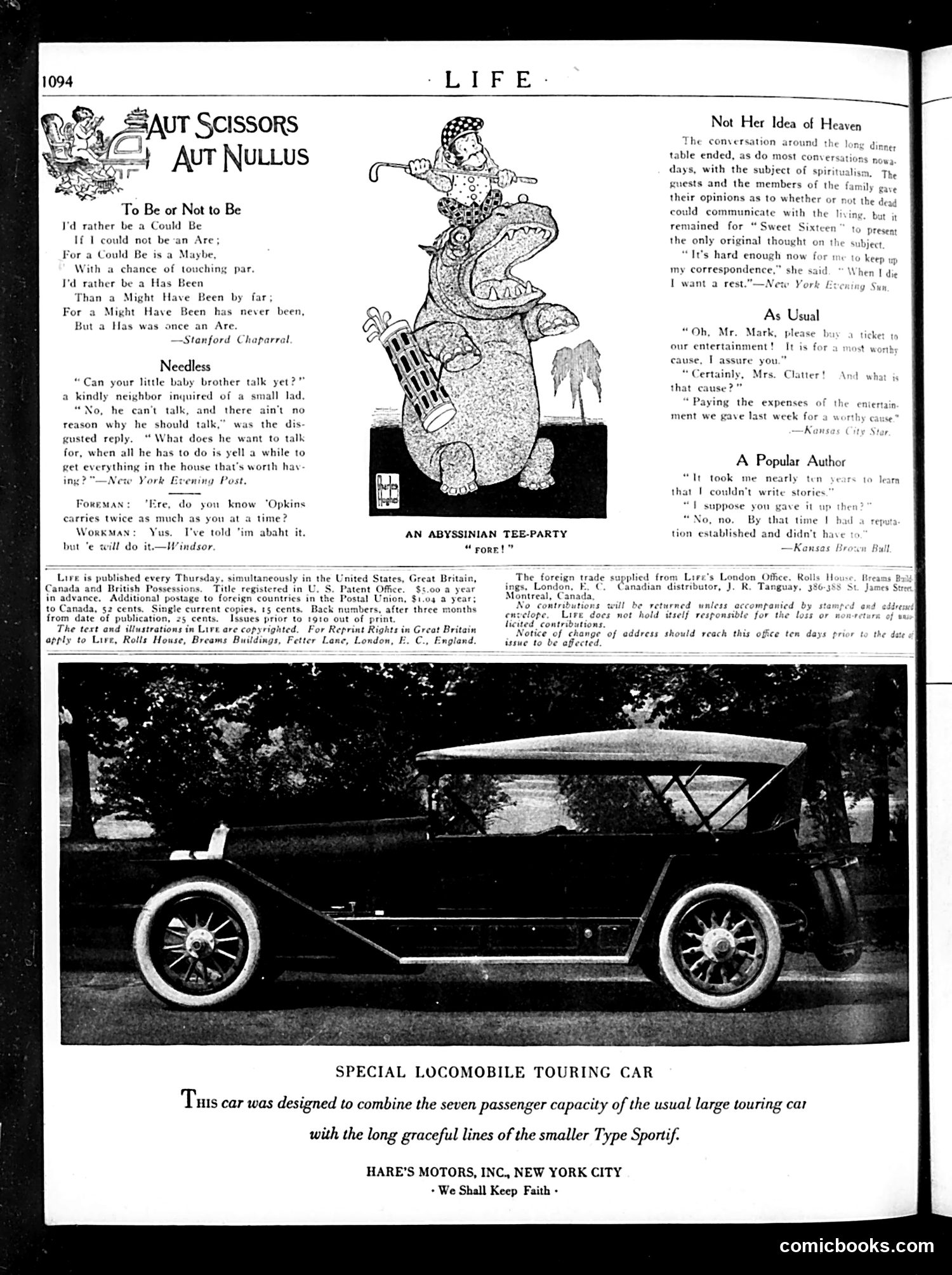
This page contains several brief humorous pieces and advertisements typical of Life's satirical format: **"Aut Scissors Aut Nullus"** presents philosophical poems playing on the "to be or not to be" theme—mocking pretentious existential questioning with wordplay ("Could Be," "Has Been," "Might Have Been"). **"Needless"** and **"Foreman"** are short joke pieces about verbose children and workers—common Life humor targets depicting everyday absurdities. **"An Abyssinian Tee-Party"** is a cartoon showing a hippo at a tea party, likely satirizing exotic or "primitive" subjects through anthropomorphic animal humor—reflective of early 20th-century attitudes. The remaining items—"Not Her Idea of Heaven," "As Usual," and "A Popular Author"—are brief anecdotes about social gatherings and writing, typical filler content. The **Locomobile touring car advertisement** occupies the lower half, showcasing an automobile combining luxury features—standard for Life's revenue model blending editorial and advertising content.
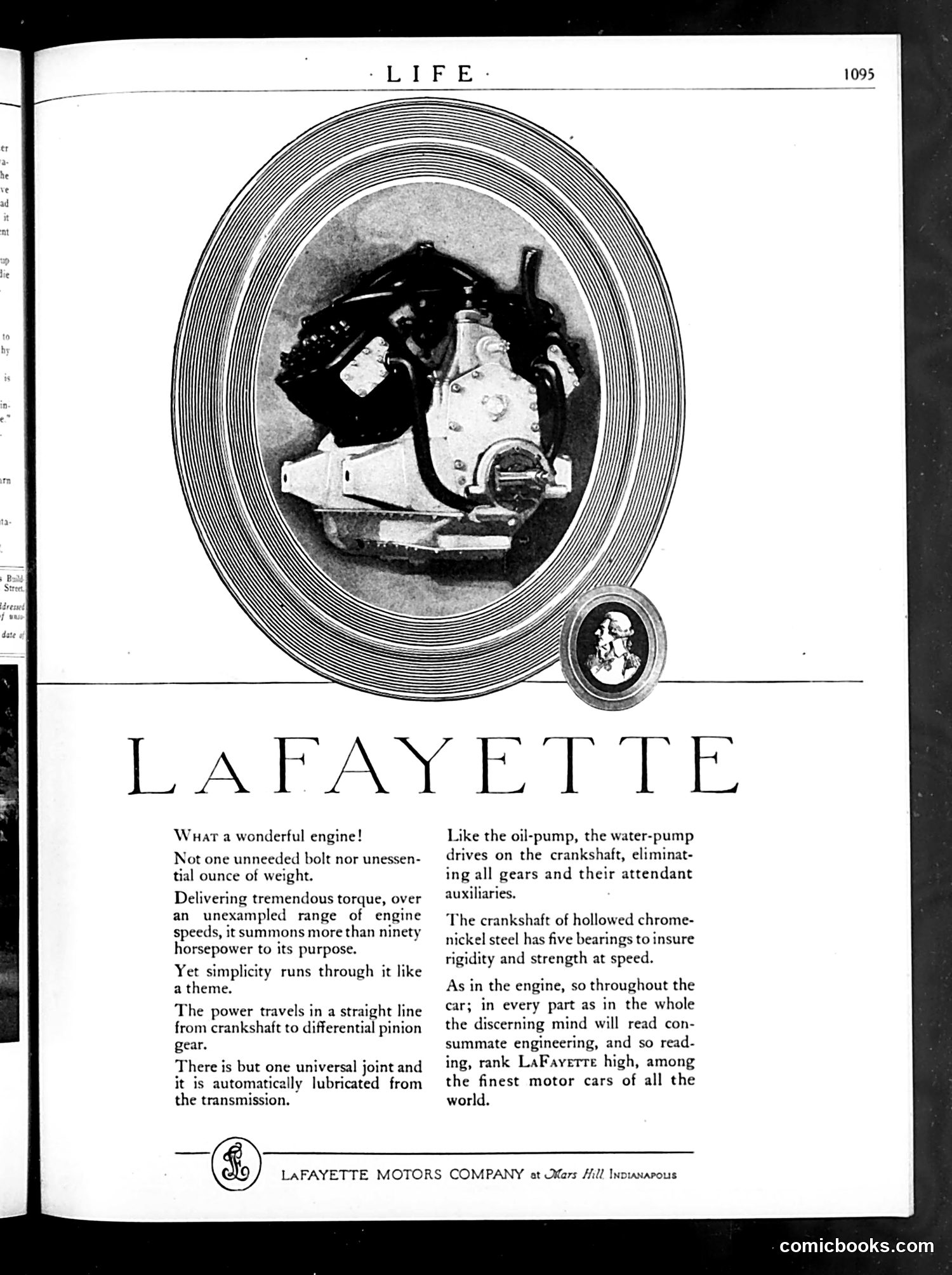
This is **not a cartoon or satire**—it's a straightforward **automobile advertisement** from Life magazine (page 1095). The page promotes the Lafayette automobile, manufactured by Lafayette Motors Company in Indianapolis. The technical text celebrates the car's engine design, emphasizing engineering excellence: its powerful output (90+ horsepower), mechanical simplicity, and innovative features like the single universal joint and integrated lubrication system. The oval photograph shows the engine itself, displayed as the centerpiece of the advertisement's design. The small circular inset appears to be a company logo. This represents typical early-20th-century automotive advertising that appealed to readers' appreciation for mechanical innovation and engineering prowess—selling the car through detailed technical specifications rather than lifestyle or emotional appeal.
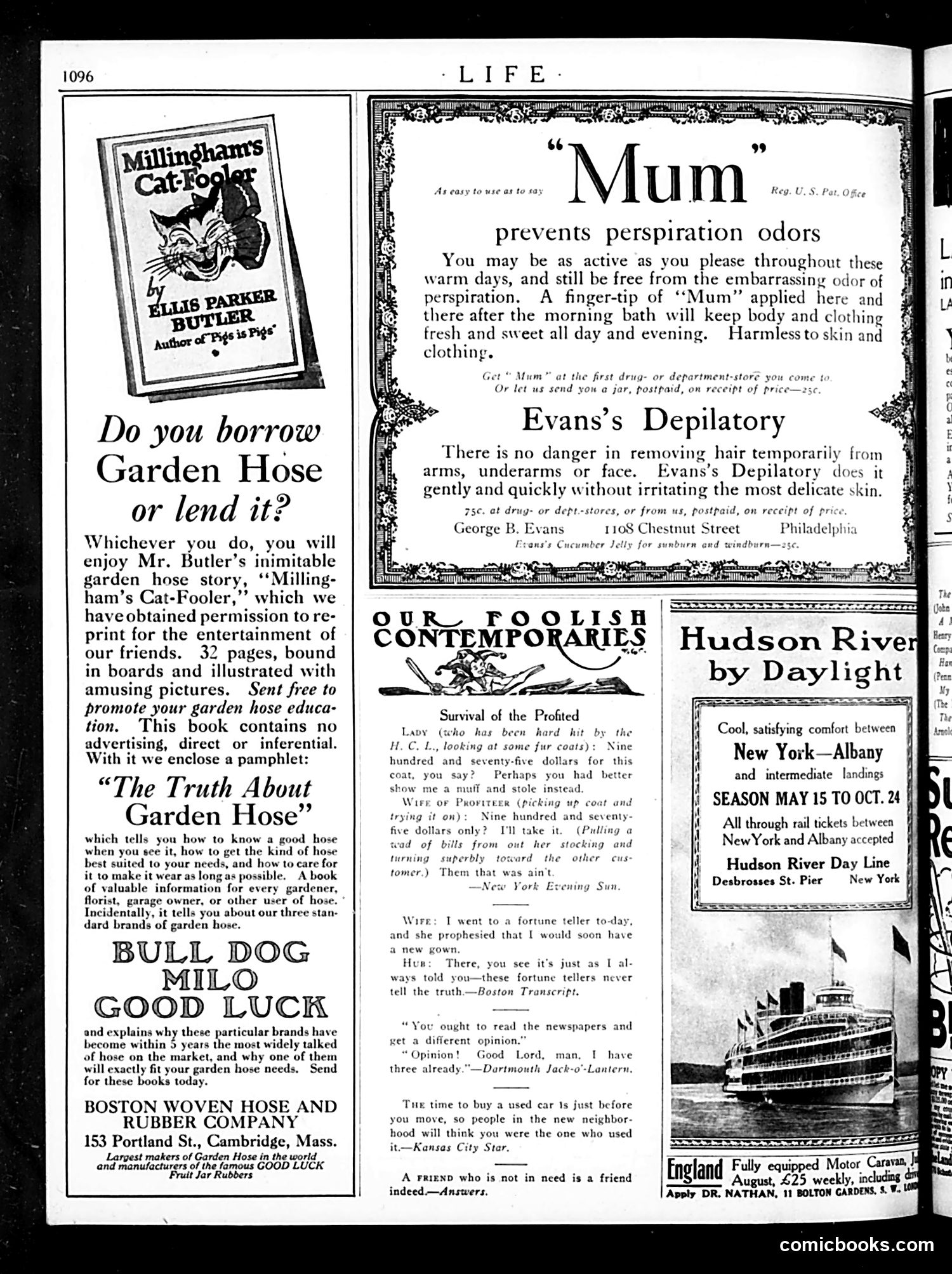
This page is primarily **advertising** for period products (deodorant, hair removal), garden hose, and riverboat services. However, the center contains a satirical cartoon section titled "Our Foolish Contemporaries." The featured cartoon, "Survival of the Profited," mocks wartime profiteering and class disparity. A wealthy woman ("Wife of Profiteer") casually purchases an expensive fur coat ($975) using cash from her stocking, while a poorer woman ("Lady") who has been economically stressed by inflation (the "H.C.L."—high cost of living) cannot afford it. The joke's bitter edge: the profiteer's spouse thrives financially while ordinary citizens struggle. The surrounding jokes mock fortune tellers, used cars, and differing opinions—light social commentary typical of Life magazine's satirical humor. The cartoon suggests moral criticism of those who profited excessively during World War I while others faced genuine hardship.
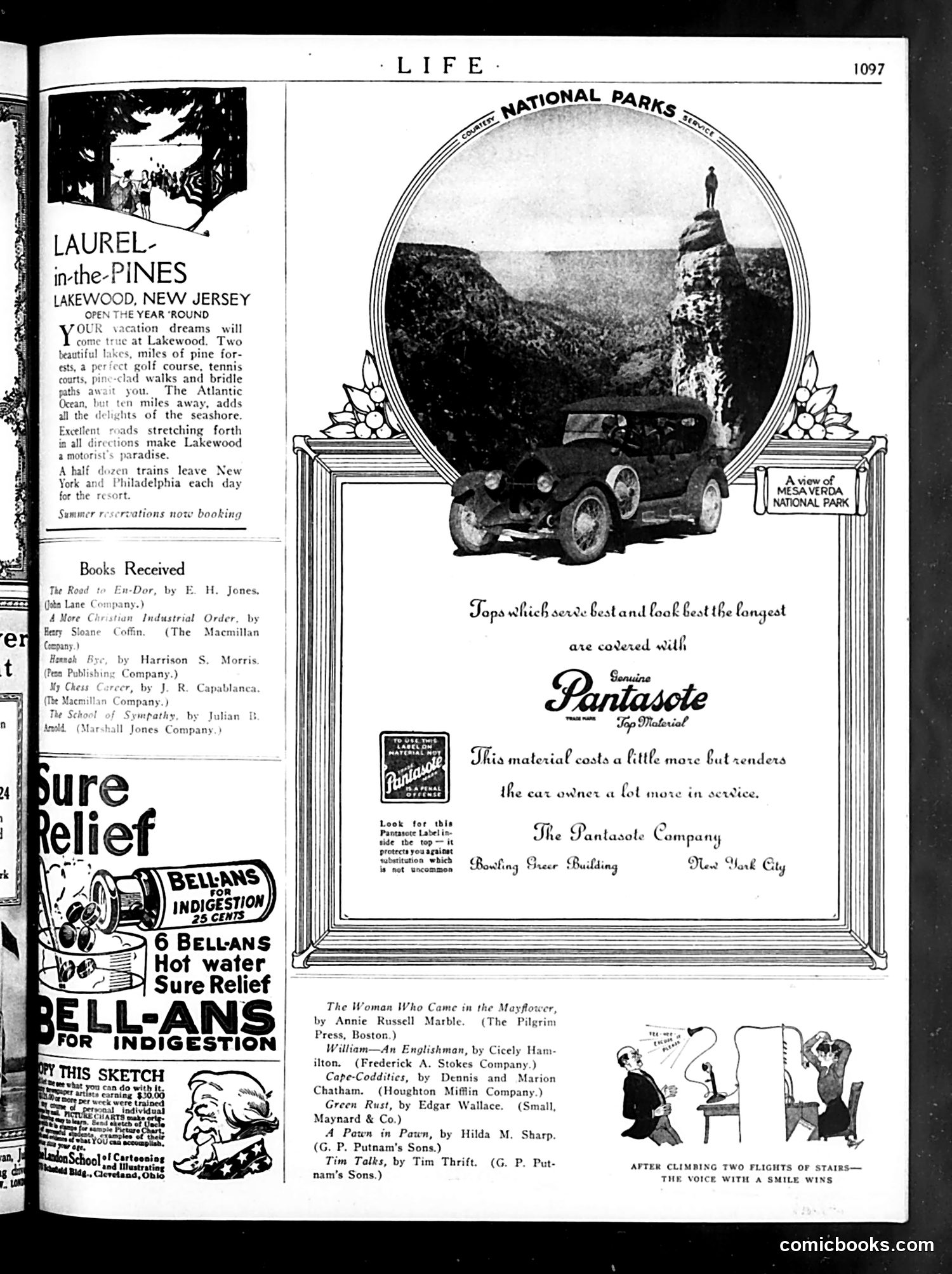
This page is primarily **advertising and promotional content** rather than political satire. The main elements are: 1. **Laurel-in-the-Pines resort ad** (top left): Promotes a New Jersey vacation destination with golf, tennis, and beaches—typical leisure advertising for the era. 2. **Pantasote automobile tops advertisement** (center): Shows a vintage car beneath a scenic overlook, advertising "Genuine Pantasote" fabric for convertible car tops. The pitch emphasizes durability and value. 3. **Bell-Ans indigestion remedy ad** (left): Features the product for stomach relief—a common patent medicine advertisement of this period. 4. **Small cartoon** (bottom right): Captioned "After Climbing Two Flights of Stairs—The Voice with a Smile Wins," appears to illustrate customer service etiquette. A woman at a desk greets a slightly winded visitor, suggesting salespeople should remain cheerful despite exertion. 5. **Books Received section**: Lists newly published titles, standard magazine content. This is a typical Life magazine page blending advertisements with light lifestyle content and book reviews.
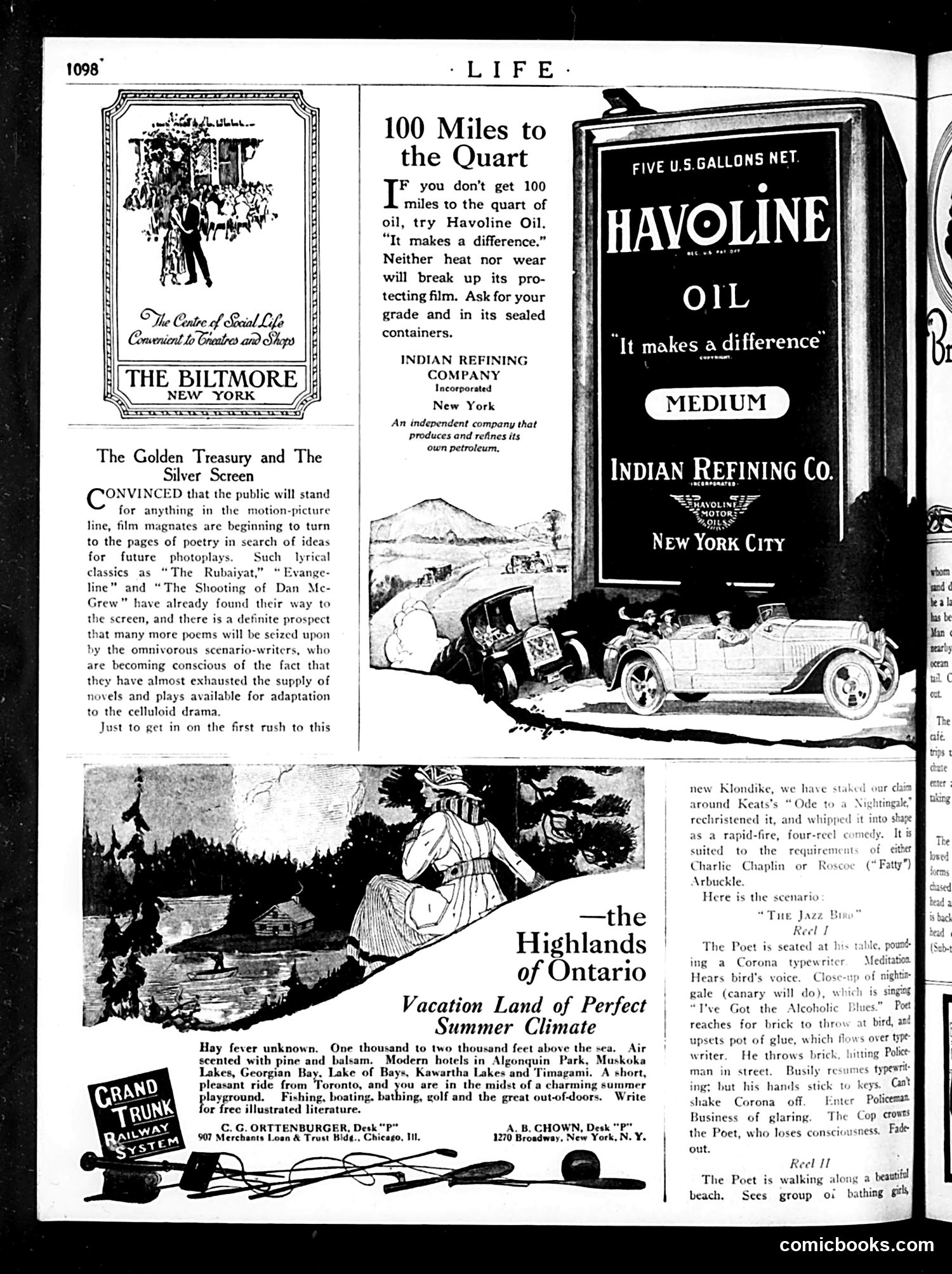
This page is primarily **advertisements and promotional content**, not political satire. The main content includes: 1. **Havoline Oil ad**: A straightforward motor oil advertisement claiming superior mileage performance—typical early automotive marketing. 2. **The Biltmore hotel ad**: Promotes the New York establishment as convenient to theaters and shops. 3. **"The Golden Treasury and The Silver Screen"**: A humorous editorial comment on Hollywood's desperation for source material. It satirizes film studios' practice of adapting *anything*—including serious poetry (Keats, Rubaiyat)—into lowbrow comedies. The joke: studios are so creatively bankrupt they're mining classical literature and turning it into slapstick films featuring Chaplin or Roscoe Arbuckle. 4. **"The Jazz Bird" scenario**: A mock film treatment spoofing avant-garde artistic pretension—a poet with a Corona typewriter, bizarre sound effects, and physical comedy (throwing bricks, gluing pots). 5. **Highlands of Ontario travel ad**: Standard vacation promotion. The satire targets **Hollywood's lowbrow adaptation strategy**, not politics or social issues.
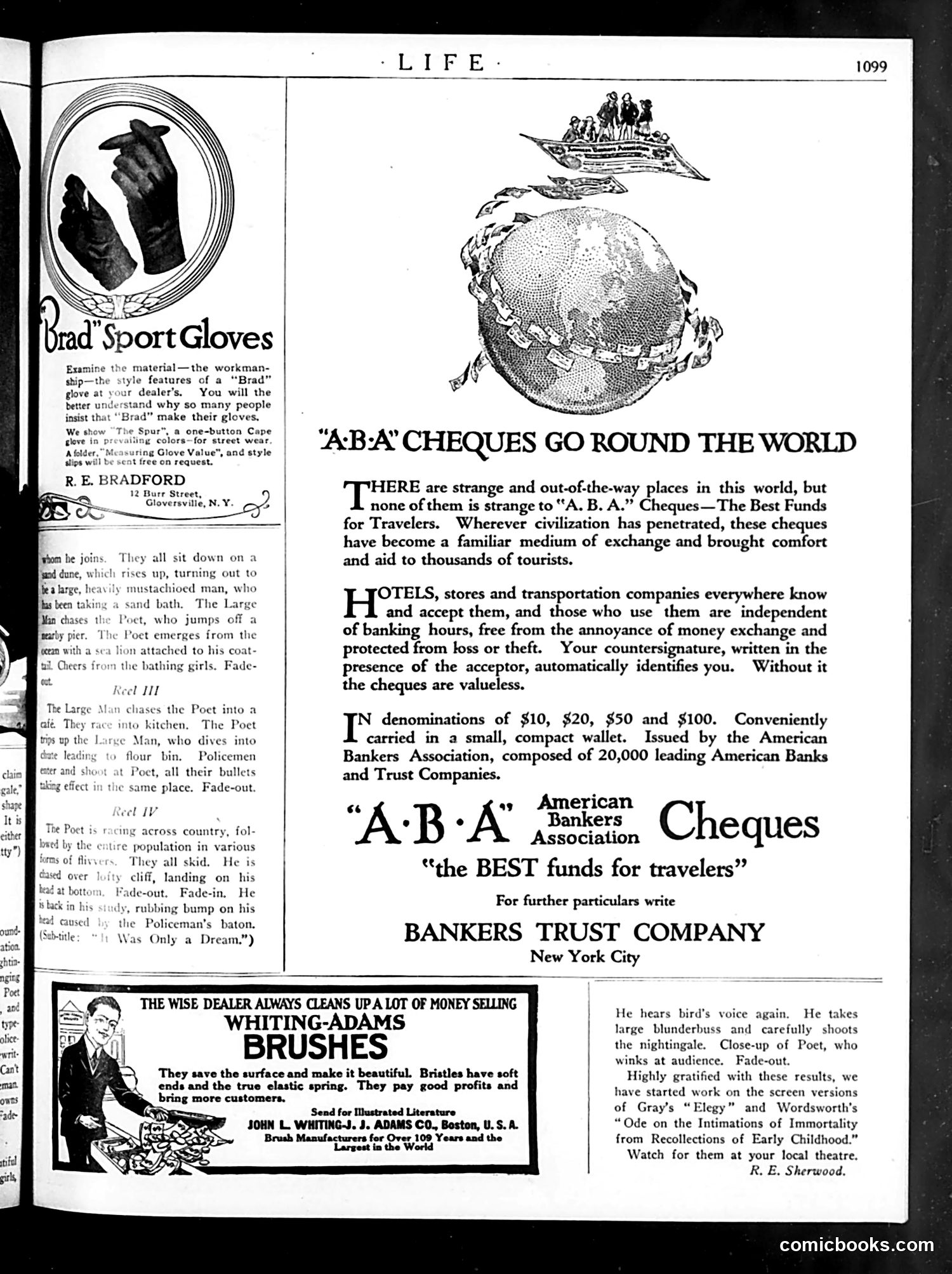
This page consists primarily of **advertisements rather than satirical cartoons**. The main content advertises: 1. **Brad Sport Gloves** — a manufacturer promoting quality workmanship in leather gloves 2. **A.B.A. Traveler's Cheques** — the dominant advertisement featuring a globe with ships, promoting American Bankers Association cheques as safe currency for international travelers. The text emphasizes their acceptance worldwide and security against theft or loss. 3. **Whiting-Adams Brushes** — showing a salesman, promoting sales benefits to retailers 4. **A brief editorial note** (by R.E. Sherwood) describing humorous film scenarios involving a "Poet" character and absurdist situations, apparently promoting upcoming screen adaptations of classic poetry. The page reflects early 20th-century advertising strategy: combining practical product promotion with entertainment content to engage readers. The traveler's cheques advertisement is particularly notable as it addresses an era when international travel required specialized financial instruments.
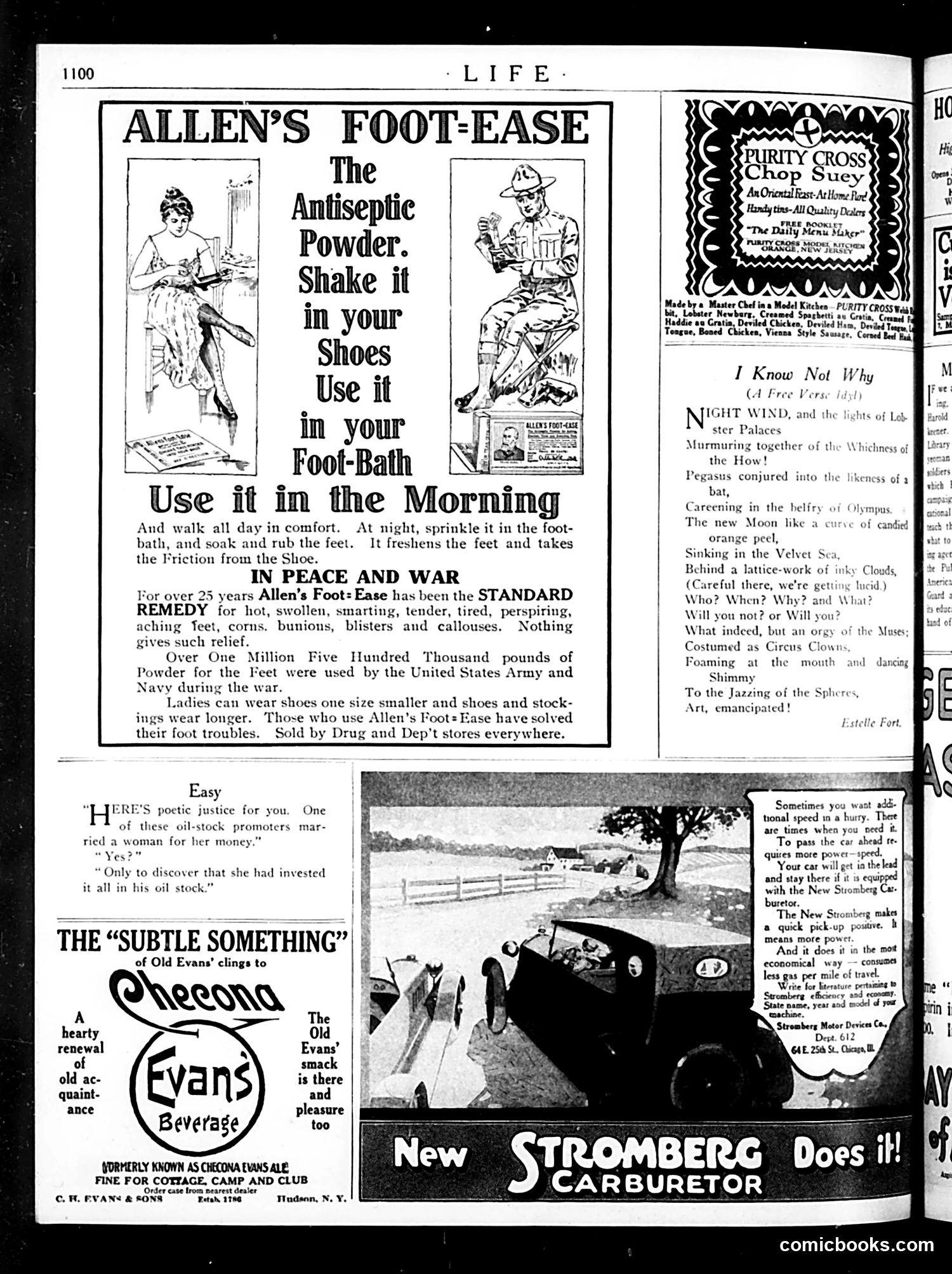
This page is primarily **product advertisements** rather than political cartoons. The main content includes: **Allen's Foot-Ease**: A antiseptic foot powder ad emphasizing its military use—1.5 million pounds were supplied to U.S. Army and Navy during World War I. The ad claims the powder reduces foot problems (blisters, corns, bunions), allowing women to wear smaller shoes and extend shoe life. **Evans Beverage**: A small ad for "Checona Evans Ale," marketed as a hearty renewal drink for "cottage, camp and club" settings. **Stromberg Carburetor**: An auto parts ad promoting faster acceleration and fuel efficiency. **Minor content**: A brief humorous anecdote about a woman investor deceived by an oil-stock promoter, and a poem titled "I Know Not Why" with abstract, modernist language. The page reflects early 20th-century consumer culture, with WWI referenced as a marketing point. No political satire is present—this is primarily commercial advertising typical of Life magazine's revenue model.
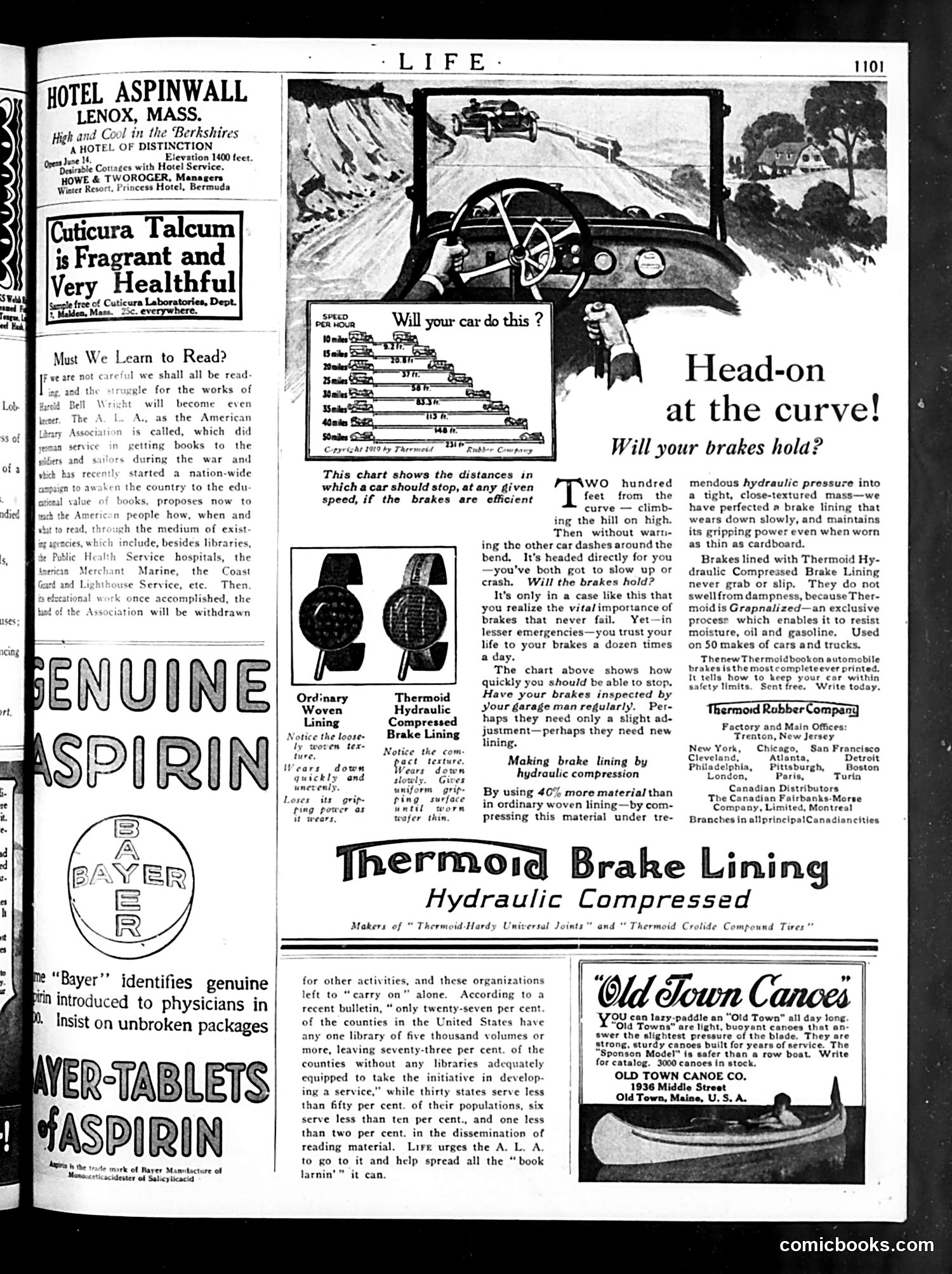
This page is primarily **advertising**, not political satire. The main content consists of ads for: 1. **Hotel Aspinwall** (Berkshires resort) 2. **Cuticura Talcum** (hygiene product) 3. **Bayer Aspirin** (medicine) 4. **Thermoid Brake Lining** (automotive safety) 5. **Old Town Canoes** (recreation) The only editorial content is a brief article titled "Must We Learn to Read?" arguing American libraries are inadequate—only 27% of counties have libraries with 5,000+ volumes. The author advocates for a national literacy initiative. The brake lining ad's headline "Head-on at the curve! Will your brakes hold?" uses dramatic hypothetical driving scenarios to market superior braking technology, reflecting 1920s automotive safety concerns. There are no political cartoons or caricatures on this page. It's a representative example of *Life* magazine's mixed editorial and commercial content from this era.
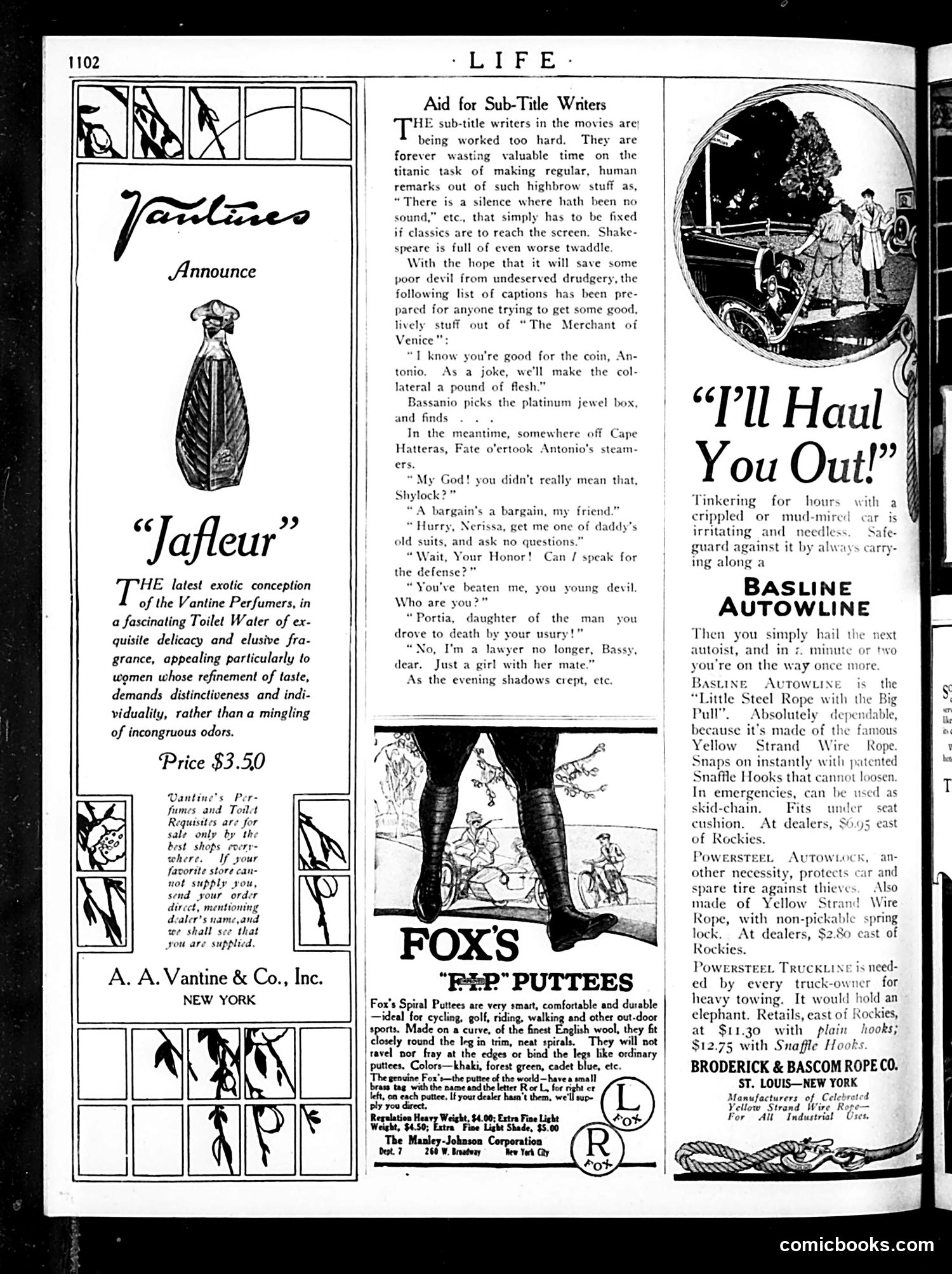
This page is primarily **advertising** with one satirical article. The main content is "Aid for Sub-Title Writers," which mocks the challenge of adapting Shakespeare for silent film. The article humorously suggests modernized, colloquial subtitle captions for *The Merchant of Venice*—converting Shakespeare's formal language into crude contemporary dialogue ("I know you're good for the coin, Antonio"). The satire targets the tension between high literature and commercial film: adapters must make classical plays accessible to mass audiences, but doing so strips away their dignity. References to specific plot points (Shylock's pound of flesh, Portia's disguise) would be recognizable to educated 1920s readers familiar with the play. The remaining content consists of product advertisements: Vantine's perfume ("Jafleur"), Fox's military puttees, and various automotive products (Basline Autoline, towing equipment). These ads reflect typical 1920s consumer goods and concerns like car maintenance during the automobile era.
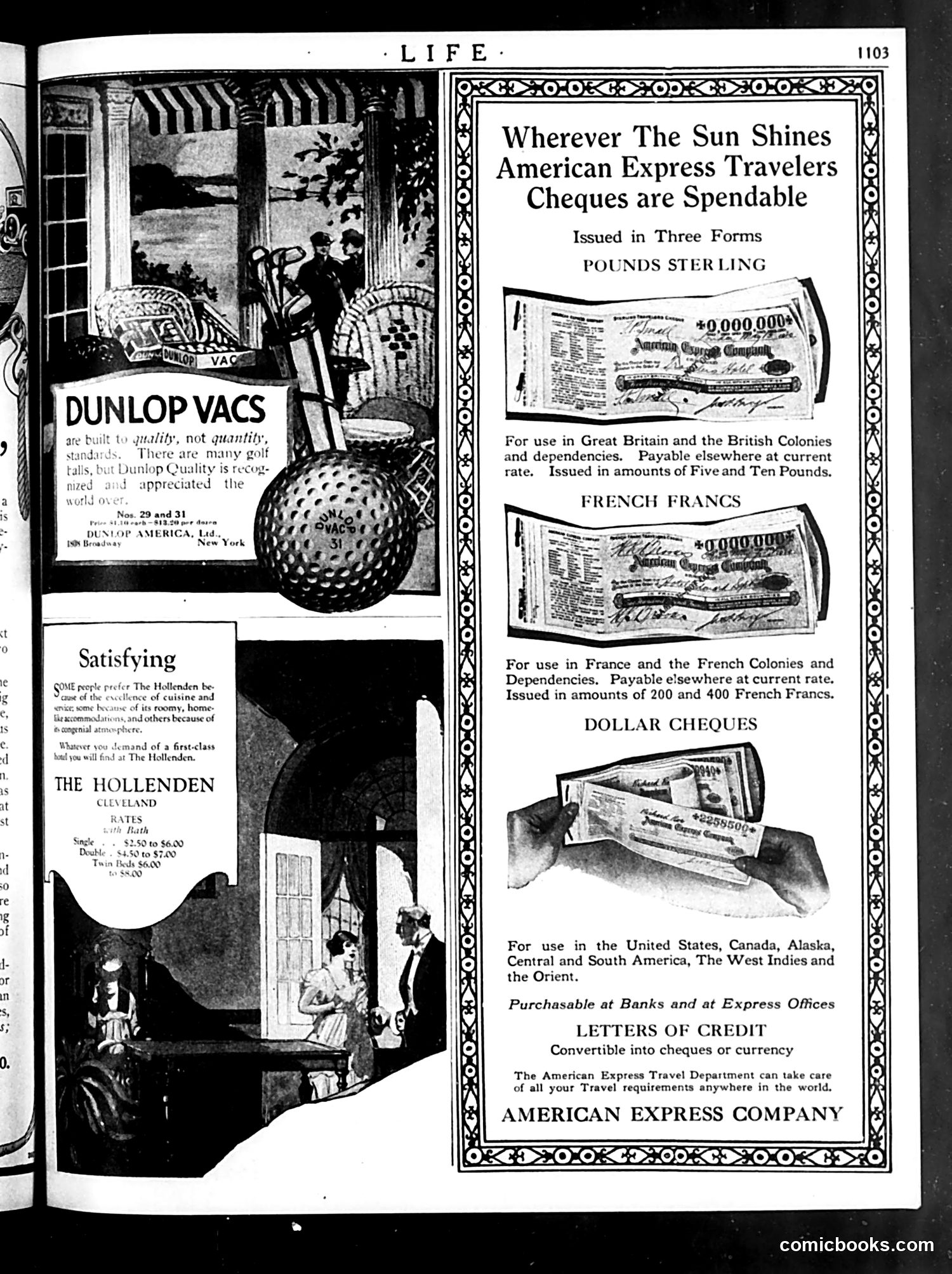
This page is **primarily advertising**, not satire or political commentary. It contains: **Right side (dominant):** American Express traveler's cheques advertisement, showcasing three currency forms (Pounds Sterling, French Francs, Dollar Cheques) for international travel. The ad emphasizes global usability and convenience for travelers to different regions. **Left side:** Two separate ads—one for Dunlop golf balls (emphasizing quality over quantity) and one for The Hollenden hotel in Cleveland (listing room rates). The page reflects early-20th-century travel commerce and leisure culture, when traveler's cheques were a novel financial innovation for the affluent. The multiple currency options reflect international travel patterns of the era. There is **no satirical content or political commentary** visible—this is straightforward magazine advertising aimed at prosperous American travelers.
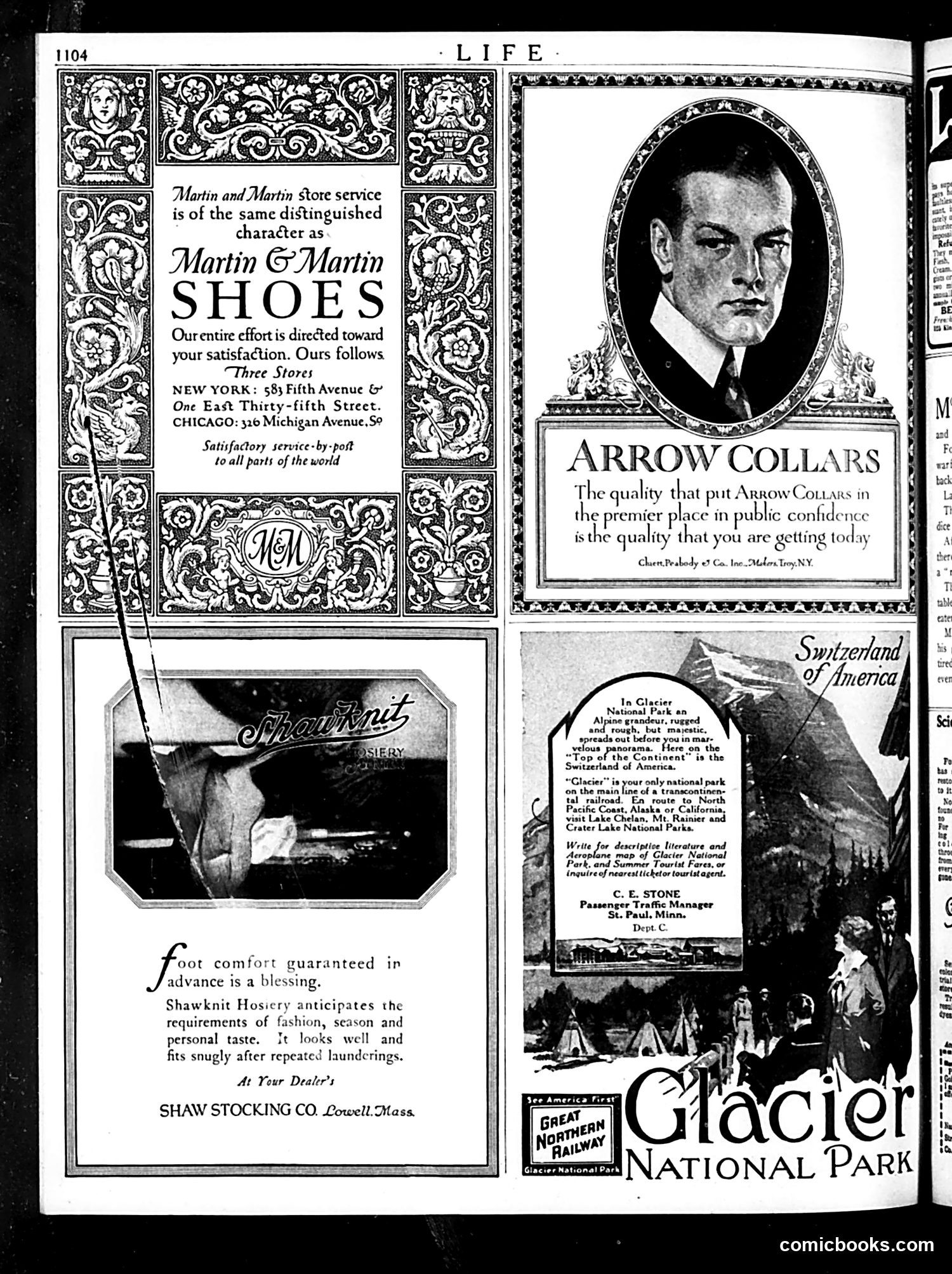
This is primarily an **advertising page** from an early 20th-century issue of *Life* magazine, not a satirical cartoon page. It contains four distinct advertisements: 1. **Martin & Martin Shoes** - promoting shoe retail stores in New York and Chicago 2. **Arrow Collars** - featuring a portrait of an unnamed man, emphasizing quality and public confidence 3. **Shawknit Hosiery** - advertising socks/stockings with claims about comfort and durability 4. **Glacier National Park** - a travel advertisement promoted via the Great Northern Railway, marketing the park as "Switzerland of America" The decorative ornamental borders and typography reflect early 1900s advertising design. There is **no political satire visible**—this appears to be a straightforward commercial page. The only visual element approaching editorial content is the Glacier National Park advertisement, which uses landscape photography to market tourism rather than to comment on politics or social issues.
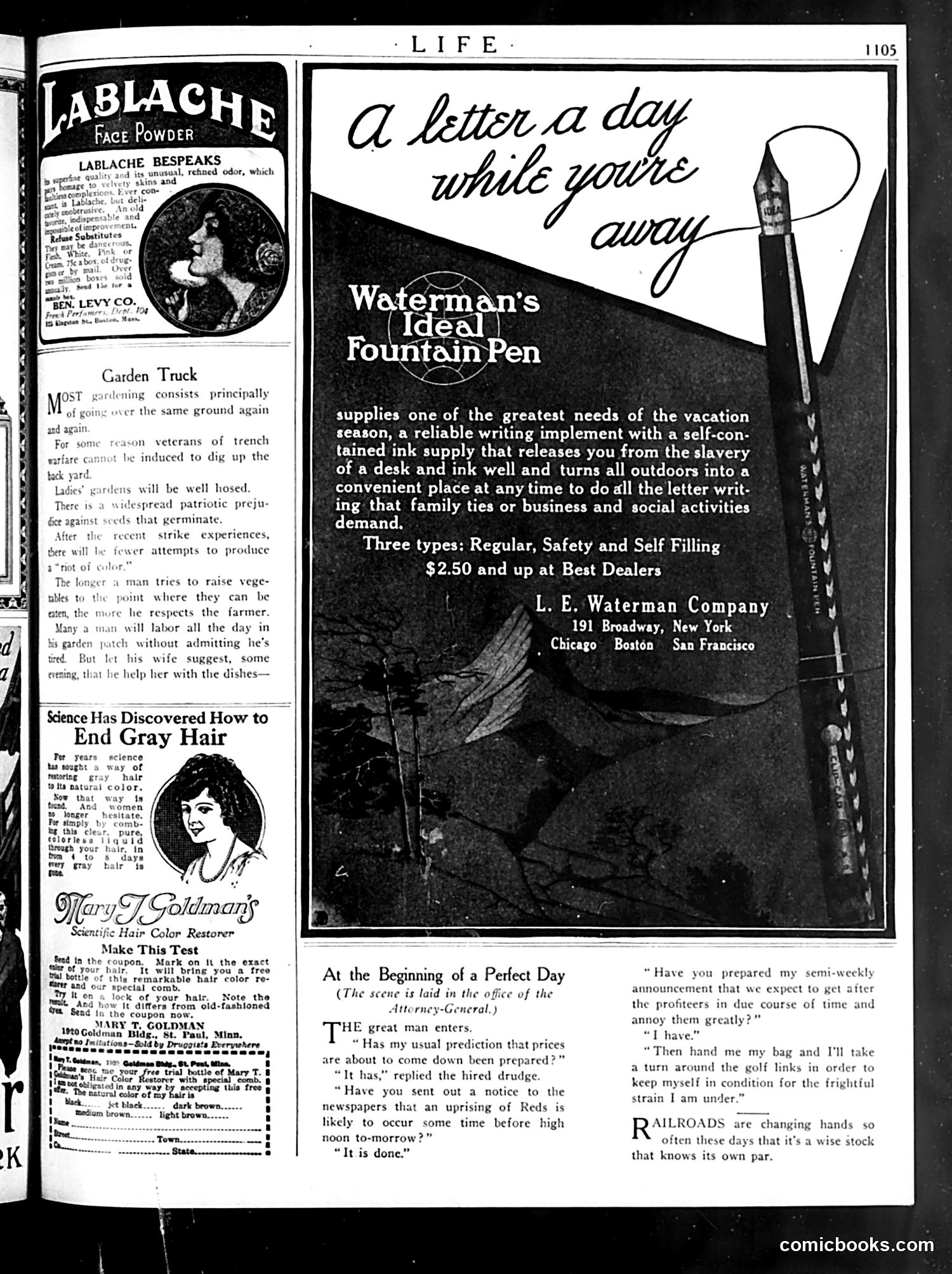
This page contains a satirical sketch titled "At the Beginning of a Perfect Day" mocking the U.S. Attorney-General's office (likely referring to A. Mitchell Palmer, who served 1919-1921). The cartoon depicts an official issuing cynical orders to his subordinate: prepare predictions about price controls, send notices warning of imminent "Red" (communist) uprisings, and manage public perception—all while he takes leisurely golf breaks. **The satire targets:** - Government manipulation of public concern about communism and inflation - The disconnect between officials' manufactured warnings and actual policy action - Performative governance designed to control public opinion rather than solve problems - The self-serving nature of bureaucratic theater during the post-WWI "Red Scare" period The joke rests on the obvious falseness of these "predictions" and "notices"—they're cynical propaganda tools rather than genuine policy responses. Modern readers should recognize this as early 20th-century critique of government PR manipulation and fearmongering.
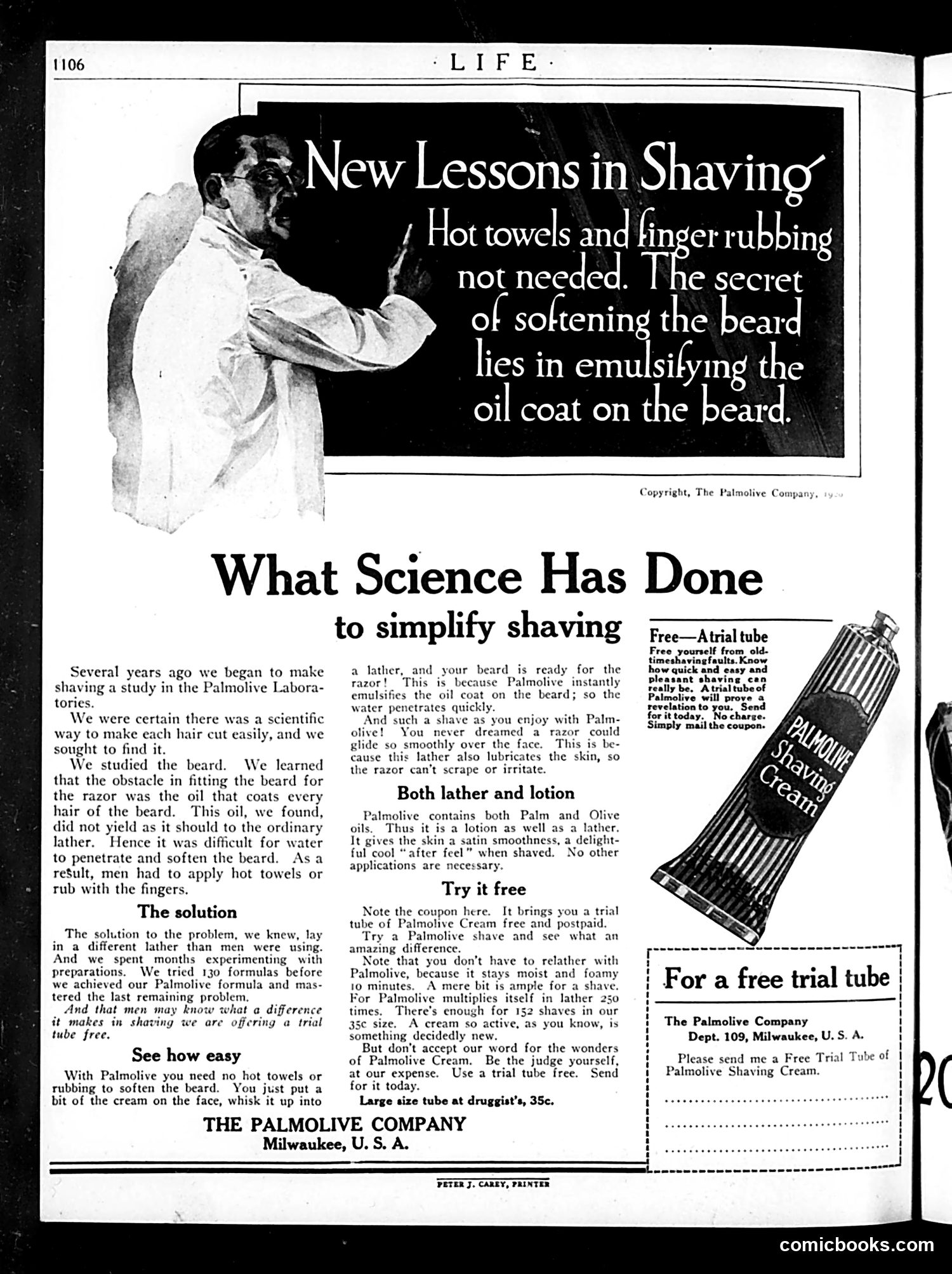
This is **not a cartoon or satire**—it's a straightforward advertisement for Palmolive shaving cream, disguised as science journalism. The page uses the authority of "science" and "laboratory research" to market a product. The company claims to have spent months studying beards and testing 130 formulas to develop a superior lather that emulsifies the oil coating facial hair, eliminating the need for hot towels or finger-rubbing. The photograph shows a man applying the cream—presented as evidence of the product's ease of use. The advertisement mimics editorial content by framing this as a genuine discovery ("What Science Has Done"), which was common advertising practice of this era. The free trial coupon offers readers proof they could test the claims themselves. By today's standards, this would violate advertising disclosure rules; the presentation blurs the line between editorial and commercial content in ways now prohibited.
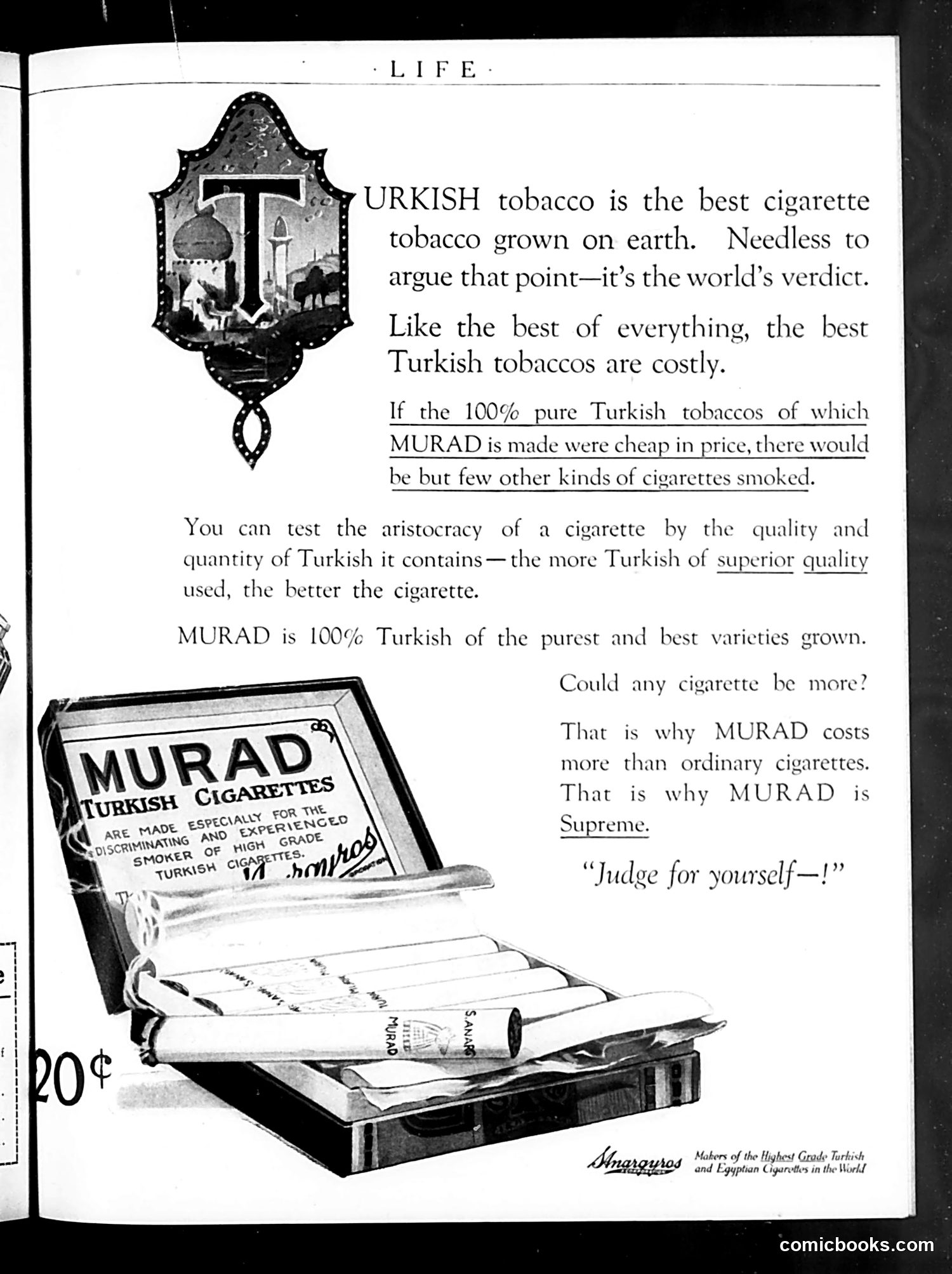
This is a **straightforward luxury cigarette advertisement**, not satire or political commentary. The page promotes MURAD brand cigarettes, emphasizing their supposed superiority through several marketing claims: **The pitch:** MURAD contains 100% pure Turkish tobacco—the world's "best" cigarette tobacco—therefore justifying premium pricing over ordinary brands. **The rhetorical strategy:** The ad uses circular logic ("best tobacco is costly; costly tobacco is best") and appeals to class consciousness ("aristocracy of a cigarette") to position the product as a status symbol for discriminating smokers. **Visual elements:** An ornate Turkish-themed decorative emblem and an open cigarette package display the product at 20 cents—likely a higher price point for the era. **Modern context:** This represents mid-20th-century tobacco advertising before health warnings, when such claims were legal and uncontested. The "Judge for yourself—!" tagline invites consumer trial, a common persuasion technique of the period.
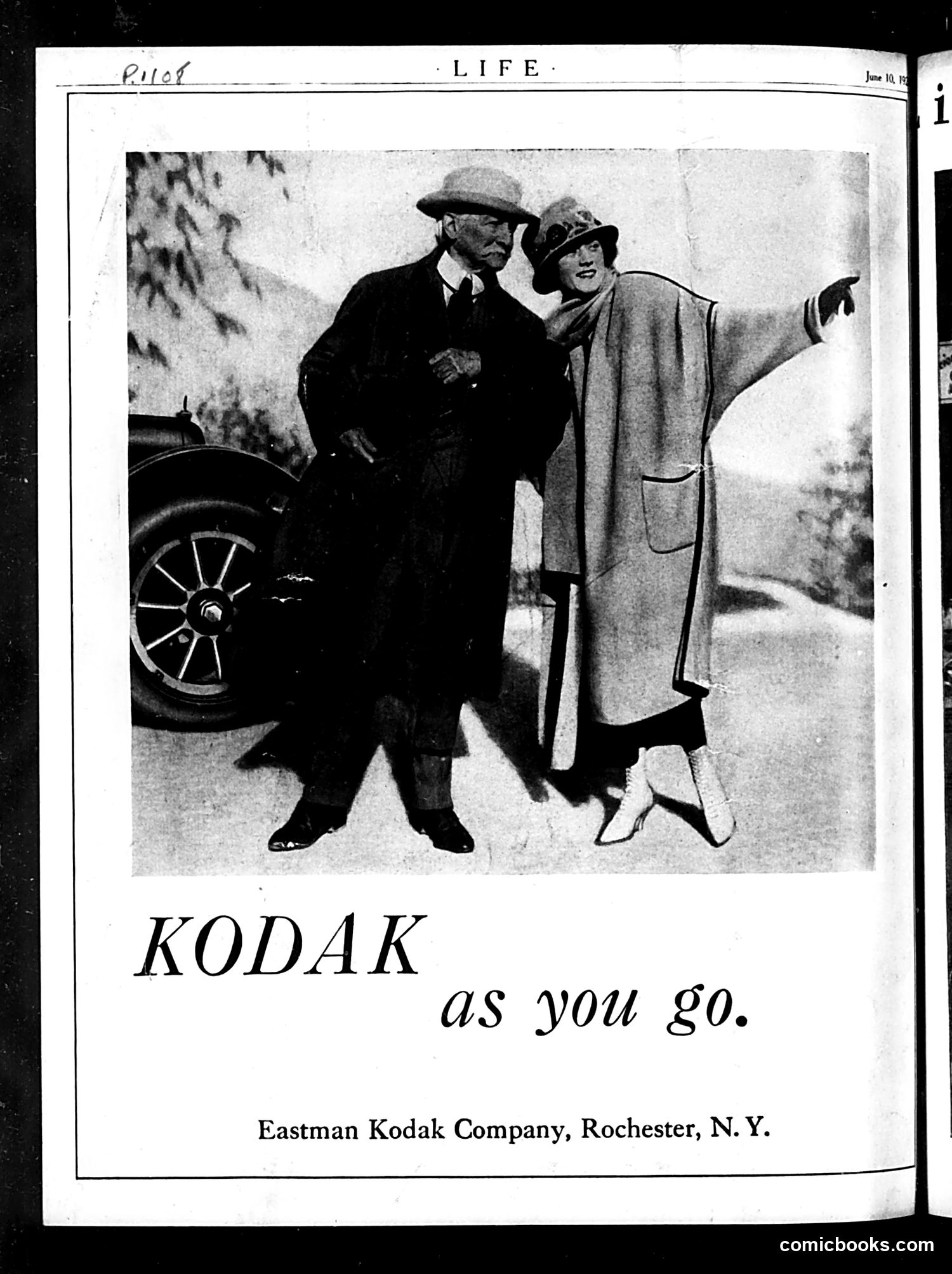
This is a **Kodak camera advertisement** from Life magazine, not political satire. The ad shows two people in 1920s attire beside an automobile, with one figure pointing to indicate a scene worth photographing. The headline "KODAK as you go" emphasizes the camera's portability for capturing candid moments during travel and leisure activities. The advertisement's appeal targets affluent consumers who owned automobiles—a luxury item at the time. It promotes photography as an accessible hobby for everyday people, positioning Kodak cameras as essential travel companions. The casual, friendly interaction between the figures suggests photography as a social, leisure activity rather than professional work. This reflects the era's consumer marketing strategy of democratizing photography for the middle class.