
Life, 1920-06-10 · page 18 of 44
Life — June 10, 1920 — page 18: what you’re looking at
What you’re looking at
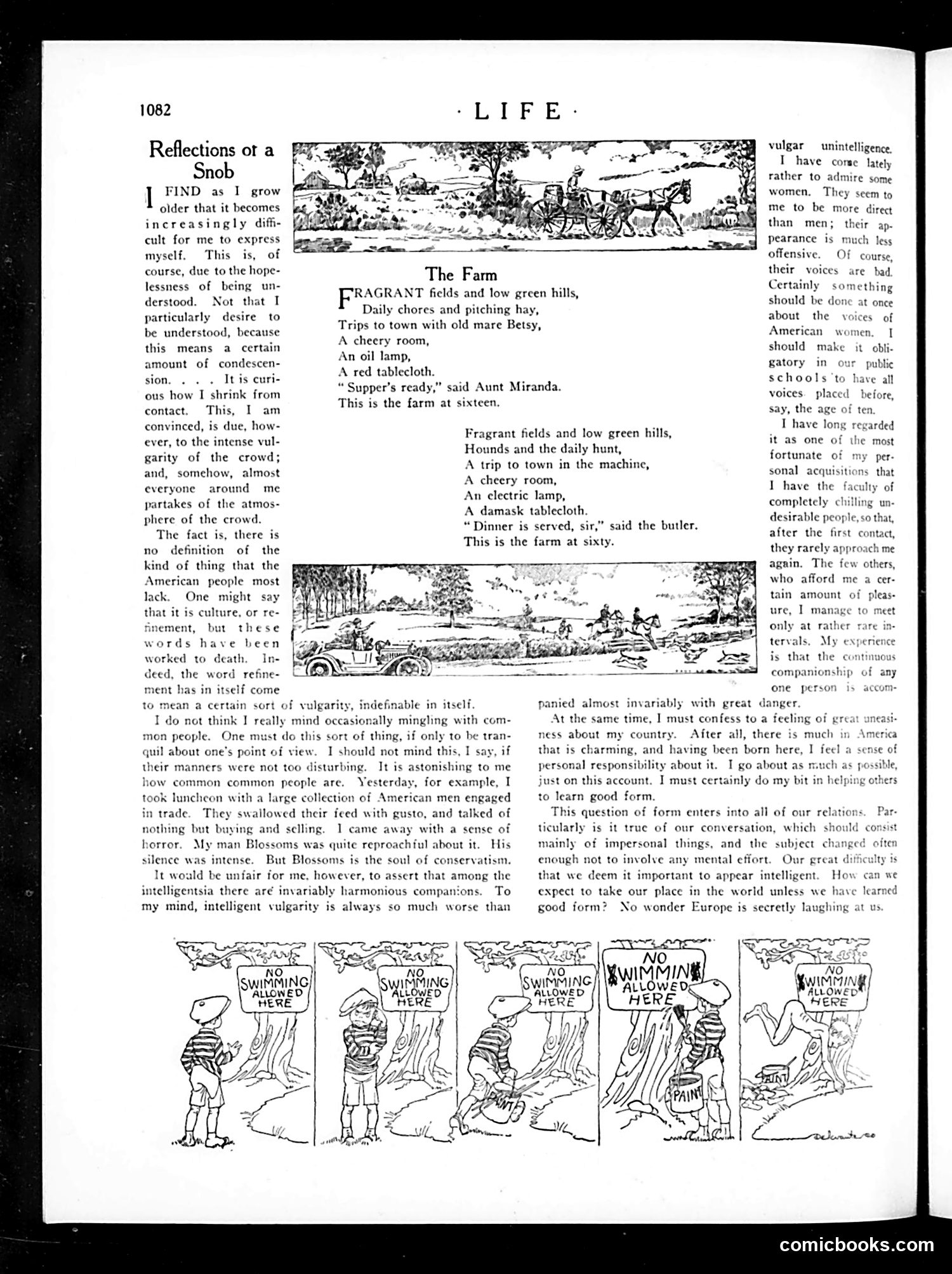
This page contains a satirical essay titled "Reflections of a Snob" mocking upper-class pretension. The unnamed narrator claims intellectual superiority while complaining that common people lack "culture" and "refinement." The irony is intentional—the author is ridiculing the speaker's own snobbery, not endorsing it. The accompanying poem "The Farm" contrasts rural simplicity at age sixteen with wealth and formality at sixty, suggesting that prosperity brings pretension rather than genuine improvement. The bottom cartoon shows a child repeatedly ignoring "No Swimming" signs at a swimming hole, each panel showing escalating consequences (getting caught, being chased, pain). The final panel reads "NO SWIMMING ALLOWED HERE"—the joke being that rules exist precisely because people ignore them. Together, the page satirizes American class anxiety and the obsession with appearing "refined" rather than being genuinely good or honest.
📄 Transcribed text from this page (OCR, searchable)
Machine-transcribed from the original scan — historical spelling and the odd misread are preserved.
1082 Reflections ot a Snob FIND as I grow older that it becomes increasingly diffi- cult for me to express myself. This is, of course, due to the hope- lessness of being un- derstood. Not that I particularly desire to be understood, because this means a certain amount of condescen- sion. . . . It is curi- ous how I shrink from contact. This, I am convinced, is due, how- ever, to the intense vul- garity of the crowd; and, somehow, almost everyone around me partakes of the atmos- phere of the crowd. The fact is, there is no definition of the kind of thing that the American people most lack. One might say that it is culture, or re- nnement, but these words have been worked to death, In- deed, the word refine- ment has in itself come to mean a certain sort of vulgarity, indefinable in itself. I people. One quil about one’s point of view their manners were not too disturbing. It is astonishing to me personal responsibility about it. I do not think I really mind occasionally mingling with com- FRAGRANT fields and low green hills, Daily chores and pitching hay, Trips to town with old mare Betsy, A cheery room, An oil lamp, A red tablecloth. “ Supper’s ready,” said Aunt Miranda. This is the farm at sixteen, Fragrant fields and low green hills, Hounds and the daily hunt, A trip to town in the machine, A cheery room, An electric lamp, A damask tablecloth. “Dinner is served, sir,” said the butler, This is the farm at sixty. ae] vulgar —unintelligence, I have corse lately rather to admire some women. They seem to me to be more direct than men; their ap. pearance is much less offensive. Of course, their voices are bad. Certainly something should be done at once about the voices of American women. I should make it obli- gatory in our public schools ‘to have all voices. placed e, say, the age of ten. I have long regarded it as one of © most fortunate of sonal acquisitic I have the fac completely chilling un- desirable people, so that, after the first contact, they rarely approach me © few others, who afford me tain amount of pleas- ure, 1 manage to n only at rather + tervals, My expe is that the companionship QUE :PStson panied almost invariably with great danger. At the same time, I must confess to a feeling of grez do this sort of thing, if only to be tran- ness about my country. After all, there is much ir I should not mind this, I say, if that is charming, and having been born here, I feel a I go about as much a »w common common people are. Yesterday, for example, I just on this account. I must certainly do my bit in hely took luncheon with a large collection of American men engaged to learn good form in trade. They swallowed their feed with gusto, and talked of nothing but buying and selling. I came away with a sense of This question of form enters into all of our rela’ horror. My man Blossoms was quite reproachiul about it. His mainly of impersonal things, and the subject c¢ silence was intense. But Blossoms is the soul of conservatism. It would be unfair for me, however, to assert that among the enough not to involve any mental effort that we deem it important to appear intelligent. How can we Our great difficulty is intelligentsia there aré invariably harmonious companions. To expect to take our place in the world unless we have learned my mind, intelligent vulgarity is always so much worse than good form? No wonder Europe is secretly laughing comicbooks.com