
Life, 1920-06-10 · page 28 of 44
Life — June 10, 1920 — page 28: what you’re looking at
What you’re looking at
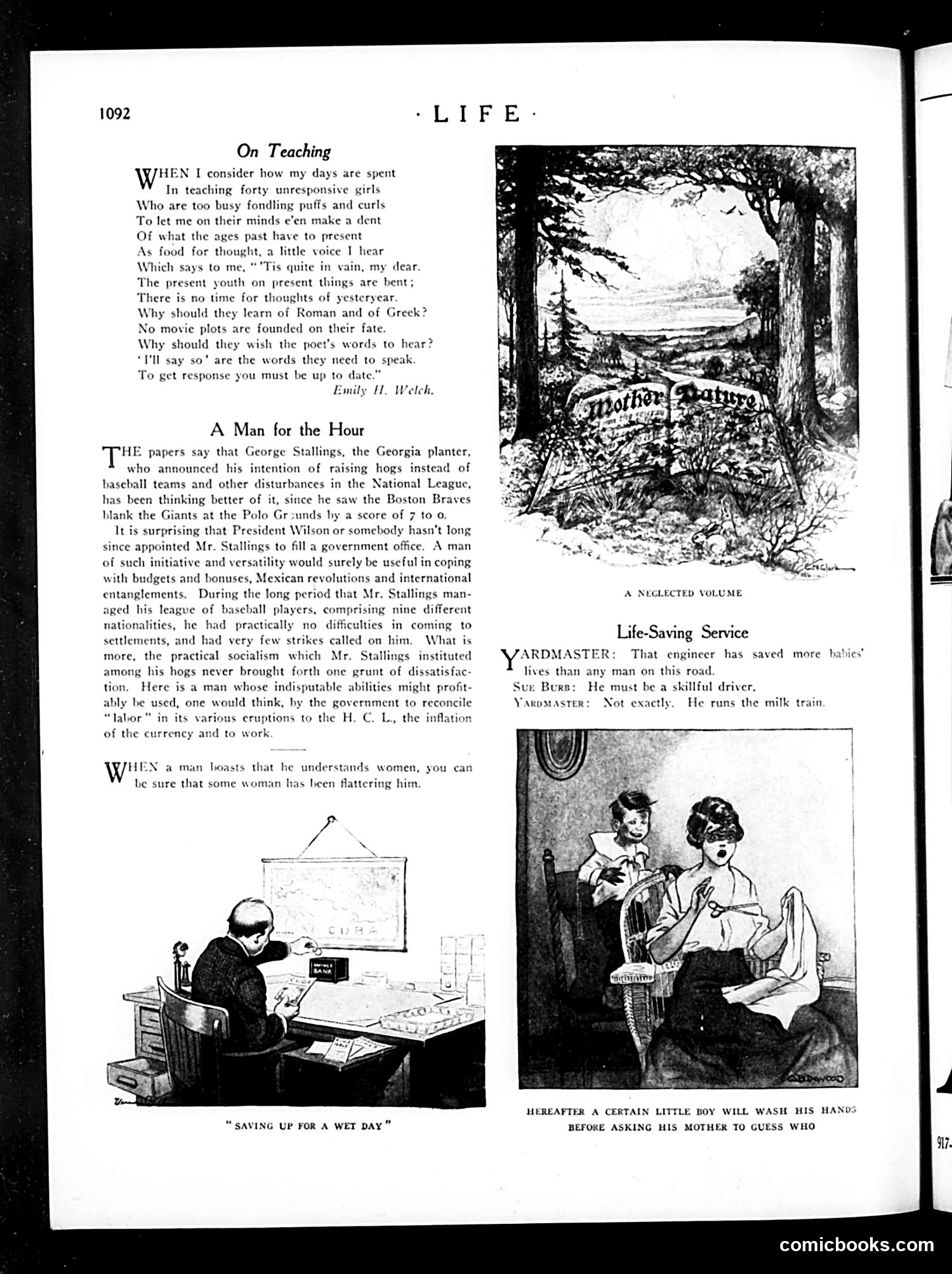
This page contains three distinct satirical pieces: **"On Teaching"** (poem by Emily H. Welch): Satirizes modern education's perceived decline. Teachers lament that 1920s students care only about current fashions ("puffs and curls") and movies, ignoring classical literature, Roman/Greek history, and poetry. The joke is that students allegedly only need modern slang ("I'll say so") rather than intellectual substance. **"A Man for the Hour"**: Mocks George Stallings, a Georgia planter and baseball manager, suggesting President Wilson should hire him for government work since he successfully managed a diverse baseball league and maintained labor peace. The satire critiques both Stallings's sudden farm-pivot and the government's apparent inability to solve contemporary problems (budgets, Mexican unrest, cost-of-living inflation). **"Life-Saving Service"**: A brief joke where a yardmaster credits an engineer with saving lives—but the punchline reveals he simply drives the milk train safely, not through exceptional skill but routine work. The cartoons accompanying these pieces illustrate the themes humorously.
📄 Transcribed text from this page (OCR, searchable)
Machine-transcribed from the original scan — historical spelling and the odd misread are preserved.
On Teaching HEN I consider how my days are spent In teaching forty unresponsive girls Who are too busy fondling puffs and curls To let me on their minds e’en make a dent Of what the ages past have to present As food for thought, a little voice I hear Which says to me, “'Tis quite in vain, my dear. The present youth on present things are bent; There is no time for thoughts of yesteryear. Why should they learn of Roman and of Greek? No movie plots are founded on their fate. Why should they wish the poet’s words to hear? “I'll say so’ are the words they need to speak: To get response you must be up to date.” Emily H.W. A Man for the Hour HE papers say that George Stallings, the Georgia planter, who announced his intention of raising hogs instead of baseball teams and other disturbances in the National League, has been thinking better of it, since he saw the Boston Braves Iank the Giants at the Polo Gr>unds hy a score of 7 to 0. It is surprising that President Wilson or somebody hasn't long since appointed Mr. Stallings to fill a government office. A man of such initiative and versatility would surely be useful in coping with budgets and bonuses, Mexican revolutions and international entanglements. During the long period that Mr. lings man- d his league of baseball players, comprising nine different nationalities, he had practically no difficulties in coming to settlements, and had very few strikes called on him. What is more, the practical socialism which Mr. Stallings instituted among his hogs never brought forth one grunt of dissatisfac- tion. Here is a man whose indisputable abilities might profit- ably be used, one would think, by the government to reconcile labor” in its various eruptions to the H. C. L., the inflation of the currency and to work HEN a man boasts that he understands women, you can be sure that some woman has been flattering him “ SAVING UP FOR A WET DAY” A NEGLECTED VOLUME Life-Saving Service ARDMASTER: That engineer has saved more ba! lives than any man on this road Sve Burs: He must be a skillful driver, Yaromaster: Not exactly. He runs the milk train. HEREAFTER A CERTAIN LITTLE BOY WILL WASH HIS HANDS BEFORE ASKING HIS MOTHER TO GUESS WHO comicbooks.com