
Life, 1920-06-10 · page 24 of 44
Life — June 10, 1920 — page 24: what you’re looking at
What you’re looking at
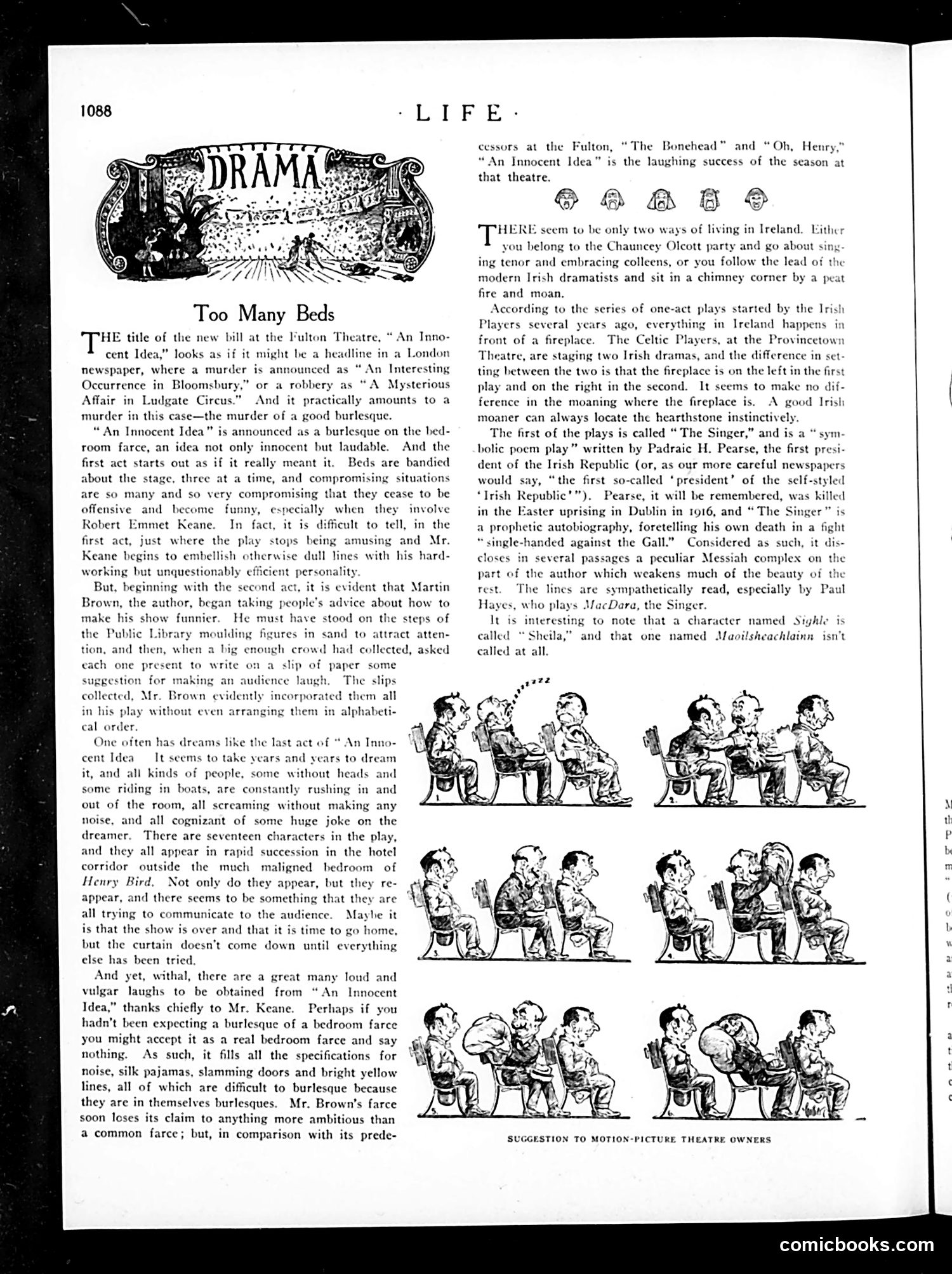
This is a theater review of the burlesque "An Innocent Idea" at the Fulton Theatre, satirizing both the play itself and broader comedic trends. **The Satire:** The reviewer mocks playwright Martin Brown for abandoning his promising premise (a burlesque of bedroom farces) after Act One. Brown apparently solicited joke suggestions from random pedestrians at the Public Library and incorporated them all without organization, creating a chaotic final act. The review compares this to fever dreams—seventeen characters appear and reappear in a hotel corridor, screaming soundlessly, apparently trying to communicate something (possibly that the show should end). **The Point:** The critic argues the play devolves from intentional satire into accidental self-parody. While Robert Emmet Keane's personality keeps it entertaining, Brown's lack of discipline transforms it into exactly what it mocked: a common farce relying on crude elements (slamming doors, bright costumes) that are already inherently absurd. The accompanying illustrations show groups of men in chairs, likely depicting the chaotic ensemble scenes criticized.
📄 Transcribed text from this page (OCR, searchable)
Machine-transcribed from the original scan — historical spelling and the odd misread are preserved.
Too Many Beds HE title of the new bill at the Fulton Theatre, cent Idea,” looks as if it might be a headline in a London “An Inno- newspaper, where a murder is announced as “ An Interesting Occurrence in Bloomsbury,” or a robbery as “A Mysterious Affair in Ludgate Circus.” And it practically amounts to a murder in this case—the murder of a good burlesque. “An Innocent Idea” is announced as a burlesque on the hed- room farce, an idea not only innocent but laudable. And the first act starts out as if it really meant it. Beds are bandied about the stage. three at a time, and compromising situations are so many and so ve compromising that they cease to be offensive and become funny, ¢ Robert Emmet Keane. In fact, first act, just where the play stops being Keane begins to embellish o ecially when they involve it is difficult to tell, in the musing and Mr. nerwise dull lines with his hard- working but unquestionably efficient personality. But, beginning with the second act, it is evident that Martin Brown, the author, be an taking people’s advice about how to make his show funnier. He must have stood on the steps of the Public Library moulding figures in sand to attract atten- tion, and then, when a big enough crowd had collected, asked each one present to write on a slip of paper some The slips collected, Mr. Brown evidently incorporated them all in his play without even a suggestion for aking an audience laugh. ranging them in alphabeti- cal order. One often has dreams like the last act of * An Inno- cent Idea It seems to take years and years to dream it, and all kinds of people, some without heads and some riding in boats, are constantly rushing in and out of the room, all screaming without making any noise, and all cognizant of some huge joke on the dreamer. There are seventeen characters in the play, and they all appear in rapid succession in the hotel corridor outside the much maligned bedroom of Henry Bird. Not only do they appear, but they re appear, and there seems to be something that they are all trying to communicate to the audience. Mayhe it is that the show is over and that it is time to go home, but the curtain doesn’t come down until everything else has been tried, And yet, withal, there are a great many loud and vulgar laughs to be obtained from “An Innocent Idea,” thanks chiefly to Mr. Keane. Perhaps if you hadn't been expecting a burlesque of a bedroom farce you might accept it as a real bedroom farce and say nothing. As such, it fills all the specifications for noise, silk pajamas, slamming doors and bright yellow lines, all of which are difficult to burlesque because they are in themselves burlesques. Mr. Brown's farce soon loses its claim to anything more ambitious than a common farce; but, in comparison with its prede- cessors at the Fulton, “The Bonehead” and “Oh, Henry,” “An Innocent Idea” is the laughing success of the season at that theatre. “em to be only two way’ of living in Ireland. Either HE you belong to the Chauncey Olcott party and go about sing ing tenor and embracing colleens, or you follow the lead of modern Irish dramatists and sit in a chimney corner by a peat fire and moan, According to the series of one-act plays started by the Iris! Players seve al years ago, everything in Ireland happens in front of a fireplace. The Celtic Players, at the Provincetown Theatre, are staging two Irish dramas, and the difference in set- ting between the two is that the fireplace is on the left in the first play and on the right in the second. It seems to make no dif- ference in the moaning where the fireplace is. A good Irish moaner ‘an always locate the hearthstone instinctively. The first of the plays is called “ The Singer,” and is sym- holic poem play” written by Padraic H. Pearse, the first presi- dent of the Irish Republic (or, as our more careful newspapers would say, “the first so-called ‘president’ of the self-styled ‘Trish Republic Pearse, it will be remembered, was killed in the Easter uprising in Dublin in 1916, and “ The Singer” is a prophetic autobiography, foretelling his own death in a fight “ single-handed against the Gall.” Considered as such, it dis- closes in several passages a peculiar Messiah complex on part of the author which weakens much of the beauty of rest. The lines are sympathetically read, especially by Paul Hayes, who plays acDara, the Singer. It is interesting to note that character named Stghle is called “ Sheila,” and that one named Maoilsheachlainn isn't called at all. SUGGESTION TO MOTION-PICTURE THEATRE OWNERS comicbooks.com