
Life, 1920-06-10 · page 16 of 44
Life — June 10, 1920 — page 16: what you’re looking at
What you’re looking at
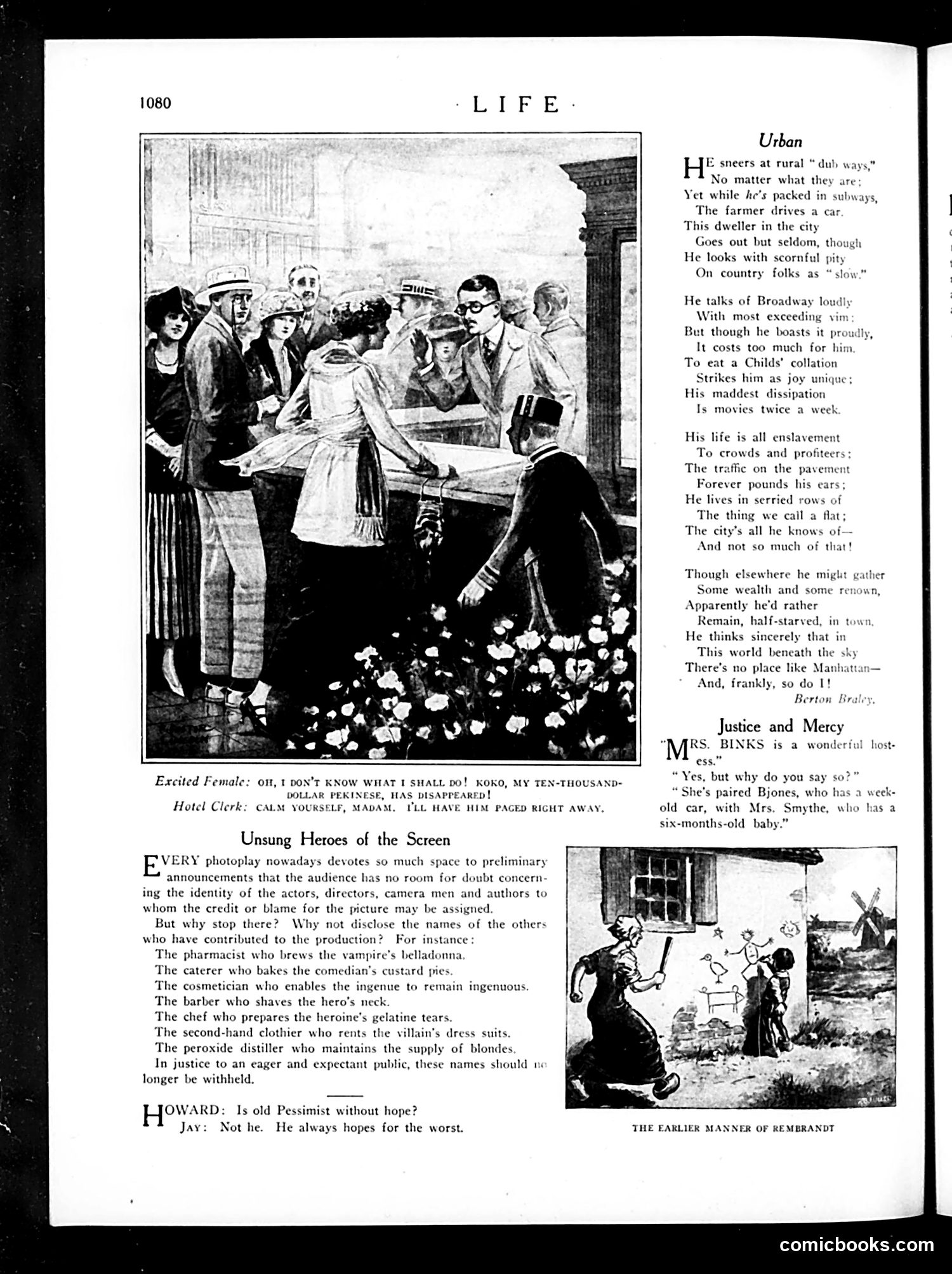
This page satirizes the lifestyle of wealthy urban dwellers during the early 20th century. The main poem "Urban" contrasts city sophistication with rural simplicity—the protagonist boasts about Broadway and expensive entertainments while scorning country people as "slow." The satire lies in exposing his pretensions: he's actually confined to cramped apartments, endures constant noise and crowds, and finances his meager pleasures (cheap movies) through financial strain. The accompanying illustration shows a hotel scene where an excited woman has discovered a lost ten-thousand-dollar diamond. The satire suggests urban life revolves around materialism and status anxiety—everyone's drama centers on wealth and luxury goods rather than genuine contentment. The brief dialogue joke plays on pessimism, reinforcing themes of urban malaise beneath surface glamour.
📄 Transcribed text from this page (OCR, searchable)
Machine-transcribed from the original scan — historical spelling and the odd misread are preserved.
Urban sheers at rural “duly ways," No matter what they are Yet while he’s packed in subways, The farmer drives a car This dweller in the city Goes out but seldom, though He looks with scornful pity On country folks as “slow.” He talks of Broadway loudly With most exceeding vim But though he boasts it 1 It costs too much for him To eat a Childs’ collation Strikes him as joy unique; His maddest dissipation Is movies twice a week His life is all enslavement To crowds and profitee The trafic on the pavement Forever pounds his ears; He lives in serried rows of The thing we call a flat; The city’s all he knows of— And not so much of that! Though elsewhere he mi Some wealth and some r Apparently he'd rather Remain, half-starved, in town, He thinks sincerely that in This world beneath the sky There's no place like Manhattan— And, frankly, so do I! Berton Braly Justice and Mercy “MES. BINKS is a wonderful ess.” Excited Female: om, 1 pON’T KNOW WHAT I SHALL DO! KOKO, MY TEN-THOUSAND- “Yes, but why do you say ‘ DOLLAR PEKINESE, HAS DISAPPEARED! She's paired Bjones, who has a week- Hotel Clerk: CALM YOURSELF, MADAM. I'LL HAVE HIM PAGED RIGHT AWAY. old car, with Mrs. Smythe, who has a six-months-old baby.” Unsung Heroes of the Screen VERY photoplay nowadays devotes so much space to preliminary announcements that the audience has no room for doubt concern ing the identity of the actors, directors, camera men and authors to whom the credit or blame for the picture may be assigned. But why stop there? Why not disclose the names of the others who have contributed to the production? For instance: The pharmacist who brews the vampire’s belladonna The caterer who bakes the comedian’s custard pies. The cosmetician who enables the ingenue to remain ingenuous. The barber who shaves the hero’s neck. The chef who prepares the heroine's gelatine tears. The second-hand clothier who rents the villain’s dress suits. The peroxide distiller who maintains the supply of blondes. In justice to an eager and expectant public, these names should nc longer be withheld, OWARD: Is old Pessimist without hope? Jay: Not he. He always hopes for the worst. THE EARLIER MANNER OF REMBRANDT comicbooks.com