
A complete issue · 56 pages · 1920
Life — May 6, 1920
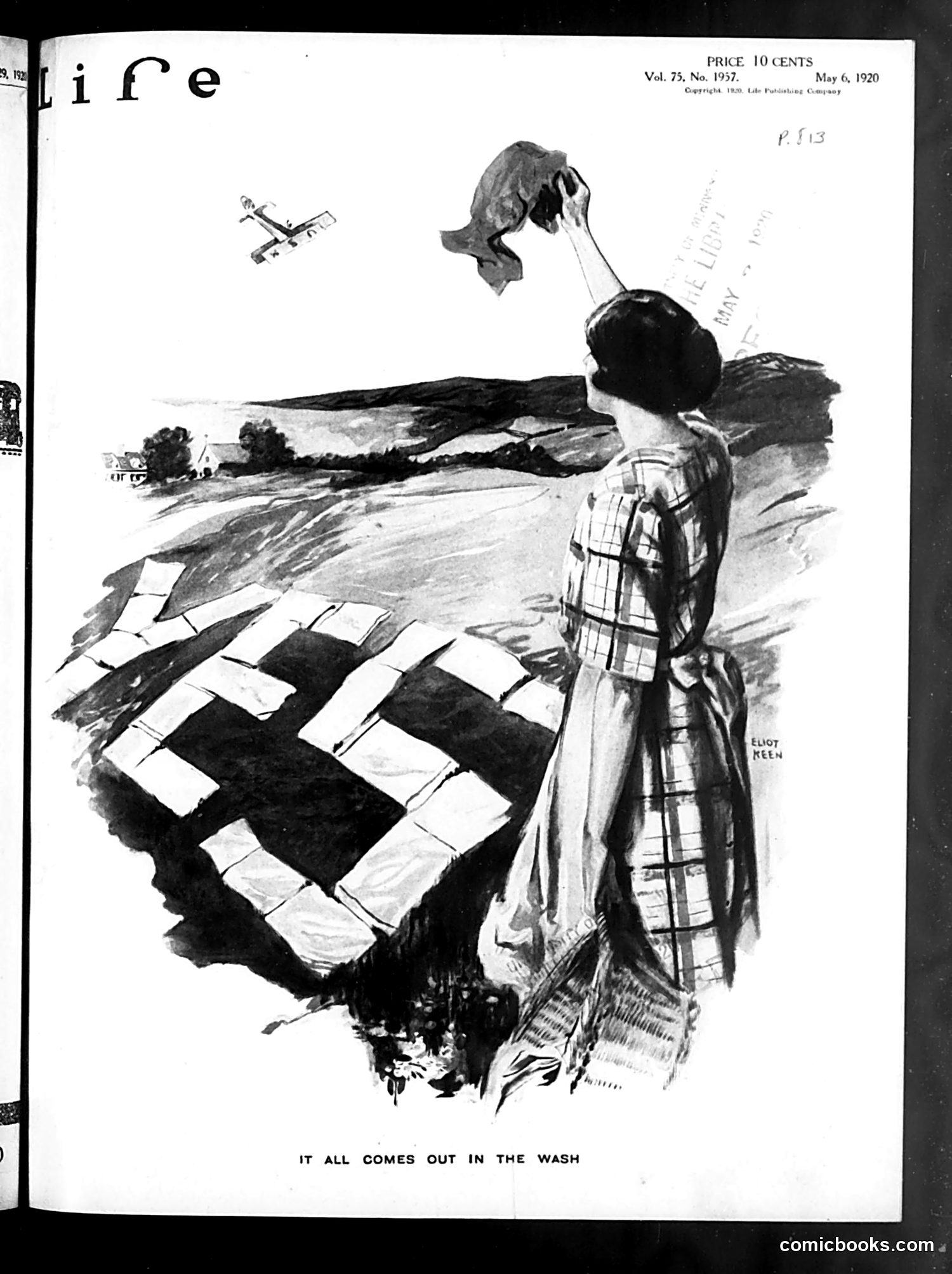
This cartoon depicts a woman in a checkered dress holding soiled laundry, waving it toward the sky where a military airplane flies. The landscape shows what appears to be a battlefield or military encampment. The title "It All Comes Out in the Wash" suggests that scandals, corruption, or misconduct from World War I—recently concluded in 1918—will eventually be exposed and cleaned up. The woman likely represents the American public or press, metaphorically "washing" away wartime secrets and improprieties. The airplane and military setting reference the war itself. The satire suggests that despite attempts to conceal wartime wrongdoing, truth will ultimately emerge through public scrutiny—a common post-WWI theme as Americans grappled with war's aftermath and accountability.
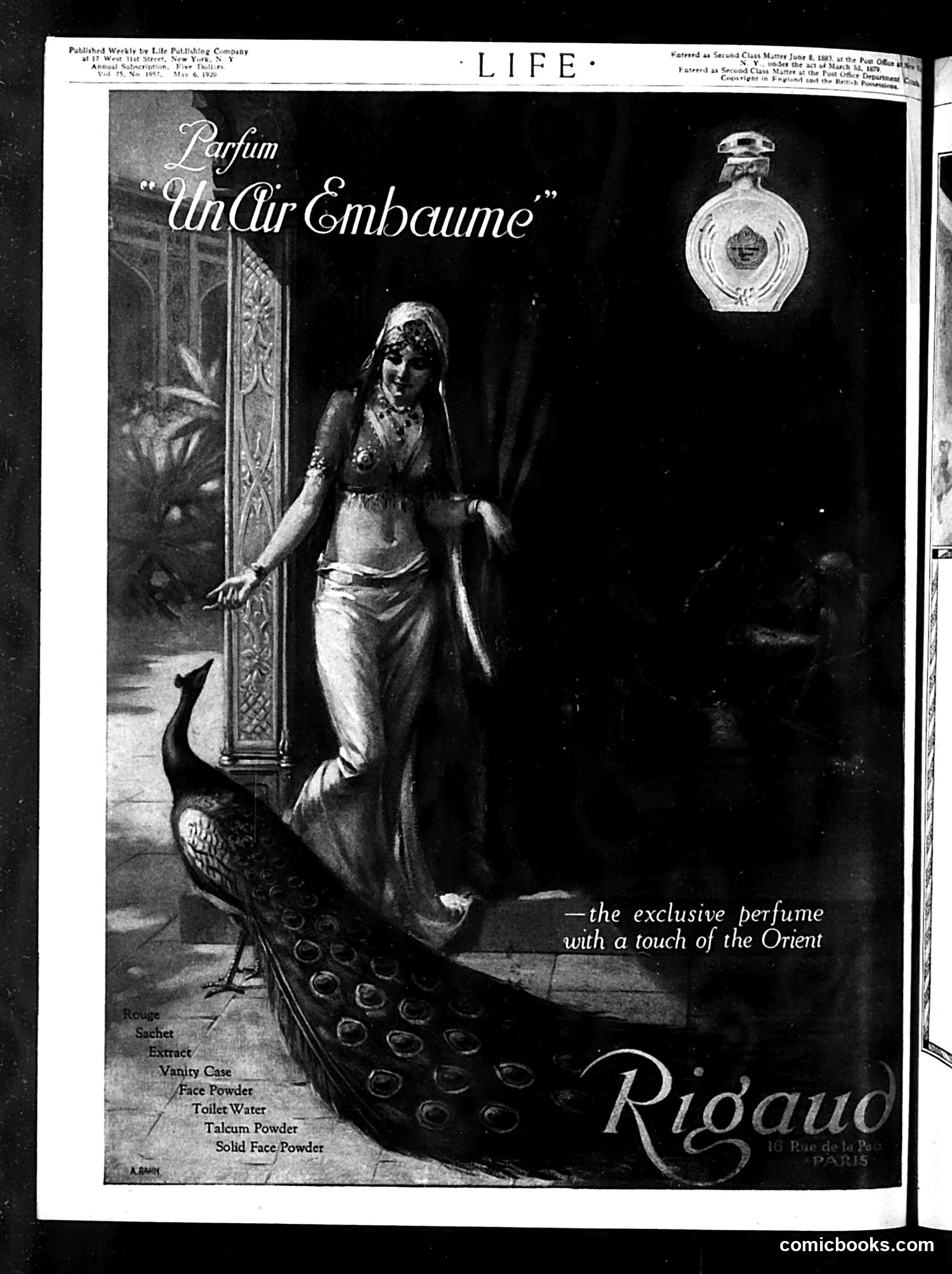
This page is **primarily advertising**, not political satire. It's a full-page advertisement for "Un'Air Embaume," a perfume by Rigaud of Paris, described as "the exclusive perfume with a touch of the Orient." The imagery uses **Orientalist aesthetics** popular in early 20th-century luxury marketing—a woman in exotic dress with a peacock, ornate architectural elements, and the decorative perfume bottle displayed. This visual language associated the product with luxury, sensuality, and "the Orient," reflecting period advertising conventions rather than satirical commentary. The left sidebar lists other Rigaud beauty products (Rouge, Face Powder, etc.), confirming this is a commercial advertisement rather than editorial content or political commentary.
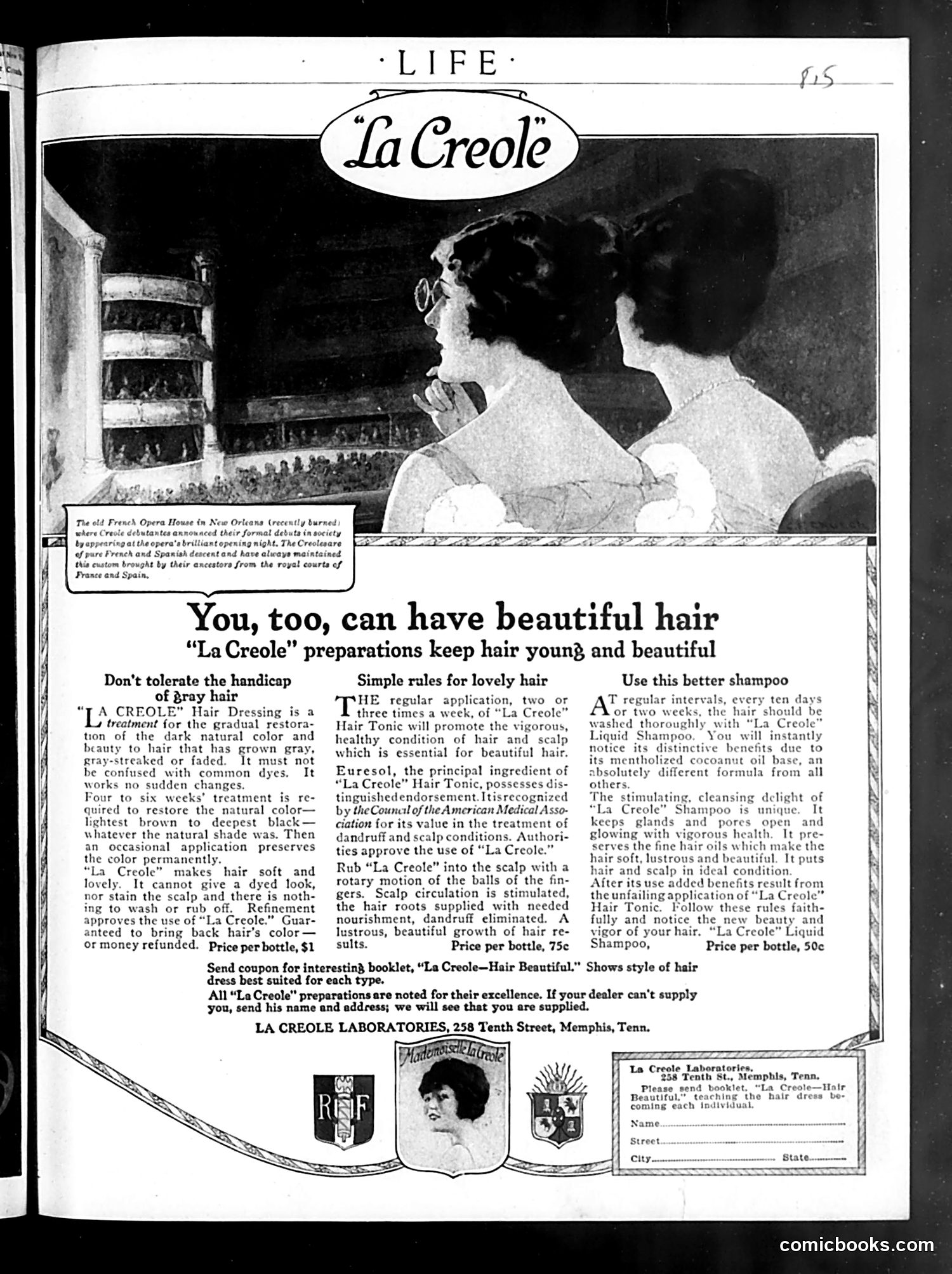
This is **primarily a commercial advertisement**, not political satire. It promotes "La Creole" hair products—a hair dressing and shampoo line marketed to women concerned about graying, fading, or unhealthy hair. The small illustration at top shows two elegantly dressed women at what appears to be the Old French Opera House in New Orleans, establishing a glamorous, sophisticated cultural setting to market the products. The advertisement emphasizes that La Creole preparations can restore youthful appearance and maintain hair health through regular application. It includes testimonials about the product's endorsement by the American Medical Association and offers a coupon for an instructional booklet on hair care. This reflects early-20th-century beauty marketing targeting women concerned with maintaining youth and appearance—a common commercial advertising strategy of the era.
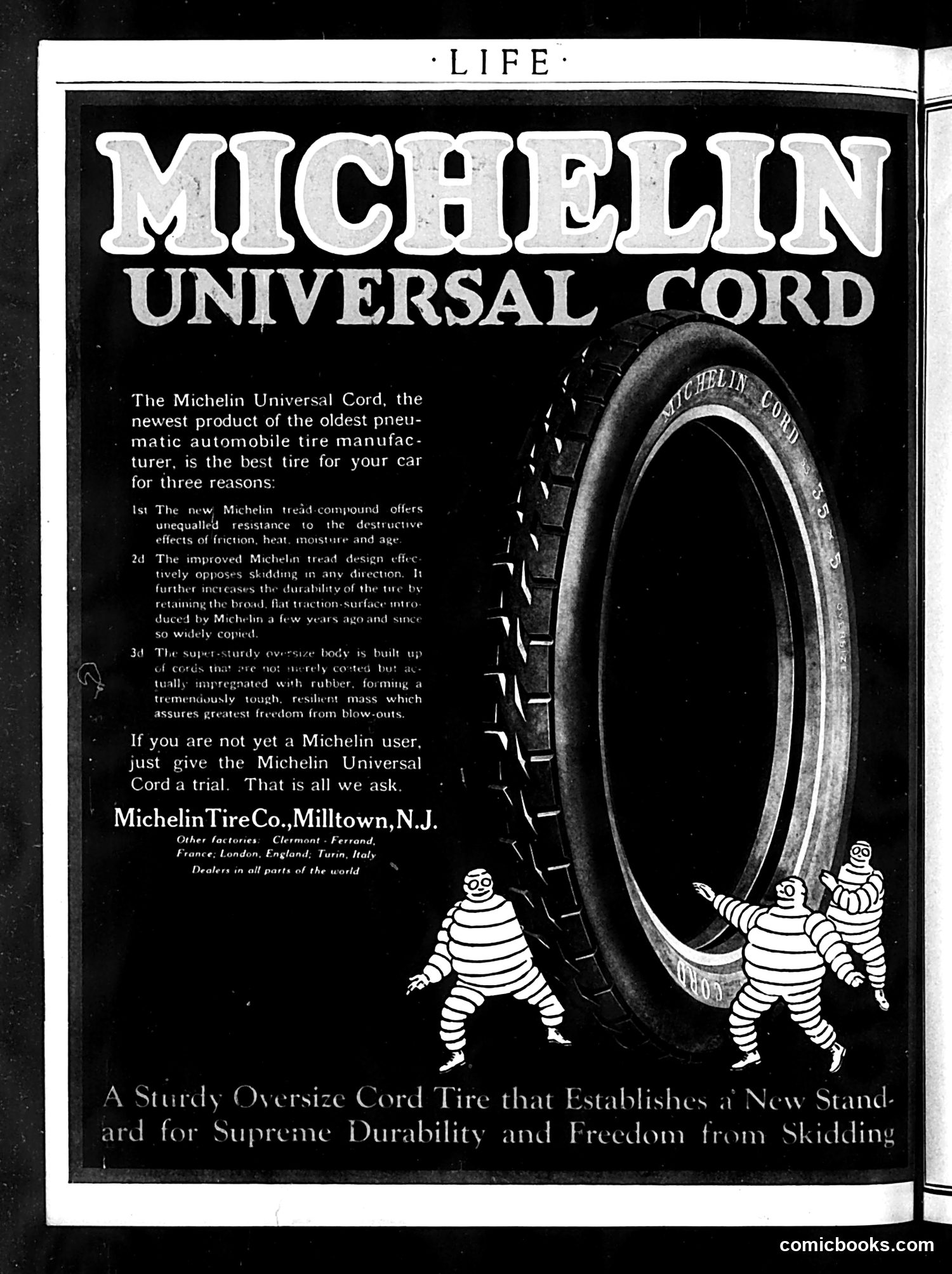
This is a **straightforward advertisement, not satire or political commentary.** The page promotes Michelin Universal Cord tires through the Michelin Man mascot (the iconic "Bibendum" character shown three times around the large tire). The ad employs the familiar advertising approach of the era: listing three technical reasons for product superiority (tread compound, tread design, oversized body construction), then using a casual call-to-action ("just give the Michelin Universal Cord a trial"). The Michelin Men are depicted as cheerful, anthropomorphic figures in their characteristic segmented/striped appearance. There is no political or satirical content—this is simply period tire marketing from Michelin's Milltown, New Jersey factory, targeting automobile owners concerned with durability and skid-resistance.
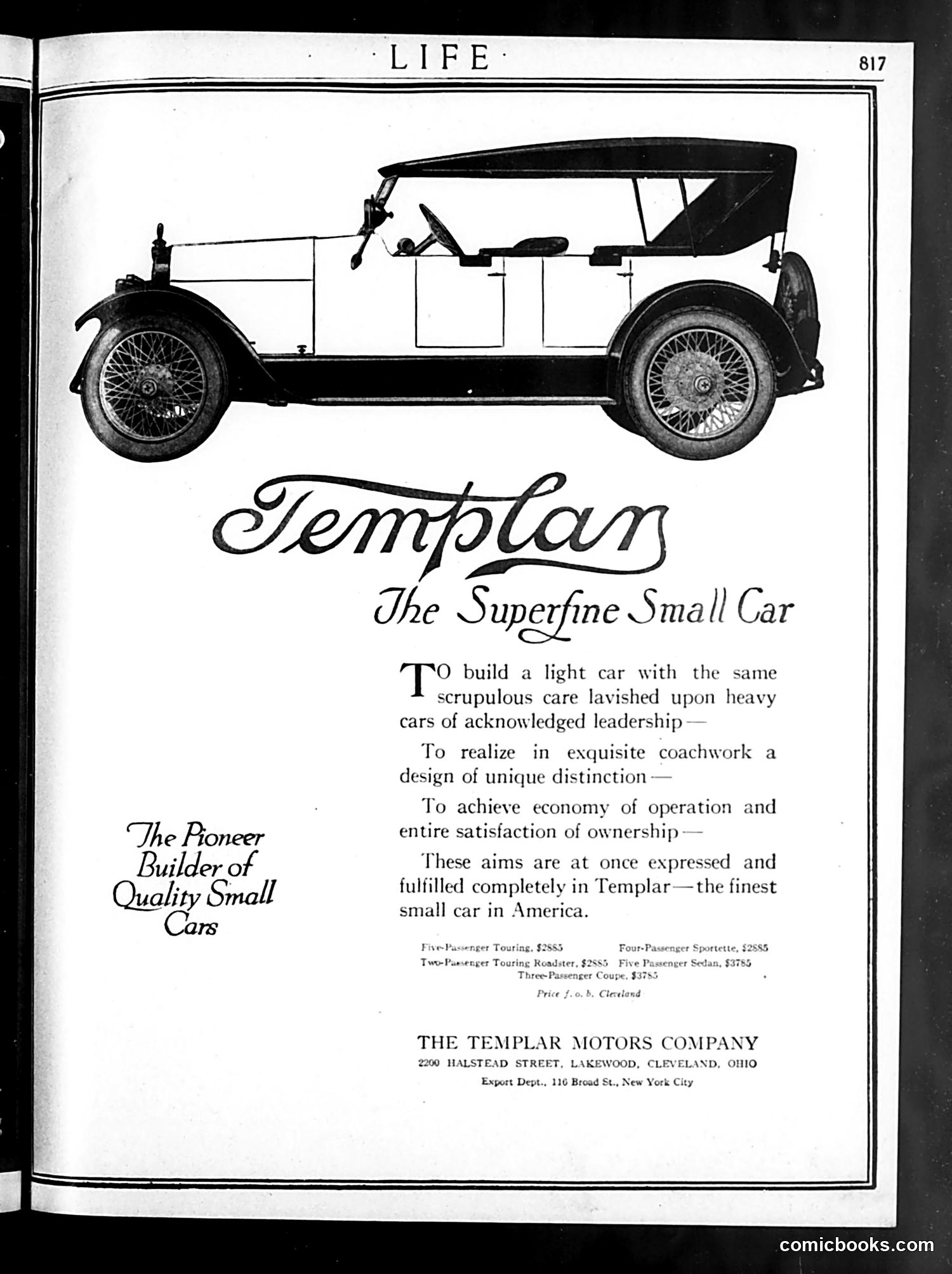
This page is **not a cartoon or satire—it is a straightforward automobile advertisement** for the Templar, a small car manufactured by the Templar Motors Company of Lakewood, Ohio (circa 1920s based on styling and pricing). The ad emphasizes quality craftsmanship in lightweight design, positioning the Templar as "the finest small car in America." It targets buyers seeking economy and reliability through phrases like "economy of operation and entire satisfaction of ownership." The side text, "The Pioneer Builder of Quality Small Cars," claims market leadership. Various models are listed with prices (ranging from $2,885-$3,750), and contact information for the New York sales office is provided. This represents typical period automotive advertising rather than political or social satire.
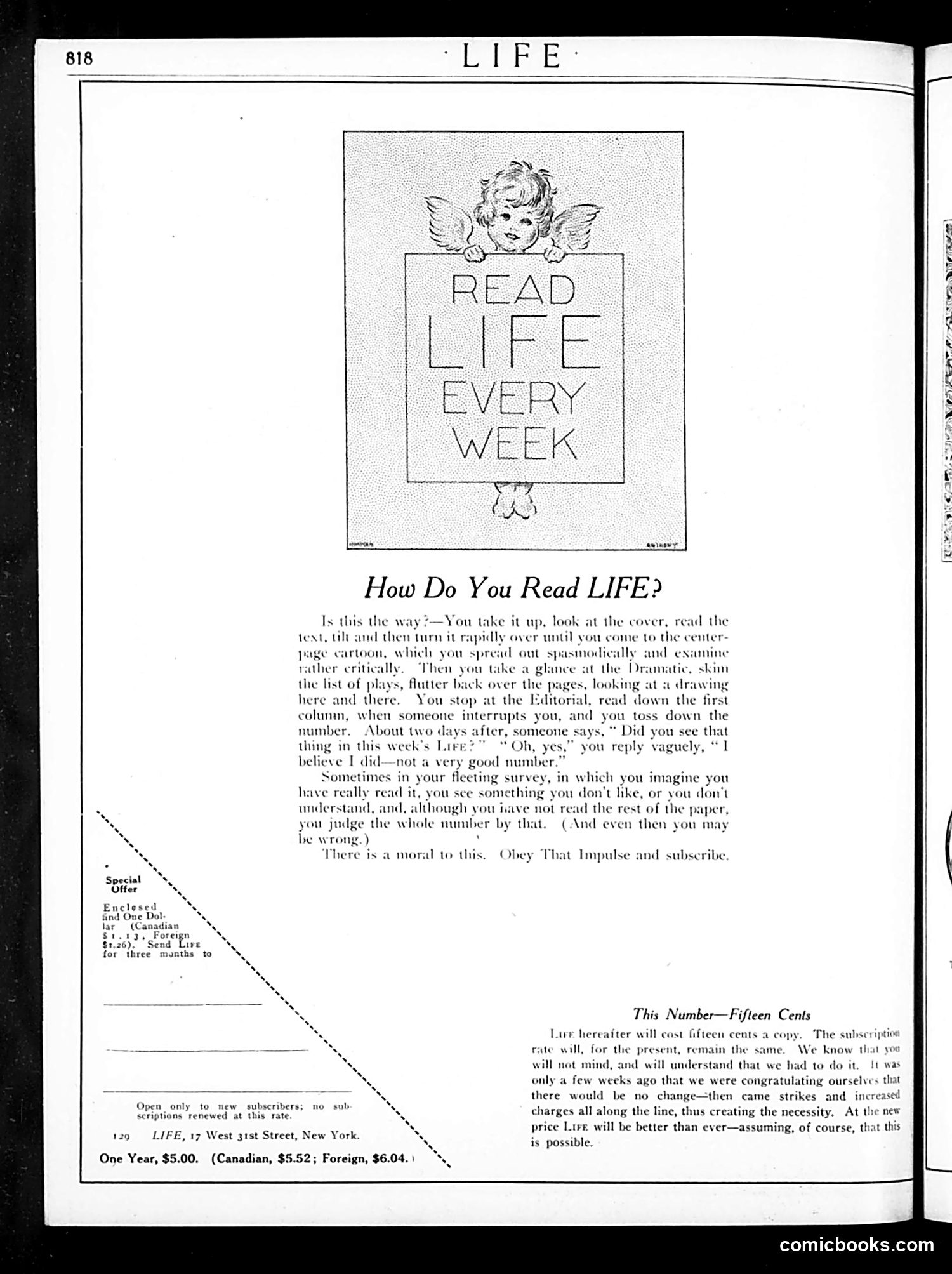
This page is primarily **advertising and editorial content**, not political satire or comics. The main image shows a cherub/cupid figure holding a sign reading "READ LIFE EVERY WEEK"—a promotional poster for the magazine itself. Below, the article "How Do You Read LIFE?" is a **self-aware, humorous critique** of how readers actually engage with the publication. The author satirizes casual readers who skim covers, glance at cartoons, skip around, and then claim to have "read" the magazine, often forming incomplete judgments based on fragments. The piece gently mocks this superficial consumption while encouraging more thorough reading. The page also contains subscription offers and pricing information, typical of magazine advertisements from this era. No specific political figures or events are referenced—this is meta-commentary on reading habits themselves.
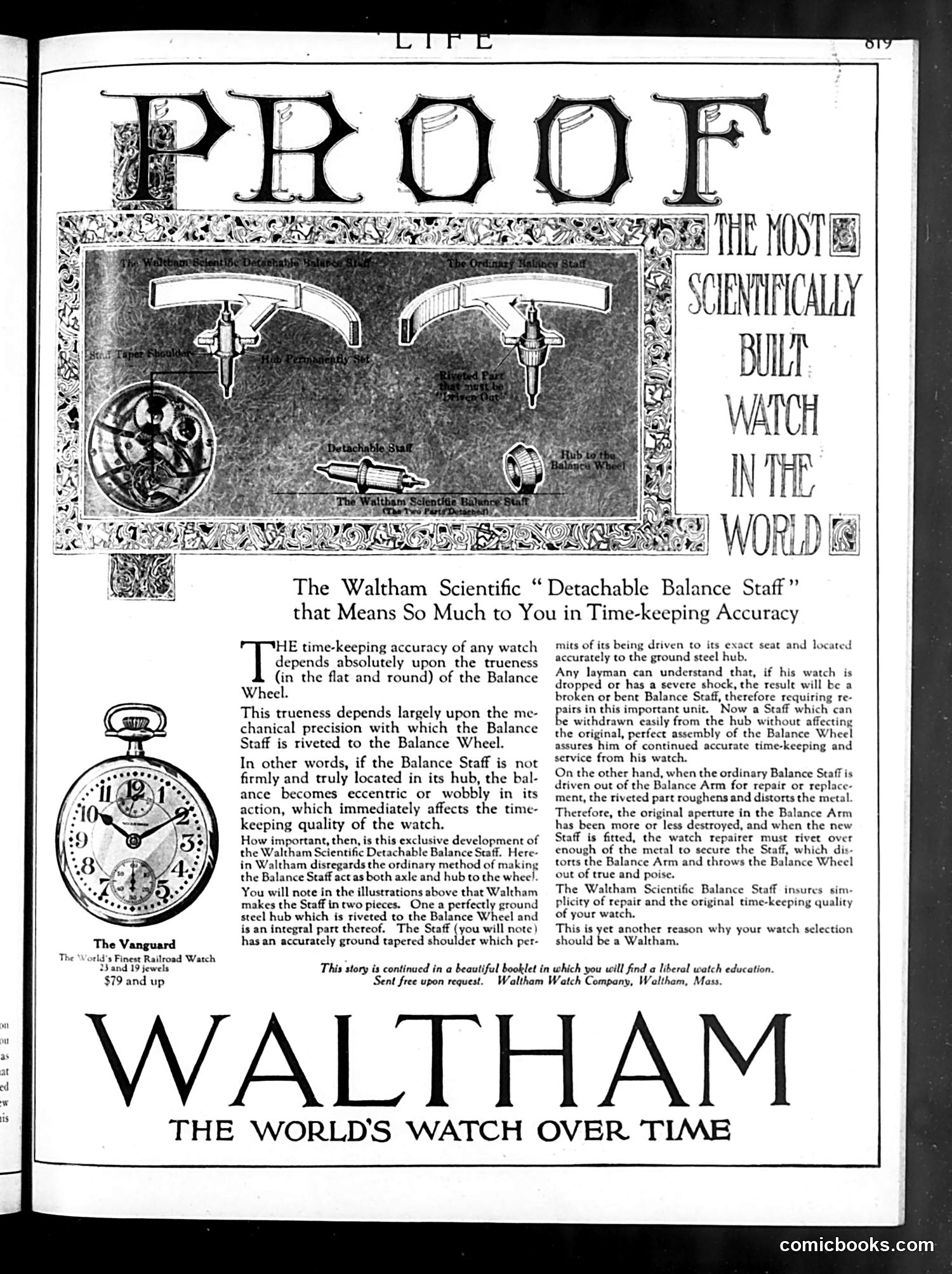
This page is primarily **advertising content**, not satirical cartooning. It's a Waltham Watch Company advertisement from *Life* magazine promoting their "Proof" watch model. The ad emphasizes the watch's "Detachable Balance Staff" as a scientific innovation ensuring accuracy. The technical diagram at top shows internal watch mechanisms. Below, a pocket watch (labeled "The Vanguard") illustrates the product. The copy explains that this balance staff can be safely removed for repair without compromising the watch's precision—a practical selling point for consumers concerned about reliability. The ad positions Waltham as scientifically advanced ("The World's Finest Railroad Watch"). This represents **straightforward product advertising** rather than satire or political commentary. The "PROOF" headline simply claims the watch's superiority is demonstrated through engineering.
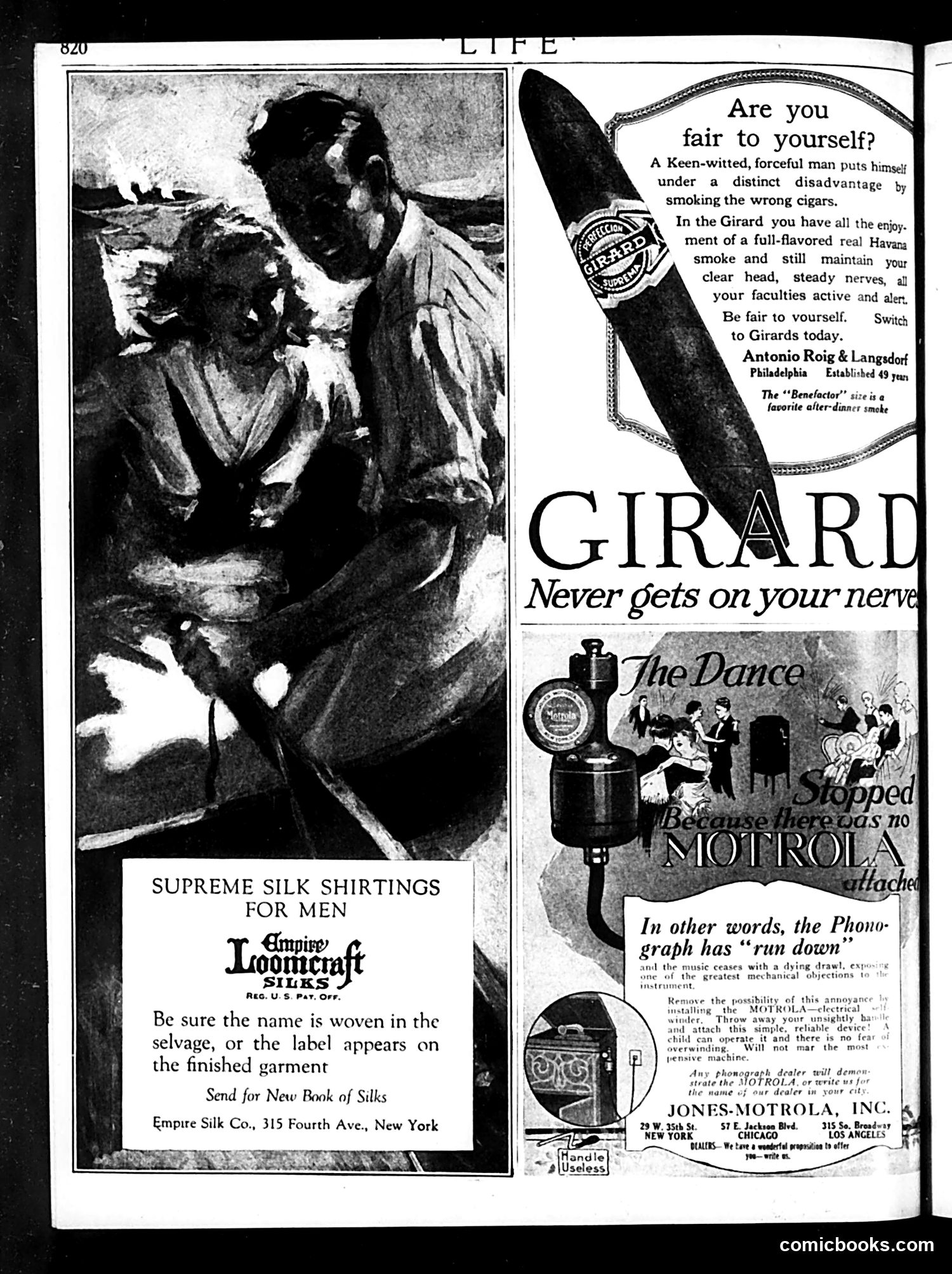
This page contains **advertisements rather than political cartoons**. The left side advertises **Empire Loomcraft Silks** for men's shirts, featuring an artistic photograph of a man with a child. The copy emphasizes checking for the brand name "woven in the selvage." The right side shows a **Girard cigar advertisement** with the slogan "Never gets on your nerve," and a separate **Jones-Mothrola phonograph ad**. The phonograph ad references "The Dance Stopped Because there has no MOTROLA attached"—apparently satirizing how a dance party halted without their product to play music. These are straightforward period advertisements. No political satire is evident on this page.
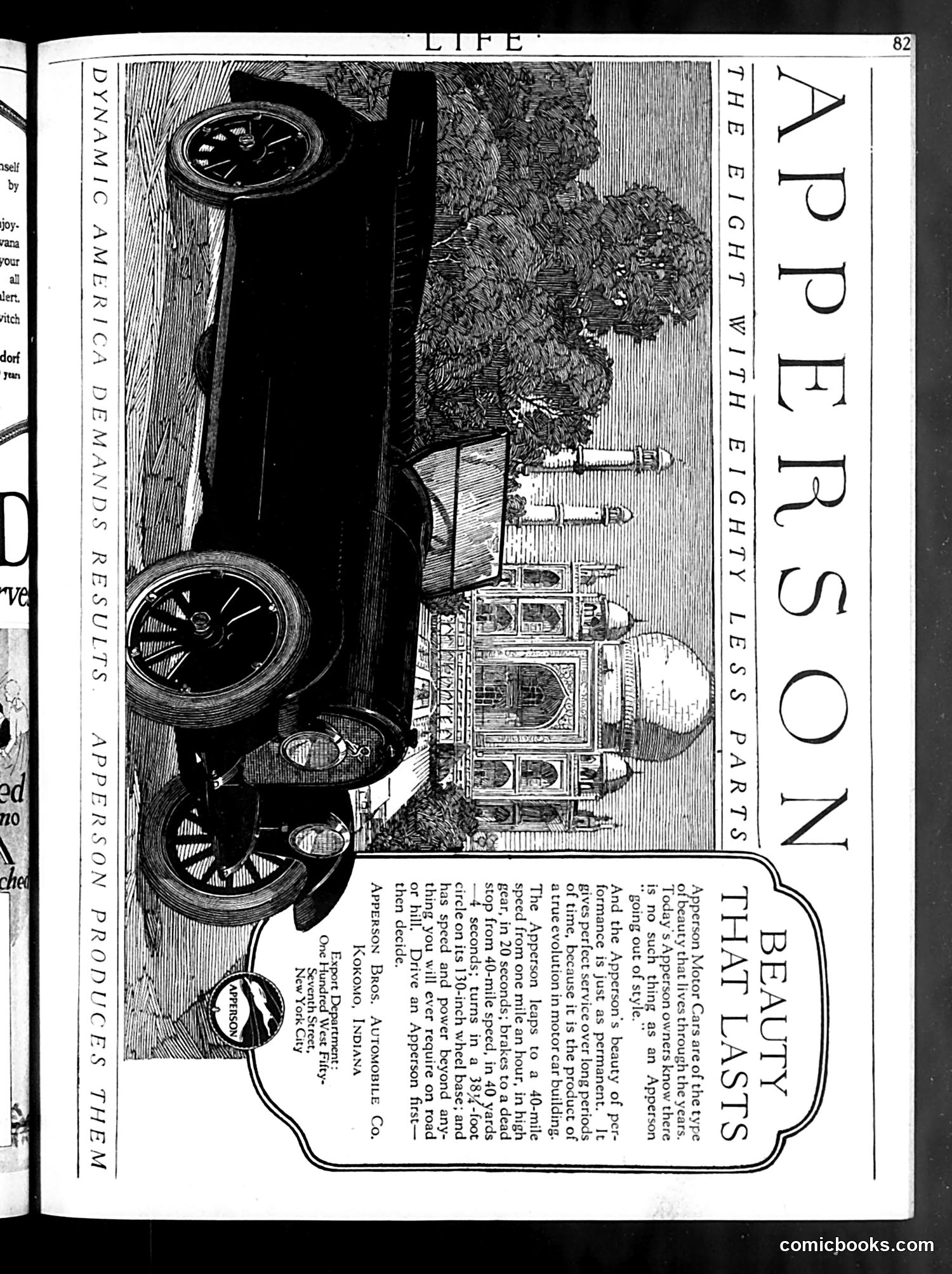
This page features an advertisement for an early automobile, presented as satirical editorial content typical of *Life* magazine's style. The illustration shows a vintage car from approximately the 1910s-1920s era, depicted rotated 90 degrees on the page. The headline "A Peddler's Son" plays on social climbing—suggesting that someone of humble origins (a peddler's child) could now afford this modern luxury vehicle. The accompanying text highlights the car's features and benefits, emphasizing how automobiles represented newfound mobility and status for middle-class Americans. This reflects the era's fascination with automobiles as both practical transportation and status symbols, while *Life*'s satirical framing gently mocks the aspirational consumerism driving early car sales.
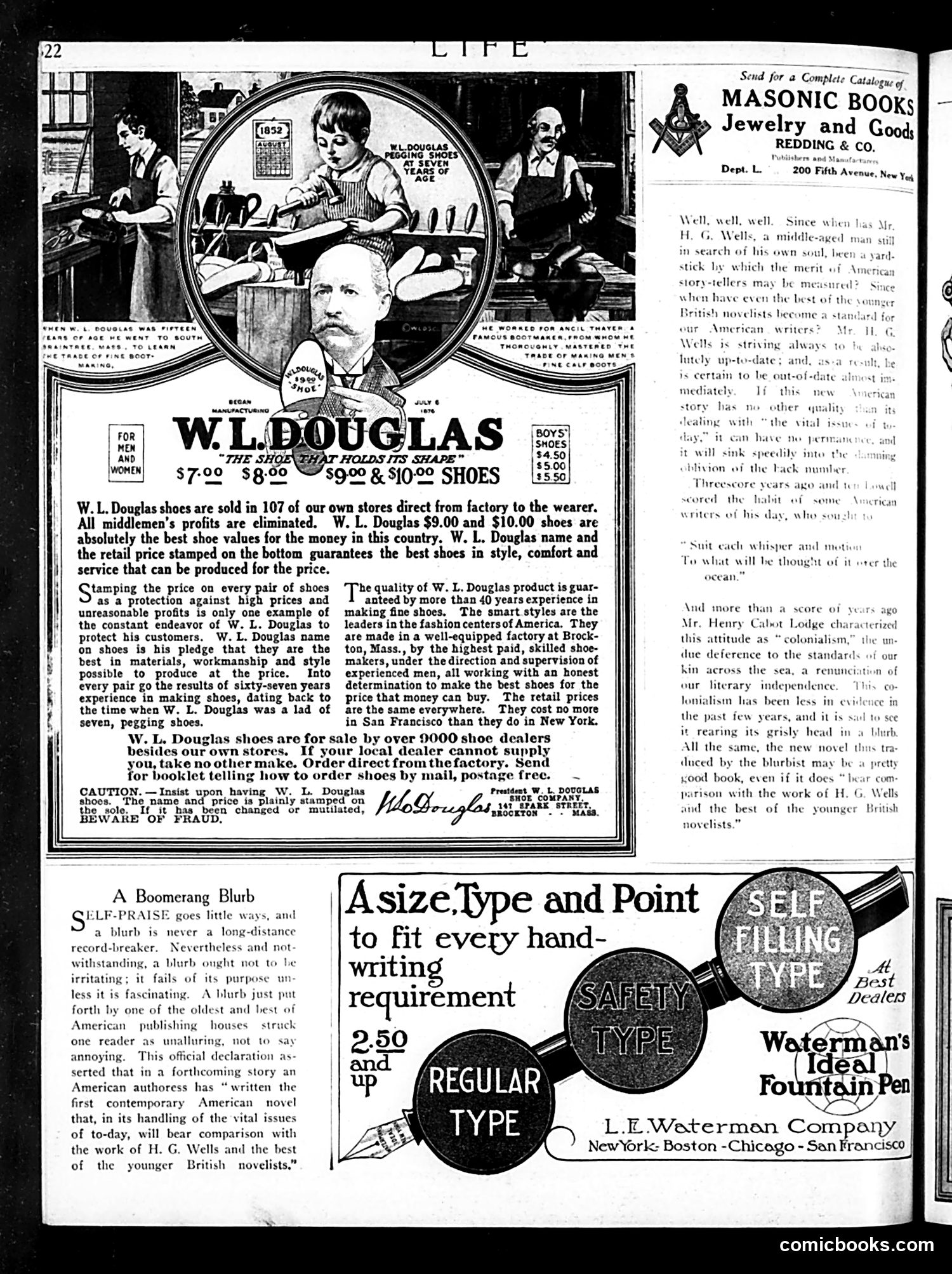
This page is primarily a **large advertisement for W.L. Douglas shoes**, featuring a portrait of the company's founder in the center. The ad emphasizes direct factory-to-consumer sales, claiming this eliminates middlemen's profits and allows competitive pricing ($7-$10 shoes). The advertisement highlights the shoes' quality, durability, and value proposition—key selling points for early 20th-century consumers concerned about getting fair value. The circular vignettes show factory workers and shoe-making processes, reassuring buyers about production standards. The page includes secondary ads for **Waterman's Ideal Fountain Pens** and masonic books, plus a brief article titled "A Boomerang Club" discussing American literature, unrelated to the shoe advertisement.
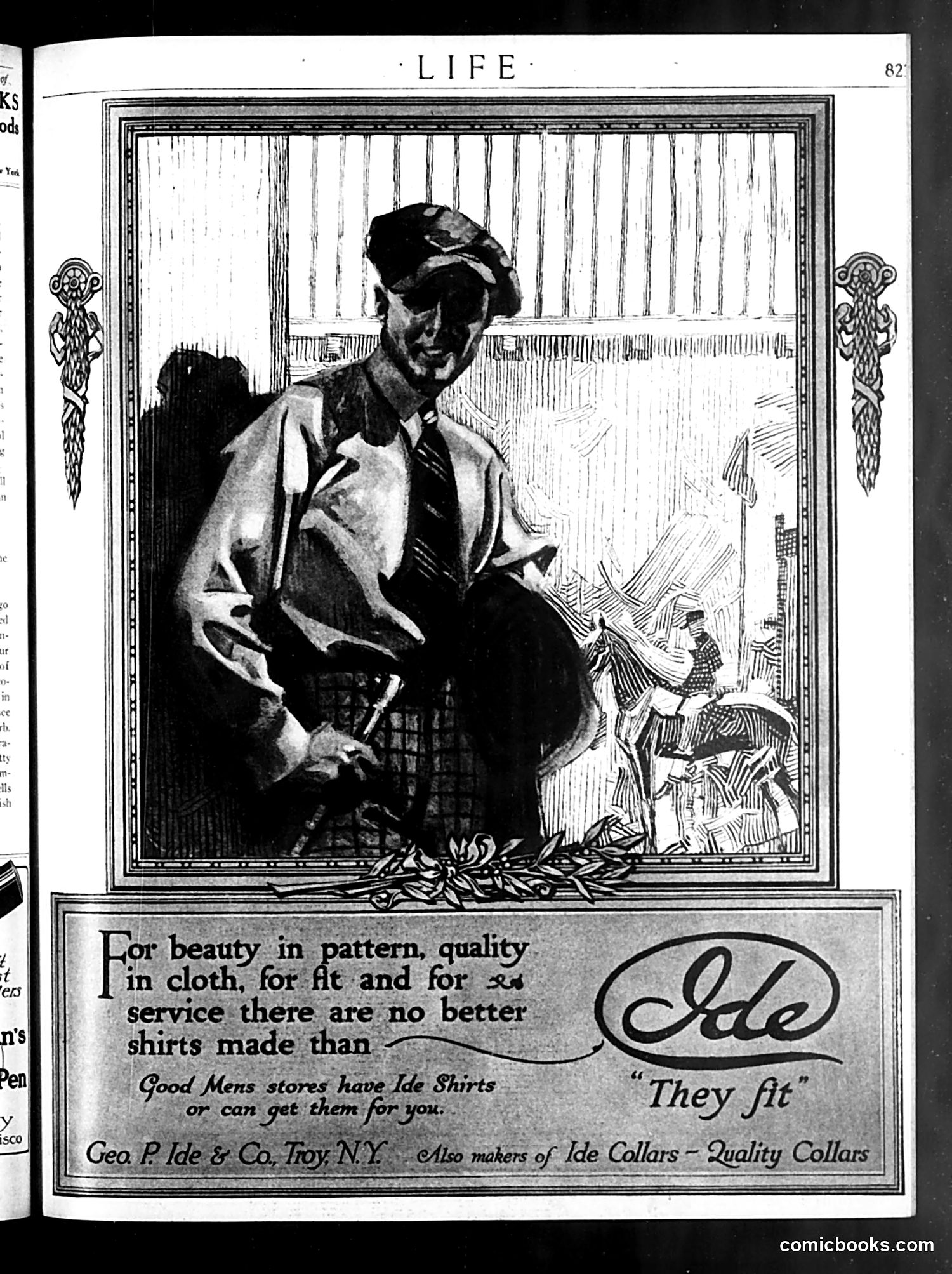
This page is primarily **an advertisement for Ide Shirts**, not political satire. The upper illustration shows a well-dressed man in professional attire examining fabric or a shirt, with what appears to be a tailor or shopkeeper in the background. The ad copy emphasizes quality: "For beauty in pattern, quality in cloth, for fit and for service there are no better shirts made than Ide." The tagline "They fit" appears prominently. The manufacturer, Geo. P. Ide & Co. of Troy, New York, also produced Ide Collars. The ornamental borders and formal typography are typical of early 20th-century magazine advertising design. This is straightforward commercial advertising with no apparent political commentary or satire.
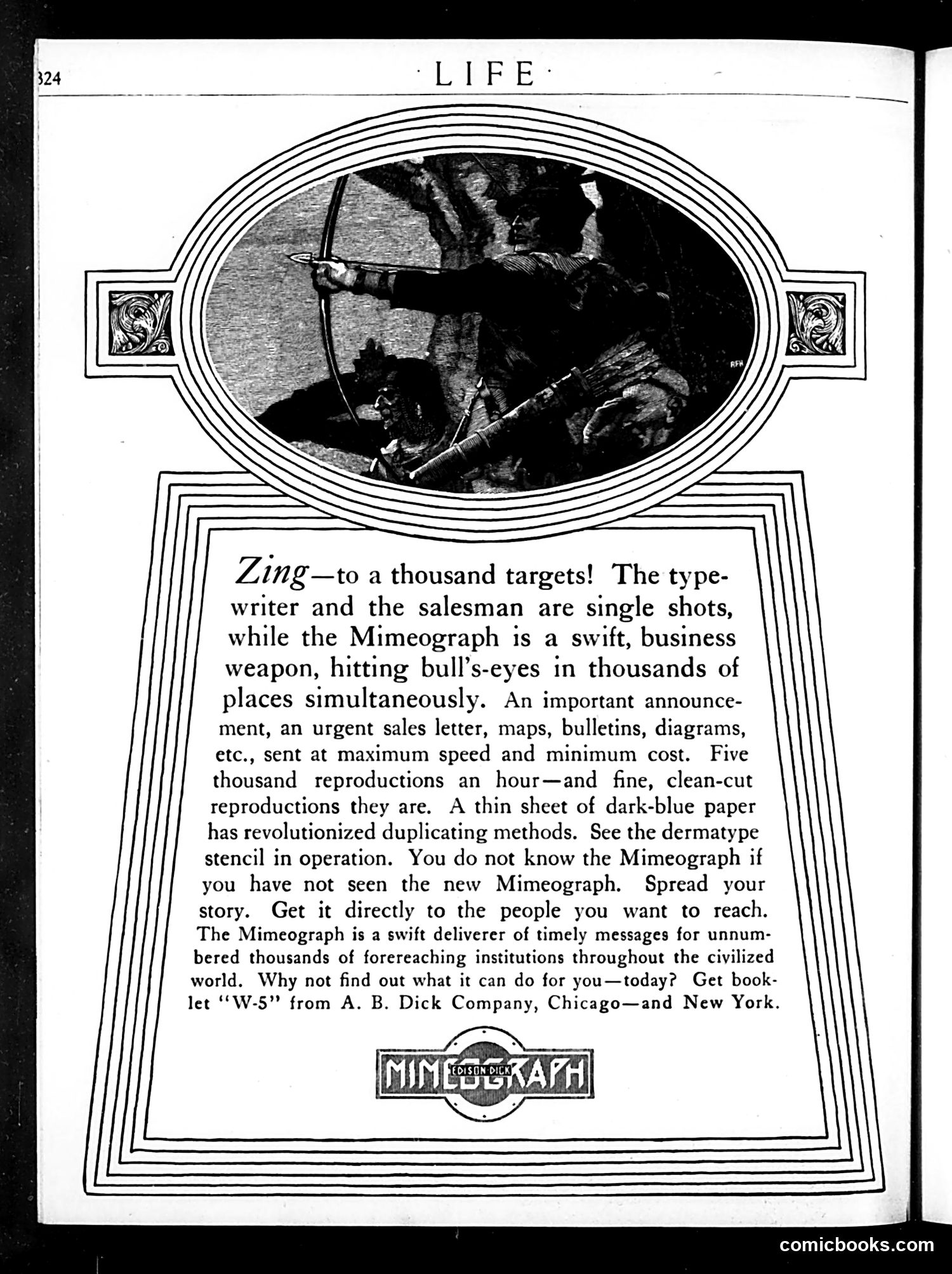
This is a **Mimeograph machine advertisement**, not political satire. The image shows an archer drawing a bow—a visual metaphor for precision and speed. The ad compares the mimeograph to archery: "Zing—to a thousand targets!" The mimeograph is pitched as a business tool for rapid document reproduction—announcements, sales letters, maps, bulletins, and diagrams—capable of producing "five thousand reproductions an hour." The ad emphasizes its efficiency compared to typewriters and salesmen ("single shots"), positioning it as a revolutionary duplicating technology. The A.B. Dick Company is promoting their mimeograph by contrasting traditional one-off communication methods with this machine's ability to "spread your story" to "unnumbered thousands" simultaneously and cost-effectively. This reflects early-20th-century enthusiasm for office technology and mass communication.
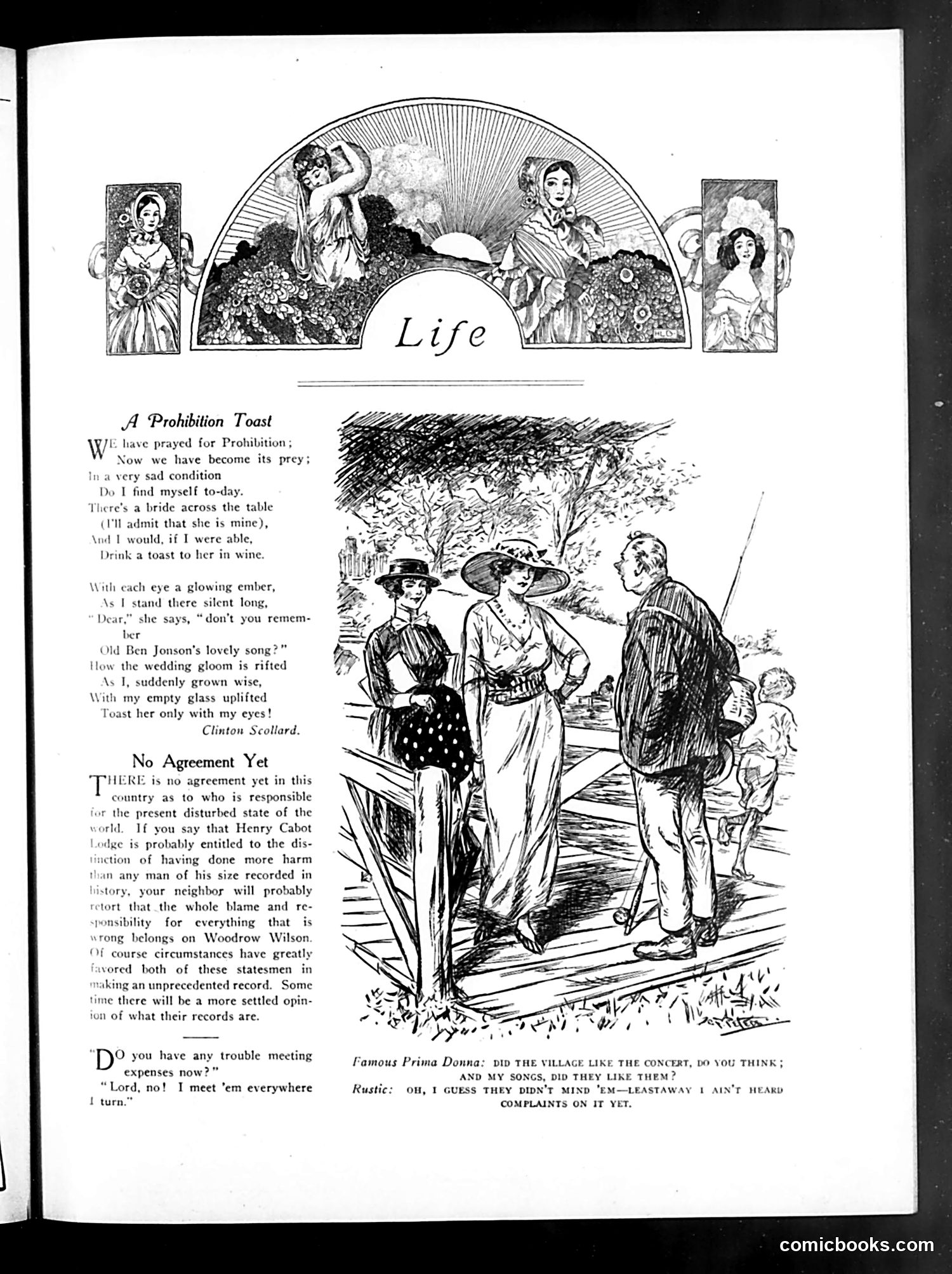
This page contains two satirical pieces from Life magazine during Prohibition (likely 1920s). **"A Prohibition Toast"** by Clinton Scollard is a poem lamenting Prohibition's passage. The speaker wishes to toast a bride "in wine" but cannot, sarcastically suggesting he'd drink "only with [his] eyes" instead. The satire mocks the law's enforcement and the nostalgia for legal alcohol. **"No Agreement Yet"** appears to reference Henry Cabot Lodge and the League of Nations dispute, blaming Lodge for the "present disturbed state of the world." The dialogue below suggests widespread economic hardship ("trouble meeting expenses"). The accompanying sketch shows two fashionable women and a man on a boardwalk, with a caption suggesting disagreement over entertainment or songs—possibly satirizing social discord during this turbulent political period.
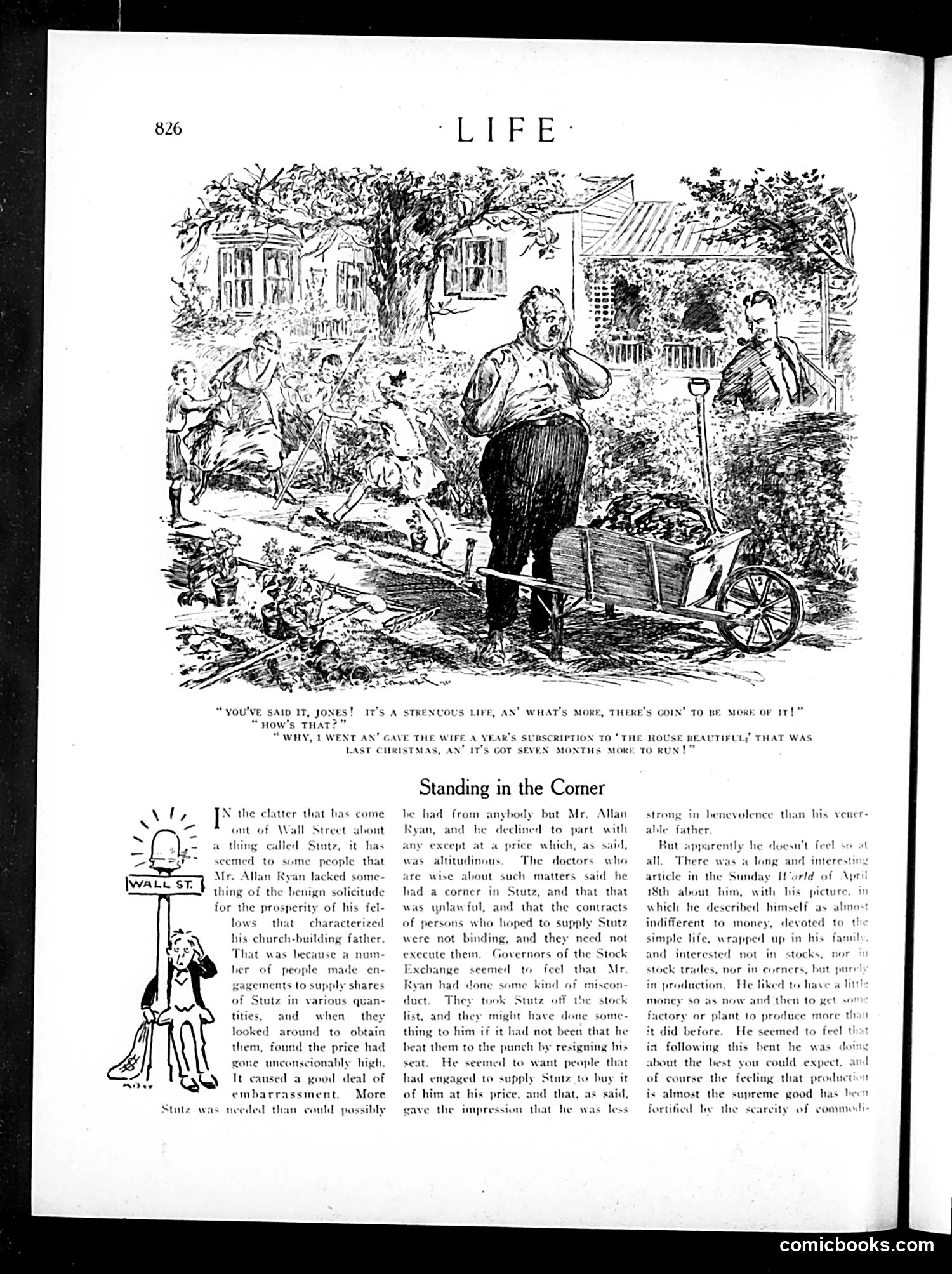
This article satirizes Mr. Allan Ryan, a wealthy businessman involved in stock market dealings. The illustration shows Ryan as a portly, well-dressed man standing in a corner—a visual metaphor for punishment or disgrace. The satire concerns Ryan's attempt to corner the Stutz automobile stock market. When he tried to manipulate prices upward, the scheme backfired: the stock price rose unexpectedly high, embarrassing him. Rather than admit defeat, Ryan resigned from his position, creating the impression he was less interested in the stock's success than in his own financial gain. The "corner" imagery suggests public humiliation—Ryan is literally and figuratively isolated for his failed market manipulation and apparent indifference to broader economic consequences.
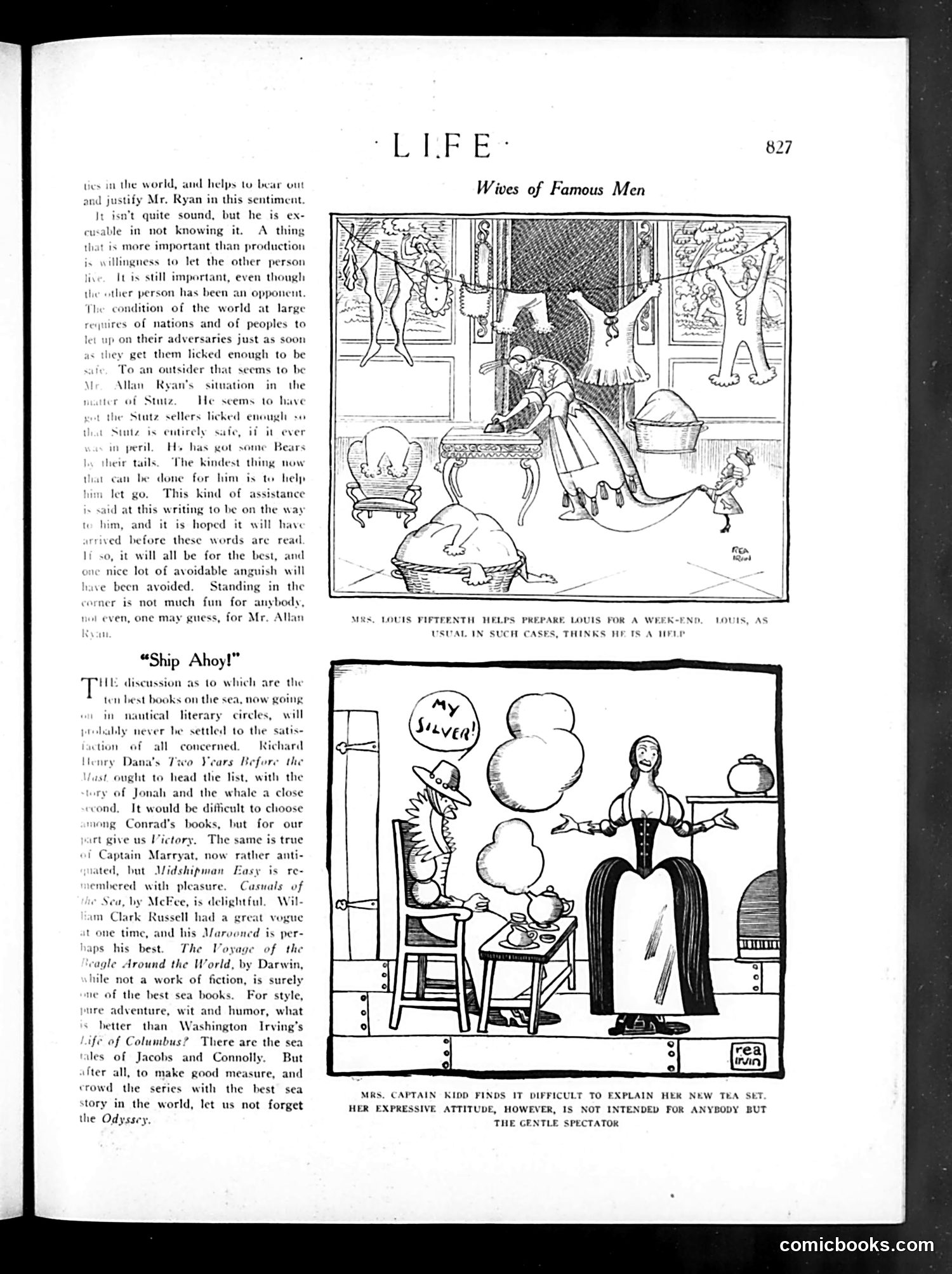
This page contains two satirical cartoons under the heading "Wives of Famous Men." **Top cartoon**: Shows Mrs. Louis Fifteenth preparing Louis XVI for a week-end, depicting her arranging his appearance with various beauty implements and attendants. The satire mocks the elaborate grooming rituals of aristocratic men. **Bottom cartoon**: "Mrs. Captain Kidd Finds It Difficult to Explain Her New Tea Set" shows a woman with an ornate tea service, suggesting she's acquired it through questionable means—implying the famous pirate's wife must constantly explain away suspicious luxuries. The caption notes her "expensive attitude" requires justification to polite society. Both cartoons satirize wives managing the public perception and appearances of their husbands' reputations, whether through vanity or suspected ill-gotten gains.
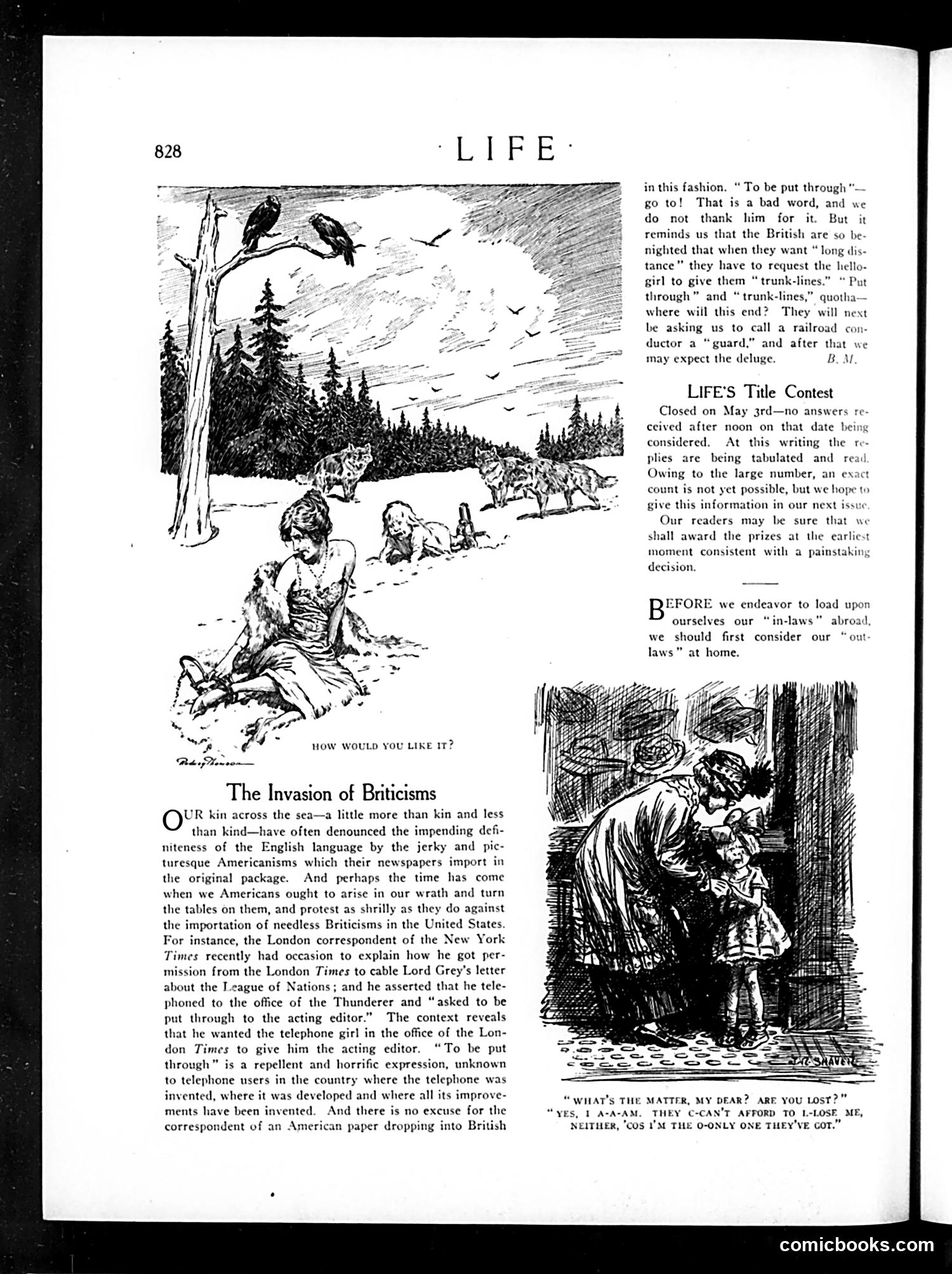
This article satirizes American newspapers adopting British English terminology and expressions. The author argues that British linguistic quirks are being imported unnecessarily into American journalism via London correspondents. The cartoon illustrates the complaint: a British correspondent (likely representing the *New York Times*'s London office) asked a telephone operator to be "put through"—unfamiliar jargon to Americans. The piece mockingly suggests Americans should protest this "invasion" of Briticism rather than adopting foreign language habits. The accompanying illustration shows a confused child asking "What's the matter, my dear? Are you lost?" with response text mocking British affectations. The satire targets what the author sees as pretentious imitation of British speech patterns infiltrating American discourse through press influence.
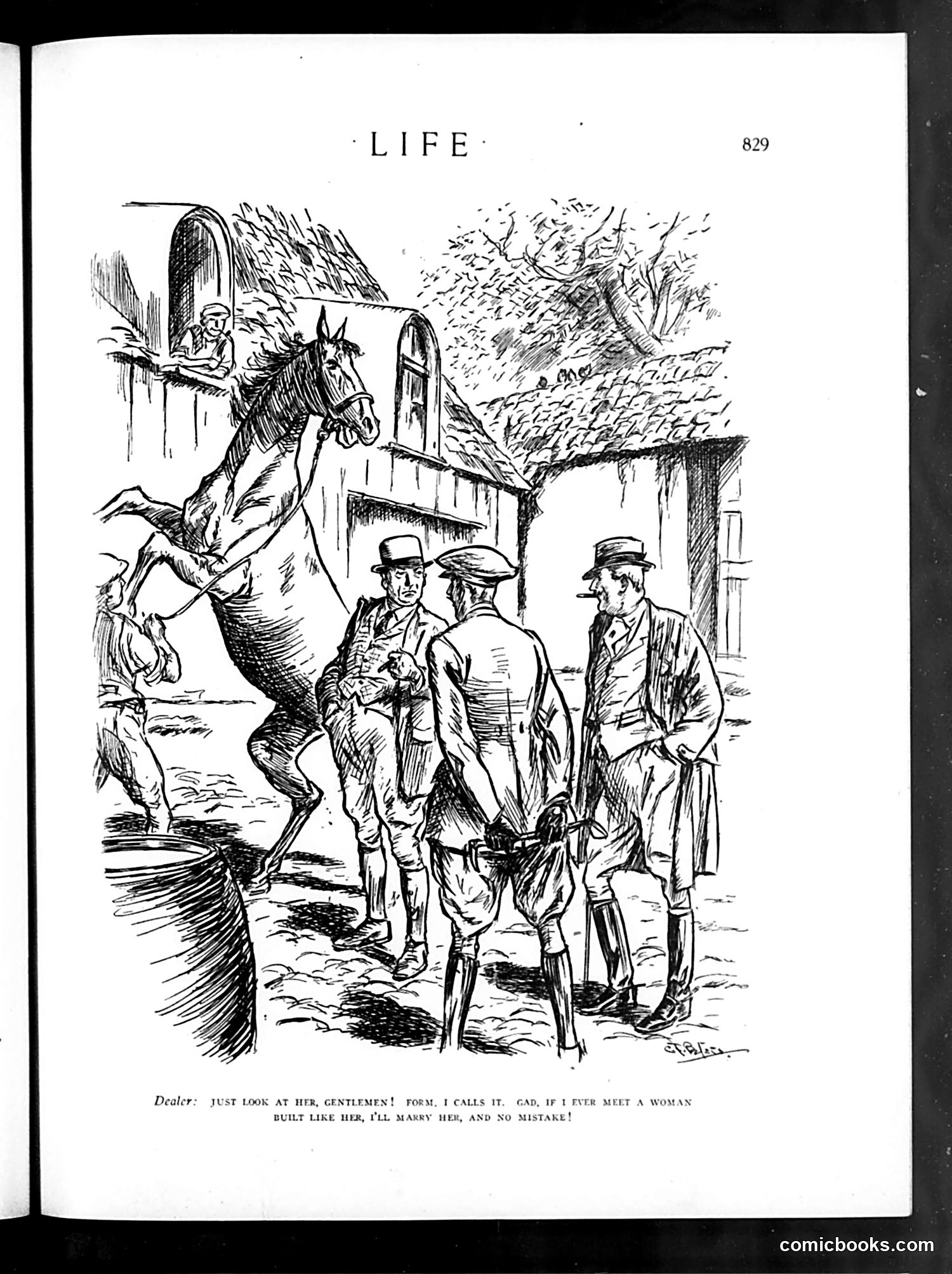
This cartoon depicts a horse dealer examining a horse with three gentlemen customers. The dealer is enthusiastically praising the animal's physique, calling attention to its "form" and declaring he'd marry any woman built similarly. The satire compares evaluating a horse to evaluating a woman—both supposedly judged primarily on physical attributes and body structure. This reflects period attitudes treating women as objects to be assessed for breeding or aesthetic purposes, much like livestock. The joke relies on the crude comparison between animal and female evaluation, treating it as humorously equivalent. This represents early 20th-century satirical commentary on misogyny and the objectification of women, presented here through the vehicle of a horse-trading scene.
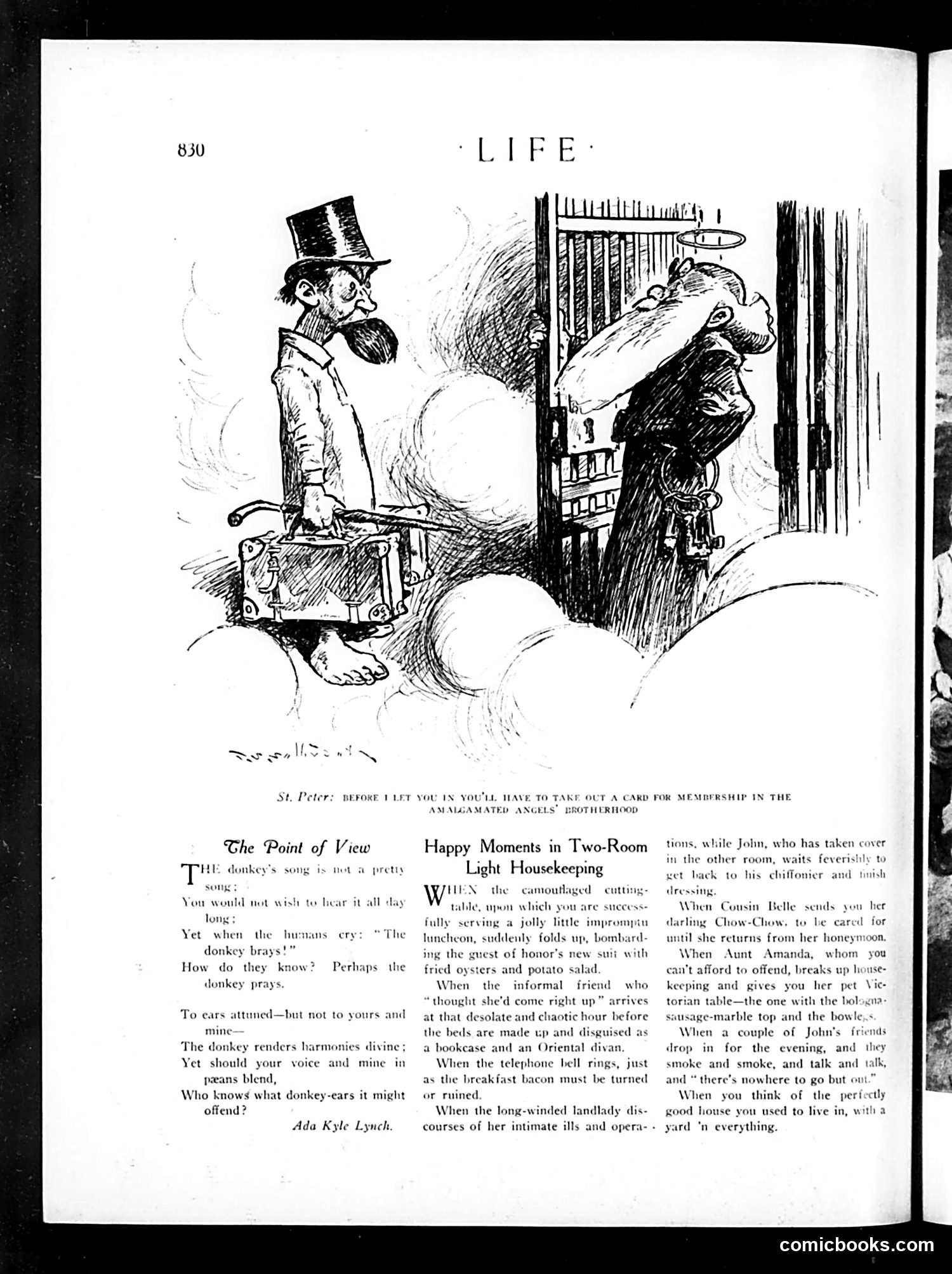
The top cartoon depicts St. Peter at heaven's gate turning away a well-dressed man carrying a suitcase, telling him he must join the "Amalgamated Angels' Brotherhood"—a satirical jab at exclusive fraternal organizations and their membership requirements, suggesting even entry to heaven requires bureaucratic membership cards. Below, "The Point of View" poem by Ada Kyle Lynch uses a donkey as metaphor for perspective: humans mock the donkey's braying, yet the donkey "renders harmonies divine" to those who listen differently. It advocates for tolerance and suggests what offends one ear may please another—likely social commentary on differing opinions or values. "Happy Moments in Two-Room Light Housekeeping" humorously catalogs the domestic frustrations of living in cramped apartments: collapsing furniture, unexpected guests, pets to care for, nosy landlords, and friends' visits in inadequate space. It satirizes the working-class reality of small urban housing, contrasting romantic ideals of married life with mundane reality.
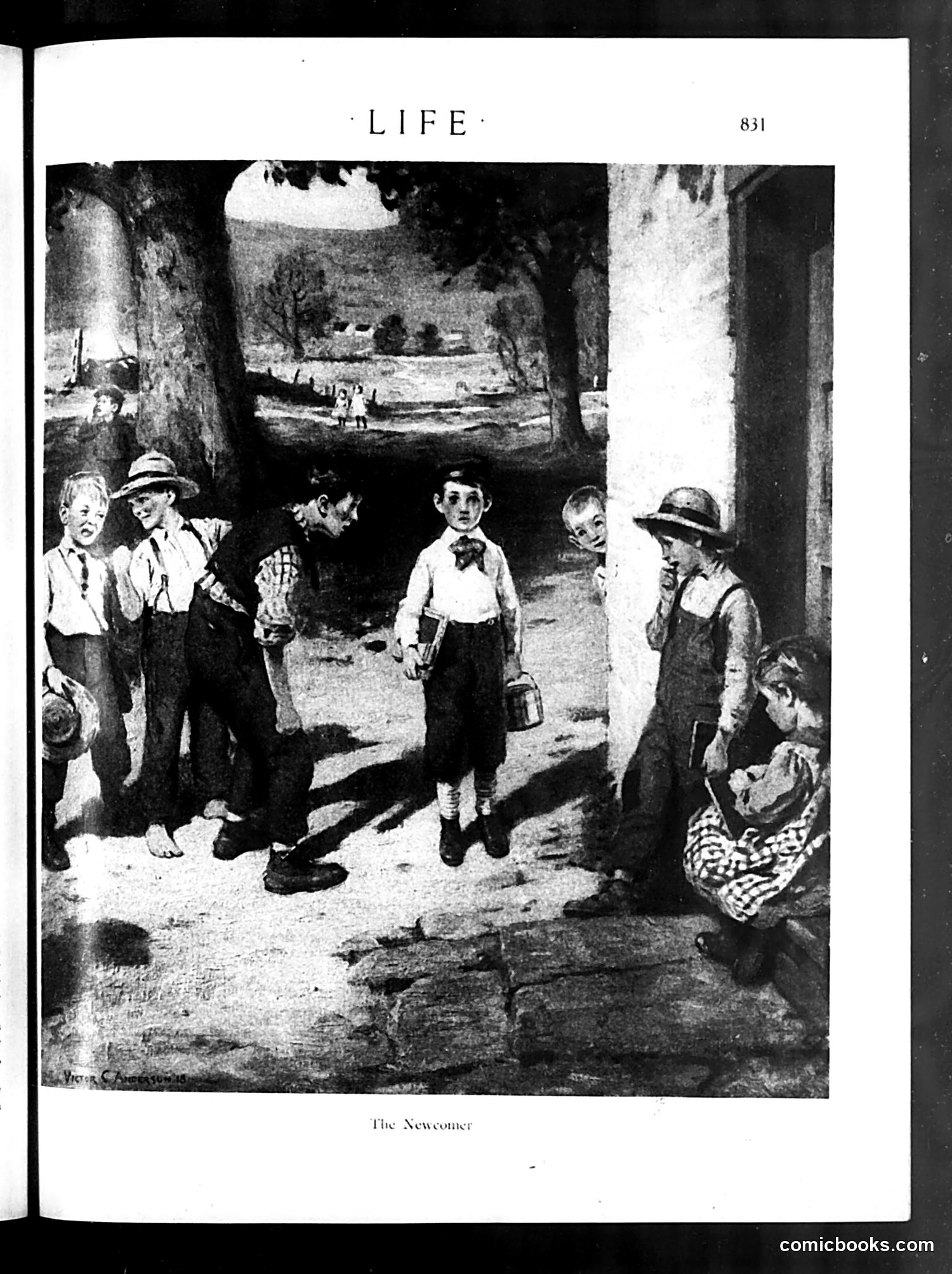
This Life magazine illustration depicts a group of working-class children in what appears to be an urban alleyway or tenement area, framed by large columns. The image shows barefoot and poorly dressed children observing a new arrival—a boy in cleaner, more formal attire carrying a lunch pail. The satire likely comments on **class divisions and poverty in early 20th-century America**. The "newcomer" appears to be either a child from a wealthier background or perhaps representing a new immigrant arriving in a poor neighborhood. The established children's scrutiny suggests social tension and the harsh realities of urban poverty contrasted against the newcomer's relative advantage, satirizing either class barriers or the integration of newcomers into working-class communities.
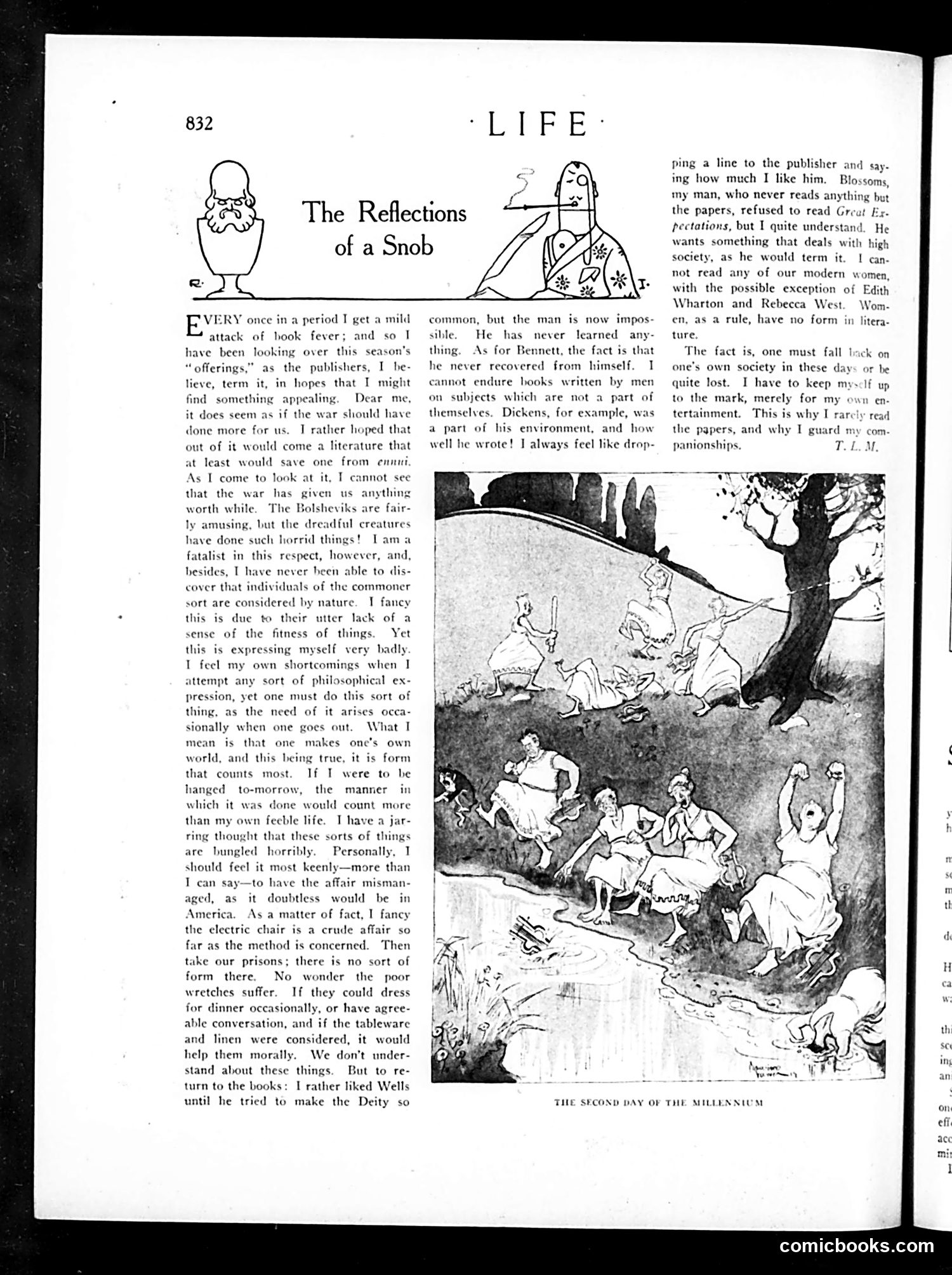
This is a satirical essay by someone identified as "T. L. M." mocking an insufferable literary snob. The unnamed narrator complains that postwar literature disappoints him, dismisses the Bolsheviks as "dreadful," and reveals his contempt for the working classes, whom he considers naturally lacking refinement. His hypocrisy is the joke: he criticizes prisons and the electric chair as aesthetically crude, yet shows no moral concern for prisoners. He dismisses most modern writers (except Edith Wharton and Rebecca West) while admitting his own inability to express philosophical ideas clearly. He obsesses over "form" and propriety—suggesting prisoners might improve morally with fine dining and linens—exposing how disconnected upper-class concerns are from genuine human welfare. The large illustration captioned "The Second Day of the Millennium" appears to satirize utopian visions, though its specific meaning requires additional context. The essay's overall target: the self-absorbed, aestheticizing snob who mistakes etiquette for morality.
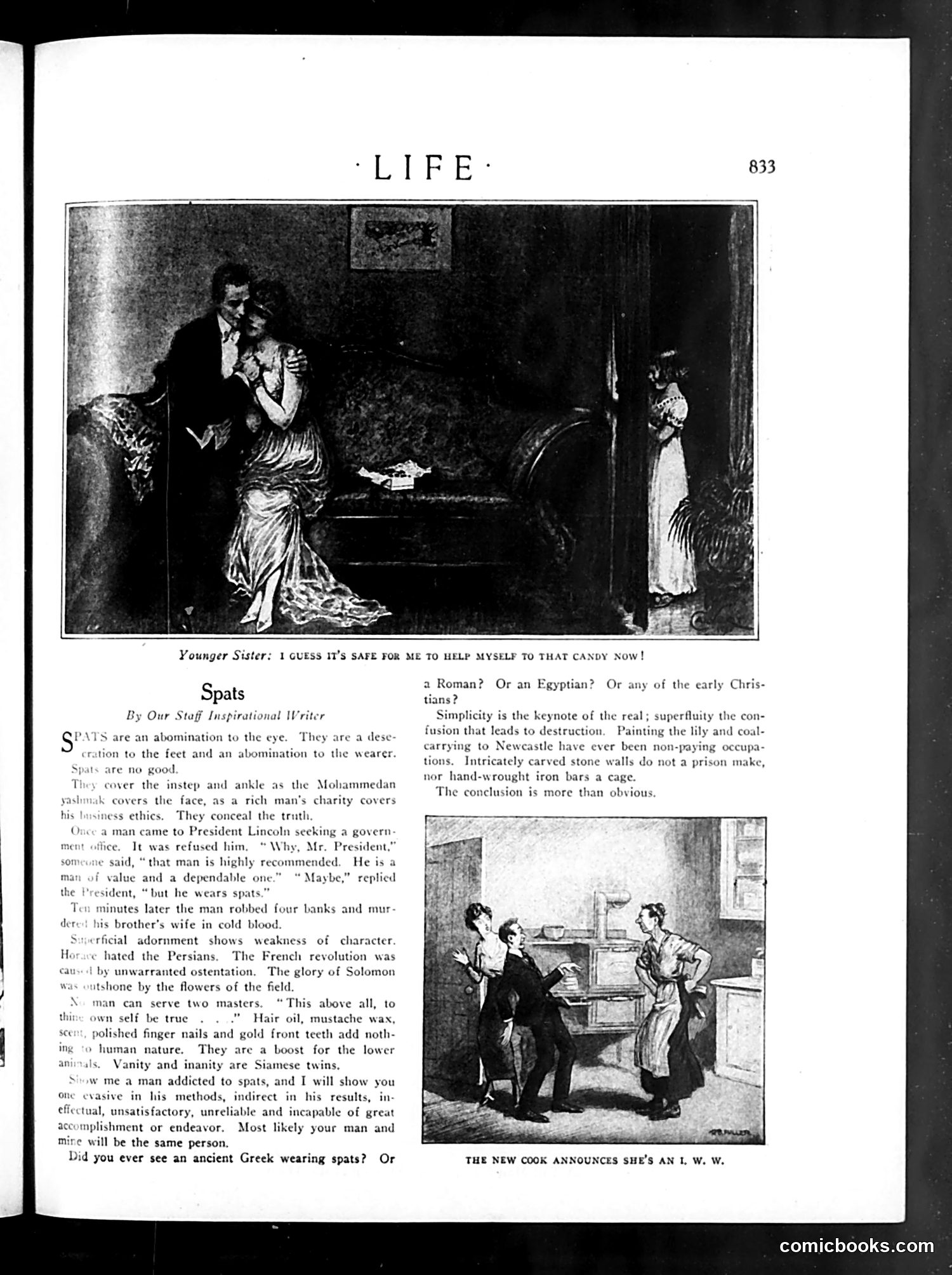
**Top Cartoon:** "Younger Sister" depicts a domestic scene where a younger sister sneaks candy while an older sister is distracted with a suitor. The joke plays on unsupervised opportunity—typical of early 20th-century humor about sibling mischief. **"Spats" Article:** A satirical essay condemning spats (the ankle coverings worn by well-dressed men). The author argues spats represent vanity, dishonesty, and moral weakness—comparing them unfavorably to ancient Greeks, Romans, and Christians who dressed plainly. The absurd anecdote about Lincoln rejecting a candidate for wearing spats reinforces the critique. This reflects Progressive-era suspicion of ostentation and class pretension. **Bottom Cartoon:** "The New Cook Announces She's an I.W.W." references the Industrial Workers of the World, a radical labor union. The joke suggests domestic help claiming radical affiliation—likely satirizing both servant aspirations and perceived communist infiltration of American homes, a contemporary anxiety of the era.
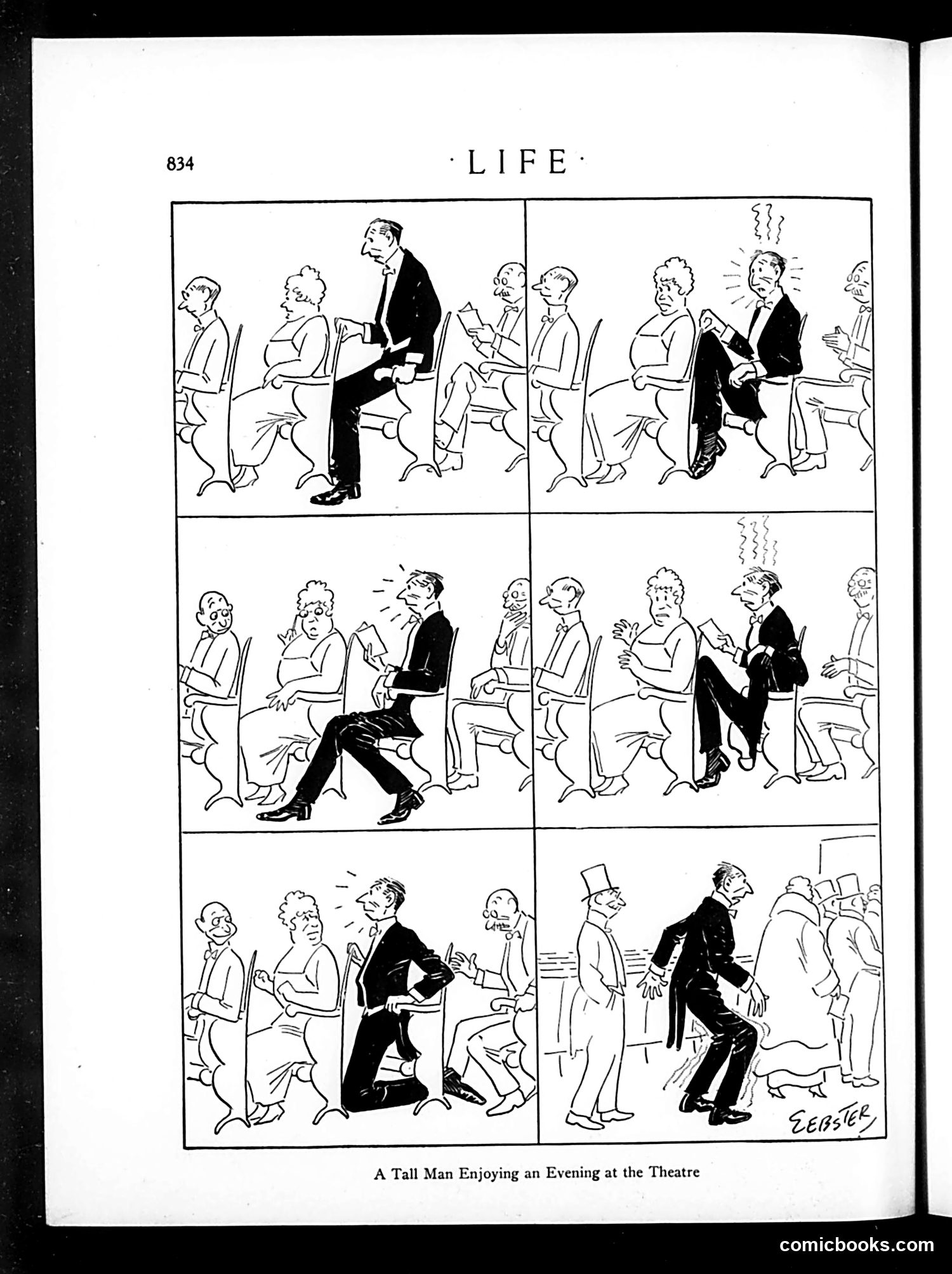
This six-panel comic depicts the frustrations of a tall man at the theater. In each scene, the man in formal attire sits among shorter patrons, but his height consistently obstructs others' views of the stage. The sequence shows escalating annoyance from surrounding theatergoers—their expressions grow increasingly angry as they crane their necks and gesture in frustration. The humor relies on a relatable social conflict: the tall man cannot help his height, yet his mere presence ruins the experience for everyone behind him. There's no resolution—the final panel shows him entering or leaving, likely having caused disruption throughout the evening. This satirizes the common theater etiquette problem of tall patrons blocking sightlines, presented as an ongoing social awkwardness with no easy solution.
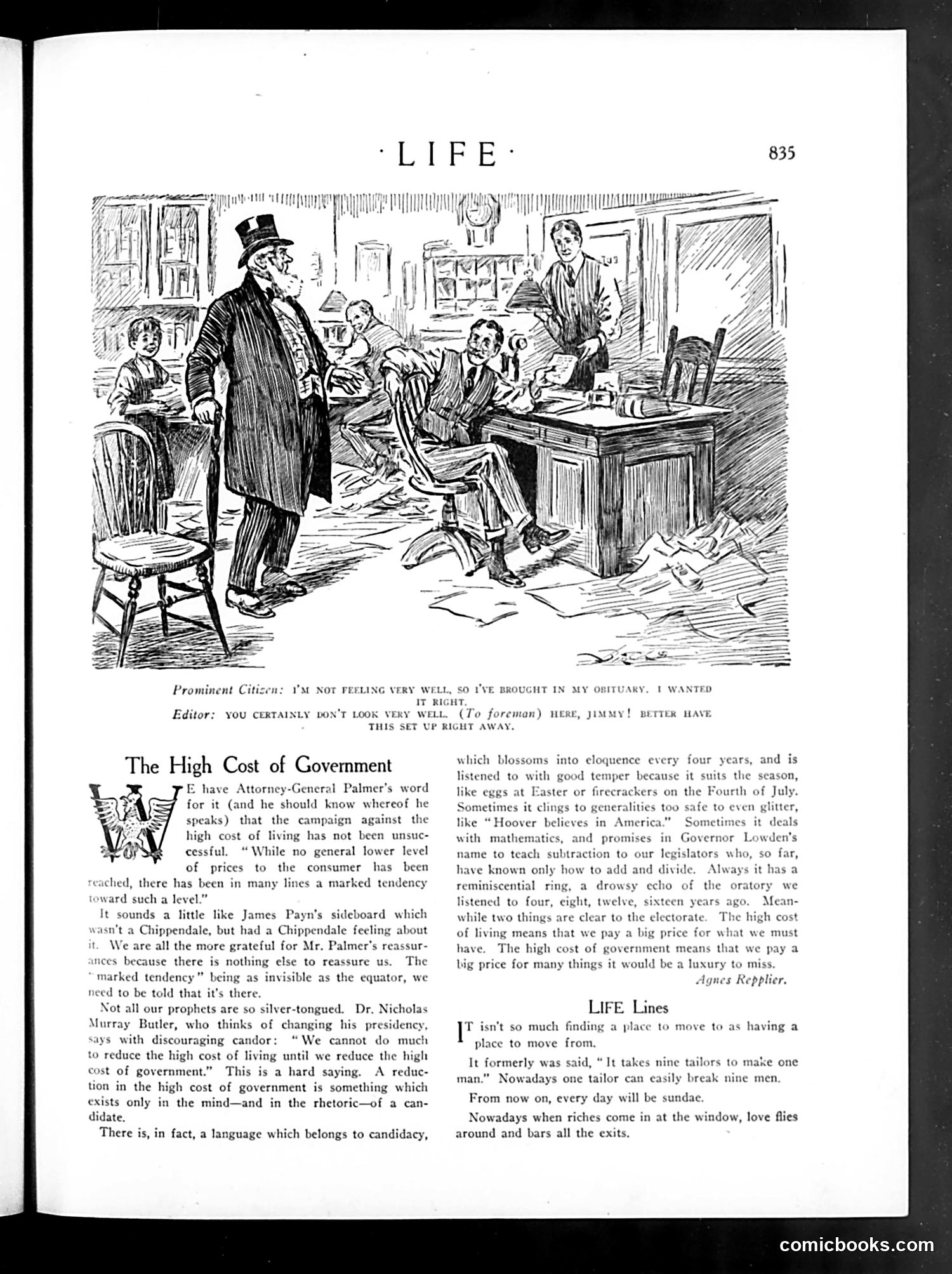
The top cartoon satirizes newspaper editors' complicity in political spin. A well-dressed "Prominent Citizen" arrives at a newspaper office with his own pre-written obituary, wanting it "set up right away"—implying he's dying or his reputation is. The editor agrees without question, telling the foreman to print it immediately. The joke: newspapers uncritically publish whatever powerful figures submit, treating their self-serving narratives as fact. The accompanying article attacks government rhetoric about controlling living costs. It mocks Attorney-General Palmer's claim of a "marked tendency" toward lower prices—invisible to actual consumers—and Dr. Nicholas Murray Butler's observation that reducing government costs exists only in political rhetoric, not reality. The satire targets politicians who use eloquent language about fiscal responsibility during election cycles while delivering nothing concrete. The piece suggests citizens are duped by repetitive campaign promises every four years.
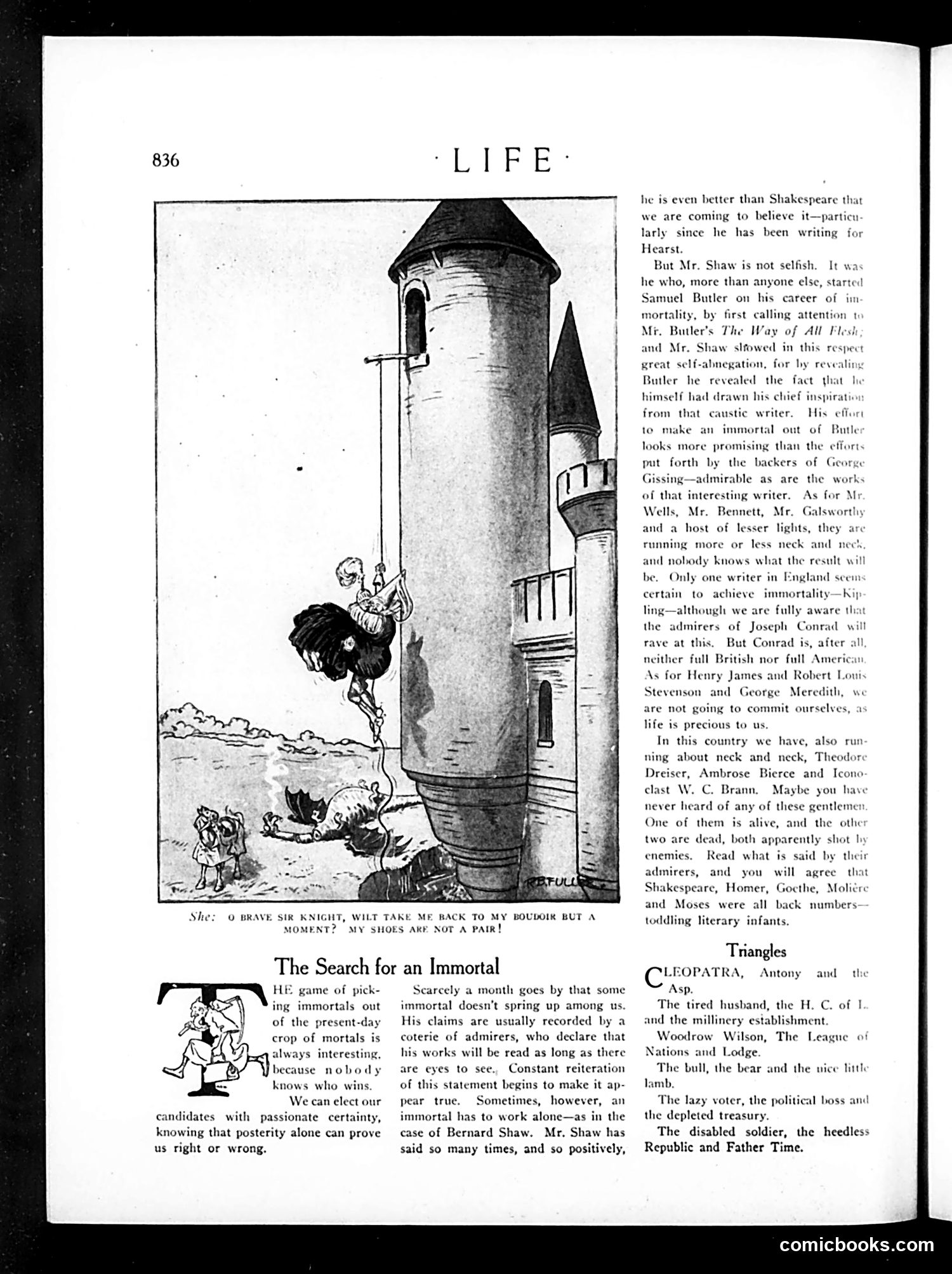
This Life magazine page contains two distinct pieces of social commentary: **"The Search for an Immortal"** mocks the literary establishment's tendency to declare contemporary writers "immortal" based on passionate advocacy rather than proven merit. It specifically names Bernard Shaw, Samuel Butler, and H.G. Wells as examples of authors whose admirers make inflated claims. The piece satirizes how repetition and coteries of supporters create false certainty about literary legacy—a problem only time can resolve. It extends this critique to American writers like Dreiser, Bierce, and W.C. Brann, noting two are already dead. **"Triangles"** is a satirical section using geometric imagery to reduce social/political situations to three-point conflicts: the tired husband versus millinery expenses; Woodrow Wilson versus Lodge regarding the League of Nations; economic forces (bull/bear) versus the vulnerable; corrupt politicians versus the voter; and Time's indifference to the disabled soldier. Each represents contemporary anxieties compressed into dramatic tension. The cartoons mock both literary pretension and contemporary political/social imbalances with biting brevity.
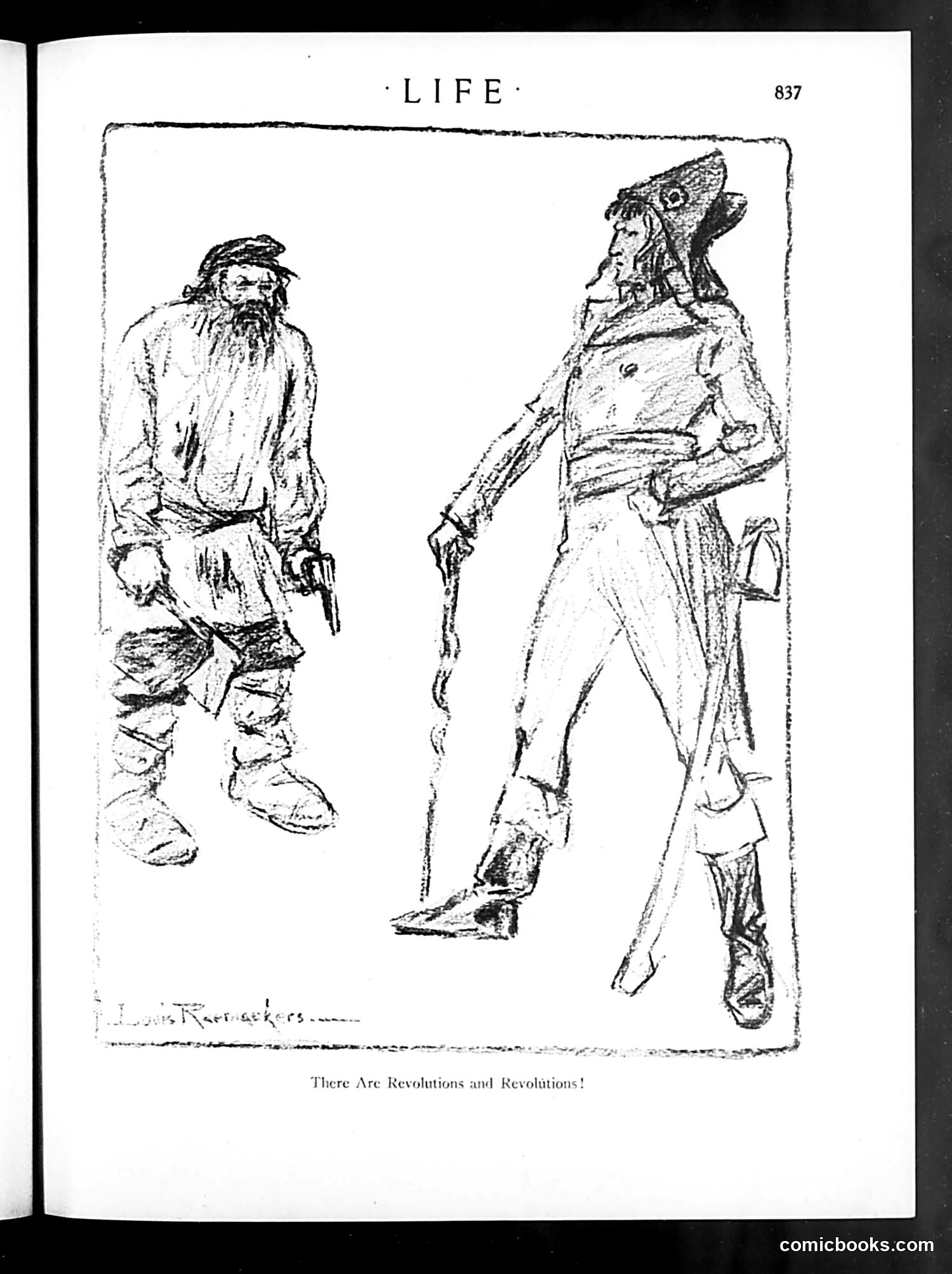
This single-panel cartoon contrasts two figures representing different types of revolutionaries. On the left stands a scruffy, bearded man in tattered peasant clothing with crude weapons—representing a violent, working-class revolutionary. On the right is a well-dressed military officer in uniform with formal regalia, representing an establishment or aristocratic "revolution." The caption "There Are Revolutions and Revolutions!" suggests the satirist is commenting on how revolutions differ dramatically depending on who leads them. The joke appears to critique the hypocrisy that violent upheaval by the poor is treated as dangerous radicalism, while similar upheaval by the military or elite is presented as legitimate governmental change. This likely reflects early 20th-century anxieties about labor movements versus military coups.
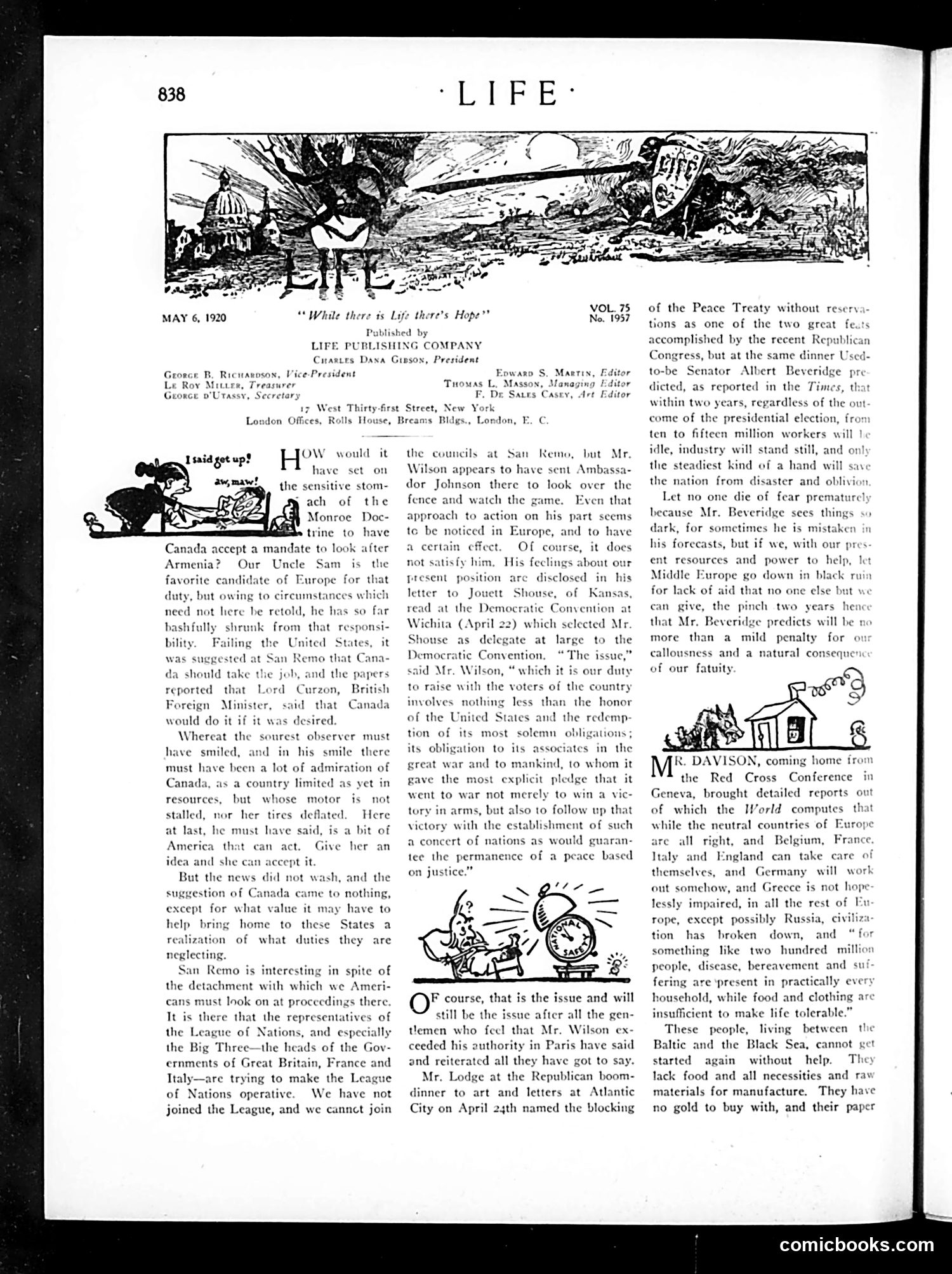
This editorial page satirizes American reluctance to engage with post-WWI international obligations. The main cartoon (top) depicts Uncle Sam sitting passively while the world burns—illustrating America's detachment from League of Nations proceedings at San Remo, where Britain, France, and Italy are negotiating. The text critiques: 1. **Canadian responsibility**: The ironic proposal that Canada (not America) should mandate Armenia, highlighting U.S. hypocrisy in avoiding duties. 2. **Wilson vs. Republicans**: President Wilson claims honoring war pledges and establishing a "concert of nations" is essential; Senator Henry Cabot Lodge and former Senator Albert Beveridge argue against the Peace Treaty without reservations. 3. **Beveridge's doom-saying**: The article mocks Beveridge's prediction that 10-15 million workers will idle and industry collapse within two years—treating his pessimism as overwrought fear-mongering. The satire targets American isolationism and partisan obstruction of international cooperation immediately after WWI.
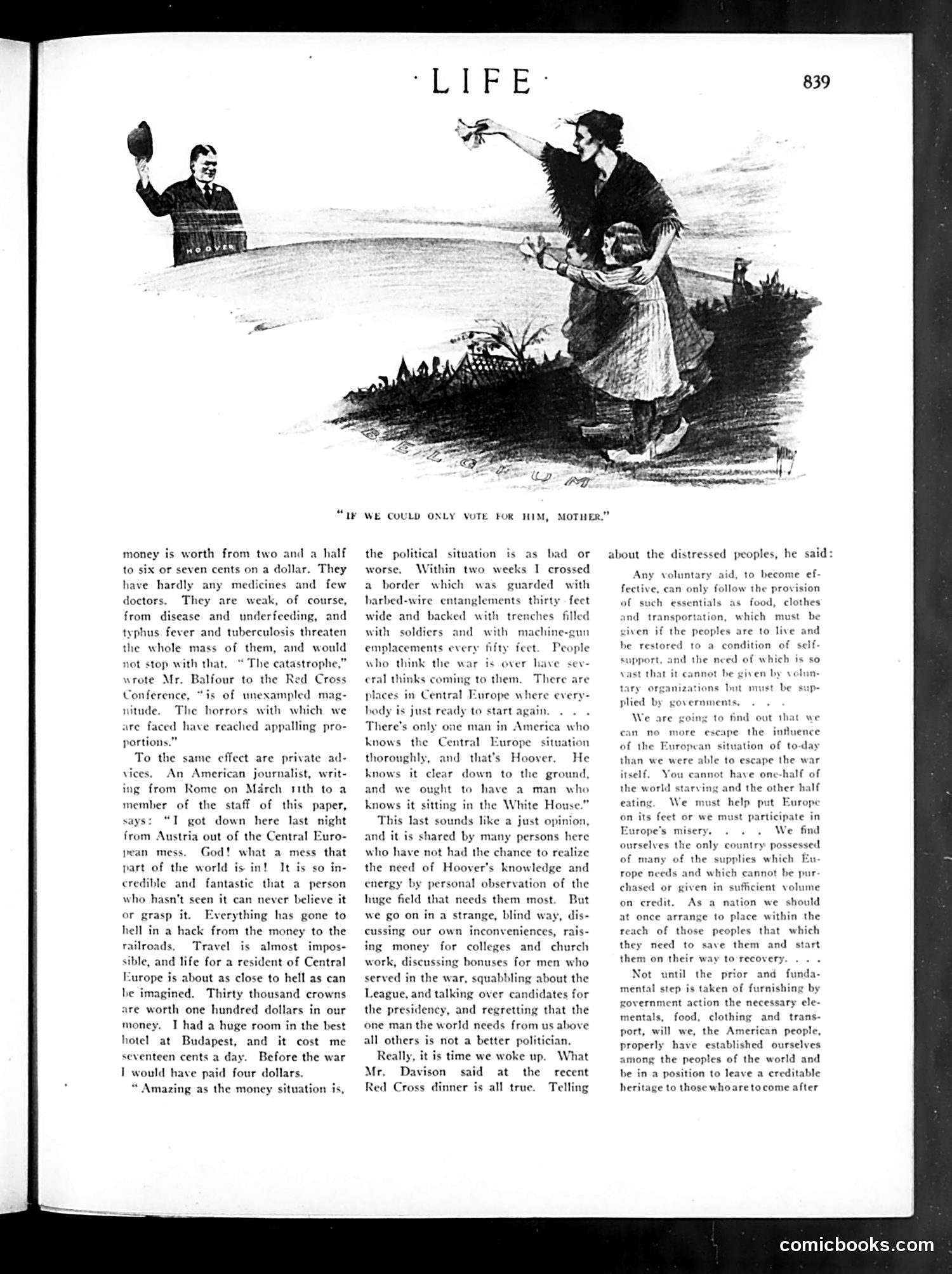
This cartoon satirizes American politics in the post-WWI era (circa 1920). The image shows a woman fishing while a man stands nearby holding his hat—the caption suggests she wishes she could vote for someone (likely Herbert Hoover) to address the European crisis. The accompanying text describes catastrophic conditions in Central Europe: hyperinflation, disease, starvation, and political instability following World War I. The article argues that Hoover uniquely understands the situation and possesses the expertise needed to help, but regrets he's "not a better politician"—implying political considerations prevent his elevation to higher office (possibly the presidency). The cartoon's point: women's exclusion from voting prevents them from supporting the one candidate qualified to solve Europe's humanitarian crisis. It's a commentary on both the political inadequacy of available leaders and, implicitly, an argument for women's suffrage (which passed nationally in 1920).
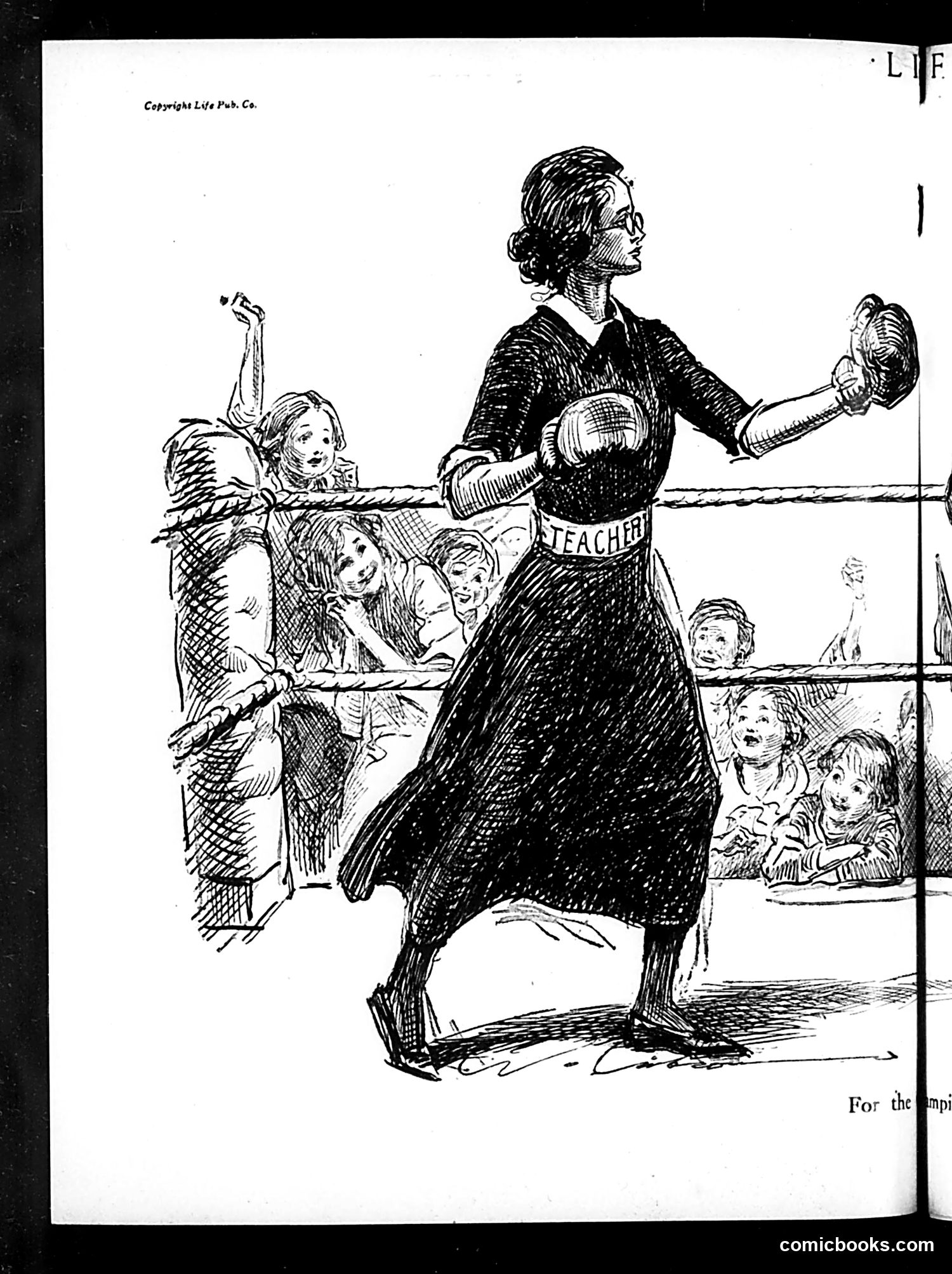
This illustration depicts a female teacher juggling multiple spheres labeled with children's faces while maintaining her composure before an audience of schoolchildren. The "TEACHER" band around her waist emphasizes her professional role. The satire critiques the demanding, multitasking nature of teaching—the teacher must simultaneously manage numerous students' individual needs and attention while performing for an audience. The juggling metaphor suggests the impossible balancing act teachers face. The partial text at bottom ("For the empi...") is cut off, making the complete context unclear, but the cartoon likely comments on educational pressures, overcrowded classrooms, or unrealistic expectations placed on teachers during the early-to-mid 20th century when *Life* magazine was active.
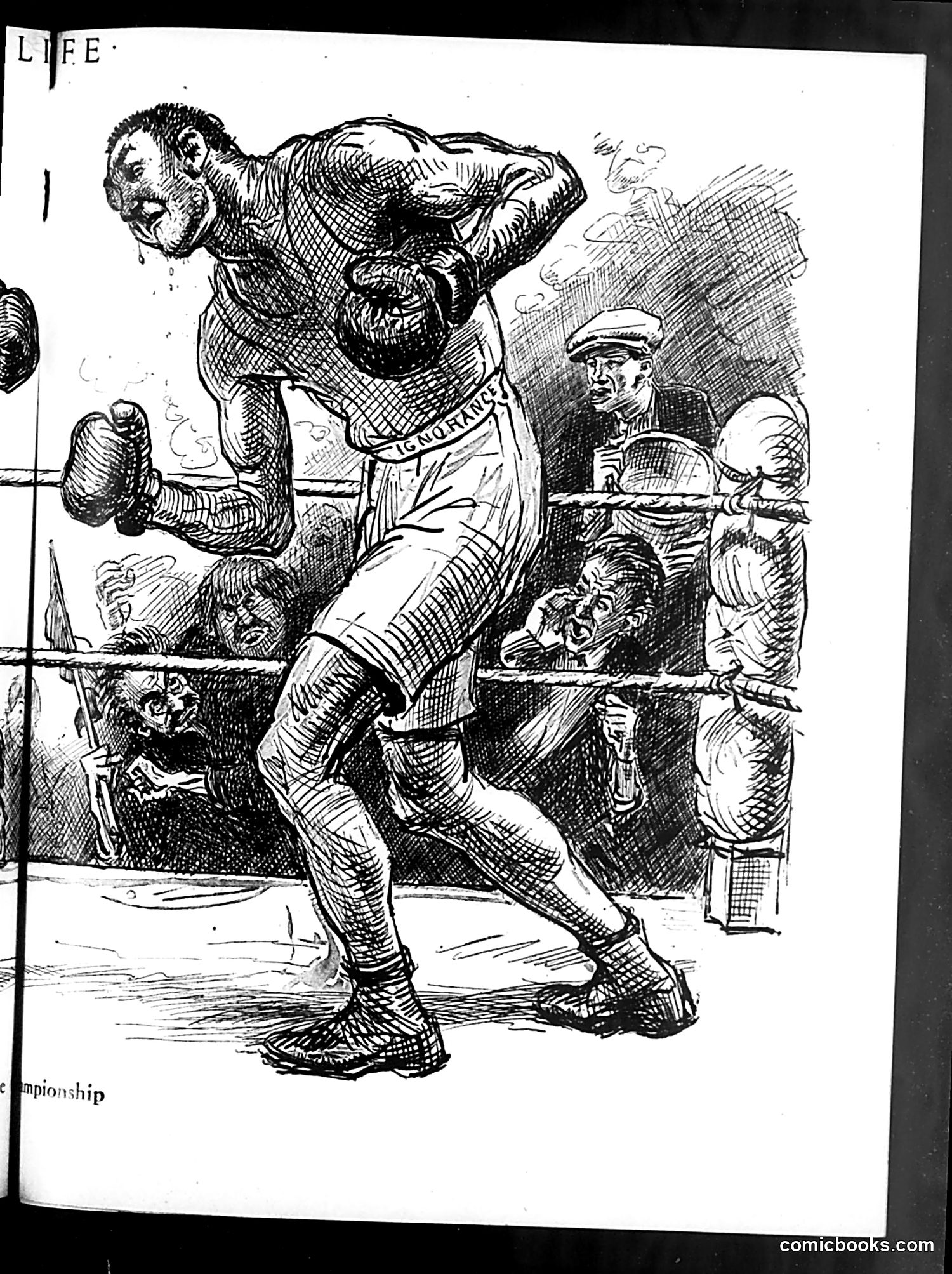
This is a boxing match cartoon from *Life* magazine. The central figure is a boxer mid-punch, wearing what appears to be a championship belt labeled "NO RULES." He's depicted with exaggerated, caricatured features in a pugilistic stance. The audience in the background watches from the roped ring, suggesting this is a professional or public spectacle. The "NO RULES" belt is key—it satirizes unethical or brutal competition, likely referencing business practices, politics, or sports of the era where competitors operated without moral constraints. The cartoon critiques ruthless conduct in some competitive arena, mocking the notion that victory achieved through any means (however destructive) deserves championship status. Without the publication date visible, the specific context remains unclear, though the satire concerns unchecked aggression.
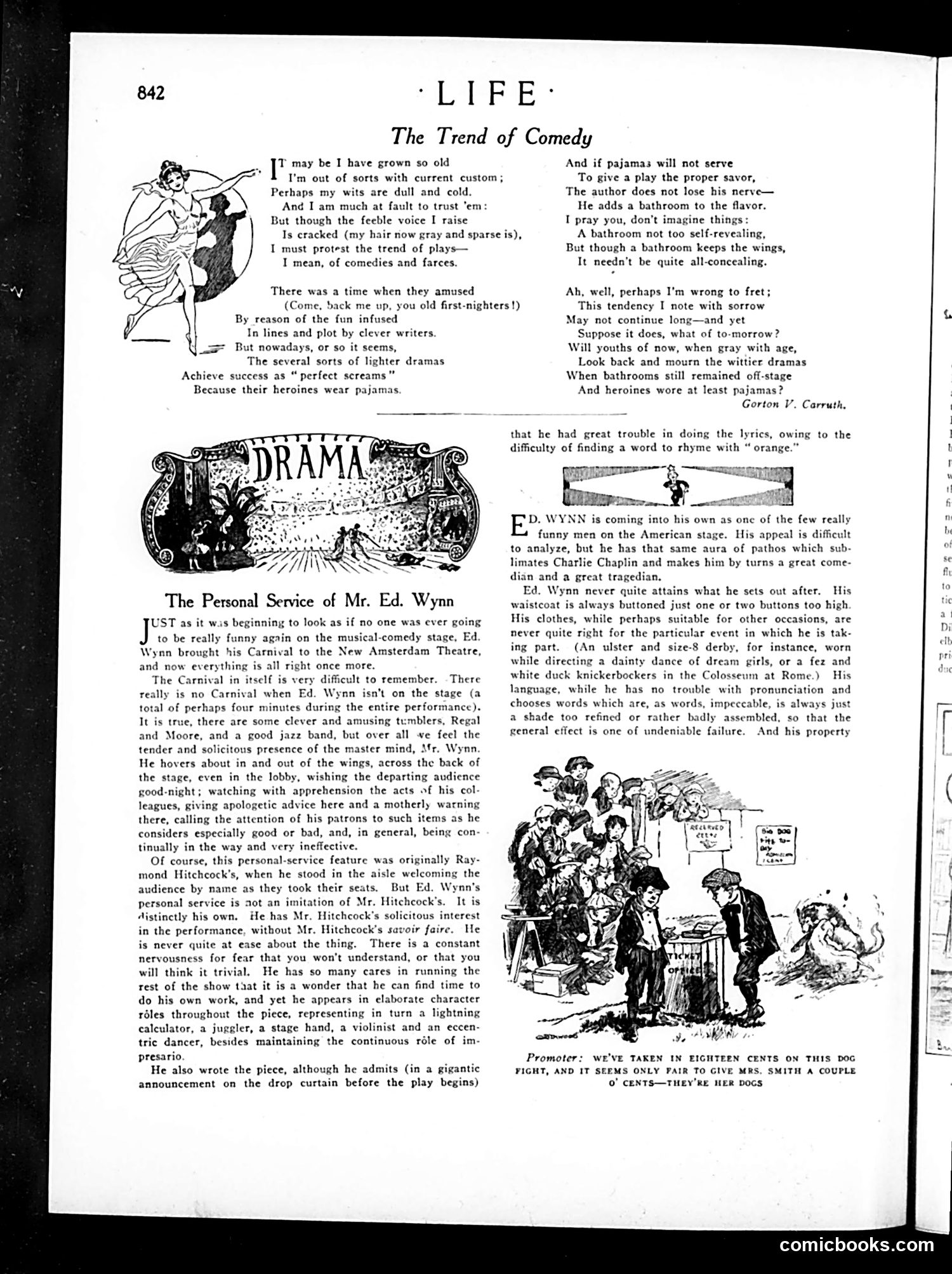
This page critiques contemporary Broadway comedy trends circa the 1920s. The poem "The Trend of Comedy" (attributed to Gorton V. Carruth) laments that modern comedies rely on shock value—specifically actresses wearing pajamas and bathrooms on stage—rather than clever writing. The author nostalgically recalls when comedies succeeded through witty plots and dialogue, not scandalous costume choices. The accompanying article praises **Ed. Wynn**, a prominent vaudeville/musical comedy performer, for bringing genuine humor to *The Carnival* through his energetic physical performance and elaborate character work—contrasting with the cheap sensationalism the poem condemns. The satire targets Broadway's perceived decline: producers substituting substance with provocative staging. The pajama reference reflects 1920s anxiety about changing social morals and women's fashion; bathrooms on stage represent similarly crude attempts at modern sophistication. Wynn represents the "old guard" of comedy skill, making him valuable precisely when the industry embraces shortcuts.
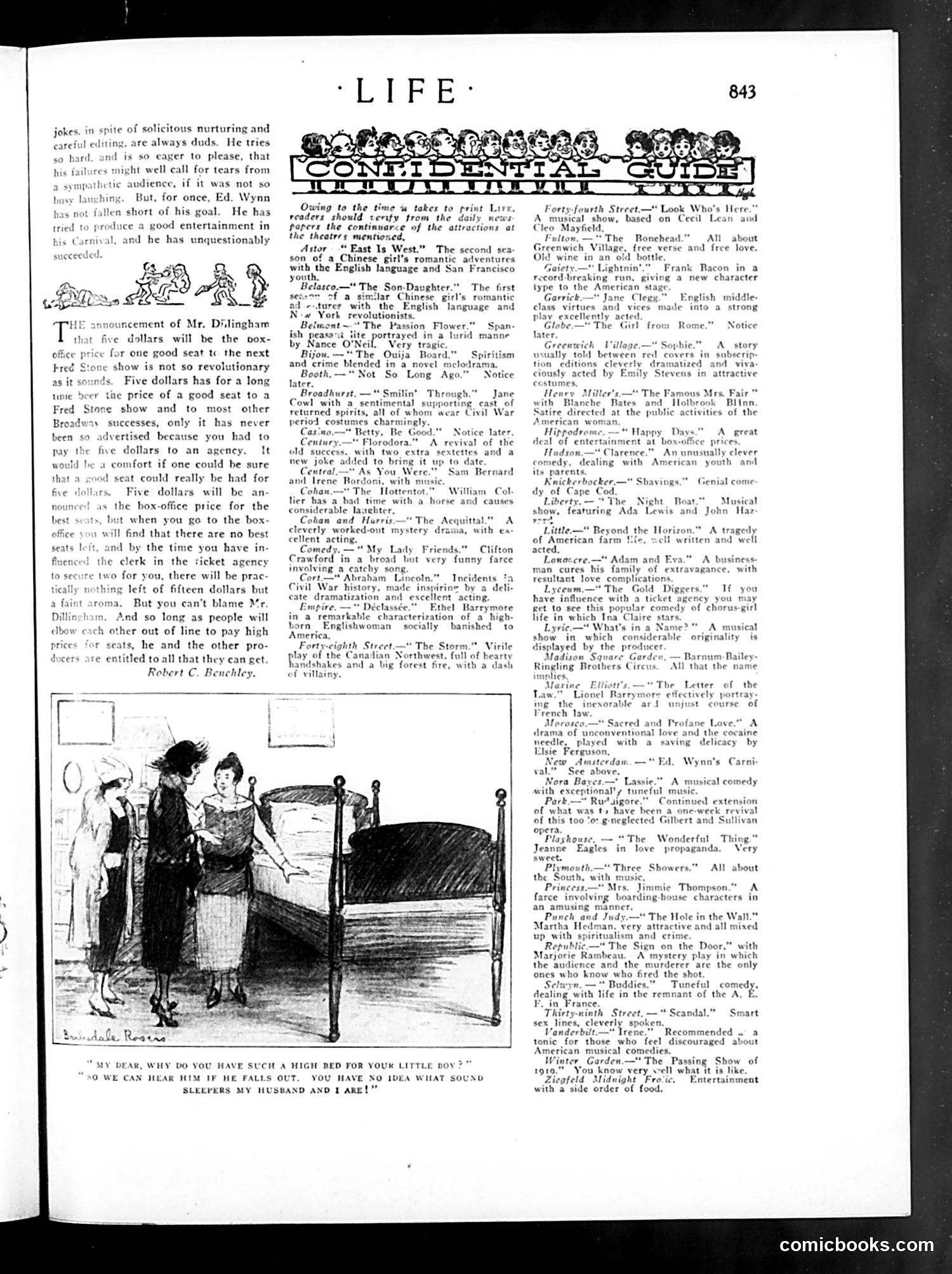
This page contains a Robert C. Benchley theater column reviewing Broadway productions, alongside a single cartoon illustration. **The Cartoon:** The sketch depicts a couple in a bedroom with a tall bed. The wife asks her husband why they need such a high bed for their small boy, saying "We can hear him if he falls out. You have no idea what sound sleepers my husband and I are!" The joke satirizes parental negligence disguised as practicality—the couple is essentially admitting they sleep so soundly they wouldn't wake even if their child fell from a dangerously high bed. It's dark domestic humor mocking oblivious parents prioritizing their own comfort over child safety. **The Column:** Benchley discusses theater ticket pricing, specifically criticizing impresario Charles Dillingham's announcement that Fred Stone show seats will cost five dollars at the box office. Benchley sarcastically notes this isn't revolutionary pricing, but objects to hidden agency fees that effectively make tickets much more expensive. He blames audiences for tolerating price gouging rather than the theaters themselves.
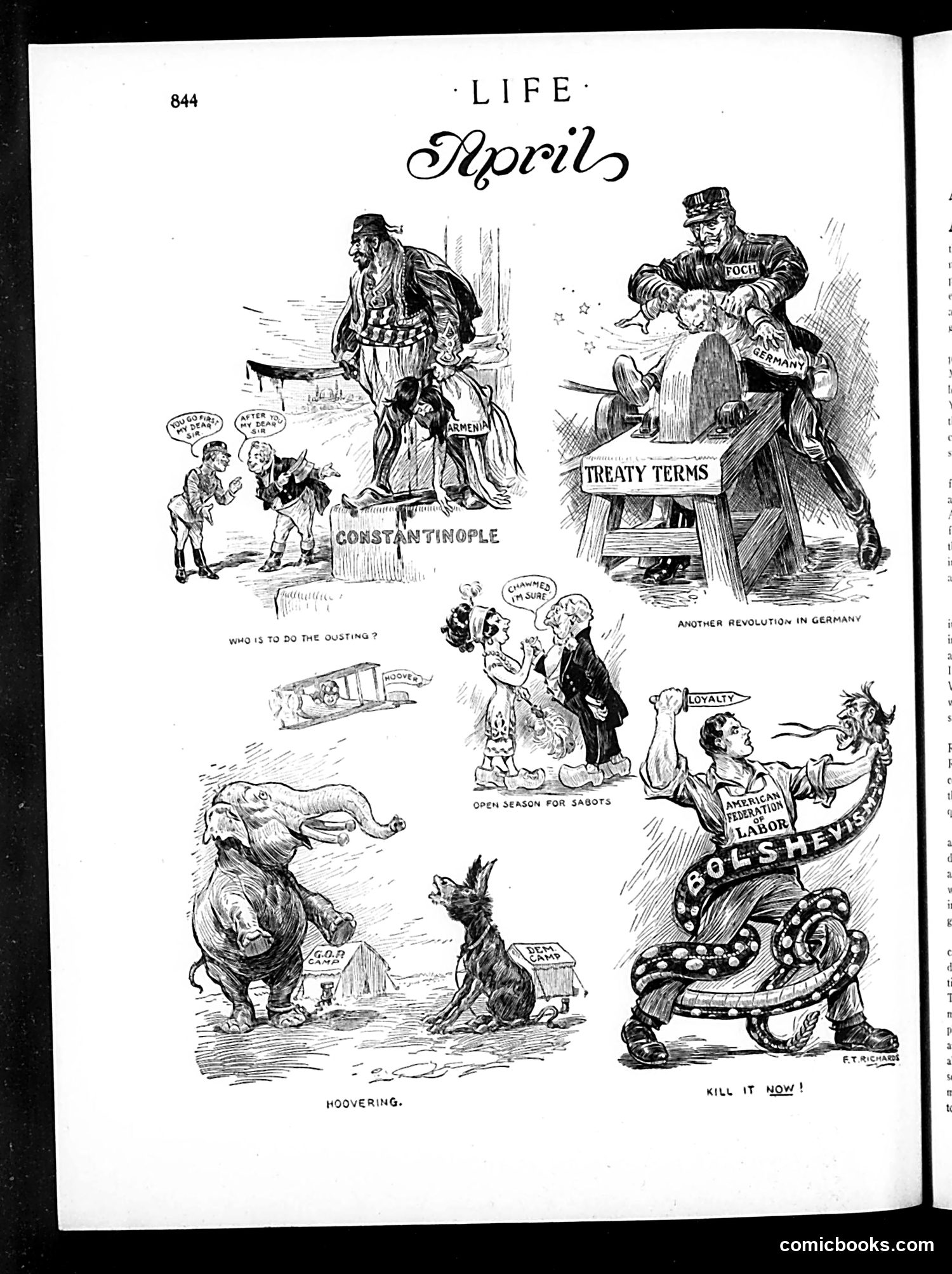
This page contains several satirical cartoons addressing early 1920s political events. "Constantinople" depicts figures debating the city's fate following World War I. "Treaty Terms" shows a figure labeled "Foch" (French military leader) presenting harsh conditions, likely referencing post-WWI peace negotiations. "Another Revolution in Germany" satirizes Germany's political instability during the Weimar period. "Hoovering" appears to mock Herbert Hoover (likely referring to his role in food relief or politics). "Open Season for Sabots" suggests labor unrest, while "Kill It Now!" features imagery associated with Bolshevism/communism—the cartoonist advocates eliminating the threat. The overall theme reflects American anxieties about postwar geopolitics, labor movements, and communist expansion.
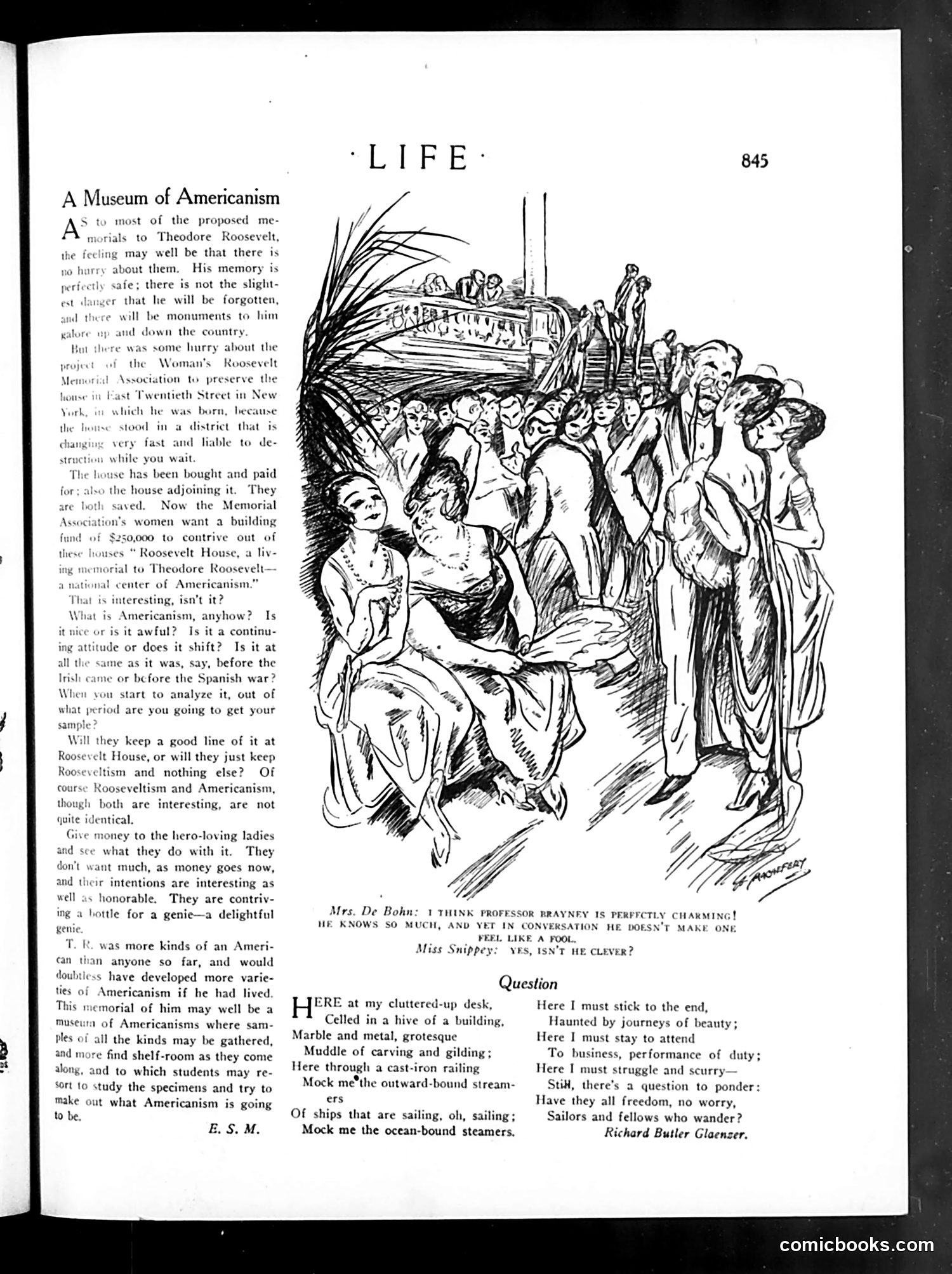
This page satirizes the proposal for a Theodore Roosevelt Memorial House in New York. The main article questions what "Americanism" actually means—noting that TR embodied many varieties of it, and asking whether a museum can authentically preserve such an abstract concept. The satire suggests the memorial organizers want to bottle something inherently fluid and undefinable, comparing it to "a bottle for a genie." The accompanying cartoon illustrates this absurdity: a crowd of admirers gazes rapturously at what appears to be an idealized female figure (representing Americanism or Roosevelt's legacy), treating an intangible concept as if it were a physical, collectible object. The secondary cartoon and poem are unrelated social humor: a woman praises a professor for being knowledgeable yet humble in conversation, while the poem contrasts office-bound workers with free-roaming sailors, questioning whether true freedom exists.
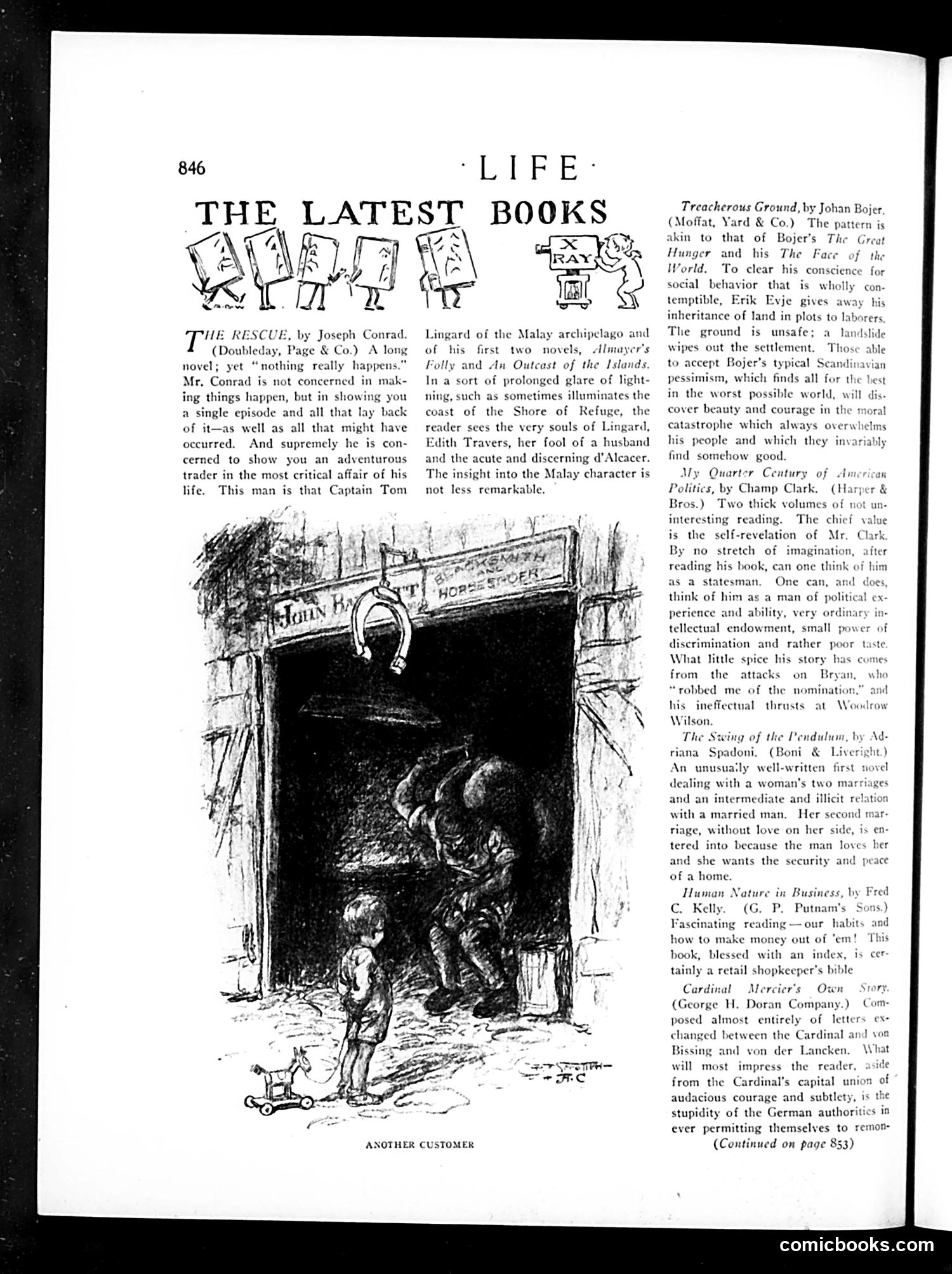
This page features book reviews from *Life* magazine's literary section. The prominent illustration titled "Another Customer" depicts a working-class figure entering what appears to be a shop or establishment, likely satirizing consumer culture or labor conditions. The reviews discuss novels by Joseph Conrad, Johan Bojer, and others. Of particular note: the review of Champ Clark's political memoir sharply criticizes him as intellectually mediocre, lacking imagination and discriminating taste—suggesting he's a political operative rather than statesman. References to his attacks on William Jennings Bryan indicate this is post-1896 political commentary. Another review discusses Cardinal Mercier's wartime letters, criticizing German authorities' stupidity for allowing their publication—implying this relates to WWI-era censorship controversies. The overall tone is typical *Life* satire: culturally sophisticated, skeptical of political pretense, and focused on revealing character through literary analysis.
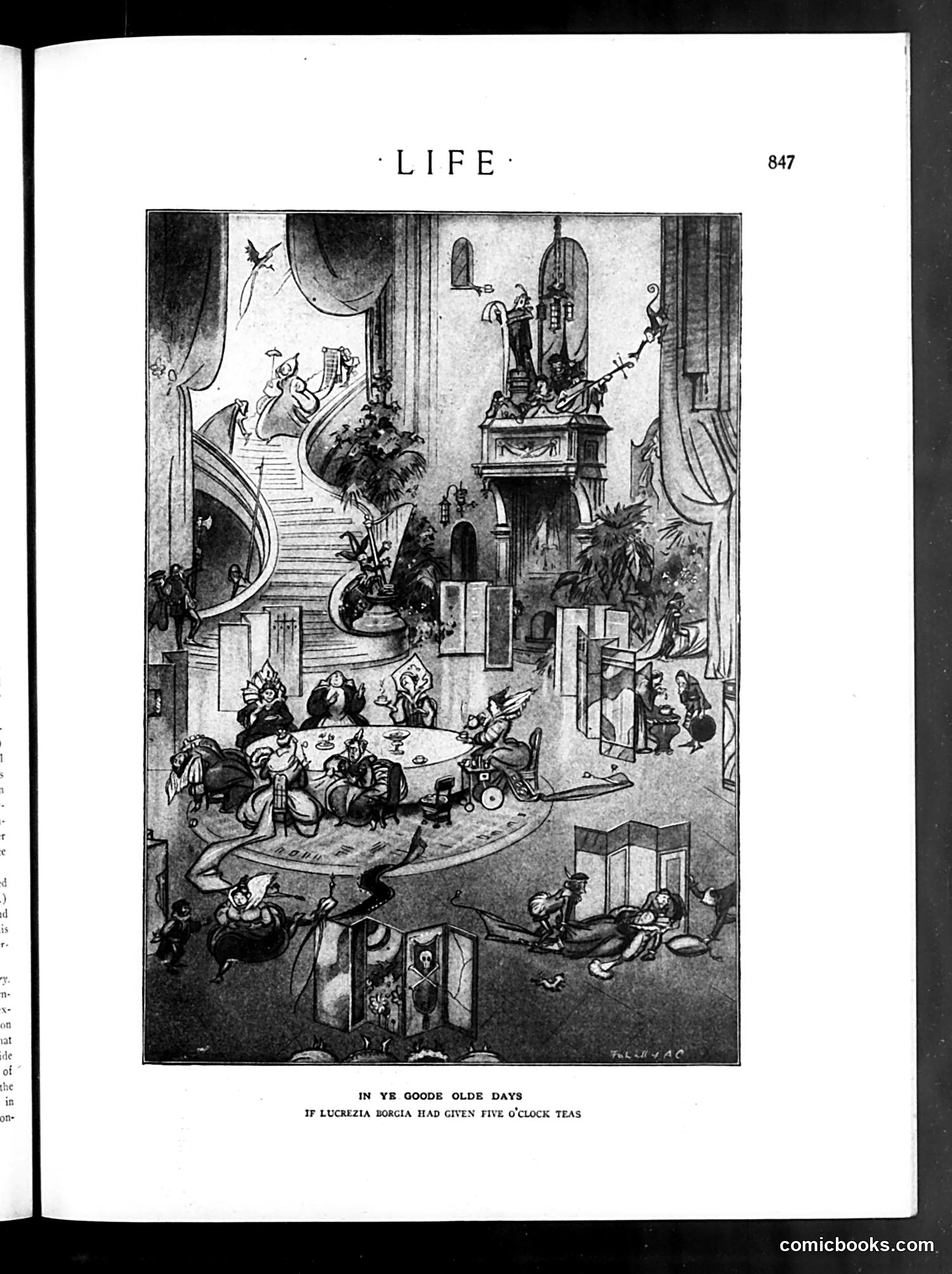
This is a satirical fantasy illustration depicting what would happen if the historical figure Lucrezia Borgia—infamous in Renaissance Italy for alleged poisonings and moral scandals—had hosted fashionable five o'clock tea parties (a Victorian/Edwardian social convention). The cartoon mocks both Borgia's murderous reputation and contemporary high-society tea culture. The elaborate, chaotic scene shows elegantly dressed guests in a palatial setting with multiple levels, towers, and decorative elements. The satire suggests that Borgia's legendary poisoning methods would transform a genteel social ritual into absolute mayhem. The joke relies on the contrast between Borgia's dark historical notoriety and the refined pretension of upper-class social gatherings, implying that society women of the era are similarly duplicitous or dangerous beneath their civilized veneer.
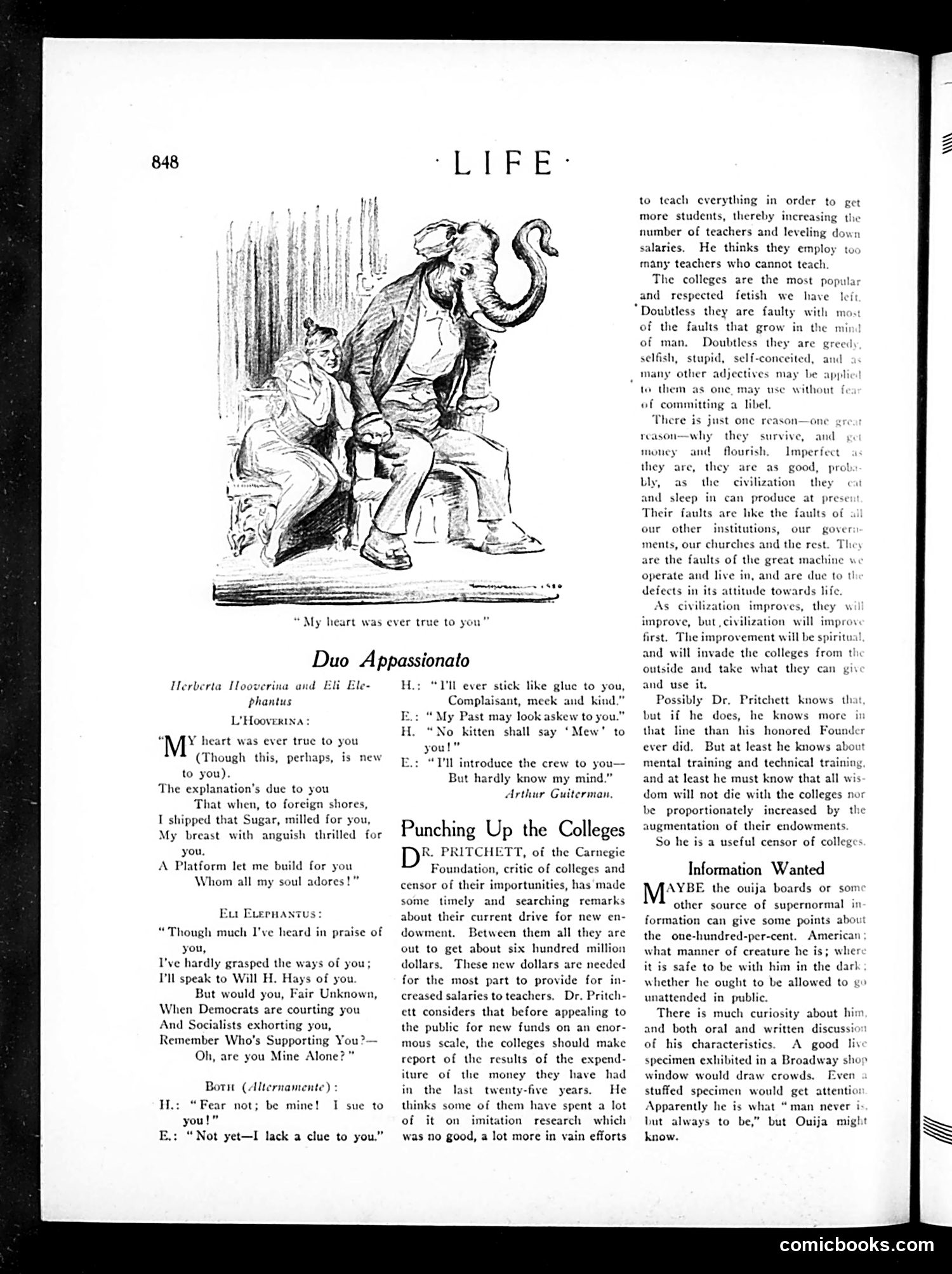
This satirical piece depicts a romantic dialogue between "Herberta Hooverina" (a female figure representing Herbert Hoover) and "Eli Elephantus" (the Republican elephant mascot). The cartoon mocks Hoover's courtship of voters and the Republican Party's political messaging. Hooverina claims loyalty while referencing sugar shipments and platform-building—likely alluding to Hoover's actual record in commerce and politics. The elephant responds with political calculations, referencing Will H. Hays (Hollywood censor) and warning her against Democratic and Socialist temptation. The humor lies in personifying political figures and parties as lovers engaged in insincere romantic banter, exposing the transactional nature of political appeals. The separate article critiques colleges for wasteful spending and employing ineffective teachers, suggesting Life magazine was questioning institutional claims of improvement despite massive funding requests.
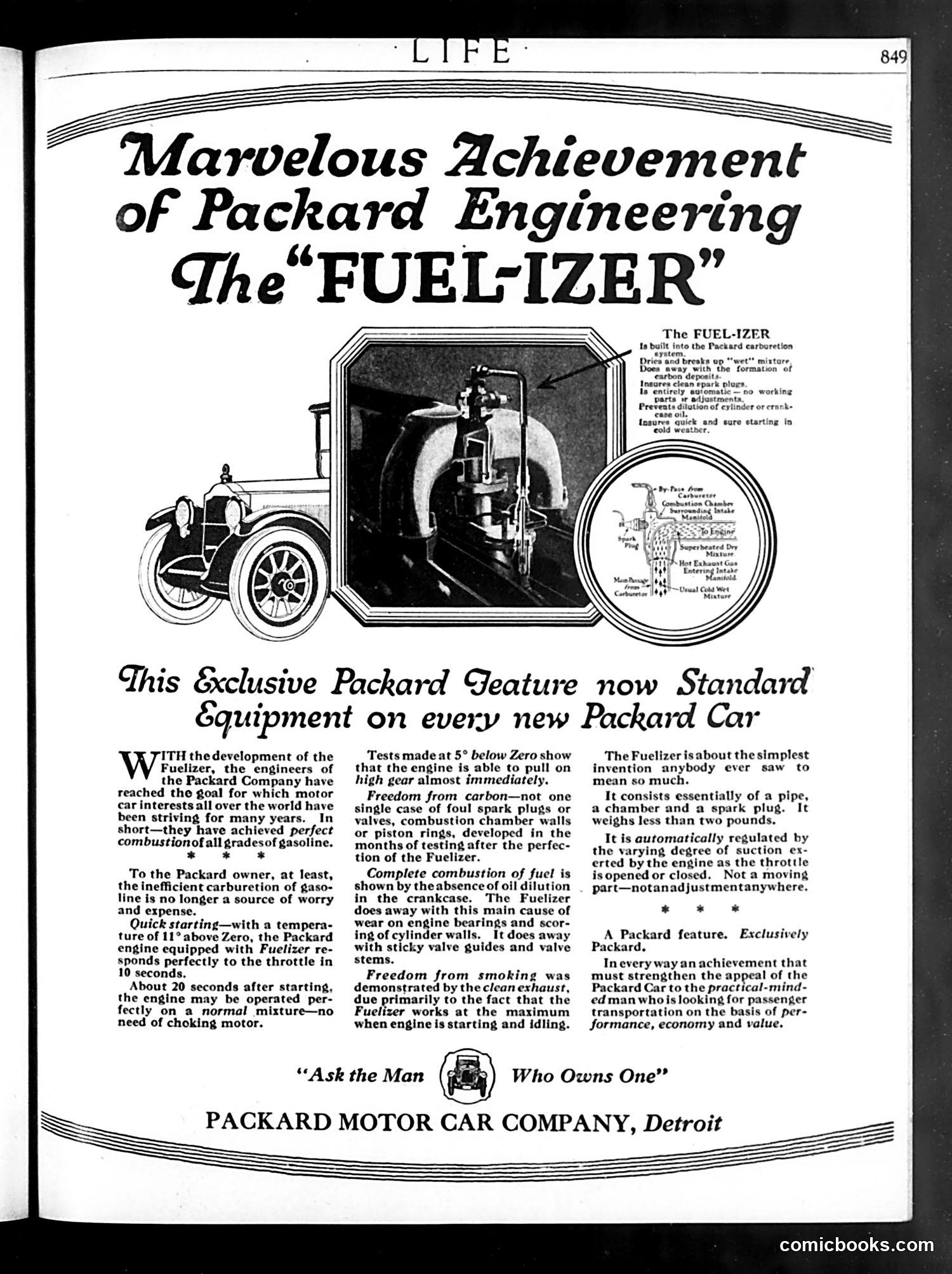
This is **not a cartoon or satire** — it's a straightforward advertisement from Life magazine for Packard Motor Car Company's "Fuel-Izer" technology. The page promotes an engineering innovation: a fuel management system built into Packard automobiles that allegedly solved a major problem of the era — poor fuel combustion in gasoline engines. The ad claims the Fuel-Izer prevents carbon deposits, ensures clean spark plugs, enables quick cold-weather starting, and eliminates engine smoking. The visual shows a vintage Packard automobile with a technical diagram of the fuel system's components. The advertisement emphasizes that this feature comes standard on all new Packard cars and appeals to practical-minded buyers seeking "performance, economy and value." This reflects early automotive advertising's emphasis on mechanical innovation as a selling point — before features like styling or brand prestige dominated car marketing.
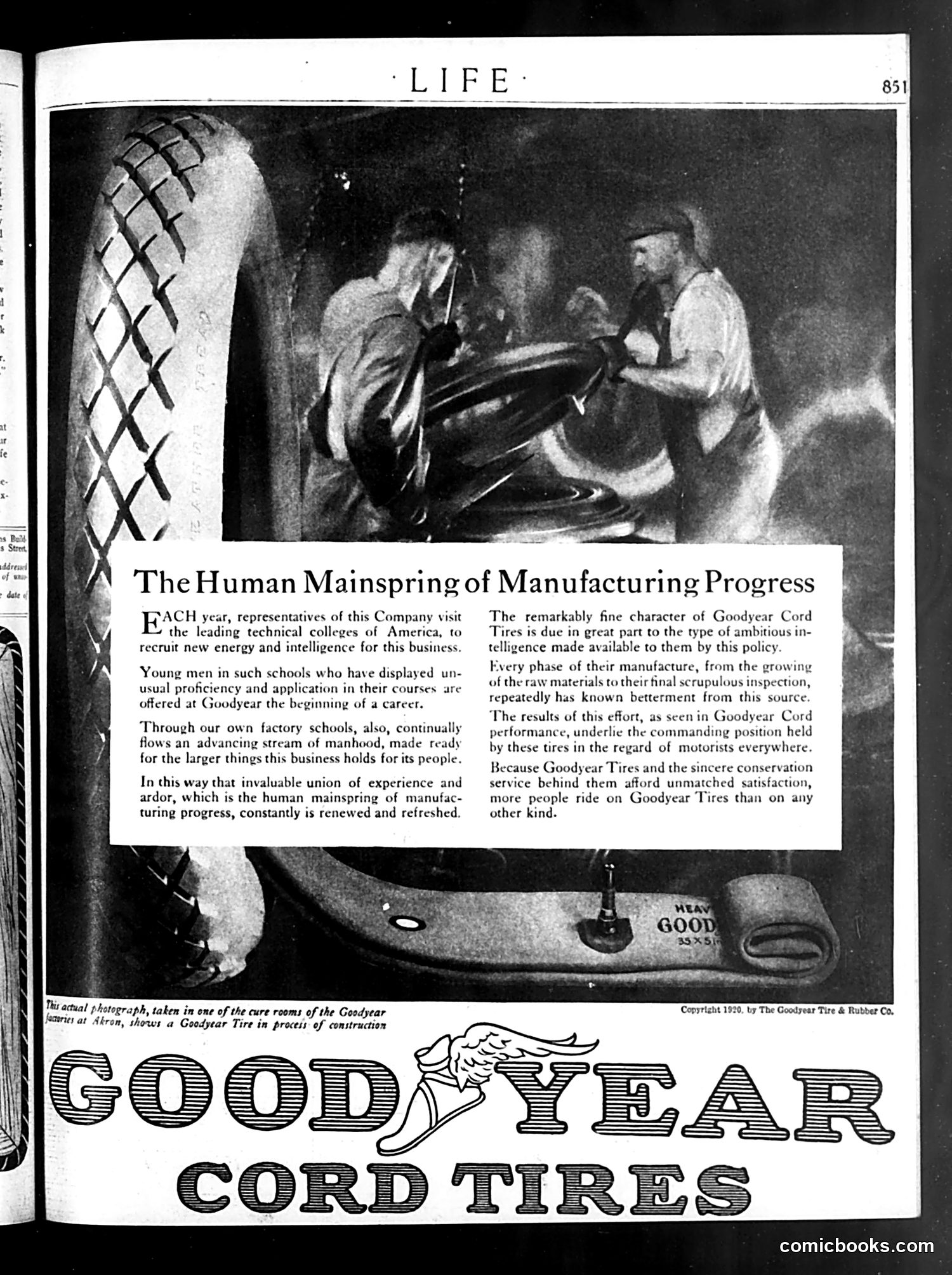
This is a **Goodyear Tire advertisement**, not satire. Published in 1920, it promotes Goodyear's manufacturing philosophy and product quality to *Life* magazine readers. The photograph shows factory workers manufacturing a tire in Goodyear's Akron, Ohio facility. The accompanying text emphasizes that Goodyear's competitive advantage stems from recruiting talented young men from technical colleges, training them through factory schools, and maintaining high standards throughout production. The advertisement's core message—that superior tires result from superior workforce management—was a common corporate narrative of the early 20th century. It appeals to contemporary American values: ambitious youth, technical education, meritocracy, and craftsmanship. The "human mainspring" metaphor suggests workers are the engine driving manufacturing excellence. This reflects Progressive Era confidence in industrial efficiency and the dignity of skilled labor, before such claims became subjects of labor-movement critique.
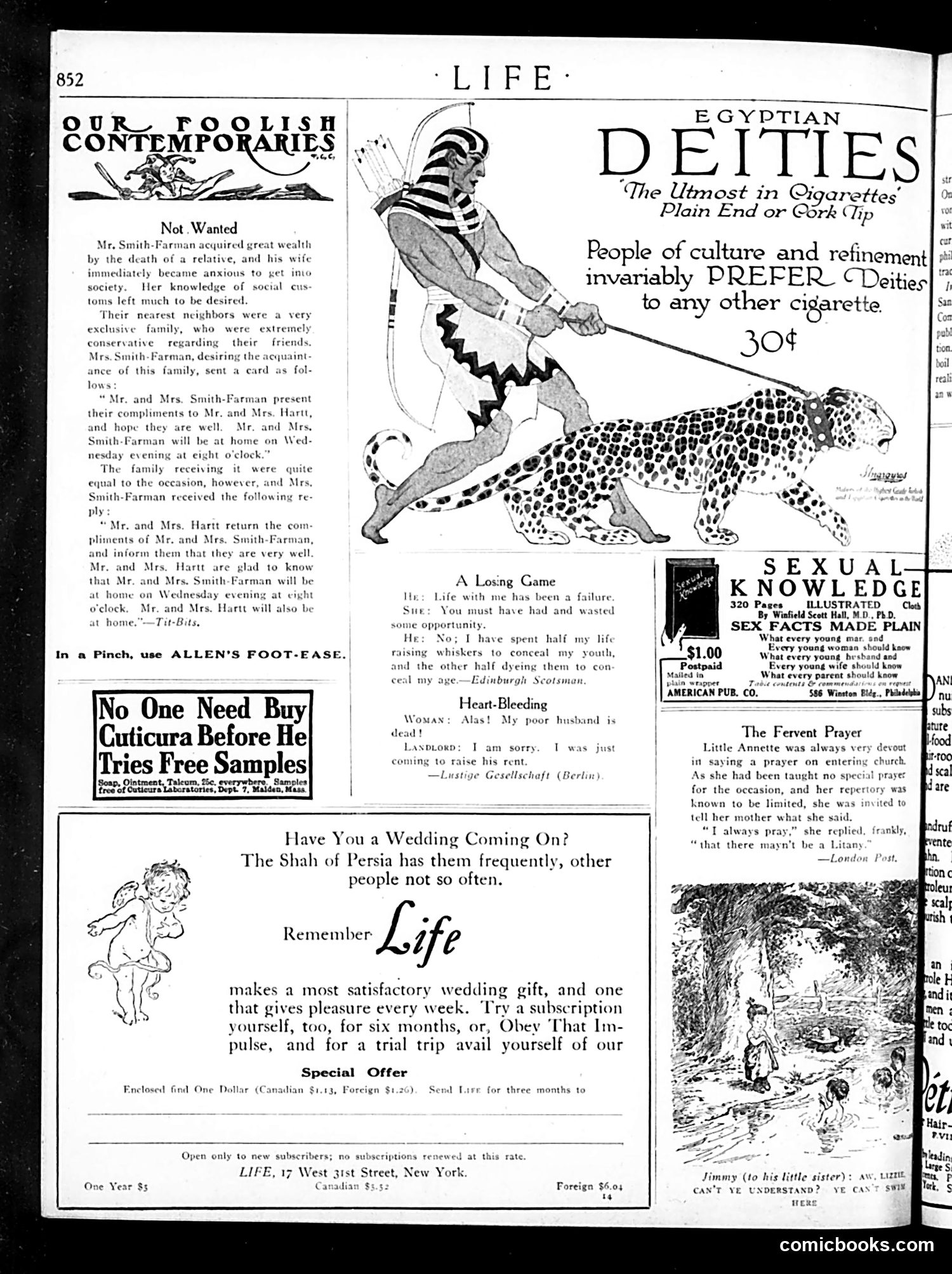
This page mixes satirical humor with period advertising typical of early 20th-century Life magazine. **"Not Wanted"** satirizes nouveau riche social climbing. The Smith-Farmans, newly wealthy from an inheritance, desperately seek entry into high society but lack social refinement. Their neighbors, the Hartts, deliver a cutting rebuke through an exaggeratedly formal reply card that matches their pretentious invitation while pointedly noting they'll "also be at home"—implying indifference. **The advertisements reflect period concerns**: Egyptian Deities cigarettes appeal to cultural sophistication; a "Sexual Knowledge" manual targets anxious young people; Allen's Foot-Ease and Cuticura promise practical relief. **The humor pieces** ("Losing Game," "Heart-Bleeding") use stock situations: marital failures and class tensions between landlords and tenants. The page illustrates Life's formula: mocking social pretension while simultaneously selling products promising self-improvement and status elevation to the same aspirational readers.
This page is primarily **advertising and book reviews**, not political satire. The main content includes: **Book Reviews** (right column): Grant M. Overton reviews contemporary novels including works by Elisabeth Sanxay Holding and John Galsworthy. One review mentions *The Inside Story of the Peace Conference* by Edward J. Dillon, discussing the Paris Peace Conference (post-WWI, 1919) with cynicism—suggesting the conference failed to produce lasting idealistic outcomes. **Advertisements** (left and center): - A **dandruff shampoo ad** (Pétrole-Hahn) with a small cartoon of a man scratching his head - A **Tiffany & Co.** luxury goods advertisement The dandruff cartoon is mild humor about an everyday annoyance, not political commentary. The page reflects 1920s consumer culture and literary criticism rather than satirical commentary on current events. The Peace Conference reference is the only topical element—expressing postwar disillusionment.
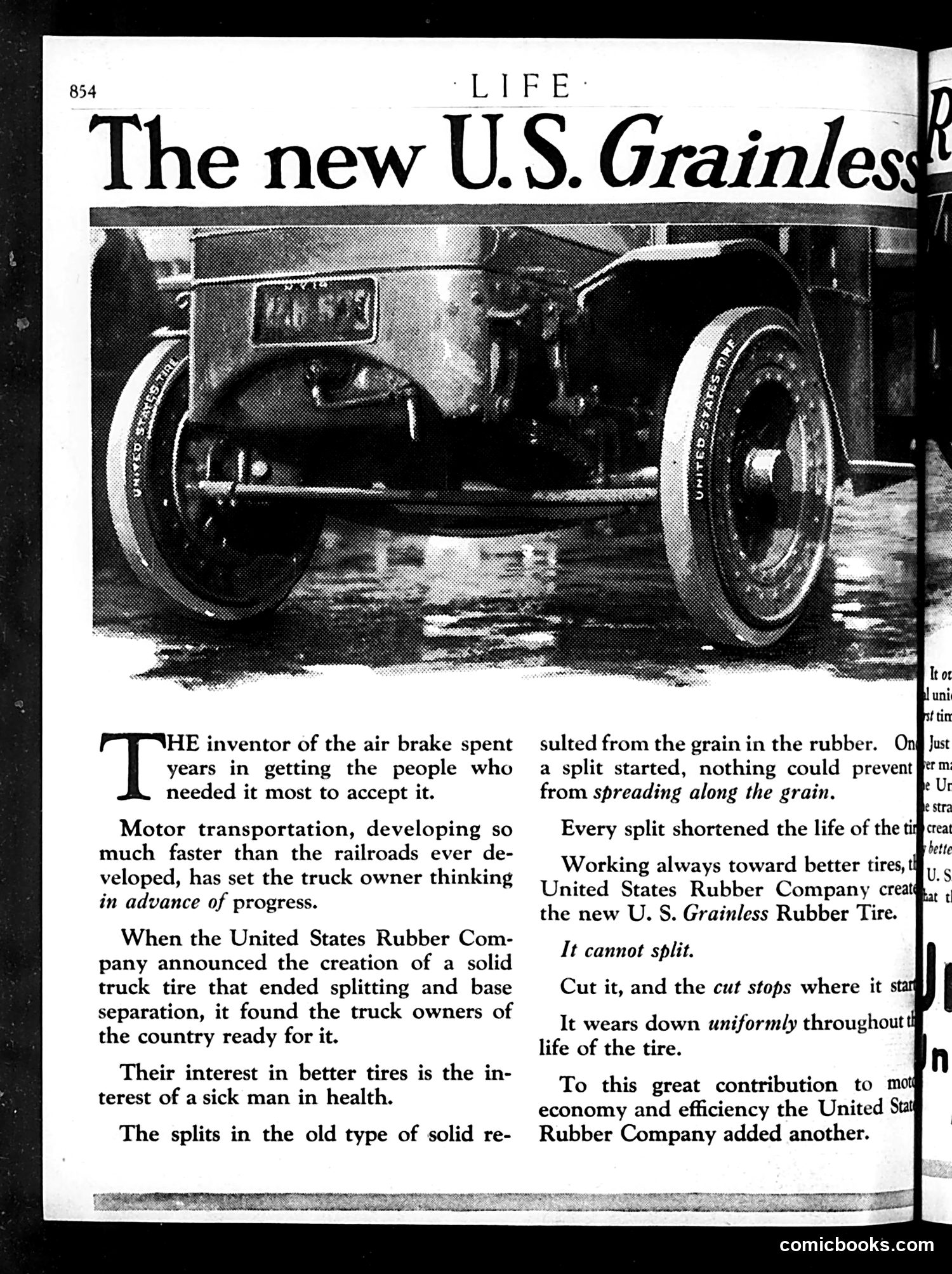
This is a **product advertisement**, not a cartoon or satire. It promotes the United States Rubber Company's new "Grainless" truck tire. The page shows an underside view of a solid truck tire and argues that this innovation solves a critical problem: old solid tires would split along the grain in the rubber, progressively spreading and shortening tire life. The new "Grainless" tire cannot split this way and wears uniformly. The text uses an analogy comparing truck owners' interest in better tires to "a sick man in health"—suggesting the need is urgent and obvious. It also references the air brake inventor's struggle to gain acceptance, implying that superior technology takes time to be recognized. There is **no satire or political commentary** here. This is straightforward early-20th-century industrial advertising emphasizing durability and progress in motor transportation technology.
This page is primarily **advertising** rather than political satire. The dominant content is a Resinol Soap advertisement featuring an illustration of a mother teaching her daughter proper skincare—"The First Lesson"—promoting the soap's benefits for healthy skin. Below this is a short poem titled "Defiance" by Westmore Willcox, Jr., expressing individualistic rebellion against societal rules ("your tyrant laws"). The right column contains a humorous narrative titled "The House that 'Jack' Built," a parody of the nursery rhyme that satirizes the frustrations of purchasing a California bungalow kit home. It chronicles one A. Payer's experience: enthusiasm from an advertisement, then discovering he owned no land, buying expensive jungle property, dealing with delayed shipments, incomprehensible blueprints, demanding carpenters, parking fees, and taxes—a comedic cascade of unexpected costs and complications. The page also includes advertisements for Bell-an (indigestion relief) and Capewell Horse Nails, typical of early 20th-century magazine content.
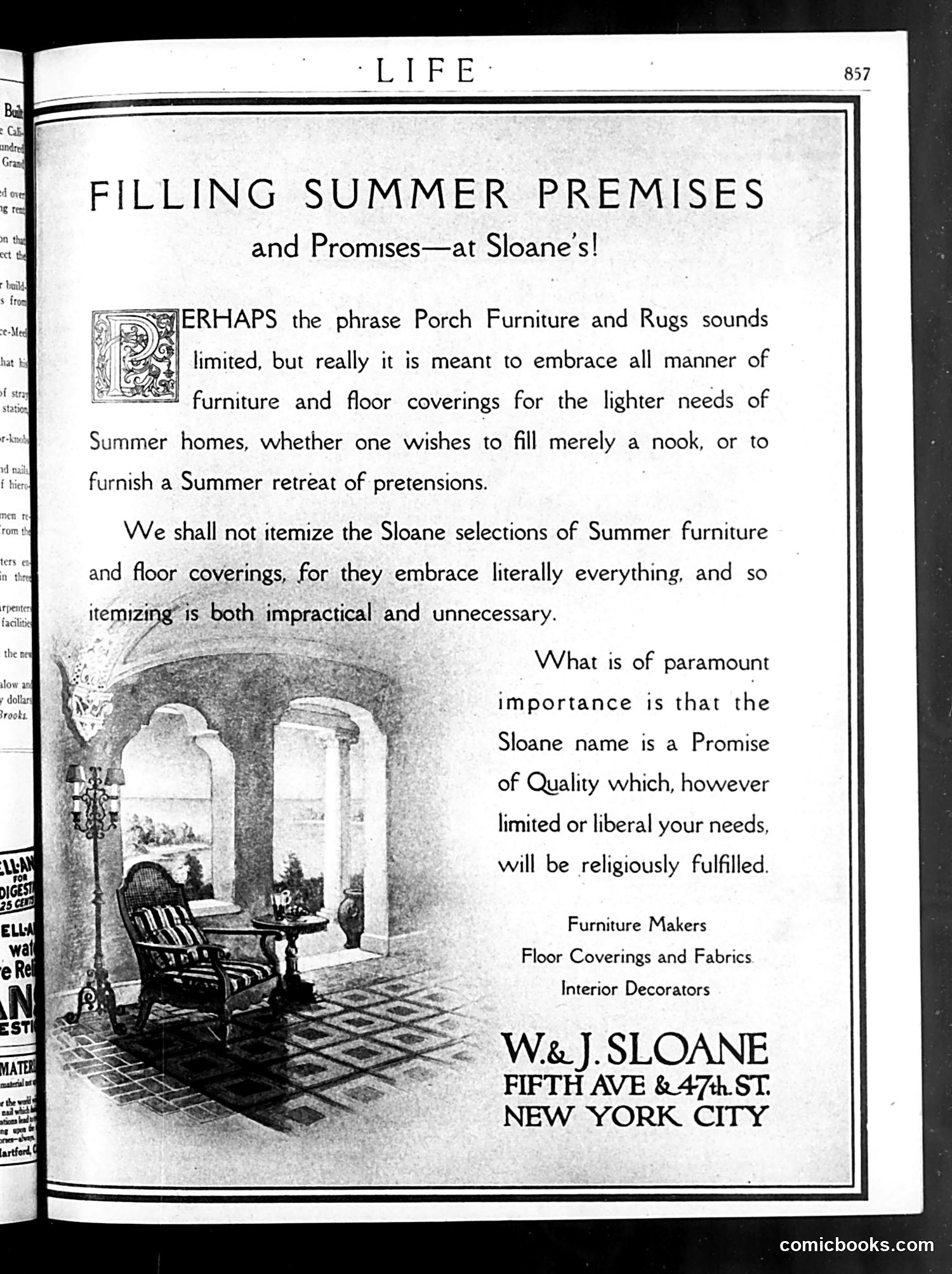
This is primarily an **advertisement**, not satire or political commentary. It's a full-page ad for W. & J. Sloane, a New York furniture and interior design company, appearing in *Life* magazine (page 857). The ad promotes Sloane's summer furniture offerings for seasonal homes. The accompanying illustration shows an elegant interior space with arched windows, patterned flooring, and period furniture—meant to exemplify the sophisticated aesthetic Sloane promises. The ad's appeal relies on associating the Sloane brand name with guaranteed quality and reliability ("a Promise of Quality which...will be religiously fulfilled"), regardless of budget level. This was typical luxury brand marketing of the era—emphasizing trustworthiness and taste rather than specific product details. There is no cartoon, caricature, or satirical commentary visible. This represents straightforward early-20th-century advertising in a magazine known for humor and social commentary.
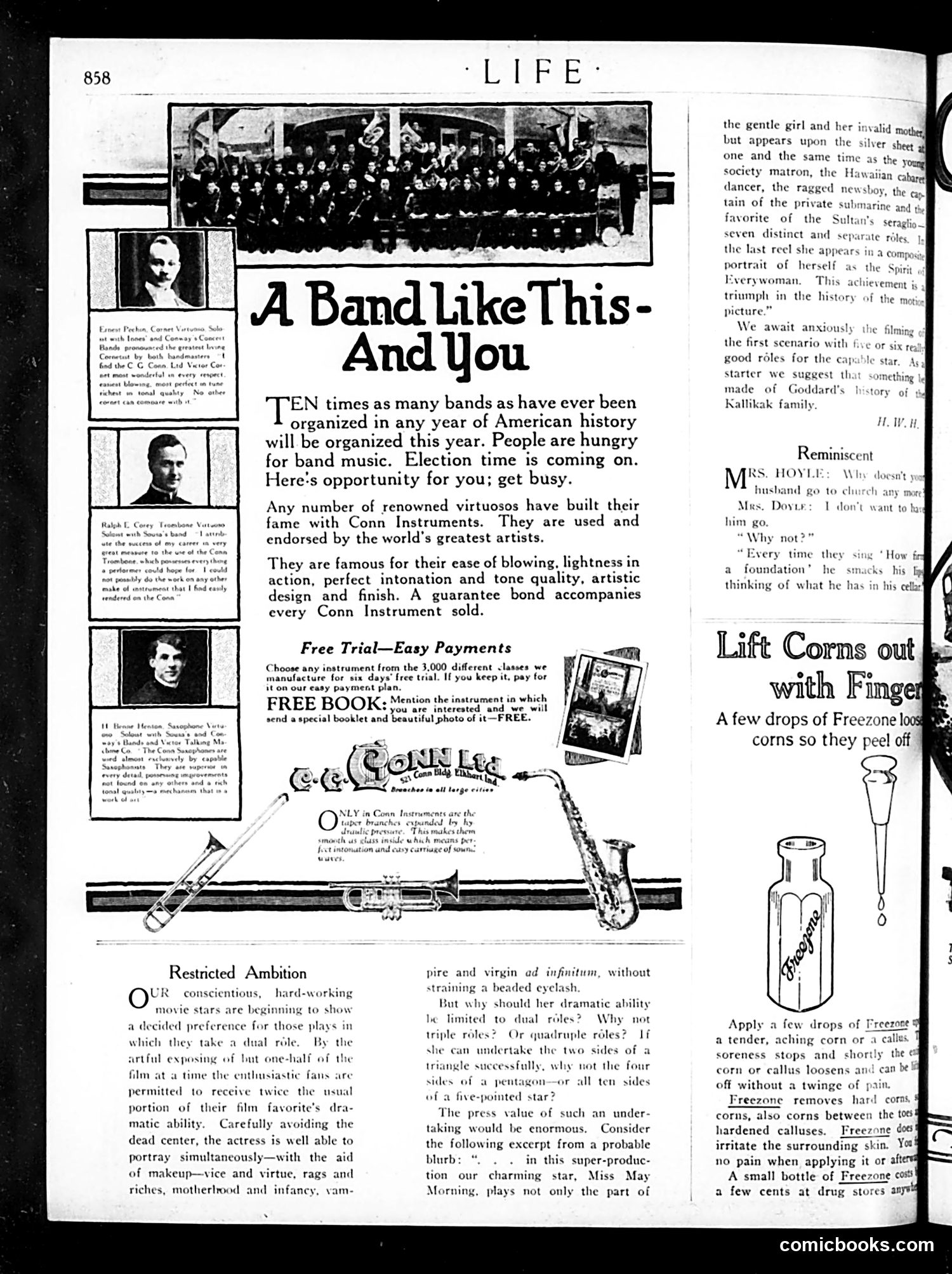
This page contains primarily **advertisements** rather than political cartoons. The main content is a Conn musical instruments ad promoting band formation during an election year, suggesting bands are good for civic engagement and entertainment. Below that is a **satirical article titled "Restricted Ambition"** about movie actresses playing dual roles. The humor targets Hollywood's limited ambitions: it jokes that if actresses can convincingly portray two different characters simultaneously (through makeup and camera work), why not expand to five, ten, or even all sides of a five-pointed star? The satire mocks both the theatrical conventions of dual roles and actresses' restricted opportunities in film, using absurdist escalation for comedic effect. The page also includes: - A "Reminiscent" humor column about a husband avoiding church - A **Freezone corn-removal product advertisement** The content reflects 1920s-era concerns about entertainment industry limitations and consumer product marketing.
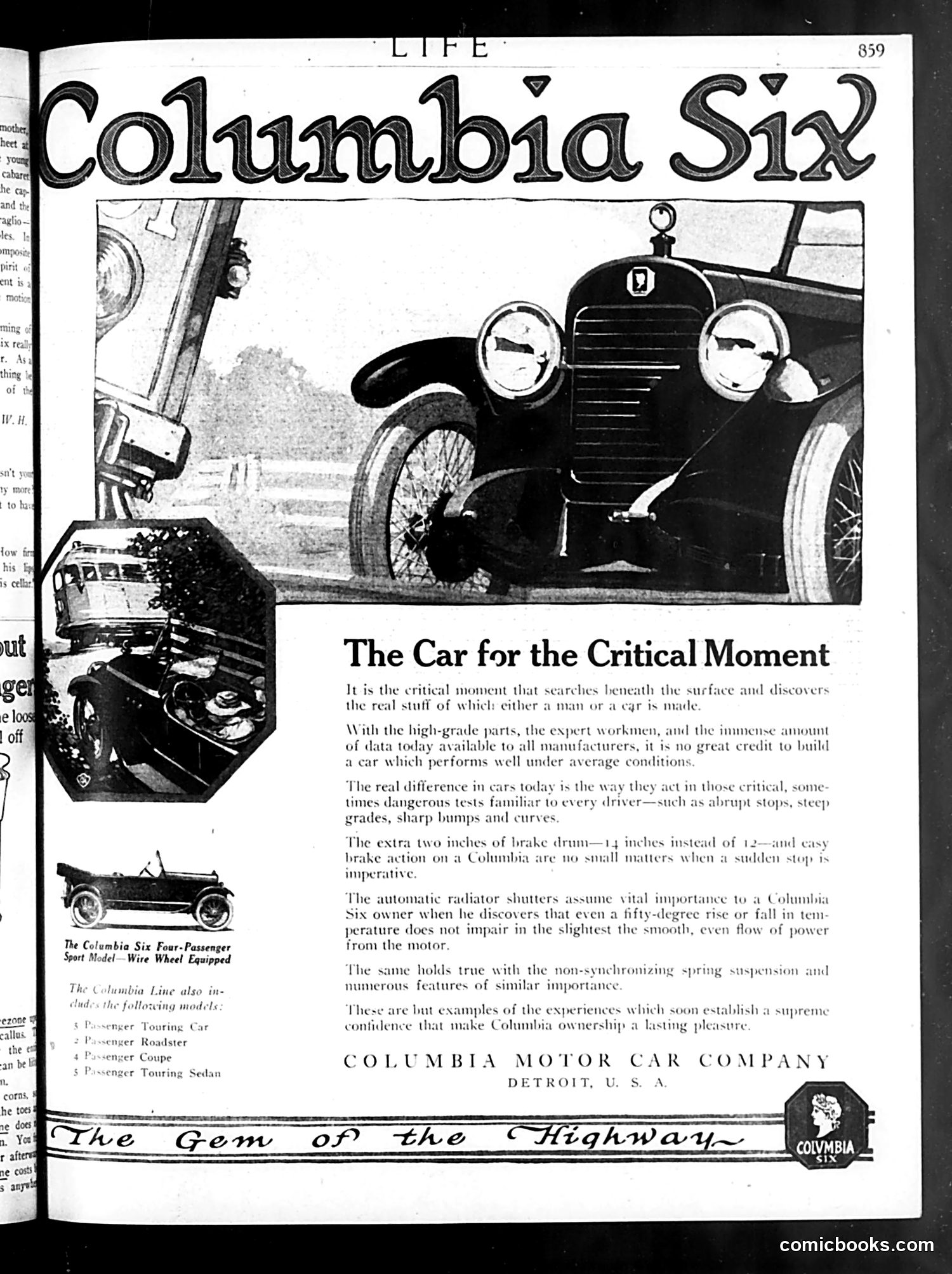
This is **not a cartoon or satire**, but rather a straightforward automobile advertisement from Life magazine's advertising section (page 859). The Columbia Motor Car Company promotes their "Six" model by positioning it as superior in "critical moments"—emergency driving situations like sudden stops, steep grades, and sharp curves. The ad emphasizes practical engineering features: larger brake drums (14 inches vs. 12), automatic radiator shutters for temperature control, and suspension systems that perform under stress. The rhetoric frames car quality not by luxury or prestige, but by reliability during dangerous conditions—a selling point relevant to early automotive buyers concerned with safety and performance. The accompanying photograph shows a modest, open-air touring car typical of the 1910s-1920s era. The tagline "Gem of the Highway" reinforces the quality message. This reflects a period when automobiles were still relatively new, and manufacturers competed partly on engineering credentials.
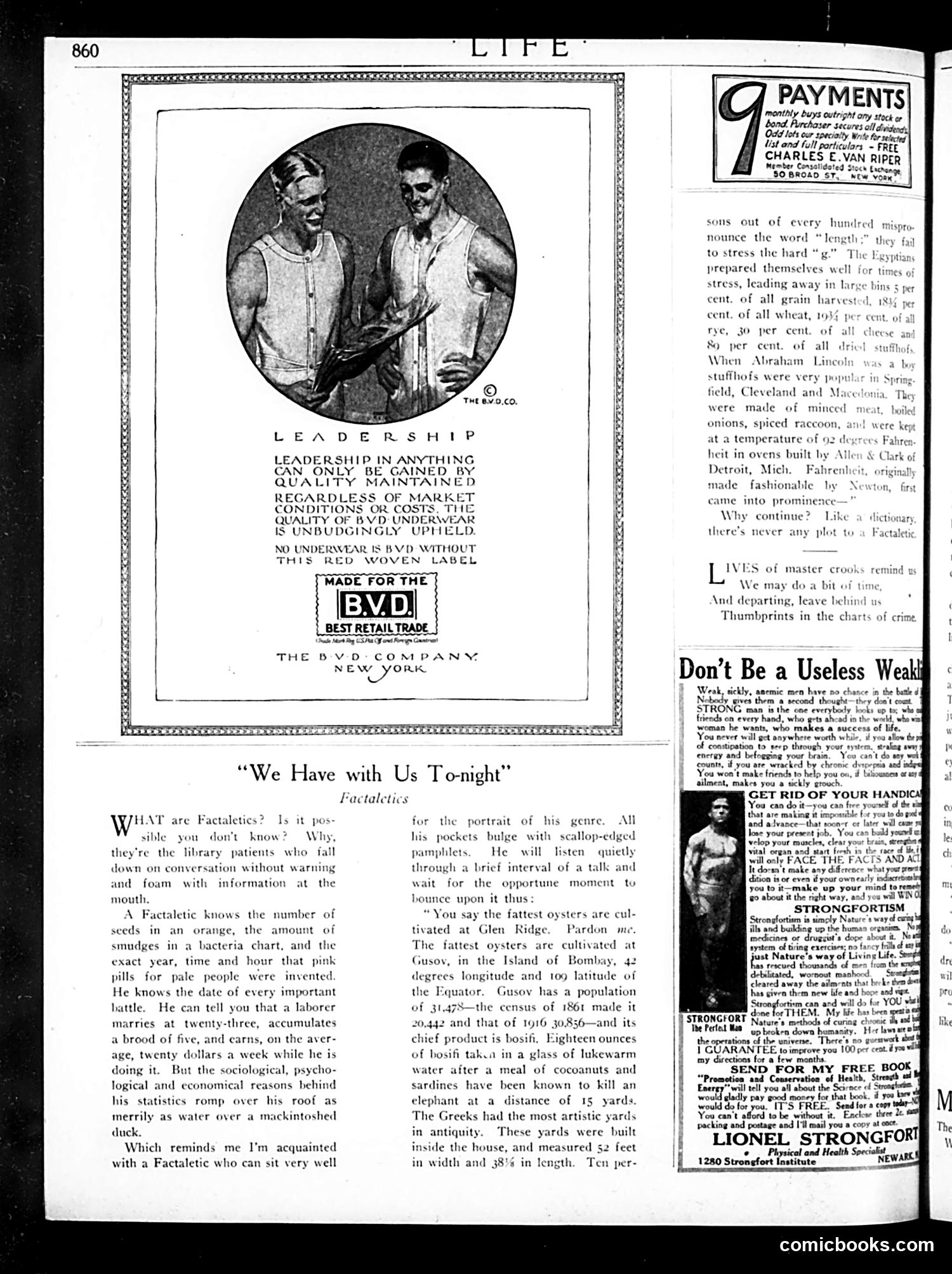
This Life magazine page combines two distinct pieces of content: **The BVD Advertisement** (top): A full-page ad for BVD brand underwear, featuring two illustrated men. The ad emphasizes "Leadership in anything can only be gained by quality maintained regardless of market conditions or costs," positioning quality underwear as essential to success. The red woven label is presented as a guarantee of reliability. **"We Have with Us To-night: Factaletics"** (bottom article): A humorous essay mocking a specific social type—the "Factaletic"—defined as someone who compulsively interrupts conversations with obscure, useless facts. The author describes such people as human "libraries" who bombard others with trivia (seed counts, oyster cultivation locations, labor statistics) without understanding their *meaning* or relevance. The satire targets turn-of-the-century American pretension: people who accumulate and display factual knowledge as markers of sophistication, despite lacking actual wisdom or social awareness. The illustration of the "Factaletic" appears designed to capture this pedantic, oblivious personality type.
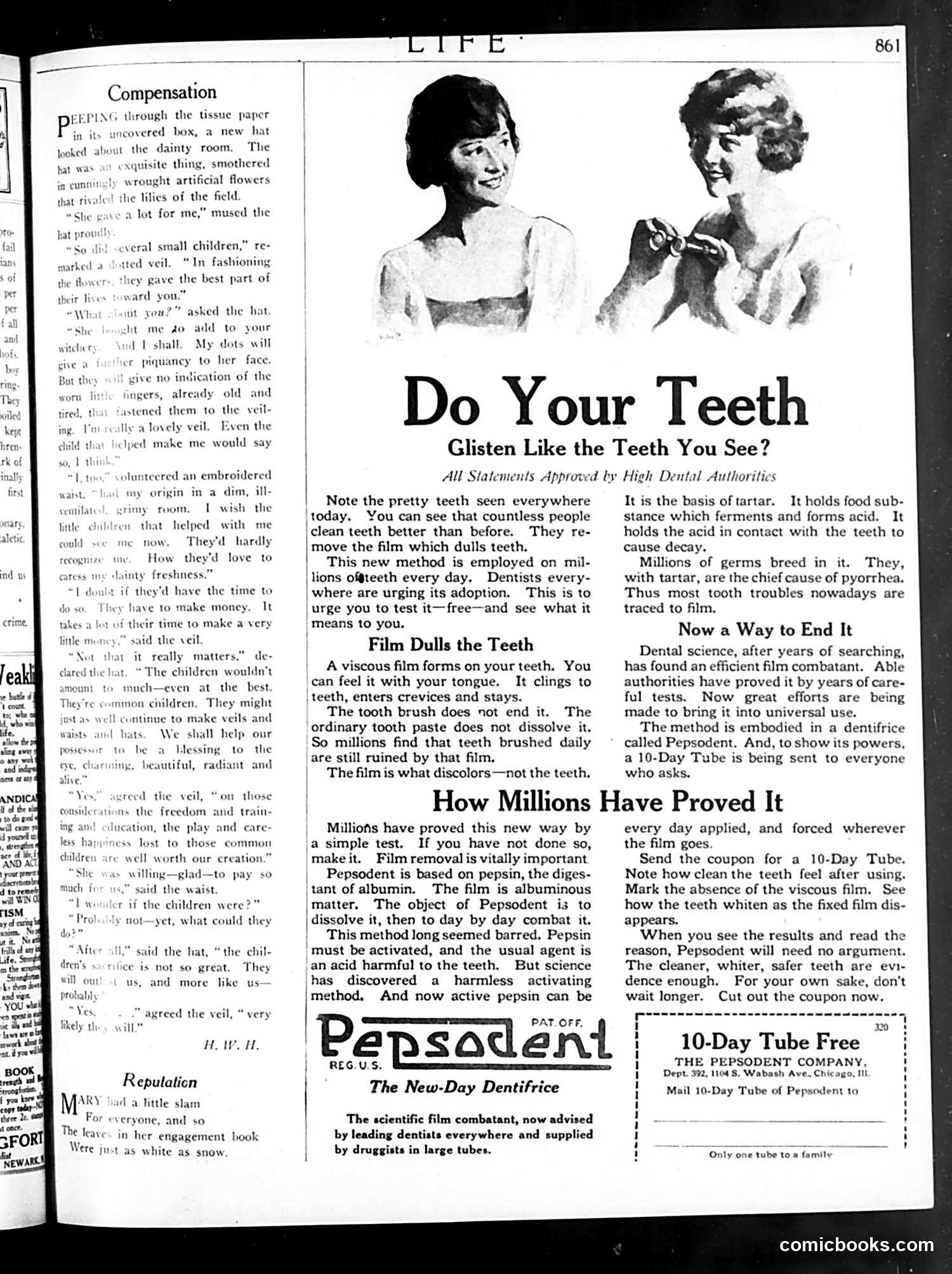
This page contains two distinct pieces of content: **Left side - "Compensation" story**: A satirical short story featuring personified luxury items (a hat, veil, waist) discussing the child labor used to create them. The items congratulate themselves on their beauty while acknowledging they were made by poor children working in terrible conditions. The satire's point: the moral cost of fashionable goods is obscured by their prettiness—wealthy consumers benefit from exploitation they'd rather not acknowledge. **Right side - Pepsodent advertisement**: A full-page toothpaste ad promoting a new product claiming to remove "film" from teeth. It presents the advertisement as scientifically endorsed ("All Statements Approved by High Dental Authorities") and offers free samples. The ad uses before/after imagery and testimonials to build credibility. **Context**: This reflects early 20th-century Life magazine's mix of social criticism and advertising, highlighting the era's child labor practices and emerging consumer culture around dental hygiene products.
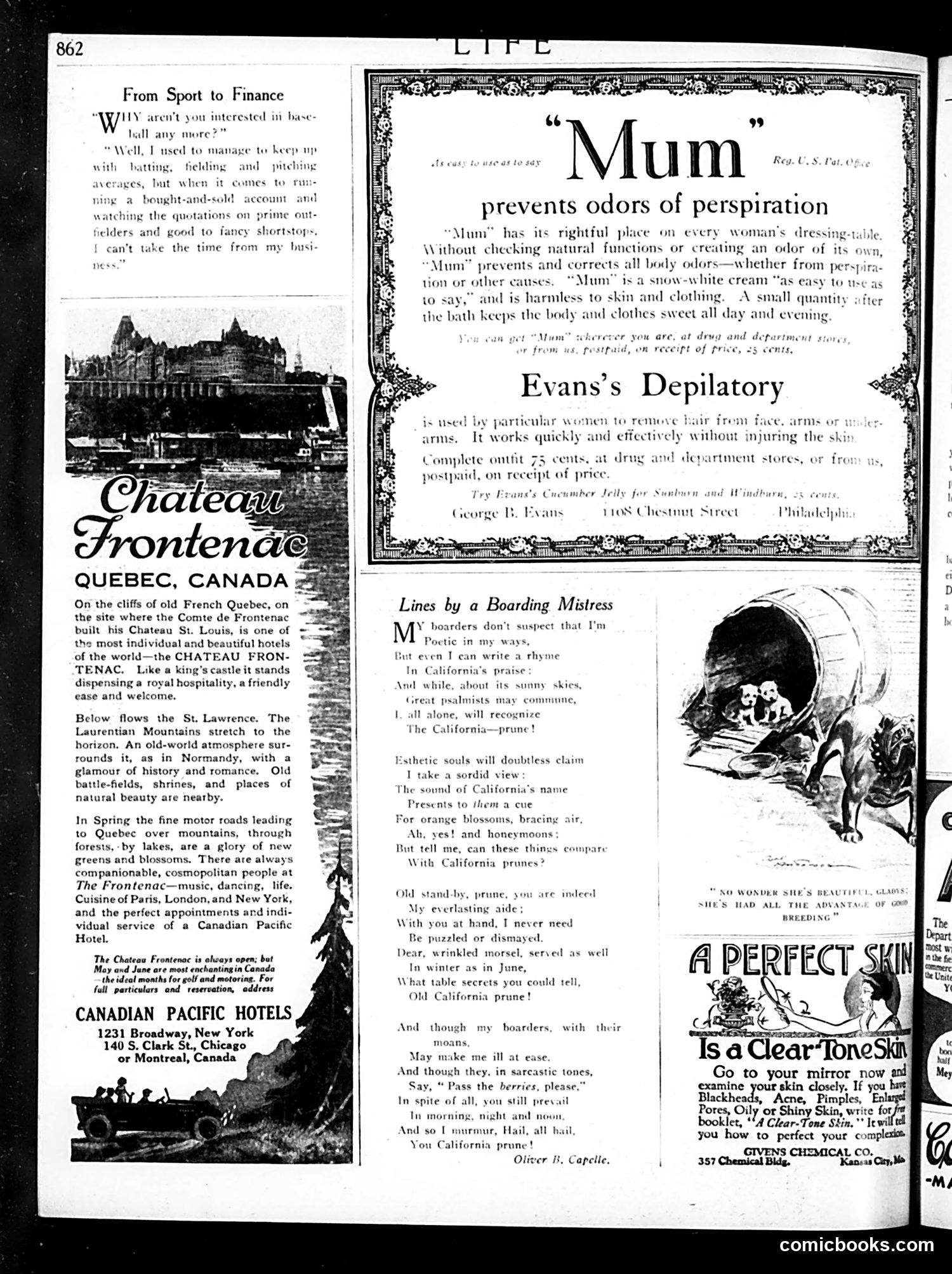
This page is primarily **advertisements and light humor**, not political satire. The main cartoon joke appears in "From Sport to Finance": A baseball fan explains he's lost interest in the sport because managing statistics about players' batting averages now competes with tracking stock prices of those same players—suggesting the commercialization of baseball and how financial speculation has invaded even leisure interests. The page is otherwise dominated by **period advertisements** (circa 1910s-1920s based on styling): - "Mum" deodorant cream - Chateau Frontenac hotel in Quebec - Evans's Depilatory hair removal product - A humorous poem "Lines by a Boarding Mistress" celebrating California prunes as a digestive aid - "A Perfect Skin" skincare product The prune poem is gentle satire on landlady practicality—she appreciates prunes for their utility rather than romance, contrasting with others' sentimental California imagery. This is a typical Life magazine format mixing light social commentary with commercial content targeting primarily female readers.
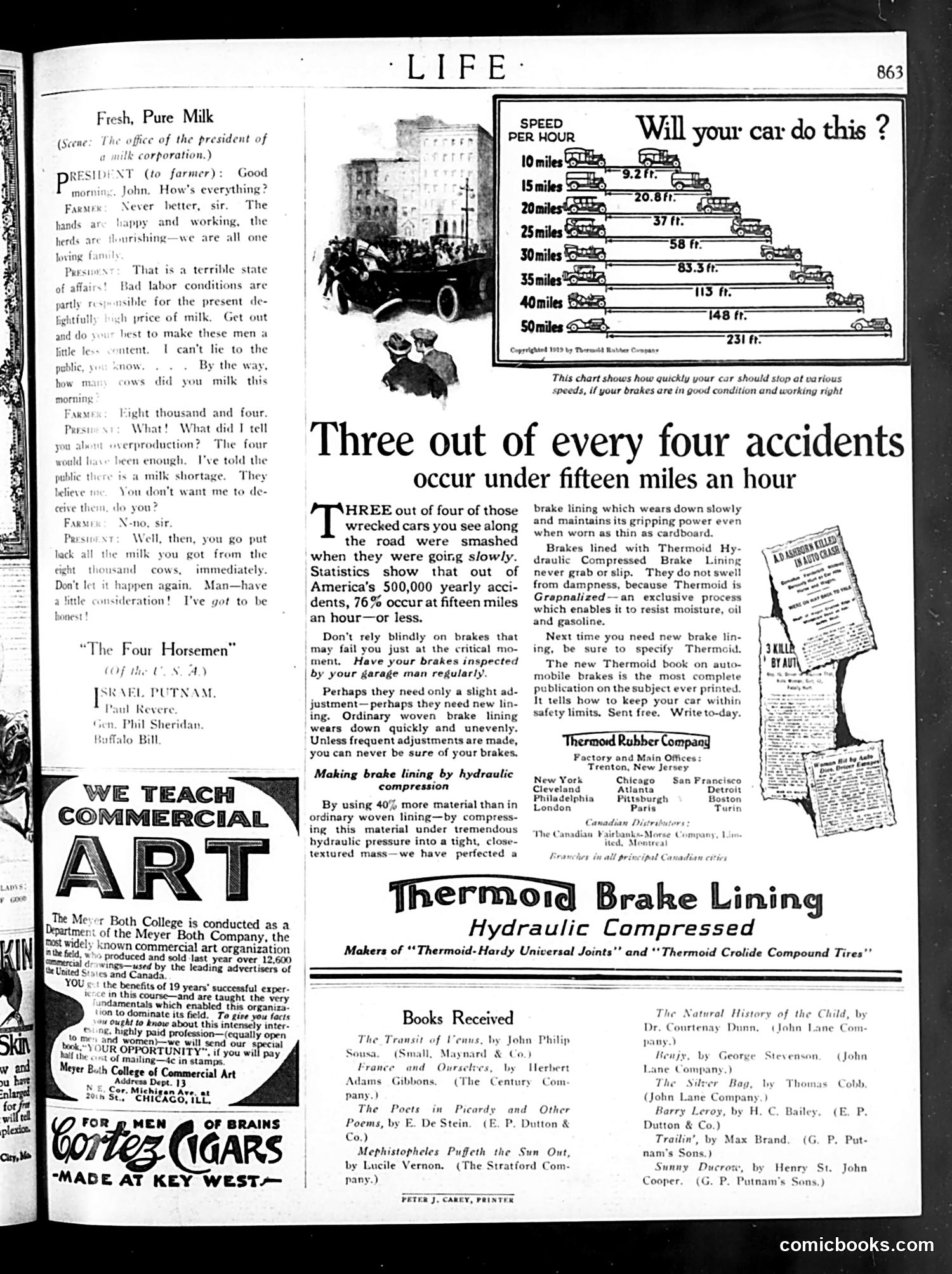
This page contains a satirical dialogue titled "Fresh, Pure Milk" depicting a corporate president confronting a farmer about milk production. The president demands the farmer increase output to address a "milk shortage," but when the farmer explains that poor labor conditions make this impossible, the president dismisses the workers' concerns—despite having just claimed bad conditions were the problem. The satire critiques the hypocrisy of management: executives blame workers for production shortfalls while simultaneously refusing to improve working conditions or wages that might incentivize greater output. The page also includes a Thermoid brake lining advertisement with a safety chart showing stopping distances at various speeds, emphasizing that most accidents occur at low speeds due to brake failure—a public safety message wrapped in commercial promotion.
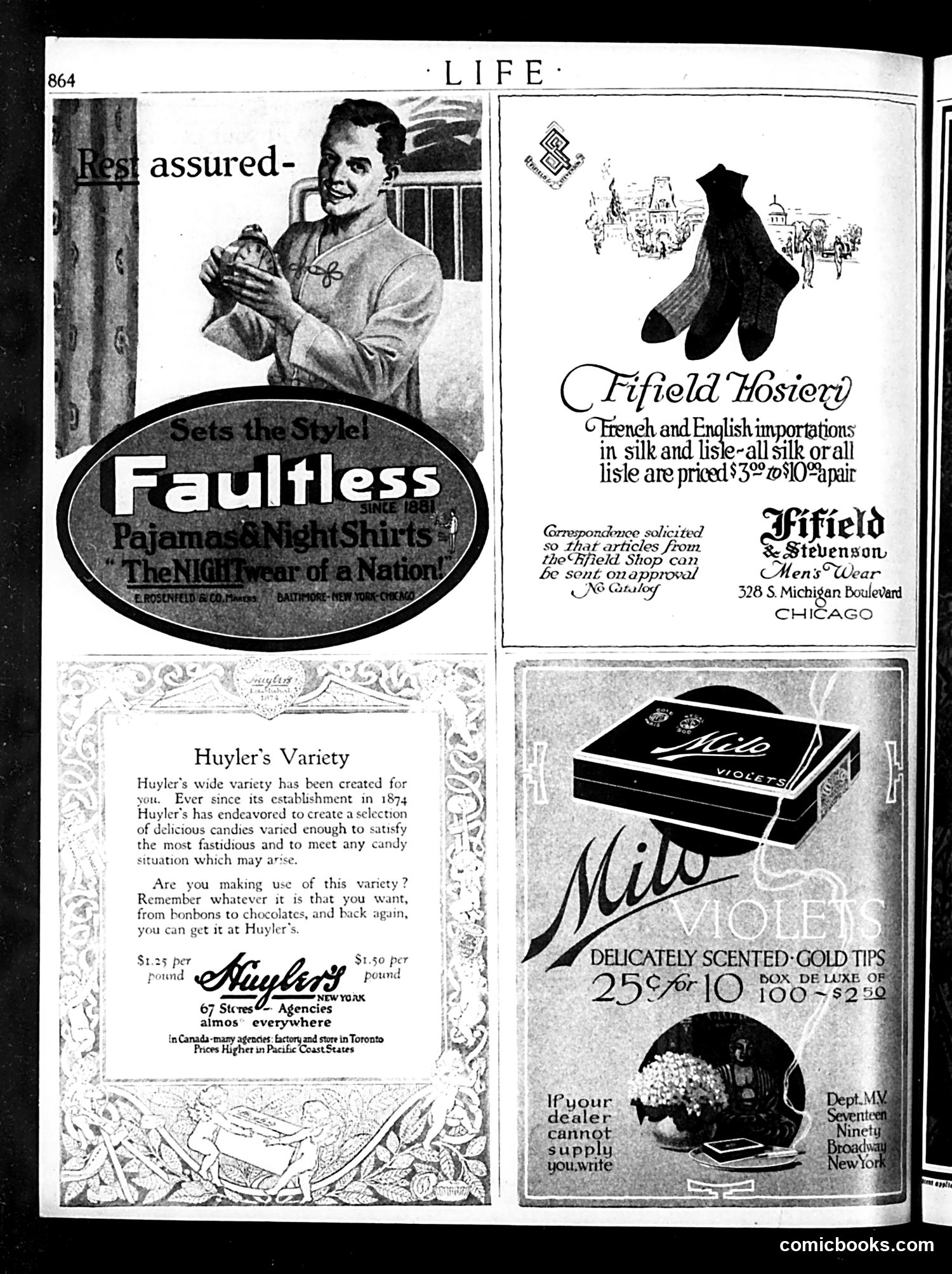
This page consists primarily of **advertisements**, not political cartoons or satire. It's a commercial page from an early 20th-century issue. The ads include: 1. **Faultless Pajamas** - A man modeling nightwear, emphasizing it "Sets the Style" and is "The Nightwear of a Nation" 2. **Fifield Hosiery** - Chicago men's wear shop advertising silk stockings at $3-$10 per pair 3. **Huyler's Candies** - Established 1874, promoting their variety of chocolates and bonbons at $1.25-$1.50 per pound, with 67 stores nationwide 4. **Milo Violets** - Gold-tipped delicately scented candies at 25¢ for a box of 100 These are straightforward consumer product advertisements targeting middle/upper-class readers, typical of Life magazine's advertising content during this era. There is no political satire or social commentary visible on this particular page.
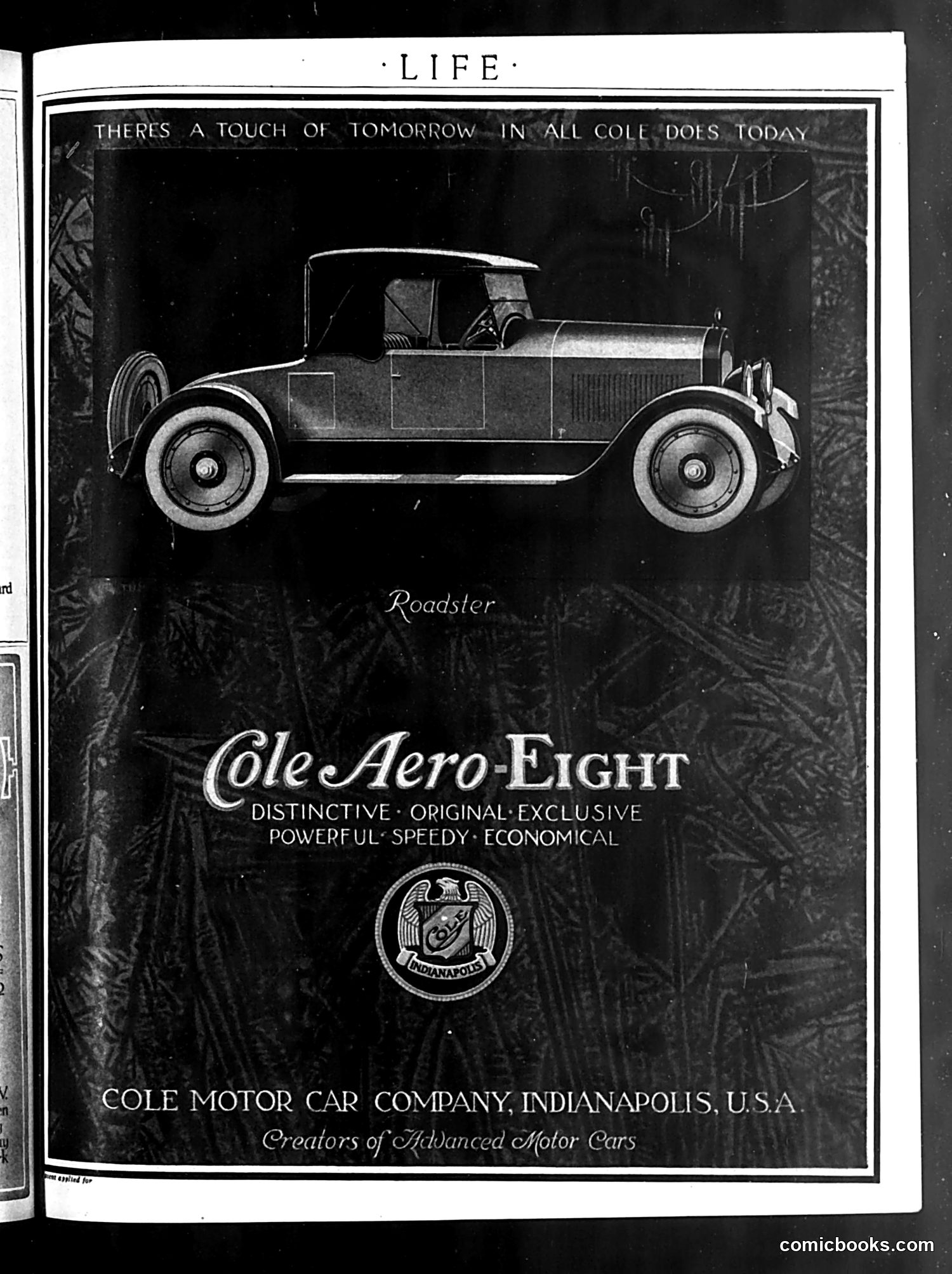
This is not a political cartoon but rather a **full-page automobile advertisement** from Life magazine. It promotes the Cole Aero-Eight Roadster, manufactured by the Cole Motor Car Company in Indianapolis. The ad employs forward-looking marketing language typical of the early automotive era, claiming the vehicle represents "tomorrow" through its "distinctive," "original," and "exclusive" features. The side-profile illustration shows a sleek open-air roadster with period-appropriate styling—spoke wheels, running board, and open cabin. The tagline "There's a touch of tomorrow in all Cole does today" positions the car as innovative and ahead of competitors. The company's self-description as "Creators of Advanced Motor Cars" emphasizes technological progressiveness—a key selling point when automobiles were still relatively new luxury goods. This reflects early 20th-century consumer advertising's emphasis on modernity and progress.
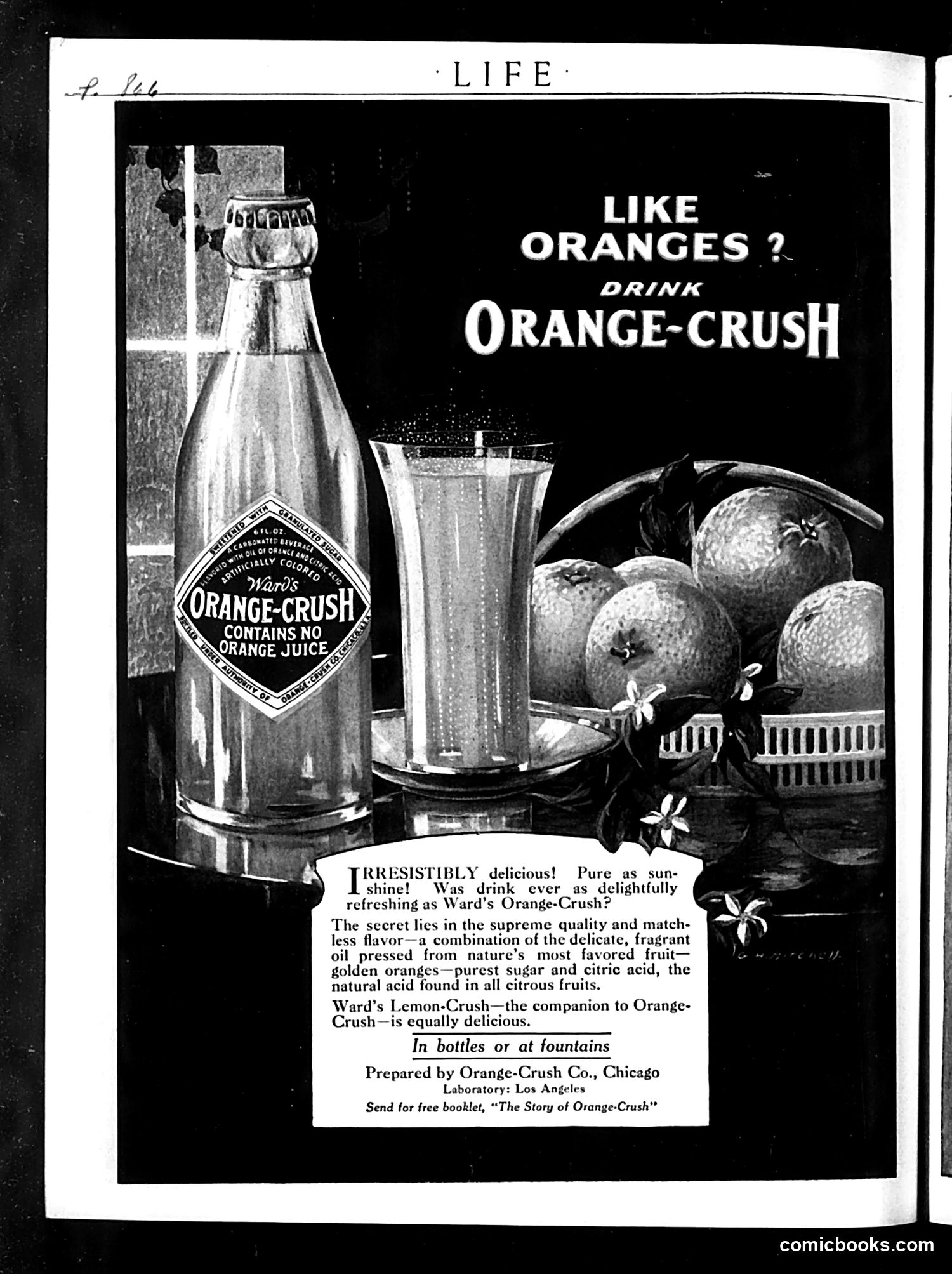
This is primarily a **product advertisement** for Ward's Orange-Crush beverage, not a political cartoon. The page features a vintage soft drink ad from Life magazine's advertising section. The ad uses a simple comparative hook: "Like Oranges? Drink Orange-Crush," pairing text with imagery of actual oranges and a bottle of the product. The label notes the drink "contains no orange juice"—a candid admission that despite its name and orange imagery, it's a flavored beverage rather than actual juice. The copy emphasizes quality ingredients (oil from oranges, sugar, citric acid) to suggest authenticity. A companion product, "Lemon-Crush," is mentioned. The ad directs readers to request a free booklet and notes the product is available "in bottles or at fountains" (soda fountains being common refreshment venues of the era). This reflects early 20th-century marketing practices: using evocative imagery and ingredient descriptions to sell synthetic beverages.
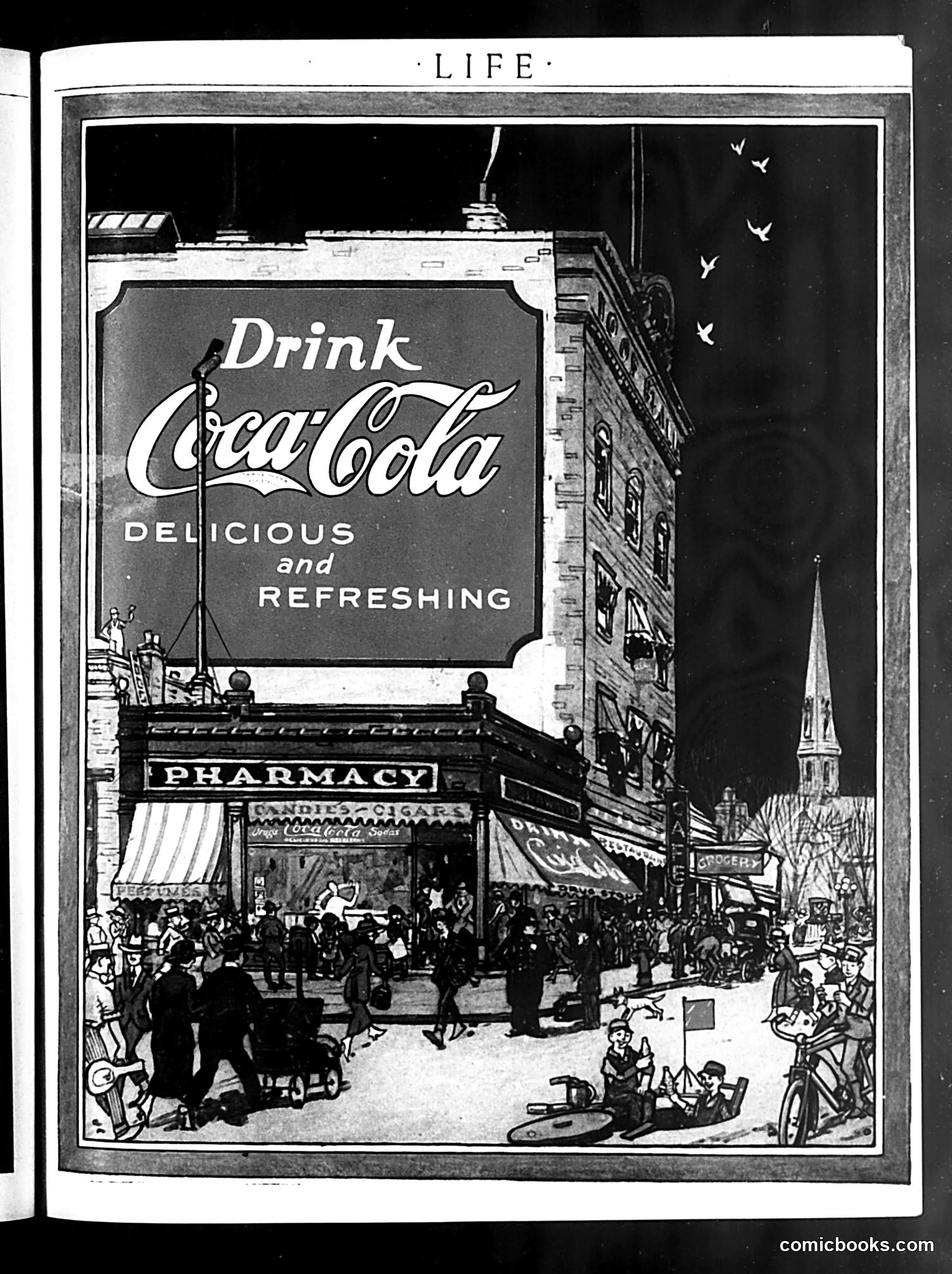
This is primarily a **Coca-Cola advertisement** rather than political satire. The image shows a large illuminated billboard advertising "Drink Coca-Cola: Delicious and Refreshing" positioned above a busy urban street scene with a pharmacy storefront below. The scene depicts early 20th-century city life—pedestrians, vehicles, and commercial activity beneath towering buildings and a church spire. The advertisement emphasizes Coca-Cola's accessibility in everyday American commerce, specifically visible above a pharmacy (where soft drinks were commonly sold). There is **no apparent political satire or caricature**. This appears to be a straightforward commercial illustration celebrating modern advertising and urban consumer culture, typical of *Life* magazine's content during the advertising era.
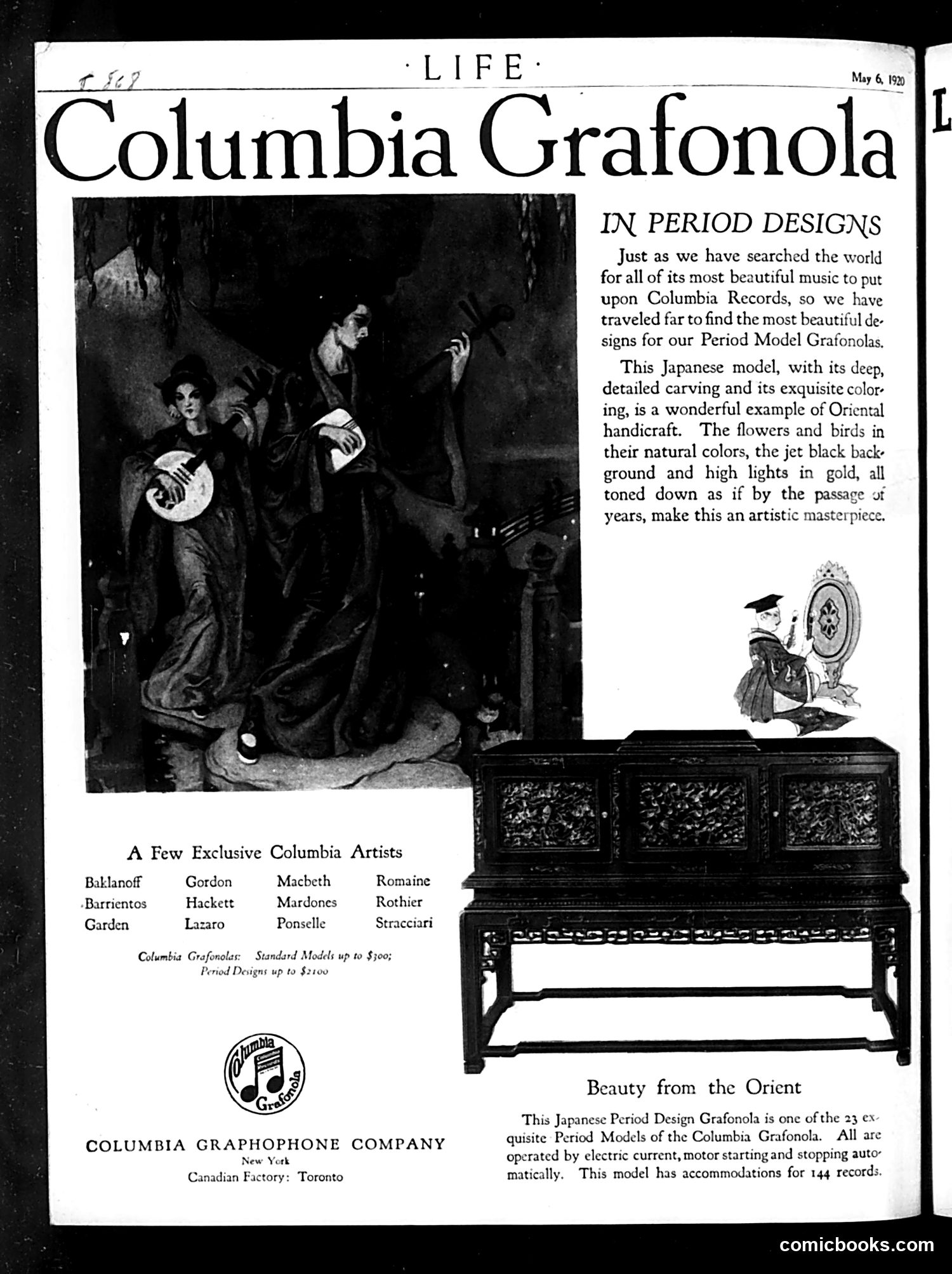
This is primarily **advertising, not satire or political commentary**. It's a 1929 Life magazine advertisement for Columbia Grafonola phonographs (record players). The left image depicts an operatic or theatrical scene—likely representing one of the "exclusive Columbia Artists" listed below (names suggesting opera singers like Ponselle, Hackett, and others). This visual establishes the brand's association with high-culture music. The main pitch advertises a Japanese-designed grafonola cabinet as an exotic, artistic luxury item. The marketing emphasizes "Oriental handicraft" with detailed carving and gold accents—appealing to 1920s American consumers' fascination with "the Orient" as refined and timeless. The practical details (144-record capacity, electric operation) anchor the luxury positioning in modern functionality. Pricing ($300+) signals this as premium merchandise for affluent buyers. There is no satire here—this is straightforward luxury-goods marketing leveraging both high art and Orientalism as status symbols.