
Life, 1920-05-06 · page 30 of 56
Life — May 6, 1920 — page 30: what you’re looking at
What you’re looking at
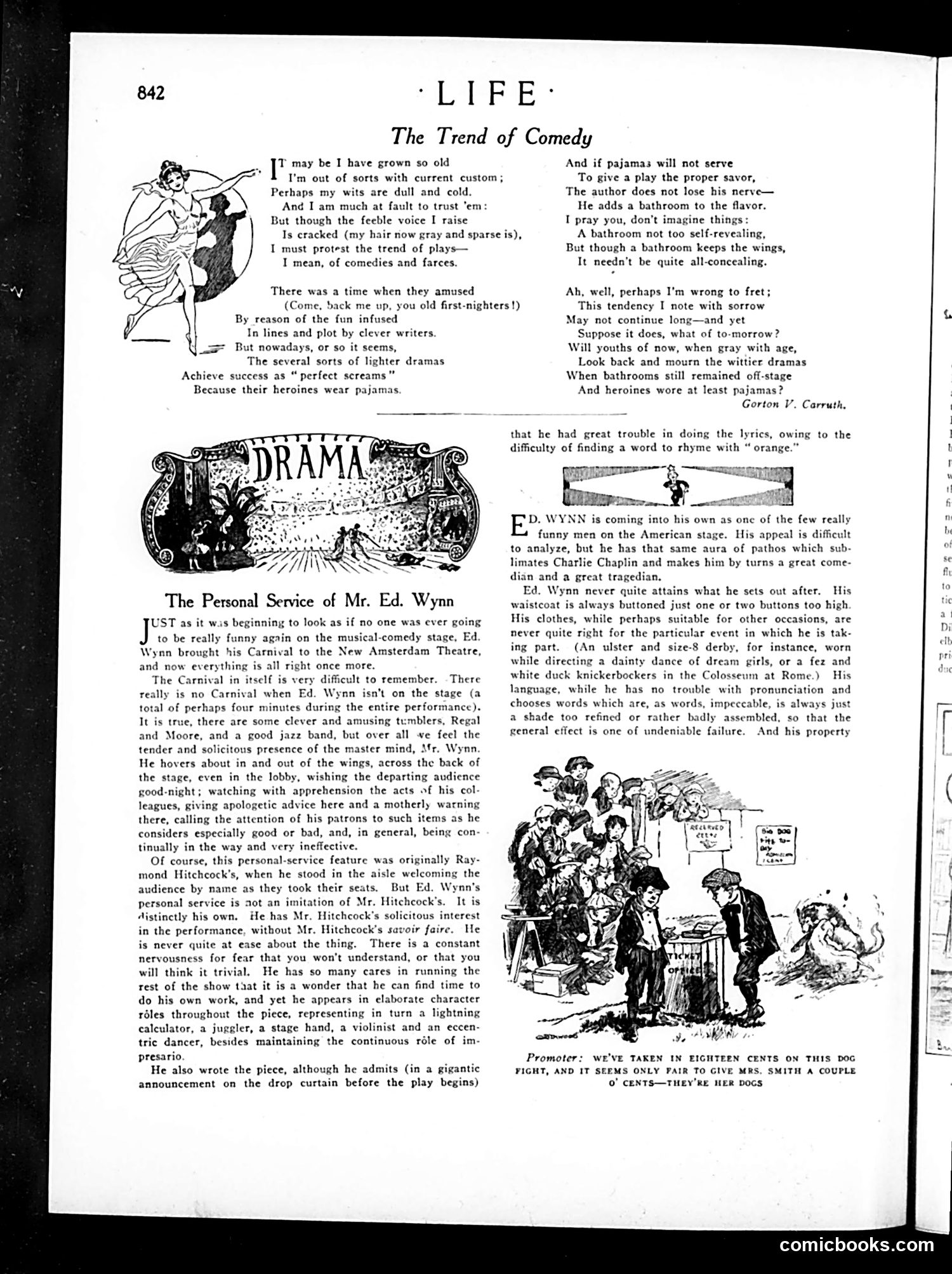
This page critiques contemporary Broadway comedy trends circa the 1920s. The poem "The Trend of Comedy" (attributed to Gorton V. Carruth) laments that modern comedies rely on shock value—specifically actresses wearing pajamas and bathrooms on stage—rather than clever writing. The author nostalgically recalls when comedies succeeded through witty plots and dialogue, not scandalous costume choices. The accompanying article praises **Ed. Wynn**, a prominent vaudeville/musical comedy performer, for bringing genuine humor to *The Carnival* through his energetic physical performance and elaborate character work—contrasting with the cheap sensationalism the poem condemns. The satire targets Broadway's perceived decline: producers substituting substance with provocative staging. The pajama reference reflects 1920s anxiety about changing social morals and women's fashion; bathrooms on stage represent similarly crude attempts at modern sophistication. Wynn represents the "old guard" of comedy skill, making him valuable precisely when the industry embraces shortcuts.
📄 Transcribed text from this page (OCR, searchable)
Machine-transcribed from the original scan — historical spelling and the odd misread are preserved.
T may be I have grown so old I'm out of sorts with current custom; Perhaps my wits are dull and cold. And I am much at fault to trust 'em: But though the feeble voice I raise I must protest the trend of plays— I mean, of comedies and farces. There was a time when they amused By reason of the fun infused In lines and plot by clever writers But nowadays, or so it seems, The several sorts of lighter dramas Achieve success as “perfect screams” Because their heroines wear pajamas. The Personal Service of Mr. Ed. Wynn UST as it wis beginning to look as if no one was ever going to be really funny again on the musical-comedy stage, Ed. Wynn brought his Carnival to the New Amsterdam Theatre, and now everything is all right once more. The Carnival in itself is very difficult to remember. There ly is no Carnival when Ed. Wynn isn’t on the stage (a 1 of perhaps four minutes during the entire performance). It is true, there are some clever and amusing tumblers, Regal and Moore, and a good jazz band, but over all we feel the tender and solicitous presence of the master mind, Mr. Wynn He hovers about in and out of the wings, across the back of the stage, even in the lobby, wishing the departing audience good-night; watching with apprehension the acts of his col- leagues, giving apologetic advice here and a motherly warning there, calling the attention of his patrons to such items as he considers especially good or bad, and, in general, being con- tinually in the way and very ineffective. Of course, this personal-service feature was originally Ray- mond Hitchcock’s, when he stood in the aisle welcoming the audience by name as they took their seats. But Ed. Wynn's personal service is aot an imitation of Mr. Hitchcock's. It is Aistinctly his own, He has Mr. Hitchcock's solicitous interest in the performance, without Mr. Hitchcock's savoir faire. He is never quite at ease about the thing. There is a constant nervousness for fear that you won't understand, or that you will think it trivial, He has so many cares in running the rest of the show taat it is a wonder that he can find time to do his own work, and yet he appears in elaborate character réles throughout the piece, representing in turn a lightning calculator, a juggler, a stage hand, a violinist and an eccen- tric dancer, besides maintaining the continuous réle of im- presario. He also wrote the piece, although he admits (in a gigantic announcement on the drop curtain before the play begins) LARP IE ° The Trend of Comedy Is cracked (my hair now gray and sparse is), (Come, back me up, you old first-nighters !) And if pajamas will not serve To give a play the proper savor, The author does not lose his nerve— He adds a bathroom to the flavor. I pray you, don’t imagine things: A bathroom not too self-revealing, But though a bathroom keeps the wings, It needn't be quite all-concealing. Ah, well, perhaps I'm wrong to fret; This tendency I note with sorrow May not continue long—and yet Suppose it does, what of to-morrow? Will youths of now, when gray with age, Look back and mourn the wittier dramas When bathrooms still remained off-stage And heroines wore at least pajamas? Gorton V. Carruth, that he had great trouble in doing the lyrics, owing to the difficulty of finding a word to rhyme with “ orange.” D. WYNN is coming into his own as onc of the few really funny men on the American stage. His appeal is difficult to analyze, but he has that same aura of pathos which sub- limates Charlie Chaplin and makes him by turns a great come- dian and a great tragedian. Ed, Wynn never quite attains what he sets out after. His waistcoat is always buttoned just one or two buttons too high His clothes, while perhaps suitable for other occasions, are never quite right for the particular event in which he is tak- ing part. (An ulster and size-8 derby, for instance, worn while directing a dainty dance of dream girls, or a fez and white duck knickerbockers in the Colosseum at Rome.) His language, while he has no trouble with pronunciation and chooses words which are, as words, impeccable, is always just a shade too refined or rather badly assembled, so that the general effect is one of undeniable failure. And his property Promoter: We'VE TAKEN IN EIGHTEEN CENTS ON THIS DOG FIGHT, AND IT SEEMS ONLY PAIR TO GIVE MRS, SMITH A COUPLE 0’ CENTS—THEY'RE HER DOGS PS amine: comicbooks.com