
Life, 1920-05-06 · page 20 of 56
Life — May 6, 1920 — page 20: what you’re looking at
What you’re looking at
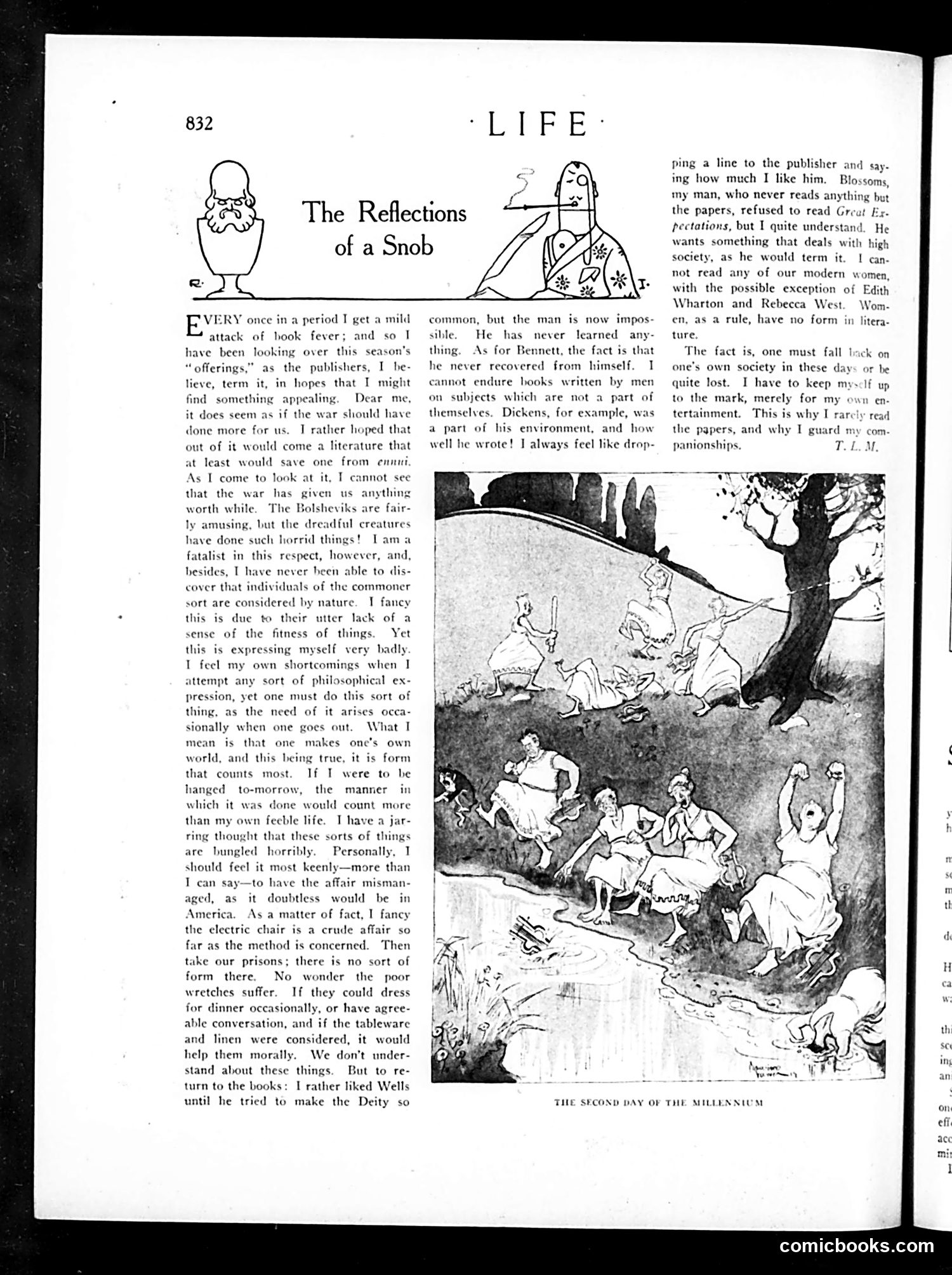
This is a satirical essay by someone identified as "T. L. M." mocking an insufferable literary snob. The unnamed narrator complains that postwar literature disappoints him, dismisses the Bolsheviks as "dreadful," and reveals his contempt for the working classes, whom he considers naturally lacking refinement. His hypocrisy is the joke: he criticizes prisons and the electric chair as aesthetically crude, yet shows no moral concern for prisoners. He dismisses most modern writers (except Edith Wharton and Rebecca West) while admitting his own inability to express philosophical ideas clearly. He obsesses over "form" and propriety—suggesting prisoners might improve morally with fine dining and linens—exposing how disconnected upper-class concerns are from genuine human welfare. The large illustration captioned "The Second Day of the Millennium" appears to satirize utopian visions, though its specific meaning requires additional context. The essay's overall target: the self-absorbed, aestheticizing snob who mistakes etiquette for morality.
📄 Transcribed text from this page (OCR, searchable)
Machine-transcribed from the original scan — historical spelling and the odd misread are preserved.
The Reflections of a Snob EY" RY once in a period T get a mild attack of hook fever; and so I have been looking over this season's “offerings,” as the publishers, I be- lieve, term it, in hopes that I might find something appealing. Dear me, it does seem as if the war should have I rather hoped that out of it would come a literature that least from As I come to look at it, T cannot see done more for us. would save one enti, that the war has given us anything worth while. The Bolsheviks are fair- ly amusing, but the dreadful creatures have done such horrid things! Lama fatalist in this respect, however, and, hesides, T have never been able to dis- cover that individuals of the commoner sort are considered by nature. 1 faney this is due to their utter lack of a sense of the fitness of things. Yet this is expressing myself very badly I feel my own shortcomings when I attempt any sort of philosophical ex- pression, yet one must do this sort of thing, as the need of it arises occa- sionally when one goes out. What I mean is that one makes one’s own world, and this being true, it is form that most. If T hanged to-morrow, the manner in which it was done would count more counts were to be than my own feeble life. T have a jar- ring thought that these sorts of things are bungled horribly. Personally, 1 should feel it most keenly—more than T can say—to have the affair misman- aged, as it doubtless would be in America. As a matter of fact, 1 fancy the electric chair is a crude affair so far as the method is concerned. Then take our prisons; there is no sort of form there. No wonder the poor If they could dress for dinner occasionally, or have agree- able conversation, and if the tableware and linen were considered, it would help them morally. We don’t under- stand about these things. But to re- turn to the books: I rather liked Wells until he tried to make the Deity so wretches suffer. common, but the man is now impos- never learned any- pnett, the fact is that sible. He has thing. As for B he never recovered from himself. 1 cannot endure books written by men on subjects which are not a part of themselves. Dickens, for example, was a part of his environment, and how well he wrote! I always feel like drop- THE SECOND DAY OF THE ping a line to the publisher and say. ing how much I like him. Blossoms, my man, who never reads anything but the papers, refused to read Great E. pectations, but I quite understand. He wants something that deals with high society, as he would term it. 1 can. not read any of our modern women, with the possible exception of Edith Wharton and Rebecca West. Wom- en, as a rule, have no form in litera- ture, The fact is, one must fall lack on one’s own society in these days or be quite lost. I have to keep mysclf up to the mark, merely for my own en- tertainment. This is why I rarely read the papers, and why I guard my com- panionships. T. LM. MILLENNIUM comicbooks.com