
Life, 1920-05-06 · page 27 of 56
Life — May 6, 1920 — page 27: what you’re looking at
What you’re looking at
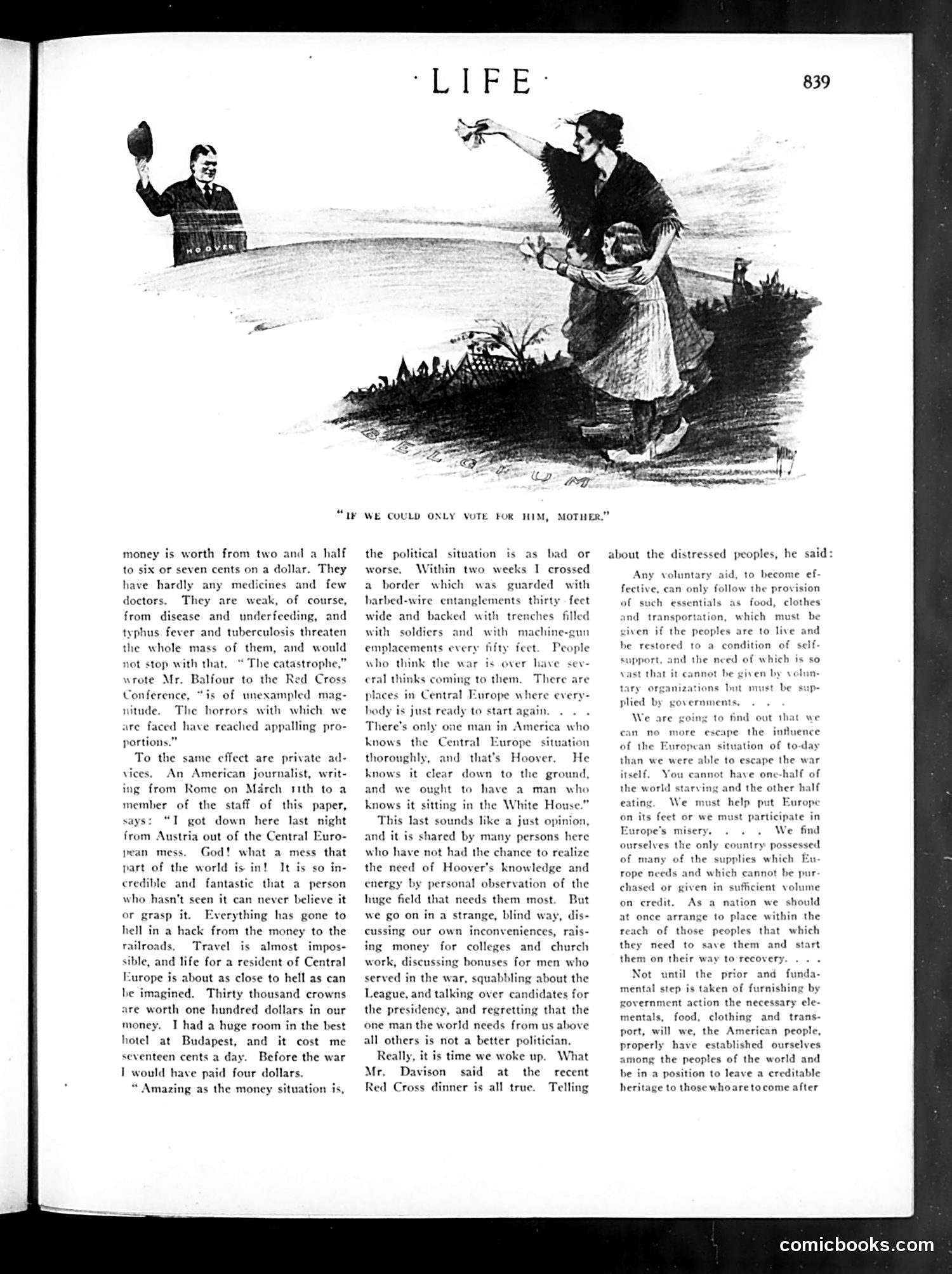
This cartoon satirizes American politics in the post-WWI era (circa 1920). The image shows a woman fishing while a man stands nearby holding his hat—the caption suggests she wishes she could vote for someone (likely Herbert Hoover) to address the European crisis. The accompanying text describes catastrophic conditions in Central Europe: hyperinflation, disease, starvation, and political instability following World War I. The article argues that Hoover uniquely understands the situation and possesses the expertise needed to help, but regrets he's "not a better politician"—implying political considerations prevent his elevation to higher office (possibly the presidency). The cartoon's point: women's exclusion from voting prevents them from supporting the one candidate qualified to solve Europe's humanitarian crisis. It's a commentary on both the political inadequacy of available leaders and, implicitly, an argument for women's suffrage (which passed nationally in 1920).
📄 Transcribed text from this page (OCR, searchable)
Machine-transcribed from the original scan — historical spelling and the odd misread are preserved.
“Ie WE COULD ONLY VOTE FOR HIM, MOTHER.” money is worth from two and a half to six or seven cents on a dollar. They have hardly any medicines and few doctors. They are weak, of course, from disease and underfeeding, and typhus fever and tuberculosis threaten the whole mass of them, and would not stop with that. “ The catastrophe,” wrote Mr. Balfour to the Red Cross Conference, “is of unexampled mag- nitude. The horrors with which we are faced have reached appalling pro- portion: To the same effect are private ad- vices. An American journalist, writ- ing from Rome on March 1th to a member of the staff of this paper, says: “I got down here last night from Austria out of the Central Euro- God! what a mess that It is so in- pean mess. part of the world is in! credible and fantastic that a person who hasn't seen it can never believe it or grasp it. Everything has gone to hell in a hack from the money to the railroads, Travel is almost impos- sible, and life for a resident of Central Europe is about as close to hell as can be imagined. Thirty thousand crowns are worth one hundred dollars in our money. I had a huge room in the best hotel at Budapest, and it cost me Before the war | would have paid four dollars. seventeen cents a da “ Amazing as the money situation is, the political situation is as bad or Within two weeks 1 crossed a border guarded with harbed-wire entanglements thirty feet wide and backed with tren: with soldiers and with machine-gun worse, which was es filled emplacements every fifty feet. People who think the war is over have sev- eral thinks coming to them. There are places in Central Europe where every- hody is just ready to start again. 2. . There's only one man in America who knows the Central Europe situation thoroughly, and that's Hoover, He knows it clear down to the ground, and we ought to have a man who knows it sitting in the White House.” This last sounds like a just opinion, and it is shared by many persons here who have not had the chance to realize the need of Hoover's knowledge and energy by personal observation of the huge field that needs them most. But we go on in a strange, blind way, dis- cussing our own inconveniences, rai: ing money for colleges and church work, discussing bonuses for men who served in the war, squabbling about the League, and talking over candidates for the presidency, and regretting that the one man the world needs from us above all others is not a better politician. Really, it is time we woke up. What Mr. Davison said at the recent Red Cross dinner is all true. Telling pout the distressed peoples, he said: Any voluntary aid, to become ef fective, can only follow the provision of such essentials as food, clothes and transportation, which must be ziven if the peoples are to live and be restored 10 a condition of self support, and the need of which is so vast that it cannot be given by volun- tary organizations but must be sup- plied by governments. 2. We are going to find out that we can no more escape the influence of the European situation of to-day than we were able to escape the war itself, You cannot have one-half of the world starving and the other half eating. We must help put Europe on its feet or we must participate in We find ntry possessed Europe's misery... ourselves the only c¢ of many of the supplies which rope needs and which cannot be pur chased or given in sufficient volume on credit. As a nation we should at once arrange to place within the reach of those peoples that which need to save them and start them on their way to recovery. . . Not until the prior and funda- mental step is taken of furnishing by government action the necessary ele- mentals, food, clothing and trans- port, will we, the American people, properly have established ourselves among the peoples of the world and be in a position to leave a creditable heritage to those whoare tocome after comicbooks.com