
Life, 1920-05-06 · page 33 of 56
Life — May 6, 1920 — page 33: what you’re looking at
What you’re looking at
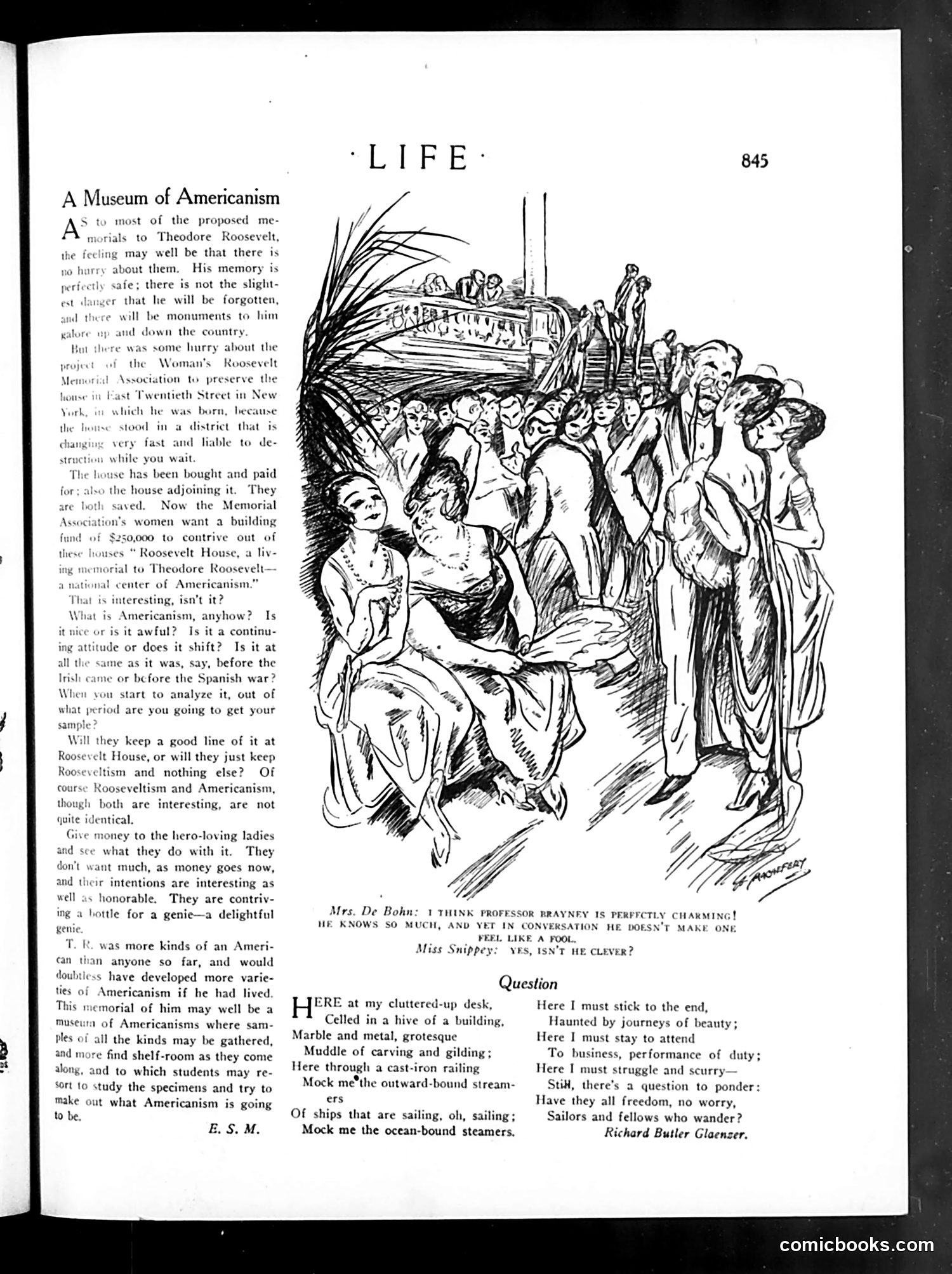
This page satirizes the proposal for a Theodore Roosevelt Memorial House in New York. The main article questions what "Americanism" actually means—noting that TR embodied many varieties of it, and asking whether a museum can authentically preserve such an abstract concept. The satire suggests the memorial organizers want to bottle something inherently fluid and undefinable, comparing it to "a bottle for a genie." The accompanying cartoon illustrates this absurdity: a crowd of admirers gazes rapturously at what appears to be an idealized female figure (representing Americanism or Roosevelt's legacy), treating an intangible concept as if it were a physical, collectible object. The secondary cartoon and poem are unrelated social humor: a woman praises a professor for being knowledgeable yet humble in conversation, while the poem contrasts office-bound workers with free-roaming sailors, questioning whether true freedom exists.
📄 Transcribed text from this page (OCR, searchable)
Machine-transcribed from the original scan — historical spelling and the odd misread are preserved.
A Museum of Americanism A to most of the proposed me- morials to Theodore Roosevelt, the feeling may well be that there is no hurry about them. His memory is ly safe; there is not the slight- est danger that he will be forgotten, wd there will be monuments to him perte galore up and down the country But there was some hurry about the Woman's jon to preserve the project of — the Roosevelt Memorial Associ house in East Twentieth Street in New York, the se stood in a district that is which he was born, because very fast and liable to de- while you wait. ise has been bought and paid the house adjoining it. They saved. Now the Memorial om’s women want a building 2,000 to contrive out of vases “ Roosevelt House, a liv- srial to Theodore Roosevelt— tional center of Americanism.” That is interesting, isn't it? What is Americanism, anyhow? Is it nice or is it awful? Is it a continu- ing attitude or does it shift? Is it at all the same as it was, say, before the Irish came or before the Spanish war? When you start to analyze it, out of what period are you going to get your sample? Will they keep a good line of it at Roosevelt House, or will they just keep Rooseveltism and nothing else? Of Rooseveltism and Americanism, both are interesting, are not ntical. Give money to the hero-loving ladies and sce what they do with it. They don’t want much, as money goes now, and their intentions are interesting as well as honorable, They are contriv- ing a hottle for a genie—a delightful genie T. kt. was more kinds of an Ameri- can than anyone so far, and would doubtless have developed more varie- ties of Americanism if he had lived. This memorial of him may well be a museum of Americanisms where sam- ples of all the kinds may be gathered, and more find shelf-room as they come along, and to which students may re- Sort to study the specimens and try to make out what Americanism is going to be, E.S. M. Mrs. De Bohn: r Miss Snippe: 1 THINK PROFESSOR RRAYNEY IS PERPFCTLY CHARMING! HE KNOWS SO MUCH, AND YET IN CONVER: TION HE DOESN'T MAKE ONE YES, ISN'T HE CLEVER? Question HERE at my cluttered-up desk, Celled in a hive of a building, Marble and metal, grotesque Muddle of carving and gilding; Here through a cast-iron railing Mock me*the outward-bound stream- ers Of ships that are sailing, oh, sailing; Mock me the ocean-bound steamers, Here I must stick to the end, Haunted by journeys of beauty; Here I must stay to attend To business, performance of duty; Here I must struggle and scurry— Sti, there’s a question to ponder: Have they all freedom, no worry, Sailors and fellows who wander? Richard Butler Glaenzer. comicbooks.com