
A complete issue · 36 pages · 1920
Life — January 22, 1920
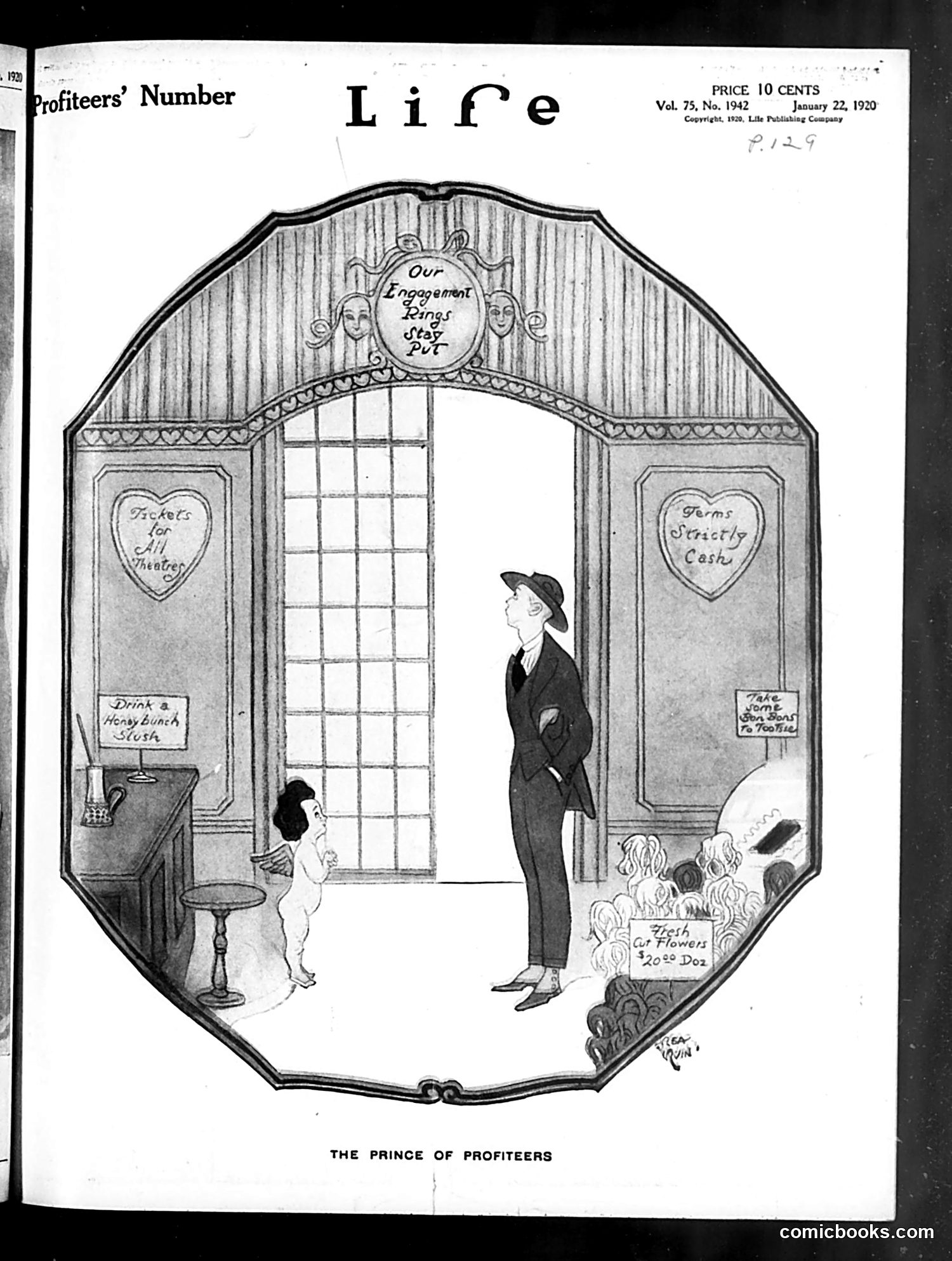
This January 1920 cartoon satirizes wartime profiteering. A well-dressed man stands in an ornate theater labeled "Our Engagement Brings Sold Out," confronting various business schemes. The left side advertises "Tickets for All Theaters" and "Drink & Heavy Lunch Slush." The right side promotes "Terms Strictly Cash," "Store Samples to Peddlers," and "Cloth Flowers 1200 Doz." The cartoon mocks a businessman exploiting post-WWI economic conditions through multiple schemes—reselling theater tickets, running restaurants, and hawking cheap goods. The "Prince of Profiteers" title derisively crowns this figure as emblematic of war-era opportunists who accumulated wealth through middleman tactics and price gouging rather than legitimate production, a common post-war complaint about profiteers.
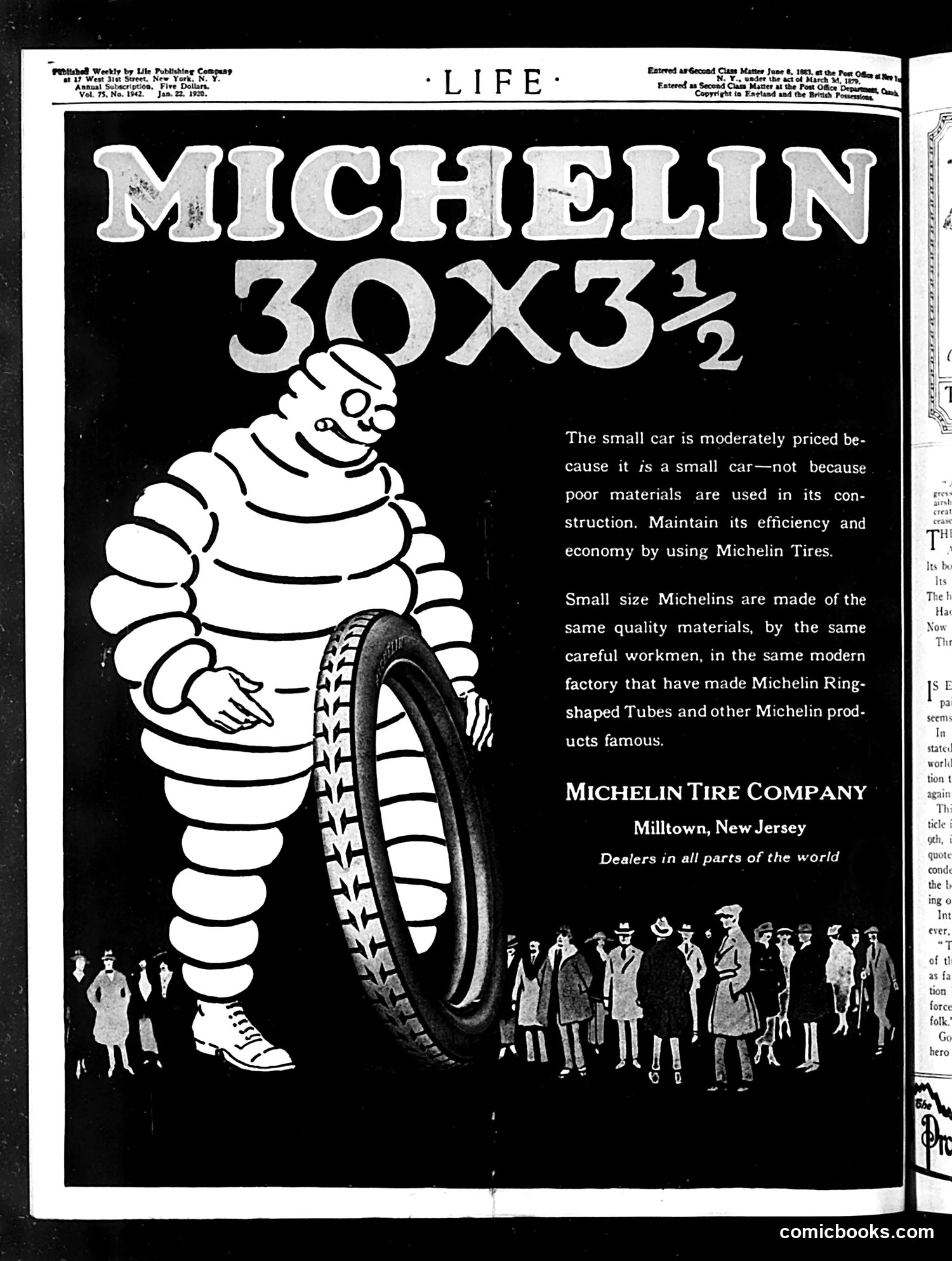
This is primarily a **Michelin Tire Company advertisement**, not political satire. The page features the famous Michelin Man mascot (Bibendum) — a rotund, tire-like figure made of stacked tire rings — holding a Michelin tire. The ad promotes the "Michelin 30x3½" tire size for small cars. The sales pitch emphasizes that small tires maintain the same quality standards as larger Michelin products, using identical materials and manufacturing processes from their New Jersey factory. The small figures at the bottom appear to represent ordinary people/consumers, reinforcing the accessible, everyday nature of this tire option. This is **commercial advertising**, not editorial commentary or political cartoons, though the Michelin Man mascot itself became an iconic American advertising character during this era.
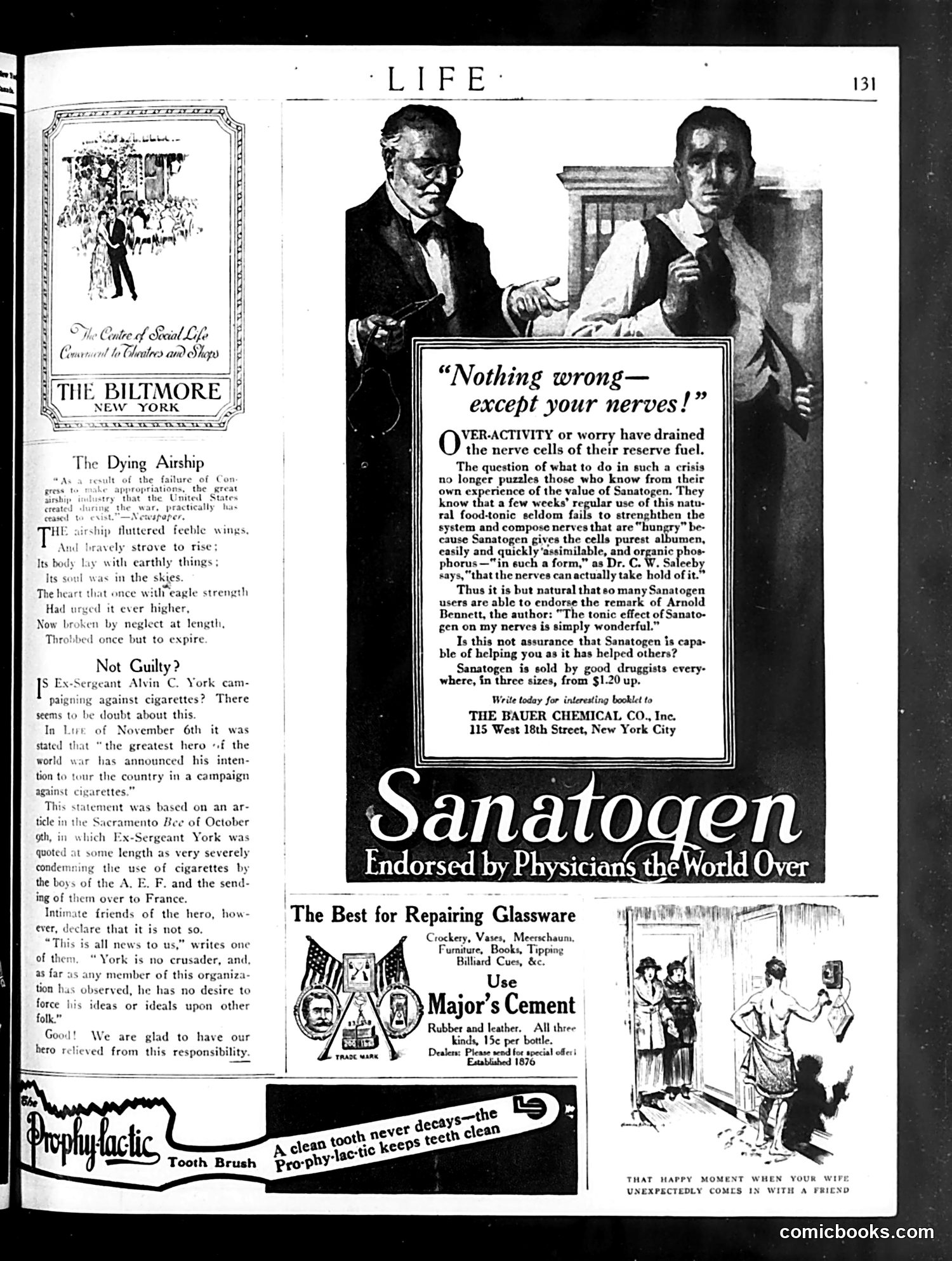
This LIFE magazine page (p. 131) is primarily **advertising**, not political satire. The dominant content features a **Sanatogen tonic advertisement** claiming to cure "overactivity or worry" by strengthening nerves—a common patent medicine pitch of the era. The ad includes a testimonial from "Arnold Bennett, the author," suggesting the product helped him. Below are smaller ads for **Major's Cement** (for repairing glassware) and a **Pro-phy-lactic Tooth Brush**. The left column contains a poem titled "The Dying Airship" and a brief article about "Not Guilty?"—regarding Ex-Sergeant Alvin C. York and cigarettes—but these are minor editorial content dwarfed by commercial messaging. The page reflects early 20th-century magazine economics: advertising subsidized publication.
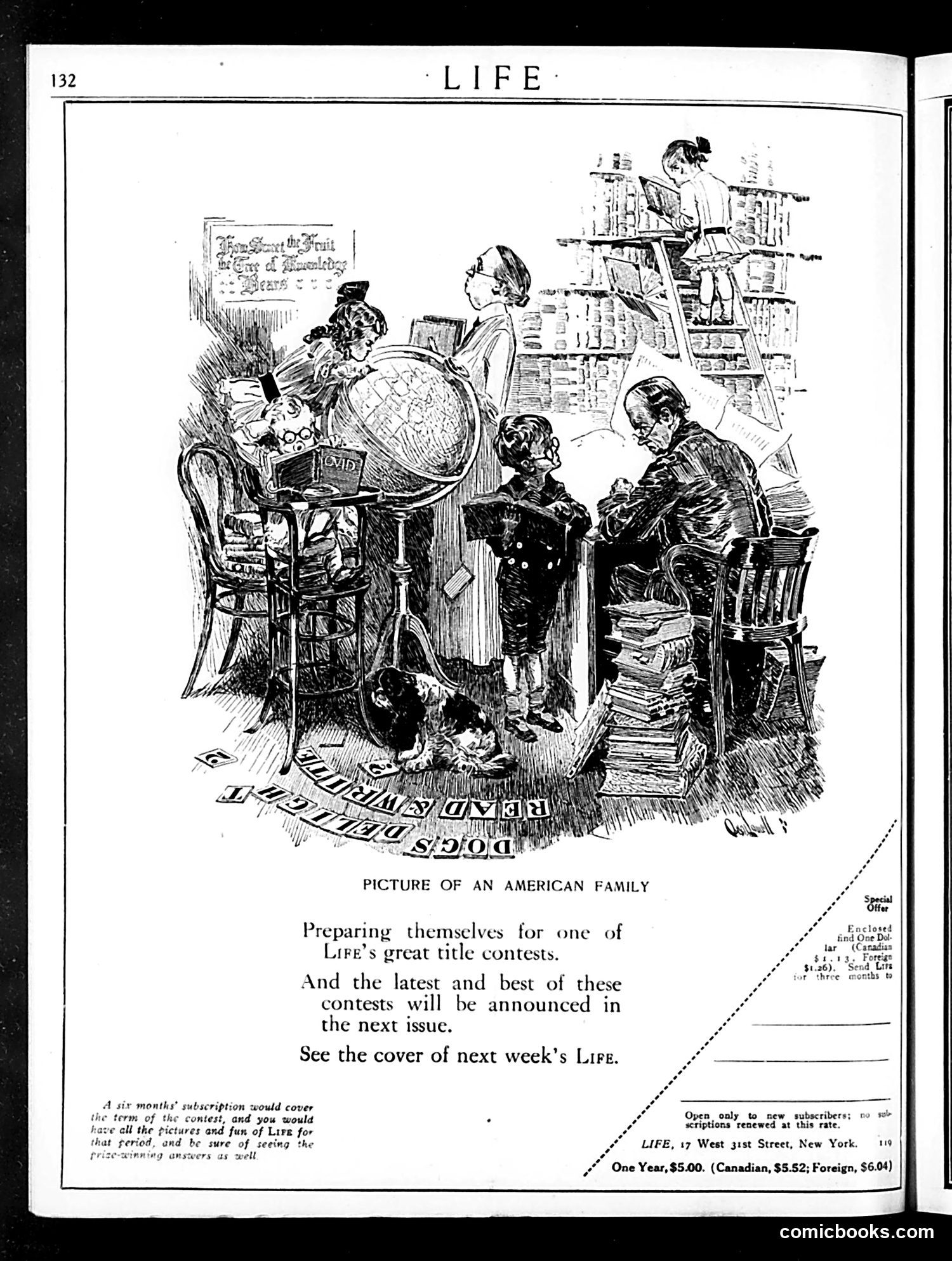
This is primarily a **subscription advertisement** for *Life* magazine rather than a political cartoon. The illustration depicts "an American family" surrounded by stacks of papers and periodicals, gathered around a globe, apparently preparing for "one of LIFE's great title contests." The satire is gentle and self-promotional: the image humorously suggests that *Life* magazine offers so much content and entertainment value that families will eagerly engage with its contests and features. The globe and scattered reading materials emphasize the magazine's broad scope and global perspective. The advertisement promises that "the latest and best" contests will be announced in the next issue, encouraging subscription. There's no specific political reference—this is marketing humor targeting middle-class American households in what appears to be the early 20th century.
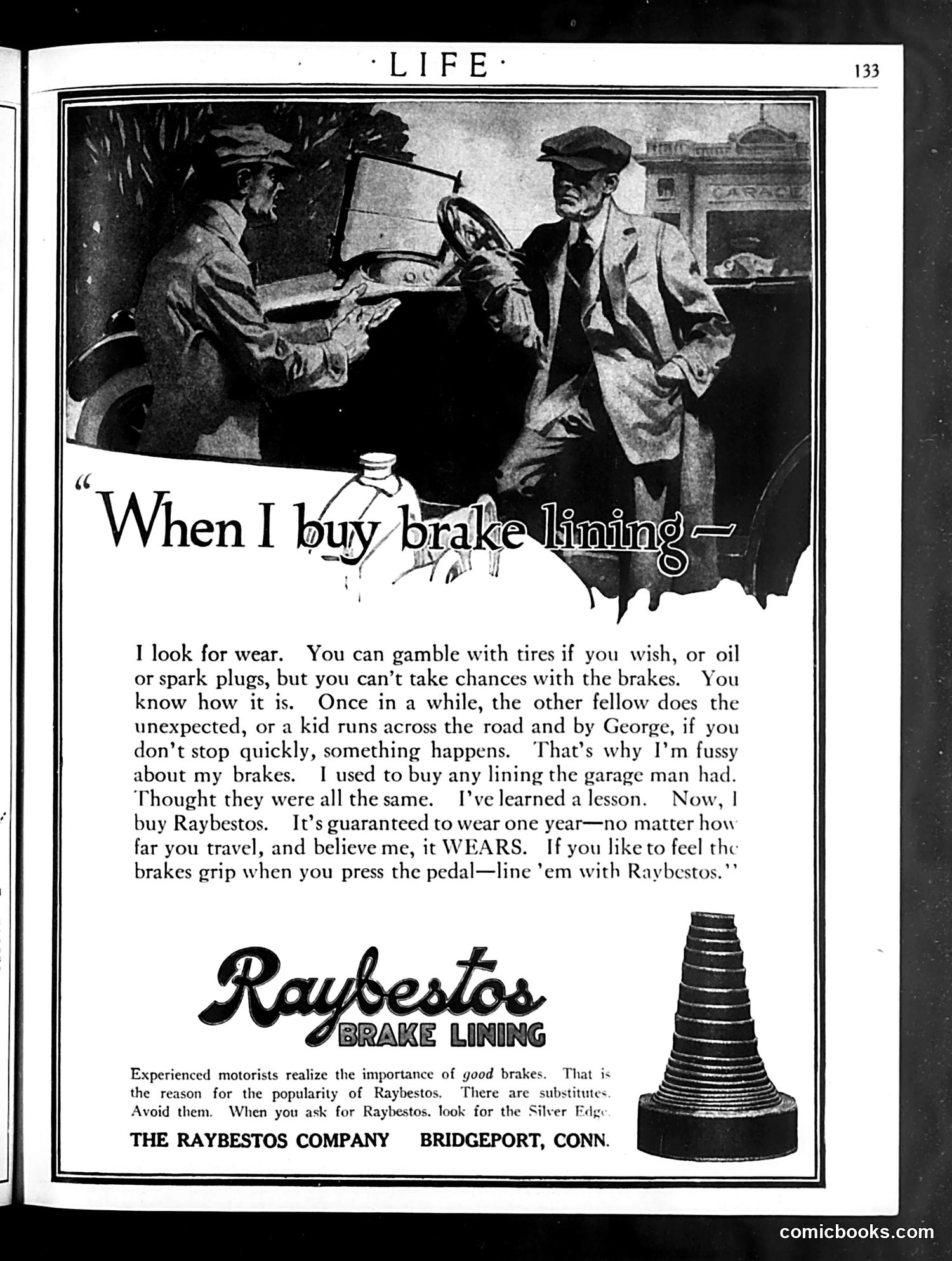
This is a straightforward **product advertisement**, not political satire. It features a testimonial from an unnamed motorist (left) speaking with a garage mechanic (right) about brake lining quality. The ad uses a common early-20th-century sales technique: the honest tradesman endorsement. The speaker explains he learned to prioritize brake safety over cheaper alternatives, now exclusively buying Raybestos brand because it's "guaranteed to wear one year" with reliable stopping power. The humor is gentle—the setup presents brake failure as a serious hazard ("by George, if you don't stop quickly, something happens"), making the pivot to Raybestos seem like practical wisdom rather than marketing. The cone-shaped brake lining sample displayed at bottom emphasizes the product's tangible quality. This reflects early automotive safety consciousness when brake reliability was genuinely unpredictable.
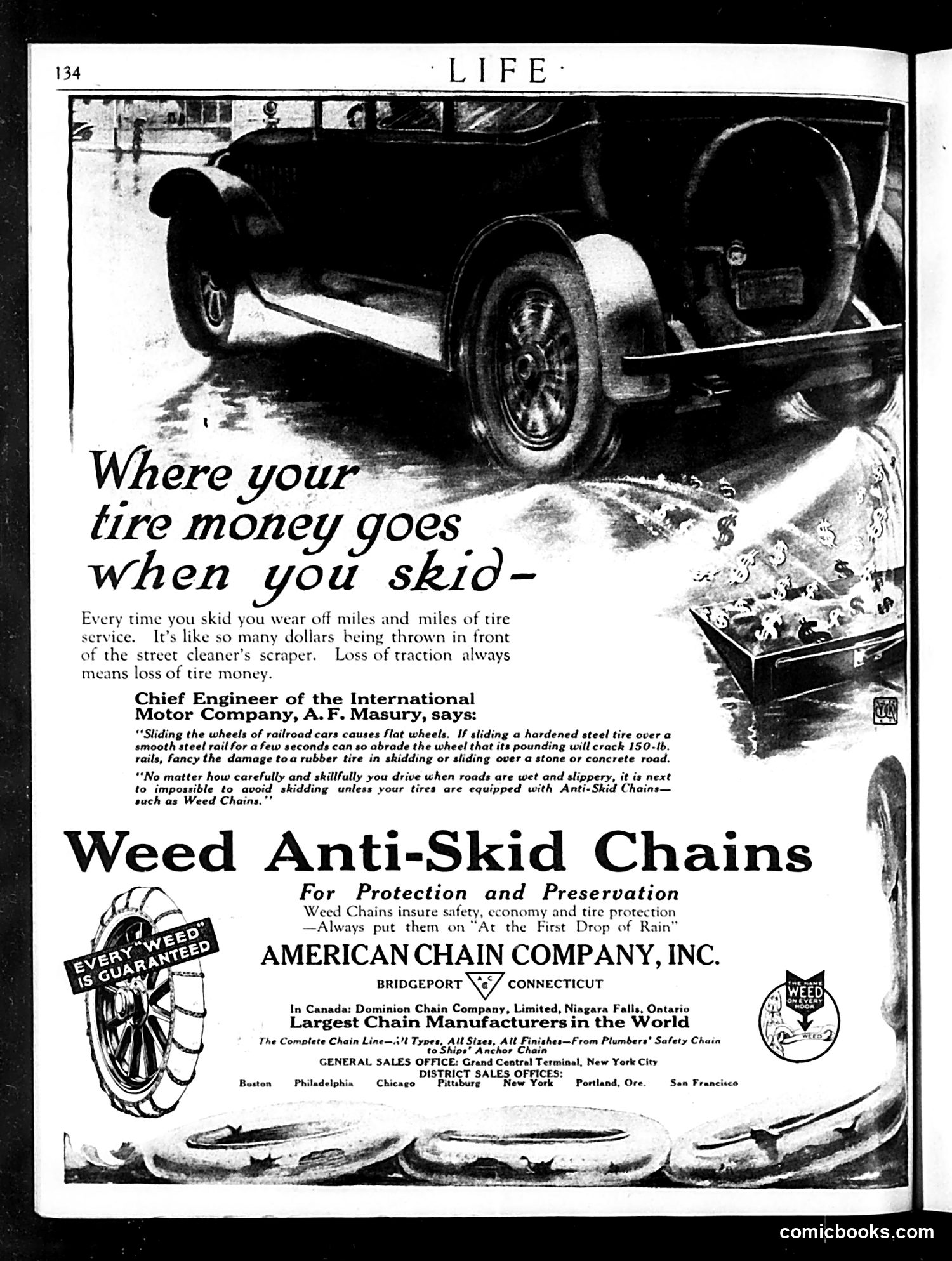
This page is **primarily an advertisement**, not editorial satire. It promotes Weed Anti-Skid Chains for automobile tires. The ad uses a cautionary approach: it shows a car skidding and emphasizes financial waste from tire damage during skids. The quoted "Chief Engineer of the International Motor Company" warns that skidding causes severe tire wear—like money literally vanishing into a street cleaner's scraper. The message is straightforward safety marketing: wet or slippery roads make skidding inevitable unless tires have anti-skid chains. The visual metaphor of money pouring out reinforces the economic argument for purchasing the product. This reflects early 20th-century automotive concerns about winter driving safety and the expense of tire replacement before modern tread designs existed.
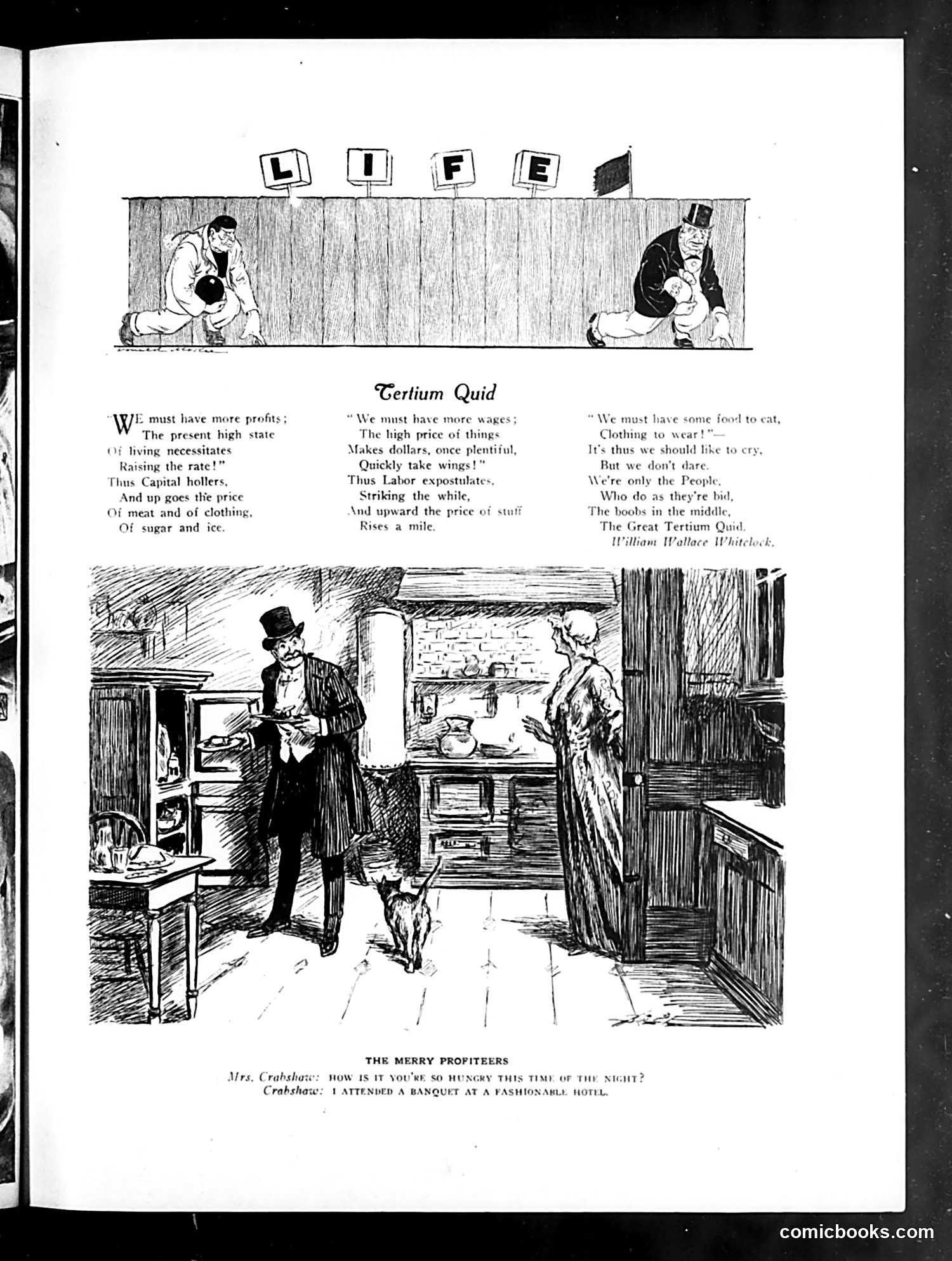
This page presents two satirical pieces about class conflict and economic inequality, likely from the early 20th century. **"Tertium Quid"** (Latin: "a third thing") uses three parallel verses to mock competing claims: capitalists demand higher profits, workers demand higher wages, and the poor demand basic food and clothing. The accompanying illustration shows two men crouching over a wooden fence labeled "LIFE"—suggesting both groups are positioned above ordinary people. **"The Merry Profiteers"** below depicts a well-dressed businessman returning home after attending a fashionable hotel banquet while his wife stands hungry in their modest kitchen. The satire targets the hypocrisy of the wealthy enjoying lavish meals while claiming ignorance of the poor's deprivation—a critique of Gilded Age inequality and indifference.
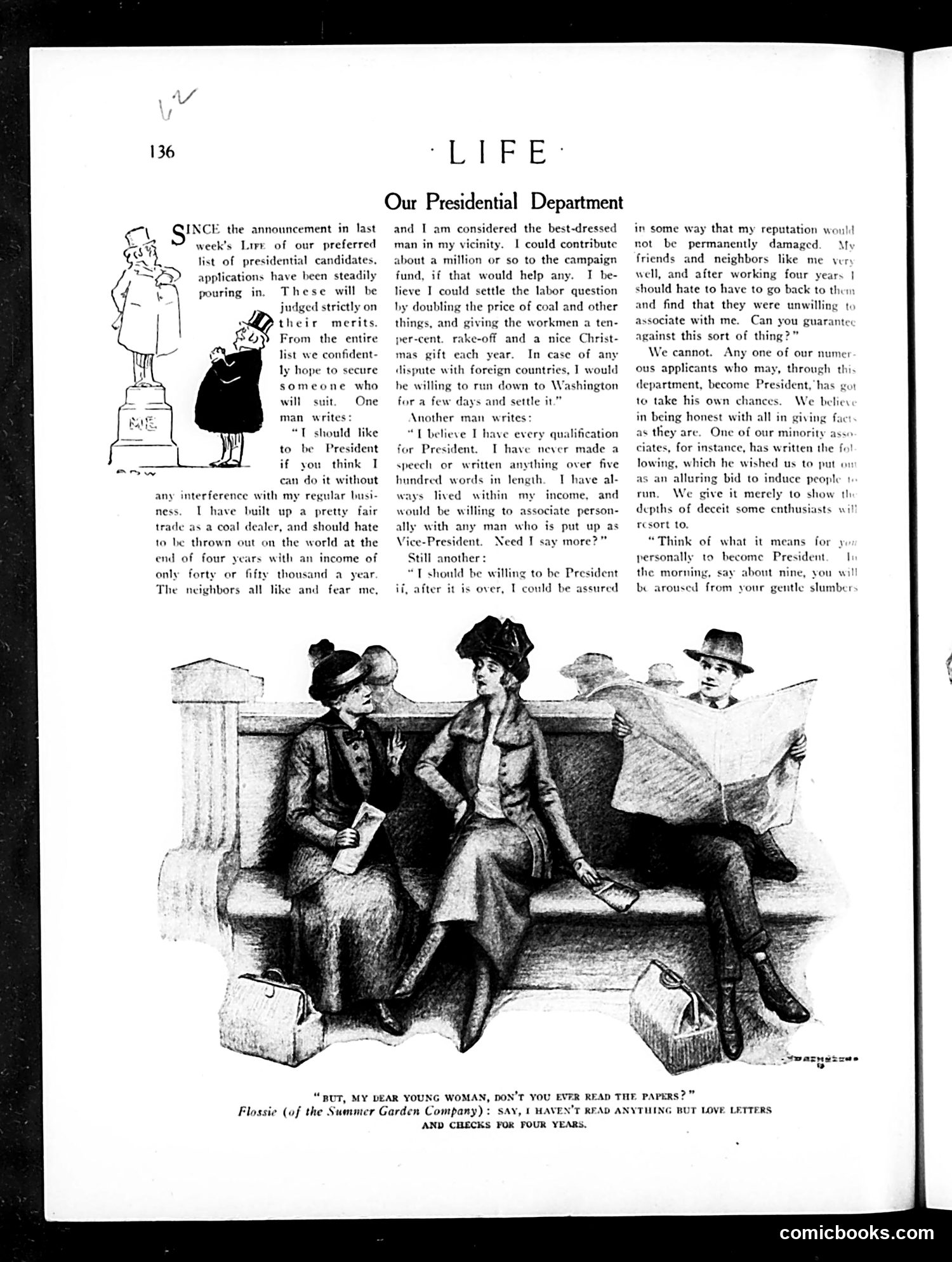
This page satirizes the 1912 presidential election cycle by publishing absurd application letters from ordinary citizens claiming qualifications for the presidency. The applicants boast of modest accomplishments—building a coal business, maintaining income within fifty thousand annually—as if these credentials suited them for high office. The cartoon below depicts a woman on a train rejecting romantic attention with the dismissive line: "Don't you ever read the papers?" She claims to have read nothing but love letters and checks for four years—suggesting she's entirely removed from current events and news, making her perfectly unqualified (and thus humorously ideal) for the presidency. The satire mocks both actual candidates' actual qualifications and public indifference to politics.
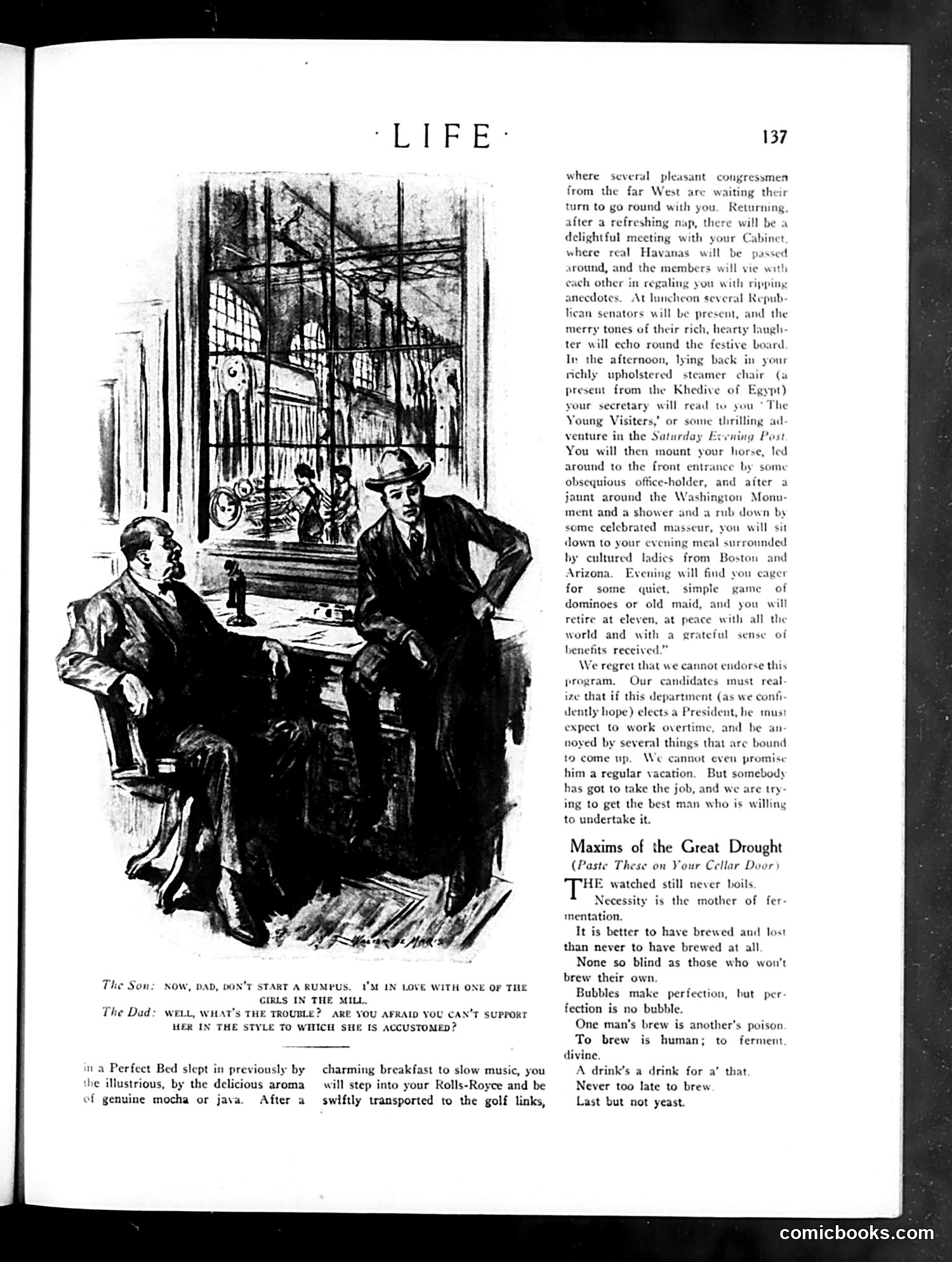
This page contains a cartoon dialogue between a father and son discussing employment. The son announces he's "in love with one of the girls in the office," prompting the father's skeptical response: "Well, what's the trouble? Are you afraid you can't support her in the style to which she is accustomed?" The satire targets early 20th-century anxieties about women's economic expectations and workplace dynamics. The father's concern—that the son cannot afford to maintain a woman's lifestyle—reflects contemporary tensions about dating costs and marriage economics during a period when women increasingly worked outside the home. The cartoon mocks both the father's materialistic outlook and the implied assumption that women required financial support beyond their means.
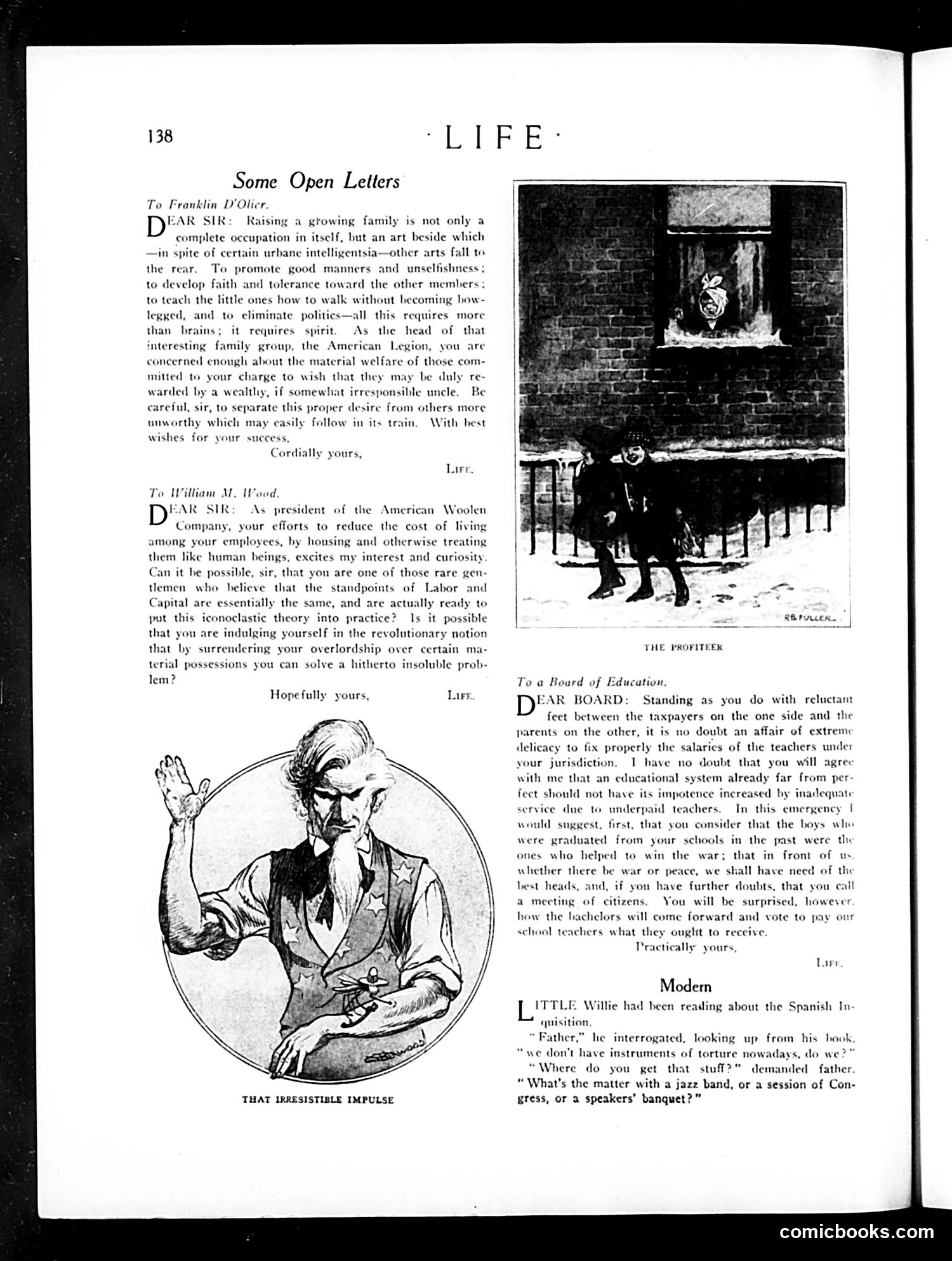
This page contains "Some Open Letters" — a satirical advice column. The two illustrated cartoons are: 1. **"That Irresistible Impulse"** — depicts a man gesturing expressively, likely satirizing uncontrollable human behavior or impulses. 2. **"The Profiteer"** — shows a figure at a window, apparently commenting on wartime profiteering (the sketch credit reads "CESFULLER"). The letters address serious social issues: family welfare, labor-capital relations, and teacher salaries. The tone is sardonic — the magazine mocks both wealthy uncles reluctant to help relatives and employers exploiting workers while claiming class harmony is possible. The "Modern" section at bottom presents a brief comedic dialogue where a child questions his father about Spanish Inquisition torture methods versus modern entertainments, likely satirizing how contemporary amusements seem comparably barbaric to older forms of cruelty.
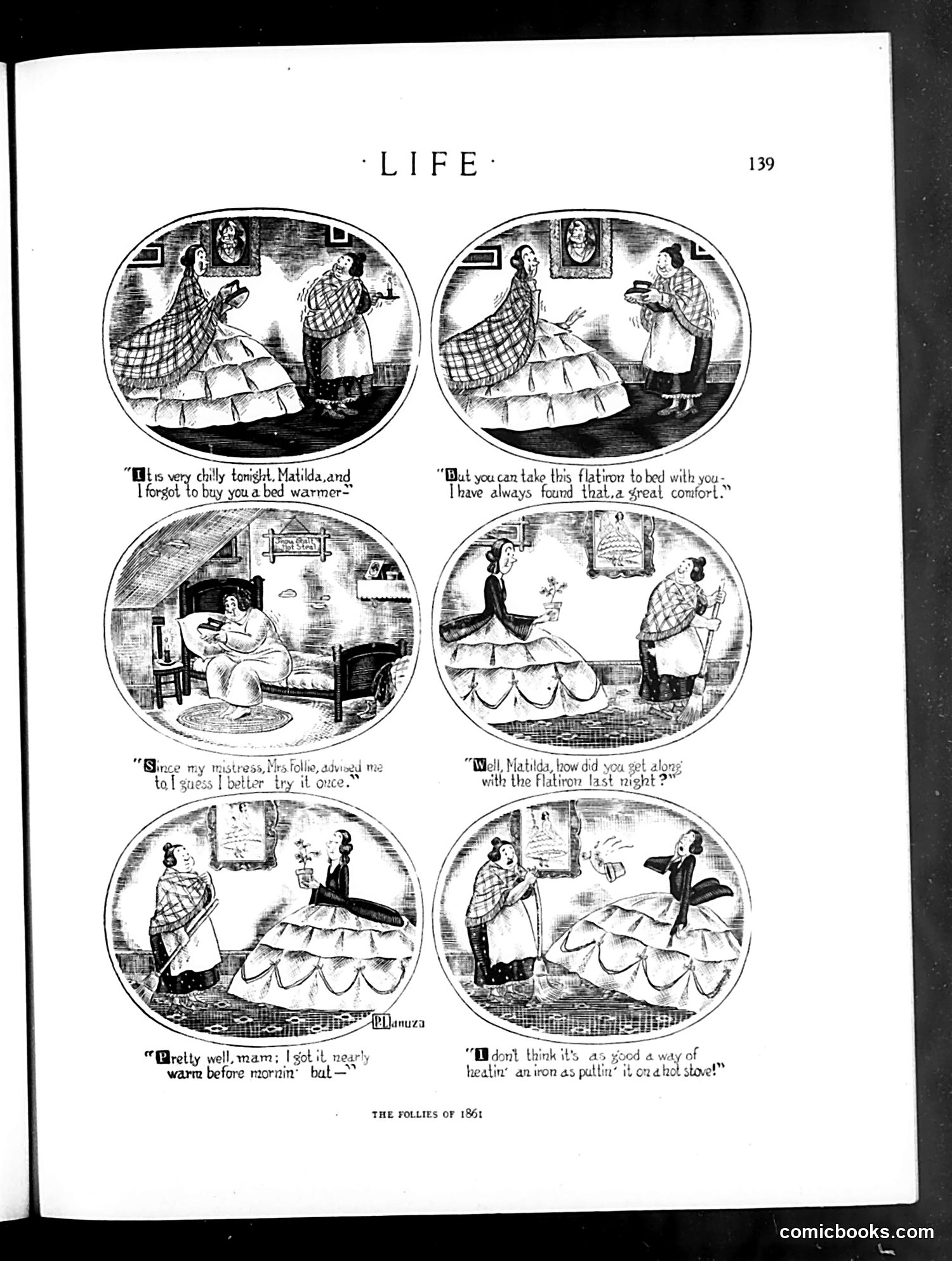
This is a six-panel comic strip titled "The Follies of 1861" depicting a domestic scene between a husband and wife (Matilda). The satire centers on **the use of bed-warming devices** during winter—specifically a "flatiron" (heated metal plate) as a substitute for a proper bed warmer. The joke unfolds as the wife proudly suggests using the hot flatiron in bed for warmth, the husband reluctantly tries it, and discovers it works reasonably well until the final panel, where he sarcastically rejects the idea as inferior to "an iron" (possibly a stove). The cartoonist (signed "Momuza") is likely satirizing either **wartime privations of 1861** (during early American Civil War period) or **household economy and frugal domestic practices**. The humor derives from the wife's innovation contrasted with the husband's masculine skepticism about practical domestic solutions.
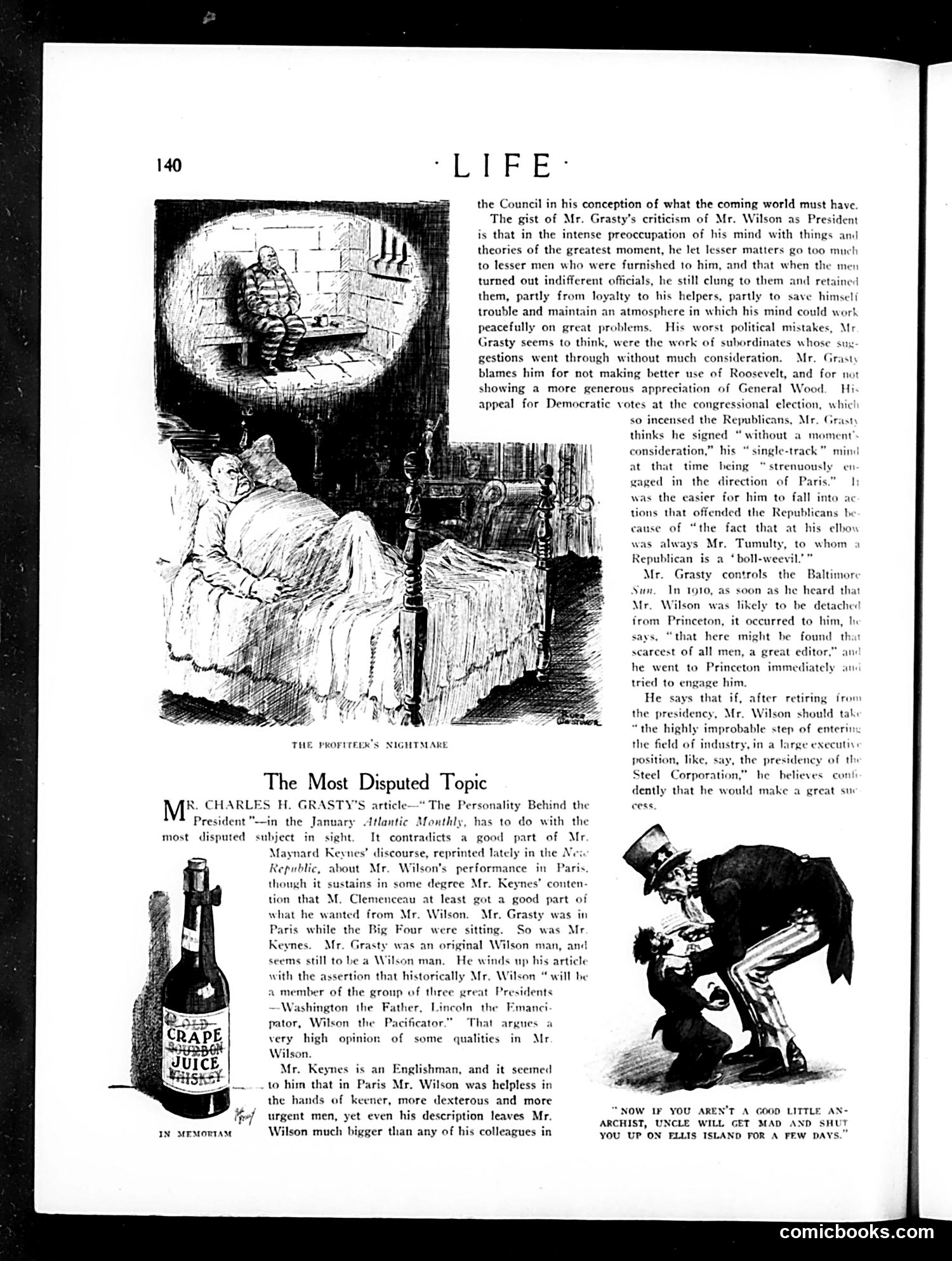
This page satirizes disagreements about President Wilson's performance at the Paris Peace Conference following World War I. The article criticizes Charles Grasby's Atlantic Monthly piece, which defends Wilson's role while appearing to blame Wilson for various diplomatic failures. The main cartoon "The Profiteer's Nightmare" (top) shows a sleeping figure troubled by visions—likely depicting anxiety about Wilson's presidency and policies. The bottom cartoon mocks political infighting, with a caption about an "anarchist" being sent to "Ellis Island for a few days"—referencing deportation policies used against suspected radicals during the post-war Red Scare era. The page reflects deep American political divisions over Wilson's international diplomacy and domestic policies circa 1919-1920.
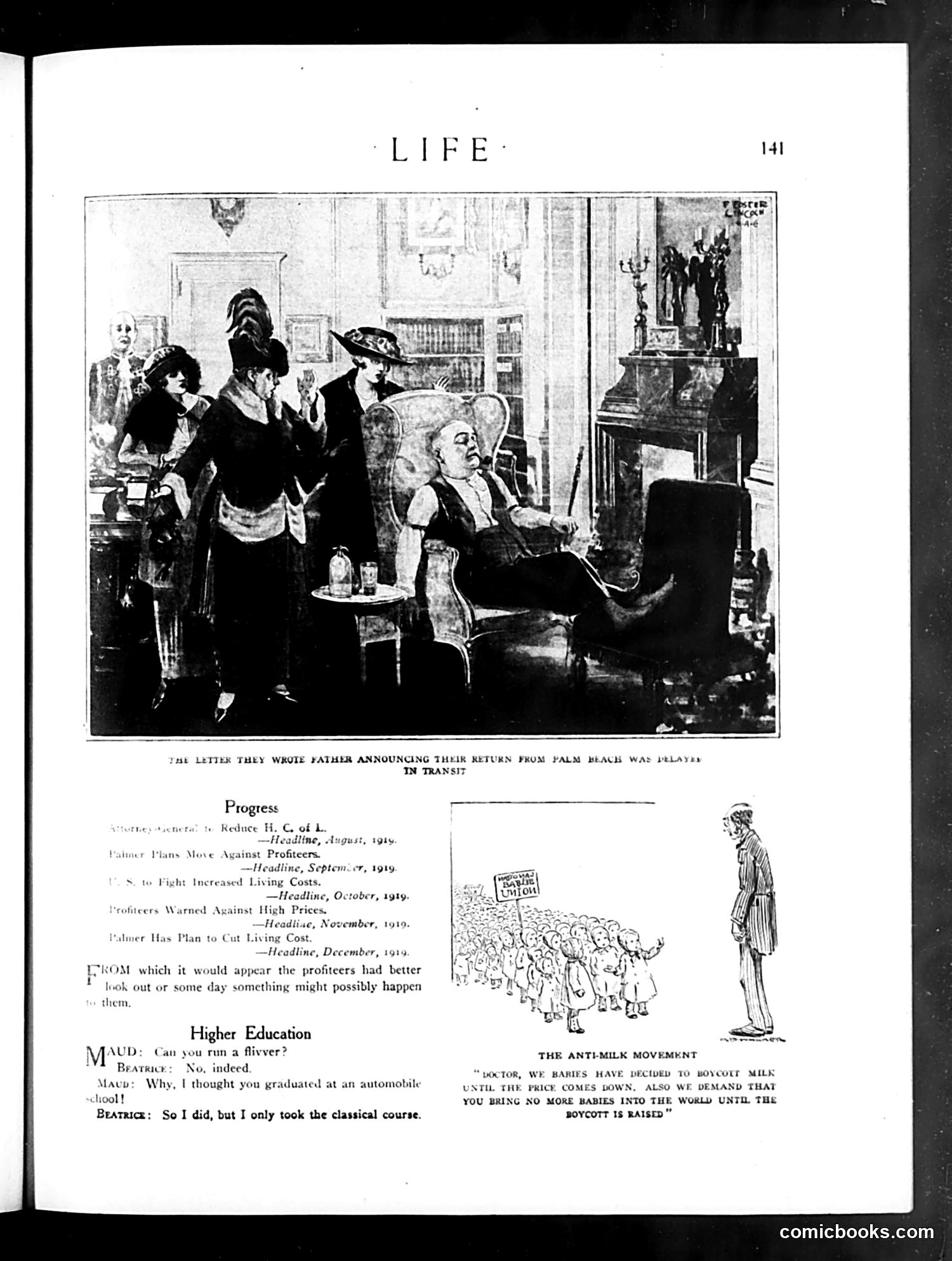
The page contains two distinct satirical items: **Top illustration**: Shows society women receiving letters about returning from Palm Beach, satirizing upper-class social rituals and correspondence during the 1919 winter season. **"Progress" section**: Lists agricultural/farming headlines from 1919, mocking farmers' conflicts with profiteers over living costs—suggesting repeated warnings that went unheeded. **"Higher Education" dialogue**: A joke about an automaton school graduate, playing on contemporary anxieties about mechanization and education's relevance. **"The Anti-Milk Movement" cartoon**: Depicts a tall figure (likely representing profiteers or capitalists) standing over a crowd of children. The caption satirizes a boycott movement—babies' parents refusing to buy milk until prices drop, critiquing high food costs during the post-WWI inflation period of 1919. All content reflects 1919 economic frustrations and class tensions.
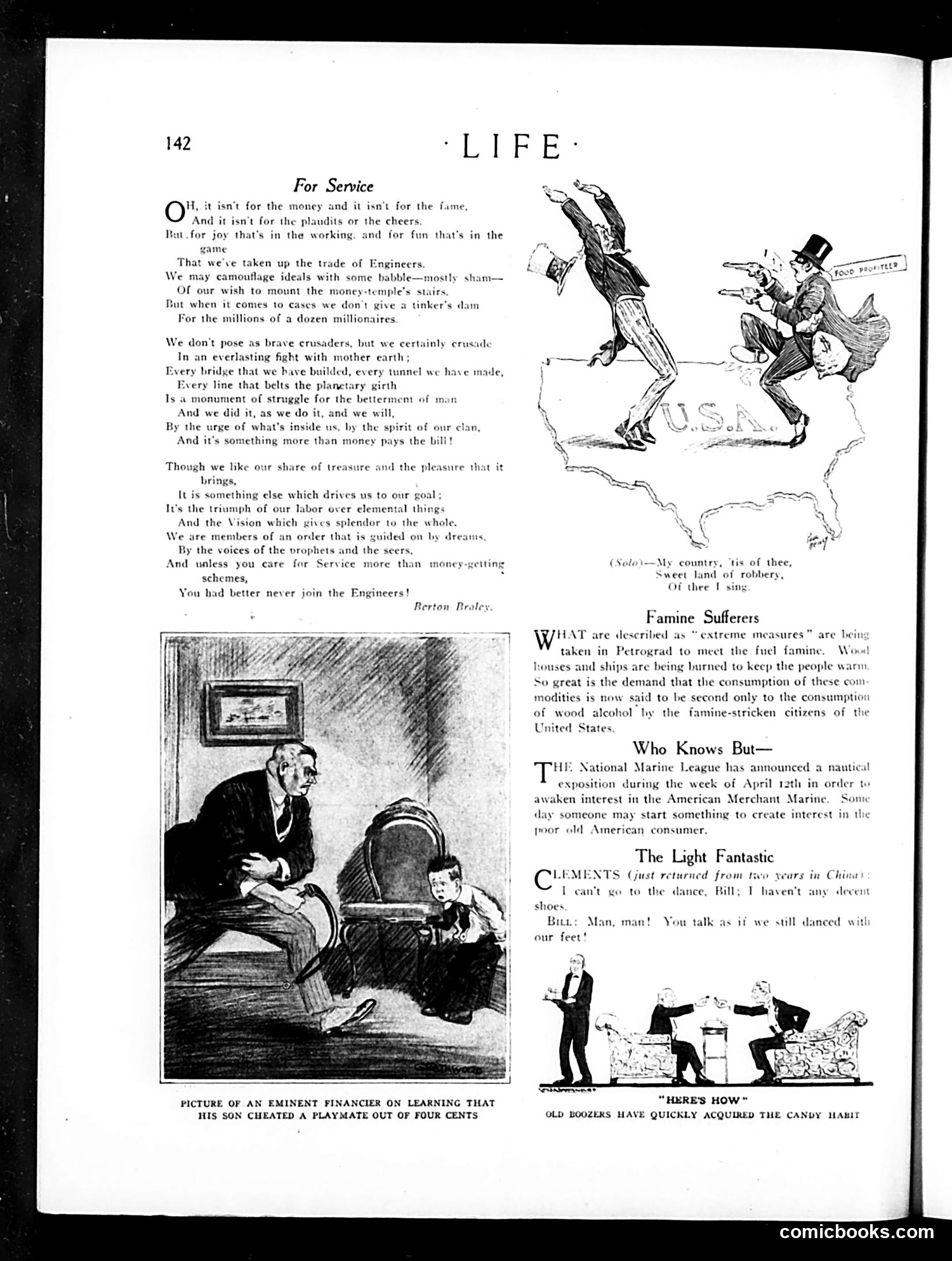
This page contains several satirical pieces. The poem "For Service" by Berton Braley celebrates engineering and infrastructure work over mere moneymaking—advocating that engineers pursue meaningful labor rather than wealth. The illustration below depicts "an eminent financier" discovering his son cheated a playmate out of four cents—a commentary on inherited dishonesty and moral corruption among the wealthy class. "Famine Sufferers" references Petrograd's (Leningrad's) fuel crisis, where wood and ships are being burned for warmth due to extreme demand—suggesting societal breakdown. "The Light Fantastic" is a humorous dialogue between Clements (returned from China) and Bill about dancing without shoes—light domestic humor. The bottom cartoon, "Here's How," depicts older men acquiring "the candy habit," likely joking about Prohibition-era substitutes for alcohol.
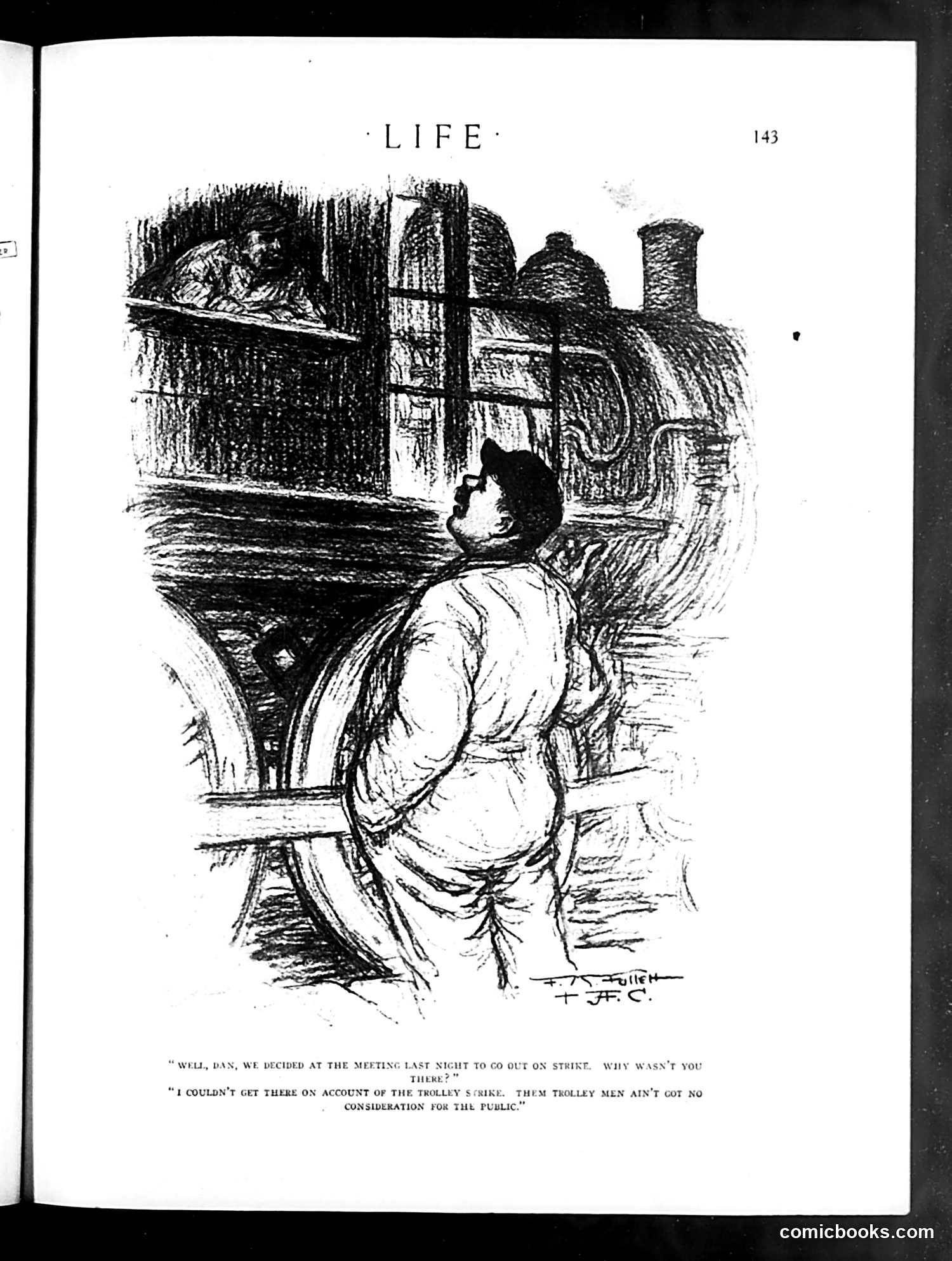
This is a satirical cartoon from *Life* magazine depicting a labor dispute. The drawing shows a heavyset man in work clothes viewed from behind, standing near industrial machinery (possibly a factory or trolley depot). The dialogue reveals the satire: A coworker asks why the man didn't attend a strike meeting. His response—that he "couldn't get there on account of the trolley's strike"—is the joke's punch line. He explains "them trolley men ain't got no consideration for the public." The humor is ironic: the man supports the workers' strike but is inconvenienced by *another* workers' strike (the trolley operators'), exposing the contradiction in labor's collective action when multiple groups strike simultaneously. This likely references early 20th-century labor unrest when multiple industries struck at overlapping times.
This page satirizes the heated debate over the League of Nations Treaty following World War I. President Wilson (referenced in his letter to a Jackson dinner) and William Jennings Bryan (quoted in his speech) represent the Democratic position supporting ratification, while Senator Henry Cabot Lodge led Republican opposition. The cartoon's main point: **public exhaustion**. The text expresses the American people's fatigue with endless political wrangling over whether to ratify the treaty, with Article X being the central sticking point. Rather than debating the League's merits, citizens are portrayed as simply *tired*—fed up with politicians, constitutional arguments, and drawn-out Senate proceedings. The satire captures genuine 1920 sentiment: Americans wanted peace and decisiveness, not prolonged political theater. The phrase "We want a complete change of thought" encapsulates the frustration driving the eventual rejection of the League.
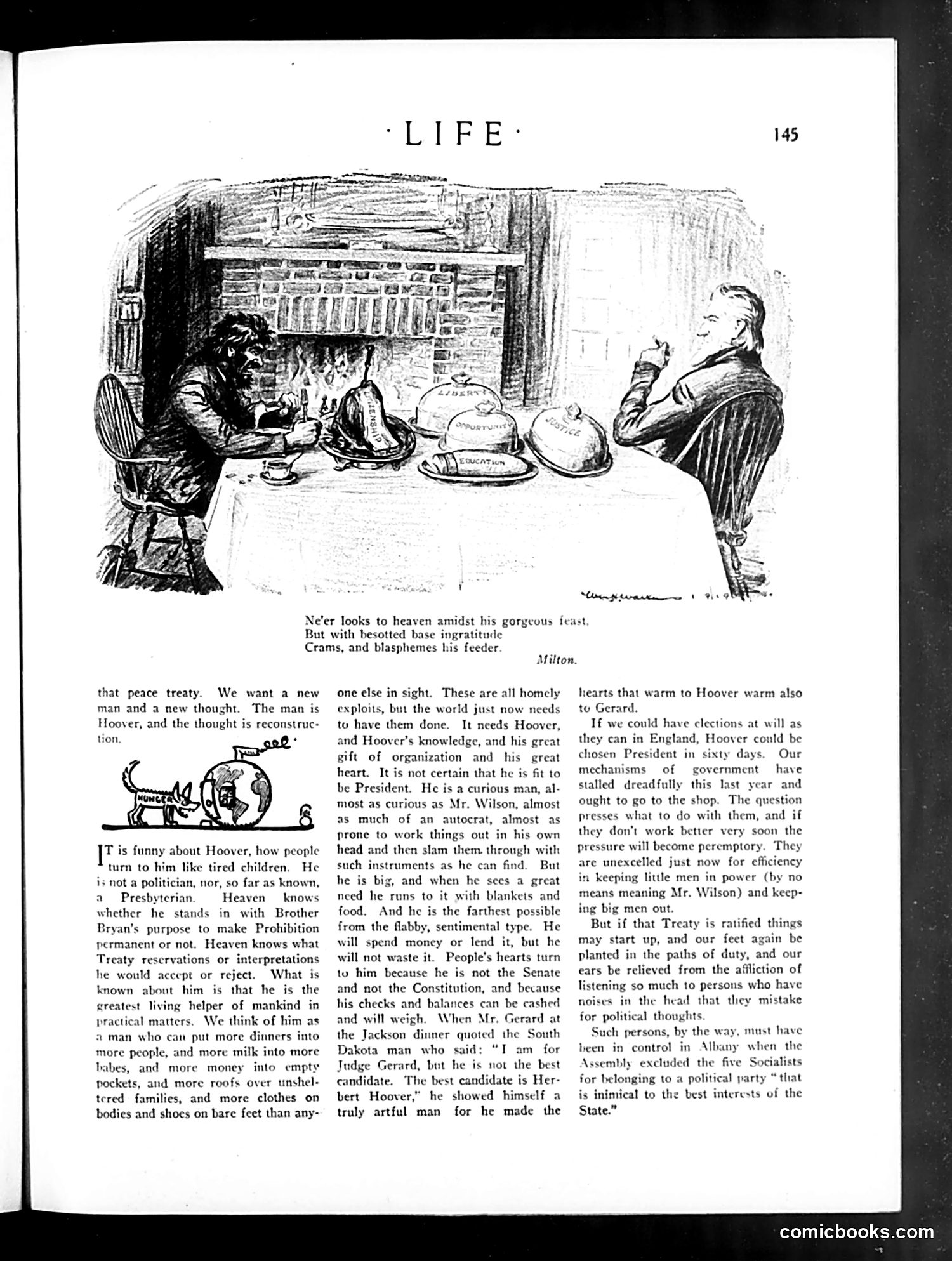
This page advocates for **Herbert Hoover** as a presidential candidate, contrasting his practical competence with Wilson's perceived ineffectiveness. The cartoon depicts two diners—likely representing different political views—sharing a meal, with labeled dishes suggesting competing interests or platforms. The text praises Hoover as a non-politician with exceptional organizational skills and humanitarian concern (references his WWI relief work). It criticizes the current government's mechanisms as inefficient and designed to keep "little men in power" while blocking capable leaders. A secondary political jab targets **Albany's Assembly**, which recently expelled five Socialist legislators for belonging to a party deemed "inimical to the State." The author views this as an example of government overreach by small-minded officials. The Milton epigraph mocks ingratitude toward benefactors—likely referring to public indifference toward Hoover's aid efforts or to Wilson's governance after the war.
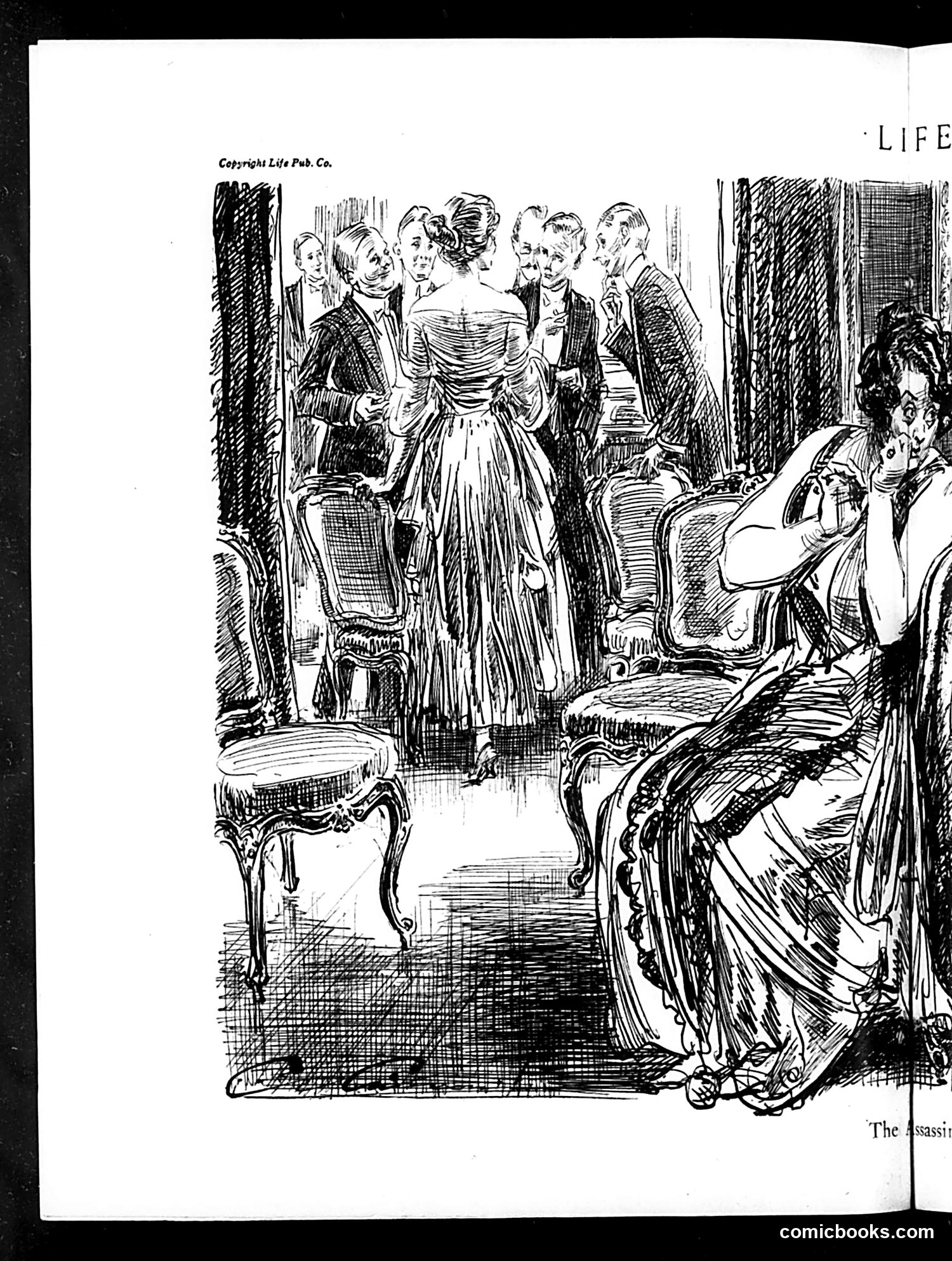
This is a sketch from *Life* magazine showing an elegant social gathering in what appears to be a wealthy home. A woman in an elaborate gown stands conversing with several men in formal attire, while seated women observe from the foreground. The caption reads "The Assassin." The satire likely mocks high society courtship rituals—depicting the woman as a social "assassin" who strategically navigates elite gatherings, presumably to secure an advantageous marriage or social position. The formal, ornate setting emphasizes the artificiality of upper-class social performances. Without the complete article text, the specific target of satire remains unclear, but the image suggests *Life*'s typical critique of pretentious wealthy society and the calculated nature of romantic/matrimonial politics among the elite.
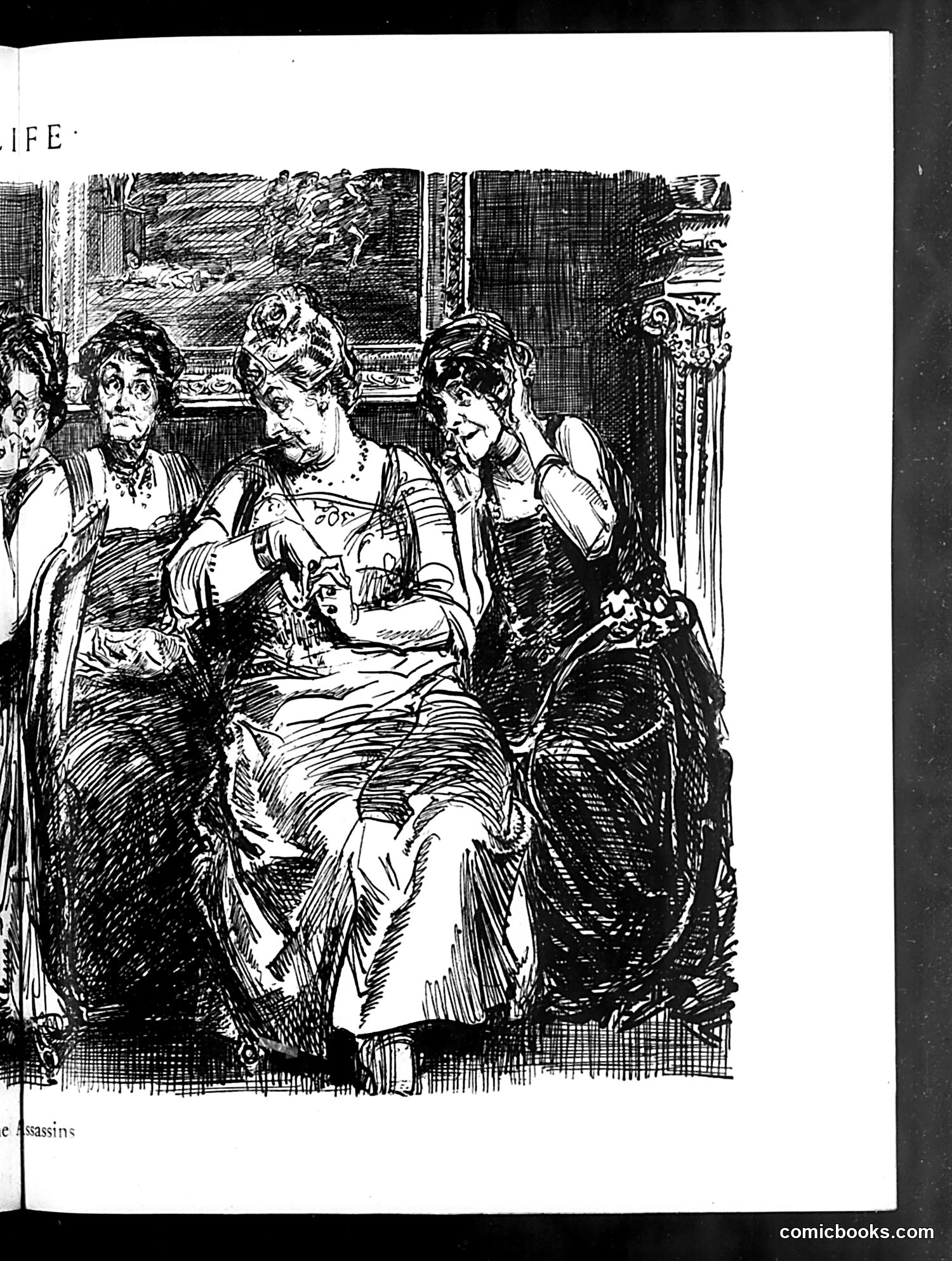
This appears to be a satirical illustration titled "Assassins" from *Life* magazine. The image shows a group of women in Victorian-era dress surrounding a central seated female figure. The caricatured style and exaggerated facial features suggest social satire, likely targeting women of a particular social class or profession. Without clearer context or visible dates/bylines, the specific targets remain unclear. The composition suggests commentary on either female social groups, potentially sex workers or performers, or perhaps a critique of wealthy society women. The theatrical staging and dramatic expressions emphasize the satirical intent, but the exact historical reference—which political or social scandal this references—cannot be definitively determined from the image alone.
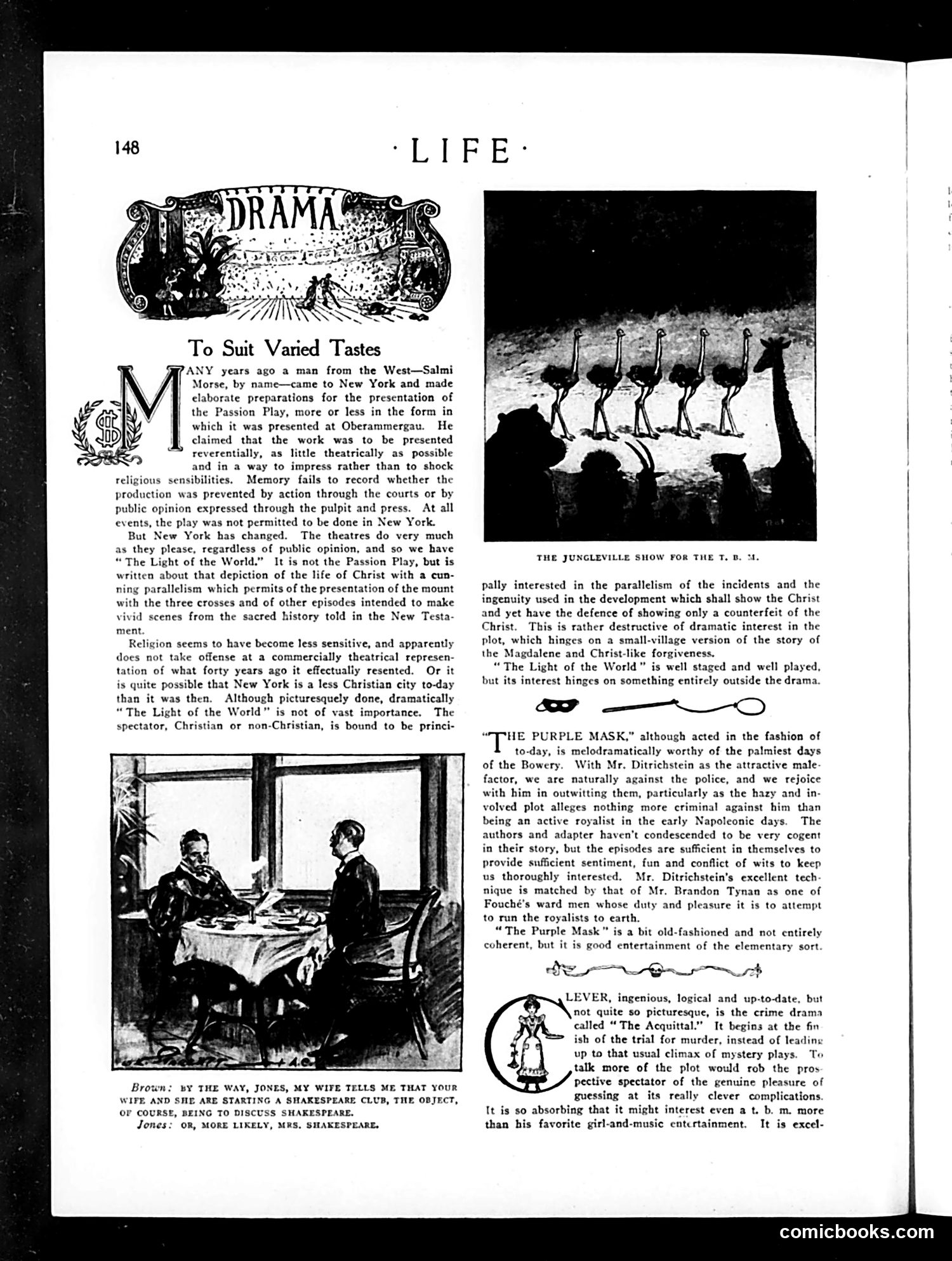
This page reviews Broadway theatrical productions, with particular focus on religious drama's acceptability in New York society. The main article discusses "The Light of the World," a play about Christ presented with deliberate theatrical parallelism. The author notes a striking cultural shift: forty years prior, a reverential Passion Play by Salmi Morse was prevented—either by courts or public religious outcry. Now, New York theaters operate without such restrictions, suggesting either diminished religious sensitivity or that the city has become "less Christian." The bottom cartoon is a joke about a Shakespeare Club: when one character mentions his wife is starting one "to discuss Shakespeare," his friend quips it's "more likely, Mrs. Shakespeare"—implying the wives will gossip about the playwright's wife rather than study his works. The page also briefly reviews "The Purple Mask" and "The Acquittal," melodramatic crime plays of varying quality.
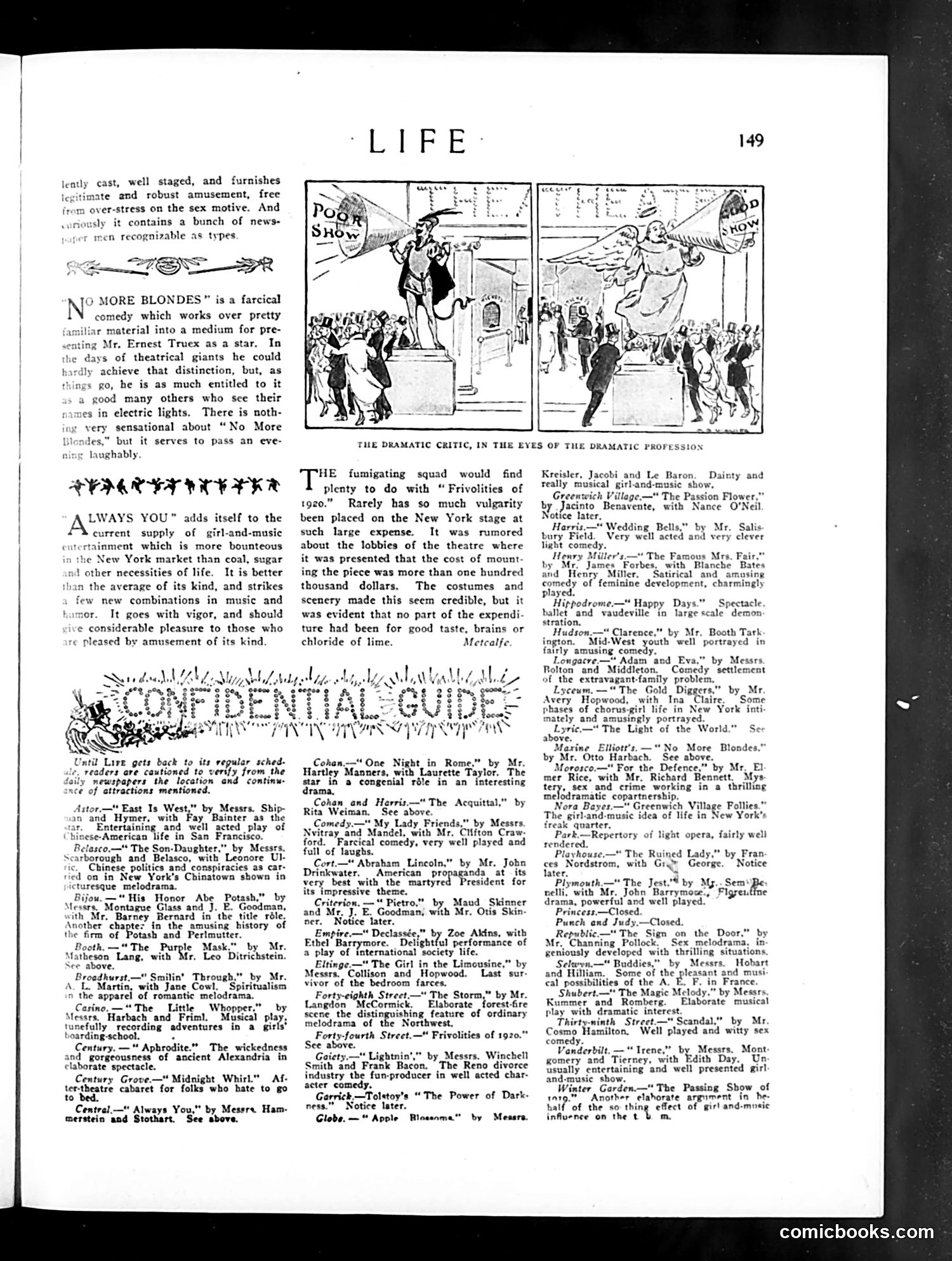
This page from Life magazine (circa 1920) contains theater reviews and a cartoon satirizing dramatic critics. The two-panel cartoon at the top shows "The Dramatic Critic, in the Eyes of the Dramatic Profession"—depicting how theater professionals viewed theater critics. The cartoon contrasts two perspectives: On the left, a critic appears to be dismissively evaluating a theatrical performance; on the right, the profession's view of critics is shown as inflated, pompous figures. The satire suggests critics wielded disproportionate power over theatrical success, and that performers and producers resented their influence. The accompanying text reviews various Broadway productions, including mentions of "No More Blondes" (starring Ernest Truex) and "Always You." A particularly harsh review of "Frivolities of 1920" criticizes its vulgar content and expensive production values ($100,000+), suggesting money was wasted on spectacle rather than quality writing. The overall message: critics held significant sway over theater's commercial and artistic success, a tension that clearly frustrated the theatrical community being reviewed.
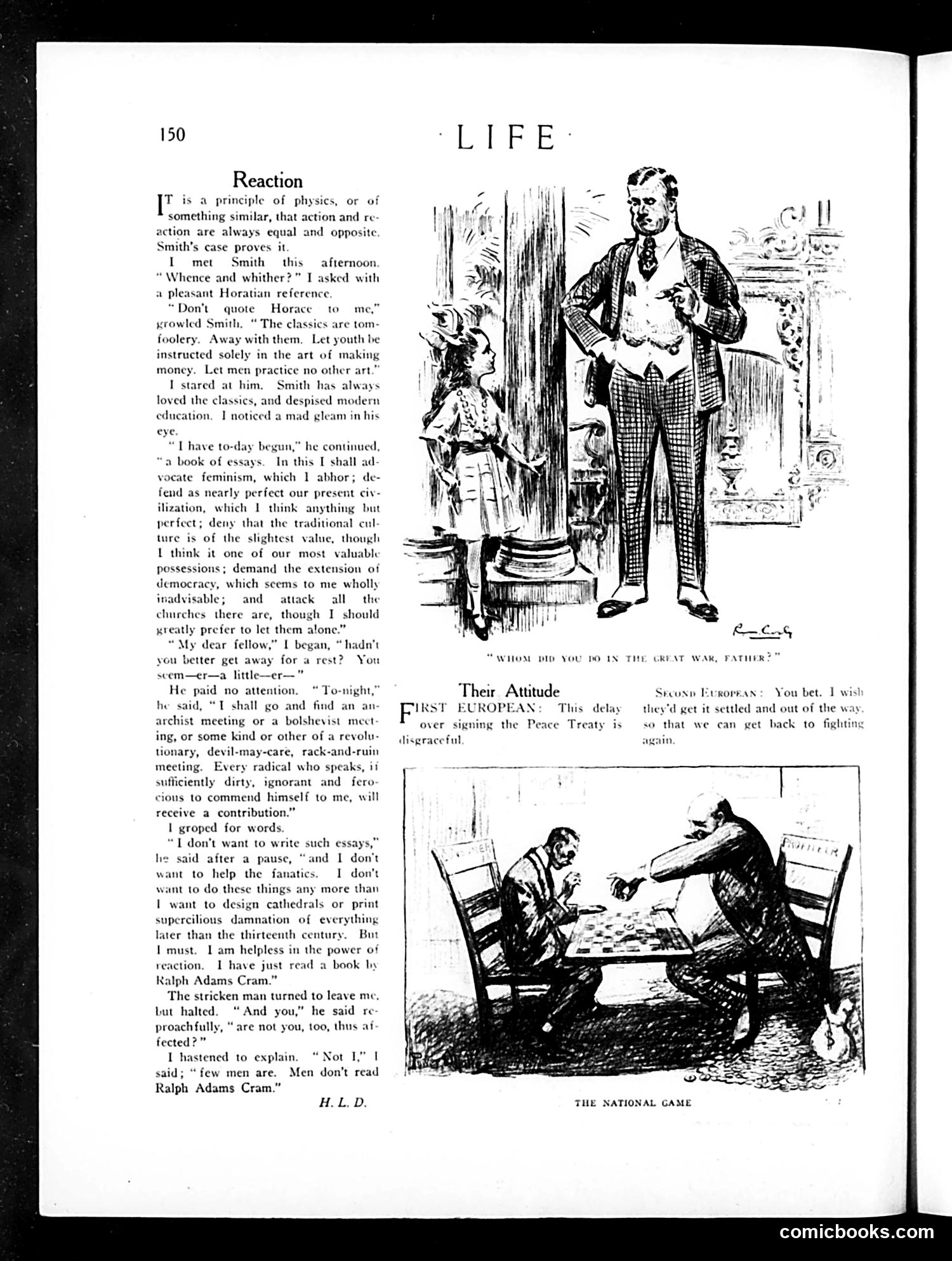
**"Reaction" (left):** A humorous essay about a man named Smith who has undergone a complete ideological reversal after reading Ralph Adams Cram's work (likely his conservative architectural/cultural criticism). Smith, formerly a classics-loving traditionalist, now advocates feminism, democracy, and radicalism—positions he actually despises. The joke satirizes how exposure to reactionary arguments can paradoxically push someone toward radical positions through contrarian impulse. The narrator is unaffected because "men don't read Ralph Adams Cram." **"Their Attitude" (bottom right):** Two cartoons about post-WWI attitudes. The top depicts a father and child discussing his wartime role, with Europeans eager to "get back to fighting again"—satirizing the failure of the Peace Treaty to create lasting peace and the cynical European appetite for renewed conflict. **"The National Game" (bottom):** Shows two men playing chess, captioned as "the national game," likely suggesting diplomacy or international relations as a mere game played by those indifferent to human consequences.
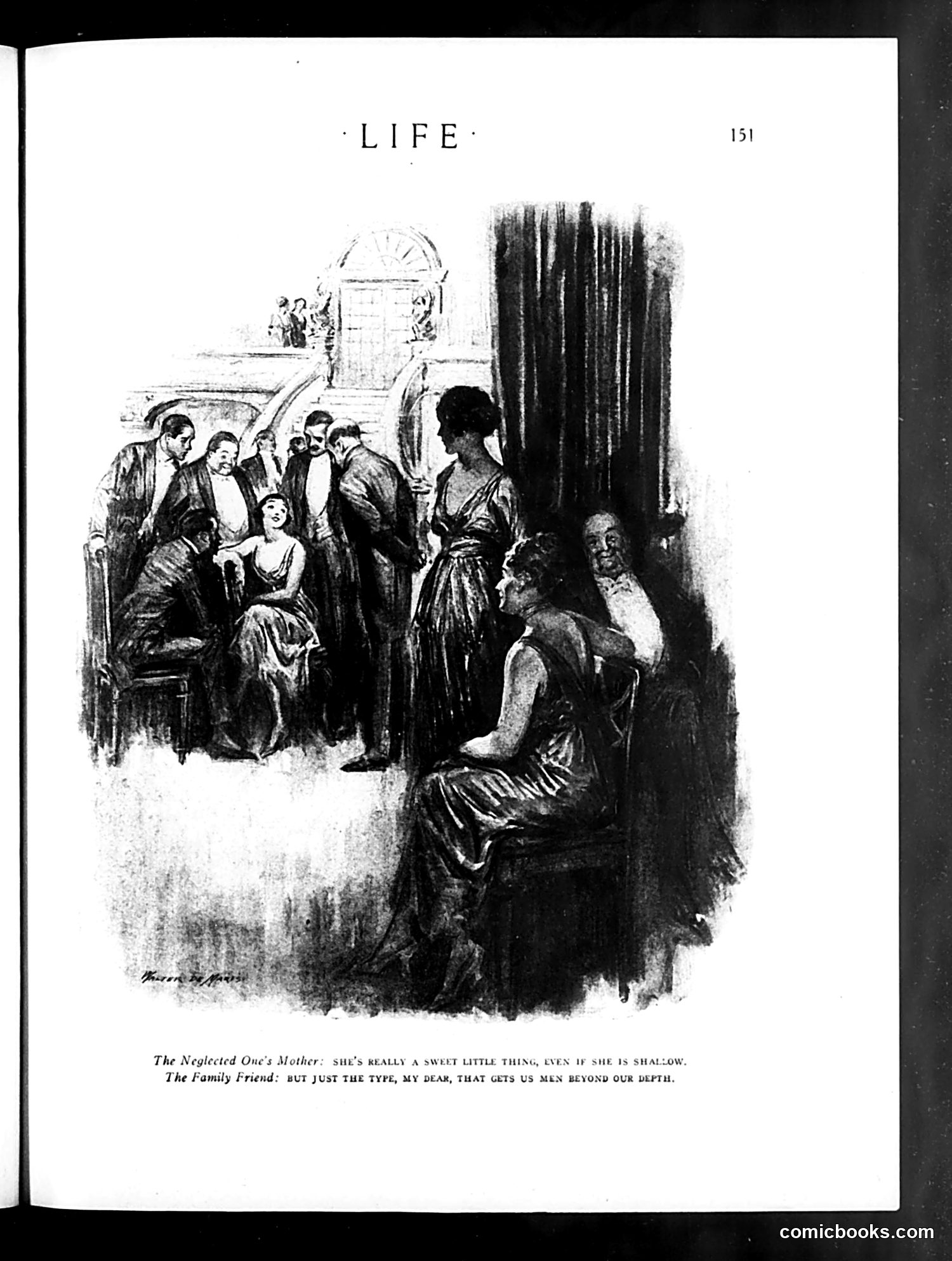
This is a social satire cartoon depicting a conversation between two figures—apparently a mother and a "family friend"—about a young woman. The mother defends the girl as "sweet" but admits she's "shallow," while the family friend warns that this very type of superficial attractiveness is what leads men astray ("beyond our depth"). The satire appears to target Victorian-era attitudes about women and morality: the condescending assumption that shallow, pretty women are inherently dangerous to men's virtue and judgment. The cartoon mocks both the mother's defensive rationalization and the family friend's pompous moralizing about feminine wiles. The "neglected one" in the title suggests this young woman lacks proper guidance or attention, leaving her vulnerable to such judgments.
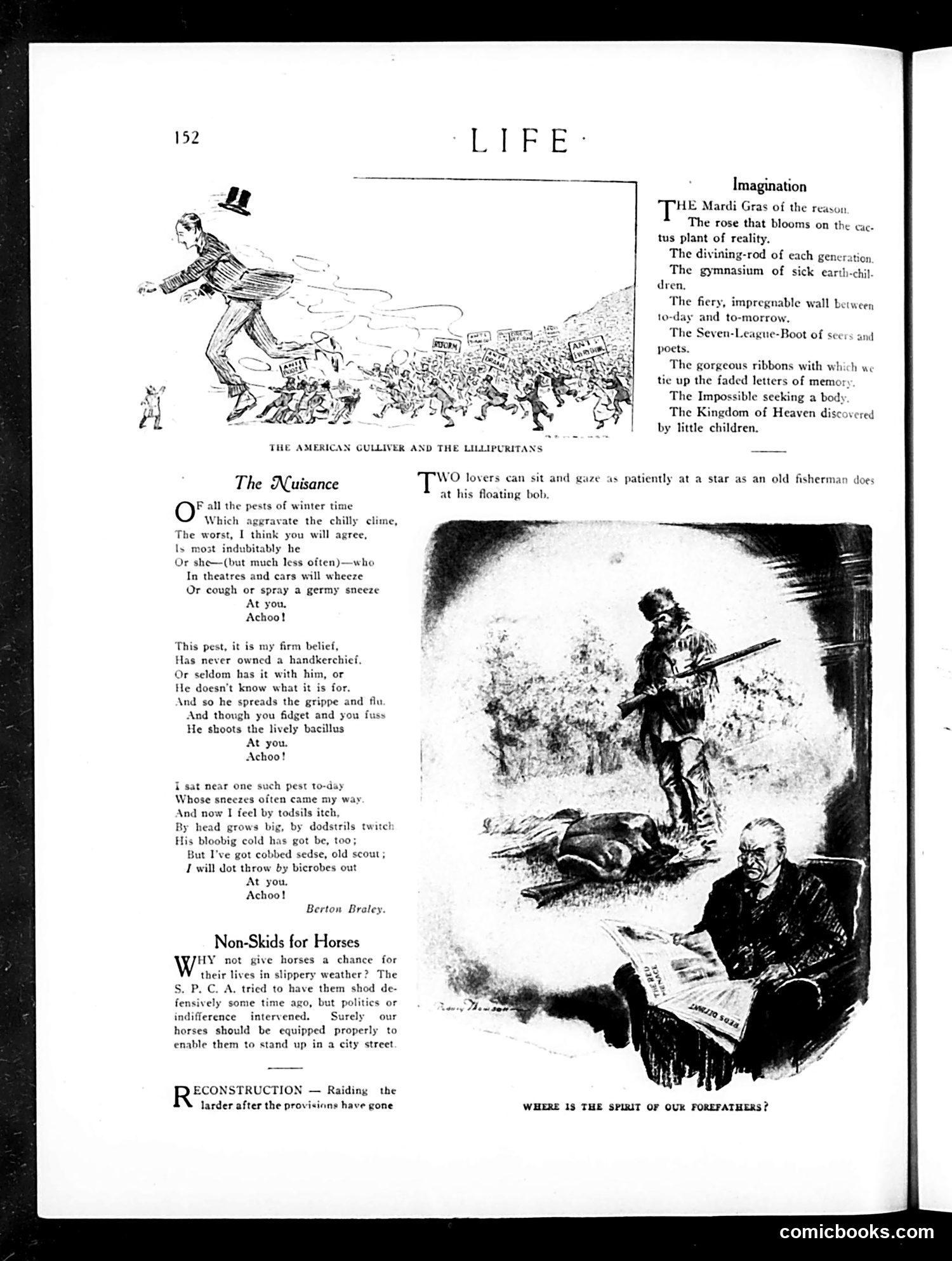
**Top Cartoon - "The American Gulliver and the Lilliputians":** References Jonathan Swift's *Gulliver's Travels*. A giant figure (representing America or American power) towers over a crowd of tiny people (the "Lilliputians"). This satirizes America's disproportionate influence or the contrast between American ambitions and ordinary citizens' concerns—likely from the post-WWI era when America's global role was expanding. **"The Nuisance" Poem by Berton Braley:** Satirizes inconsiderate theatergoers and transit riders who cough and sneeze without covering their mouths, spreading illness to others. The speaker humorously notes he caught the cold but has the decency not to spread germs back—mocking those lacking basic courtesy and hygiene. **Lower Image - "Where is the Spirit of Our Forefathers?":** Shows two men reading a newspaper, with one appearing distressed. The caption questions whether American civic virtue has declined, likely referencing post-war disillusionment or contemporary social/political concerns about modern society abandoning traditional values. The page blends social commentary with humor about everyday annoyances and broader cultural anxieties.
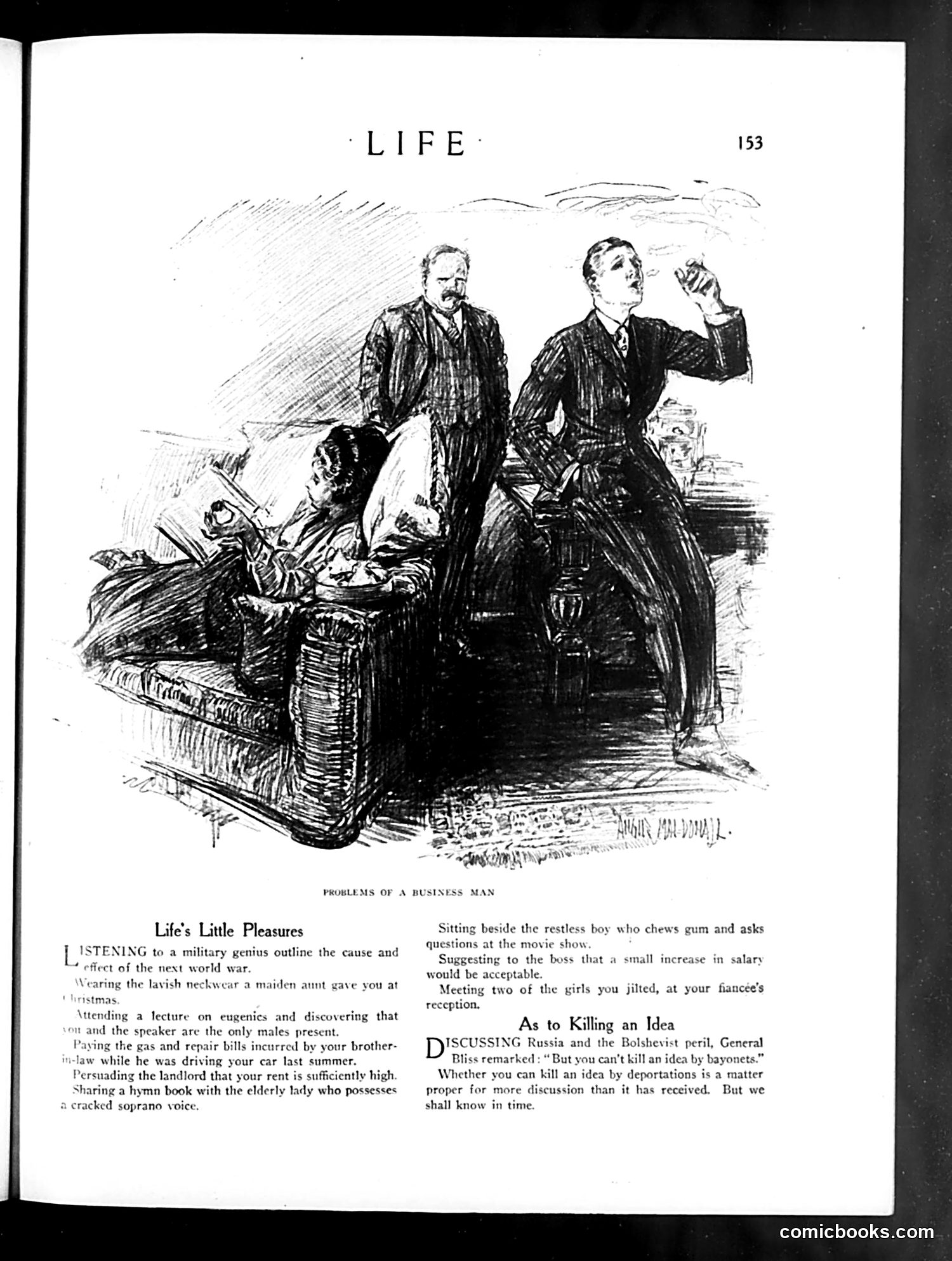
This page satirizes the everyday frustrations of middle-class American businessmen. The sketch depicts three men and a boy—likely illustrating one of the listed "problems." The left column humorously catalogs mundane social annoyances: enduring bad movies with chatty children, requesting raises, wearing ugly gifts, meeting ex-girlfriends, and listening to tedious conversation. The right section references a contemporary political debate. General Tasker Bliss (a WWI figure) reportedly said you cannot kill ideas "by bayonets"—a comment on Russian Bolshevism. The editor responds skeptically, questioning whether deportations (likely referring to the U.S. Red Scare and mass deportations of suspected communists in 1919-1920) could succeed where violence failed. The closing phrase "we shall know in time" suggests skepticism about anti-communist suppression tactics. Together, the page juxtaposes trivial personal annoyances with serious ideological conflict, suggesting both dominate the businessman's consciousness.
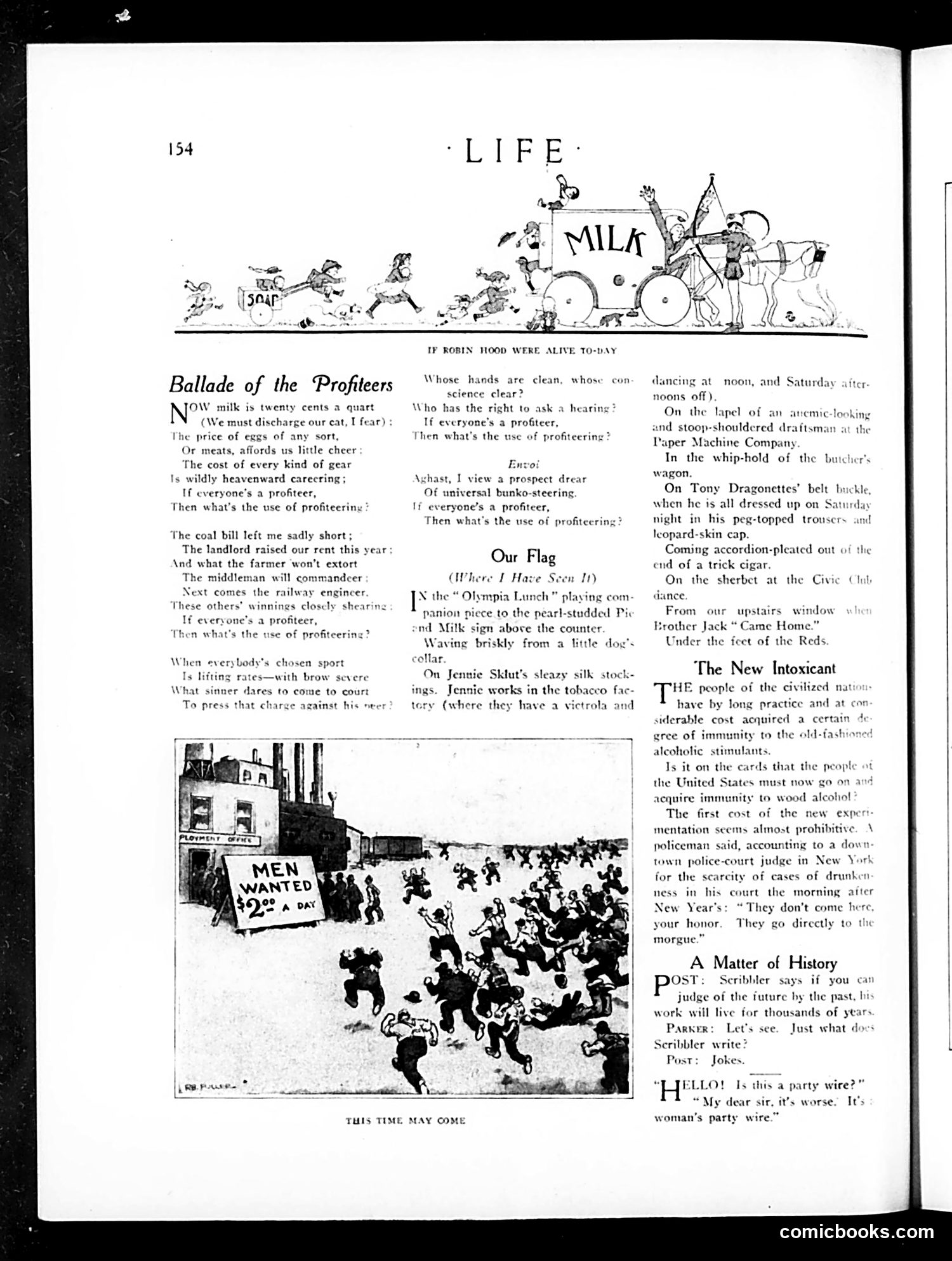
This page satirizes **post-WWI American profiteering and inflation**. The "Ballade of the Profiteers" poem mocks widespread price-gouging across all sectors—milk at 20 cents a quart, coal, rent, food—while asking the rhetorical question: if *everyone* is a profiteer, what's the point? The satire suggests corruption is so universal that morality has collapsed. The reference to "If Robin Hood Were Alive To-Day" frames profiteers as modern thieves exploiting ordinary citizens. The photograph shows a crowd scrambling for jobs ("Men Wanted $2 a Day"), capturing the economic chaos and desperation of the era. "Our Flag" ironically locates patriotic symbols not on flagpoles but on mundane working-class items—a lunch counter sign, a factory worker's stockings, a butcher's wagon. This deflates nationalism, suggesting true patriotism exists only among struggling workers. "The New Intoxicant" jokes darkly about wood alcohol poisonings, referencing Prohibition-era deaths when people drank toxic substitutes after alcohol was banned. The final exchange mocks intellectuals: a writer's work "lives for thousands of years"—as jokes, not serious literature.
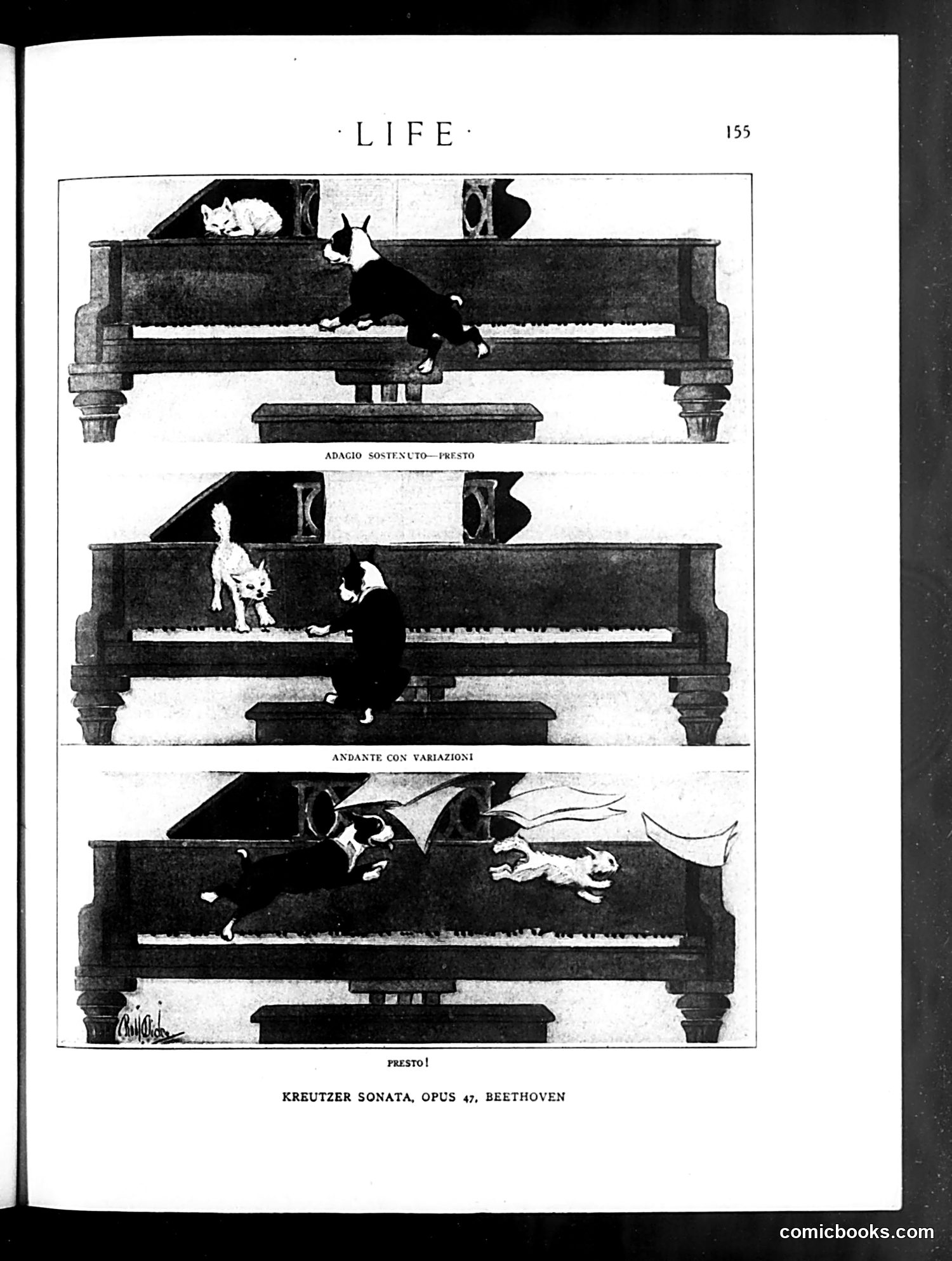
This page presents a humorous visual commentary on performing Beethoven's Kreutzer Sonata. The three panels depict the same piano scene with escalating chaos: 1. **"Adagio Sostenuto—Presto"**: A composed pianist with cats observing calmly 2. **"Andante Con Variazioni"**: A woman pianist plays while a dog watches 3. **"Presto!"**: The final panel shows wild chaos—the pianist appears frenzied, with the dog jumping dramatically, suggesting the music has become frenetic and uncontrolled The satire mocks the contrast between classical music's formal structure and the unpredictable reality of live performance, particularly how animals (and perhaps the performer) react to the increasingly demanding "Presto" (fast) sections. The word "Presto!" as the punchline emphasizes the breakdown of control, turning concert performance into comedy.
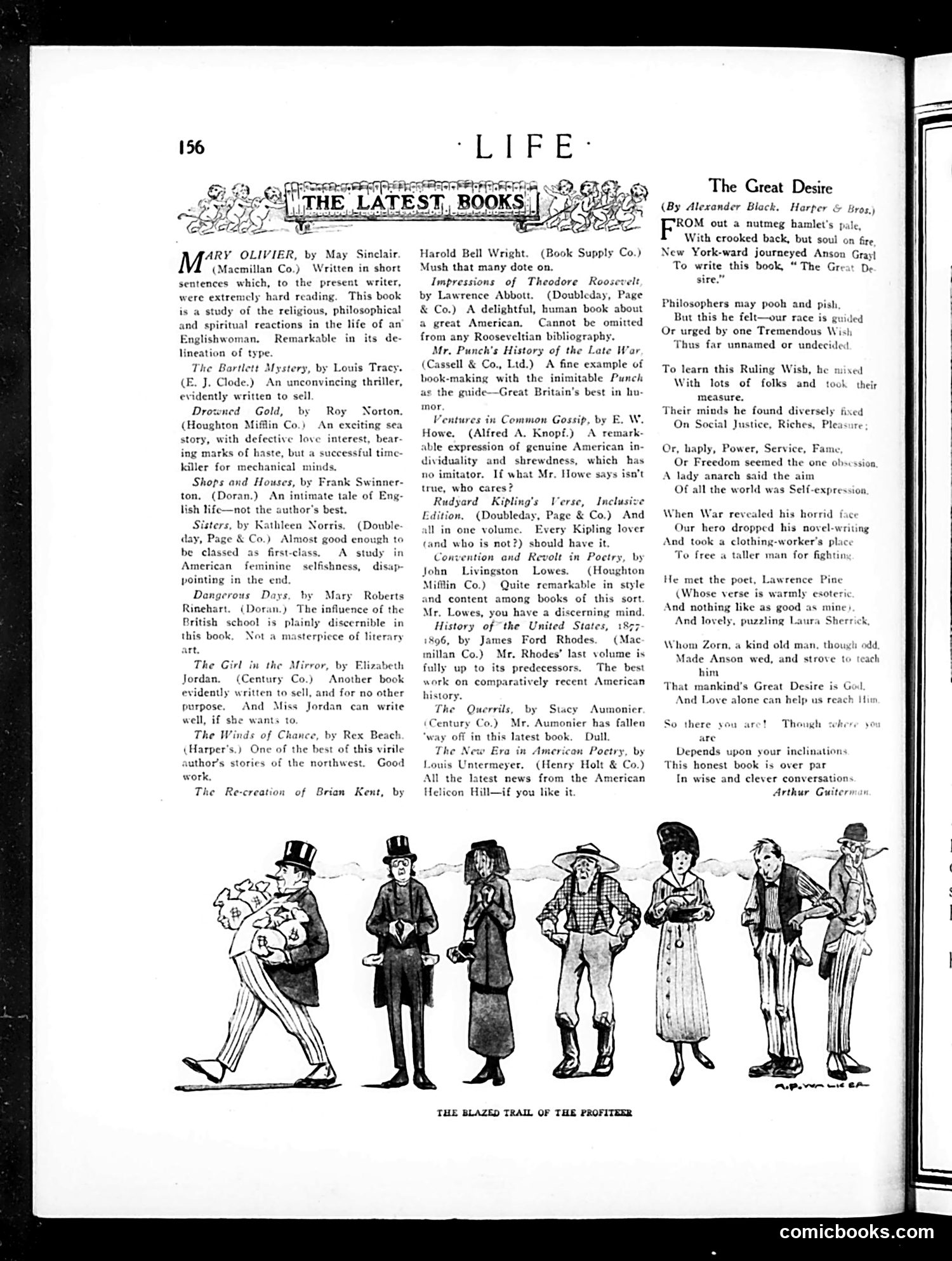
This page is primarily a **book review section** from Life magazine. The cartoon at the bottom—"The Blazed Trail of the Profiteer"—appears to satirize **wartime profiteering during World War I**. The seven figures represent different character types or social classes who exploited the war for personal gain. The leftmost figure, laden with money bags, likely represents the war profiteer—someone accumulating wealth through military contracts or black-market dealings while others sacrificed. The varied figures alongside him (appearing to include military personnel, workers, and civilians) suggest different groups affected by or complicit in wartime exploitation. The "blazed trail" metaphor implies these profiteers left a visible, damaging path through society. This reflects contemporary American concern about wealthy industrialists and speculators enriching themselves while soldiers fought and civilians suffered rationing and hardship.
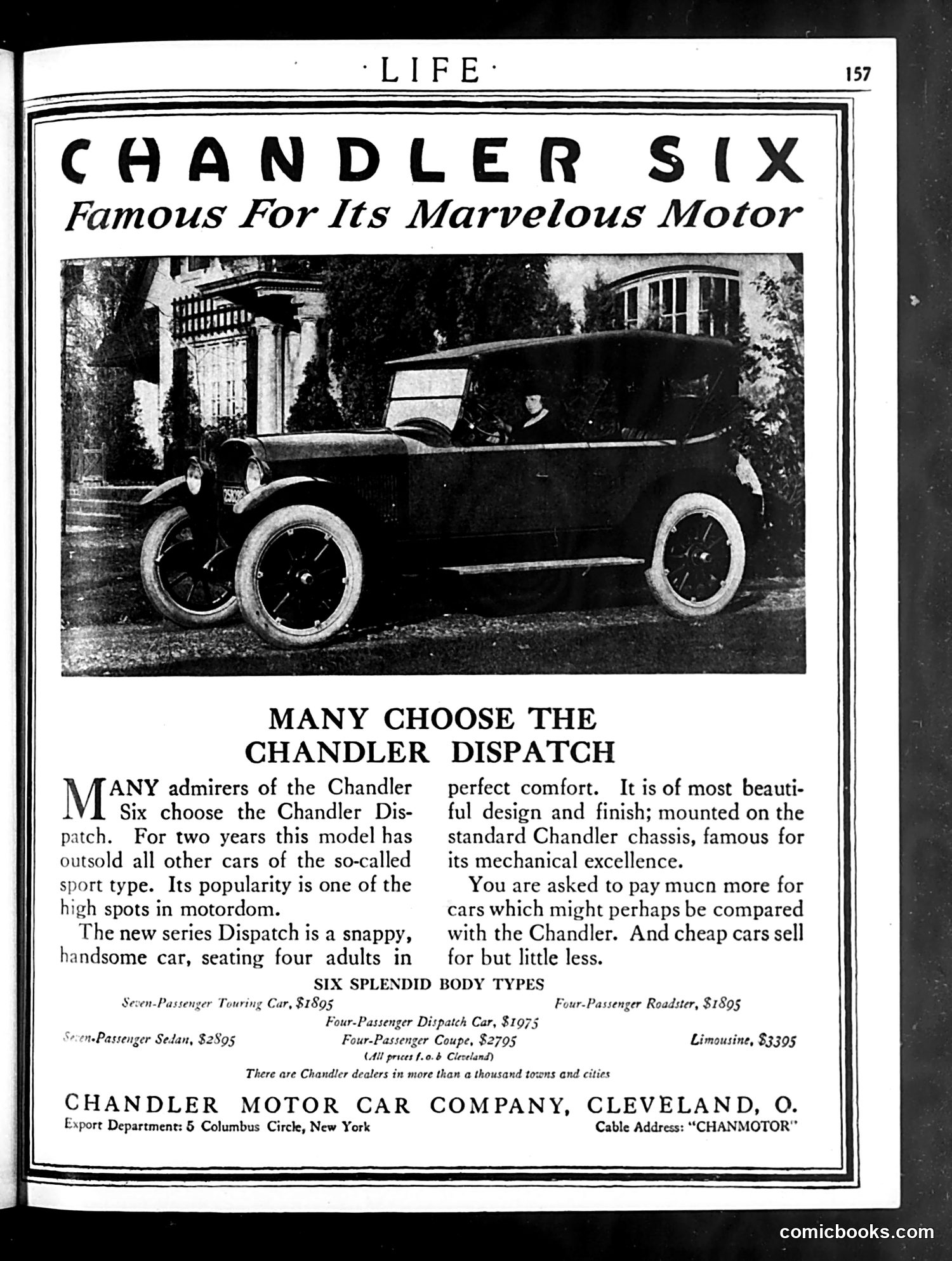
This is **not a cartoon or satire page**—it's a straightforward automobile advertisement from *Life* magazine (page 157). The Chandler Motor Car Company is promoting their "Six" model, specifically the new "Dispatch" variant. The ad uses a photograph of the vehicle and standard marketing rhetoric of the 1920s era: emphasizing the car's superior motor, beautiful design, and value proposition. The closing argument—that buyers must pay more for comparable cars, while cheaper alternatives cost only slightly less—is a classic pricing justification pitch meant to position the Chandler as a premium mid-market choice. The "six splendid body types" listed (touring car, sedan, roadster, coupe, limousine) reflect the era's custom-body automobile market, where chassis could be fitted with different passenger configurations. There is no political satire or social commentary here—simply period commercial advertising highlighting automotive features and pricing for a Cleveland-based manufacturer.
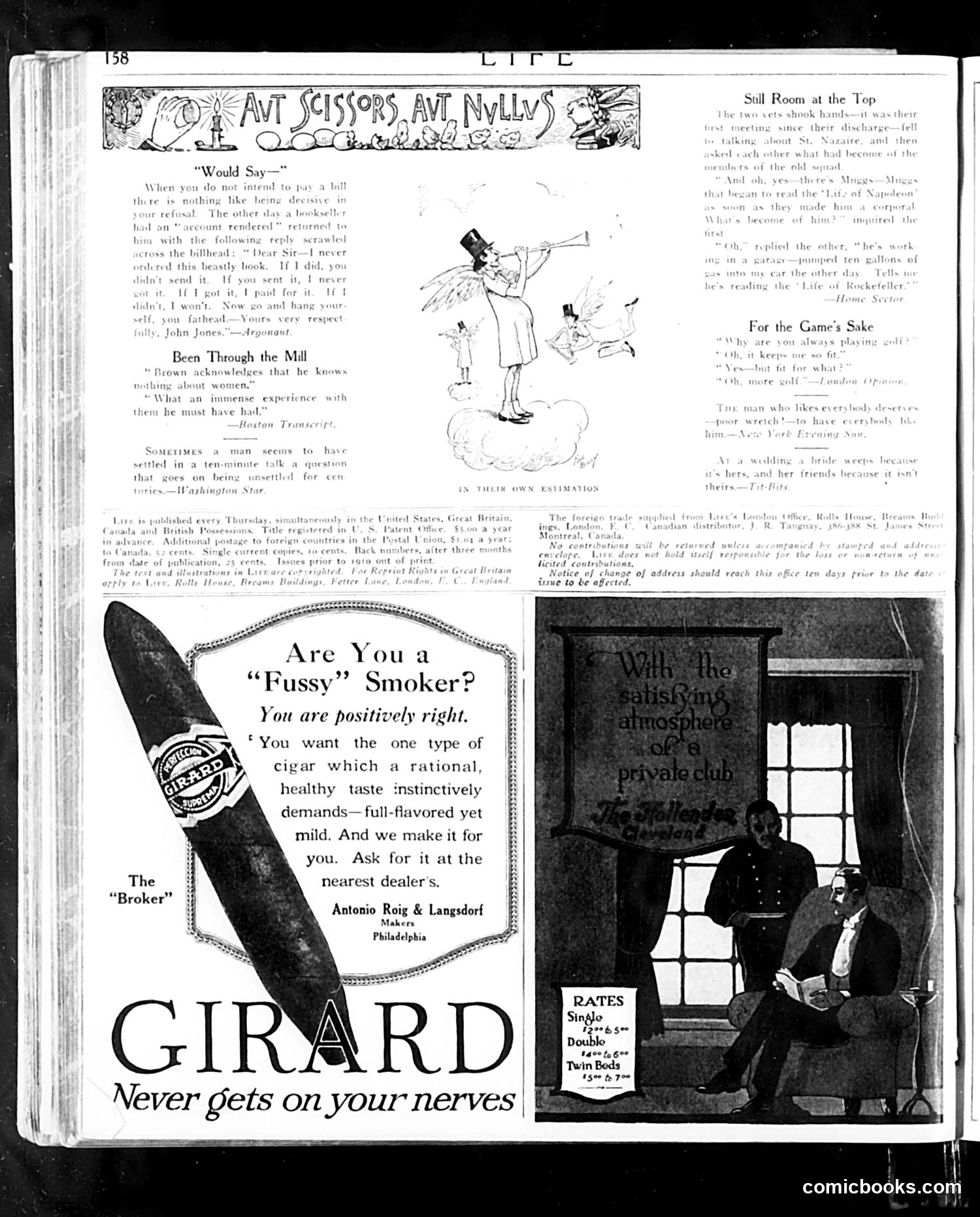
This page combines humor content with advertising. The main cartoon ("In Their Own Estimation") depicts a man standing on a cloud, appearing to inflate his own importance—a visual metaphor for self-aggrandizement or delusion of grandeur. The joke satirizes people who overestimate their own worth or significance. The page also features various humorous short pieces including "Would Say," "Beth Through the Mill," and "For the Game's Sake"—typical of Life's satirical humor section from this era. The advertisements are period-typical: a Girard cigar ad ("Never gets on your nerves") playing on anxieties about appearing refined, and what appears to be a private club advertisement. These ads reflect early-to-mid 20th century consumer culture and social aspirations, marketing products by appealing to readers' desire for status and respectability.
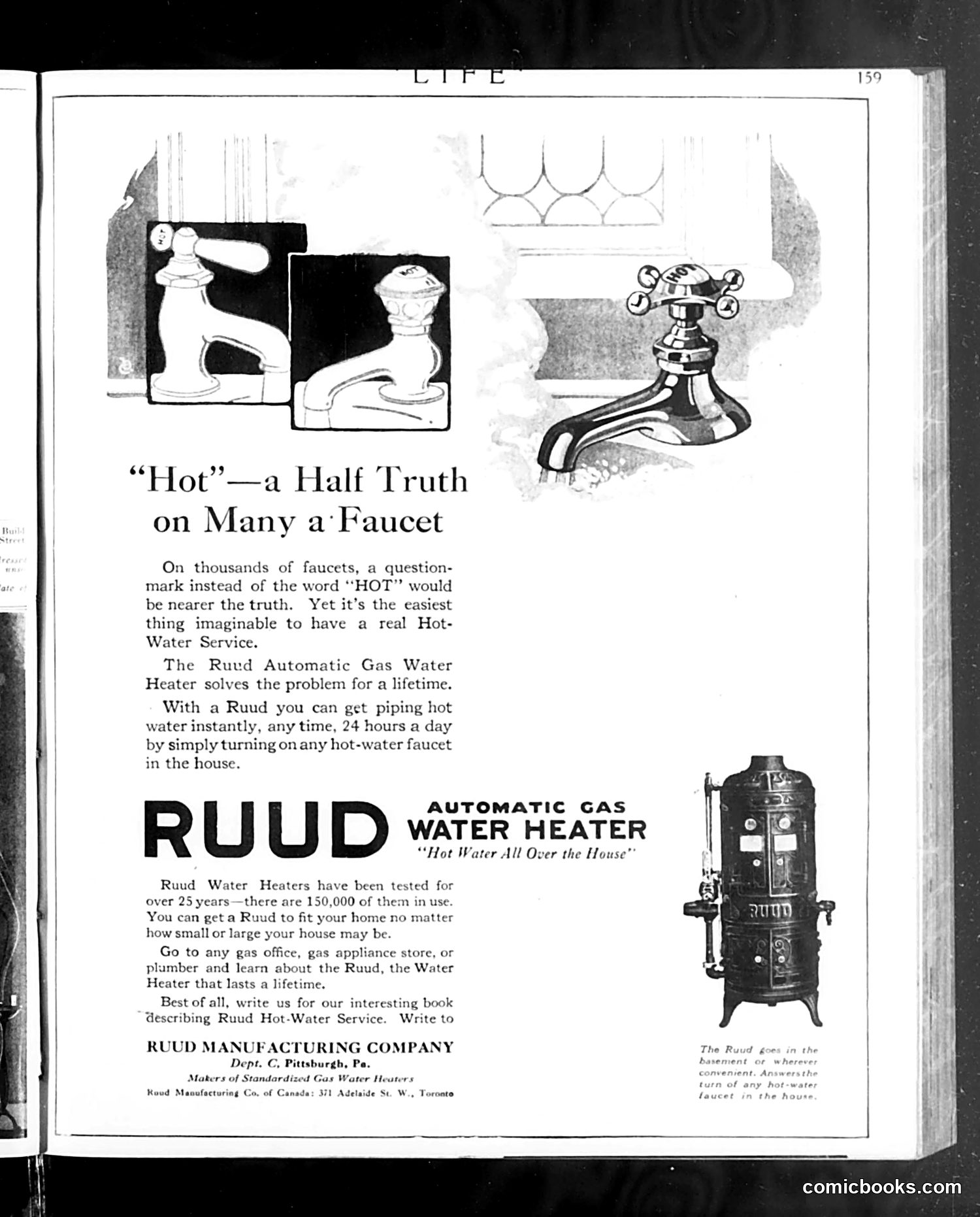
This is a **product advertisement**, not political satire. The page uses humor to sell Ruud Automatic Gas Water Heaters. The joke: The opening cartoon shows a bathroom faucet labeled "HOT" that delivers only cold water—a common household frustration of the era. The text humorously suggests a question mark would be more honest than the word "HOT" on most faucets. The solution pitched is the Ruud heater, which promises instant hot water 24/7 throughout the home. The advertisement emphasizes reliability (tested 25+ years, 150,000 in use) and universal availability (fits any home size). The small cartoon illustrations show the problem (disappointed users) and the product itself—a large cylindrical gas water heater unit shown on the right. This reflects early-to-mid 20th-century home comfort anxieties: reliable hot water was still a luxury many households lacked consistently. The ad's placement in *Life* magazine targeted middle-class readers who could afford modern gas appliances.
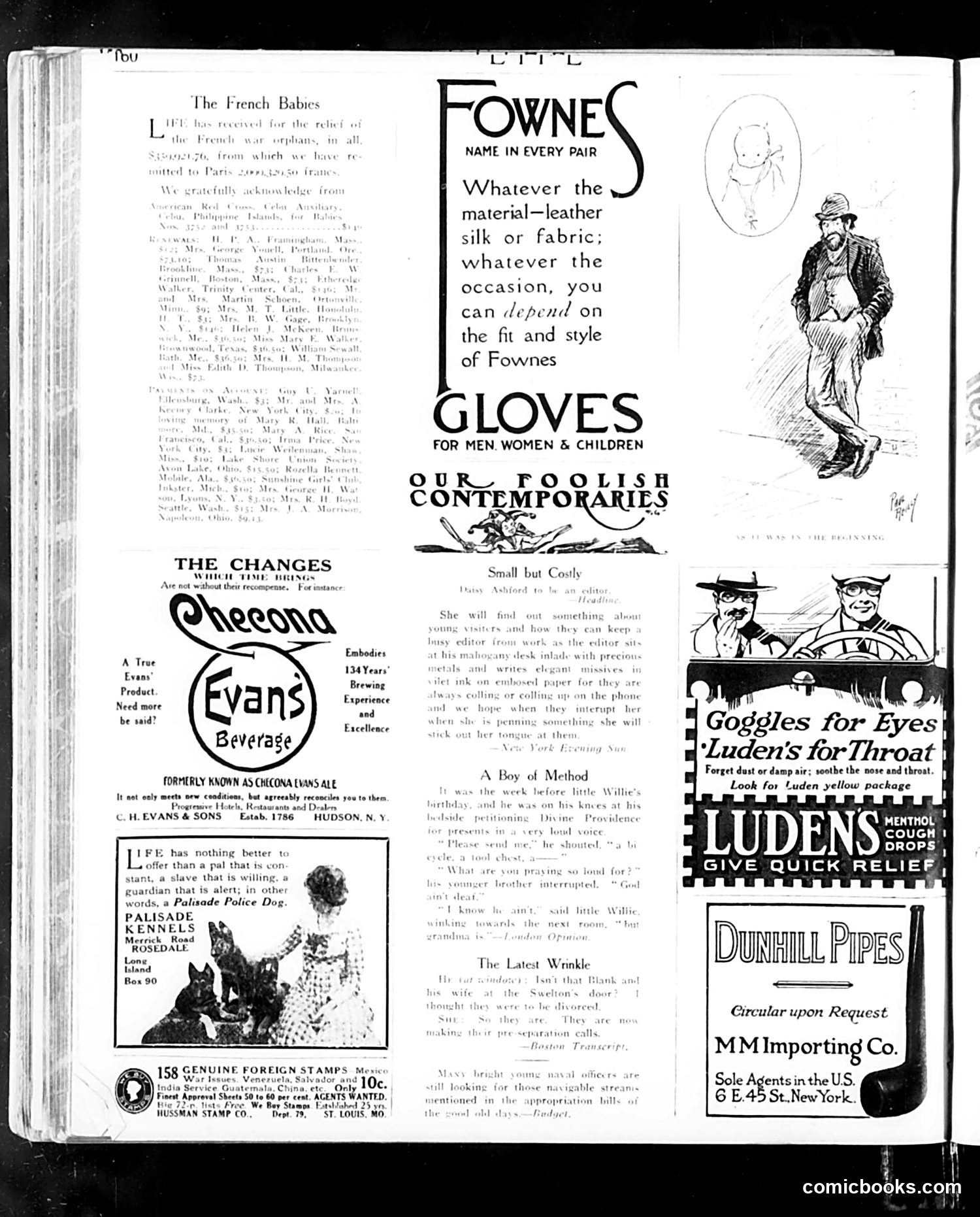
This page is primarily **advertising**, not political satire. It features multiple commercial advertisements typical of early 20th-century magazines: **Main Content:** - **Fownes Gloves** dominates the center, with an illustrated gentleman figure promoting quality gloves for all occasions - **Evans Beverage** ad references the company's 134-year history and "brewing experience" - **Palisade Kennels** advertises a police dog ("Palisade Police Dog") - **Ludens throat lozenges** and **Dunhill Pipes** appear in smaller ads **The "Foolish Contemporaries" Section:** This appears to be a humorous editorial column titled "Our Foolish Contemporaries," likely mocking current trends or public figures, though the specific OCR text is too garbled to decipher the intended satirical targets. **For Modern Readers:** The page reflects an era when magazines subsidized their content through dense advertising. The emphasis on established brands ("134 Years'"), quality assurances, and genteel imagery reflects pre-Depression consumer culture assumptions about taste and reliability.
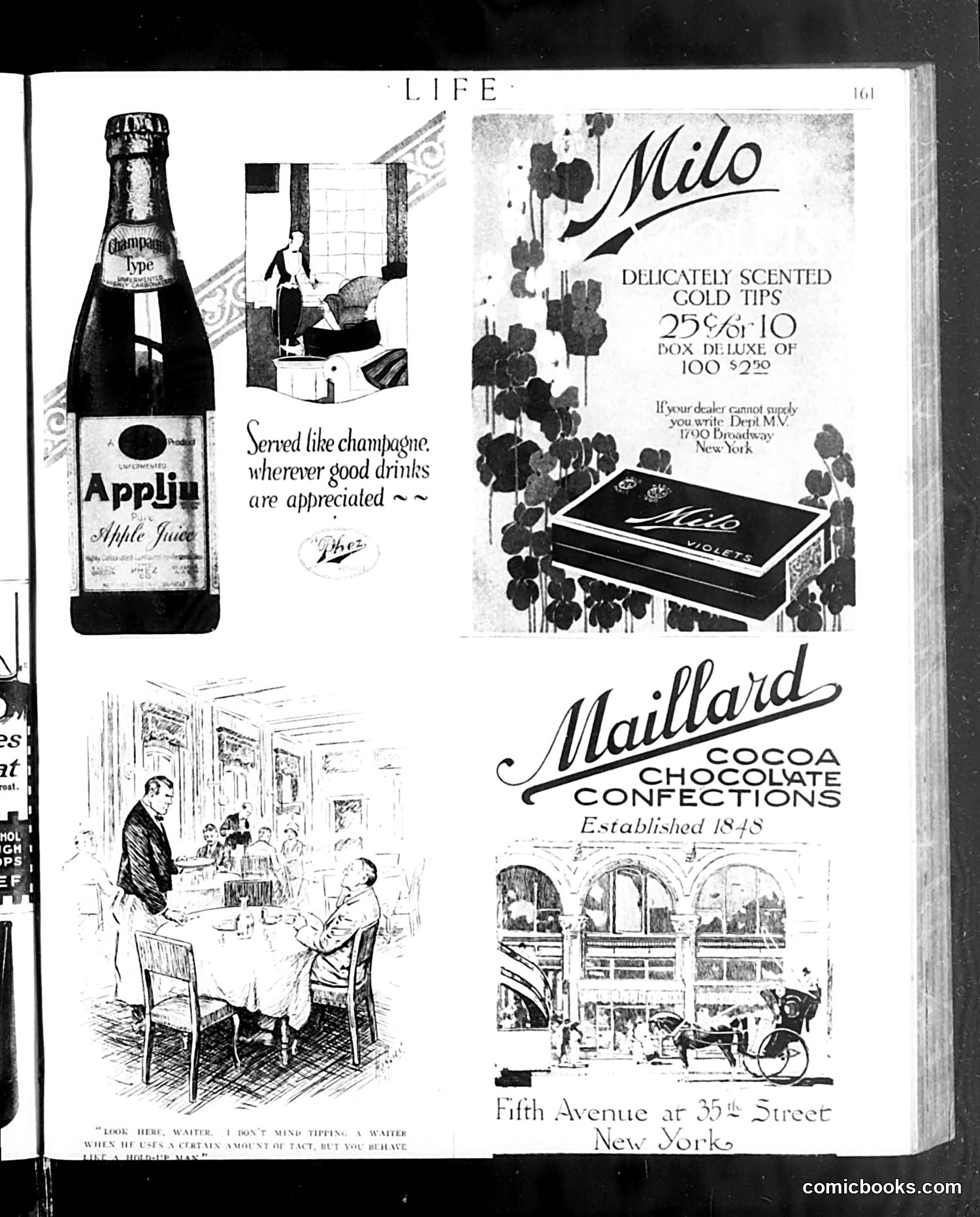
This page is primarily **advertising**, not political satire. It contains four vintage advertisements: 1. **Applin Apple Juice** — positioned as a premium beverage "served like champagne," suggesting apple juice as an upscale alternative drink 2. **Milo Cigarettes** — delicately scented cigars with gold tips, priced at 25¢/10 or $2.90 per box 3. **Maillard Cocoa and Confections** — established 1848, located at Fifth Avenue and 35th Street, New York, shown with a storefront illustration The only sketch with narrative humor appears at bottom left: a waiter conversation about tipping etiquette (text partially unclear in OCR). **Historical context**: These ads reflect early 20th-century consumer culture normalizing tobacco and sugar products. The tone emphasizes luxury and sophistication—typical marketing strategies before modern health warnings existed.
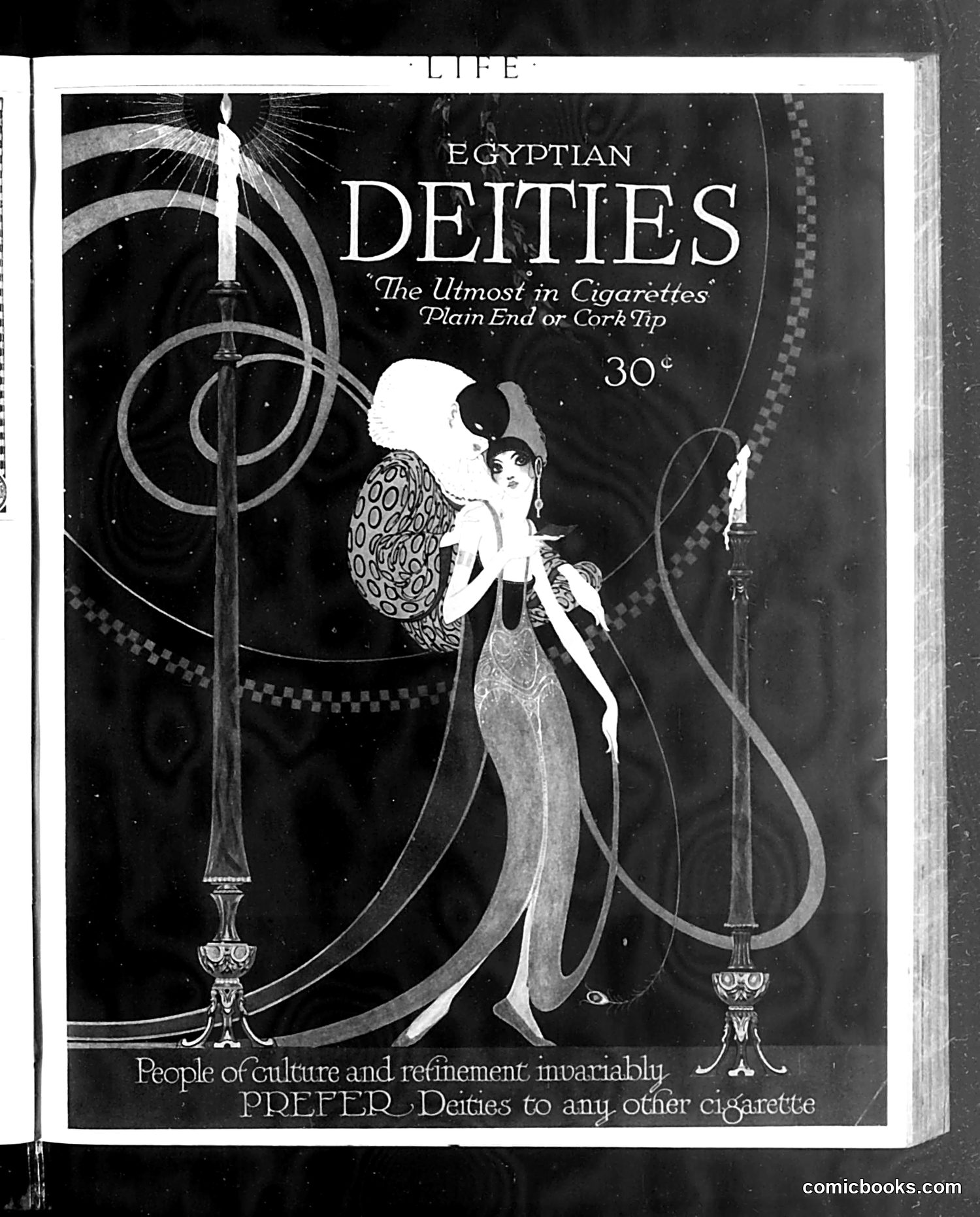
This is a **cigarette advertisement**, not political satire. It promotes "Egyptian Deities" brand cigarettes at 30 cents, available in plain end or cork tip varieties. The ad features an Art Deco-styled illustration of an elegant woman in Egyptian-inspired costume and headdress, posed among ornamental candelabras with flowing ribbons. The visual design appeals to 1920s-era glamour and exoticism. The tagline claims "People of culture and refinement invariably PREFER Deities to any other cigarette"—a common advertising strategy that associated the product with sophistication and social status. The Egyptian theme likely capitalized on contemporary fascination with ancient Egypt (intensified by King Tutankhamun's tomb discovery in 1922). This reflects early 20th-century marketing norms that openly promoted cigarettes without health warnings.
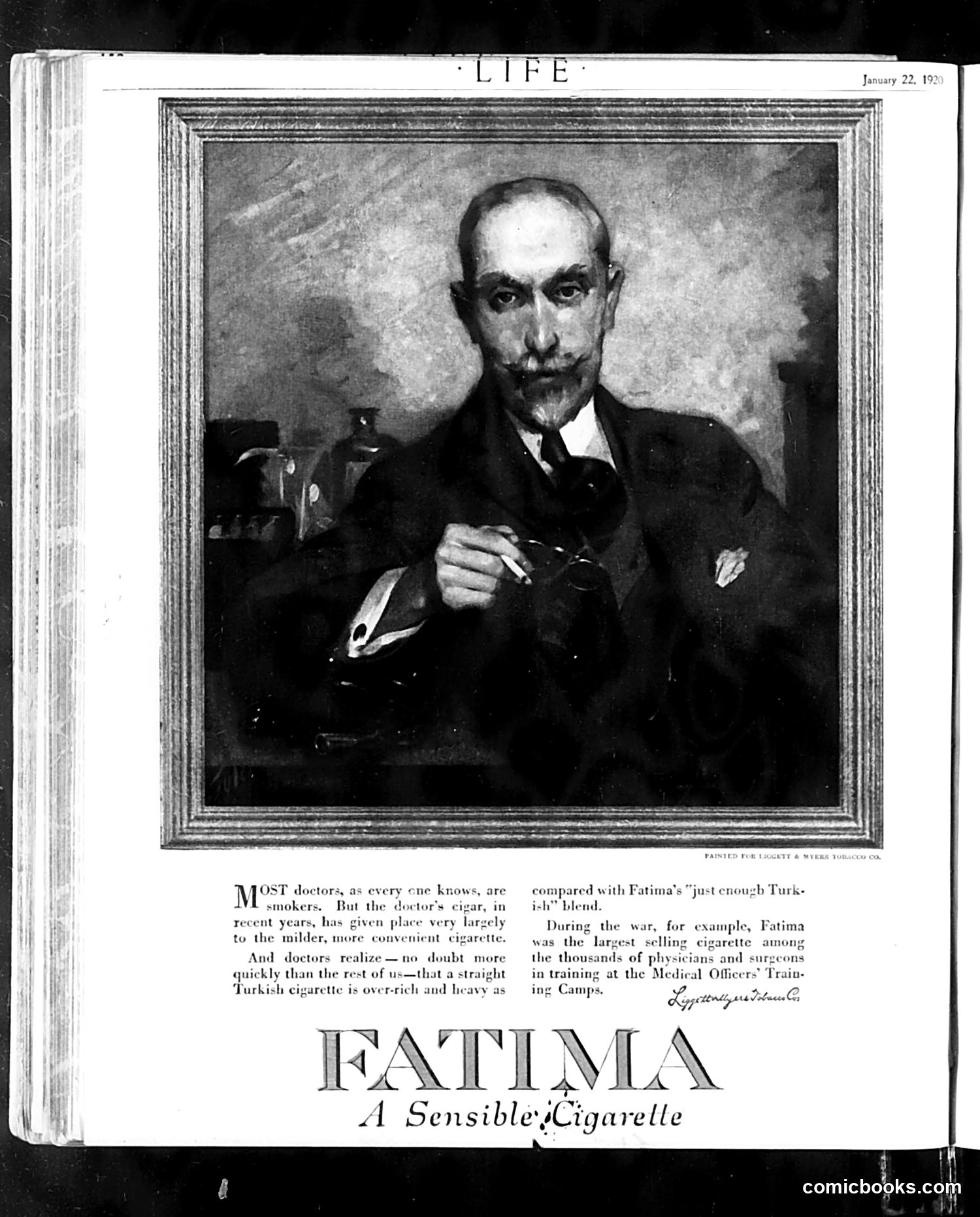
This is a **cigarette advertisement** from *Life* magazine (January 22, 1933), not a political cartoon. The image shows a well-dressed man in formal attire holding a cigarette, presented as an authority figure—likely a doctor, given the ad's messaging about physicians. **The Pitch:** The ad argues that doctors have abandoned heavy Turkish cigarettes in favor of milder options like Fatima. It claims "straight Turkish cigarette is over-rich and heavy" and that doctors recognize this. The ad references Fatima's popularity during WWI among medical personnel at training camps. **The Satire/Strategy:** This is a common early-20th-century advertising tactic—using doctors' perceived endorsement to legitimize cigarettes as "sensible" and healthy. The ad exploits medical authority to market a product we now know is harmful. **What modern readers miss:** This reflects an era when cigarette marketing could freely invoke doctor approval, before health warnings were required. The irony—that doctors smoking cigarettes was considered evidence of safety—is now glaringly obvious.