
Life, 1920-01-22 · page 20 of 36
Life — January 22, 1920 — page 20: what you’re looking at
What you’re looking at
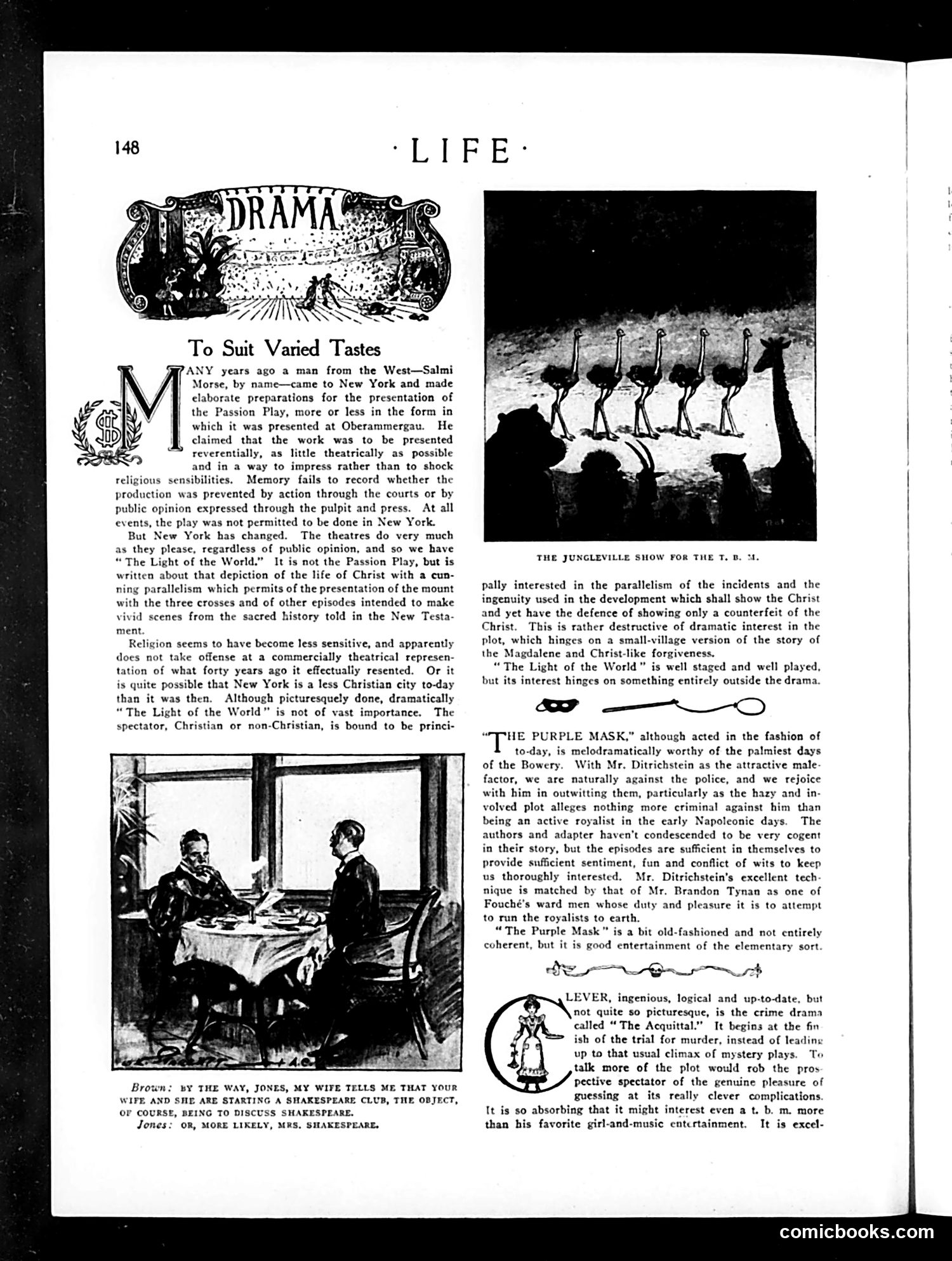
This page reviews Broadway theatrical productions, with particular focus on religious drama's acceptability in New York society. The main article discusses "The Light of the World," a play about Christ presented with deliberate theatrical parallelism. The author notes a striking cultural shift: forty years prior, a reverential Passion Play by Salmi Morse was prevented—either by courts or public religious outcry. Now, New York theaters operate without such restrictions, suggesting either diminished religious sensitivity or that the city has become "less Christian." The bottom cartoon is a joke about a Shakespeare Club: when one character mentions his wife is starting one "to discuss Shakespeare," his friend quips it's "more likely, Mrs. Shakespeare"—implying the wives will gossip about the playwright's wife rather than study his works. The page also briefly reviews "The Purple Mask" and "The Acquittal," melodramatic crime plays of varying quality.
📄 Transcribed text from this page (OCR, searchable)
Machine-transcribed from the original scan — historical spelling and the odd misread are preserved.
To Suit Varied Tastes ANY years ago a man from the West—Salmi Morse, by name—came to New York and made elaborate preparations for the presentation of the Passion Play, more or less in the form in which it was presented at Oberammergau. He claimed that the work was to be presented reverentially, as little theatrically as possible and in a way to impress rather than to shock religious sensibilities. Memory fails to record whether the production was prevented by action through the courts or by public opinion expressed through the pulpit and press. At all events, the play was not permitted to be done in New York. But New York has changed. The theatres do very much as they please, regardless of public opinion, and so we have “The Light of the World.” It is not the Passion Play, but is written about that depiction of the life of Christ with a cun- ning parallelism which permits of the presentation of the mount with the three crosses and of other episodes intended to make vivid scenes from the sacred history told in the New Testa- ment. Religion seems to have become less sensitive, and apparently does not take offense at a commercially theatrical represen- tation of what forty years ago it effectually resented. Or it is quite possible that New York is a less Christian city to-day than it was then. Although picturesquely done, dramatically “The Light of the World” is not of vast importance. The spectator, Christian or non-Christian, is bound to be princi- Brown: wY THE WAY, JONES, MY WIFE TELLS ME THAT YOUR WIFE AND SHE ARE STARTING A SHAKESPEARE CLUB, THE OBJECT, OF COURSE, BEING TO DISCUSS SHAKESPEARE. Jones: OR, MORE LIKELY, MRS, SHAKESPEARE. THE JUNGLEVILLE SHOW FOR THE T. B. ML pally interested in the parallelism of the incidents and the ingenuity used in the development which shall show the Christ and yet have the defence of showing only a counterfeit of the Christ. This is rather destructive of dramatic interest in the plot, which hinges on a small-village version of the story of the Magdalene and Christ-like forgiveness. “The Light of the World” is well staged and well played, but its interest hinges on something entirely outside the drama. (= ee SD) “"CHE PURPLE MASK,” although acted in the fashion of to-day, is melodramatically worthy of the palmiest days of the Bowery. With Mr. Ditrichstein as the attractive male. factor, we are naturally against the police, and we rejoice with him in outwitting them, particularly as the hazy and in- volved plot alleges nothing more criminal against him than being an active royalist in the early Napoleonic days. The authors and adapter haven't condescended to be very cogent in their story, but the episodes are sufficient in themselves to provide sufficient sentiment, fun and conflict of wits to keep us thoroughly interested. Mr. Ditrichstein’s excellent tech- nique is matched by that of Mr. Brandon Tynan as one of Fouché's ward men whose duty and pleasure it is to attempt to run the royalists to earth. “The Purple Mask” is a bit old-fashioned and not entirely coherent, but it is good entertainment of the elementary sort. LEVER, ingenious, logical and up-to-date, but not quite so picturesque, is the crime drama called “ The Acquittal.” It begins at the fin ish of the trial for murder, instead of leadinx up to that usual climax of mystery plays. To talk more of the plot would rob the pros pective spectator of the genuine pleasure of guessing at its really clever complications. It is so absorbing that it might interest even a t. b. m. more than his favorite girl-and-music entertainment. It is excel- comicbooks.com