
Life, 1920-01-22 · page 17 of 36
Life — January 22, 1920 — page 17: what you’re looking at
What you’re looking at
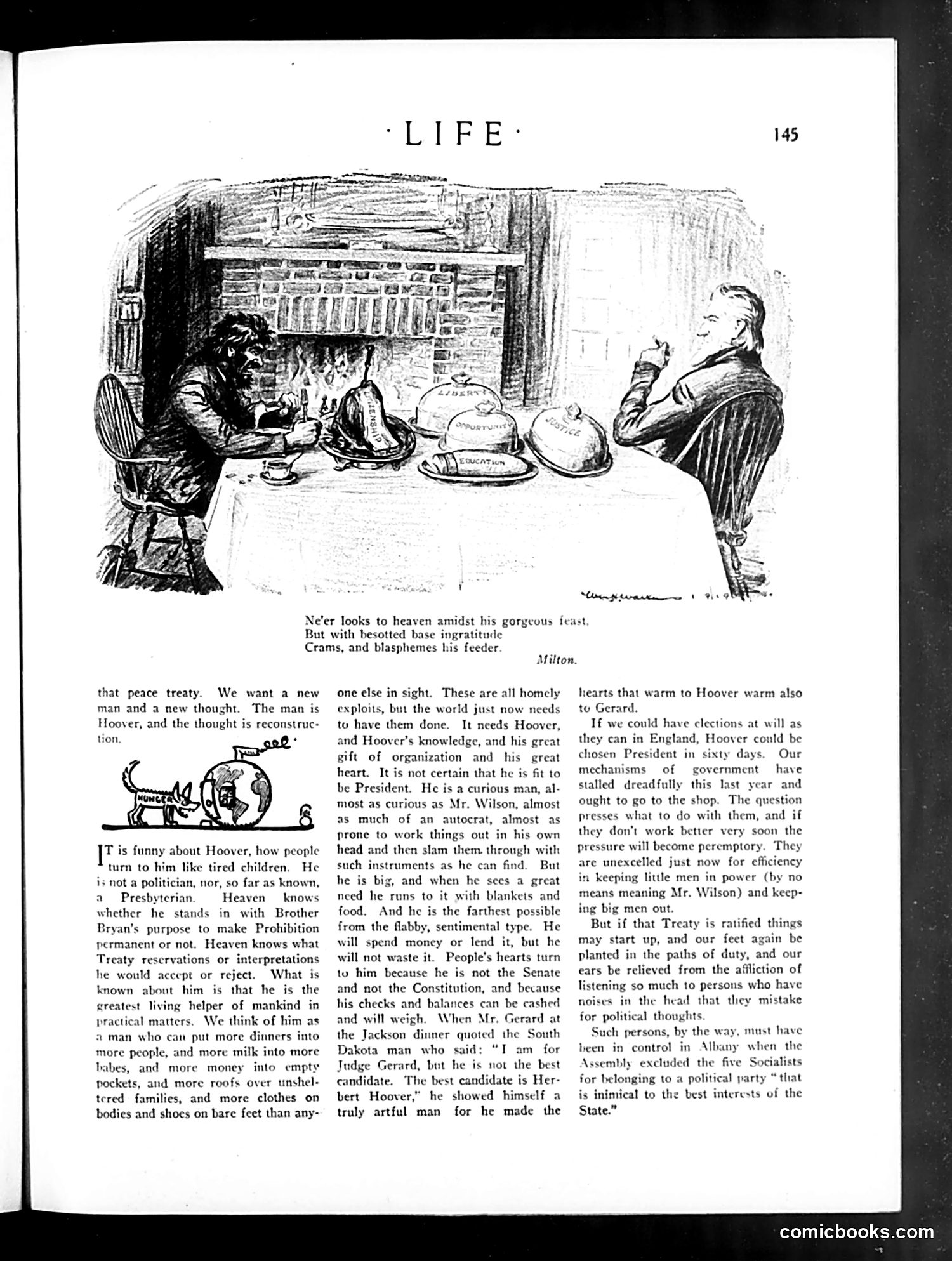
This page advocates for **Herbert Hoover** as a presidential candidate, contrasting his practical competence with Wilson's perceived ineffectiveness. The cartoon depicts two diners—likely representing different political views—sharing a meal, with labeled dishes suggesting competing interests or platforms. The text praises Hoover as a non-politician with exceptional organizational skills and humanitarian concern (references his WWI relief work). It criticizes the current government's mechanisms as inefficient and designed to keep "little men in power" while blocking capable leaders. A secondary political jab targets **Albany's Assembly**, which recently expelled five Socialist legislators for belonging to a party deemed "inimical to the State." The author views this as an example of government overreach by small-minded officials. The Milton epigraph mocks ingratitude toward benefactors—likely referring to public indifference toward Hoover's aid efforts or to Wilson's governance after the war.
📄 Transcribed text from this page (OCR, searchable)
Machine-transcribed from the original scan — historical spelling and the odd misread are preserved.
Ne’er looks to heaven amidst his gorgeous feast, But with besotted base ingratitude Crams, and blasphemes his feeder. that peace treaty. We want a new man and a new thought. The man is Hoover, and the thought is reconstruc- tion r is funny about Hoover, how pcople turn to him like tired children. He is not a politician, nor, so far as known, a Presbyterian. Heaven knows whether he stands in with Brother Bryan's purpose to make Prohibition permanent or not. Heaven knows what Treaty reservations or interpretations he would accept or reject. What is known about him is that he is the greatest living helper of mankind in practical matters. We think of him as st man who can put more dinners into more people, and more milk into more babes, and more money into empty pockets, and more roofs over unshel- tered families, and more clothes on bodies and shoes on bare feet than any- Milton. one else in sight. These are all homely exploits, but the world just now needs to have them done. It needs Hoover, and Hoover's knowledge, and his great gift of organization and his great heart. It is not certain that he is fit to be President. He is a curious man, al- most as curious as Mr. Wilson, almost as much of an autocrat, almost as prone to work things out in his own head and then slam them. through with such instruments as he can find. But he is big, and when he sees a great need he runs to it with blankets and food. And he is the farthest possible from the flabby, sentimental type. He will spend money or lend it, but he will not waste it. People’s hearts turn tu him because he is not the Senate and not the Constitution, and because his checks and balances can be cashed and will weigh. When Mr. Gerard at the Jackson dinner quoted the South Dakota man who said: “I am for Judge Gerard, but he is not the best candidate. The best candidate is Her- bert Hoover,” he showed himself a truly artful man for he made the hearts that warm to Hoover warm also te Gerard. If we could have elections at will as they can in England, Hoover could be chosen President in sixty days. Our mechanisms of government have stalled dreadfully this last year and ought to go to the shop. The question presses what to do with them, and if they don’t work better very soon the pressure will become peremptory. They are unexcelled just now for efficiency in keeping little men in power (by no means meaning Mr. Wilson) and keep- ing big men out. But if that Treaty is ratified things may start up, and our feet again be planted in the paths of duty, and our ears be relieved from the affliction of listening so much to persons who have noises in the head that they mistake for political thoughts. Such persons, by the way, must have been in control in Albany when the Assembly excluded the five Socialists for belonging to a political party “that is inimical to the best interests of the State.” comicbooks.com .