
Life, 1920-01-22 · page 21 of 36
Life — January 22, 1920 — page 21: what you’re looking at
What you’re looking at
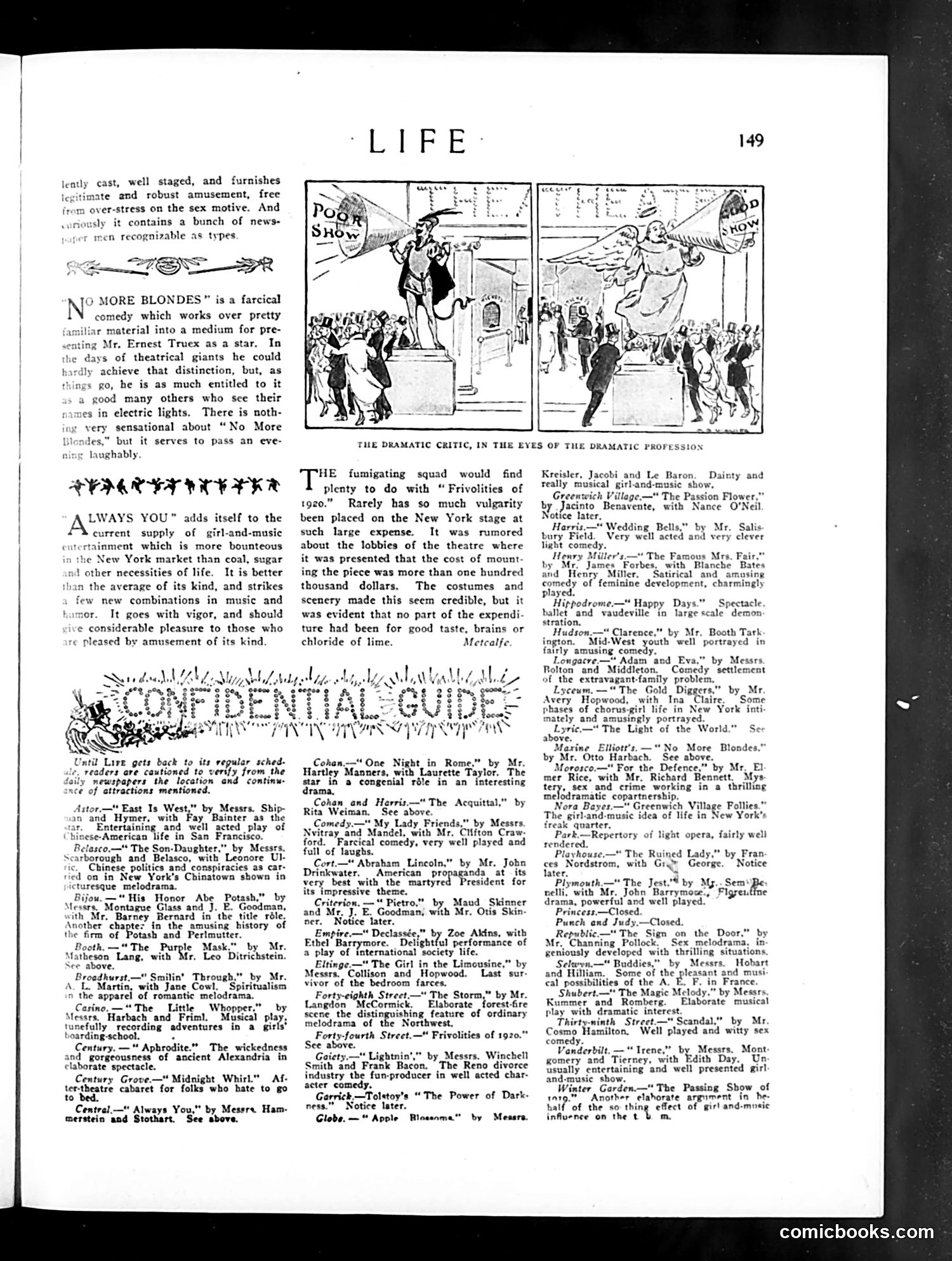
This page from Life magazine (circa 1920) contains theater reviews and a cartoon satirizing dramatic critics. The two-panel cartoon at the top shows "The Dramatic Critic, in the Eyes of the Dramatic Profession"—depicting how theater professionals viewed theater critics. The cartoon contrasts two perspectives: On the left, a critic appears to be dismissively evaluating a theatrical performance; on the right, the profession's view of critics is shown as inflated, pompous figures. The satire suggests critics wielded disproportionate power over theatrical success, and that performers and producers resented their influence. The accompanying text reviews various Broadway productions, including mentions of "No More Blondes" (starring Ernest Truex) and "Always You." A particularly harsh review of "Frivolities of 1920" criticizes its vulgar content and expensive production values ($100,000+), suggesting money was wasted on spectacle rather than quality writing. The overall message: critics held significant sway over theater's commercial and artistic success, a tension that clearly frustrated the theatrical community being reviewed.
📄 Transcribed text from this page (OCR, searchable)
Machine-transcribed from the original scan — historical spelling and the odd misread are preserved.
cast, well staged, and furnishes timate and robust amusement, free over-stress on the sex motive. And ssly it contains a bunch of news- en recognizable as types. LPR N' ) MORE BLONDES” is a farcical comedy which works over pretty iar material into a medium for pre- ting Mr. Ernest Truex as a star. In days of theatrical giants he could achieve that distinction, but, as ngs go, he is as much entitled to it a good many others who sce their es in electric lights. There is noth- very sensational about “No More Diondes,” but it serves to pass an eve- ning laughably TEPER ETAT FKR LWAYS YOU” adds itself to the current supply of girl-and-music ainment which is more bounteous » the New York market than coal, sugar } other necessities of life. It is better the average of its kind, and strikes w new combinations in music and humor. It goes with vigor, and should ¢ considerable pleasure to those who re pleased by amusement of its kind. Until Lire gets back to its regular sched- readers are cautioned to verify from the newspapers the location and continu- of attractions mentioned. Astor — East Is West,” by Messrs. Ship- vn and Hym fay Bainter as the r. Entertaining and well acted play of ese-American life in San Francisco. co.—"* The Son-Daughter,” by Messrs. Scarborough and Belasco, with Leonore UI- Chinese. politics and conspiracies as car- red on in New York's Chinatown shown in cturesque melodrama. Bijou. —" His Honor Abe Potash,” by Messrs.” Montague Glass and J. E. Goodman, vith Mr, Barney Bernard in the title réle, Another chapte: in the amusing history of the firm of Potash and Perlmutter. Booth. —"The Purple Mask.” by Mr. Matheson Lang, with Mr. Leo Ditrichstein. See above. Broadhurst.—" Smilin’ Through.” by Mr. A. L. Martin, with Jane Cowl. Spiritualism 1 the apparel of romantic melodrama, Casino, —“The Little Whopper.” by Messrs, Harbach and Friml. Musical pla tunefully recording adventures in a gir boarding-school. . Century. —“ Aphrodite.” The wickedness and gorgeousness of ancient Alexandria in claborate spectacle. Century Grove.— Midnight Whirl” Af. ter-theatre cabaret for folks who hate to go to bed. Central.—" Always You,” by Mesera. Ham- merstein and Stothart. See above. THE DRAMATIC CRITIC, IN THE EYES OF THE DRAMATIC PROFESSION HE fumigating squad would find plenty to do with “ Frivolities of tgzo." Rarely has so much vulgarity been placed on the New York stage at such large expense. It was rumored about the lobbies of the theatre where it was presented that the cost of mount- ing the piece was more than one hundred thousand dollars. The costumes and scenery made this seem credible, but it was evident that no part of the expendi- ture had been for good taste, brains or chloride of lime. Metcalfe. prema MY NEC Cohan.—" One Night in Rome,” by Mr. Hartley Manners, with Laurette Taylor. The star in a congenial réle in an interesting drama, Cohan and Herris.—" The Acquittal,” by Rita Weiman. See above. Comed: My Lady Friends,” by Messrs. Nvitray and Mandel, with Mr. Clifton Craw- ford. Farcical comedy, very well played and full of laughs. Cort.—" Abraham Lincoln,” by Mr. Jobn Drinkwater. American propaganda at its very best with the martyred President for its impressive theme. by Maud Skinner PZT TONS Criterion. —“ Pietro,” and Mr. J. E. Goodman, with Mr. Otis Skin- ner. Notice later. Empire.— Declassée,” by Zoe Akins, with Ethel Barrymore. Delightful performance of a play of international society life. Eltinge.—" The Girl in the Limousine,” by Messrs. Collison and Hopwood. Last sur- vivor of the bedroom farces. Forty-eighth Street.—" The Storm,” by Mr. Langdon McCormick. Elaborate forest-fi scene the disti melodrama of ‘the Northwest, Forty-fourth Street.— Frivolities of 1920.” See above. Geiety.—"* Lightnin’,” by Messrs. W Smith and Frank Bacon. The Reno divorce industry the fun-producer in well acted char- acter comedy. Tolstoy's “The Power of Dark- ness.” Globe. —" Apple Messrs. Riosenma” by Kreisler, Jacobi and Le Baron. Dainty and really musical girland-music show, Greenwich Village." The Passion Flower,” by Jacinto Benavente, with Nance O'Neil Notice later. * Wedding Bells,” Very well acted a by Mr. Salis. nd very clever light comed Hi Miller’s.—" The Famous Mrs. Fair,” James Forbes, with Blanche Bates id Heriry Miller. Satirical and amusing medy of feminine development, charmingly played. Hippodrome.— Happy Days.”” Spectacle ballet and vaudeville in large scale demon stration. Hudson. Clarence," by Mr. Booth Tark ington. Mid-West youth well portrayed in fairly amusing come Longacre—" Adam and Eva." by Messrs. Rolton and Middleton. Comedy settlement of the extravagant-family problem. Lyceum. —“ The Gold by_ Mr. Avery Hopwood, with Claire, Some phases of chorus-girl life in New York inti mately and amusingly portrayed. Lyric.—" The Light of the World.” above. Marine Elliott's. —“ No More Blondes, by Mr. Otto Harbach. See above. Morosco.—"' For the Defence.” by Mr, El mer Rice, with Mr. Richard Bennett. Mys tery, sex and crime working in a thrilling melodramatic copartnership. Nora Bayes— i The girl-and-music idea of life in freak quarter. Park.—Repertory of light opera, fairly well rendered, “The Ruined Lady,” by Fran New York's ces Nordstrom, with Gror George. Notice later. Plymouth.—" The Jest. by My..Sem y nelli, with Mr. John Barrymoce., Figrentine drama, powerful and well played. Princess.—Closed. Punch and Judy.—Closed. Republic_—" The Sign on the Door,” by Mr. Channing Pollock, Sex melodrama, in. geniously developed with thrilling situations. Selwyn.—" Buddies,” by Messrs. Hobart and Hilliam. Some of the pleasant and musi cal possibilities of the A. E. F. in France. Shubert.—"* The Magic Melody.” by Messrs Kummer and Romberg. Elaborate musical play with dramatic interest Thirty-ninth Street.—" Scandal,” by Mr Cosmo Hamilton, Well played and witty sex comedy. Vanderbilt. —“‘ Irene,” by Messrs. Mont gomery and Tierney, with Edith Day. Un: Usually entertaining and well presented girl and-music show. Winter Garden.—" The Passing Show of taro." Another elahorate argument in he- half of the so thing effect of gir! and-mosic influence on the t 4 nm comicbooks.com