
Life, 1920-01-22 · page 16 of 36
Life — January 22, 1920 — page 16: what you’re looking at
What you’re looking at
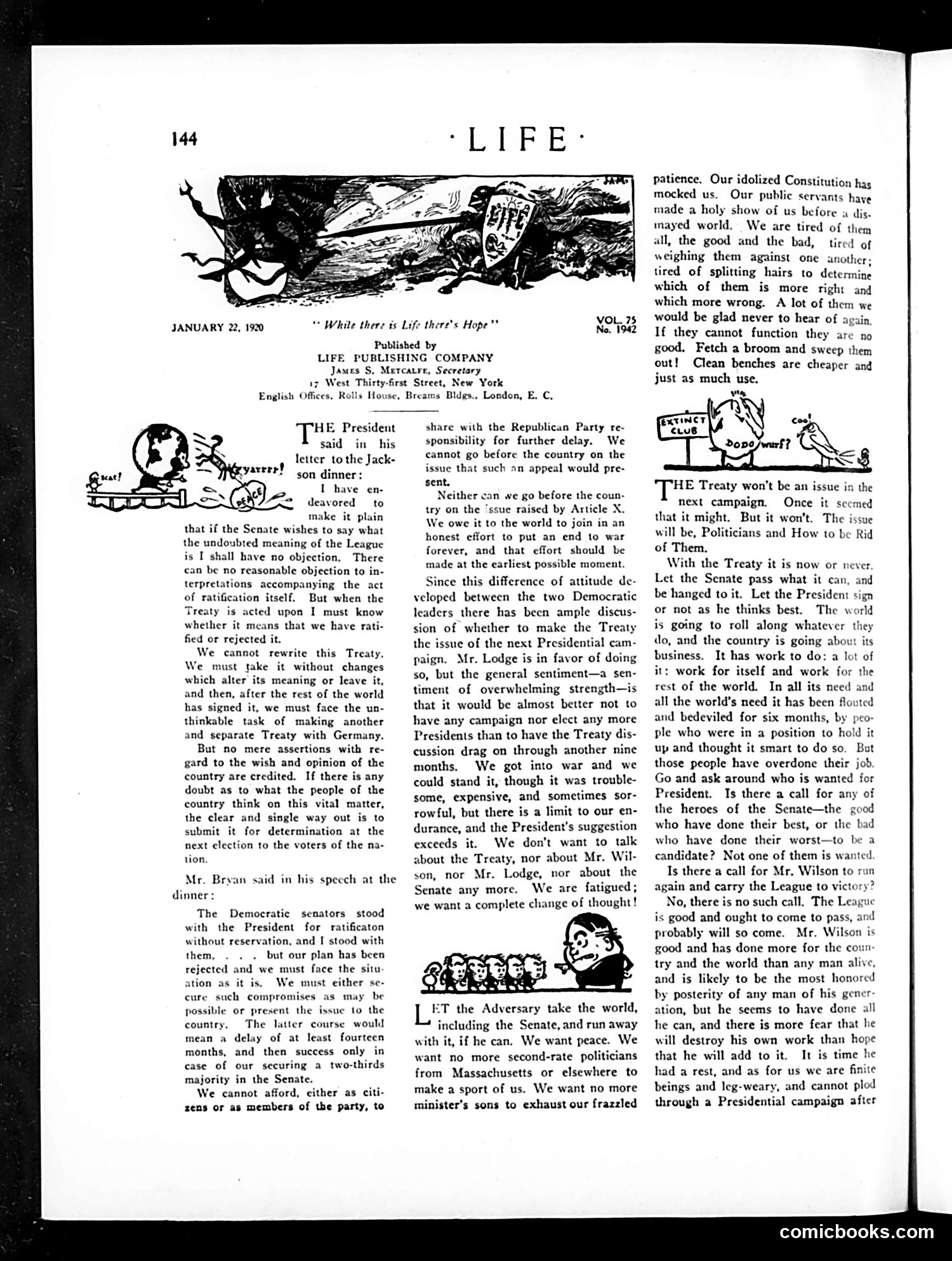
This page satirizes the heated debate over the League of Nations Treaty following World War I. President Wilson (referenced in his letter to a Jackson dinner) and William Jennings Bryan (quoted in his speech) represent the Democratic position supporting ratification, while Senator Henry Cabot Lodge led Republican opposition. The cartoon's main point: **public exhaustion**. The text expresses the American people's fatigue with endless political wrangling over whether to ratify the treaty, with Article X being the central sticking point. Rather than debating the League's merits, citizens are portrayed as simply *tired*—fed up with politicians, constitutional arguments, and drawn-out Senate proceedings. The satire captures genuine 1920 sentiment: Americans wanted peace and decisiveness, not prolonged political theater. The phrase "We want a complete change of thought" encapsulates the frustration driving the eventual rejection of the League.
📄 Transcribed text from this page (OCR, searchable)
Machine-transcribed from the original scan — historical spelling and the odd misread are preserved.
JANUARY 22, 1920 “While there is Life there's Hope” Published by LIFE PUBLISHING COMPANY James S, Metcatrr, Secretary 17 West Thirty-first Street, New York English Offices, Rolls House, Breams Bldgs., London, E. C, HE President said in his letter to the Jack- * son dinner: I have en- deavored to make it plain that if the Senate wishes to say what the undoubted meaning of the League is I shall have no objection. There can be no reasonable objection to in- terpretations accompanying the act of ratification itself, But when the Treaty is acted upon I must know whether it means that we have rati- fied or rejected it. We cannot rewrite this Treaty. We must take it without changes which alter its meaning or leave it, and then, after the rest of the world has signed it, we must face the un- thinkable task of making another and separate Treaty with Germany. But no mere assertions with re- gard to the wish and opinion of the country are credited. If there is any doubt as to what the people of the country think on this vital matter, the clear and single way out is to submit it for determination at the next election to the voters of the na- tion. Mr. Bryan said in his speech at the dinner : The Democratic senators stood with the President for ratificaton without reservation, and I stood with them, . . . but our plan has been rejected and we must face the situ ation as it is. We must either se- cure such compromises as may be possible or present the issue to the country, The latter course would mean a delay of at least fourteen months, and then success only in case of our securing a two-thirds majority in the Senate. We cannot afford, either as citi- zens or as members of the party, to share with the Republican Party re- sponsibility for further delay. We cannot go before the country on the issue that such an appeal would pre- sent. Neither can we go before the coun- try on the ‘ssue raised by Article X. We owe it to the world to join in an honest effort to put an end to war forever, and that effort should be made at the earliest possible moment. Since this difference of attitude de- veloped between the two Democratic leaders there has been ample discus- sion of whether to make the Treaty the issue of the next Presidential cam- paign, Mr. Lodge is in favor of doing so, but the general sentiment—a sen- timent of overwhelming strength—is that it would be almost better not to have any campaign nor elect any more Presidents than to have the Treaty dis- cussion drag on through another nine months. We got into war and we could stand it, though it was trouble- some, expensive, and sometimes sor- rowful, but there is a limit to our en- durance, and the President’s suggestion exceeds it. We don’t want to talk about the Treaty, nor about Mr. Wil- son, nor Mr. Lodge, nor about the Senate any more. We are fatigued; we want a complete change of thought! the Adversary take the world, including the Senate, and run away with it, if he can. We want peace. We want no more second-rate politicians from Massachusetts or elsewhere to make a sport of us. We want no more minister’s sons to exhaust our frazzled patience. Our idolized Constitution has mocked us. Our public servants haye made a holy show of us before a dis mayed world. We are tired of them all, the good and the bad, tired of weighing them against one another; tired of splitting hairs to determine which of them is more right and which more wrong. A lot of them we would be glad never to hear of « If they cannot function they are no good. Fetch a broom and sweep them out! Clean benches are cheaper and just as much use, THE Treaty won't be an issue in the next campaign. Once it secmed that it might. But it won't. The issue will be, Politicians and How to be Rid of Them. With the Treaty it is now or never. Let the Senate pass what it can, and be hanged to it. Let the President sign or not as he thinks best. The world is going to roll along whatever they do, and the country is going about its business. It has work to do: a lot of it: work for itself and work for the rest of the world. In all its need and all the world’s need it has been flouted and bedeviled for six months, by peo- ple who were in a position to hold it up and thought it smart to do so. But those people have overdone their job. Go and ask around who is wanted for President. Is there a call for any of the heroes of the Senate—the good who have done their best, or the bad who have done their worst—to be a candidate? Not one of them is wanted. Is there a call for Mr, Wilson to run again and carry the League to victor No, there is no such call. The Lea, is good and ought to come to pass, and probably will so come. Mr. Wilson is good and has done more for the cou try and the world than any man alive, and is likely to be the most honored by posterity of any man of his gener- ation, but he seems to have done all he can, and there is more fear that he will destroy his own work than hope that he will add to it. It is time he had a rest, and as for us we are finite beings and leg-weary, and cannot plod through a Presidential campaign after comicbooks.com