
Life, 1920-01-22 · page 22 of 36
Life — January 22, 1920 — page 22: what you’re looking at
What you’re looking at
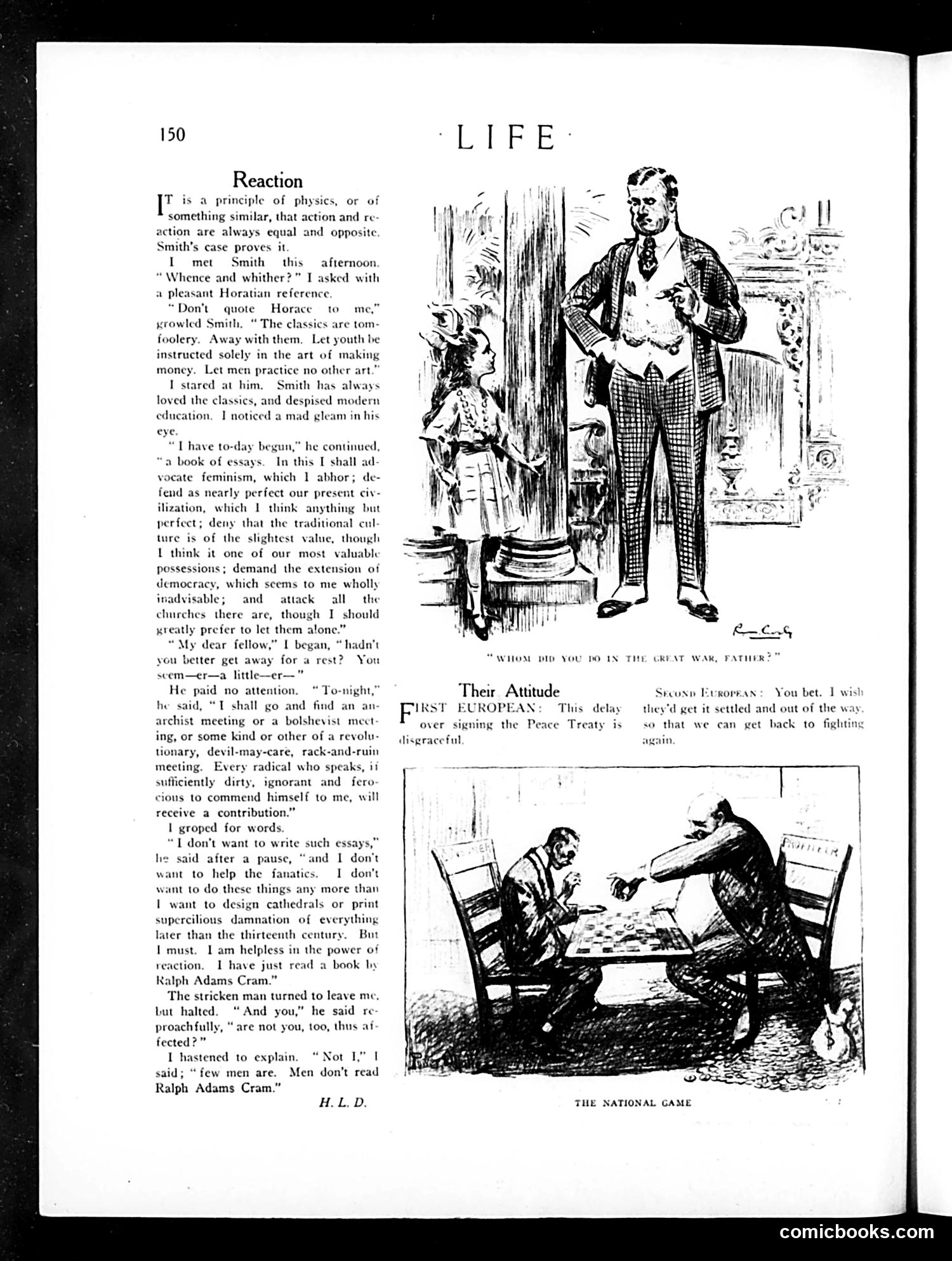
**"Reaction" (left):** A humorous essay about a man named Smith who has undergone a complete ideological reversal after reading Ralph Adams Cram's work (likely his conservative architectural/cultural criticism). Smith, formerly a classics-loving traditionalist, now advocates feminism, democracy, and radicalism—positions he actually despises. The joke satirizes how exposure to reactionary arguments can paradoxically push someone toward radical positions through contrarian impulse. The narrator is unaffected because "men don't read Ralph Adams Cram." **"Their Attitude" (bottom right):** Two cartoons about post-WWI attitudes. The top depicts a father and child discussing his wartime role, with Europeans eager to "get back to fighting again"—satirizing the failure of the Peace Treaty to create lasting peace and the cynical European appetite for renewed conflict. **"The National Game" (bottom):** Shows two men playing chess, captioned as "the national game," likely suggesting diplomacy or international relations as a mere game played by those indifferent to human consequences.
📄 Transcribed text from this page (OCR, searchable)
Machine-transcribed from the original scan — historical spelling and the odd misread are preserved.
150 Reaction I" is a principle of physics, or of omething similar, that action and re- ction are always equal and opposite. Smith's case proves it [met Smith this afternoon “Whence and whither?” I asked with a pleasant Horatian reference. “Don't quote Hor to me,” xrowled Smith. “ The classics are tom- foolery. Away with them, Let youth be instructed solely in the art of making money. Let men practice no other art.” I stared at him. Smith has always loved the classics, and despised modern education. I noticed a mad gleam in his eye. “T have to-day begun,” he continued, “a book of essays. In this I shall ad- vocate feminism, which 1 abhor; de- fend as nearly perfect our present civ- ilization, which I think anything but perfect; deny that the traditional cul ture is of the slightest value, though 1 think it one of our most valuable possessions; demand the extension of democracy, which seems to me wholly inadvisable; and attack all the churches there are, though I should xreatly prefer to let them alone.” ty dear fellow,” I began, “hadn't you better get away for a rest? You scem—er—a litthe—er— He paid no attention.“ To-night,” he said, “T shall go and find an an archist meeting or a bolshevist: meet- ing, or some kind or other of a revolu- tionary, devil-may-care, rack-and-ruin meeting. Every radical who speaks, ii sufficiently dirty, ignorant and fero cious to commend himself to me, will receive a contribution.” I groped for words. “1 don’t want to write such essays,” he said after a pause, “and I don't want to help the fanatics. I don't want to do these things any more than 1 want to design cathedrals or print supercilious damnation of everything later than the thirteenth century. But I must. 1 am helpless in the power of reaction. I have just read a book by Ralph Adams Cram.” The stricken man turned to leave me, but halted. “And you,” he said re proach fully, “are not you, too, thus af astened to explain. “Not 1," 1 few men are. Men don’t read Ralph Adams Cram.” H.L. D. IRST Their Attitude Sreox This delay they'd get it settled and out of the way EUROPEAN testi “WHOM DID YOU POOIN THE GREAT WAR, FATHER?” Evrorkan You bet. 1 wis! over signing the Peace Treaty is so that we can get back to fighting disgr: ful gain. THE NATIONAL GAME comicbooks.com