
Life, 1920-01-22 · page 28 of 36
Life — January 22, 1920 — page 28: what you’re looking at
What you’re looking at
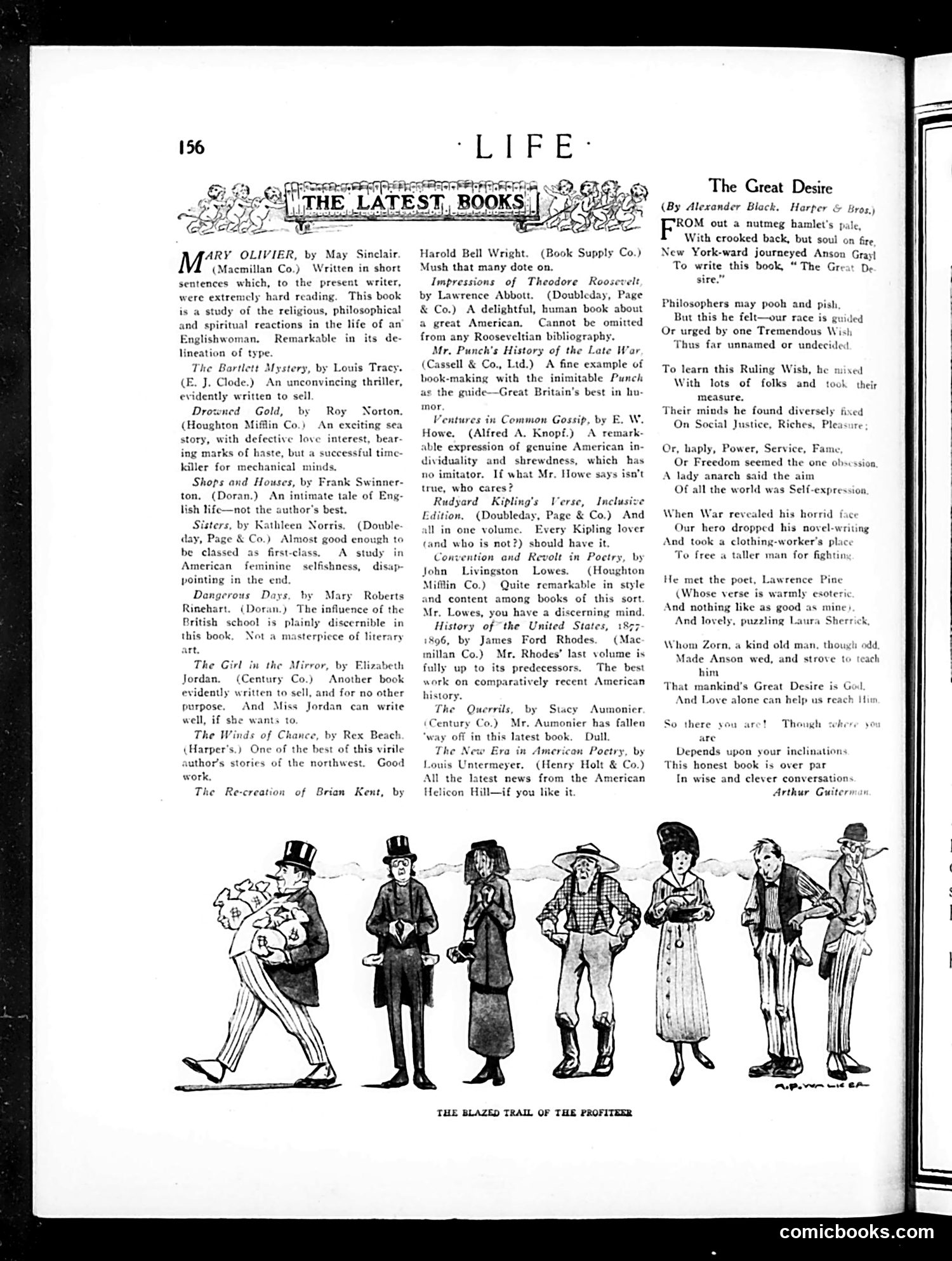
This page is primarily a **book review section** from Life magazine. The cartoon at the bottom—"The Blazed Trail of the Profiteer"—appears to satirize **wartime profiteering during World War I**. The seven figures represent different character types or social classes who exploited the war for personal gain. The leftmost figure, laden with money bags, likely represents the war profiteer—someone accumulating wealth through military contracts or black-market dealings while others sacrificed. The varied figures alongside him (appearing to include military personnel, workers, and civilians) suggest different groups affected by or complicit in wartime exploitation. The "blazed trail" metaphor implies these profiteers left a visible, damaging path through society. This reflects contemporary American concern about wealthy industrialists and speculators enriching themselves while soldiers fought and civilians suffered rationing and hardship.
📄 Transcribed text from this page (OCR, searchable)
Machine-transcribed from the original scan — historical spelling and the odd misread are preserved.
YARY OLIVIER, by May Sinclair. (Macmillan Co.) Written in short sentences which, to the present writer, were extremely hard reading. This book is a study of the religious, philosophical d spiritual reactions in the life of an lishwoman, Remarkable in its de- lineation of type. The Bartlett Mystery, by Louis Tracy. (E. J, Clode.) An unconvincing thriller, evidently written to sell Drowned Gold, by Roy Norton. (Houghton Mifflin Co.) An exciting sea story, with defective love interest, bear- ing marks of haste, but a successful time- killer for mechanical minds. Shops and Houses, by Frank Swinner- ton. (Doran.) An intimate tale of Eng- lish life—not the author's best. Sisters, by Kathleen Norris. (Double. day, Page & Co.) Almost good enough to be classed as first-class. A study in American feminine selfishness, disap- pointing in the end. Dangerous Days, by Mary Roberts Rinehart. (Doran.) The influence of the British school is plainly discernible in this book art. The Girl in the Mirror, by Elizabeth Jordan. (Century Co.) Another book evidently written to sell, and for no other purpose. And Miss Jordan can write well, if she war The Winds of Chance, by Rex Beach (Harper’s.) One of the best of this virile author's stories of the northwest. Good work, Not a masterpiece of literary The Re-creation of Brian Kent, by Harold Bell Wright. (Book Supply Co.) Mush that many dote on. Impressions of Theodore Roo. by Lawrence Abbott. (Doubleday, Page & Co.) A delightful, human book about a great American, Cannot be omitted from any Rooseveltian bibliography. Mr. Punch’s History of the Late War (Cassell & Co,, Ltd.) A fine example of book-making with the inimitable Punch as the guide—Great Britain's best in hu- mor Ventures in Common Gossip, by E. W. Howe. (Alfred A. Knopf.) A remark. ible expression of genuine American in- dividuality and shrewdness, which has no imitator. If what Mr. Howe says isn’t true, who cares? Rudyard Kipling’s Verse, Inclusive Edition, (Doubleday, Page & Co.) And ill in one volume. Every Kipling lover who is not?) should have it. Convention and Revolt in Poetry, by John Livingston Lowes. (Houghton Miffin Co.) Quite remarkable in style and content among books of this sort Mr, Lowes, you have a discerning mind. History of the United States, 1896, by James Ford Rhodes. (Mac millan Co.) Mr. Rhodes’ last volume is fully up to its predecessors. The best work on comparatively recent American history. The Querrils, by Stacy Aumonier Century Co.) Mr. Aumonier has fallen 7 in this latest book. Dull. The New Era in American Poctry, by Louis Untermeyer. (Henry Holt & Co.) All the latest news from the American Helicon Hill—if you like it. THE BLAZED TRAIL OF THE PROFITEER The Great Desire (By Alexander Black. Harper & Bros.) ROM out a nutmeg bamlet’s pale, With crooked back, but soul on fire New York-ward journeyed Anson Gray! To write this book, “The Great De sire.” Philosophers may pooh and pish But this he felt—our race is g Or urged by one Tremendous Wish Thus far unnamed or undecided To learn this Ruling Wish, he mixed With lots of folks and took their measure. Their minds he found diversely fix On Social Justice, Riches, Pleas Or, haply, Power, Service, Fame Or Freedom seemed the one obs. A lady anarch said the aim Of all the world was Self-expression When War revealed his horrid face Our hero dropped his novel-writing And took a clothing-worker’s place To free a taller man for fightin: He met the poet, Lawrence Pine (Whose verse is warmly esoteric And nothing like as good as mine) And lovely, puzzling Laura Shi Whom Zorn, a kind old man, thougli « Made Anson wed, and strove to him That mankind’s Great Desire is G: And Love alone can help us reach So there you are! Though cehere are Depends upon your inclinations This honest book is over par In wise and clever conversations Arthur Guitern upon Ue eA comicbooks.com