
A complete issue · 44 pages · 1920
Life — January 8, 1920
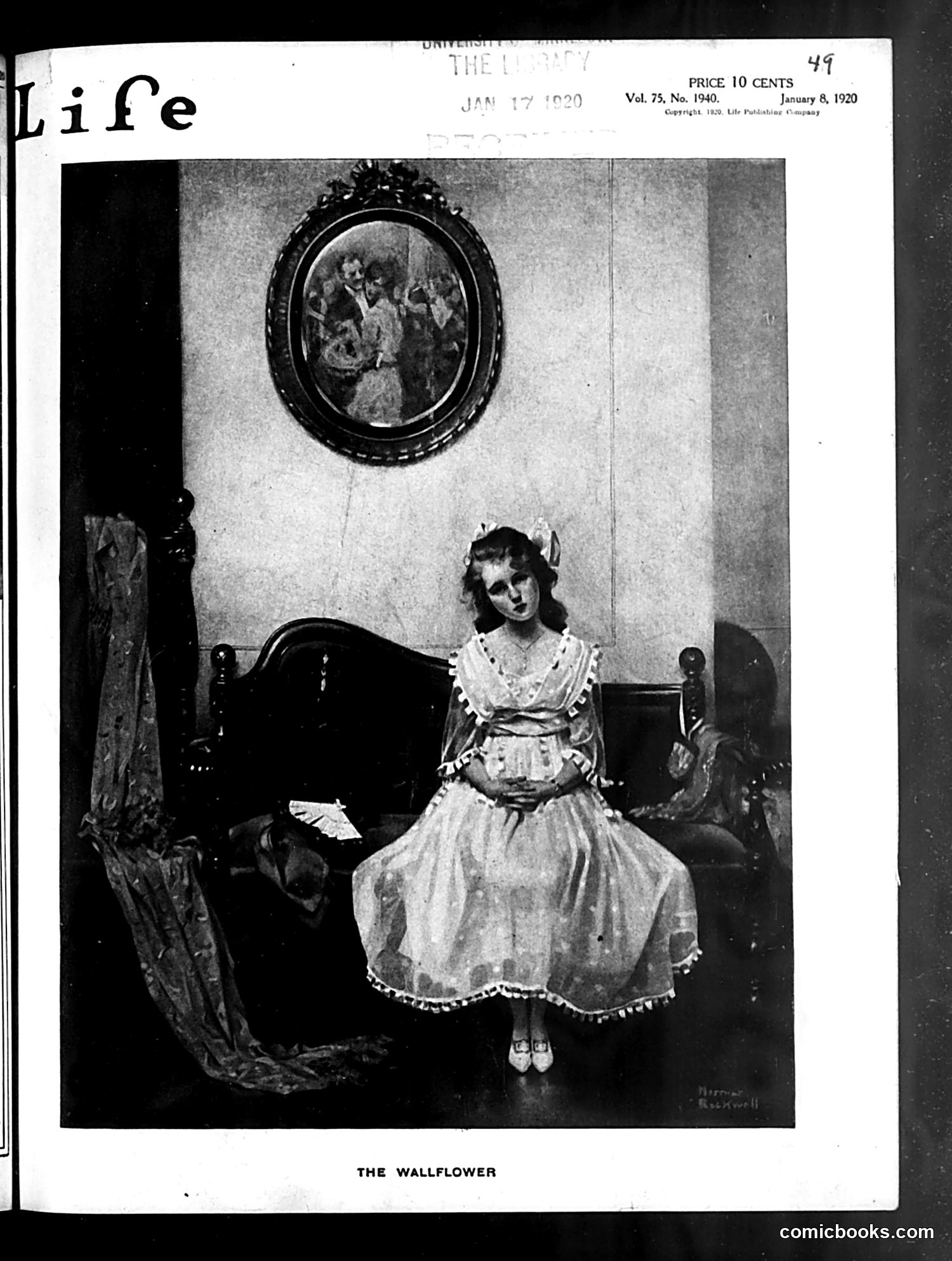
This is a satirical photograph, not a political cartoon. It depicts a young woman in an elegant white dress sitting alone in what appears to be a formal interior setting, with a portrait on the wall above her and period furniture visible. The title "The Wallflower" refers to someone (typically a woman) left sitting alone at social events, unable to find a dance partner. This image uses the term literally and metaphorically—presenting an elegantly dressed woman as socially isolated despite her refined appearance. The satire likely comments on dating conventions or social anxieties of the post-WWI era (1920), poking gentle fun at the gap between outward presentation and social acceptance among young women seeking romantic attention.
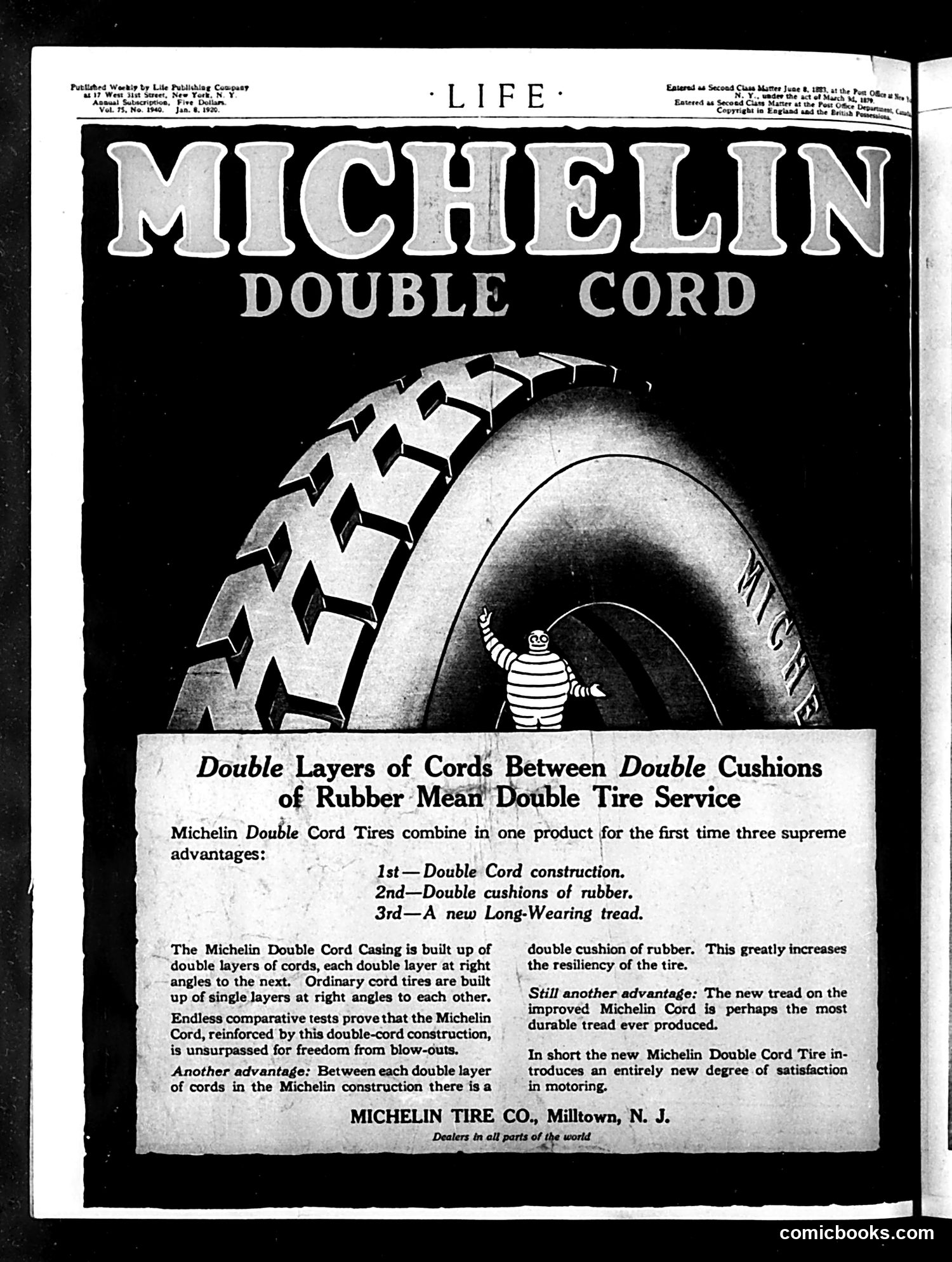
This page is **primarily a Michelin tire advertisement**, not political satire. It appears in *Life* magazine (a satirical publication that also carried ads) and promotes Michelin's "Double Cord" tire technology. The ad features: - A large tire illustration with a **Michelin Man mascot** (the recognizable character made of stacked tire rings) - Marketing copy emphasizing three innovations: double cord construction, double rubber cushions, and improved tread durability - Claims of superior performance and "long-wearing" capabilities The small figure beside the tire is the iconic **Michelin Man** (Bibendum), the company's anthropomorphic brand mascot since 1898. There is **no political cartoon or satire here**—this is straightforward commercial advertising using the brand's established visual identity and marketing language typical of early-20th-century tire promotions.
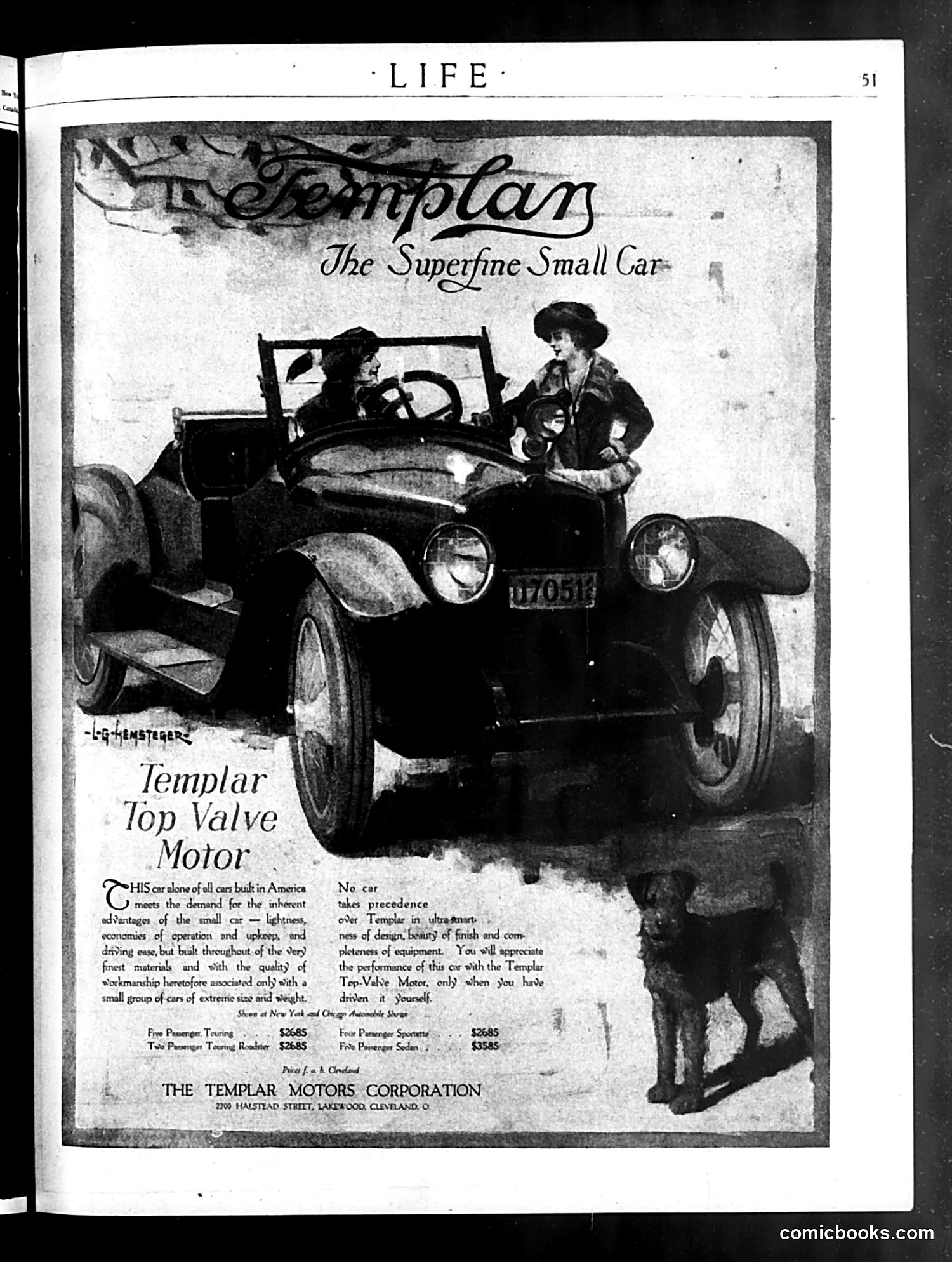
This page is **primarily an advertisement**, not satire or political commentary. It promotes the Templar automobile, described as "The Superfine Small Car" with a "Top Valve Motor." The image shows three well-dressed figures (two women and a child) posing with the vehicle, emphasizing its appeal to middle-class families. The accompanying text highlights the car's efficiency, quality construction, and reliable performance—standard marketing language for early automotive advertising. The advertisement lists several model prices ($2585-$3585) and identifies the manufacturer as the Templar Motors Corporation in Lakewood, Cleveland, Ohio. There is **no political satire or social commentary** present. This is straightforward commercial advertising from the early automotive era, targeting consumers seeking affordable, well-built personal transportation.
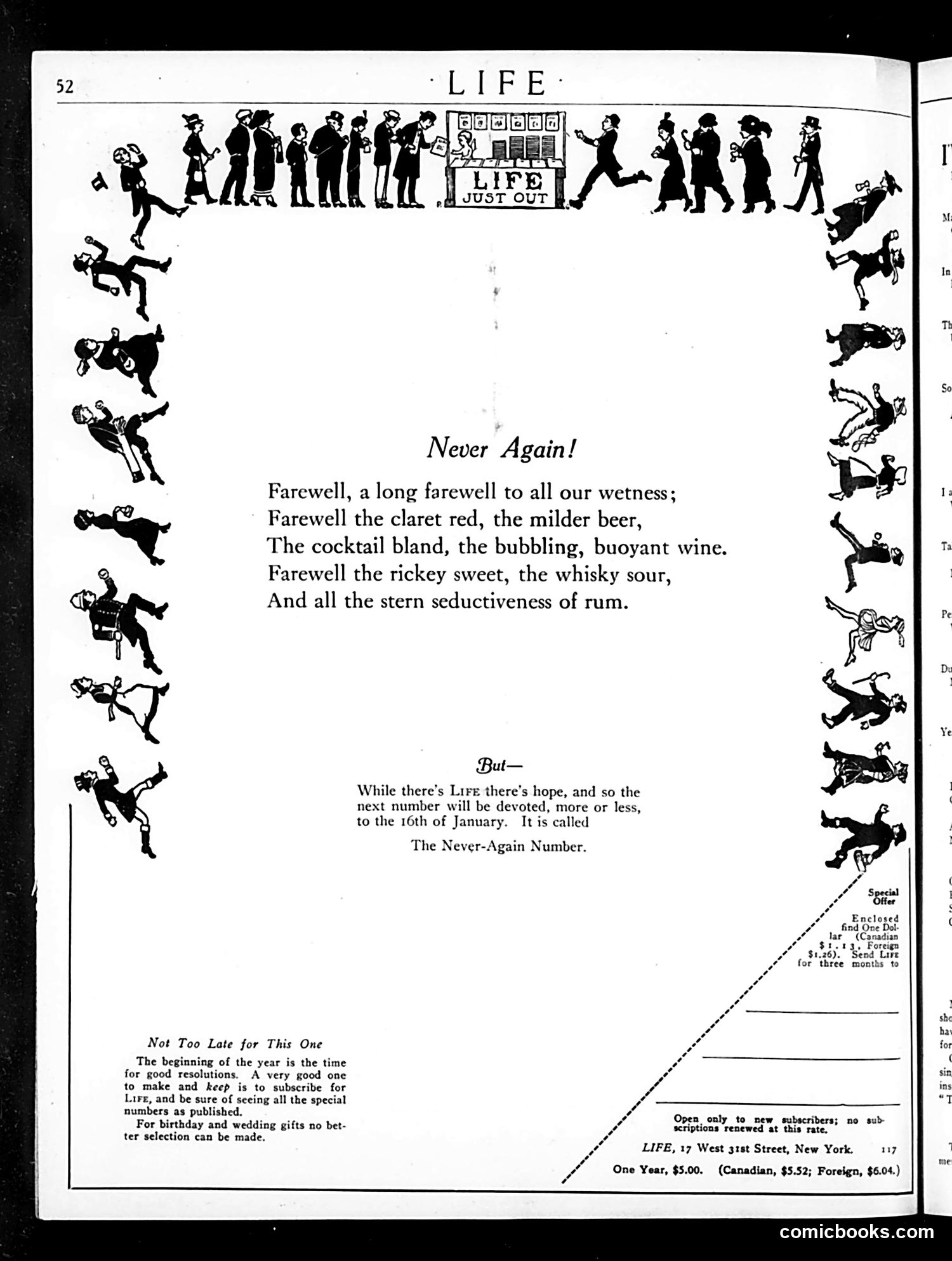
This page bids farewell to Prohibition, which ended on January 16, 1933. The "Never Again!" headline and poem mock the era of alcohol restrictions, listing banned drinks—claret, beer, cocktails, whiskey, and rum—that Americans will supposedly never taste again. The satirical text mourns "wetness" (pro-alcohol sentiment) with mock solemnity. The surrounding illustrations show figures in various states of intoxication or revelry, emphasizing the chaos and excess associated with both Prohibition's enforcement and its repeal. The bottom section announces Life's "Never-Again Number" celebrating the end of Prohibition, positioned as hopeful news. The page also includes subscription advertising, typical of the magazine's format.
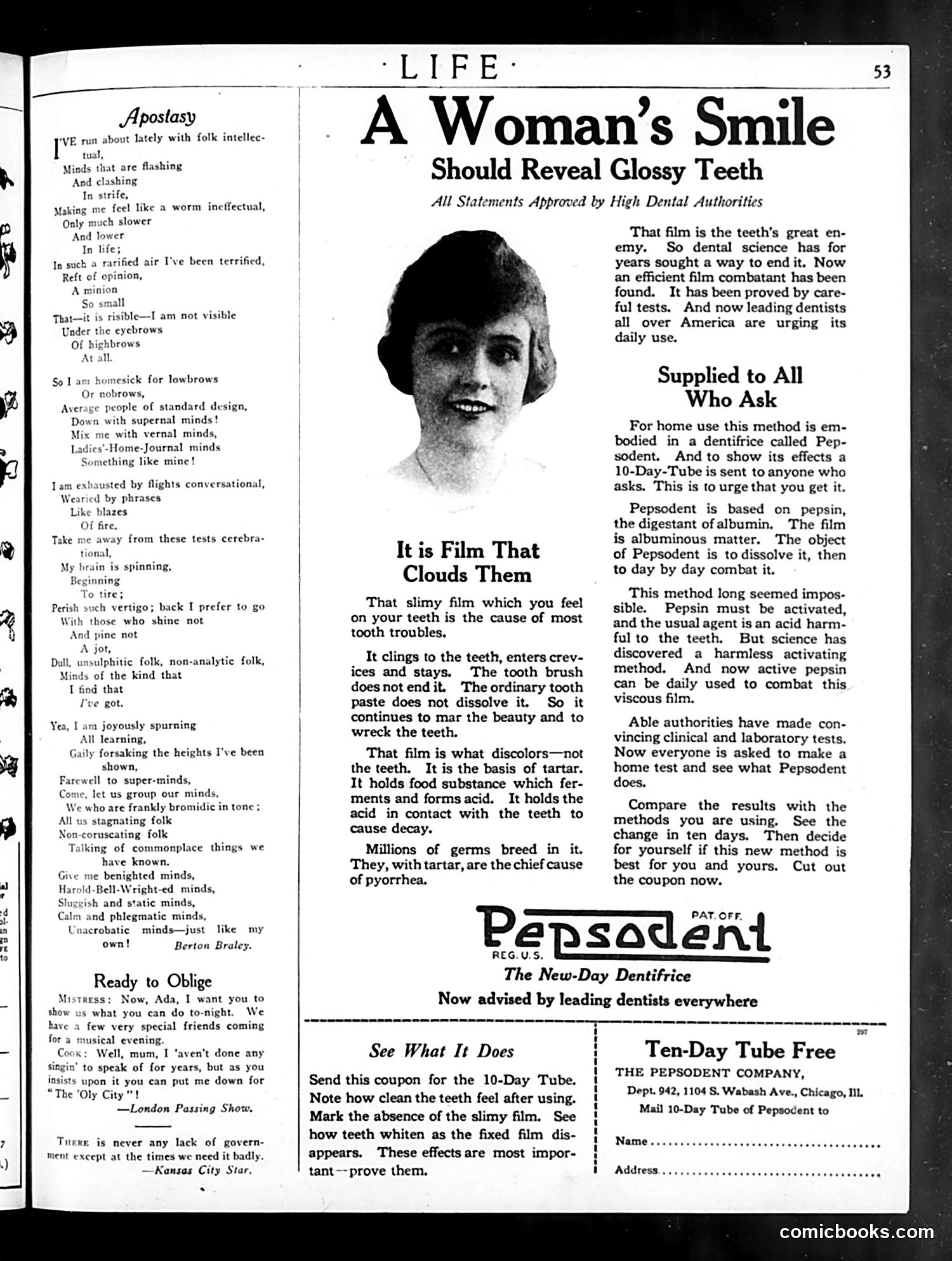
This page contains no political cartoon or satire. The left column features a serious poem titled "Apostasy" by Berton Braley, critiquing intellectual pretension and superficiality among the upper classes—themes common to 1920s social commentary. The right side is entirely a **Pepsodent toothpaste advertisement**. The ad promotes a new film-dissolving dentifrice, claiming it removes the "slimy film" that causes tooth decay and discoloration. It emphasizes scientific validation ("approved by high dental authorities") and offers a free 10-day sample tube. This represents typical early 20th-century advertising rhetoric: marketing a product through pseudo-scientific claims and appeals to expert authority—methods now recognized as common in vintage advertising but relatively novel then.
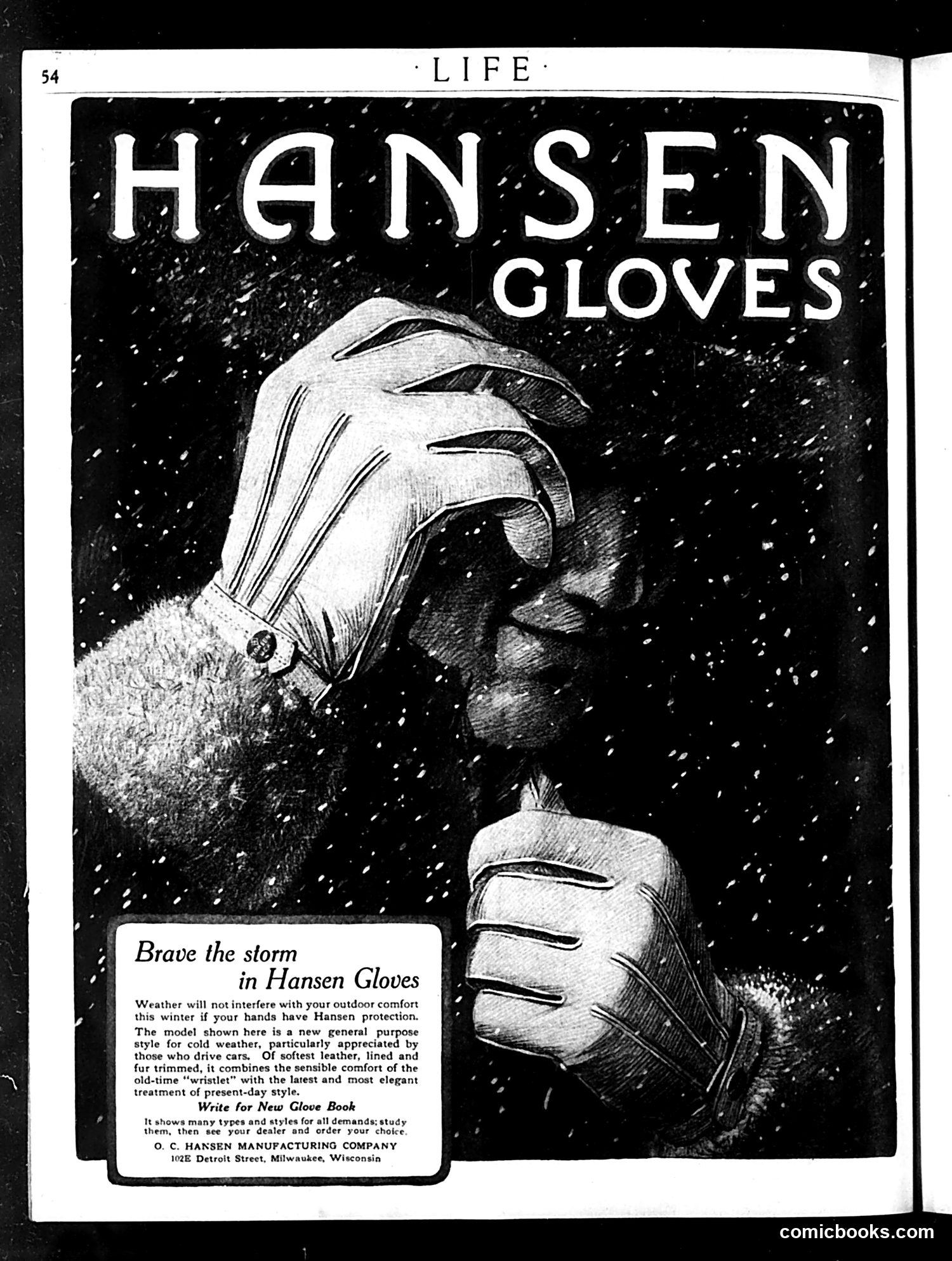
This page is **primarily an advertisement**, not political satire. It promotes Hansen Gloves, manufactured by O.C. Hansen Manufacturing Company in Milwaukee, Wisconsin. The ad features an illustrated hand wearing leather gloves with fur trim, shown against a snowy background. The tagline "Brave the storm in Hansen Gloves" emphasizes winter protection. The accompanying text highlights the gloves' features: soft leather lining, fur trim, and a design combining comfort with "present-day style." There is no political cartoon or satirical content here. The snowy, dramatic imagery is purely atmospheric marketing designed to appeal to customers facing winter weather. The page simply showcases a functional product advertisement from the early-to-mid 20th century era of *Life* magazine.
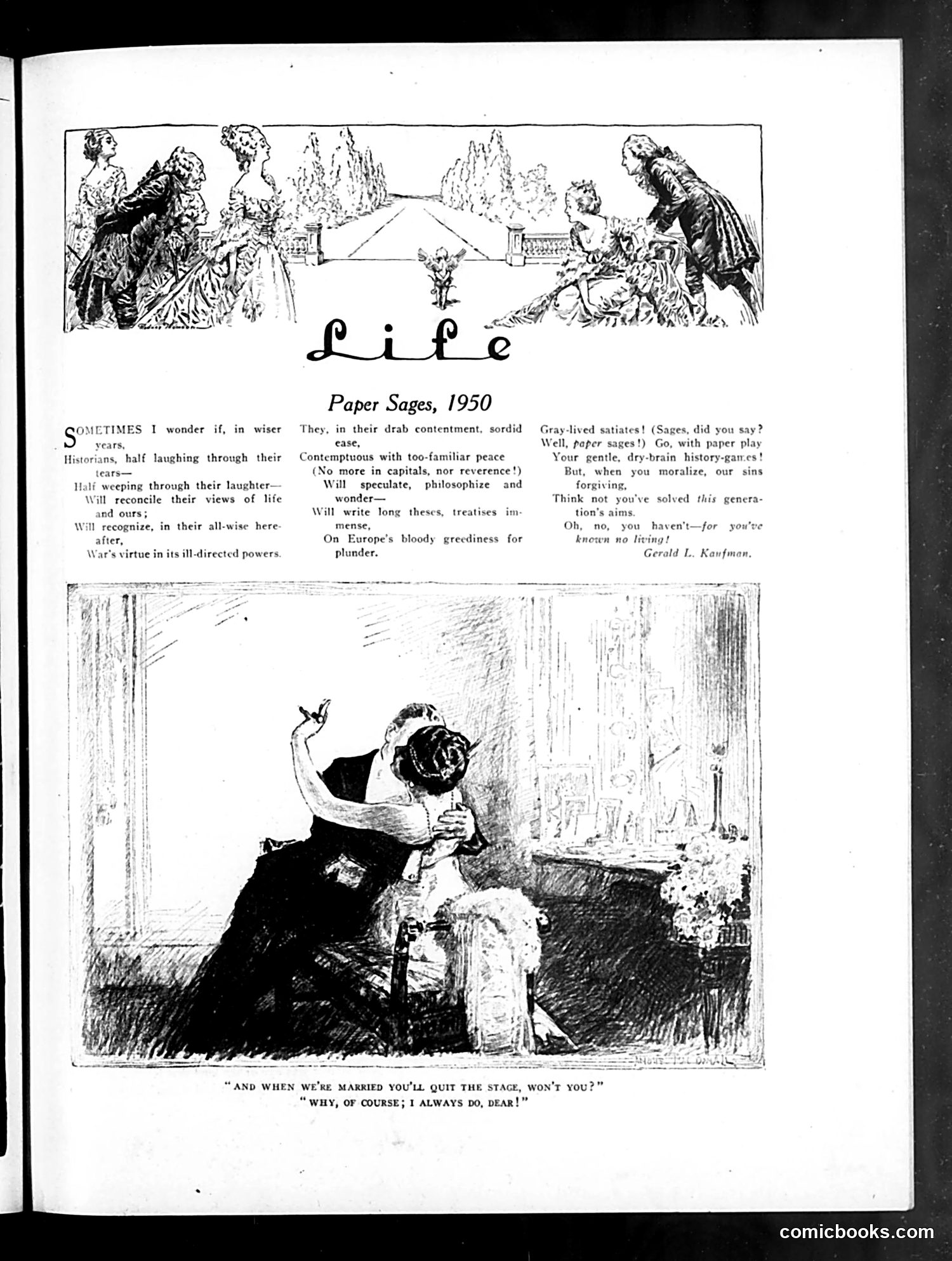
This page satirizes intellectual historians and philosophers. The upper poem mocks scholars who write extensively about history and European politics while remaining detached from real life—"half laughing through their tears" of abstract knowledge. The lower cartoon depicts a domestic scene where a woman asks her male companion if he'll quit his stage career when they marry. He responds he always does. This appears to critique the common theatrical practice of male performers abandoning their careers for domestic life, contrasting sharply with the "paper sages" above who theorize endlessly without practical commitment. The juxtaposition suggests satire of both ivory-tower intellectualism and gender-role expectations in mid-century American life.
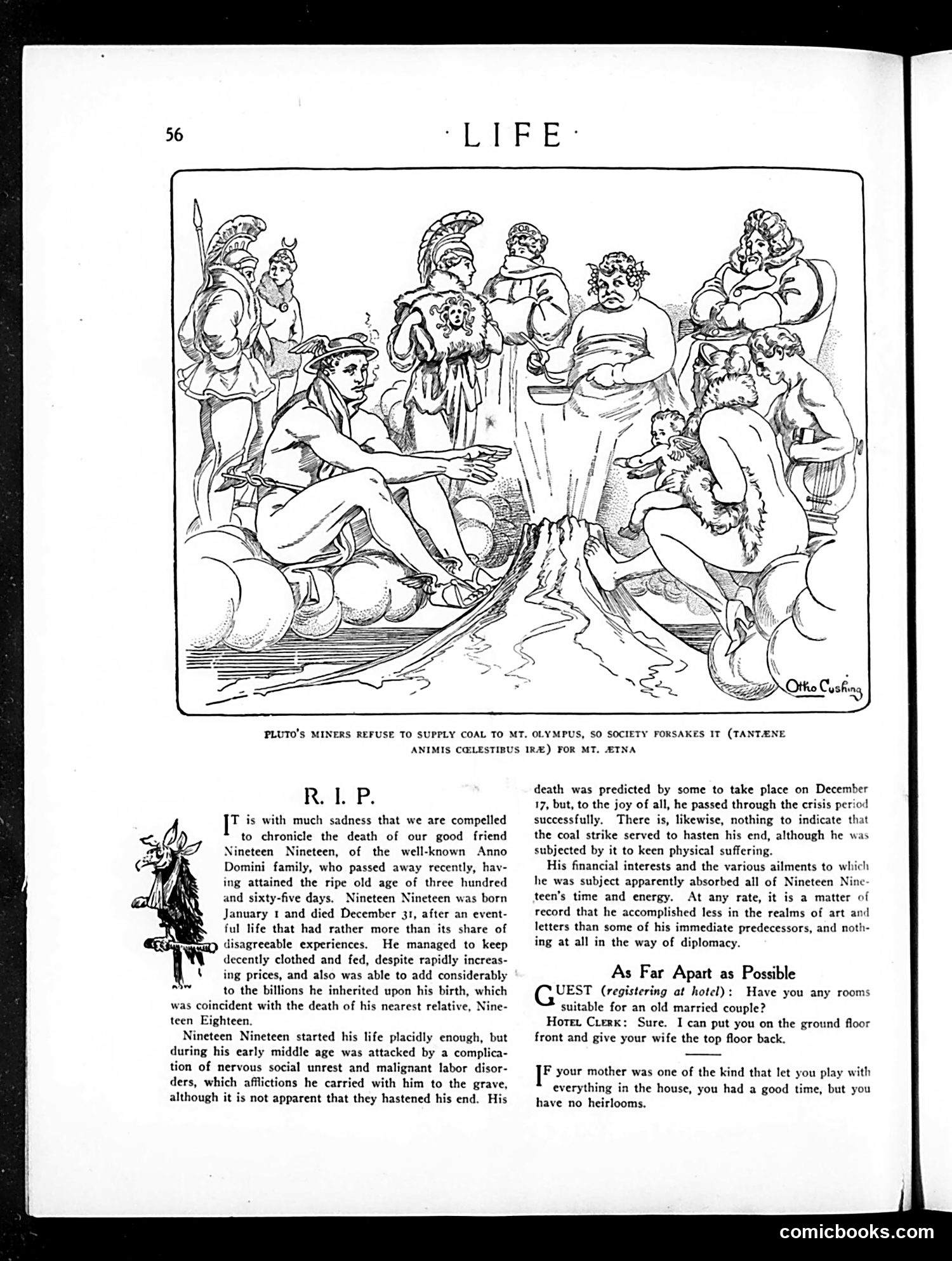
The main cartoon, credited to Otto Cushing, depicts classical and mythological figures. The caption references "Pluto's miners" refusing to supply coal to Mount Olympus, so "society forsakes it (tantene animis celestibus iras) for Mt. Aetna." This is a satirical commentary on a **coal miners' strike**. The gods of classical mythology represent wealthy society, while Pluto (god of the underworld/mining) symbolizes miners. The joke: when miners refuse to supply coal (fuel/power), the wealthy abandon their usual luxuries and turn to alternative sources. The page also contains an obituary ("R.I.P.") and humorous advice columns below. The satire criticizes both labor unrest and the dependent relationship between society's elite and working-class miners.
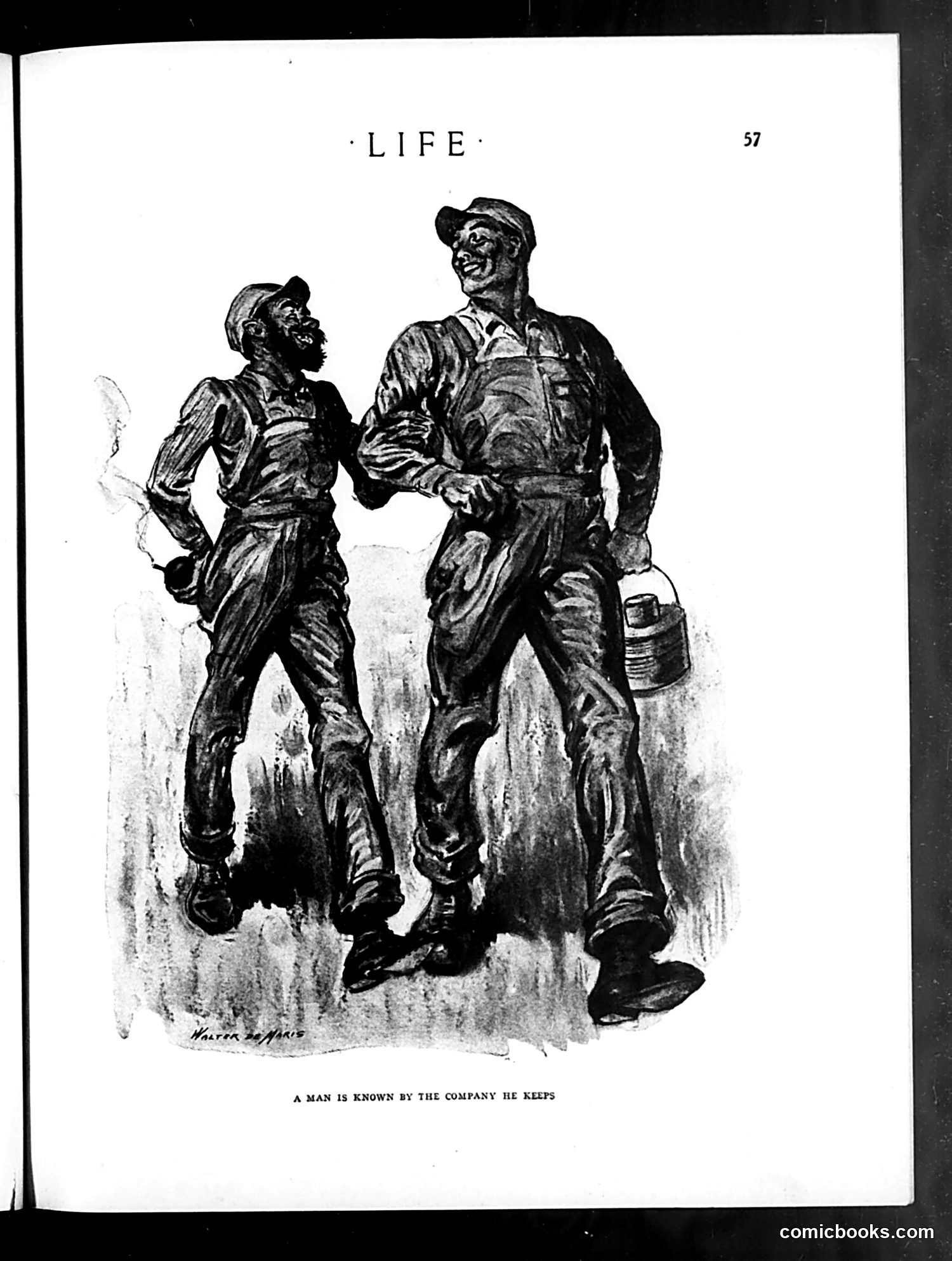
This is a satirical illustration from *Life* magazine (page 57) depicting two working-class men—a younger and older laborer—walking together while conversing. Both wear work clothes and aprons; one carries a bucket, suggesting manual labor. The caption reads: "A MAN IS KNOWN BY THE COMPANY HE KEEPS." This is a visual play on the traditional proverb about character being reflected by one's associates. The satire appears to comment on social mobility and class perception: the illustration suggests that laborers or working-class men are judged by their companions, likely critiquing either class prejudice or making commentary on workers' social standing. The artist's signature appears to read "Warren DeLarris" or similar. Without additional context about the magazine's publication date, the specific social circumstances remain somewhat unclear, though the piece critiques class-based social judgment.
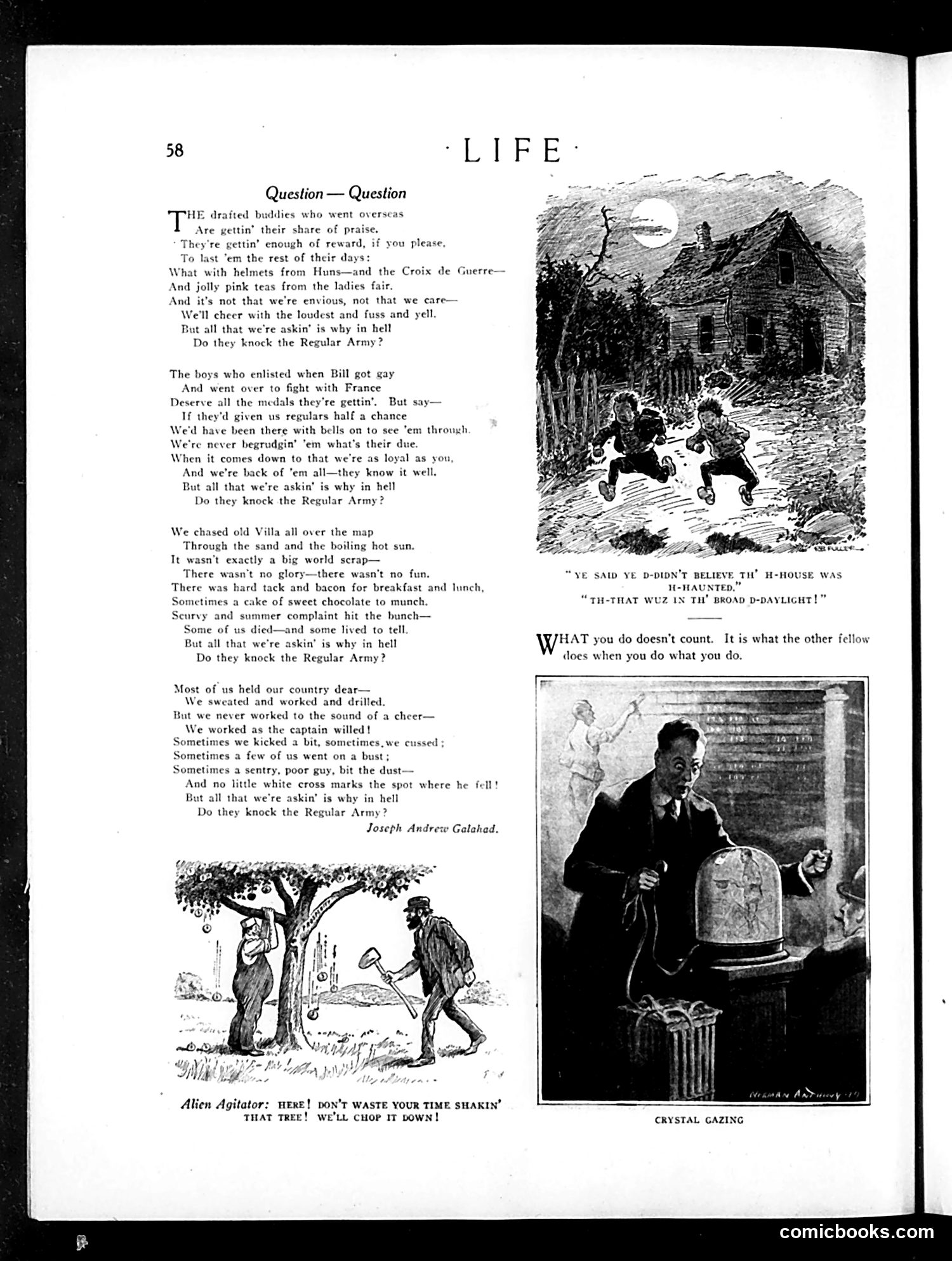
This page satirizes **World War I soldiers** returning home. The poem critiques public indifference to veterans' sacrifices, repeatedly asking "Do they knock the Regular Army?"—meaning do citizens respect or acknowledge soldiers' service. The poem contrasts soldiers' hardships (fighting in France, chasing Villa, casualties) with civilians' comfortable complaints about "hard luck and bacon for breakfast." It sarcastically suggests soldiers deserve medals but would accept merely being "seen through" windows or acknowledged. The two illustrations depict working-class humor: one shows men discussing a haunted house, the other shows an "Alien Agitator" wasting time shaking a tree. **The central message**: Veterans' sacrifices are forgotten by a civilian population more concerned with petty grievances—a common post-WWI complaint about public gratitude.
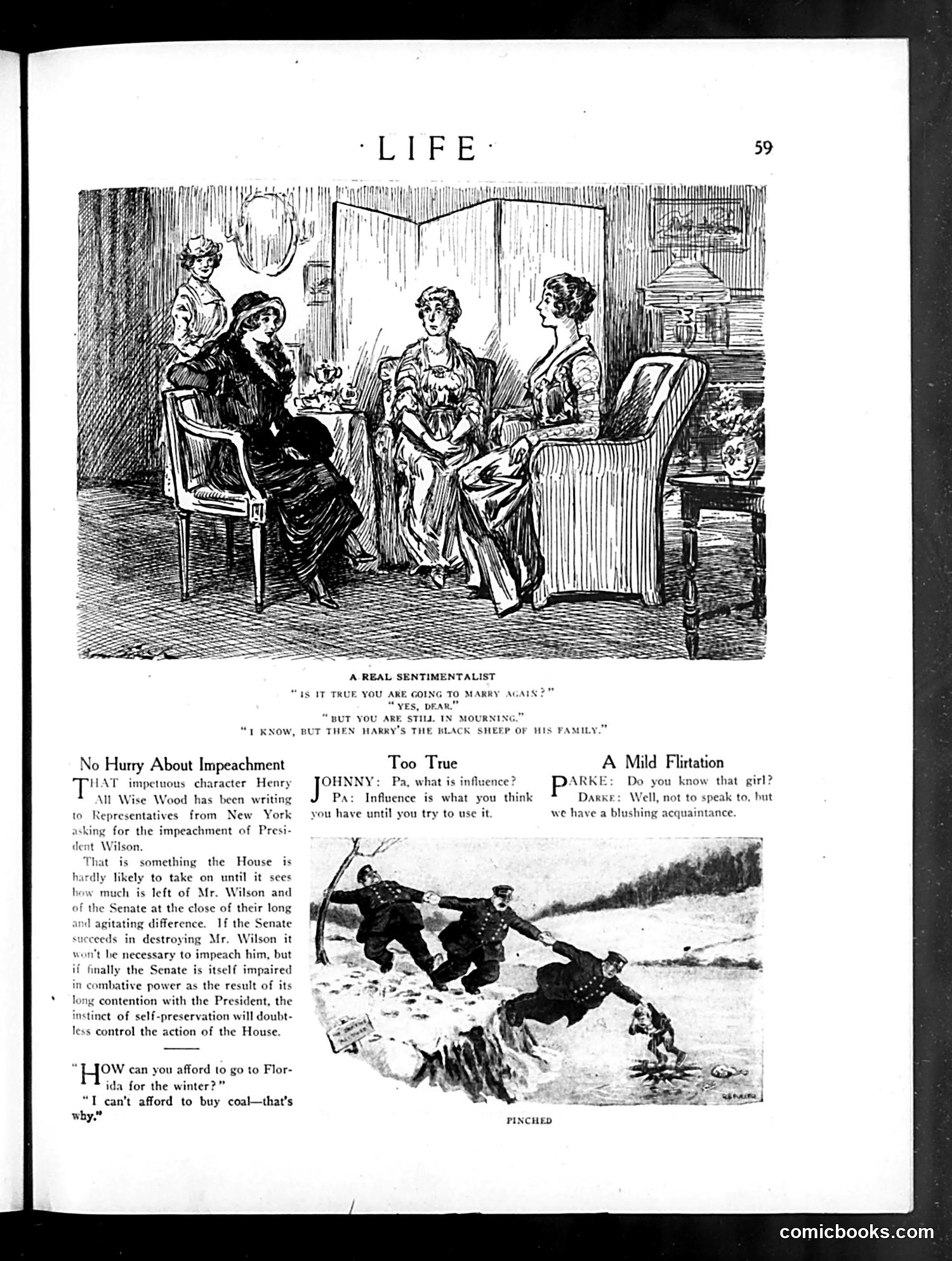
**Top Cartoon**: "A Real Sentimentalist" depicts four women in an elegant drawing room discussing remarriage. The dialogue reveals social hypocrisy: a widow claims she'll remain faithful to her deceased husband's memory, yet the narration notes her new suitor is "the black sheep of his family"—suggesting she's pursuing him despite (or because of) his disreputable status. The satire mocks sentimental declarations about widowhood that mask pragmatic or opportunistic romantic interests. **Bottom Section**: Three brief comic vignettes satirize everyday absurdities. "No Hurry About Impeachment" references political gridlock regarding President Wilson. "Too True" jokes about influence requiring practical experience. "A Mild Flirtation" and "Pinched" offer domestic humor. The overall page targets hypocrisy, pretense, and the gap between stated principles and actual behavior among the genteel classes.
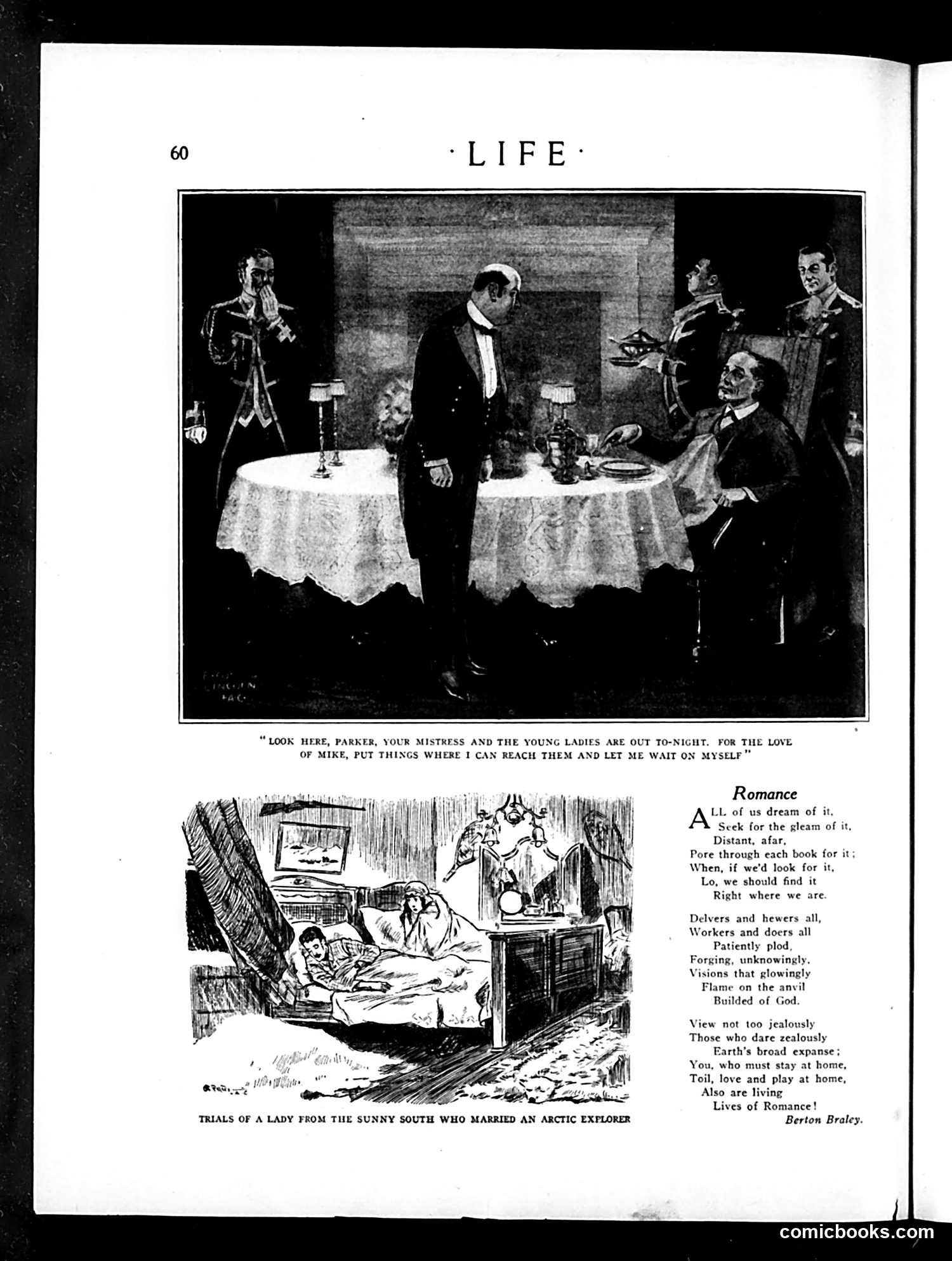
This page from *Life* magazine contains two distinct pieces: **Top image**: A satirical scene showing military officers at a formal dinner. The caption quotes one officer instructing a servant to arrange things so he can wait on himself while his mistress and young ladies are out. The satire targets officers' self-indulgent priorities and perhaps critiques military privilege during wartime. **Bottom image and poem**: Titled "Trials of a Lady from the Sunny South Who Married an Arctic Explorer," it depicts a woman in bed in what appears to be an Arctic setting. The accompanying poem by Breton Braley, titled "Romance," ironically contrasts romantic ideals with domestic reality—suggesting the disappointment of a southern woman transplanted to harsh conditions through marriage to an explorer. Both pieces use humor to satirize social expectations around romance, class, and gender roles.
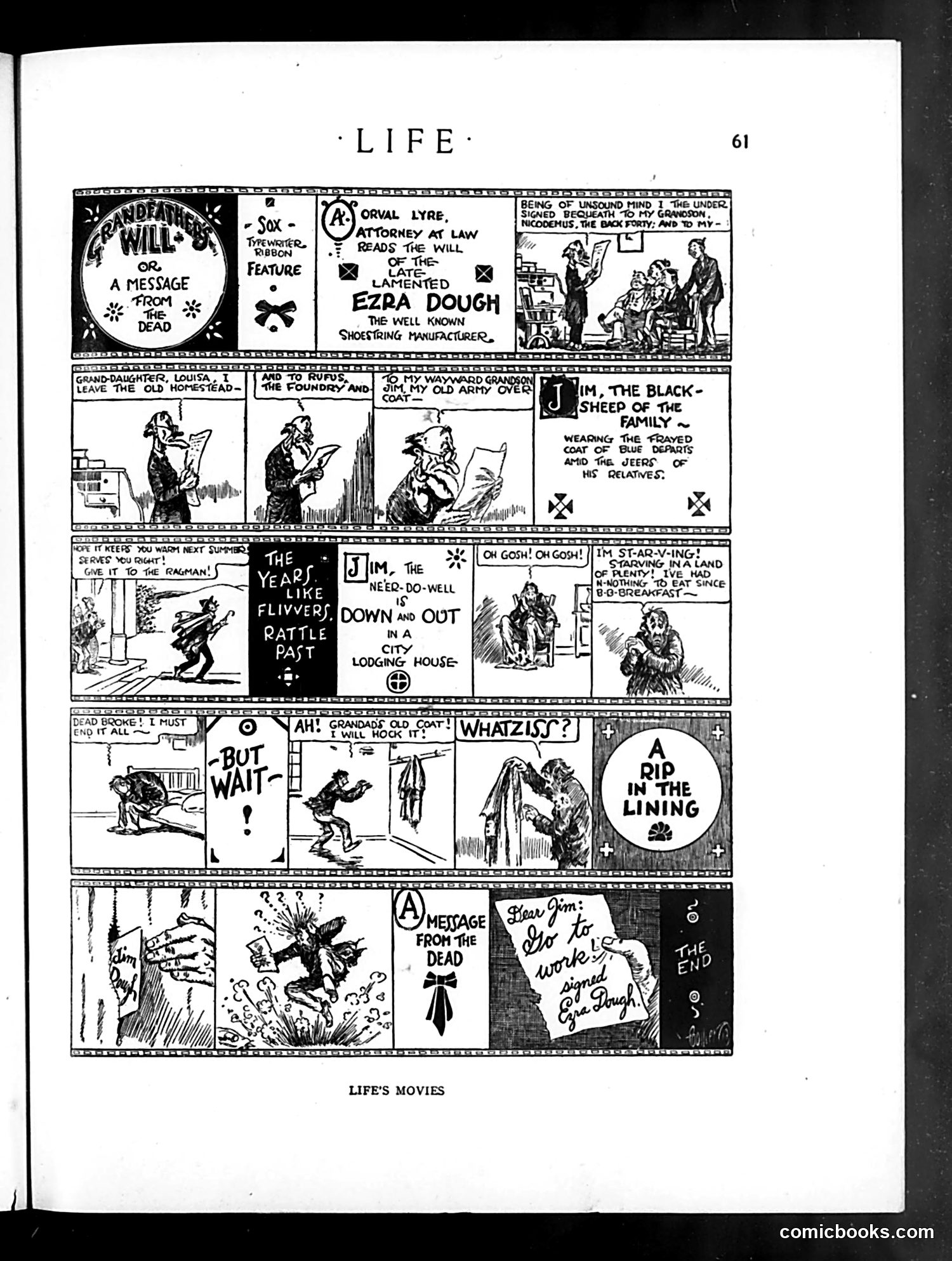
This page presents a humorous comic strip sequence titled "Life's Movies" that parodies melodramatic silent film tropes. The narrative follows a will-reading scene involving "Ezra Dough," a shoestring manufacturer, and includes stock characters like "Jim, the Black Sheep of the Family" and a mysterious "need-do-well" living in a city lodging house. The satire mocks overwrought silent-film conventions: dramatic revelations ("A RIP IN THE LINING"), exaggerated character types, and implausible plot twists. The comic employs visual gags and absurdist humor typical of early 20th-century American comedy, poking fun at cinema's tendency toward melodrama and coincidence-driven narratives. The strip appears designed to entertain readers familiar with contemporary movie conventions by exaggerating their most ridiculous elements.
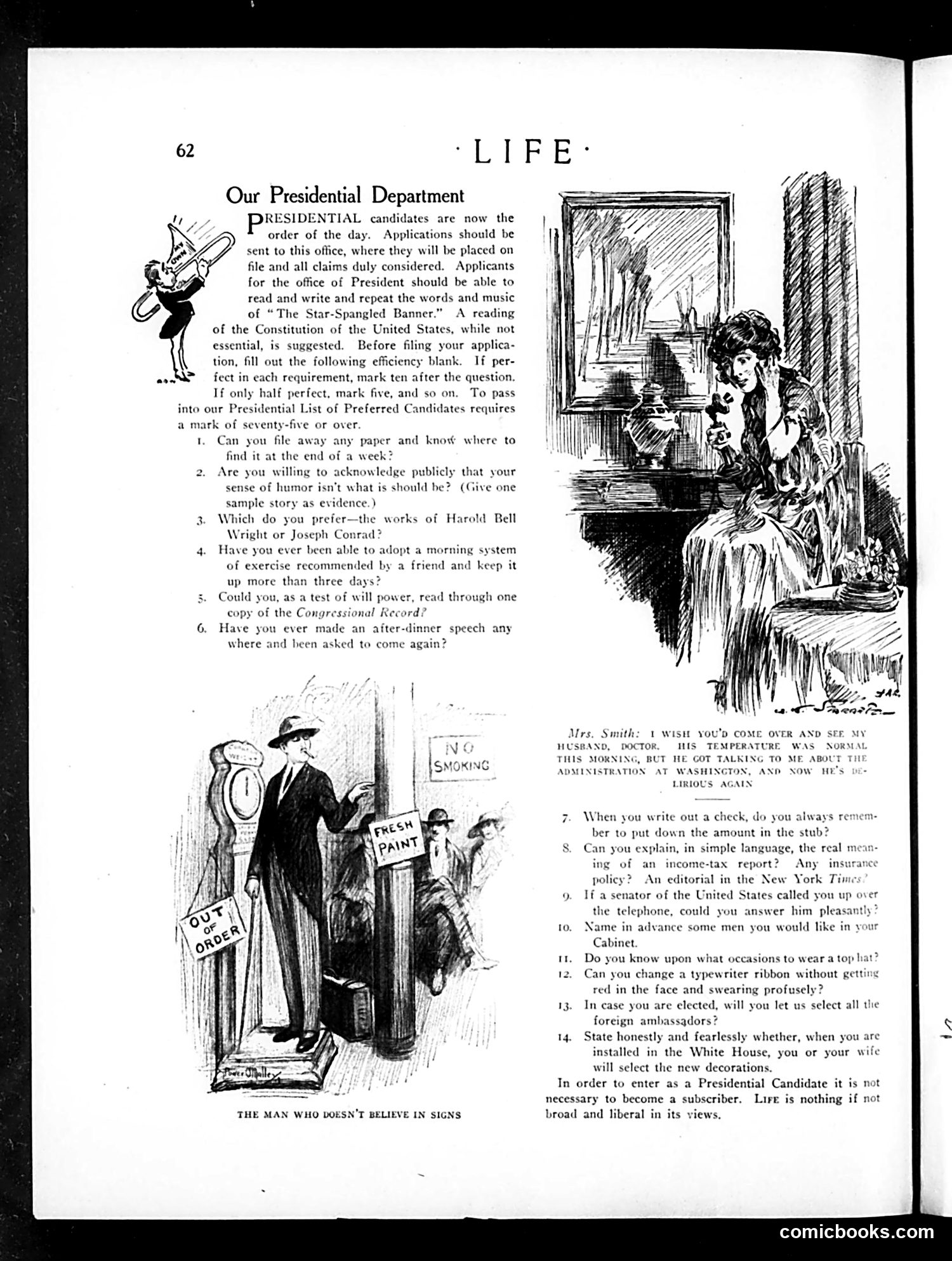
This page satirizes presidential candidates through a mock "application process." The text presents humorous qualification questions (e.g., "Can you say any paper and know where to find it at the end of the week?" and "Have you ever made an after-dinner speech any where and been asked to come again?"). The cartoon titled "THE MAN WHO DOESN'T BELIEVE IN SIGNS" depicts a well-dressed man ignoring obvious workplace signs like "NO SMOKING," "FRESH PAINT," and "OUT OF ORDER"—satirizing politicians who disregard rules or public opinion. The accompanying sketch shows a woman frustrated with her husband's political talk, mocking how presidential ambitions intrude on domestic life. The satire targets the pretensions and obliviousness of political candidates circa the 1910s-1920s.
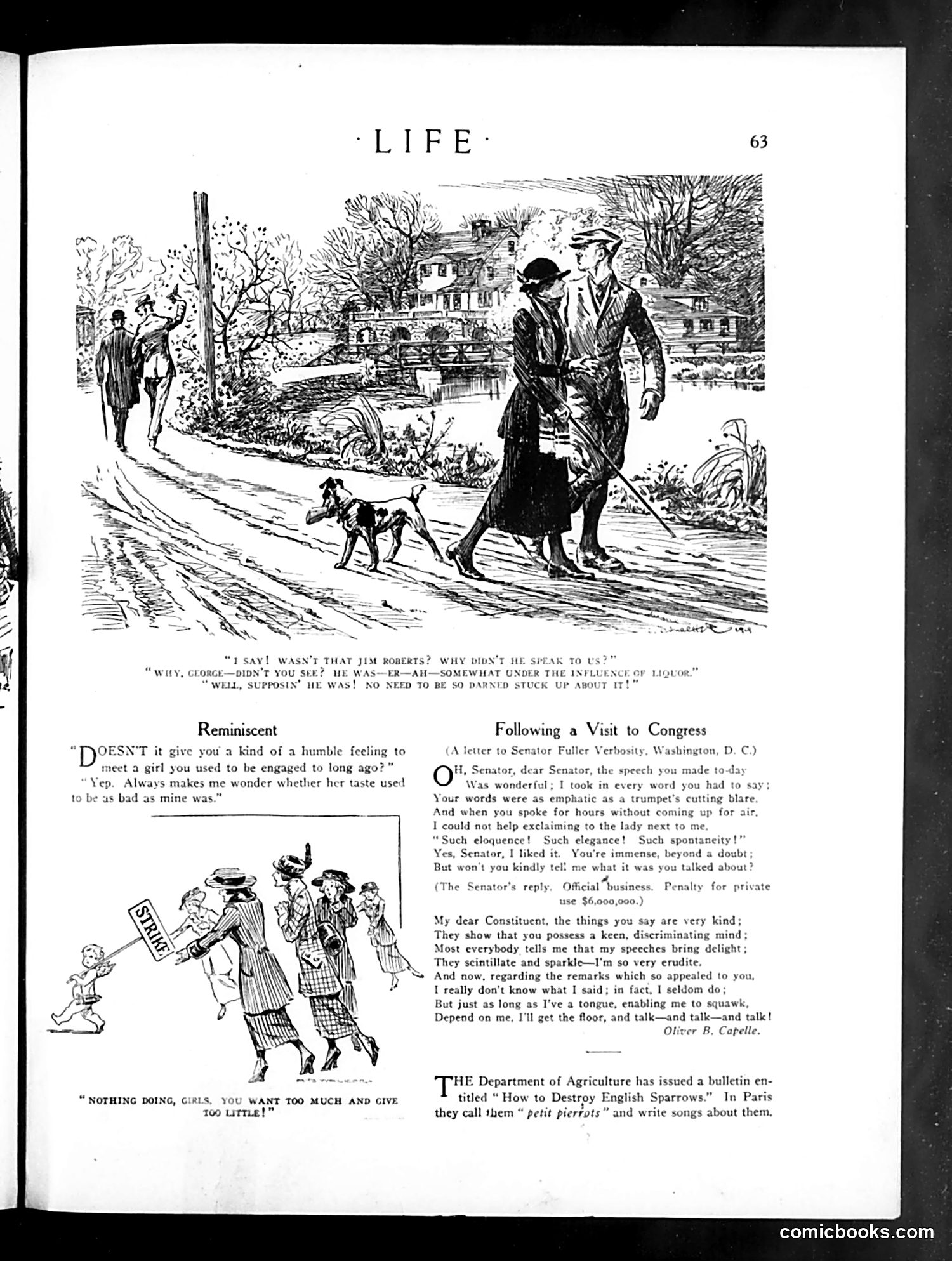
**Top Cartoon:** A social scene depicting a man and woman walking with a dog, observed by others nearby. The caption satirizes the man's intoxication: "I say! Wasn't that Jim Roberts? Why didn't he speak to us?" The response blames his condition on alcohol ("somewhat under the influence of liquor"), mocking his public appearance while drunk. **"Reminiscent" Section:** A brief joke about reconsidering a past engagement, suggesting the woman's tastes have improved. **"Following a Visit to Congress":** A satirical poem by Oliver B. Capelle mocking a Senator's verbose speech about trivial matters. The letter criticizes empty political rhetoric—the Senator talks extensively without conveying meaningful substance, poking fun at congressional verbosity and lack of substance. **Lower Cartoon:** A caption about women wanting "too much and give too little"—a domestic gender-relations joke.
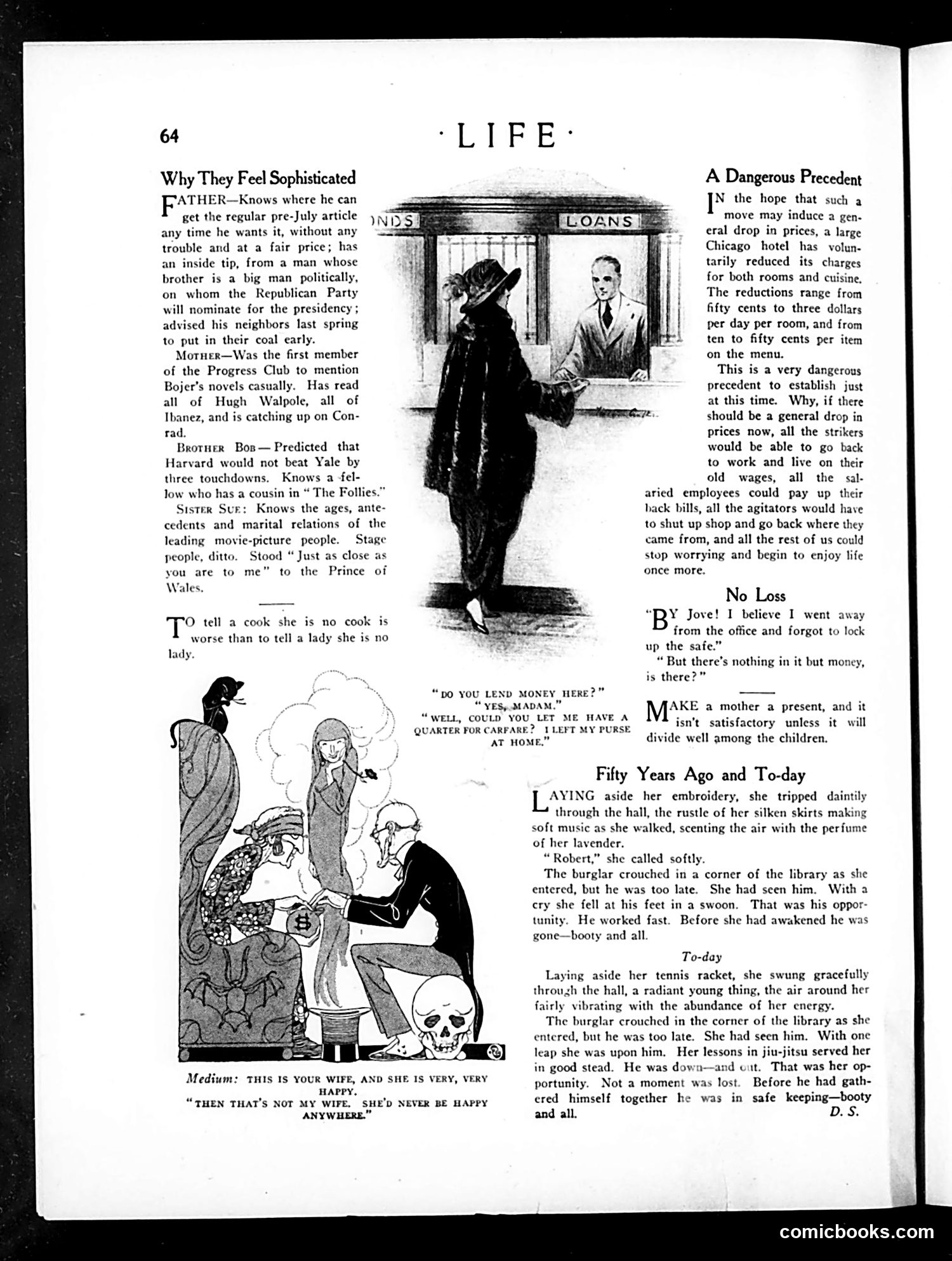
This 1920s Life page satirizes social pretension and changing mores through multiple cartoon commentaries: **"Why They Feel Sophisticated"** mocks middle-class aspirations. It lists supposedly worldly accomplishments—Father's political insider knowledge, Mother's familiarity with modernist authors (Walpole, Ibáñez, Conrad), Brother's sports predictions, Sister's celebrity gossip—all presented as markers of sophistication despite being trivial or secondhand information. The satire suggests people feel cultured by surface-level knowledge rather than genuine understanding. **"A Dangerous Precedent"** ironically attacks a Chicago hotel's price reductions as threatening social order—if prices drop, workers could return to jobs at old wages, agitators would lose cause, and the comfortable classes would "stop worrying and begin to enjoy life." The sarcasm exposes economic self-interest disguised as concern. **"Fifty Years Ago and To-day"** contrasts Victorian femininity (the swooning woman burglar victim) with modern active womanhood (the jiu-jitsu-trained burglar apprehender). This celebrates women's liberation while mocking nostalgic traditionalists. The minor jokes ridicule financial institutions and gift-giving expectations.
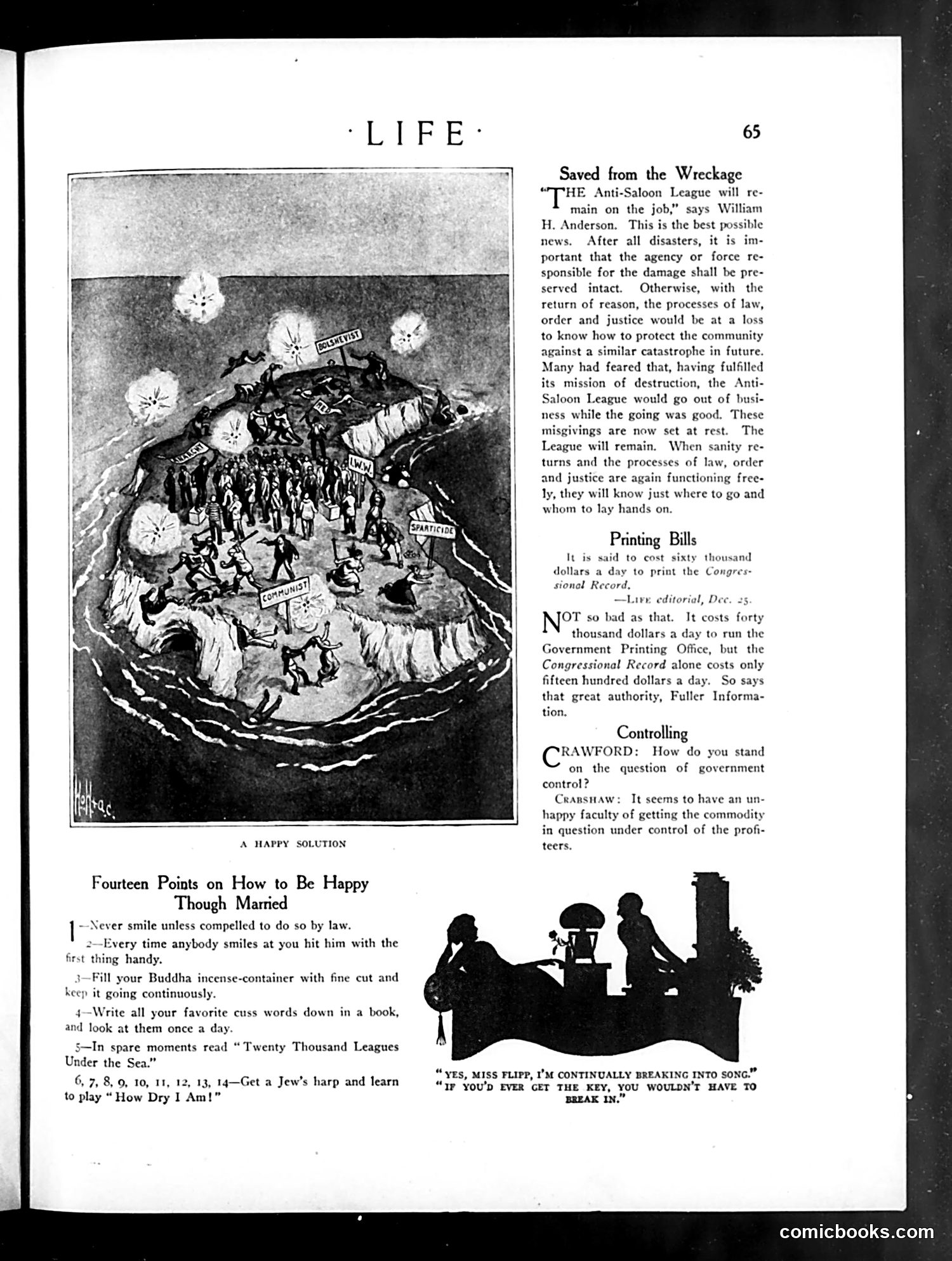
**Main Cartoon ("A Happy Solution"):** A satirical illustration showing the destruction wrought by Prohibition. The image depicts a wrecked landscape filled with chaos and devastation, labeled as representing the Anti-Saloon League's campaign. The accompanying article sarcastically praises the League for remaining "on the job," arguing that since they caused this "catastrophe," they should be preserved so authorities know whom to hold responsible when sanity returns and legal processes resume. **"Fourteen Points" Humor:** Mocks marital unhappiness through absurdist advice—never smile, hit people who smile at you, burn incense continuously, write down curse words, read adventure novels, and play a Jew's harp badly. This satirizes both self-help literature and marriage itself. **Supporting Articles:** Brief commentary on printing costs for the Congressional Record and government control of commodities, suggesting profiteers benefit from regulation. **Context:** This page reflects 1920s anxieties about Prohibition's effects and satirizes the Anti-Saloon League's role in its passage, portraying the policy as destructive while using dark humor to critique both the policy and those responsible.
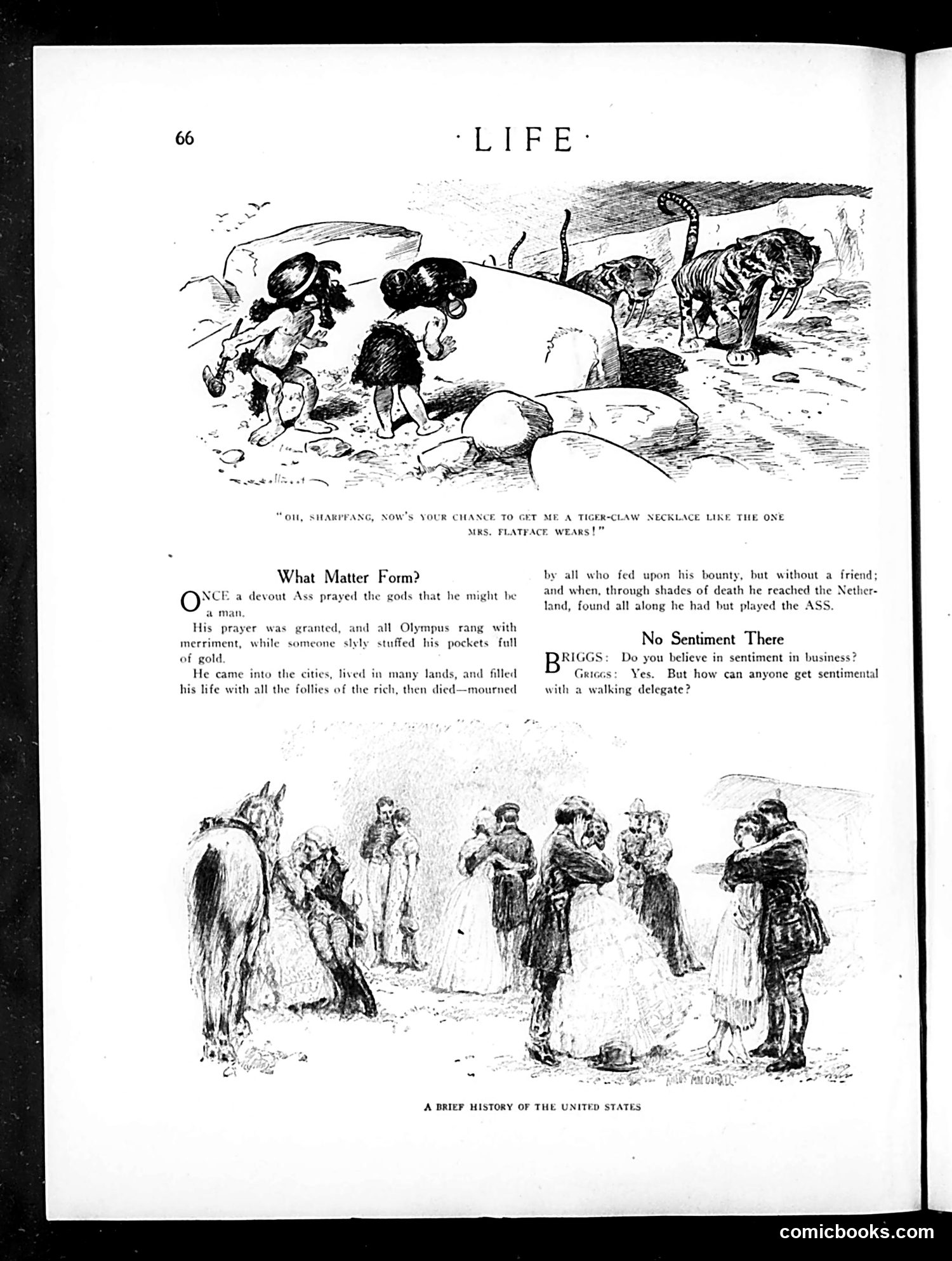
**Top Cartoon:** A prehistoric/caveman scene mocking materialism and status anxiety. A female character pressures her male companion to hunt a tiger so she can wear a fashionable tiger-claw necklace like a wealthy neighbor ("Mrs. Flatface"), satirizing how consumer desire and keeping-up-with-the-Joneses behavior is timeless and primitive. **"What Matter Form?" Story:** A fable about an Ass who prays to become human. Granted this wish, he acquires wealth and indulges in rich men's vices, but dies friendless despite being surrounded by those dependent on his money. The moral: external form (being human/wealthy) doesn't improve character—he remained an ass at heart. **"No Sentiment There" Joke:** A business owner claims to believe in sentiment but can't practice it with a "walking delegate" (a labor union representative or organizer). The satire mocks how labor-management relations were purely antagonistic, with no room for human sympathy or understanding. All three pieces critique materialism, pretense, and the dehumanizing effects of wealth and labor conflicts.
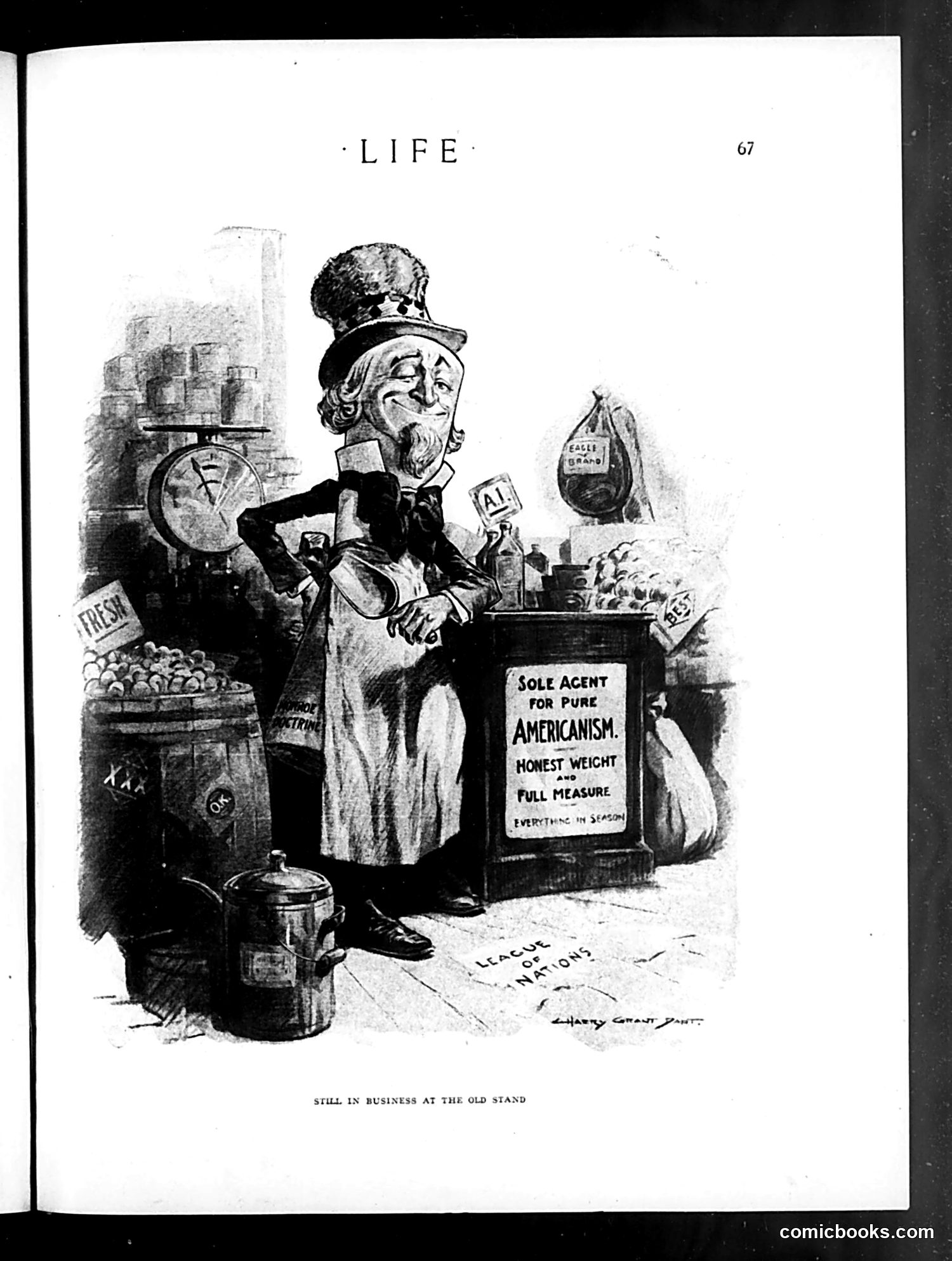
This cartoon satirizes an old-fashioned merchant or vendor ("Uncle Sam" figure, based on the top hat and facial hair style) who claims to be the "sole agent for pure Americanism" with "honest weight and full measure." The satire suggests hypocrisy: despite his patriotic proclamations displayed on a sign, he's actually conducting business "at the old stand"—implying he continues questionable or corrupt practices unchanged. The surrounding imagery (scales, fresh produce, various goods) suggests a marketplace merchant, likely critiquing American business or political leaders who espouse patriotic values while maintaining dishonest or exploitative practices. The cartoon mocks the gap between proclaimed American ideals and actual conduct.
This editorial page discusses the 1920 presidential race, contrasting Republican and Democratic candidates. The cartoons (small illustrated figures of roosters and a cow) appear decorative rather than substantive. **Key figures referenced:** - Republican candidates: General Wood, Senator Harding, Senator Poindexter, Governor Coolidge, Governor Lowden - Democratic possibilities: Mr. Gerard (former ambassador to Germany), Mr. Bryan, Mr. McAdoo, Mr. Wilson (outgoing president) **The satire's point:** Republicans offer simplistic solutions—merely replace incompetent incumbents with sound business management and let the GOP "squeeze" profit from the world. Democrats face a harder task: they're committed to Wilson's idealistic "New Era" (League of Nations, peace treaties) and need a candidate with genuine "consecration" (moral authority). Gerard lacks this quality despite his resume. The piece mocks Republican oversimplification while suggesting Democrats are trapped by their own ideological commitments—neither party offers real solutions.
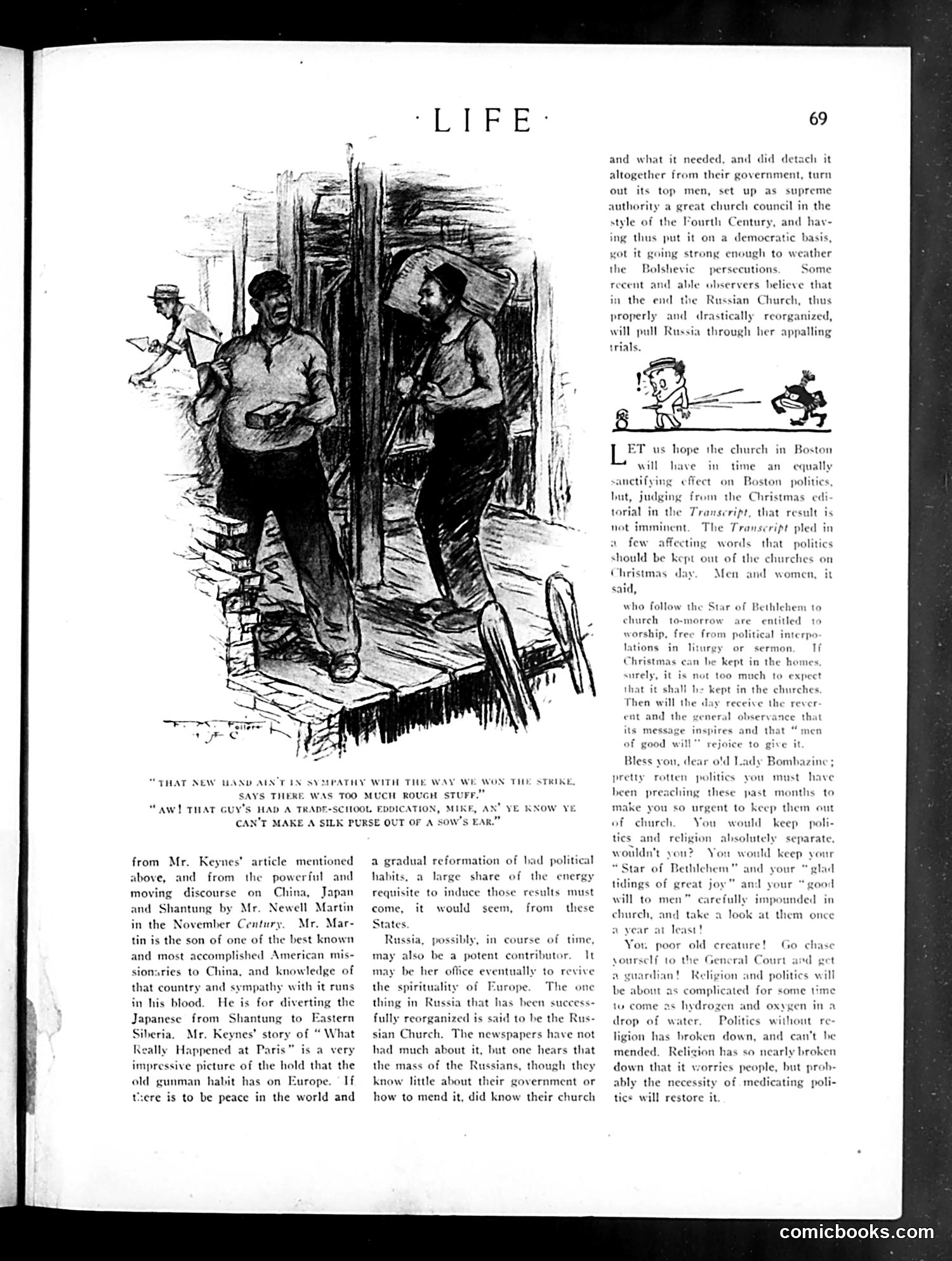
This page contains a political cartoon critiquing class prejudice and labor politics. Two working-class men discuss a strike; one dismisses a fellow striker with the insult "you can't make a silk purse out of a sow's ear"—a period expression meaning lower-class people cannot be refined. The joke targets the speaker's own hypocrisy: he's attacking someone for having only trade-school education while displaying crude prejudice himself. The accompanying article discusses international politics and the Russian Church's reorganization. The editorial then mocks Boston's *Transcript* newspaper for urging that politics be kept out of Christmas services. Life's satirical response (addressing "dear old Lady Bombazine," likely a fictional prim matron) argues this separation is impossible—religion and politics are inseparable forces, and ignoring politics in churches enables corruption. The satire targets both class snobbery and naive calls for political neutrality in public institutions.
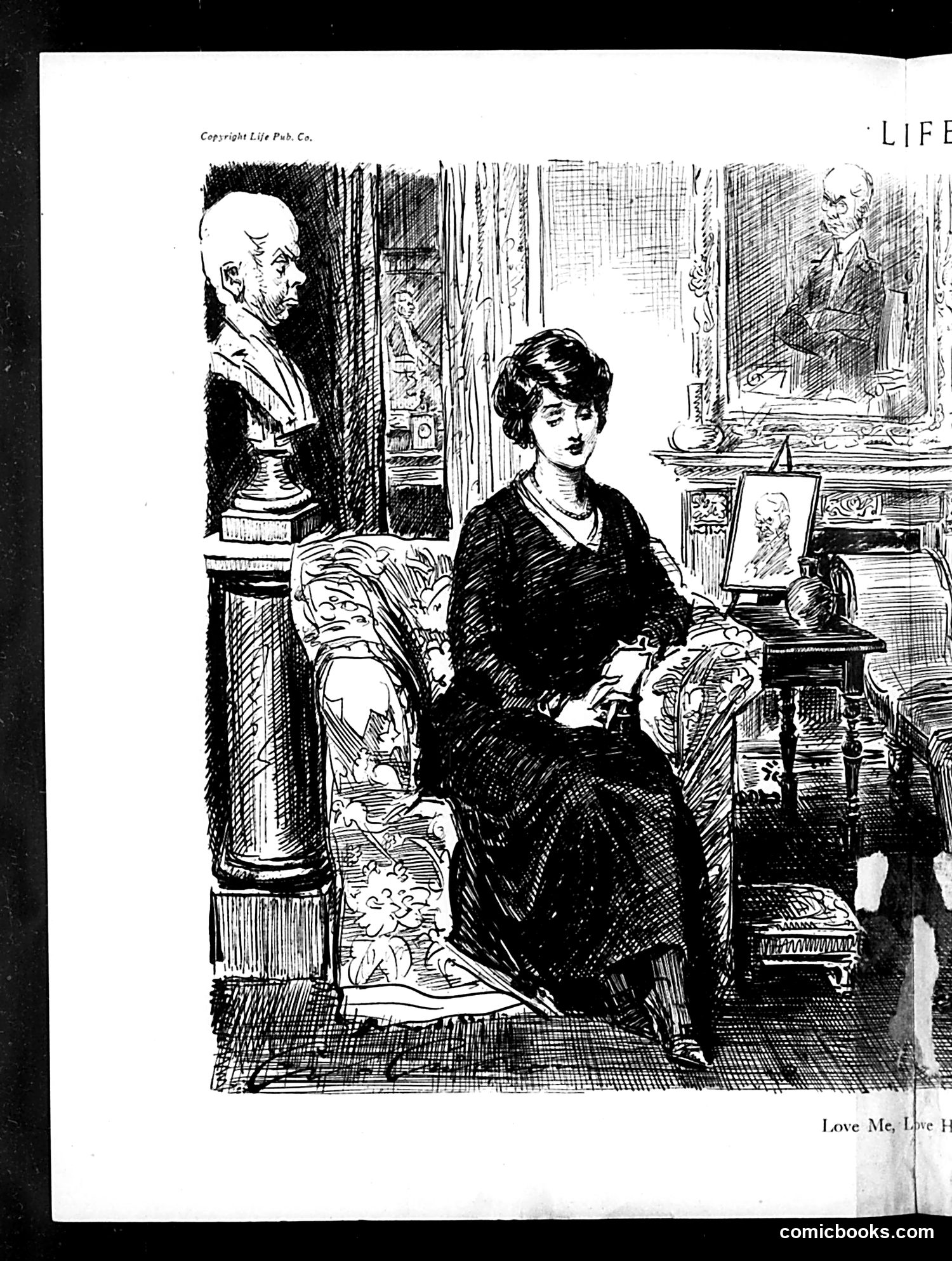
This appears to be a page from *Life* magazine showing a single illustration rather than a political cartoon. The sketch depicts an interior domestic scene: a well-dressed woman seated in an elegant room holds what appears to be a photograph or document, while a bust sculpture is visible on a pedestal behind her. A man's figure appears in the background. The partial caption "Love Me, L..." suggests this illustrates a story or narrative piece rather than topical satire. Without the complete text, caption, or title, I cannot definitively identify the specific story being referenced or explain the full context. The artwork style and fashion suggest early-to-mid 20th century publication, but the satirical or narrative point remains unclear from the visible information.
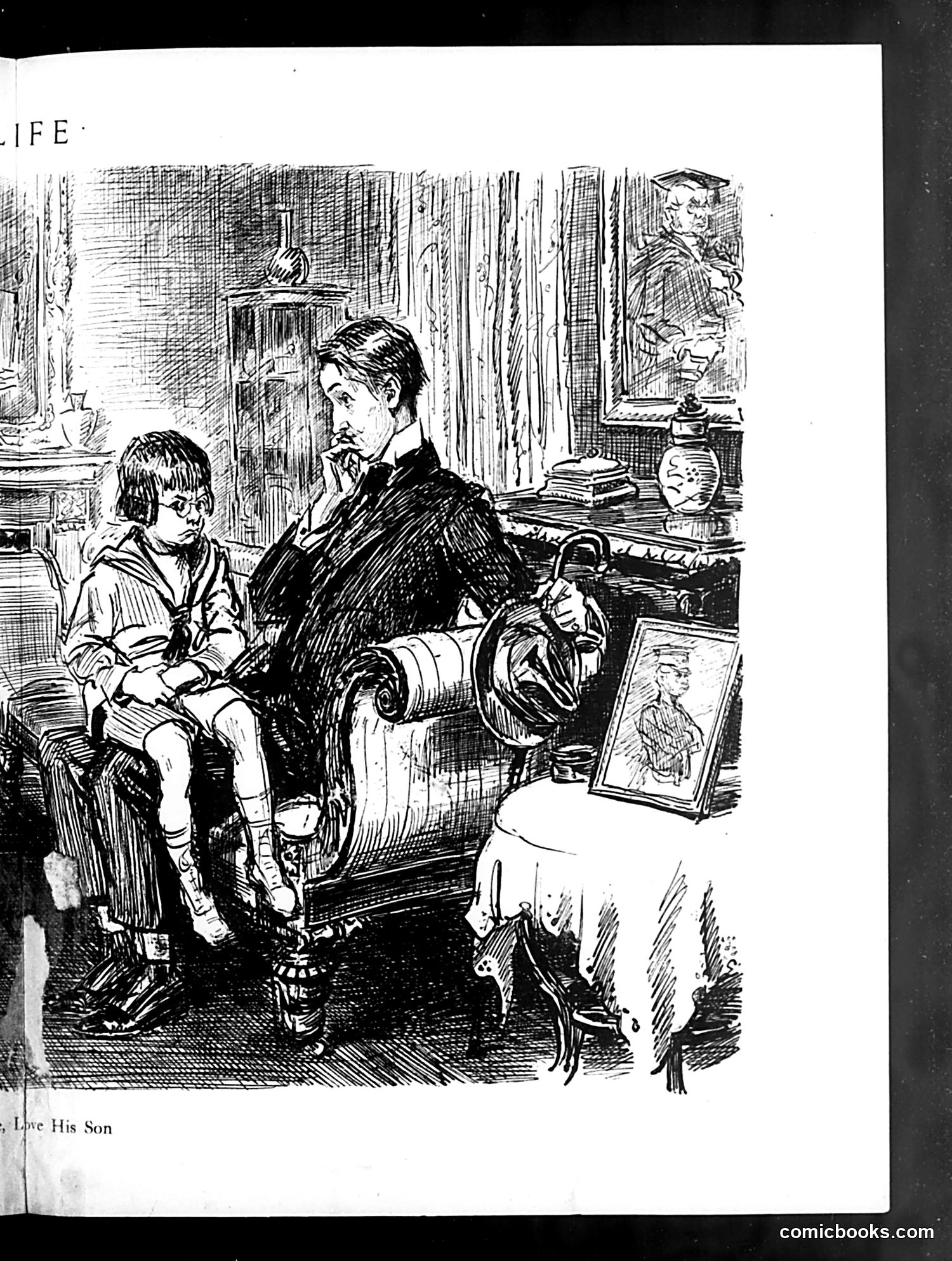
This appears to be an illustration titled "Love His Son" from Life magazine. The sketch shows an adult man and young boy in what seems to be a study or home interior, with the man seated and the boy nearby. The scene depicts a moment of domestic interaction or instruction between father and son. Without additional context from the full article or caption, the specific satirical point is unclear. The illustration's style suggests late 19th or early 20th-century work. The domestic subject matter and title suggest commentary on parenting, education, or family relationships—possibly critiquing contemporary attitudes toward fatherhood or child-rearing practices common to Life's satirical approach of that era. However, the precise social or political reference cannot be determined from the image and fragment alone.
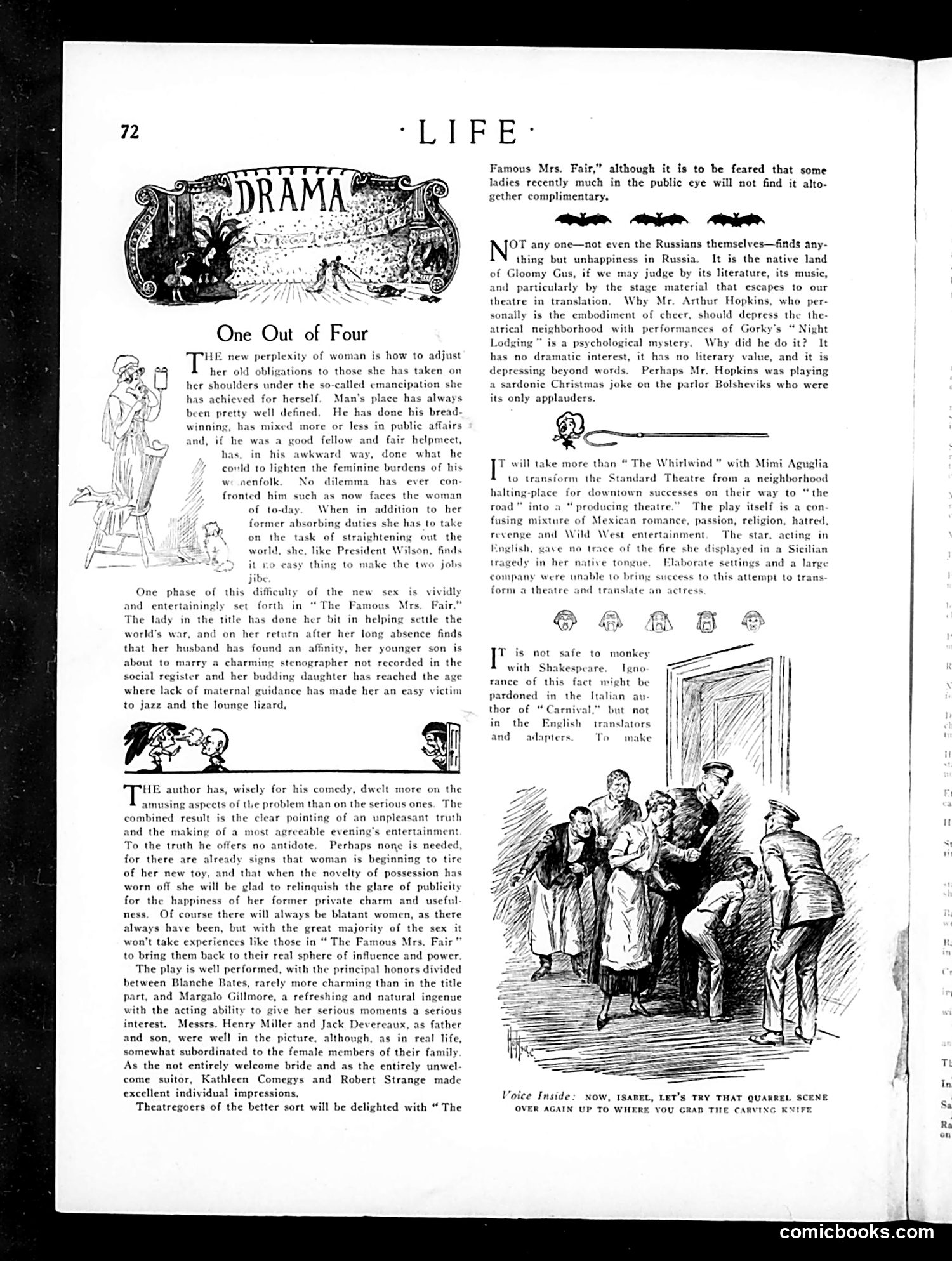
This page reviews "The Famous Mrs. Fair," a contemporary play addressing women's evolving social roles post-World War I. The critic argues the play intelligently explores the tension between women's traditional domestic duties and their newly claimed public/political engagement—"the new perplexity of woman." The plot centers on a woman who, absent during wartime service, returns home to find her husband has taken a mistress, her son is engaged to an unsuitable woman, and her daughter has fallen into vice ("jazz and the lounge lizard"). The review suggests this cautionary tale will discourage women from abandoning their "real sphere of influence and power" in domestic life, predicting most women will tire of public prominence and "relinquish the glare of publicity." The criticism reflects conservative anxiety about women's suffrage and expanded opportunities, framing female emancipation as a temporary "novelty" rather than lasting social change. The sketch depicts a woman juggling multiple obligations, visualizing the article's central tension.
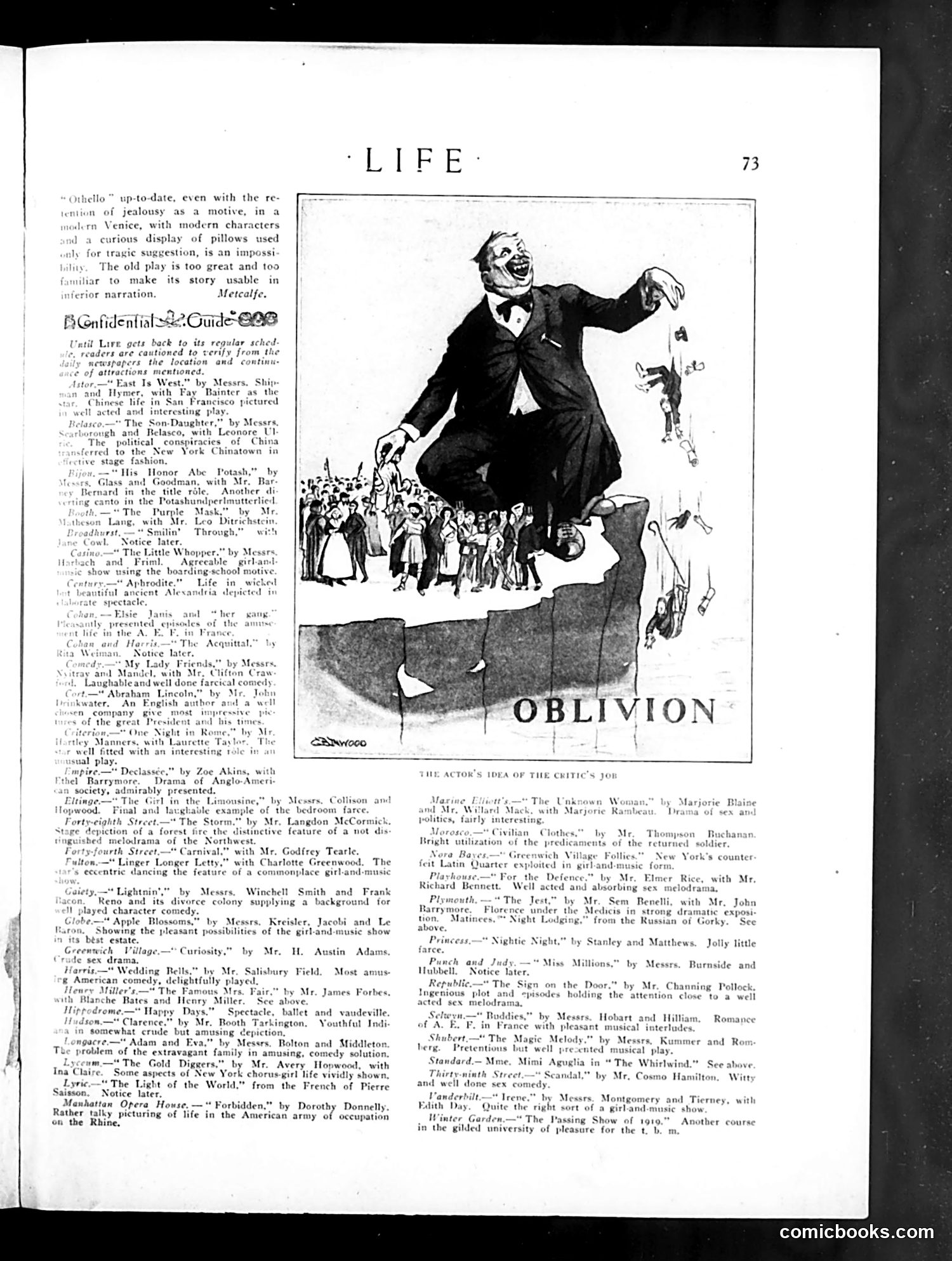
This cartoon satirizes theater critics by depicting a grotesque figure in formal dress hovering above a crowd of tiny theatergoers. The exaggerated caricature—with an enormous head and distorted features—represents the critic as a towering, almost monstrous authority figure looming over the public. The title "Oblivion" and the subtitle "The Actor's Idea of the Critic's Job" suggests the satire: actors view critics as destructive forces capable of consigning their work to oblivion. The critic's enlarged proportions emphasize their outsized power to make or break theatrical productions. The surrounding text lists contemporary Broadway shows, dating this to the early 20th century. The cartoon mocks the mutual tension between theater professionals and critics—how actors perceived critics as wielding disproportionate influence over their livelihoods through reviews.
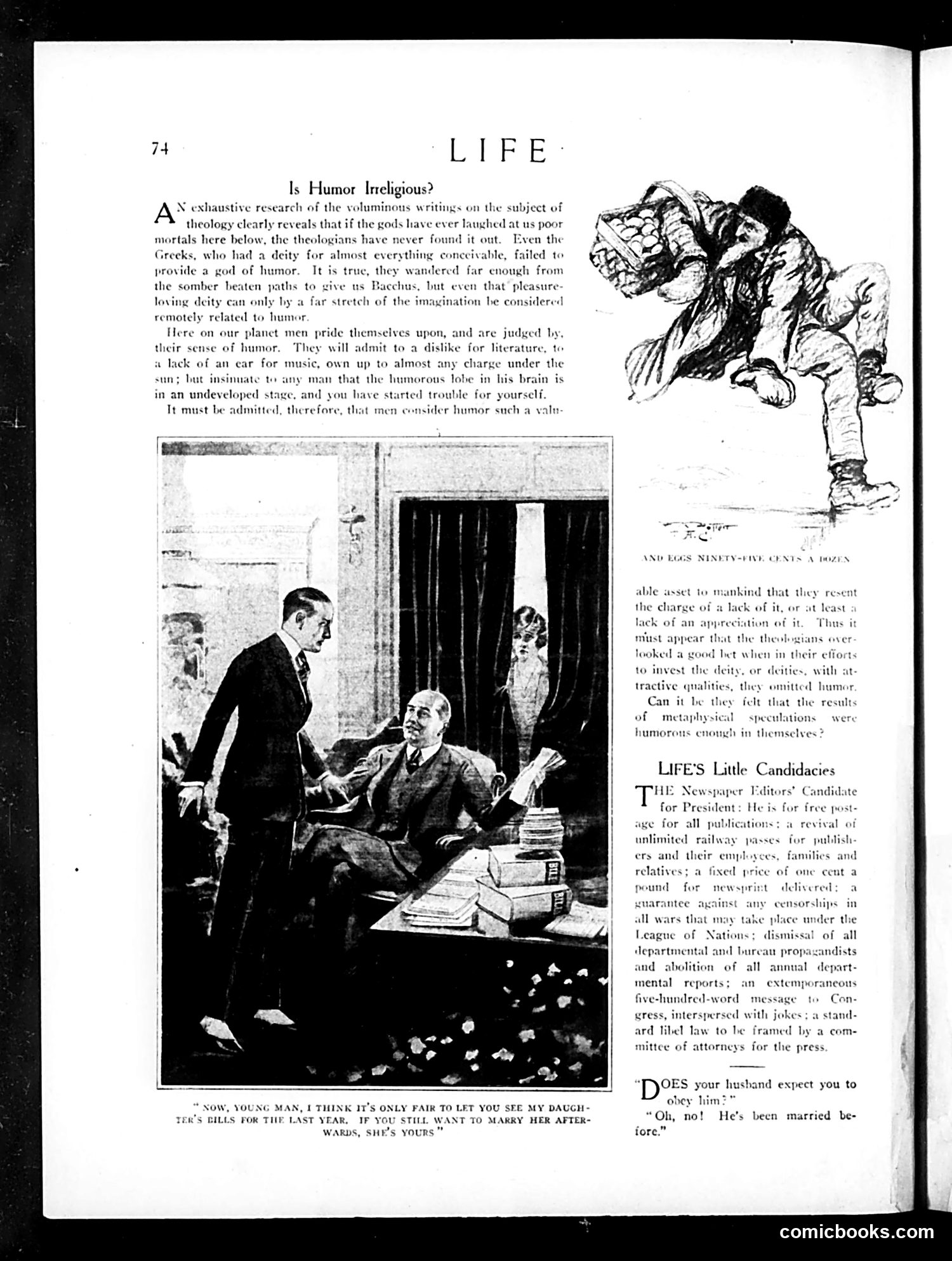
This page contains satirical commentary on American society circa early 20th century. **"Is Humor Irreligious?"** discusses theology's apparent exclusion of humor—even the Greeks had gods for nearly everything but lacked a god of humor. The piece argues humorousness is highly valued among humans, yet theologians seem to have omitted it as a divine attribute, suggesting either an oversight or assumption that metaphysical speculation is inherently funny. **"Life's Little Candidacies"** satirizes newspaper editors' political priorities through a mock "candidate for President" platform. It lists self-serving demands: free postage, unlimited railway passes, cheap newsprint, censorship immunity, and a standardized libel law controlled by press attorneys—highlighting how special interests distort political discourse. The cartoon below shows a father presenting his daughter's bills to a prospective suitor as a financial warning. The joke's punchline—"he's been married before"—implies experienced husbands expect such expenses, mocking both female spending habits and marriage expectations of the era.
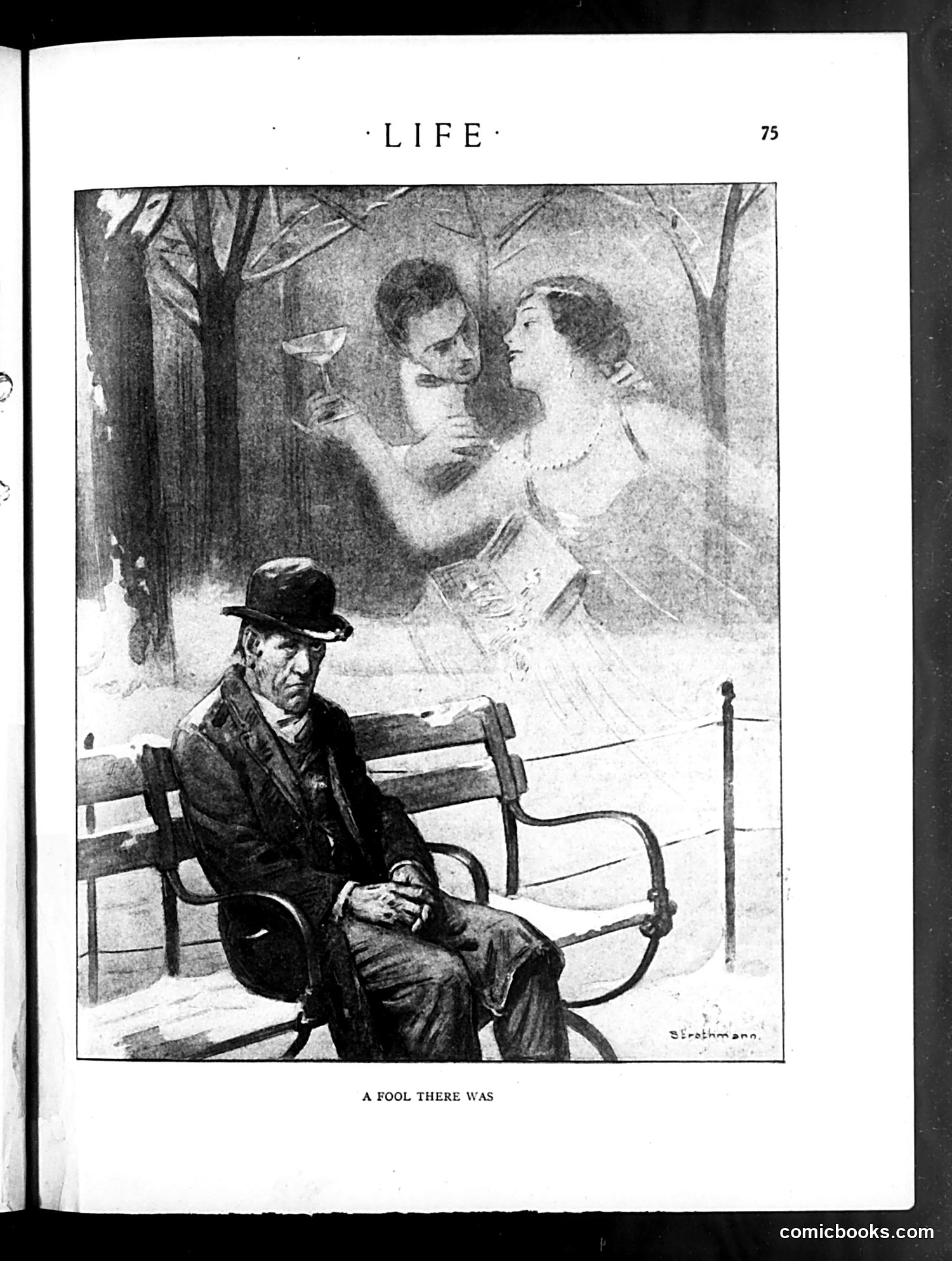
This cartoon depicts a well-dressed man sitting alone on a bench in winter, appearing dejected or contemplative. Behind him, a ghostly or ethereal image shows two women with a cocktail glass, suggesting temptation or romantic fantasy. The title "A Fool There Was" references a 1909 play and 1915 film about a man seduced and ruined by a femme fatale. The cartoon appears to satirize male gullibility in romantic or social situations—the solitary figure represents a man who has been fooled or abandoned, left alone while fantasizing about the women who led him astray. The work is signed by Strothmann, a cartoonist for Life magazine. The satire targets masculine weakness and poor judgment in matters of romance or temptation.
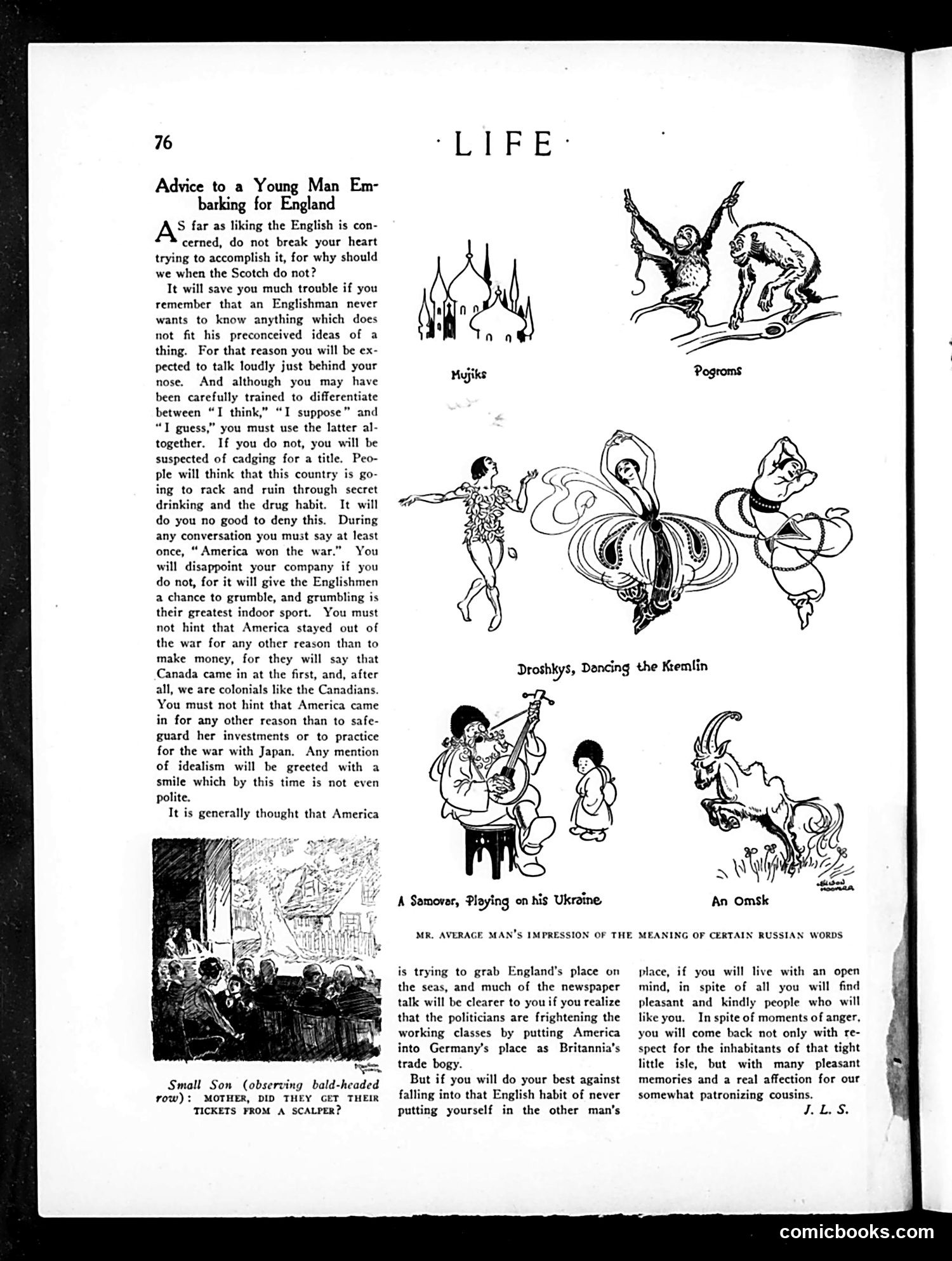
This satirical piece offers tongue-in-cheek advice to Americans visiting post-WWI England, reflecting American-British tensions of that era. **Main Content:** The article mocks English insularity and class consciousness, warning Americans that English people dismiss ideas outside their preconceptions. It cautions against using "I guess" (seen as lower-class) and advises repeatedly mentioning "America won the war" to provoke English grumbling—their "greatest indoor sport." **Political Context:** Post-WWI anxieties dominate. Americans are warned that British politicians portray America as a trade threat replacing Germany, and that mentioning America's late entry or financial motives (not idealism) will invite cynical smiles. **Illustrations:** Whimsical drawings label Russian words ("Hajiks," "Pogroms," "Droshkys," "Omsk") as "average man's impression"—stereotyping Russians as exotic/violent, reflecting period xenophobia. **The Satire:** Despite mockery, the conclusion advises openness, suggesting English people are fundamentally decent despite their quirks—offering backhanded affection to "somewhat patronizing cousins."
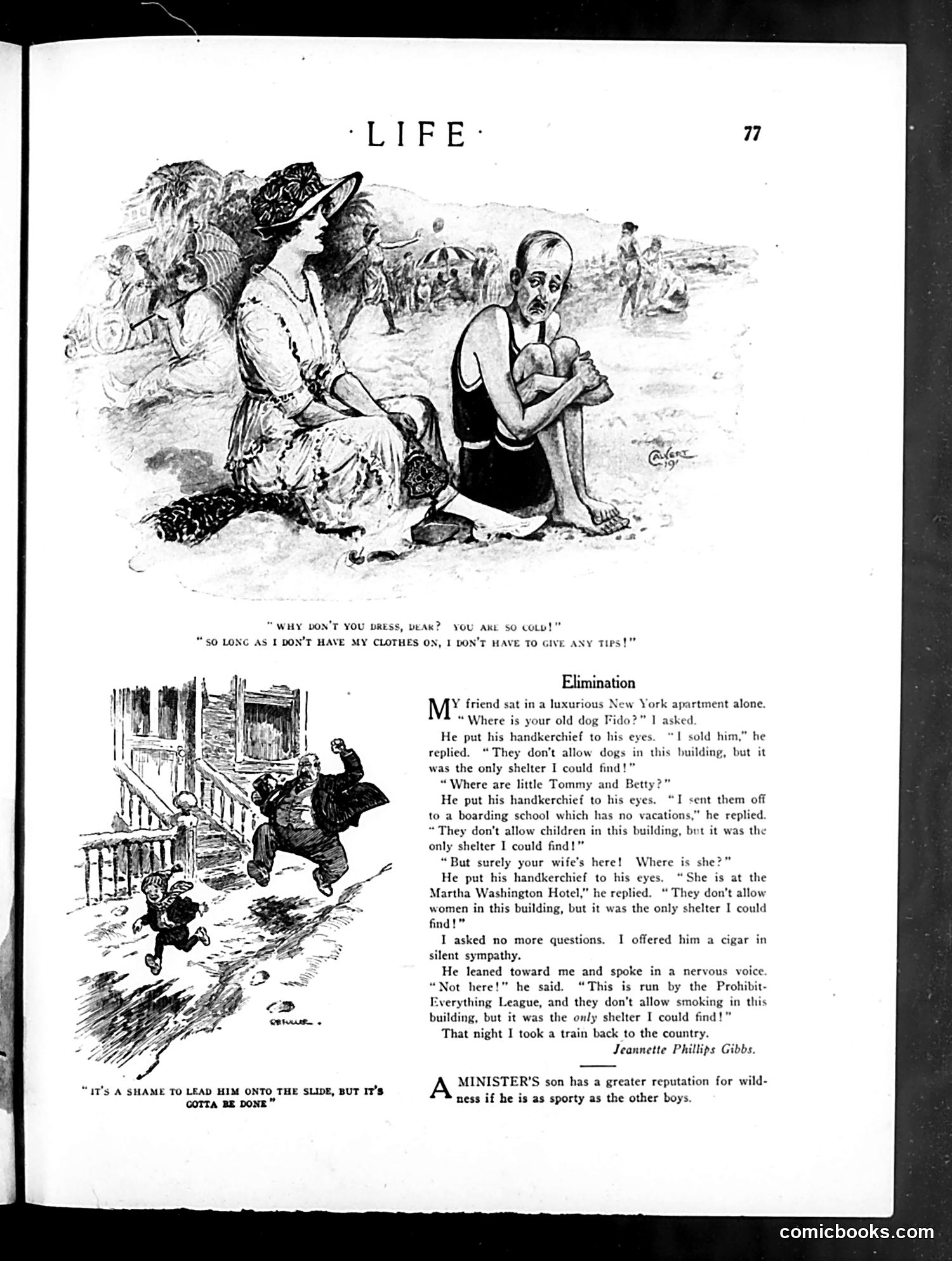
This page contains two satirical pieces mocking early 20th-century social restrictions: **Top cartoon**: A beach scene showing a man refusing to dress despite cold weather because he won't give tips to attendants. The joke targets tipping culture's absurdity—he'd rather suffer than pay. **"Elimination" story**: Satirizes the Prohibition era's moral crusades. A man has systematically eliminated his dog, children, and wife from his apartment because his building—run by the "Prohibit-Everything League"—bans them. The dark humor escalates with each family member's absence, culminating in the building also banning smoking. The narrator flees to the country in disgust. The satire targets not just Prohibition itself, but the era's broader pattern of restrictive "purity" organizations that sought to eliminate perceived social evils through blanket bans. The joke is that in eliminating "undesirable" elements, the building has become an absurd, inhuman space where even the resident's own family has no place. **Context**: This reflects 1920s anxiety about Prohibition's overreach and moralistic activism.
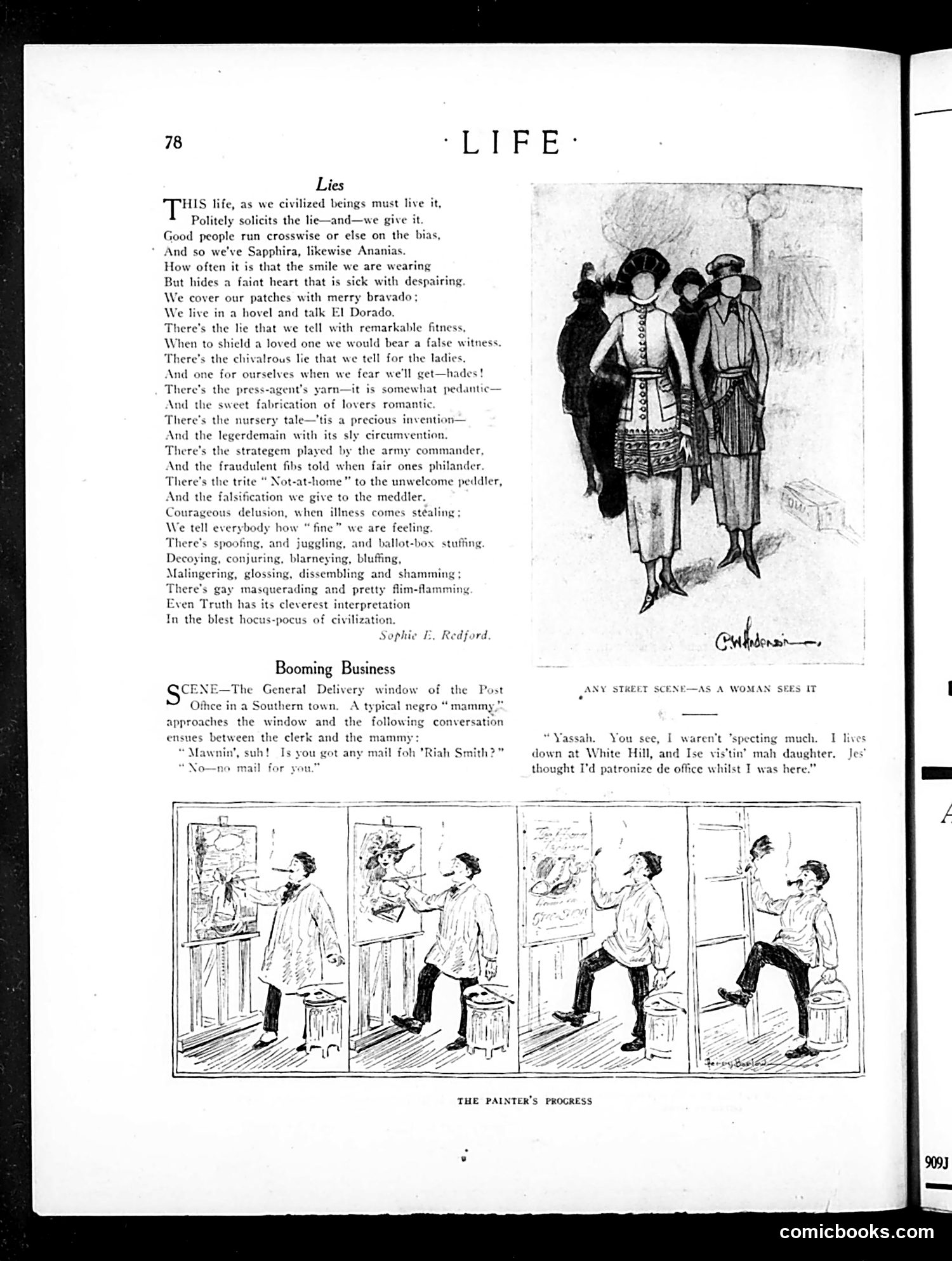
This page contains satirical content about deception in civilized society. **"Lies" (poem by Sophie E. Redford):** A comprehensive critique of everyday dishonesty—from white lies protecting loved ones to grand fabrications. It catalogs various social deceptions: press agents' exaggerations, romantic fabrications, political ballot-stuffing, and false cheerfulness about illness. The poem suggests hypocrisy is woven into "civilized" life itself. **"Booming Business" (sketch):** Shows a Black woman ("mammy" stereotype) visiting a Southern post office. She humorously explains she patronized the office despite low expectations, having traveled from White Hill to visit her daughter. The humor plays on the contrast between her modest circumstances and the formal postal service setting. **"The Painter's Progress" (comic strip):** Depicts sequential panels of a man painting a wall, progressively losing balance or control—visual comedy about incompetence or mishap. The page's overall theme connects: lies permeate society, from grand deceptions to small courtesies, framed within period racial stereotypes now considered offensive.
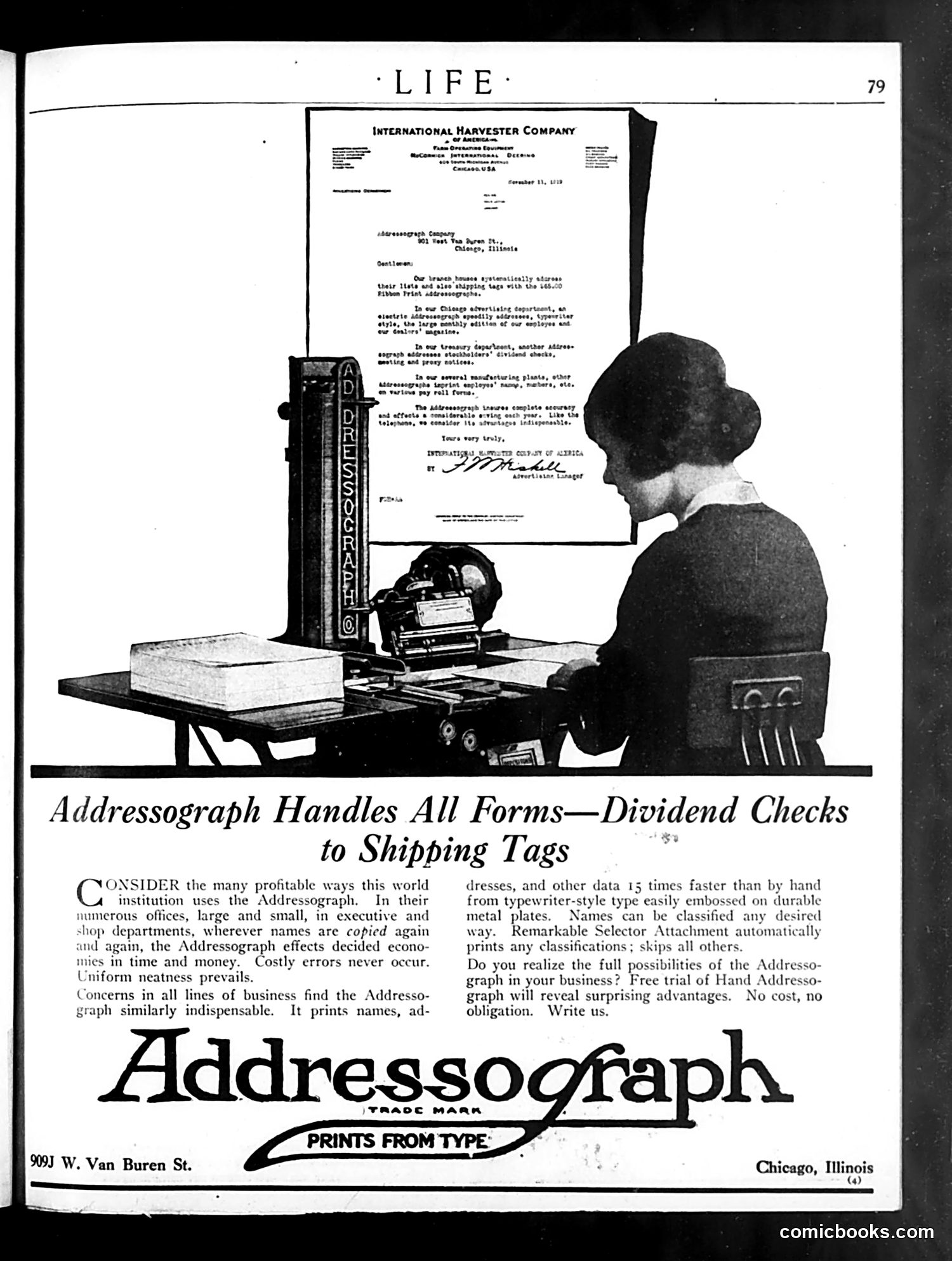
This is primarily a **business advertisement**, not a political cartoon. It promotes the Addressograph, a machine that prints addresses and names on documents mechanically. The image shows a woman operating an Addressograph machine at a desk, with a letter from International Harvester Company displayed above as an example of the machine's use. The company letter testifies to how valuable the Addressograph is for their business operations—printing names on dividend checks, shipping tags, payroll forms, and stockholder notices. The "satire" here is gentle corporate marketing: the page presents a testimonial letter (made to look official) alongside the advertisement to convince potential business customers that the Addressograph saves time and money while ensuring accuracy and uniform appearance. For modern readers, this represents early 20th-century office automation advertising—demonstrating how businesses adopted mechanical solutions to handle repetitive administrative tasks before computers existed.
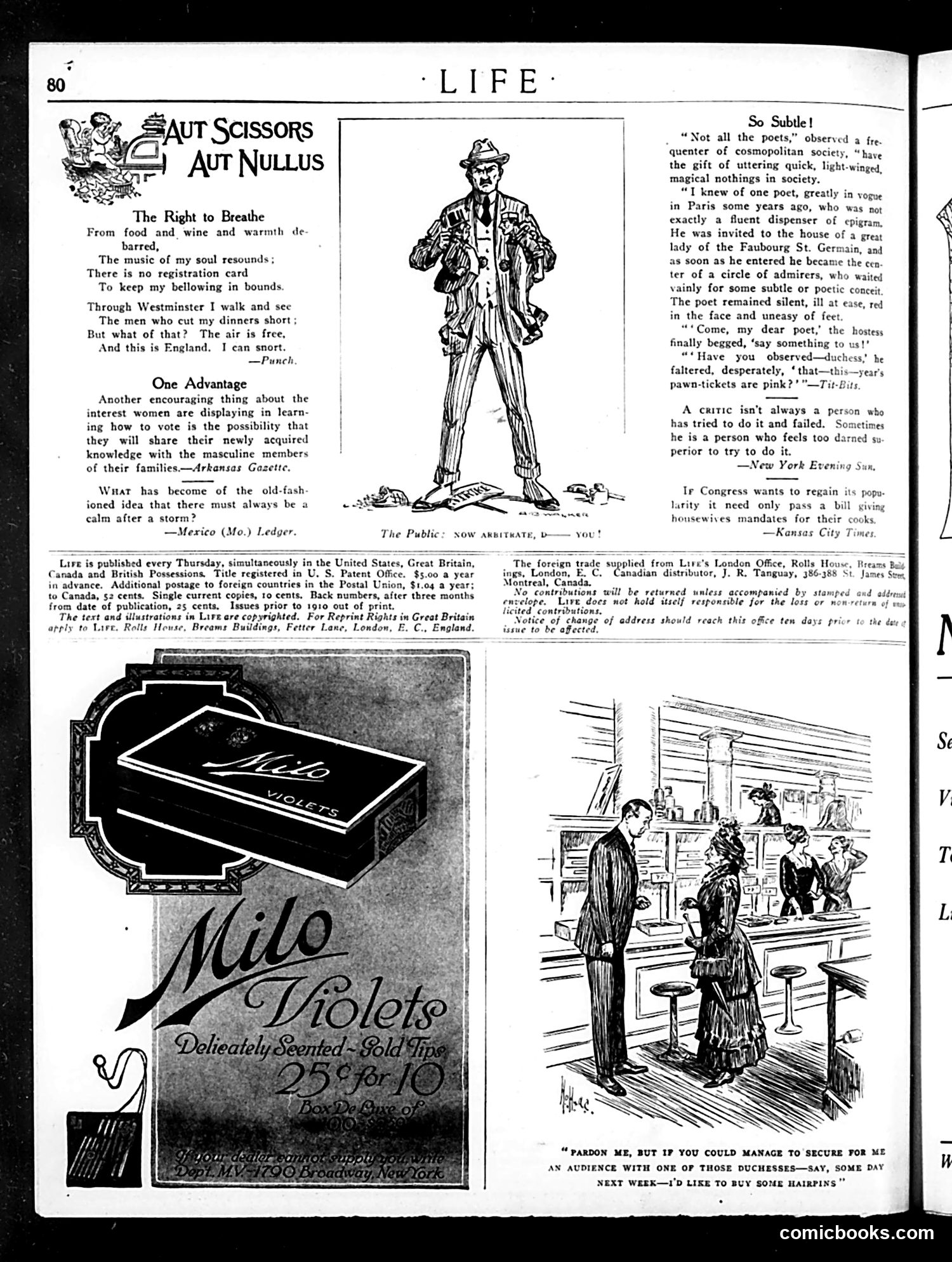
This page from *Life* (circa early 20th century) combines satirical verse, advertisements, and humor commentary: **"The Right to Breathe"** — A poem mocking wartime rationing or food restrictions, celebrating England's remaining freedom (air to breathe). References "registration card," suggesting government control measures. **"One Advantage"** — A quip about women gaining voting rights, joking they'll educate men in their families about voting. **"So Subtle!"** — A society anecdote mocking a pretentious Parisian poet invited to an aristocratic salon who, unable to produce witty conversation, makes a banal observation about pink pawn-tickets—satirizing affected literary circles. **The cartoon** (bottom right) shows a man at a bar desperately asking a woman to introduce him to wealthy duchesses so he can sell them hairpins—mocking both social-climbing salesmen and the absurdity of high-society networking. The page overall mocks class pretension, wartime restrictions, and social climbing through humor typical of *Life*'s satirical approach.
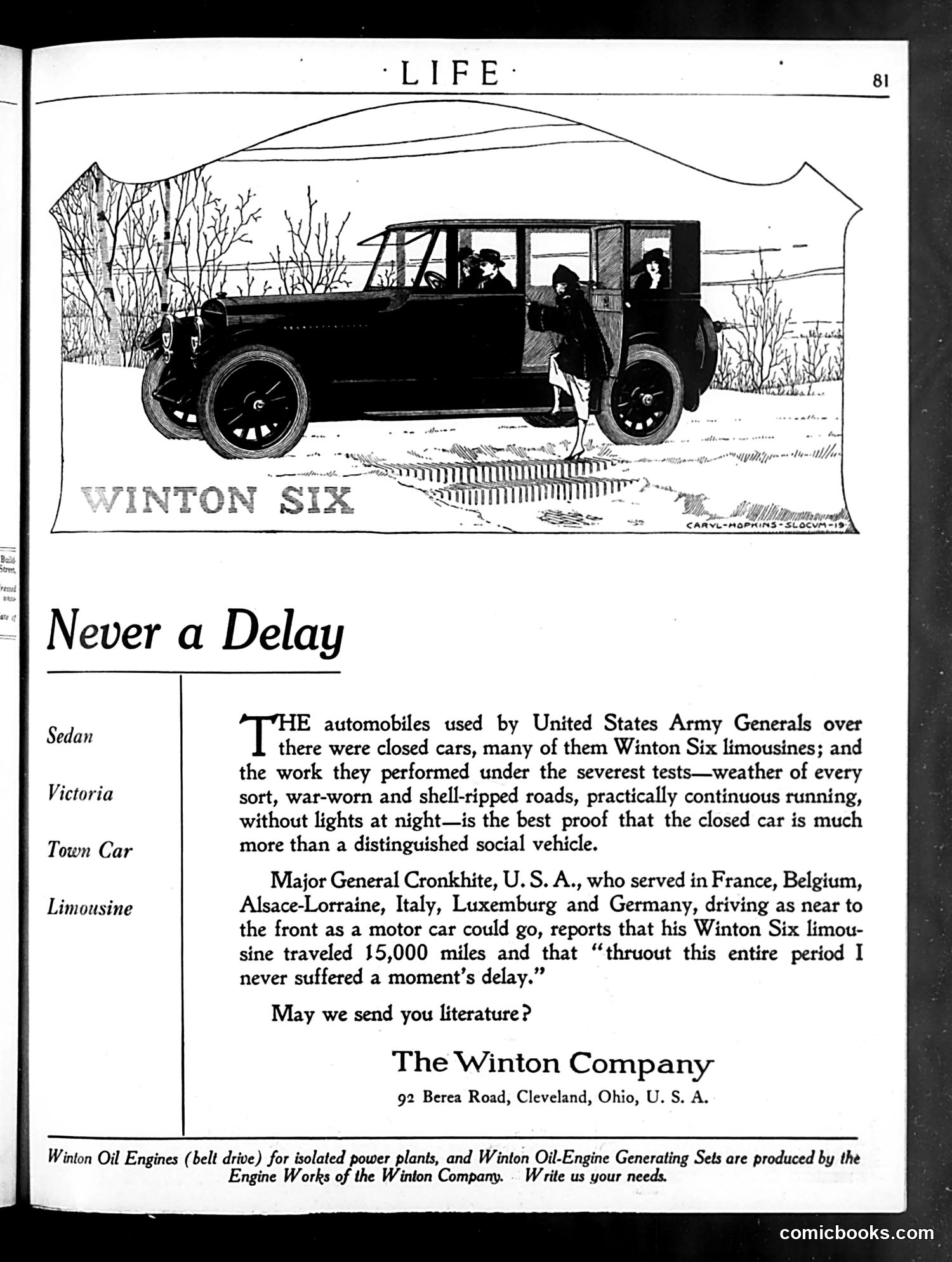
This is primarily a **vehicle advertisement**, not political satire. The Winton Company uses post-WWI testimonial marketing to promote their automobiles. The "cartoon" is a stylized illustration of a Winton Six limousine with passengers, depicting it as a luxury closed car. The ad's central claim: these vehicles proved their worth under extreme military conditions in France and Europe during World War I. **The pitch to modern readers:** Rather than satirizing anything, this leverages military credibility. Major General Cronkhite's endorsement—15,000 miles with "never a moment's delay"—attempts to rebrand the closed car from mere "distinguished social vehicle" to reliable military equipment. The ad lists body styles (Sedan, Victoria, Town Car, Limousine) as options, targeting affluent buyers who could afford both the car and the social status it conveyed. This reflects 1920s advertising strategy: use wartime heroics and technical achievement to sell consumer goods to a post-war, prosperity-minded American audience.
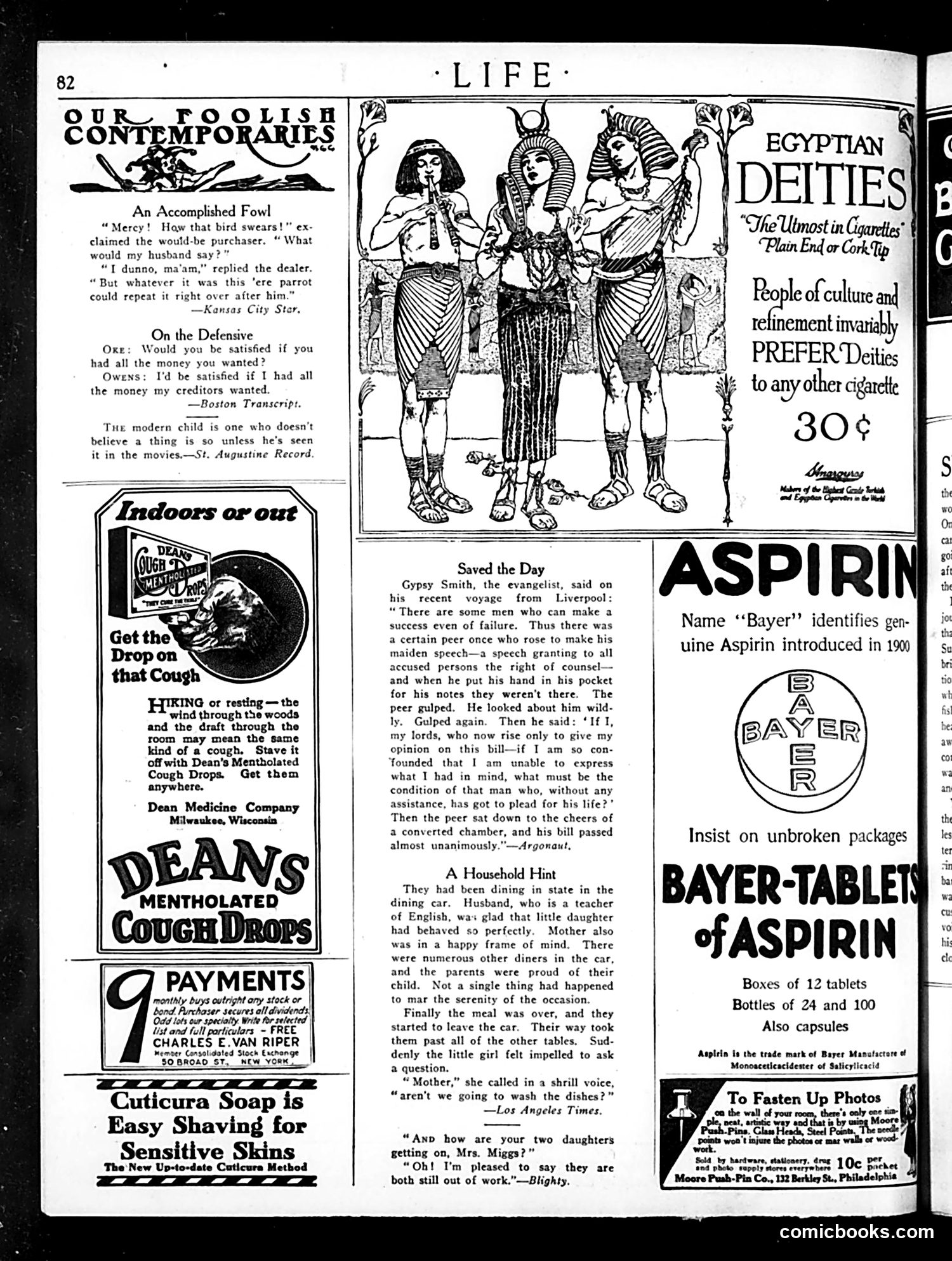
This page is primarily **advertisements and humor columns**, not political satire. The content includes: **Humor pieces**: Short jokes from newspapers about parrots that swear, creditors, and children who only believe things seen in movies—typical early 20th-century newspaper humor. **Notable story**: "Saved the Day" recounts evangelist Gypsy Smith's anecdote about a British peer whose forgotten speech notes led to an impromptu argument for defendants' rights. The peer's improvisation wins over the chamber—a story celebrating quick thinking and democratic principles. **Advertisements**: The page is dominated by ads for cough drops, cigarettes ("Egyptian Deities"), Aspirin (emphasizing Bayer's trademark), Cutícura soap, and stock brokerage services—reflecting 1920s consumer culture. **No significant political cartoon or satire** appears here; it's primarily a mundane magazine page mixing light humor with period advertising.
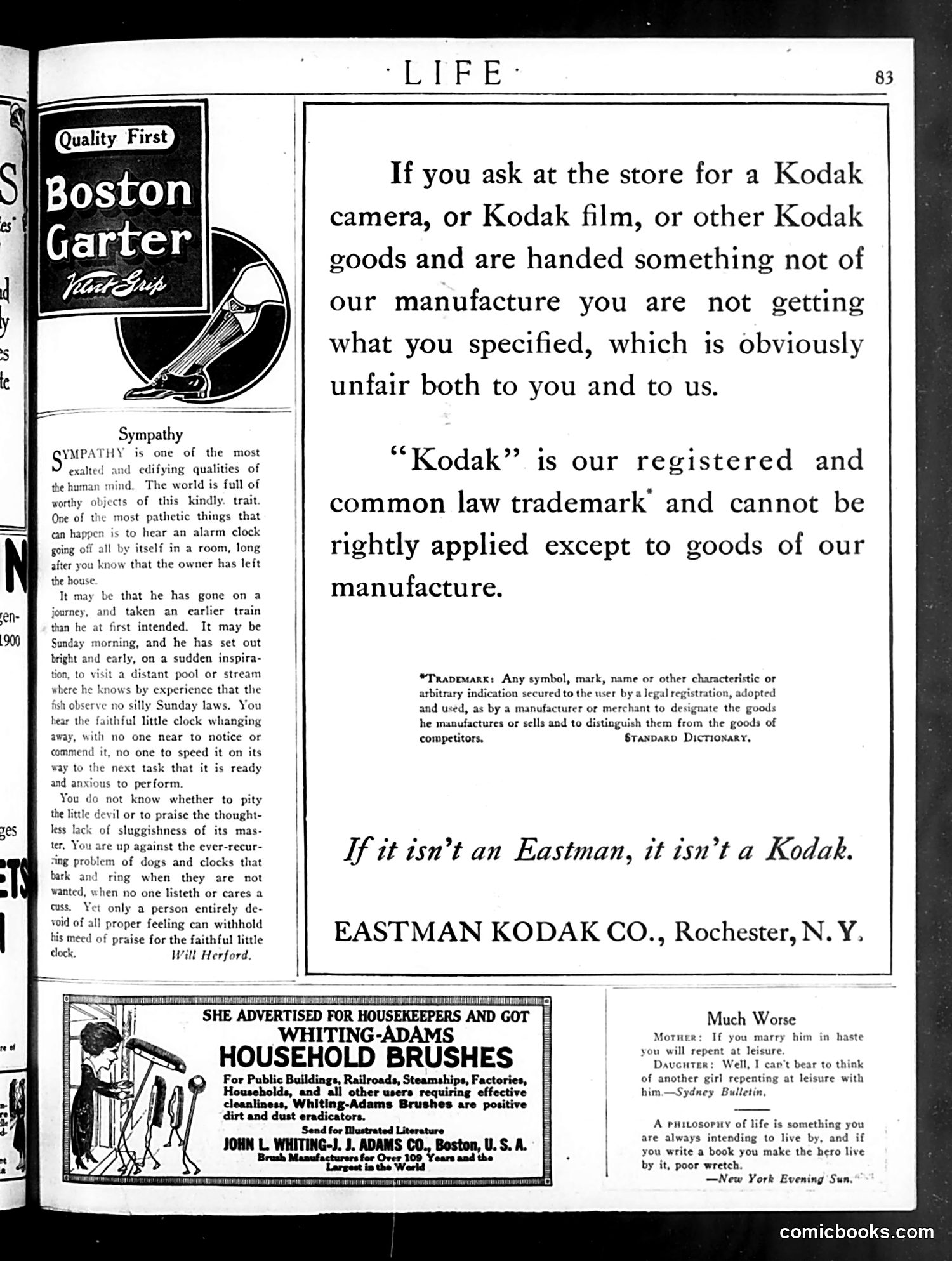
This page contains three distinct advertisements/content items: **Kodak Trademark Advertisement**: The main content is Eastman Kodak Company's legal notice warning consumers and retailers against counterfeit or mislabeled Kodak products. The company asserts that "Kodak" is their registered trademark and cannot be applied to non-Kodak goods. The famous slogan "If it isn't an Eastman, it isn't a Kodak" emphasizes brand protection. This reflects early 20th-century concerns about knockoff products and trademark infringement—a consumer protection issue. **Whiting-Adams Brushes Ad**: A smaller advertisement promoting household brushes for institutional cleaning. **"Much Worse" Humor Column**: A brief satirical piece about marriage consequences, using the format of a mother-daughter dialogue mocking hasty marriage decisions. The page primarily addresses trademark protection and consumer fraud rather than political satire, reflecting commercial and domestic humor typical of Life's content from this era.
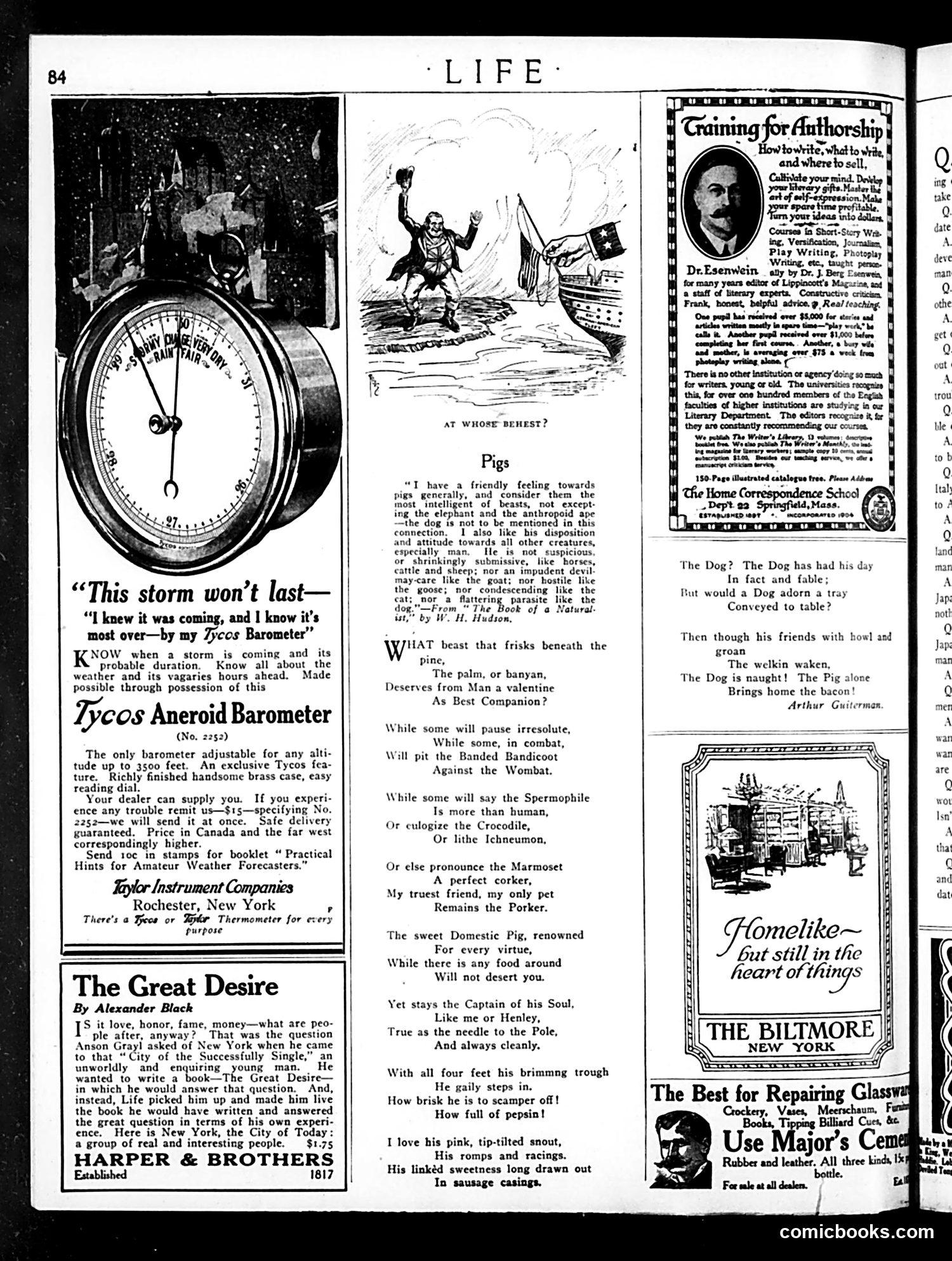
The main cartoon depicts a man confidently holding a Tycos Barometer, claiming he can predict storm duration. The satire is straightforward advertising humor: the man's certainty ("I knew it was coming") is undercut by his reliance on a mere instrument—the joke being that even with modern gadgetry, weather prediction remains unreliable. The cartoon illustrates the barometer's promise while gently mocking human overconfidence in technology. The page also features a poem celebrating pigs as superior to dogs—a humorous inversion of conventional animal preferences. The final line, "The Pig alone / Brings home the bacon," delivers the punchline: pigs are practical and useful, unlike sentimentally-favored dogs. This reflects early-20th-century satirical priorities: utility trumps romantic attachment. The remaining content consists largely of advertisements and book promotions, typical of Life's mixed editorial-commercial format.
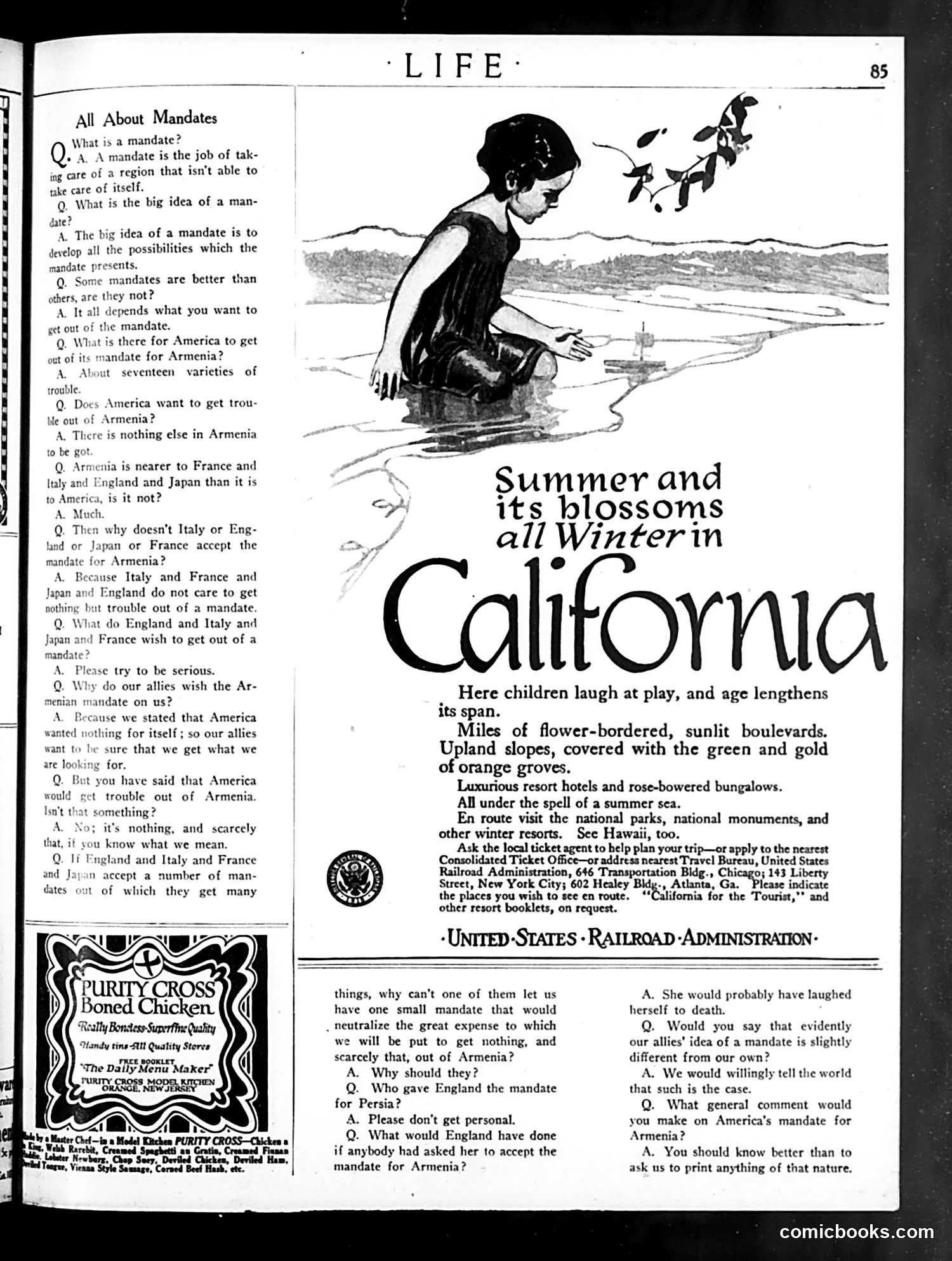
This page satirizes America's reluctant acceptance of League of Nations mandates after World War I, specifically the Armenian mandate. Through a Q&A format, the article mocks U.S. foreign policy inconsistency. **The Setup:** America claimed to want nothing for itself, yet Allied nations (Britain, France, Japan, Italy) eagerly assigned it the unprofitable Armenian mandate—a region offering only "seventeen varieties of trouble." The satire exposes the absurdity: other nations rejected the same burden, recognizing it as worthless, yet pushed it onto America anyway. **The Joke:** The dialogue reveals American naïveté—politicians promised selflessness while getting stuck with expensive colonial responsibilities yielding no benefit. The final exchange shows the magazine's exasperation at being asked to endorse this arrangement. **Context:** This reflects 1920s American isolationism debates and skepticism about League involvement. The accompanying California tourism ad provides ironic contrast—escapism versus international obligation.
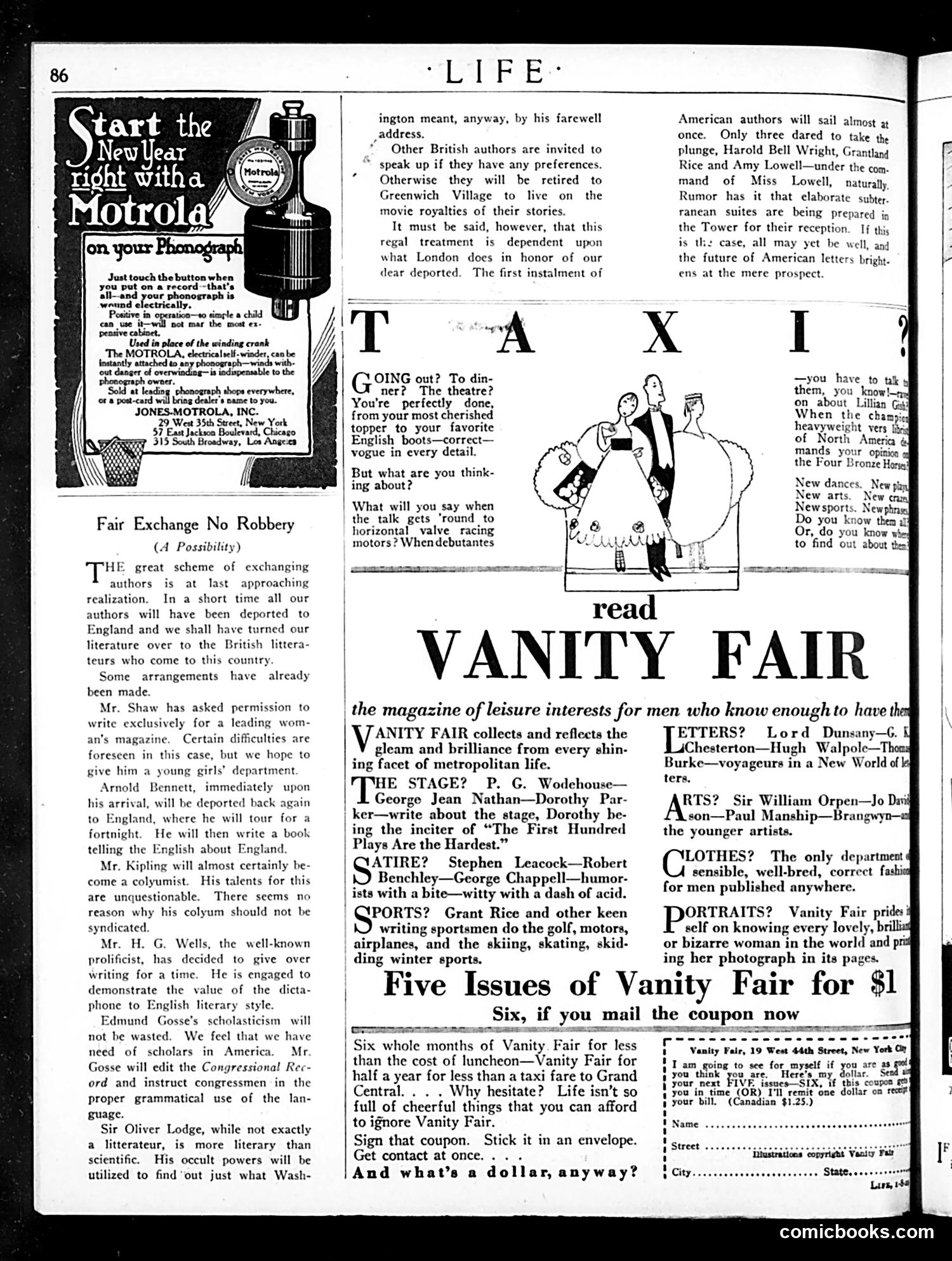
This Life magazine page contains two main satirical pieces: **"Fair Exchange No Robbery"** satirizes a hypothetical scheme to deport American authors to England while importing British writers. The joke lists famous British authors (Shaw, Bennett, Kipling, Wells, Gosse, Lodge) and imagines absurd American jobs for them—Shaw editing a "girls' department," Kipling becoming a columnist, Gosse editing the Congressional Record. The satire mocks both British literary pretension and American cultural anxiety, suggesting Americans desperately need European sophistication. It's a tongue-in-cheek commentary on early 20th-century transatlantic literary rivalry and America's cultural inferiority complex. **The "Taxi" cartoon** shows a well-dressed couple in a taxi, with the man worried the woman will embarrass him by discussing unfamiliar topics like "horizontal valve racing motors" and debutante gossip at dinner. It satirizes masculine anxiety about appearing knowledgeable in social situations—a dated but recognizable concern about performing sophistication. Below is an advertisement for *Vanity Fair* magazine, emphasizing it covers leisure, arts, fashion, and social topics for cultured men.
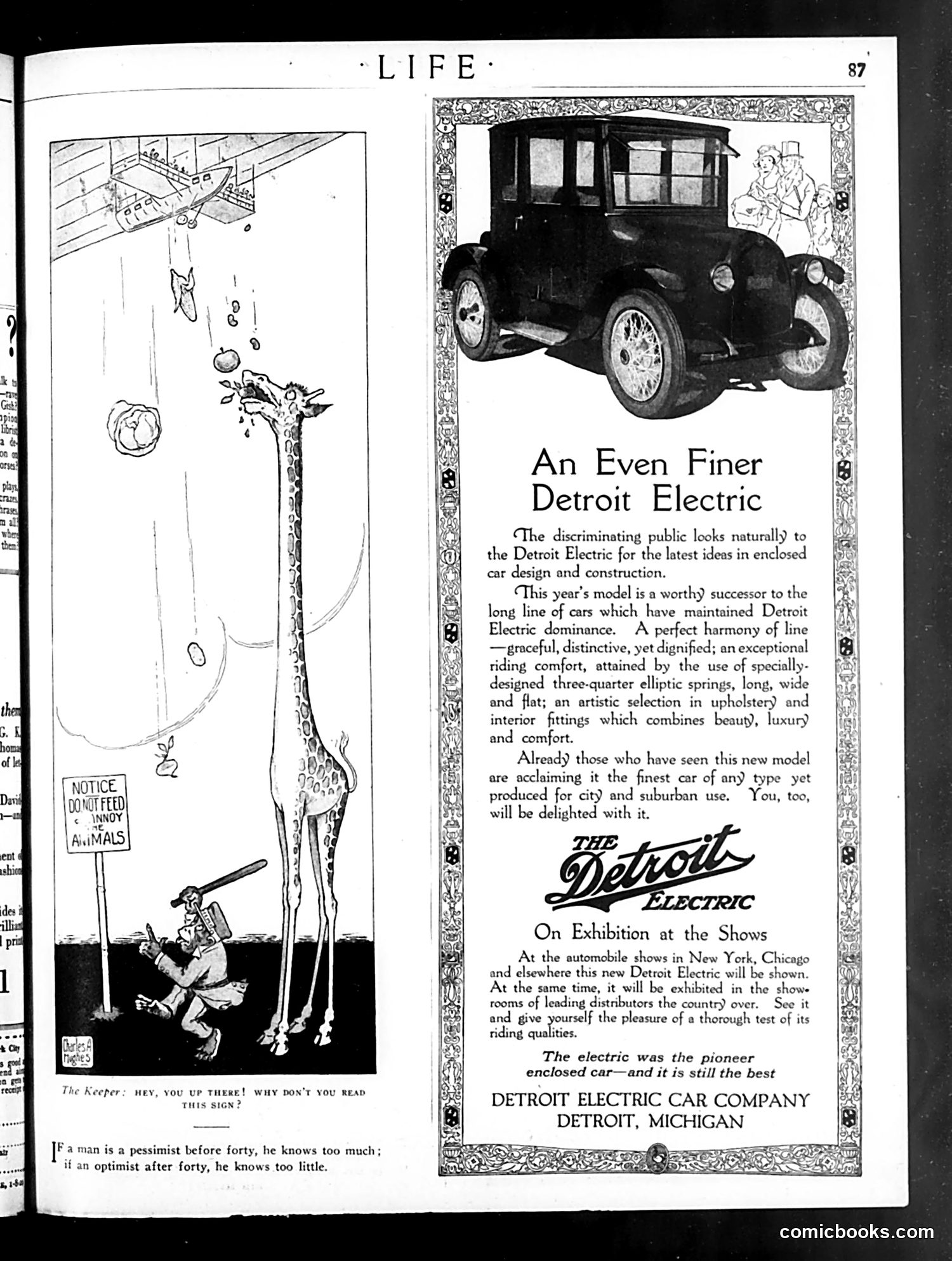
This page combines a satirical cartoon (left) with a Detroit Electric automobile advertisement (right). **The Cartoon:** A zookeeper discovers animals have escaped their enclosure. The sign reads "Notice: Do Not Feed Animals." The keeper exclaims, "Hey, you up there! Why don't you read this sign?" The satire appears to mock people—possibly politicians or public figures—who ignore explicit warnings or rules, treating them as irrelevant. The "animals" metaphor suggests the targets are behaving irrationally or dangerously by disregarding clear instructions. **The Advertisement:** Promotes the Detroit Electric enclosed automobile as the finest city car, emphasizing its comfort, design, and pioneering status. It claims the electric car "was the pioneer enclosed car—and it is still the best." **Context:** Early 1900s automobiles were novel; electric cars competed with gasoline models. The juxtaposition of a "rule-breaking animals" cartoon with aspirational consumer advertising is typical of *Life* magazine's satirical approach—mixing social commentary with contemporary commerce.
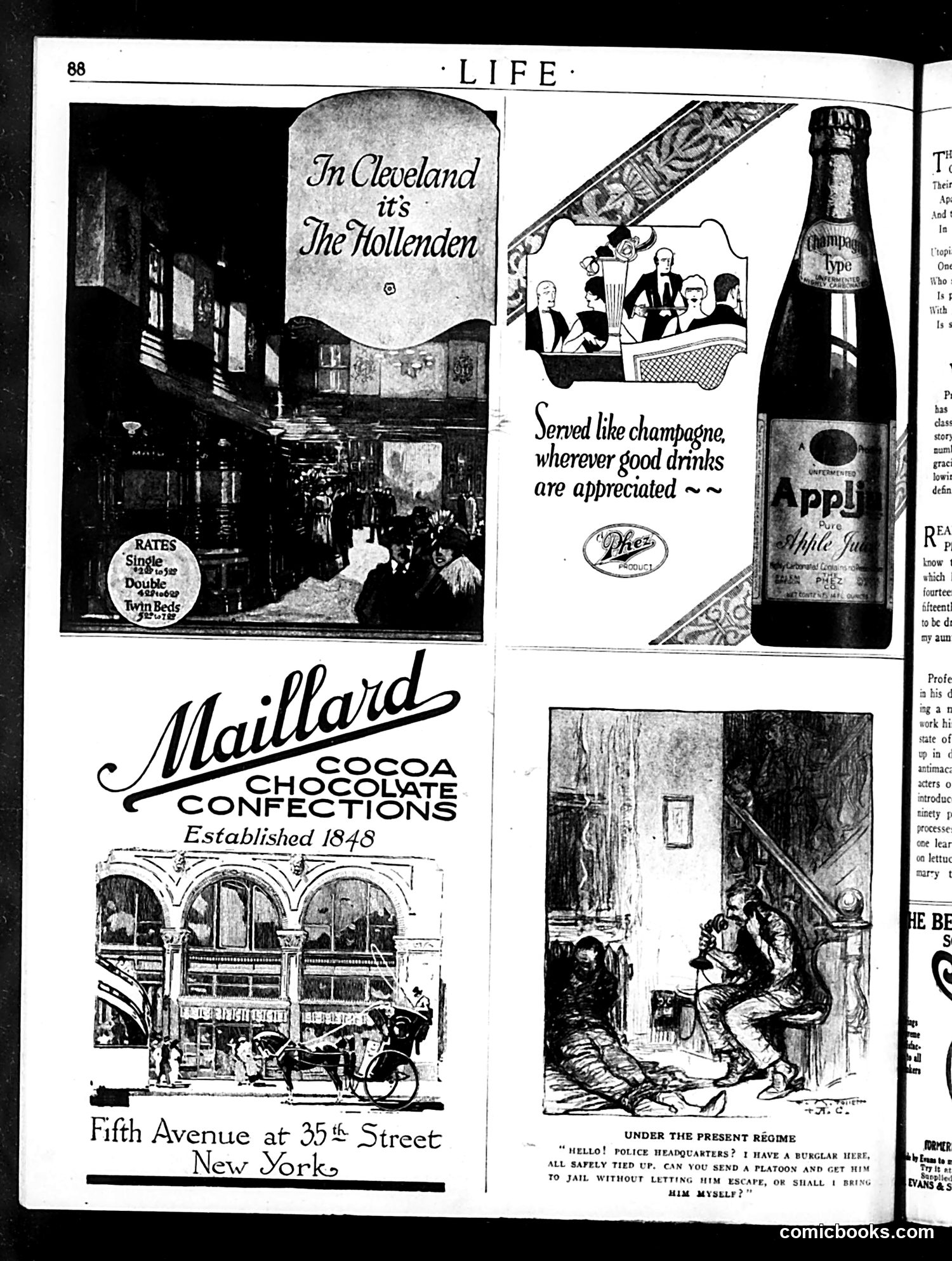
This page mixes **advertisements** with a **political cartoon**. **Top advertisements:** Hotels (The Hollenden in Cleveland) and a beverage product called "Appli" are promoted as premium goods. **Main cartoon** (bottom right, titled "Under the Present Régime"): Shows someone calling police about a burglar, sarcastically asking if officers can arrest the criminal without him escaping—or should the caller just bring the burglar in themselves. This is **satire on police incompetence**, suggesting law enforcement of the era (appears to be 1920s-30s based on style) was so ineffective that citizens couldn't rely on them to successfully jail criminals. The joke critiques widespread concerns about corruption, inefficiency, or inability of police to handle basic law enforcement duties. **Additional ads:** Maillard Cocoa and Chocolate Confections (established 1848) at Fifth Avenue, New York.
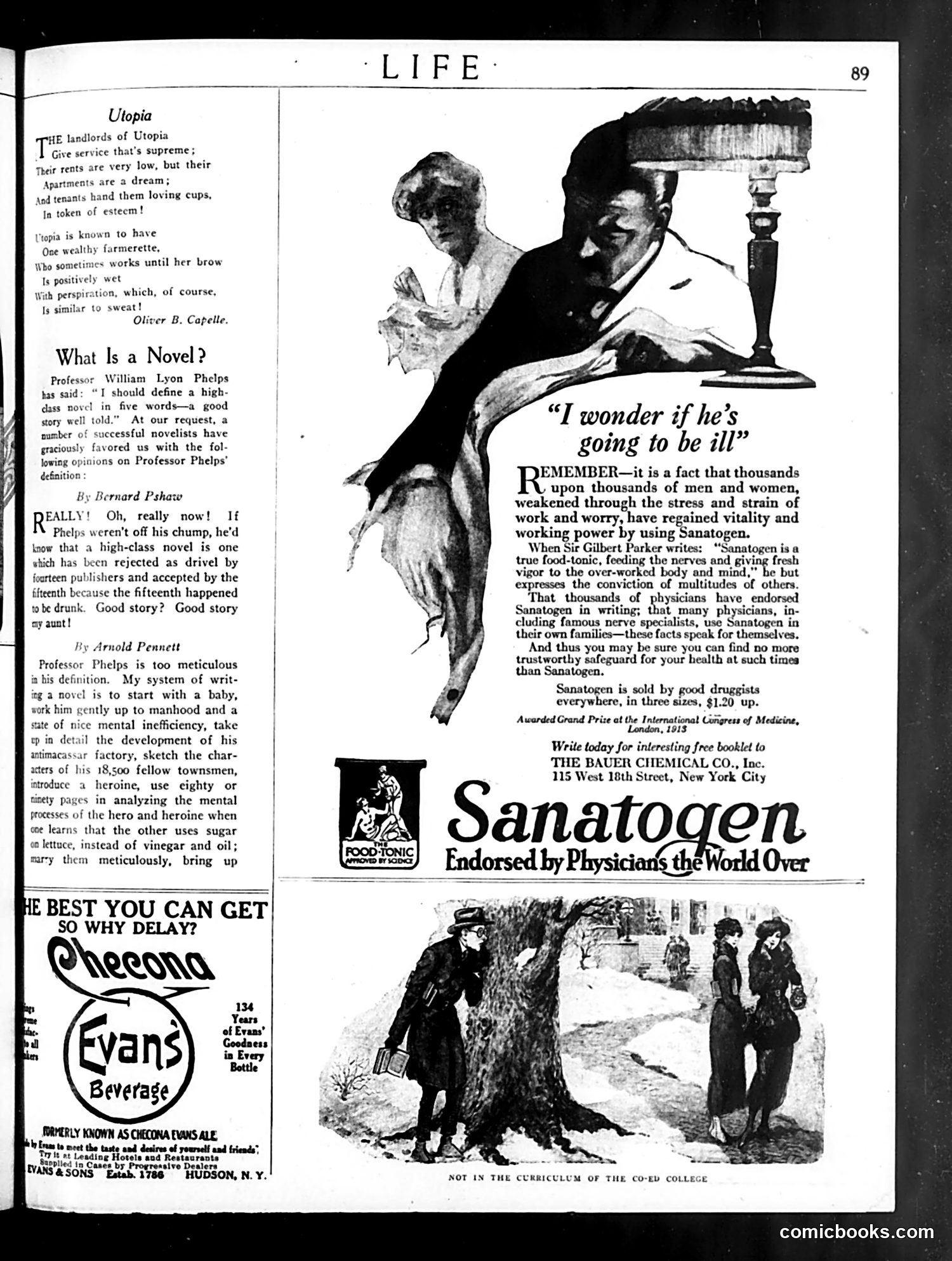
This page contains satirical content about literary definitions and social commentary typical of early 20th-century Life magazine. **"Utopia" Section**: A short satirical poem mocking idealized depictions of landlord-tenant relations and wealthy "farmerettes" (female farmers), suggesting such rosy scenarios are unrealistic fantasy. **"What Is a Novel?" Section**: The main satire responds to Professor William Lyon Phelps's definition of a novel as "a good story well told." Fictional author responses parody pretentious literary criticism—one suggests novels must be rejected by publishers before acceptance (mocking the publishing industry's inconsistency), another describes an absurdly complex writing method involving 18,500 characters and obsessive detail. The humor targets both professorial pomposity and avant-garde literary pretension of the era. **Bottom Image**: Captioned "Not in the Curriculum of the Co-ed College," showing what appears to be a street scene—likely satirizing limitations of women's education or social propriety in colleges. The page also features advertisements for Sanatogen (a nerve tonic) and Chicona Evans Beverage, typical of period magazines.
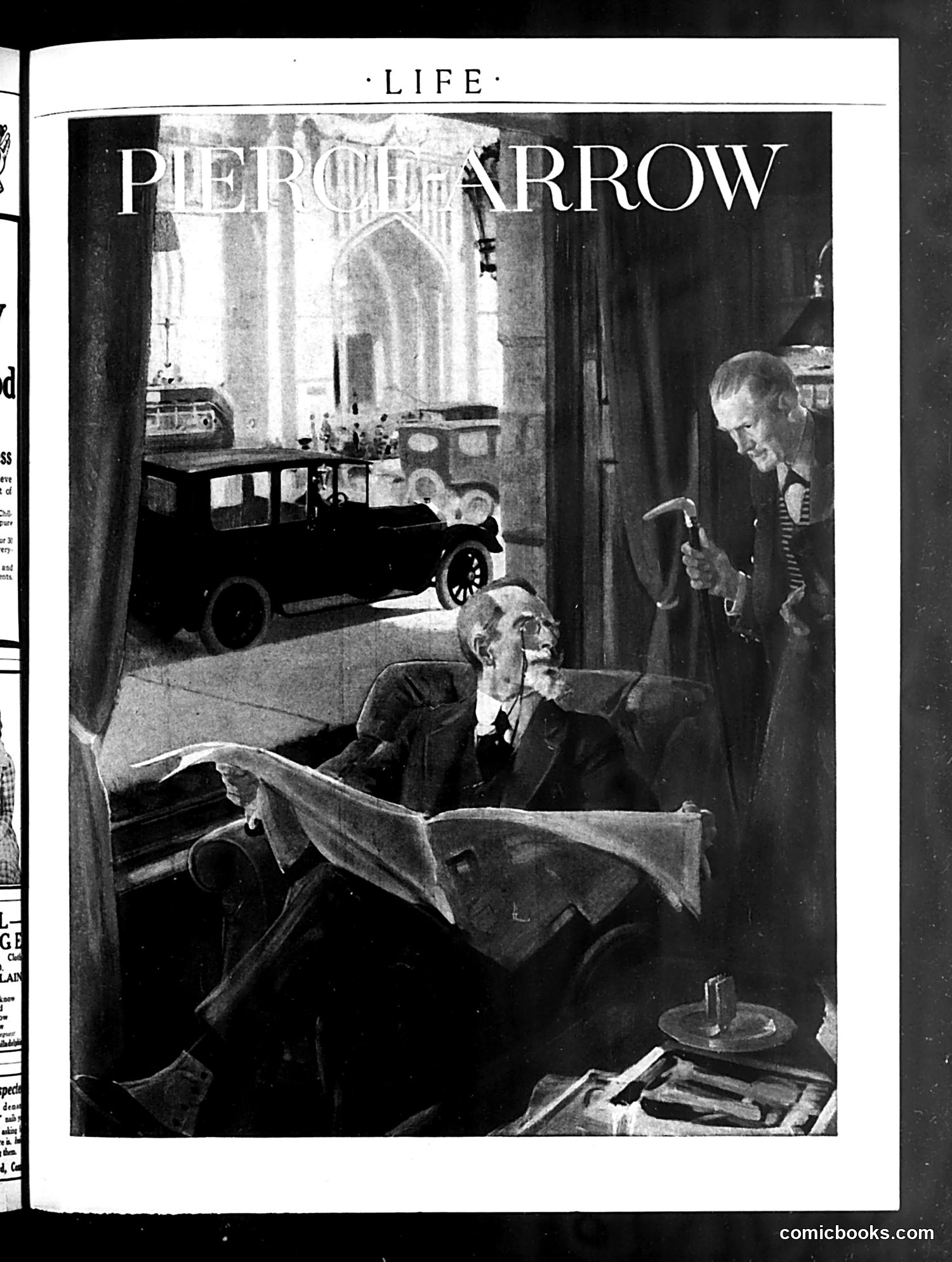
This appears to be a satirical illustration titled "Pierced Arrow" from Life magazine. The image shows a seated elderly man reading a newspaper while a standing man gestures toward him with what appears to be a large arrow or implement. Through a window behind them, a vintage automobile is visible on a street with Gothic architecture. The satire likely plays on the phrase "pierced arrow"—possibly referencing a Native American or historical figure, or making a pun about being "pierced" by news. The man's intense reaction to reading the newspaper suggests he's received shocking or troubling information. Without additional context or visible date, the specific political or social event being mocked remains unclear, though the formal dress and period setting suggest early 20th-century American satire.
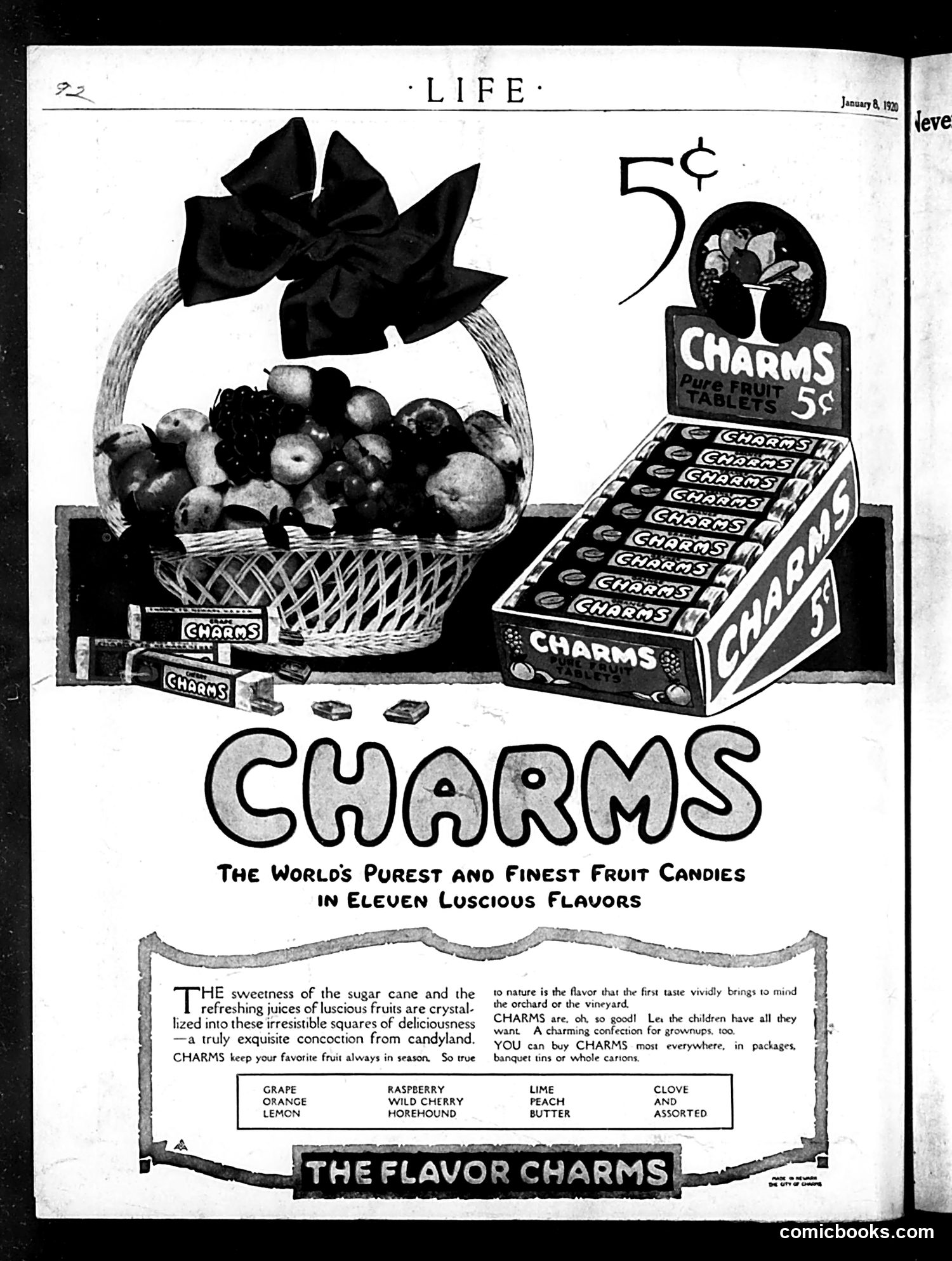
This is a **product advertisement**, not political satire. It promotes Charms fruit candies at 5 cents, positioning them as "the world's purest and finest fruit candies" available in eleven flavors (grape, orange, lemon, raspberry, wild cherry, horehound, lime, peach, butter, clove, and assorted). The ad uses typical 1920s marketing rhetoric: emphasizing natural fruit flavors so authentic they evoke orchards and vineyards, appealing to both children and adults, and highlighting the product's widespread availability. The basket of fruit and decorative display box are designed to make the candy seem wholesome and luxurious. There is no political content or satirical joke—this is straightforward commercial promotion appearing in Life magazine's pages.