
Life, 1920-01-08 · page 24 of 44
Life — January 8, 1920 — page 24: what you’re looking at
What you’re looking at
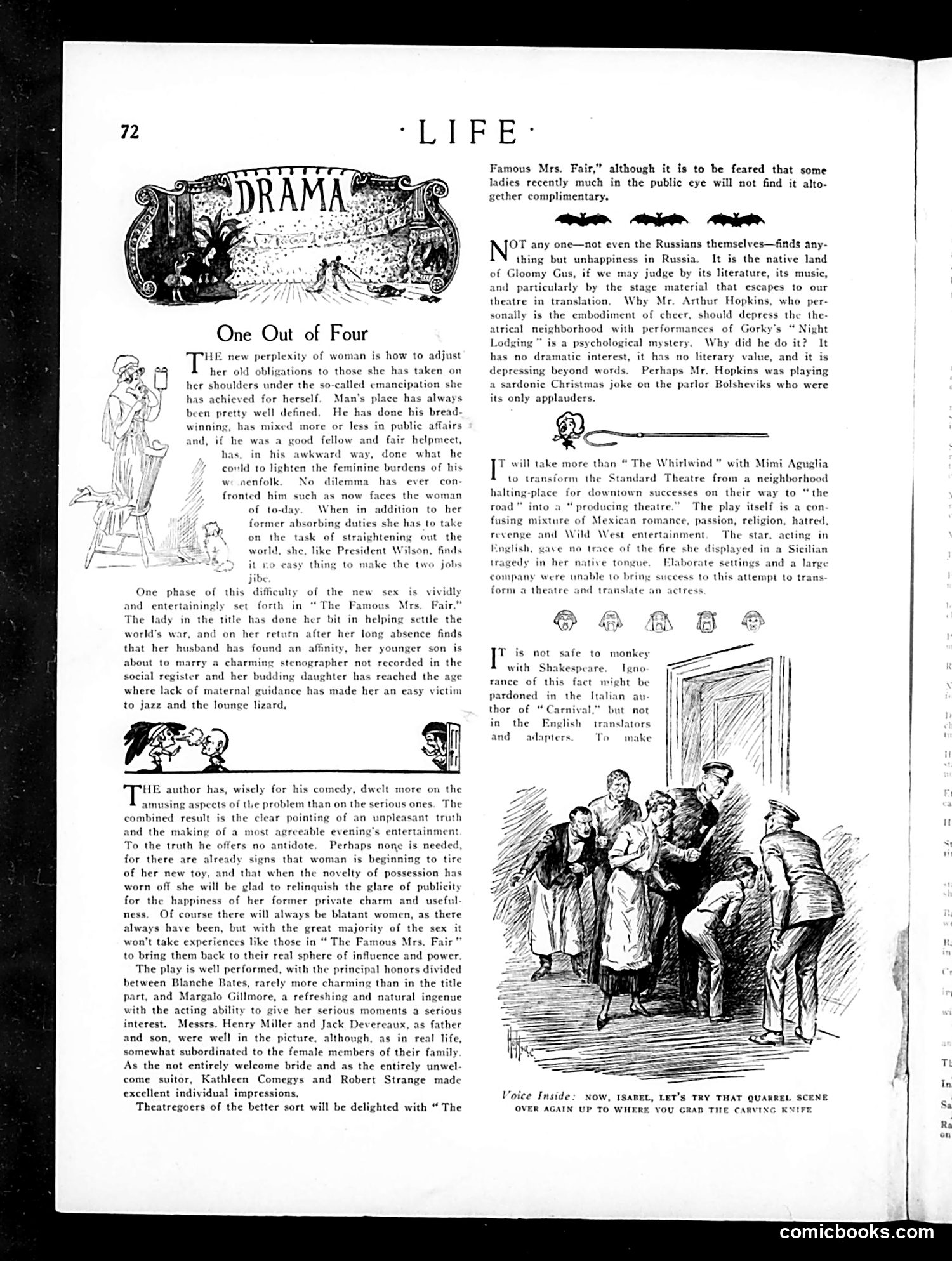
This page reviews "The Famous Mrs. Fair," a contemporary play addressing women's evolving social roles post-World War I. The critic argues the play intelligently explores the tension between women's traditional domestic duties and their newly claimed public/political engagement—"the new perplexity of woman." The plot centers on a woman who, absent during wartime service, returns home to find her husband has taken a mistress, her son is engaged to an unsuitable woman, and her daughter has fallen into vice ("jazz and the lounge lizard"). The review suggests this cautionary tale will discourage women from abandoning their "real sphere of influence and power" in domestic life, predicting most women will tire of public prominence and "relinquish the glare of publicity." The criticism reflects conservative anxiety about women's suffrage and expanded opportunities, framing female emancipation as a temporary "novelty" rather than lasting social change. The sketch depicts a woman juggling multiple obligations, visualizing the article's central tension.
📄 Transcribed text from this page (OCR, searchable)
Machine-transcribed from the original scan — historical spelling and the odd misread are preserved.
One Out of Four HE new perplexity of woman is how to adjust her old obligations to those she has taken o her shoulders under the so-called emanc Man's place has always as done his bread- has achieved for herself been pretty well defined. He has mixed more or less in public . if he was a good fellow and fair helpm has, in his awkward way, done what he conld to lighten the feminine burdens of his wr: nenfolk. No dilemma has ever con airs t winnin| fronted him such as now faces the woman of to-day When in addition to her “ former absorbing duties she has to take - Be on the task of straightening out the 4 world, she, like President Wilson, finds it no easy thing to make the two jobs jibe One phase of this difficulty of the new sex is vividly ows Mrs, Fair.” The lady in the title has done her bit in helping settle the and entertainingly set forth in “ The world’s war, and on her return after her long absence finds that her husband has found an affinity, her younger son is stenographer not recorded in the daughter has reached the ag where lack of maternal guidance has made her an easy victim to jazz and the lounge lizard, about to marry a char social register and her buddin; HE author has, wisely for his comedy, dwelt more on the musing aspects of the problem than on the serious ones. The combined result is the clear pointing of an unpleasant truth and the making of a most agreeable evening's entertainment To the truth he offers no antidote. Perhaps none is needed, for there are already signs that woman is beginning to tire of her new toy, and that when the novelty of possession has worn off she will be glad to relinquish the glare of publicity for the happiness of her former private charm and useful ness. Of course there will always be blatant women, as there always have been, but with the great majority of the sex it won't take experiences like those in “ The Famous Mrs. Fair" to bring them back to their real sphere of influence and power The play is well performed, with the principal honors divided between Blanche Bates, rarely more charming than in the title part, and Margalo Gillmore, a refreshing and natural ingenue with the acting ability to give her serious moments a seri interest. Messrs. Henry Miller and Jack Devereaux, as father and son, were well in the picture, although, as in real life, somewhat subordinated to the female members of their family As the not entirely welcome bride and as the entirely unwel- come suitor, Kathleen Comegys and Robert Strange made excellent individual impressions. Theatregoers of the better sort will be delighted with “ The us “LIFE™ mous Mrs. Fair,” although it is to be feared that some ladies recently much in the public eye will not find it alto- gether complimentary. eign Ane Angin OT any one—not even the Russians themselves—finds any- thing but unhappiness in Russia. It is the native land of Gloomy Gus, if we may judge by its literature, its music, and particularly by the stage material that escapes to our Why Mr. Arthur Hopkins, who per- sonally is the embodiment of cheer, should depress the the- atrical neighborhood with performances of Gorky's “N Lodging ” is a psychological mystery. Why did he do it? It has no dramatic interest, it has no literary value, and it is depressing beyond words. Perhaps Mr. Hopkins was playing a sardonic Christmas joke on the parlor Bolsheviks who were its only applauders. theatre in translation. I will take more than “ The Whirlwind ” with Mimi Aguglia to transform the Standard Theatre from a neighborhood halting-place for downtown successes on their way to “the The play itself is a con ing theatre fusing mixture of Mexican romance, passion, religion, hatred, road" into a “ pro revenge and Wild West entertainment. The star, acting in English, gave no trace of the fire she displayed in a Sicilian ve. Els company were unable to bring success to this attempt to trans tragedy in her native t porate settings and a large form a theatre and translate I" is not safe to monkey with Shakespeare. 1 nce of this fact might be pardoned in the Italian au- thor of “Carnival.” but not in the English translators and adapters. To make rel ress. i & gno ra Voice Inside: Now, ISABEL, LET'S TRY THAT QUARREL SCENE OVER AGAIN UP TO WHERE YOU GRAB TITE CARVING KNIFE comicbooks.com