
Life, 1920-01-08 · page 28 of 44
Life — January 8, 1920 — page 28: what you’re looking at
What you’re looking at
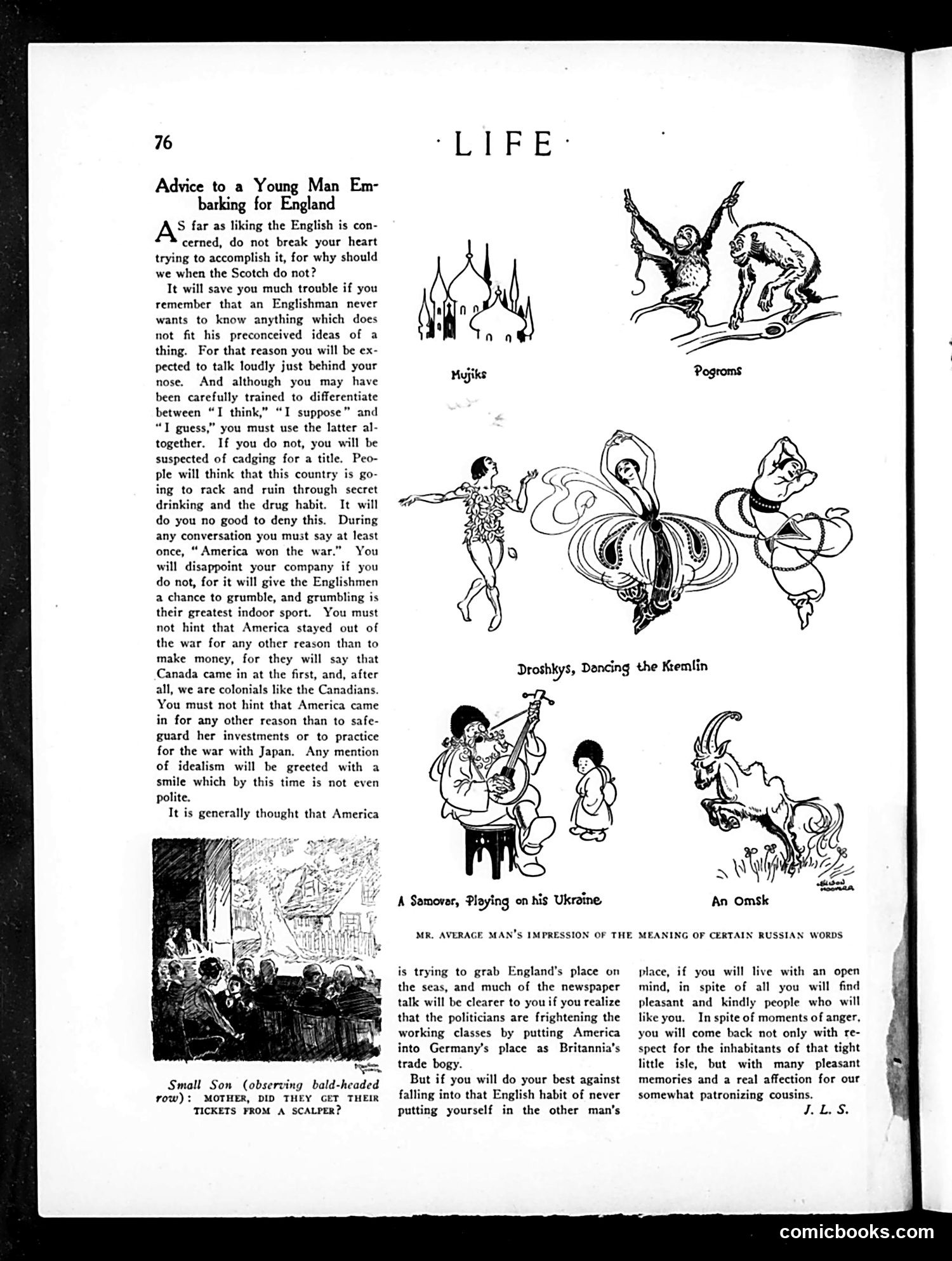
This satirical piece offers tongue-in-cheek advice to Americans visiting post-WWI England, reflecting American-British tensions of that era. **Main Content:** The article mocks English insularity and class consciousness, warning Americans that English people dismiss ideas outside their preconceptions. It cautions against using "I guess" (seen as lower-class) and advises repeatedly mentioning "America won the war" to provoke English grumbling—their "greatest indoor sport." **Political Context:** Post-WWI anxieties dominate. Americans are warned that British politicians portray America as a trade threat replacing Germany, and that mentioning America's late entry or financial motives (not idealism) will invite cynical smiles. **Illustrations:** Whimsical drawings label Russian words ("Hajiks," "Pogroms," "Droshkys," "Omsk") as "average man's impression"—stereotyping Russians as exotic/violent, reflecting period xenophobia. **The Satire:** Despite mockery, the conclusion advises openness, suggesting English people are fundamentally decent despite their quirks—offering backhanded affection to "somewhat patronizing cousins."
📄 Transcribed text from this page (OCR, searchable)
Machine-transcribed from the original scan — historical spelling and the odd misread are preserved.
76 Advice to a Young Man Em- barking for England AS far as liking the English is con- cerned, do not break your heart trying to accomplish it, for why should we when the Scotch do not? It will save you much trouble if you remember that an Englishman never wants to know anything which does not fit his preconceived ideas of a thing. For that reason you will be ex- pected to talk loudly just behind your nose. And although you may have been carefully trained to differentiate between “I think,” “I suppose” and “TI guess,” you must use the latter al- together. If you do not, you will be suspected of cadging for a title. Peo- ple will think that this country is go- ing to rack and ruin through secret drinking and the drug habit. It will do you no good to deny this. During any conversation you must say at least “ America won the war.” You ppoint your company if you do not, for it will give the Englishmen a chance to grumble, and grumbling is their greatest indoor sport. You must not hint that America stayed out of the war for any other reason than to make money, for they will say that Canada came in at the first, and, after all, we are colonials like the Canadians. You must not hint that America came in for any other reason than to safe- guard her investments or to practice for the war with Japan. Any mention of idealism will be greeted with a smile which by this time is not even polite. It is generally thought that America Small Son (observing bald-headed row): MOTHER, DID THEY GET THEIR TICKETS FROM A SCALPER? A Samover, Playing on his Ukraine MR. AVERAGE MAN'S IMPRESSION OF THE is trying to grab England's place on the seas, and much of the newspaper talk will be clearer to you if you realize that the politicians are frightening the working classes by putting America into Germany’s place as Britannia’s trade bogy. But if you will do your best against falling into that English habit of never putting yourself in the other man’s Wal An omsk MEANING OF CERTAIN RUSSIAN WORDS place, if you will live with an open mind, in spite of all you will find pleasant and kindly people who will like you. In spite of moments of anger, you will come back not only with re- spect for the inhabitants of that tight little isle, but with many pleasant memories and a real affection for our somewhat patronizing cousins. ILS. comicbooks.com