
A complete issue · 48 pages · 1920
Life — January 1, 1920
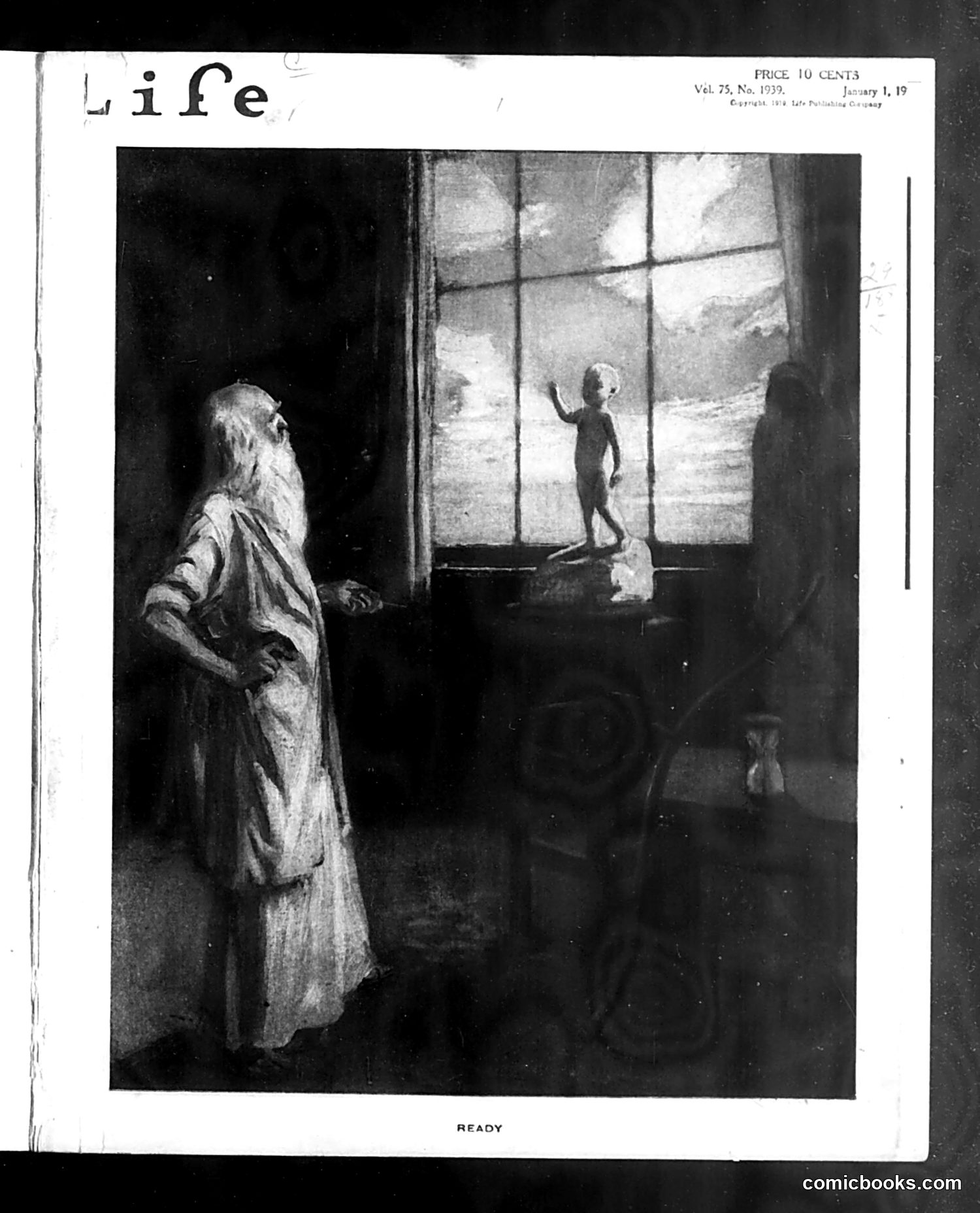
This appears to be a political cartoon titled "READY" from Life magazine (Vol. 75, No. 1939, January 1, 19[?]). The image depicts an elderly man with white hair and beard, dressed in robes, gazing out a window at a small, naked child standing on the windowsill. The composition suggests anticipation or preparation for something momentous. Without additional context or visible labels identifying the specific figures, the exact political or social reference remains unclear. However, the allegorical setup—an elder figure observing a child in a precarious position while looking "ready"—likely comments on some contemporary event or social condition from early 1939. The title "READY" suggests preparation for an imminent situation, possibly related to pre-World War II tensions or domestic American concerns of that period. More specific identification would require additional historical documentation.

This is **not a cartoon or satirical content**—it's a straightforward **advertisement for United States Tires** appearing in Life magazine. The ad employs a colonial/imperial narrative: it describes how "thousands of acres of jungle-land in Sumatra have been transformed into flourishing rubber plantations" to supply US Tire production. The accompanying photographs show plantation operations and manufacturing processes. The ad emphasizes that US Tires controls its own rubber supply, ensuring quality. The repeated phrase "United States Tires are Good Tires" is the core marketing message. The decorative silhouettes at bottom (appearing to show colonial or tropical imagery) and the company logo reinforce the brand identity. This reflects early-20th-century American industrial confidence and the commercial exploitation of colonial rubber resources—presented here as a positive achievement in manufacturing.
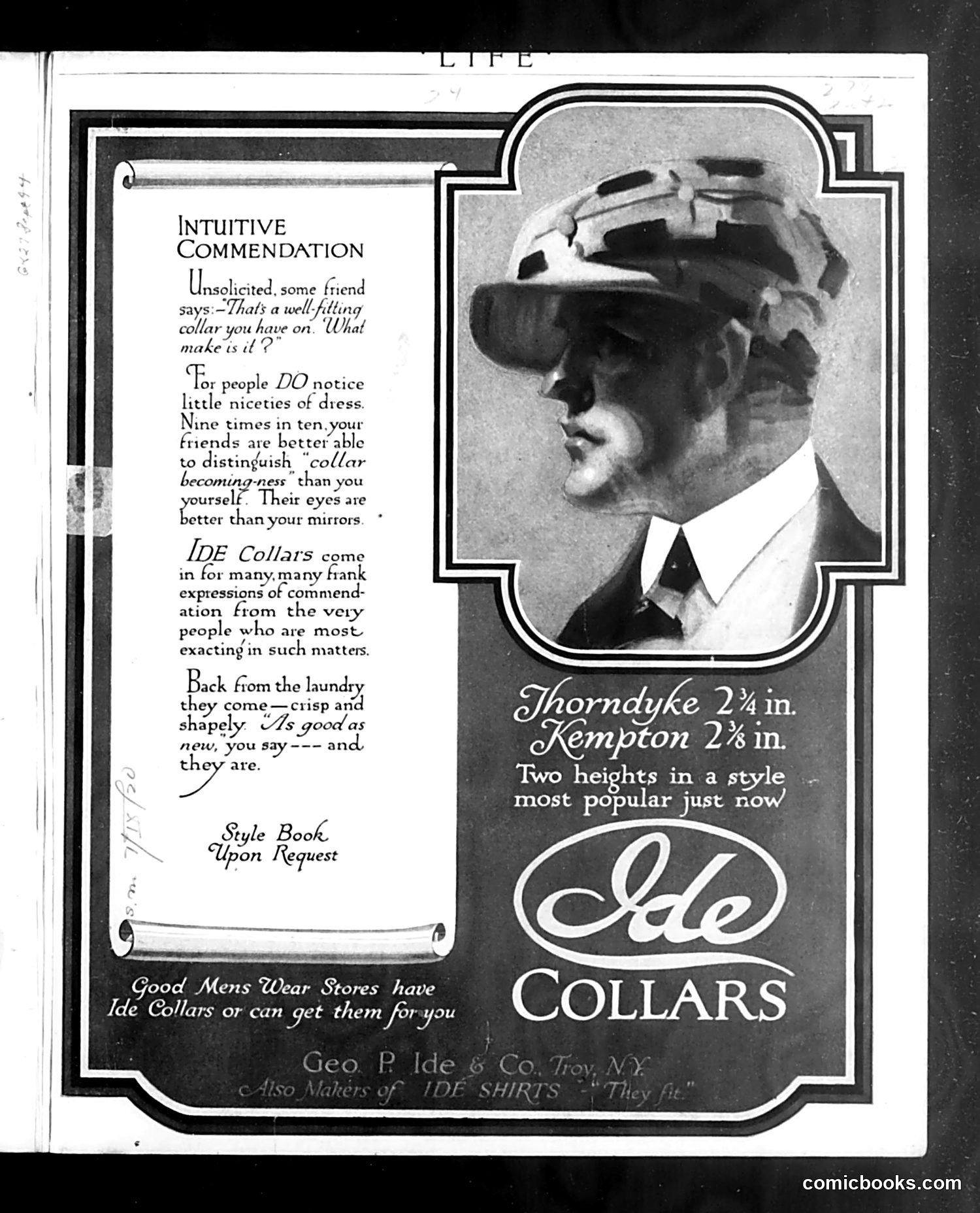
This page is primarily **advertising, not satire or political commentary**. It's an Ide Collars advertisement from Geo. P. Ide & Co. of Troy, New York. The ad uses the heading "Intuitive Commendation" to frame a marketing pitch: friends notice quality collars, and Ide Collars are supposedly so well-made they distinguish the wearer's taste. The photo shows a man modeling the product—specifically two collar heights ("Thorndyke 2¼ in." and "Kempton 2⅜ in."). The text emphasizes that collars come "crisp and shapely" from the laundry, appealing to men concerned with appearance. This is straightforward early-20th-century menswear marketing with no detectable political or social satire.
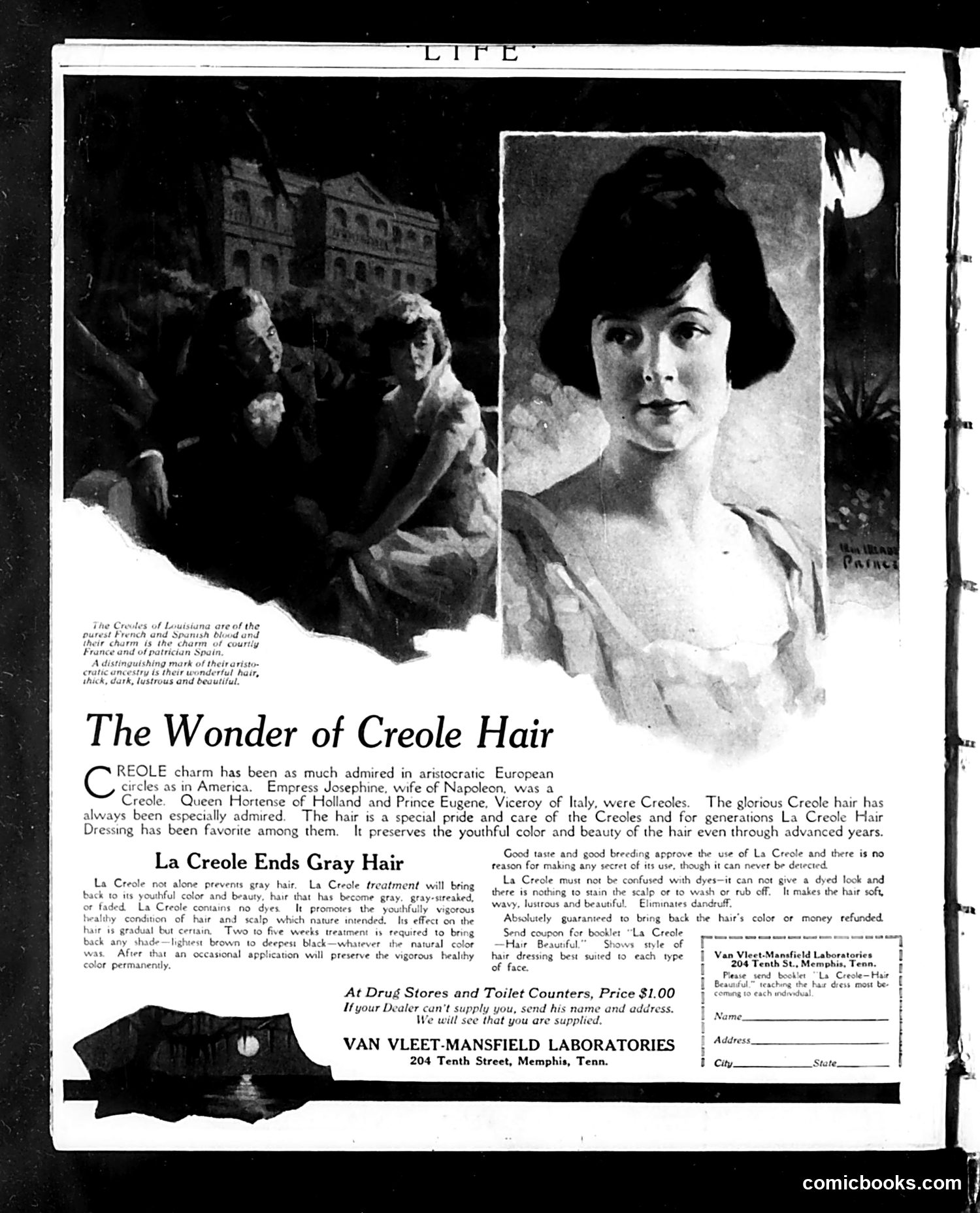
This page is **primarily a product advertisement**, not satirical content. It promotes "La Creole Hair Dressing," a hair treatment marketed to prevent gray hair and maintain hair color. The advertisement references **aristocratic European appeal**, mentioning Empress Josephine (Napoleon's wife) and other European nobility to lend prestige to the product. The text claims Creole hair was "especially admired" in "aristocratic European circles." The right side features a **portrait of a woman** with dark hair, presumably demonstrating the product's results. The left image shows what appears to be a social scene. The ad emphasizes the product "ends gray hair" and promises results without dyes, priced at $1.00. There is **no discernible political satire** on this page—it's straightforward early-20th-century cosmetic marketing leveraging European aristocratic associations to appeal to American consumers.
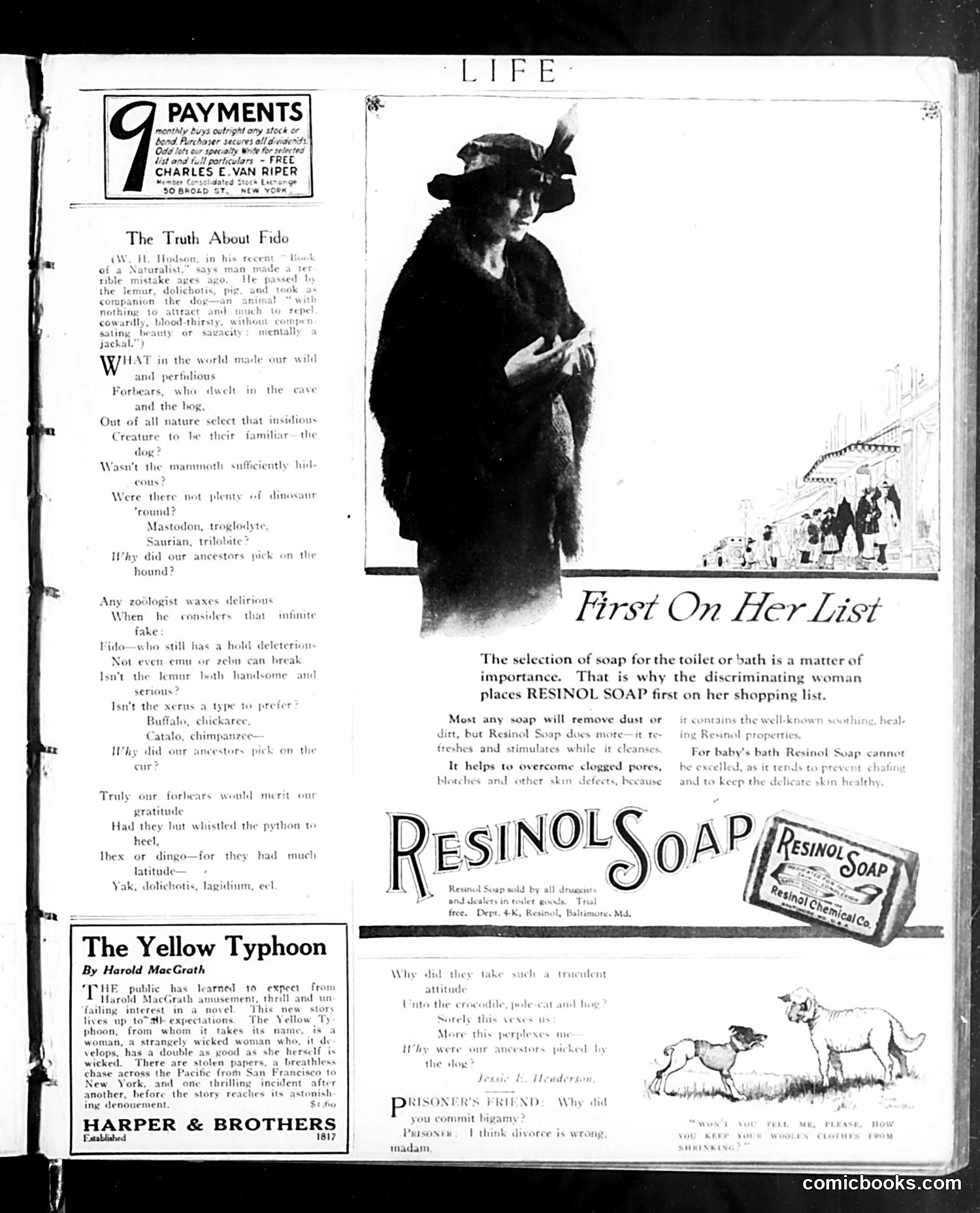
This page is primarily **advertising and literary content** rather than political satire. The dominant feature is a Resinol Soap advertisement showing a fashionable woman in a feathered hat, emphasizing soap's skincare benefits for "clogged pores, blotches and other skin defects." The left column contains "The Truth About Fido," a humorous poem questioning why humans chose dogs as companions when other animals existed, suggesting dogs were inferior choices to mammoths, dinosaurs, or big cats. It's lighthearted satire on pet ownership rather than politics. Below that is an advertisement for Harold MacGrath's novel *The Yellow Typhoon*, a serialized story about a "wicked woman" and Pacific intrigue. The page reflects early 20th-century consumer culture and popular entertainment rather than serious political commentary.
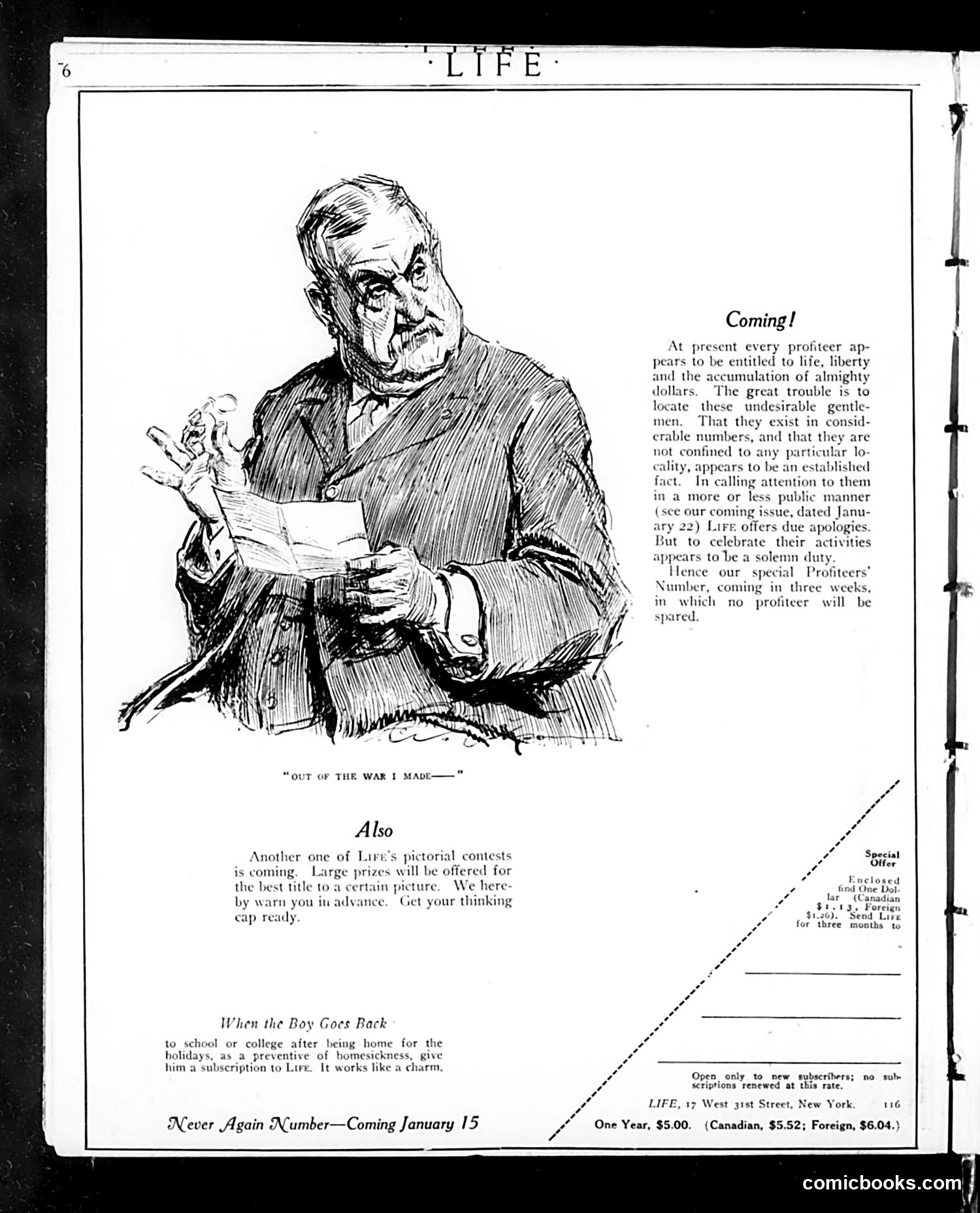
This page from *Life* magazine features a satirical cartoon titled "Out of the War I Made—" depicting a portly profiteer holding money and what appears to be a small human figure or puppet. The cartoon critiques war profiteers—businessmen who accumulated wealth through wartime contracts and dealings. The image suggests such figures literally "made" people (reduced them to puppets or commodities) through war. The accompanying text announces that *Life* will soon publish a special "Profiteers' Number" where "no profiteer will be spared," indicating the magazine planned systematic satirical exposure of these wealthy individuals. The page also advertises subscription offers and a pictorial contest, typical of magazine promotion from this era.
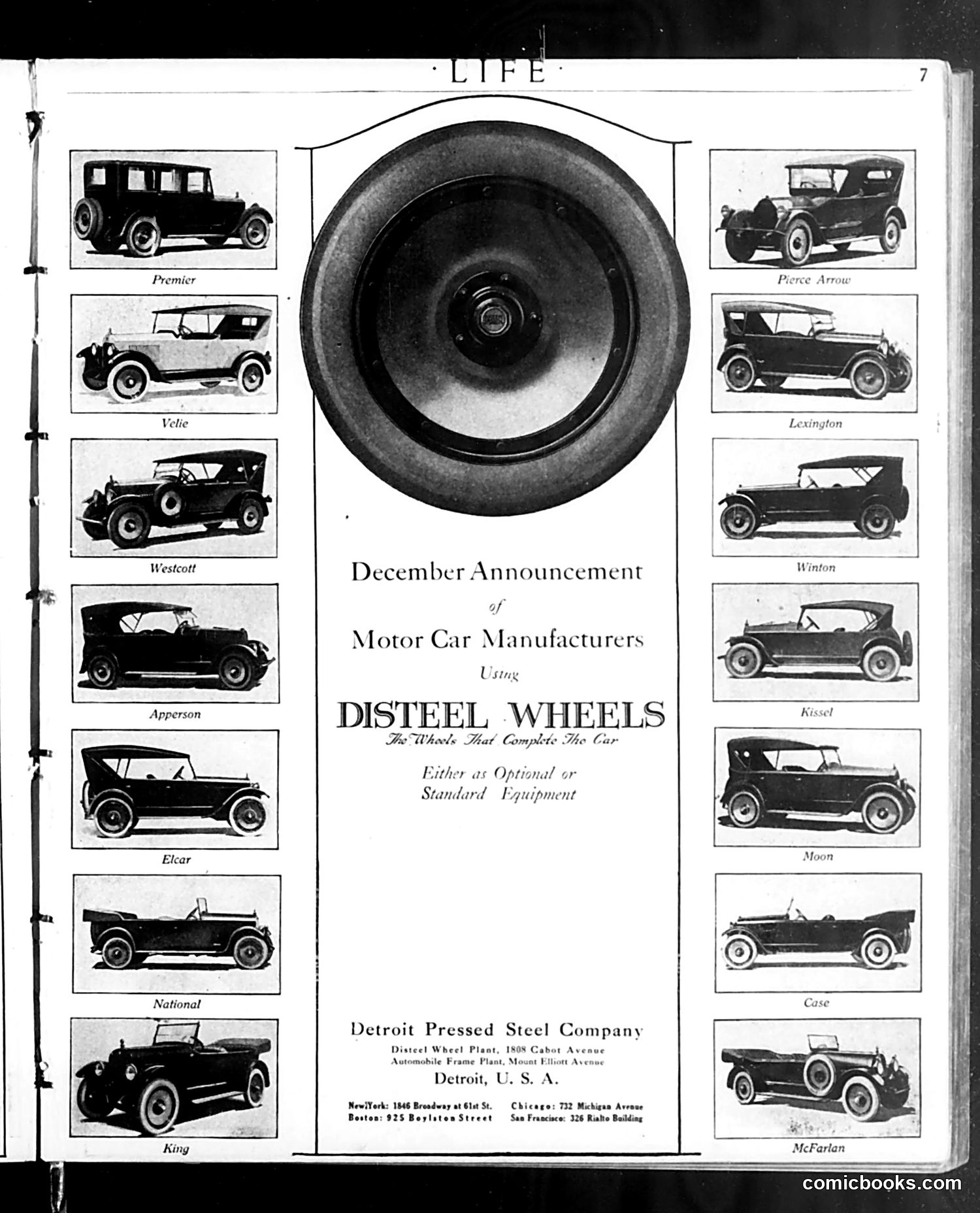
This is not a satirical cartoon page but rather **a December advertisement** from *Life* magazine for Disteel Wheels, manufactured by the Detroit Pressed Steel Company. The page features photographs of approximately 16 different automobile models from the early 1920s era (Premier, Pierce-Arrow, Velie, Lexington, Westcott, Winton, Apperson, Kissel, Elcar, Moon, National, Case, King, and McFarlan). A large wheel image dominates the center, emphasizing that these competing car manufacturers all used Disteel Wheels as either optional or standard equipment. This is essentially a B2B advertisement celebrating industry standardization—demonstrating that the wheel supplier's product was trusted across numerous automobile brands, which would have reassured consumers of quality and compatibility.
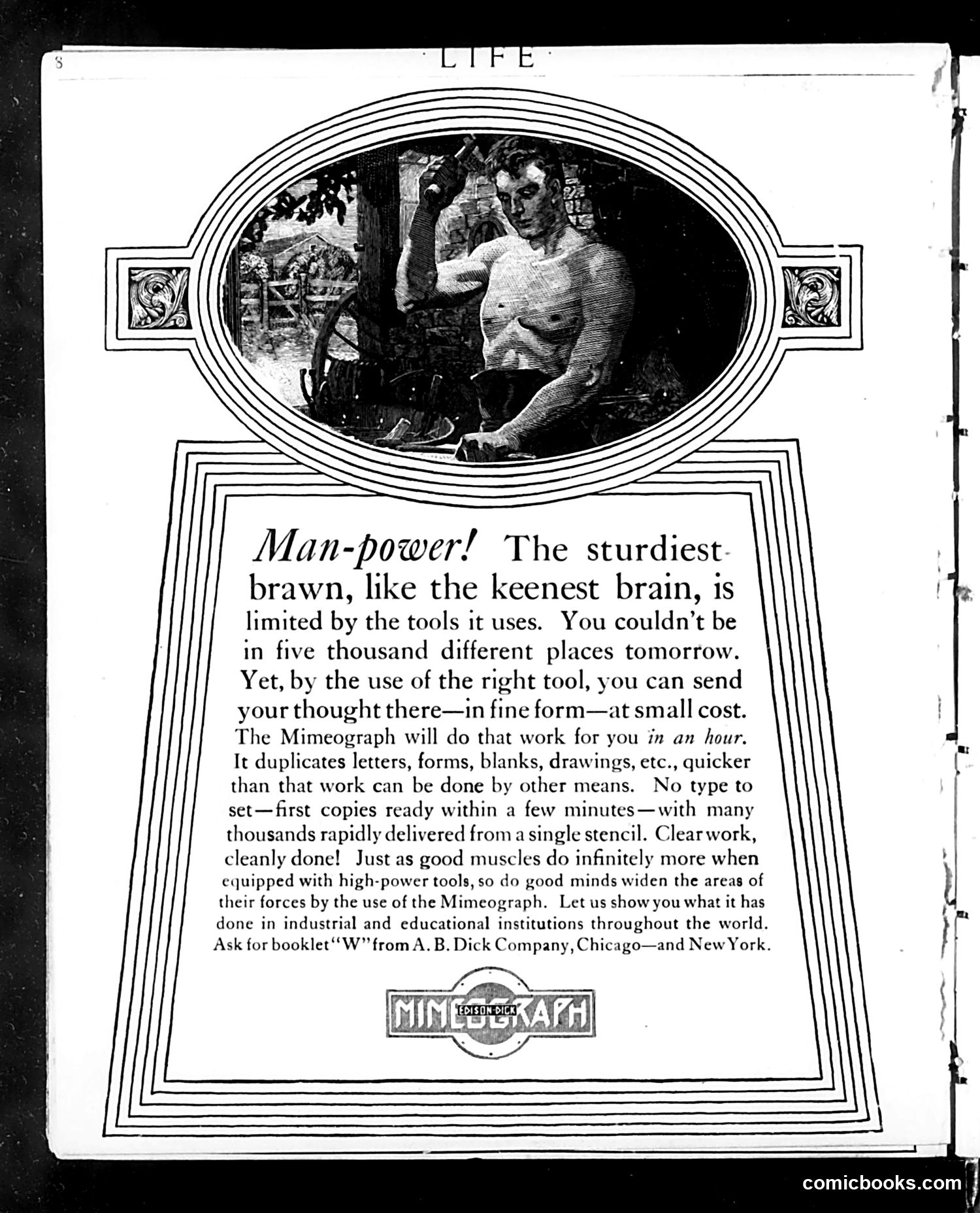
This is an **advertisement**, not a political cartoon. It promotes the Mimeograph machine, manufactured by A.B. Dick Company of Chicago and New York. The ad's headline "Man-power!" uses a muscular male figure to metaphorically argue that tools extend human capability. The text compares the brain's limitations to muscular strength—both can accomplish more with proper equipment. The Mimeograph, it claims, enables rapid duplication of documents (letters, forms, drawings) without typesetting, producing "first copies ready within a few minutes" from a single stencil. This was revolutionary for early 20th-century offices and schools. The pitch targets institutions wanting efficiency: the machine supposedly multiplies intellectual and administrative output, making it economically valuable for "industrial and educational institutions throughout the world."
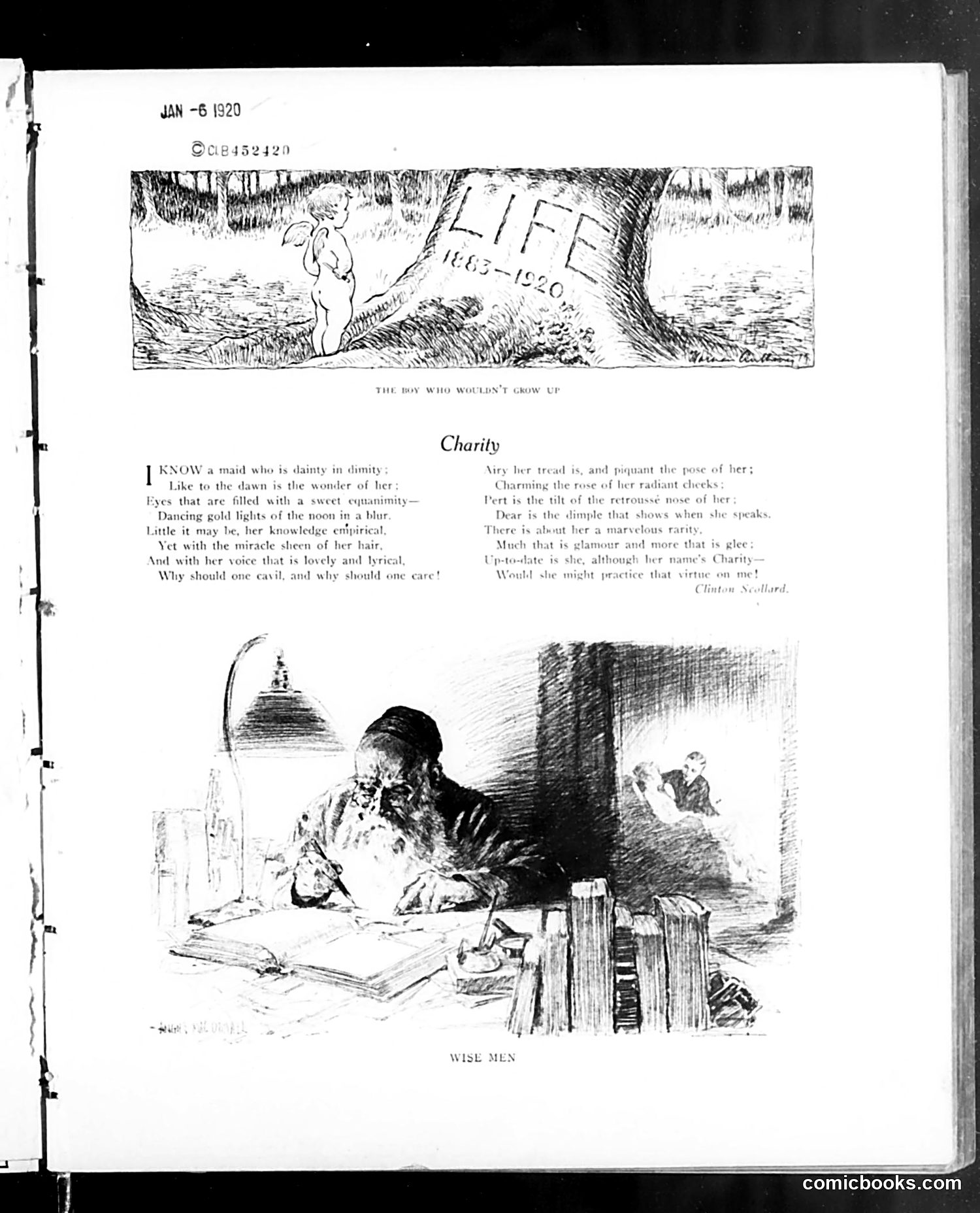
**Top Cartoon: "The Boy Who Wouldn't Grow Up"** A cherub-like figure stands beside a massive tree trunk carved with "LIFE 1883-1920," suggesting this marks Life magazine's death or significant transition. The date range indicates the publication's 37-year run. **Poem: "Charity"** Attributed to Clinton Scollard, this poem praises an unnamed woman ("Charity") for her beauty, grace, and virtue—likely a compliment piece rather than satire. **Bottom Illustration: "Wise Men"** Shows an elderly scholar or writer hunched over books and manuscripts, apparently working by lamplight. This appears a straightforward illustration accompanying the "Charity" poem rather than political satire. The page overall seems commemorative rather than satirical, possibly marking a significant moment for the publication itself.
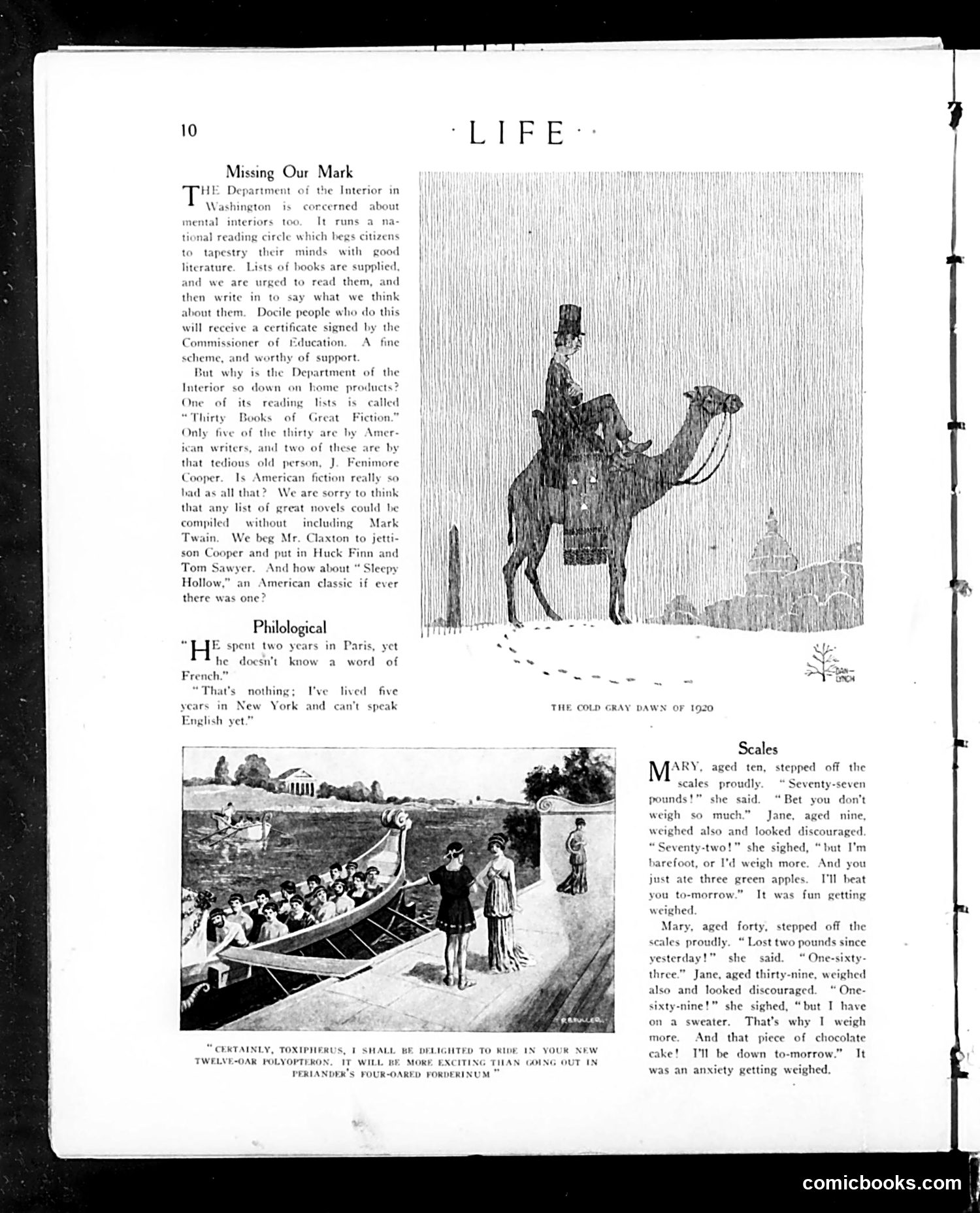
**"Missing Our Mark"** critiques the Department of Interior's reading list of "Thirty Books of Great Fiction," noting it omits major American authors like Mark Twain, James Fenimore Cooper, Huckleberry Finn, and Tom Sawyer—a glaring oversight the writer sarcastically describes as evidence American fiction is "bad as all that." **"Philological"** is a brief joke about language acquisition: someone spent two years in Paris but knows no French, while another lived five years in New York unable to speak English—mocking the difficulty of actually learning languages through mere residence. **"Scales"** humorously depicts three females of increasing age (10, 40, and 39) stepping on scales with progressively absurd excuses for weight gain, satirizing how people rationalize their bodies.
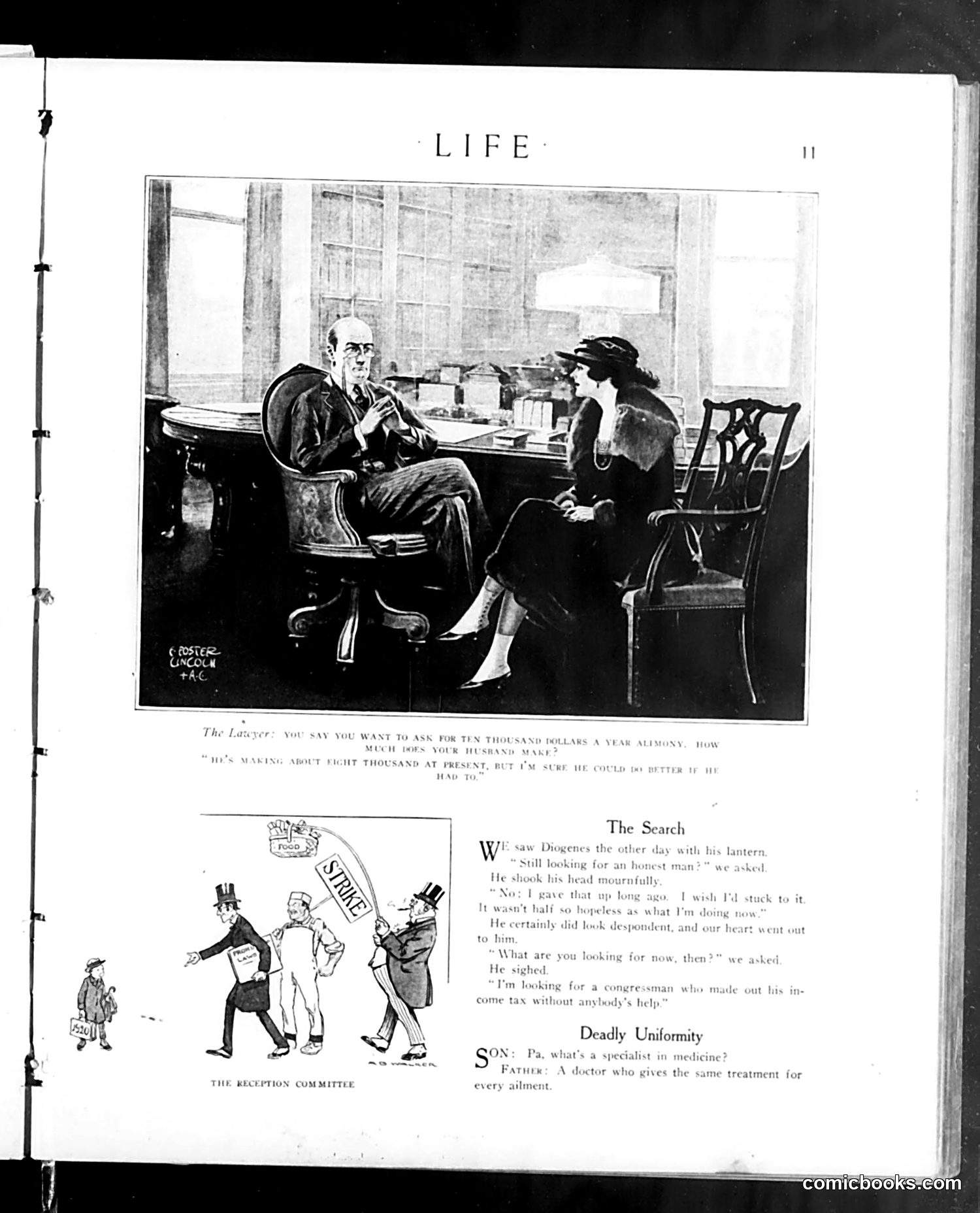
**Top Illustration**: A lawyer and woman in an office discuss alimony. The lawyer mentions the husband "making about eight thousand at present" while the woman seeks "$10,000 a year alimony." The joke satirizes the legal profession's role in divorces and the financial negotiations that accompany them—a commentary on divorce proceedings becoming commercialized. **"The Search"**: A brief humorous piece referencing Diogenes (ancient Greek philosopher famous for searching for an honest man with a lantern). The modern twist: someone now searches for "a congressman who made out his income tax without anybody's help"—satirizing political corruption and tax evasion among legislators. **"Deadly Uniformity"**: A short joke defining a medical specialist as "a doctor who gives the same treatment for every ailment"—mocking ineffective medical practice.
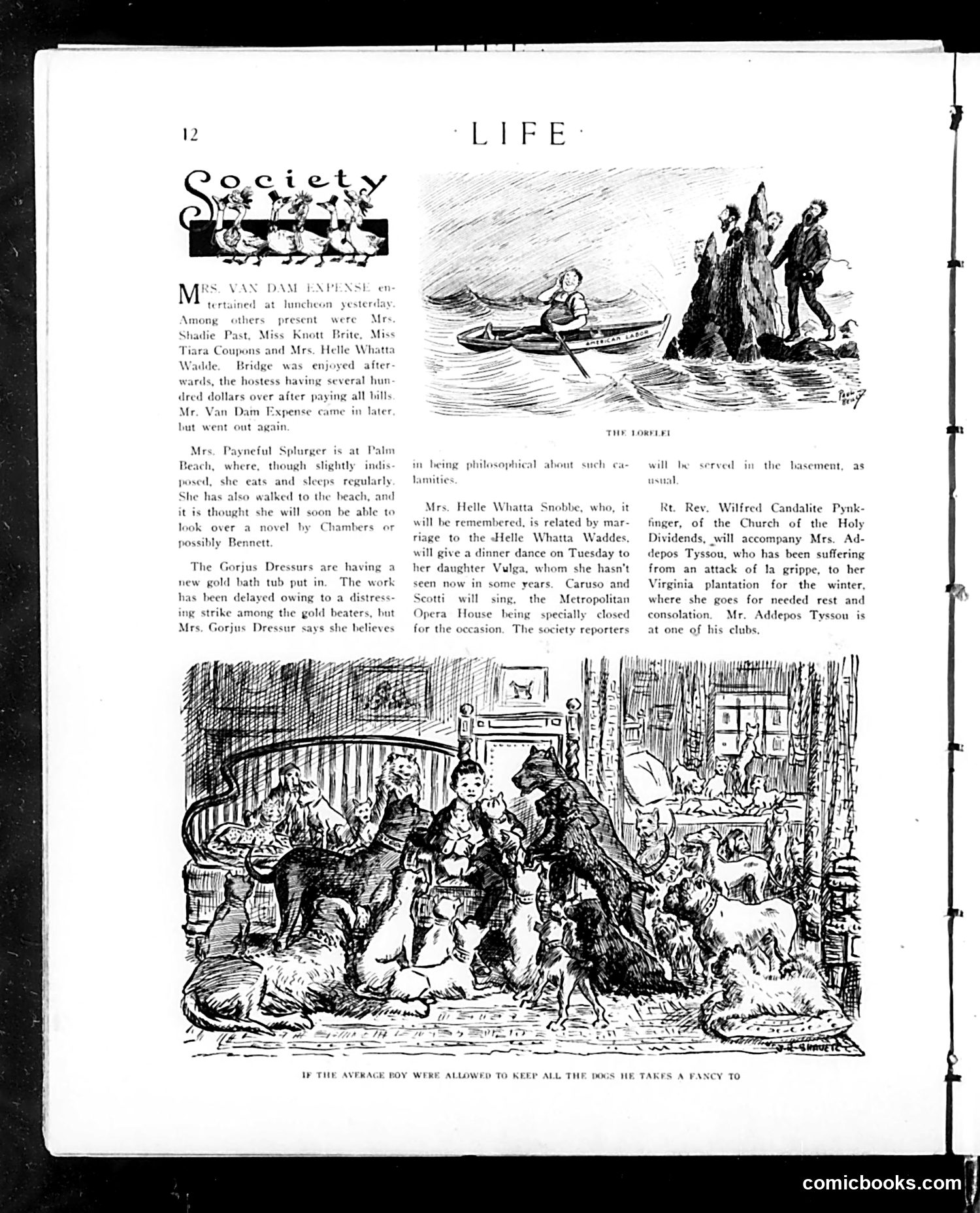
This page contains **society gossip and humorous illustrations** rather than political satire. The text discusses upper-class social events: Mrs. Van Dam's expensive bridge party, Mrs. Payneful Splurger at Palm Beach, and the Gorjus Dressurs' delayed pool opening. The two cartoons are unrelated to the text: 1. **"The Lobster"** (top right): Shows a boatman approaching figures on shore—appears to be a simple recreational scene. 2. **Bottom cartoon** (captioned "If the Average Boy Were Allowed to Keep All the Dogs He Takes a Fancy To"): A humorous domestic scene depicting numerous dogs and children in a crowded living room, satirizing boys' tendency to adopt every stray dog they encounter. Both cartoons offer light social humor rather than political commentary.
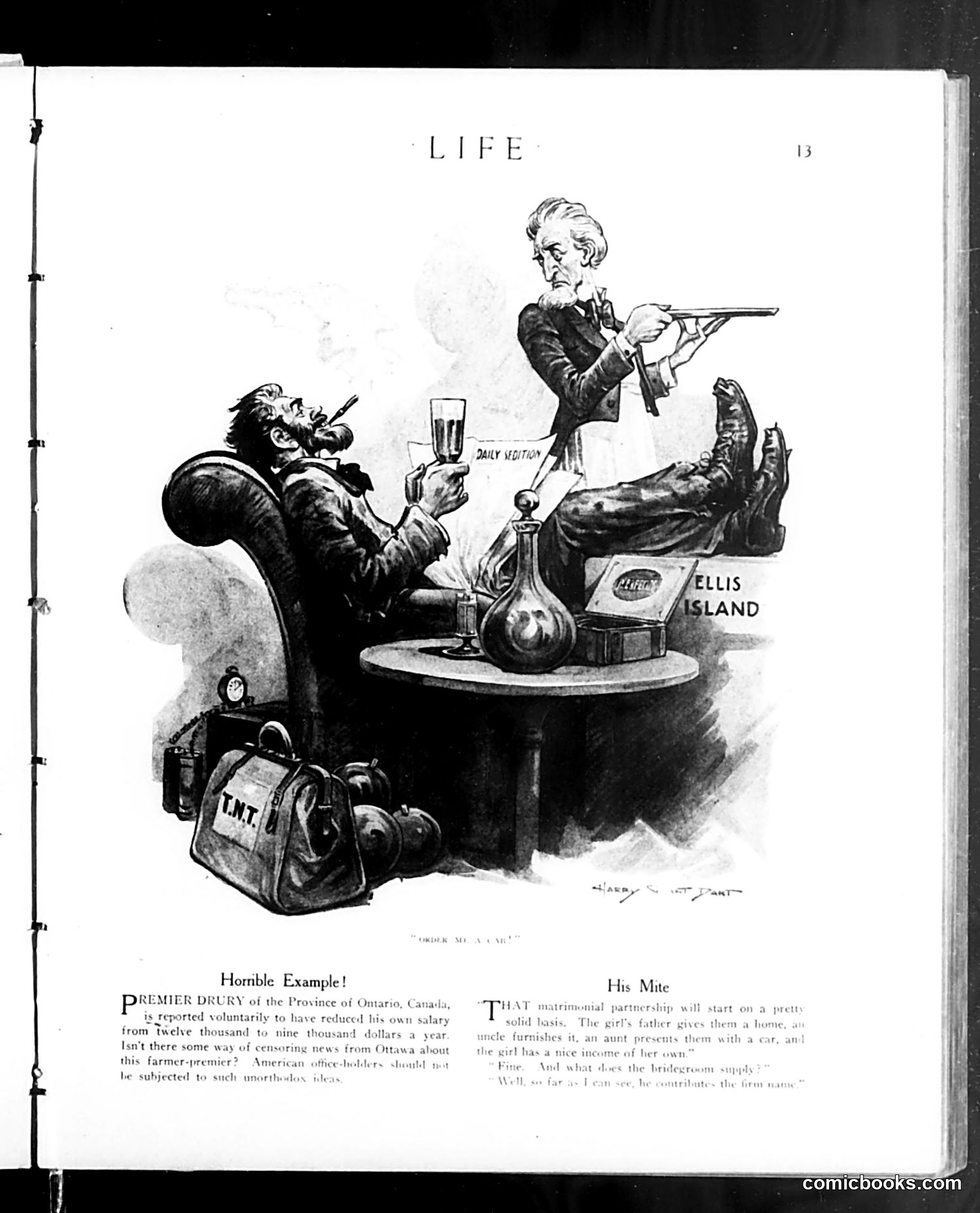
This page contains two satirical pieces about Canadian politics and marriage. The main illustration depicts a stern older man (labeled as "Premier" of Ontario, Canada) aiming a rifle at a table where a younger man sits with a drink. A travel bag marked "T.M.T." sits nearby. The left text mocks the Premier for voluntarily reducing his salary, questioning whether Ottawa officials should face similar "unorthodox ideas." The right section, "His Mite," uses marriage as metaphor: a girl receives a home and car as dowry, prompting commentary about the "bridegroom's supply" and financial contributions. The cartoon satirizes both political frugality and marital economics through exaggerated visual contrast—the rifle suggests dramatic consequences for unconventional financial decisions.
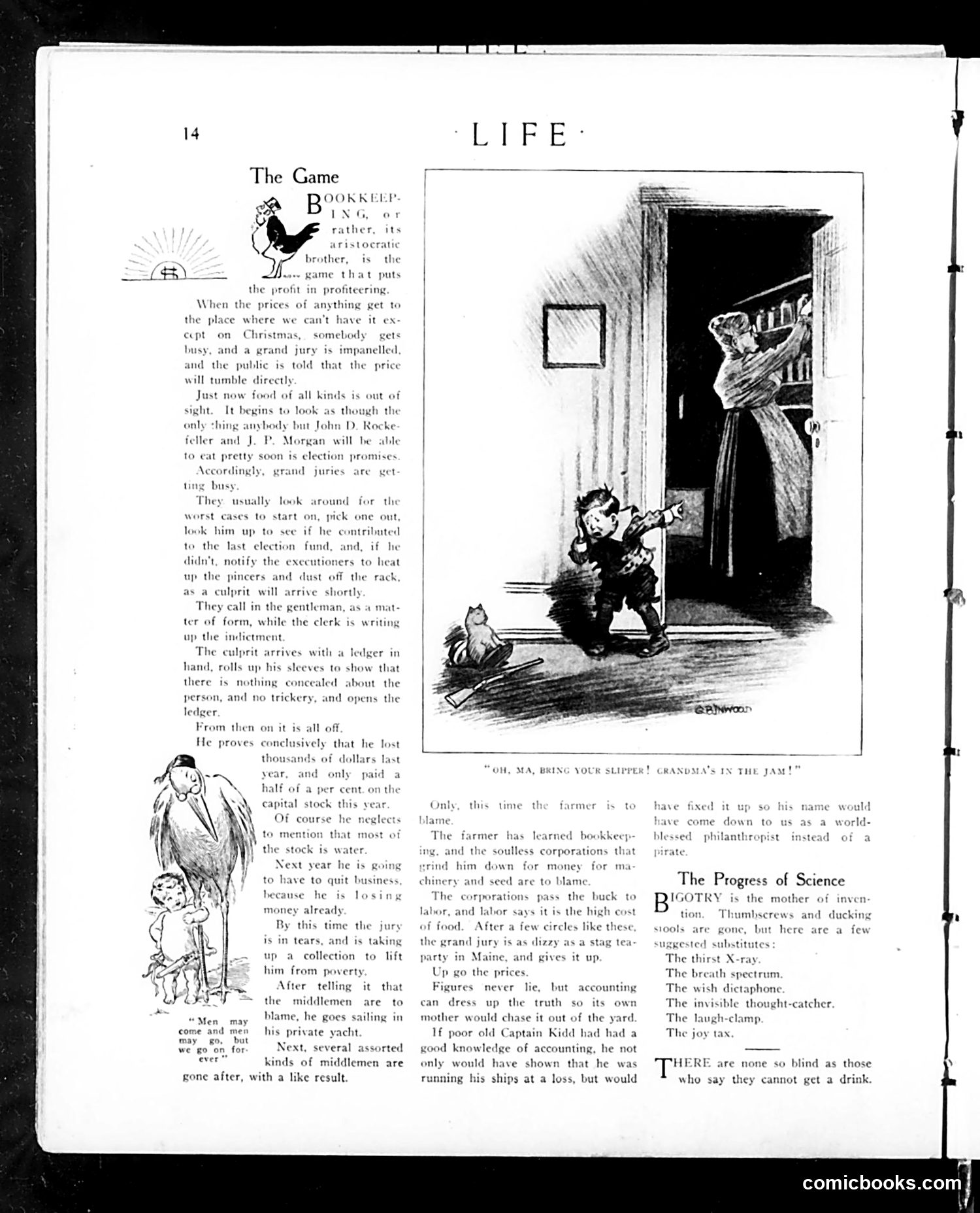
This page from *Life* magazine contains two distinct pieces of satirical content: **"The Game" (left column):** A text essay with accompanying illustrations mocking bookkeeping and corporate fraud. It describes how businesses manipulate financial records—hiding losses, inflating profits, and deceiving stockholders and the public. The small illustrations show a businessman and what appears to be figures discovering deception. The satire targets corporate dishonesty and suggests that election promises about food prices won't prevent economic manipulation. **Main Cartoon (center-right):** Titled "Oh, Ma, Bring Your Slipper! Grandma's in the Jam!" shows a child calling upstairs while an elderly woman appears to be in a doorway. This appears to be domestic humor, likely poking fun at grandmothers and household situations, though the specific reference is unclear without more context. **"The Progress of Science" (right):** A humorous list of invented modern annoyances—X-rays, breath spectrum, wish telephone, etc.—satirizing technological "progress."
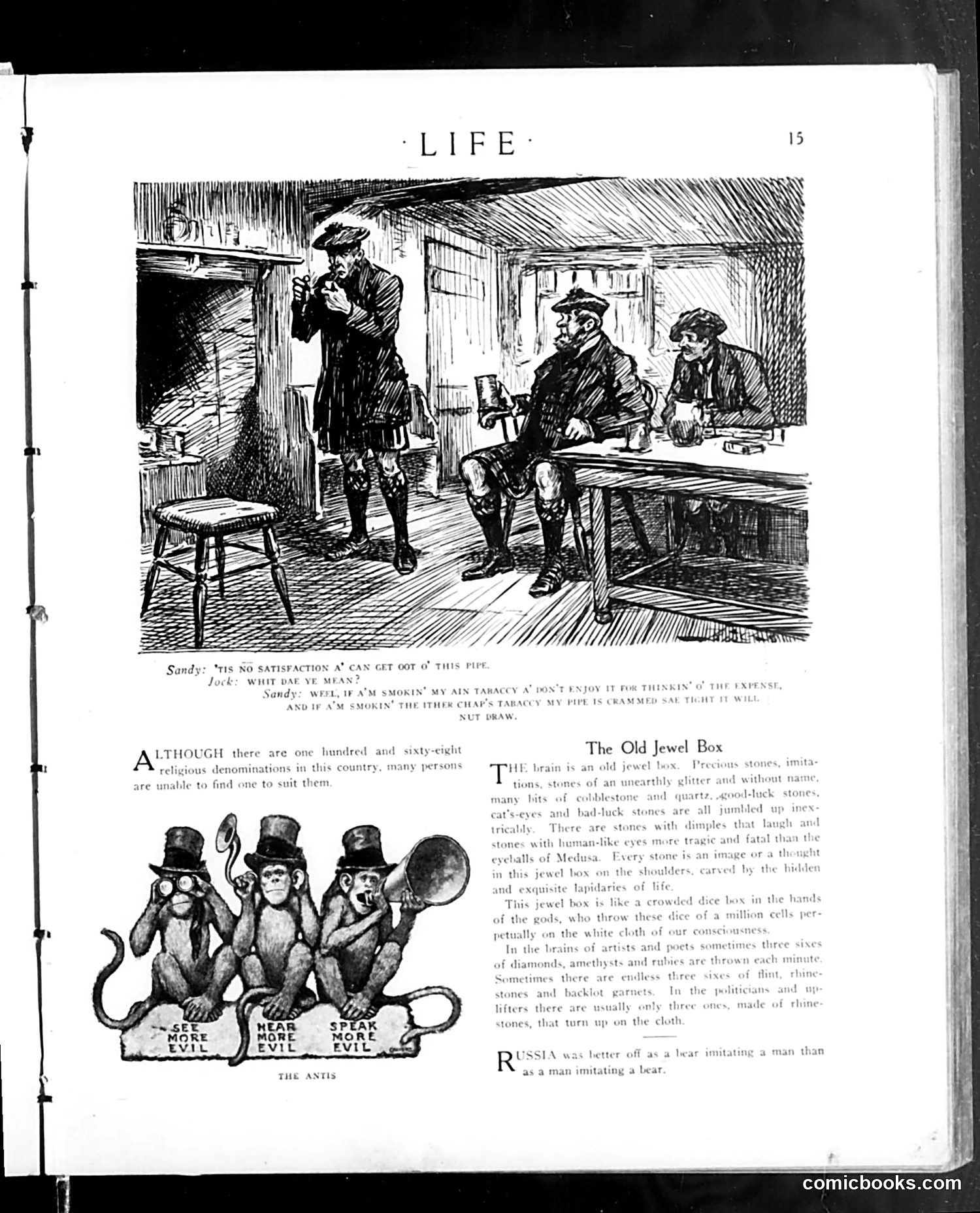
**Top Cartoon**: A standing figure complains about pipe smoking to seated men in what appears to be a bar or tavern. The dialogue satirizes working-class arguments about tobacco use—one man defends his right to smoke despite others' complaints about the expense and smell. **"The Antis" Illustration**: Three monkeys labeled "See More Evil," "Hear More Evil," and "Speak More Evil" mock anti-smoking advocates. This parodies the "see no evil" proverb, suggesting those opposed to smoking are foolish or hypocritical. **"The Old Jewel Box" Essay**: Begins a philosophical piece about spiritual treasures and human consciousness, unrelated to the cartoons above. The page satirizes contemporary debates over smoking etiquette and personal freedoms in shared social spaces.
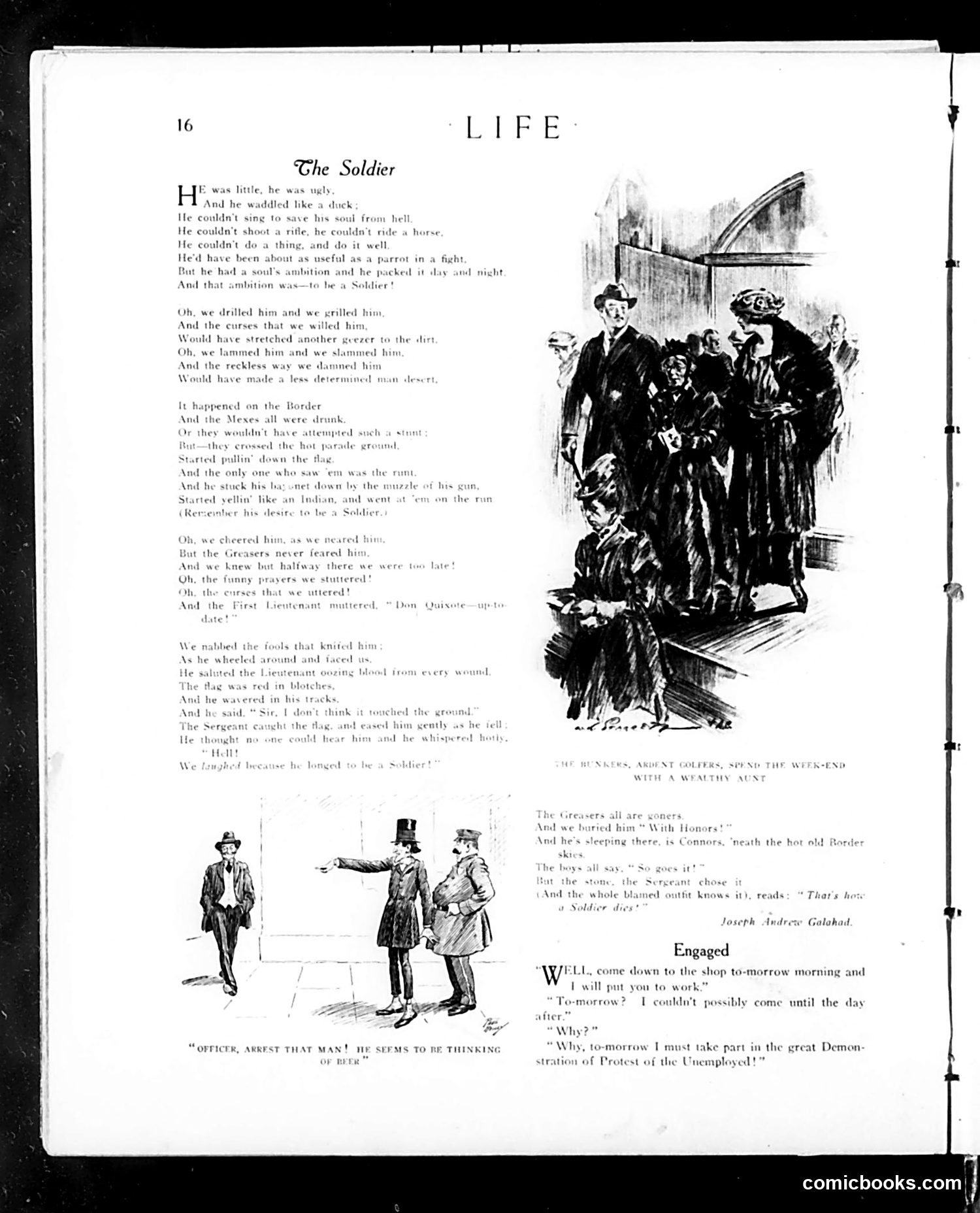
**"The Soldier"** is a satirical poem mocking military recruitment and discipline. It describes a physically unsuitable man ("little," "ugly," "waddled like a duck") who cannot shoot, ride, or fight—yet is deemed perfect for one ambition: "to be a Soldier." The verses detail his brutal training and eventual death on the "Border" (likely the Mexican border, referencing early 1900s conflicts). The satire critiques how armies accept and sacrifice the unfit, while the accompanying illustrations show military officers and a common soldier. **"Engaged"** presents a workplace joke: a prospective employee cannot start work tomorrow because he must participate in a "Demonstration of Protest of the Unemployed." The humor lies in the irony—he's refusing employment to protest unemployment. The bottom illustration shows an officer attempting to arrest a man for "thinking of beer," mocking both police overreach and working-class concerns of the era. Both pieces satirize early 20th-century social anxieties: militarism, labor unrest, and class tension.
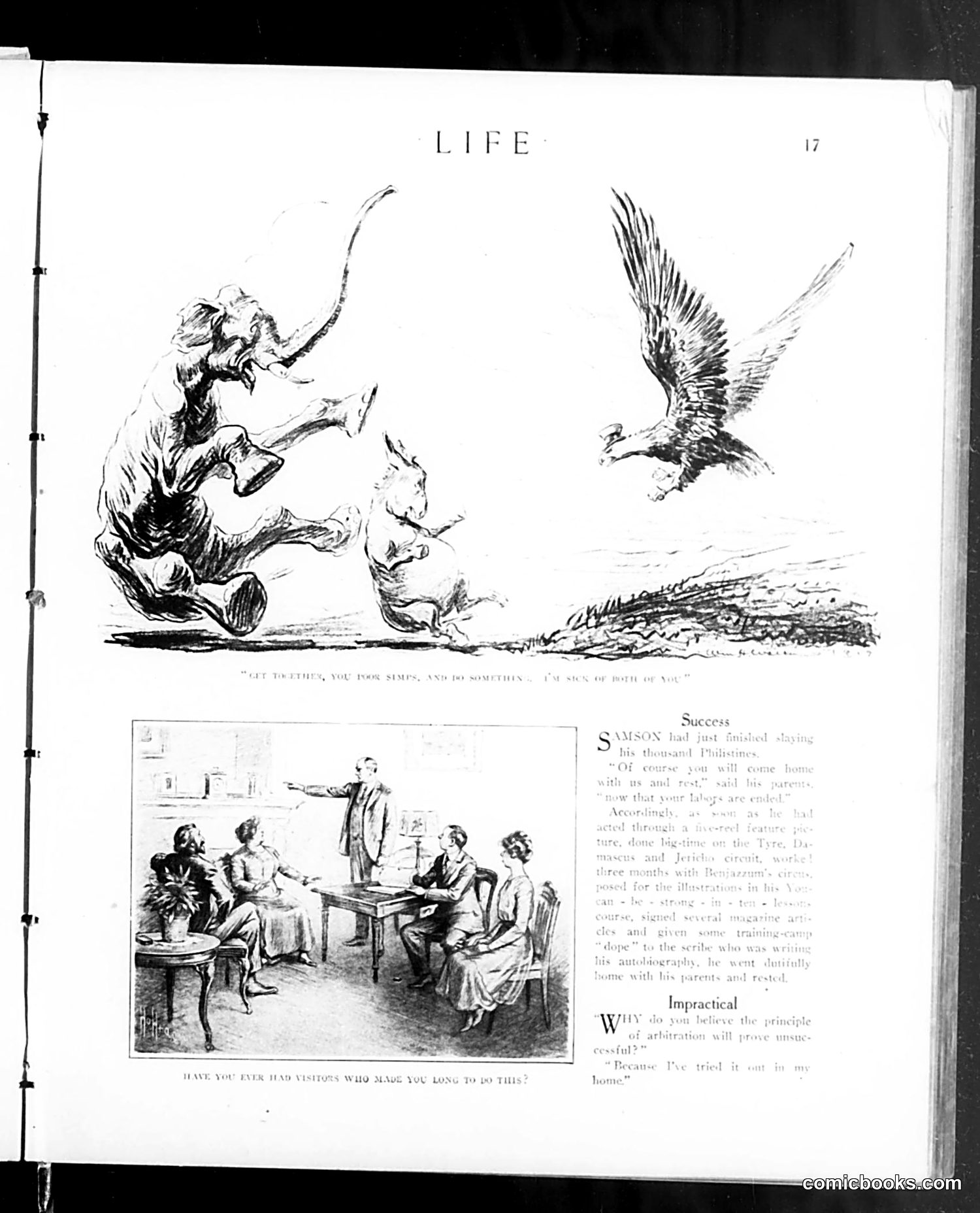
This page contains two distinct pieces: **Top cartoon**: Shows animals (appears to be a dog and eagle or large bird) in conflict, with the caption "GET INSTRUCTIONS, YOU POOR SIMPS, AND DO SOMETHING. I'M SICK OF BOTH OF YOU." The satire likely critiques political or social figures as foolish animals following orders. **Lower illustration and text**: Depicts a formal indoor scene titled "HAVE YOU EVER HAD VISITORS WHO MADE YOU LONG TO DO THIS?" The accompanying "Success" and "Impractical" sections discuss someone named Samson completing a theatrical engagement and contemplating arbitration as a principle. The overall humor appears to satirize social pretense and the gap between ambitious aspirations and practical reality—common themes in early 20th-century American satire. The exact political figures or events referenced remain unclear without additional context.
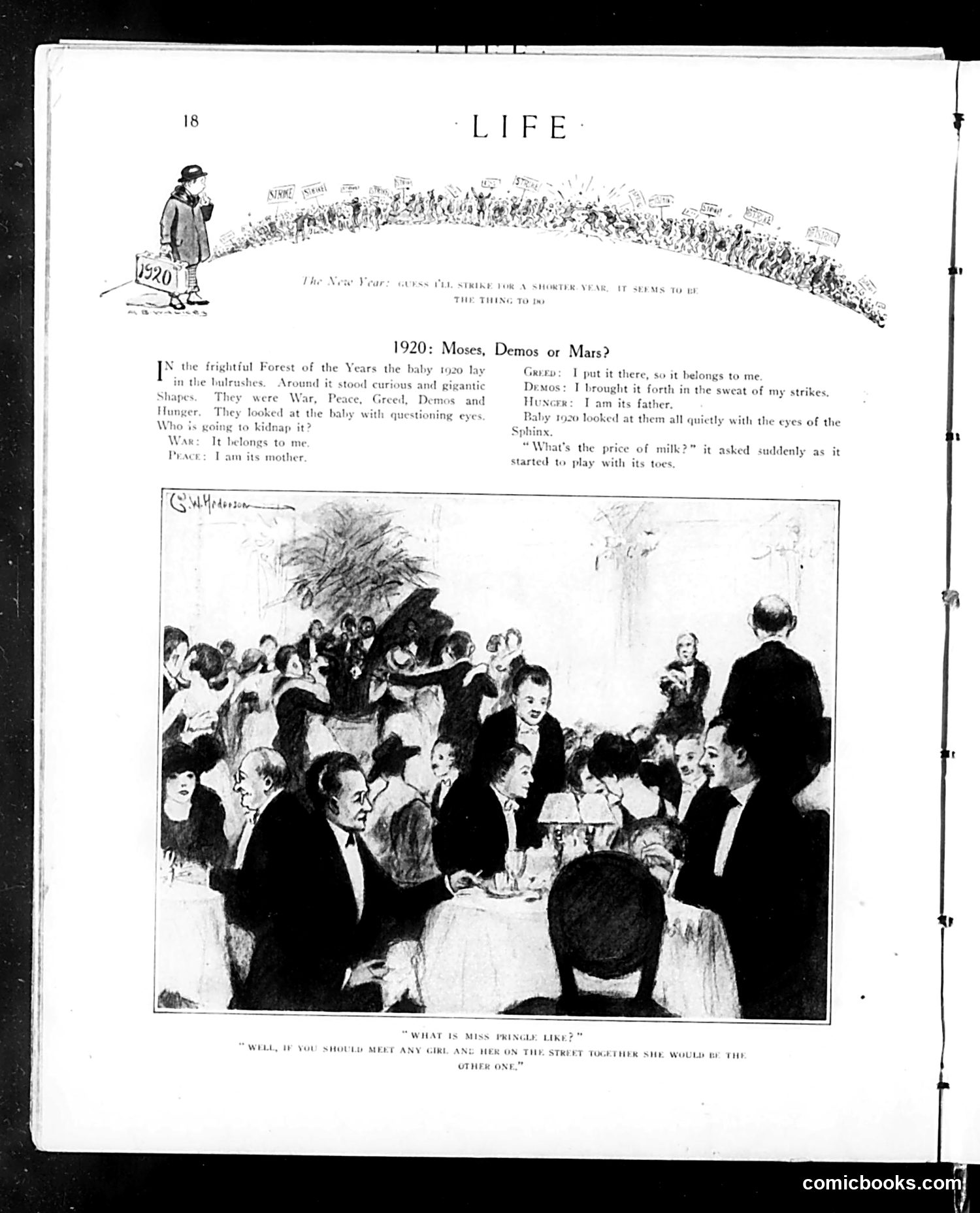
This Life magazine page satirizes post-WWI anxieties about 1920's future. The top illustration shows baby 1920 surrounded by allegorical figures representing War, Peace, Greed, Demos (Democracy), and Hunger—debating who will "kidnap" the newborn year. The satire suggests uncertainty about whether 1920 will bring religious salvation (Moses), democratic progress (Demos), or militarism (Mars). The lower cartoon depicts a social gathering where someone asks "What is Miss Pringle like?"—receiving the arch response that if you saw her with another girl simultaneously, you'd recognize her as "the other one." This mocks superficial social judgments and conformity among socialites. Together, the page expresses 1920s anxieties: political instability and class-based social superficiality.
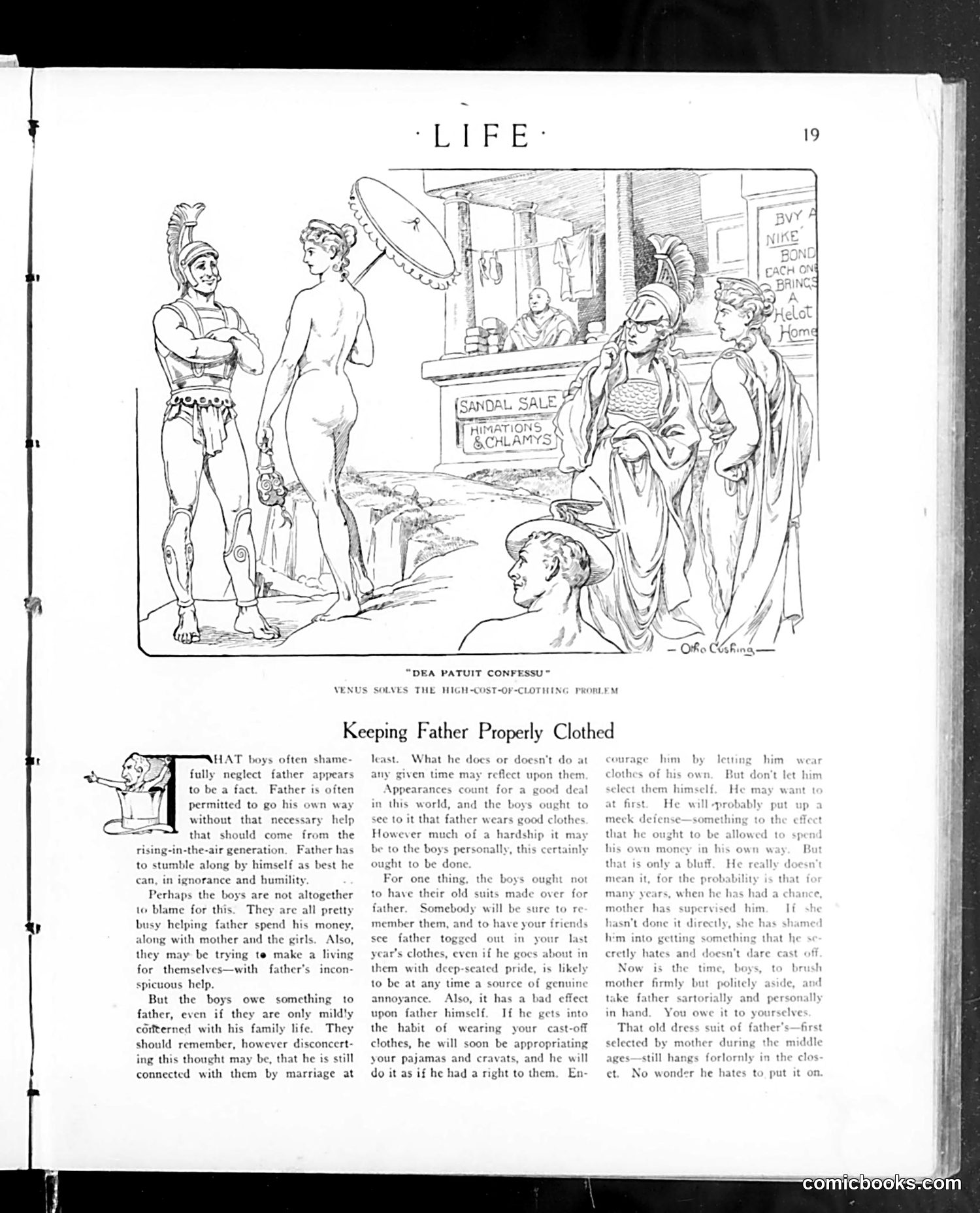
## The Cartoon ("Dea Patuit Confessu") The top illustration depicts Venus, the Roman goddess of love, in a classical marketplace setting among clothed figures. The Latin caption translates roughly to "the goddess confesses." The satire suggests that even Venus—traditionally depicted nude—acknowledges the necessity of proper clothing in modern society. This is a clever visual pun on the era's "high cost of clothing" problem. ## The Article ("Keeping Father Properly Clothed") The accompanying text addresses a common domestic problem: fathers neglecting their appearance and sons being reluctant to help maintain their father's wardrobe. The author argues that boys owe their fathers respect through ensuring paternal proper dress, warning that if fathers adopt the habit of wearing hand-me-downs and cast-off clothes, they'll soon appropriate sons' pajamas and cravats. ## Context This reflects early 20th-century middle-class anxieties about generational respect, masculine appearance, and family financial management during a period of rising living costs.
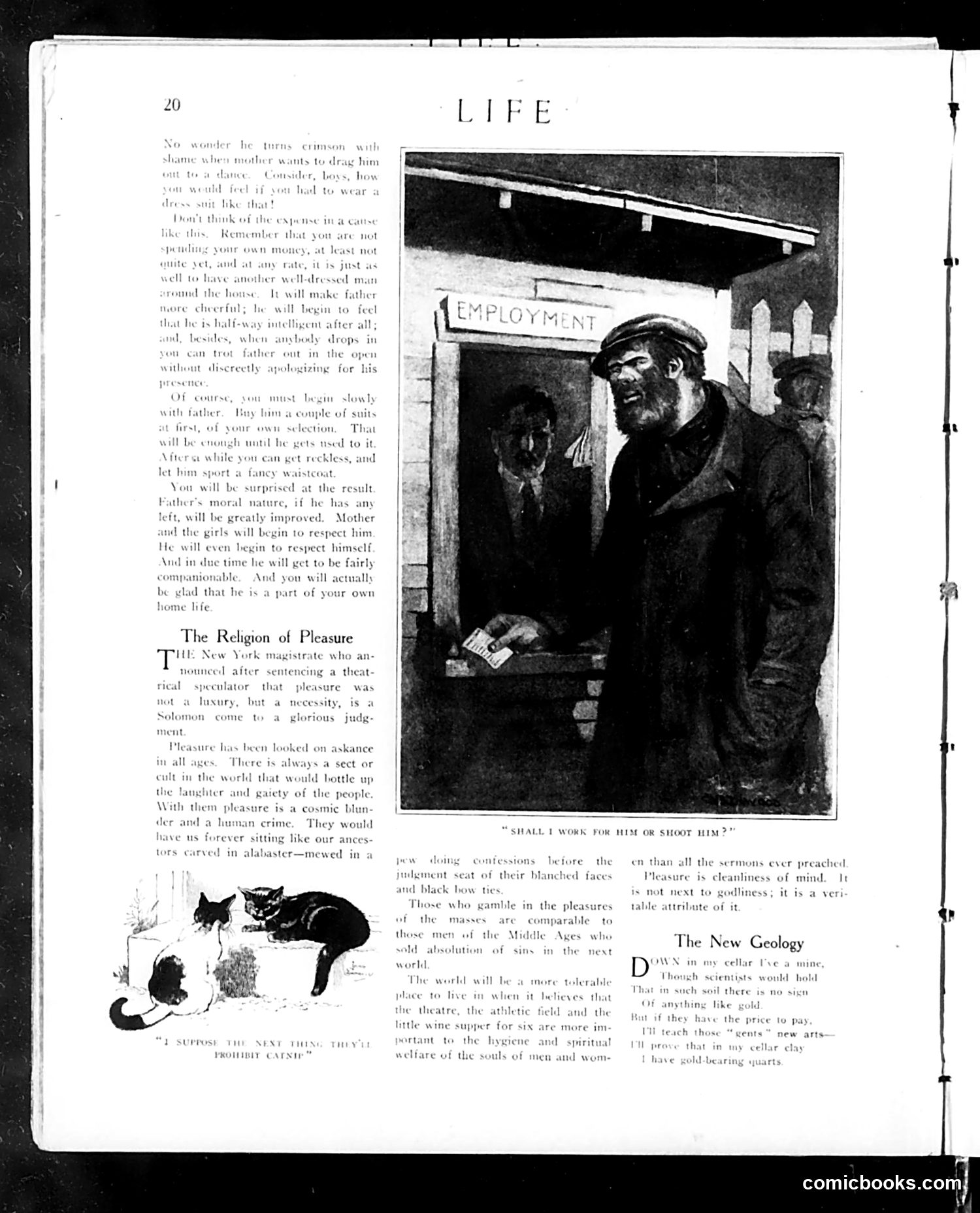
This page contains two distinct pieces of social commentary: **"The Religion of Pleasure"** section satirizes moral rigidity and hypocrisy. It mocks those who condemn pleasure-seeking as sinful while supporting a more tolerant, modern worldview. The piece argues that denying simple pleasures (theater, athletics, modest dining) is unnecessarily austere and that measured enjoyment contributes to mental health and family happiness. The reference to a New York magistrate sentencing a "theatrical speculator" suggests real legal cases where entertainment was prosecuted as vice. **The accompanying illustration** of cats appears to caption a humorous line: "I suppose the next thing they'll prohibit cats!" — suggesting absurdist escalation of moral policing. **"The New Geology"** (bottom) is an unrelated poem about discovering minerals in a cellar, likely whimsical filler. The overall tone reflects early 20th-century progressive debates about Puritanism versus modern pleasures, urban morality, and changing social standards.
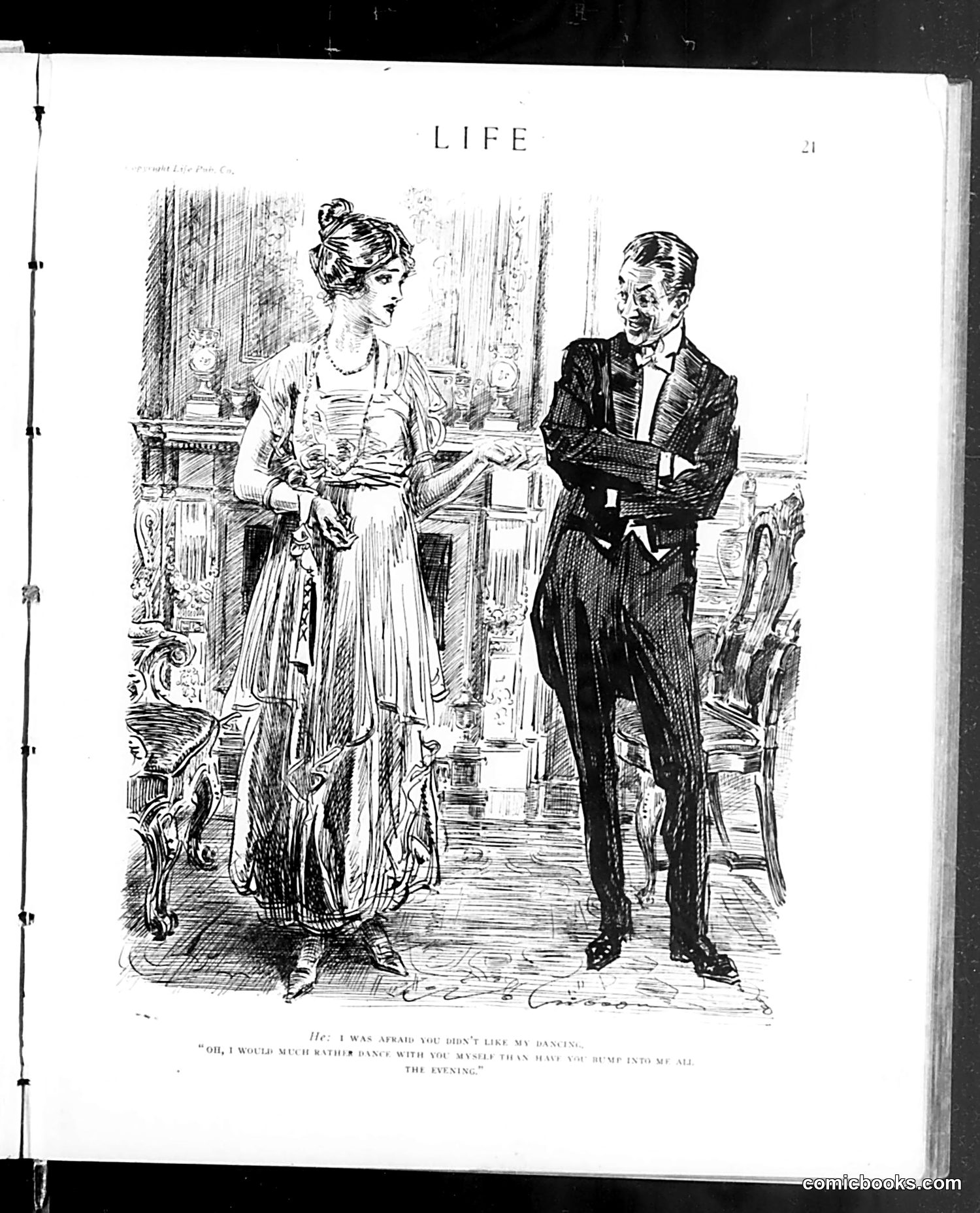
This is a satirical cartoon from Life magazine depicting a social interaction between a well-dressed man and woman in an elegant interior setting. The caption reads: "He: 'I was afraid you didn't like my dancing.' She: 'Oh, I would much rather dance with you myself than have you bump into me all the evening.'" The joke is a backhanded compliment about the man's poor dancing ability. Rather than affirm that she enjoys his dancing, the woman sarcastically suggests she'd prefer he dance *with* her (implying he'd at least stay in one place) rather than continue colliding with her as he stumbles around the dance floor. This reflects early 20th-century social commentary on courtship rituals and the awkwardness of social dancing among the upper classes.
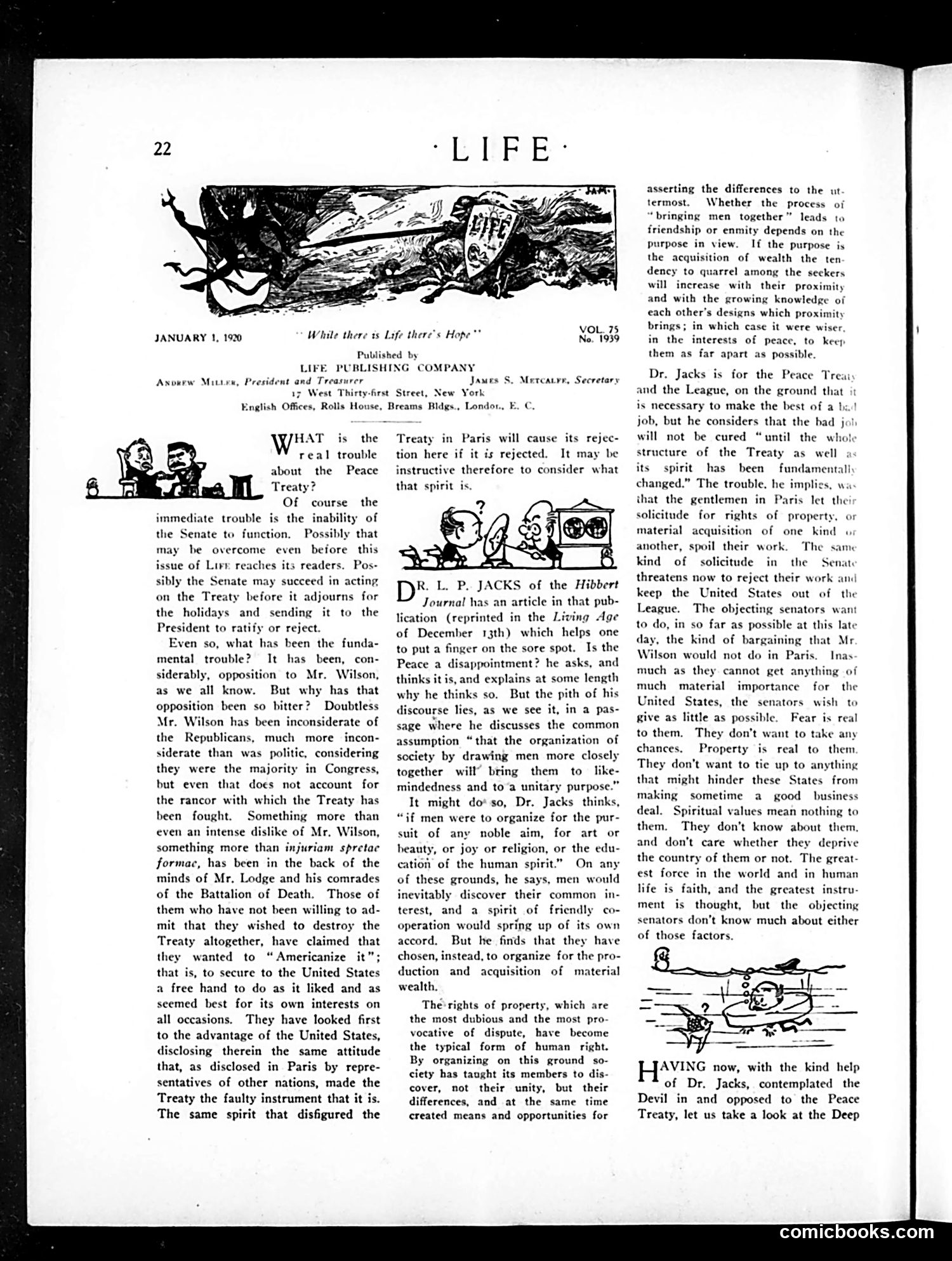
This page debates the fundamental problem underlying Senate rejection of Woodrow Wilson's Paris Peace Treaty. The article argues that opposition stems not merely from partisan dislike of Wilson, but from a deeper philosophical conflict. The central argument, attributed to Dr. R.L.P. Jacks, proposes that the Treaty failed because nations organized around **material wealth acquisition** rather than noble shared purposes (art, religion, education). When men organize for profit, proximity breeds competition and conflict over property rights—the "most dubious" basis for human cooperation. The cartoons (small illustrations visible) appear to satirize political obstruction, likely depicting Senator Henry Cabot Lodge and Republican opponents as obstacles to peace. The irony: American senators claiming to "Americanize" the Treaty actually replicate the selfish nationalism that corrupted the Paris negotiations itself. Both prioritize national advantage over collective welfare.
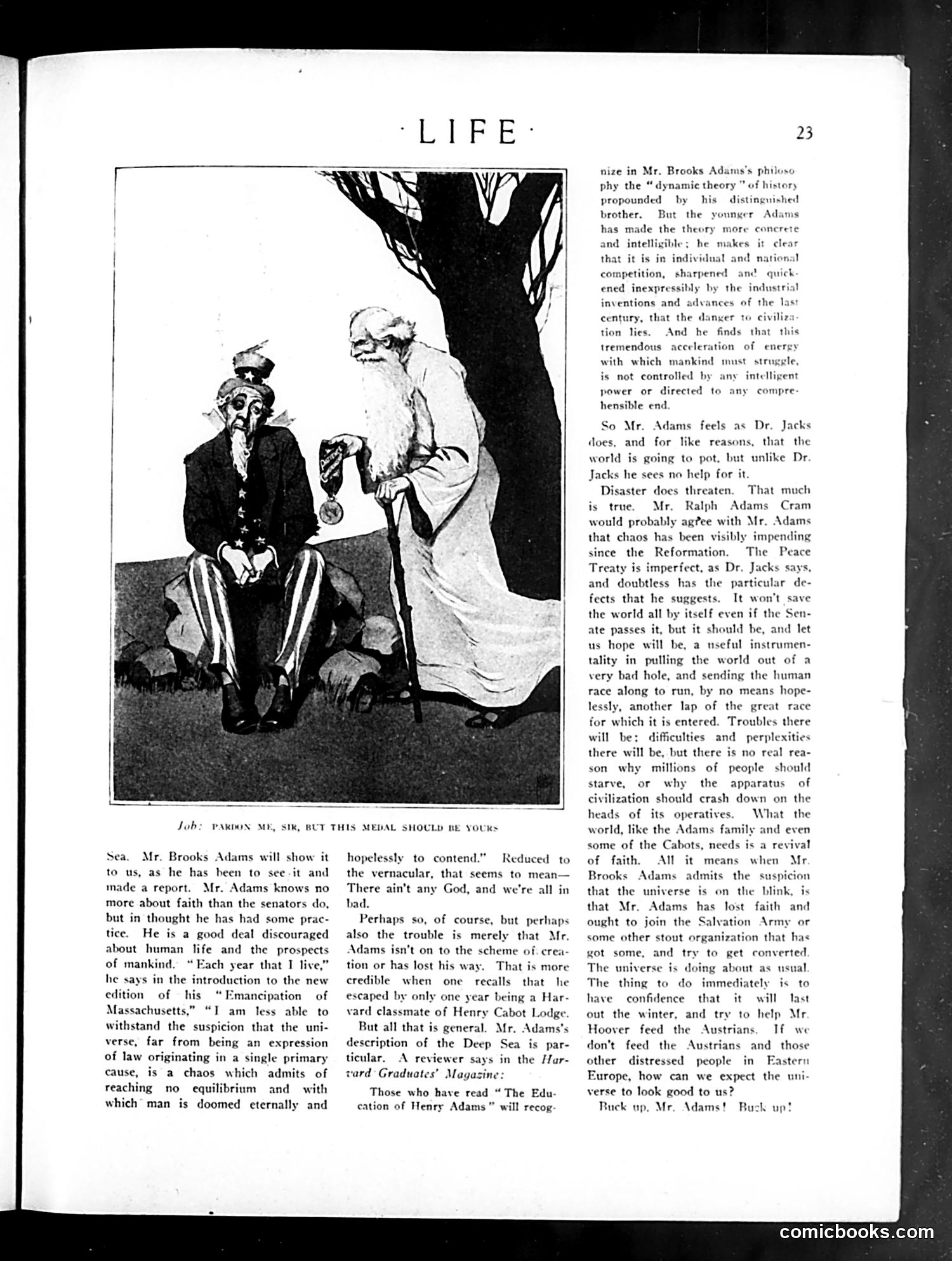
This page critiques **Brooks Adams**, the historian and pessimist brother of Henry Adams, whose philosophy is described as deterministic and fatalistic—essentially arguing the universe is chaos and humanity is doomed. The cartoon depicts Adams as a skeletal, grim figure receiving a medal from Death personified, captioned "Pardon me, sir, but this medal should be yours"—mocking his death-obsessed worldview. The article argues Adams is wrong: while troubles exist (post-WWI, the Peace Treaty is imperfect), there's no reason for widespread starvation or civilizational collapse. The writer urges faith and practical action—specifically feeding starving Austrians and supporting Herbert Hoover's relief efforts—rather than Adams's nihilistic resignation. The satire targets both Adams's philosophical pessimism and, implicitly, isolationist reluctance to help post-war Europe. The final cry "Buck up, Mr. Adams!" demands optimism and engagement over defeatism.
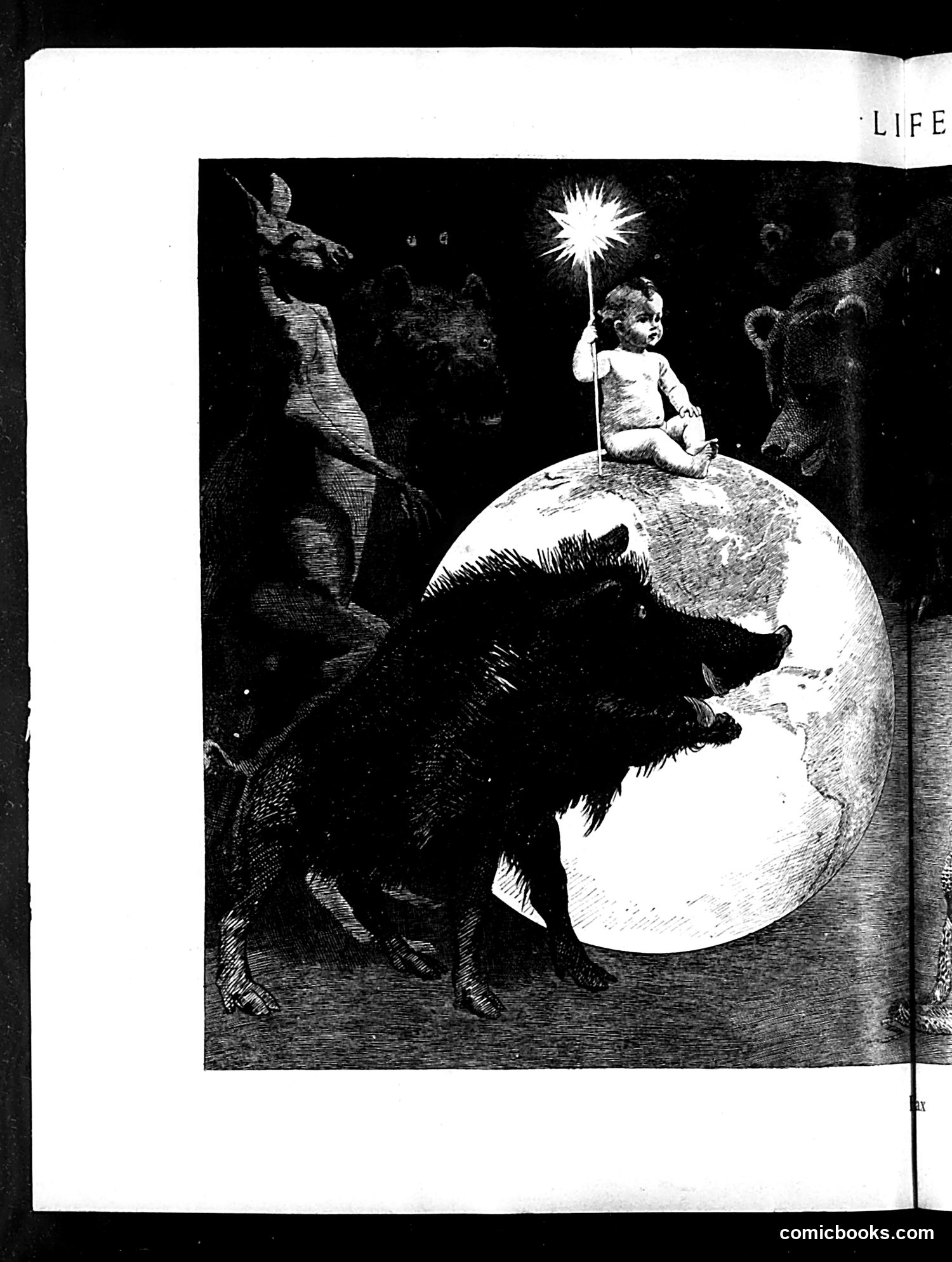
This appears to be a satirical illustration from *Life* magazine showing a small child sitting atop a large globe, holding a bright light or torch aloft while surrounded by dark animal figures (possibly bears or other creatures) in shadowy poses around them. The imagery likely represents **innocence or hope (the child with light) confronting darkness or danger (the surrounding beasts)**. Without visible text identifying specific political figures or events, the exact satirical target remains unclear. However, the composition suggests commentary on **vulnerable humanity facing threatening forces**—possibly referencing geopolitical tensions, war, or other existential threats of the era when this was published. The allegorical style was common in early 20th-century political satire.
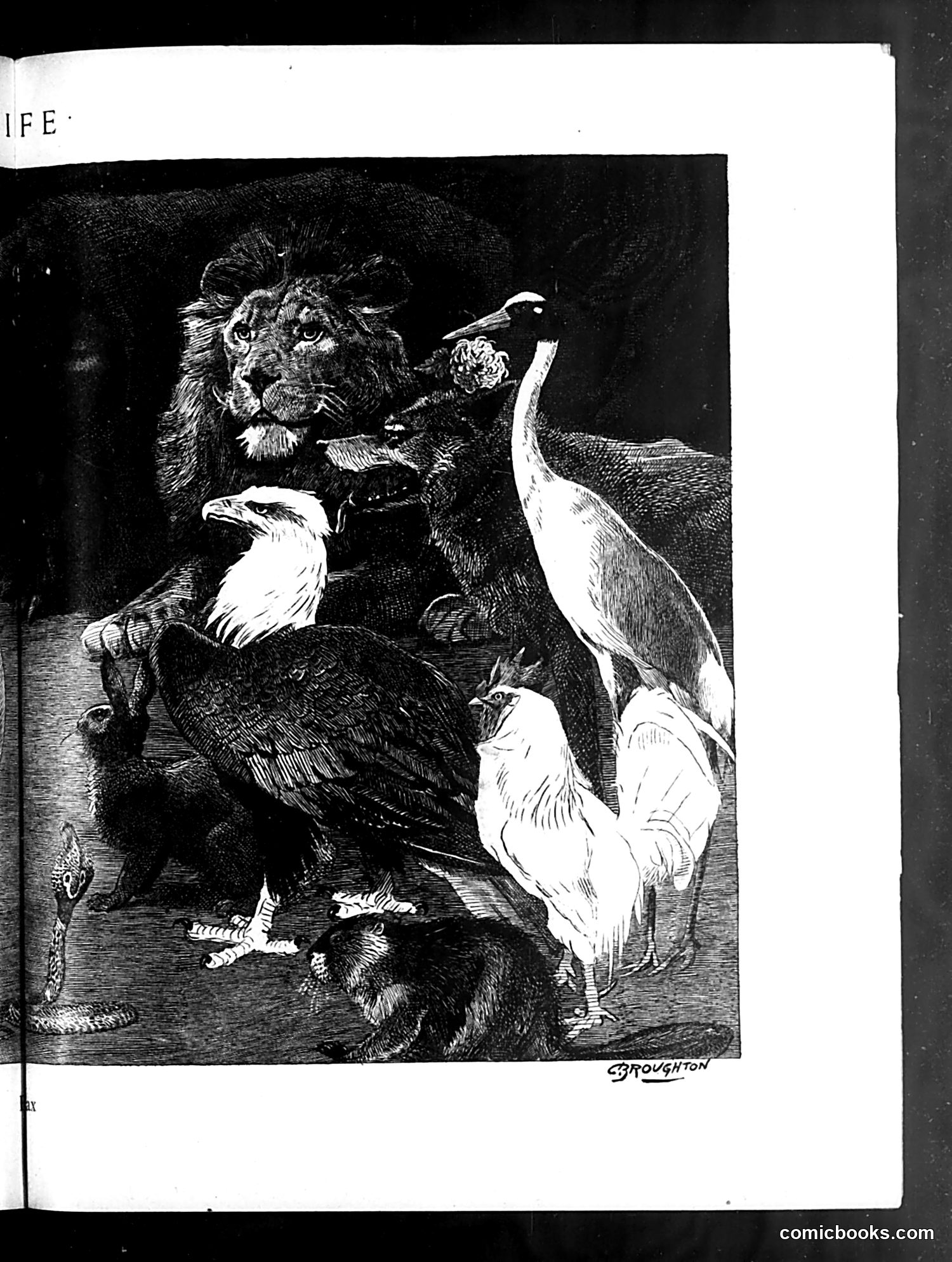
This satirical illustration by Broughton depicts a lion confronting two cranes or similar long-necked birds. The composition suggests a fable or moral allegory—likely referencing Aesop's tales about animals representing human behavior or social types. The lion, depicted as powerful but seemingly distracted or amused, faces the birds in what appears to be a standoff. The artist's technique uses strong contrast between the dark lion and the white birds to create visual drama. Without additional OCR text from the page itself, the specific political or social commentary remains unclear. The image could satirize power dynamics, foolish bravery, or the clash between established authority (the lion) and lesser entities. The context of *Life* magazine suggests contemporary social or political relevance, but the exact reference is uncertain without more textual information.
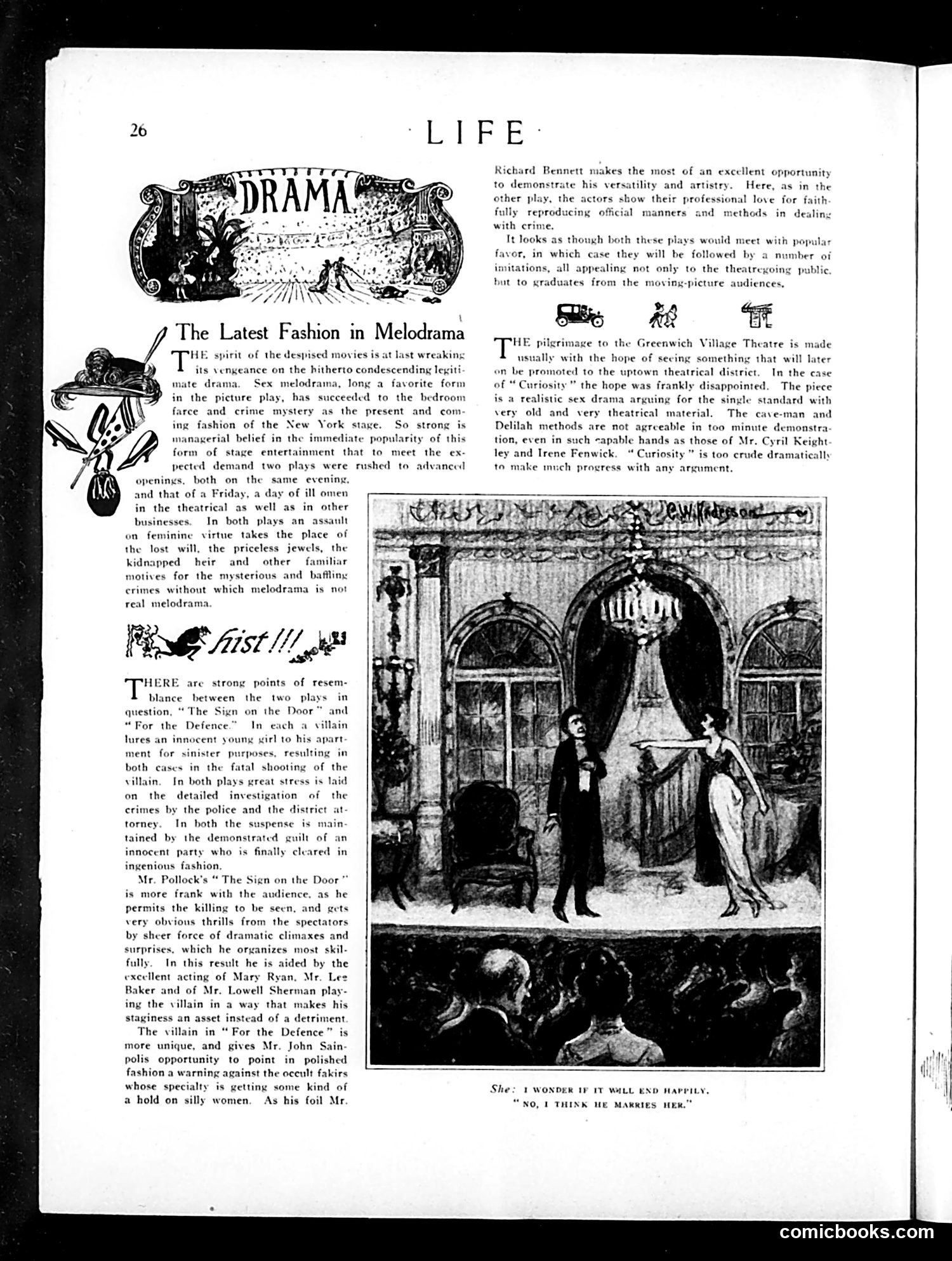
This page critiques the Broadway theater's recent adoption of "sex melodrama"—a genre previously associated with lowbrow motion pictures. Life's satirical point: legitimate theater, long considered superior to movies, is now desperate enough to copy Hollywood's sensational formulas. Two plays opened simultaneously that evening—"The Sign on the Door" and "For the Defence"—both featuring nearly identical plots: a villain lures an innocent young woman to his apartment with criminal intent, resulting in his death. The review notes both plays rely on crude dramatic devices (assault on virtue replacing traditional melodrama's stolen jewels or kidnapped heirs) and police investigation suspense. Life mocks this desperation while acknowledging the plays may succeed, spawning imitators appealing to "graduates from the moving-picture audiences"—a backhanded insult suggesting theater now courts former moviegoers. The small cartoon caption jokes cynically about marriage prospects given this theatrical environment.
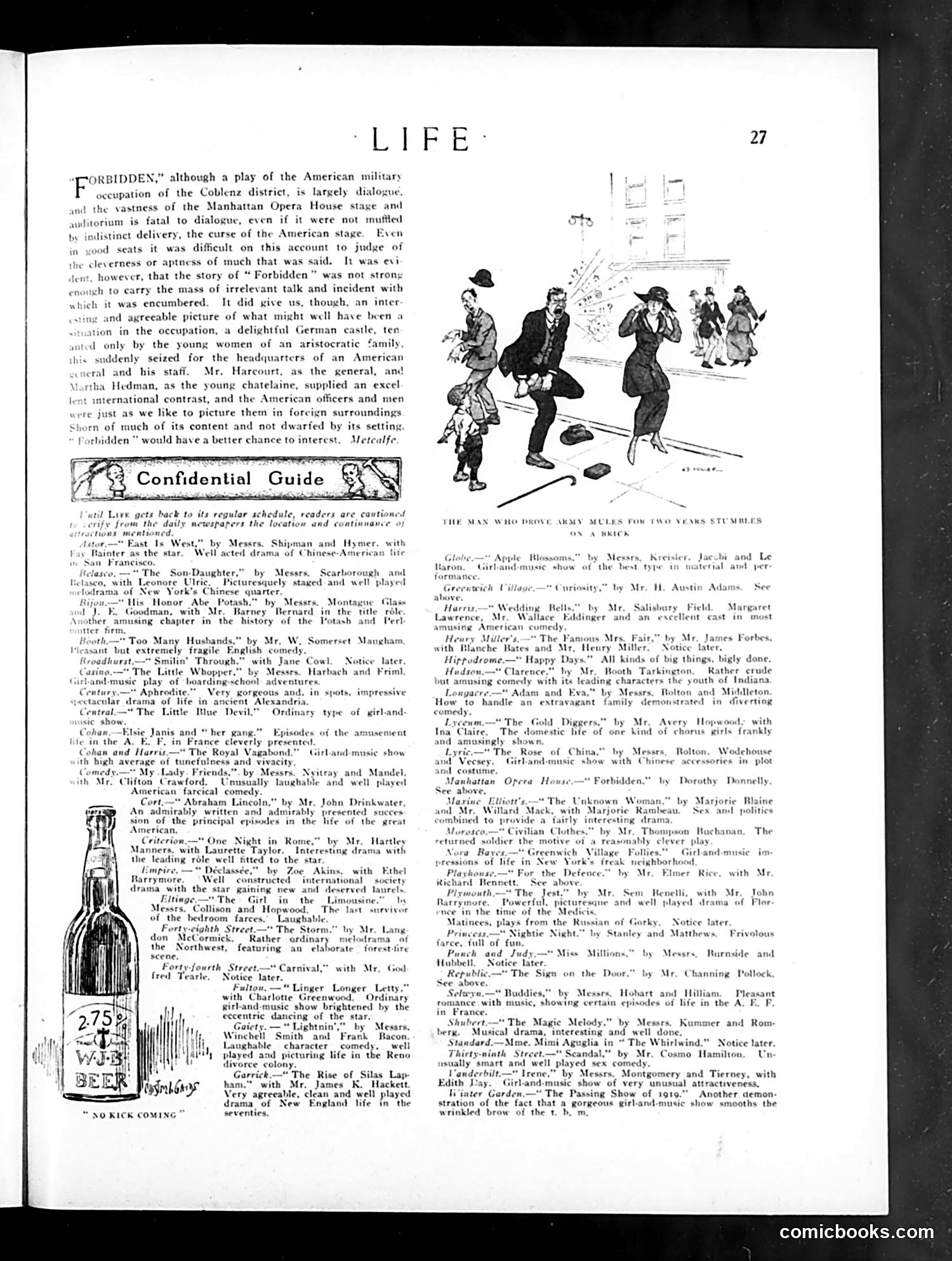
This page is primarily a **theater review column** titled "Confidential Guide," cataloging Broadway productions and their merits. The main illustration depicts a comedic scene captioned "THE MAN WHO BROKE ARMY MULES FOR TWO YEARS STUMBLES ON A BRICK"—a slapstick image of a man tumbling over an obstacle, likely illustrating one of the theatrical comedies being reviewed. The reviews themselves discuss plays from the immediate post-WWI period, including "Forbidden" (about American military occupation in Coblenz, Germany), Chinese-American dramas, farcical comedies, and a notable production of "Abraham Lincoln" by John Drinkwater. The satirical function here is subtle—the column gently mocks theatrical pretension and reviews plays with a critical eye toward dialogue quality, staging effectiveness, and authenticity. The beer advertisement ("NO KICK COMING") at bottom left is period-typical. **For modern readers:** This reflects 1920s Broadway's preoccupations with post-war themes, racial/immigrant narratives, and lowbrow comedy alongside "serious" drama.
This page contains literary book reviews from Life magazine, mixing serious critique with satirical verse. The top illustration depicts figures reclining—likely symbolizing leisure or indulgence related to the reviewed books. The opening review of Henri Barbusse's *Light* contains political satire: the critic observes that if Barbusse were American, he'd be made a senator or Treasury secretary and would perform "exceedingly" poorly—because Americans foolishly put intellectuals in positions of political power over "delicate things" like soldiers and railroads, whereas the French wisely keep them in academies. The "Rhymed Reviews" section uses verse to mock Somerset Maugham's *The Moon and Sixpence*—a novel about a respectable London broker who abandons his family to become a painter. The reviewer sarcastically condemns the protagonist's selfish devotion to "Art" and "private self-expression," calling his paintings "rotten," and criticizes how the man wastes canvas pursuing artistic obsession rather than proper social duty. Both reviews reflect conservative early-20th-century anxieties about bohemian individualism versus social responsibility.
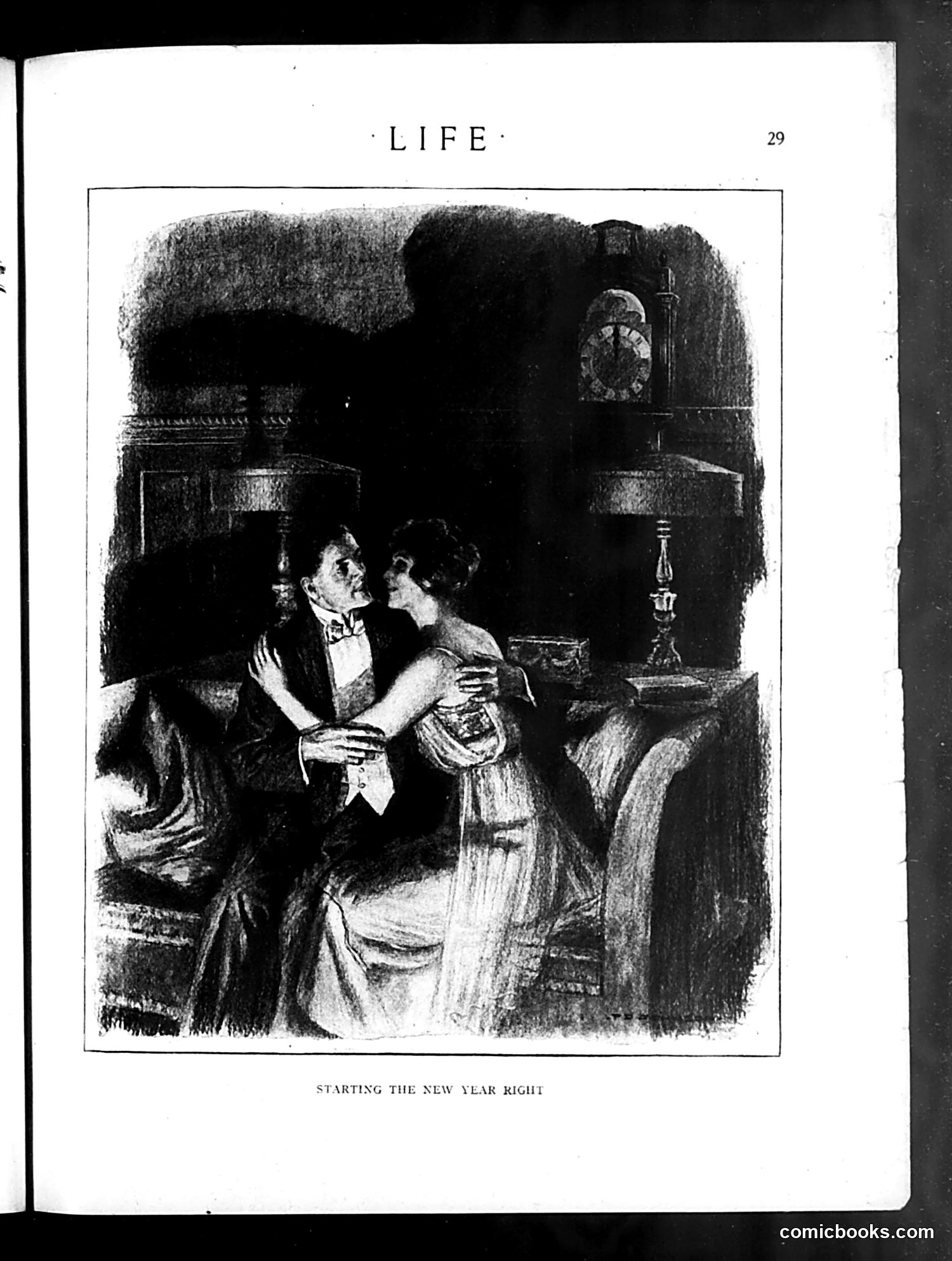
This illustration depicts an intimate New Year's Eve scene between a well-dressed man in formal attire (tuxedo with bow tie) and a woman in an elegant gown. They appear to be embracing or dancing in an upscale interior, with a clock visible on the wall in the background showing midnight—the traditional moment for New Year's celebrations. The satire appears to target romantic or social conventions of the era. The caption's phrasing—"starting the new year right"—suggests ironic commentary on how people celebrate or what they prioritize at this threshold moment. The formal dress and refined setting indicate this concerns upper-class behavior, likely mocking contemporary attitudes about romance, propriety, or leisure among wealthy society. Without additional context, the specific social critique remains implicit.
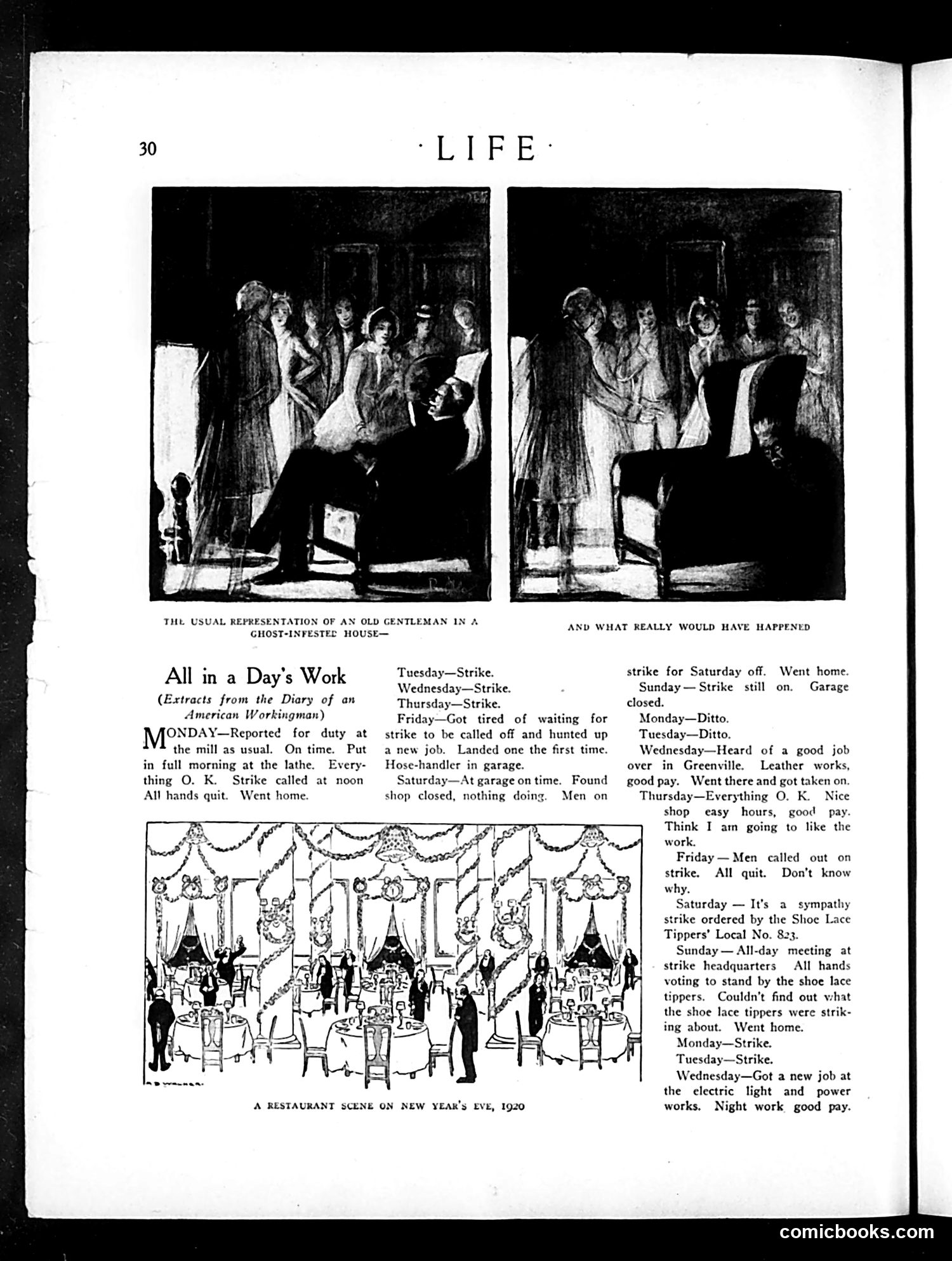
This 1920 *Life* magazine page satirizes labor strikes and union activity through contrasting narratives. The top images show a ghost-story trope (an old gentleman encountering spirits), captioned to suggest what "really would have happened"—a meta-joke about expectations versus reality. The main text presents a working man's diary documenting his attempts to find stable employment, repeatedly disrupted by strikes. The satire's target: the proliferation and apparent absurdity of labor actions. Each new job ends when workers strike—sometimes for unclear reasons (the "Shoe Lace Tippers' Local" strike where the diarist admits he "couldn't find out what the shoe lace tippers were striking about"). The cartoon ridicules both the chain-reaction nature of sympathy strikes and the perceived unreasonableness of labor organizing in the post-WWI period. The illustration of the fancy 1920 restaurant suggests contrast with the working man's precarious situation. The satire's political position: *Life* mocks labor activism as counterproductive and chaotic, preventing workers from maintaining employment.
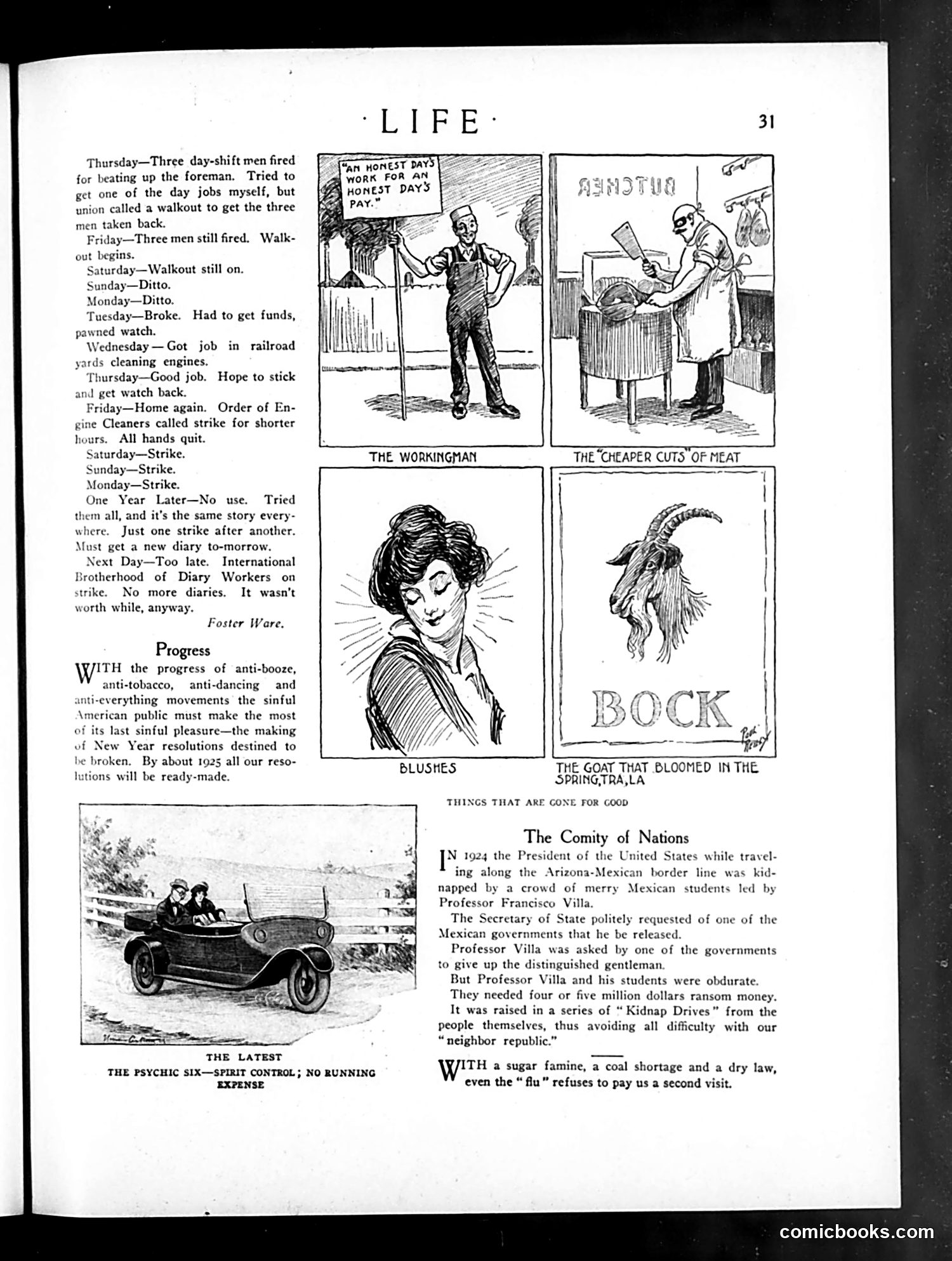
This page contains two distinct satirical pieces: **The Diary Entry ("Foster Ware")** mocks labor union activism through absurdist escalation. A worker documents repeated strikes—first for fired coworkers, then for shorter hours—that spiral into chaos. The joke peaks when the "International Brotherhood of Diary Workers" strikes, preventing him from even recording further strikes. The satire critiques both union rigidity and the endless cycle of labor disputes in 1920s America. **"The Comity of Nations"** appears to be satirical fiction (despite its "1924" date frame). It describes a fictional kidnapping of the U.S. President by Mexican students led by "Professor Francisco Villa," with ransom raised through "Kidnap Drives." This likely satirizes U.S.-Mexican diplomatic relations and American nervousness about the Mexican border during this era, mocking both the absurdity of the scenario and America's tendency to sensationalize Mexican affairs. Both pieces use exaggeration and impossibility to critique contemporary social anxieties.
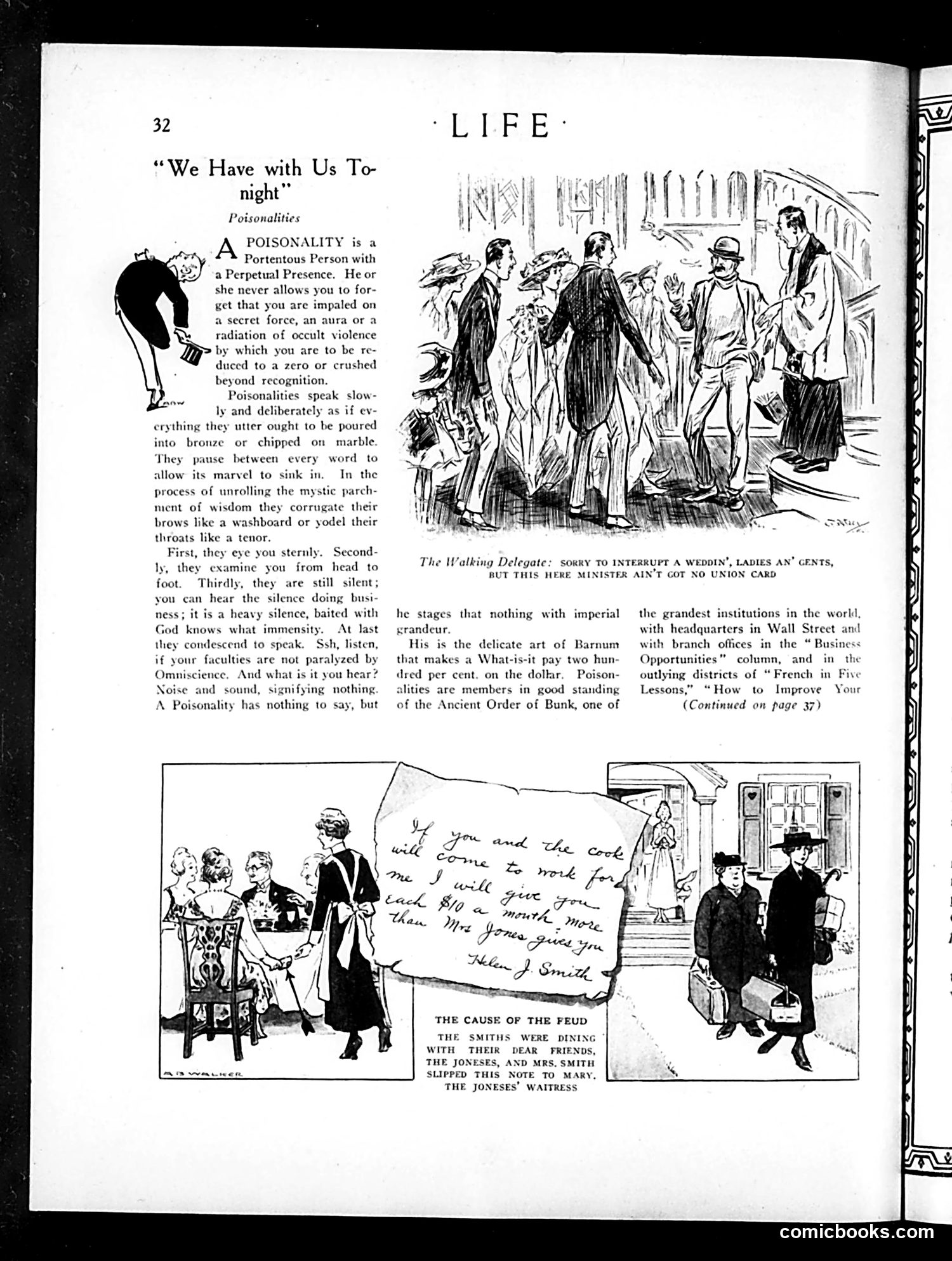
This page satirizes "Poisonalities"—pompous, pretentious people who affect an air of mysterious profundity while saying nothing of substance. The text describes them as deliberately slow-speaking, enigmatic types who manipulate through silence and gravitas, corrupting their features with exaggerated expressions to appear wise. The cartoons illustrate the concept: the top illustration shows "The Walking Delegate," a labor union representative rudely interrupting a wedding, having no "union card" to justify his presence—mocking working-class organizers as intrusive outsiders. The bottom cartoon depicts "The Cause of the Feud," where the Smiths and Joneses' friendship dissolves over a note about employment terms—satirizing how trivial grievances and miscommunication destroy social bonds. Together, the page mocks pretentious self-importance and social friction caused by bombastic personalities and working-class agitation in early 20th-century American society.
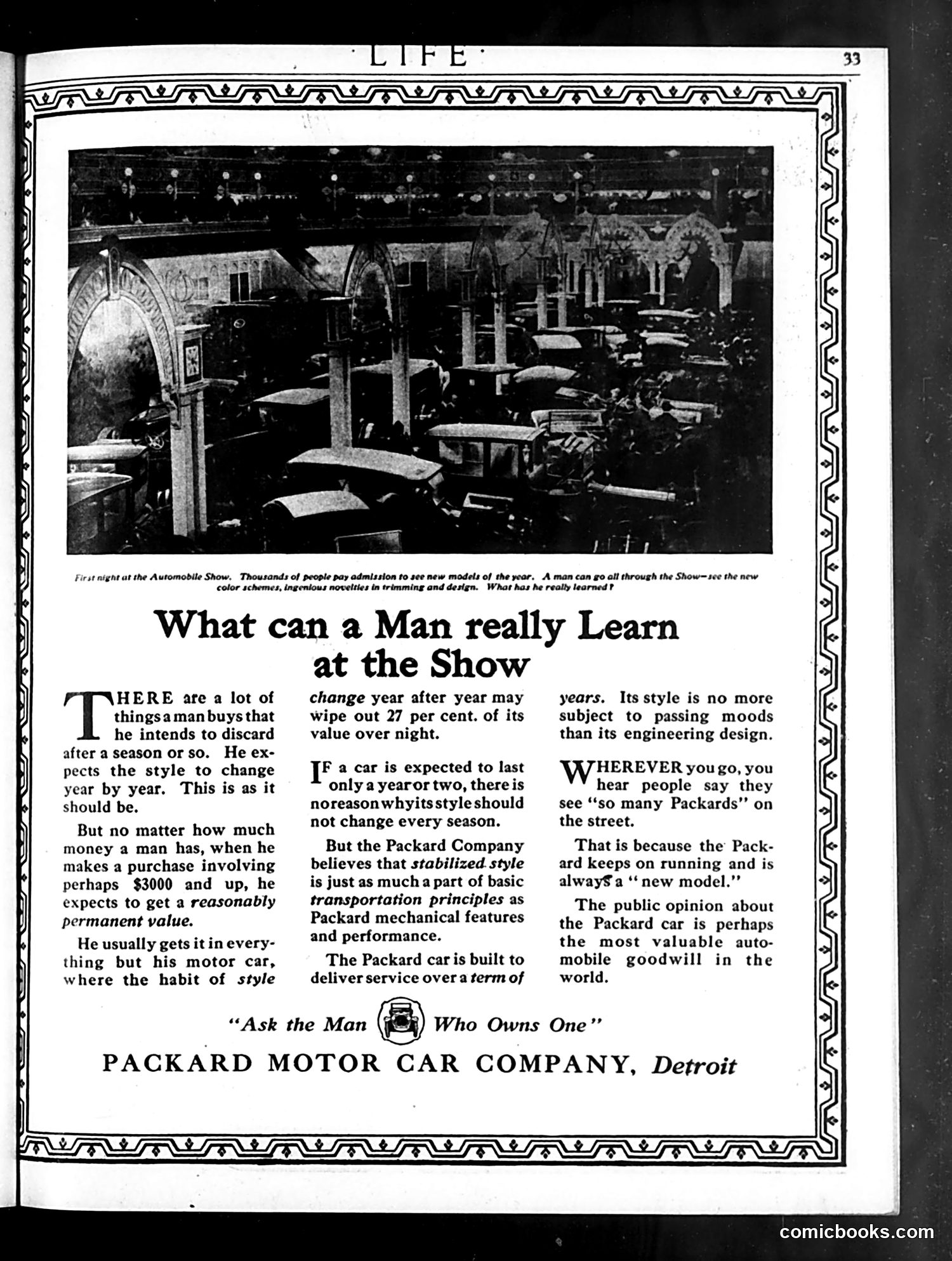
This is **not a cartoon or satire**—it's a straightforward advertisement for Packard automobiles, disguised as editorial commentary. The "joke" or argument being made: At automobile shows, visitors see flashy new styling and design changes, but this teaches them nothing about real value. The ad criticizes competitors (implied: Ford, General Motors) who change car styles annually to depreciate older models by ~27%, manipulating buyers into frequent replacements. **Packard's counter-argument**: Since their cars are engineered to last years, not seasons, styling should remain stable—like engineering principles. The ad claims Packards retain value and longevity, which explains why "so many Packards" remain on streets (they don't become obsolete quickly). The tagline "Ask the Man Who Owns One" was Packard's actual slogan, suggesting real owners validate the brand's durability claims versus competitors' wasteful "planned obsolescence" through style changes.
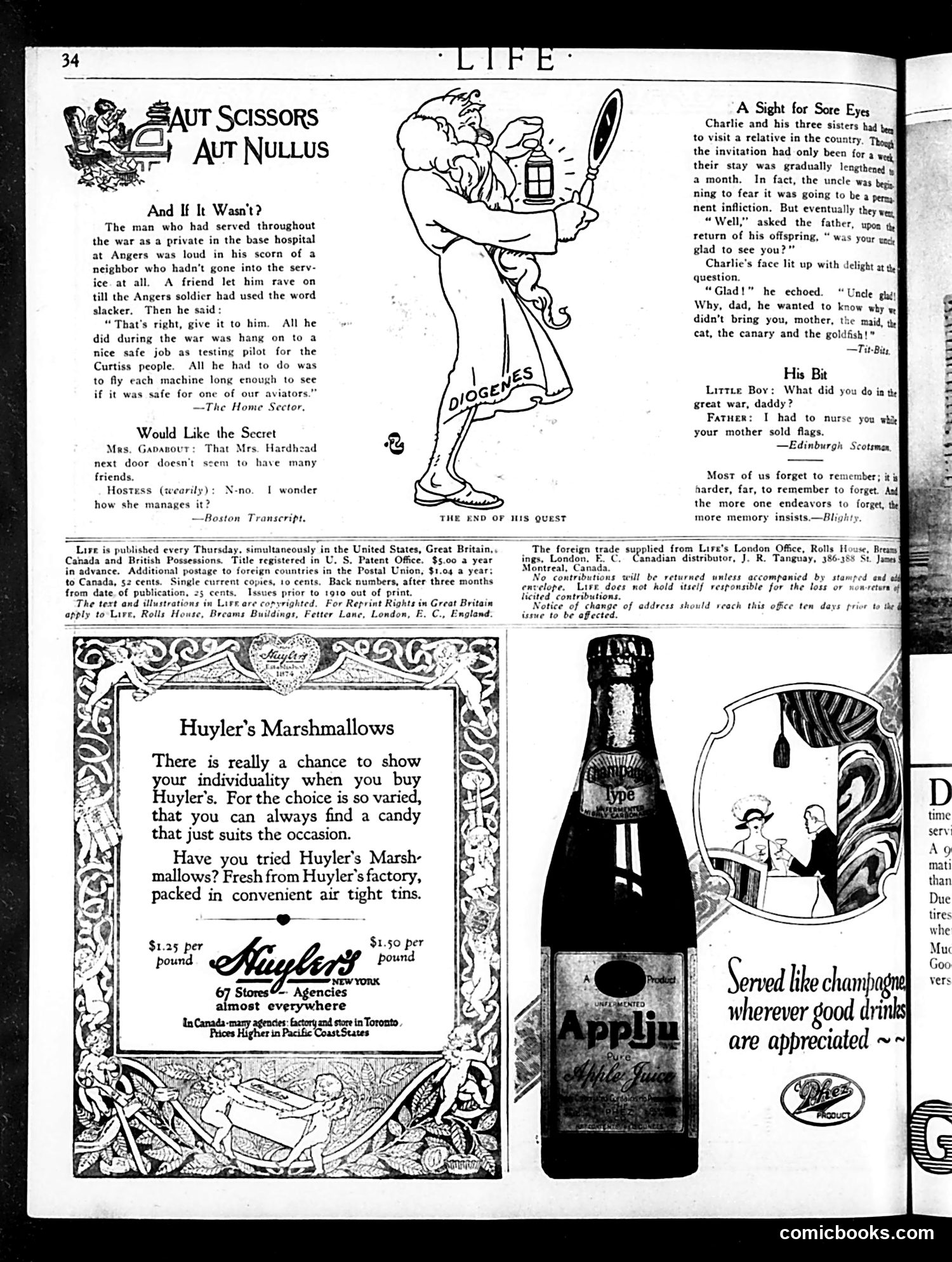
This page contains several short humorous pieces typical of Life's satirical format, plus period advertisements. **"And If It Wasn't?"** satirizes false modesty about wartime service. A soldier stationed safely at a base hospital scorns a neighbor as a "slacker" (draft-dodger), unaware the neighbor actually risked his life as a test pilot for Curtiss aircraft—arguably more dangerous than hospital duty. **"Would Like the Secret"** is a brief joke about a woman's unpopularity, with the punchline that her neighbor manages friendlessness despite trying. **"A Sight for Sore Eyes"** depicts an uncle relieved when his visiting nieces and nephew finally leave, humorously revealing he wanted them gone all along. **"His Bit"** jokes that a father's WWI contribution was being nursed by his wife while she sold war-bonds—a domestic alternative to military service. The advertisements (Huyler's Marshmallows, Applin beer) are typical period marketing, emphasizing product variety and quality.
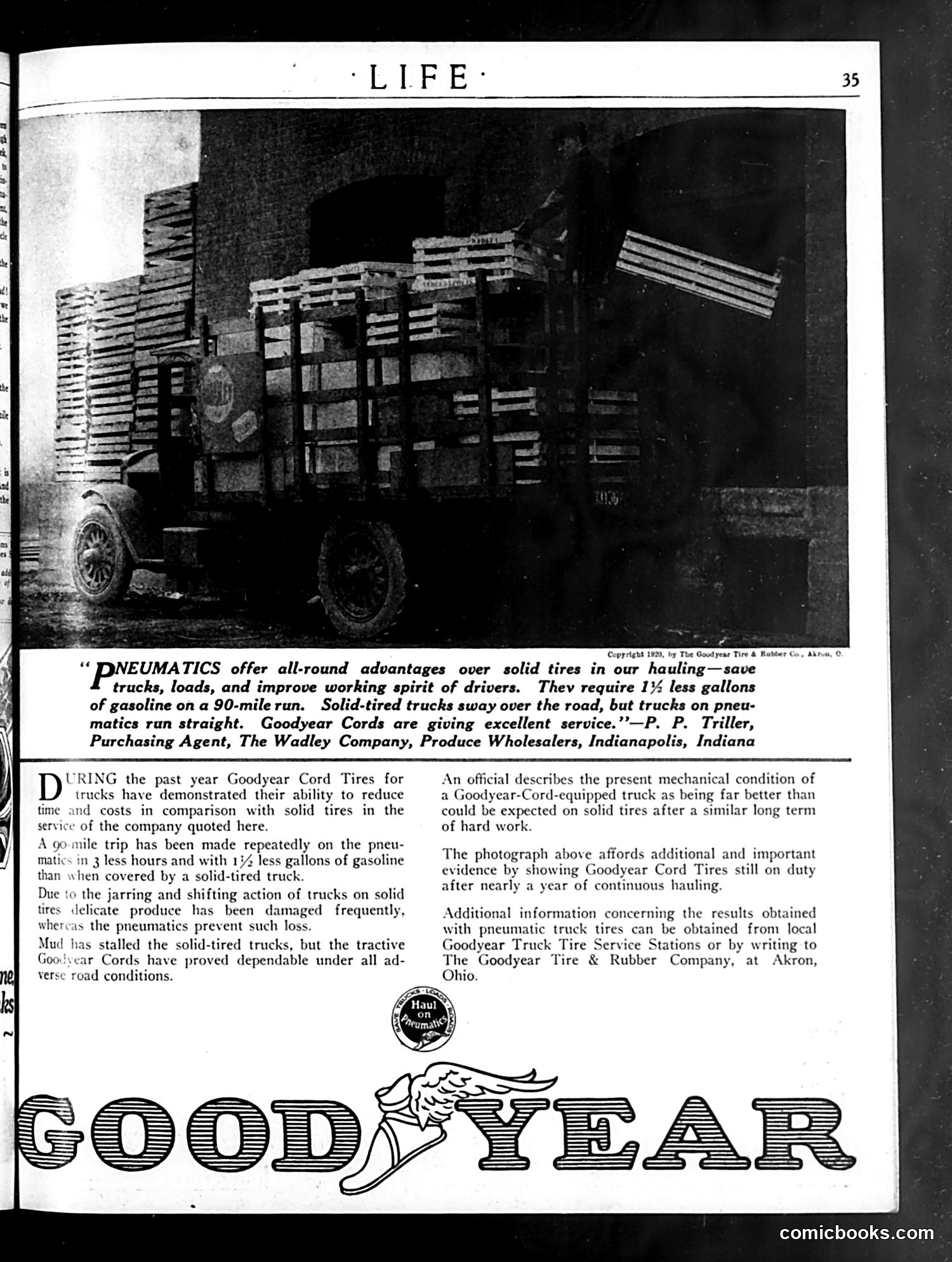
This is a **Goodyear tire company advertisement**, not political satire. The page promotes pneumatic (air-filled) truck tires over solid tires for commercial hauling. **The pitch:** A testimonial from P. P. Triller, purchasing agent for The Wadley Company (produce wholesalers in Indianapolis), claims pneumatic tires offer multiple advantages—they reduce fuel consumption (1.5% less gasoline on 90-mile runs), improve driver morale, prevent cargo damage through reduced jarring, and provide better traction in mud compared to solid tires. **The evidence:** A photograph shows a Goodyear Cord tire still functioning after nearly a year of continuous hauling, demonstrating durability. The advertisement emphasizes cost savings and efficiency—appeals to business owners managing truck fleets during the prosperous 1920s before the Depression. This represents early automobile industry advertising targeting commercial users rather than consumers.
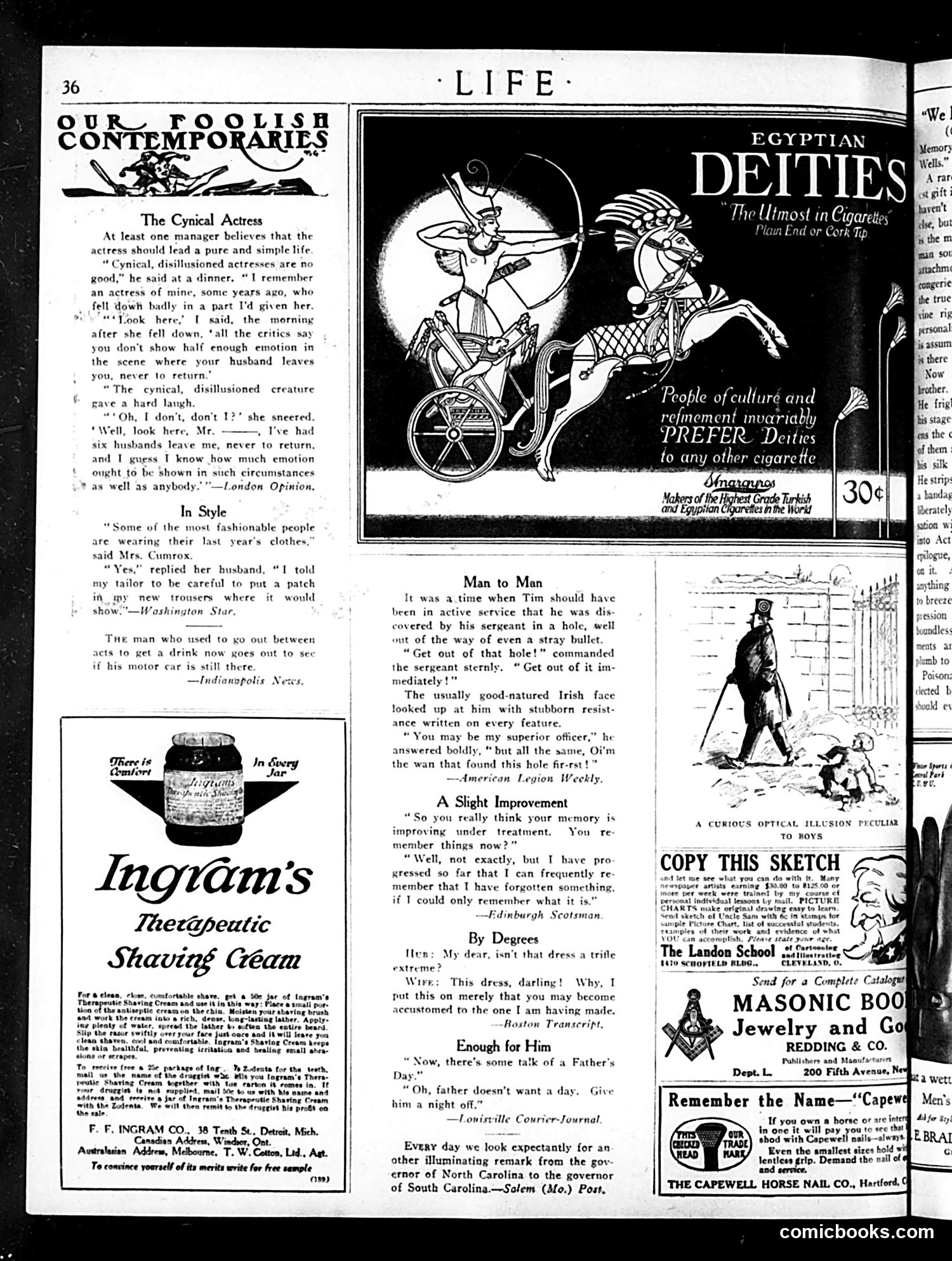
This page from *Life* (a satirical magazine) contains several short humorous anecdotes and advertisements typical of early 20th-century American humor. **"The Cynical Actress"** mocks theatrical managers' moralizing about actresses' behavior. A manager claims emotional actresses must live purely, then contradicts himself by recounting how an actress who'd experienced six real divorces understood authentic emotion better than his direction—satirizing hypocrisy about women's propriety. **"In Style"** jokes about Depression-era fashion: wealthy people wear last year's clothes while pretending it's fashionable; a man deliberately patches new trousers to appear worn. **"Man to Man"** presents an Irish soldier's defiant humor—refusing orders because he "found" his foxhole first, asserting working-class dignity against military hierarchy. The remaining pieces are brief jokes about memory loss, fashion, and fathers' Day, plus advertisements for shaving cream, cigarettes, and masonic jewelry—typical period advertising. The overall tone reflects early-20th-century American satire: workplace absurdities, class tensions, gender contradictions, and everyday life humor.
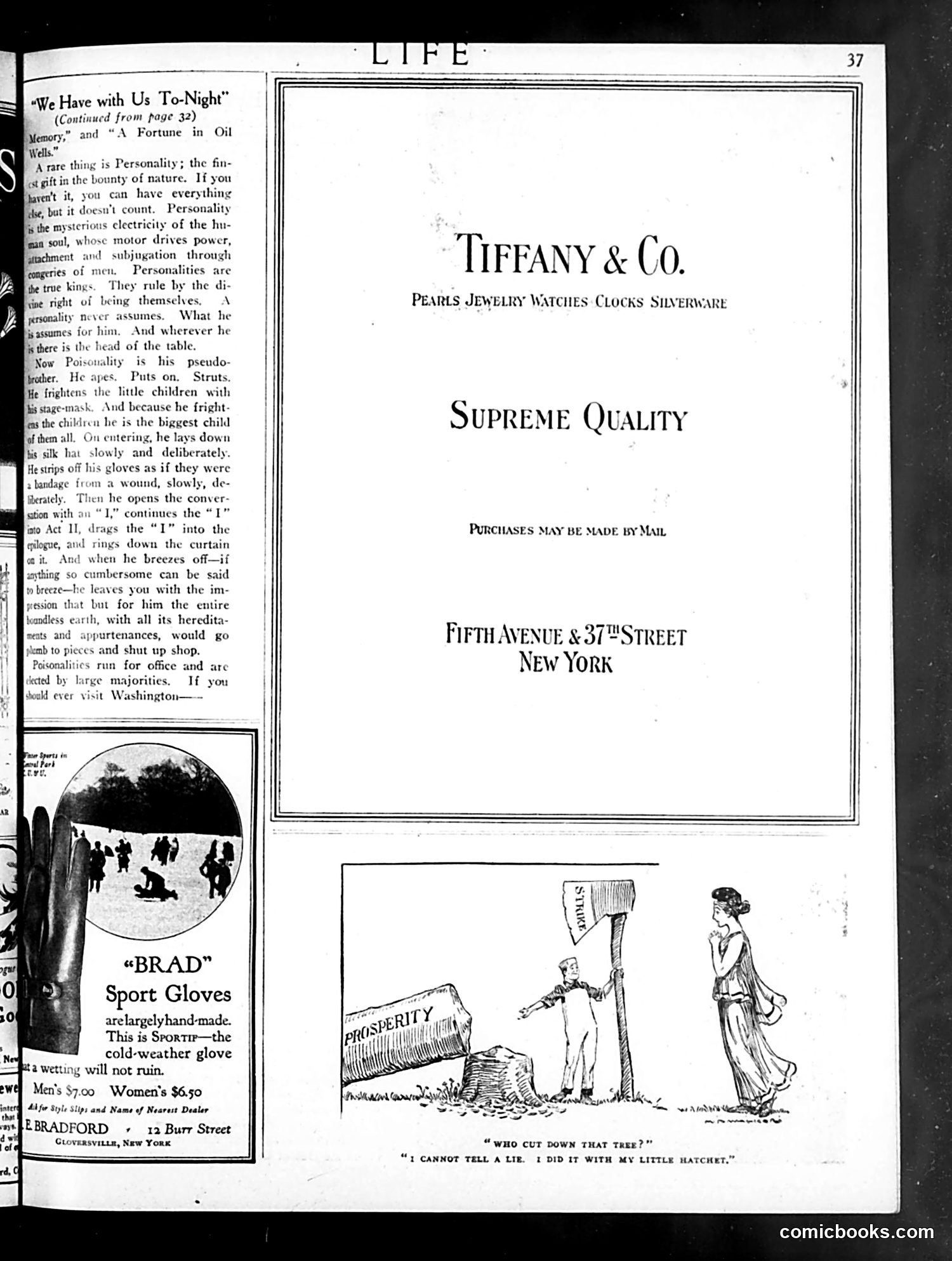
This page contains a **Tiffany & Co. luxury advertisement** (center-right) and a **cartoon at the bottom** satirizing American mythology. The cartoon depicts the famous George Washington apocryphal story: young Washington supposedly confessed to cutting down his father's cherry tree with his hatchet, claiming "I cannot tell a lie." The figures show a boy with a hatchet, a felled tree labeled "Prosperity," and a woman (likely representing the nation or virtue) observing. The satire is biting: the cartoon inverts the moral lesson. Rather than praising Washington's honesty, it suggests that destructive action—literally chopping down prosperity—is presented as virtuous honesty. This likely critiques American political figures or policies that claim moral rectitude while causing economic or social harm. The left column contains editorial text celebrating "Personality" as a form of power, contrasting it with empty posturing. This thematic connection suggests the cartoon extends that critique: public figures adopt the *persona* of honesty while committing destructive acts.
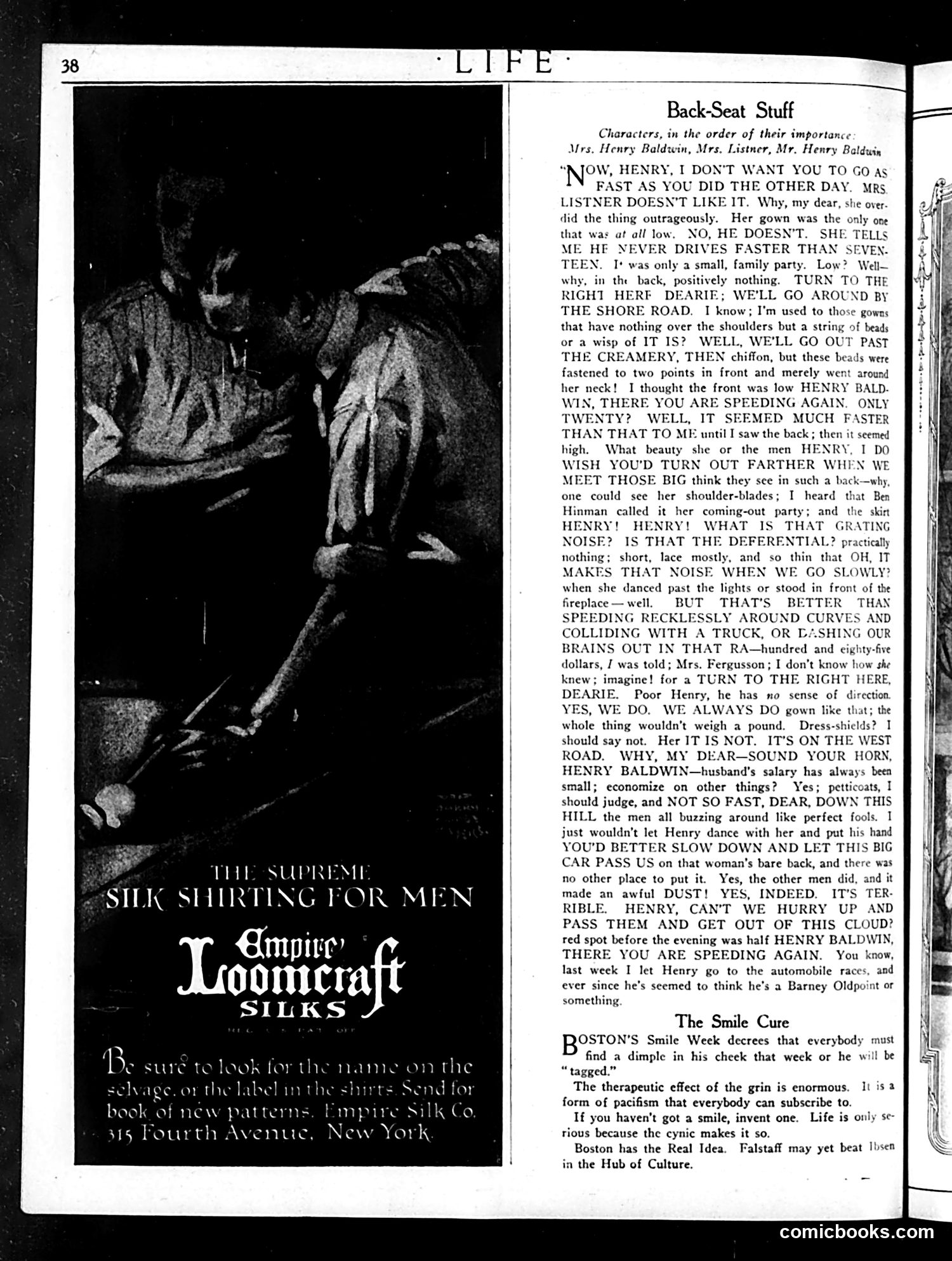
This comic sketch satirizes nagging wives and automobile culture in the early 1900s. Mrs. Henry Baldwin repeatedly scolds her husband Henry about his reckless driving, while also criticizing a younger woman's scandalous fashion—a low-backed gown that reveals her shoulder blades and bare back. The humor targets several social anxieties: wives' complaints about dangerous speeding, the shock of women's increasingly revealing clothing (shoulder-baring dresses were considered daring), and the distraction young women posed to respectable married men. Henry can't concentrate on driving because of both his wife's constant interruptions and the sight of the immodestly dressed woman. The sketch mocks both Henry's inability to satisfy his wife and the tension between new female fashion and traditional propriety. A reference to "Barney Oldfield" (a famous racecar driver) jokes that Henry fancies himself a daredevil. The accompanying Empire Silk advertisement sells men's dress shirts—practical attire for the respectable gentleman, unlike the scandalous fashions troubling Mrs. Baldwin.
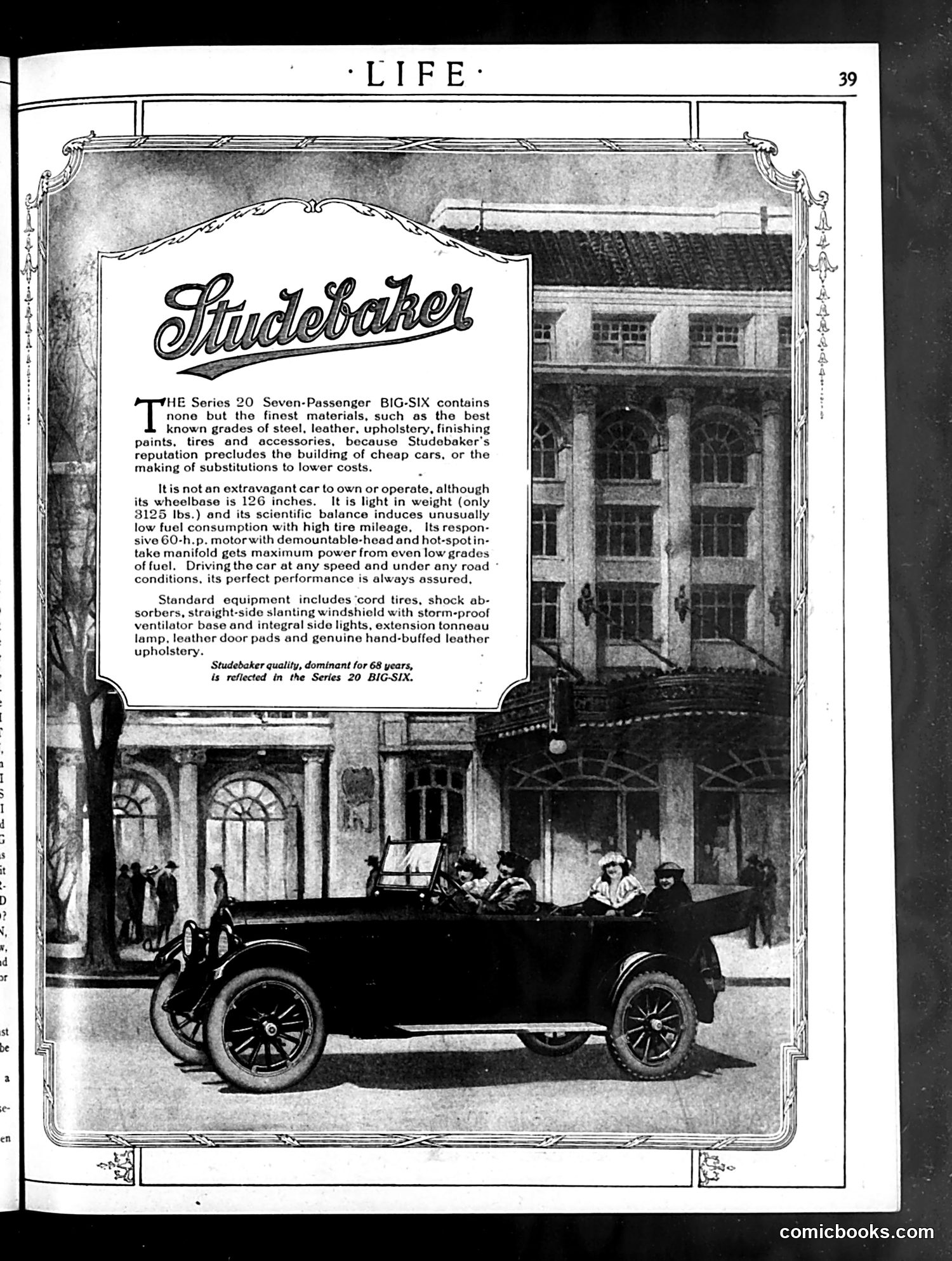
The page promotes Studebaker's Series 20 Seven-Passenger "Big-Six" car. The image shows an open-top touring car with several passengers parked before an elegant classical building (likely representing a luxury venue or hotel). The advertisement emphasizes quality materials and engineering—steel, leather, upholstery—while claiming the car is practical and economical despite its 126-inch wheelbase and 60-horsepower engine. It stresses that Studebaker's 68-year reputation prevents cutting corners, and boasts features like shock absorbers and hand-buffed leather. The tone appeals to affluent buyers seeking prestige without extravagance. This is a straightforward commercial pitch, not satirical commentary. The "Life" magazine context (which published both humor and ads) means this glossy advertisement simply occupied premium editorial space alongside the magazine's actual satirical content.
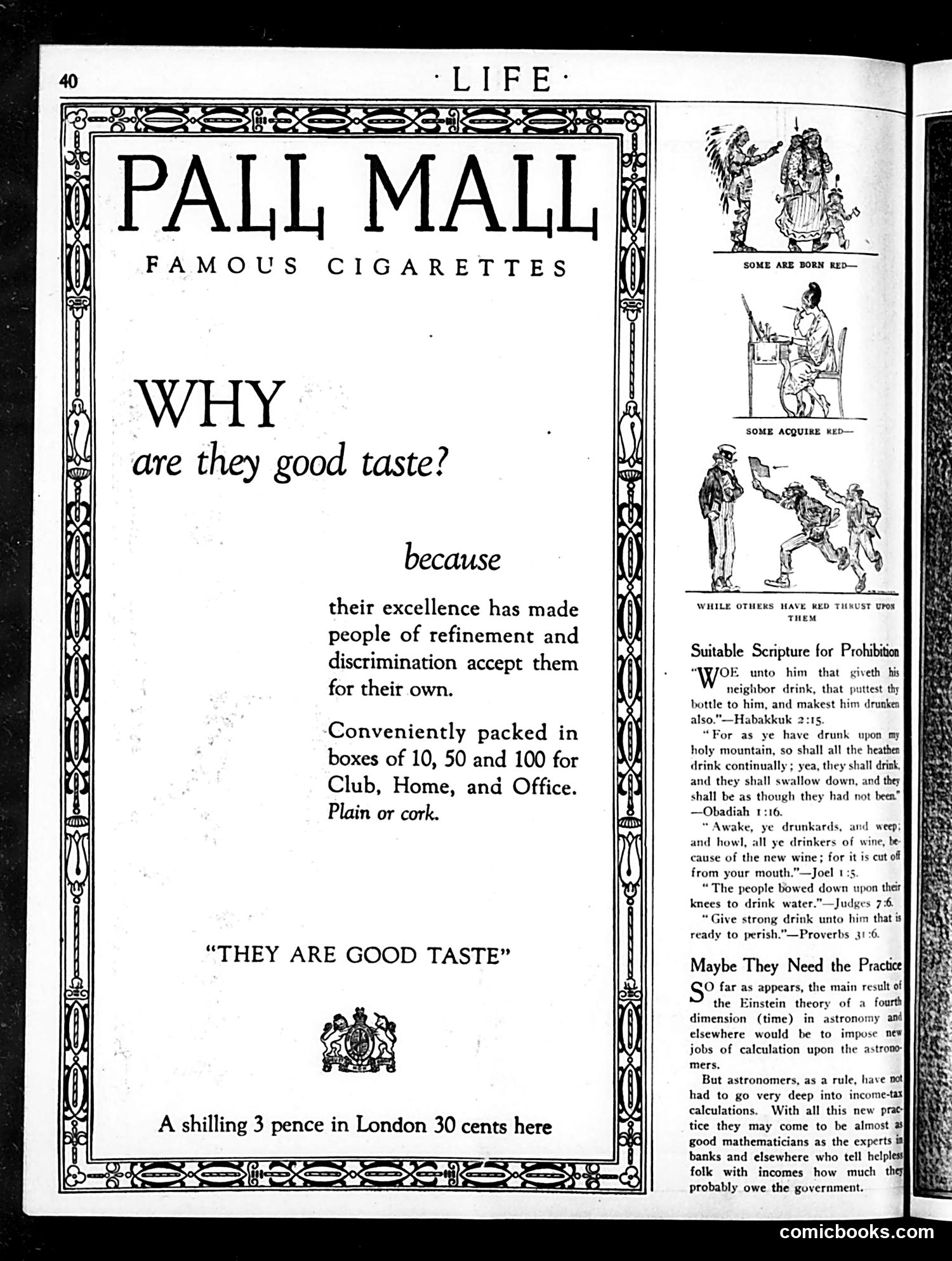
This page contains a **Pall Mall cigarette advertisement** (left) alongside **satirical content** (right) that uses dark humor to critique Prohibition, which was likely recently enacted or being debated. The ad ironically claims the cigarettes have "good taste" and appeal to "people of refinement"—typical luxury marketing language. The right side contains **"Suitable Scripture for Prohibition,"** where the editors sarcastically quote Bible passages *supporting* drinking to mock Prohibition advocates who also cited scripture. The passages range from condemnations of drunkenness to commands to give strong drink—highlighting the biblical contradictions Prohibition supporters ignored. Below that, **"Maybe They Need the Practice"** satirizes Einstein's theory of the fourth dimension by suggesting astronomers practicing complex calculations might become as skilled as tax experts—a jab at how Prohibition-era government was creating new bureaucratic jobs and financial complications. The overall tone: Life magazine was mocking Prohibition as hypocritical, economically disruptive, and scripturally unsupported.
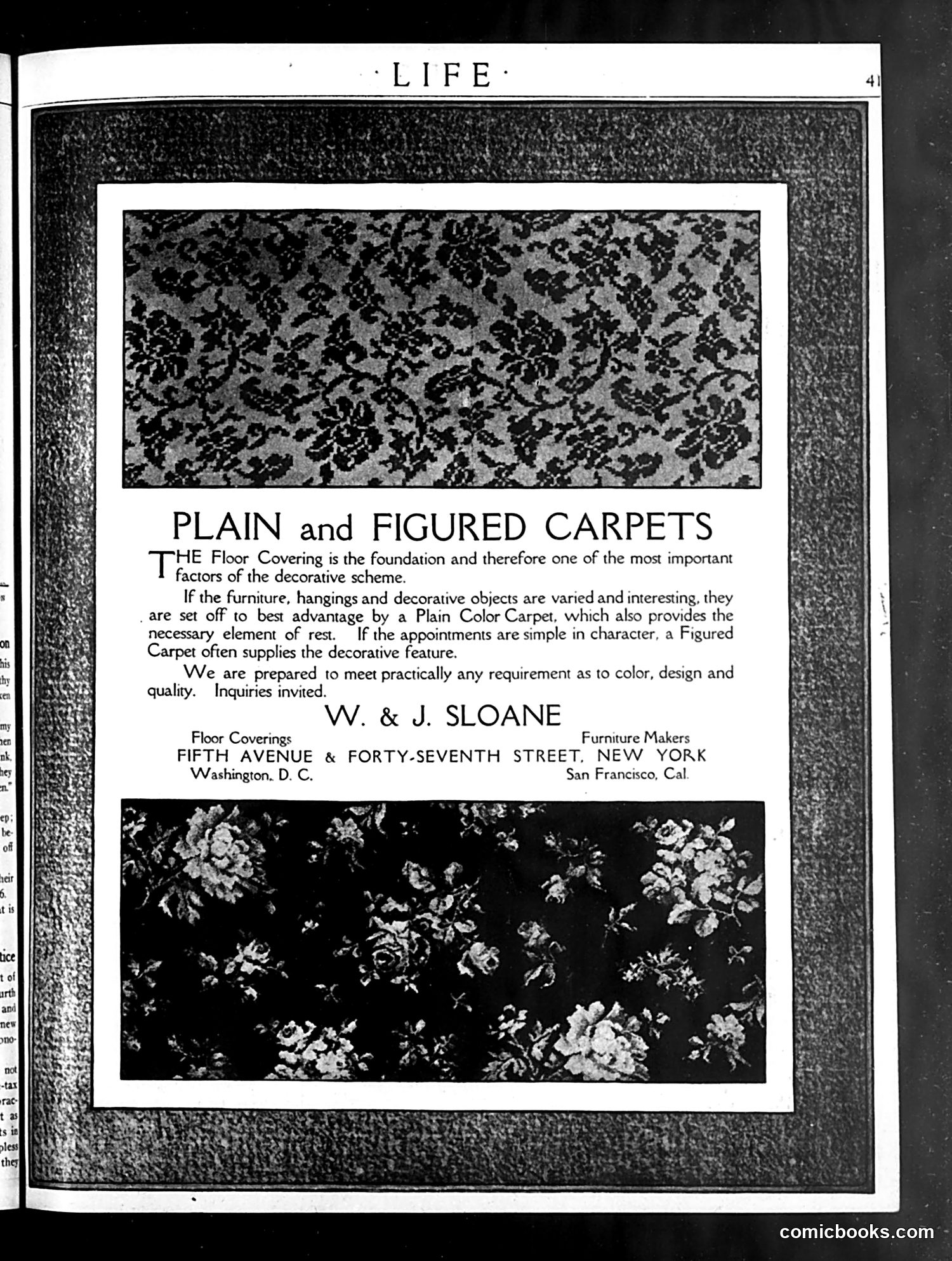
This is a straightforward advertisement, not a political cartoon or satire. W. & J. Sloane, a luxury furniture and floor covering company, promotes their carpet offerings to interior decorators and wealthy homeowners. The page features two carpet samples—a plain patterned design (top) and a figured floral design (bottom)—illustrating their product range. The ad argues that plain carpets complement varied furnishings while patterned carpets enhance simple décor. It's typical early-20th-century magazine advertising targeting the affluent market, with locations in New York, Washington D.C., and San Francisco. There is no satirical content or social commentary present—merely commercial promotion of home furnishings.
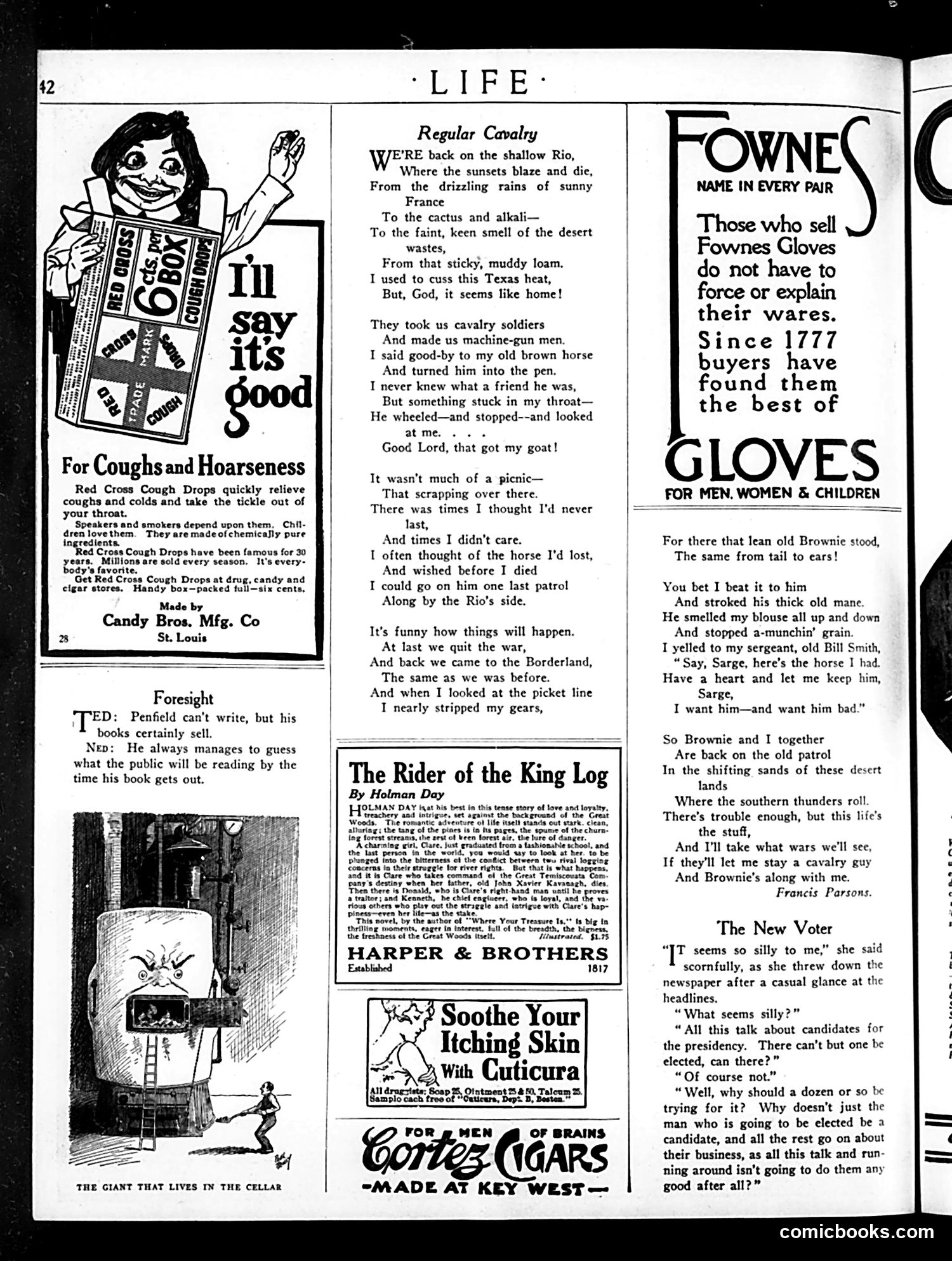
This Life magazine page (page 42) contains primarily **advertisements and light poetry** rather than political satire. The main content includes: - **"Regular Cavalry"** — a sentimental poem about a soldier reunited with his horse after WWI, reflecting post-war nostalgia and the emotional bonds between soldiers and animals - **"The Rider of the King Log"** — an advertisement for a Holman Day novel set in Maine wilderness, marketed as romantic adventure fiction - **"The New Voter"** — the beginning of a piece satirizing women newly eligible to vote (likely referencing the 19th Amendment, 1920), with a woman dismissively dismissing political talk as "silly" The advertisements (Red Cross Cough Drops, Fownes Gloves, Cuticura, Cortez Cigars) are standard period marketing. **The satire here is gentle**: mocking new female voters as disinterested in politics while simultaneously giving them voice on the page — itself a form of social commentary on women's newly-won but still-questioned political participation.
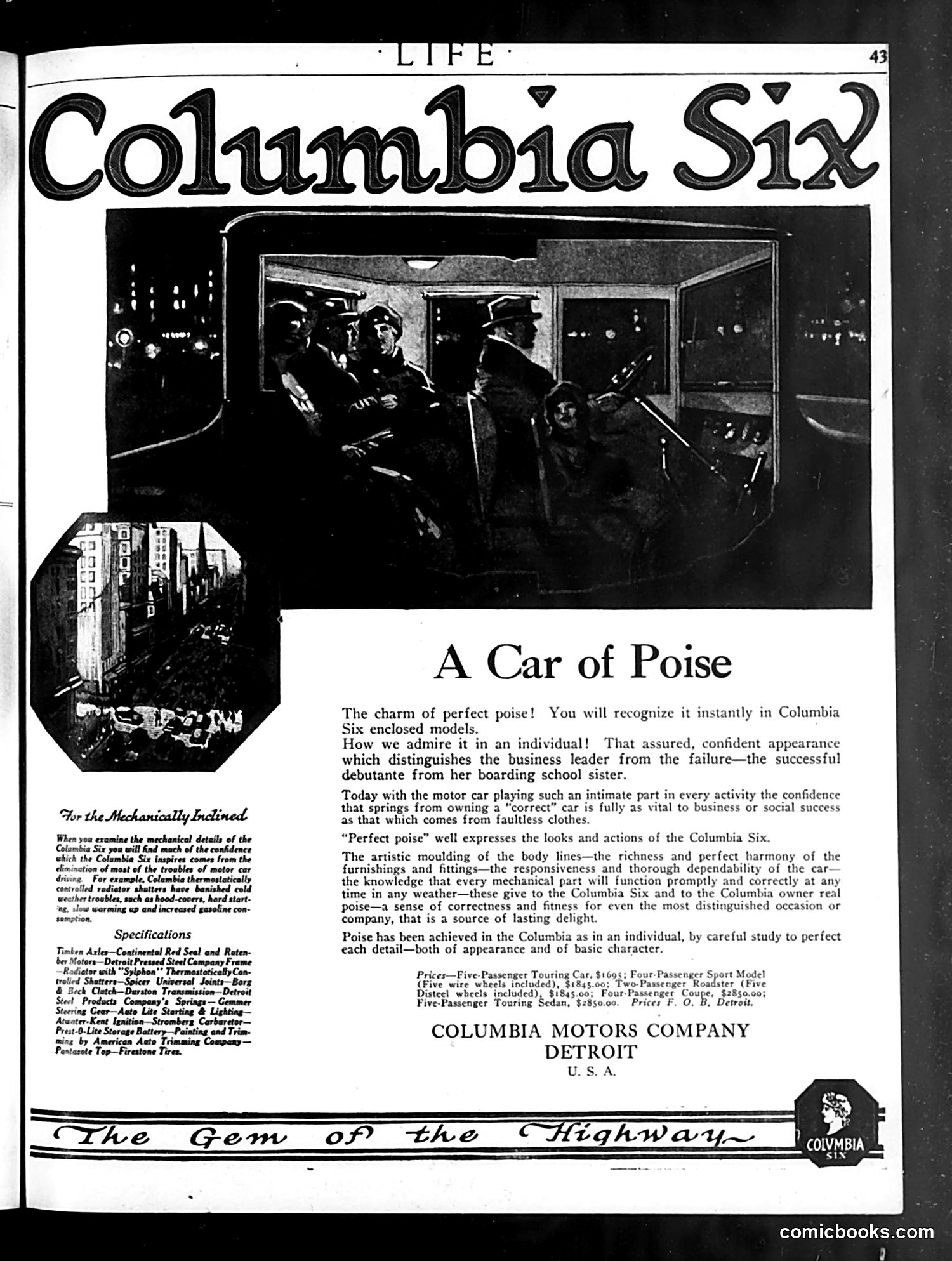
This is primarily a **automobile advertisement**, not political satire. The Columbia Motors Company uses social psychology to market their car by equating vehicle ownership with personal status and respectability. The ad's central conceit: owning a Columbia Six conveys "poise"—the assured confidence of successful business leaders and society debutantes. The imagery shows well-dressed passengers in an enclosed automobile, suggesting luxury and propriety. The copywriting makes an explicit analogy: just as "faultless clothes" signal social success, a "correct" car communicates reliability and refinement to observers. Technical specifications (Timken axles, Firestone tires) establish mechanical legitimacy, but the real sales pitch is aspirational—purchasing this vehicle purchases respectability. This reflects 1920s American consumer culture, where automobiles had shifted from novelties to status symbols integral to middle-class identity. The ad targets business professionals and society figures concerned with maintaining appearances.
This page is an advertisement *for advertising itself*—a meta-promotional piece by *Life* magazine's advertising department. Rather than selling a product, it argues for the value of reading advertisements. The piece makes several claims designed to legitimize advertising as beneficial: ads keep readers "in touch with the world's progress," reveal new comforts, help consumers save money, prevent fraud, and serve as "guide-posts to better buying." This reflects early-20th-century advertising's struggle for cultural legitimacy. Ads were still viewed with some suspicion by the public, so *Life* needed to convince readers that advertisements themselves deserved attention and trust. The rhetorical strategy—repeating "Don't miss the advertisements"—suggests this was a genuine concern that required persuasion rather than assumption. The page appears earnest rather than satirical, positioning *Life* as an advocate for consumer information and progress.
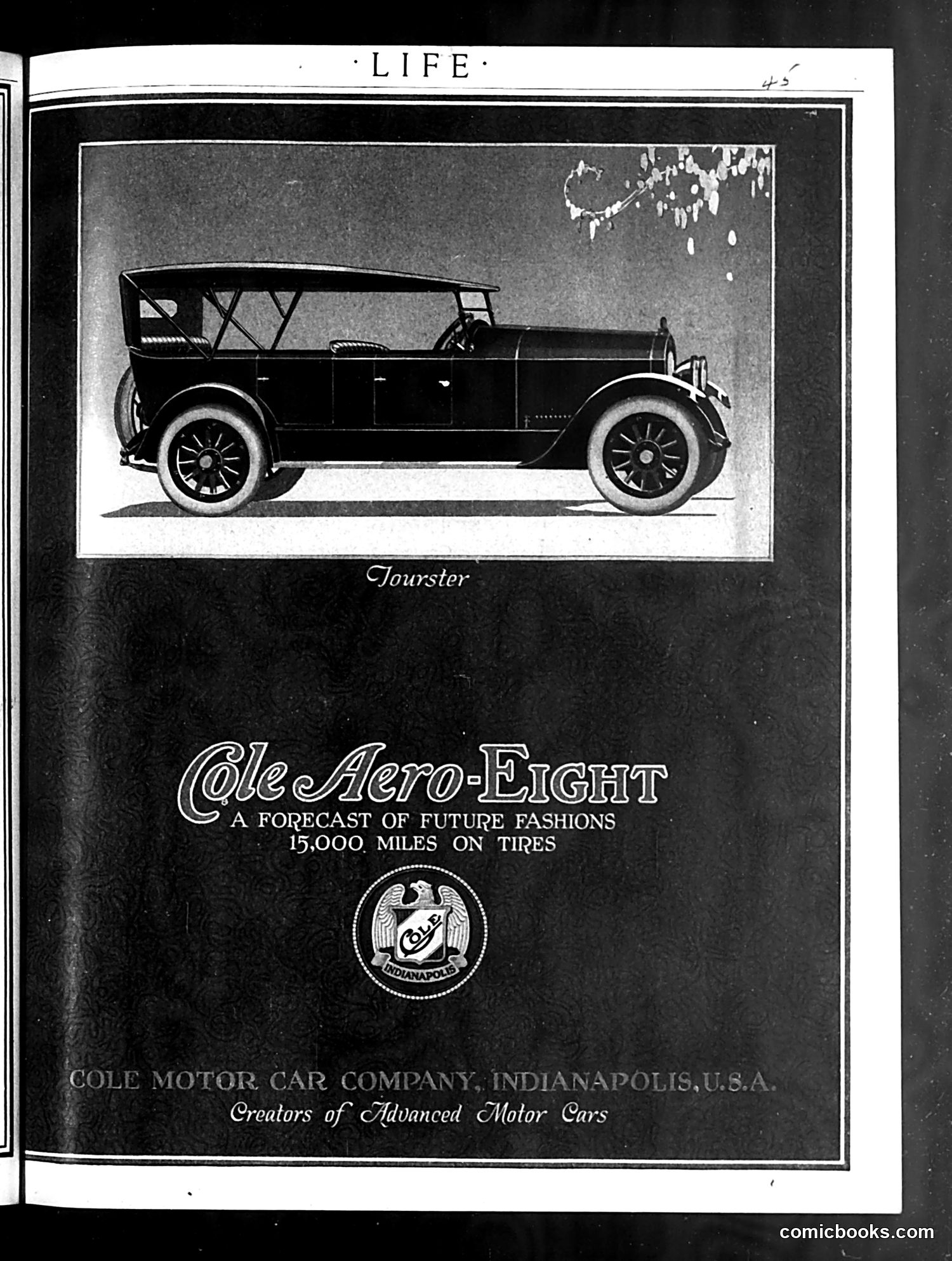
This page is primarily **advertising, not satire or political commentary**. It's a full-page advertisement for the Cole Motor Car Company of Indianapolis, promoting their "Aero-Eight" automobile model (shown as a "Tourster" — an open-air touring car). The ad's headline claims "A Forecast of Future Fashions," suggesting the vehicle represents advanced automotive design. The notation "15,000 Miles on Tires" appears to be a durability claim — likely touting tire longevity as a selling point, which would have been a significant concern for early automobile buyers. The company tagline, "Creators of Advanced Motor Cars," emphasizes technological innovation. This appears to be a vintage automotive advertisement, not satire—typical of early 20th-century trade magazine advertising that emphasized mechanical superiority and future-oriented design.
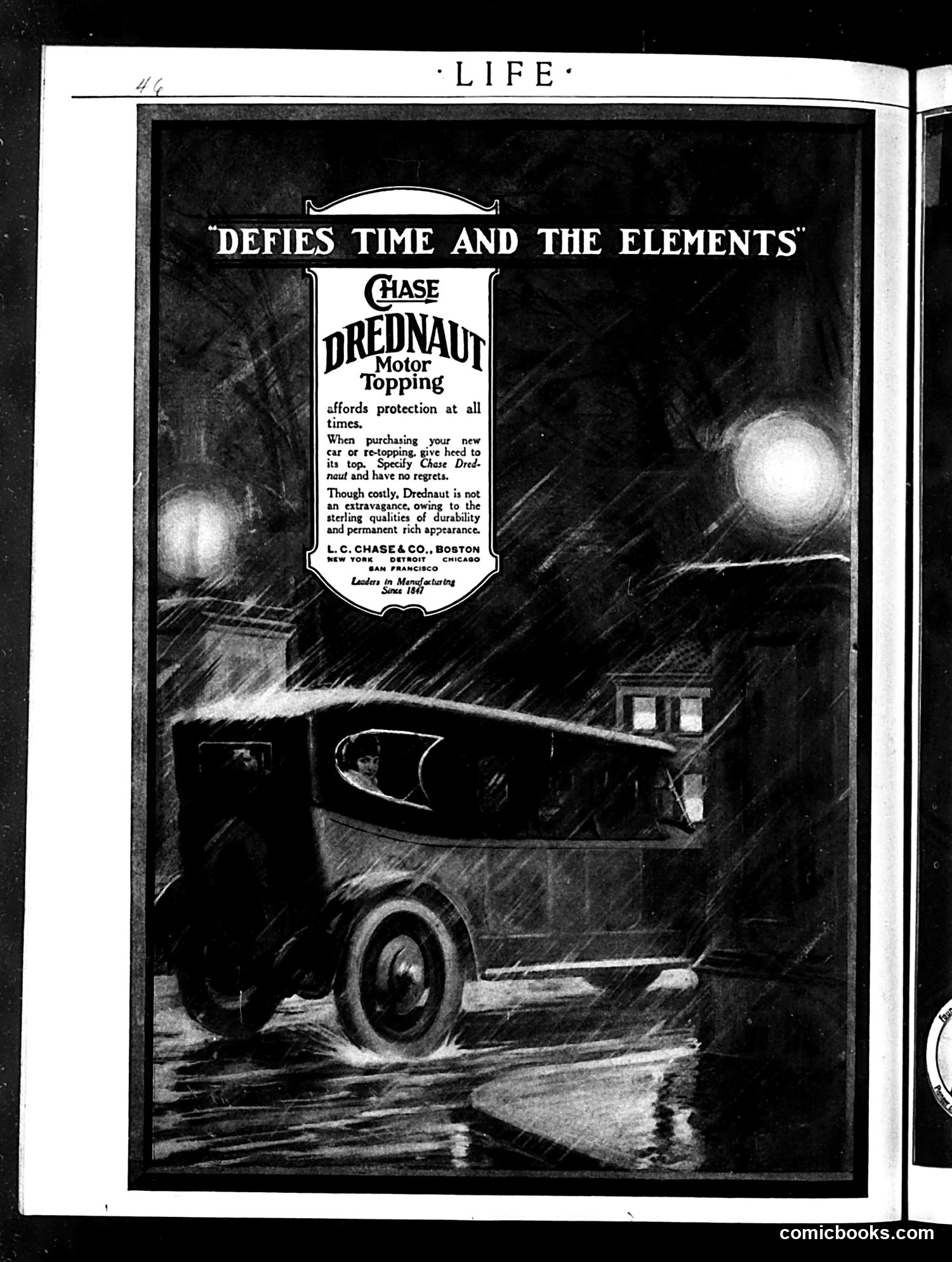
This is a **car-top advertisement**, not political satire. The page features an ad for Chase Drednaut Motor Topping—a protective coating for automobile convertible tops. The image shows a vintage car in heavy rain at night, visually demonstrating the product's value proposition: protection "at all times" against weather elements. The dramatic stormy setting emphasizes durability and water resistance. The ad targets car buyers considering new purchases or re-topping needs, acknowledging the product is "costly" but justified by longevity and appearance. Chase & Co., based in Boston with offices in major cities, positions itself as industry leaders "since 1847." There is no political commentary or satirical content—this is straightforward period advertising leveraging atmospheric imagery to sell automotive maintenance products.
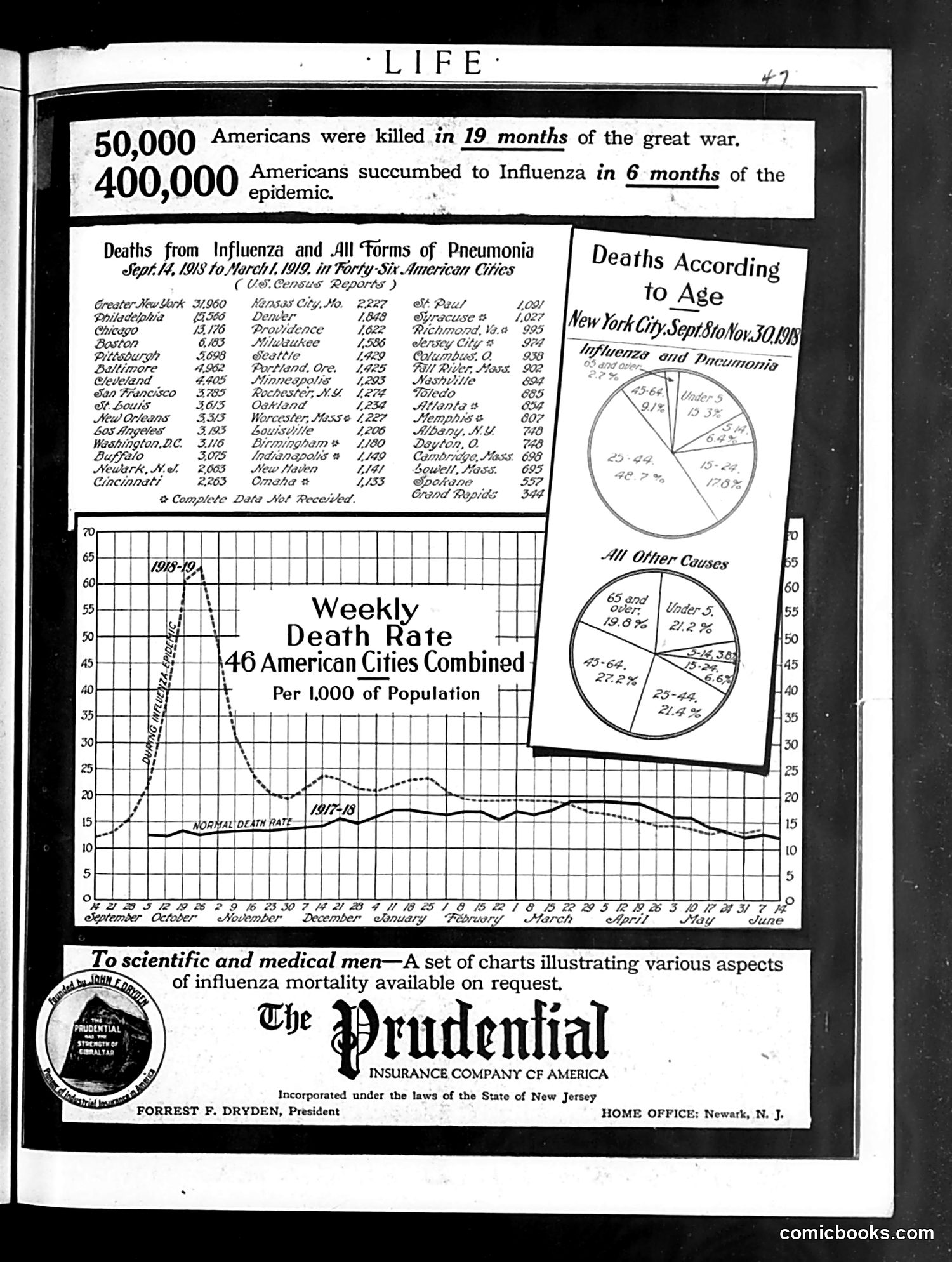
This is **not satire or a cartoon**, but rather a public health infographic—an insurance company advertisement masquerading as educational content. The page compares American deaths in World War I (50,000 in 19 months) against influenza deaths (400,000 in 6 months), documenting the 1918-1919 Spanish Flu pandemic. The data includes death tolls by city, age-based mortality pie charts, and a weekly death-rate graph showing the epidemic's sharp October 1918 peak followed by a sustained plateau. **The satirical point**: The Prudential Insurance Company presents this grim mortality data as "scientific and medical" information available "on request"—essentially using a devastating public health crisis as marketing material to demonstrate their actuarial sophistication and reach. The implicit message to potential customers: we track death rates carefully; trust us with your insurance needs. For modern readers, this reveals how the 1918 flu killed more Americans than the entire war effort, a fact often overshadowed in historical memory.
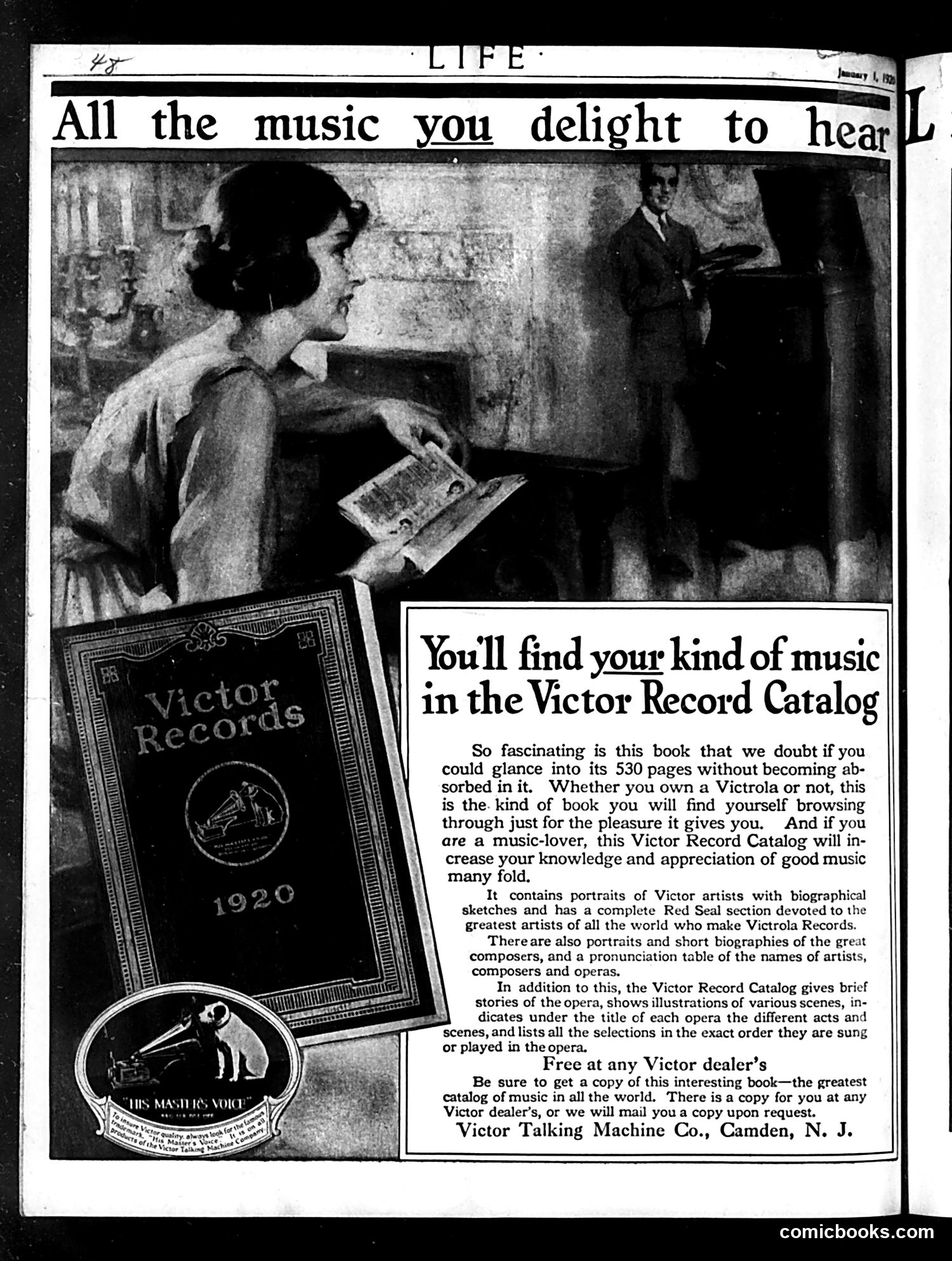
This is a 1920 advertisement, not satire or political commentary. It promotes Victor's Record Catalog—a 530-page reference book available free at Victor dealers or by mail. The image shows a woman browsing the catalog while a man operates a Victrola (Victor's phonograph brand) in the background. The ad emphasizes the catalog's comprehensiveness: it contains artist biographies, a "Red Seal" section featuring world-class performers, composer information, opera plots with scene illustrations, and pronunciation guides. The pitch appeals to both Victrola owners and non-owners, suggesting the catalog itself—regardless of whether someone owned the equipment—was worth reading for music education and enjoyment. This reflects the era when record catalogs functioned as cultural guides, helping consumers navigate classical music, opera, and popular recordings.