
Life, 1920-01-01 · page 33 of 48
Life — January 1, 1920 — page 33: what you’re looking at
What you’re looking at
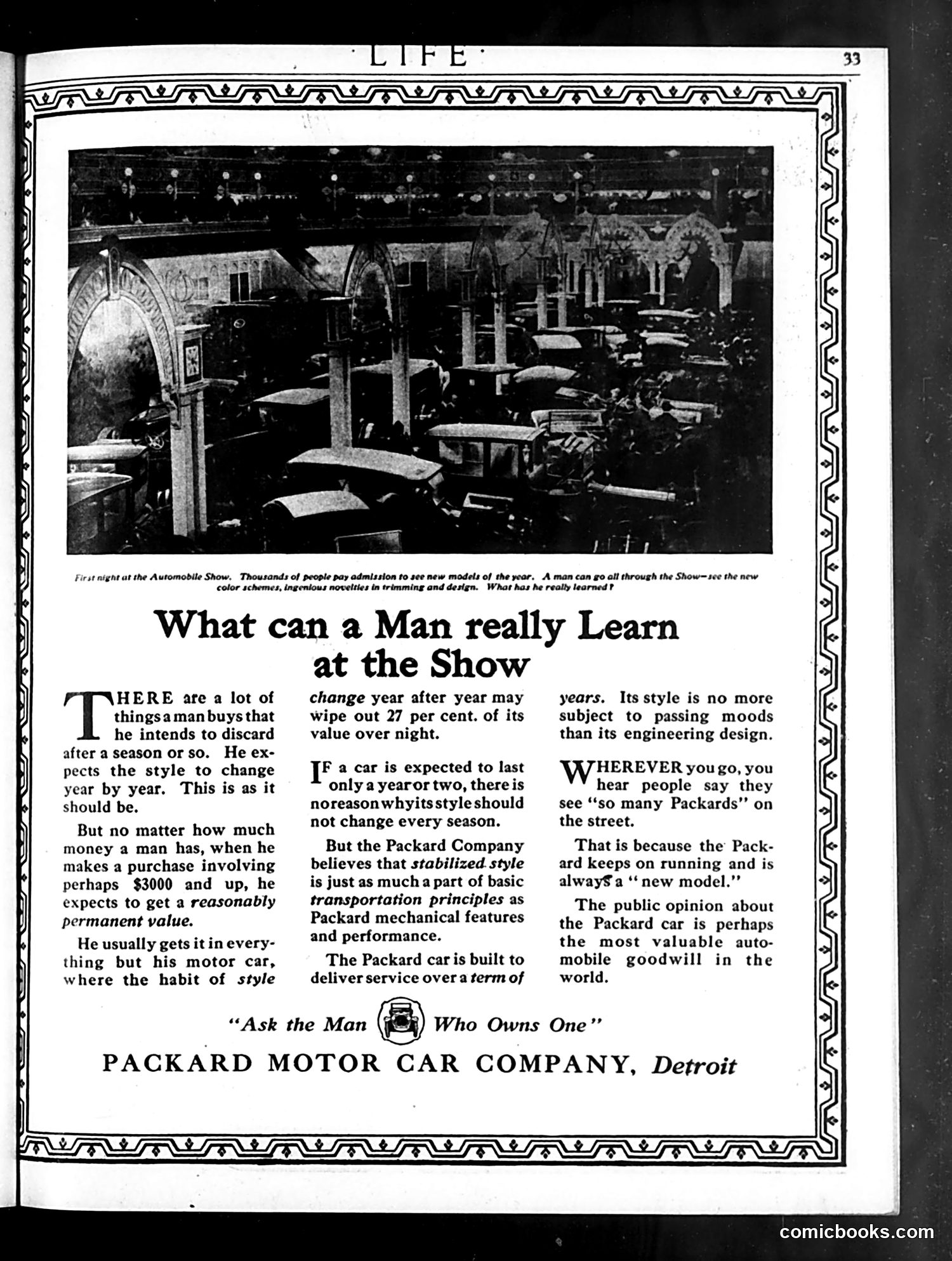
This is **not a cartoon or satire**—it's a straightforward advertisement for Packard automobiles, disguised as editorial commentary. The "joke" or argument being made: At automobile shows, visitors see flashy new styling and design changes, but this teaches them nothing about real value. The ad criticizes competitors (implied: Ford, General Motors) who change car styles annually to depreciate older models by ~27%, manipulating buyers into frequent replacements. **Packard's counter-argument**: Since their cars are engineered to last years, not seasons, styling should remain stable—like engineering principles. The ad claims Packards retain value and longevity, which explains why "so many Packards" remain on streets (they don't become obsolete quickly). The tagline "Ask the Man Who Owns One" was Packard's actual slogan, suggesting real owners validate the brand's durability claims versus competitors' wasteful "planned obsolescence" through style changes.
📄 Transcribed text from this page (OCR, searchable)
Machine-transcribed from the original scan — historical spelling and the odd misread are preserved.
First night at the Automobile Show, Thousands of people pay admission to see new models of the year. A man can go all through the Show=see the new color schemes, ingenious novelties in trimming and design. What has he really learned ? What can a Man really Learn HERE ate a lot of thingsa man buys that he intends to discard after a season or so. He ex- pects the style to change year by year. This is as it should be. But no matter how much money a man has, when he makes a purchase involving perhaps $3000 and up, he expects to get a reasonably permanent value. He usually gets it in every- thing but his motor car, where the habit of style “Ask the Man at the Show change year after year may wipe out 27 per cent. of its value over night. IF a car is expected to last only a yearor two, there is noreason whyits style should not change every season. But the Packard Company believes that stabilized. style is just as mucha part of basic transportation principles as Packard mechanical features and performance. The Packard car is built to deliver service over a term of years. Its style is no more subject to passing moods than its engineering design. WHEREVER you go, you hear people say they see ‘‘so many Packards” on the street. That is because the Pack- ard keeps on running and is alway$ a ‘‘new model.” The public opinion about the Packard car is perhaps the most valuable auto- mobile goodwill in the world. Who Owns One” PACKARD MOTOR CAR COMPANY, Detroit comicbooks.com