
Life, 1920-01-01 · page 22 of 48
Life — January 1, 1920 — page 22: what you’re looking at
What you’re looking at
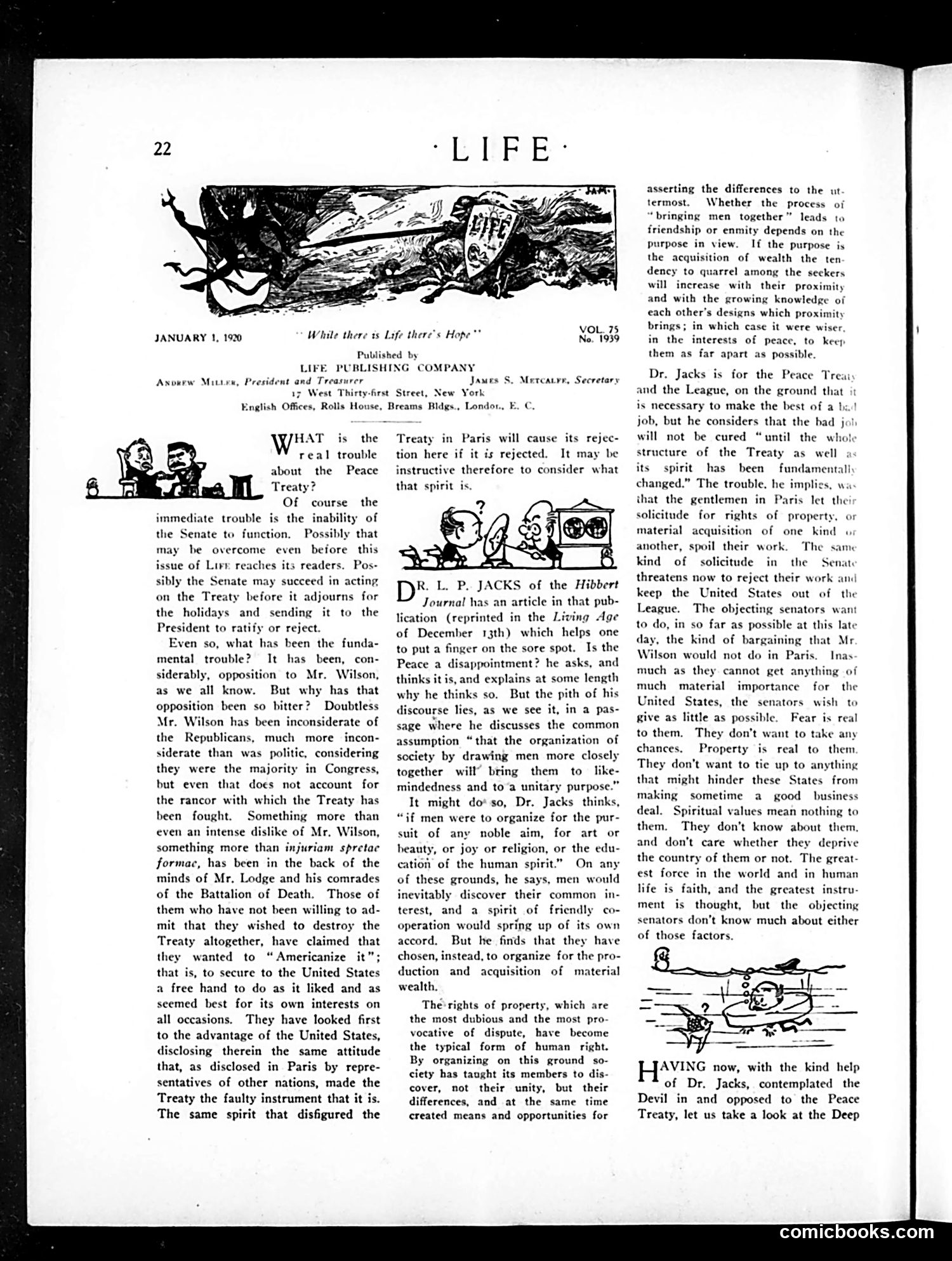
This page debates the fundamental problem underlying Senate rejection of Woodrow Wilson's Paris Peace Treaty. The article argues that opposition stems not merely from partisan dislike of Wilson, but from a deeper philosophical conflict. The central argument, attributed to Dr. R.L.P. Jacks, proposes that the Treaty failed because nations organized around **material wealth acquisition** rather than noble shared purposes (art, religion, education). When men organize for profit, proximity breeds competition and conflict over property rights—the "most dubious" basis for human cooperation. The cartoons (small illustrations visible) appear to satirize political obstruction, likely depicting Senator Henry Cabot Lodge and Republican opponents as obstacles to peace. The irony: American senators claiming to "Americanize" the Treaty actually replicate the selfish nationalism that corrupted the Paris negotiations itself. Both prioritize national advantage over collective welfare.
📄 Transcribed text from this page (OCR, searchable)
Machine-transcribed from the original scan — historical spelling and the odd misread are preserved.
JANUARY 1, 1920 Pub LIFE Axverw Mitivu, President and Treasurer While there ts Life there's Hope** ished by PUBLISHING COMPANY James S. Mercatyr, Secretary 17 West Thirty-first Street, New York English Offices, Rolls House, Breams Bldgs., HAT is the real trouble about the Peace Treaty? Of course the immediate trouble is the inability of the Senate to function, Possibly that may be overcome even before this issue of Lire reaches its readers. Pos- sibly the Senate may succeed in acting on the Treaty before it adjourns for the holidays and sending it to the President to ratify or reject. Even so, what has been the funda- mental trouble? It has been, con- siderably, opposition to Mr. Wilson, as we all know. But why has that opposition been so bitter? Doubtless Mr. Wilson has been inconsiderate of the Republicans, much more incon- siderate than was politic, considering they were the majority in Congress, but even that does not account for the rancor with which the Treaty has been fought. Something more than even an intense dislike of Mr, Wilson, something more than injuriam spretae formae, has been in the back of the minds of Mr. Lodge and his comrades of the Battalion of Death. Those of them who have not been willing to ad- mit that they wished to destroy the Treaty altogether, have claimed that they wanted to “Americanize it”; that is, to secure to the United States a free hand to do as it liked and as scemed best for its own interests on all occasions. They have looked first to the advantage of the United States, disclosing therein the same attitude that, as disclosed in Paris by repre- sentatives of other nations, made the Treaty the faulty instrument that it is. The same spirit that disfigured the Londor., E. Treaty in Paris will cause its rej tion here if it is rejected. It may be instructive therefore to consider what that spirit is. R. L. P. JACKS of the Hibbert Journal has an article in that pub- lication (reprinted in the Living Age of December 13th) which helps one to put a finger on the sore spot. Is the Peace a disappointment? he asks, and thinks it is, and explains at some length why he thinks so. But the pith of his discourse lies, as we see it, in a pas- sage Where he discusses the common assumption “that the organization of society by drawing men more closely together will” bring them to like- mindedness and to’a unitary purpose.” It might do* so, Dr. Jacks thinks, “if men were to organize for the pur- suit of any noble aim, for art or beauty, or joy or religion, or the edu- cation of the human spirit.”. On any of these grounds, he says, men would inevitably discover their common in- terest, and a spirit of friendly co- operation would spring up of its own accord. But he finds that they have chosen, instead, to organize for the pro- duction and acquisition of wealth, material The rights of property, which are the most dubious and the most pro- vocative of dispute, have become the typical form of human right. By organizing on this ground so- ciety has taught its members to dis- cover, not their unity, but their differences, and at the same time created means and opportunities for asserting the differences to the ut termost. Whether the process of “bringing men together” leads to friendship or enmity depends on the purpose in view. If the purpose js the acquisition of wealth the ten dency to quarrel among the seckers will increase with their proximity and with the growing knowledge of each other's designs which proximity brings; in which case it were wiser in the interests of peace, to keep them as far apart as possible. Dr. Jacks is for the Peace Trea and the League, on the ground that is necessary to make the best of a ba! job, but he considers that the bad j will not be cured “until the whok structure of the Treaty as well its spirit has been fundamental changed.” The trouble. he implies, wa that the gentlemen in Paris let the: solicitude for rights of property, or material acquisition of another, spoil their work. The s: kind of solicitude in the Senate threatens now to reject their work and keep the United States out of the League. The objecting senators want to do, in so far as possible at this late day, the kind of bargaining that Mr Wilson would not do in Paris. Inas much as they cannot get anything of much material importance for the United States, the senators wish to give as little as possible. Fear is real to them. They don’t it to take any chances. Property is real to them They don't want to tie up to anything that might hinder these States from making sometime a good business deal. Spiritual values mean nothing to them. They don’t know about them, and don't care whether they deprive the country of them or not. The great- est force in the world and in human one kind life is faith, and the greatest instru ment is thought, but the objecting senators don’t know much about either of those factors. AVING now, with the kind help of Dr. Jacks, contemplated the Devil in and opposed to the Peace Treaty, let us take a look at the Deep comicbooks.com