
A complete issue · 40 pages · 1919
Life — July 17, 1919
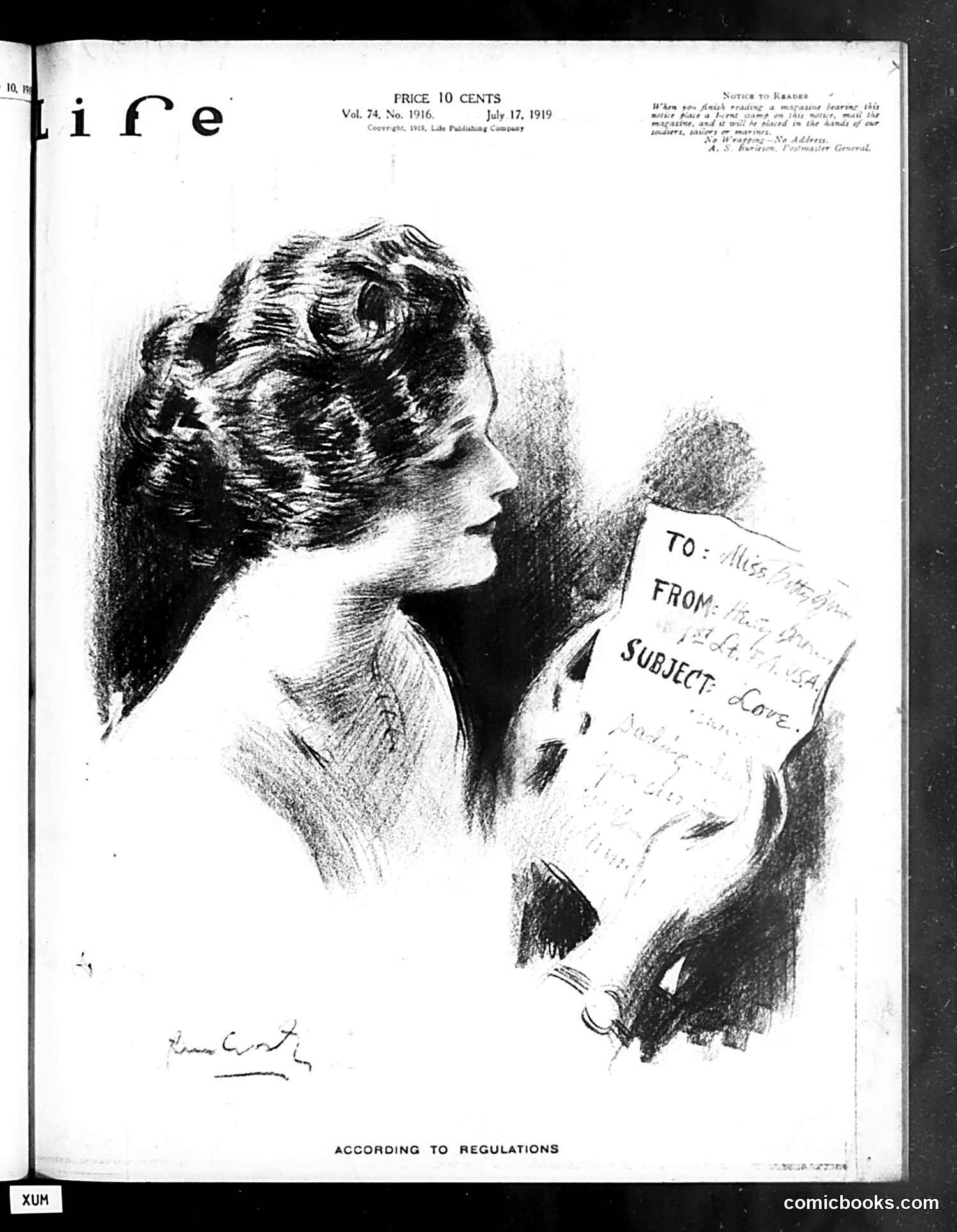
This cover depicts a woman in profile reading a letter labeled "TO: Miss [unclear] FROM: [unclear] SUBJECT: Love." The sketch style and composition suggest romantic correspondence—a common theme in early 20th-century satirical magazines. The caption "ACCORDING TO REGULATIONS" indicates the satire concerns official rules or propriety governing romantic communication, likely poking fun at social conventions around courtship correspondence. The formal "TO/FROM/SUBJECT" format mimics business letters, humorously contrasting official bureaucratic language with intimate matters of the heart. Published in 1919, just after World War I, this may reference post-war social adjustments or changing attitudes toward romance. The artist's signature appears lower left. Without additional context, the specific regulations or figures referenced remain unclear.
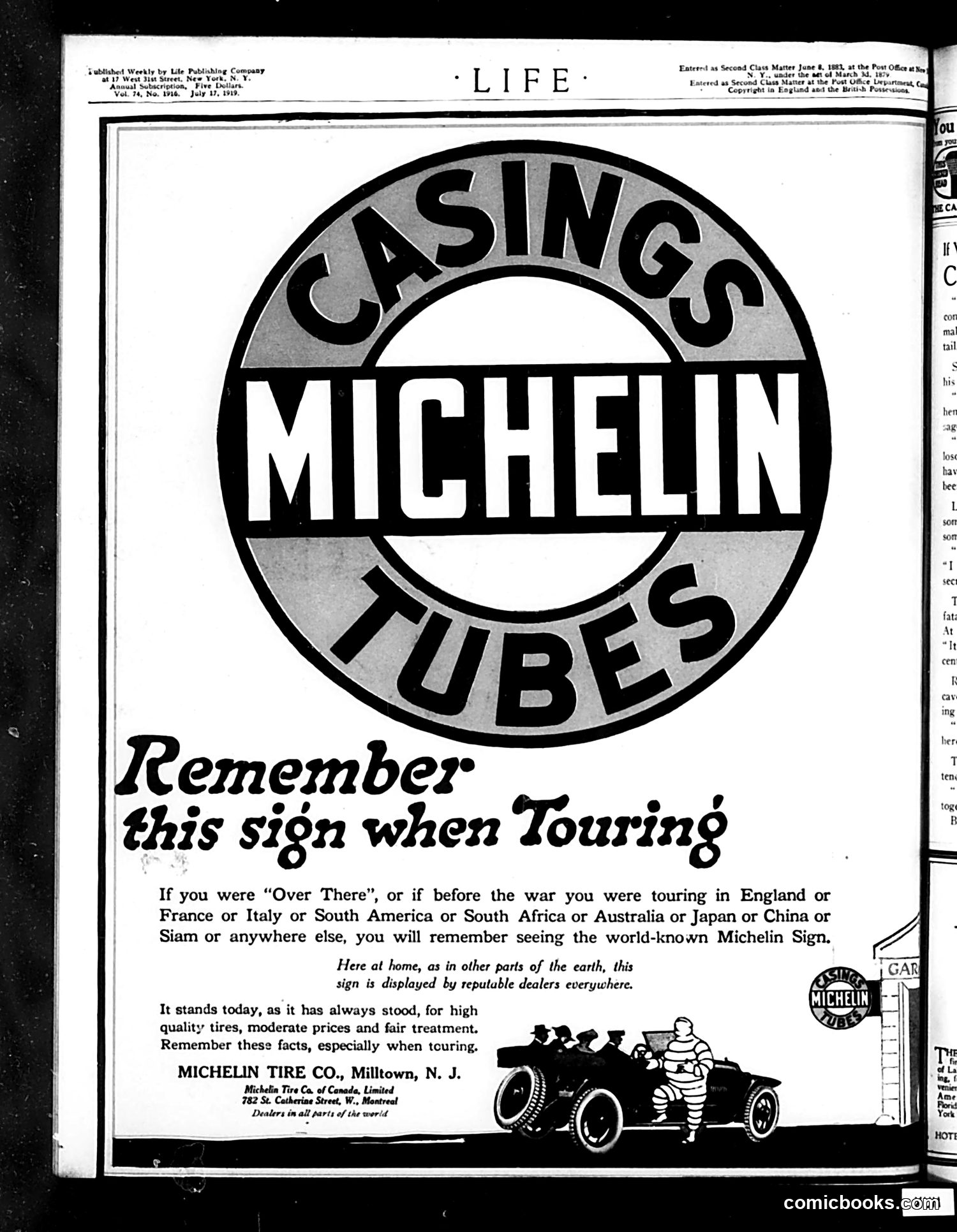
This is a **full-page advertisement**, not a political cartoon. It promotes Michelin Tires by displaying their famous logo—a circular seal reading "Casing Michelin Tubes." The ad targets touring motorists, referencing WWI ("Over There") and colonial travel to England, France, Italy, South America, Africa, Australia, Japan, and China. The Michelin Man mascot appears alongside a vintage racing car. The pitch emphasizes brand recognition: the Michelin sign is "world-known," seen globally by travelers. The text promises "high quality tires, moderate prices and fair treatment," positioning Michelin as a reliable, internationally trusted brand. The company's address is listed as Milltown, New Jersey, with Canadian and Montreal offices noted—standard early 20th-century tire industry advertising.
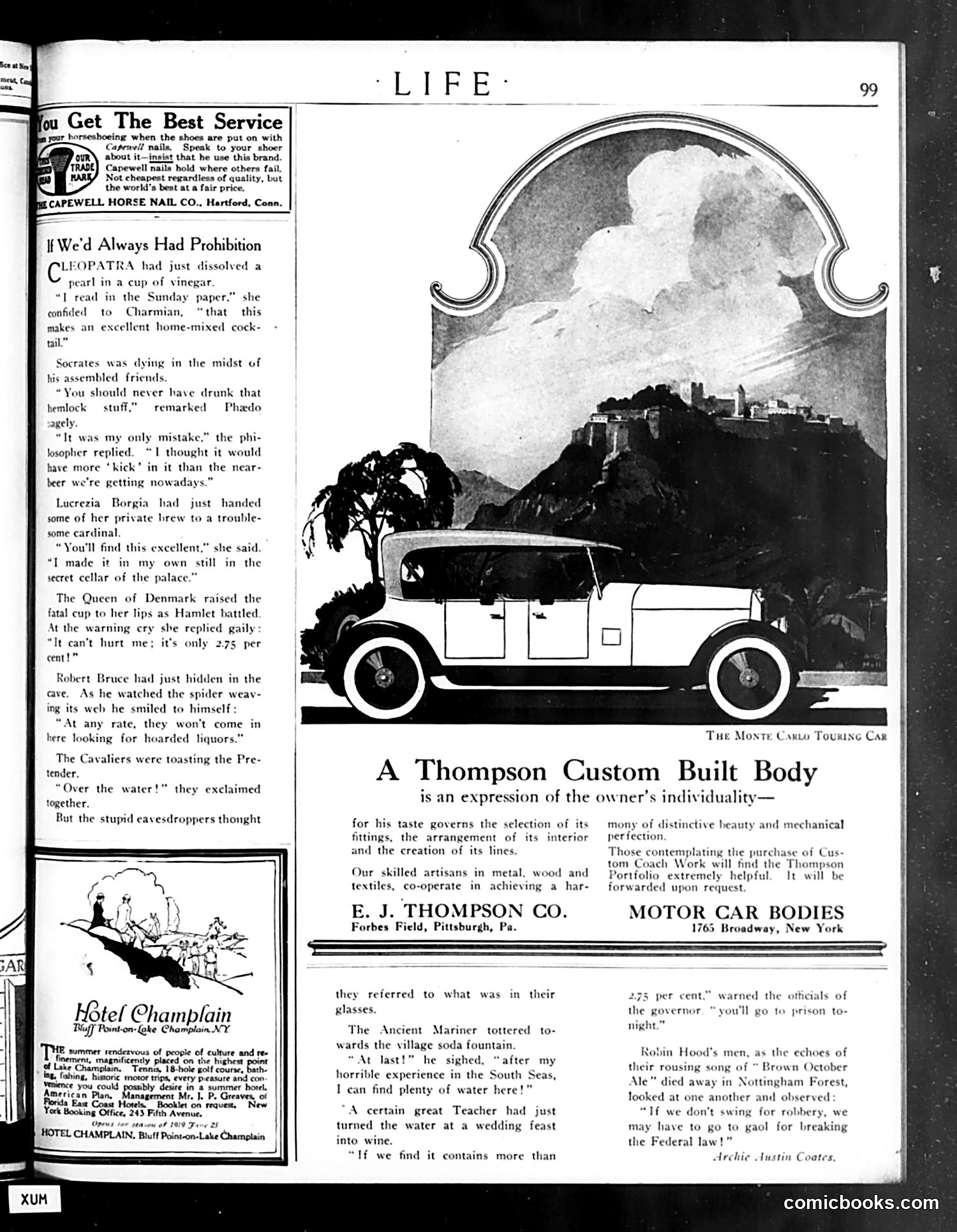
This page contains a satirical story titled "If We'd Always Had Prohibition" that imagines historical figures discussing alcohol under a prohibition regime. The references include Cleopatra dissolving a pearl in vinegar, Socrates drinking hemlock, and various aristocratic figures (Lucrezia Borgia, the Queen of Denmark, Robert Bruce, the Cavaliers) all attempting to justify their drinking or discussing hoarded liquors. The humor relies on the absurdity of applying Prohibition-era concerns retroactively to famous historical moments, suggesting that banning alcohol would have fundamentally altered history itself. The page also contains advertisements, including one for the E.J. Thomson Company's custom car bodies, and a Hotel Champlain advertisement at bottom left.
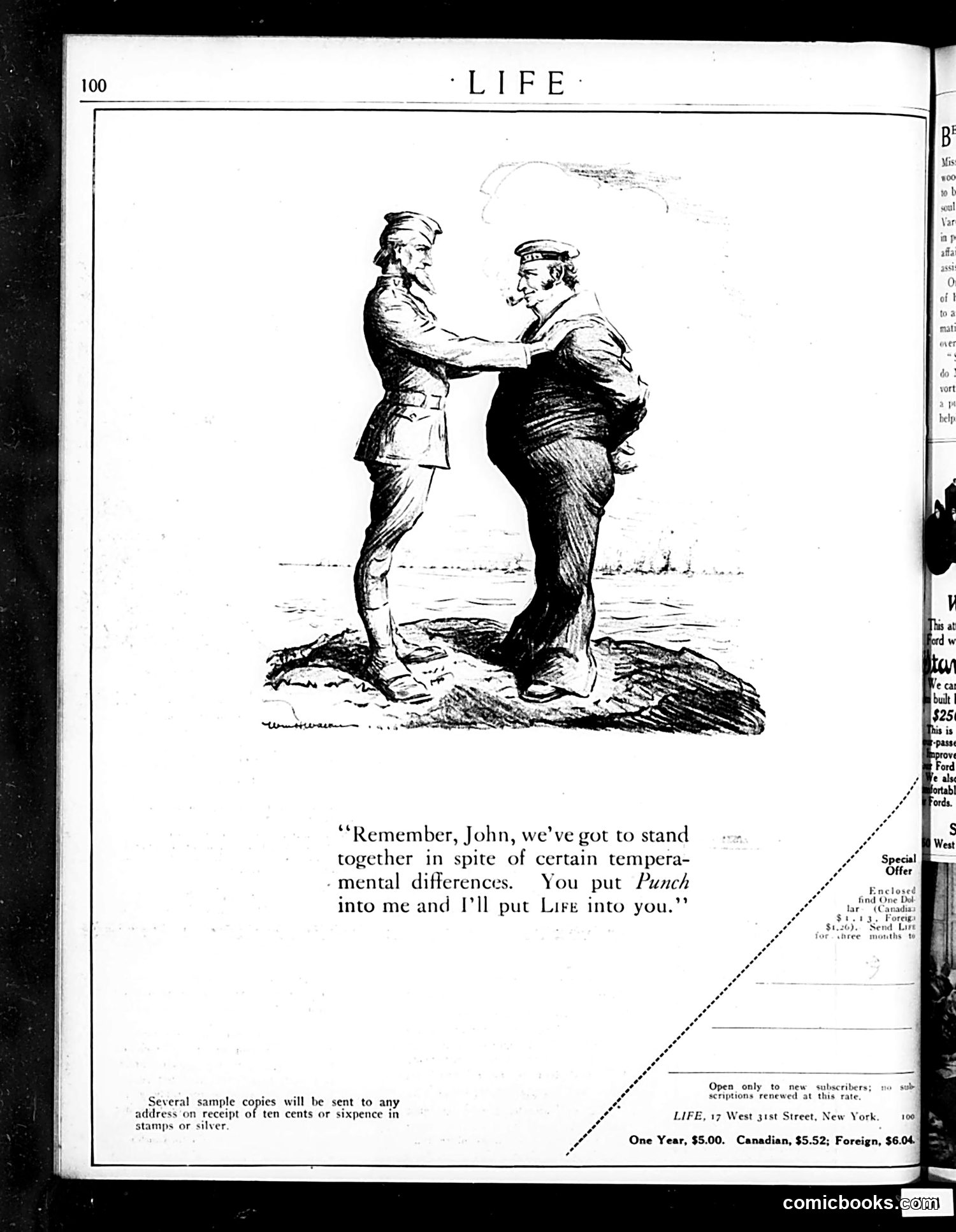
This is an advertisement for *Life* magazine disguised as political satire. The cartoon shows two men in formal dress shaking hands, with the caption: "Remember, John, we've got to stand together in spite of certain temperamental differences. You put *Punch* into me and I'll put *Life* into you." The figures represent personifications of two rival satirical magazines: *Punch* (the British humor publication, on the left) and *Life* (American, on the right). The joke plays on their competition while suggesting they should cooperate despite differences in style and national origin. The advertisement below emphasizes *Life*'s exclusivity for new subscribers and lists subscription rates. This was a common marketing strategy—wrapping advertisements in clever editorial-style content to engage readers while promoting the publication itself.
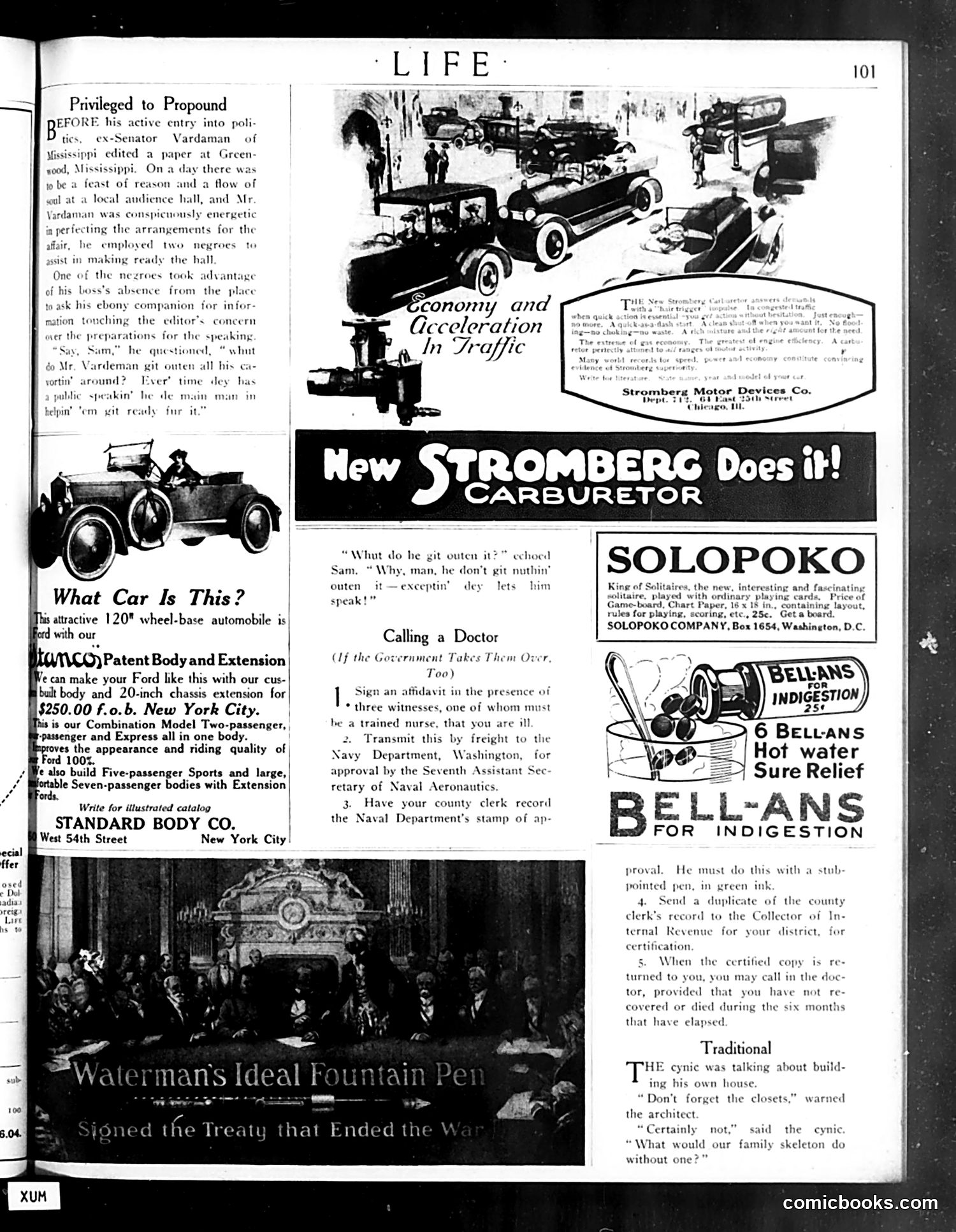
This page is primarily **advertising**, not political satire. The dominant content features: **Main Advertisement:** Stromberg Motor Device Co.'s carburetor, emphasized with "New STROMBERG Does it!" The ad showcases various automobiles and claims efficiency benefits. **Additional Ads:** Solopoko solitaire game, Bellans indigestion relief, Waterman's Ideal Fountain Pen, and Standard Body Co.'s customizable Ford bodies. **Editorial Content:** A brief article titled "Privileged to Propound" discusses ex-Senator Vardaman of Mississippi preparing a banquet. A smaller piece, "Calling a Doctor," outlines bureaucratic procedures for government medical approval—mocking red tape through numbered steps requiring signatures, freight approval, and Navy Department stamps. The humor is subtle workplace satire rather than political commentary.
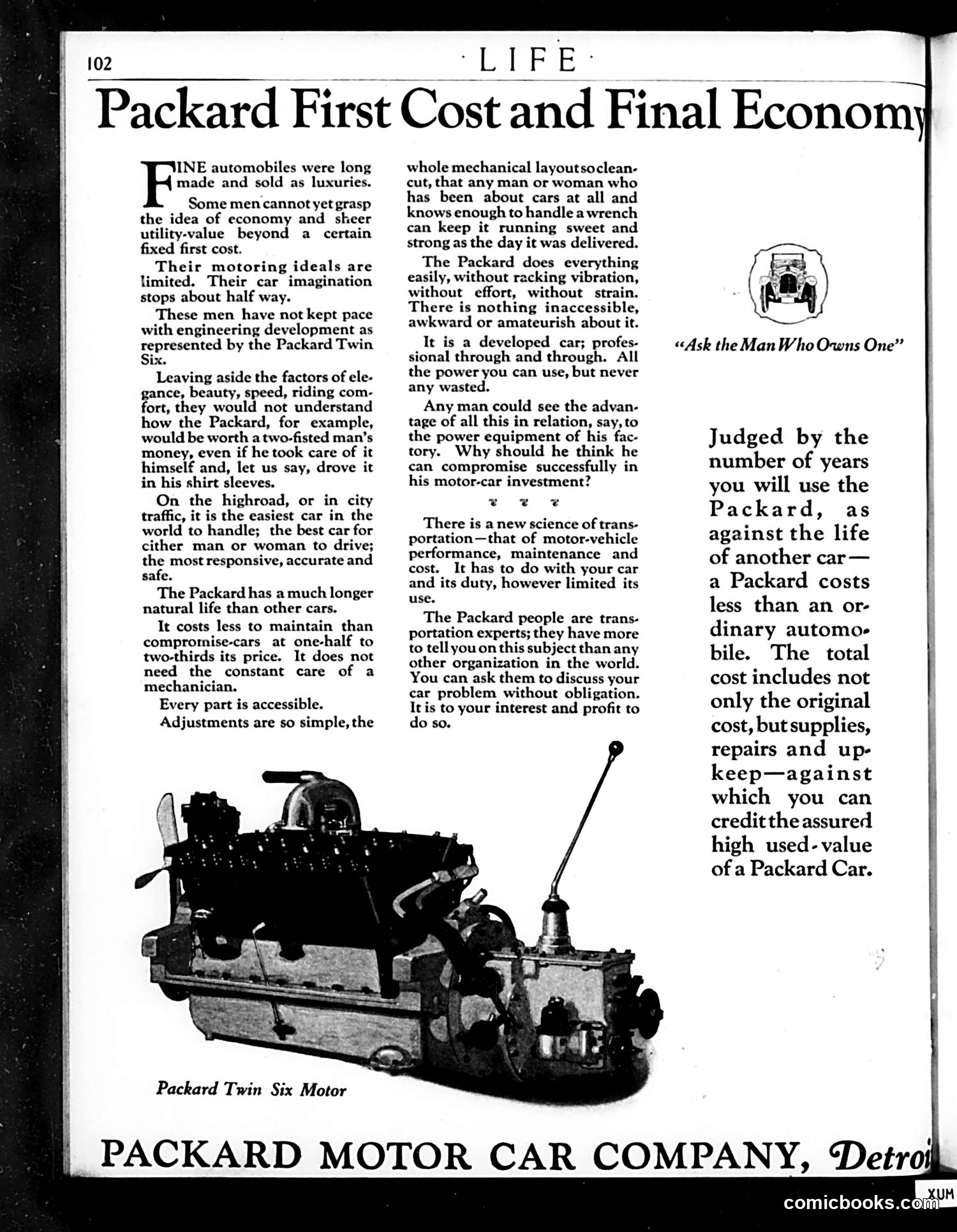
This page is primarily a **Packard automobile advertisement**, not political satire. It appeared in *Life* magazine (page 102) and promotes the Packard Twin Six motor car. The advertisement argues that while some men fixate on initial cost, a Packard represents superior long-term economy. The key claim: a Packard costs less to maintain than cheaper cars and retains higher resale value, making total ownership cost lower despite the higher purchase price. The image shows the Packard Twin Six engine, emphasizing mechanical quality and accessibility of parts. The tagline "Ask the Man Who Owns One" became Packard's famous slogan. This reflects early 20th-century automotive marketing targeting affluent buyers willing to pay premium prices for reliability and durability—a luxury positioning still used today.
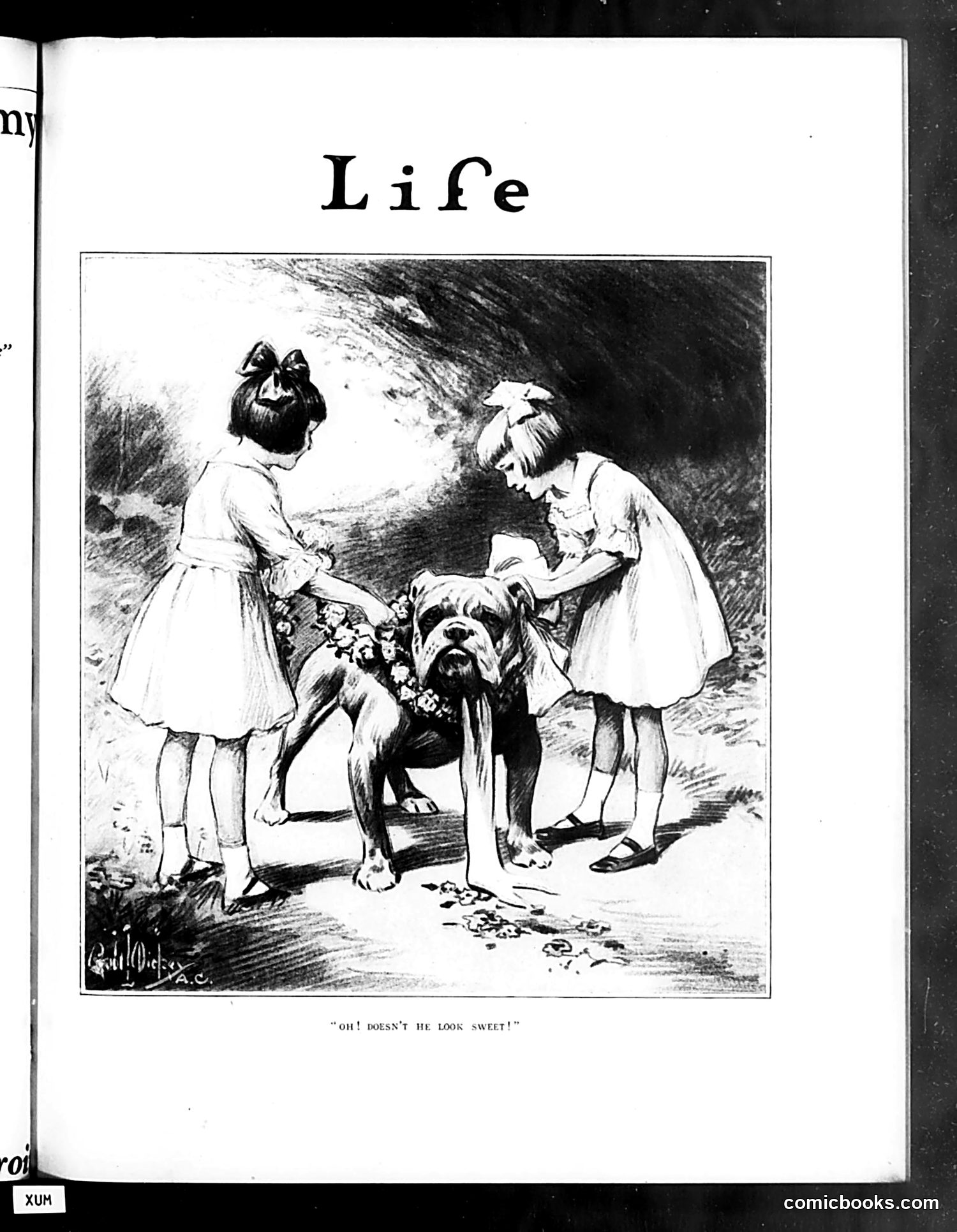
This is a title page for a section called "Life" featuring a pen-and-ink illustration by an artist whose signature appears at bottom left. The drawing shows two young girls in dresses adorning a large dog with a flower garland around its neck. The caption reads: "Oh! Doesn't he look sweet!" The image appears to be sentimental domestic humor typical of early-to-mid 20th century American magazines—depicting innocent childhood innocence and affection toward animals. There's no apparent political satire here; rather, it's a genteel illustration likely introducing a section of the magazine featuring lighter, family-oriented content. The artistic style and subject matter suggest this served as gentle, wholesome entertainment for *Life* magazine's readers.
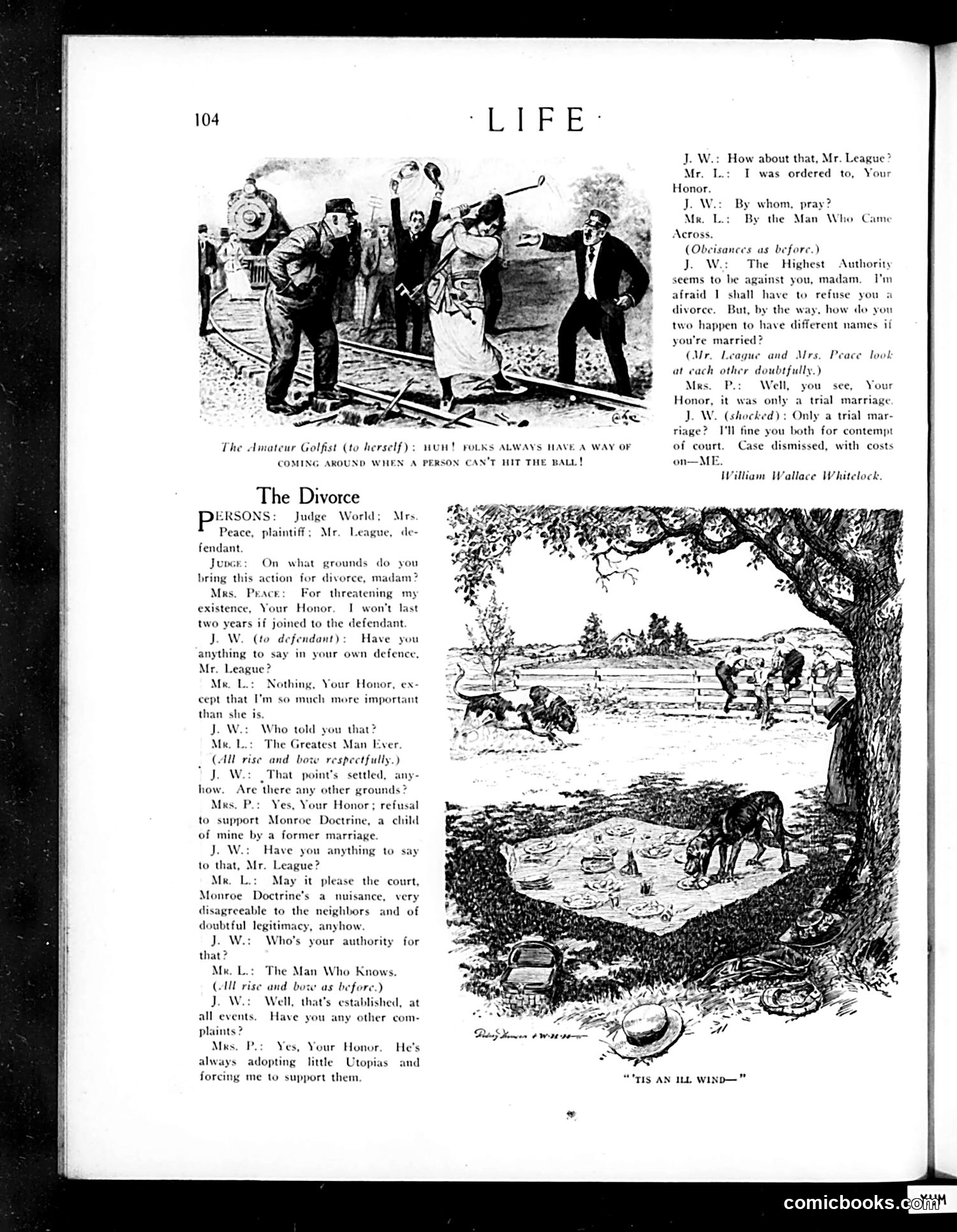
This page satirizes early 20th-century divorce proceedings and gender dynamics. The top cartoon shows a golfer's obliviousness—a husband so absorbed in golf that he can't hit the ball properly, presumably neglecting his marriage. The main sketch, titled "The Divorce," presents a courtroom scene where Mrs. Peace sues Mr. League for divorce. The satire targets Mr. League's absurd defense: he claims importance and references "the Man Who Came Across" and "the Man Who Knows" as authorities—vague, self-aggrandizing appeals rather than substantive legal arguments. The judge dismisses the case with costs against him. The bottom illustration, captioned "TIS AN ILL WIND," depicts rural life—likely contrasting the couple's disconnection from practical reality. The satire mocks both marital incompatibility and men's frivolous excuses in defending against divorce.
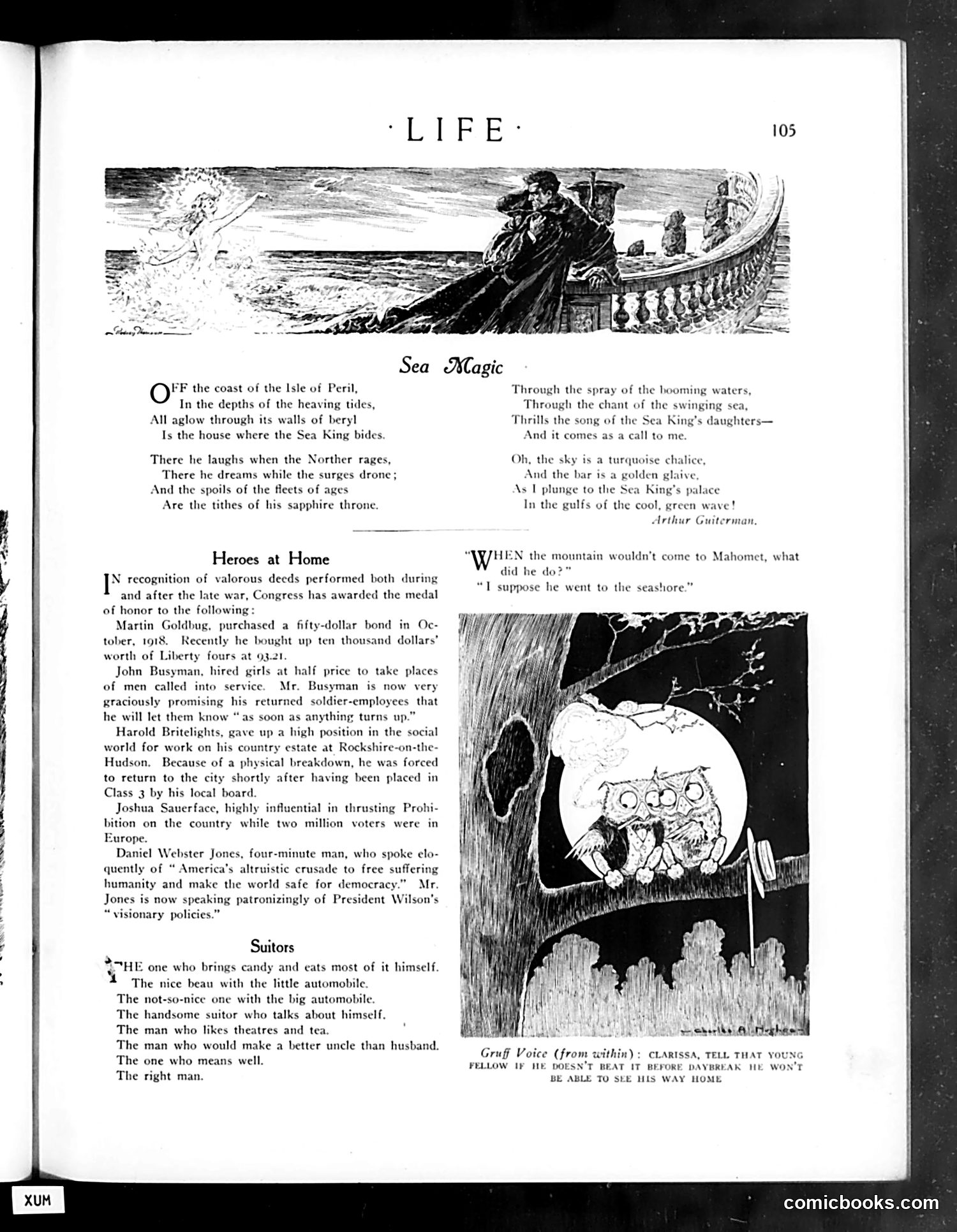
This page contains three distinct sections: 1. **"Sea Magic"** — A romantic poem by Arthur Guiterman about ocean enchantment, illustrated with an ornate engraving of figures in a gondola. 2. **"Heroes at Home"** — A prose section recognizing soldiers and war workers who received Congressional medals, naming specific individuals (Martin Goldbug, John Busyman, Harold Brightleigh, Joshua Sauface, Daniel Webster Jones) and describing their contributions during and after WWI. 3. **"Suitors"** — A humorous list poem mocking different types of men (candy-eaters, automobile owners, theater-goers, etc.), appearing to satirize social types and romantic pretensions. 4. **"Gruff Voice"** — A cartoon with accompanying caption about someone beating daybreak to avoid being seen, likely a domestic or romantic comedy scenario. The page blends patriotic recognition with social satire typical of Life magazine's era.
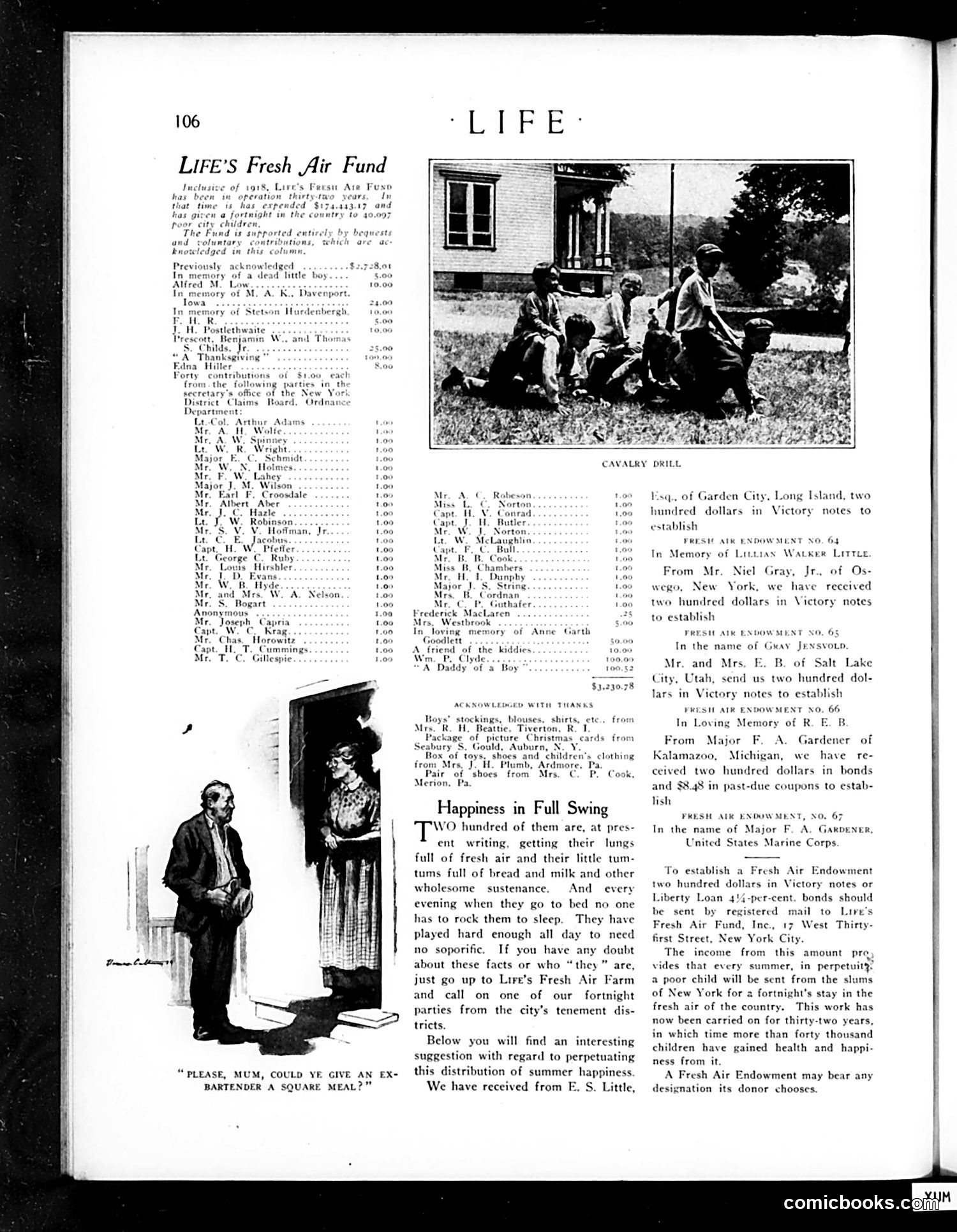
This page combines charitable fundraising with satirical illustration. The main cartoon at bottom left depicts an impoverished figure asking "PLEASE, MUM, COULD YE GIVE A EXARTENDER A SQUARE MEAL?" — a period representation of urban poverty and begging, using exaggerated dialect to characterize the beggar. The bulk of the page documents "LIFE'S Fresh Air Fund," listing donors who contributed to send poor children from New York tenements to countryside farms for summer relief. The accompanying photograph labeled "CAVALRY DRILL" shows children in rural settings. The satire is implicit: the contrast between the desperate beggar and the charitable fund suggests both the extent of urban poverty and middle-class efforts (however limited) to address it. The cartoon's sympathetic framing critiques social inequality rather than the poor themselves.
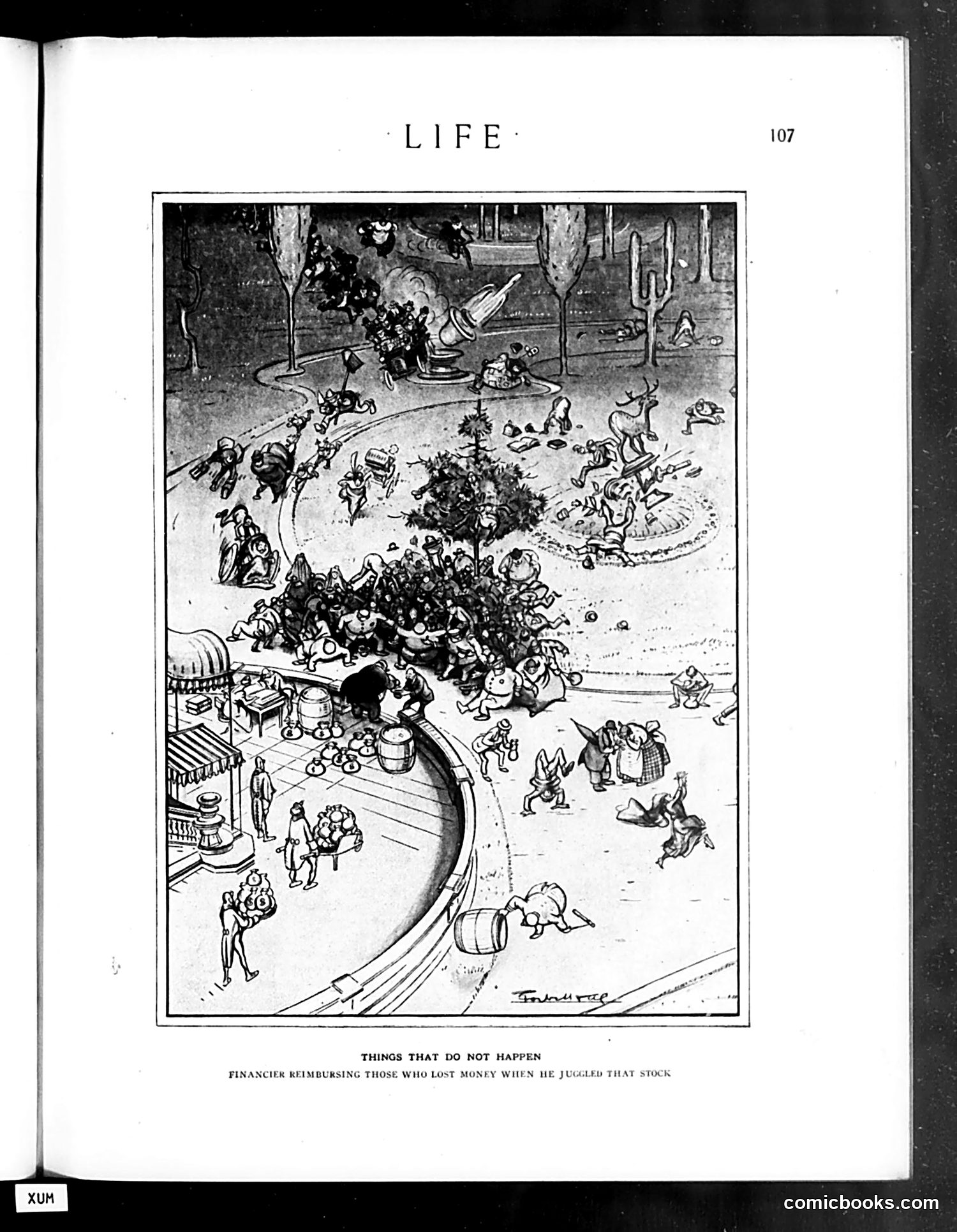
This satirical cartoon from *Life* magazine depicts a fantastical circus scene titled "Things That Do Not Happen." The caption specifies the satirical target: "Financier Reimbursing Those Who Lost Money When He Juggled That Stock." The cartoon mocks financial fraud and stock market manipulation. A well-dressed financier jugggles money and stocks at the center while crowds of ordinary people—appearing distressed or celebratory—surround him in a circus-like setting. The satire is that financiers who engaged in stock manipulation causing public financial losses were rarely held accountable or forced to reimburse victims. The "things that do not happen" refers to this lack of consequences—depicting such reimbursement as an impossibly fantastical circus act rather than actual reality.
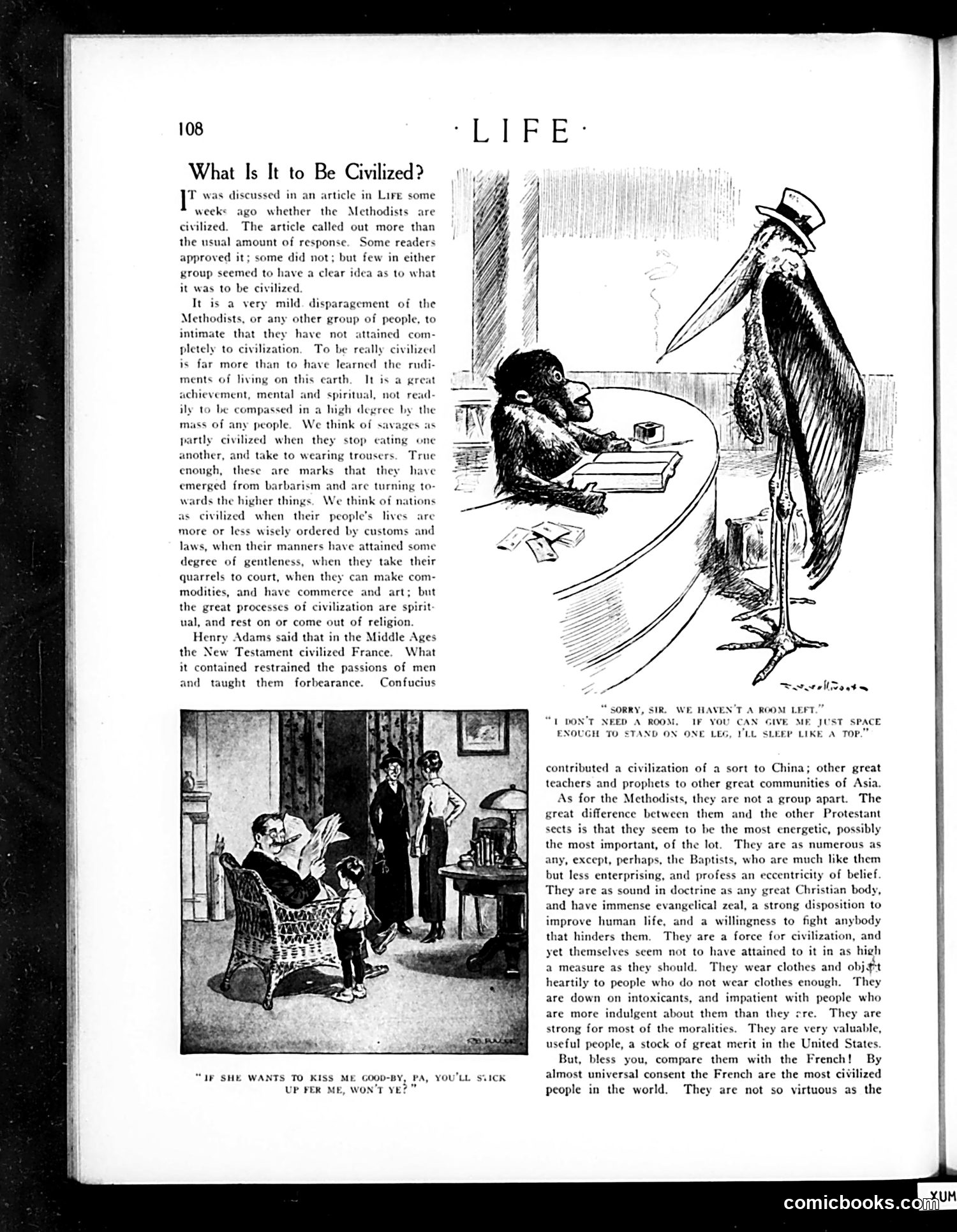
This page satirizes definitions of "civilization" through two cartoons mocking Victorian-era social pretensions. The **top cartoon** shows a shabby man being evicted by an elegant gentleman, with the caption about lacking room. The joke ridicules how "civilized" people value superficial etiquette (standing room, proper dress) over basic human compassion. The **bottom cartoon** depicts a mother refusing to kiss her son goodbye ("If she wants to kiss me good-by, Pa, you'll sick up me, won't ye?"), illustrating how rigid Victorian propriety suppresses natural human affection—parents avoiding physical contact with children to maintain "civilized" decorum. Both cartoons mock how contemporary society equates civilization with artificial constraints and emotional coldness, rather than genuine kindness or human connection. The accompanying text supports this critique of Methodist and other cultural standards.
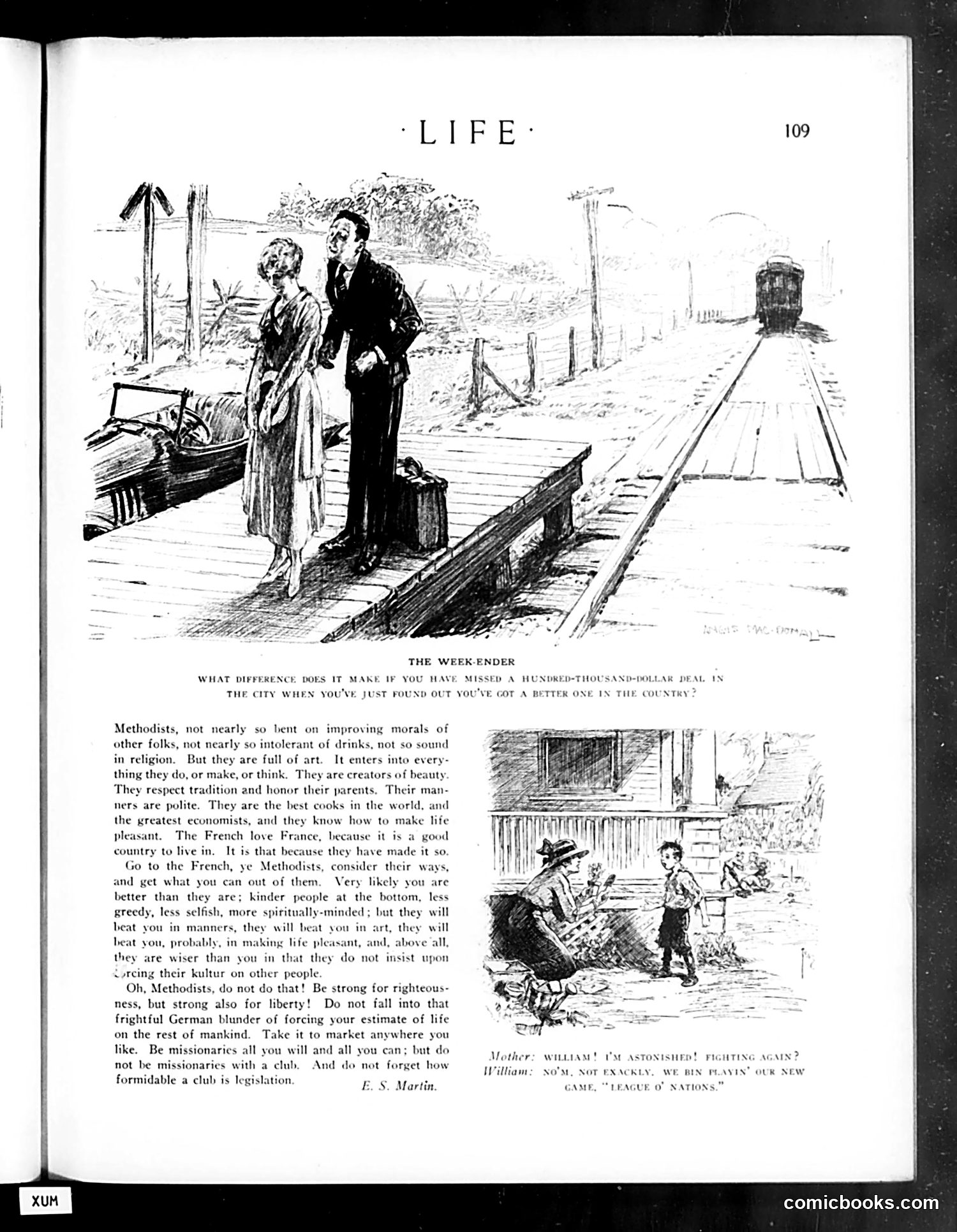
**Top Cartoon ("The Week-Ender"):** A well-dressed couple at a railway station watches a train approach. The caption questions whether missing a $100,000 business deal matters if you've found "a better one in the country"—suggesting romantic or leisurely escape from urban commerce. **Bottom Cartoon:** A mother confronts a boy named William about fighting. He responds they're playing a new game called "League of Nations," implying children mock the real League of Nations as merely a game or failure at preventing conflict. **Text Column:** E.S. Martin's essay criticizes Methodists for moral superiority while praising French culture's superior graciousness, art, and wisdom. He urges Methodists to embrace French values rather than impose their own standards on others.
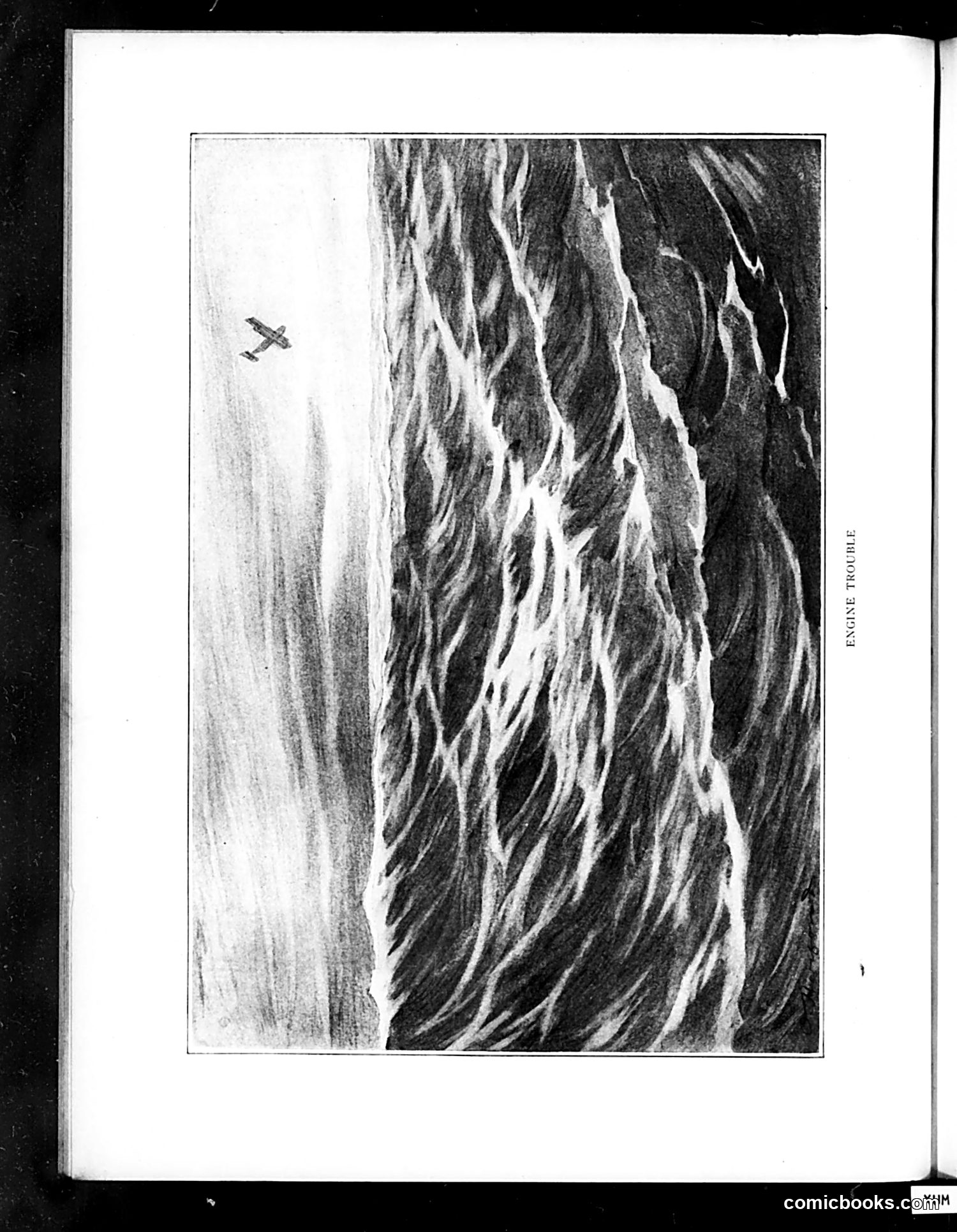
This page appears to be from an early aviation-era publication of *Life* magazine. The image shows an aircraft in flight against a dramatic cloudy sky, with the caption "EXCUSE PROFANITY" positioned vertically on the right side. The cartoon's humor likely plays on early aviation fears and the unpredictability of flight. The phrase "excuse profanity" suggests the aircraft pilot (or perhaps passengers) are swearing—either due to mechanical trouble, dangerous weather conditions, or simply the terror of flying in this primitive aviation era. The joke assumes readers would find it understandable that someone in such a perilous situation would resort to cursing, while politely requesting forgiveness for doing so. This reflects early-20th-century attitudes toward both aviation danger and social propriety.
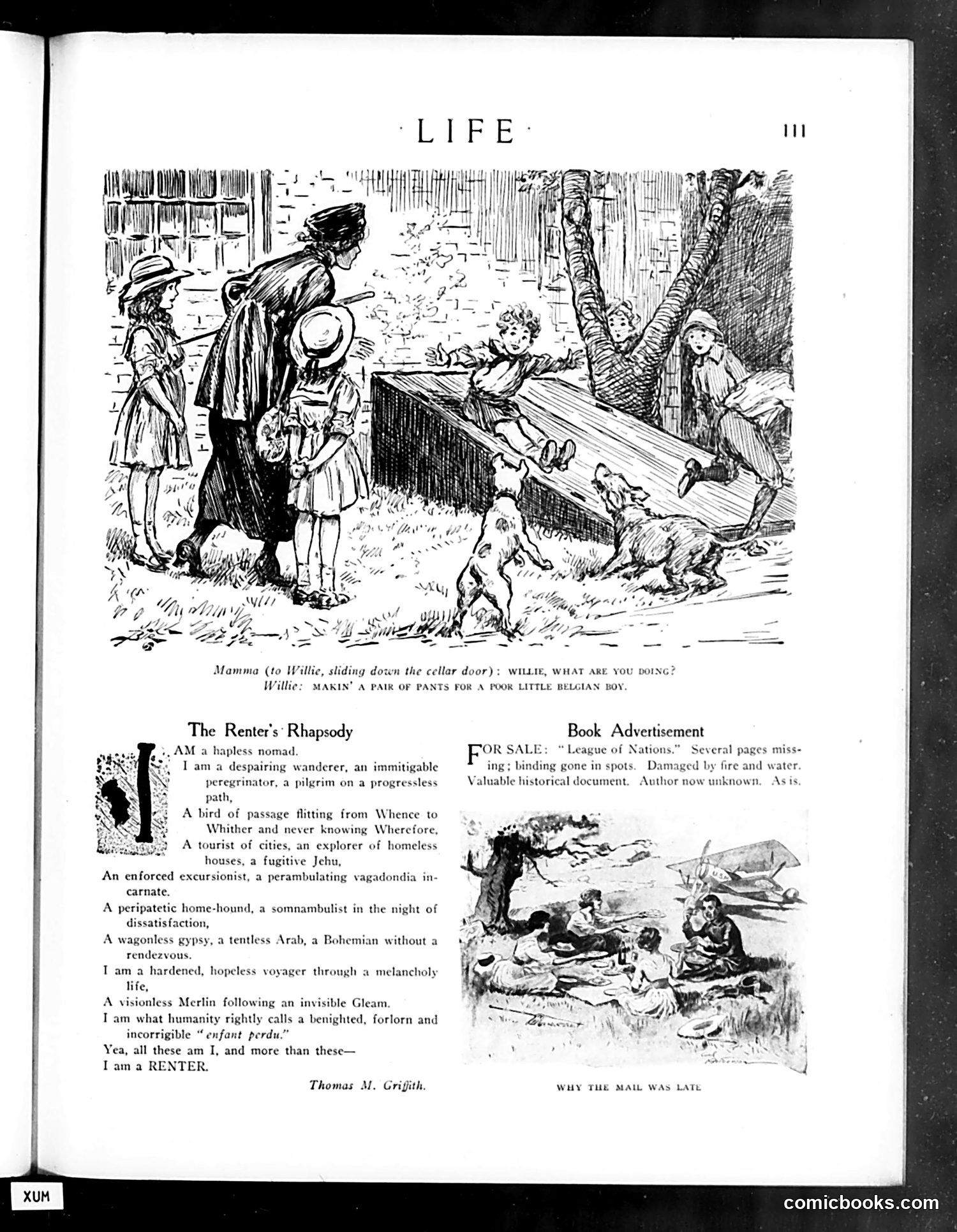
The top cartoon shows a mother catching a boy named Willie making pants for "a poor little Belgian boy." This references **WWI-era charitable efforts** to aid Belgian civilians, who suffered terribly during German occupation (1914-1918). The humor lies in Willie's resourcefulness—he's repurposing materials to help—though the mother's intervention suggests she disapproves of him giving away household goods. Below is "The Renter's Rhapsody," a poem by Thomas M. Griffith describing the plight of a perpetually displaced tenant—someone constantly moving, homeless, and rootless. This reflects **urban housing instability**, a recurring social problem of the era. The lower illustration advertises a damaged book about the "League of Nations," likely relating to post-WWI political reorganization.
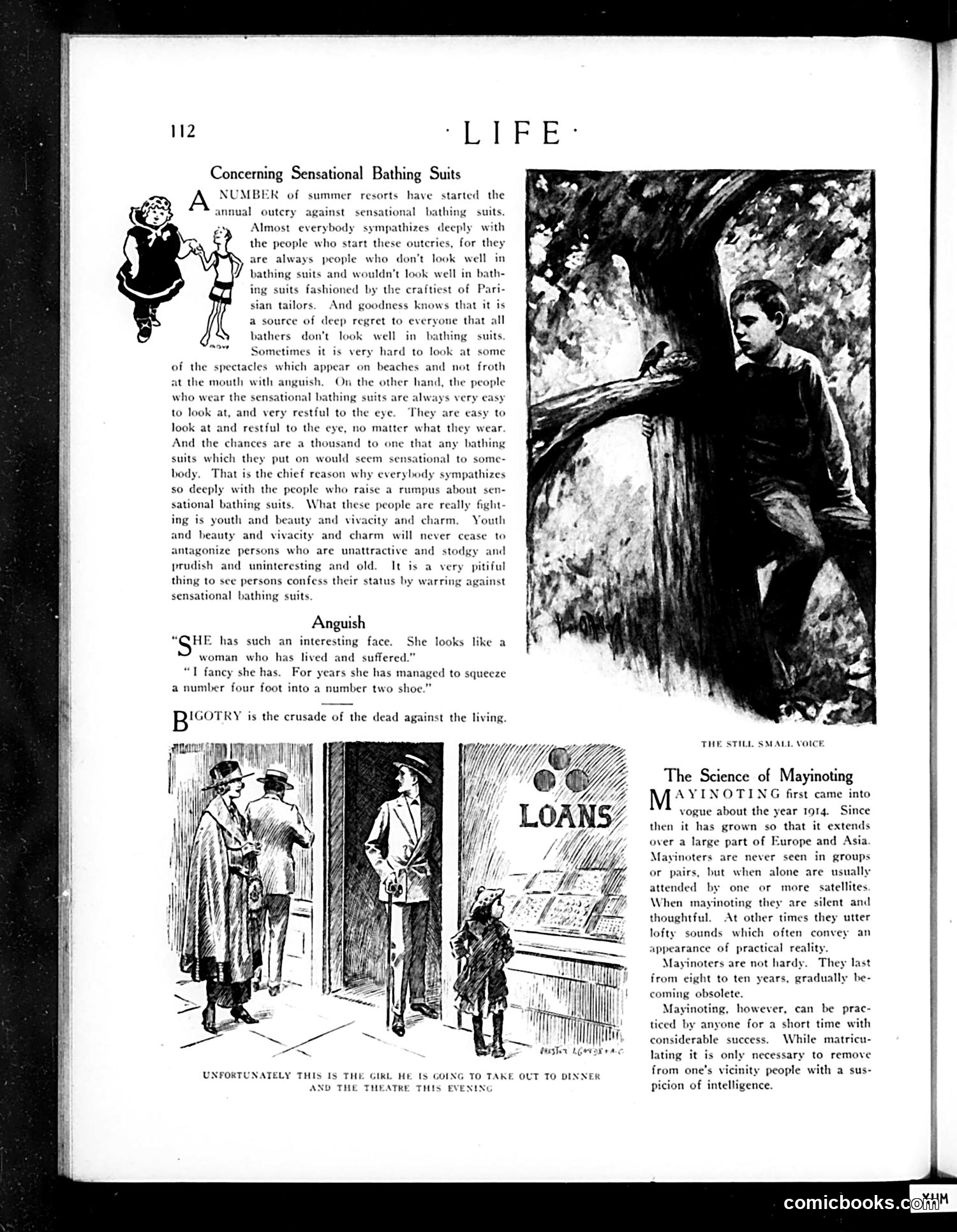
This page contains social satire typical of early 20th-century Life magazine. The main article defends "sensational bathing suits" against summer resort complaints, arguing that critics are simply unattractive people envious of youth and beauty. The satire mocks prudish moralists by suggesting their real grievance is that attractive people look good regardless of what they wear. The cartoon labeled "Anguish" jokes about a woman with a worn face, suggesting her suffering comes from squeezing size-four feet into size-two shoes—a dig at women's fashion vanity. The bottom cartoon shows a man taking out an unattractive woman to dinner, captioned as "unfortunate." "The Science of Mayinoting" appears to be nonsense satire defining "mayinoters" as affected, pretentious people who last about a decade before becoming obsolete—likely mocking a contemporary social trend or personality type Life's readers would recognize.
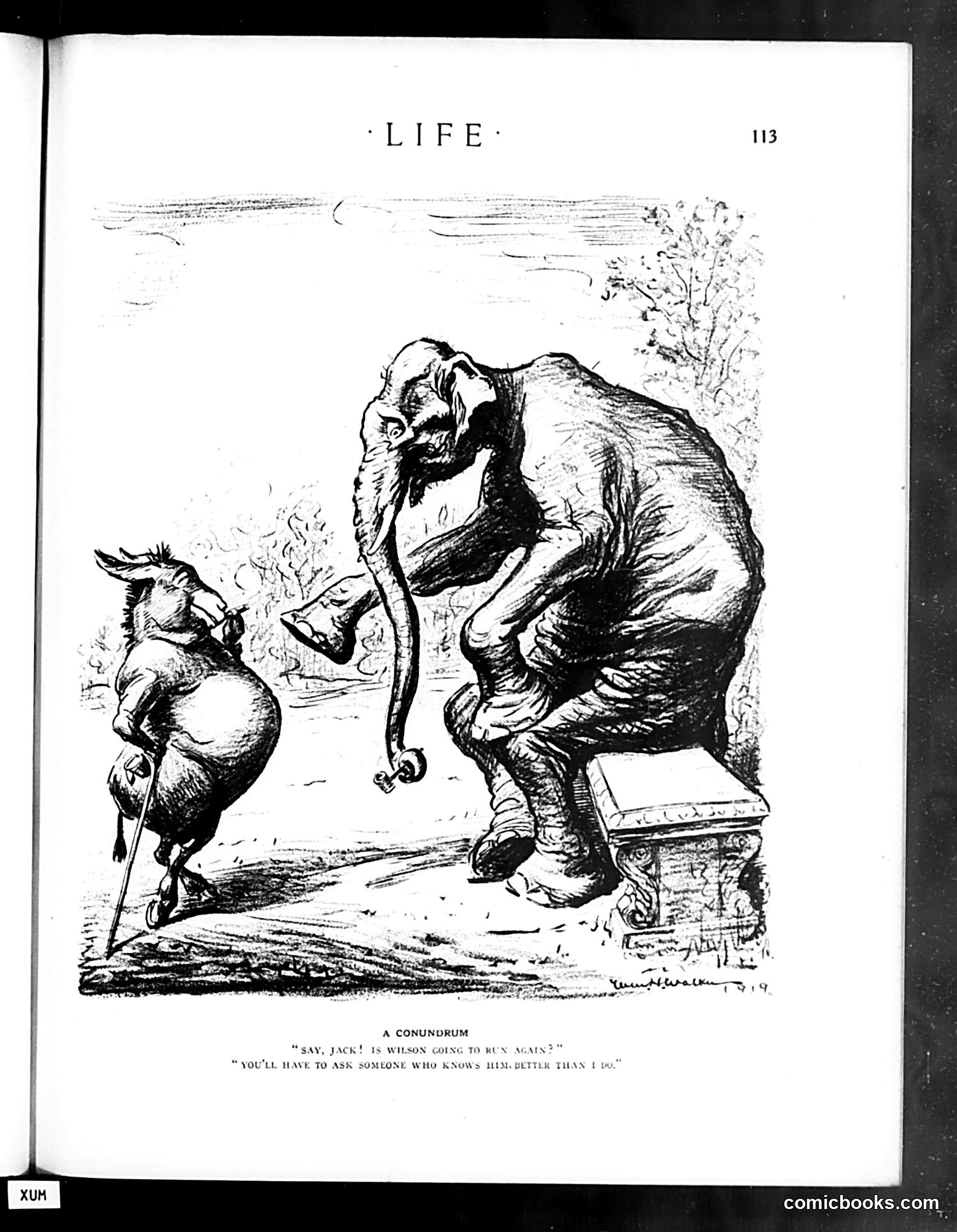
This cartoon depicts two figures in conversation—one appears to be a smaller character (possibly representing the common man or press) asking a larger, more rotund figure about whether "Wilson" will "run again." The larger figure responds that you'd need to ask someone who knows him better. The reference is almost certainly to President Woodrow Wilson and speculation about whether he would seek another term. The "conundrum" is the joke: even those close to Wilson or in positions to know his intentions won't commit to an answer, suggesting Wilson's plans or true intentions are genuinely mysterious or deliberately obscured. The satire mocks the opacity of political decision-making and politicians' reluctance to be forthright about their ambitions.
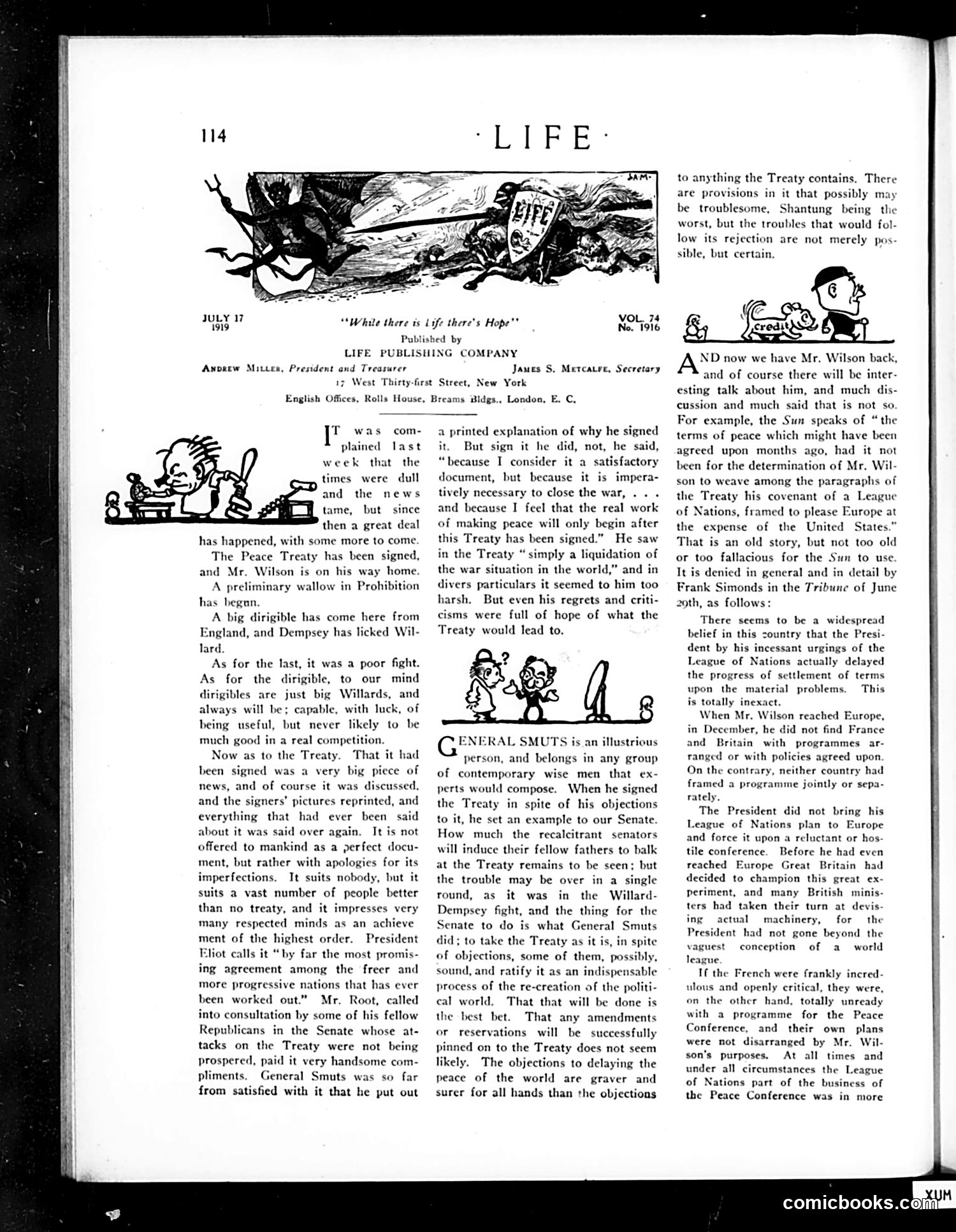
This page discusses the recently signed Treaty of Versailles ending World War I, with President Wilson returning home to face Senate ratification debates. **The cartoons** (visible but small) appear to reference contemporary figures and events: dirigibles, boxing (Dempsey vs. Willard fight), and likely Wilson himself. **The political context**: The editorial argues that while the Treaty is imperfect, rejecting it would be worse. It invokes General Smuts (a South African statesman who signed despite reservations) as a model for reluctant senators. The piece acknowledges specific criticisms—the Shantung provision bothers even supporters—but warns that delay threatens world peace more than any treaty flaw. **The satire's point**: The comparison of senators to Dempsey's opponent and dirigibles to "big Willards" uses boxing/engineering metaphors to mock congressional hesitation as fumbling and outdated. The editor advocates pragmatic acceptance over perfectionist rejection.
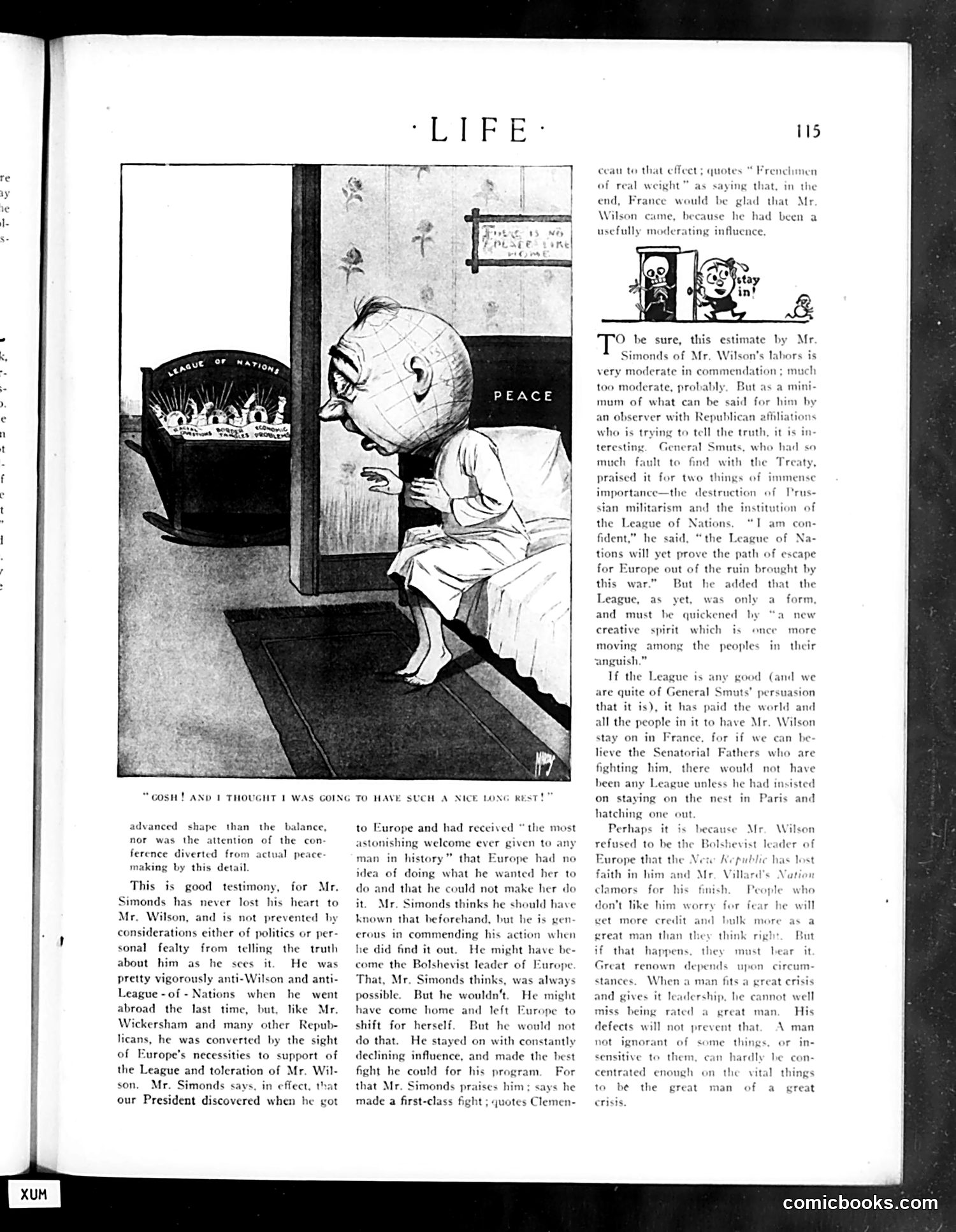
The main cartoon depicts a figure labeled "Peace" being held like a baby by a woman in bed, with a "League of Nations" emblem visible on a dresser. The caption reads: "Gosh! And I thought I was going to have such a nice long rest!" **The Satire:** This mocks President Woodrow Wilson's post-WWI efforts. The "Peace" looks exhausted rather than restful—suggesting that achieving peace through the League of Nations negotiations proved far more difficult and demanding than anticipated. The woman represents Europe, who expected a peaceful respite after the war but instead found herself caring for an exhausting infant (the fragile peace). **Context:** The accompanying text discusses Wilson's disappointing experience in Europe—he received an enthusiastic welcome but discovered European powers had no intention of following his vision. The cartoon satirizes how the promised "peace" required constant, exhausting maintenance rather than offering the promised rest. The League itself is portrayed as underdeveloped ("only a form") and requiring nurturing to survive.
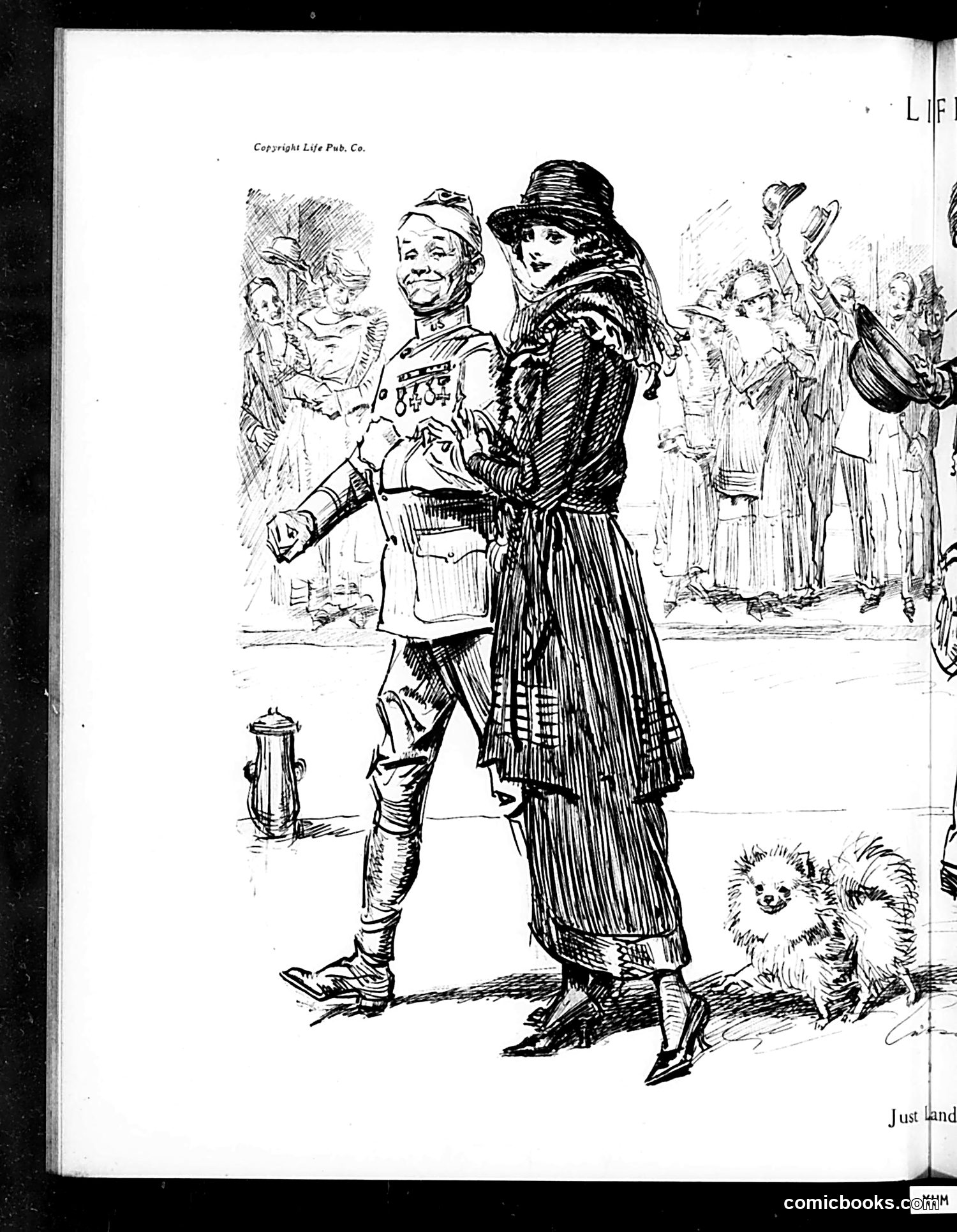
This appears to be a satirical illustration from *Life* magazine showing a military officer in uniform (with medals and insignia visible) alongside a fashionably dressed woman in a hat and coat, with a small dog at their feet. Behind them is a crowd of cheering civilians. The caption reads "Just and..." (incomplete on this page). The cartoon likely satirizes a romantic or social encounter between a military figure and a woman, possibly commenting on wartime relationships, military privilege, or social hierarchies. The enthusiastic crowd suggests public approval or celebration of their union. Without the complete caption or publication date visible, the specific historical reference remains unclear, though the military dress and illustration style suggest early-to-mid 20th century context.
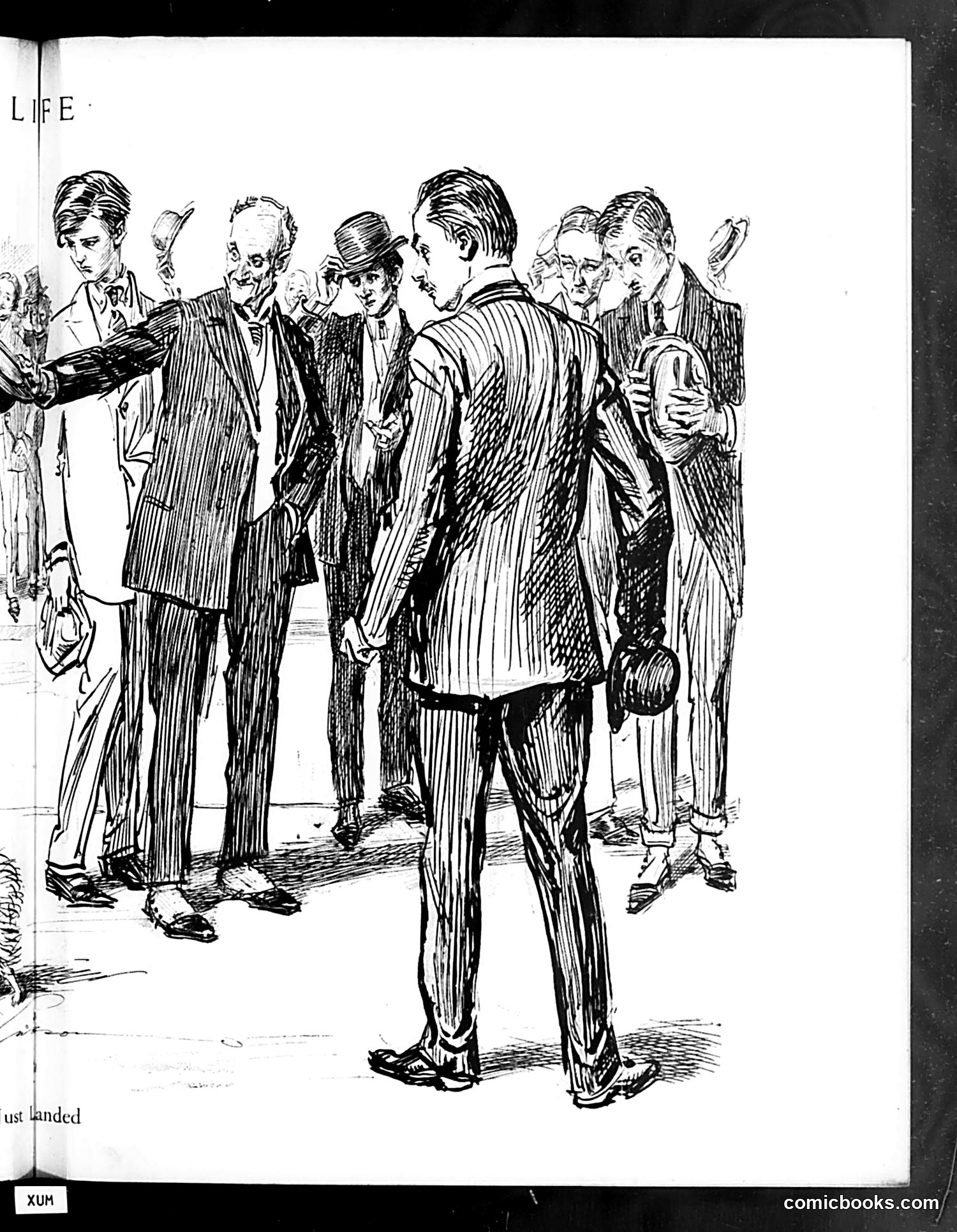
This political cartoon from *Life* magazine depicts a group of well-dressed men in suits gathered together, with one figure prominently positioned with his back to the viewer in the foreground. The title "Just Landed" suggests these are newly arrived figures, possibly immigrants or foreign dignitaries. The cartoon appears to satirize a formal diplomatic or political gathering, likely depicting international relations or negotiations. The men's expressions and body language suggest conversation or negotiation among powerful figures. However, without clearer identifying labels, specific dates, or additional context visible on the page, I cannot definitively identify which particular historical figures or political event this references. The formal attire and gathering style suggest early-to-mid 20th century international affairs, but the specific satirical point remains unclear from the image alone.
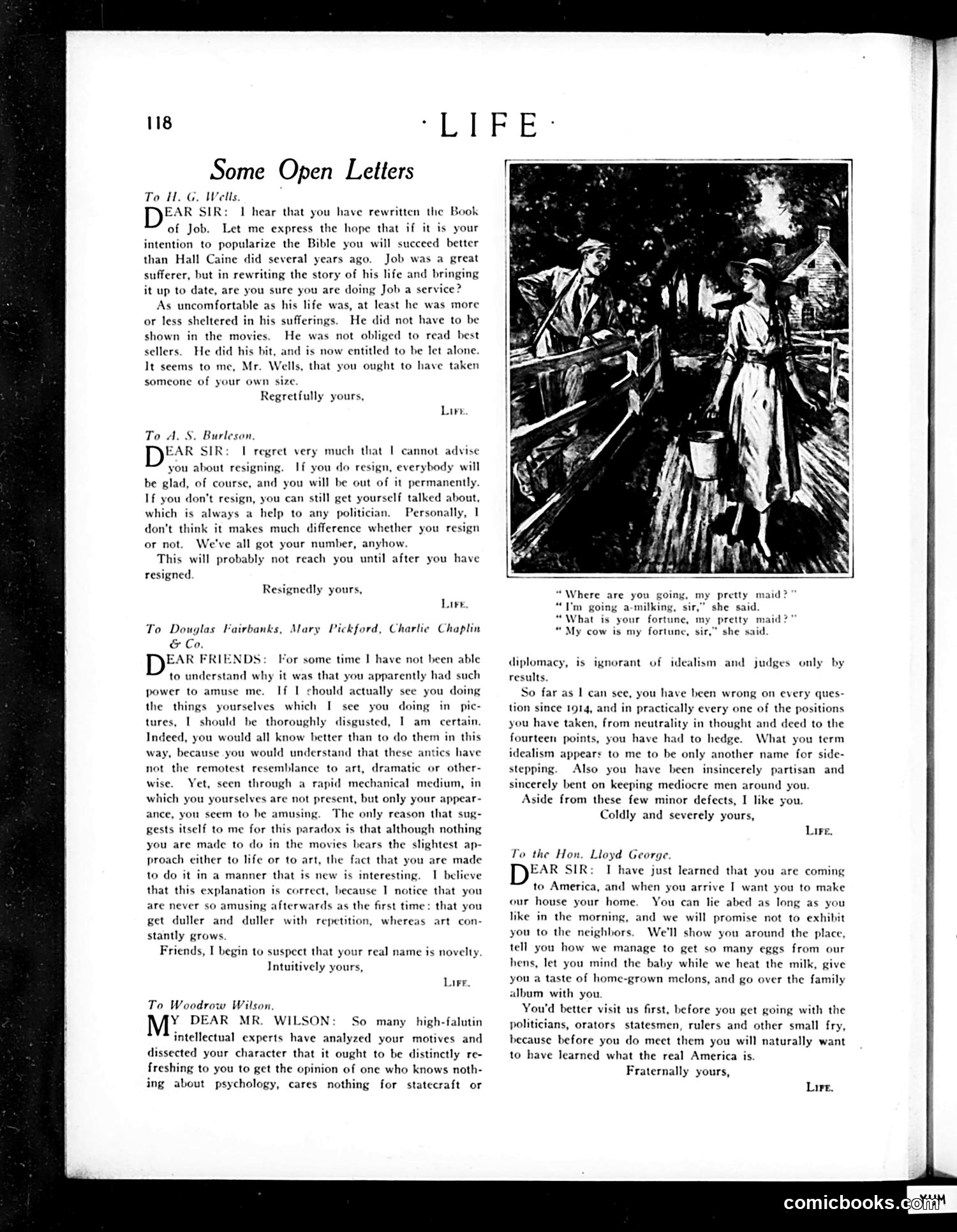
This page features mock "open letters" from Life's editors to public figures, a common satirical format. The letters humorously critique their subjects by: **To H.G. Wells**: Mocks his modernization of the Book of Job, suggesting even suffering biblical figures deserve rest from contemporary indignities like movies and bestsellers. **To A.S. Burleson** (Wilson's Postmaster General): Sarcastically advises resignation is pointless since his reputation is already damaged—either way he's compromised. **To film stars** (Fairbanks, Pickford, Chaplin): Argues their charm exists *only* through mechanical film medium. Real-life antics would be disgusting; their appeal is mere novelty, not artistry. **To Woodrow Wilson**: Brutally attacks his post-1914 record as consistently wrong, calling his "idealism" mere side-stepping and accusing him of surrounding himself with mediocre advisors. The accompanying illustration shows a rural milking scene with period dialogue, likely contrasting simple country virtue against the corrupted figures being satirized. The letters exemplify Life's sophisticated political humor targeting wartime leadership.
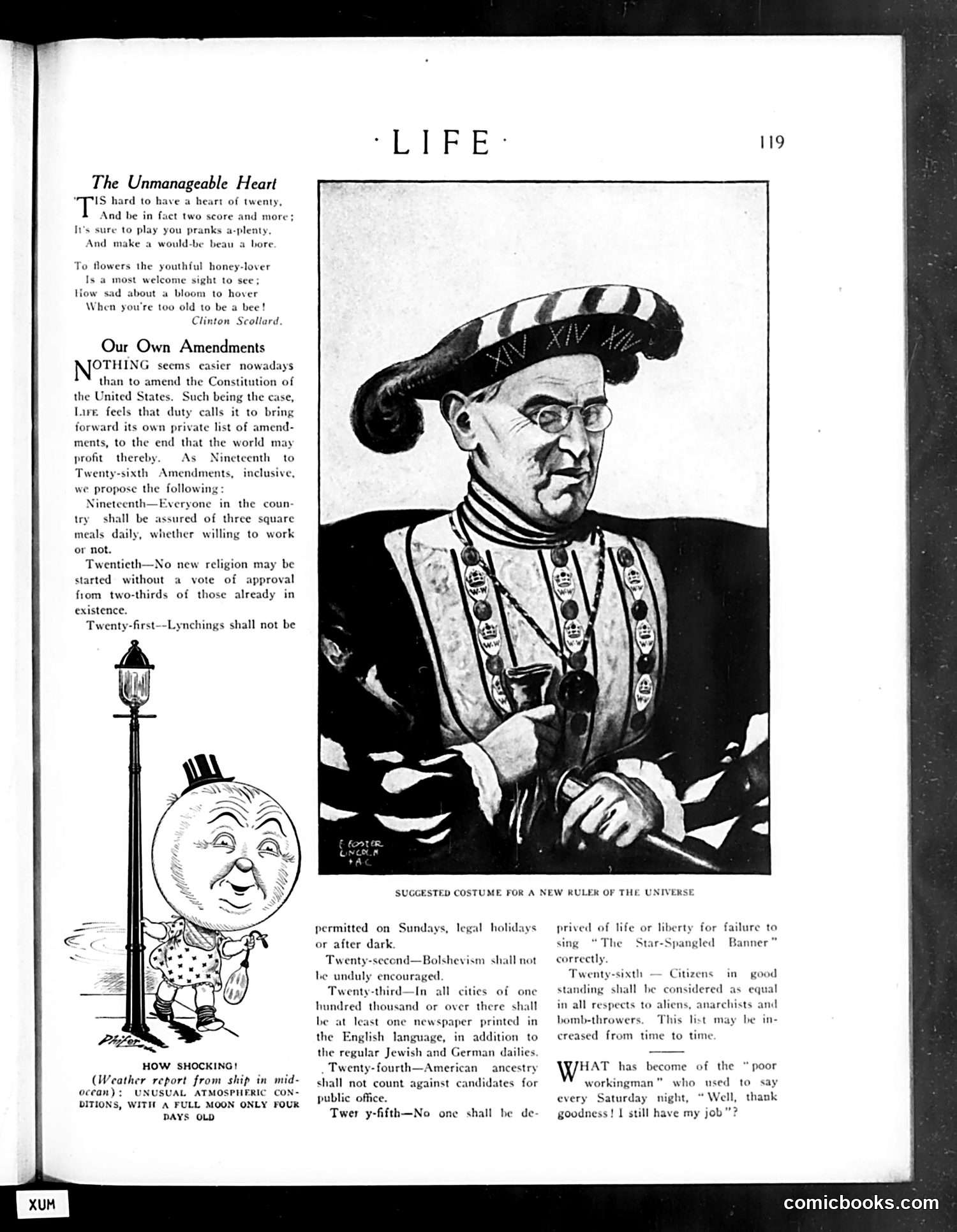
This page satirizes American anxieties of the 1920s through mock constitutional amendments. "Our Own Amendments" is a humorous list proposing absurd legal changes, reflecting genuine social tensions of the era: The amendments mock competing ideologies—Amendment Twenty targets new religions (likely referencing concern about religious movements), while Amendment Twenty-second references "Bolshevism" (anti-communist anxiety). Amendment Twenty-first prohibits lynching (a serious social evil treated satirically). Amendment Twenty-fourth mocks anti-immigrant sentiment by proposing ancestry shouldn't disqualify candidates. Amendment Twenty-sixth sarcastically suggests immigrants, anarchists, and "bomb-throwers" should have equal rights—ironically exposing prejudice. The large portrait labeled "Suggested Costume for a New Ruler of the Universe" appears to caricature an authoritarian figure wearing ornate regalia, likely critiquing those proposing sweeping constitutional changes. The page's final question—"What has become of the 'poor workingman' who used to say every Saturday night, 'Well, thank goodness! I still have my job'?"—suggests economic anxiety about job security during this period.
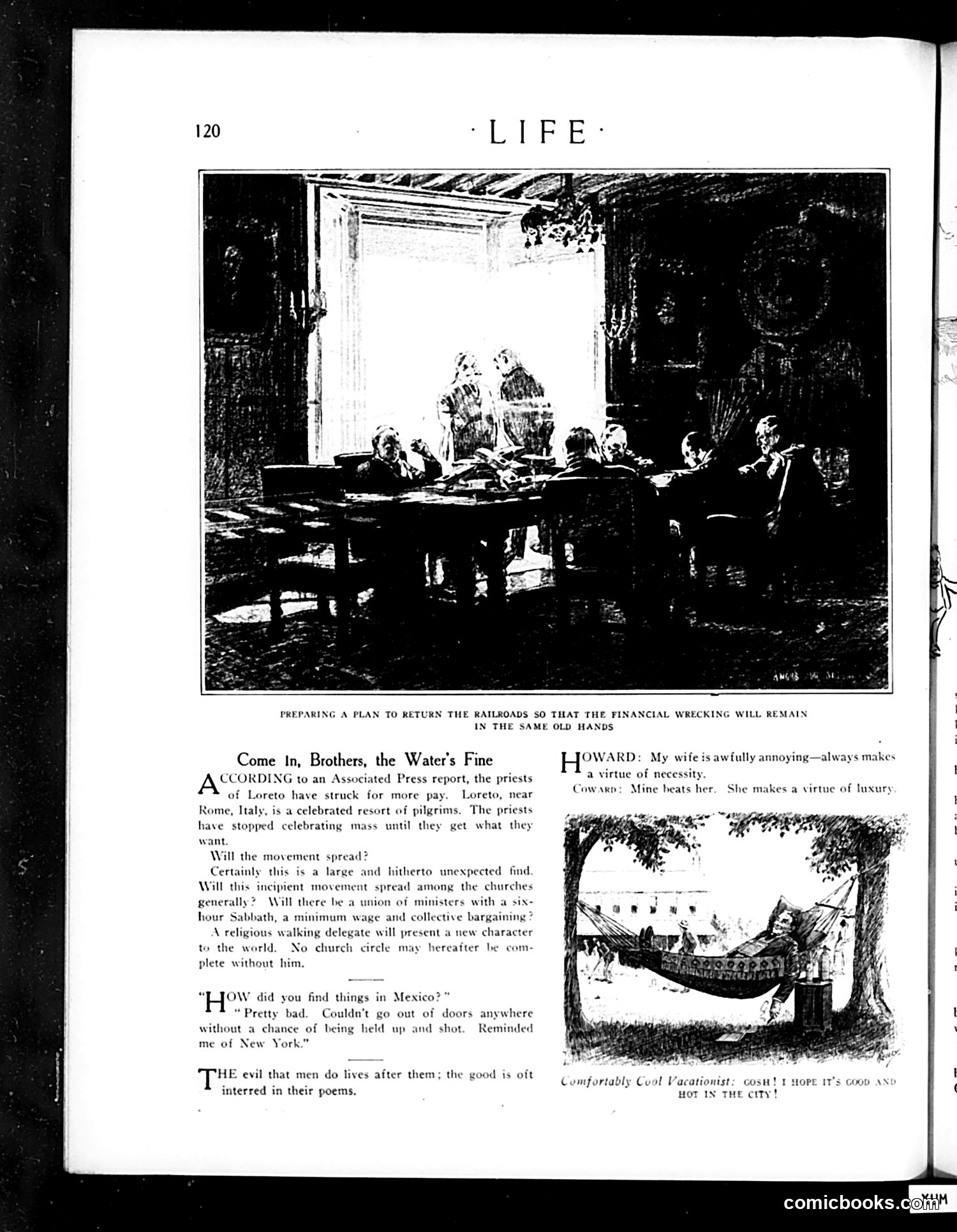
This page contains multiple satirical pieces targeting early 20th-century American concerns: **Top cartoon**: Depicts railroad executives plotting to regain control of nationalized railways while keeping financial corruption "in the same old hands"—satirizing railroad industry malfeasance and efforts to resist government regulation. **"Come In, Brothers, the Water's Fine"**: Mocks priests in Loreto, Italy striking for better pay, sarcastically questioning whether labor organizing will spread to American churches with "six-hour Sabbaths" and "minimum wage." The title suggests priests are joining a growing labor movement. **Mexico dialogue joke**: Satirizes both Mexican violence and American urban crime by equating them—a visitor says Mexico's danger "reminded me of New York." **Right-side illustrations**: A dialogue between Howard and Coward about wives, and a hammock vacation scene captioned about hoping it's cool, offering lighter humor contrasting the heavier political content. The page reflects Progressive Era anxieties about labor unrest, government control, and social disorder.
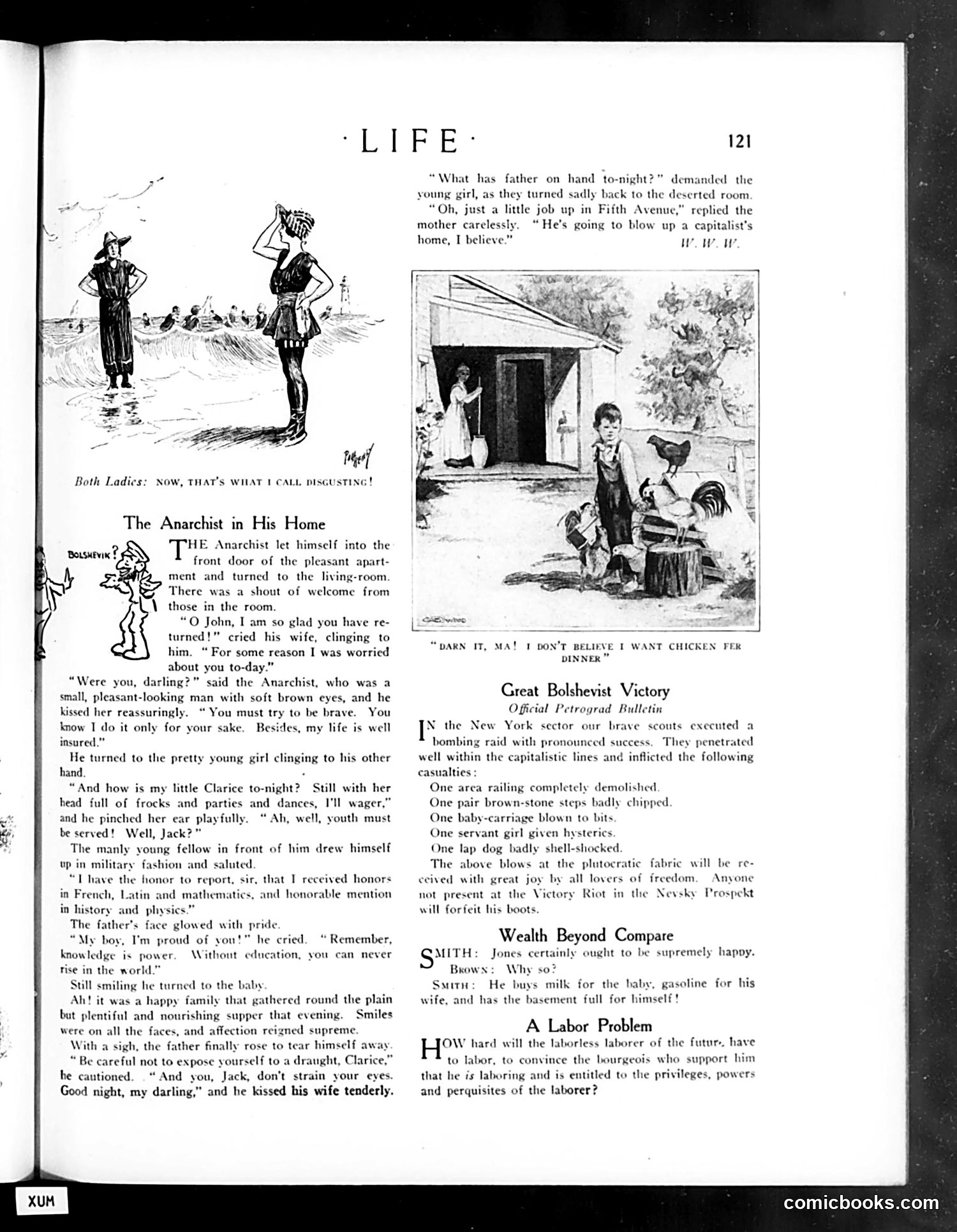
This page contains three distinct anti-radical satirical pieces from the Red Scare era (likely early 1920s): **"The Anarchist in His Home"** presents ironic contrast: a devoted family man who—the mother casually reveals—plans to "blow up a capitalist's home" that evening. The joke mocks radicals as hypocrites: domesticated, educated, loving fathers who nonetheless commit violence. **"Great Bolshevist Victory"** parodies Soviet propaganda bulletins, claiming a "bombing raid" destroyed minor property (railings, steps, a baby carriage, a servant girl's nerves, a dog). The absurdist humor ridicules both Bolshevik boasting and their actual destructive capacity. **"Wealth Beyond Compare"** and **"A Labor Problem"** are brief gags mocking labor radicals and Bolshevism more generally. The page's underlying message: anarchists and Bolshevists are portrayed as simultaneously dangerous terrorists and ridiculous, incompetent extremists. This reflects American anxiety following actual bombing campaigns by anarchists and the 1917 Russian Revolution.
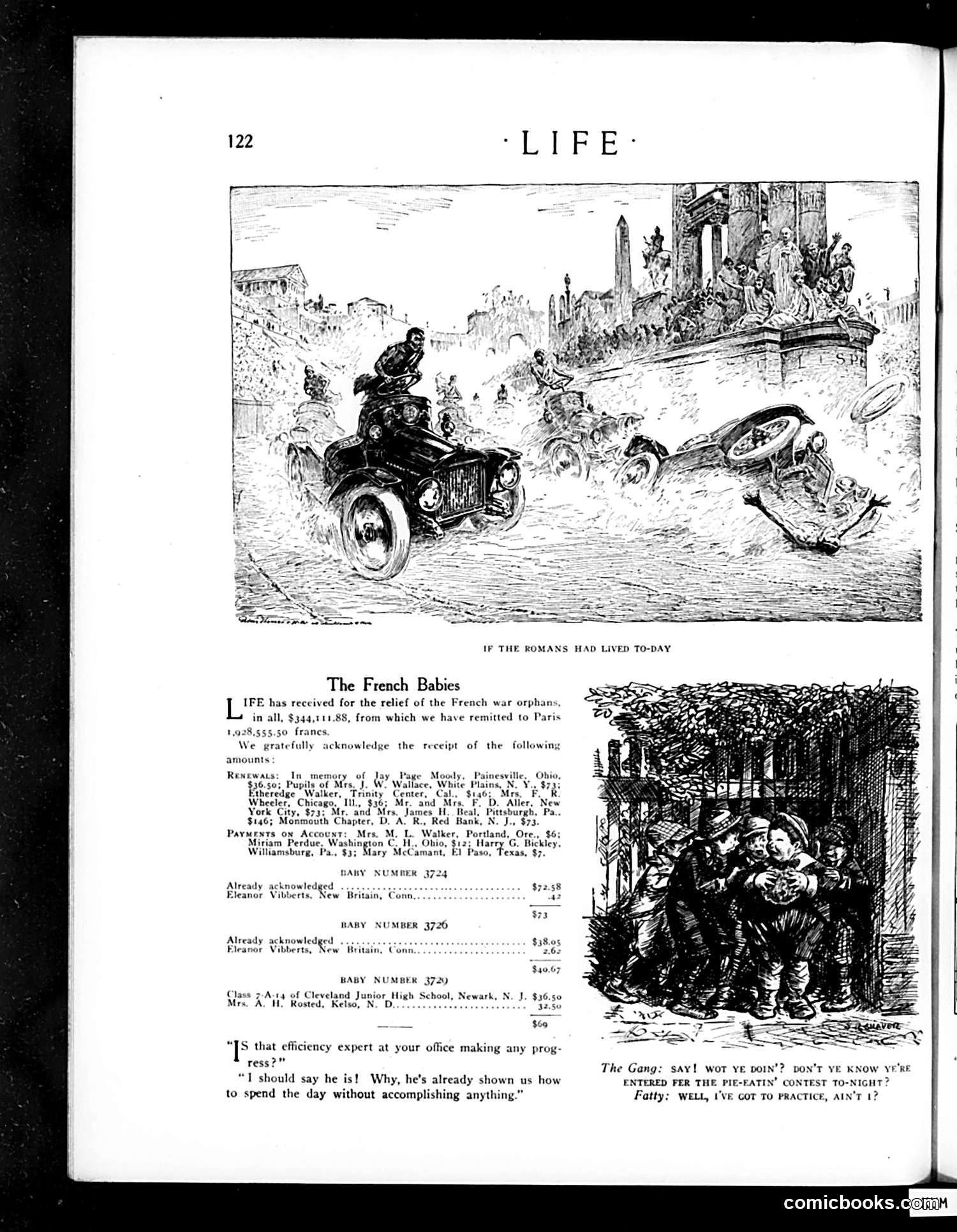
This *Life* magazine page contains three distinct elements: **Top cartoon ("If the Romans Had Lived To-Day"):** A satirical sketch imagining ancient Romans driving early automobiles in a chaotic race, with spectators watching from classical architecture. The joke mocks both Roman gladiatorial entertainment and modern motorcar culture—suggesting cars have simply replaced chariots as vehicles for reckless public spectacle. **Main article ("The French Babies"):** A earnest fundraising report acknowledging donations for French war orphans relief following World War I. The magazine had collected over $344,000 and remitted nearly two million francs to Paris. Individual donors and organizations are listed by name. **Bottom cartoon:** A workplace humor strip where an "efficiency expert" (a contemporary business trend) is mocked for teaching employees how to waste time productively—satirizing consultants who complicate rather than improve operations. **"The Gang" comic:** Street children discuss a pie-eating contest, with "Fatty" claiming he needs practice—simple, lighthearted humor about working-class youth culture. The page mixes serious charitable work with satirical commentary on modern life.
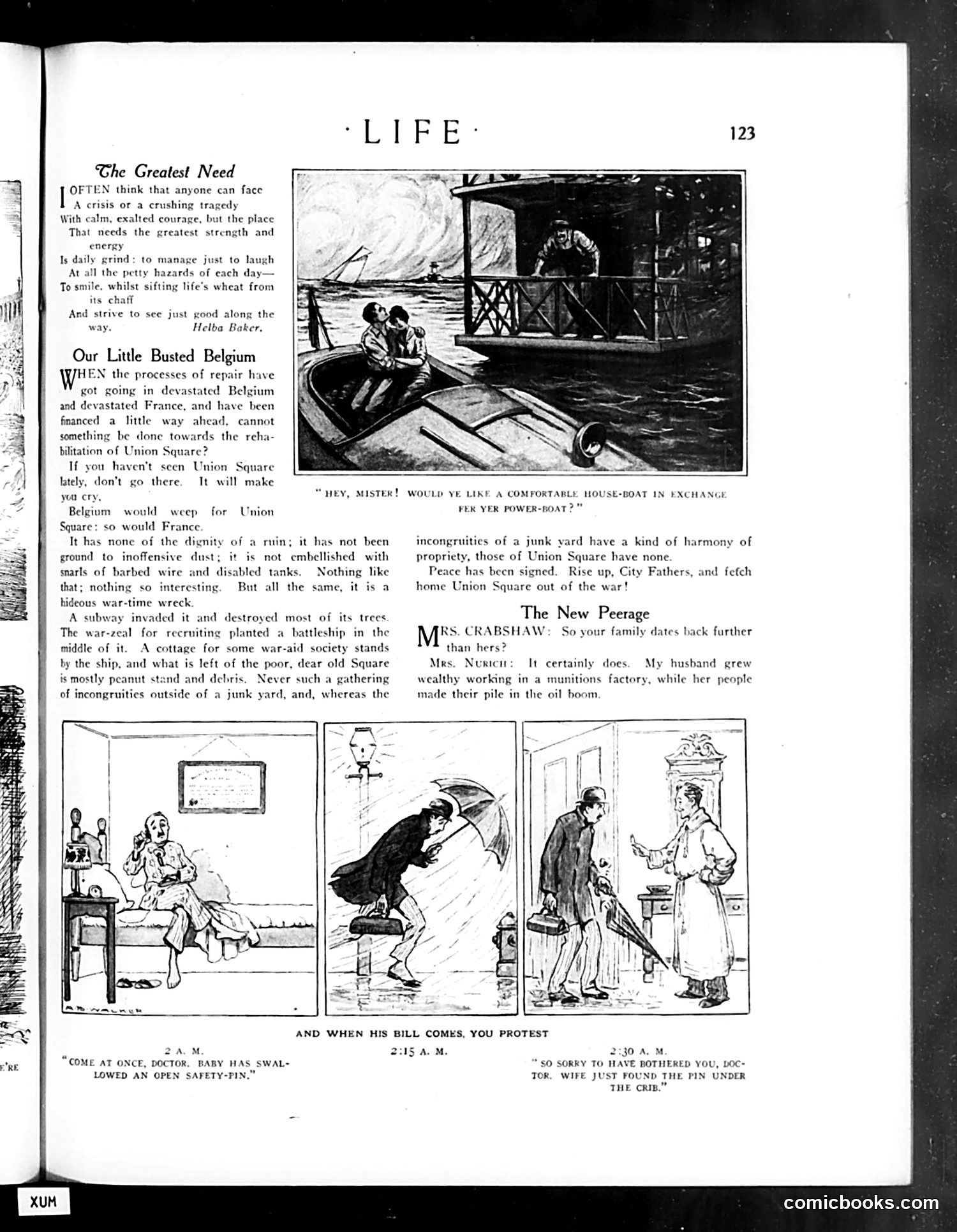
This page contains three distinct satirical pieces from post-World War I America: **"Our Little Busted Belgium"** criticizes New York City's Union Square, comparing its wartime deterioration to devastated Belgium and France. The piece sarcastically suggests that while European cities receive reconstruction aid, Union Square remains a chaotic "junk yard" cluttered with a subway station, a recruiting battleship, war-aid society structures, and peanut stands. It's a call for civic restoration. **The cartoon below** depicts a boatman offering a "comfortable house-boat in exchange for yer power-boat"—likely mocking wartime profiteering or the economic disruption among the wealthy. **"The New Peerage"** satirizes how World War I created new social hierarchies. Mrs. Crabshaw boasts her husband's family grew wealthy in munitions manufacturing and oil during the war, while Mrs. Nutch's family merely has old aristocratic lineage. The joke: wartime profiteers now outrank traditional wealth and status. **The three-panel comic strip** satirizes the disruption of domestic life—a doctor makes a 2:15 AM house call for a baby who swallowed a safety pin, only to receive a 2:30 AM apology when the pin is found under the crib.
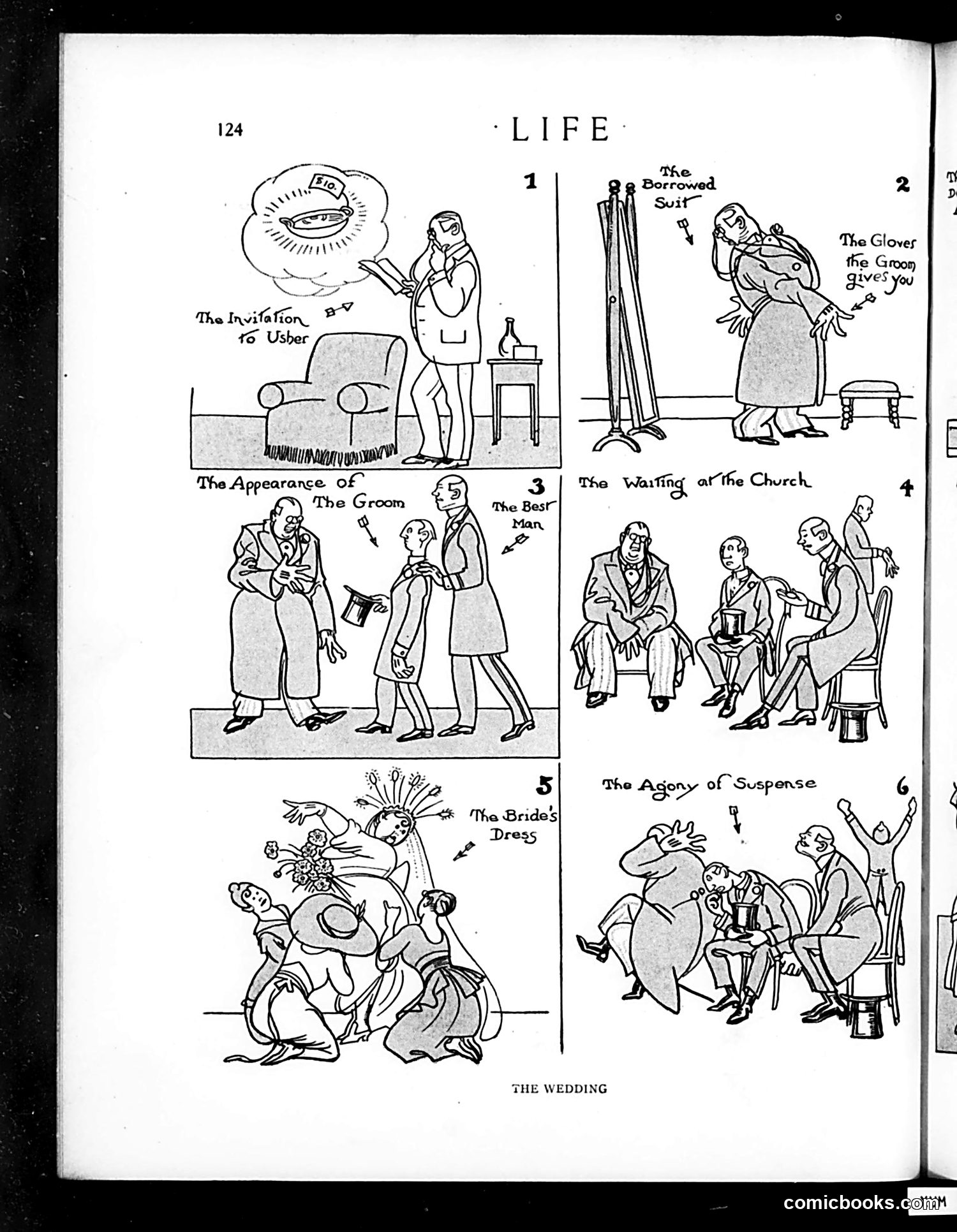
This is a six-panel satirical sequence depicting wedding preparations and events. The humor centers on the chaos and anxieties surrounding a society wedding: 1. **"The Invitation to Usher"** - A man receives the invitation but imagines a formal dinner jacket instead 2. **"The Borrowed Suit"** - He borrows ill-fitting formal wear from the groom 3. **"The Appearance of the Groom"** - The groom and best man appear disheveled or nervous 4. **"Waiting at the Church"** - Guests sit awkwardly before the ceremony 5. **"The Bride's Dress"** - Women fuss excitedly over the bride's appearance 6. **"The Agony of Suspense"** - Guests display nervous tension awaiting the ceremony The satire mocks the stress, expense, and social pretension involved in early 20th-century American weddings, particularly among the middle class attempting formal propriety.
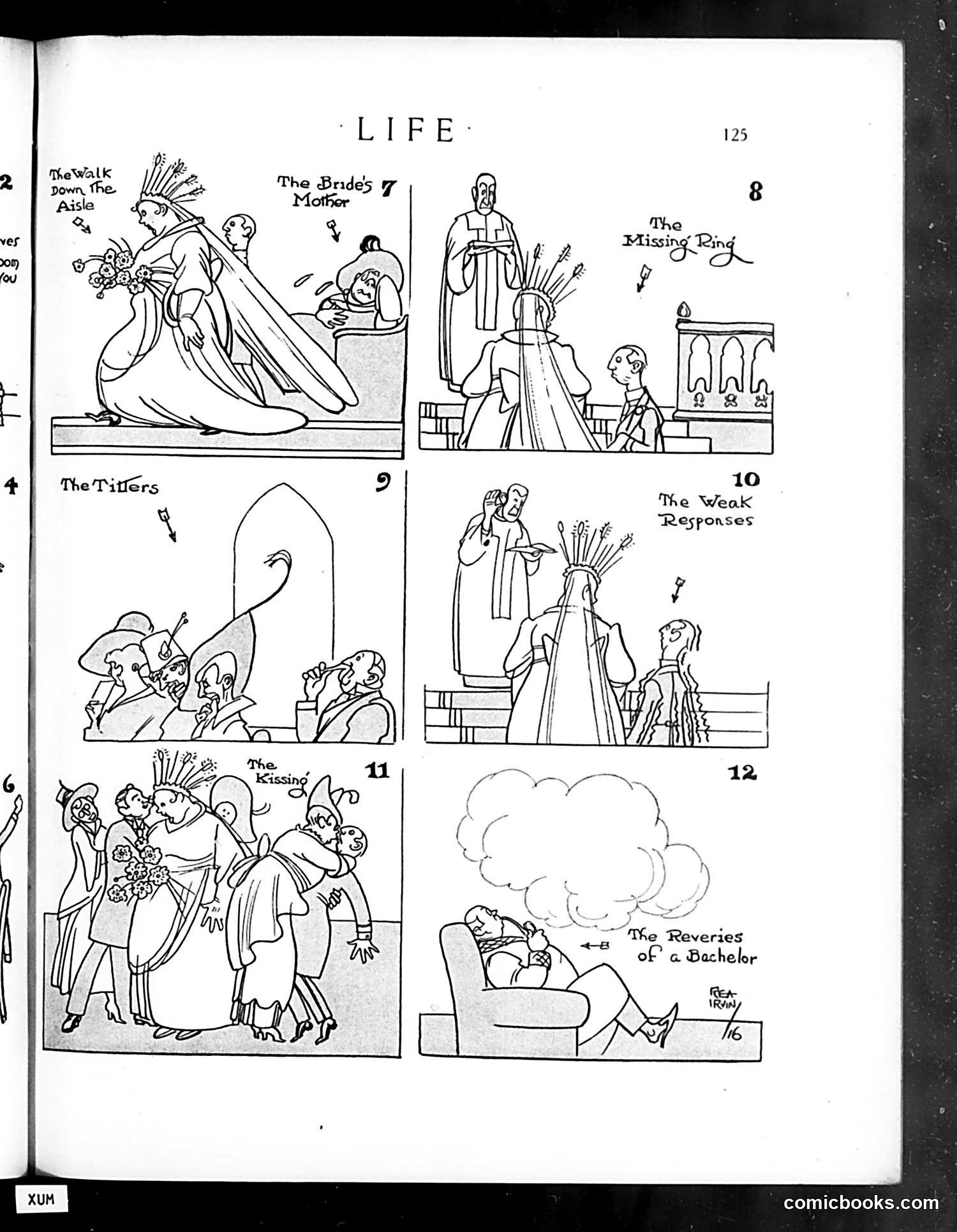
This page presents six sequential comic panels numbered 7-12, telling a narrative story titled "The Walk Down the Aisle" through "The Reveries of a Bachelor." The sequence appears to satirize marriage and weddings through a man's perspective. It begins with a bride walking down the aisle, progresses through ceremonial moments (panels 8-11 showing the bride's mother, missing ring, weak responses, and a kissing scene), and concludes with panel 12: a bachelor daydreaming on a couch, presumably imagining or reconsidering the entire wedding scenario. The satire targets male ambivalence about marriage—the final panel suggests the elaborate wedding ceremony is merely a fantasy or anxious reverie of an unmarried man. The humor relies on depicting marriage as an overwhelming, somewhat comedic ordeal from a bachelor's perspective.
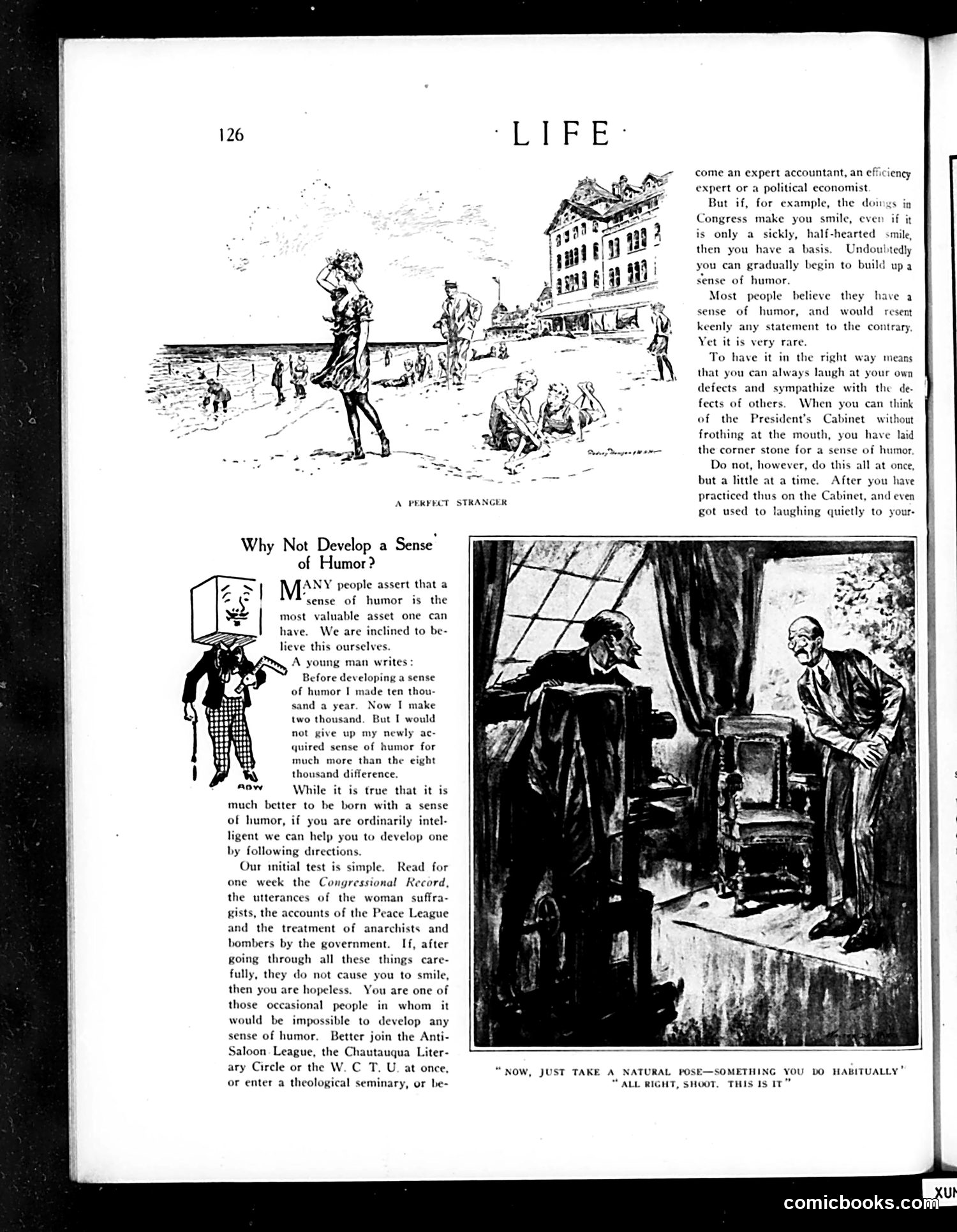
This page advocates developing a sense of humor as a valuable life skill. The main article argues that humor requires practice and self-awareness—the ability to laugh at one's own flaws and sympathize with others' defects. The satirical "test" for humor is deliberately absurd: if reading the *Congressional Record*, women suffragists' statements, Peace League accounts, and government treatment of anarchists doesn't make you smile, you're hopeless. The implication is that these contemporary political topics are inherently ridiculous. The punchline suggests that those who *can't* develop humor should join anti-humor organizations: the Anti-Saloon League, Chautauqua Literary Circle, or WCTU—all real, earnest reform movements of the era. The cartoons illustrate people attempting natural poses for photography, reinforcing the theme that humor requires authentic self-awareness rather than forced performance.
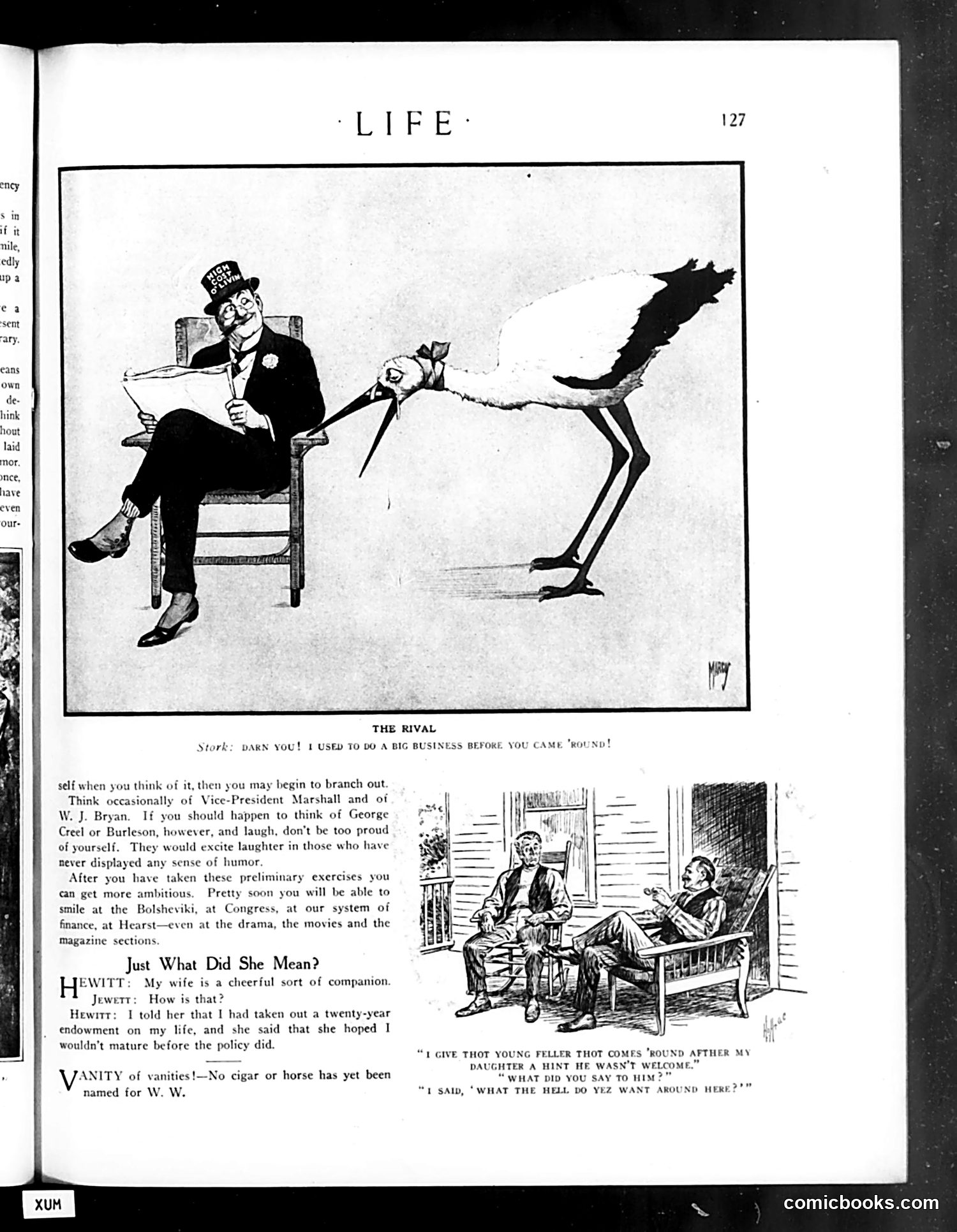
The top cartoon depicts a **stork (representing childbirth) competing with a man** seated in a chair. The stork complains it "used to do a big business before you came 'round!"—a joke about declining birth rates, likely referencing WWI-era concerns about population. The man appears to represent contraception or family planning methods becoming more accessible, reducing the stork's traditional role in delivering babies. The accompanying text references **Vice President Marshall, William Jennings Bryan, George Creel, and Albert Burleson**—figures from the Wilson administration (1913-1921)—as subjects suitable for satirical mockery, suggesting the magazine's political satire targets contemporary government officials. Below are two unrelated humor pieces: one about a wife's dark joke regarding her husband's life insurance policy, and another depicting working-class dialect humor about discouraging a suitor. The overall page represents *Life* magazine's blend of political satire and domestic humor typical of early 20th-century American magazines.
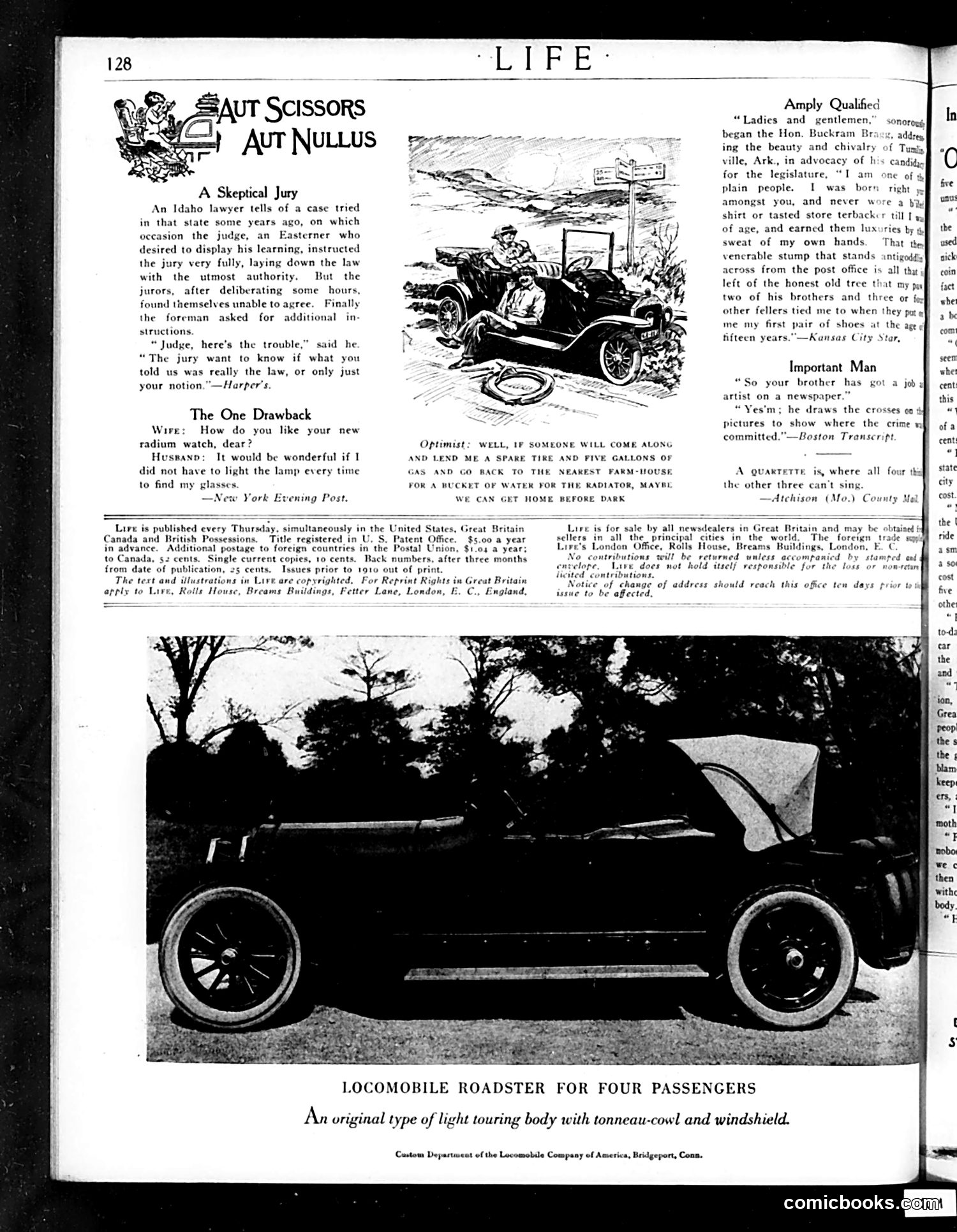
This page contains three separate humorous pieces typical of Life's satirical format: **"A Skeptical Jury"**: A judge gives elaborate legal instructions, but jurors can't agree whether his statements represent actual law or mere personal opinion. The joke satirizes verbose judicial authority and the gap between what judges assert and what's legally legitimate. **"The One Drawback"**: A husband praises his new radium watch but complains he still needs a lamp to read it—mocking the overhyped promises of early radium products, which were marketed as miraculous but remained impractical. **"Amply Qualified"**: A politician claims fitness for legislature by boasting of poverty and rusticity (never wearing a silk shirt, chewing store tobacco), including being tied to a tree as punishment. This satirizes populist candidates who weaponize humble origins as political credentials. The page also includes an advertisement for a Locomobile roadster automobile with tonneau-cowl and windshield—a luxury touring vehicle for four passengers.
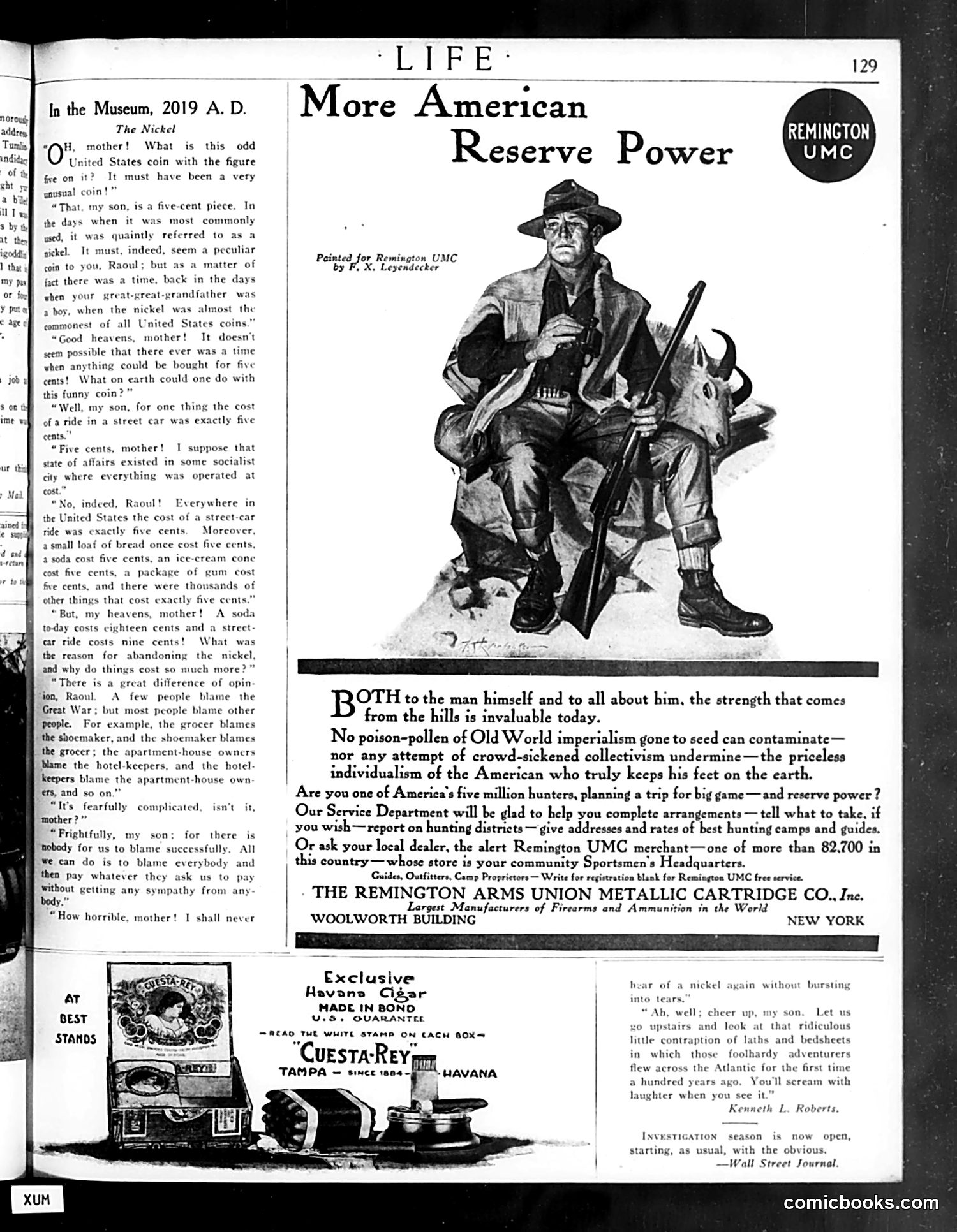
This 1919 *Life* magazine page satirizes post-WWI American inflation through two pieces: **Left column:** A humorous dialogue set in "2019 A.D." where a mother explains to her son "Raoul" what a nickel was—a coin that once bought a streetcar ride, bread, or soda. The joke targets postwar price inflation: items that cost 5 cents now cost 18 cents or more. When asked who to blame, the mother notes everyone blames someone else (grocer blames shoemaker, etc.), with "nobody for us to blame successfully." This satirizes the finger-pointing over inflation's causes. **Right side:** A Remington UMC firearms advertisement disguised as patriotic editorial content. The illustration depicts a rugged American hunter/frontiersman embodying "reserve power" and individualism, contrasting with "Old World imperialism" and "collectivism." It targets hunters and sportsmen as exemplars of American strength. The juxtaposition is ironic: while inflation frustrates ordinary citizens, advertisers wrap commercial appeals in nationalist rhetoric about American individualism and reserve strength.
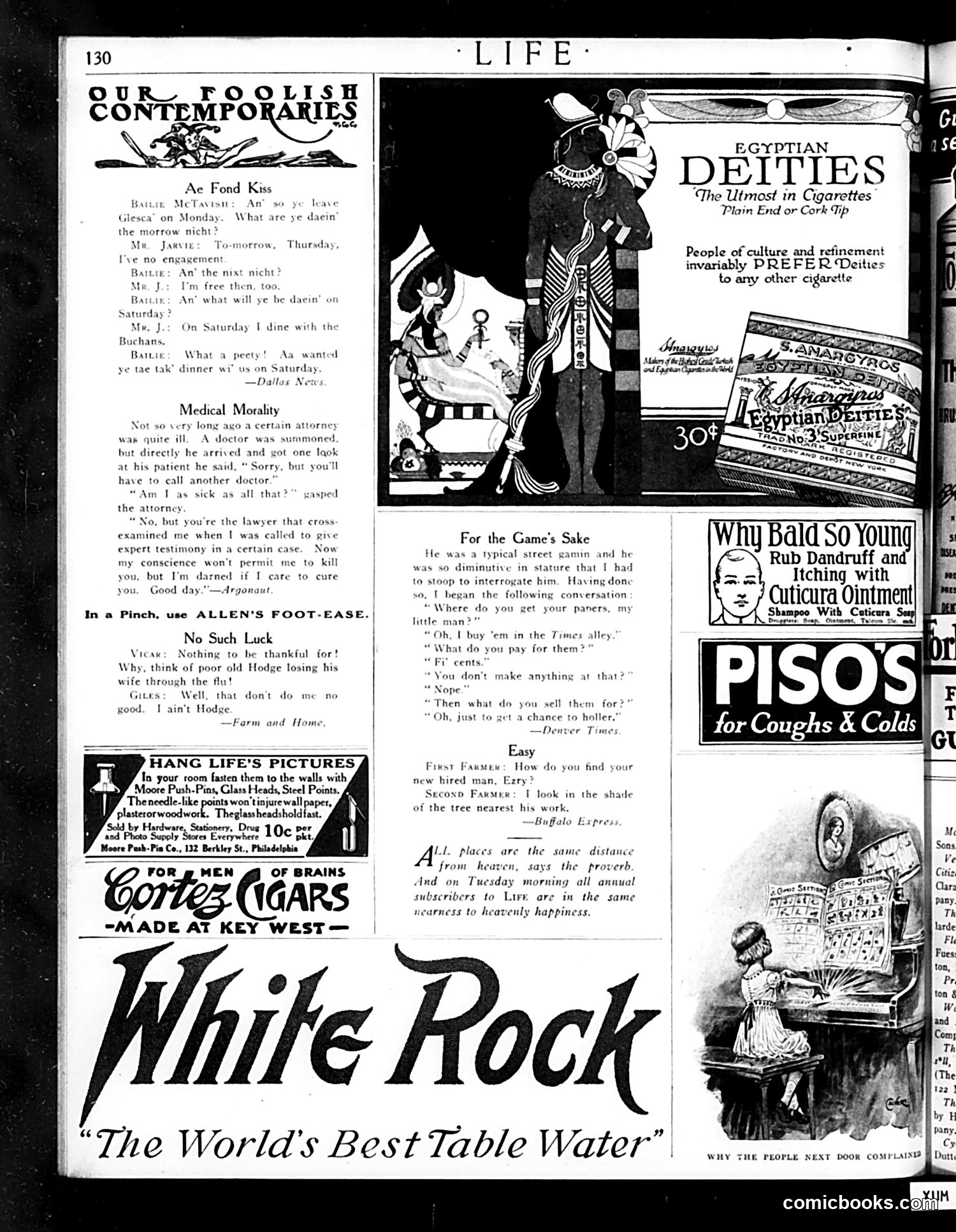
This page is primarily **advertising and light humor** rather than political satire. It contains several unrelated comedic sketches: **"Ae Fond Kiss"** and **"Medical Morality"** are brief Scottish-dialect and legal profession jokes with no significant satirical content—just mild humor about social arrangements and a doctor refusing to treat a lawyer he previously faced in court. **"For the Game's Sake"** depicts a street child vendor in the Times alley, apparently making no profit selling newspapers "just to get a chance to holler"—likely satirizing child labor and economic desperation, though gently. The page is dominated by **period advertisements**: Egyptian Deities cigarettes, Pisos cough remedy, Cuticura products, Cortes cigars, and White Rock water. These ads feature typical early-20th-century marketing imagery and claims. **No major political figures or events are referenced.** The satirical content is minor and domestic—marital plans, workplace ethics, street trade—reflecting ordinary American life rather than significant social commentary.
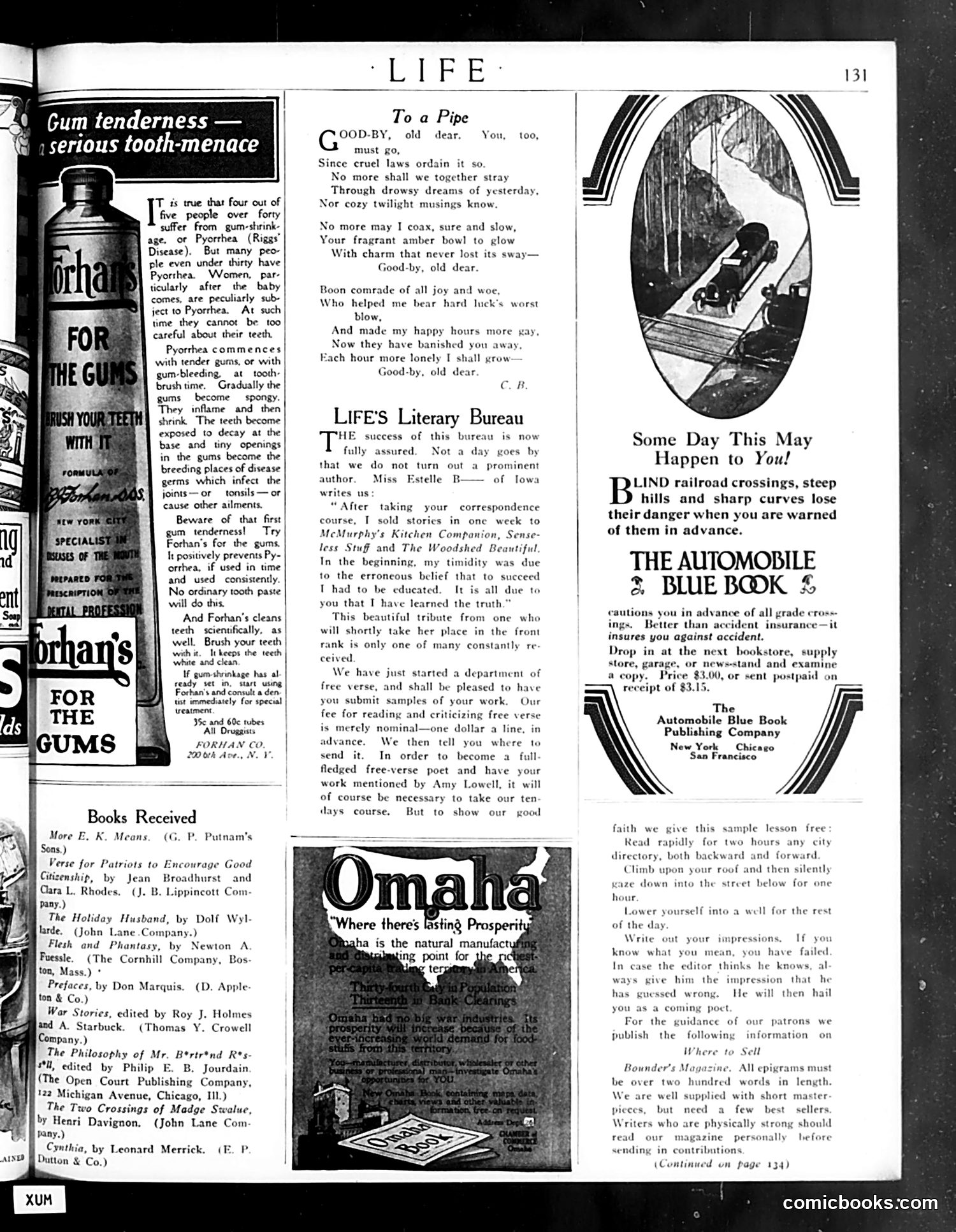
This page contains three distinct elements: **Left side:** Advertisement for Forhan's toothpaste, warning of pyorrhea (gum disease) affecting people over forty, marketed as a preventative dental product. **Center:** A sentimental poem titled "To a Pipe," written by C.B., bidding farewell to a beloved pipe tobacco as if saying goodbye to a friend. This appears to reference **Prohibition** — the poem mourns the loss of a cherished smoking companion due to "cruel laws" that have "banished you away." This is satirical commentary on the alcohol ban that also affected tobacco culture and personal freedoms. **Right side:** "LIFE's Literary Bureau" — a humorous satire mocking correspondence writing courses and get-rich-quick schemes. It features a fake testimonial from someone who claims instant success, and charges one dollar per line to critique "free verse" poetry, promising connections to famous modernist poet Amy Lowell. This ridicules both vanity publishing and the pretentiousness of 1920s literary modernism. The Automobile Blue Book advertisement appears secondary.
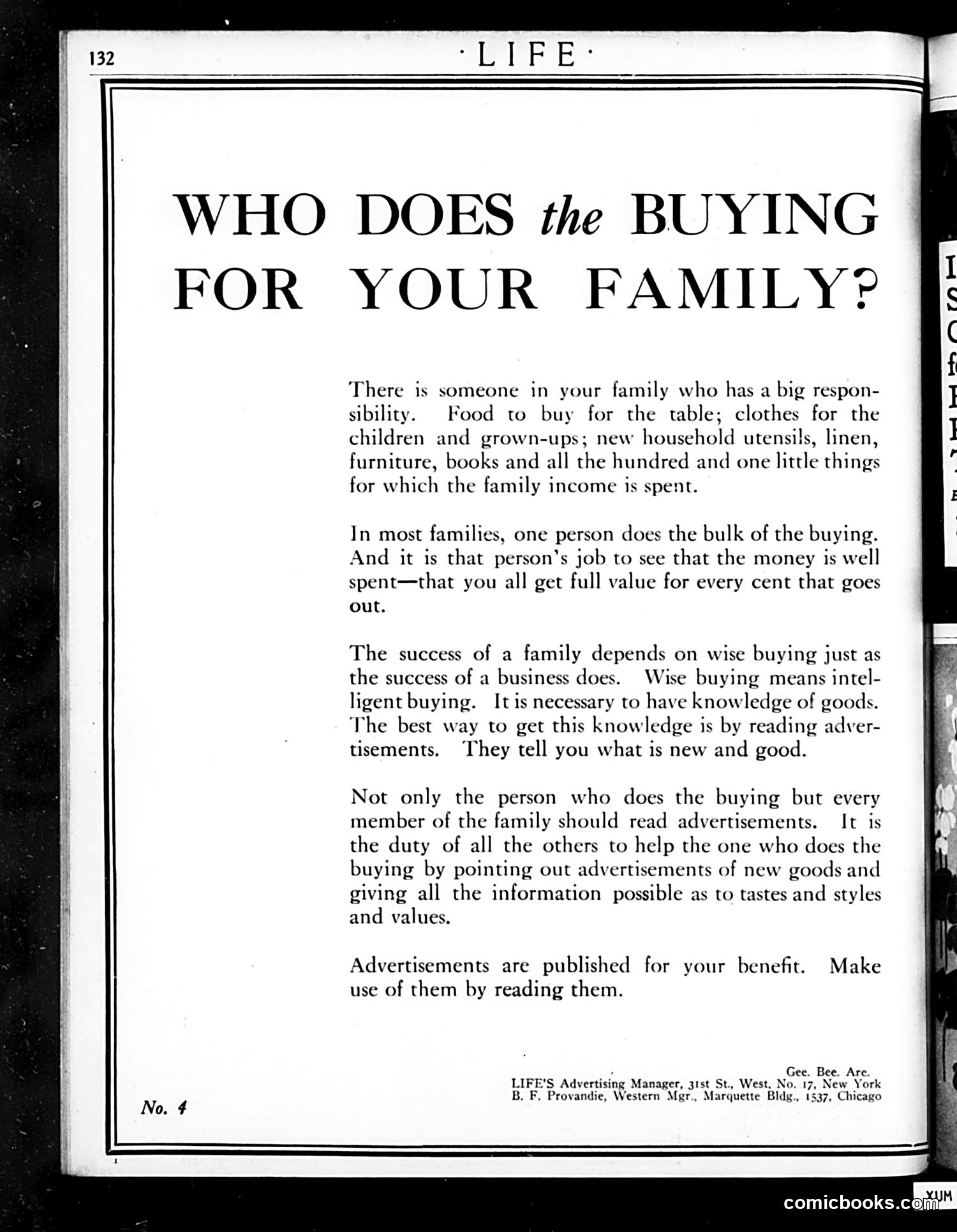
This is not a cartoon but an **advertisement/editorial piece** from Life magazine promoting the value of reading advertisements. The content addresses the (presumably female) family member responsible for household purchasing—a significant economic role in early-20th-century domestic life. The piece frames wise shopping as a business skill requiring "knowledge of goods," encouraging readers to study advertisements as educational tools. Notably, it also calls on *all* family members to read ads and assist the primary shopper by identifying new products and providing information about "tastes and styles and values." The message reflects the era's recognition of household purchasing power while promoting advertising itself as a public service. This self-interested pitch—essentially asking readers to consume more advertising—was typical of Life's approach to monetizing its publication through advertiser partnerships.
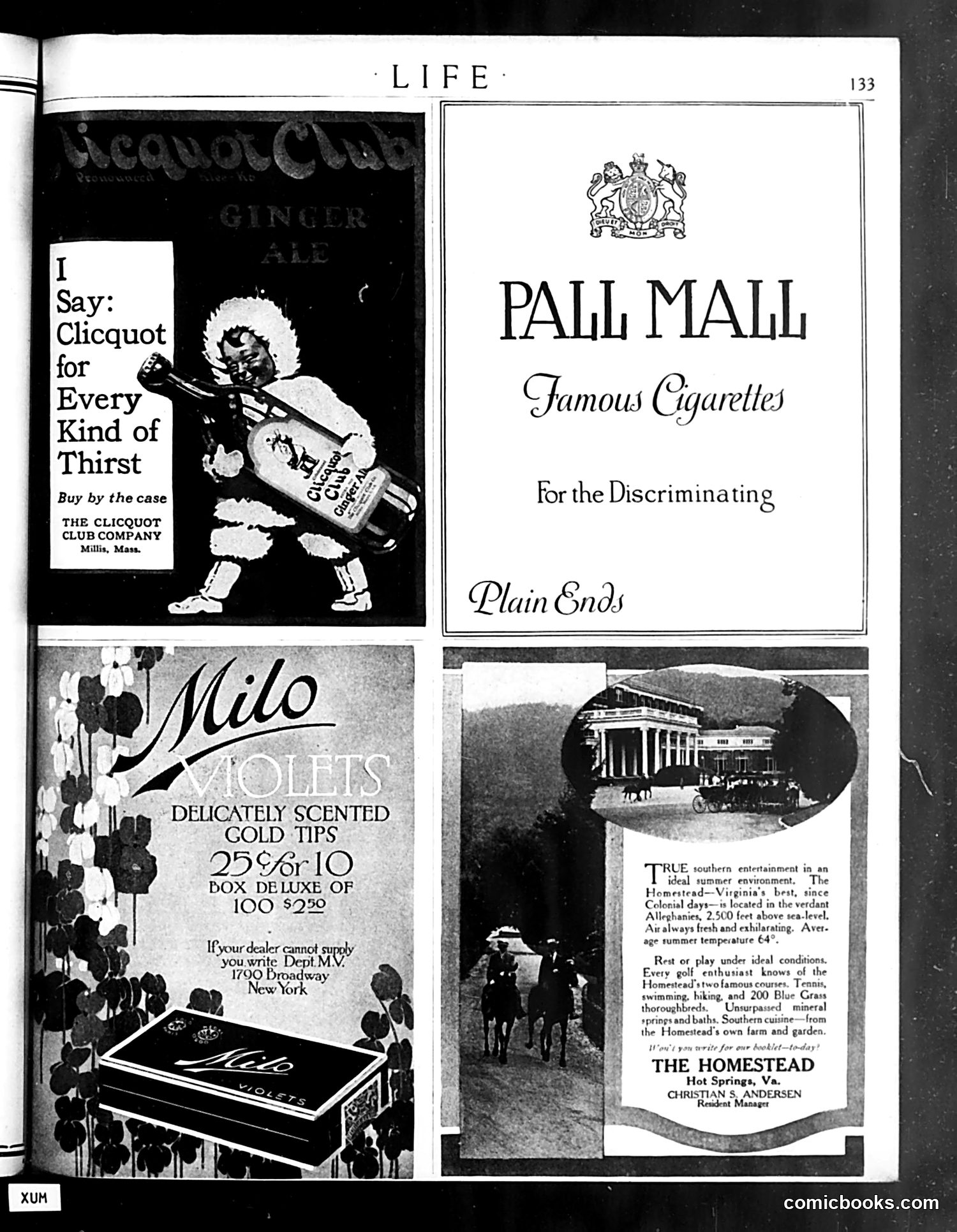
This page is primarily **advertising**, not satire or political commentary. It contains four separate product advertisements typical of early-to-mid 20th century magazines: 1. **Clicquot Club** (top left): A ginger ale advertisement featuring a cartoonish character in winter clothing, emphasizing the product as refreshment "for every kind of thirst." 2. **Pall Mall Cigarettes** (top right): Positioning the brand as for "the Discriminating" consumer with "Plain Ends." 3. **Milo Violets** (bottom left): Delicately scented cigarettes marketed as luxury goods ($2.50 per box of 100). 4. **The Homestead** (bottom right): A resort advertisement in Hot Springs, Virginia, highlighting recreational activities and amenities. The page reflects period consumer culture and advertising aesthetics rather than containing political satire or social commentary. The imagery and messaging are straightforward product promotion.
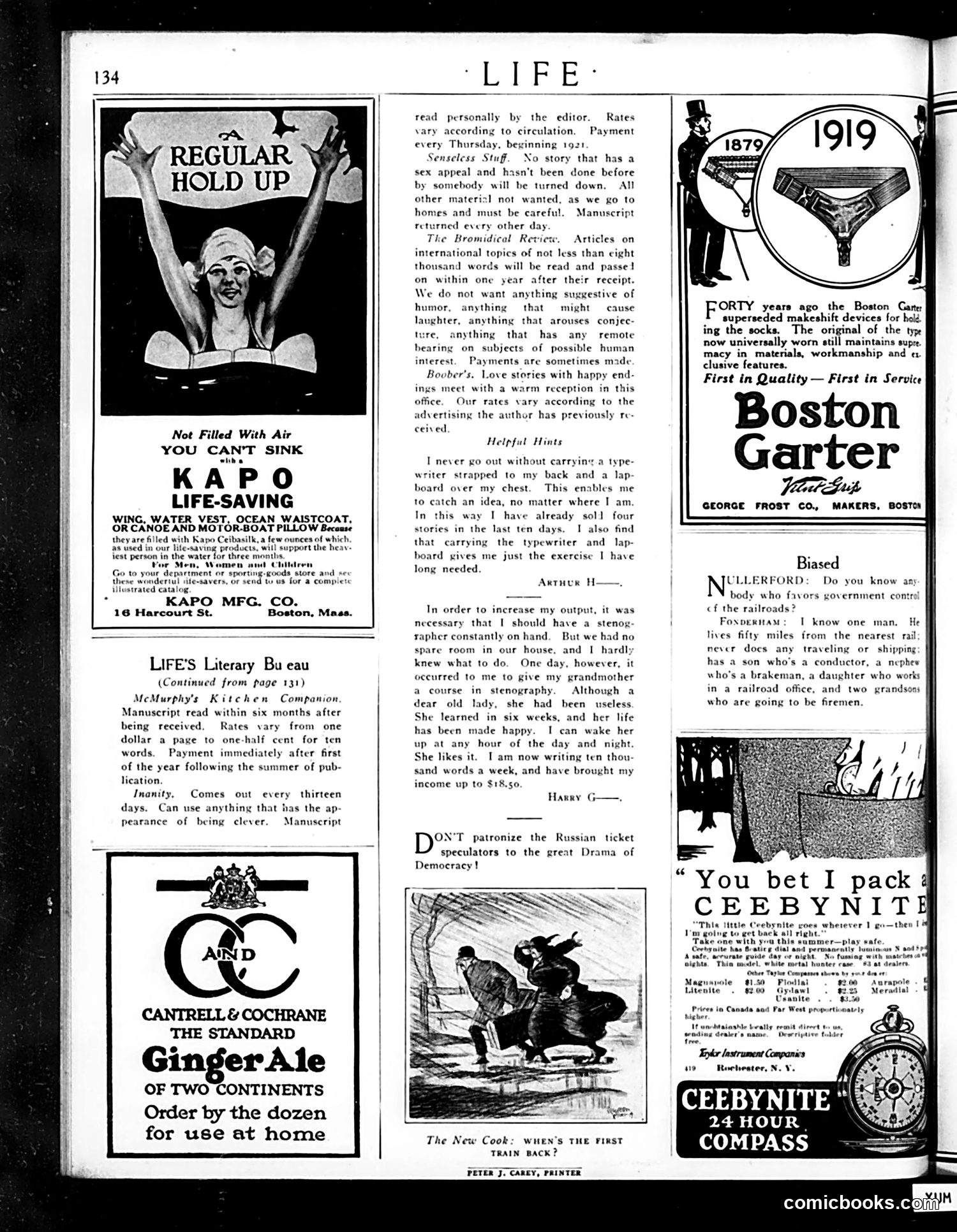
This page is primarily **advertising and satirical humor columns**, not political cartooning in the traditional sense. The main satirical content is "LIFE's Literary Bureau"—a mockery of magazine submission guidelines. It parodies pretentious publications by describing absurd editorial policies: one magazine accepts only "senseless stuff" with no humor or human interest; another takes a year to respond to submissions. The satire mocks both self-important editors and struggling writers chasing publication. The "Helpful Hints" section continues this theme, with writers describing ridiculous productivity hacks (carrying typewriters on their backs, teaching stenography to grandmothers). The final dialogue joke plays on railroad regulation debates: a man favors government control of railroads—but only because his entire family works for the railroad industry, so he profits regardless. This satirizes self-interested arguments in policy debates. The page is otherwise filled with period product advertisements (life jackets, ginger ale, garters, compasses).
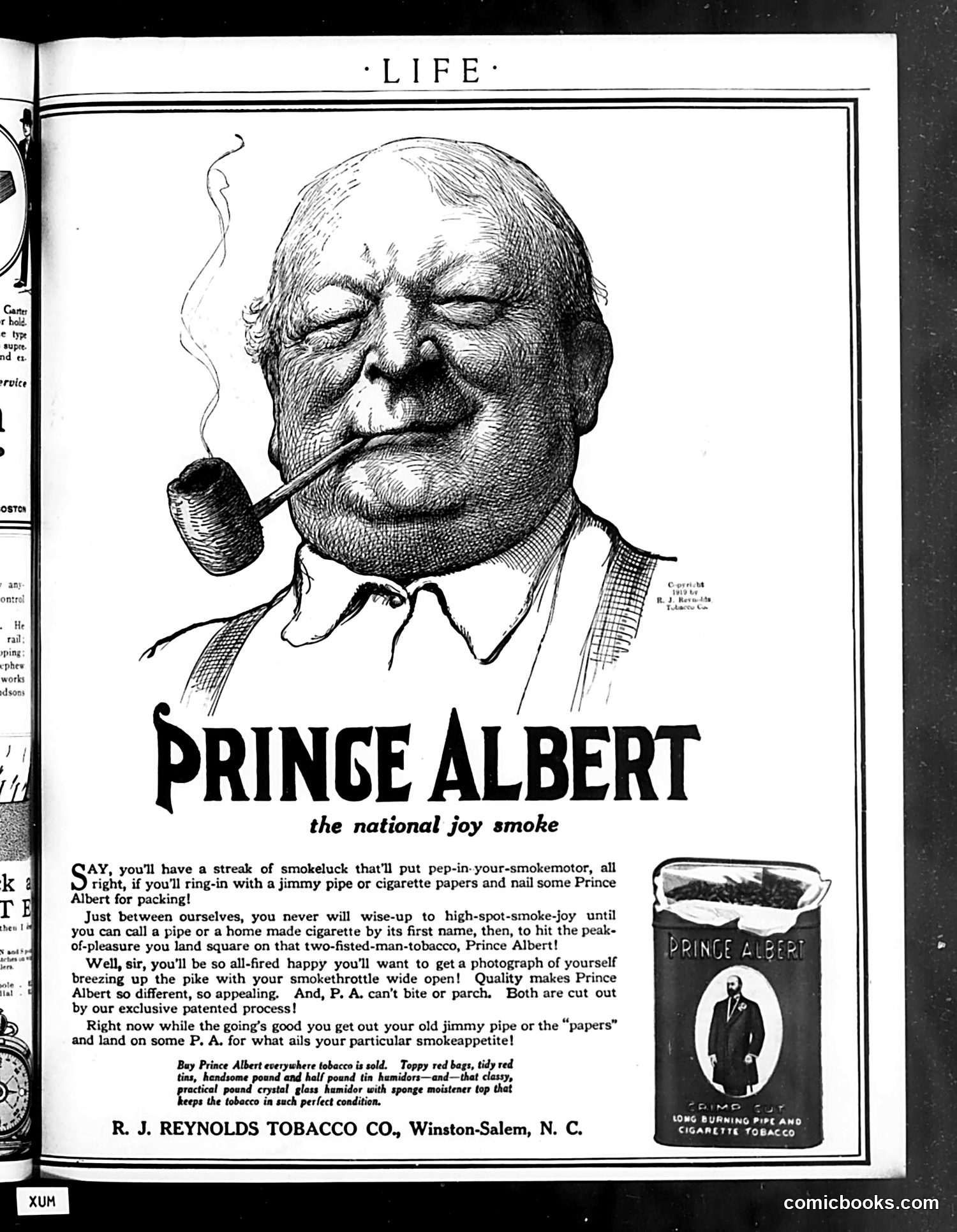
This is a **tobacco advertisement**, not political satire. It appeared in *Life* magazine promoting Prince Albert pipe tobacco by R.J. Reynolds Tobacco Co. The image shows a caricatured gentleman smoking a pipe, labeled "the national joy smoke." The ad uses colloquial, playful language ("smokeluck," "smokemotor," "smokethrottle") to pitch the product's appeal. It emphasizes that Prince Albert tobacco is superior because it "can't bite or parch" and uses an "exclusive patented process." The advertisement targets male smokers, suggesting that using this tobacco will make them so happy they'll want photographs of themselves. It promises availability in various packaging formats (bags, tins, humidors). This reflects early 20th-century advertising norms when tobacco was openly promoted without health warnings, and such ads appeared regularly in mainstream publications like *Life*.
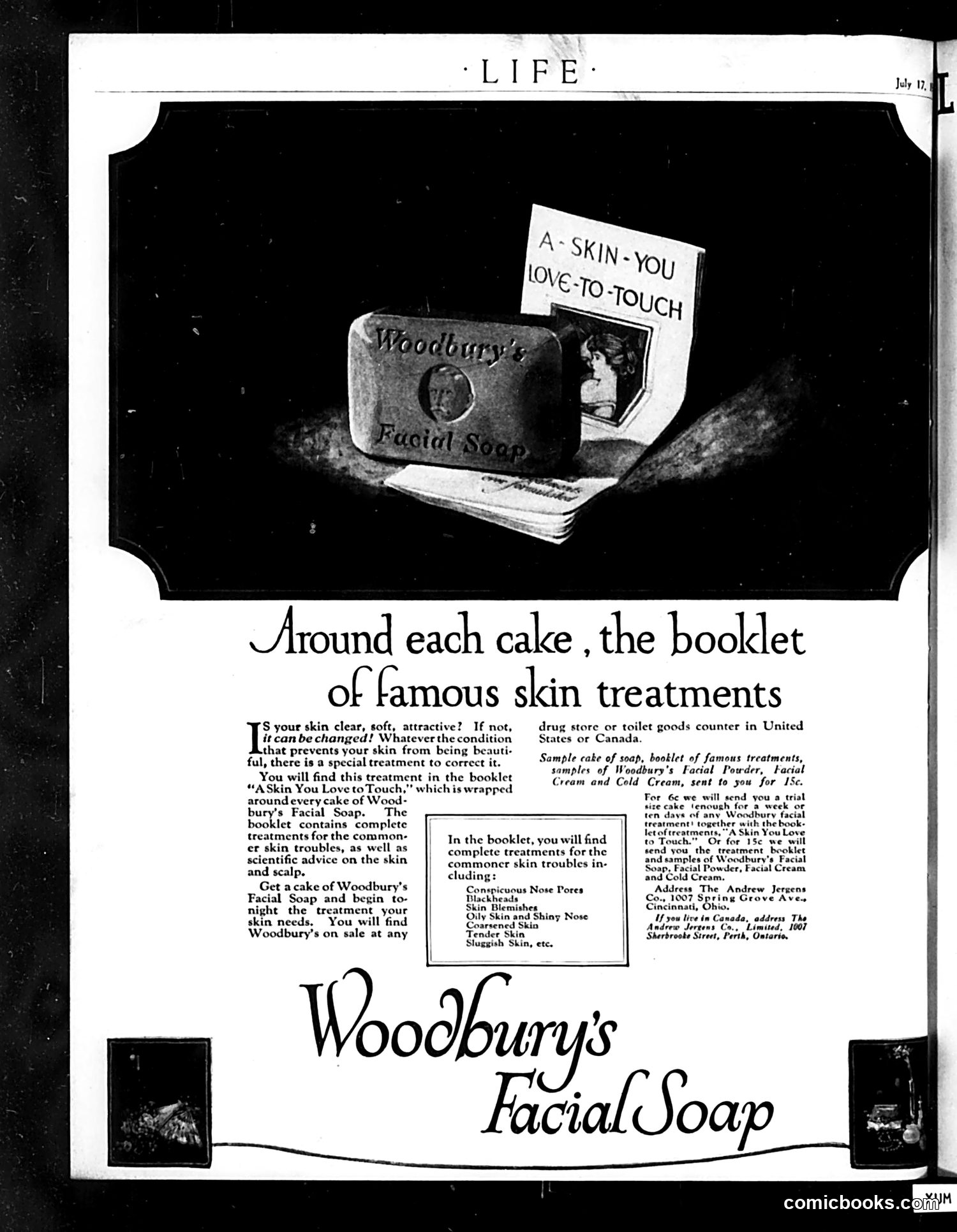
This is primarily a **product advertisement**, not political satire. It's a Woodbury's Facial Soap ad from *Life* magazine (dated July 17, visible in corner). The page shows a bar of soap and promotional booklet titled "A Skin You Love to Touch" held in someone's hands. The advertisement promises that various skin conditions—blackheads, blemishes, coarse pores, sluggish skin—can be corrected with the included booklet of "famous skin treatments." **What a modern reader should know:** This represents early 20th-century beauty marketing that: - Treated common skin issues as correctable "problems" requiring commercial solutions - Used scientific-sounding language ("scientific advice") to sell products - Offered free samples and booklets as marketing incentives - Addressed insecurities about appearance as selling points There is **no political cartoon or satire** on this page—it's straightforward period advertising reflecting era-specific beauty standards and consumer marketing tactics.