
Life, 1919-07-17 · page 22 of 40
Life — July 17, 1919 — page 22: what you’re looking at
What you’re looking at
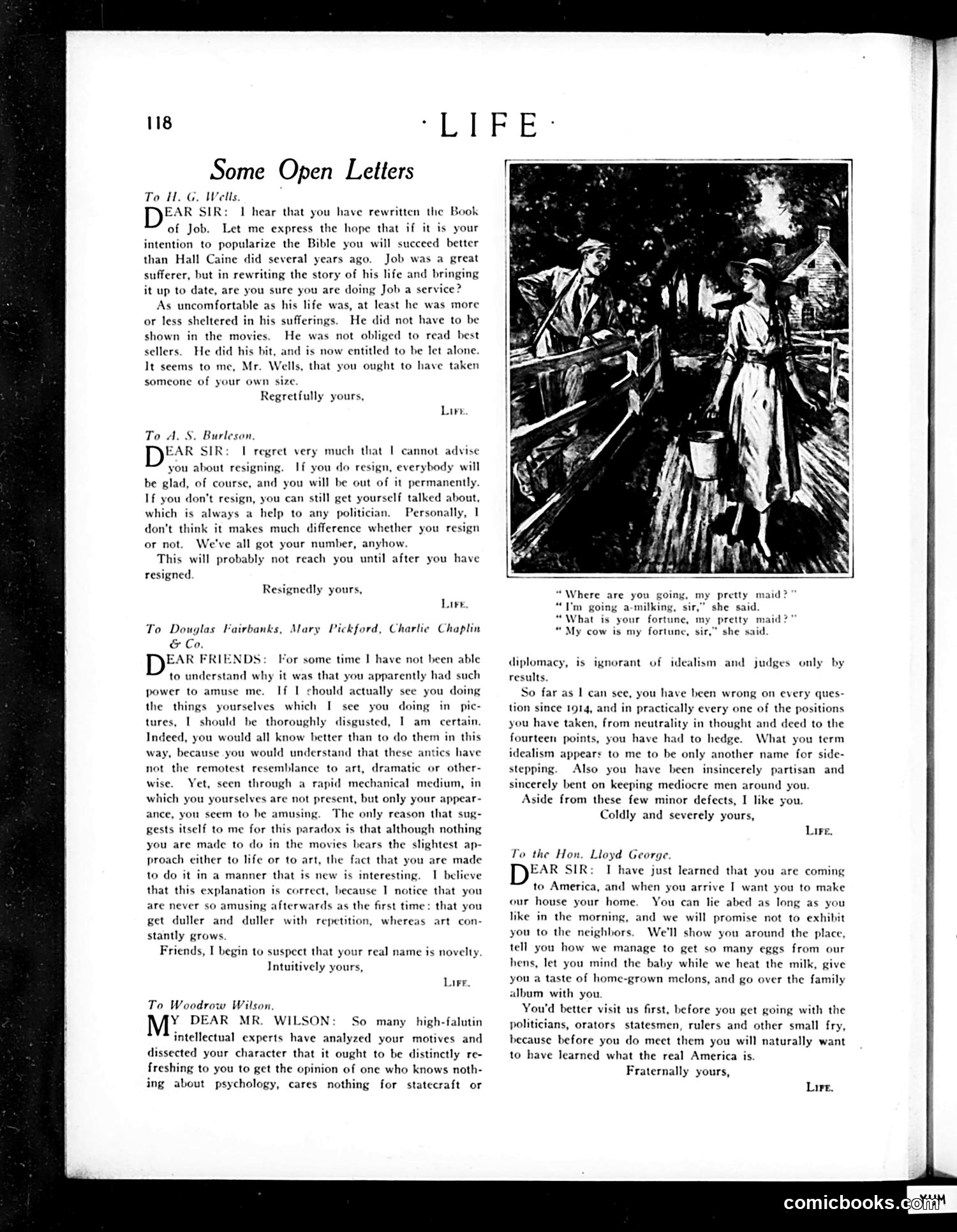
This page features mock "open letters" from Life's editors to public figures, a common satirical format. The letters humorously critique their subjects by: **To H.G. Wells**: Mocks his modernization of the Book of Job, suggesting even suffering biblical figures deserve rest from contemporary indignities like movies and bestsellers. **To A.S. Burleson** (Wilson's Postmaster General): Sarcastically advises resignation is pointless since his reputation is already damaged—either way he's compromised. **To film stars** (Fairbanks, Pickford, Chaplin): Argues their charm exists *only* through mechanical film medium. Real-life antics would be disgusting; their appeal is mere novelty, not artistry. **To Woodrow Wilson**: Brutally attacks his post-1914 record as consistently wrong, calling his "idealism" mere side-stepping and accusing him of surrounding himself with mediocre advisors. The accompanying illustration shows a rural milking scene with period dialogue, likely contrasting simple country virtue against the corrupted figures being satirized. The letters exemplify Life's sophisticated political humor targeting wartime leadership.
📄 Transcribed text from this page (OCR, searchable)
Machine-transcribed from the original scan — historical spelling and the odd misread are preserved.
Some Open Letters To H. G, Wells AR SIR: I hear that you have rewritten the Book of Job. Let me express the hope that if it is your intention to popularize the Bible you will succeed better than Hall Caine did several years ago. Job was a great sufferer, but in rewriting the story of his life and bringing it up to date, are you sure you are doing Job a service? As uncomfortable as his life was, at least he was more or less sheltered in his sufferings. He did not have to be shown in the movies. He was not obliged to read best sellers. He did his bit, and is now entitled to be let alone. It seems to me, Mr. Wells, that you ought to have taken someone of your own size. Regretfully yours, Lire To S. Burleson EAR SIR you about resigning. If you do resign, everybody will be glad, of course, and you will be out of it permanently. If you don’t resign, you can still get yourself talked about, which is always a help to any politician, Personally, | don't think it makes much difference whether you resign or not. We've all got your number, anyhow. This will probably not reach you until after you have resigned. I regret very much that | cannot advise Resignedly yours, Lire To Douglas Fairbanks, Mary Pickford, Charlie Chaplin & Co. EAR FRIENDS: For some time I have not been able to understand why it was that you apparently had such power to amuse me. If I should actually see you doing the things yourselves which I see you doing in_ pic- tures, I should be thoroughly disgusted, 1 am certain. Indeed, you would all know better than to do them in this way, because you would understand that these antics have not the remotest resemblance to art, dramatic or other- wise. Yet, seen through a rapid mechanical medium, in which you yourselves are not present, but only your appear- ance, you seem to he amusing. The only reason that sug- gests itself to me for this paradox is that although nothing you are made to do in the movies bears the slightest ap- proach either to life or to art, the fact that you are made to do it in a manner that is new is interestiny that this explanation is correct, 1 I believe ause I notice that you are never so amusing afterwards as the first time: that you get duller and duller with repetition, whereas art con- stantly grows. Friends, I begin to suspect that your real name is novelty Intuitively yours, Lire. To Woodrow Wilson Y DEAR MR. WILSON: So many high-falutin intellectual experts have analyzed your motives and dissected your character that it ought to be distinctly re- freshing to you to get the opinion of one who knows noth- ing about psychology, cares nothing for statecraft or “Where are you going, my pretty maid?” “I'm going a-milking, sir,” she said. “What is your fortune, my pretty maid?” “ My cow is my fortune, sir,” she said diplomacy, is ignorant of idealism and judges only by results. 0 far as I can see, you have been wrong on every ques- tion since 1914, and in practically every one of the positions. you have taken, from neutrality in thought and deed to the fourteen points, you have had to hedge. What you term idealism appears to me to be only another name for side- stepping. Also you have been insincerely partisan and sincerely bent on keeping mediocre men around you. Aside from these few minor defects, I like you. Coldly and severely yours, Lire. To the Hon. Lloyd George. ZAR SIR: I have just learned that you are coming to America, and when you arrive I want you to make our house your home. You can lie abed as long as you like in the morning, and we will promise not to exhibit you to the neighbors. We'll show you around the place, tell you how we manage to get so many eggs from our hens, let you mind the baby while we heat the milk, give you a taste of home-grown melons, and go over the family album with you. You'd better visit us first, before you get going with the politicians, orators statesmen, rulers and other small fry, because before you do meet them you will naturally want to have learned what the real America is. Fraternally yours, Lire. comicbooks. com