
Life, 1919-07-17 · page 6 of 40
Life — July 17, 1919 — page 6: what you’re looking at
What you’re looking at
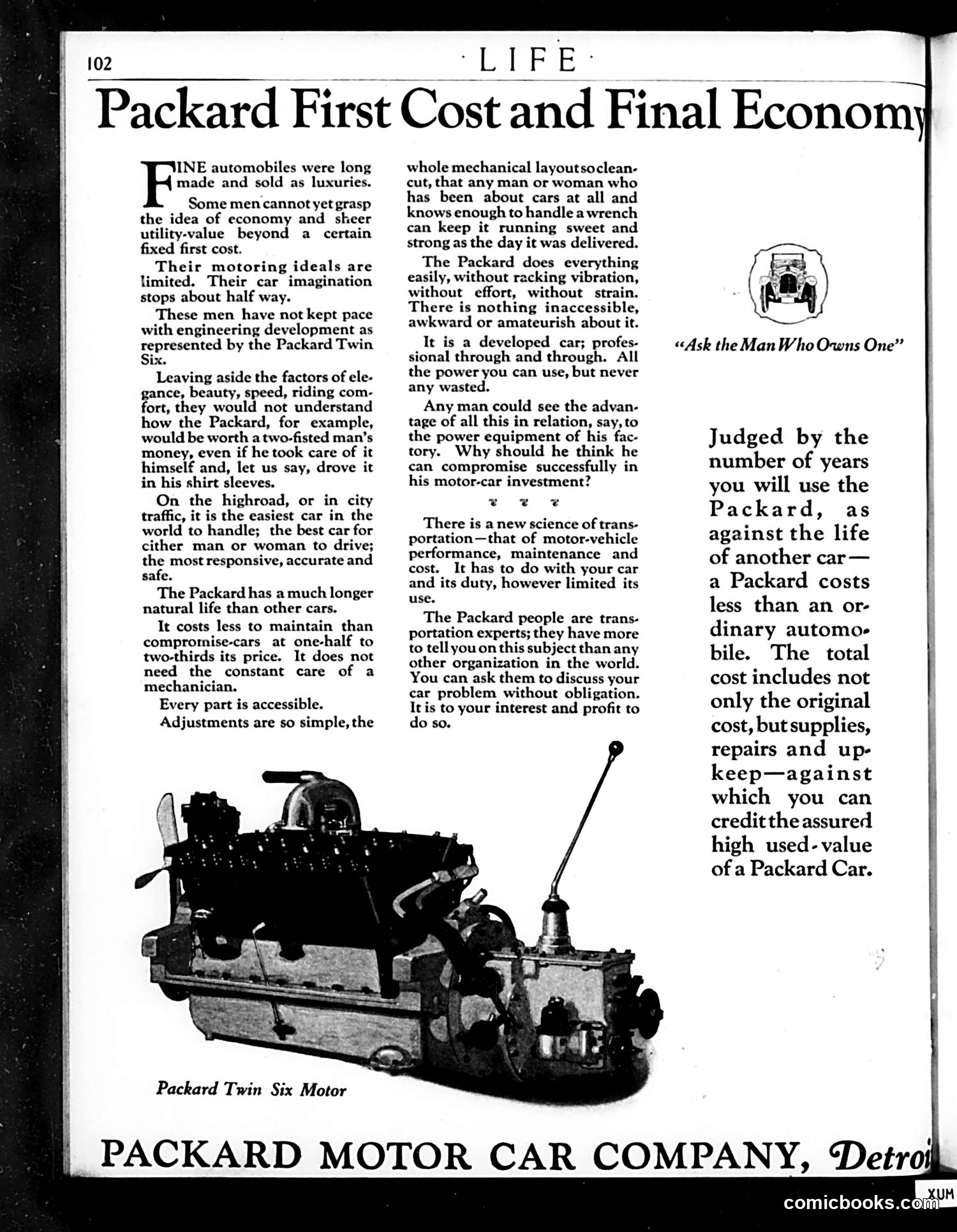
This page is primarily a **Packard automobile advertisement**, not political satire. It appeared in *Life* magazine (page 102) and promotes the Packard Twin Six motor car. The advertisement argues that while some men fixate on initial cost, a Packard represents superior long-term economy. The key claim: a Packard costs less to maintain than cheaper cars and retains higher resale value, making total ownership cost lower despite the higher purchase price. The image shows the Packard Twin Six engine, emphasizing mechanical quality and accessibility of parts. The tagline "Ask the Man Who Owns One" became Packard's famous slogan. This reflects early 20th-century automotive marketing targeting affluent buyers willing to pay premium prices for reliability and durability—a luxury positioning still used today.
📄 Transcribed text from this page (OCR, searchable)
Machine-transcribed from the original scan — historical spelling and the odd misread are preserved.
Packard First C INE automobiles were long made and sold as luxuries. Some men cannot yet grasp the idea of economy and sheer utility-value beyond a certain fixed first cost. Their motoring ideals are limited. Their car imagination stops about half way. These men have not kept pace with engineering development as represented by the Packard Twin Six. Leaving aside the factors of ele- gance, beauty, speed, riding com- fort, they would not understand how the Packard, for example, would be worth a two-fisted man’s money, even if he took care of it himself and, let us say, drove it in his shirt sleeves. On the highroad, or in city traffic, it is the easiest car in the world to handle; the best car for cither man or woman to drive; the most responsive, accurate and safe. The Packard has a much longer natural life than other cars. It costs less to maintain than compromise-cars at one-half to two-thirds its price. It does not need the constant care of a mechanician. Every part is accessible. Adjustments are so simple, the Packard Twin Six Motor “LIFE: whole mechanical layoutsoclean- cut, that any man or woman who has been about cars at all and knows enough to handle awrench can keep it running sweet and strong as the day it was delivered. The Packard does everything easily, without racking vibration, without effort, without strain. There is nothing inaccessible, awkward or amateurish about it. It is a developed car; profes- sional through and through. All the power you can use, but never any wasted. Any man could see the advan- tage of all this in relation, say, to the power equipment of his fac- tory. Why should he think he can compromise successfully in his motor-car investment? 23 2 There is a new science of trans- portation—that of motor-vehicle performance, maintenance and cost. It has to do with your car and its duty, however limited its use. The Packard people are trans- portation experts; they have more to tellyouon this subject than any other organization in the world. You can ask them to discuss your car problem without obligation. It is to your interest and profit to do so. (Ee «Ask the ManWho Owns One” Judged by the number of years you will use the Packard, as against the life of another car— a Packard costs less than an or- dinary automo- bile. The total cost includes not only the original cost, but supplies, repairs and up- keep—against which you can credit the assured high used- value of a Packard Car. comicbooks.co! ost and Final Economy _PACKARD MOTOR CAR COMPANY, Detroi mie IM