
A complete issue · 50 pages · 1919
Life — May 15, 1919
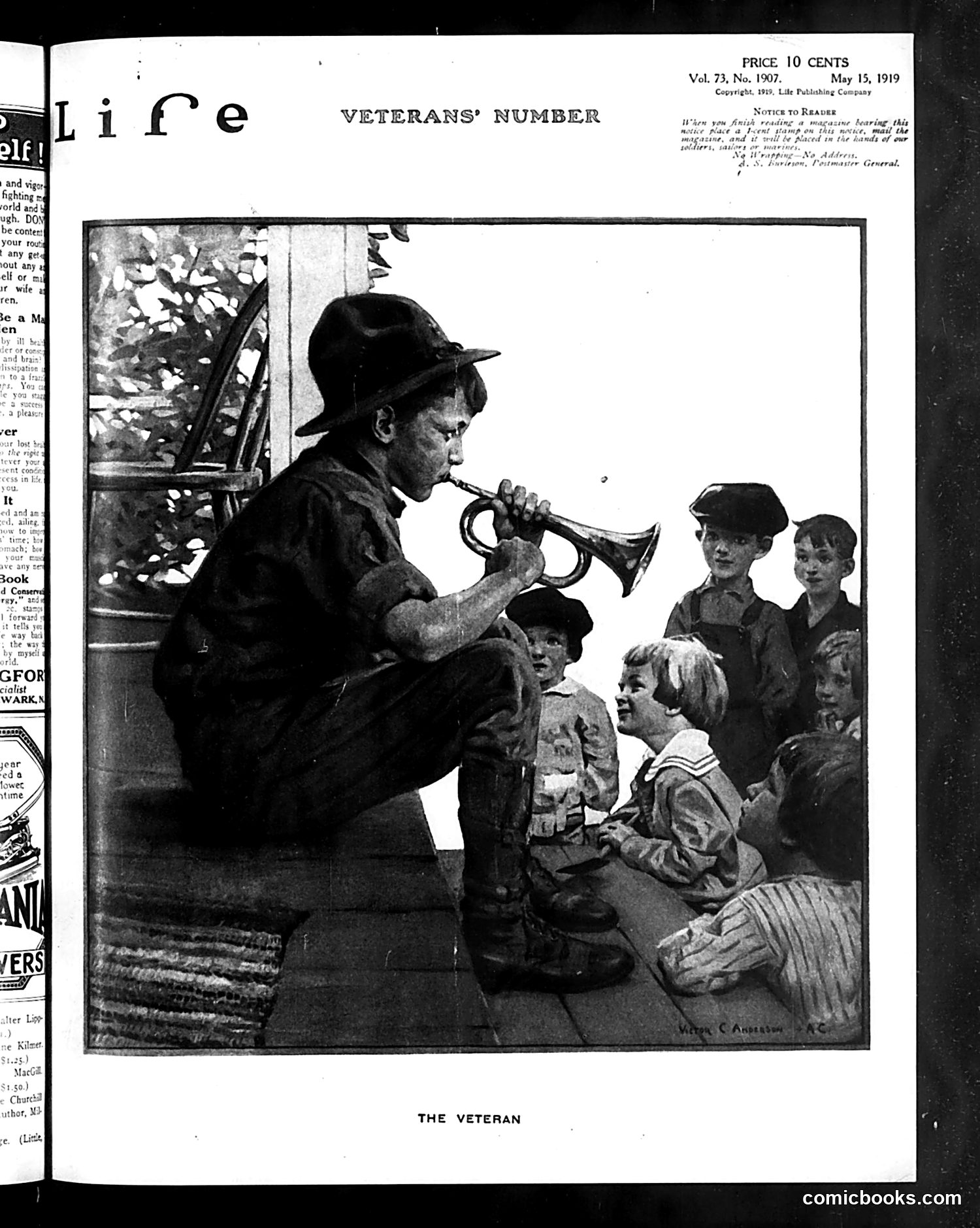
This is Life's "Veterans' Number" from shortly after World War I's November 1918 armistice. The photograph shows a uniformed soldier playing a bugle or horn to an attentive group of children seated around him. The image is titled simply "THE VETERAN." The piece appears to celebrate the return of American servicemen to civilian life and their role in communities. The veteran is depicted sharing his experiences or entertaining youth—likely representing post-war reintegration and the soldier's new civilian role. Given Life's satirical nature, there may be gentle irony in contrasting the soldier's military service with domestic peacetime activities, though the image itself presents a straightforward, nostalgic representation of homecoming and community connection.
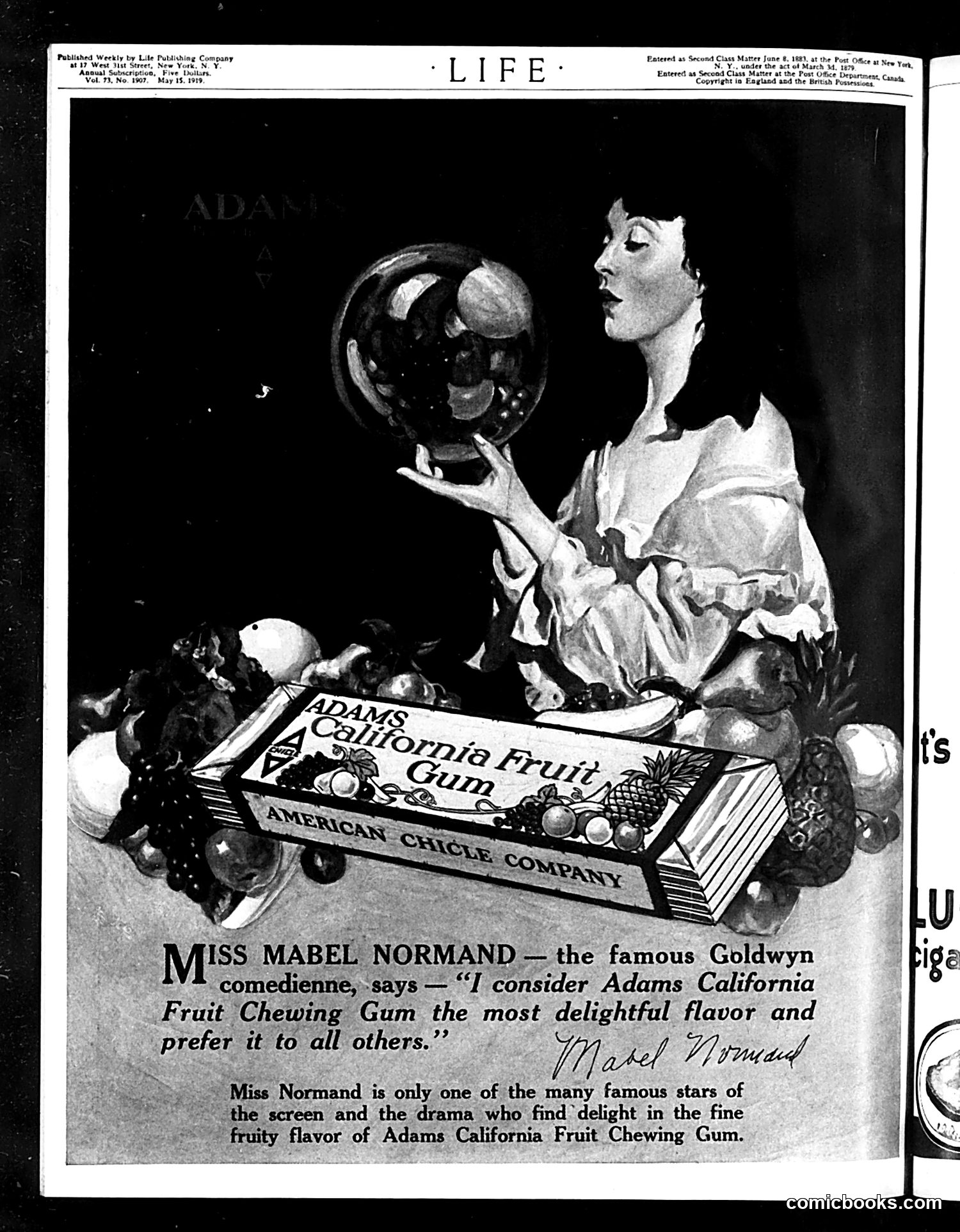
This is primarily an **advertisement**, not political satire or editorial content. The page features a celebrity endorsement from **Mabel Normand**, identified as a famous Goldwyn comedienne (silent film actress), promoting **Adams California Fruit Chewing Gum**. The theatrical staging—Normand holding a crystal ball while surrounded by fruit—evokes mystical fortune-telling, a popular entertainment trope of the era. The "crystal ball" likely references her film work and creates visual drama for the ad. The endorsement quotes Normand praising the gum's "delightful flavor," a standard celebrity testimonial claiming that famous entertainers prefer this product. The ad emphasizes that multiple "famous stars of the screen and the drama" endorse Adams gum, leveraging celebrity culture to sell consumer products—a marketing strategy that remains standard today.
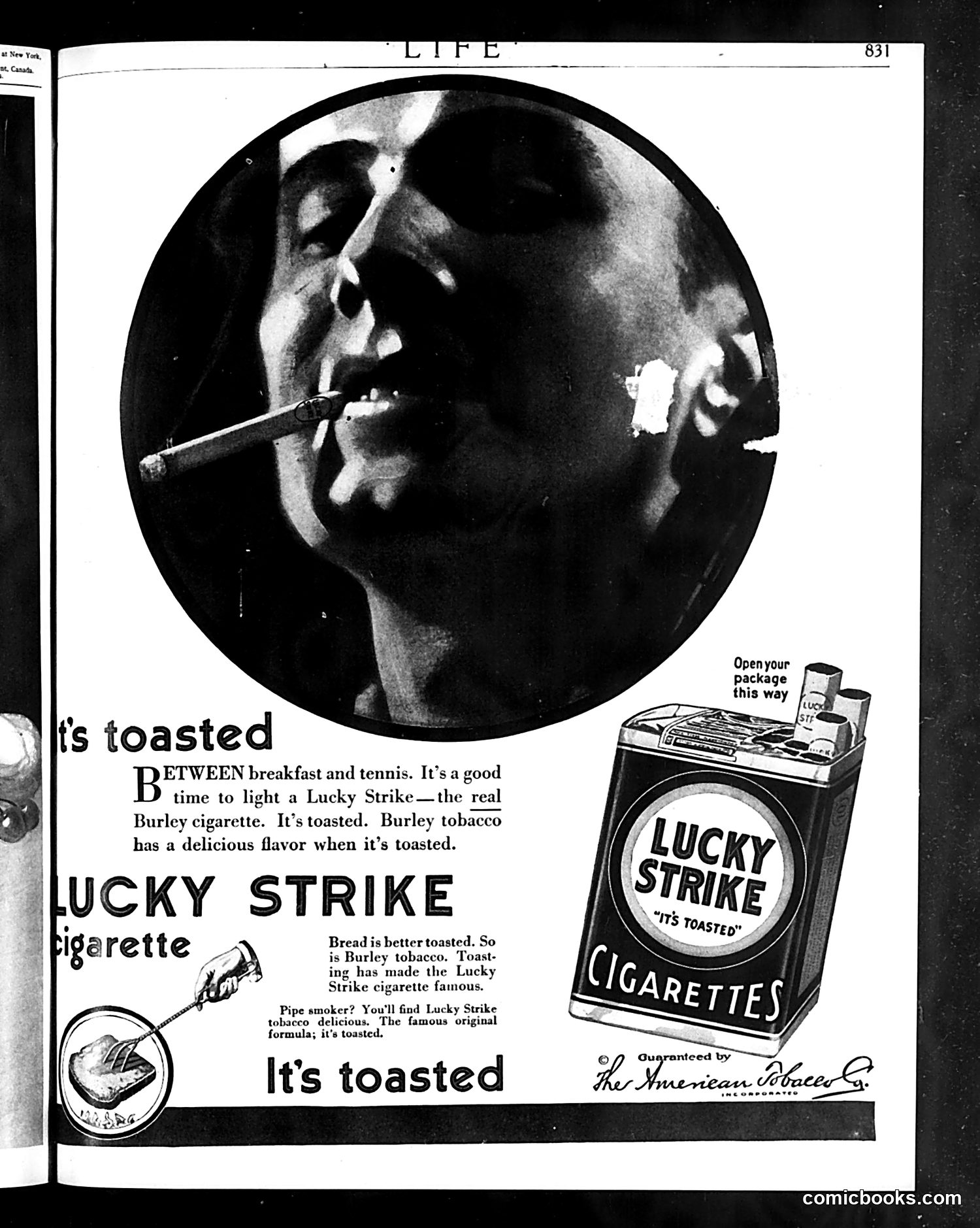
This is a **cigarette advertisement**, not political satire. It promotes Lucky Strike's "toasted" tobacco process as a selling point, claiming the toasting creates superior flavor for various smoking occasions—"between breakfast and tennis." The large circular image shows a man smoking a cigarette, presented as an aspirational figure enjoying leisure time. The advertisement emphasizes that "Burley tobacco has a delicious flavor when it's toasted" and repeats "It's toasted" as the key marketing message. The page includes product packaging imagery and mentions the cigarettes are "Guaranteed by The American Tobacco Co." **For modern readers**: This reflects an era when cigarette advertising was completely unrestricted and could make health/flavor claims freely in mainstream magazines. The "toasted" process was Lucky Strike's actual competitive advantage in that era.
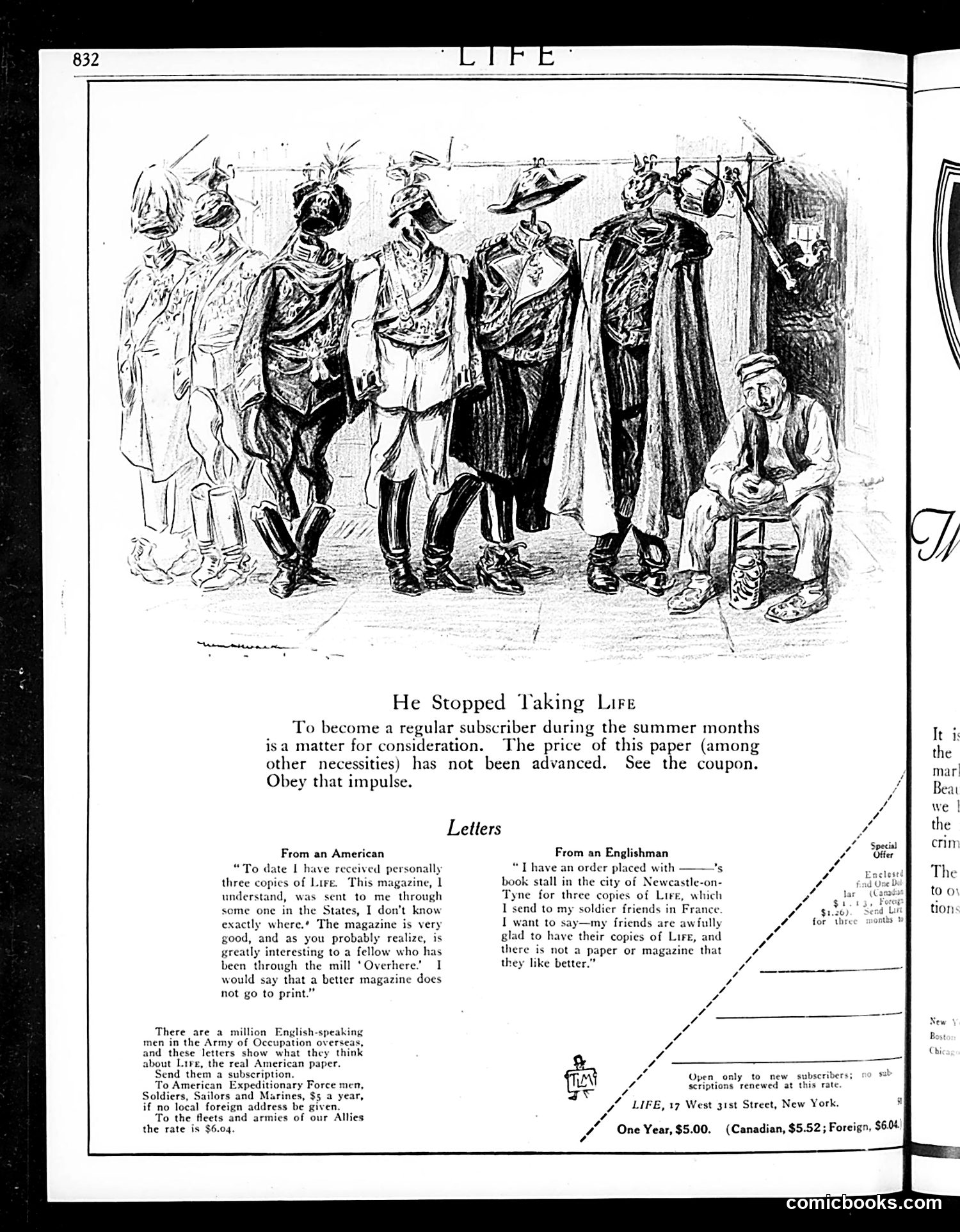
This page from *Life* magazine features a satirical cartoon titled "He Stopped Taking Life" that mocks someone who discontinued his magazine subscription during summer months. The cartoon depicts military officers in ornate uniforms—likely representing European royalty or high-ranking WWI-era military officials—standing in a group while a common soldier sits apart, looking dejected. The satire suggests that even soldiers overseas appreciate *Life*'s value as essential reading. The accompanying letters from American and English servicemen emphasize how widely distributed the magazine is among troops in France and the Army of Occupation. The humor implies that ceasing subscription is socially or patriotically questionable when soldiers treasure the publication so highly.
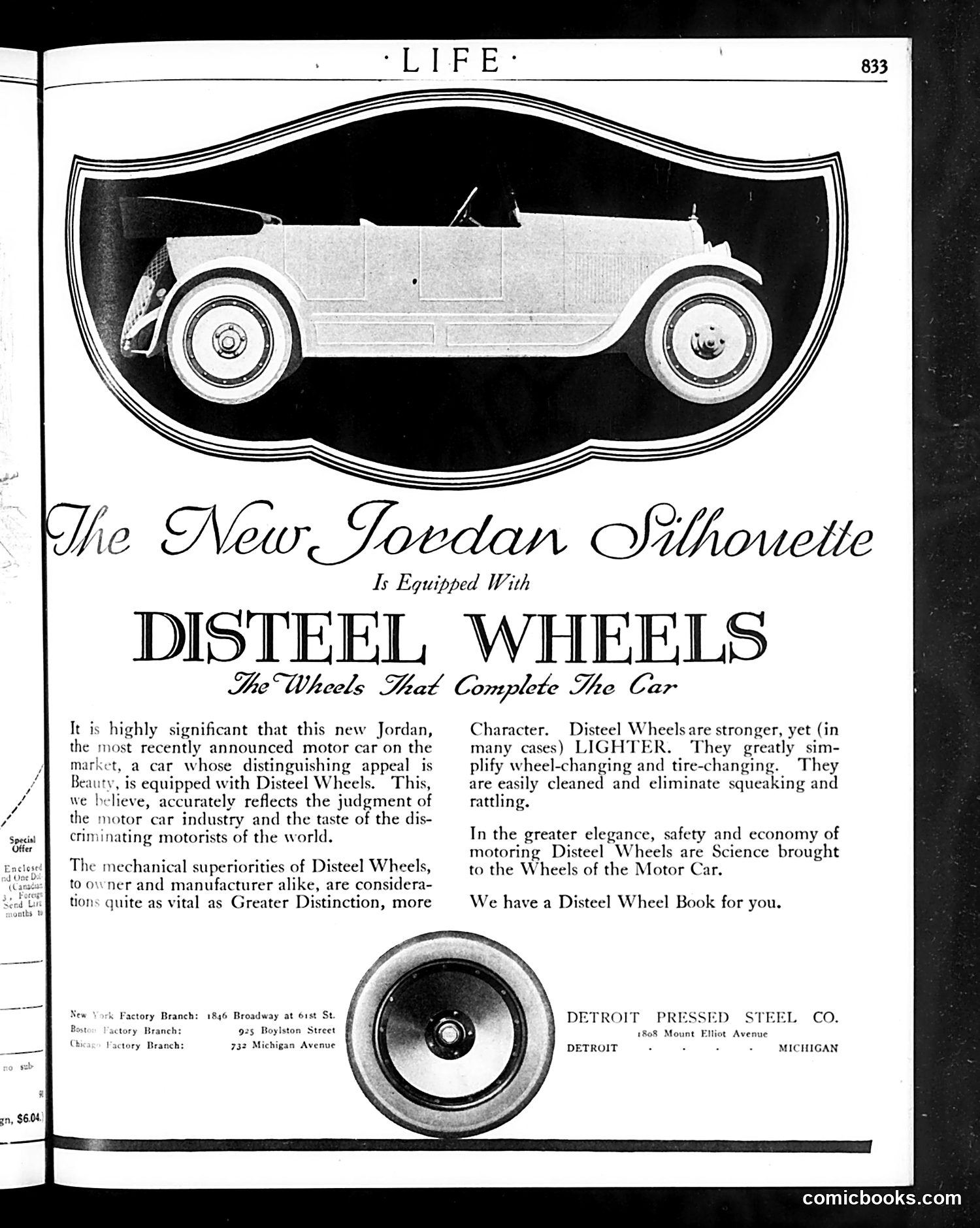
This page is **not a political cartoon or satire**—it's a straightforward advertisement. It promotes the Jordan automobile, a real car manufactured in the 1920s, highlighting its new feature: Disteel Wheels (steel wheels manufactured by Detroit Pressed Steel Co.). The ad emphasizes practical benefits: Disteel Wheels are stronger, lighter, easier to clean, and eliminate squeaking. The appeal is to "discriminating motorists" who value both elegance and economy. The image shows a side-view silhouette of the Jordan automobile, and a close-up photograph of the wheel itself. This is period commercial advertising in *Life* magazine, not editorial content or satire.
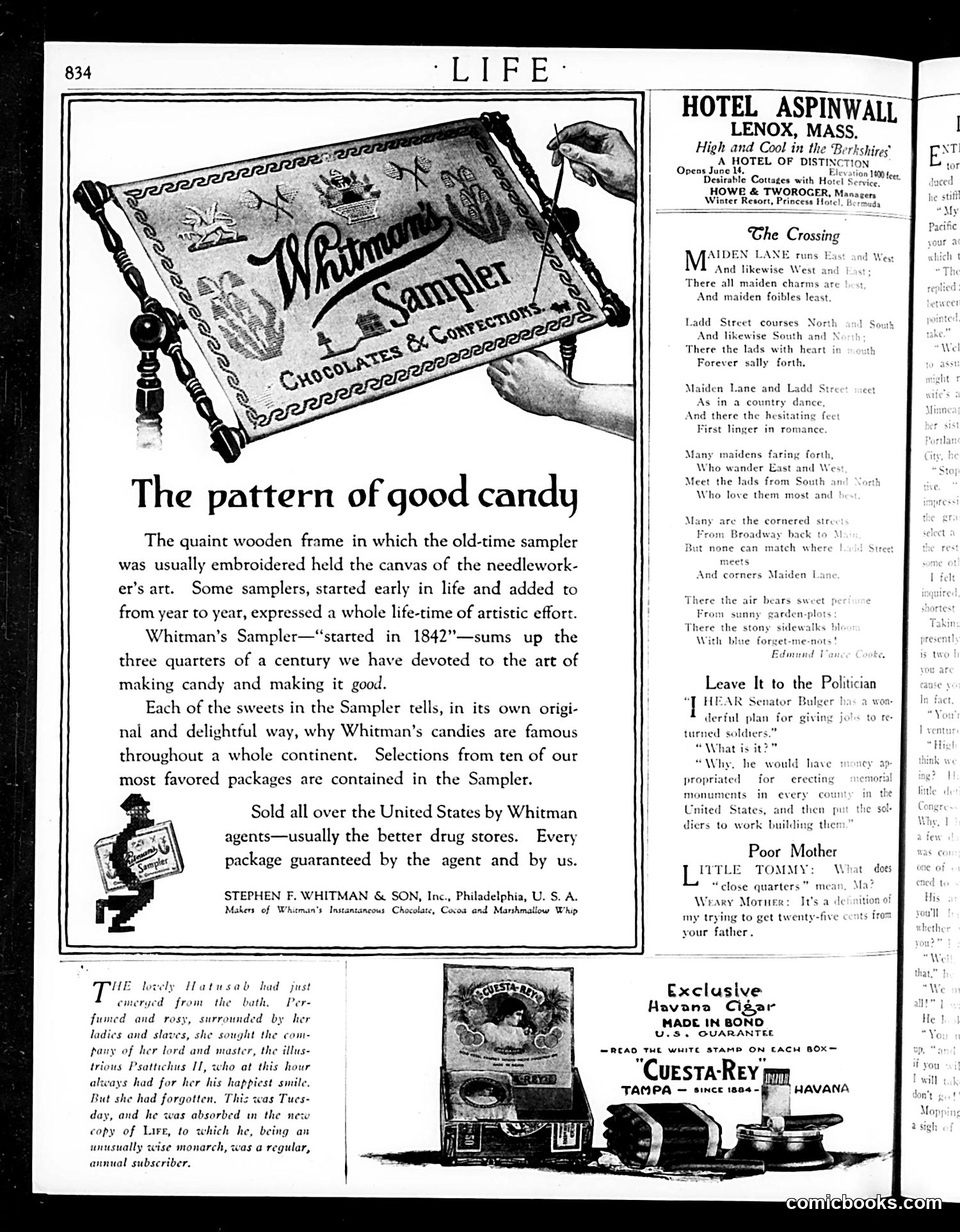
This page is primarily **advertising rather than political satire**. The dominant content is a Whitman's Sampler chocolate advertisement featuring a decorative wooden sampler frame (referencing needlework samplers). The ad emphasizes the product's long candy-making tradition ("three quarters of a century") and nationwide availability. The right column contains unrelated content: a poem titled "The Crossing" about Maiden Lane in New York City, and brief comedic exchanges ("Leave It to the Politician," "Poor Mother") that appear to be humor filler rather than serious satire. Additional ads for Hotel Aspinwall and Cuesta-Rey cigars occupy the bottom portion. The page reflects Life magazine's mixed business model combining light humor with commercial advertisements.
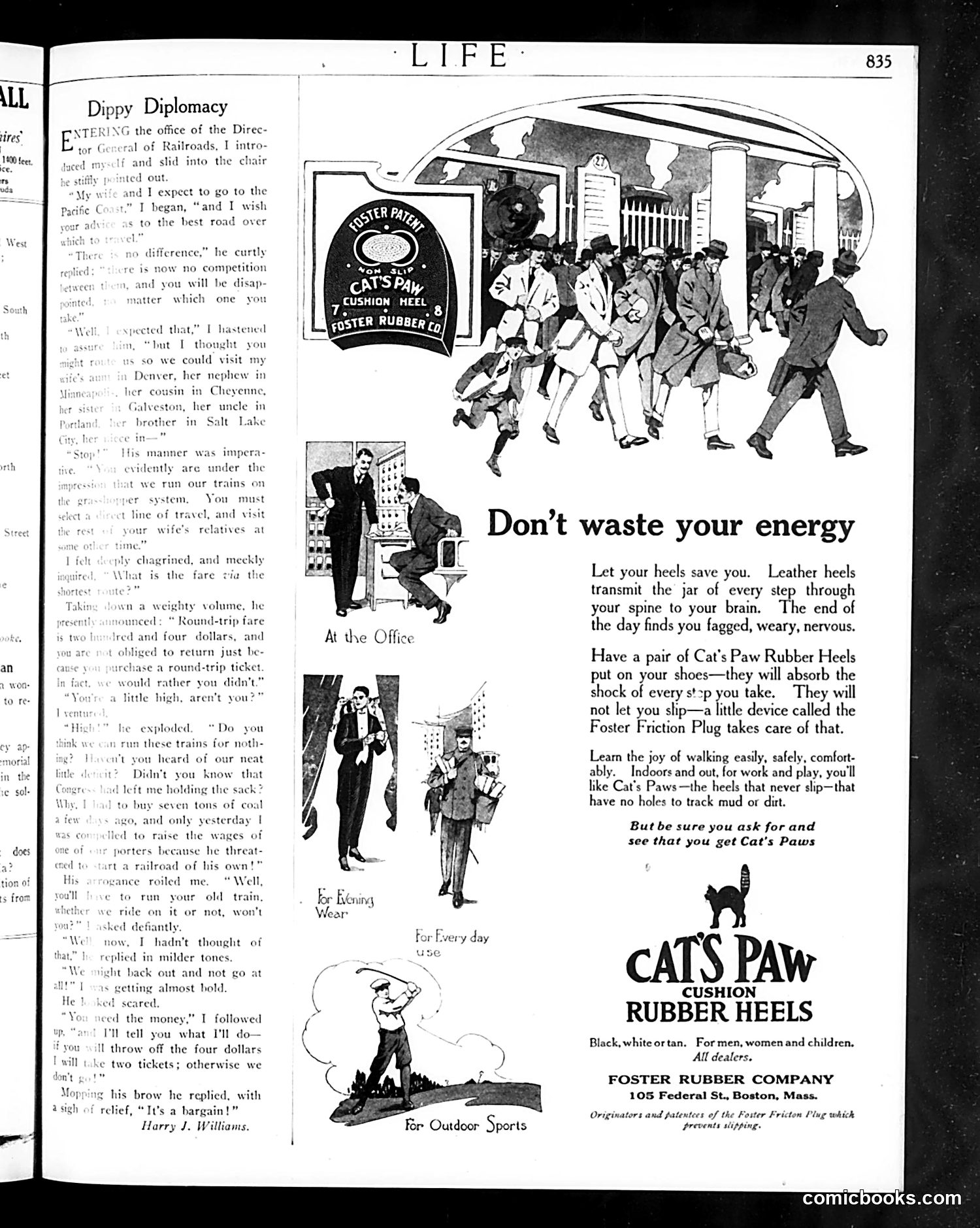
This page contains a humorous short story ("Dippy Diplomacy") on the left, but the dominant content is a **full-page advertisement for Cat's Paw Rubber Heels** by the Foster Rubber Company of Boston. The ad uses comedic illustrations showing people in various situations—at an office, commuting, playing sports—arguing that rubber heels prevent fatigue and worn shoes. The central cartoon shows a group of men appearing to slip or slide, illustrating the product's grip and safety benefits. The humor relies on everyday workplace and travel frustrations relatable to 1920s readers. The ad emphasizes practicality: rubber heels absorb shock, prevent slipping, and keep shoes from getting muddy—concerns that would resonate with commuters and office workers of that era. The "Cat's Paw" branding and mascot give the product personality.
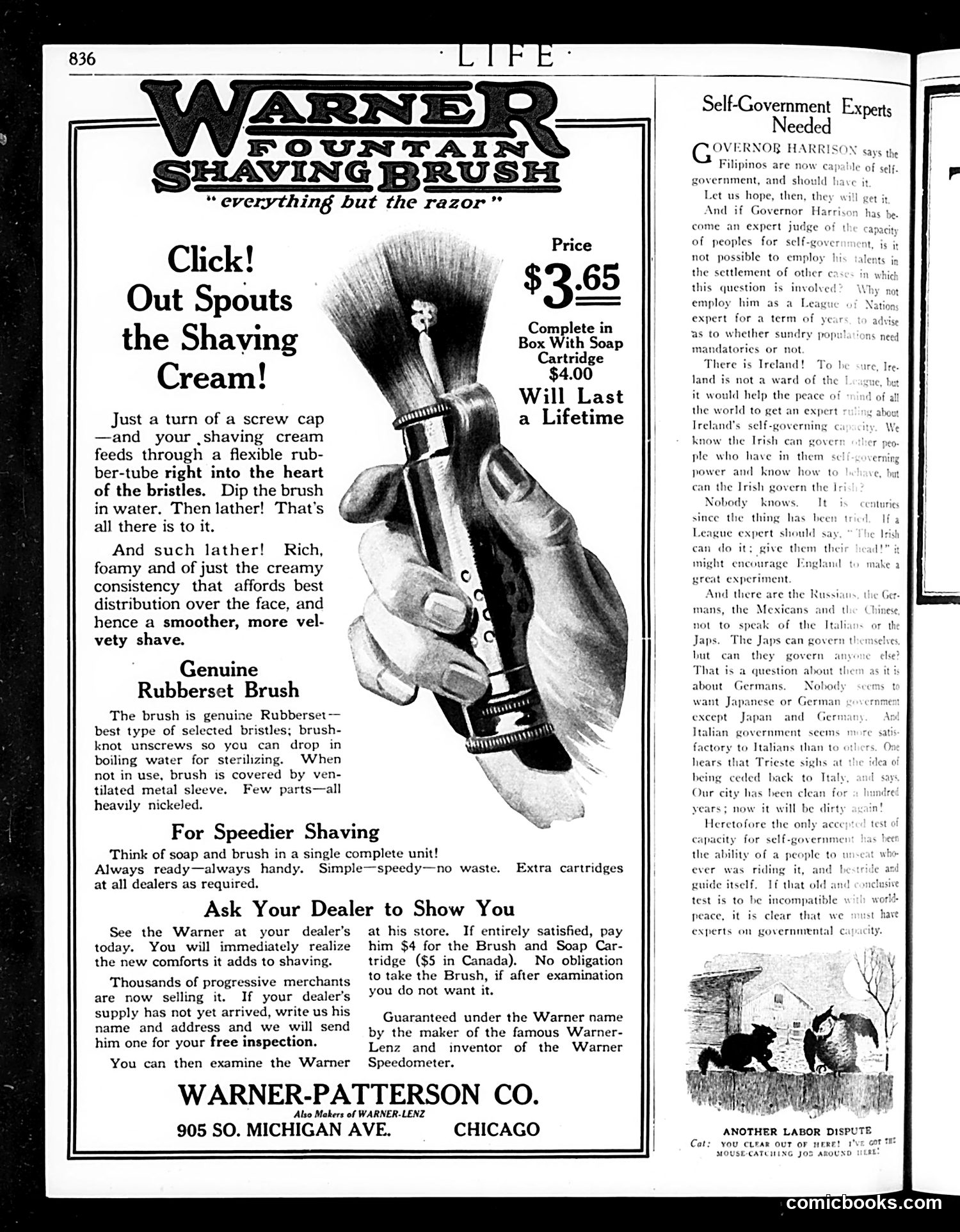
This page is **primarily a Warner Fountain Shaving Brush advertisement** (left side), not political satire. The ad shows a mechanical shaving brush with a screw-cap that dispenses cream through rubber tubes into the bristles—a product innovation marketed as convenient and time-saving. The right side contains an article titled **"Self-Government Experts Needed,"** where Governor Harrison argues that certain nations (Ireland, Russia, Mexico, Italy, Japan, Germany) lack capacity for self-government and suggests experts should be employed to guide them. The accompanying cartoon depicts rabbits causing property damage, captioned "Another Labor Dispute." The satire here appears to mock Harrison's paternalistic view by implying that even "civilized" nations have labor problems, undermining his hierarchical claims about governance capacity.
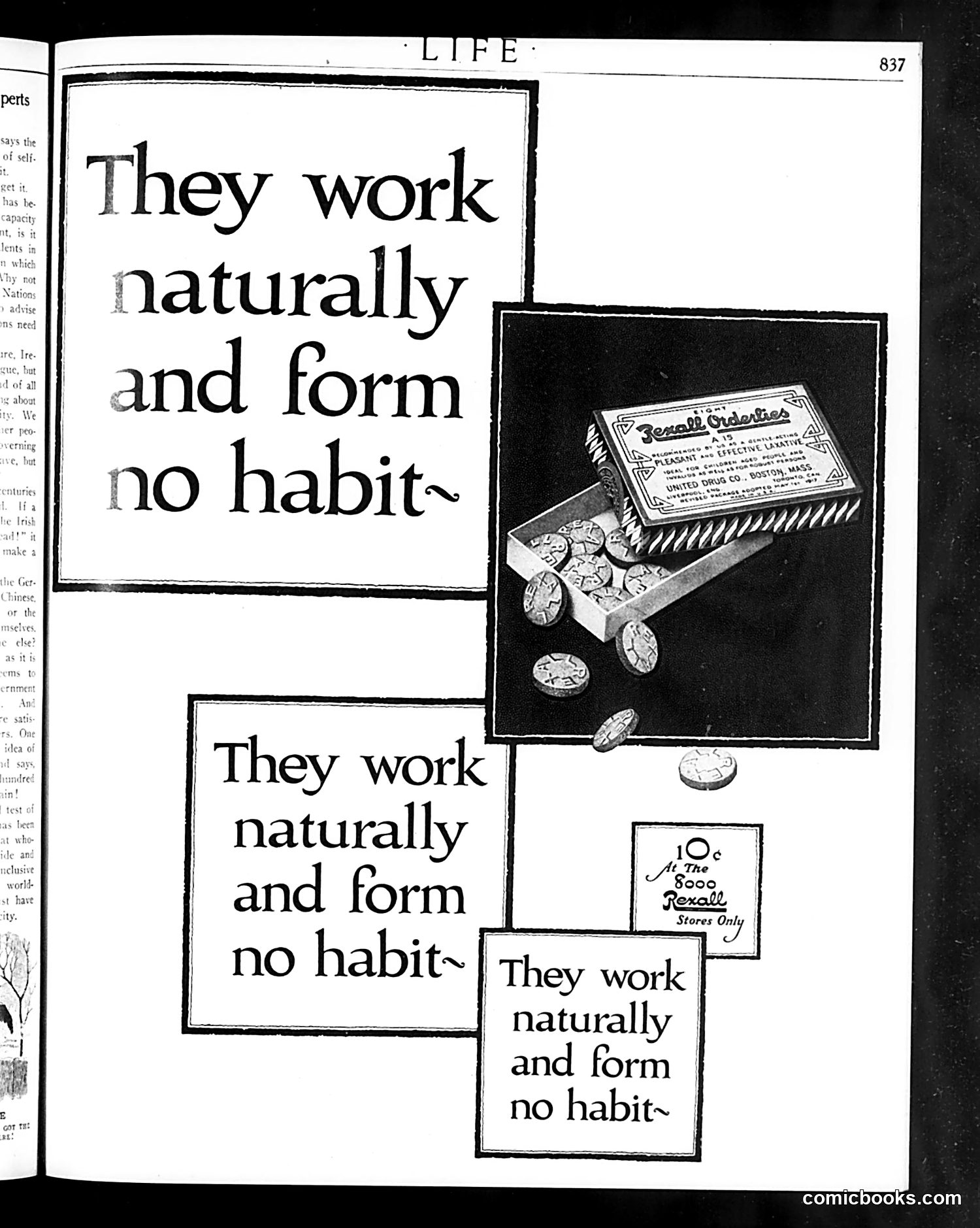
This is a vintage advertisement for Rexall Orderlies, a laxative product sold at Rexall drugstores. The repeated slogan "They work naturally and form no habit" appears three times in descending text boxes, with an image of the product box and individual pills displayed. The advertisement's emphasis on "form no habit" reflects early 20th-century concerns about dependency on patent medicines and laxatives—a legitimate public health worry of the era. By repeatedly stressing the non-habit-forming nature, the ad attempts to reassure consumers that this product was safe for regular use, distinguishing it from other remedies that might cause dependency. The price "10¢" at the bottom indicates affordability for mass-market appeal.
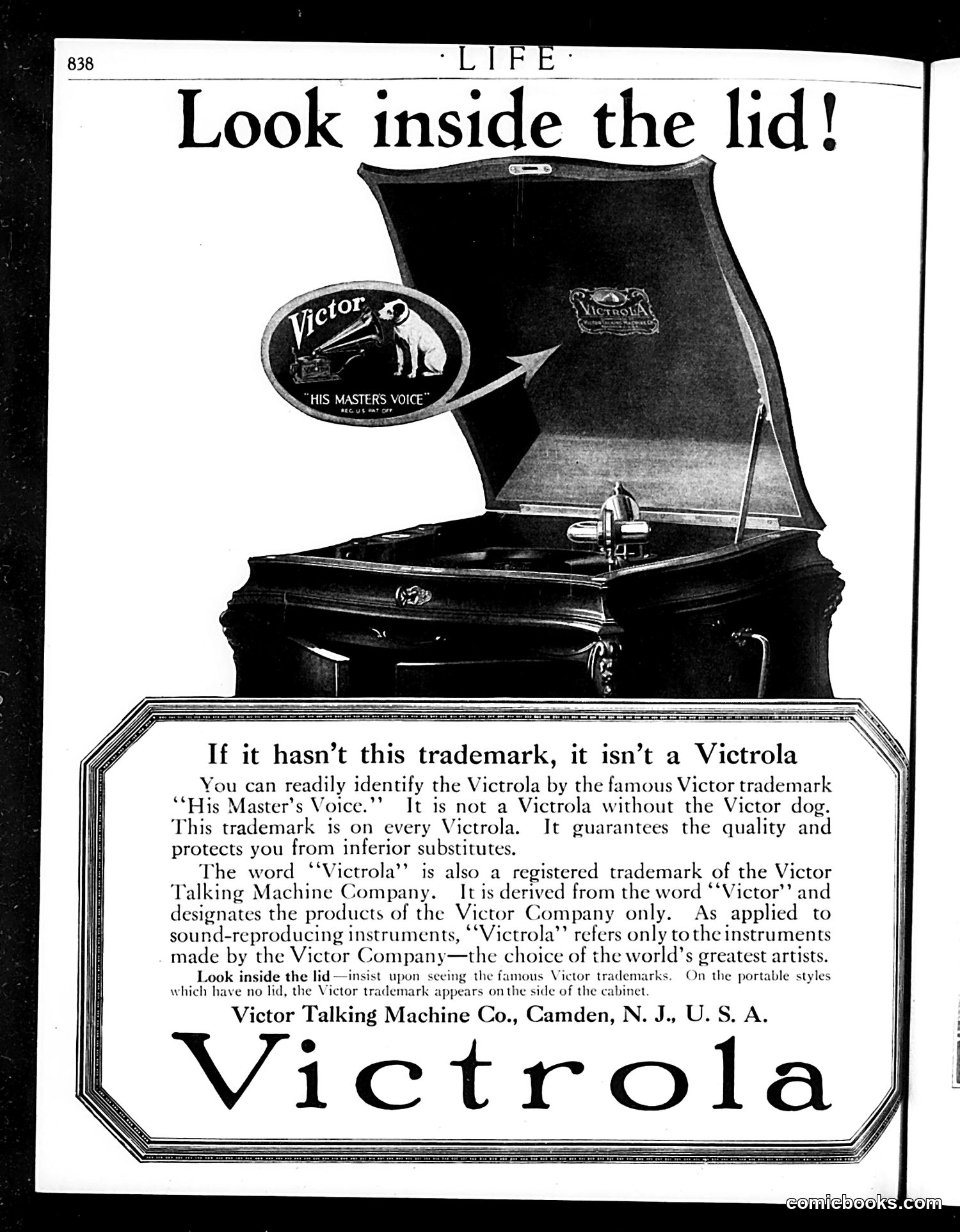
This is a **Victrola phonograph advertisement**, not a political cartoon. The page promotes the Victor Talking Machine Company's "Victrola" brand record players. The advertisement's main appeal is **brand authentication**—it emphasizes identifying genuine Victrolas by the "His Master's Voice" trademark (the famous image of a dog listening to a gramophone). The text warns consumers against inferior substitutes, stressing that only authentic Victrolas bear this distinctive trademark on the cabinet. The "Look inside the lid!" headline directs buyers to check for the trademark as proof of genuine manufacture. This reflects early 20th-century consumer concerns about counterfeit products. The company positions the Victrola as "the choice of the world's greatest artists," using prestige marketing to justify the premium product.
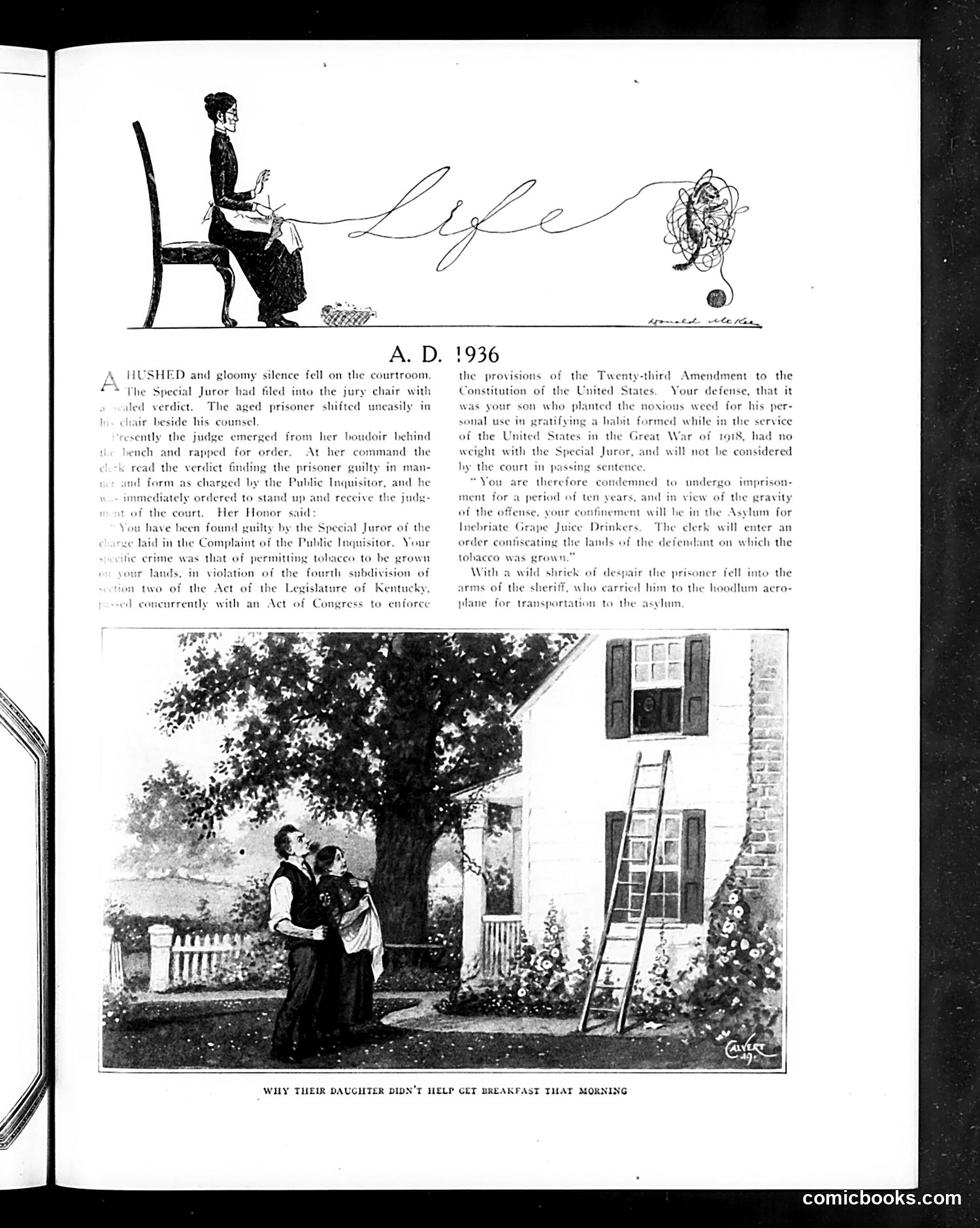
This 1936 *Life* magazine page satirizes a legal case involving tobacco cultivation. The top cartoon shows a figure at a desk laboriously writing or "untangling" legal arguments—representing the complexity of the defendant's case. The main story describes a courtroom verdict: a defendant was found guilty of violating the Twenty-third Amendment and Kentucky state law by growing tobacco on their land. The judge sentenced them to ten years in prison, with lands to be confiscated. The bottom photograph's caption, "Why Their Daughter Didn't Help Get Breakfast That Morning," suggests the daughter was arrested alongside the defendant—apparently for assisting in the illegal tobacco cultivation. The satire critiques the severity of these agricultural law penalties during the Depression era.
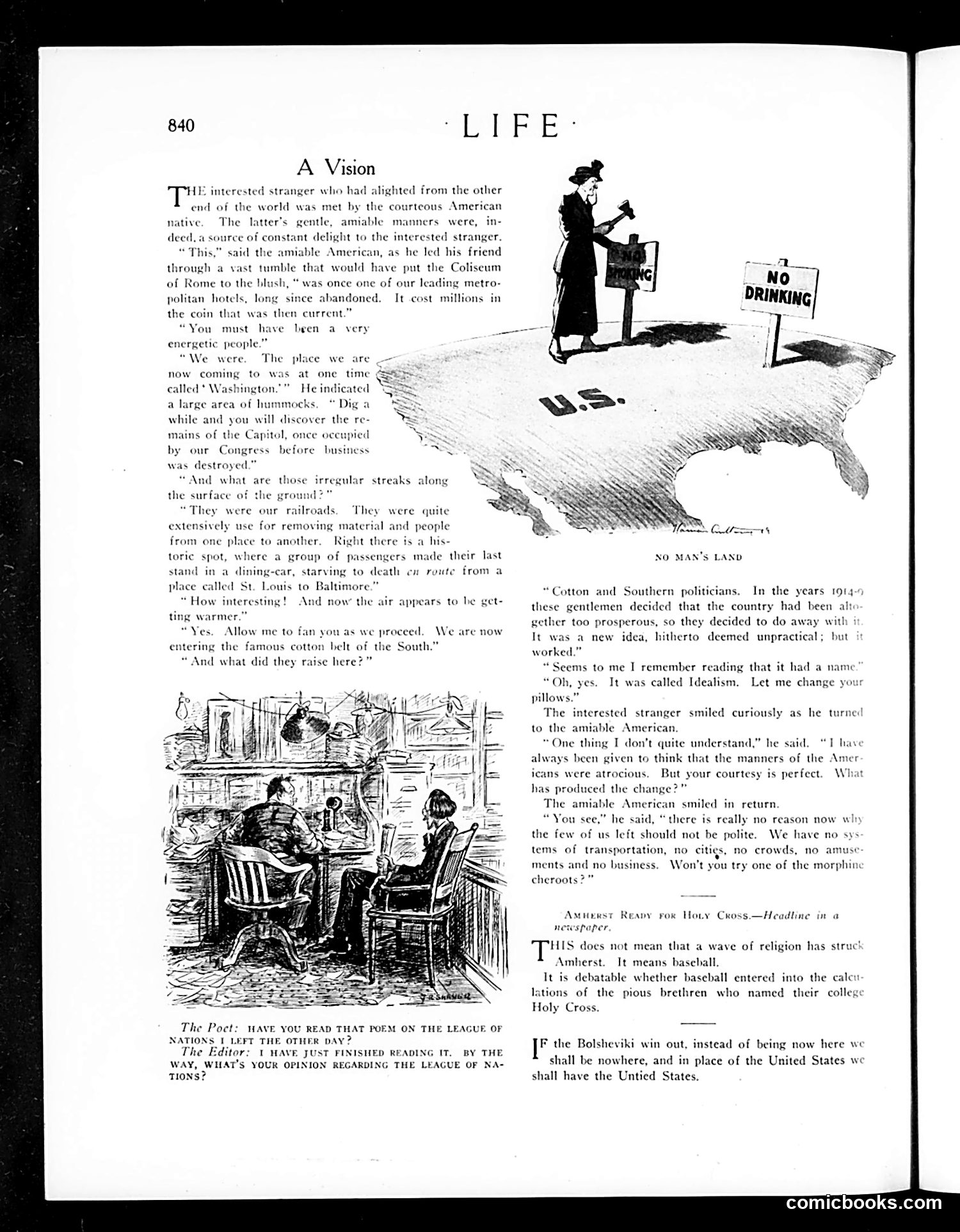
This page satirizes American isolationism and the country's reluctance to engage internationally. The cartoon "So Man's Land" depicts a figure (appearing to represent America or an American politician) standing at the border of the U.S., with a "NO DRINKING" sign—likely referencing Prohibition. The accompanying dialogue discusses the South's economic decline and "Idealism," suggesting commentary on regional politics and national ideals. The lower cartoon shows two men in conversation, with discussion of the League of Nations and transportation systems. The satire appears to critique America's withdrawal from global affairs and domestic political complacency during the post-WWI period, contrasting American exceptionalism with practical isolationism.
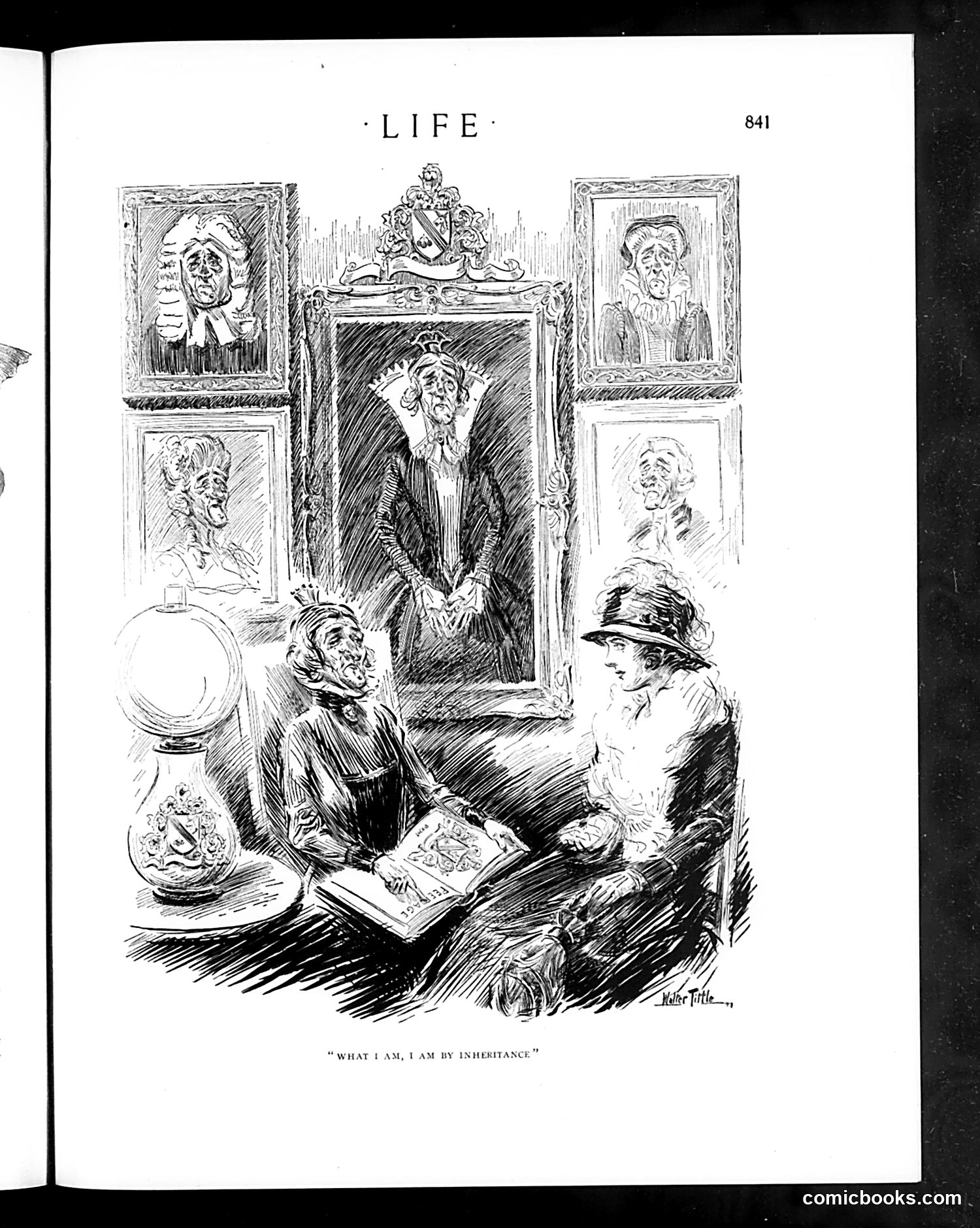
This satirical cartoon depicts two visitors viewing a gallery of ancestral portraits. The central figure appears to be an aristocrat or wealthy heir displaying family portraits lining the walls—suggesting lineage and noble breeding. The caption's irony is the central joke: the heir is essentially claiming that his identity and worth derive entirely from inherited status rather than personal merit or accomplishment. The cartoon satirizes the pretensions of the leisure class who pride themselves on ancestral connections while contributing nothing themselves. The visitors' expressions suggest skepticism toward this claim. The artwork—a detailed sketch showing period clothing and interior furnishings—indicates this is likely American social satire from the late 19th or early 20th century, mocking inherited aristocratic pretensions in a democratic society.
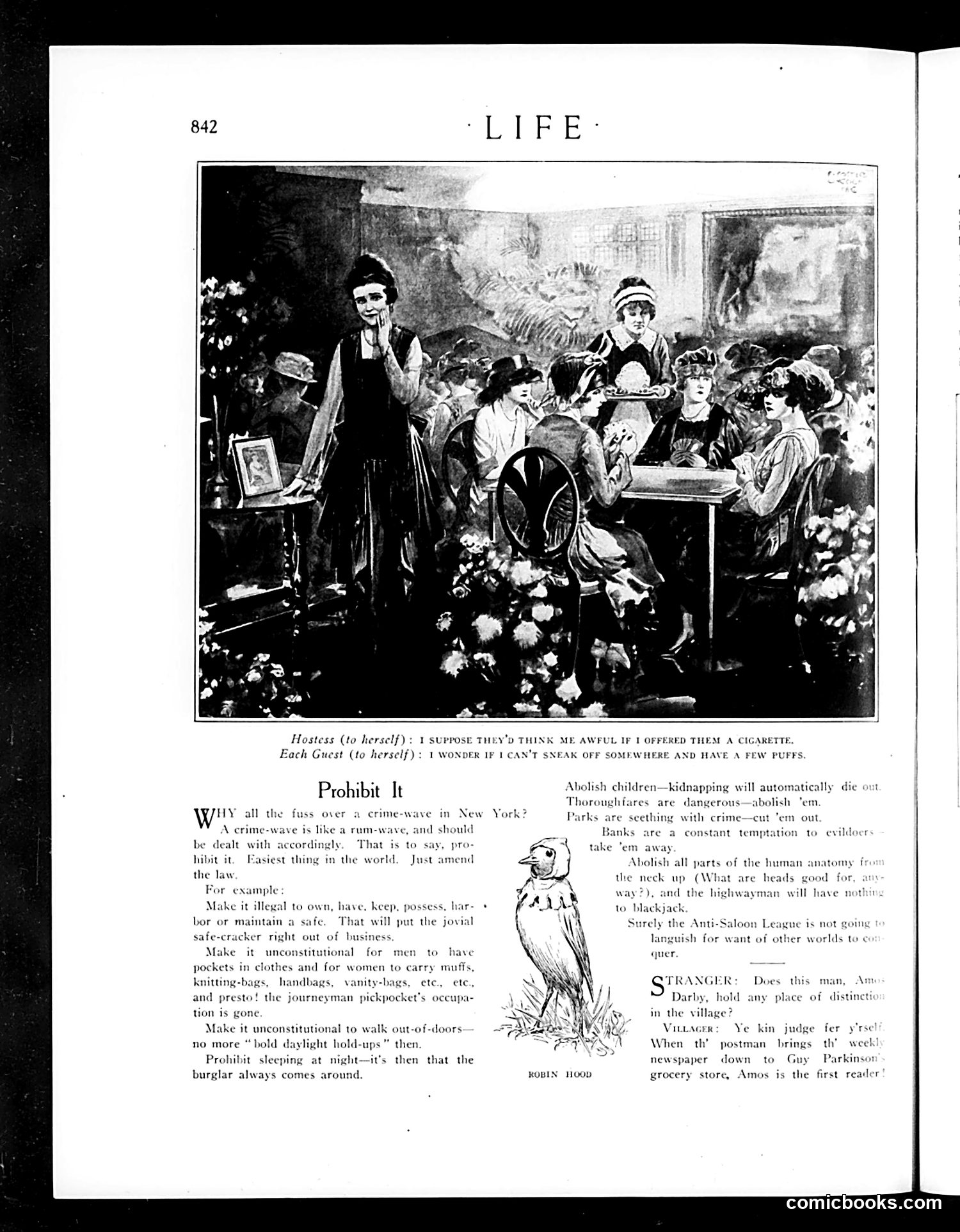
This page satirizes crime-wave hysteria in New York through exaggerated "solutions." The text mockingly proposes absurd legal prohibitions: making safes illegal, banning pockets and bags from clothing, and outlawing nighttime sleep—all presented as serious crime-prevention measures. The opening illustration shows a social gathering where guests discuss sneaking away for cigarettes, referencing Prohibition-era alcohol smuggling culture. The Robin Hood illustration accompanies the main satire, likely contrasting romanticized outlaws with contemporary criminals. The page ridicules panicked public responses to crime by reducing them to logical absurdity. Rather than addressing root causes, the satirist shows how prohibition-based thinking—then culturally relevant given alcohol Prohibition—becomes increasingly ridiculous when applied indiscriminately to everyday objects and activities.
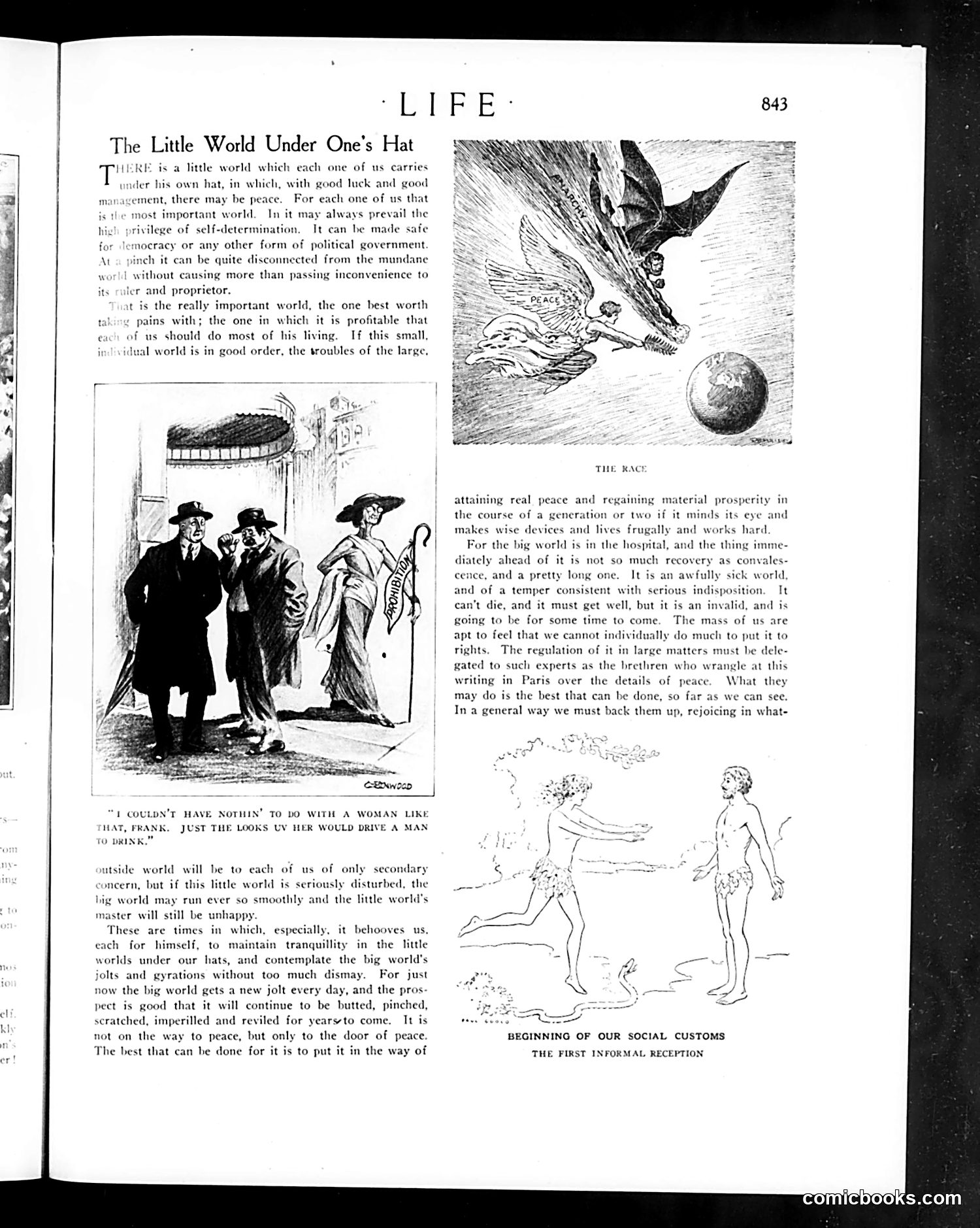
This essay argues that each person's internal mental world is their most important domain—more controllable than external politics. The accompanying cartoons illustrate this philosophy: **Left cartoon** (by Ceswood): Three men in formal dress with the caption "I couldn't have nothin' to do with a woman like that, Frank. Jest the looks uv her would drive a man to drink." This satirizes how people blame external circumstances (women, appearance) for their choices, rather than accepting personal responsibility. **Right illustrations**: Labeled "Beginning of Our Social Customs" and "The First Informal Reception," these appear to depict early human interaction, humorously suggesting that social conventions develop from basic human nature—reinforcing the essay's point about managing one's internal world.
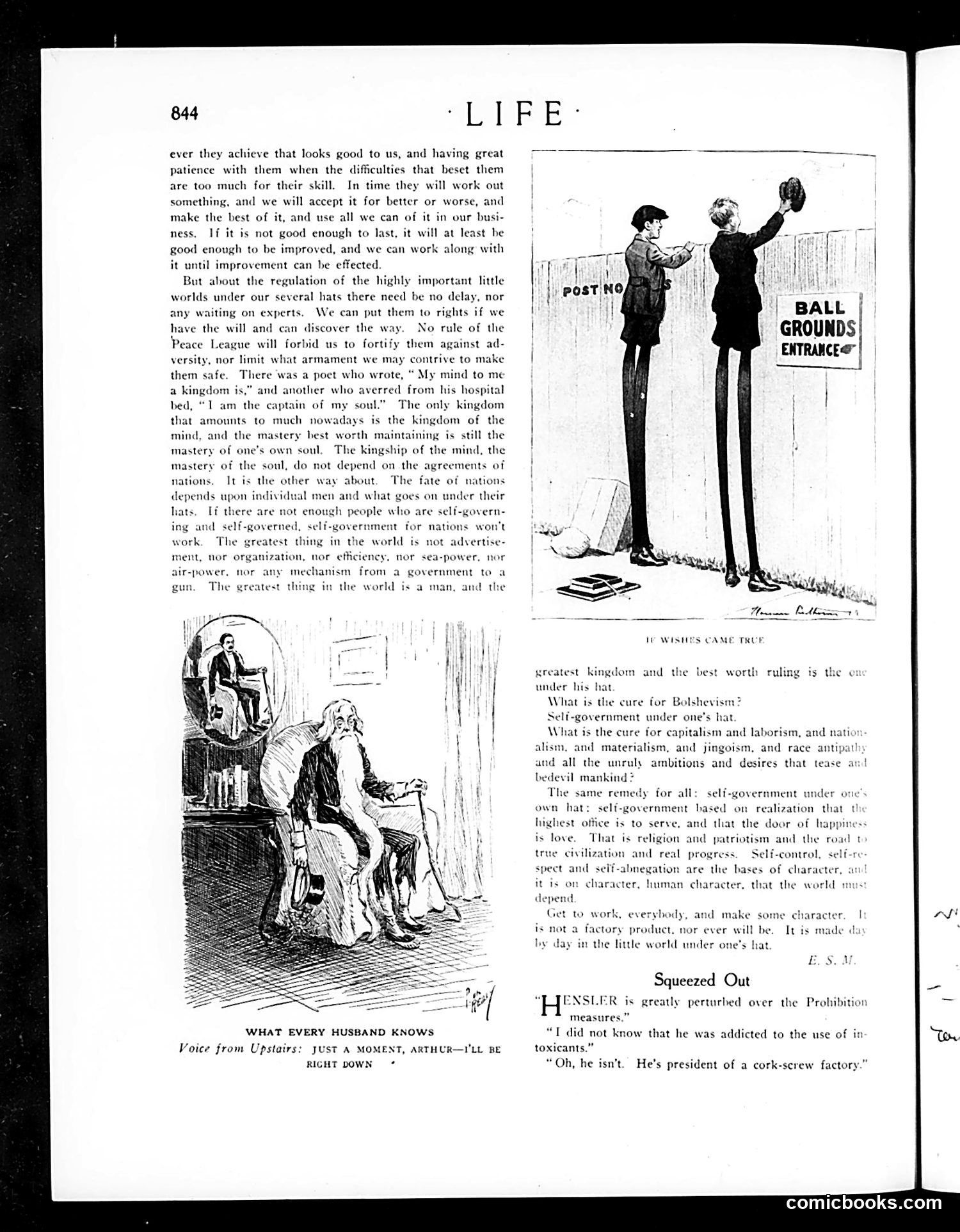
This page contains two distinct cartoons satirizing early 20th-century social issues. **"What Every Husband Knows"** (bottom left): A domestic humor cartoon showing a husband waiting while his wife delays coming downstairs. The joke plays on the common complaint that wives take excessive time preparing themselves—a standard trope of the era's "battle of the sexes" humor. **"If Wishes Came True"** (top right): Two elongated, spindly-legged figures stand at a "Ball Grounds Entrance" with a "Post No" sign. The satire likely mocks wishful thinking about social prohibition—possibly Prohibition's enforcement or the idealistic notion that rules can solve human problems without genuine compliance. **The main text** advocates "self-government under one's hat"—essentially arguing that personal moral character and self-control (not external laws or government mechanisms) are society's true foundation. This reflects contemporary debates about Prohibition, labor unrest, and whether legislation alone could reform society. **"Squeezed Out"** (bottom): A joke where a man is "perturbed" by Prohibition—not because he drinks, but because he manufactures cork-screws, facing economic ruin from the alcohol ban.
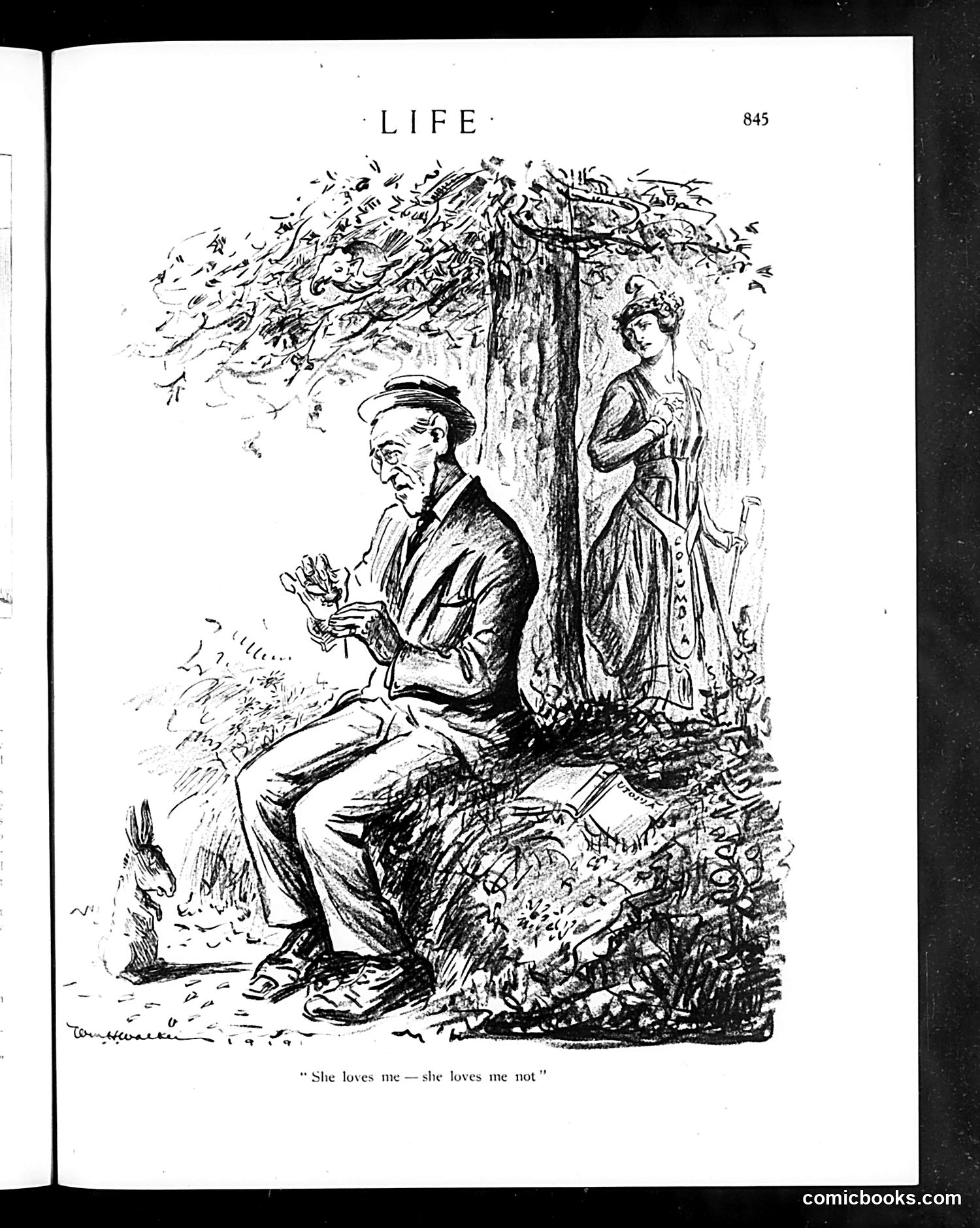
This single-panel cartoon depicts a working-class man (indicated by his worn clothing and hat) sitting beneath a tree, plucking petals in the classic fortune-telling game of "loves me, loves me not." A well-dressed woman stands nearby, observing him. The satire appears to contrast social classes: the anxious laborer seeking reassurance about a woman's affections through superstition, while the elegantly-dressed woman (likely of higher social standing) remains emotionally distant or indifferent. The cartoon mocks either romantic uncertainty or the futility of working-class men hoping to win women above their station. The childish game emphasizes the man's helplessness and desperation in matters of the heart.
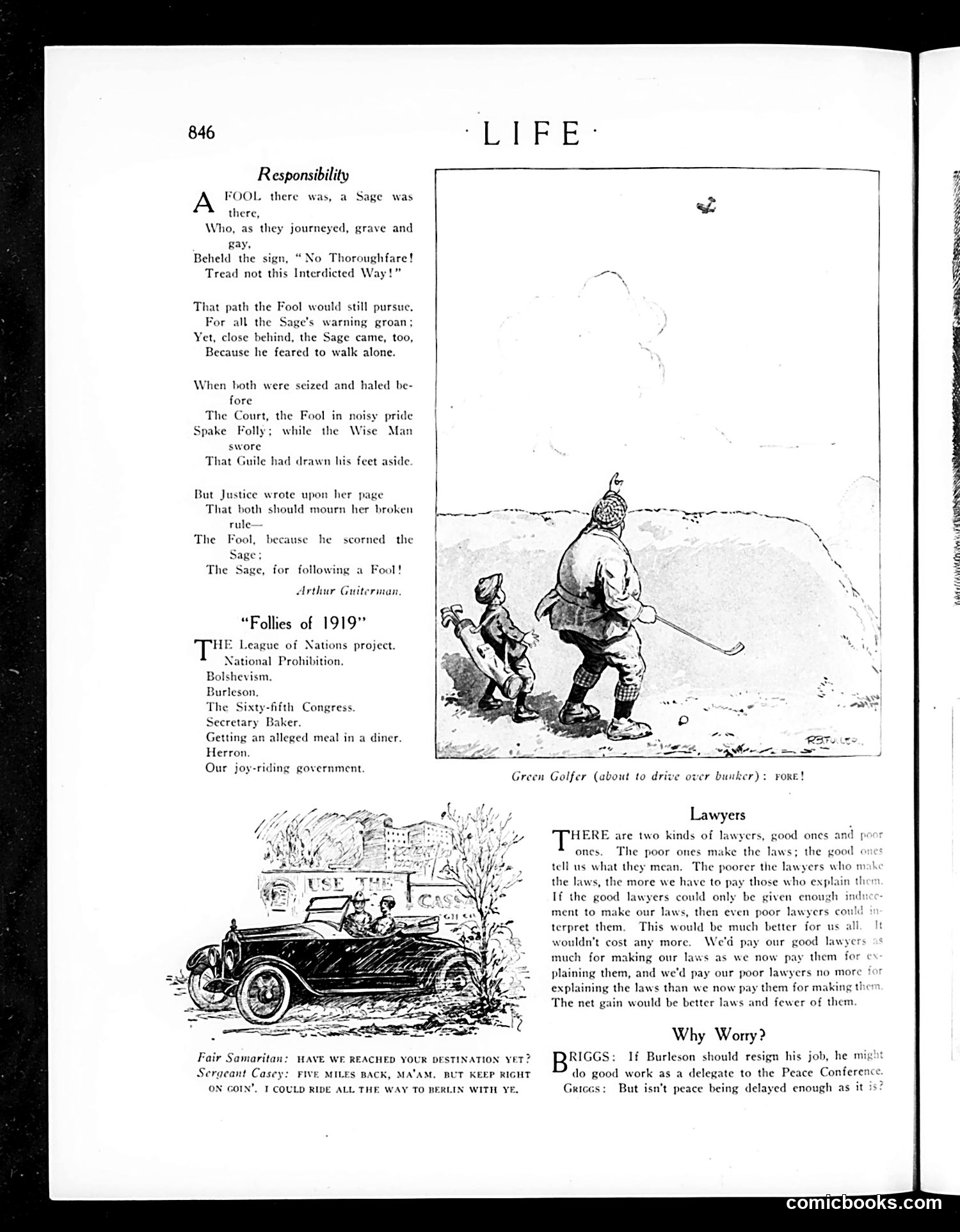
This page from Life (circa 1919) contains multiple satirical pieces commenting on post-WWI American politics and society. **"Responsibility" (top):** A moral poem by Arthur Guiterman about a Fool who ignores warning signs and a Sage who follows him despite knowing better. Both face justice equally—the Fool for his recklessness, the Sage for his cowardice. The accompanying list suggests this satirizes contemporary follies: the League of Nations debate, Prohibition, Bolshevism fears, and the Wilson administration (Secretary Baker, Postmaster General Burleson). **"Lawyers" section:** Critiques the legal profession, arguing poor lawyers who *make* laws should be replaced by good ones, eliminating the need for expensive lawyers to *interpret* them. **Bottom cartoons:** One shows a driver asking directions ("Green Golfer about to drive over bunker"), the other ("Fair Samaritan") features a reference to Postmaster General Burleson potentially resigning to join the Peace Conference delegation—with skepticism that this would actually expedite peace negotiations. The page's theme: governmental incompetence and the folly of those following incompetent leaders.
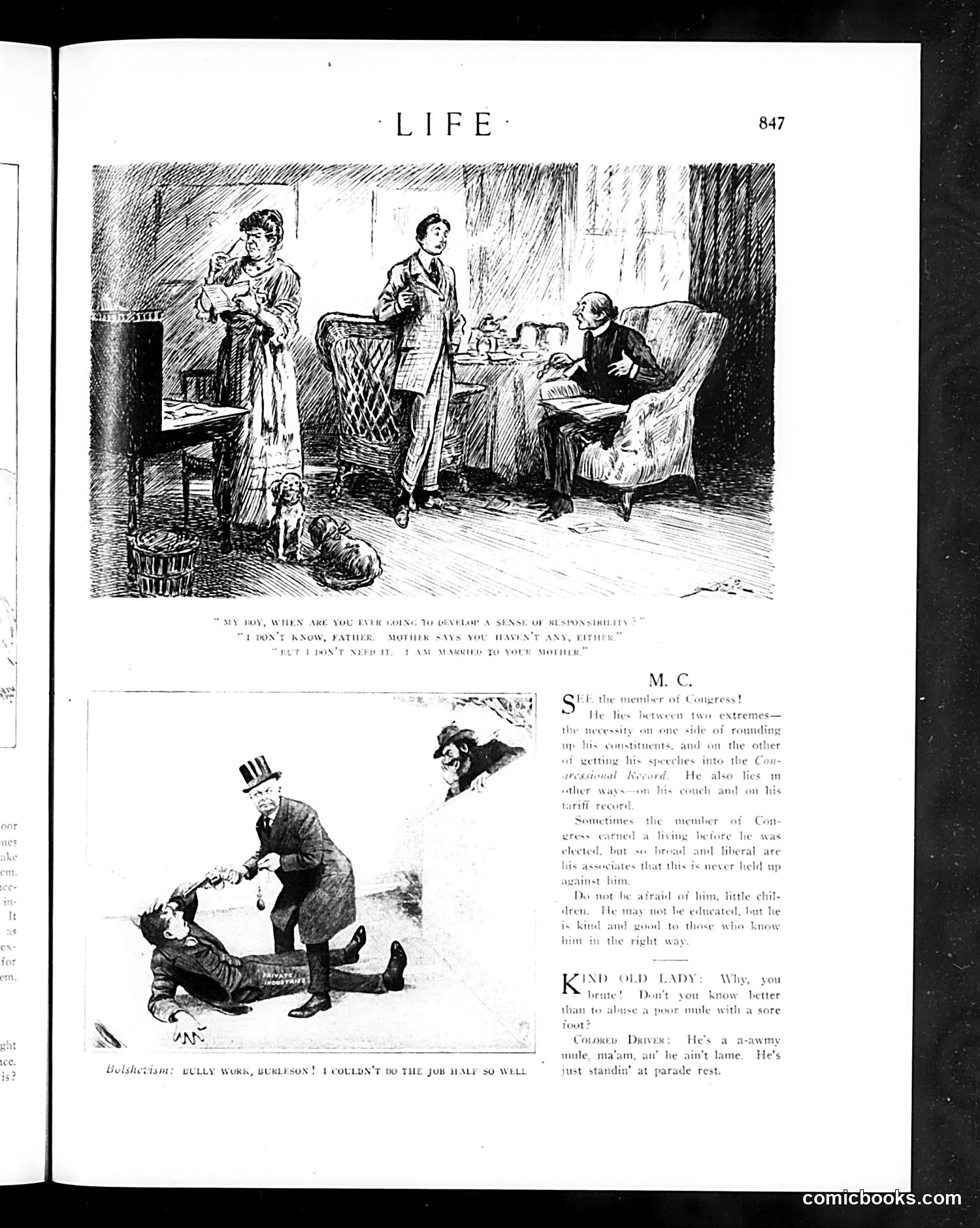
The top cartoon depicts a domestic scene where a mother scolds her son about lacking responsibility, while the father defends the boy, saying he hasn't any sense to develop. This satirizes parental disagreement over child discipline. The lower cartoon shows a well-dressed man (appearing to be a politician or authority figure, based on his top hat) praising a mule-driver for his work, calling him a "bully worker." The humor relies on the absurd compliment—the politician claims he couldn't do the job "half so well," mocking politicians' incompetence compared to working-class laborers. Both cartoons appear to critique middle-class values and political incompetence through domestic and occupational humor, typical of *Life*'s satirical approach.
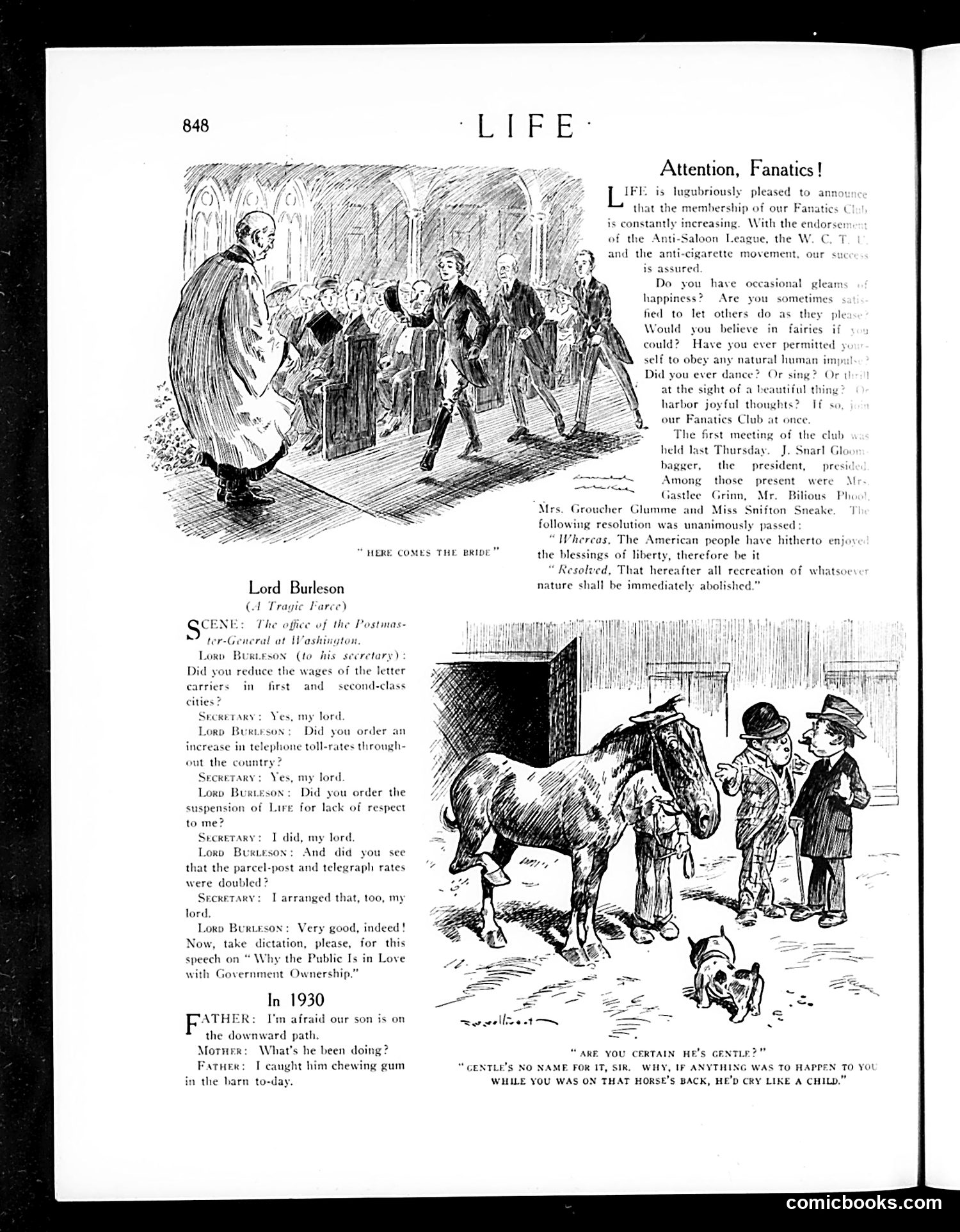
This page contains three distinct satirical pieces mocking American social reform movements and government overreach circa 1920s: **"Attention, Fanatics!"** ridicules the "Fanatics Club," a thinly-veiled jab at prohibitionist and anti-pleasure reform movements (note references to "Anti-Saloon League" and "anti-cigarette movement"). The club's absurd resolution to abolish all recreation satirizes how puritanical reformers sought to eliminate human happiness and natural enjoyments. **"Lord Burleson"** attacks Postmaster General Albert Burleson, depicted as a petty tyrant methodically raising rates and cutting wages while hypocritically claiming the public loves "Government Ownership." This mocks Wilson-era government expansion and Burleson's unpopular policies. **"In 1930"** shows a father dismayed that his son chewed gum—a dark prophecy about how intrusive government surveillance and control might make children fear minor infractions, turning boys into nervous wrecks. It warns against authoritarianism. All three pieces share anti-prohibition, anti-reform sentiment typical of Life's skeptical editorial stance.
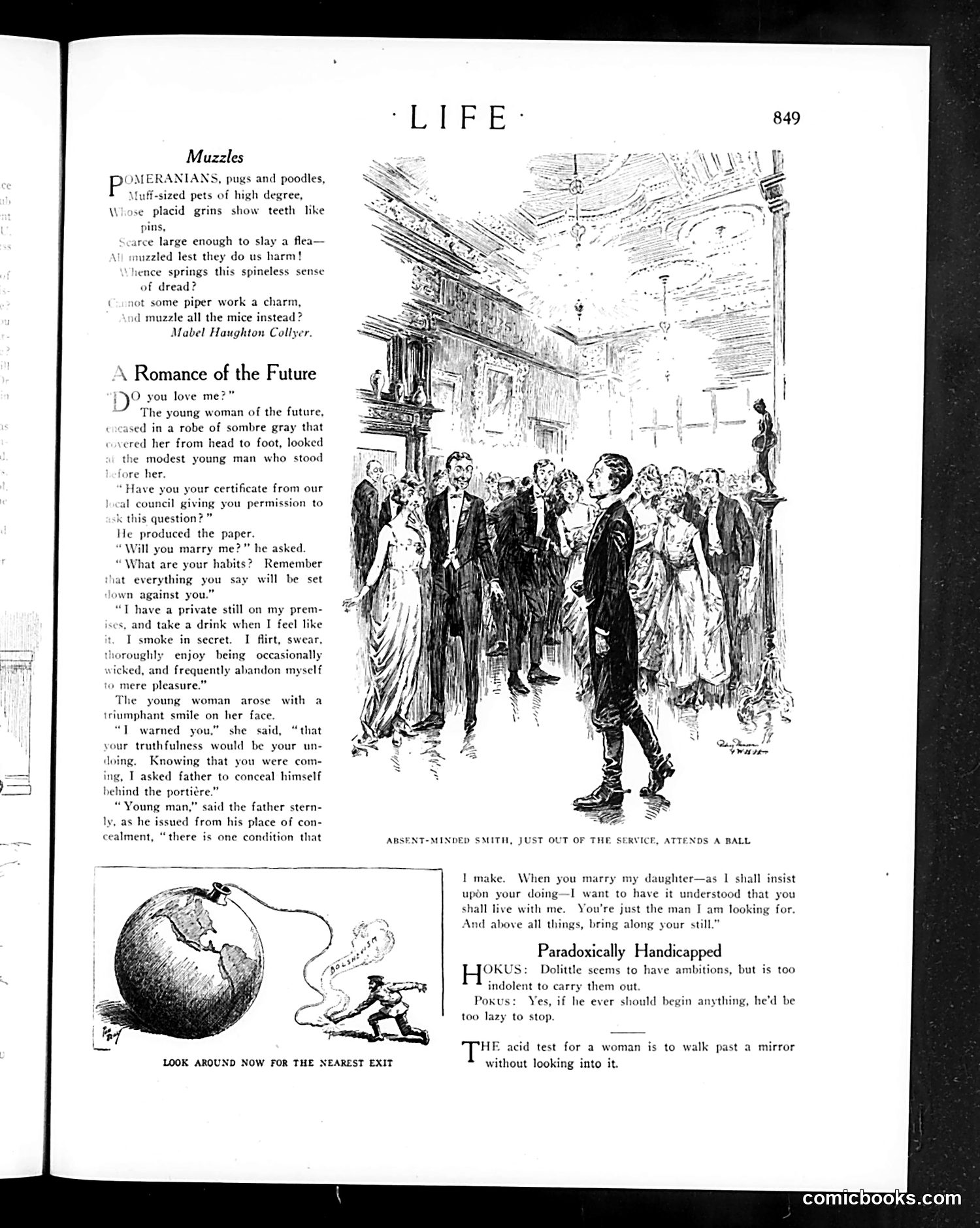
This page contains three distinct pieces of social satire: **"Muzzles"** is a humorous poem questioning why we muzzle dogs (to prevent harm) yet don't muzzle mice, which cause actual damage. It's light wordplay commentary on illogical social practices. **"A Romance of the Future"** satirizes progressive-era anxieties about bureaucratic control and gender relations. A young woman requires her suitor to obtain official permission to propose marriage and produce documentation of his character. The joke's twist: her father, hidden behind a curtain, approves the dishonest man precisely *because* he admitted vices—valuing honesty over morality. This mocks both excessive regulation and shifting social values around candor. **"Paradoxically Handicapped"** is a brief joke about Dolittle's contradiction: he's too lazy to start projects but (implied) too lazy to quit them—a personality paradox. The bottom item references "Absent-minded Smith" attending a ball after military service, though context is limited. These pieces reflect early 20th-century concerns about bureaucracy, changing courtship customs, and character.
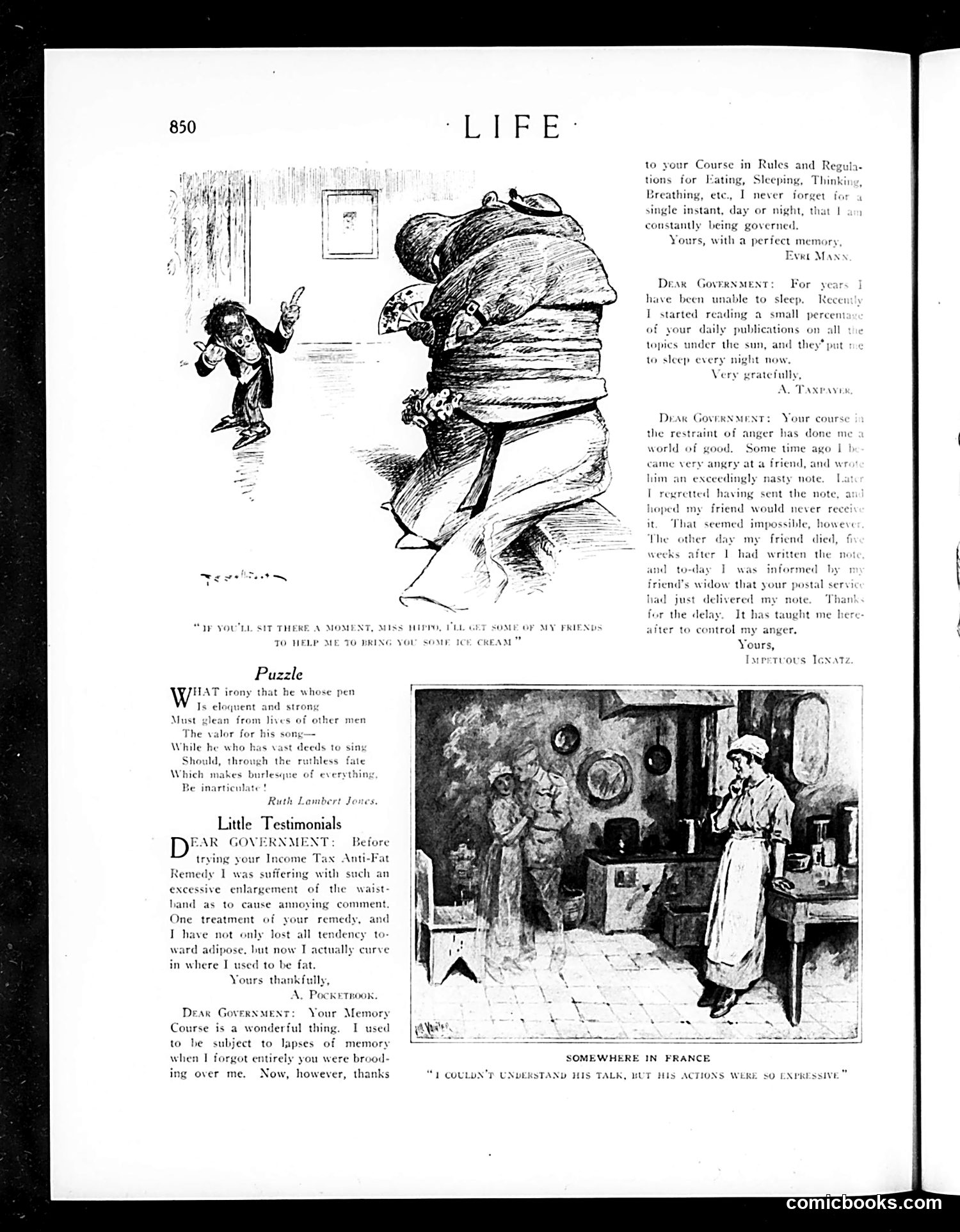
This page satirizes the U.S. Government through mock "testimonials" praising fictional self-improvement courses. The humor hinges on ironic reversals: readers claim the Government's courses in "Rules and Regulations" for behavior, anger management, and memory have transformed their lives—but the implied joke is that Government *actually* governs citizens constantly without their consent, controls their emotions through policy, and citizens remain under Government surveillance. The cartoon depicts a rotund hippopotamus (representing someone of wealth or status) summoning friends for ice cream—a commentary on indulgence and frivolity, likely mocking the idle rich or corrupt officials. The bottom illustration, labeled "Somewhere in France," shows a WWI-era scene where language barriers matter less than physical actions—suggesting military effectiveness transcends communication problems, or commenting on the absurdity of war itself. The overall page ridicules Government paternalism through exaggerated praise, a common Life magazine technique during the Progressive Era.
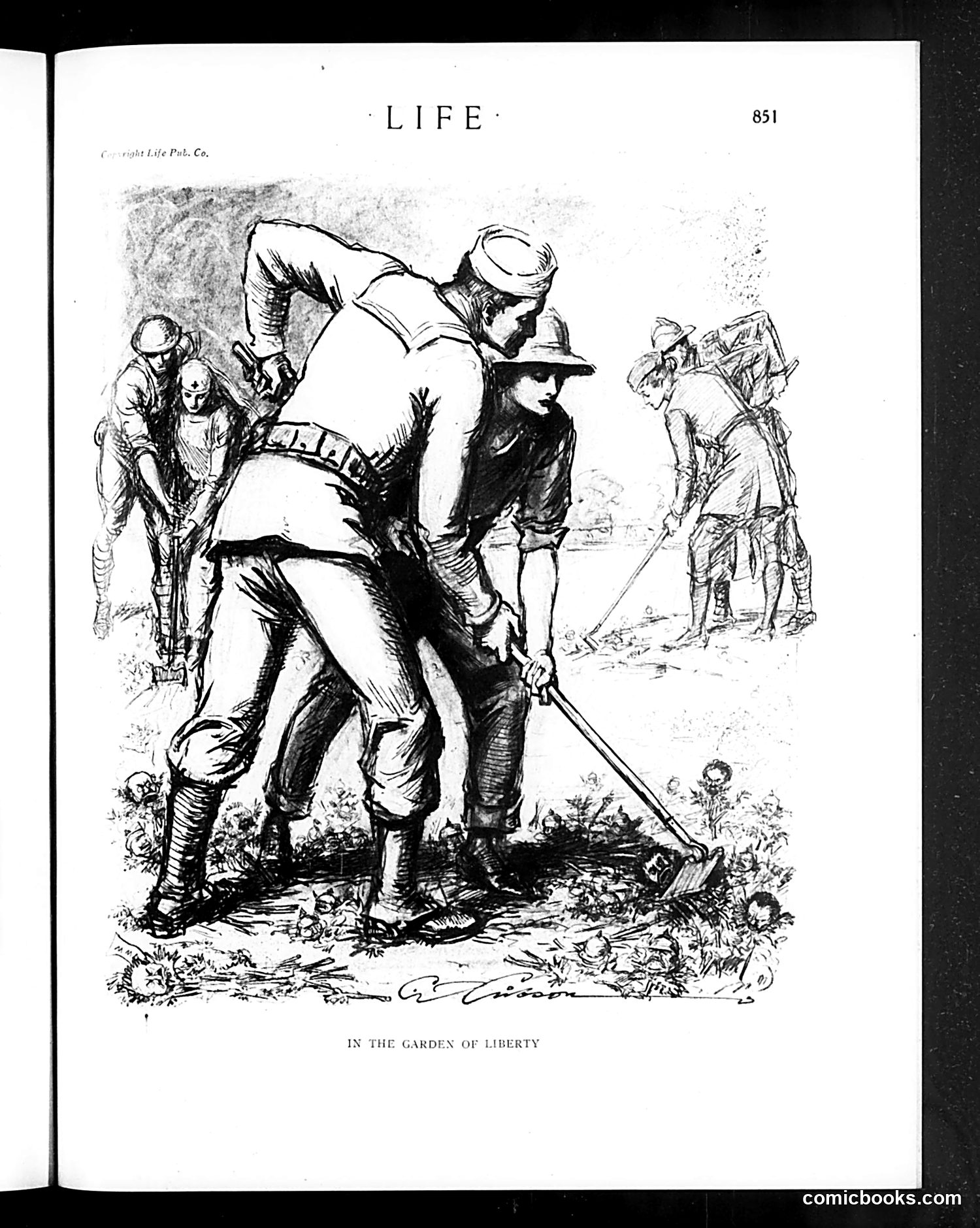
This political cartoon depicts military figures actively cultivating or tending to a garden—a metaphor for nation-building or governance. The soldiers appear to be *weeding* or *digging* in soil labeled "liberty," suggesting ironic commentary: those claiming to defend liberty are instead undermining or destroying it through their actions. The figure in front, prominently displayed with a spade, seems central to this critique. Other military personnel work alongside, implying institutional involvement rather than individual wrongdoing. The cartoon likely satirizes American military or government interventionism—possibly U.S. imperial activities or military occupation—by suggesting that the professed goal of spreading "liberty" is actually destructive. The visual pun of literal garden-tending critiques the contradiction between stated democratic ideals and actual imperial practice.
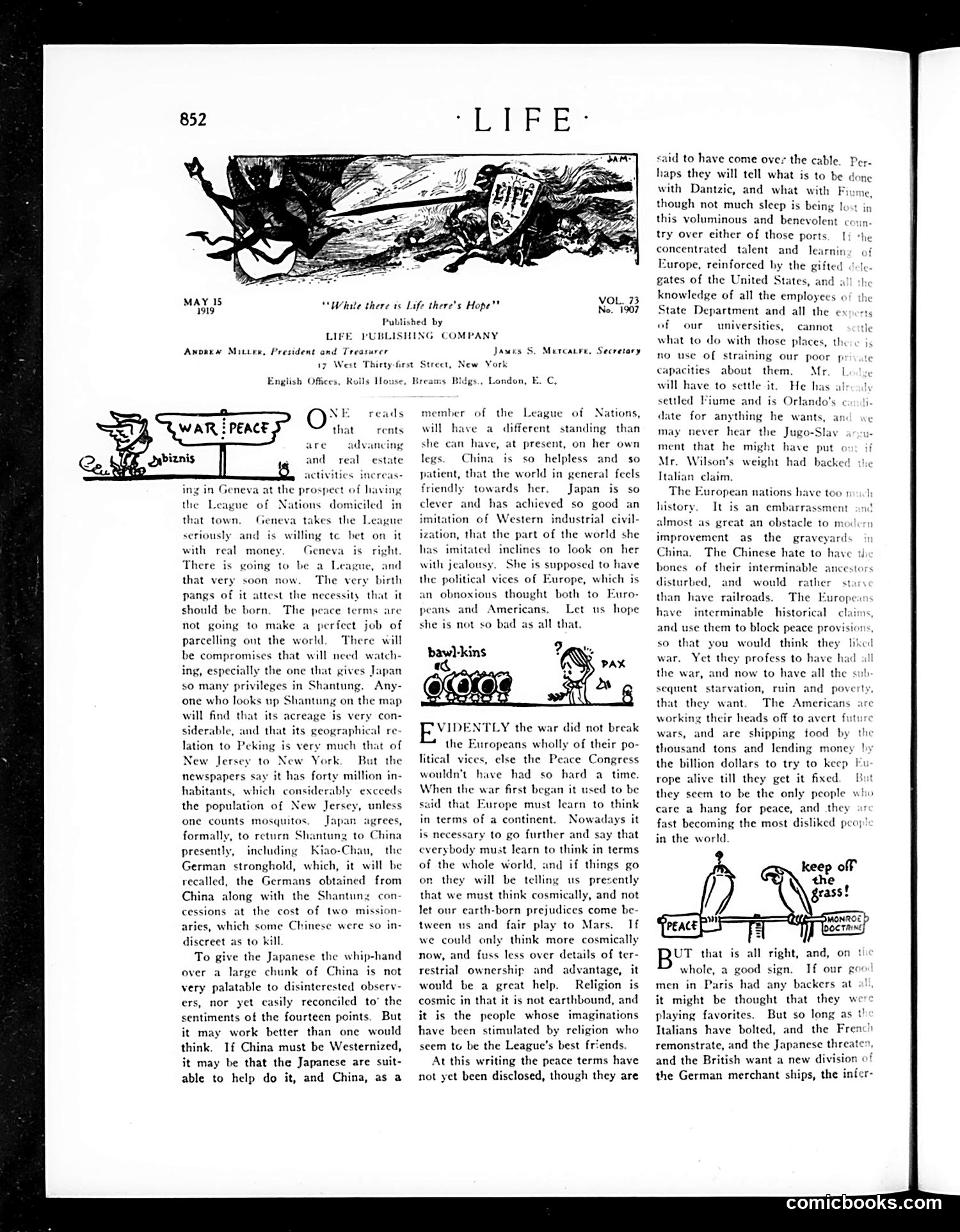
This Life magazine editorial (May 15, 1919) discusses the nascent League of Nations and the Paris Peace Congress peace terms. The cartoons satirize competing concerns about the treaty: The **"War & Peace" cartoon** depicts tension between warring interests, symbolizing ongoing disputes despite peace declarations. The **"Bawlkins"** and **"Keep off the Grass"** cartoons mock the difficulty of reconciling national interests—particularly **Japan's advantageous position in Shantung** (a Chinese province), which the author finds troubling despite theoretical support for Japan's "Westernization" of China. The text criticizes European powers for retaining "political vices" despite war's lessons, arguing they must "think cosmically" rather than prioritize "terrestrial ownership and advantage." The author suggests religion offers the cosmopolitan thinking the League needs. The satirical thrust: post-war idealism clashes with persistent great-power self-interest and old imperial habits.
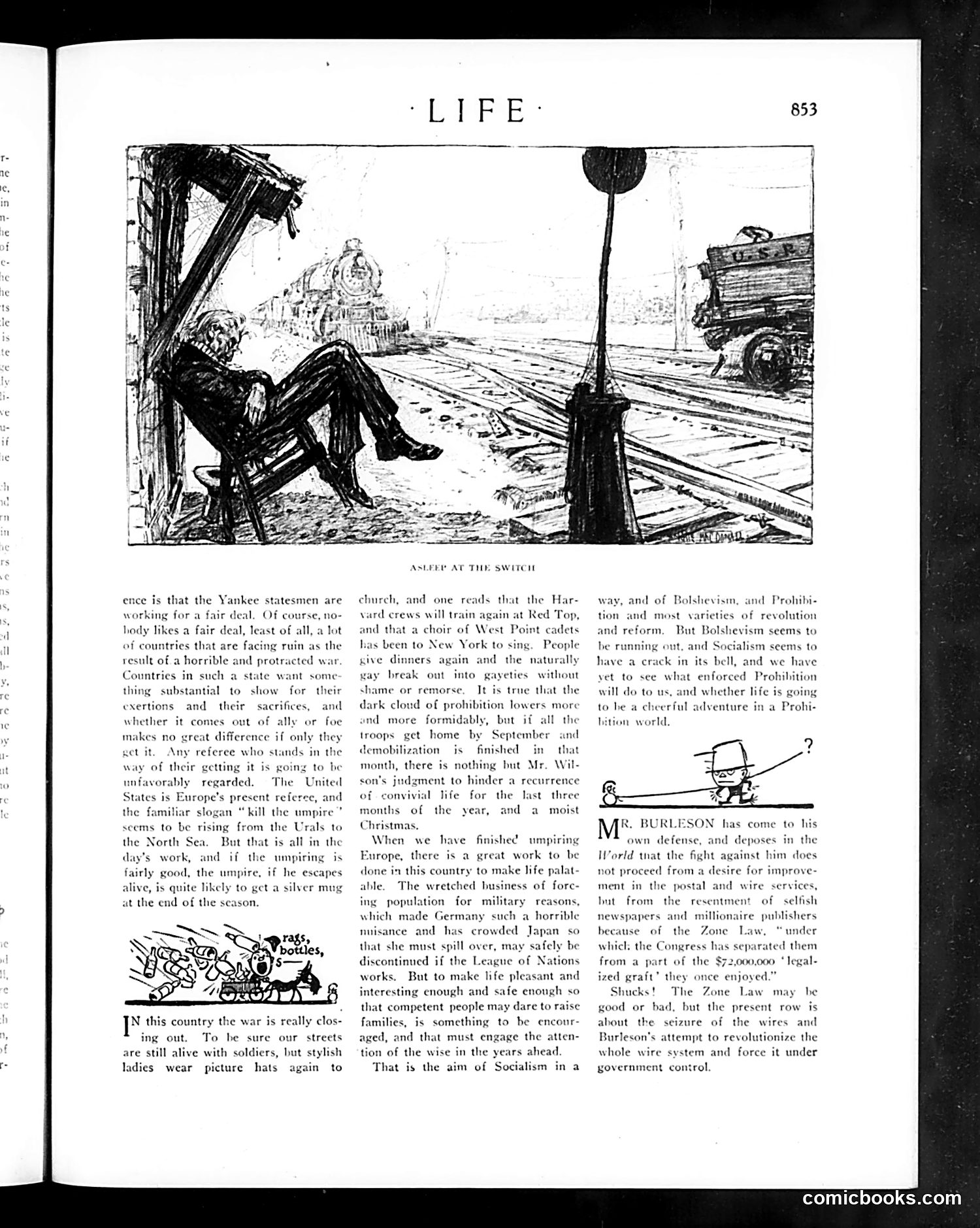
This editorial cartoon depicts a railroad worker napping while a train approaches in the background—a visual metaphor for post-WWI American complacency. The accompanying text discusses how the U.S. is "really closing out" the war, with soldiers still in streets but life returning to normal (Harvard rowing, West Point choirs singing in New York). The satire targets American inattention to serious post-war challenges: reconstructing Europe, managing demobilization, and addressing domestic social problems. The article mentions competing ideologies—Socialism, Bolshevism, and Prohibition—that will shape the coming years, warning that while the fighting has ended, critical work remains. The "switch" likely refers to the need for America to shift its focus from military to domestic reconstruction. The sleeping figure represents Americans who might miss crucial decisions ahead, particularly regarding whether enforced Prohibition will make life "a cheerful adventure" in peacetime.
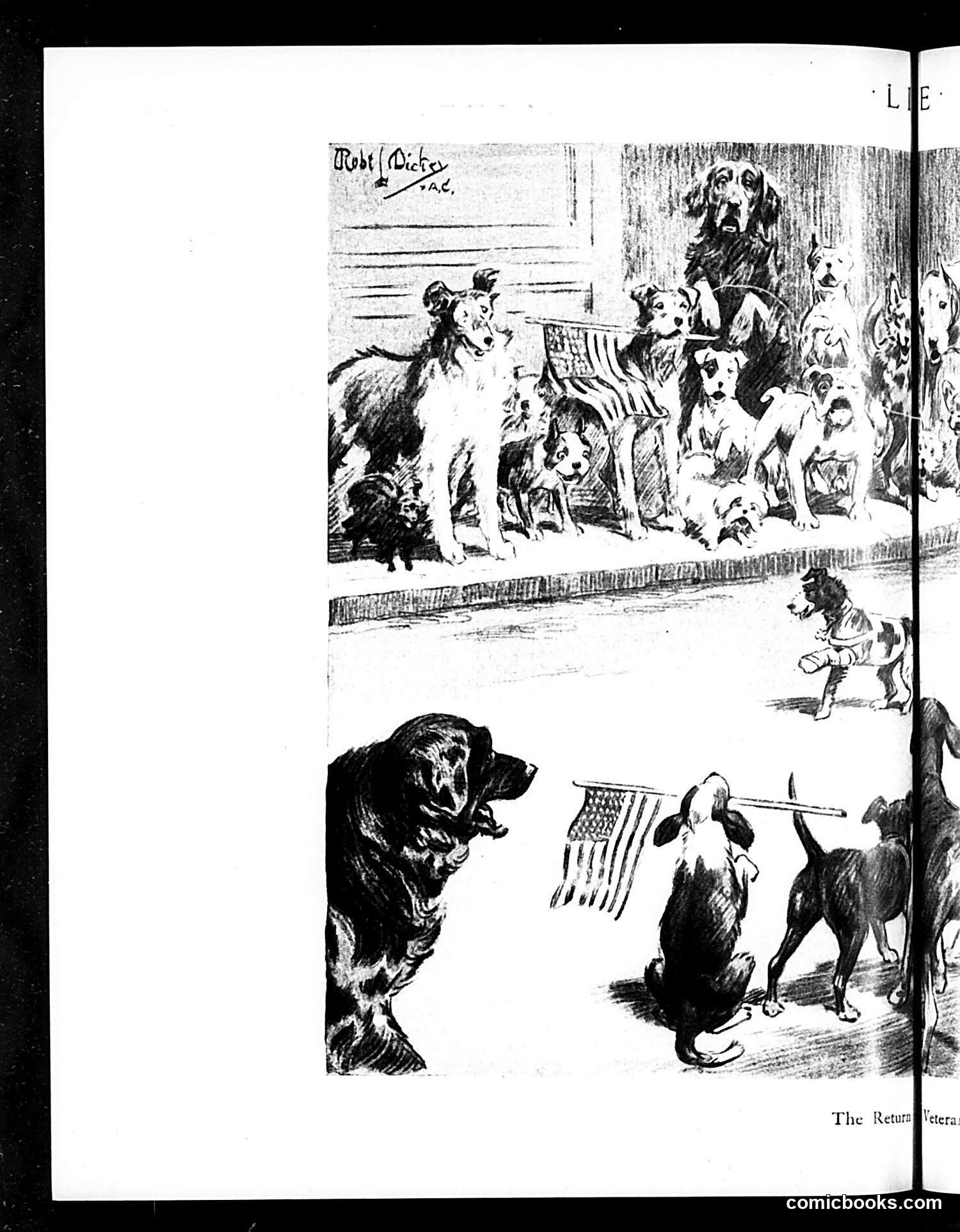
This appears to be a satirical cartoon about dogs, likely using canine characters as stand-ins for human political or social figures. The top panel shows a gathering of dogs, possibly representing a homecoming or reunion scene. The bottom panel depicts dogs with American flags and what appears to be a military or patriotic context. Without clearer text or additional context about the specific historical moment Life magazine published this, I cannot definitively identify which political figures or events are being satirized. The "returned veteran" reference suggests commentary on soldiers returning from war, but the specific conflict and satirical targets remain unclear from the image alone.
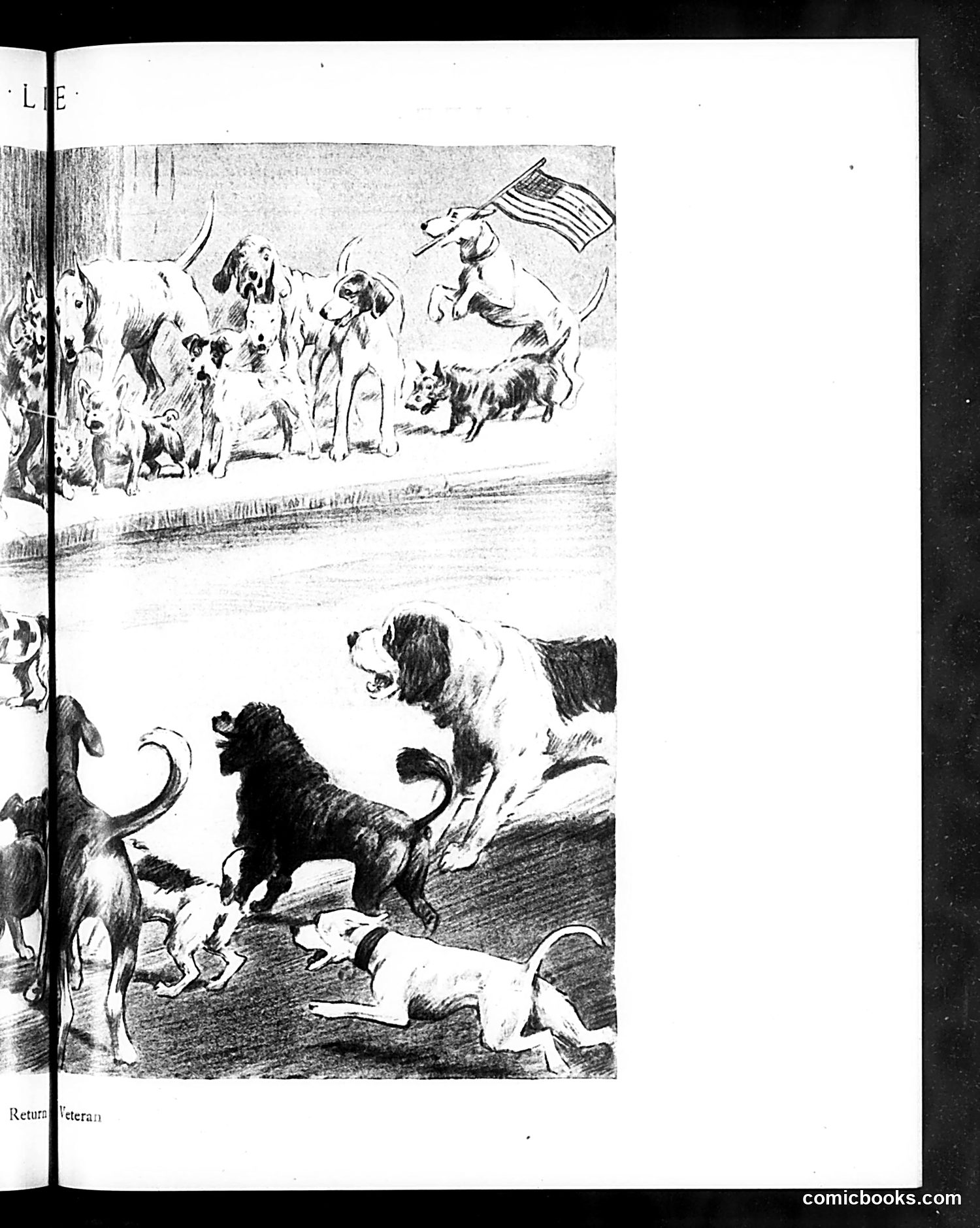
The OCR text is illegible, so I must rely on the images themselves. The page contains two cartoon panels depicting dogs. The top panel shows a group of dogs, with one prominently waving an American flag. The bottom panel shows dogs in what appears to be a domestic or street scene. The caption at bottom reads "Return Veteran," suggesting these cartoons comment on the treatment of returning military veterans—likely from World War I or II, given Life magazine's historical context. The satire appears to compare returning veterans to dogs: the top image suggests patriotic enthusiasm upon homecoming, while the bottom image may ironically depict their subsequent neglect or poor treatment by society. This would reflect a common post-war theme about veterans being celebrated during conflict but abandoned afterward. Without clearer text or artist attribution, the specific historical moment remains uncertain.
This page satirizes the pretensions of classical music critics and defends *Life* magazine's skepticism toward both opera and the film industry. **Main Target:** Music critic W.J. Henderson, who previously championed opera and serious music but has recently questioned whether classical music actually conveys meaning or moral lessons. The article quotes Henderson asking whether a Bach fugue teaches anything, or whether musicians are simply self-important aesthetes. **The Satire:** *Life* celebrates Henderson's apostasy as vindication of their own heretical position—that neither opera nor contemporary cinema deserve uncritical reverence. The piece mocks music devotees as cultish worshippers of their "musical gods." **Context:** This reflects early 20th-century debates about "high" versus popular art. *Life* positioned itself as a democratic voice skeptical of elite cultural gatekeepers who treated classical music and (implicitly) experimental film as sacred. The "Confidential Guide" section lists contemporary theatrical productions, suggesting *Life* covered entertainment more broadly than serious music critics deemed respectable.
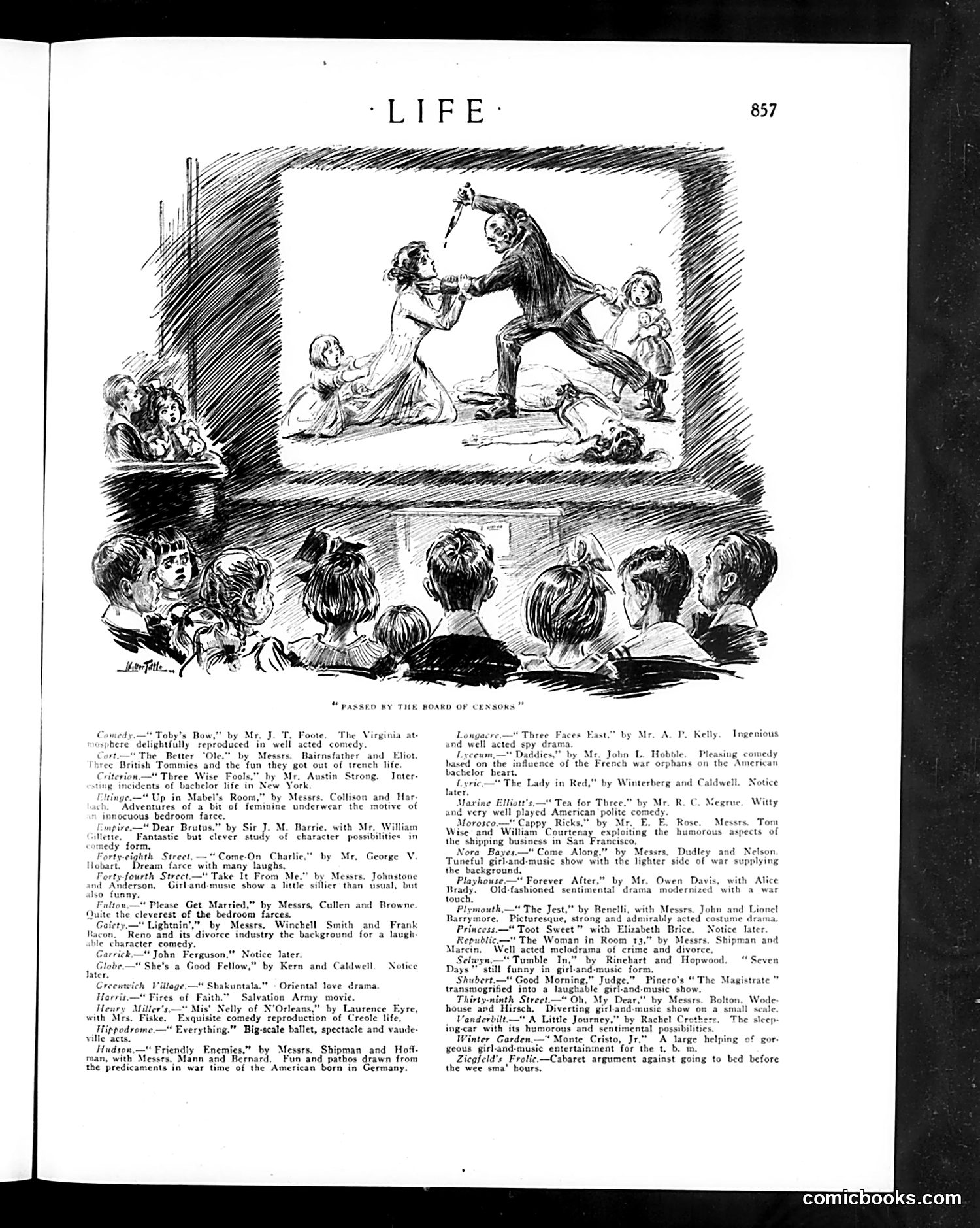
This satirical cartoon depicts theatrical censorship during the World War I era. The image shows a puppet show or stage performance where children watch actors performing above while adult censors sit in the audience below, presumably approving the content. The accompanying text lists Broadway theaters and their current productions, with the caption's ironic title suggesting that these plays have been officially approved despite often featuring scandalous content: bedroom farces, divorce comedies, and tales of infidelity ("Up in Mabel's Room," "Please Get Married," "Lightnin'" about Reno divorces). The satire mocks the Board of Censors' apparent ineffectiveness—they supposedly "passed" these morally questionable entertainments, implying the censorship process was either toothless or absurdly permissive. The juxtaposition of innocent children watching with official approval jokes about institutional hypocrisy regarding public morality standards.
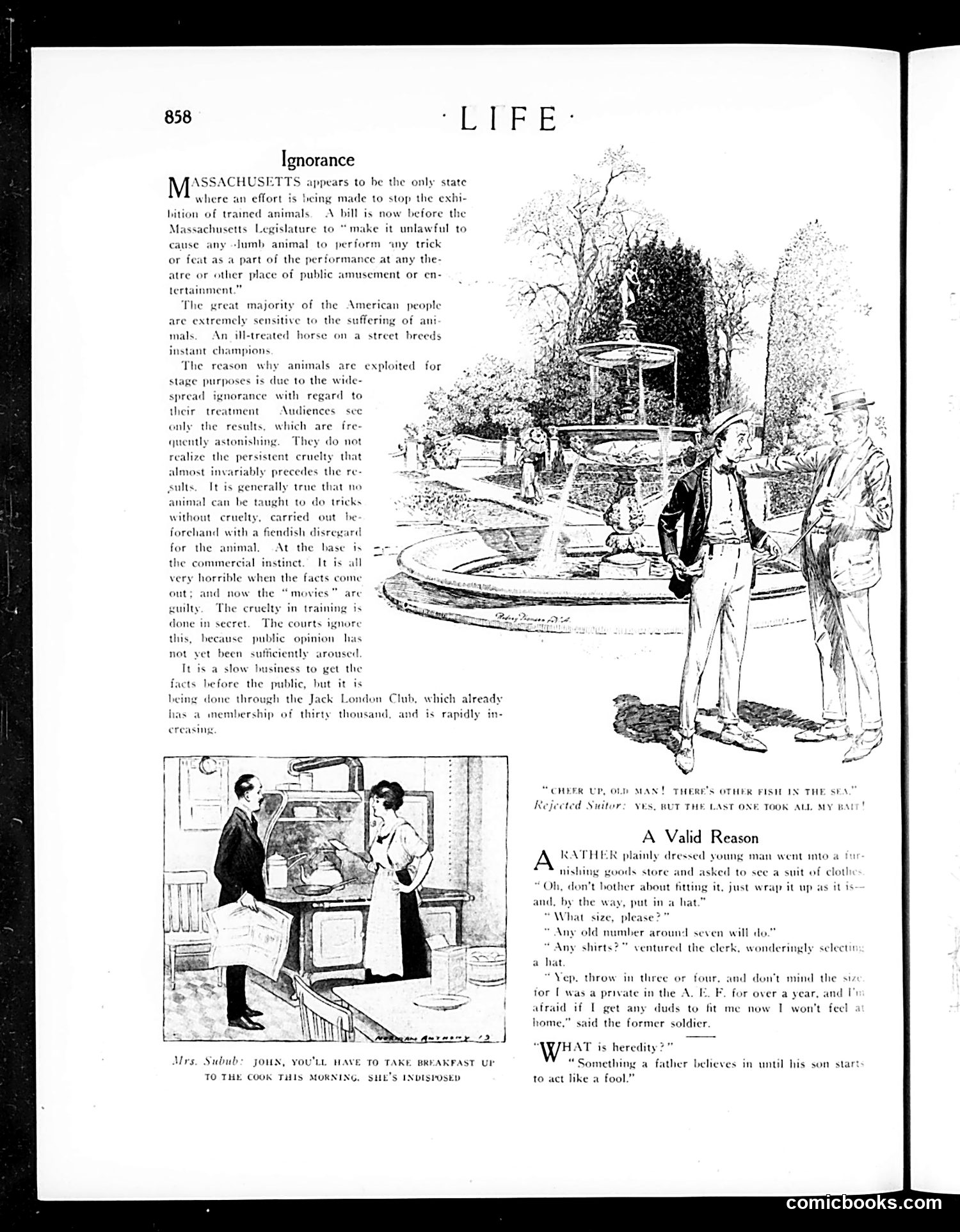
This page contains three distinct pieces of social commentary: **"Ignorance" (main article):** Advocates for Massachusetts legislation banning trained animals in entertainment. The text argues audiences don't realize the systematic cruelty required to train animals to perform tricks, and that public ignorance enables this abuse. It mentions the Jack London Club's efforts to raise awareness—London was a prominent animal-welfare advocate of the era. **"Cheer Up, Old Man!" cartoon:** A rejected suitor complains that his previous girlfriend took all his money (his "bait"), making future romantic prospects financially impossible. It's a simple romantic humor joke about financial ruin from dating. **"A Valid Reason" cartoon:** A poorly-dressed man buys ill-fitting clothes deliberately, explaining he was a soldier and fears properly-fitted clothes would make him homesick. The humor derives from his unusual logic and apparent poverty or eccentricity post-military service. The page reflects early 20th-century concerns: animal welfare advocacy, romantic courtship anxieties, and the social reintegration of veterans.
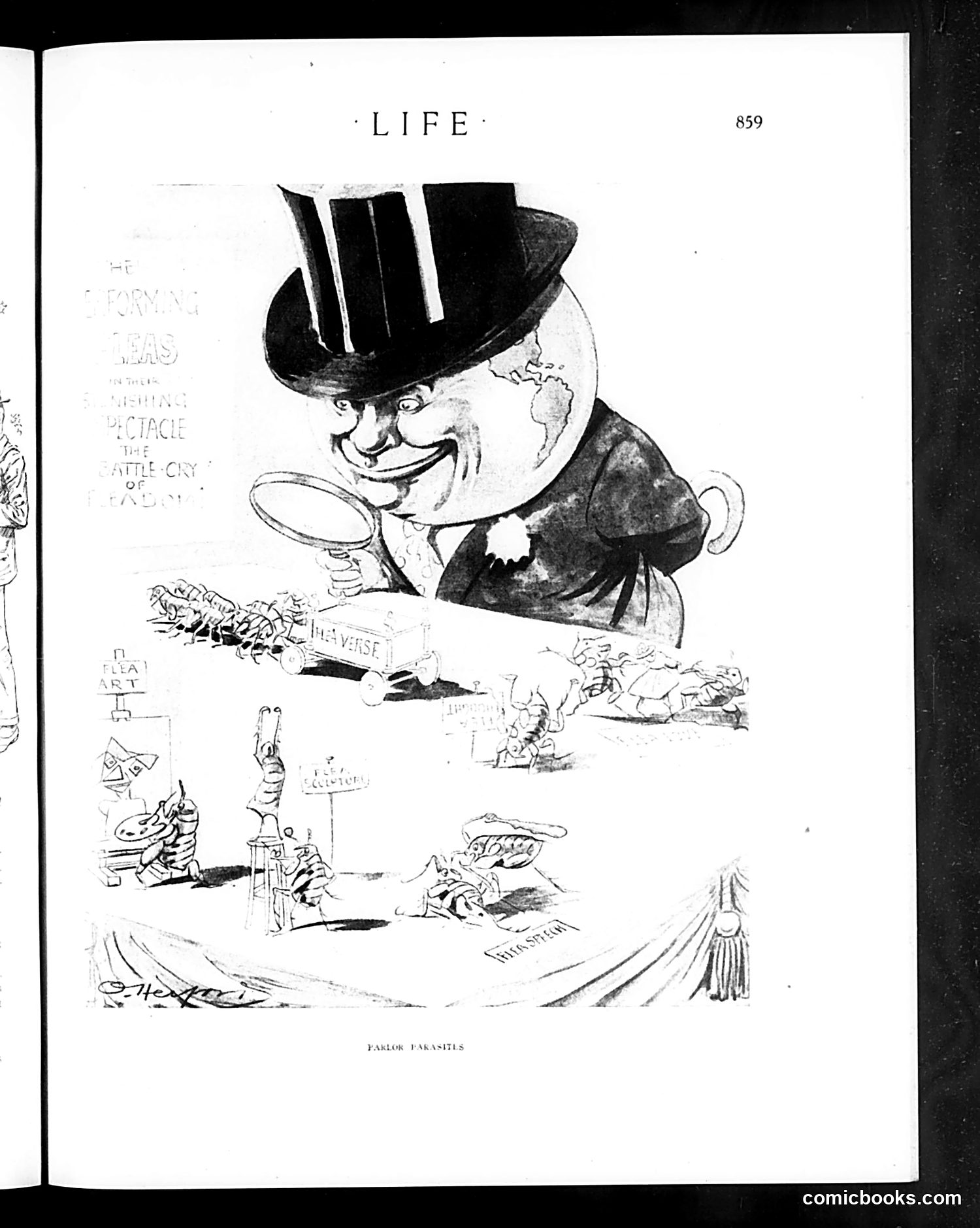
This satirical cartoon from *Life* magazine depicts a grotesque figure with an exaggerated moon-shaped face wearing a top hat and holding a magnifying glass, examining tiny human figures below. The caption reads "PARLOR PARASITES." The illustration appears to be social commentary about parasitic behavior in domestic or social settings—the magnifying glass suggests scrutiny or inspection of small, insignificant people. The "parlor" reference indicates drawing-room society. Without additional context about the specific date or historical event referenced, the exact target of satire is unclear. However, the caricature style and exaggerated features typical of early 20th-century *Life* magazine suggest this critiques some form of social pretension or exploitation within polite society, with the large figure representing someone who exploits or preys upon smaller, weaker individuals in social contexts.
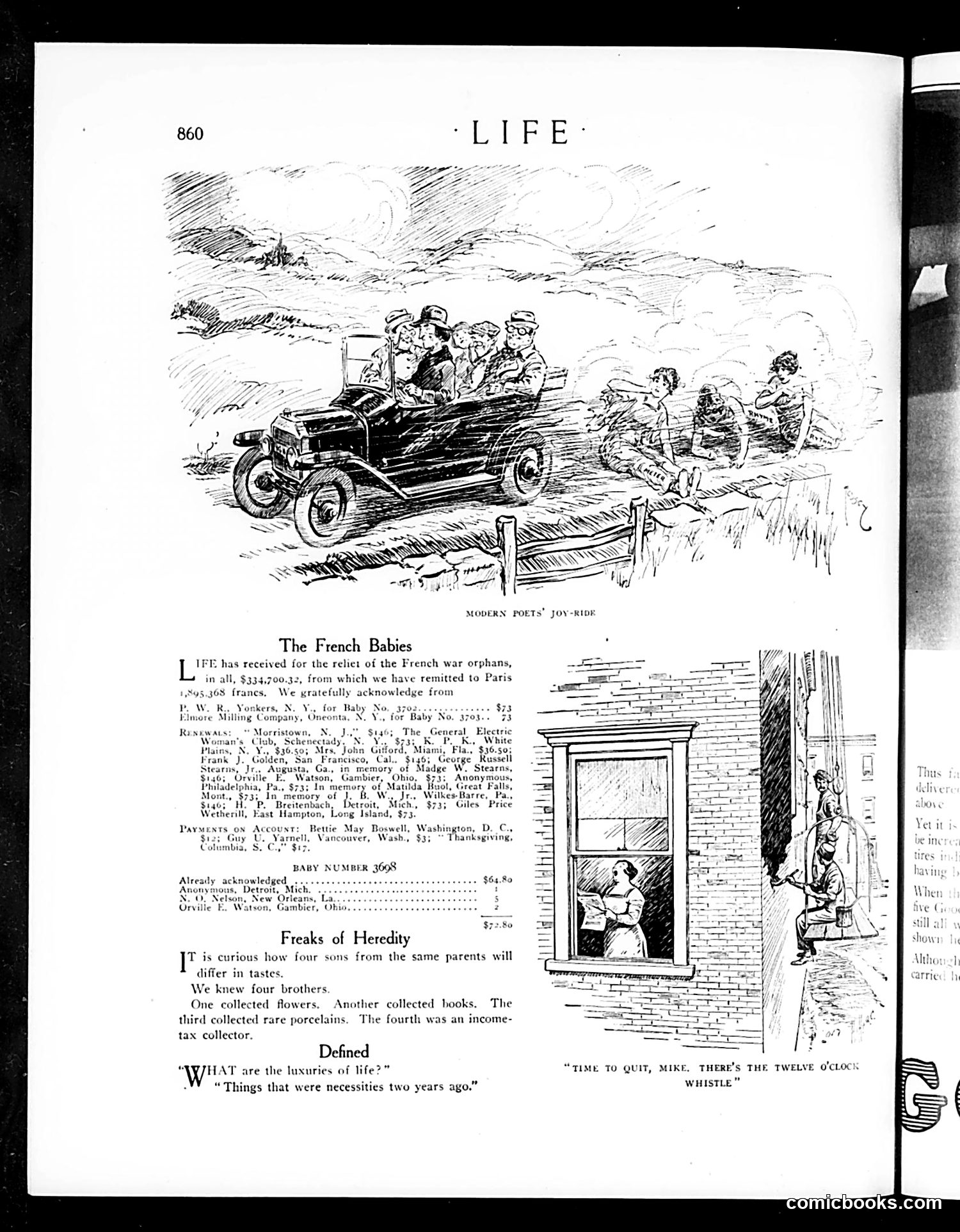
**Top Cartoon ("Modern Poets' Joy-Ride"):** Shows wealthy urban dwellers in a fancy automobile encountering poor rural families on the roadside. The satire critiques the disconnect between rich city people enjoying leisure drives and the economic disparities of rural America—a common theme during the 1920s as automobiles became status symbols. **"The French Babies" Section:** Life magazine is fundraising for French war orphans from World War I, listing donations from readers. This reflects post-WWI American charitable efforts to aid devastated European populations. **"Freaks of Heredity":** A humorous short piece about four brothers with different collecting interests, with the punchline that the fourth became an "income-tax collector"—likely satire on the newly-implemented federal income tax (established 1913), portrayed as an undesirable "hobby." **Bottom Right Cartoon:** A domestic scene where someone tells "Mike" it's past midnight—likely satirizing either working-class schedules or Prohibition-era speakeasy culture. The page reflects 1920s American concerns: wealth disparity, tax burdens, and postwar relief efforts.
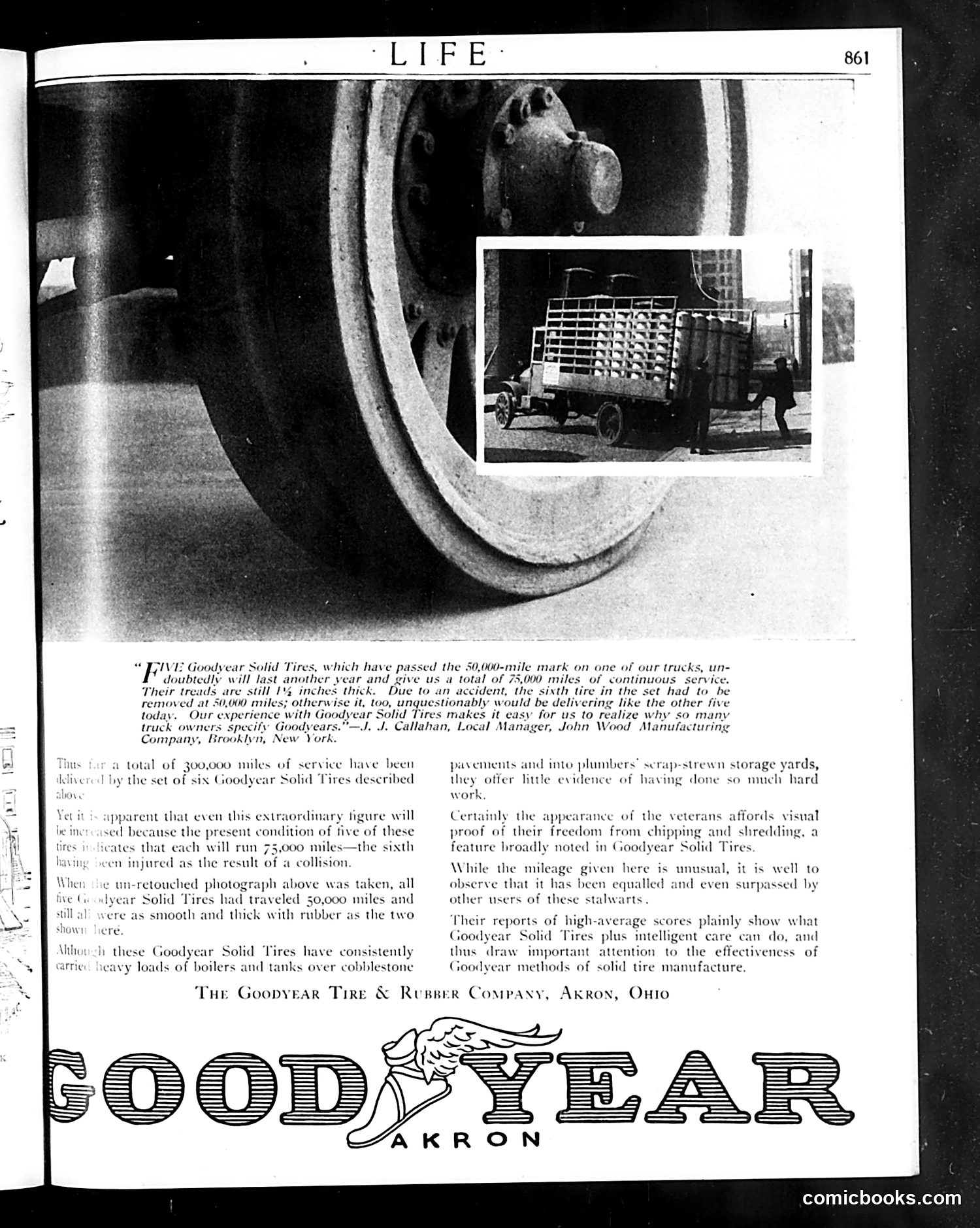
This page is **not a cartoon or satire**—it's a full-page advertisement for Goodyear Solid Tires. The image shows a close-up of a truck tire and an inset photo of a loaded delivery truck. The ad uses a testimonial from J.J. Callahan, Local Manager of John Wood Manufacturing Company in Brooklyn, to tout durability. He claims their set of six Goodyear Solid Tires collectively delivered 300,000 miles of service, with five tires potentially reaching 75,000 miles each. The text emphasizes the tires' thick treads, resistance to damage from rough urban roads and collisions, and superior performance compared to competitors. The appeal is to truck fleet owners and managers by presenting concrete mileage data and real-world testimonials as proof of value and cost-effectiveness for commercial vehicle use.
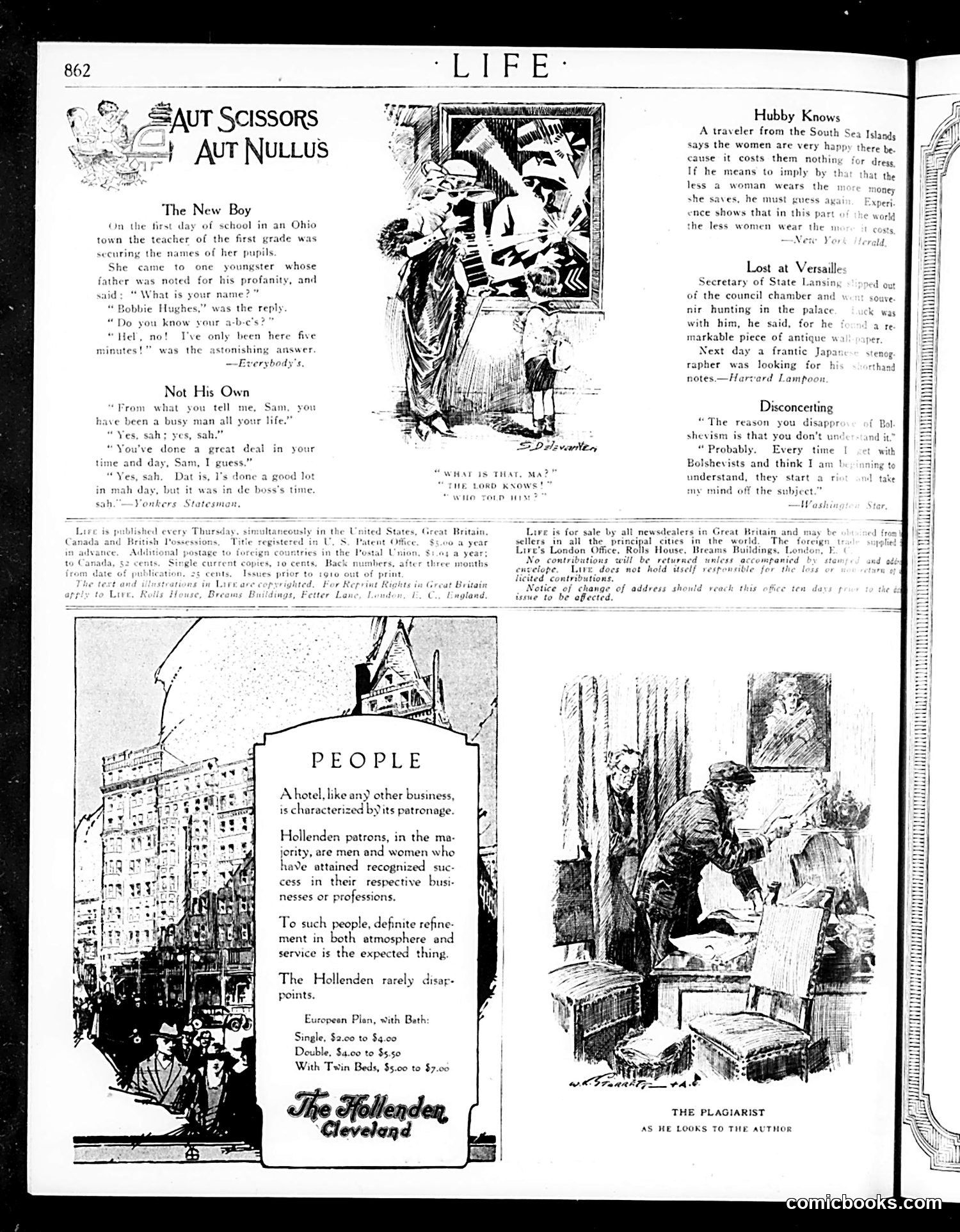
This page contains several brief humorous sketches typical of early 20th-century American satirical magazines: **"The New Boy"** jokes about a first-grader whose profane father hasn't taught him the alphabet—the humor lies in innocent ignorance contrasted with parental vulgarity. **"Hubby Knows"** satirizes gender economics: a traveler claims South Sea Island women are happy because expensive clothing costs nothing there, implying women save money by wearing less. The joke mocks both the traveler's naïveté and period attitudes about female consumption. **"Lost at Versailles"** and **"Disconcerting"** are brief anecdotes poking fun at absent-minded officials and the contradictions of Bolshevism. **"Not His Own"** features a dialect-heavy exchange with an African American character about doing "a good job," reinforcing period stereotypes. The page also includes a Hollenden Hotel advertisement and a cartoon titled "The Plagiarist" showing someone copying from an author—a visual pun on literary theft. Overall, the page reflects early 1900s humor conventions: simple wordplay, ethnic caricature, and domestic satire.
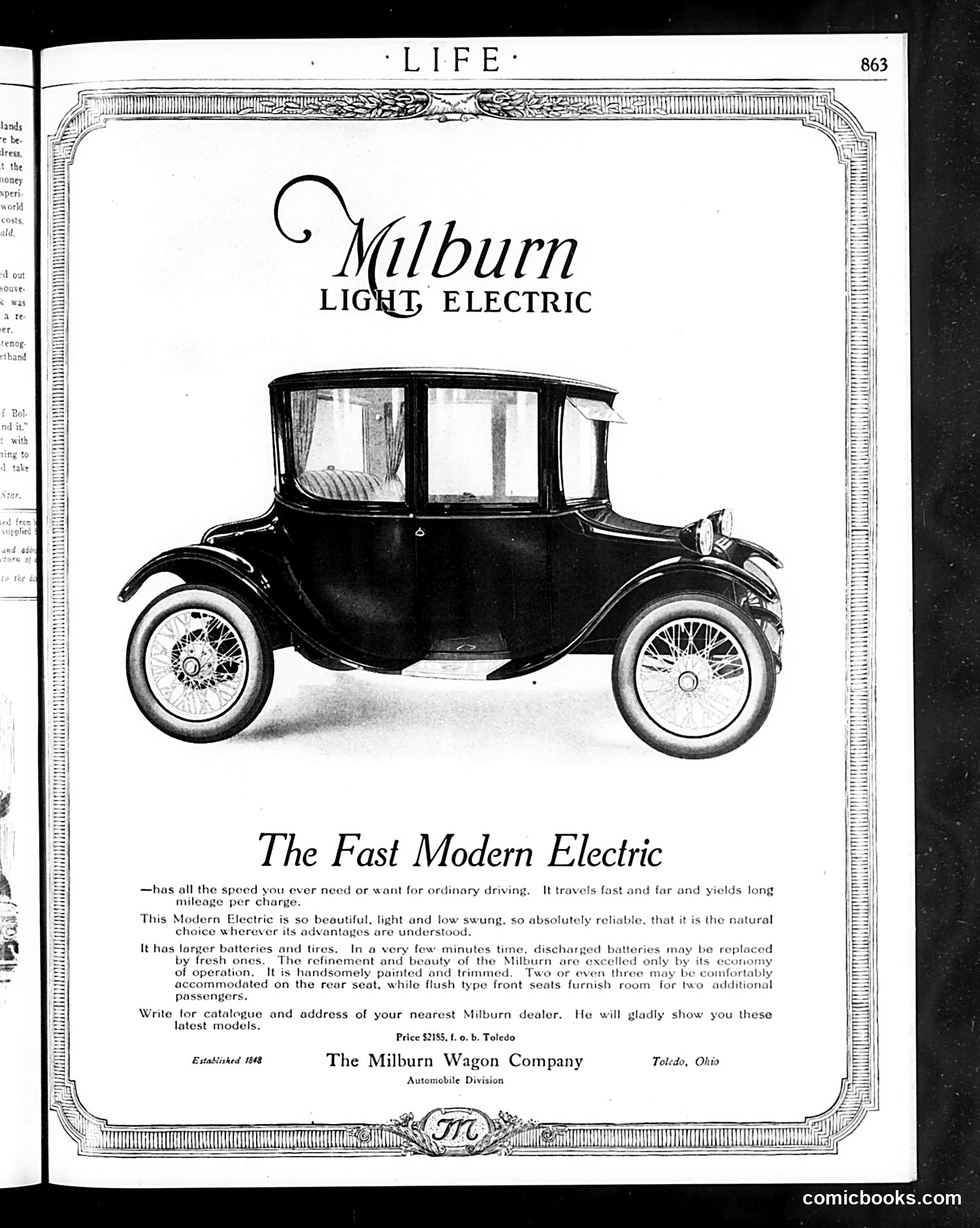
This is **not a cartoon or satire** — it's a straightforward advertisement for the Milburn Light Electric automobile, published in *Life* magazine (page 863). The ad promotes an electric vehicle as "The Fast Modern Electric," emphasizing practical benefits: speed, range, reliability, and ease of battery replacement. It highlights luxury features like comfortable seating for up to five passengers and elegant styling. The Milburn Wagon Company, based in Toledo, Ohio (established 1848), positions the electric car as the natural choice for discerning buyers. The price of $2,185 f.o.b. Toledo is listed. This reflects early 20th-century automotive marketing when electric vehicles were serious competitors to gasoline cars, marketed to wealthy consumers who valued refinement and ease of operation. The ad's presence in *Life*'s pages simply reflects that the magazine carried advertisements alongside editorial content.
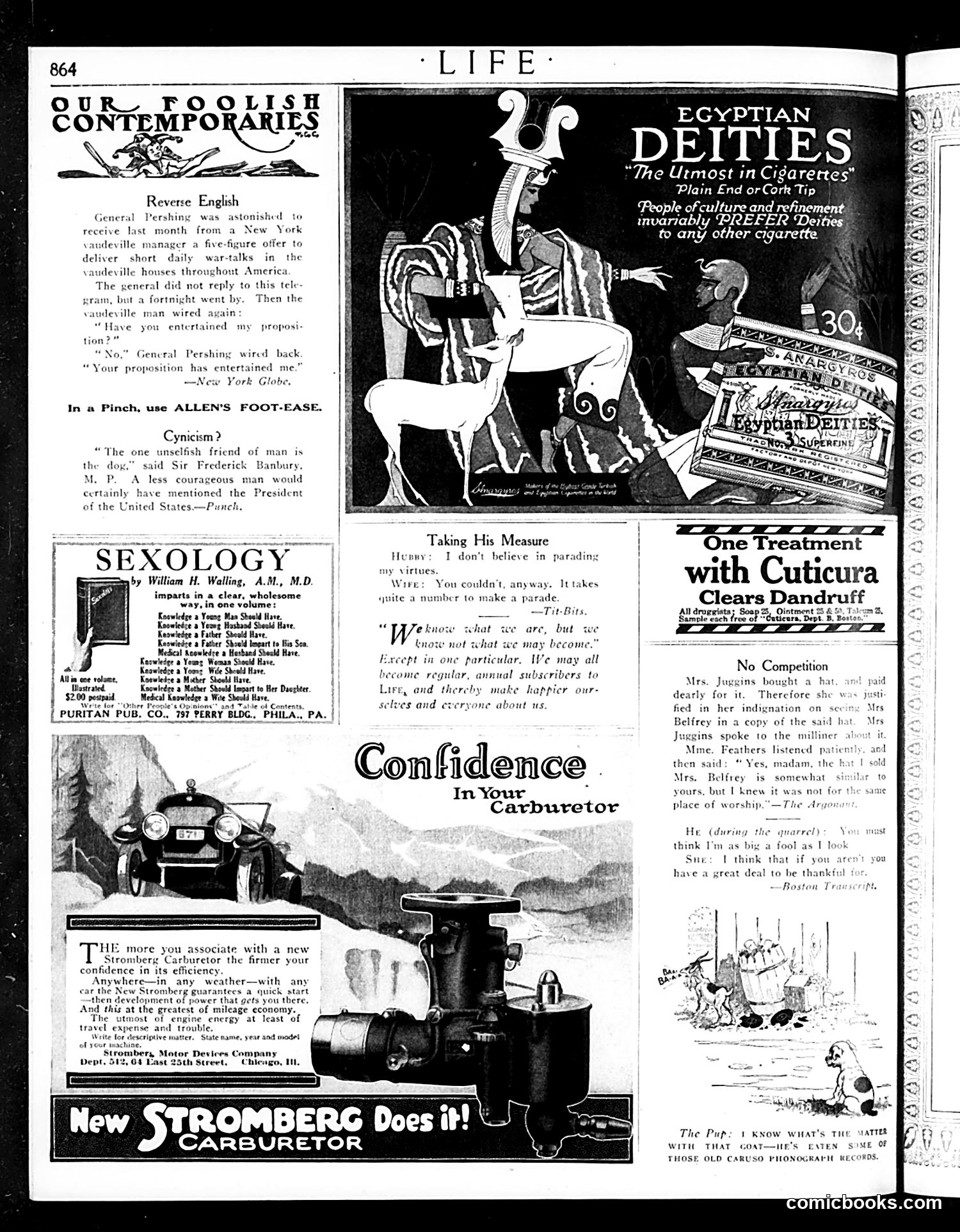
This page is primarily **advertisements and humor pieces** rather than political commentary. The key content: **"Reverse English"** (top left): A joke about General Pershing declining a vaudeville offer. When the theater manager wires asking if he's "entertained" the proposition, Pershing replies his proposition has "entertained" him instead—a play on words suggesting the manager's offer was itself the entertainment. **Other humor pieces** include brief jokes about cynicism, marriage advice, and a pun about a dog eating old Caruso phonograph records (the dog's "wattee" problem suggests the dog sounds like an operatic singer). **The advertisements** dominate: Egyptian Deities cigarettes, Cuticura dandruff treatment, Stromberg carburetors, Allen's Foot-Ease, and a "Sexology" book series. These reflect 1920s consumer culture and patent medicine marketing common to the era. There is **no significant political satire** on this page—it's a standard satirical magazine mixing light humor with commercial advertising.
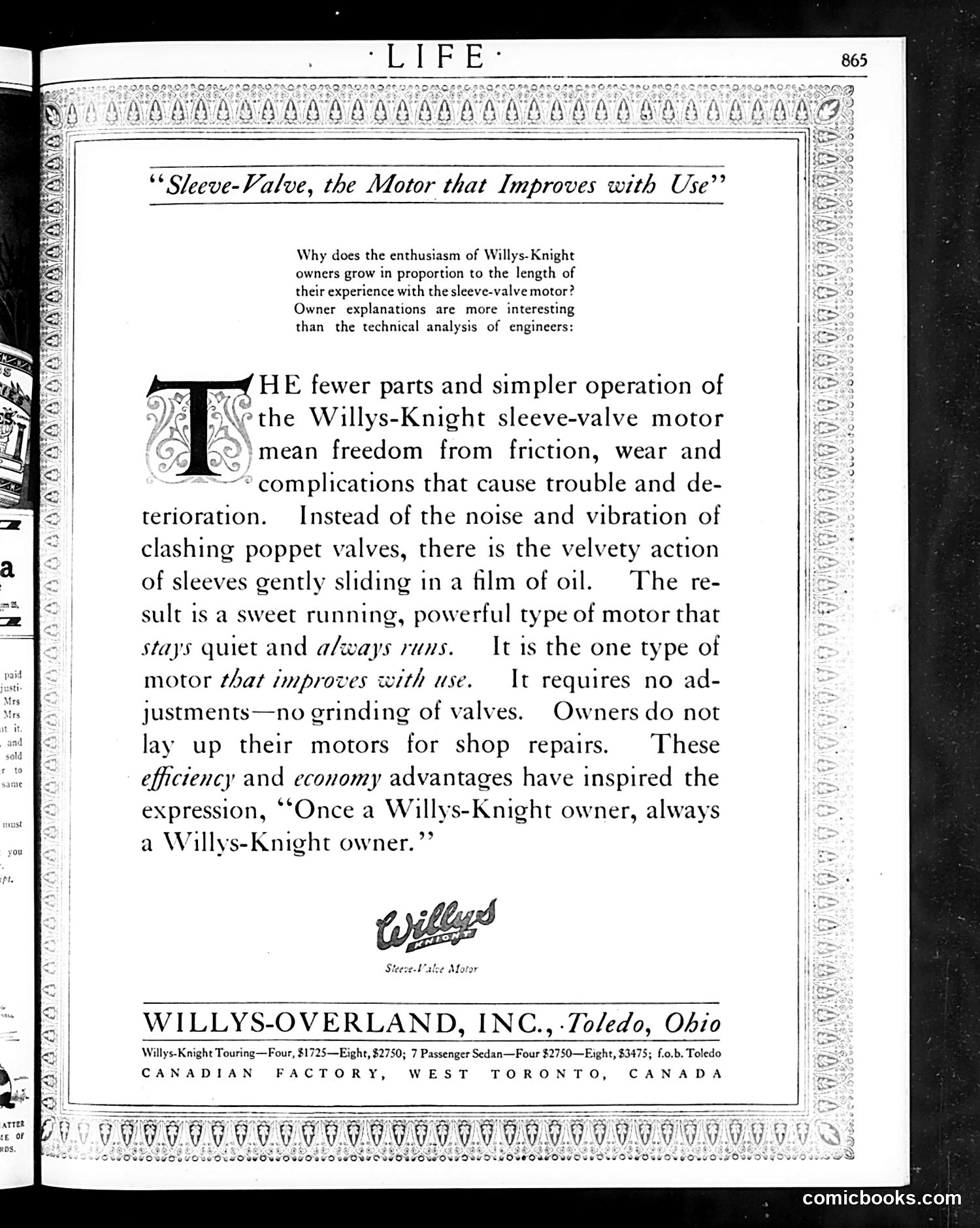
This is not a cartoon or satire, but a full-page advertisement for the Willys-Knight automobile, published in *Life* magazine (page 865). The ad promotes the sleeve-valve motor technology, claiming it requires fewer parts and less maintenance than competitors' poppet-valve engines. The marketing message targets middle-class car owners with promises of reliability and economy—no valve grinding, no shop repairs needed. The phrase "improves with use" and the slogan "Once a Willys-Knight owner, always a Willys-Knight owner" emphasize customer loyalty based on performance. This reflects early 1920s automotive advertising strategy: technical superiority and cost savings as selling points. The ad lists model prices ($1,725–$3,475) and notes both American (Toledo, Ohio) and Canadian manufacturing locations.
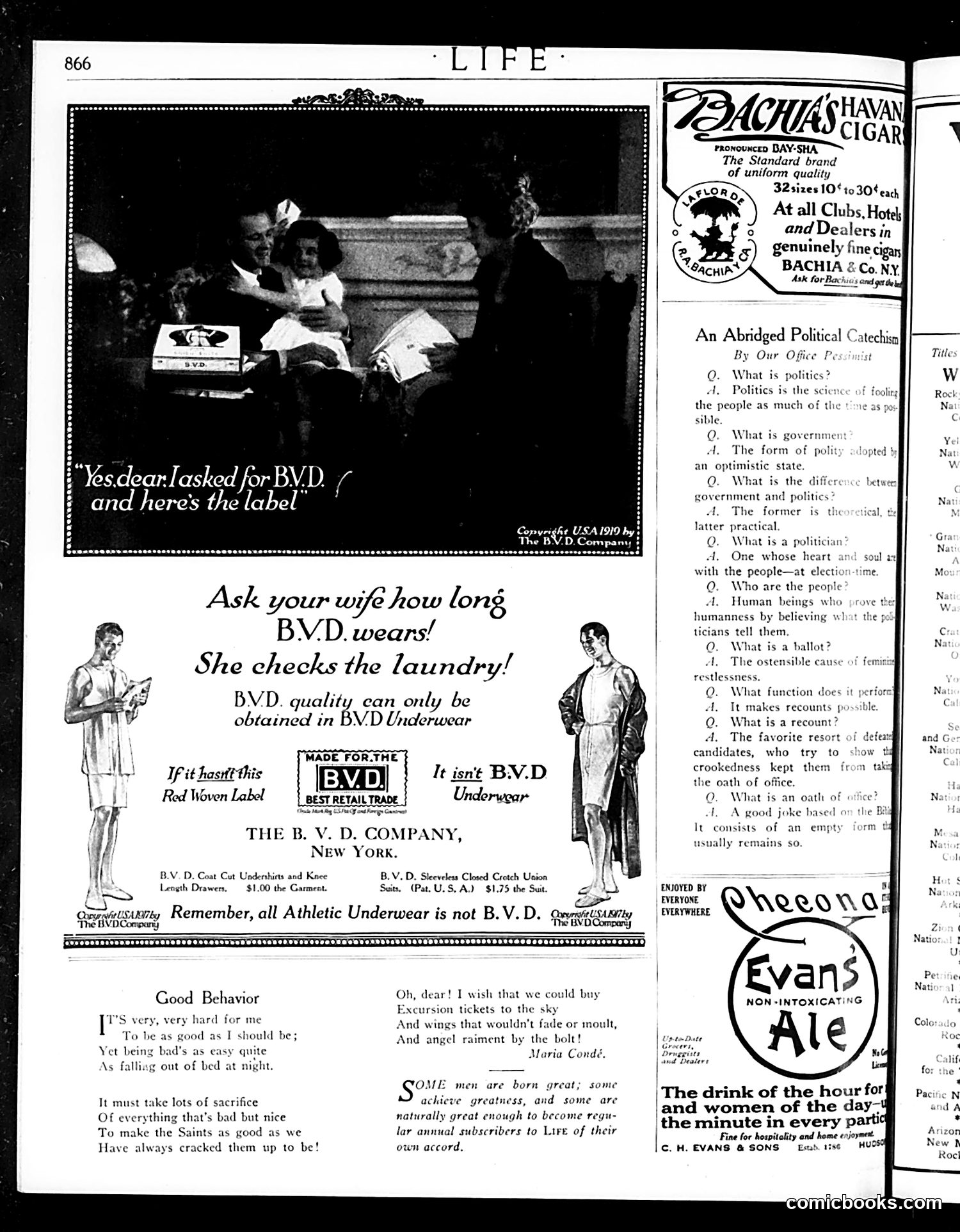
This page is primarily **advertising** rather than satirical content, though it contains period humor. **Main Advertisement: B.V.D. Underwear** The dominant feature is a B.V.D. (a major American underwear brand) ad showing a wife checking laundry. The pitch appeals to wives as judges of underwear durability—"Ask your wife how long B.V.D. wears! She checks the laundry!" This reflects early 20th-century marketing strategy: targeting women as household purchasers and quality arbiters. The "Red Woven Label" serves as authenticity proof against counterfeits. **Secondary Content:** - **"An Abridged Political Catechism"**: Mock Q&A satirizing politics as a cynical science ("fooling the people"), politicians as self-interested, and ballots/recounts as theater masking corruption. Standard Progressive-era skepticism toward politics. - **Minor poems** on "Good Behavior" and greatness - **Bachia Cigars** and **Cheona Evans Ale** ads The page exemplifies how Life mixed satirical editorial content with commercial advertising to subsidize publication.
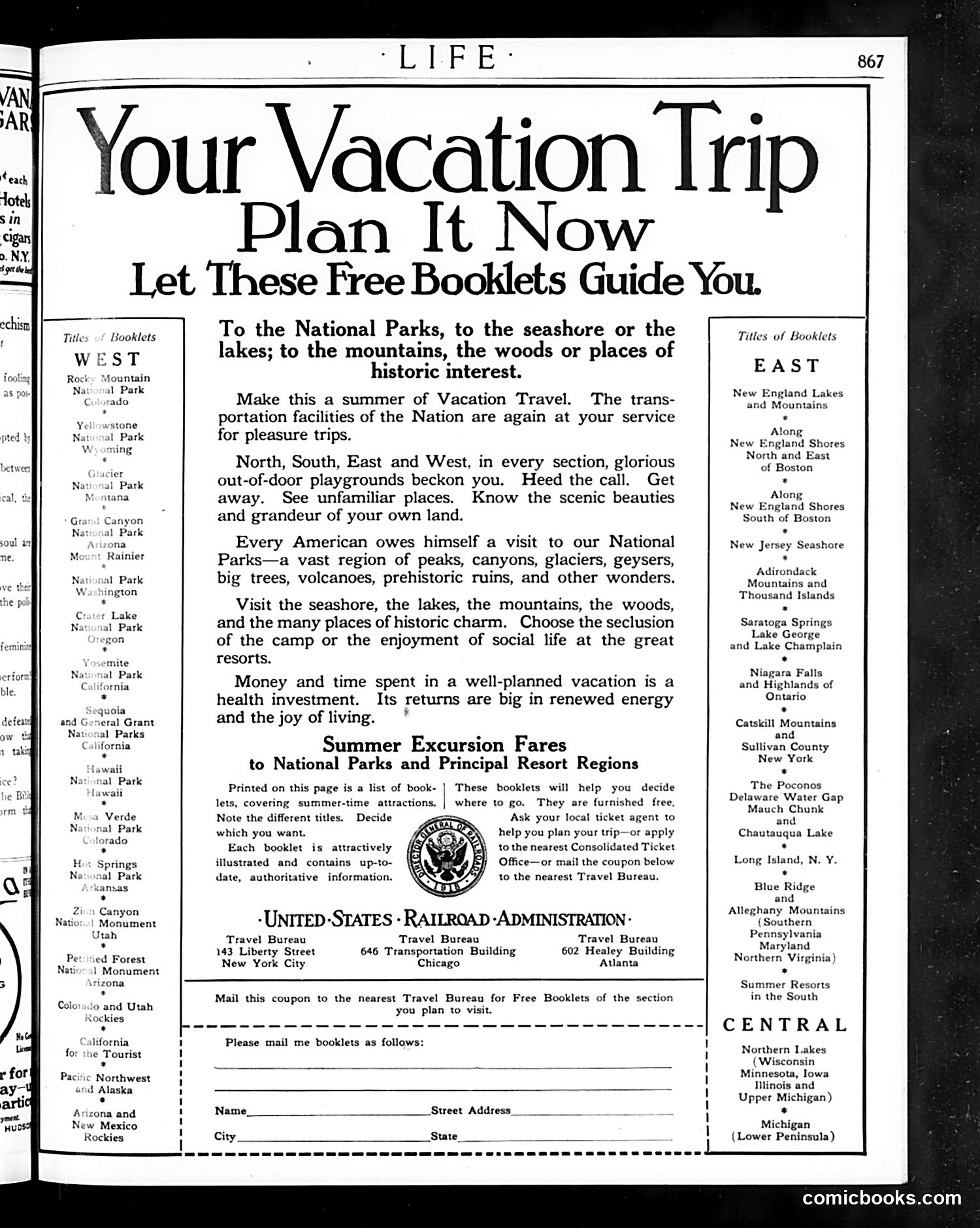
This is not a cartoon or satirical piece, but rather a **public service advertisement** from the United States Railroad Administration promoting domestic vacation travel to American national parks and resorts. **Historical Context:** The ad encourages Americans to visit scenic destinations across all regions—West, East, and Central—emphasizing national parks like Yellowstone, Grand Canyon, and the Adirondacks. It frames vacation travel as a "health investment" that renews energy and joy. **Key Point:** This appears designed to boost railroad passenger traffic during the post-WWI period when transportation facilities were "again at your service for pleasure trips." By offering free informational booklets about vacation destinations, the railroads encourage Americans to travel domestically rather than abroad. **For Modern Readers:** This reflects an era when railroads dominated vacation travel, before automobiles and commercial aviation became dominant. The patriotic language ("every American owes himself a visit") suggests government backing of domestic tourism as economic stimulus and national pride. This is essentially **travel advertising masquerading as civic duty**.
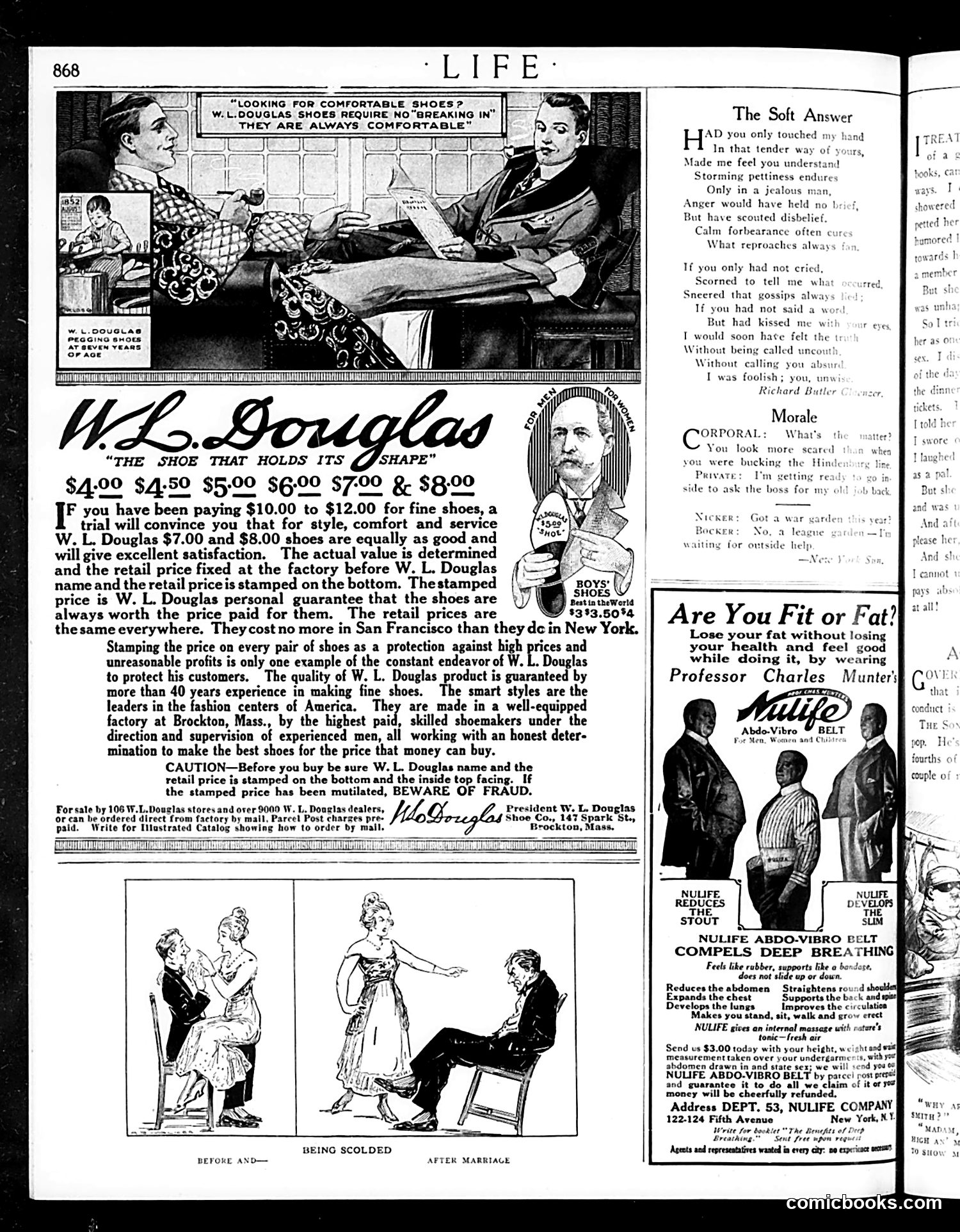
This page contains primarily **advertisements** with minimal editorial content. The main satirical element is a small cartoon strip at bottom left titled "Before and After Marriage," showing a woman scolding a man, then the same couple after marriage with reversed roles—a common trope mocking how relationships change after wedding vows. The page is dominated by **product ads**: W.L. Douglas shoes (emphasizing factory-set pricing as protection against fraud and markup), a poetry piece titled "The Soft Answer" (likely relationship advice), and a "Nulife Abdo-Vibro Belt" claiming to reduce abdomens and improve posture through vibration. The shoe ad's lengthy text warns against counterfeit pricing, reflecting early 20th-century consumer concerns about fraud. The marriage cartoon's humor relies on the dated assumption that wives become nagging and husbands become henpecked—reflecting period gender stereotypes presented as inevitable comedy.
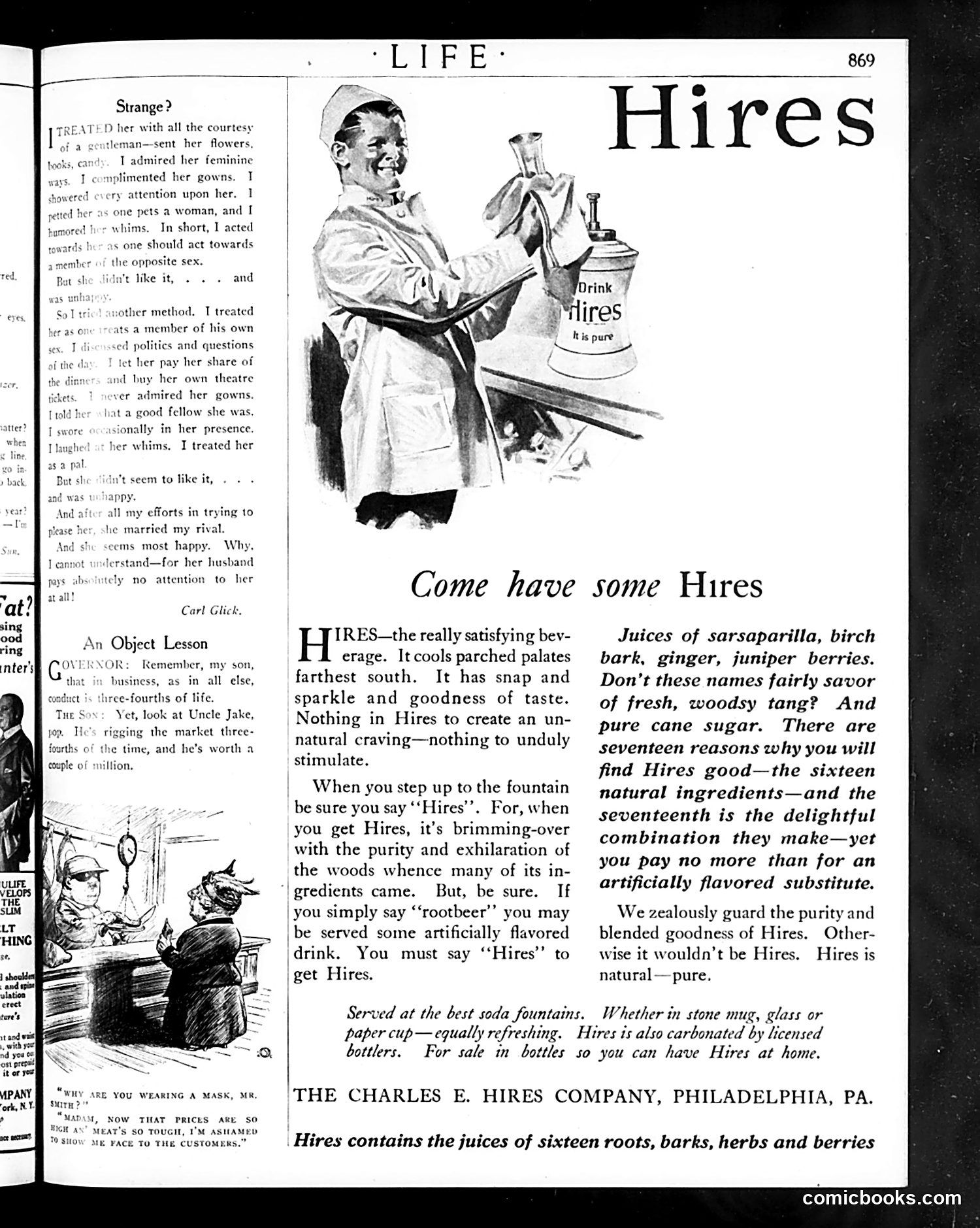
This page mixes editorial content with advertising. The left column contains two pieces: "Strange?" by Carl Glick describes a man's failed courtship—he treated a woman with gentlemanly courtesy, then as an equal peer, but she married someone else anyway, leaving him baffled. This appears to satirize changing gender dynamics and male confusion about how to court modern women. Below is "An Object Lesson," a brief joke about a butcher wearing a mask because meat prices are so high and the product so poor quality that he's ashamed to face customers—sharp satire on post-WWI inflation and food quality. The dominant content is a **Hires root beer advertisement** featuring an illustrated soda jerk holding a glass. The copy emphasizes Hires' "natural" ingredients (sixteen roots, barks, and herbs) and purity, explicitly contrasting it with artificially flavored competitors. This reflects early-20th-century consumer anxiety about food authenticity and "pure" versus adulterated products.
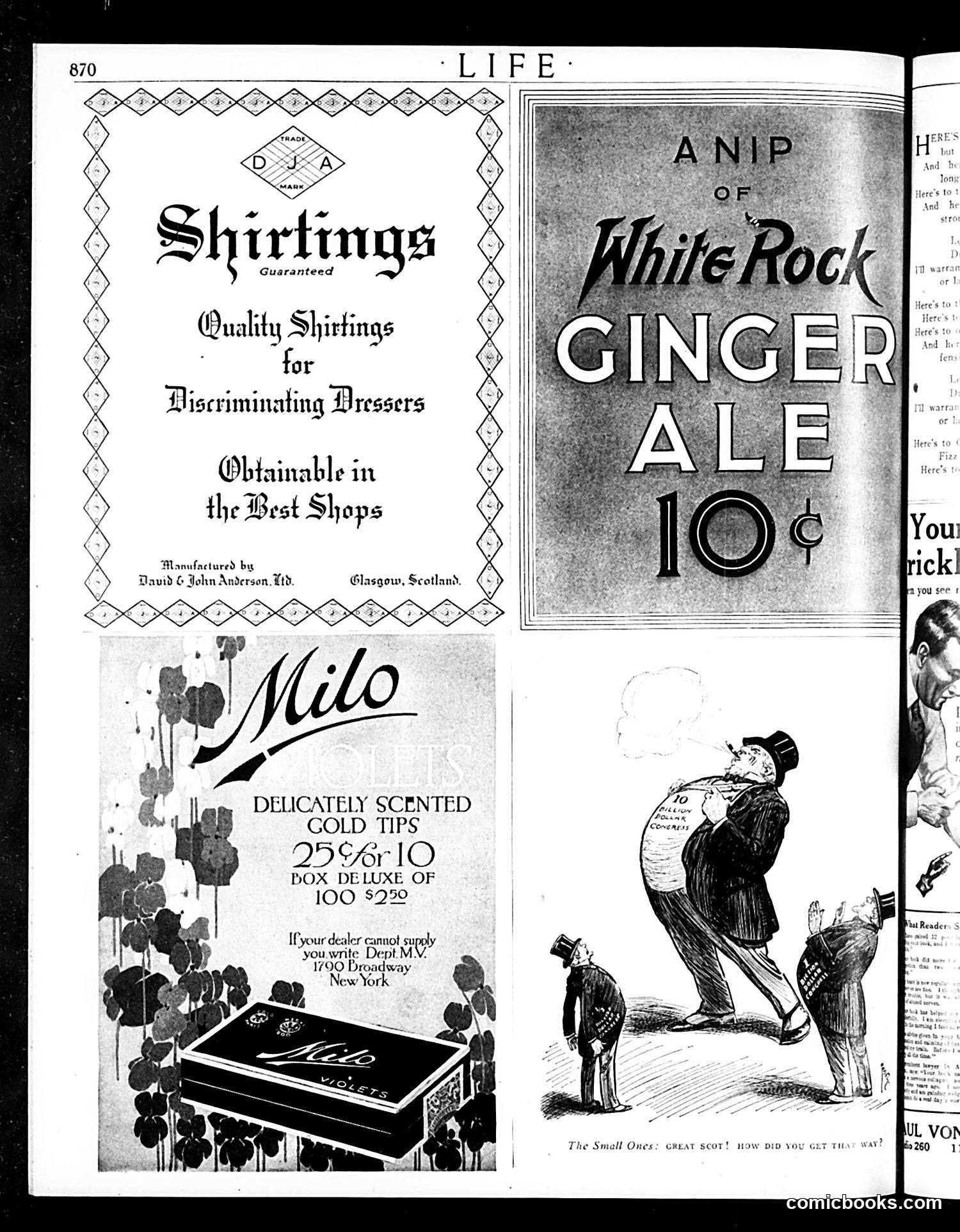
This page is primarily **advertisements**, not editorial content or political satire. The visible ads promote: 1. **Shirtings** — quality fabric for discriminating dressers, manufactured in Glasgow 2. **Milo Gold Tips** — delicately scented cigarettes (25¢ or 10 for a box of 100 at $2.50) The only cartoon is a small illustration at bottom-right captioned "The Small Ones: Great Scot! How did you get that way?" It depicts a tall man with a child and small dog, apparently making a humorous observation about the child's size or appearance—a gentle joke with no discernible political content. This appears to be a typical early 20th-century **Life magazine page of commercial advertisements** with minimal satirical content. The cartoon, if satirical at all, is mild social humor rather than commentary on politics or current events.
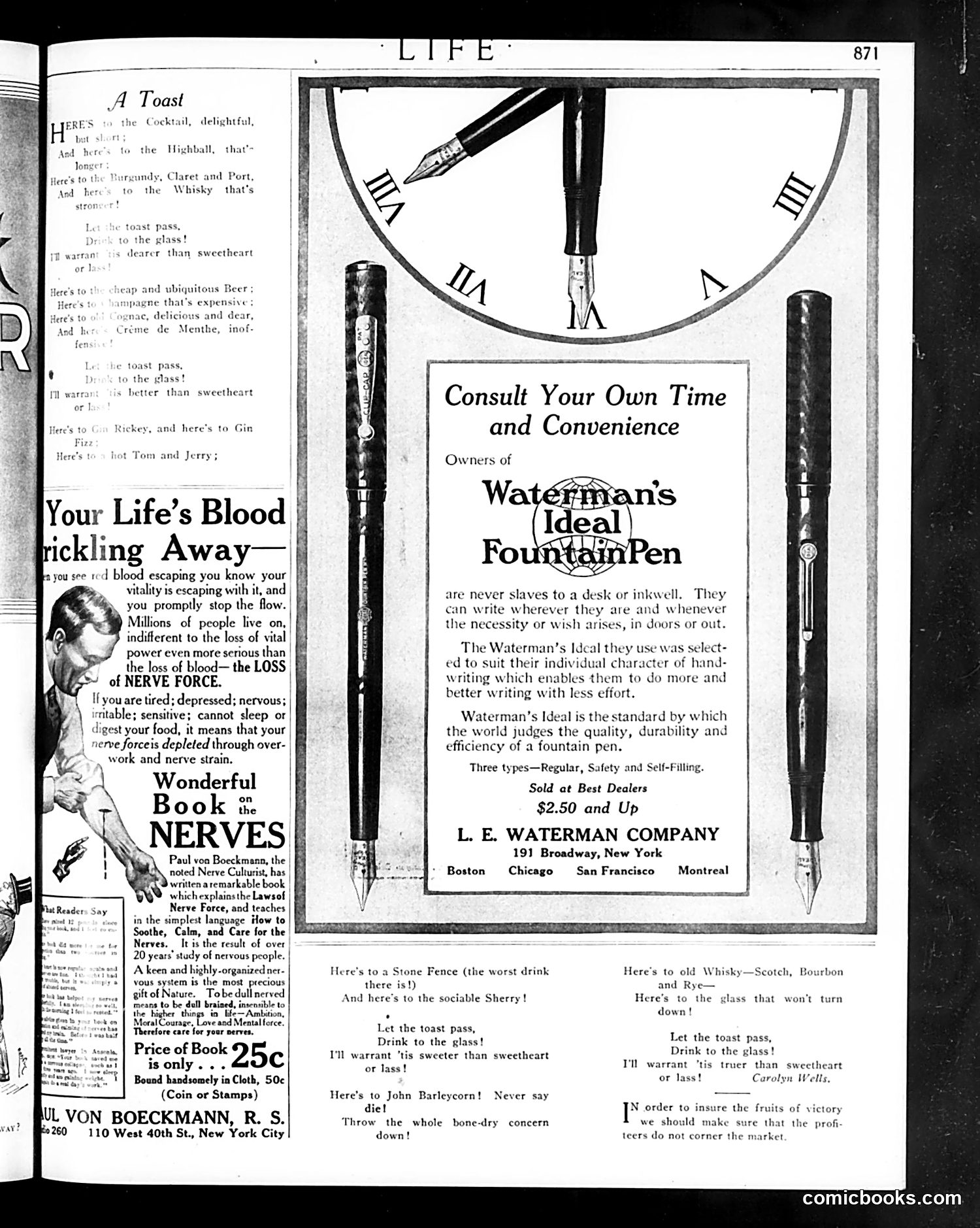
This page mixes advertising with satirical poetry. "A Toast" (left and bottom) is humorous verse by Carolyn Wells celebrating various alcoholic drinks—cocktails, beer, whiskey, gin—with repeated refrains about drinking toasts. The humor lies in treating alcohol with mock-reverence and the observation that drinks are "truer than sweetheart or lass," suggesting alcohol's reliability over romantic relationships. The center features a Waterman's Ideal Fountain Pen advertisement, using the freedom of writing anywhere as a selling point—users are "never slaves to a desk." Left sidebar advertises Paul von Boeckmann's "Book on the Nerves" (25¢), claiming nerve exhaustion causes fatigue and depression, offering his guide as remedy. This reflects early-20th-century pseudoscience about "nerve force." The bottom's final couplet mocks wartime profiteering, warning against allowing profiteers to "corner the market"—likely WWI-era commentary on war-related price-gouging.
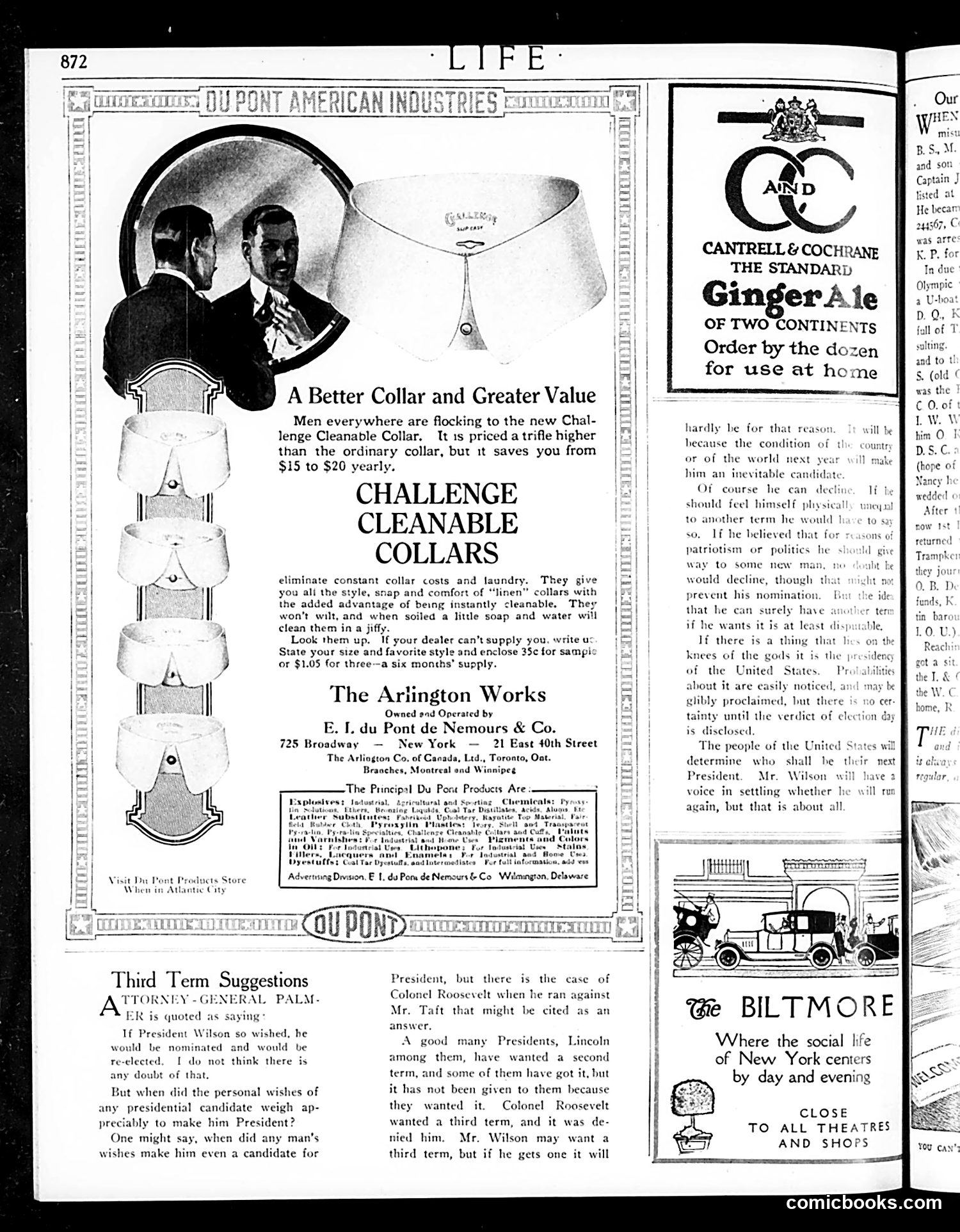
This page is primarily **advertising**, not political satire. The main content features advertisements for Challenge Cleanable Collars (by DuPont) and The Biltmore hotel, alongside smaller ads for ginger ale and a theater. The only political content appears in the text column titled "Third Term Suggestions," which discusses President **Woodrow Wilson's potential re-election**. Attorney General Palmer is quoted saying Wilson could be nominated and re-elected if he wished. The author argues that personal wishes don't determine presidencies, citing **Theodore Roosevelt's failed attempt at a third term** as precedent. The piece suggests the American people—not Wilson's desires—will decide whether he runs again. This reflects 1916 election speculation about whether Wilson would seek a third term (he ultimately did and won).
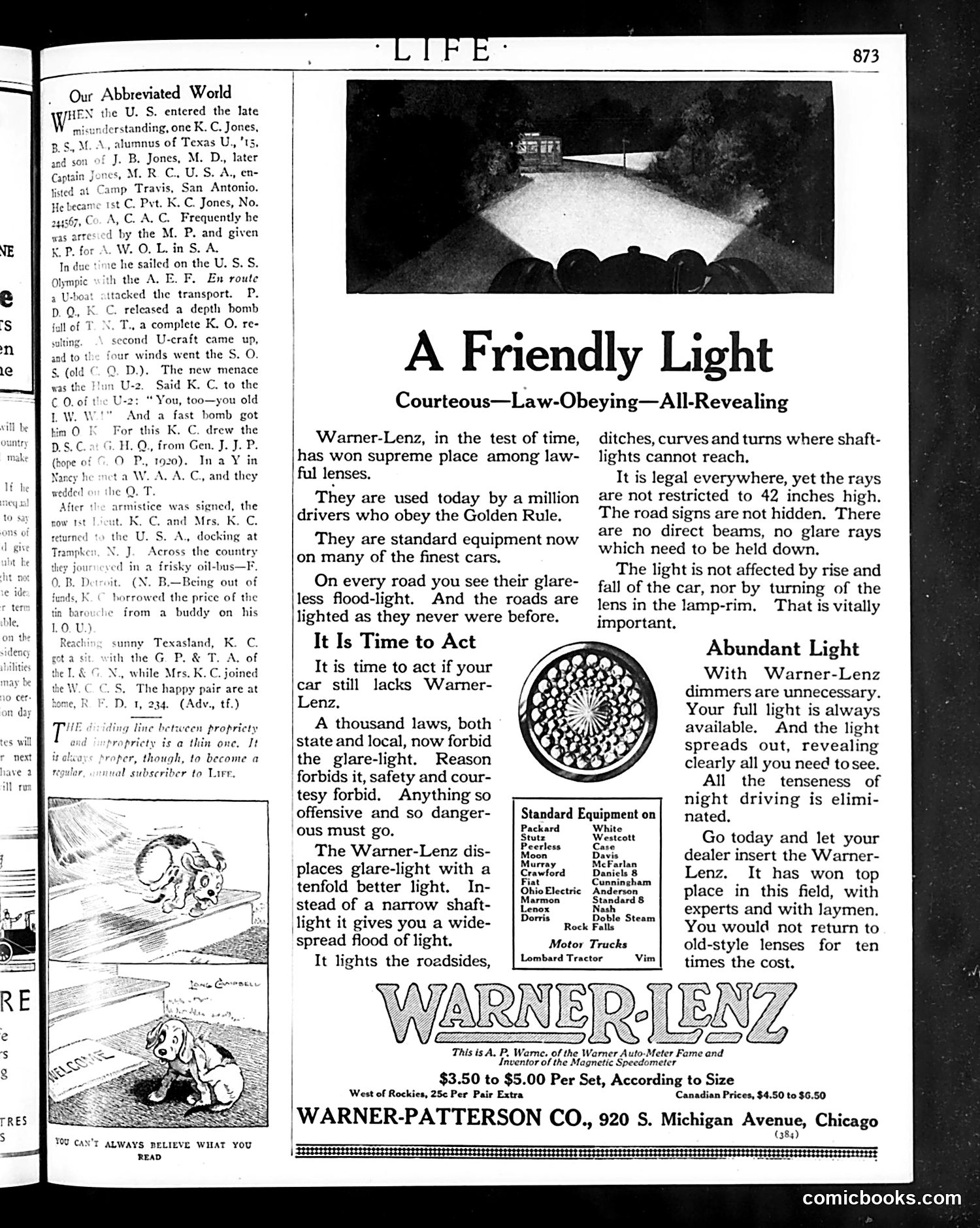
This page is primarily **advertising**, not satire or political commentary. The left column contains a brief "Our Abbreviated World" section—a humorous anecdote about a Texas University alumnus named K.C. Jones who, after entering WWI service, returns home and borrows money from a buddy, illustrating casual post-war repatriation. The dominant content is a full-page **Warner-Lenz automobile headlight advertisement**. The ad promotes their superior "flood-light" technology as legally mandated (referencing state/local laws against "glare-lights"), safe, and already standard equipment on luxury cars like Marmon, Packard, and Locomobile. The advertisement targets car owners with appeals to courtesy, safety, and legal compliance—typical 1920s marketing. The two small illustrated panels on the left appear to be unrelated cartoons or vignettes, now largely illegible in this reproduction. **No political satire is present.** This is a commercial magazine page from the automotive era.
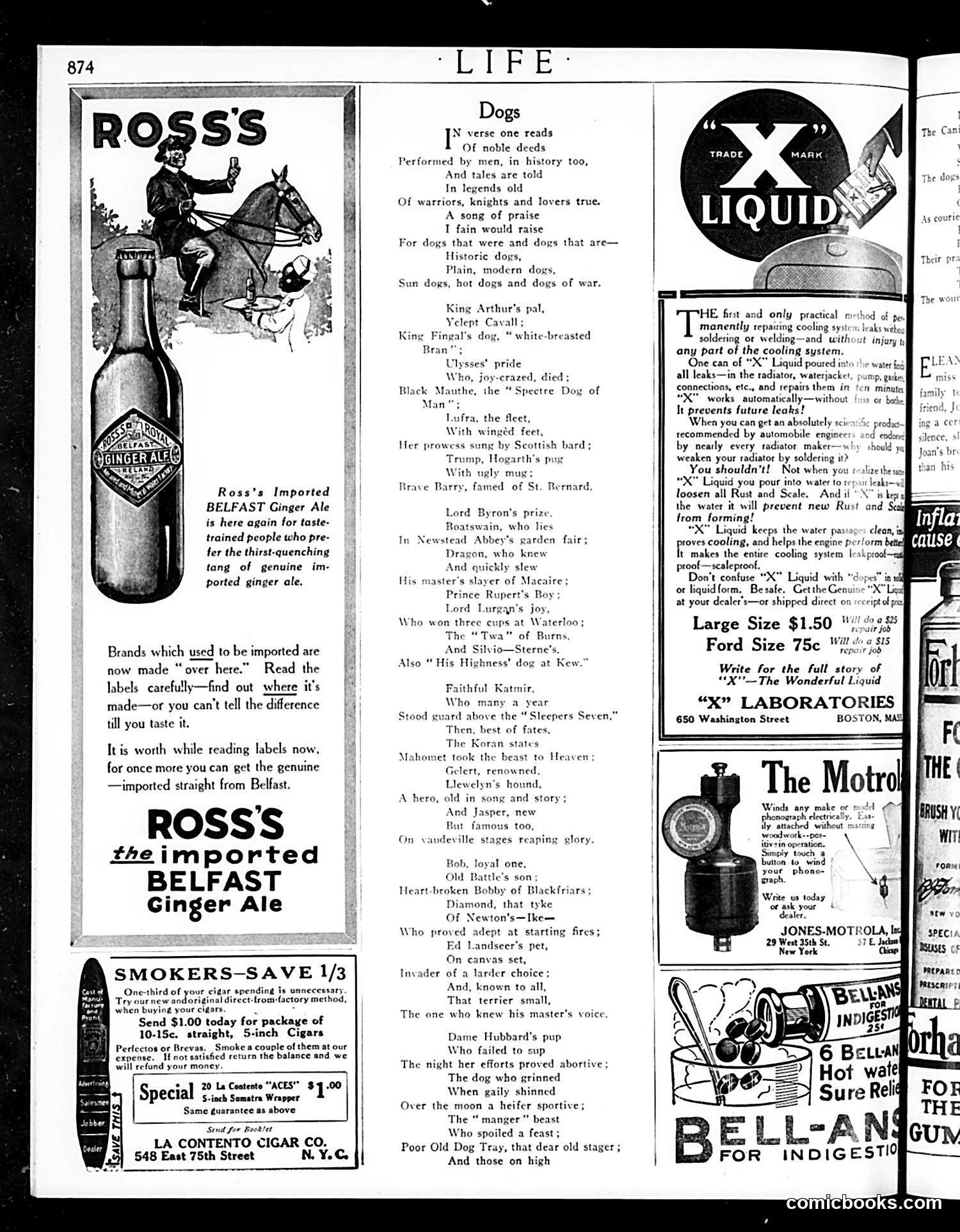
This page is primarily **literary and advertising content** rather than political satire. The center features a lengthy poem celebrating famous dogs throughout history and literature—from King Arthur's Caval to nursery rhyme characters like Dame Hubbard's pup and the cow jumping over the moon. The poem mixes genuine historical/literary references (Byron's Boatswain, Sir Edwin Landseer's paintings, the Koran's mention of a faithful dog) with whimsical ones. The humor is gentle and nostalgic, celebrating canine loyalty and fame across centuries. The surrounding advertisements (Ross's Ginger Ale, X Liquid radiator sealant, cigars, and Bell-ans antacid) are typical period marketing unrelated to the poem's content. **No political satire is present**—this appears to be Life magazine's lighter, literary fare celebrating dogs as cultural icons.
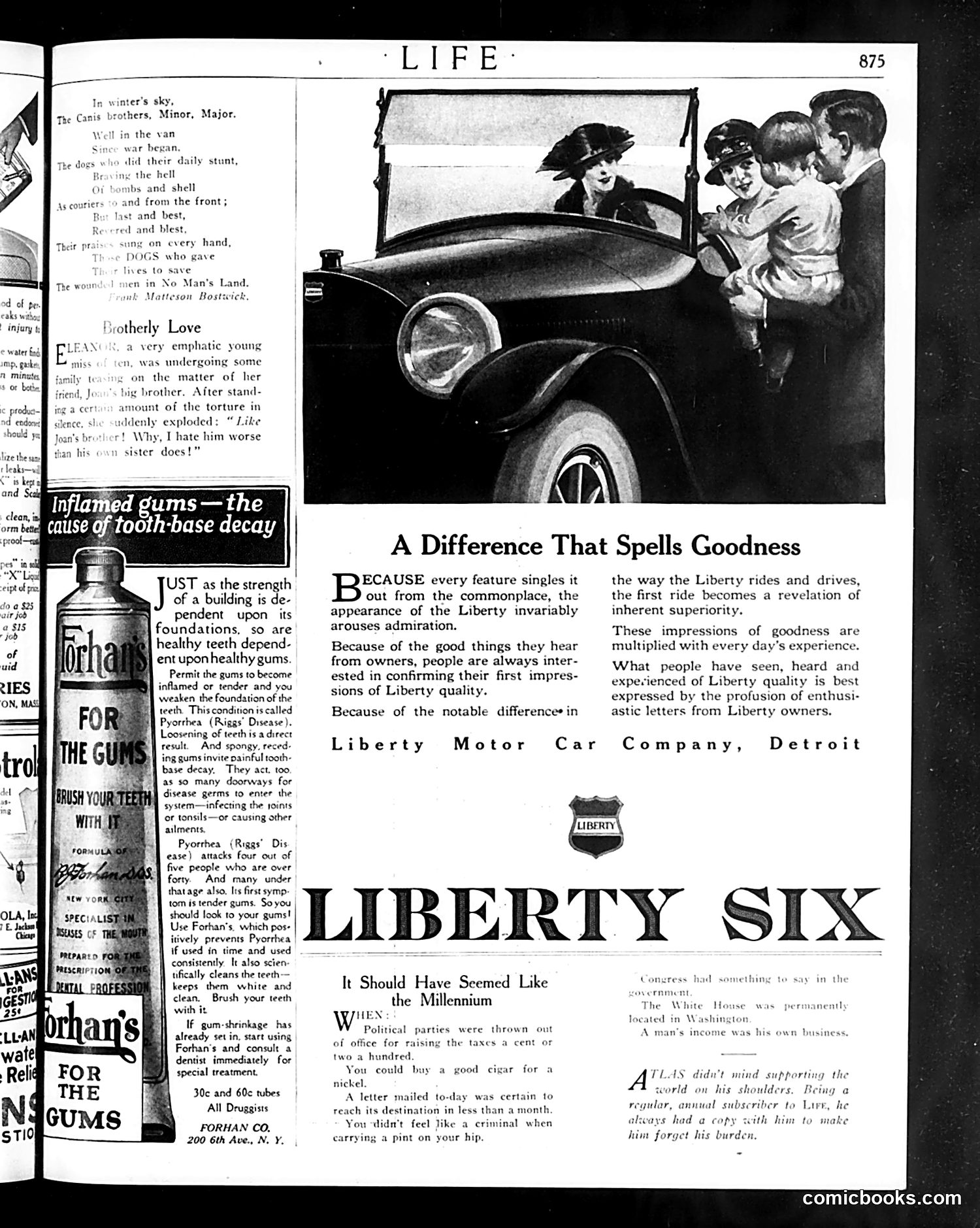
This page combines two distinct elements: **advertising and satirical commentary on modern life**. The top section features a **Liberty automobile advertisement**, showing a family admiring the car. The text emphasizes the car's quality and superiority—a typical pitch for luxury vehicles of this era (appears early 20th century, likely 1920s-30s). Below that is a **satirical piece titled "It Should Have Seemed Like the Millennium,"** lampooning how much worse conditions have become. It nostalgically contrasts the past (when you could buy cigars cheaply, mail arrived quickly, taxes were minimal, and carrying alcohol wasn't criminal) with the present—apparently the Prohibition era, when possessing alcohol made one feel "like a criminal." The satire's point: despite technological progress (represented by the modern Liberty car), modern life has become absurdly more burdensome through taxation, government regulation, and moral restriction. The final joke—that even *Life* magazine subscribers can't escape their problems—undercuts any pretense of improvement. The humor targets government overreach and changing social restrictions.
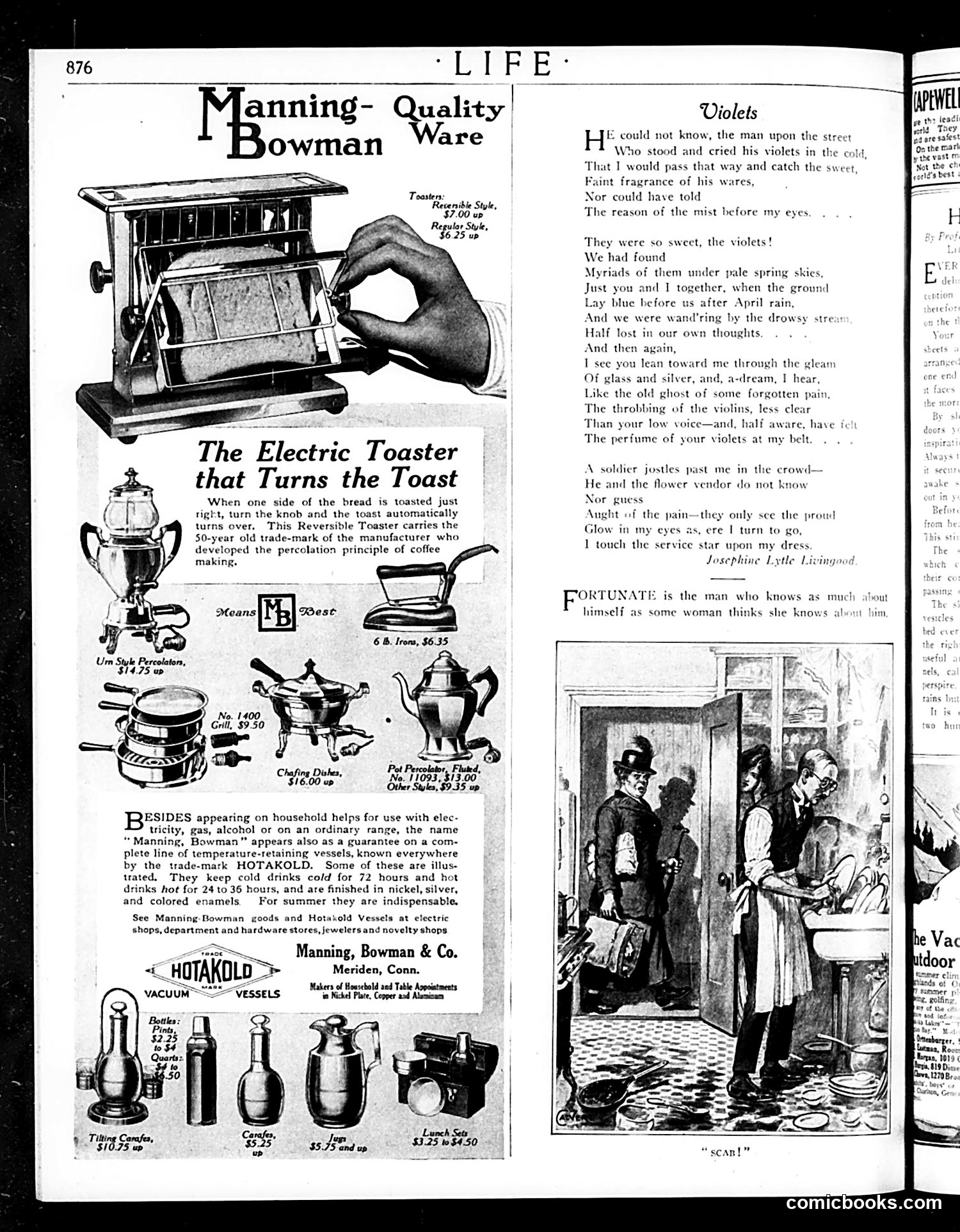
This page is primarily **advertising**, featuring Manning-Bowman kitchen appliances (toasters, percolators, vacuum vessels). However, it includes a significant poem, "Violets," by Josephine Lytle Livingood that reflects **World War I-era sentiment**. The poem describes a woman encountering a street flower vendor, triggered by memories of finding violets with a lover. The emotional climax reveals she now wears a **service star**—a badge indicating she has lost a family member in WWI. The "soldier" passing by represents the war's human cost. The poem's meaning: a small sensory moment (violets) resurrects personal loss amid the casual indifference of wartime urban life. The service star transforms her from grieving civilian into visible war casualty—socially recognized but privately suffering. This was relevant to 1920s *Life* readers still processing post-war trauma and loss.
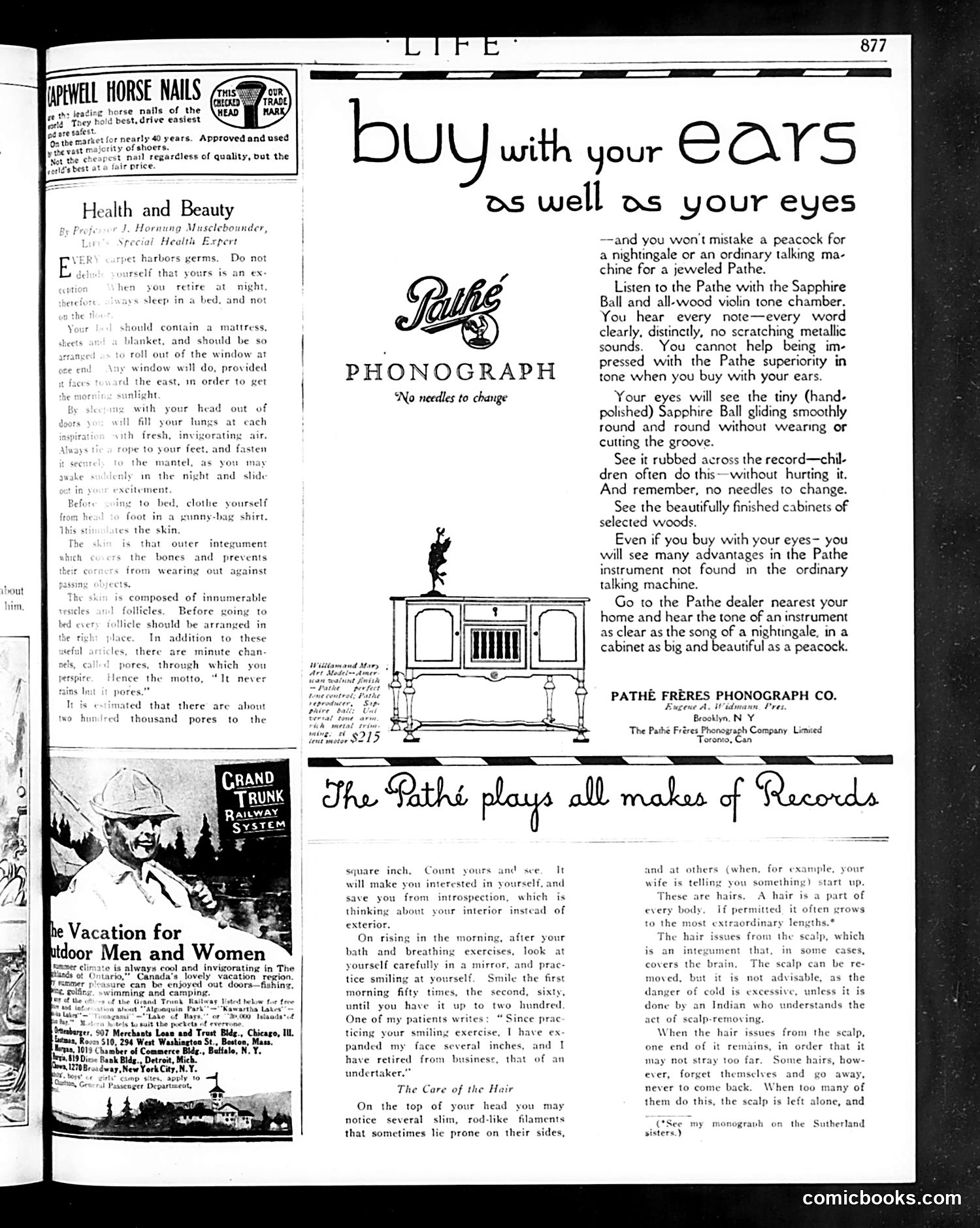
This page is primarily **advertising and lifestyle advice**, not political satire. The main content includes: **Pathe Phonograph Advertisement**: A major ad promoting the superiority of listening to phonographs with your ears ("buy with your ears as well as your eyes"). It humorously contrasts high-quality sound with mistaking "a peacock for a nightingale"—meaning cheap machines produce tinny, unnatural sound. The ad emphasizes the Sapphire Ball stylus and wooden cabinets as marks of quality. **"Health and Beauty" Column**: Humorous pseudo-medical advice from a self-styled "health expert" about sleeping, skin care, and hair. The tone is satirical—particularly the anecdote about smiling exercises causing a man to "expand his face several inches" and retire from business. This gently mocks dubious health fads common in the era. **Supporting ads**: For horse nails, Grand Trunk Railway vacations, and other period products. The satire targets **consumer culture and quack health advice** rather than politics.
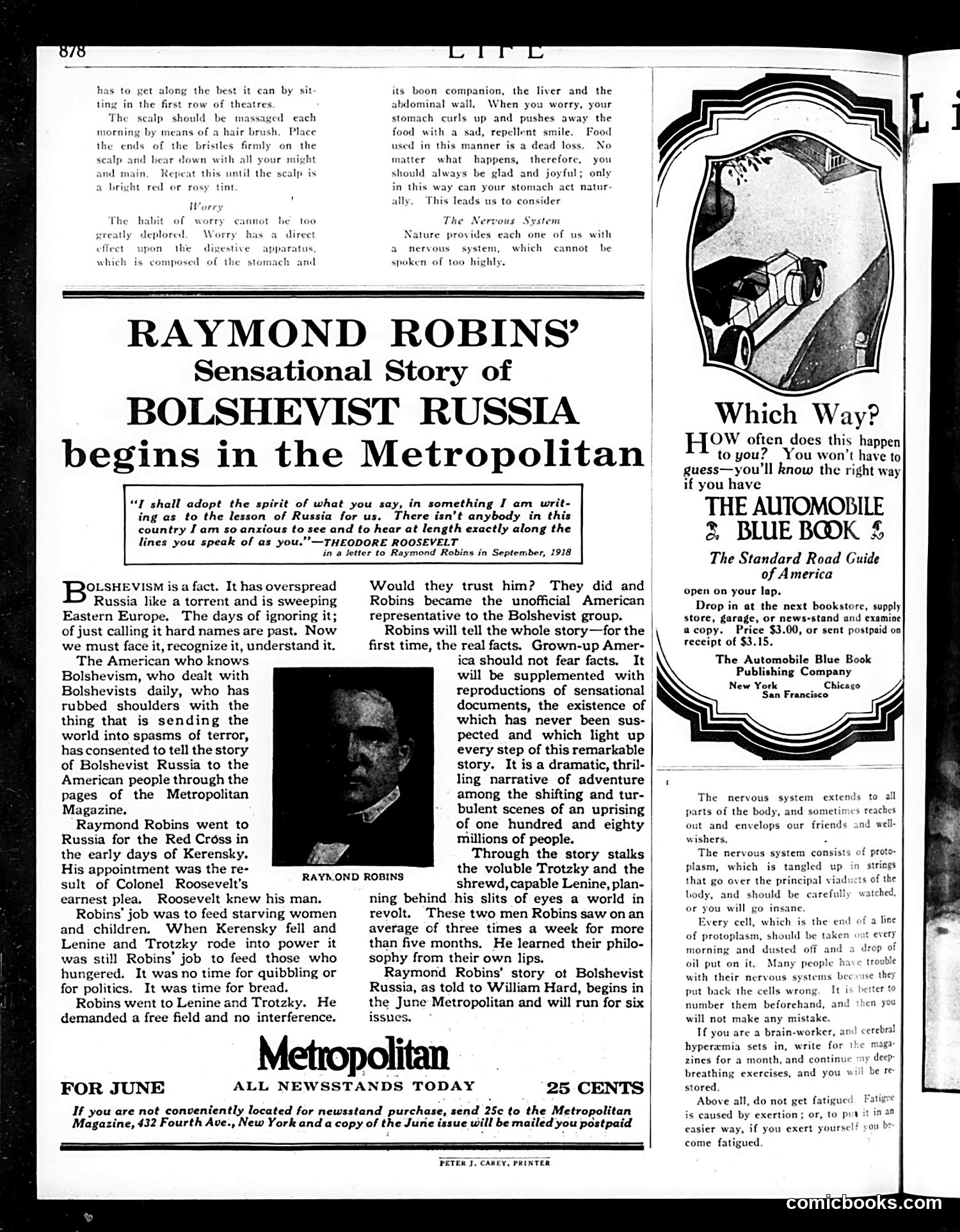
This page combines health advice with an advertisement for *Metropolitan* magazine's serialization of Raymond Robins' account of Bolshevik Russia. **The Political Context:** In 1918, Bolshevism was terrifying to American readers—a revolutionary ideology that had just overthrown Russia's government. The ad presents Robins as a credible witness: he went to Russia for the Red Cross under President Theodore Roosevelt's endorsement, and remained there even after the Bolshevik takeover, dealing directly with Lenin and Trotsky to secure food for starving civilians. **The Pitch:** The magazine frames this as urgent knowledge—Americans must "face it, recognize it, understand it" rather than dismiss Bolshevism. Robins' firsthand account, featuring "sensational documents," promises to reveal "the real facts" about this world-shaking uprising affecting "one hundred and eighty millions of people." **The Appeal:** By linking Roosevelt's personal endorsement and Robins' humanitarian work to political insight, *Metropolitan* positions itself as offering serious, authoritative analysis of the Russian Revolution for educated American readers.