
Life, 1919-05-15 · page 28 of 50
Life — May 15, 1919 — page 28: what you’re looking at
What you’re looking at
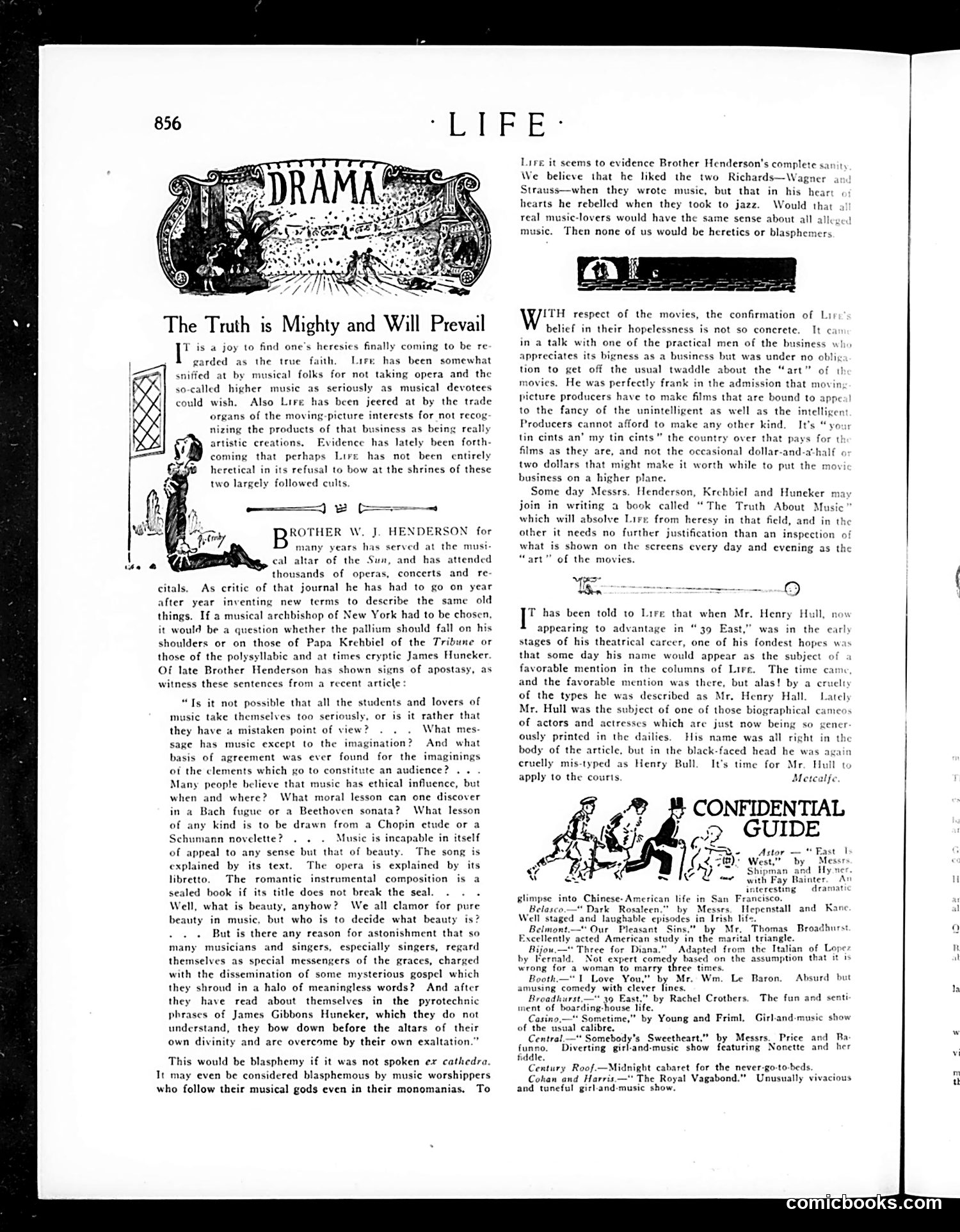
This page satirizes the pretensions of classical music critics and defends *Life* magazine's skepticism toward both opera and the film industry. **Main Target:** Music critic W.J. Henderson, who previously championed opera and serious music but has recently questioned whether classical music actually conveys meaning or moral lessons. The article quotes Henderson asking whether a Bach fugue teaches anything, or whether musicians are simply self-important aesthetes. **The Satire:** *Life* celebrates Henderson's apostasy as vindication of their own heretical position—that neither opera nor contemporary cinema deserve uncritical reverence. The piece mocks music devotees as cultish worshippers of their "musical gods." **Context:** This reflects early 20th-century debates about "high" versus popular art. *Life* positioned itself as a democratic voice skeptical of elite cultural gatekeepers who treated classical music and (implicitly) experimental film as sacred. The "Confidential Guide" section lists contemporary theatrical productions, suggesting *Life* covered entertainment more broadly than serious music critics deemed respectable.
📄 Transcribed text from this page (OCR, searchable)
Machine-transcribed from the original scan — historical spelling and the odd misread are preserved.
See te The Truth is Mighty and Will Prevail [ is a joy to find one’s heresies finally coming to be re garded as the true faith. Lire has been somewhat sniffed at by musical folks for not taking opera and the so-called higher music as seriously as musical devotees could wish. Also Lire has been jeered at by the trade organs of the moving-picture interests for not recog. nizing the products of that business as being really artistic creations. Evidence has lately been forth- coming that perhaps Lire has not been entirely heretical in its refusal to bow at the shrines of these two largely followed cults. SY) ve ROTHER W. J. HENDERSON for the musi- “iy many years has served cal altar of the Sun, and has attended thousands of operas, concerts and re: citals. As critic of that journal he has had to go on year after year inventing new terms to describe the same old things. If a musical archbishop of New York had to be chosen, it would be a question whether the pallium should fall on his shoulders or on those of Papa Krehbiel of the Tribune or those of the polysyllabic and at times cryptic James Huneker. Of late Brother Henderson has shown signs of apostasy, as witness these sentences from a recent article: “Is it not possible that all the students and lovers of music take themselves too seriously, or is it rather that they have « mistaken point of view? . . . What mes- sage has music except to the imagination? And what basis of agreement was ever found for the imaginings of the clements which go to constitute an audience? .. Many people believe that music has ethical influence, but when and where? What moral lesson can one discover in a Bach fugue or a Beethoven sonata? What lesson of any kind is to be drawn from a Chopin etude or a Schumann novelette? . . . Music is incapable in itself of appeal to any sense but that of beauty. The song is explained by its text. The opera is explained by its libretto. The romantic instrumental composition is a sealed book if its title does not break the seal... . Well, what is beauty, anyhow? We all clamor for pure beauty in music, but who is to decide what beauty is? . . + But is there any reason for astonishment that so many musicians and singers, especially singers, regard themselves as special messengers of the graces, charged with the dissemination of some mysterious gospel which they shroud in a halo of meaningless words? And after they have read about themselves in the pyrotechnic phrases of James Gibbons Huneker, which they do not understand, they bow down before the altars of their own divinity and are overcome by their own exaltation.” This would be blasphemy if it was not spoken ex cathedra. It may even be considered blasphemous by music worshippers who follow their musical gods even in their monomanias. To EEE * Lire it seems to evidence Brother Henderson's complete sanit We belicve that he liked the two Richards—Wagner a Strauss—when they wrote music, but that in his heart ¢ hearts he rebelled when they took to jazz. Would that » real music-lovers would have the same sense about all a music. Then none of us would be heretics or blasphe: ITH respect of the movies, the confirmation of Liy belief in their hopelessness is not so conerete. It ca in a talk with one of the practical men of the business who appreciates its bigness as a business but was under no obli tion to get off the usual twaddle about the “art” of 1 movies. He was perfectly frank in the admission that movin picture producers have to make films that are bound to appeal to the fancy of the unintelligent as well as the intellixent Producers cannot afford to make any other kind. It's “ye tin cints an’ my tin cints” the country over that pays for t films as they are, and not the occasional dollar-and-athalf « two dollars that might make it worth while to put the mos business on a higher plane. Some day Messrs. Henderson, Krehbiel and Huneker ma join in writing a book called “The Truth About Music” which will absolve Lire from heresy in that field, and in the other it needs no further justification than an inspection of what is shown on the screens every day and evening as the “art” of the movies. T has been told to Lire that when Mr. Henry Hull, no appearing to advantage in “39 East,” was in the early stages of his theatrical carcer, one of his fondest hopes w that some day his name would appear as the subject of a favorable mention in the columns of Lire. The time came and the favorable mention was there, but alas! by a cruelty of the types he was described as Mr. Henry Hall. Lately Mr. Hull was the subject of one of those biographical cameos of actors and actresses which are just now being so gener ously printed in the dailies. His name was all right in the body of the article, but in the black-faced head he was again cruelly mis-typed as Henry Bull. It’s time for Mr. Hull to apply to the courts. Metealfe os TS Astor — "Fast | <, 71D)" West,” by Mess ) Shipman and Hy nc swith Fay Bainter. Av interesting dramat glimpse into Chinese-American life in San Francisco. Belasco.—" Dark Rosaleen.” by Messrs. Hepenstall, and Kane Well staged and laughable episodes in Irish life. Belmont.—" Our Pleasant Sins." by Mr. Thomas Broadhurst Excellently acted American study in the marital triangle. Bijow.—" Three for Diana.” Adapted from the Italian of Ls by Fernald, Not expert comedy based on the assumption that i wrong for a woman to marty three times. Booth.—" 1 Love You,” by Mr. Wm. Le Baron. Absurd but amusing comedy with clever {ines Broadhurst.—" x9 East,” by Rachel Crothers, The fun and senti ment of boarding-house life. Casino, Sometime,” by Young and Friml, Girland-music show of the usual calibre. Central.—" Somebody's Sweetheart.” by Messrs. Price and Ra anno. Diverting girl-and-music show featuring Nonette and her fiddle. Century Roof.—Midnight cabaret for the never-go-to-beds. Cohan and Harris—" The Royal Vagabond.” Unusually vivacious and tuneful girland-music show. Ccomicbooks.com