
Life, 1919-05-15 · page 12 of 50
Life — May 15, 1919 — page 12: what you’re looking at
What you’re looking at
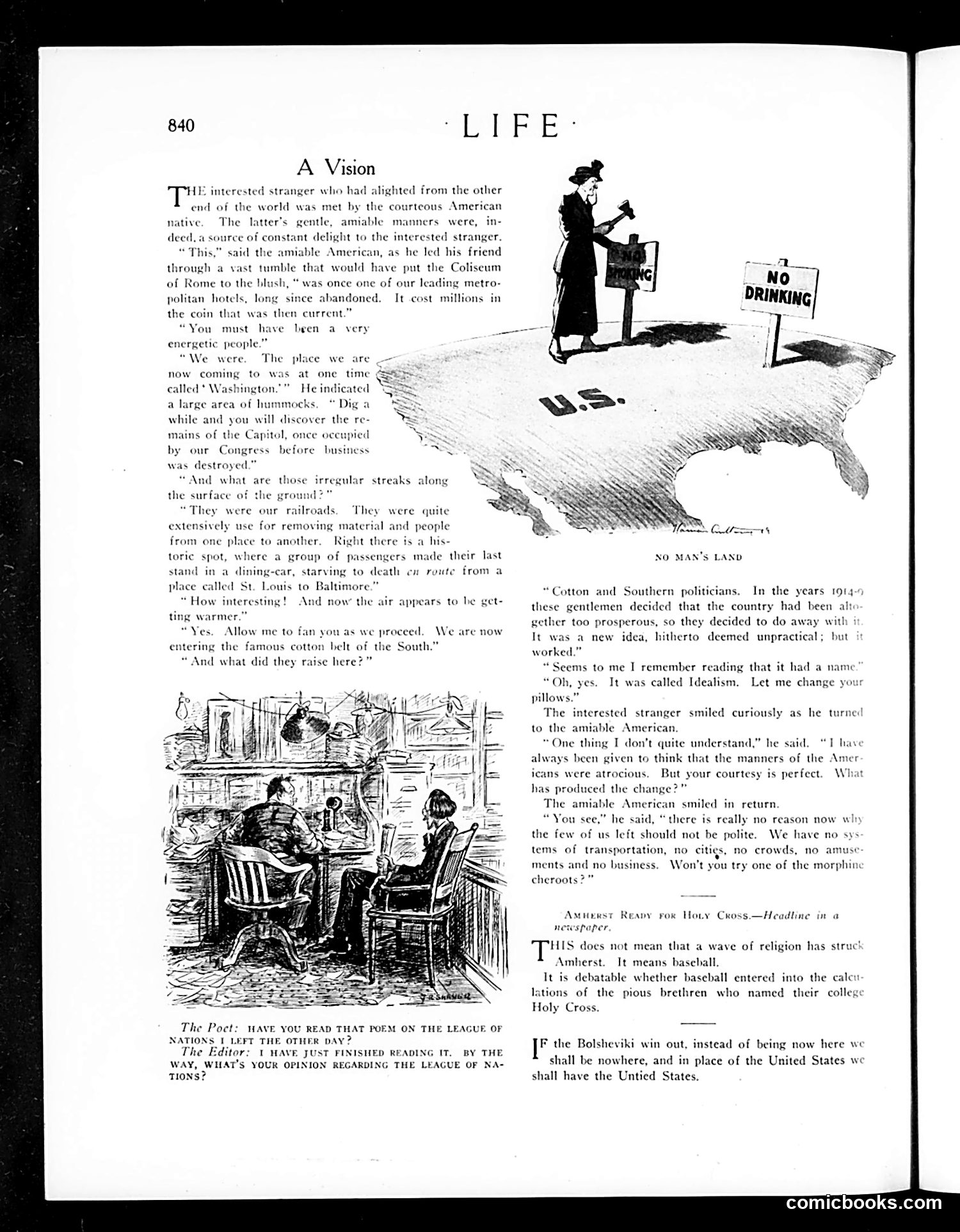
This page satirizes American isolationism and the country's reluctance to engage internationally. The cartoon "So Man's Land" depicts a figure (appearing to represent America or an American politician) standing at the border of the U.S., with a "NO DRINKING" sign—likely referencing Prohibition. The accompanying dialogue discusses the South's economic decline and "Idealism," suggesting commentary on regional politics and national ideals. The lower cartoon shows two men in conversation, with discussion of the League of Nations and transportation systems. The satire appears to critique America's withdrawal from global affairs and domestic political complacency during the post-WWI period, contrasting American exceptionalism with practical isolationism.
📄 Transcribed text from this page (OCR, searchable)
Machine-transcribed from the original scan — historical spelling and the odd misread are preserved.
mE A Vision E interested stranger who had alighted from the other end of the world was met by the courteous American native. The latter's gentle, amiable manners were, in- deed, a source of constant delight to the interested stranger. This,” said the amiable American, as he led his friend through a vast tumble that would have put the Coliseum of Rome to the blush, “'was once one of our leading metro- potitan hotels, long since abandoned. It .cost millions in the coin that was then current.” “You must have been a: ‘very energetic: people “We were. The place we are now coming to was at one time called* Washington." He indicated a large area of hummocks while and you will discover mains of the Capitol, once occ bycour Coneres® Belore: business “And what are those irregular streaks along the surface of 2 They were our railroads. They were quite extensively use for removing material and people from one place to another. Right there is a his- loric spot, where a group of passengers made their last xo MAN'S LAND stand in a dining-car, starving to death en route from a place called St. Louis to Baltimore Cotton and Southern politicians. In the years 1914 these gentlemen decided that the country had been alt gether too prosperous, so they decided to do away wit! It was a new id hitherto deemed unpractical; but worked.” “How interesting! And now’ the air appears to be get- ting warmer.” “Yes. Allow me to fan you as we proceed. We are now entering the famous cotton belt of the South.” “And what did they raise here?” “we * t did they raise here Seems to me I remember reading that it had a nam “Oh, yes. It was called Idealism. Let me change you pillows.” T interested stranger smiled curiously as he turne: to the amiable American. “One thing I don’t quite understand,” he said. “T hav always been given to think that the manners of the Amer icans were atrocious. But your courtesy is perfect. What has produced the change?” The amiable American smiled in return You see,” he said, “there is really no reason now w the few of us left should not be polite. We have no sys tems of transportation, no. citigs, no crowds, no amus¢ ments and no business, Won't you try one of the morphine cheroots?" Axtieest Reapy rox Hoy Cross —Headline in a newspaper. HIS does not mean that a wave of religion has struct Amherst. It means baseball It is debatable whether baseball entered into the calcu lations of the pious brethren who named their colleg Holy Cross. The Poct: WAVE YOU READ THAT POEM ON THE LEAGUE OF NATION LEFT THE OTHER DAY? The Editor: 1 WAVE JUST FINISHED READING IT, BY THE - es c WAY OETA YOUETGEINIGUT REDAT GINS Tale LEAGOE OUINAL shall be nowhere, and in place of the United States w« TIONS? shall have the Untied States. F the Bolsheviki win out, instead of being now here w« comicbooks.com