
A complete issue · 34 pages · 1918
Life — November 14, 1918
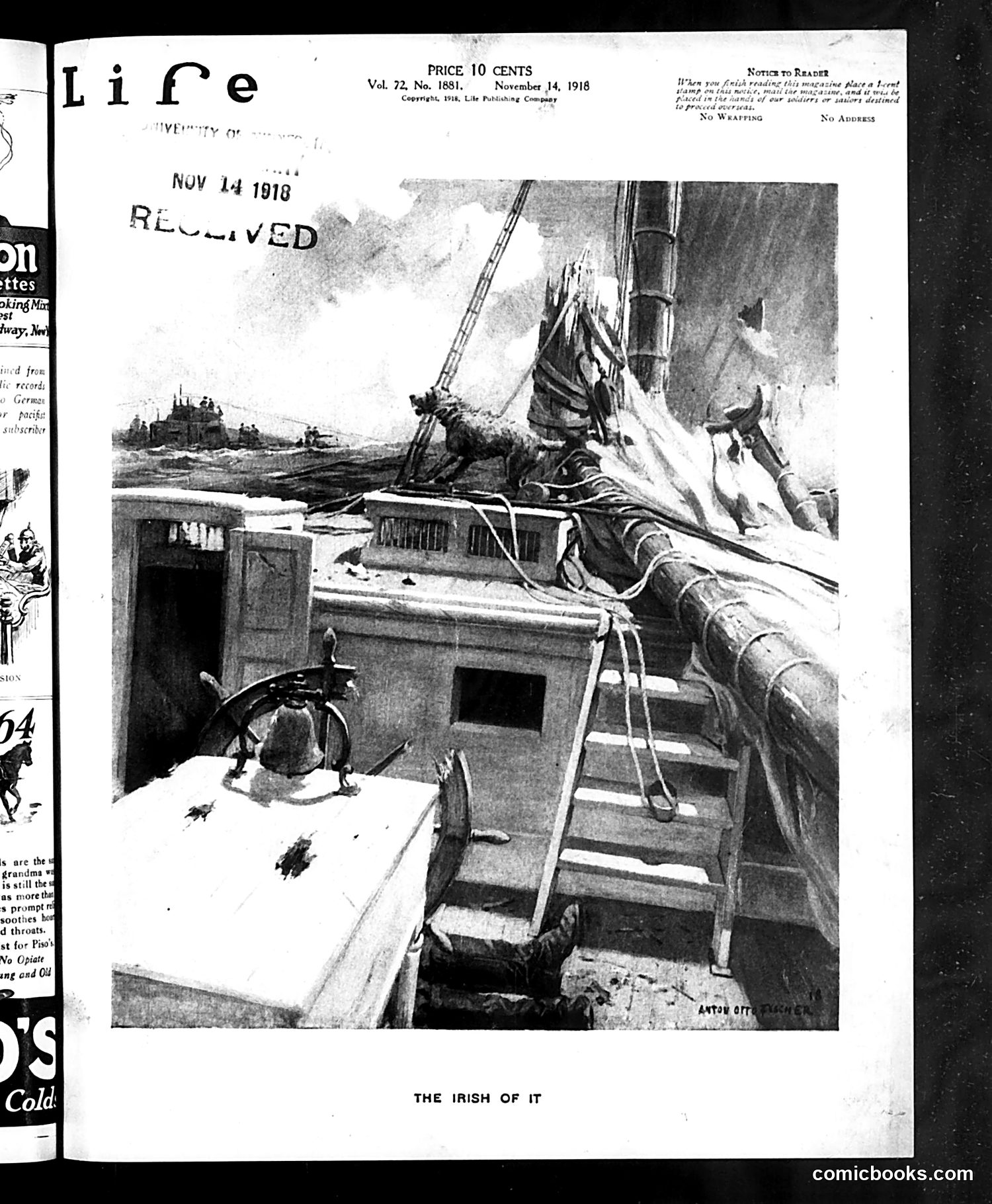
This November 14, 1918 *Life* magazine page shows a naval vessel, likely depicting an Irish ship or crew. The caption "The Irish of It" suggests a humorous commentary on Irish naval personnel or Irish-related maritime matters. The image appears to show the deck of a warship with various equipment, rigging, and what looks like a ship visible in the background. Given the date—just days after World War I's armistice (November 11, 1918)—this likely references Irish sailors' experiences during the war or in the immediate post-war period. Without clearer visual details or additional text, the specific satirical point remains unclear, but it appears to mock or comment on Irish naval service or seafaring character during this historical moment.
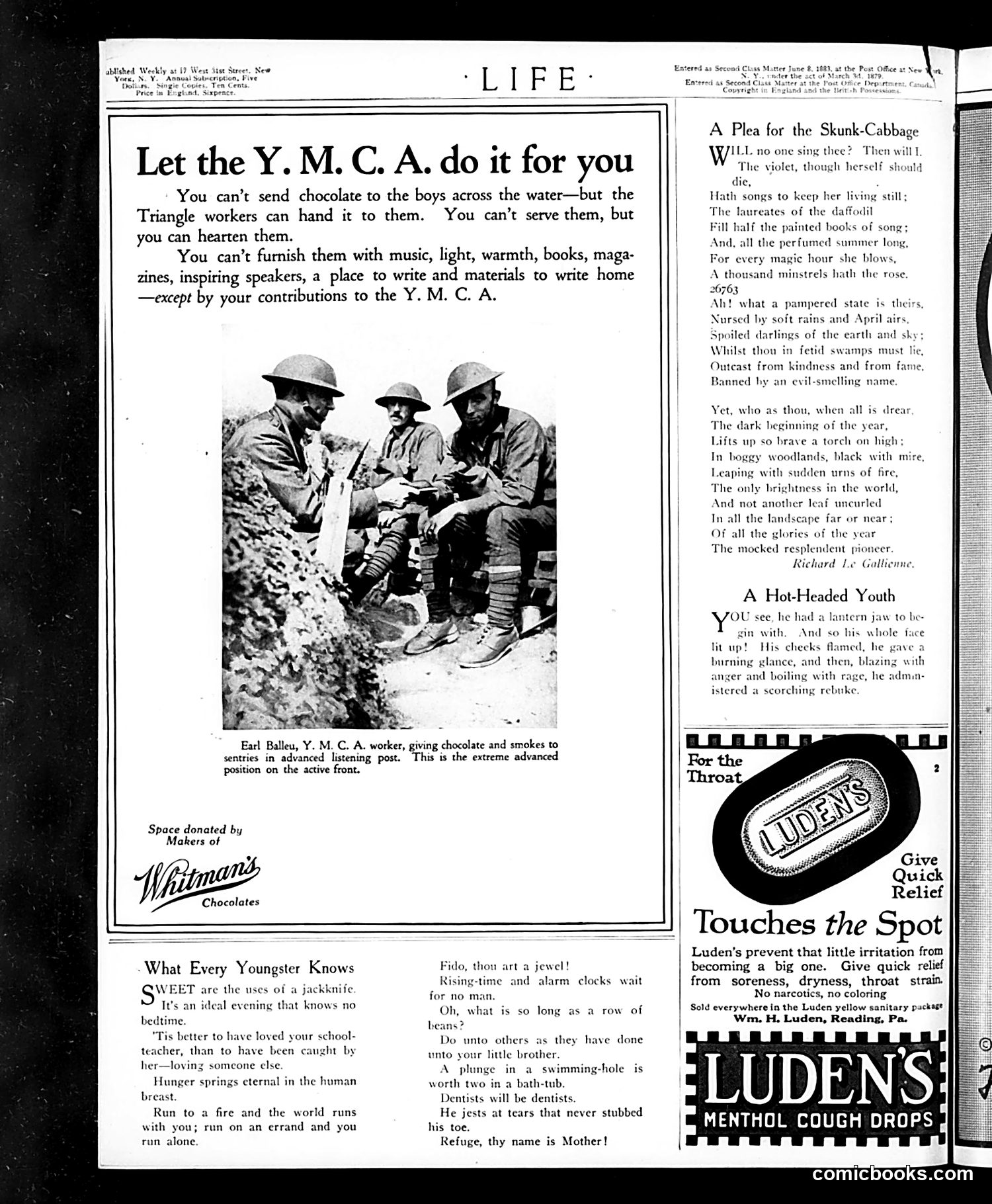
This page combines WWI-era fundraising advocacy with poetry and product advertisements. **Main Content:** The dominant left advertisement urges readers to support the YMCA's wartime relief efforts for soldiers. The photograph shows a Y.M.C.A. worker (Earl Ballew) distributing chocolate and cigarettes to soldiers in trenches at the front lines. The text emphasizes what civilians *cannot* directly provide to troops overseas—only the Y.M.C.A. can deliver these morale-boosting supplies and services through donations. **Supporting Content:** The right column features patriotic poetry ("A Plea for the Skunk-Cabbage") and short humor pieces, along with period advertisements for Luden's cough drops. This is explicitly wartime propaganda encouraging charitable contributions, not political satire.
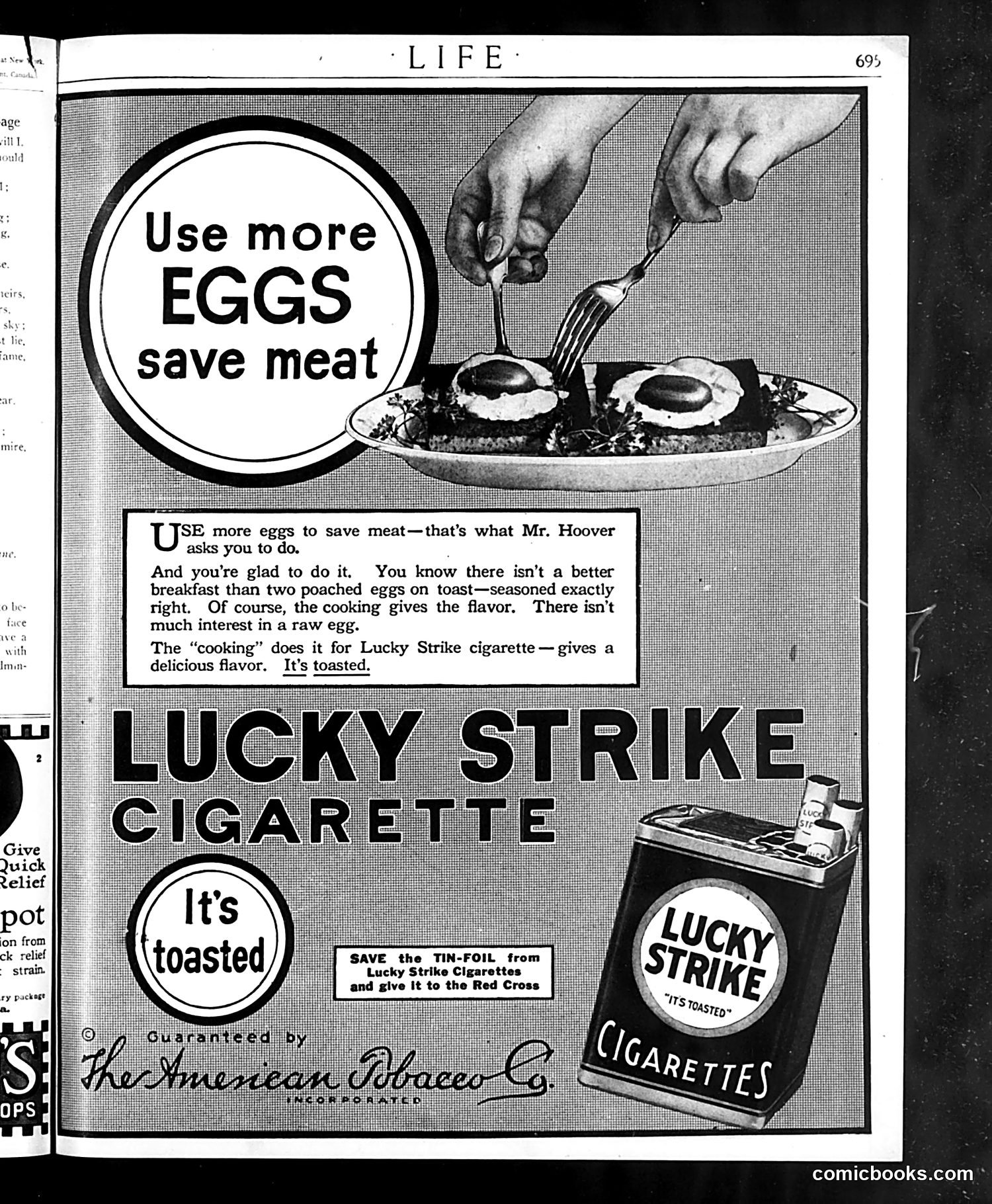
This is primarily a **cigarette advertisement**, not satire or political commentary. It's a Lucky Strike ad from the American Tobacco Company that uses patriotic wartime messaging (referencing "Mr. Hoover," likely Herbert Hoover's WWI food conservation efforts). The ad's central message: eat more eggs to conserve meat for the war effort. Eggs and toast are presented as a patriotic, satisfying breakfast alternative. The copywriting then **pivots absurdly** to claim Lucky Strike cigarettes are similarly "toasted" and delicious—conflating wartime rationing advice with cigarette marketing. The final note requests tin-foil collection for the Red Cross, reinforcing the patriotic framing while promoting cigarettes—a now-shocking example of how corporations exploited wartime sacrifice for commercial gain.
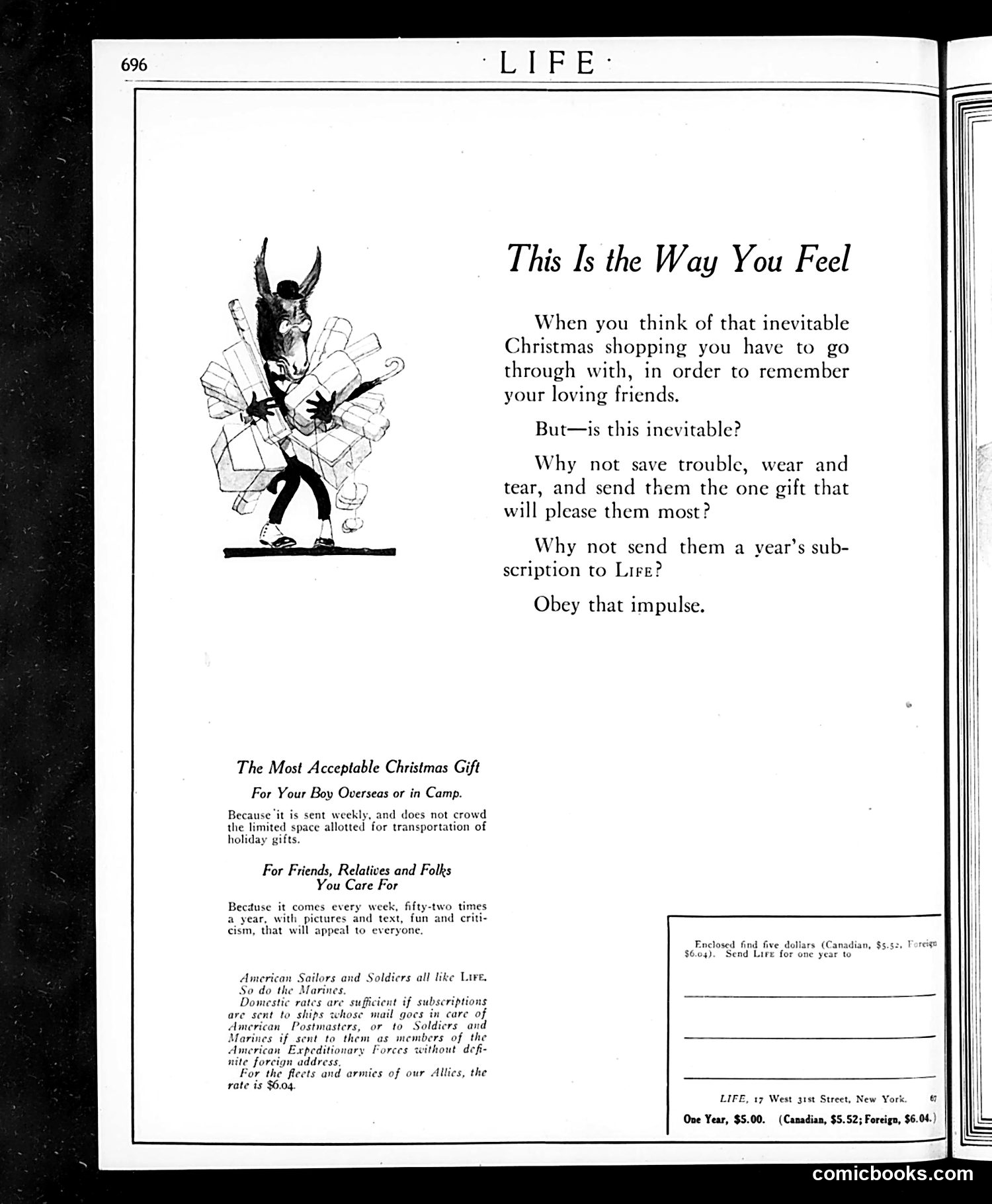
This page is primarily **advertisement** for LIFE magazine subscriptions disguised as editorial content. The devil illustration represents the stress and burden of Christmas shopping—the "inevitable" task of buying gifts for loved ones. The satirical pitch reframes this obligation: rather than endure shopping's "trouble, wear and tear," readers should gift a year's LIFE subscription instead. The magazine promises weekly delivery with "pictures and text, fun and criticism" appealing to everyone. The ad specifically targets those sending gifts to servicemen overseas or in camp, emphasizing LIFE's compact weekly format suits limited mail transport. The devil embodies the frustration the advertisement claims to solve—making LIFE itself the solution to holiday shopping anxiety.
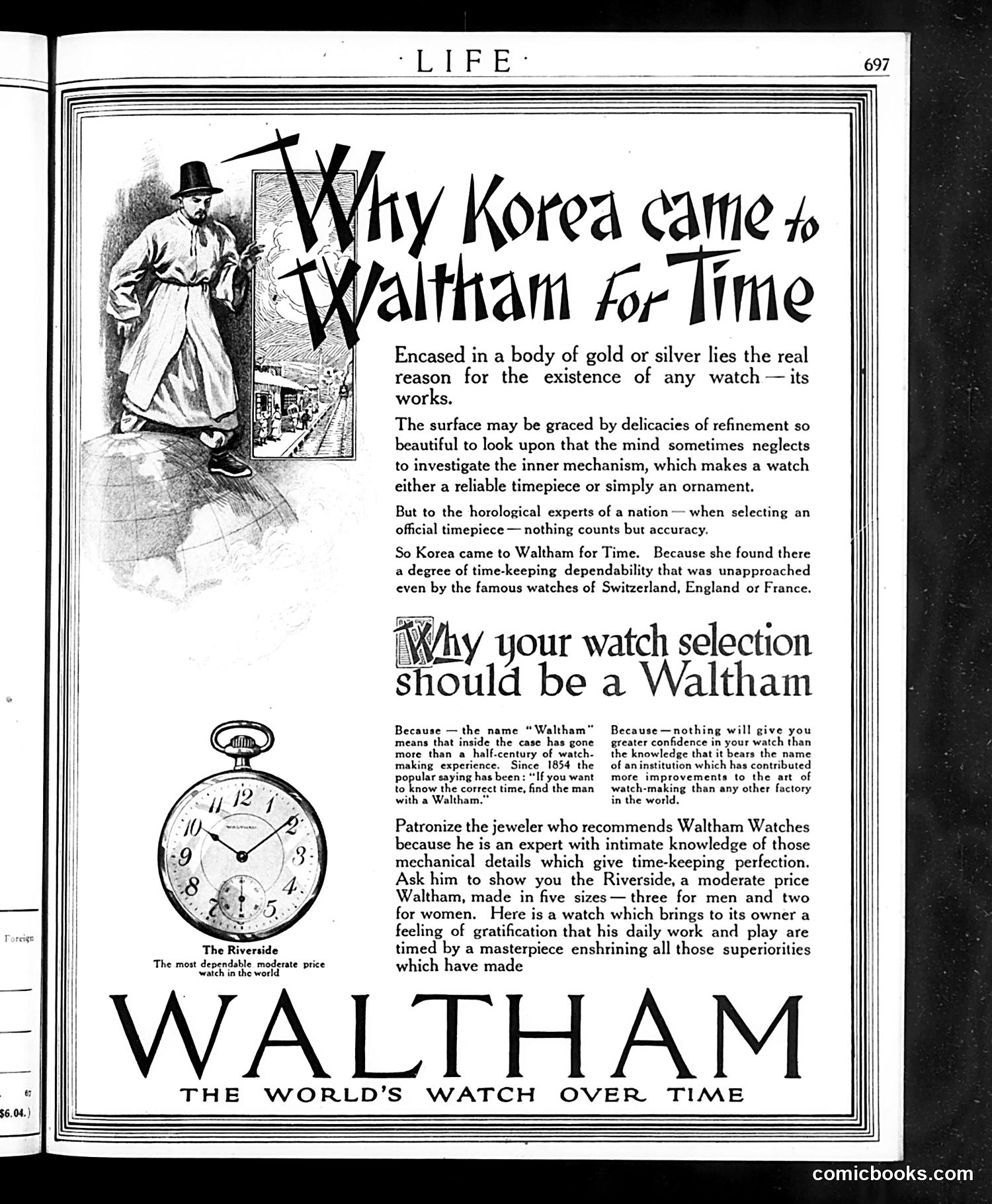
This is primarily a **product advertisement**, not satirical content. The page promotes Waltham watches, a major American watchmaker. The illustration shows a figure in period dress (appears to be meant as a Korean or Asian representative) carrying a large cross, symbolizing Korea's adoption of Western timekeeping technology. The accompanying text claims Korea selected Waltham watches for official use because of their superior accuracy compared to Swiss, English, and French competitors. The advertisement emphasizes Waltham's reliability since 1854 and encourages jewelers to recommend their "Riverside" model to customers. The tagline "The World's Watch Over Time" serves as both marketing slogan and pun. This reflects early 20th-century advertising strategies using international examples to establish product prestige.
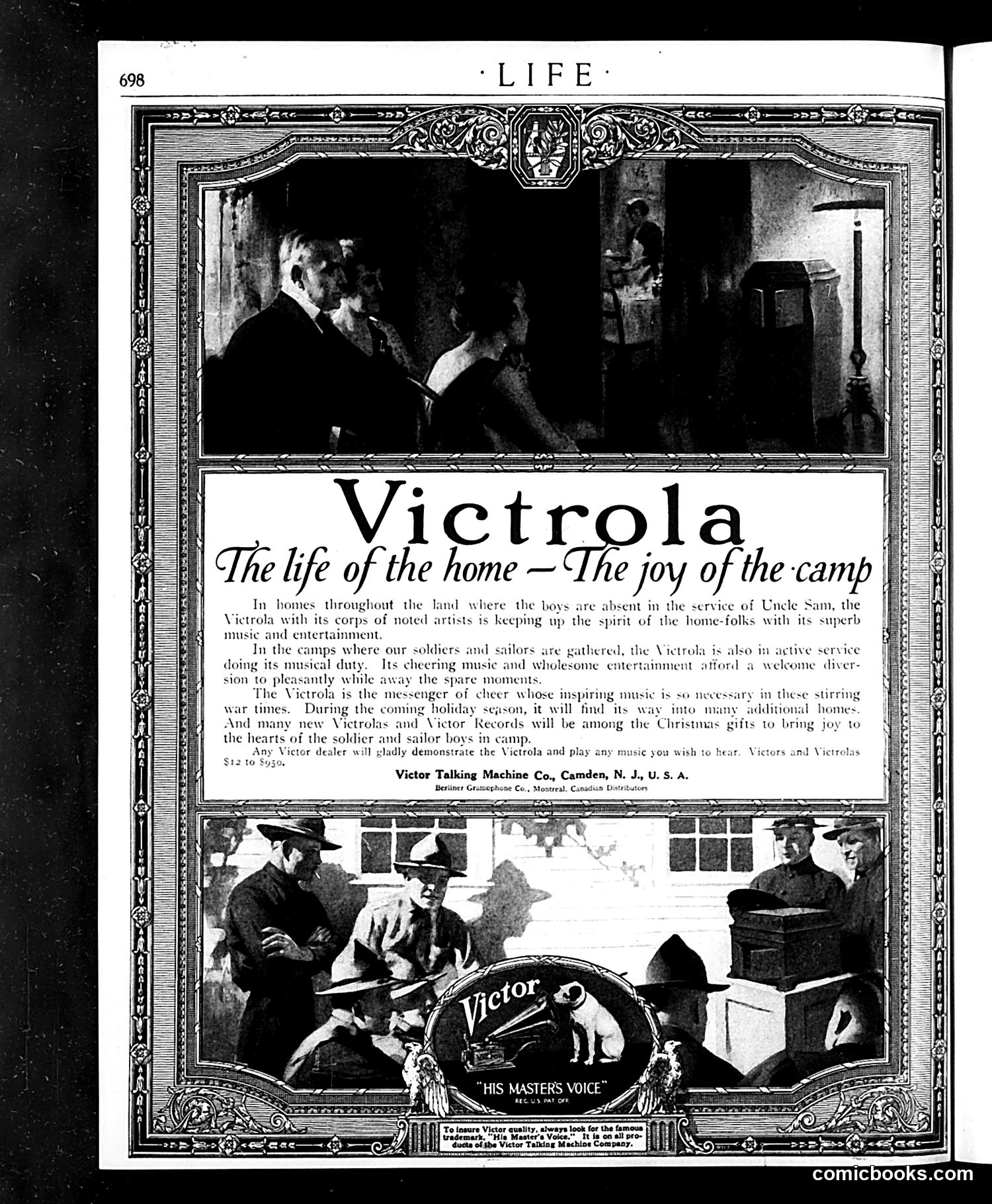
This is primarily a **Victor Talking Machine Company advertisement**, not political satire. The ad promotes the Victrola phonograph as entertainment for American homes during World War I, when soldiers and sailors were absent serving "Uncle Sam." The image shows civilians (likely families) gathered around the Victrola, with a separate scene depicting soldiers in camp. The advertisement's appeal is patriotic and morale-focused: the phonograph keeps the "home-folks" connected to entertainment while the war continues, and soldiers receive "wholesome entertainment" during downtime in camps. The ad emphasizes the Victrola as a unifying force during wartime—bridging separated families and supporting troop morale. Prices range from $12 to $350, positioning it as accessible luxury for middle-class Americans supporting the war effort.
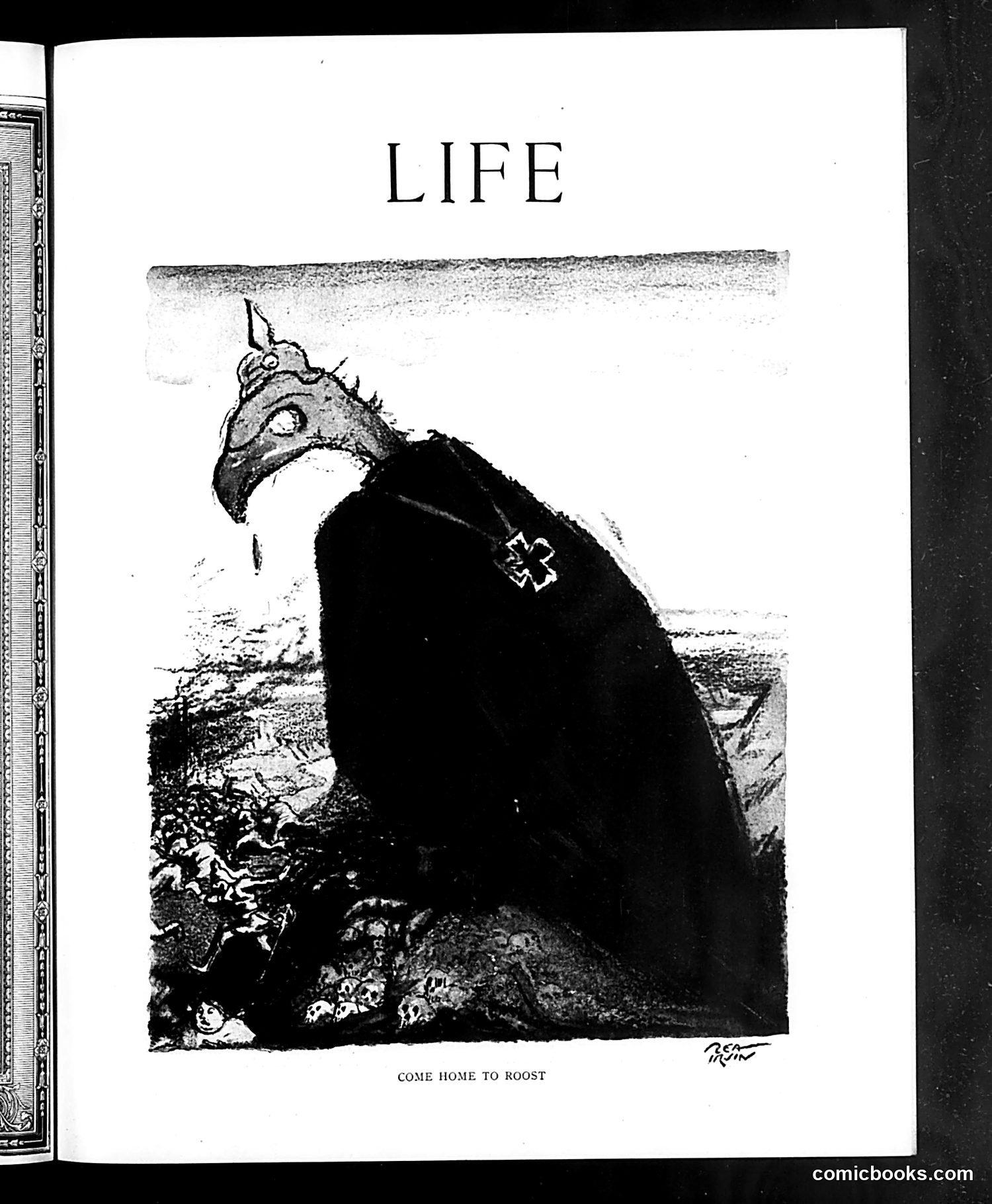
This is a title page for Life magazine featuring a political cartoon titled "Come Home to Roost." The image depicts a large bird—apparently an eagle or similar imposing fowl—wearing what appears to be a military or ceremonial garment with a cross symbol. The bird has a stern, predatory expression and looks downward. The phrase "come home to roost" is an idiom meaning consequences have arrived or past actions have caught up with someone. The military imagery and the bird's aggressive posture suggest this cartoon critiques militarism or a specific military leader/regime. The cross emblem likely references German militarism, suggesting this may relate to World War I or its aftermath, though the specific historical moment remains unclear without additional context.
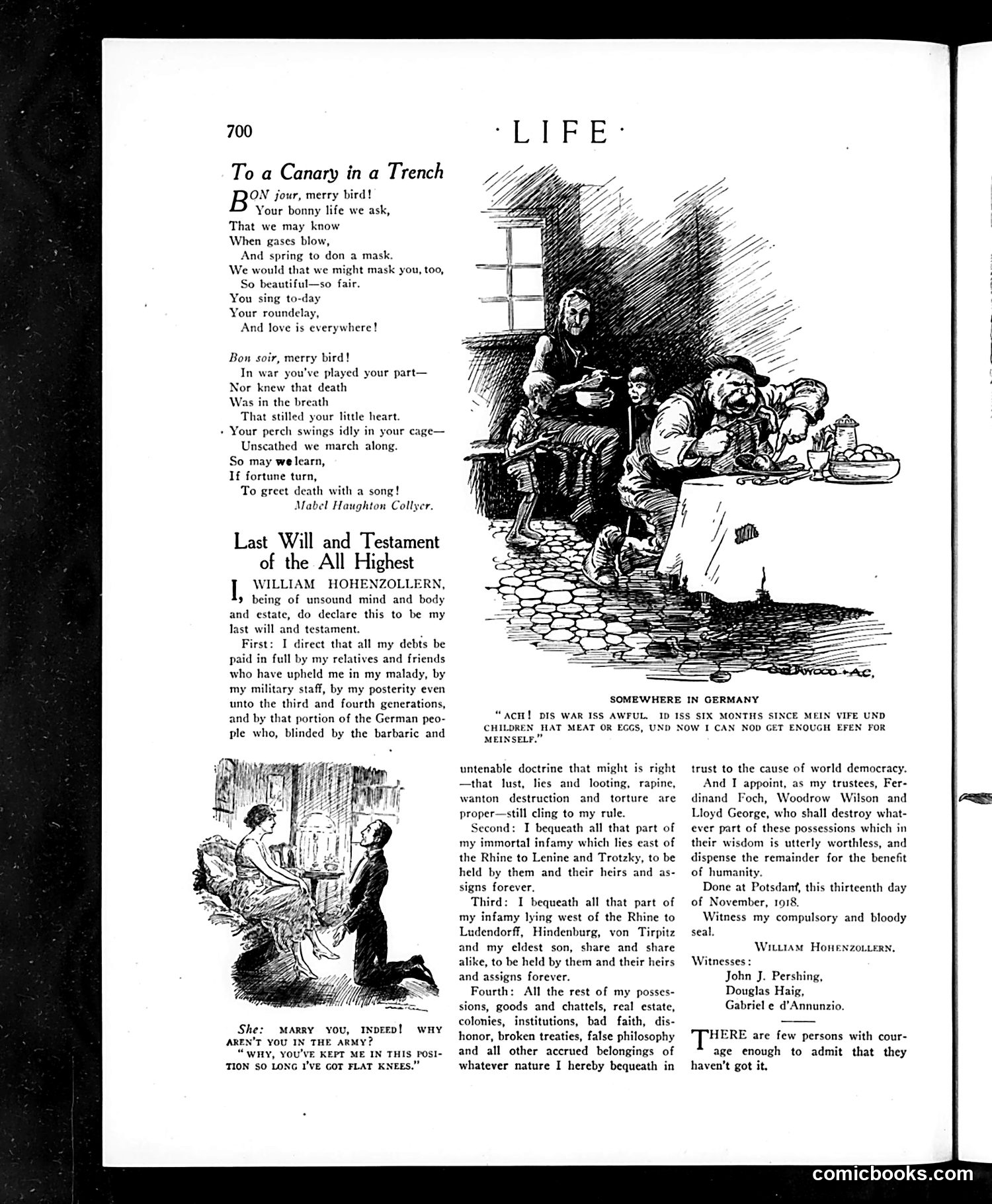
This page contains two distinct pieces: **"To a Canary in a Trench"** (top left): A poem by Mabel Haughton Collyer addressing a bird as a morale booster for soldiers in WWI trenches. It references the canary's singing providing comfort to troops facing death and poison gas attacks. **"Last Will and Testament of the All Highest"** (center/right): A satirical mock will supposedly written by William Hohenzollern (German Kaiser Wilhelm II). It humorously bequeaths German territories and possessions to various parties, mocking German defeat in WWI. The caption "SOMEWHERE IN GERMANY" references wartime hardship and food scarcity. **Bottom cartoon**: A domestic scene where a woman questions a man about military service, with the caption about him keeping "flat knees"—likely a sarcastic reference to avoiding active combat duty. All content reflects WWI-era American anti-German sentiment.
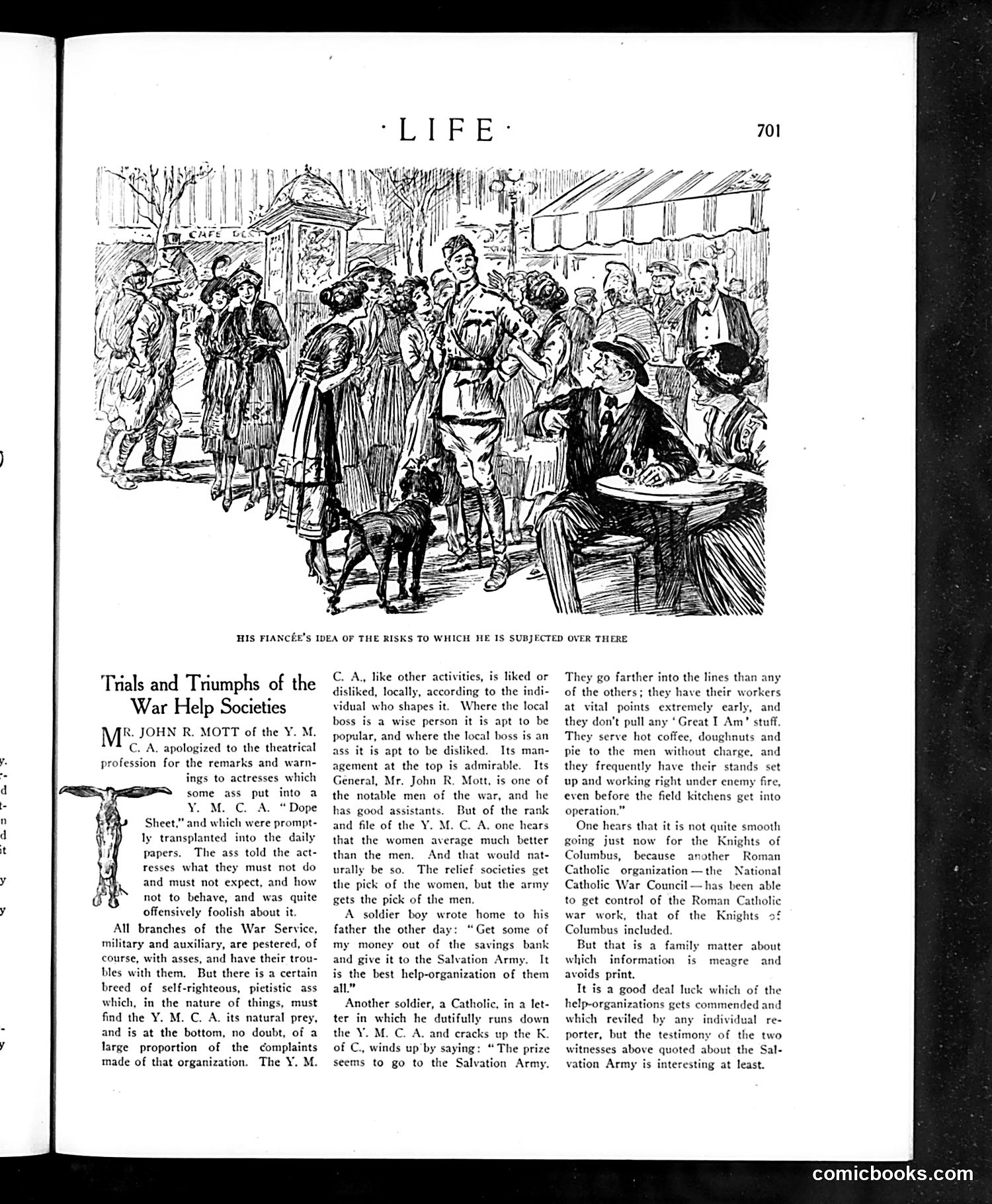
This page satirizes wartime relief organizations, particularly tensions between different charitable groups. The illustration depicts a crowded street scene where a man sits at a table while crowds of people (appearing to be seeking aid) gather around him. The text discusses competition between war relief societies—specifically the Y.M.C.A. and Salvation Army—for funds and volunteers. Mr. John R. Mott of the Y.M.C.A. is referenced defending his organization against criticism. The satire mocks how these groups compete for resources and public support during wartime, with soldiers' letters quoted showing preference for the Salvation Army's practical aid over the Y.M.C.A.'s offerings. The cartoon humorously illustrates this organizational rivalry and the public confusion about which charity deserves donations.
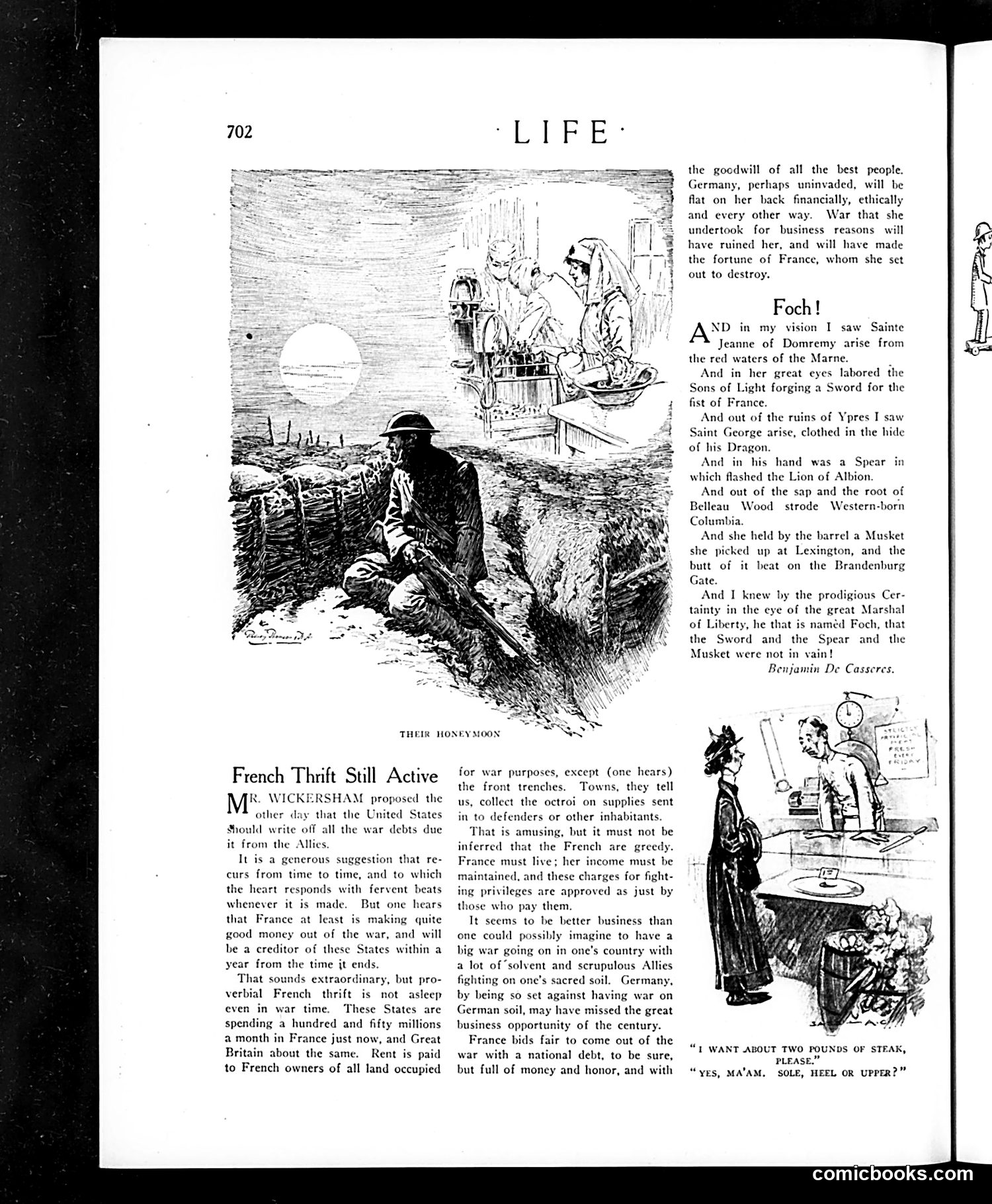
This page contains two distinct pieces of satirical commentary on post-WWI France: **Top Section ("Their Honeymoon"):** The illustration shows a soldier in a trench gazing at a romantic vision of figures in the distance. The accompanying text by Benjamin De Casseres is poetic commentary celebrating French military heroism, referencing Saint Joan of Arc, French weapons and victories. **Bottom Section ("French Thrift Still Active"):** This satirizes France's financial dealings with Allied nations. Mr. Wickersham proposes the U.S. write off all war debts owed by the Allies. The satire criticizes France's determination to collect war reparations and maintain profitable financial arrangements while remaining financially dependent on Allied creditors—portraying French business interests as opportunistic amid wartime suffering. The right illustration humorously depicts a restaurant patron ordering expensive cuts of meat, satirizing French materialism and continued luxury consumption despite war's devastation.
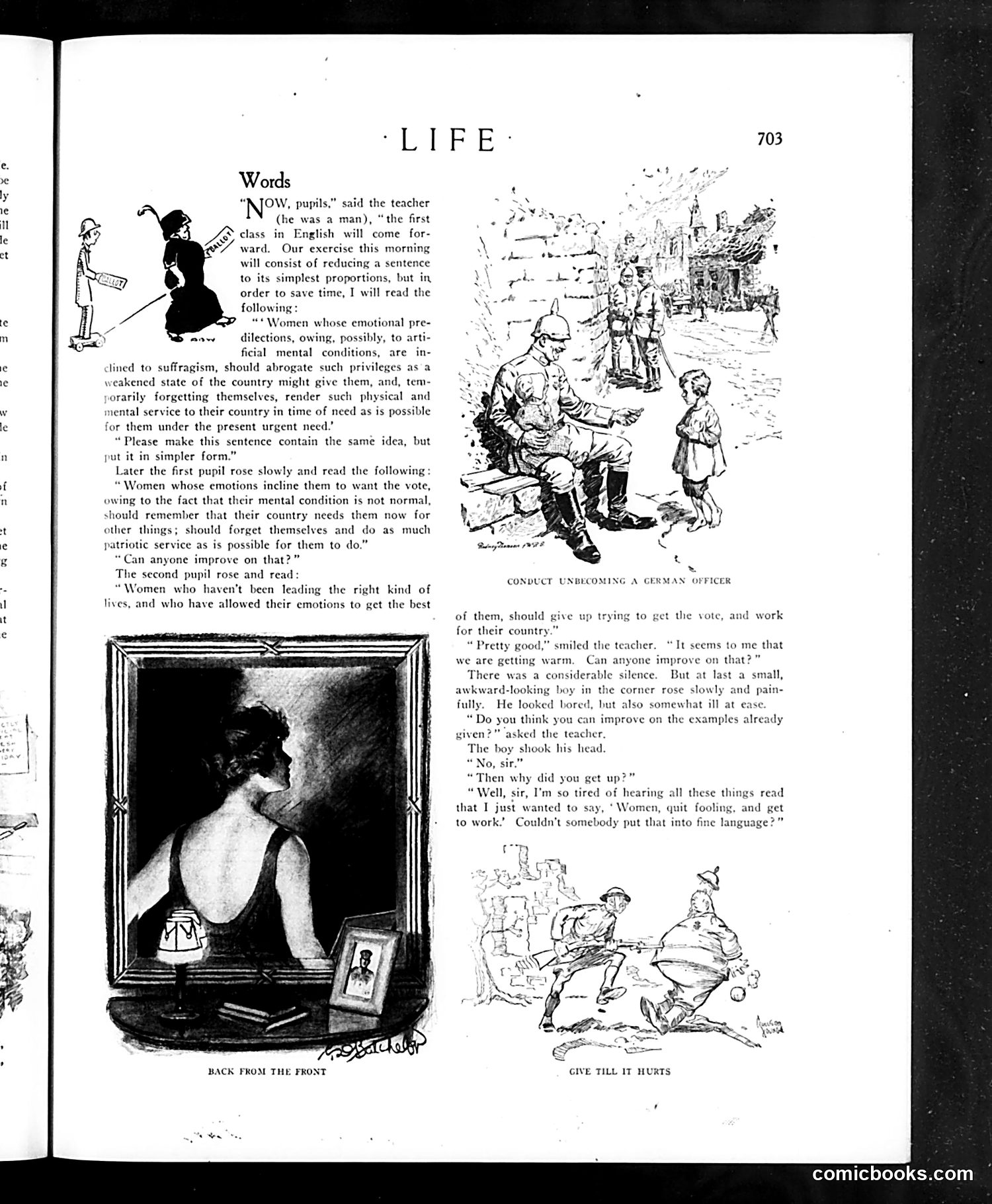
This page contains a satirical dialogue between a teacher and pupils about women's suffrage and patriotism during wartime. The teacher presents simplified arguments for why women should abandon voting rights and focus on "patriotic service" instead—framing suffrage as a "weakened" privilege women shouldn't claim while the country needs them for other duties. The cartoon "Back From the Front" (lower left) depicts a woman in an evening gown viewing a photograph, likely contrasting frivolous civilian life with war's sacrifices. "Give Till It Hurts" (lower right) shows children playing roughly, suggesting the need for sacrifice. The satire mocks attempts to suppress women's suffrage activism by reframing it as unpatriotic during wartime—a rhetorical strategy used to discourage women's rights advocacy when national survival seemed paramount.
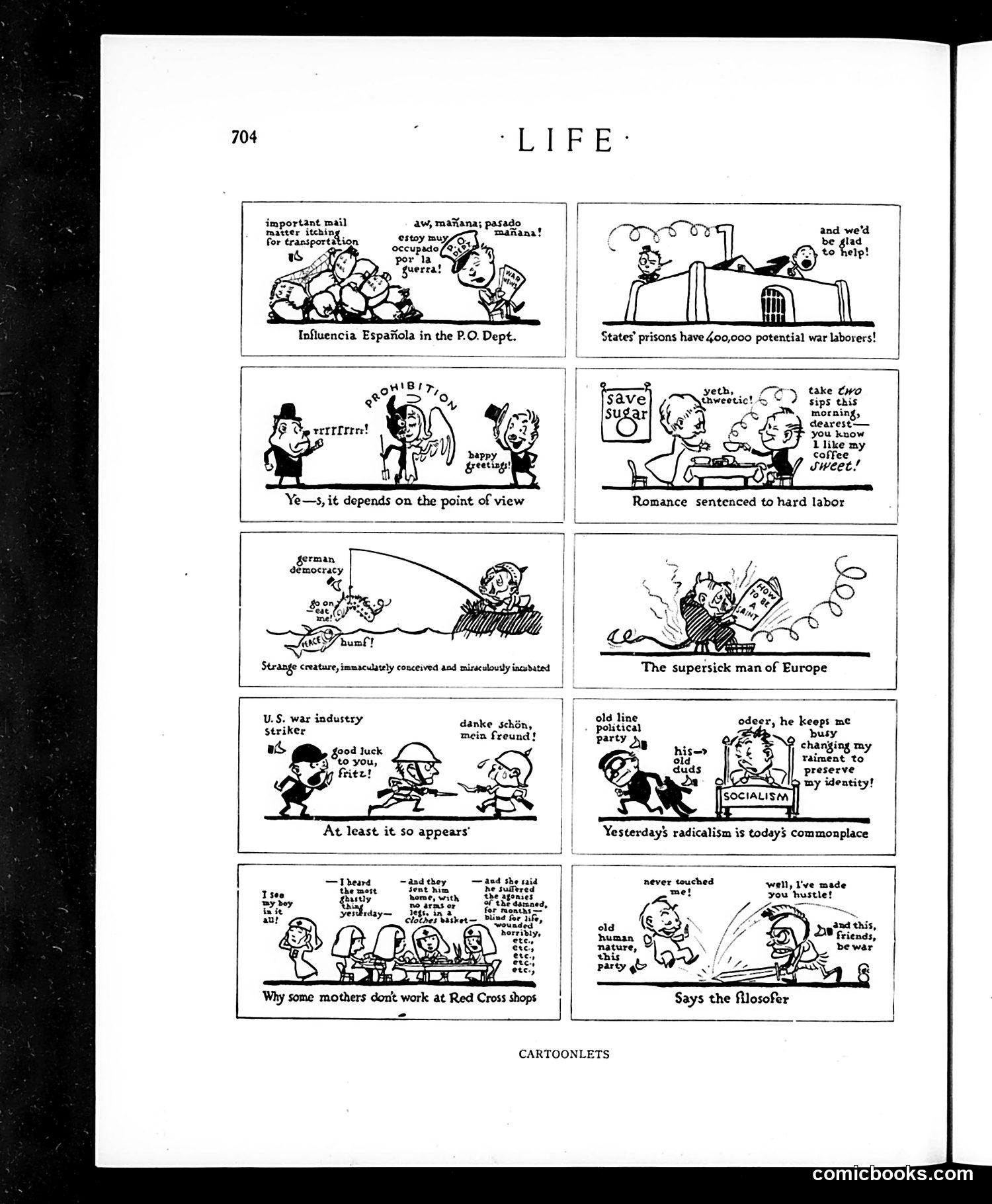
This page contains ten satirical cartoonlets addressing WWI-era American political and social issues: 1. **Spanish Flu in Post Office**: References the 1918 influenza pandemic affecting government workers. 2. **Prison Labor**: Comments on using convicts as wartime laborers. 3. **Prohibition Debate**: Shows disagreement over alcohol ban ("depends on point of view"). 4. **Sugar Rationing**: Mocks romance under wartime shortages. 5. **German Democracy**: Satirizes Germany's claim to democratic values. 6. **European Chaos**: Depicts continent's post-war instability. 7. **War Industry Striker**: Questions labor strikes during wartime. 8. **Political Radicals**: Suggests yesterday's radical ideas became mainstream. 9. **Red Cross Workers**: Explains why some mothers avoid Red Cross volunteer work. 10. **Philosophy**: Contrasts idealism with pragmatic compromise.
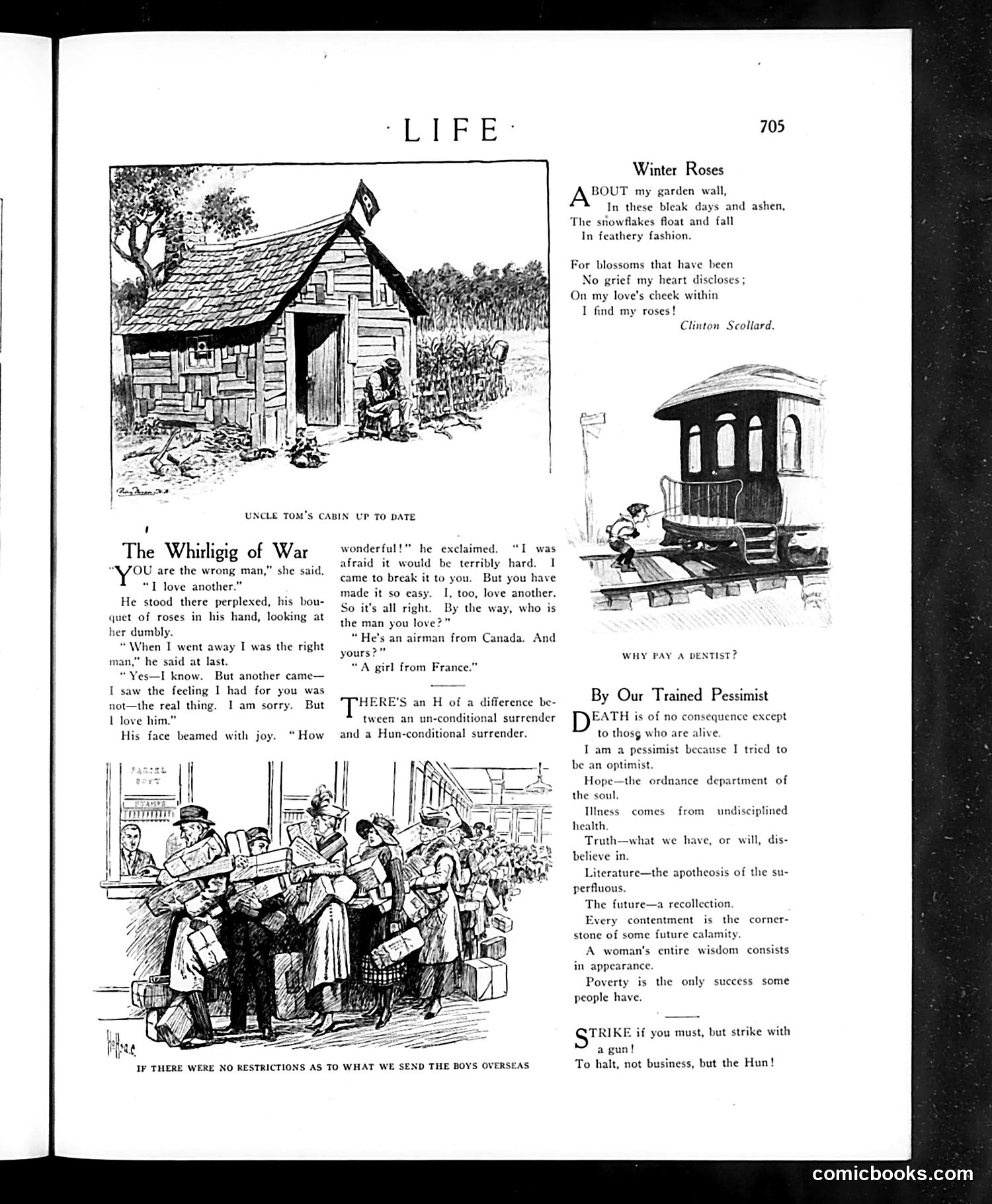
This page contains two unrelated pieces of satirical content: **"The Whirligig of War"** (top): A short romantic story about a woman rejecting a man because she loves another—an airman from Canada. The satire appears to mock wartime romantic entanglements and the emotional complications soldiers face. **"If There Were No Restrictions as to What We Send the Boys Overseas"** (bottom): A sketch showing civilians enthusiastically packing goods. The satire criticizes unrestricted sending of supplies to soldiers abroad, suggesting people would send impractical or excessive items rather than necessities. **"Why Pav a Dentist?"** and **"By Our Trained Pessimist"** are separate opinion pieces offering cynical social commentary. The page reflects WWI-era concerns about the home front's relationship to the war effort.
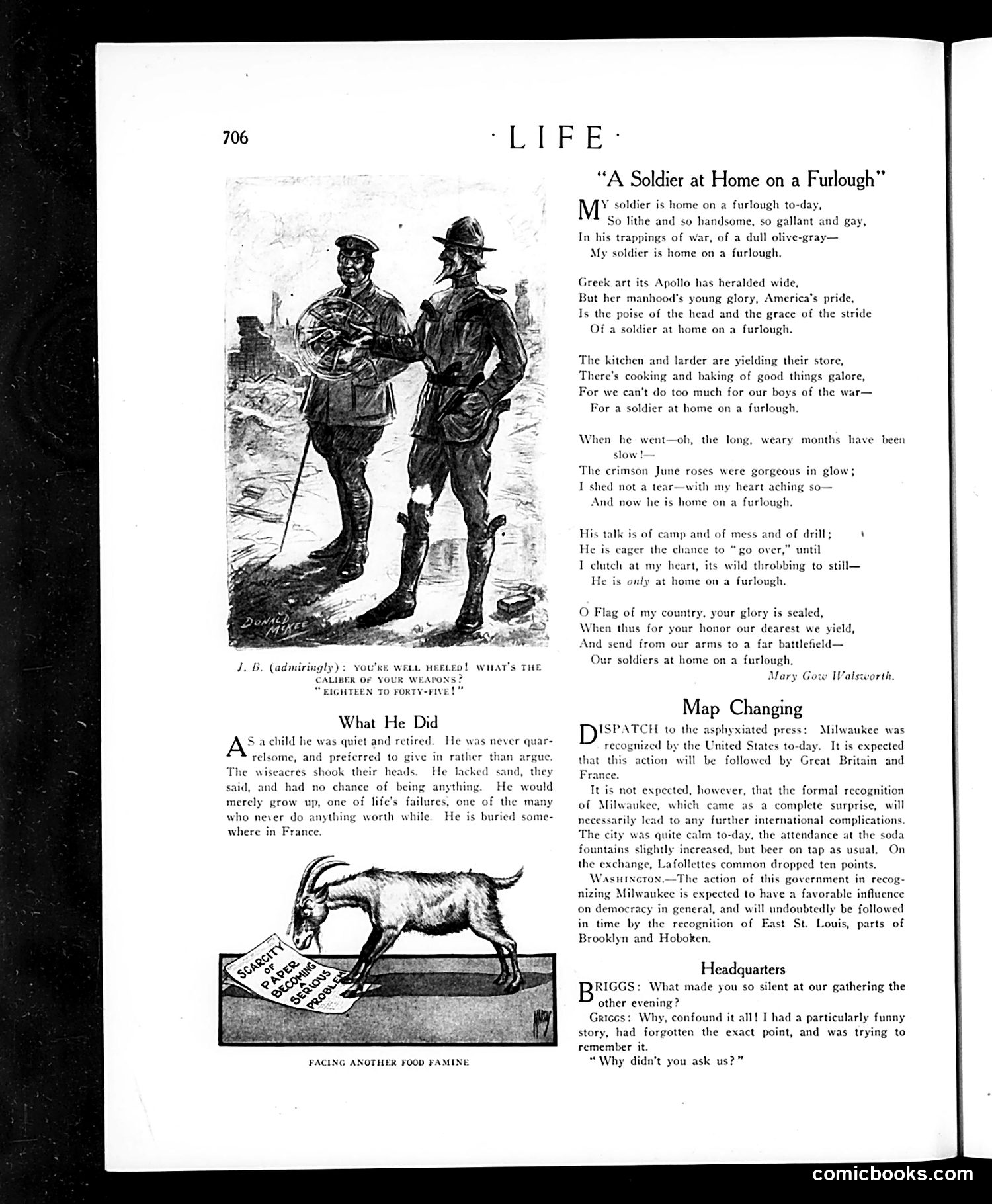
This page presents WWI-era content. The main illustrated poem by Mary Gose Walsworth celebrates a soldier's brief home visit, contrasting the joy of his return against the hardships of war ("camp and mess and drill"). The accompanying soldier illustration shows two military men, likely depicting the contrast between active duty and leave. The bottom cartoon titled "Facing Another Food Famine" shows a goat eating rationing documents, satirizing wartime food shortages and scarcity rationing that affected the American home front during World War I. The "Map Changing" and "Headquarters" sections appear to be brief news dispatches about Milwaukee's diplomatic recognition and military gossip—typical of Life magazine's satirical news commentary from this period.
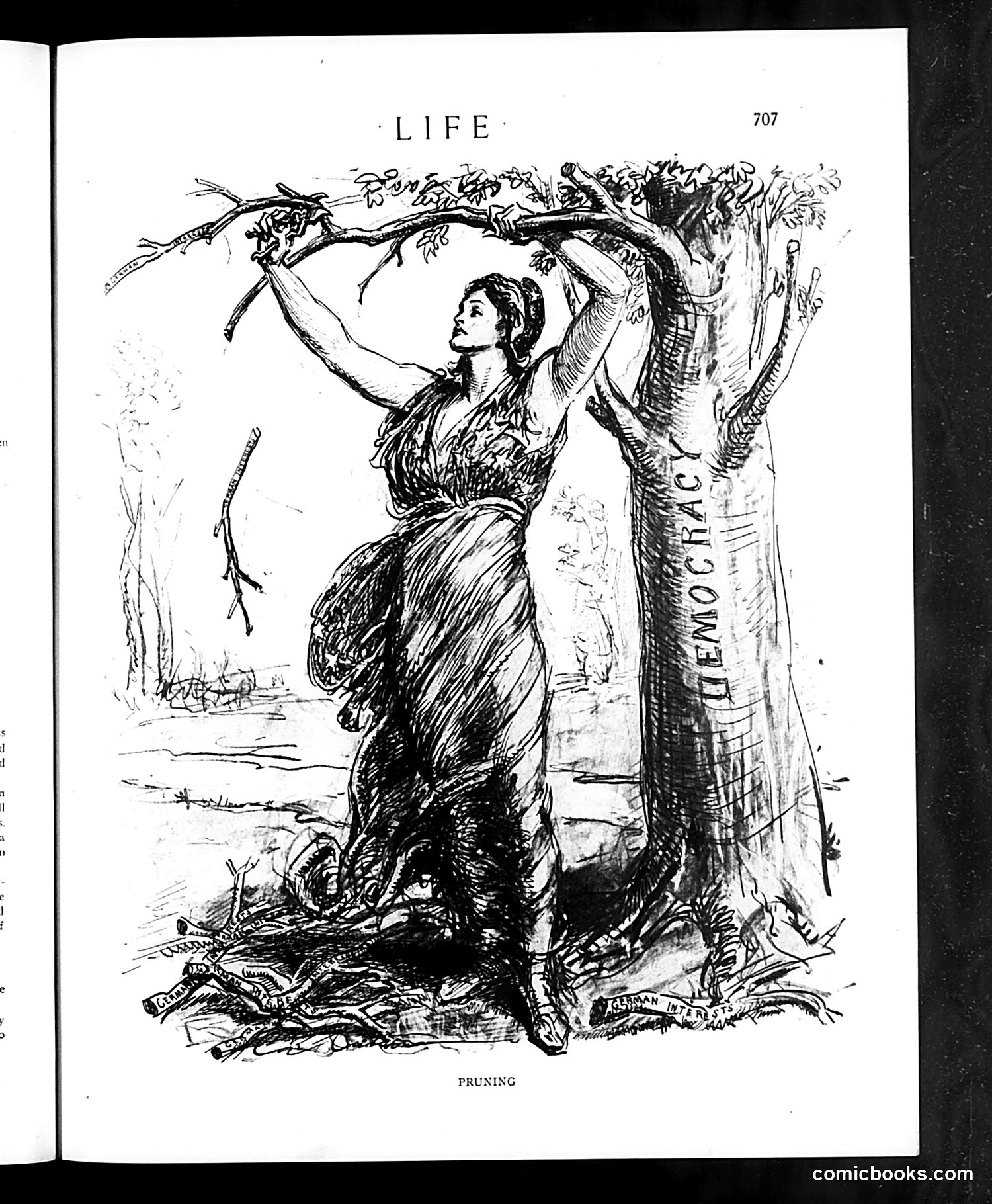
This allegorical illustration depicts a woman pruning branches from a large tree marked "DEMOCRACY." The cartoon appears to be commentary on political or governmental trimming—likely suggesting that certain powers or rights are being cut away from democratic institutions. The woman, dressed in classical style (possibly representing Lady Liberty or America itself), actively removes branches, implying deliberate action to shape or reduce democratic functions. The fallen branches at the base remain unlabeled in this image, making their specific identity unclear. Without the magazine's date or surrounding articles, the precise political context—which laws, rights, or powers faced trimming—cannot be definitively determined. However, the central message critiques the removal of democratic elements, presented as potentially harmful "pruning."
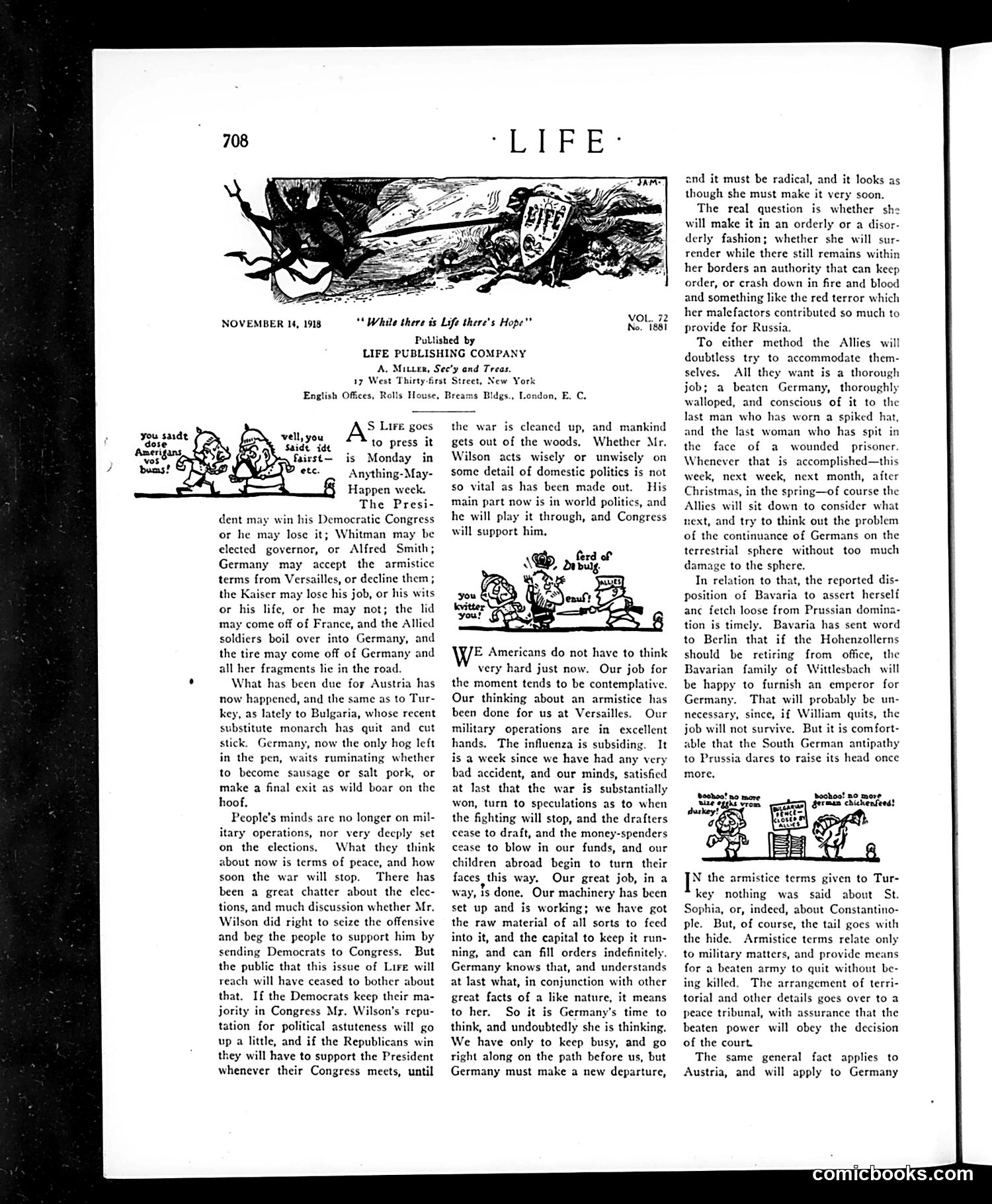
This satirical editorial addresses the immediate post-WWI moment (the armistice was signed November 11, 1918). The cartoons depict uncertainty about multiple simultaneous outcomes: Germany's fate, Wilson's political standing, and the Kaiser's position. The piece mocks the unpredictability of current events—Austria and Turkey have already collapsed; Germany remains "the only hog left in the pen." The cartoons show Americans uncertain whether Germany will accept armistice terms or decline them, whether the Kaiser will lose his job or his life. The main argument: Americans needn't think hard now; the machinery of war is set up and working. Germany, however, faces an urgent choice—accept orderly surrender or descend into revolutionary chaos ("red terror") like Russia's Bolshevik revolution. The satire suggests Germany's decision will determine regional stability far more than American domestic politics (like Wilson versus Republicans in Congress).
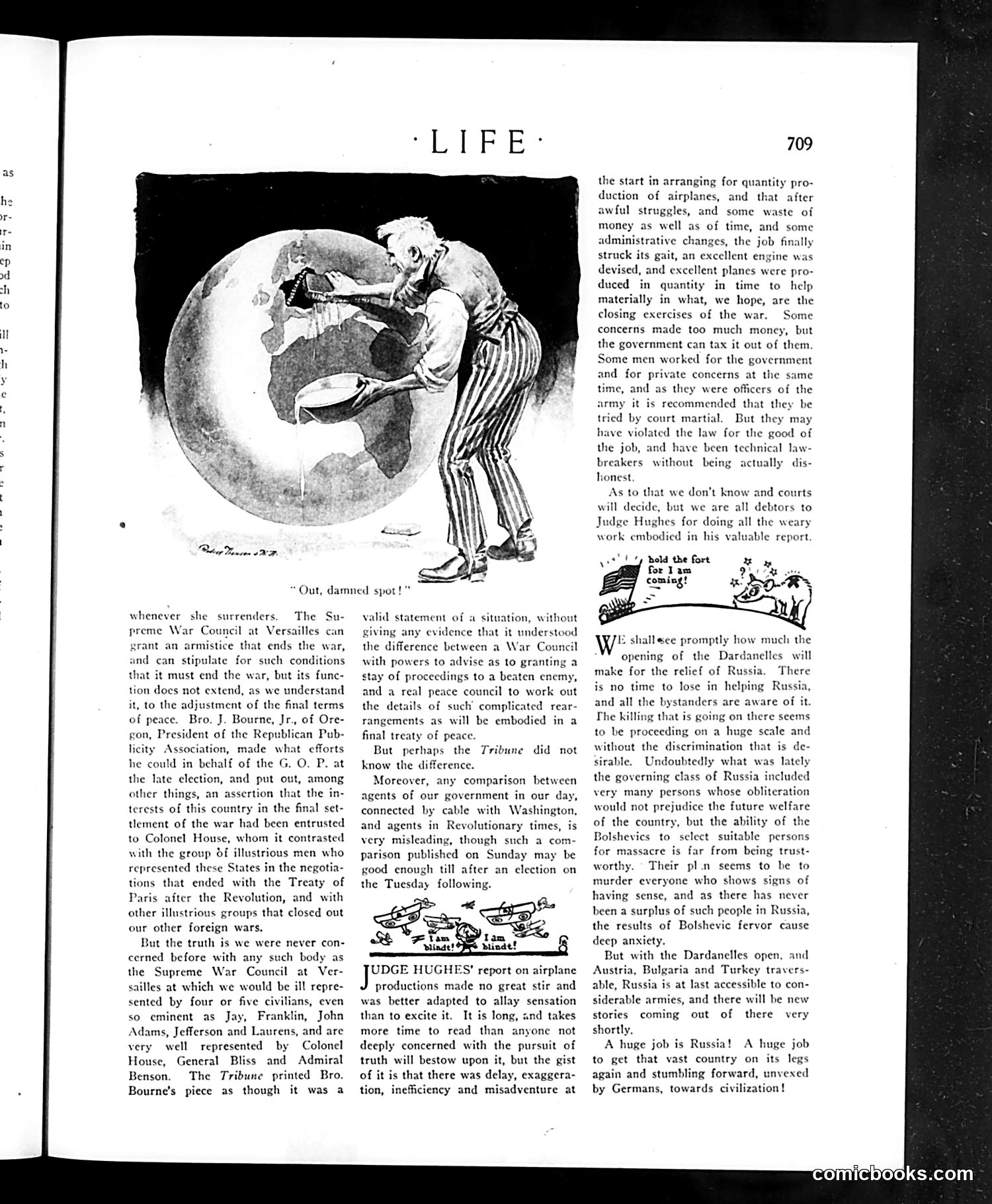
The main cartoon shows a figure in Uncle Sam-style patriotic clothing scrubbing a globe with a brush, captioned "Out, damned spot!"—a Shakespeare reference suggesting the need to clean up world disorder, likely post-WWI. The page's text discusses three topics: 1. **The Supreme War Council at Versailles**: Life defends Colonel House and American representatives against Republican criticism that they're insufficiently distinguished compared to Revolutionary-era diplomats. 2. **Judge Hughes' airplane production report**: Acknowledging wartime inefficiencies and profiteering, but crediting eventual success in plane manufacturing for the war effort. 3. **Opening the Dardanelles for Russian relief**: Advocating rapid aid to Russia through this strategic waterway, noting the humanitarian crisis there. The overall thrust is defending Wilson-era war management decisions against political opponents while acknowledging real problems were eventually solved. The "damned spot" cartoon represents cleaning up war's legacy and chaos.
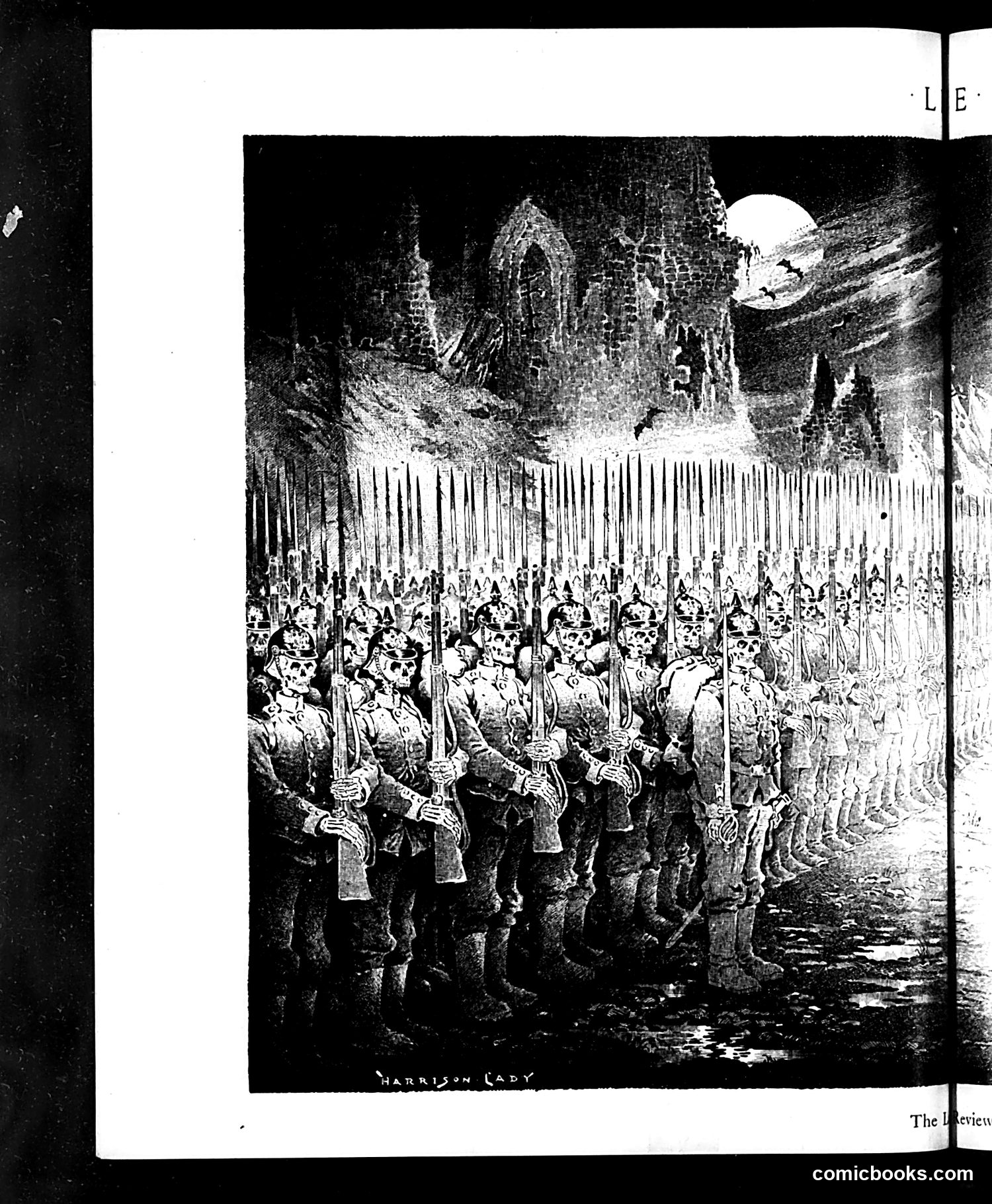
This illustration, credited to "Harrison Cady," depicts a nighttime military procession of uniformed soldiers holding long pikes or spears, arranged in precise formation. A full moon and Gothic ruins dominate the dark background, creating an ominous, theatrical atmosphere. The caption reads "The Review," suggesting this is a satirical commentary on a military inspection or parade. The Gothic setting and torchlight procession evoke medieval or fantastical imagery rather than contemporary military practice, likely mocking either ceremonial pageantry, authoritarian displays of power, or perhaps specific national military traditions of the era. Without additional context about Life's publication date, the precise political target remains unclear, though the tone is clearly critical of militaristic pomp.
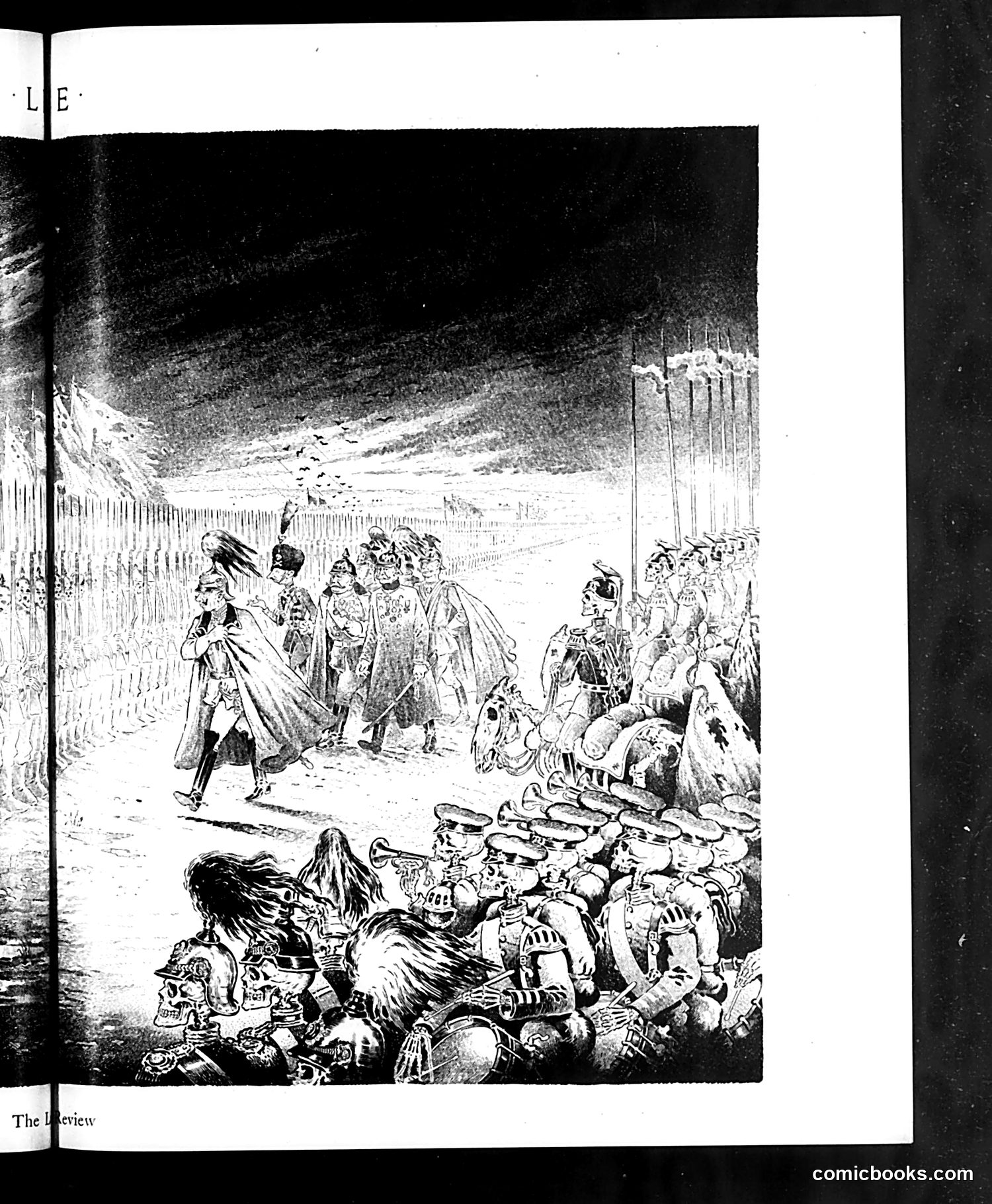
This appears to be a satirical illustration from *Life* magazine depicting a military or political scene. The image shows uniformed figures (appearing to be soldiers or officials) gathered around what looks like a fortification or encampment, with palisade fencing visible. There's a contrast between elaborately dressed, higher-ranking figures in the center and masses of armed soldiers or troops in the foreground. The composition suggests commentary on military hierarchy, possibly satirizing the disconnect between officers and enlisted troops, or critiquing military leadership and strategy. However, **without clearer textual context or visible publication date, I cannot identify the specific historical event, political figures, or satire target** this cartoon references. The OCR text is too fragmented to provide additional context about the intended message or figures depicted.
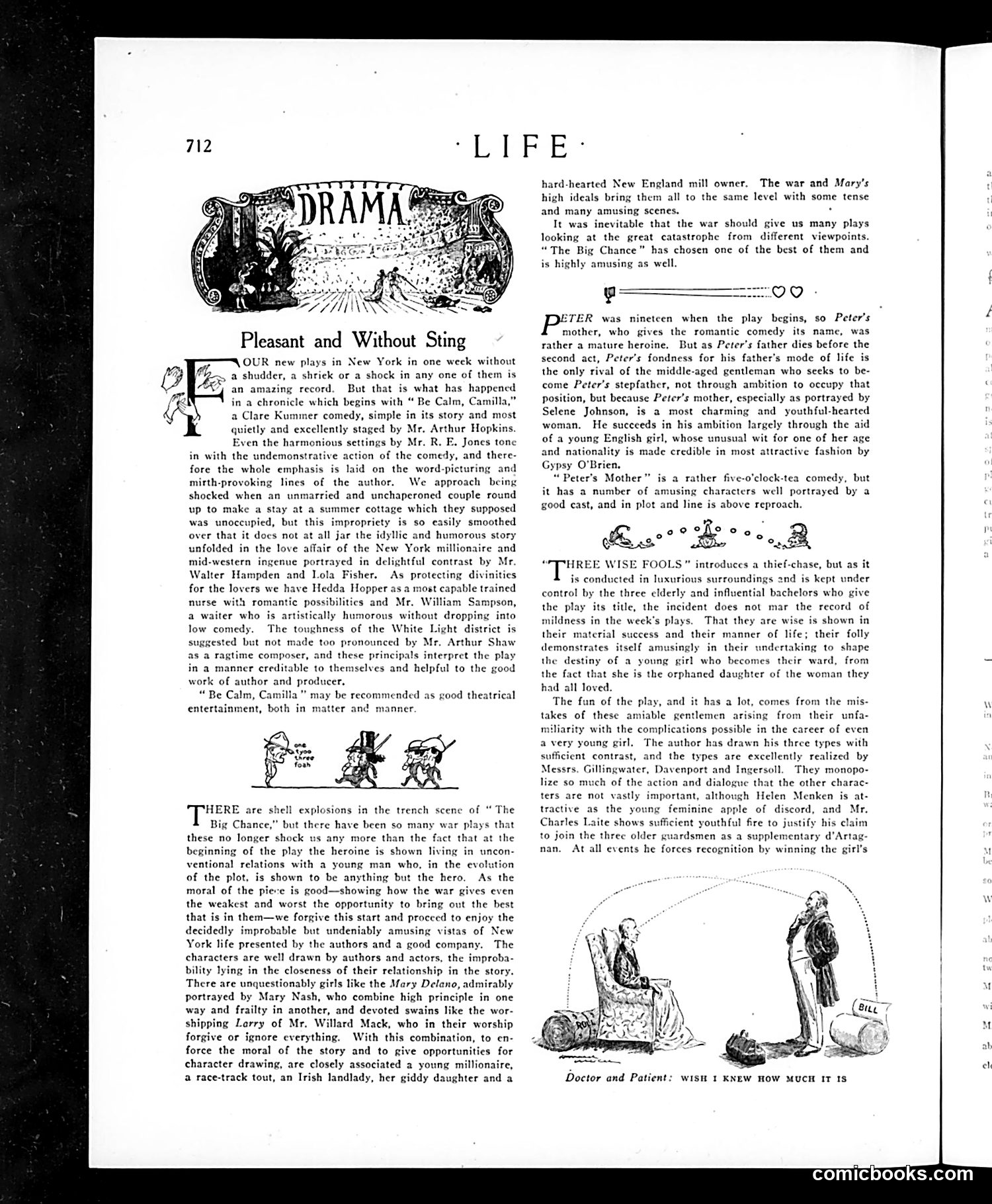
This page reviews three contemporary Broadway plays with gentle, non-offensive humor—reflecting the magazine's stated amazement that New York produced "a shudder, a shriek or a shock" in none of them. **"Be Calm, Camilla"** features Walter Hampden and Lola Fisher in a romance between a New York millionaire and mid-western woman, aided by Hedda Hopper as a nurse. **"The Big Chance"** depicts wartime redemption—a woman living "unconventionally" with a man finds moral purpose through WWI's upheaval. Mary Nash plays the principled-yet-flawed lead. **"Three Wise Fools"** centers on three elderly bachelor guardians raising an orphaned girl, with Charles Laite cast as a suitor. The cartoons (bottom illustrations) appear to be simple comedic vignettes accompanying these reviews, though specific references are unclear from the image quality. The page emphasizes character-driven, morally instructive theater—typical of early 1920s Broadway's respectable entertainment standards.
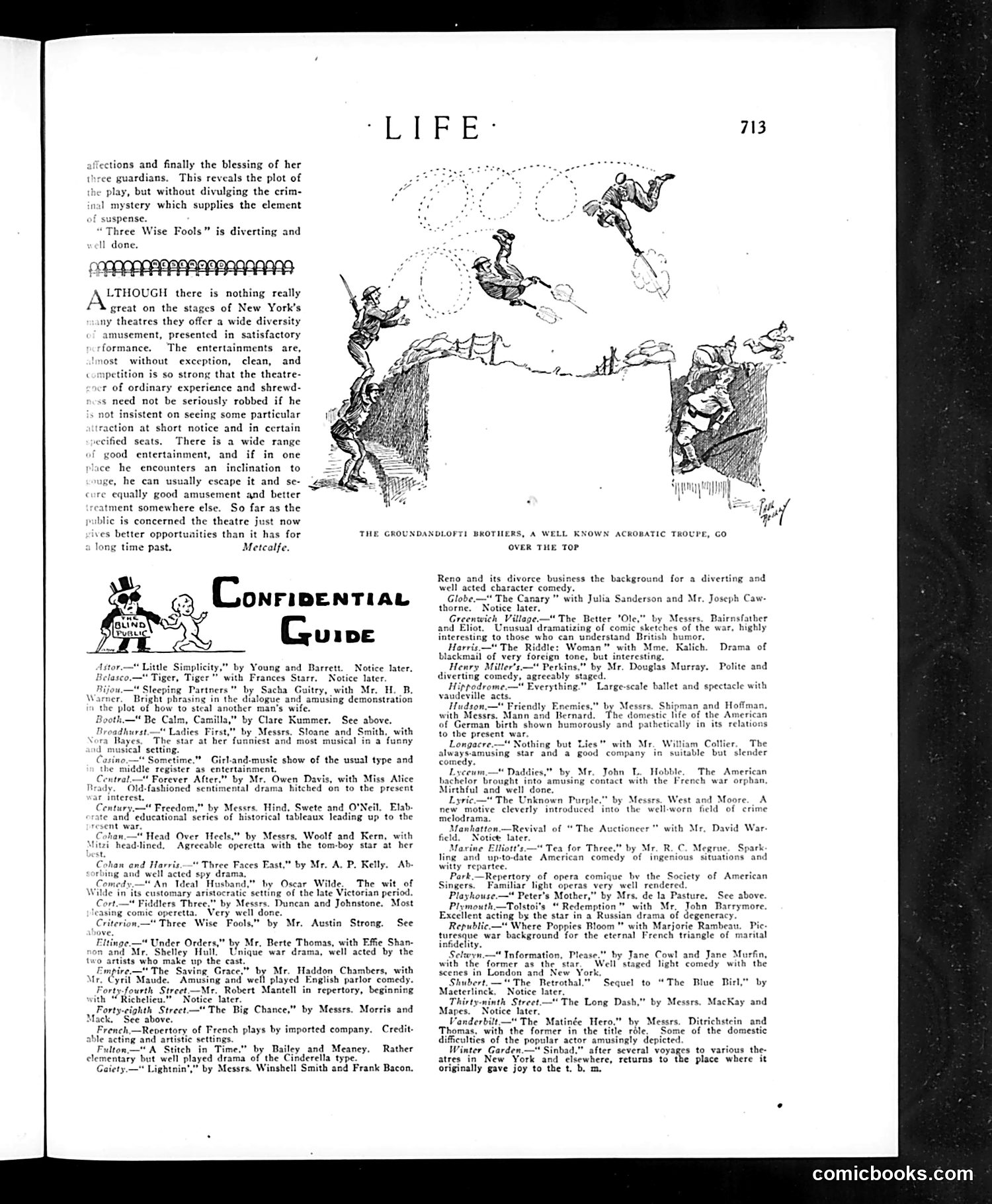
This page from *Life* magazine is primarily a theater review column discussing New York stage productions. The main illustration shows **the Groundsdorff Brothers**, a real acrobatic troupe performing their signature act of jumping over obstacles—hence "Over the Top," a phrase that gained currency during World War I. The text emphasizes that New York theaters, while lacking "great" productions, offer diverse entertainment in satisfactory quality. The reviewer argues that despite theater competition, audiences needn't worry about being deprived of good entertainment if they're flexible about timing and seating. The extensive "Confidential Guide" lists current Broadway productions with brief critiques, ranging from comedies and operettas to war-themed dramas (reflecting WWI-era interests). The acrobatic troupe image represents the variety of spectacle available to theatergoers of the era.
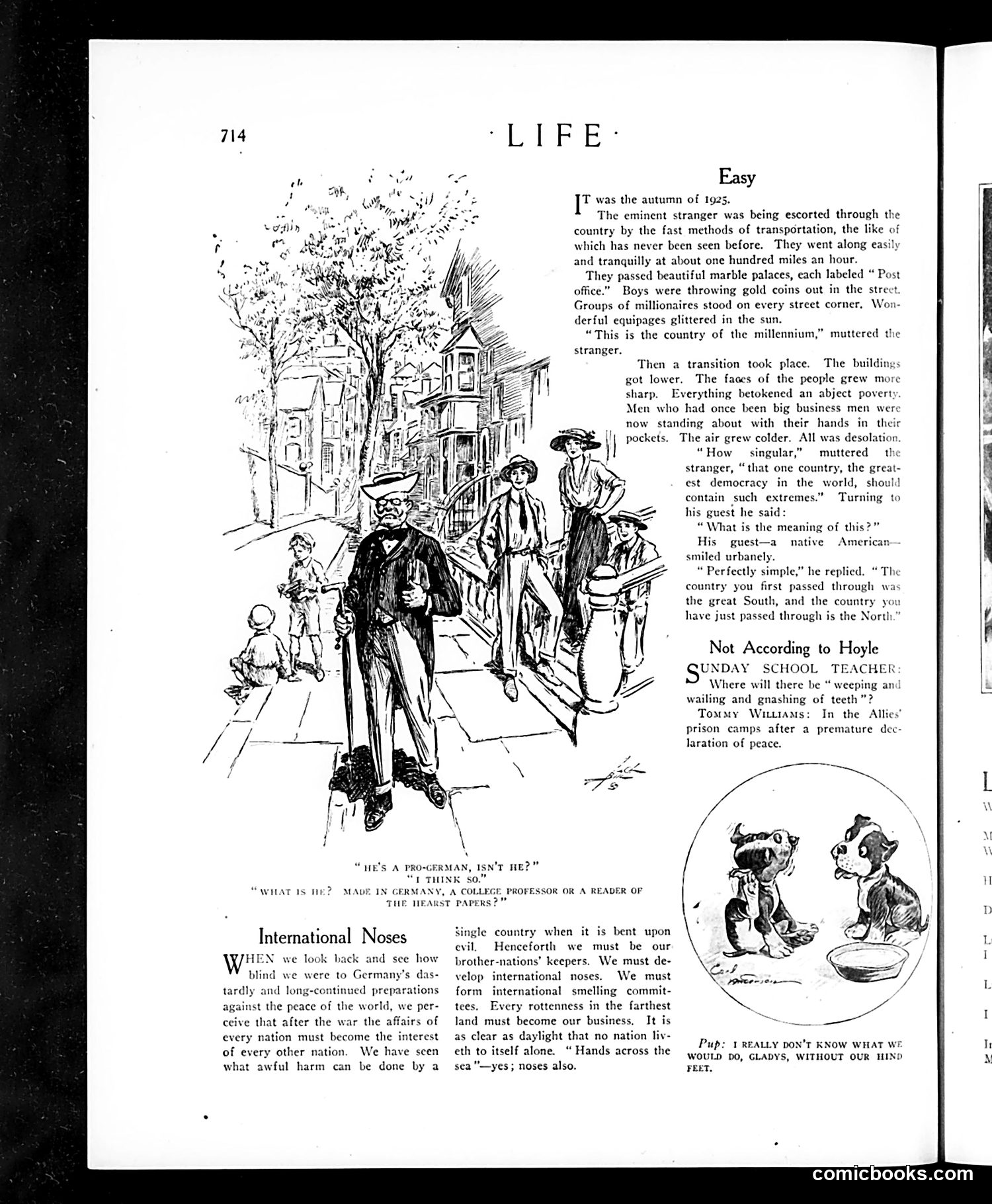
**Main Cartoon - "Easy":** This satirizes extreme wealth disparity in 1920s America. A foreign visitor tours the prosperous South (depicted with marble post offices and millionaires), then encounters the impoverished North—a striking contrast presented as natural regional economics. The satire critiques both regions: the South's apparent excess and the North's visible poverty, questioning how "the greatest democracy in the world" permits such extremes. **Secondary Cartoon - "Not According to Hoyle":** A dark joke about post-WWI tensions. A Sunday school student suggests the "weeping and gnashing of teeth" will occur in Allied prison camps after a premature peace declaration—mocking either pacifist sentiment or Allied post-war treatment of prisoners. **"International Noses":** Post-WWI commentary arguing nations must monitor each other internationally to prevent future conflicts like Germany's pre-war preparations. The crude pun on "noses" (poking into others' affairs) suggests satirical skepticism about this interventionist philosophy. All content reflects 1920s American political debates over isolationism, regional inequality, and international responsibility.
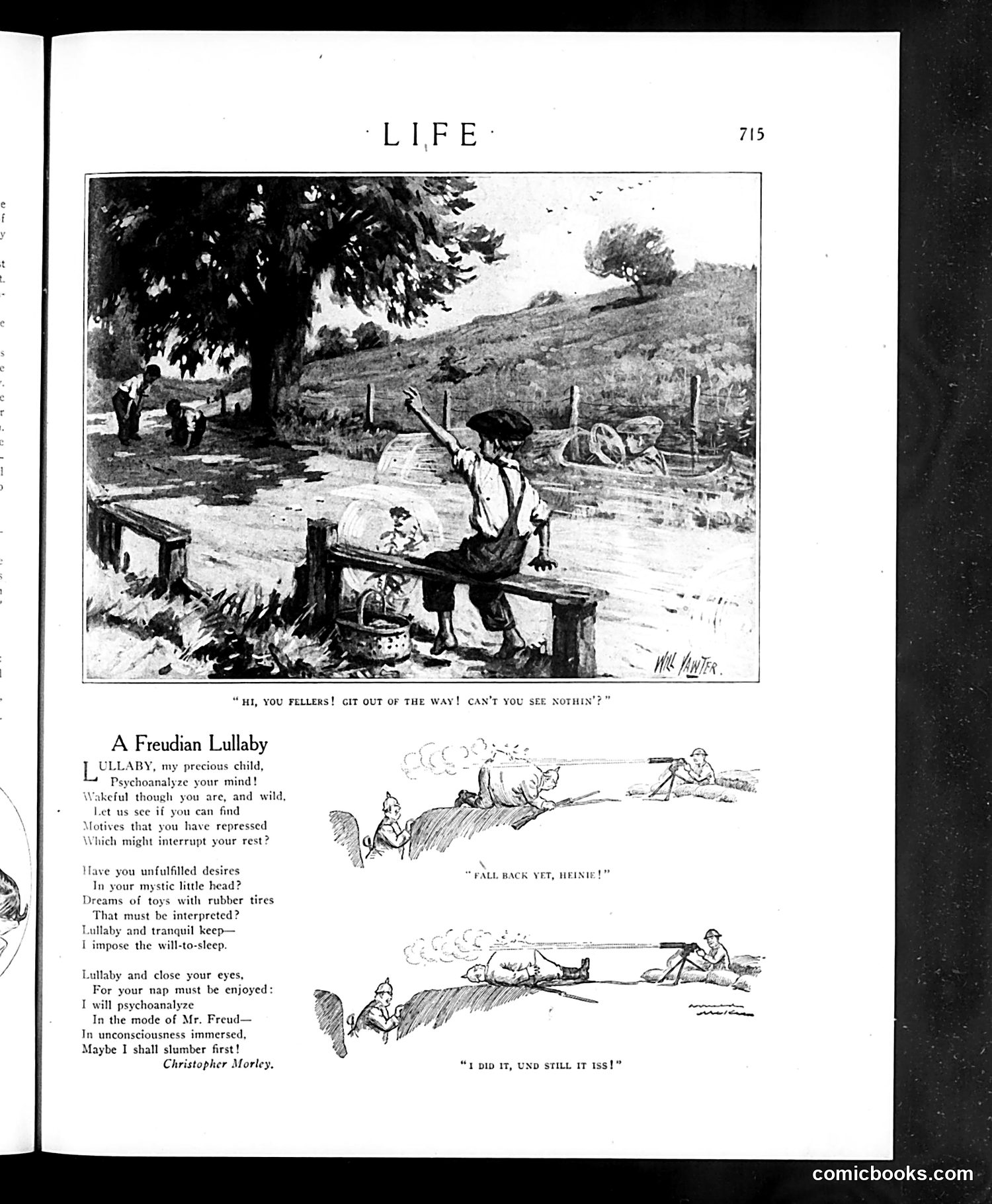
This page satirizes the early 20th-century American fascination with Freudian psychoanalysis. The poem by Christopher Morley mocks the tendency to apply Freud's theories to everyday situations, particularly child-rearing. The humor works on multiple levels: a parent attempting to psychoanalyze their child into sleep by probing for "repressed motives" and "unfulfilled desires"—treating bedtime like a therapy session. The absurdity peaks when the parent admits they might fall asleep first while analyzing the child "in the mode of Mr. Freud." The accompanying illustrations show rural laborers engaged in physical work, with captions like "Fall back yet, heist!" and "I did it, und still it iss!"—appearing to contrast practical, working-class reality against the intellectual pretensions of psychoanalytic theory. The satire targets how fashionable Freudian analysis had become among educated, middle-class Americans who applied it indiscriminately to mundane domestic life.
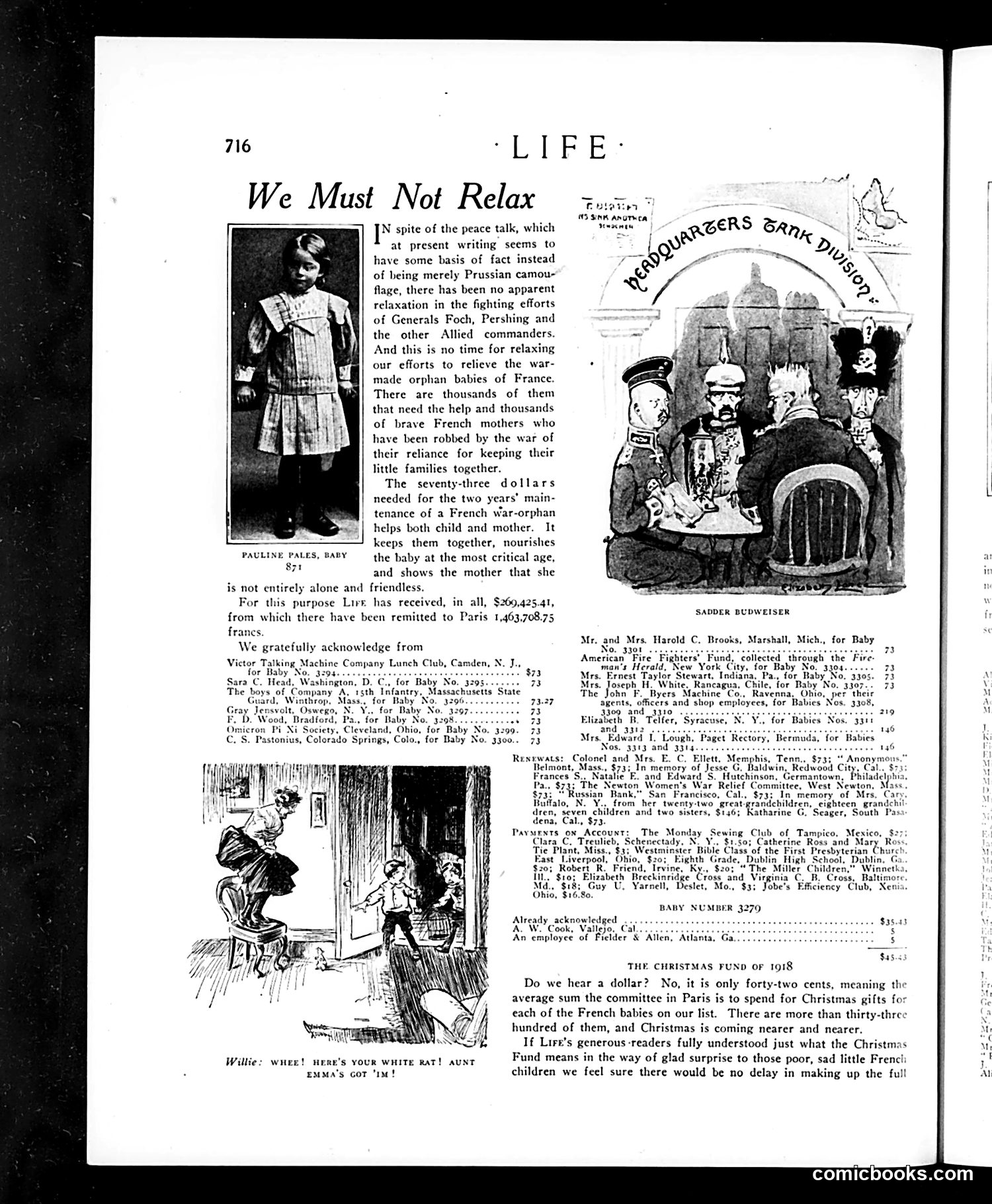
This 1918 *Life* magazine page advocates for continued charitable donations to French war orphans despite peace negotiations. The main article, "We Must Not Relax," warns that even as peace talks proceed, Allied military efforts continue—and so should humanitarian relief efforts. The page documents donations to support French children orphaned by World War I. It explains that $73 maintains one orphan for two years, keeping families together during their most vulnerable period. The two cartoons are humorous fundraising appeals: one shows a well-dressed child ("Pauline Pales, Baby 871"), and another labeled "Sadder Budweiser" depicts impoverished French orphans in stark contrast, with a caption about headquarters bank division. The bottom cartoon shows a domestic scene where a child asks "Willie" about his white rat, with the punchline implying he's neglected it—a lighthearted jab suggesting readers shouldn't neglect French orphans either. The Christmas Fund section notes donations average only 42 cents per child—an appeal for more generous giving before the holidays.
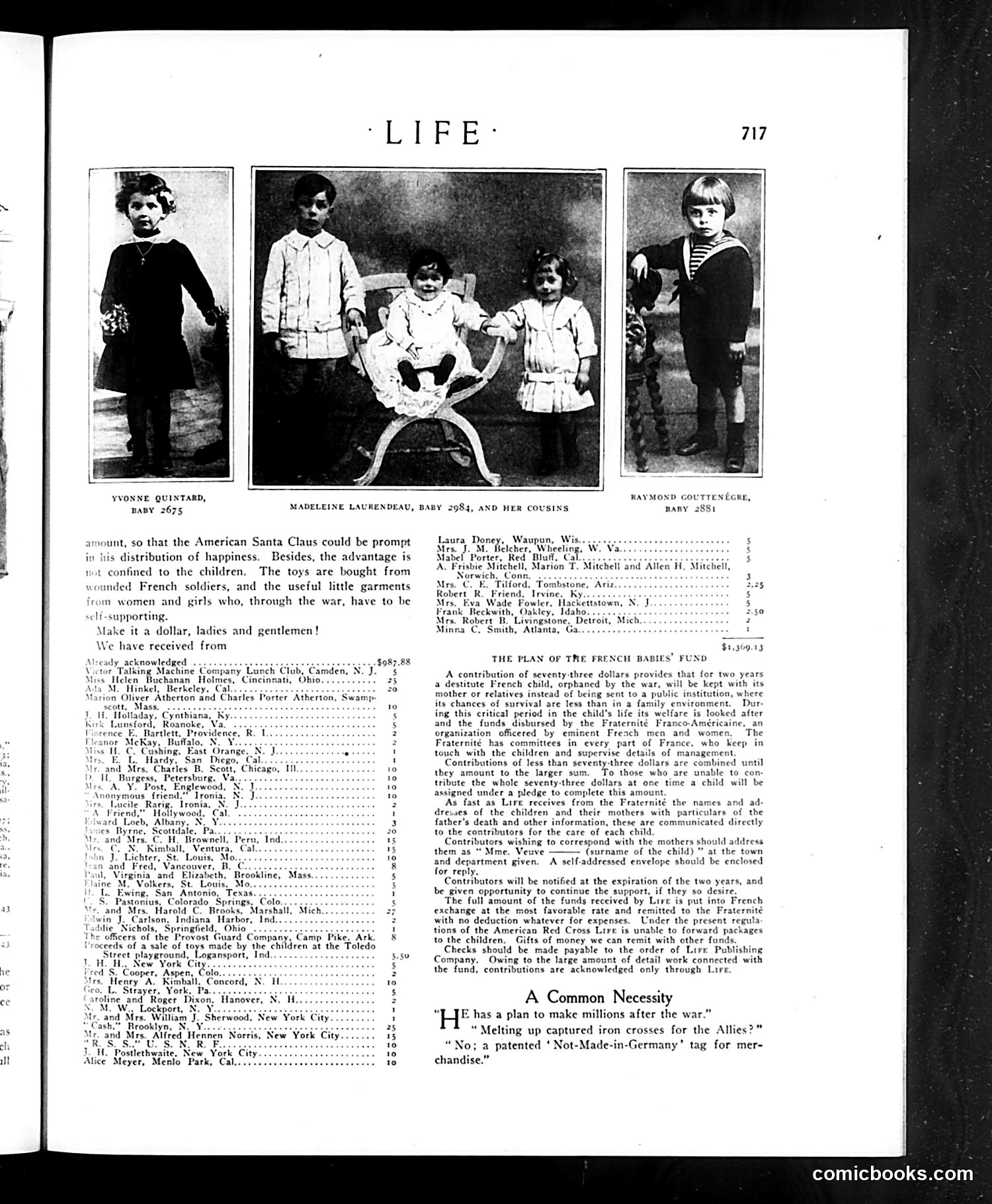
This page documents a **French Babies' Fund**, a charitable campaign supporting orphaned French children during World War I. The top photographs show individual babies and toddlers who were beneficiaries—each assigned a number like "Baby 2675." The fund's mechanism is explained in detail: donors contribute $73 to support a destitute French child for two years, keeping the child with family rather than in institutions where survival rates were lower. The Fraternité Franco-Américaine (a Franco-American fraternal organization) managed distributions and corresponded with contributors about specific children. The bulk of the page lists donors by name and location—hundreds of Americans contributing to the cause. The satirical cartoon at bottom ("A Common Necessity") appears unrelated to the fund itself; it jokes about post-war profiteering schemes. This reflects WWI-era American philanthropy toward war-devastated Europe and domestic mobilization for humanitarian relief.
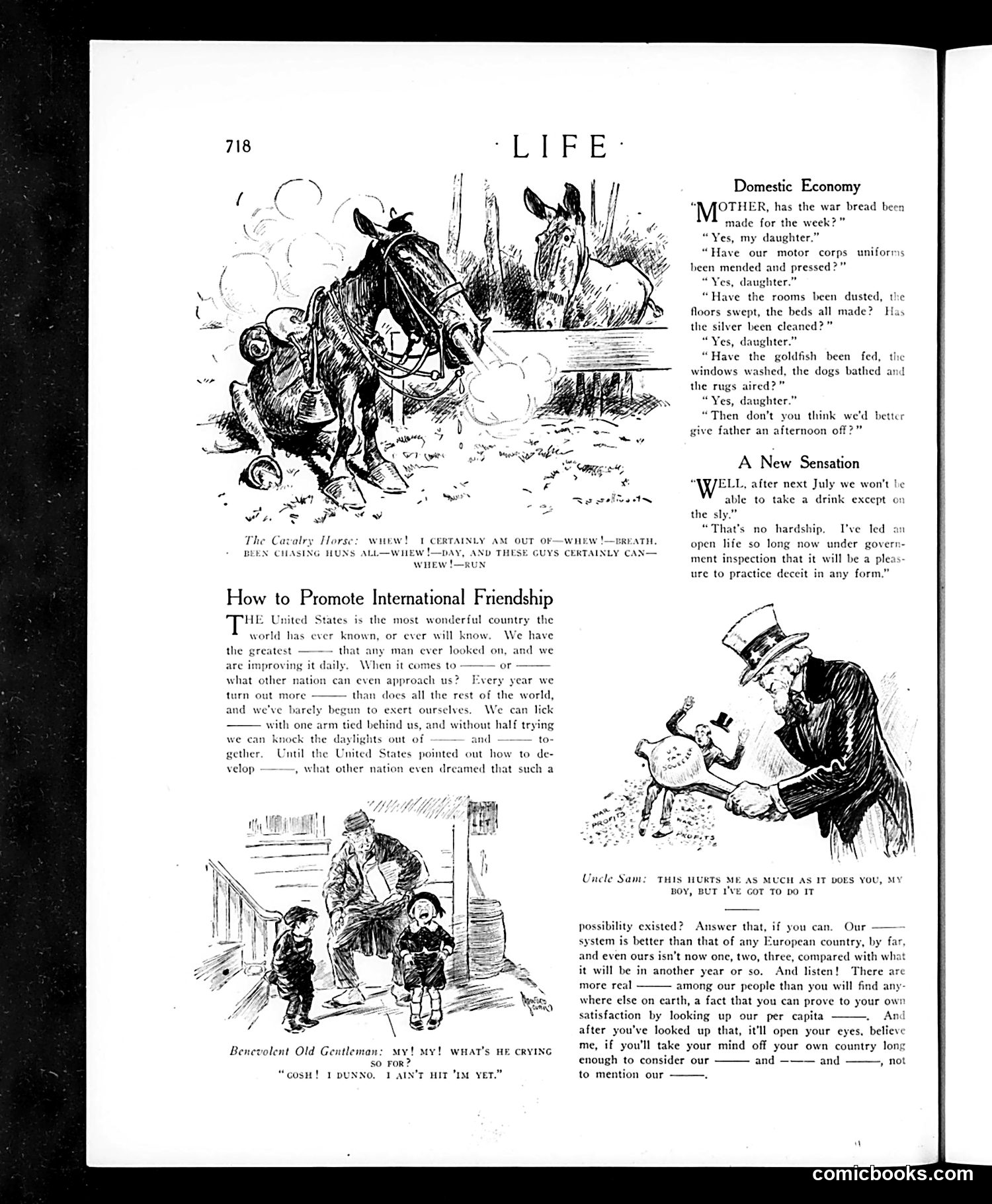
This page contains three satirical pieces critiquing American attitudes during WWI era: **"The Cavalry Horse"** (top): A frazzled horse exhausted from chasing "Huns" represents the brutal reality of warfare, contrasting with nationalistic rhetoric. **"How to Promote International Friendship"** (center): Satirizes American boastfulness. The text—with multiple blanks where specific claims are omitted—mocks self-congratulatory nationalism: the U.S. claims superiority in every domain while lecturing other nations. The illustration of a benevolent gentleman hitting a child ("I ain't hit 'im yet") darkly suggests that American "friendship" involves coercive force masked as help. **"Domestic Economy"** (right): Shows a wife managing household wartime duties while asking to give father an afternoon off, satirizing how civilians bear war's burden. **"A New Sensation"** (bottom right): References Prohibition (beginning July 1920), sarcastically suggesting that government inspection makes honest behavior seem refreshingly novel. The overarching message: American self-righteousness about democracy and superiority rings hollow amid wartime sacrifice and looming social restrictions.
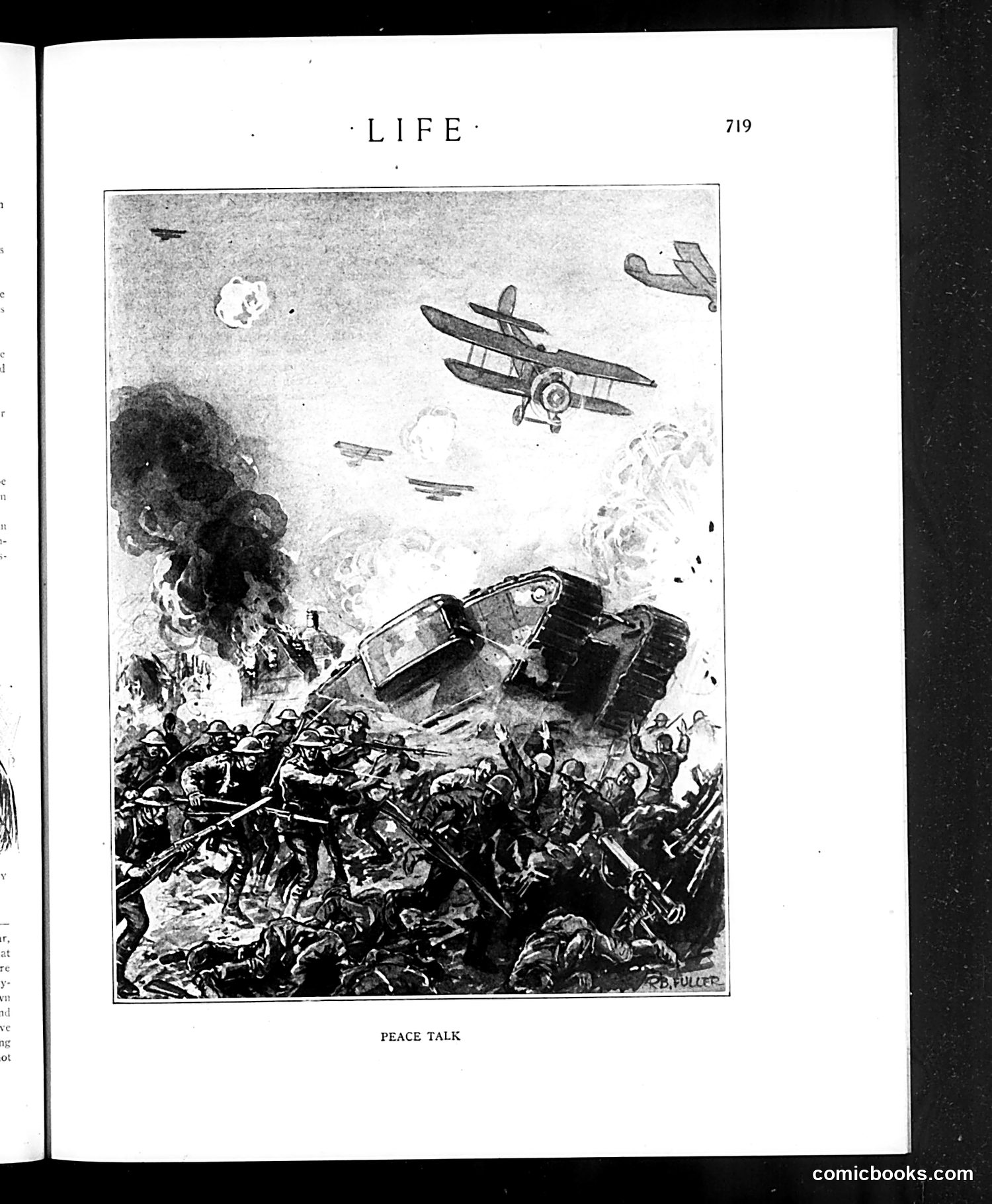
This Life magazine cartoon, signed by D. Fulmer, depicts the chaos and futility of peace negotiations during or after World War I. The image shows a massive aerial and ground battle—soldiers fighting in trenches, military vehicles burning, and warplanes attacking overhead—yet the title sarcastically calls this "Peace Talk." The satire mocks the disconnect between diplomatic efforts to end the war and the continued violence and destruction on the battlefield. The cartoon suggests that politicians' peace negotiations are meaningless theater while actual combat rages on, with soldiers dying and resources being devastated. It's a cynical commentary on how peace talks fail to halt the horrors of modern industrial warfare.
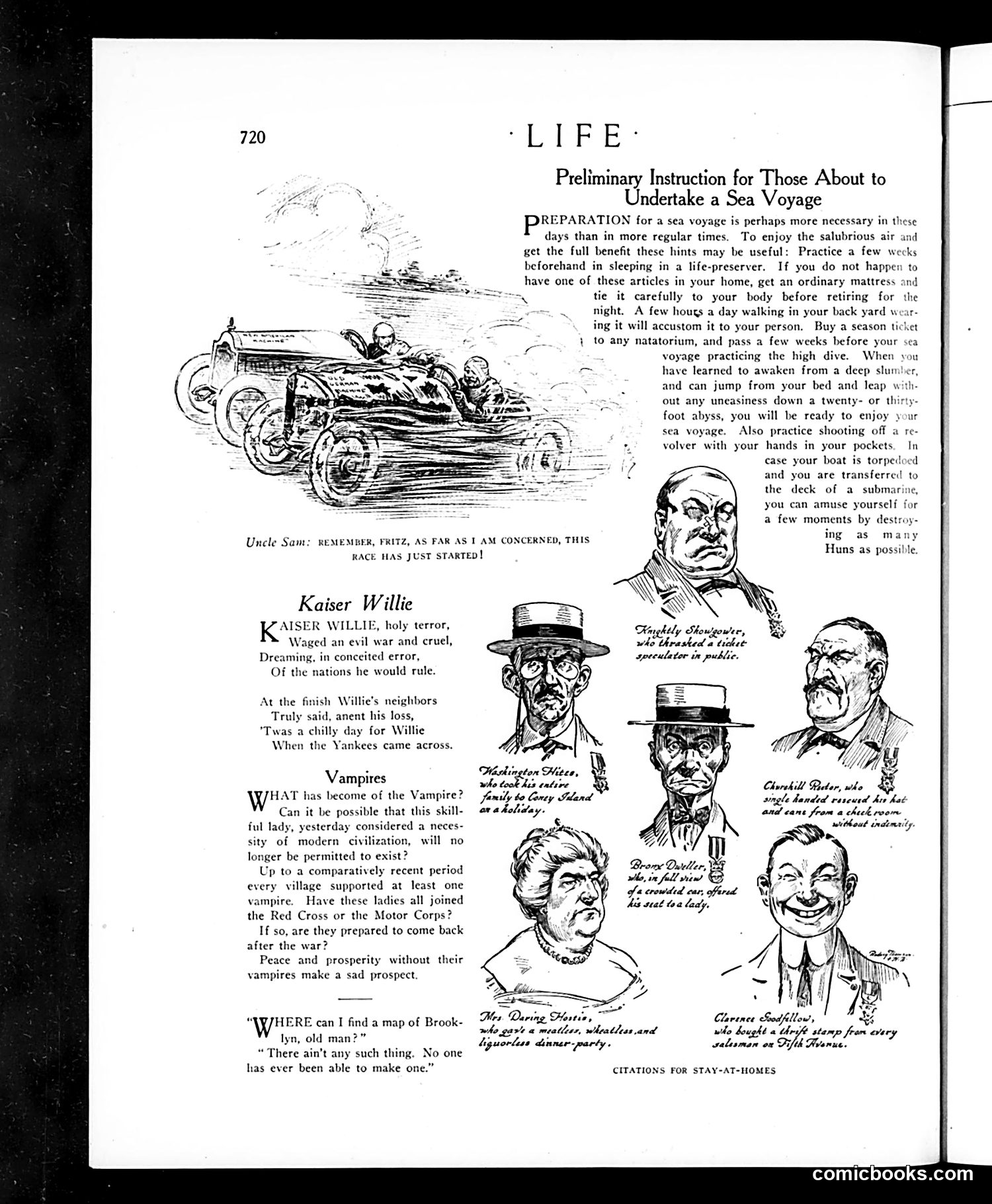
This page combines practical humor about World War I-era sea travel with political cartoons mocking German leadership and American home-front contributions. **"Preliminary Instruction"** satirizes wartime paranoia by offering absurd "safety tips" for ocean voyages—sleeping in life preservers, practicing high dives from thirty-foot heights, shooting revolvers in pockets—joking about the real dangers of German U-boat torpedoes. **"Kaiser Willie"** section mocks German Emperor Wilhelm II as a defeated aggressor after American entry turned the war's tide ("When the Yankees came across"). **"Vampires"** critiques wealthy socialites who previously defined high society through gossip and scandal but now claim wartime patriotism via Red Cross or Motor Corps service—questioning their sincerity. **"Citations for Stay-at-Homes"** presents caricatured portraits of American civilians who contributed minimally to the war effort (attending dinner parties, buying war stamps belatedly), contrasting them with actual sacrifice. The satire celebrates modest home-front contributions while mocking those claiming undeserved credit.
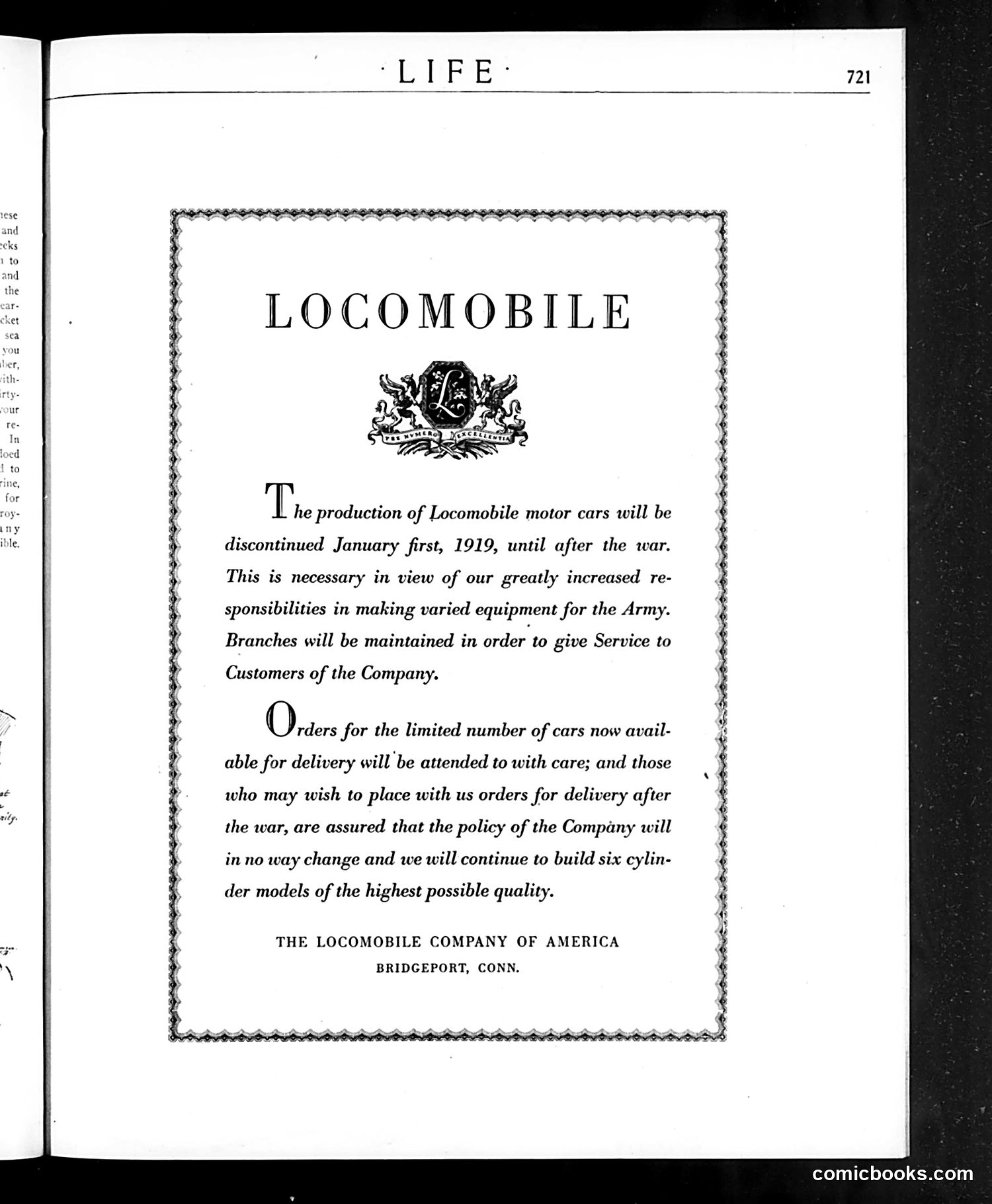
This is a **corporate advertisement**, not a cartoon or satire. It's a formal announcement from the Locomobile Company of America (an automobile manufacturer based in Bridgeport, Connecticut) regarding World War I's impact on civilian production. The company announces it will **stop making consumer automobiles on January 1, 1919**, redirecting manufacturing to Army equipment. This reflects the U.S. war effort's demands on industrial production during WWI. The advertisement reassures existing customers that service branches will remain operational and promises post-war resumption of their six-cylinder car production. It's a business communication navigating wartime economic disruption—showing how American manufacturers pivoted to military support during the conflict. There is no satire or political cartooning present on this page.
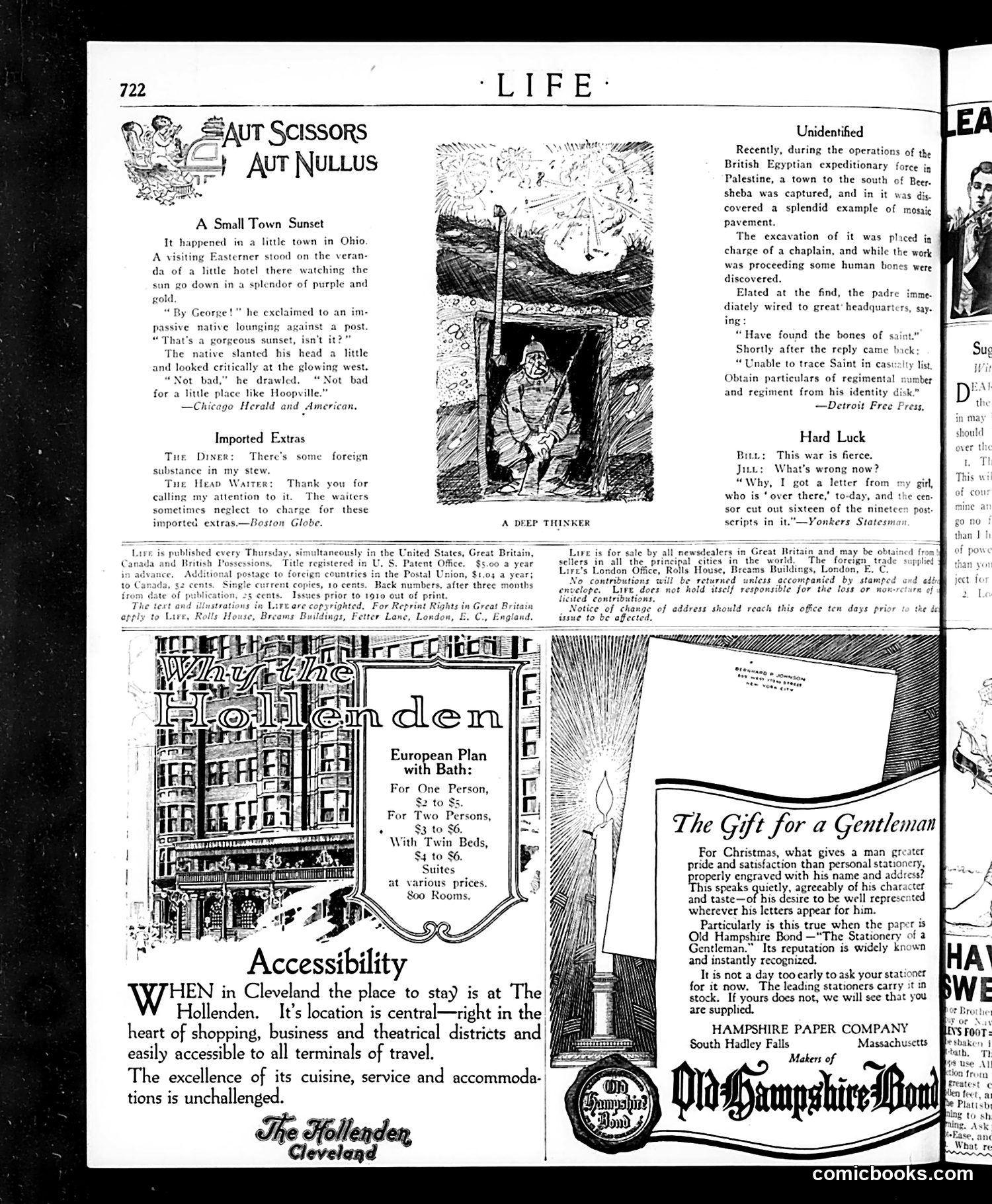
This page contains three separate humor pieces reflecting early 20th-century American life: **"A Small Town Sunset"** satirizes provincial American taste. A sophisticated Eastern visitor admires a sunset's beauty; a local dismisses it as "not bad...for a little place like Hoopville"—mocking rural people's limited aesthetic appreciation and tendency to apologize for their surroundings. **"Imported Extras"** jokes about a diner serving foreign substances in stew, playing on period anxiety about immigrant workers and food quality/safety. **"Hard Luck"** references World War I censorship, where a soldier's girlfriend's letter had 16 of 19 postscripts removed by military censors—humorously suggesting romantic correspondence was heavily monitored for security reasons. The page also contains period advertisements for The Hollenden hotel in Cleveland and Hampshire Bond stationery, reflecting typical magazine advertising of the era.
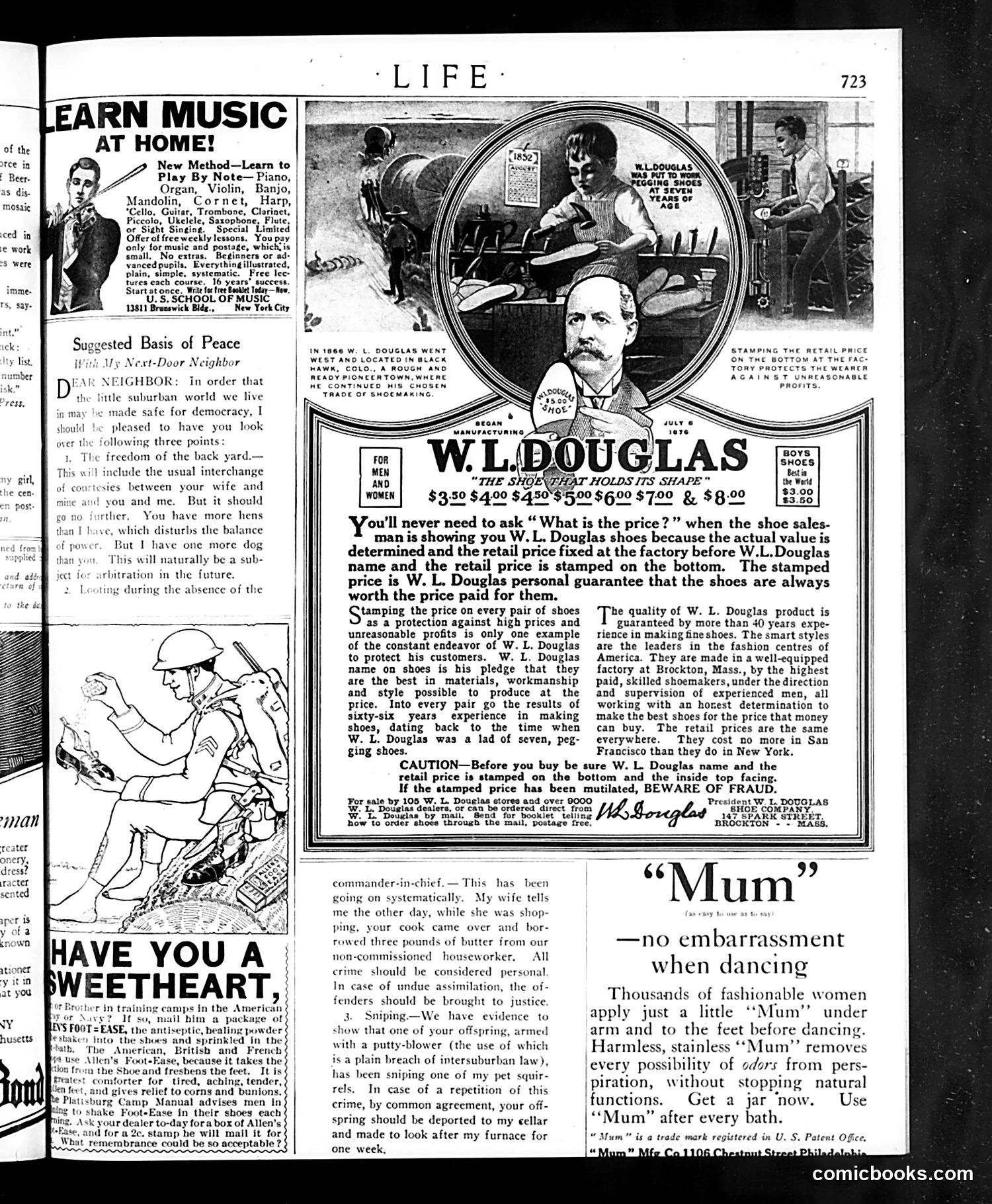
This page is primarily **advertising**, not satire or political cartooning. The dominant feature is a large **W.L. Douglas shoe advertisement** occupying the center-right. It includes a circular portrait of William L. Douglas himself, presenting the company's selling point: shoes have the retail price stamped on the bottom by the factory, preventing price-gouging and protecting consumers. The ad emphasizes quality materials, skilled labor in Brockton, Massachusetts, and consistent pricing nationwide. Supporting content includes: - A "Learn Music at Home" advertisement (top left) - A brief article titled "Suggested Basis of Peace with My Next-Door Neighbor" discussing suburban disputes over yards, hens, and dogs - A "Mum" deodorant advertisement (bottom right) The page reflects early 20th-century consumer concerns about fair pricing and product transparency, positioning W.L. Douglas as a trustworthy brand protecting workers and customers alike.
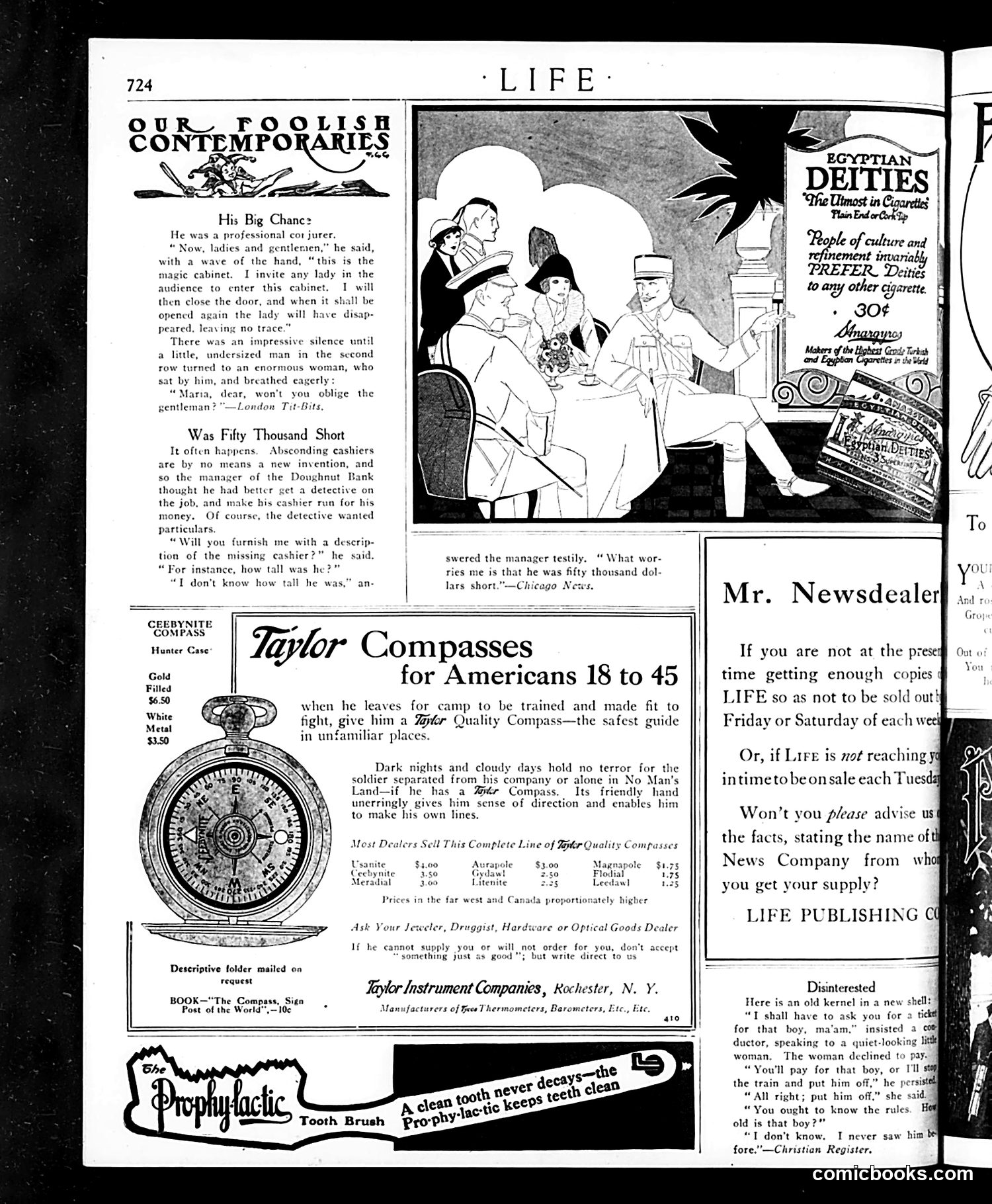
This page consists primarily of **advertising and humor columns** rather than political satire. **Main Content:** The page features three humorous anecdotes: 1. **"His Big Chance"** — A conjurer's stage trick where he invites a woman into a magic cabinet promising she'll disappear. The joke relies on innuendo about the woman being eager to vanish. 2. **"Was Fifty Thousand Short"** — A bank manager describes a missing cashier to a detective, unable to provide physical description but noting the embezzlement amount—a play on misplaced priorities. 3. **"Disinterested"** — A conductor demands payment for an underage boy; the mother agrees to let him be thrown off the train, revealing she doesn't know whose child he is—dark humor about parental indifference. **Advertising dominates the page**, featuring Taylor Compasses (marketed to soldiers/campers), Egyptian Deities cigarettes, a Prophylactic toothbrush, and a Cerbyite compass. The ads appear contemporary to WWI era based on military references. The humor is gentle, domestic, and class-conscious rather than overtly political.
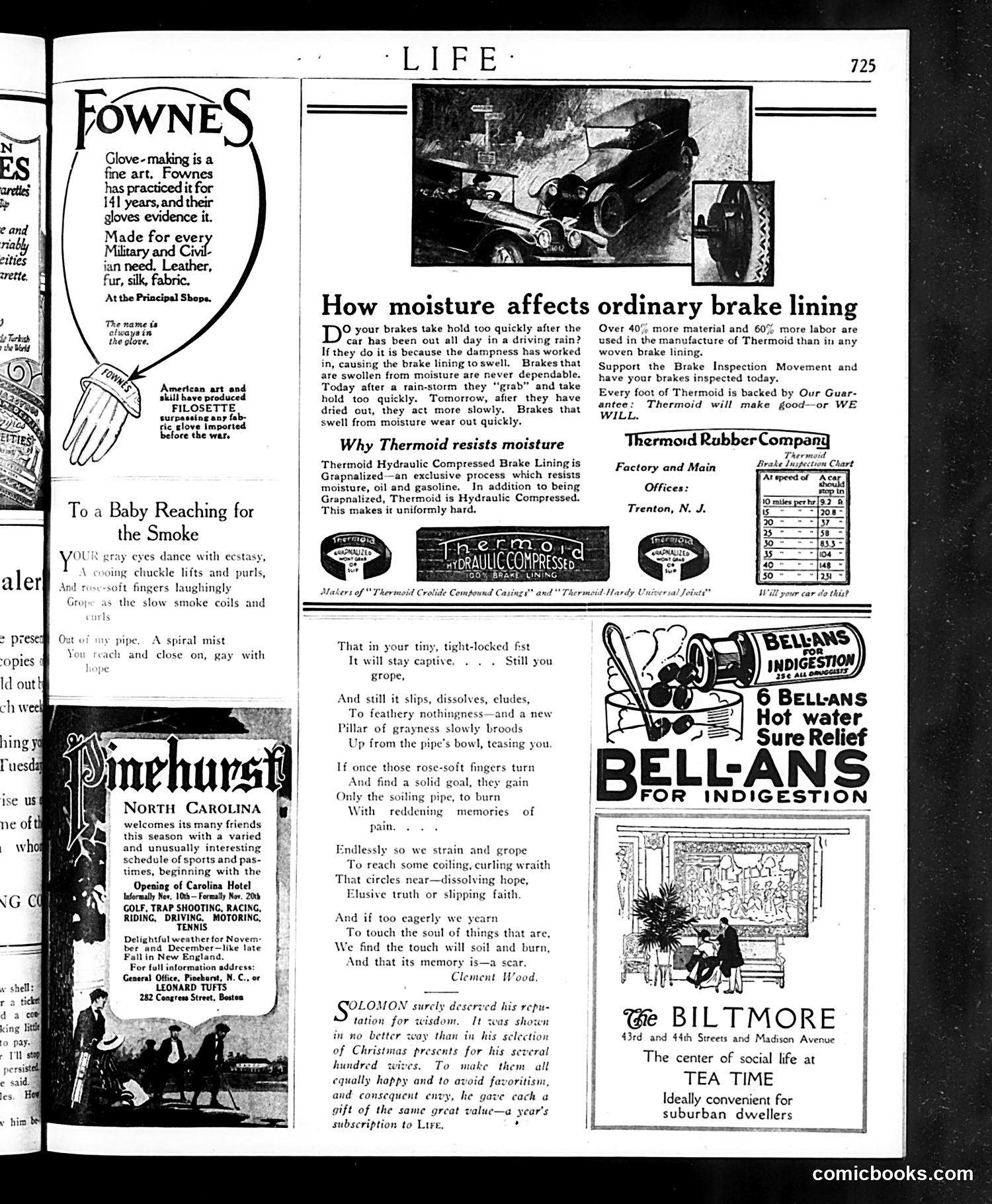
This page is primarily **advertising**, with minimal editorial content. The main elements are: **Advertisements:** - **Fownes Gloves**: Emphasizes 141 years of craftsmanship; notes American skill "imported before the war" (likely WWI reference) - **Thermoid Brake Lining**: Technical ad about moisture-resistant brake linings for automobiles - **Bellans**: Patent medicine for indigestion - **The Biltmore Hotel**: Social venue advertisement - **Carolina Hotel**: North Carolina resort promoting sports activities **Editorial Content:** - **"To a Baby Reaching for the Smoke"**: A sentimental poem by Clement Wood about a child reaching for pipe smoke—metaphorically exploring the futility of grasping intangible things (hope, faith, truth) - **Solomon reference**: A humorous closing note suggesting King Solomon gave his wives Life magazine subscriptions The page reflects early 20th-century consumer culture, automobile technology developments, and genteel leisure advertising mixed with romantic poetry typical of Life's editorial approach.
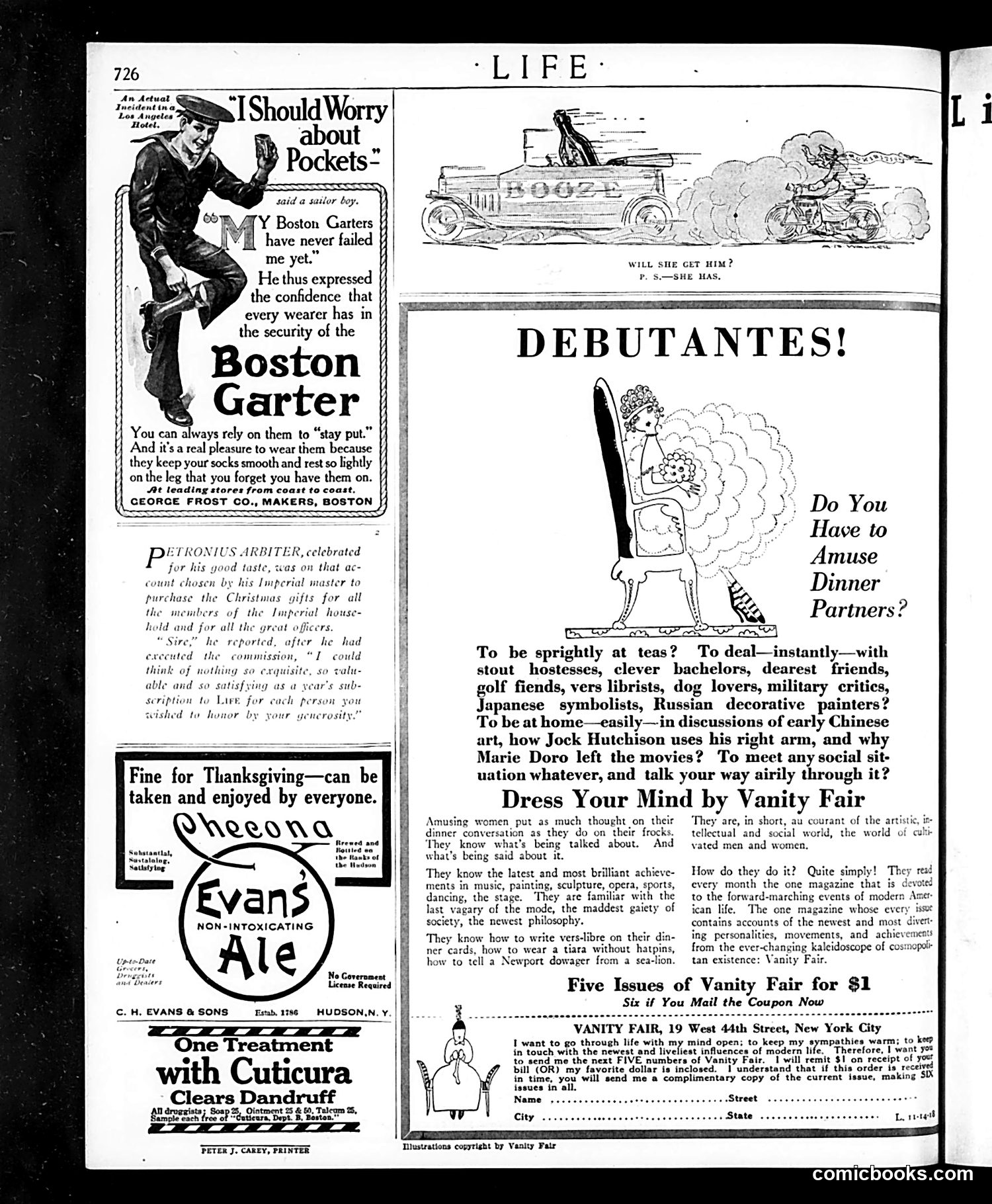
This page is primarily **advertising and promotional content** rather than political satire. The main elements include: **Advertisements:** - Boston Garters (men's sock supporters) featuring a sailor endorsing their reliability - Evans Ale - Cuticura dandruff treatment **Editorial Content:** A brief anecdote about Petronius Arbiter (Roman historical figure) choosing Christmas gifts, illustrating refined taste. **Major Feature:** A Vanity Fair magazine promotion titled "Debutantes!" The text satirizes wealthy young women who must maintain intellectual sophistication—appearing knowledgeable about art, literature, sports, and social discourse without genuine expertise. The satire suggests these women memorize talking points to navigate dinner parties and social situations with "clever bachelors" and various cultural circles. **The Joke:** Vanity Fair positions itself as the essential monthly magazine enabling women to "dress your mind"—providing the cultural knowledge needed to convincingly participate in sophisticated conversation, implying their natural education is insufficient. The cartoon shows a fashionable woman with an exaggerated feathered hat, embodying the "debutante" stereotype.