
Life, 1918-11-14 · page 20 of 34
Life — November 14, 1918 — page 20: what you’re looking at
What you’re looking at
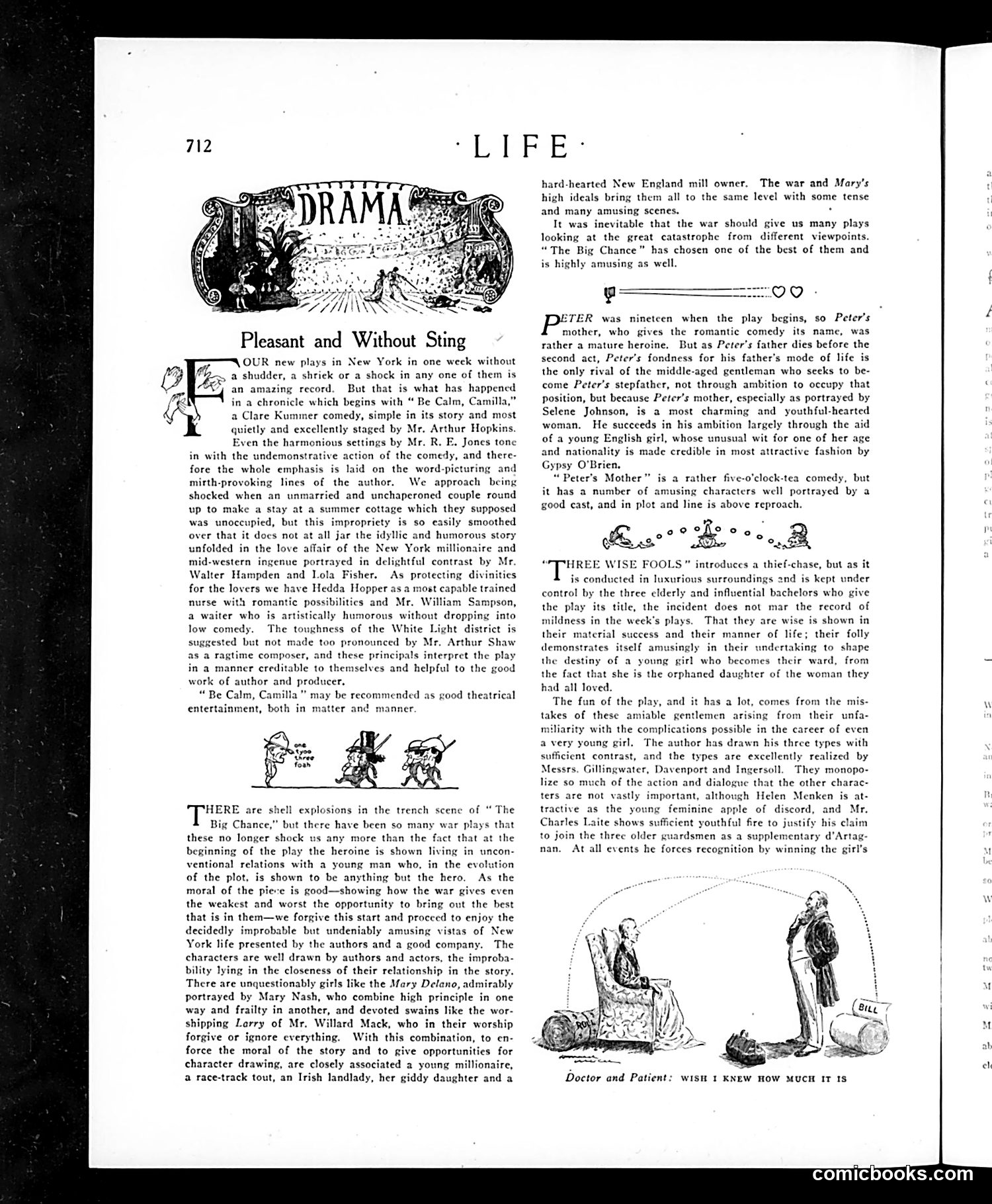
This page reviews three contemporary Broadway plays with gentle, non-offensive humor—reflecting the magazine's stated amazement that New York produced "a shudder, a shriek or a shock" in none of them. **"Be Calm, Camilla"** features Walter Hampden and Lola Fisher in a romance between a New York millionaire and mid-western woman, aided by Hedda Hopper as a nurse. **"The Big Chance"** depicts wartime redemption—a woman living "unconventionally" with a man finds moral purpose through WWI's upheaval. Mary Nash plays the principled-yet-flawed lead. **"Three Wise Fools"** centers on three elderly bachelor guardians raising an orphaned girl, with Charles Laite cast as a suitor. The cartoons (bottom illustrations) appear to be simple comedic vignettes accompanying these reviews, though specific references are unclear from the image quality. The page emphasizes character-driven, morally instructive theater—typical of early 1920s Broadway's respectable entertainment standards.
📄 Transcribed text from this page (OCR, searchable)
Machine-transcribed from the original scan — historical spelling and the odd misread are preserved.
‘LIP E* or IAS Pleasant and Without Sting Fra OUR new plays in New York in one week without fp a shudder, a shriek or a shock in any one of them is R ; A an amazing record. But that is what has happened in a chronicle which begins with “ Be Calm, Camilla, a Clare Kummer comedy, simple in its story and most sietly and excellently staged by Mr. Arthur Hopkins. ven the harmonious settings by Mr. R. E. Jones tone in with the undemonstrative action of the comedy, and there- fore the whole emphasis is laid on the word-picturing and mirth-provoking lines of the author. We approach being shocked when an unmarried and unchaperoned couple round up to make a stay at a summer cottage which they supposed was unoccupied, but this impropriety is so easily smoothed over that it docs not at all jar the idyllic and humorous story unfolded in the love affair of the New York millionaire and mid-western ingenue portrayed in delightful contrast by Mr. Walter Hampden and Lola Fisher. As protecting divinities for the lovers we have Hedda Hopper as a most capable trained nurse with romantic possibilitics and Mr. William Sampson, a waiter who is artistically humorous without dropping into low comedy. The toughness of the White Light district is suggested but not made too pronounced by Mr. Arthur Shaw as a ragtime composer, and these principals interpret the play in a manner creditable to themselves and helpful to the good work of author and producer. “ Be Calm, Camilla” may be recommended as good theatrical entertainment, both in matter and manner. HERE are shell explosions in the trench scene of Big Chance,” but there have been so many war plays that these no longer shock us any more than the fact that at the beginning of the play the heroine is shown living in uncon- ventional relations with a young man who, in the evolution of the plot, is shown to be anything but the hero. As the moral of the pieve is good—showing how the war gives even the weakest and worst the opportunity to bring out the best that is in them—we forgive this start and procced to enjoy the decidedly improbable but undeniably amusing vistas of New York life presented by the authors and a good company. The characters are well drawn by authors and actors, the improba- bility lying in the closeness of their relationship in the story. There are unquestionably girls like the Mary Delano, admirably portrayed by Mary Nash, who combine high principle in one way and frailty in another, and devoted swains like the wor- shipping Larry of Mr, Willard Mack, who in their worship forgive or ignore everything. With this combination, to en- force the moral of the story and to give opportunities for character drawing, are closely associated a young millionaire, a race-track tout, an Irish landlady, her giddy daughter and a hard-hearted New England mill owner. The war and Mary's high ideals bring them all to the same level with some tense and many amusing scenes. : It was inevitable that the war should give us many plays looking at the great catastrophe from different viewpoints. “The Big Chance” has chosen one of the best of them and is highly amusing as well. g “O90 TER was nineteen when the play begins, so Peter's mother, who gives the romantic comedy its name, was rather a mature heroine, But as Peter's father dies before the second act, Peter’s fondness for his father’s mode of life is the only rival of the middle-aged gentleman who seeks to be- come Peter's stepfather, not through ambition to occupy that position, but because Peter’s mother, especially as portrayed by Selene Johnson, is a most charming and youthful-hearted woman. He succeeds in his ambition largely through the aid of a young English girl, whose unusual wit for one of her age and nationality is made credible in most attractive fashion by Gypsy O'Brien, “Peter's Mother” is a rather five-o'clock-tea comedy, but it has a number of amusing characters well portrayed by a good cast, and in plot and line is above reproach. Baw’ £°°- BR . oe “TTHREE WISE FOOLS" introduces a thief-chase, but as it is conducted in luxurious surroundings and is kept under control by the three elderly and influential bachelors who give the play its title, the incident does not mildness in the week's plays, That they are wise is shown in their material success and their manner of life; their folly demonstrates itself amusingly in their undertaking to shape the destiny of a young girl who becomes their ward, from the fact that she is the orphaned daughter of the woman they had all loved. The fun of the play, and it has a lot, comes from the mis- takes of these amiable gentlemen arising from their unfa- iarity with the complications possible in the career of even a very young girl, The author has drawn his three types with sufficient contrast, and the types are excellently realized by Messrs. Gillingwater, Davenport and Ingersoll. They monopo- lize so much of the action and dialogue that the other charac- ters are not vastly important, although Helen Menken is at- tractive as the young feminine apple of discord, and Mr. Charles Laite shows sufficient youthful fire to justify his claim to join the three older guardsmen as a supplementary d’Artag- nan. At all events he forces recognition by winning the girl's r the record of Doctor and Patient: wisi 1 KNEW HOW MUCH IT IS comicbooks.com