
Life, 1918-11-14 · page 9 of 34
Life — November 14, 1918 — page 9: what you’re looking at
What you’re looking at
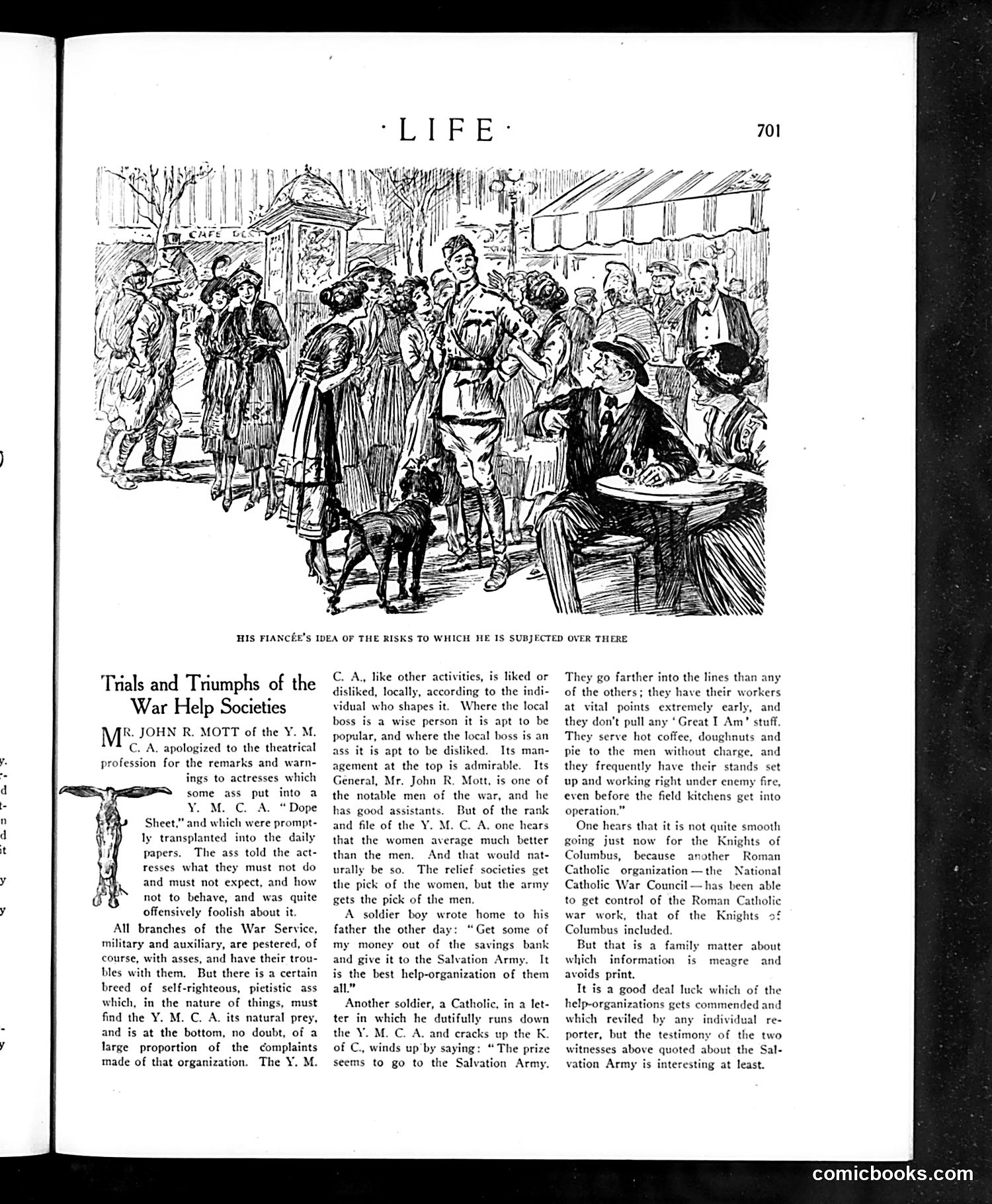
This page satirizes wartime relief organizations, particularly tensions between different charitable groups. The illustration depicts a crowded street scene where a man sits at a table while crowds of people (appearing to be seeking aid) gather around him. The text discusses competition between war relief societies—specifically the Y.M.C.A. and Salvation Army—for funds and volunteers. Mr. John R. Mott of the Y.M.C.A. is referenced defending his organization against criticism. The satire mocks how these groups compete for resources and public support during wartime, with soldiers' letters quoted showing preference for the Salvation Army's practical aid over the Y.M.C.A.'s offerings. The cartoon humorously illustrates this organizational rivalry and the public confusion about which charity deserves donations.
📄 Transcribed text from this page (OCR, searchable)
Machine-transcribed from the original scan — historical spelling and the odd misread are preserved.
“LIFE: iB £’S IDEA OF THE RISKS TO WHICH HE IS SUBJECTED OVER THERE Trials and Triumphs of the War Help Societies ME: JOHN R. MOTT of the Y. M. C. A, apologized to the theatrical profession for the remarks and warn- ings to actresses which some ass put into a Y. M. C. A. “Dope Sheet,” and which were prompt- ly transplanted into the daily papers. The ass told the act- resses what they must not do and must not expect, and how not to behave, and was quite offensively foolish about it. All branches of the War Service, military and auxiliary, are pestered, of course, with asses, and have their trou- bles with them, But there is a certain breed of self-righteous, pietistic ass which, in the nature of things, must find the Y. M. C. A. its natural prey, and is at the bottom, no doubt, of a large proportion of the complaints made of that organization. The Y. M. C. A,, like other activities, is liked or disliked, locally, according to the indi- vidual who shapes it. Where the local boss is a wise person it is apt to be popular, and where the local boss is an ass it is apt to be disliked. Its man- agement at the top is admirable. Its General, Mr. John R. Mott, is one of the notable men of the war, and he has good assistants. But of the rank and file of the Y. M. C. A. one hears that the women average much better than the men. And that would nat- urally be so. The relief societies get the pick of the women, but the army gets the pick of the men. A soldier boy wrote home to his father the other day: “Get some of my money out of the savings bank and give it to the Salvation Army. It is the best help-organization of them all.” Another soldier, a Catholic, in a let- ter in which he dutifully runs down the Y. M. C. A. and cracks up the K. of C., winds up’by saying: “The prize seems to go to the Salvation Army. They go farther into the lines than any of the others; they have their workers at vital points extremely early, and they don’t pull any ‘Great I Am’ stuff. They serve hot coffee, doughnuts and pie to the men without charge, and they frequently have their stands set up and working right under enemy fire, even before the field kitchens get into operation.” One hears that it is not quite smooth going just now for the Knights of Columbus, because another Roman Catholic organization —the National Catholic War Council —has been able to get control of the Roman Catholic war work, that of the Knights of Columbus included. But that is a family matter about which information is meagre and avoids print. It is a good deal luck which of the help-organizations gets commended and which reviled by any individual re- porter, but the testimony of the two witnesses above quoted about the Sal- vation Army is interesting at least. comicbooks.com