
Life, 1918-11-14 · page 10 of 34
Life — November 14, 1918 — page 10: what you’re looking at
What you’re looking at
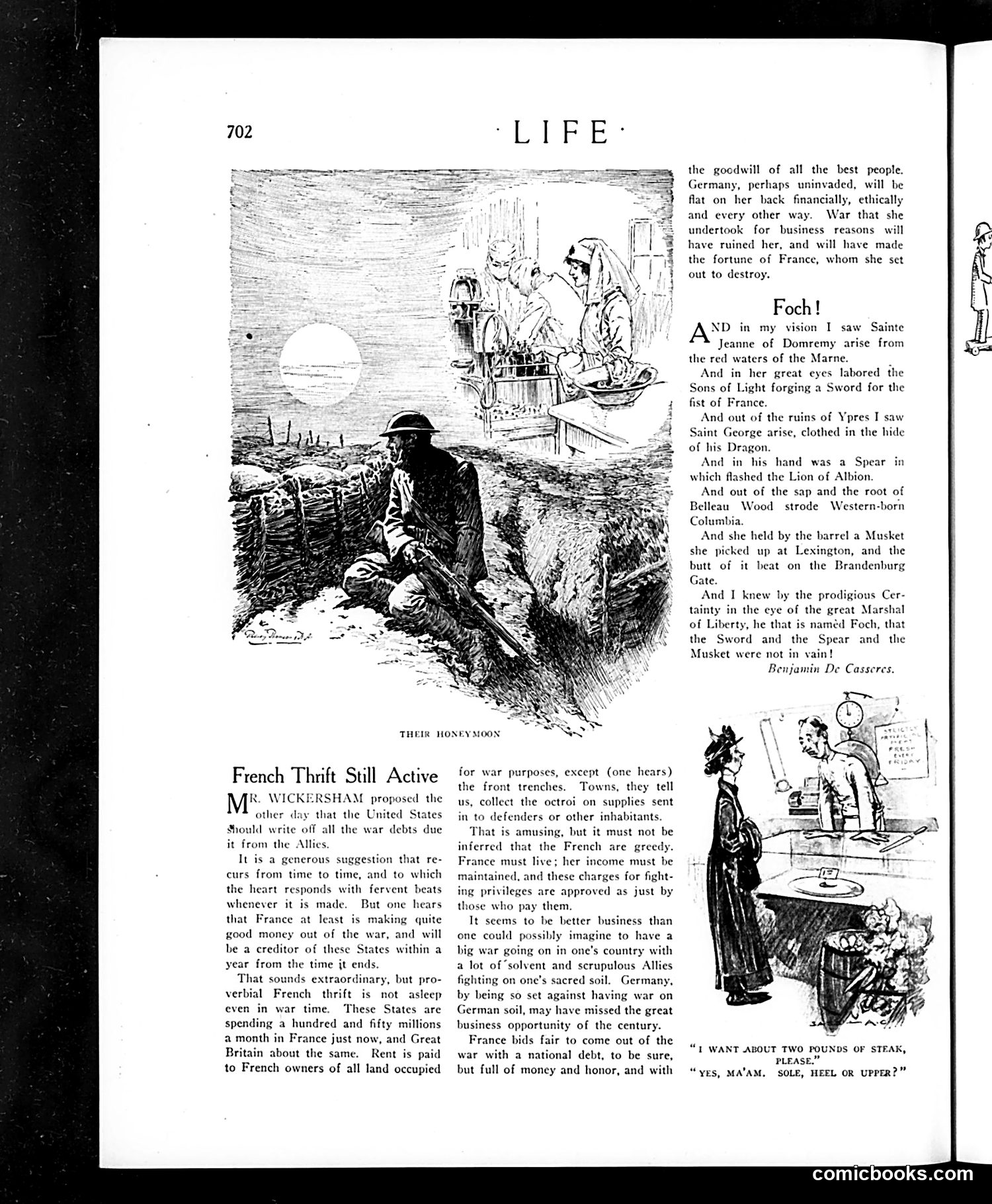
This page contains two distinct pieces of satirical commentary on post-WWI France: **Top Section ("Their Honeymoon"):** The illustration shows a soldier in a trench gazing at a romantic vision of figures in the distance. The accompanying text by Benjamin De Casseres is poetic commentary celebrating French military heroism, referencing Saint Joan of Arc, French weapons and victories. **Bottom Section ("French Thrift Still Active"):** This satirizes France's financial dealings with Allied nations. Mr. Wickersham proposes the U.S. write off all war debts owed by the Allies. The satire criticizes France's determination to collect war reparations and maintain profitable financial arrangements while remaining financially dependent on Allied creditors—portraying French business interests as opportunistic amid wartime suffering. The right illustration humorously depicts a restaurant patron ordering expensive cuts of meat, satirizing French materialism and continued luxury consumption despite war's devastation.
📄 Transcribed text from this page (OCR, searchable)
Machine-transcribed from the original scan — historical spelling and the odd misread are preserved.
702 THEIR HONEYMOON French Thrift Still Active R. WICKERSHAM proposed the other day that the United States Should write off all the war debts due it from the Allies. It is a generous suggestion that re- curs from time to time, and to which the heart responds with fervent beats whenever it is made. But one hea that France at least is making quite good money out of the war, and will be a creditor of these States within a year from the time jt ends. That sounds extraordinary, but pro- verbial French thrift is not asleep even in war time. These States are spending a hundred and fifty millions a month in France just now, and Great Britain about the same. Rent is paid to French owners of all land occupied for war purposes, except (one hears) the front trenches. Towns, they tell us, collect the octroi on supplies sent in to defenders or other inhabitants. That is amusing, but it must not be inferred that the French are greedy. France must live; her income must be maintained, and these charges for fight- ing privileges are approved as just by those who pay them. It seems to be better business than one could possibly imagine to have a big war going on in one's country with a lot of*solvent and scrupulous Allies fighting on one’s sacred soil. Germany, by being so set against having war on German soil, may have missed the great business opportunity of the century. France bids fair to come out of the war with a national debt, to be sure, but full of money and honor, and with the goodwill of all the best people. Germany, perhaps uninvaded, will be flat on her back financially, ethically and every other way. War that she undertook for business reasons will have ruined her, and will have made the fortune of France, whom she set out to destroy. Foch! ND in my Sainte Jeanne of Domremy arise from the red waters of the Marne. . And in her great eyes labored the Sons of Light forging a Sword for the fist of France. And out of the ruins of Ypres T saw Saint George arise, clothed in the hide vision I saw And in his hand was a Spear in which flashed the Lion of Albion. And out of the sap and the root of Belleau Wood strode Western-born Columbia. And she held by the barrel a Musket she picked up at Lexington, and the butt of it beat on the Brandenburg Gate. And I knew by the prodigious Cer- tainty in the eye of the great Marshal of Liberty, he that is naméd Foch, that the Sword and the Spear and the Musket were not in vain! Benjamin De Casseres. “YES, MA'AM, SOLE, HEEL OR UPPER?” comicbooks.com