
Life, 1918-11-14 · page 17 of 34
Life — November 14, 1918 — page 17: what you’re looking at
What you’re looking at
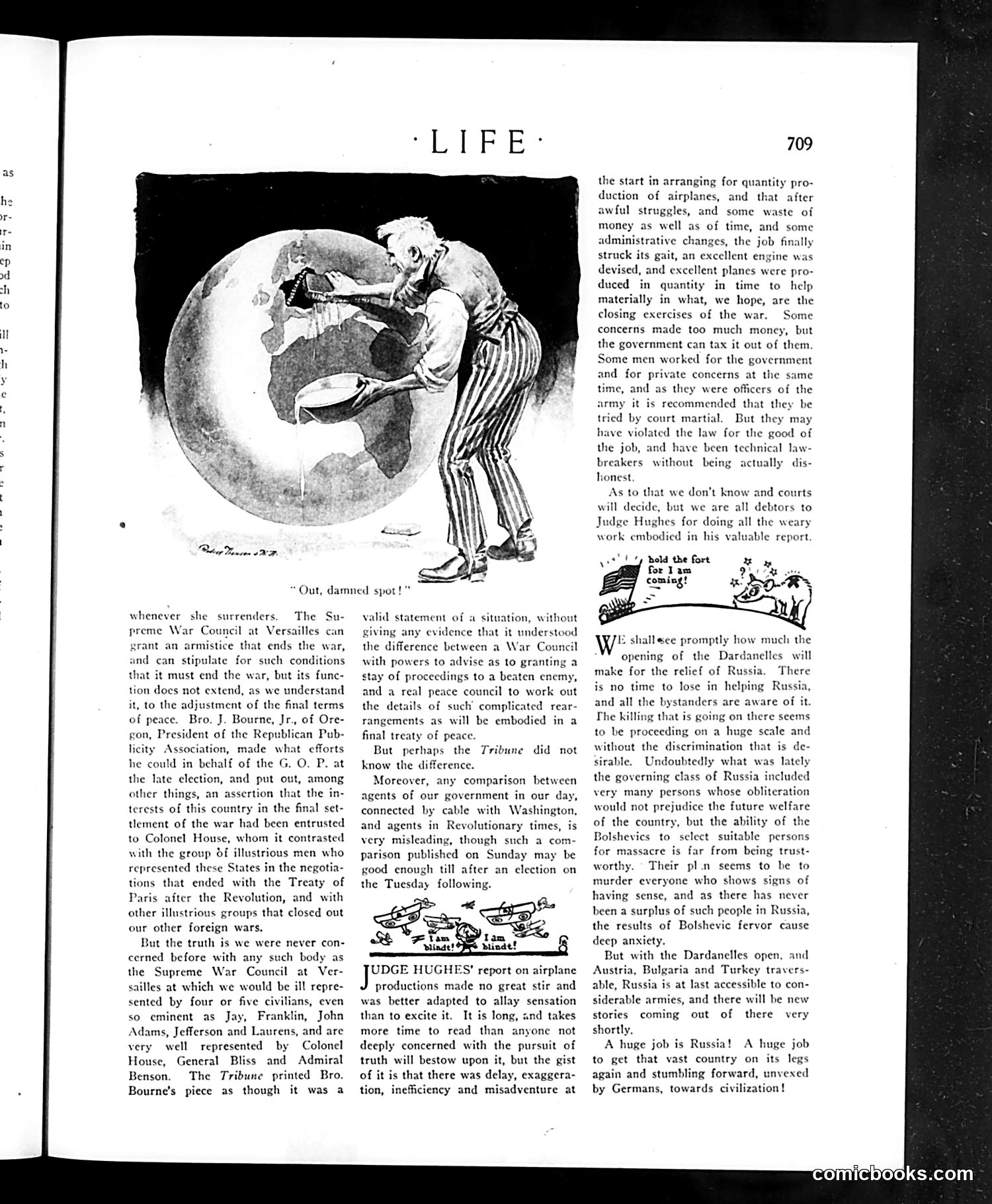
The main cartoon shows a figure in Uncle Sam-style patriotic clothing scrubbing a globe with a brush, captioned "Out, damned spot!"—a Shakespeare reference suggesting the need to clean up world disorder, likely post-WWI. The page's text discusses three topics: 1. **The Supreme War Council at Versailles**: Life defends Colonel House and American representatives against Republican criticism that they're insufficiently distinguished compared to Revolutionary-era diplomats. 2. **Judge Hughes' airplane production report**: Acknowledging wartime inefficiencies and profiteering, but crediting eventual success in plane manufacturing for the war effort. 3. **Opening the Dardanelles for Russian relief**: Advocating rapid aid to Russia through this strategic waterway, noting the humanitarian crisis there. The overall thrust is defending Wilson-era war management decisions against political opponents while acknowledging real problems were eventually solved. The "damned spot" cartoon represents cleaning up war's legacy and chaos.
📄 Transcribed text from this page (OCR, searchable)
Machine-transcribed from the original scan — historical spelling and the odd misread are preserved.
* Out, damned spot!” whenever she surrenders, The Su- preme War Council at Versailles can grant an armistice that ends the war, nd can stipulate for such conditions that it must end the war, but its func- tion does not extend, as we understand it, to the adjustment of the final terms of peace. Bro. J. Bourne, Jr., of Ore- gon, President of the Republican Pub- licity Association, made what efforts he could in behalf of the G. O. P. at the late election, and put out, among other things, an assertion that the in- terests of this country in the final set- tlement of the war had been entrusted to Colonel House, whom it contrasted with the group df illustrious men who represented these States in the negotia- tions that ended with the Treaty of Paris after the Revolution, and with other illustrious groups that closed out our other foreign wars, But the truth is we were never con- cerned before with any such body as the Supreme War Council at Ver- sailles at which we would be ill repre- sented by four or five civilians, even so eminent as Jay, Franklin, John Adams, Jefferson and Laurens, and are very well represented by Colonel House, General Bliss and Admiral Benson. The Tribune printed Bro. Bourne’s piece as though it was a valid statement of a situation, without giving any evidence that it understood the difference betwee: War Council with powers to advise as to granting a stay of proceedings to a beaten enemy, and a real peace council to work out the details of such’ complicated rear- angements as will be embodied in a final treaty of peace. But perhaps the Tribune know the difference. Moreover, any comparison between agents of our government in our day, connected by cable with Washington, and agents in Revolutionary times, is very misleading, though such a com- parison published on Sunday may be good enough till after an election on the Tuesday following. did not UDGE HUGHES’ report on airplane productions made no great stir and was better adapted to allay sensation than to excite it. It is long, and takes more time to read than anyone not deeply concerned with the pursuit of truth will bestow upon it, but the gist of it is that there was delay, exaggera- tion, inefficiency and misadventure at 709 the start in arranging for quantity pro- duction of airplanes, and that after awful struggles, and some waste of money as well as of time, and some administrative changes, the job finally struck its gait, an excellent en devised, and excellent planes were pro- duced in quantity in time to help materially in what, we hope, are the closing exercises of the war. Some concerns made too much moncy, but the government can tax it out of them. Some men worked for the government and for private concerns at the same time, and as they were officers of the army it is recommended that they be ed by court martial. But they may have violated the law for the good of the job, and have been technical law- breakers without being actually dis- honest As to that we don’t know and courts will decide, but we are all debtors to Judge Hughes for doing all the weary work embodied in his valuable report hold the fort for I am coming! shallsee promptly how much the opening of the Dardanelles will make for the relief of Russia. There is no time to lose in helping Russia, and all the bystanders are aware of it. The killing that is going on there seems to be proceeding on a huge scale and without the discrimination that is de- sirable. Undoubtedly what was lately the governing class of Russia included very many persons whose obliteration would not prejudice the future welfare of the country, but the ability of the Bolshevics to select suitable person for massacre is far from being trust- worthy. Their pl.n seems to be to murder everyone who shows signs of having sense, and as there has never been a surplus of such people in Russia, the results of Bolshevic fervor cause deep anxiety, But with the Dardanelles open, and Austria, Bulgaria and Turkey travers- able, Russia is at last accessible to con- siderable armies, and there will be new stories coming out of there very shortly. A huge job is Russia! A huge job to get that vast country on its legs again and stumbling forward, unvexed by Germans, towards civilization!