
A complete issue · 36 pages · 1918
Life — May 30, 1918
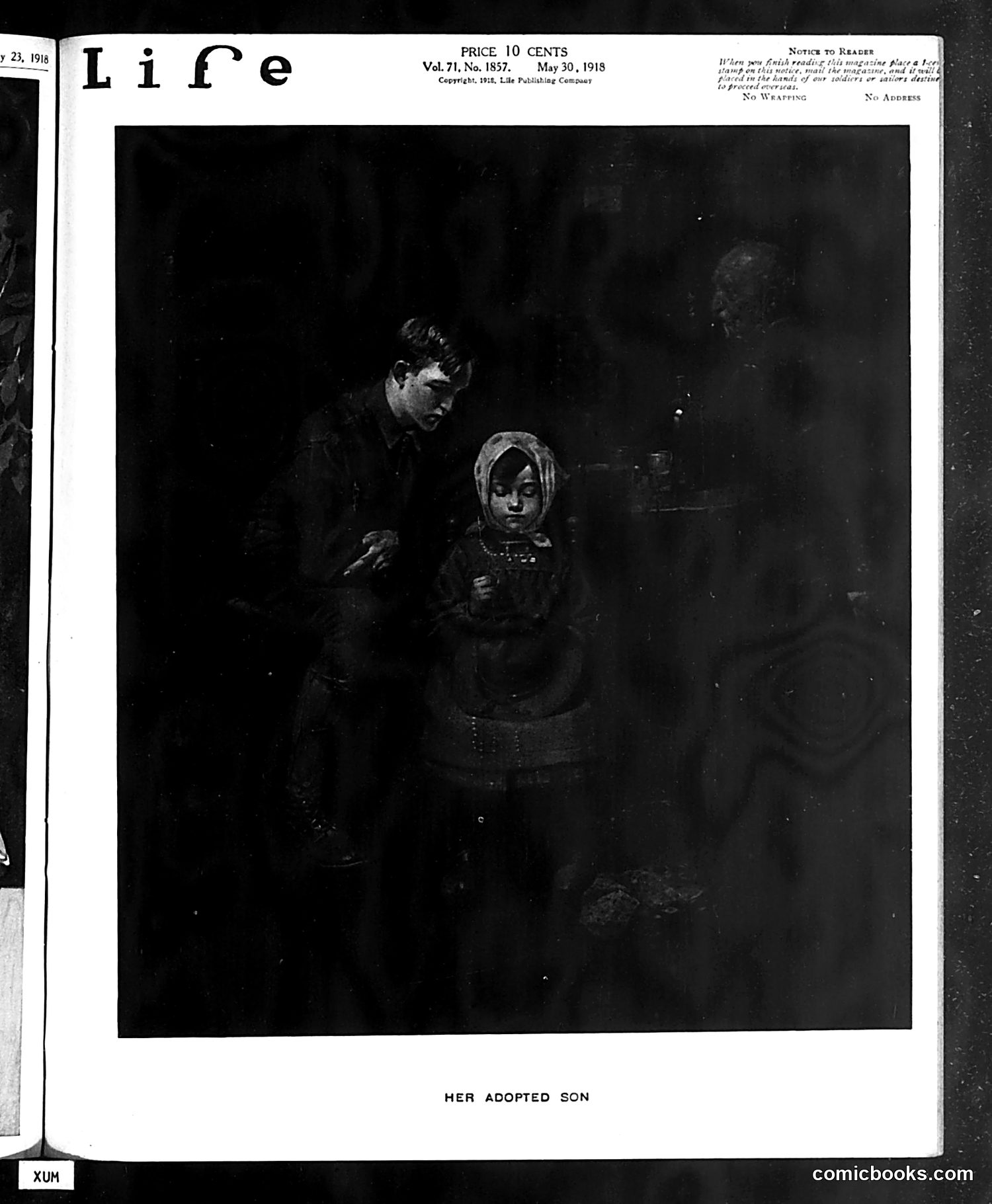
This is a dramatic black-and-white photograph, not a cartoon. The caption reads "HER ADOPTED SON," suggesting a narrative about adoption. The image shows two figures in dark clothing against a shadowy background—an adult and a child wearing a head covering. Without additional context from the article this image accompanies, I cannot definitively identify who these figures represent or what specific adoption story Life magazine was covering. Given Life's satirical nature and the May 30, 1918 date (during World War I), this could reference a contemporary adoption story of public interest, but I cannot assert specific identities or social commentary without risking inaccuracy. The dramatic lighting and composition suggest an emotional or morally significant narrative.
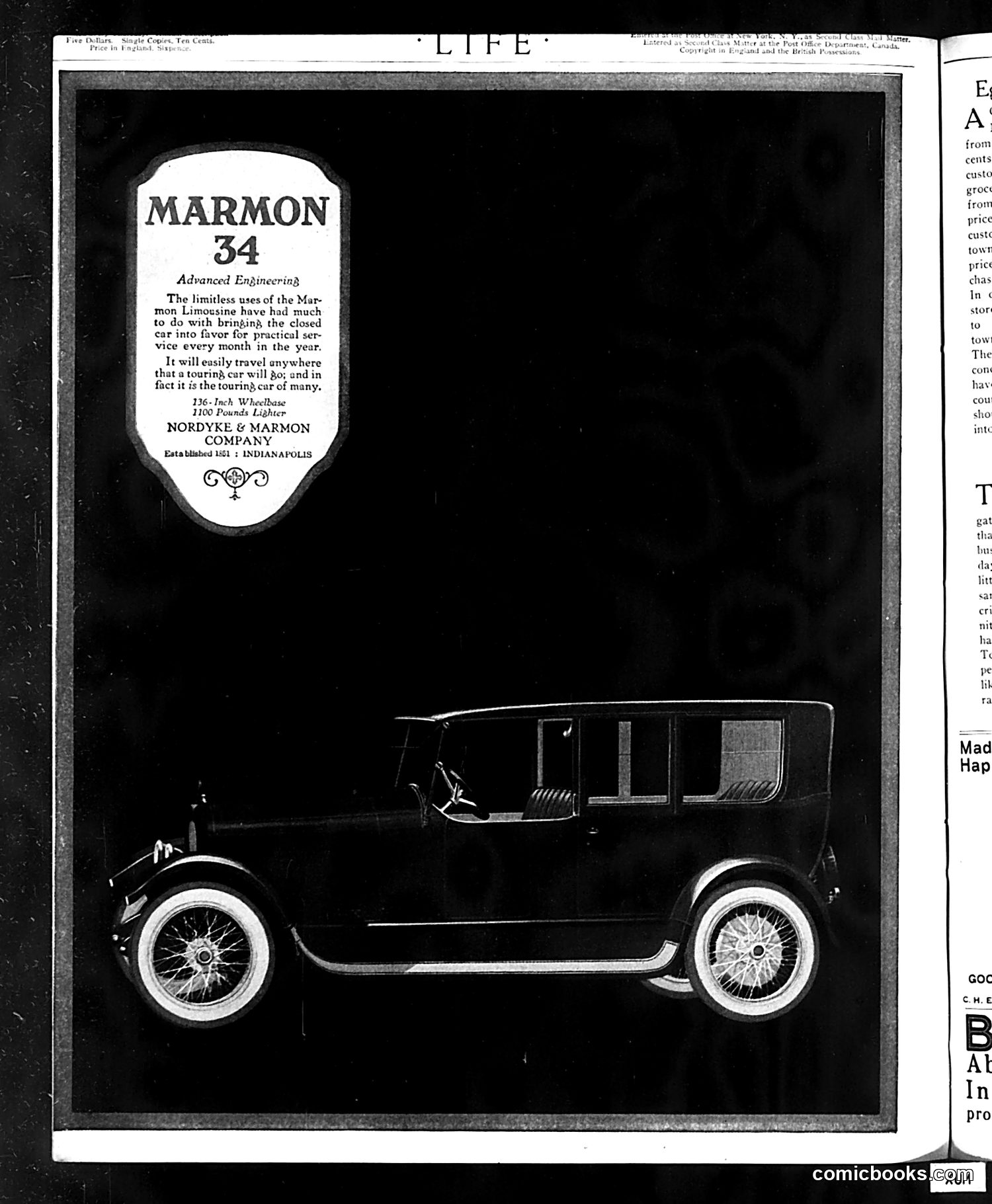
This is an advertisement, not a satirical cartoon. It promotes the **Marmon 34**, a luxury automobile manufactured by Nordyke & Marmon Company (established 1851 in Indianapolis). The ad emphasizes the car's engineering sophistication and practical benefits: it claims the "Marmon Limousine have had much to do with bringing the closed car custom into general use" and notes the model is suitable for year-round touring. Key specifications listed: 136-inch wheelbase, 1100 pounds lighter than competitors. The image shows a side-profile illustration of an elegant enclosed sedan with spoke wheels, typical of 1920s luxury automobile design. This is straightforward product marketing rather than satirical content—Life magazine regularly featured such advertisements alongside its humorous editorial material.
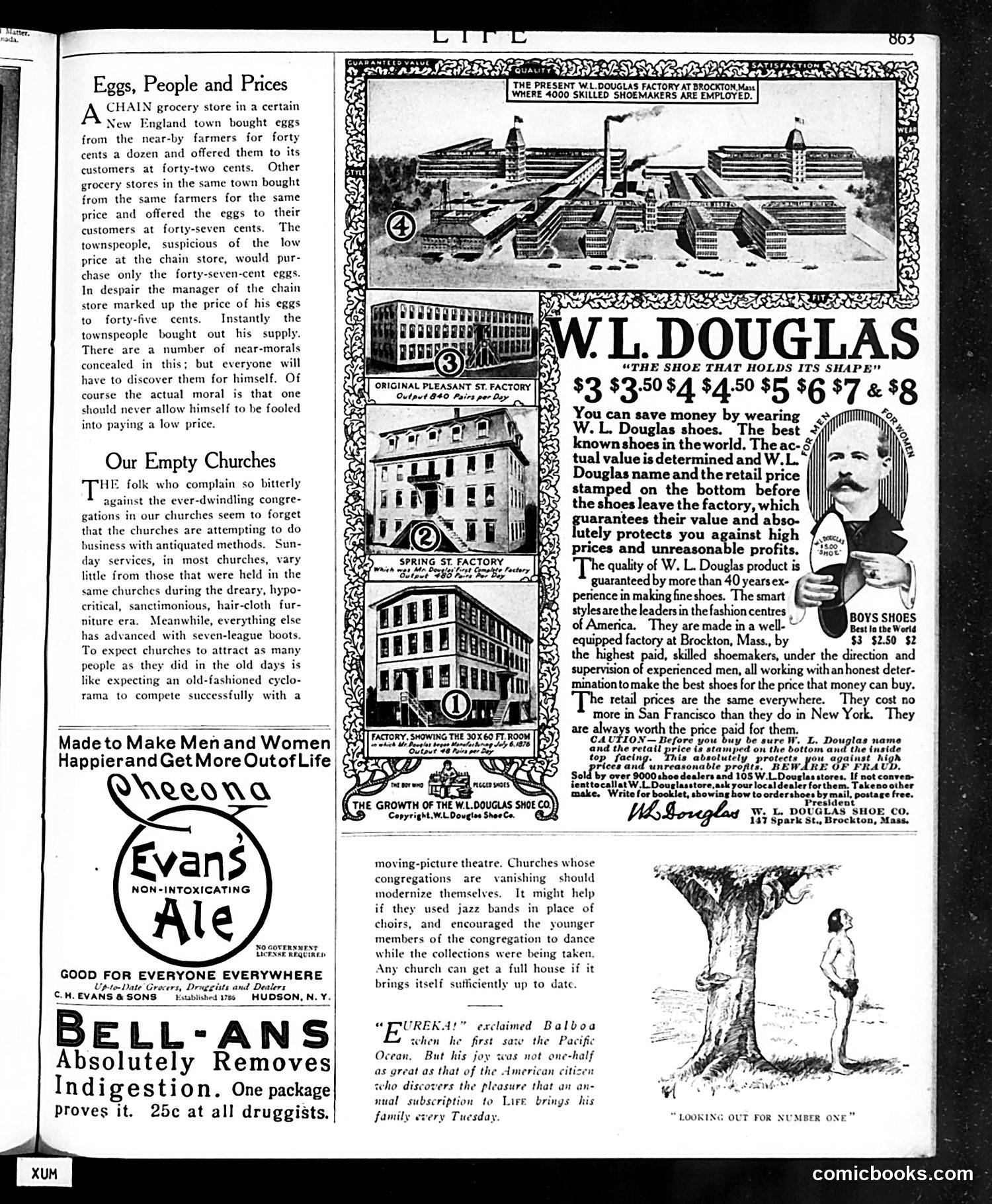
This page is **primarily advertising** with minimal editorial content. The dominant advertisement is for **W.L. Douglas shoes**, featuring a portrait of the shoe company's founder and emphasizing price points ($3–$8) and quality guarantees. The ad includes factory floor plans numbered 1–4, depicting the Brockton, Massachusetts manufacturing facility—a selling point meant to assure customers of American workmanship and value. The small editorial pieces ("Eggs, People and Prices" and "Our Empty Churches") offer social commentary on consumer behavior and church attendance, but lack specific political satire. Additional advertisements promote **Pheona Evans Ale** and **Bell-Ans antacid**. The page reflects early 20th-century consumer culture: trust in domestic manufacturing, competitive pricing concerns, and health-product marketing.
This is primarily an **editorial statement, not a cartoon**. The page is a subscription advertisement for *Life* magazine, with an ornamental header featuring cherubs. The text "Don't Skip Me" is *Life's* pitch to potential subscribers, emphasizing that the magazine shouldn't be judged by isolated pictures or articles. The editors argue they don't restrict contributors to any "settled policy" beyond "justice and Americanism," valuing contributors' independent viewpoints over conformity to narrow editorial lines. This reflects *Life's* positioning as a magazine featuring diverse perspectives and densely packed content requiring careful, complete reading rather than skimming. The subscription rates ($5.00 domestic, varying rates for Canadian and foreign) and address (17 West 31st Street, New York) date this advertisement, though the exact year is unclear from this image alone.
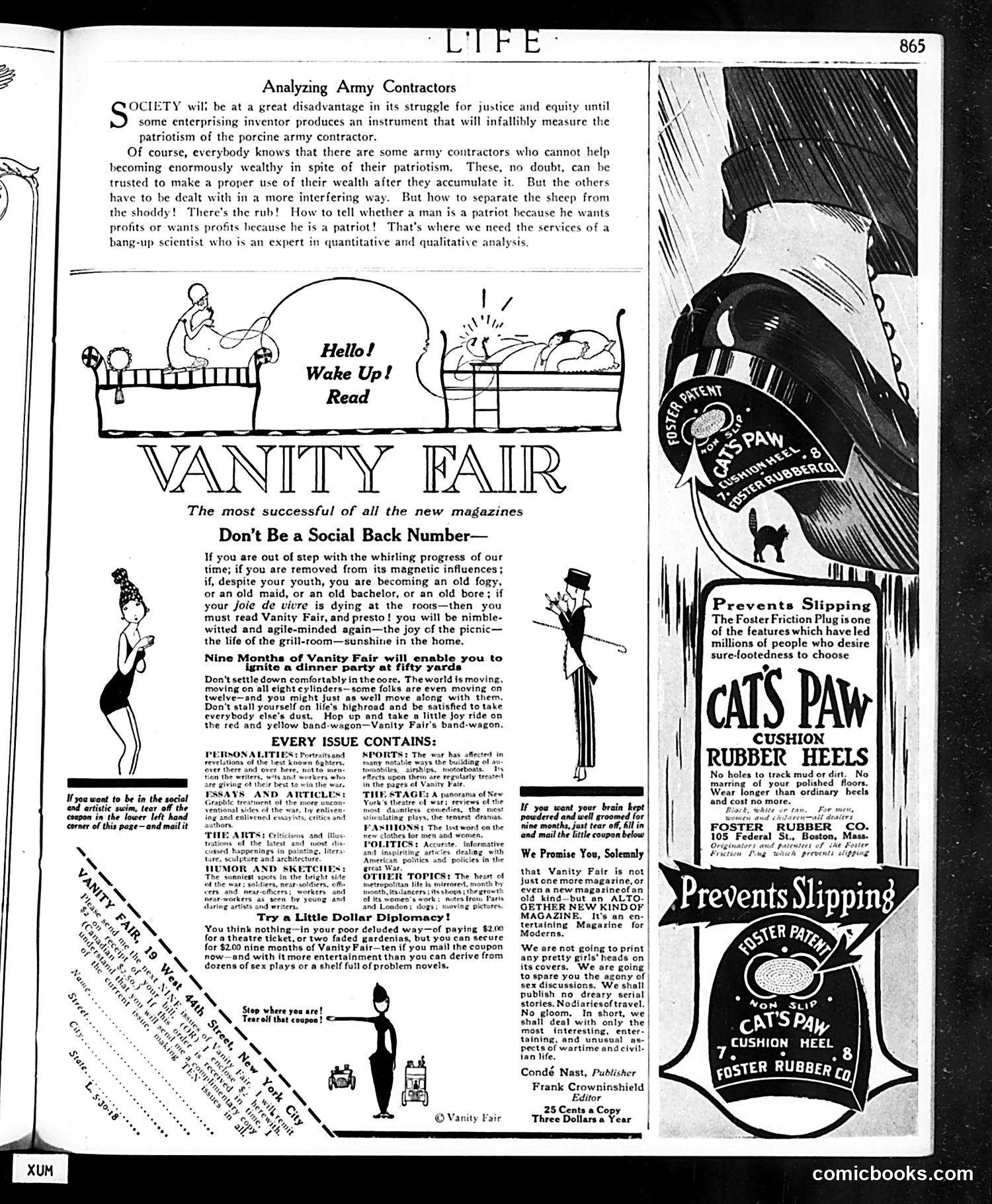
This page is primarily **advertising and magazine promotion** rather than political satire. The top editorial section "Analyzing Amy Contractors" discusses wartime profiteering—how to distinguish patriotic military contractors from those exploiting the war for excessive profits. It calls for "quantitative and qualitative analysis" to separate legitimate from illegitimate wealth accumulation. The central feature is a **Vanity Fair magazine advertisement** promoting itself as "the most successful of all the new magazines," targeting affluent readers who want cultural sophistication and entertainment. The right side contains **product advertisements**, notably the "Cat's Paw Cushion Rubber Heels" by Foster Rubber Company, emphasizing comfort and durability. Overall, this reflects **1910s-1920s consumer culture** and wartime economic concerns, with minimal actual political cartooning present.
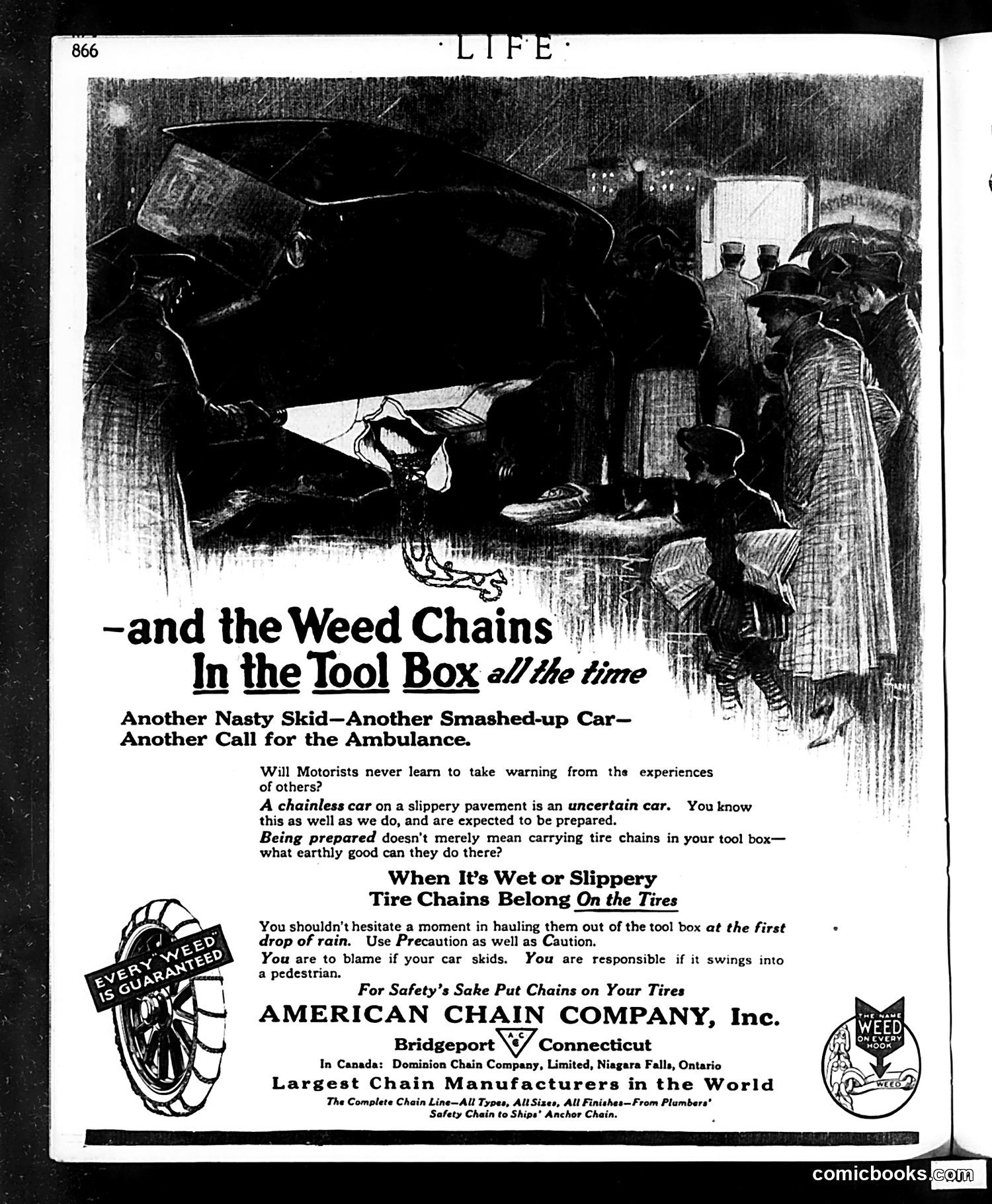
This is primarily a **safety advertisement** rather than political satire. The American Chain Company uses a dramatic accident scene to promote tire chains for wet weather driving. The illustration depicts an **automobile accident**: a car has skidded on wet pavement, hitting a pedestrian. The dark, shadowy rendering emphasizes the tragedy. Bystanders and what appears to be an ambulance are present. The advertisement's message is straightforward: motorists who fail to install tire chains on slippery roads bear responsibility for accidents and injuries. The text warns that "being prepared" means putting chains on tires "at the first drop of rain." This reflects **early 20th-century automobile safety concerns**, when tire chains were essential winter equipment and traffic deaths were rising. The ad uses guilt and social responsibility as persuasion tactics.
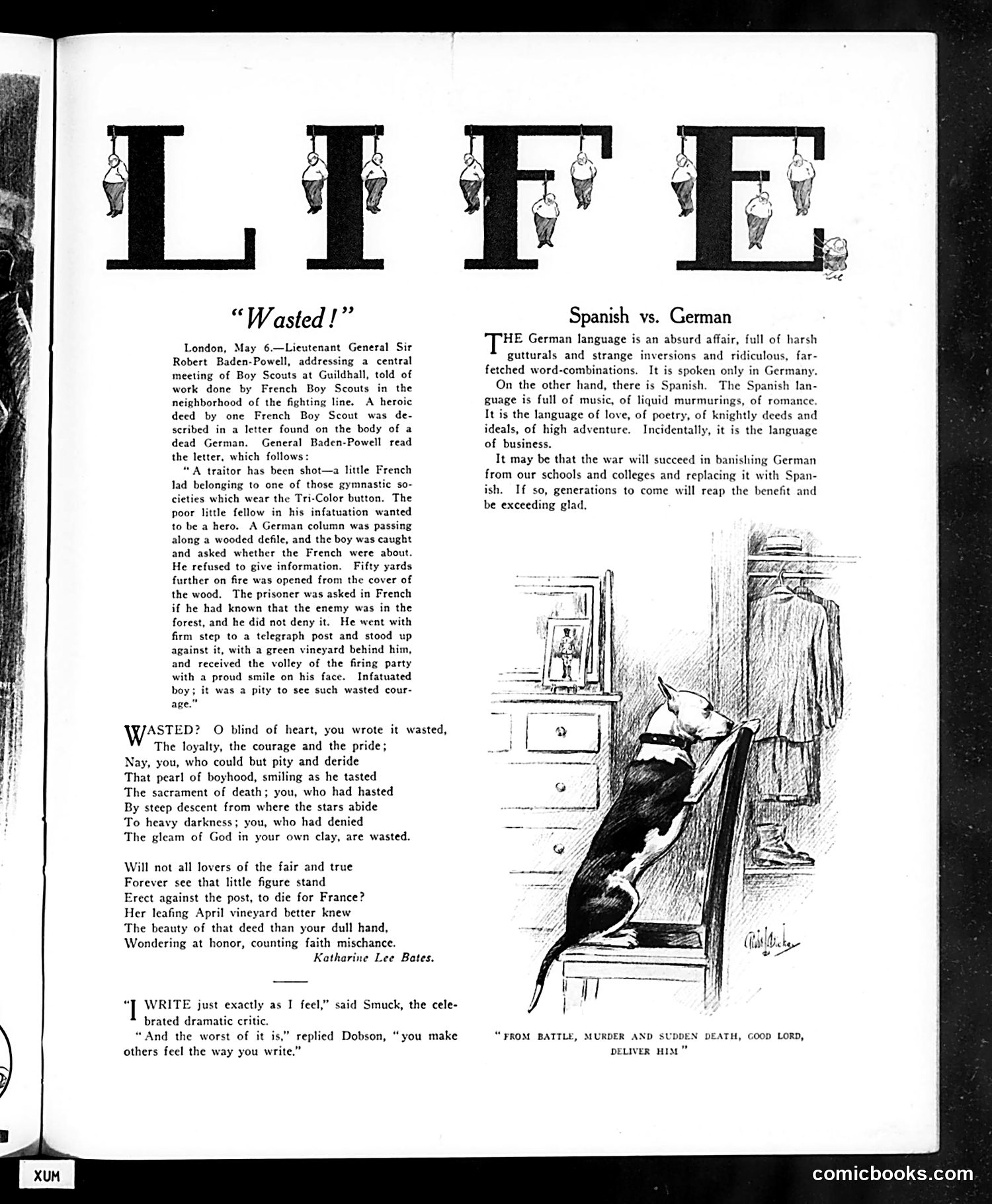
This WWI-era page contains two distinct satirical pieces: **"LIFE" Acrostic (Top):** The letters spell "LIFE" using hanging figures—dark wartime satire about casualties and waste. **"Wasted!" (Left):** A poem mocking a German soldier's failure to capture a French boy scout. The narrative describes the prisoner's refusal to provide information despite torture. The poem condemns this "wasted" opportunity, sarcastically praising the boy's courage and loyalty. It's propaganda celebrating Allied youth bravery against German brutality. **"Spanish vs. German" (Right):** An essay arguing Spanish should replace German in schools, claiming German is harsh while Spanish is musical and romantic. This reflects WWI-era anti-German sentiment and cultural nationalism—using language politics as wartime propaganda to delegitimize German culture in America. The illustration shows a slumped, defeated figure—likely representing German military defeat or moral failure.
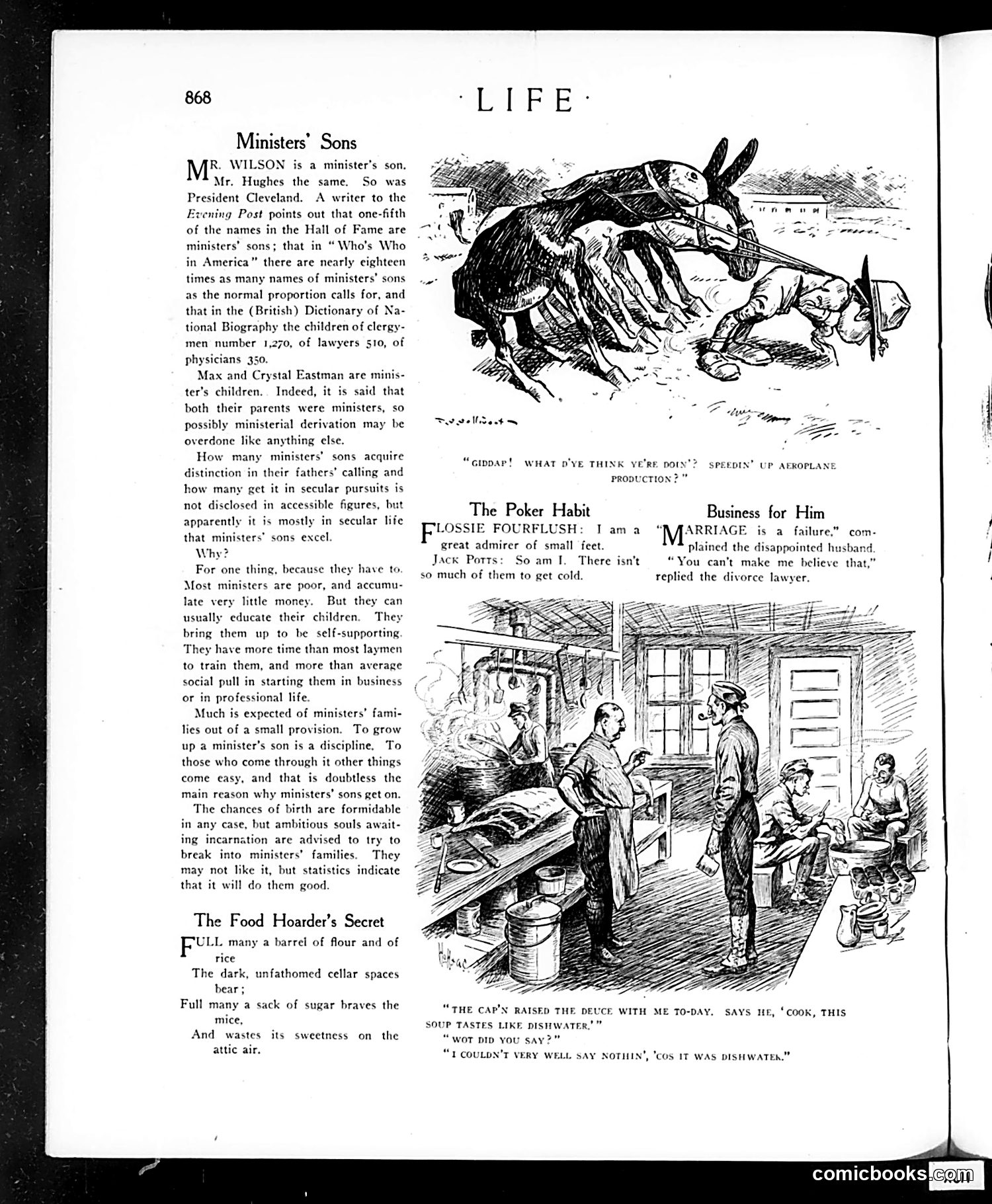
This page contains three satirical pieces about social expectations and everyday life: 1. **"Ministers' Sons"** (top): The article notes that ministers' sons appear disproportionately in the Hall of Fame, discussing how ministerial families, though often poor, emphasize education and self-improvement. The accompanying airplane cartoon appears to satirize speed or ambition. 2. **"The Poker Habit"** (middle): A brief joke exchange between Flossie Fullblush and Jack Potts about small feet—likely a flirtatious double entendre typical of the era's humor. 3. **"Business for Him"** (bottom): A domestic scene where a husband complains that "marriage is a failure," while the wife (appearing exasperated) and a cook discuss soup quality. The satire targets disappointed husbands and marital discord among the working/middle classes.
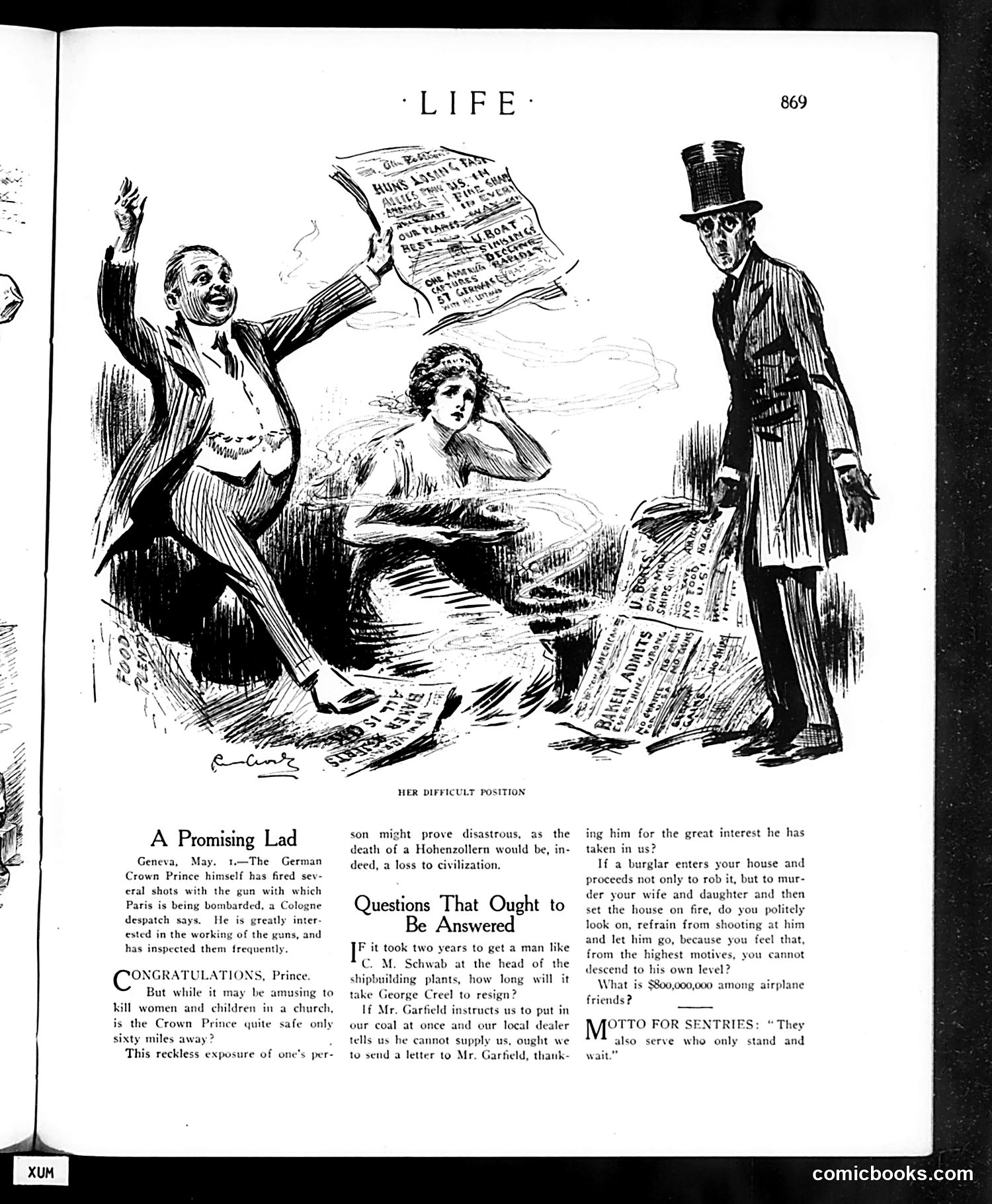
This cartoon satirizes a woman caught between competing male interests during wartime. The illustration shows a woman at a table surrounded by three men: one jubilant on the left holding newspapers, one stern in a top hat on the right, and newspapers scattered about labeled with war-related headlines. The accompanying text discusses WWI scenarios—the German Crown Prince's military movements, bombardment of Paris, and Cologne's dispatch operations. The "difficult position" appears to reference how women navigated pressure from various sides during the war: demands for patriotism, economic hardship, and potentially conflicting loyalties. The humor derives from the woman's apparent discomfort being literally "surrounded" by war news and male authority figures—a commentary on women's constrained agency during wartime.
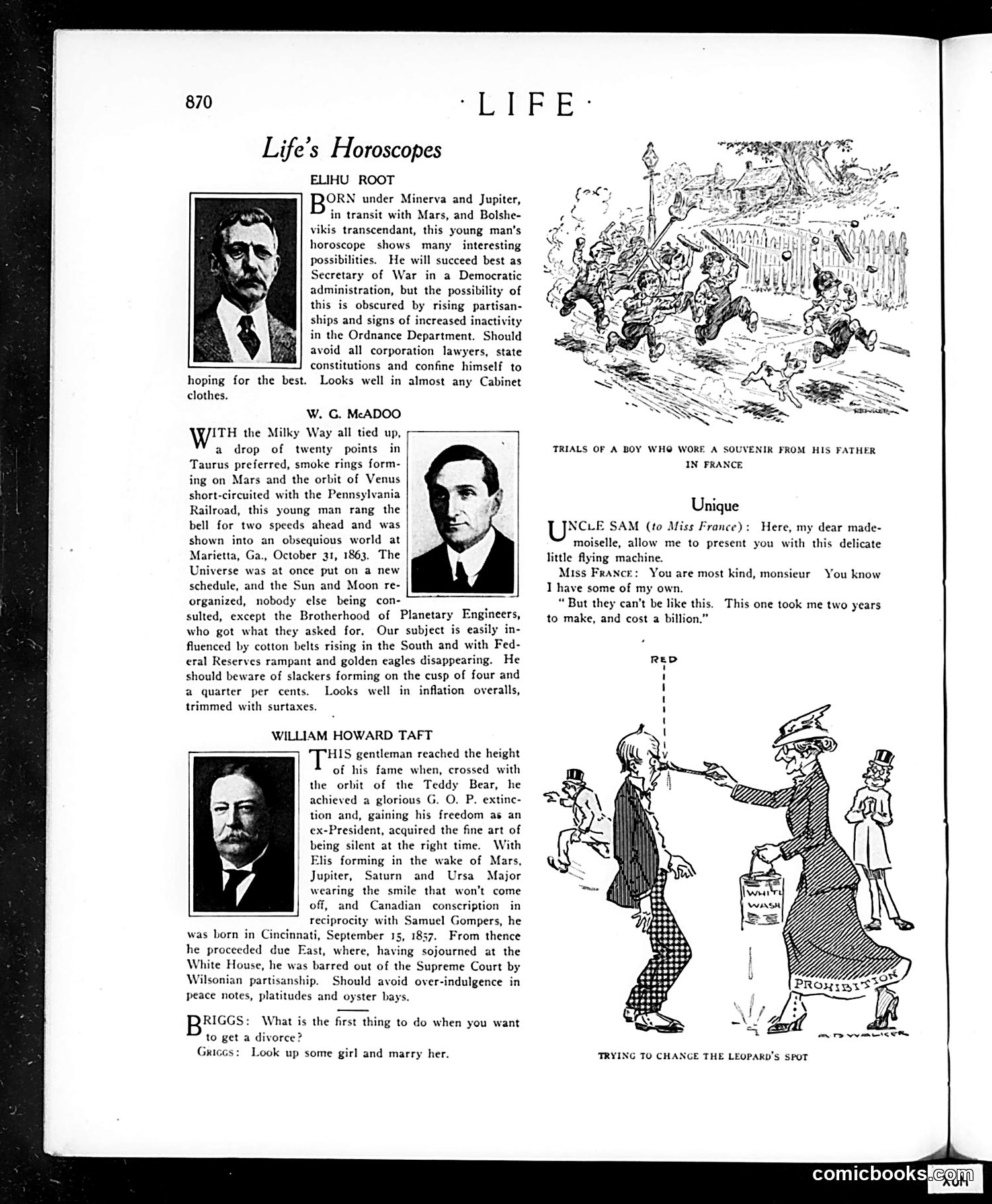
This page features satirical "horoscopes" for three political figures: Elihu Root, W.C. McAdoo, and William Howard Taft. Each entry mocks their political prospects using astrological language. The right side contains a cartoon titled "Trying to Change the Leopard's Spot," depicting Uncle Sam attempting to give a souvenir flying machine to Miss France, with references to Prohibition ("no alcohol" jar visible). This appears to satirize American diplomatic efforts or cultural export during the Prohibition era. The bottom includes a joke about divorce, unrelated to the political horoscopes above. The satire targets these prominent political figures' ambitions and public images through faux-astrological predictions—a common Life magazine technique for political commentary.
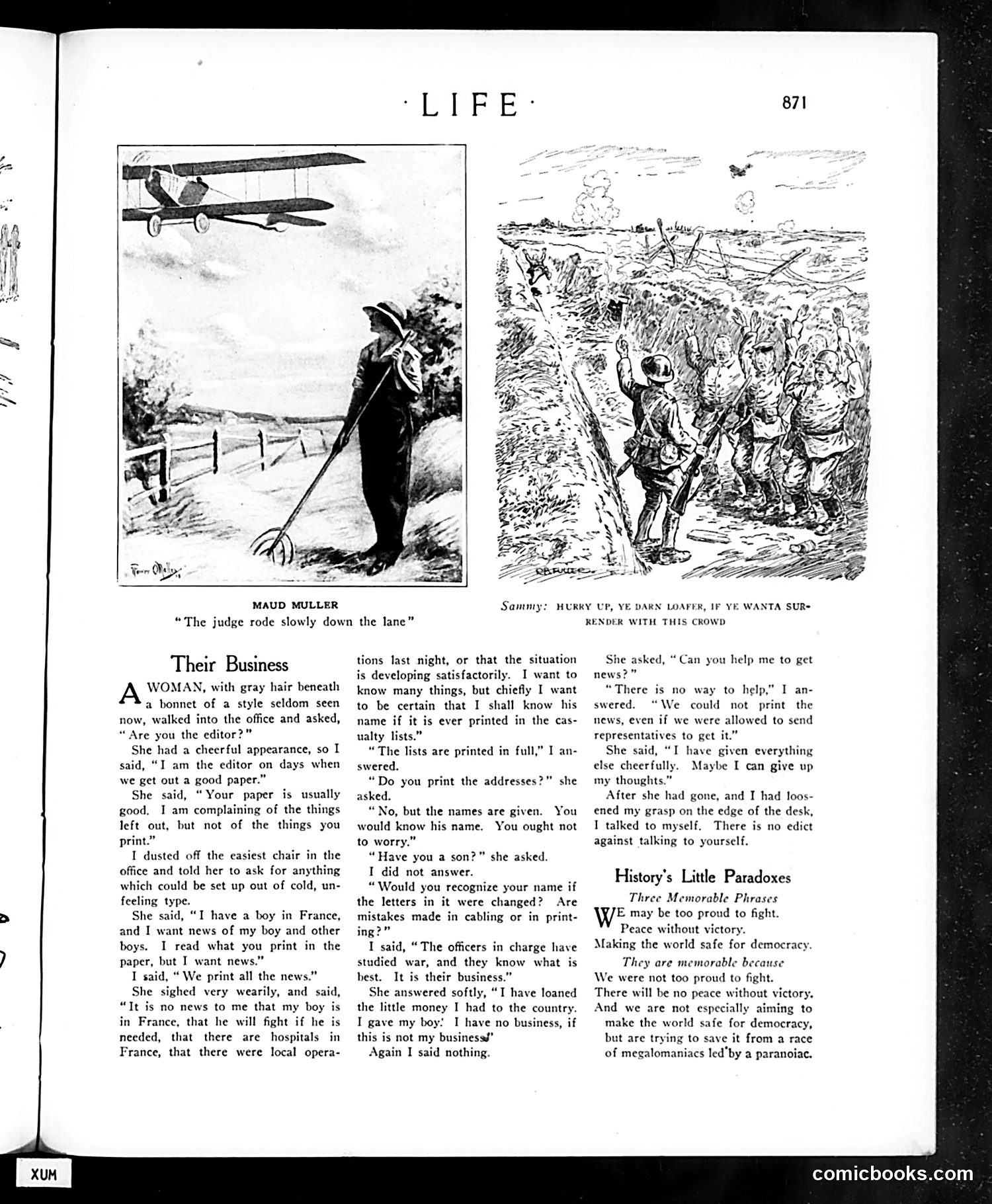
This page contains two cartoons and a short story titled "Their Business." **Left cartoon** by Maud Muller shows a man with a rake watching an airplane overhead, captioned "The judge rode slowly down the lane"—likely a playful reference to the famous poem "Maud Muller." **Right cartoon** depicts soldiers or workers addressing a crowd, with caption about "hurrying up, ye darn loafer, if ye wanna surrender with this crowd"—appearing to satirize World War I military recruitment or conscription pressure. **The story "Their Business"** concerns a newspaper editor's tense conversation with a woman seeking news about her son fighting in France. The editor refuses to print addresses or identifying details, citing military security, while the woman struggles with worry. This reflects WWI-era censorship and the emotional toll on families separated by war.
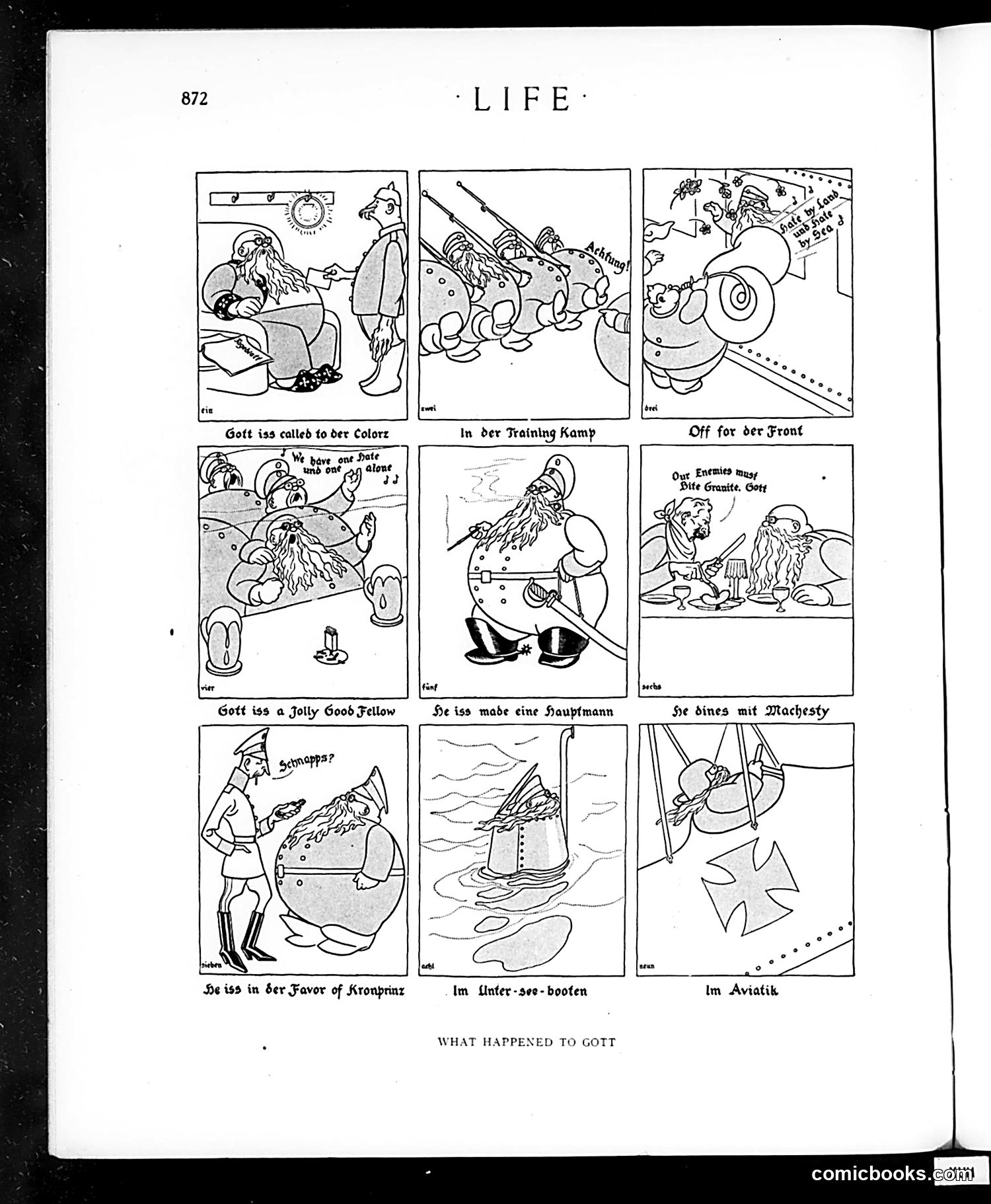
This is a nine-panel satirical comic strip depicting the misfortunes of a character named "Gott" (German for "God"). The narrative follows Gott through various humiliations: being called to the barracks, military training, heading to the front lines, socializing as a "jolly good fellow," becoming a captain, suffering in the submarine service, and finally participating in aerial combat. The captions use German phrases, indicating this satirizes German military culture and authority during what appears to be the World War I era. The crude depictions mock military hierarchy and discipline. The overall message mocks the German military establishment by literally subjecting "God" to its indignities—a pointed critique of German militarism and the degradation imposed by military service.
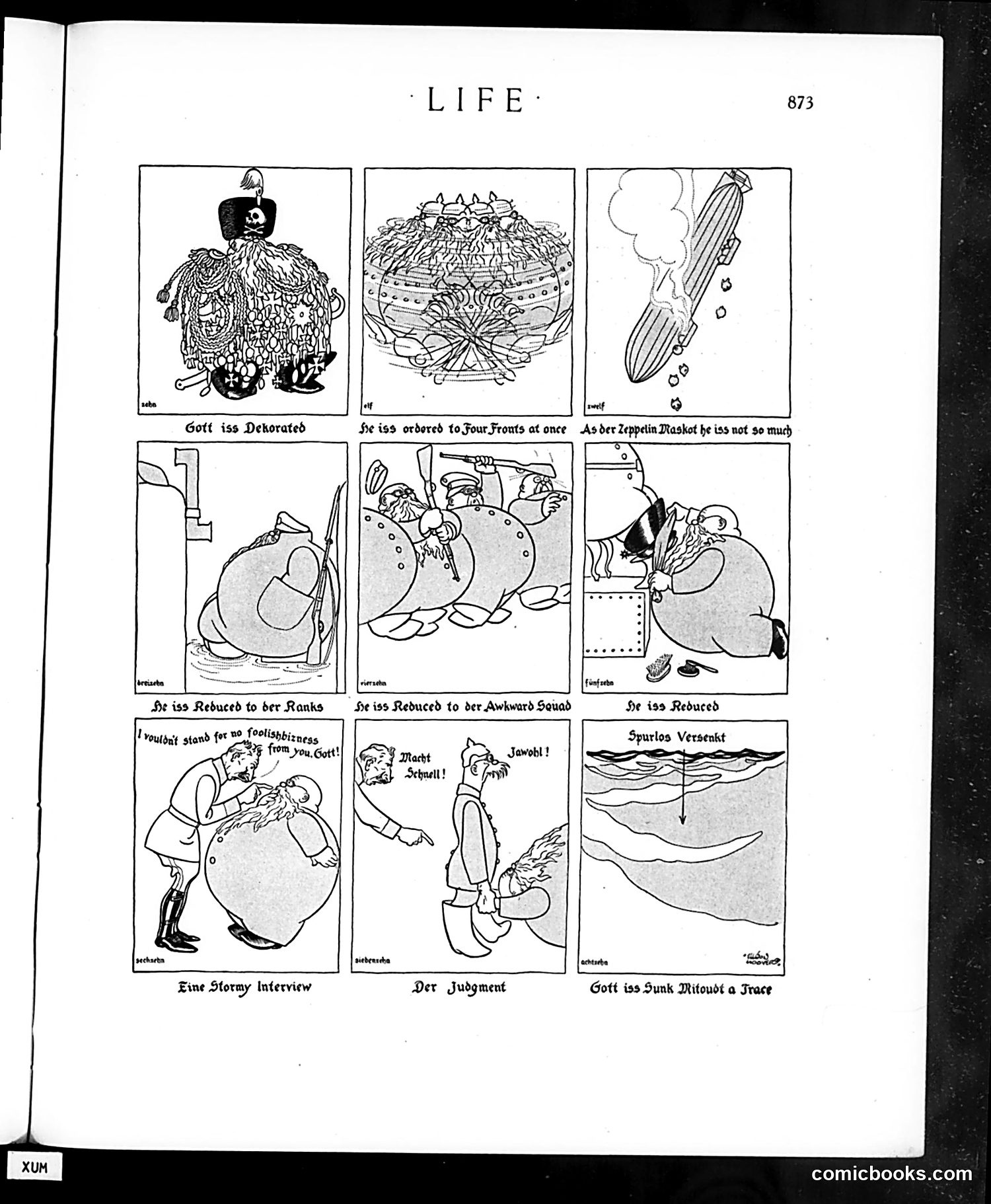
This appears to be a nine-panel comic strip mocking German military authority and leadership during World War I. The captions use German-inflected English ("Gott iss Decorated," "Der Judgment") to emphasize the subject's nationality. The recurring character—a rotund, elaborately decorated military officer—is reduced in rank and authority through successive panels, progressing from decorated commander to demoted soldier to, ultimately, sinking "without a trace." The satire ridicules German militarism by showing how even the most ornately decorated authority figures face inevitable humiliation and failure. The final panel's drowning appears to reference German naval defeats or wartime losses. The humor relies on visual degradation of martial pomp and circumstance.
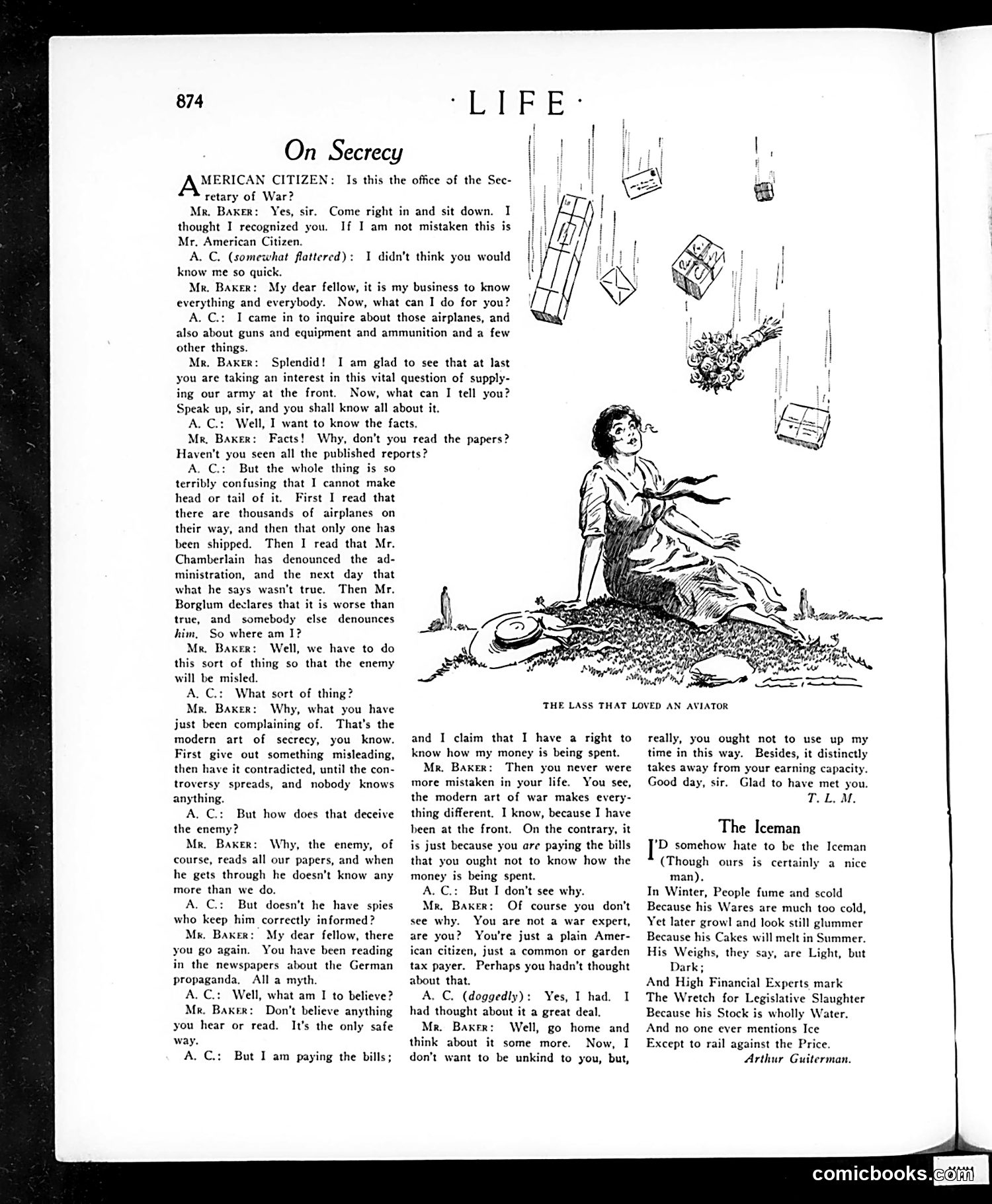
The left side presents a satirical dialogue between an American citizen and "Ms. Baker" (likely a government official), discussing wartime secrecy. The citizen complains that contradictory official statements make it impossible to know the truth—one official denies something the next day confirms. Ms. Baker defends strategic misinformation as necessary to mislead enemies. The illustration shows a woman amid falling documents/packages, captioned "The Lass That Loved an Aviator"—likely referencing romantic entanglements or casualties during WWI aviation operations. "The Iceman" is a brief poem about an iceman, noting his wares are "cold" and his cakes won't melt in summer—seemingly unrelated social commentary or filler verse. The page satirizes WWI-era government information control and public confusion.
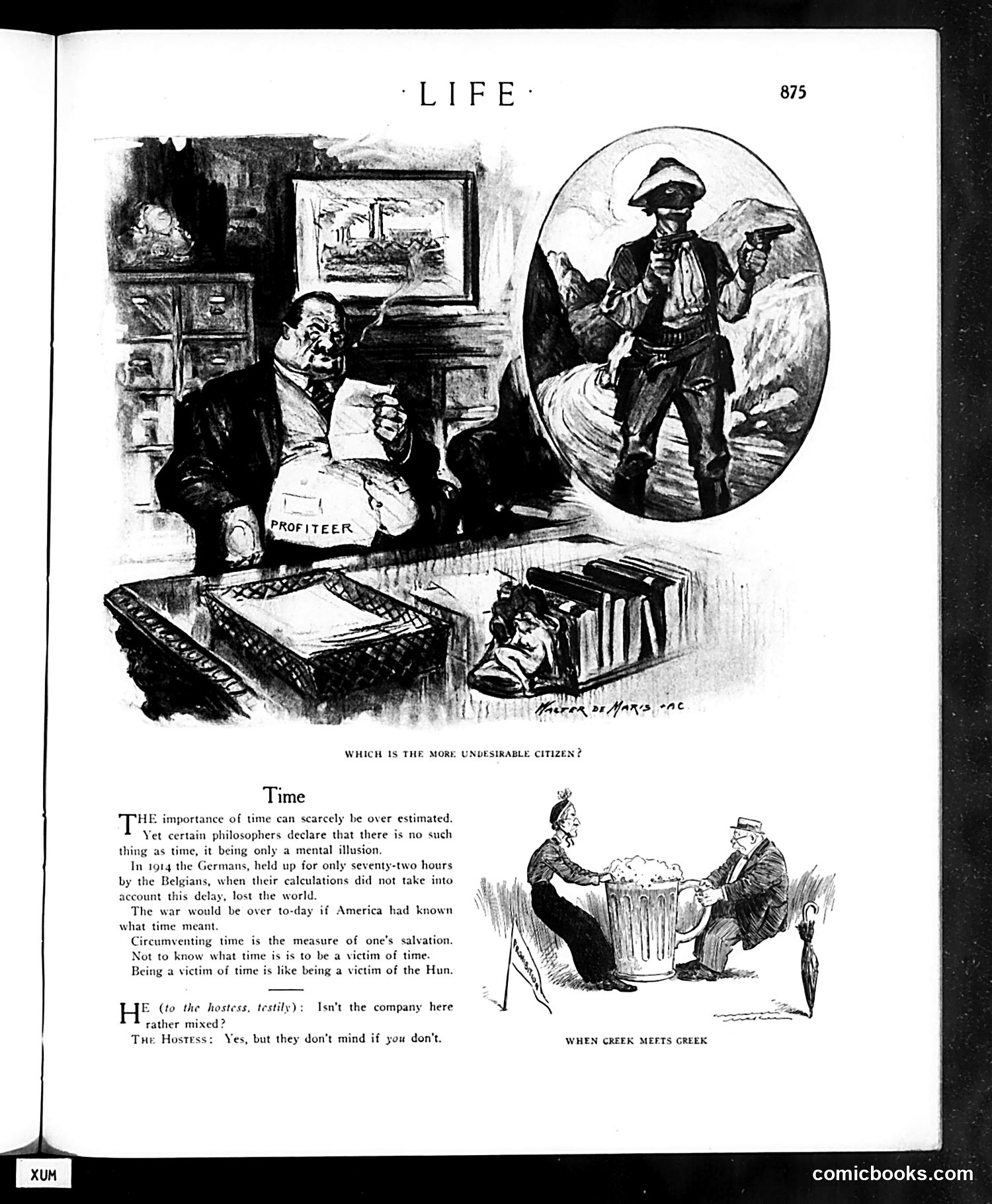
**Top Cartoon: "Which Is the More Undesirable Citizen?"** This depicts a man labeled "PROFITEER" at his desk, imagining two alternatives: soldiers in combat (shown in the thought bubble). The satire questions whether a war profiteer—someone enriching himself while others fight—is worse than an actual combatant. The reference to 1914 and Germans suggests this is WWI-era commentary on American attitudes toward profiteering. **Bottom Cartoon: "When Greek Meets Greek"** Two well-dressed figures (appearing to be a wealthy woman and man) meet at what looks like a social gathering. The caption implies mutual recognition between people of similar social standing, with a humorous undertone about class interactions. Both cartoons use visual satire to critique social behavior and class distinctions during the wartime period.
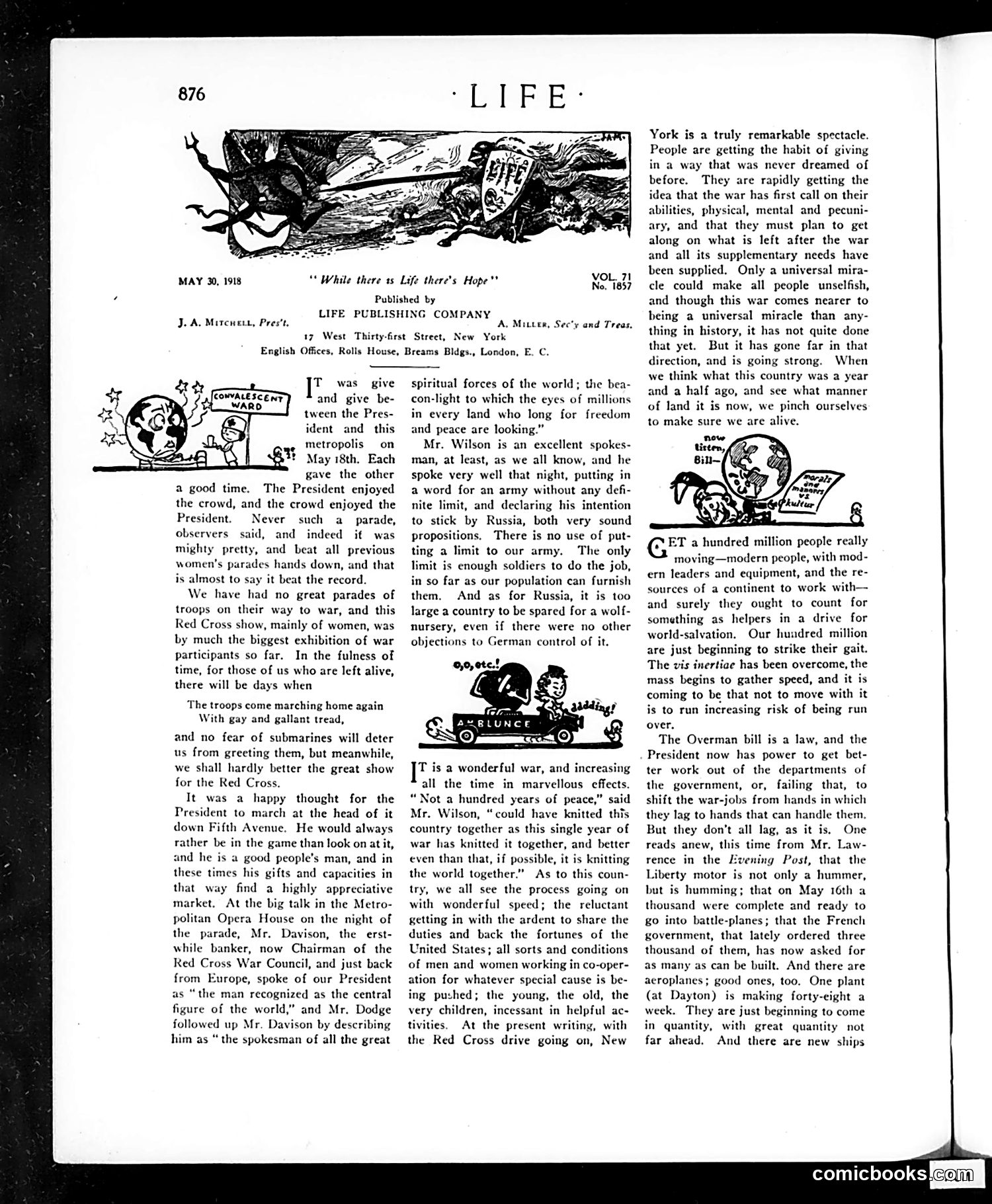
This page celebrates President Wilson's leadership during World War I, particularly his May 18th march down Fifth Avenue heading a massive Red Cross parade. The small cartoon labeled "Convalescent Ward" depicts wounded soldiers, referencing the human cost of war. The text praises Wilson as "the man recognized as the central figure of the world" and "spokesman of all the great spiritual forces." It advocates for unlimited military mobilization ("enough soldiers to do the job") and continued support for Russia against German control. The broader message emphasizes wartime sacrifice: Americans must adopt a new "habit of giving" and understand "the war has first call on their abilities, physical, mental and pecuniary." This reflects 1918 America's total-war mobilization, where civilian participation in fundraising (Red Cross drives) and material sacrifice was framed as patriotic duty. The tone is optimistic about unity, suggesting war could "knit" the nation and world together.
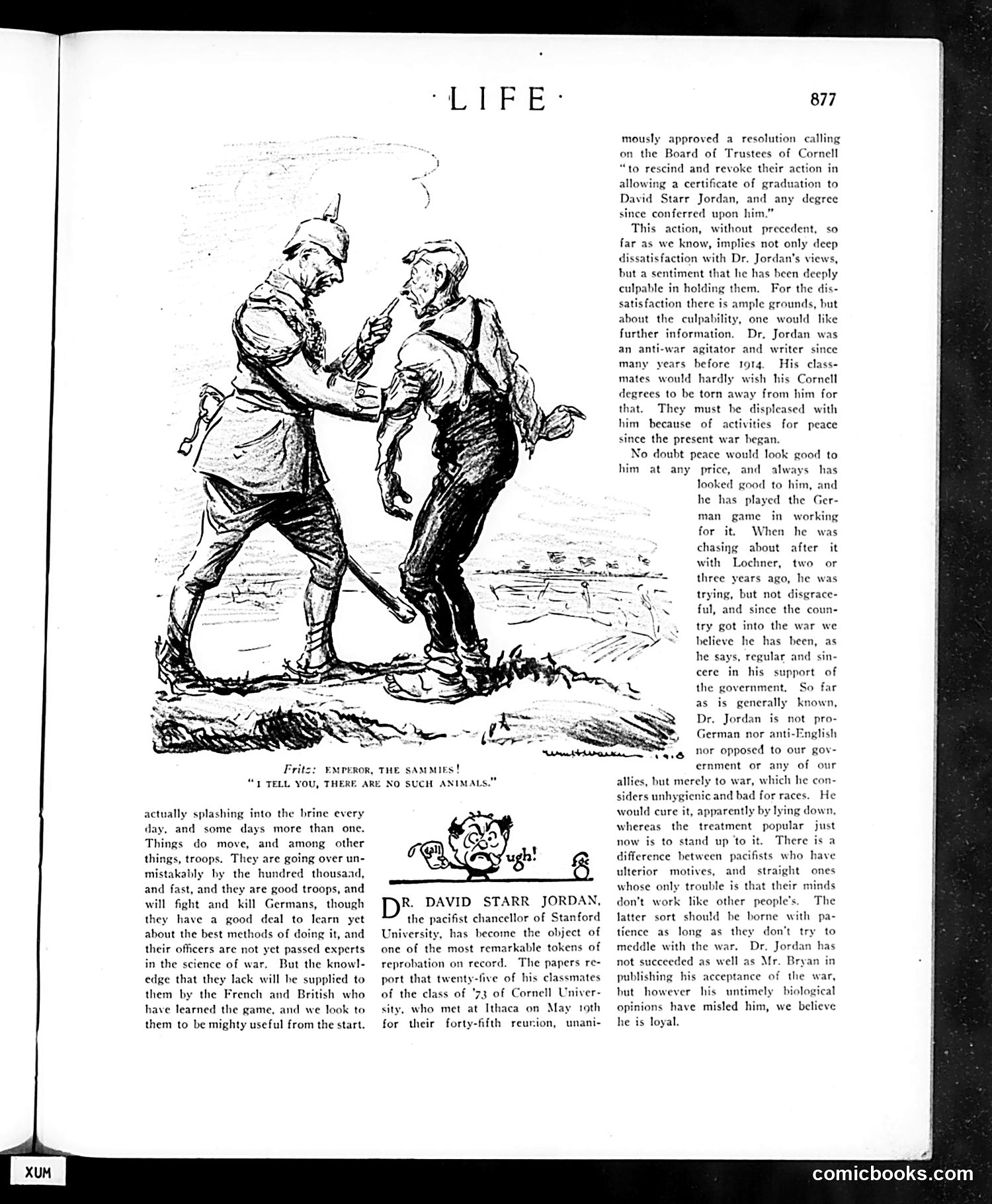
The cartoon depicts two military figures—one labeled "Fritz" (representing Germany) and one representing American forces ("the Sammies"). Fritz boasts "I tell you, there are no such animals," mocking American soldiers as inexperienced. The accompanying article addresses **David Starr Jordan**, pacifist chancellor of Stanford University. His Cornell University classmates (class of 1873) formally demanded the university revoke his degree—an unprecedented action. Their grievance: Jordan's peace activism during World War I, which the country had recently entered (1917). The magazine's stance is nuanced: it defends Jordan's right to hold pacifist views as a matter of conscience, but criticizes his wartime peace advocacy as misguided meddling. The piece distinguishes between sincere pacifists (whose "minds don't work like other people's") and those with ulterior motives, suggesting Jordan falls into the former category while remaining, ultimately, loyal to America.
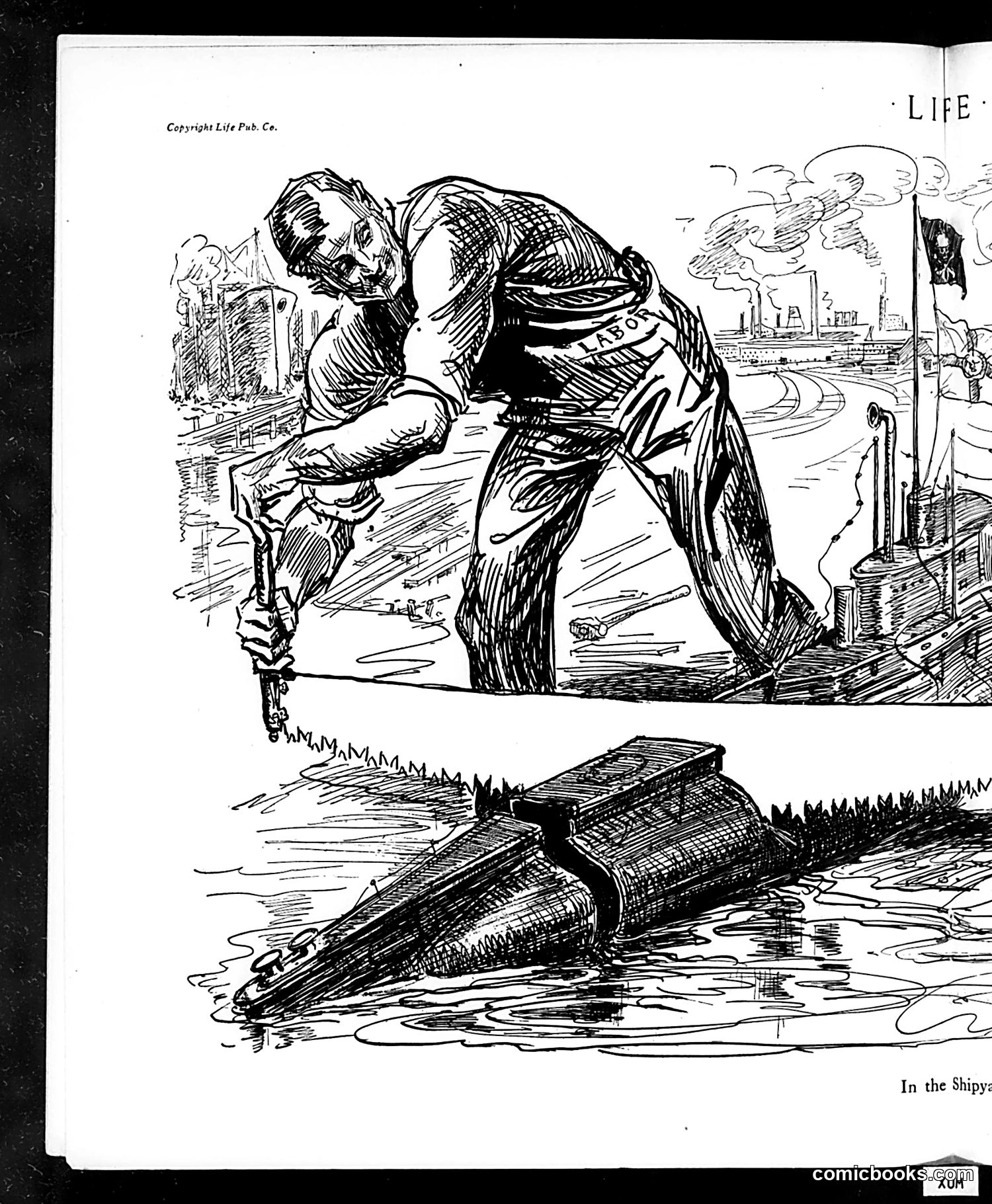
This appears to be a satirical cartoon from *Life* magazine showing a scene "In the Shipyards" (as captioned). The image depicts a large, heavyset man in work clothes bending over, seemingly engaged in manual labor at a shipyard. Industrial elements are visible in the background—ships, smokestacks, and maritime infrastructure. The satire likely targets labor conditions, working-class struggles, or industrial exploitation of the era, though without additional context or caption text visible on the page, the specific political point remains unclear. The exaggerated physical caricature and industrial setting suggest commentary on either the dignity (or indignity) of shipyard work, or possibly attitudes toward laborers themselves. The incomplete text fragments prevent definitive interpretation of the intended message.
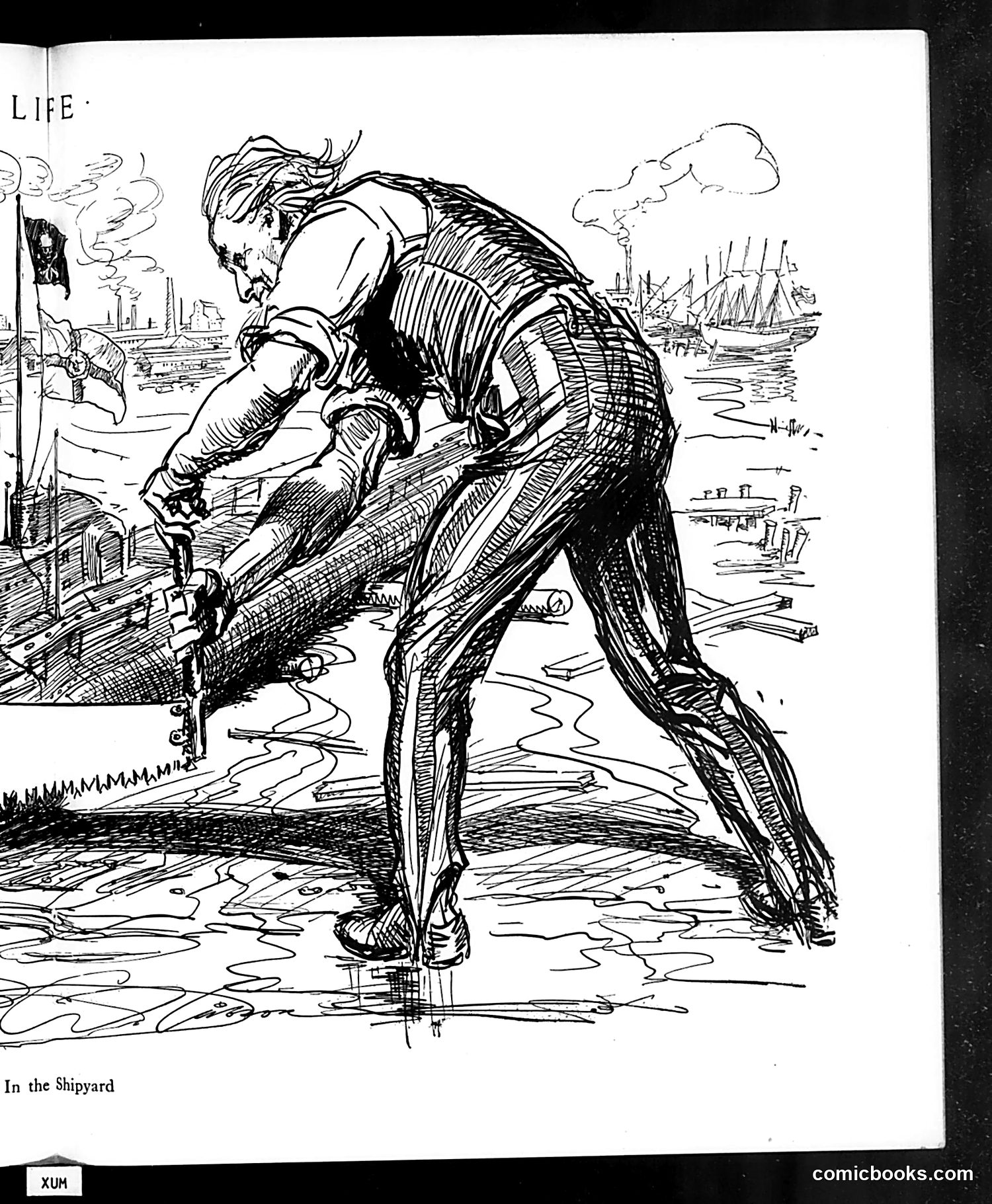
This political cartoon depicts a laborer in a shipyard, shown in exaggerated physical proportions with elongated limbs. The figure is bent over working, with industrial imagery in the background—ships, smokestacks, and dock infrastructure visible. The cartoon appears to comment on working-class labor conditions, likely satirizing either the physical toll of shipyard work or broader labor exploitation during an industrial era. The caricatured body style was typical of early-to-mid 20th century satirical art. Without additional context from the magazine issue, the specific political target remains unclear—it could reference labor rights, industrial working conditions, or wartime shipbuilding. The exaggeration suggests social commentary rather than straightforward documentation.
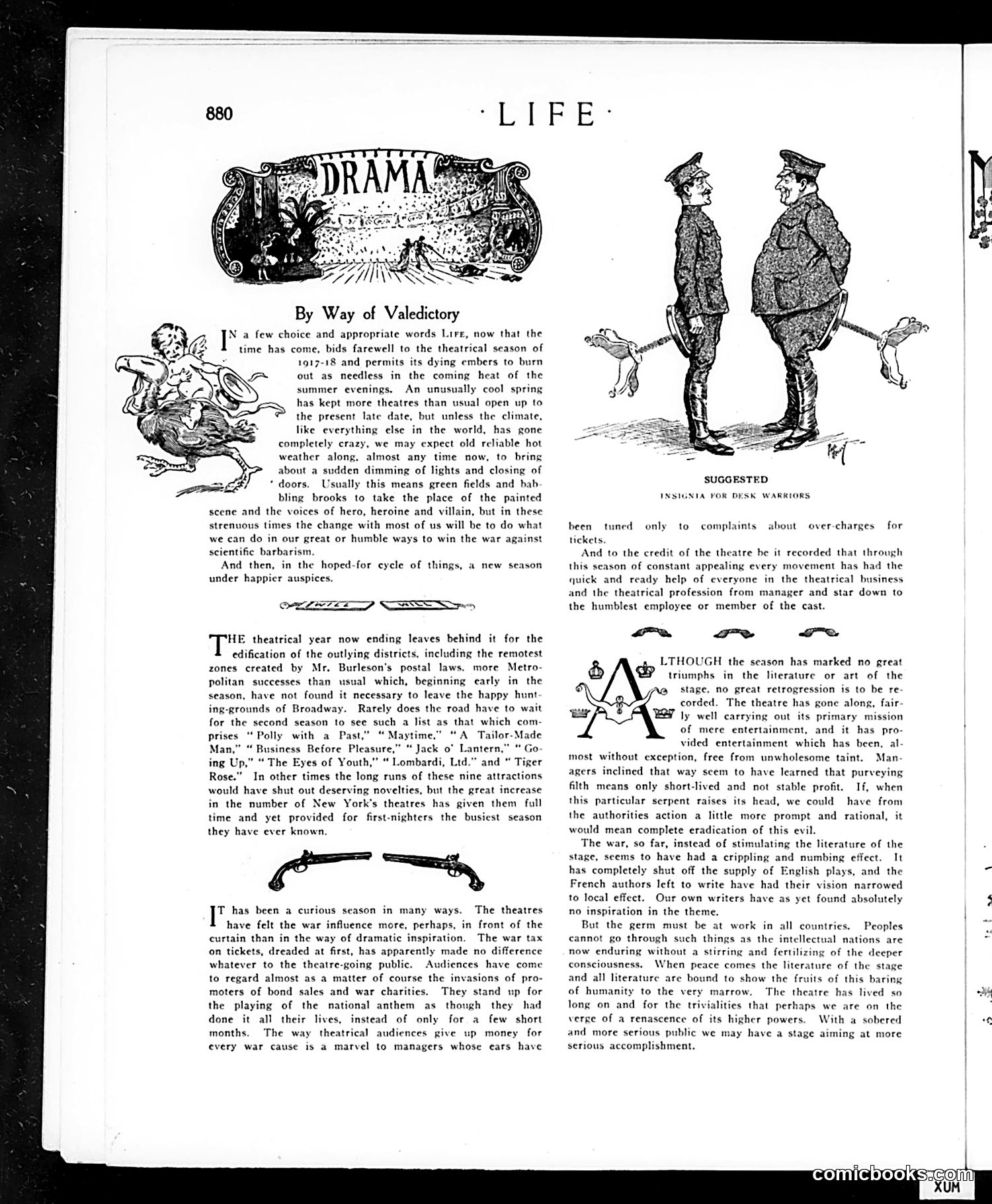
This is a theatrical review closing out Broadway's 1917-18 season during World War I. The small cartoon captioned "Suggested Insignia for Desk Warriors" depicts two military-uniformed men in conversation—likely satirizing civilians who avoided combat duty while remaining stateside. The main text celebrates that theaters stayed open longer than usual due to cool spring weather, and praises the theatrical season's productivity, noting nine successful Broadway productions. However, the author critiques the war's cultural impact: English plays dried up, and American writers produced uninspired work. The page acknowledges audiences' patriotic acceptance of war bond drives and national anthem performances. It credits the theater industry for supporting war causes generously, though some managers previously complained about ticket price increases. The overall tone is valedictory—bidding farewell to the season while expressing hope for better theatrical art post-war, suggesting the conflict has temporarily dampened creative achievement rather than inspiring it.
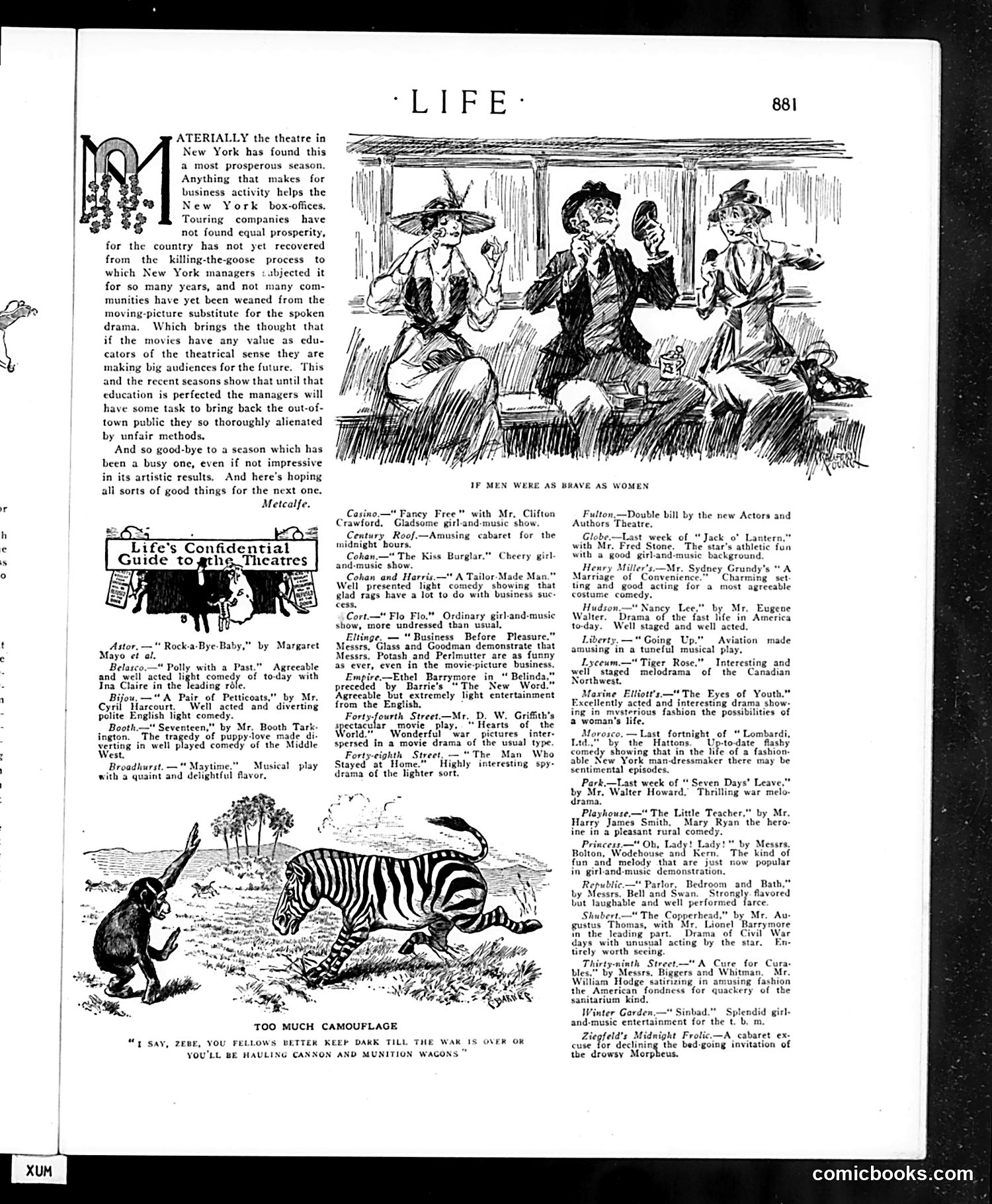
This cartoon satirizes wartime gender dynamics. It depicts a zebra (likely representing Germany or the enemy, given the "camouflage" caption) being confronted by women, while a man crouches fearfully behind them. The caption's dialogue—a soldier warning the zebra to "keep dark till the war is over or you'll be hauling cannon and munition wagons"—suggests the joke is about civilian men avoiding military service through concealment, contrasted with women's visible contributions to the war effort. The title "If Men Were as Brave as Women" implies social criticism: women are depicted as boldly confronting danger while men hide. This reflects early-20th-century debates about male military conscription and women's expanding public roles during World War I, mocking male cowardice by comparison to female courage and visibility in wartime society.
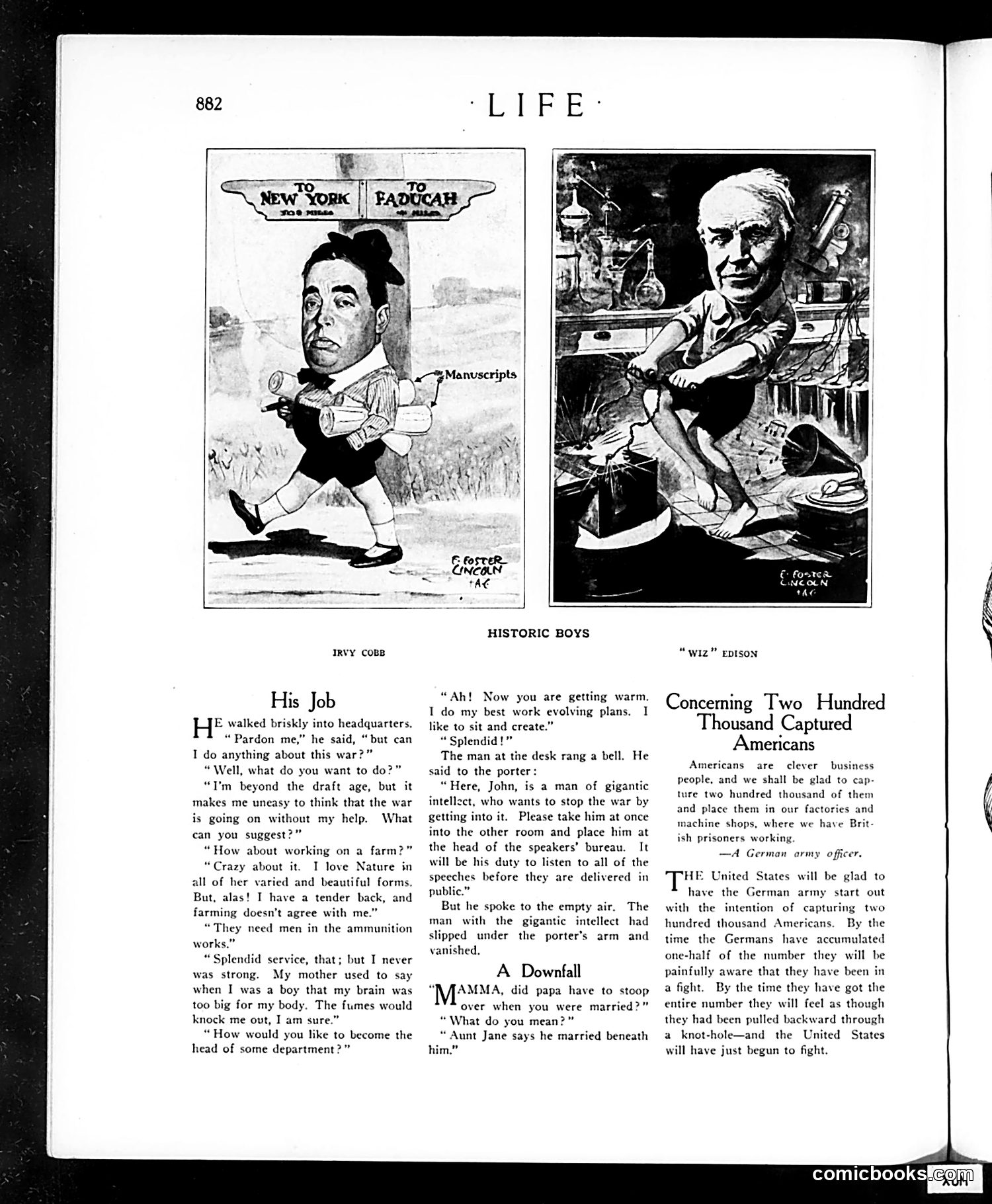
This page contains three satirical pieces about American involvement in World War I: **"His Job" (Irvy Cobb caricature):** Mocks a man of apparent importance who eagerly volunteers to help the war effort but finds excuses rejecting every practical suggestion—farm work (bad back), ammunition factory (weak constitution), administration. When finally offered a desk job as head of the speakers' bureau, he vanishes. The joke: such self-important figures talk about sacrifice but flee actual responsibility. **"A Downfall" (Edison caricature):** A brief joke about a man marrying "beneath him." **"Concerning Two Hundred Thousand Captured Americans":** Presents a German officer's boastful claim about capturing American workers, then rebuts it: Americans will prove so formidable that by the time Germans capture even half that number, they'll realize they're in a real fight. It's patriotic propaganda asserting American military superiority. The page satirizes both American self-serving reluctance to contribute and confidently challenges German military ambitions.
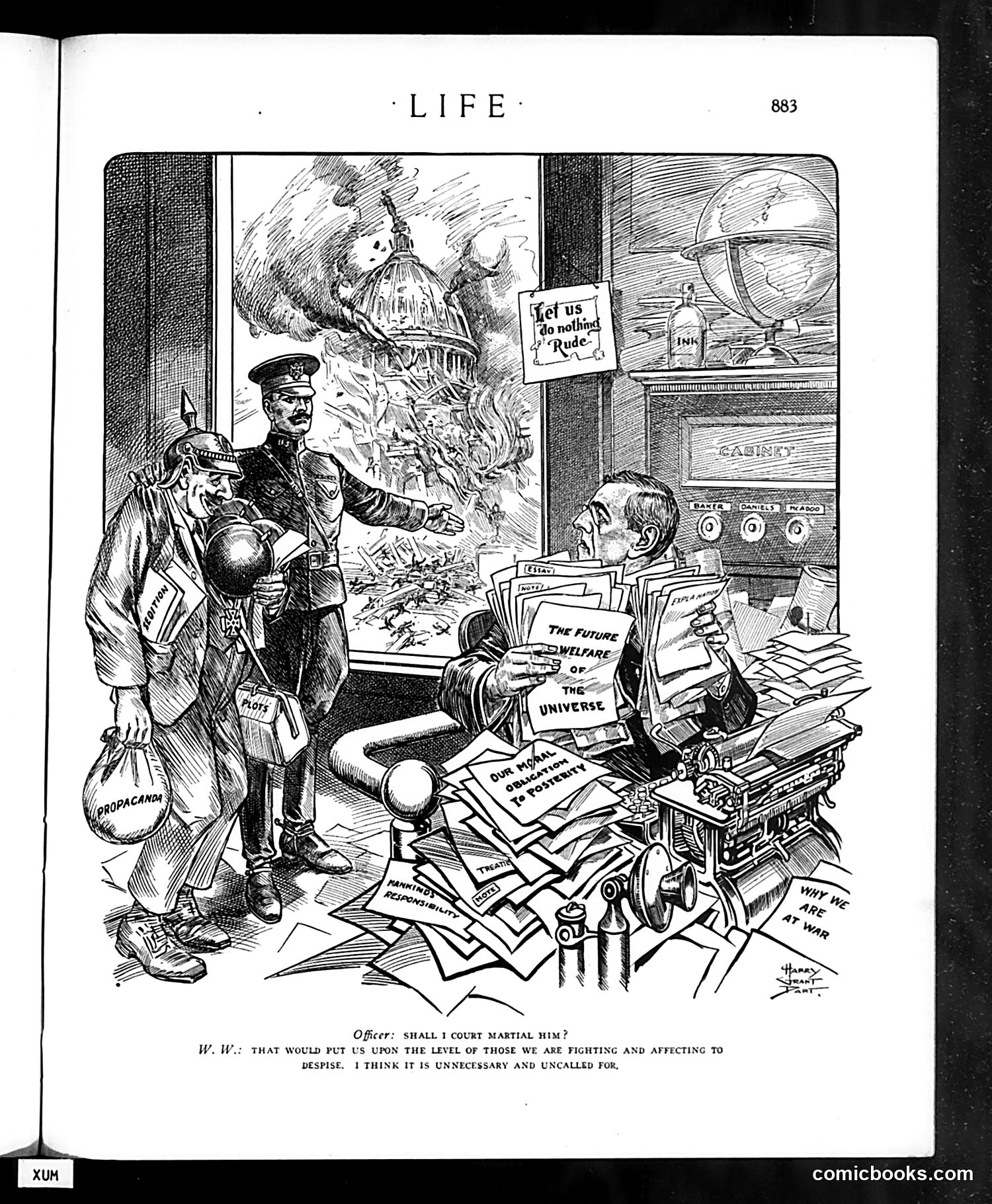
This WWI-era satirical cartoon depicts a military officer encountering a propagandist or civilian official amid chaos (burning Capitol building visible). The officer holds a bag labeled "PROPAGANDA" while papers scatter showing "THE FUTURE," "WELFARE OF THE UNIVERSE," and "OUR FINANCIAL OBLIGATION TO POSTERITY." The cartoon critiques wartime propaganda and morale-damaging rhetoric. The officer's response—refusing court martial because it would lower them to their enemies' level—sarcastically suggests the government won't punish those spreading demoralizing messages, despite the damage caused. The "Let us do nothing 'Rude'" sign and scattered documents suggest bureaucratic ineffectiveness amid crisis. The satire attacks both military restraint and civilian propagandists undermining the war effort through pessimistic messaging about post-war obligations and costs.
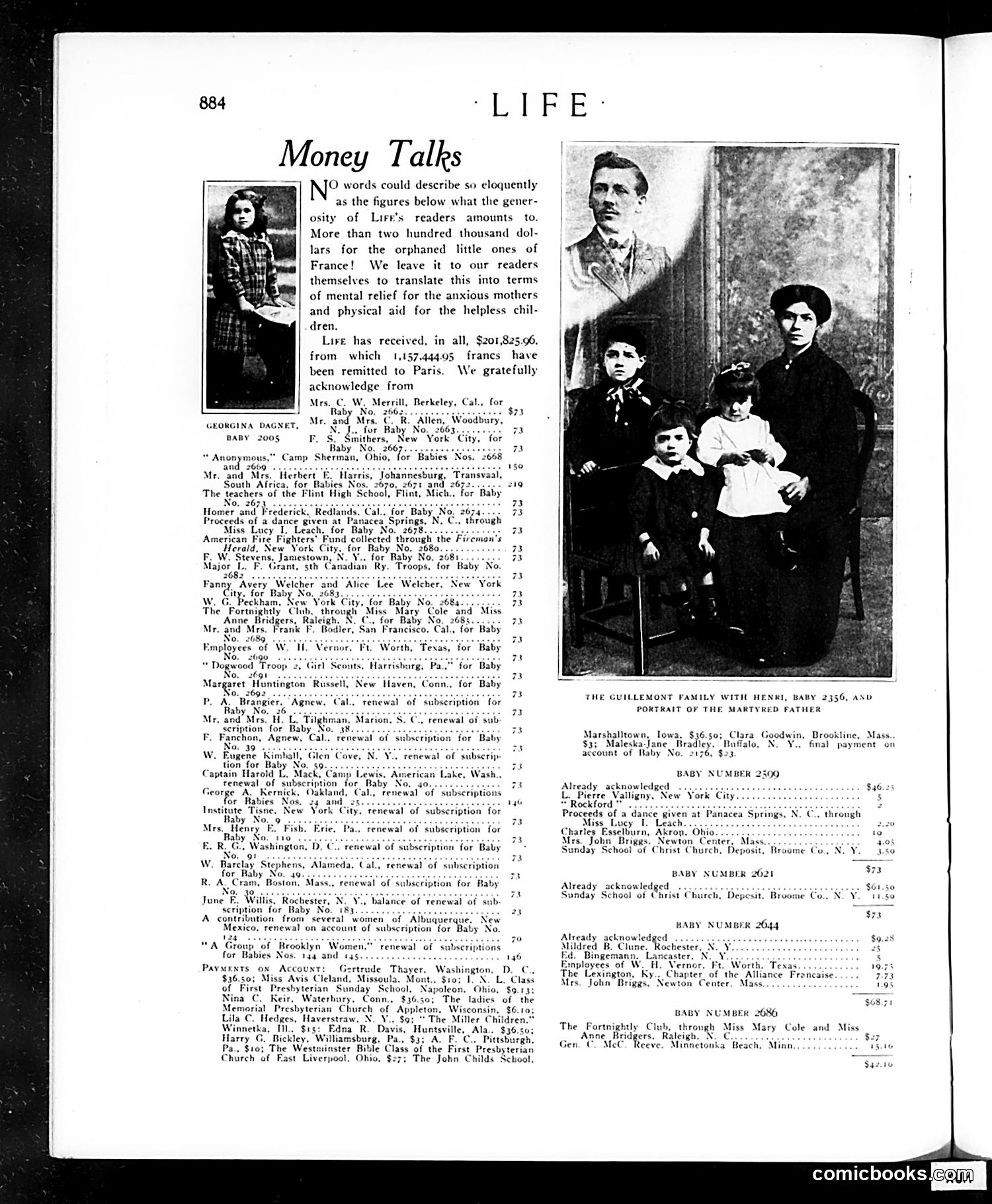
This page documents **Life magazine's fundraising campaign for French war orphans**, likely from World War I era. The headline "Money Talks" presents donations as evidence of American generosity. The text lists contributors who have "adopted" specific babies through subscription—paying to support individual French orphans. The amounts ($73, $150, $210, etc.) represent ongoing financial commitments. Two photographs illustrate the appeal's emotional core: a portrait of a French orphan girl (Georgina Dagnet, Baby 2005) and a family photograph identified as "The Guillemont Family with Henri, Baby 2356, and Portrait of the Martyred Father"—suggesting the father died in the war. The satire is implicit: the headline's cynical tone ("Money Talks") contrasts with the humanitarian cause, perhaps gently mocking how financial contributions serve as the primary way Americans can help distant suffering, while emphasizing the scale of need ($201,825.96 collected).
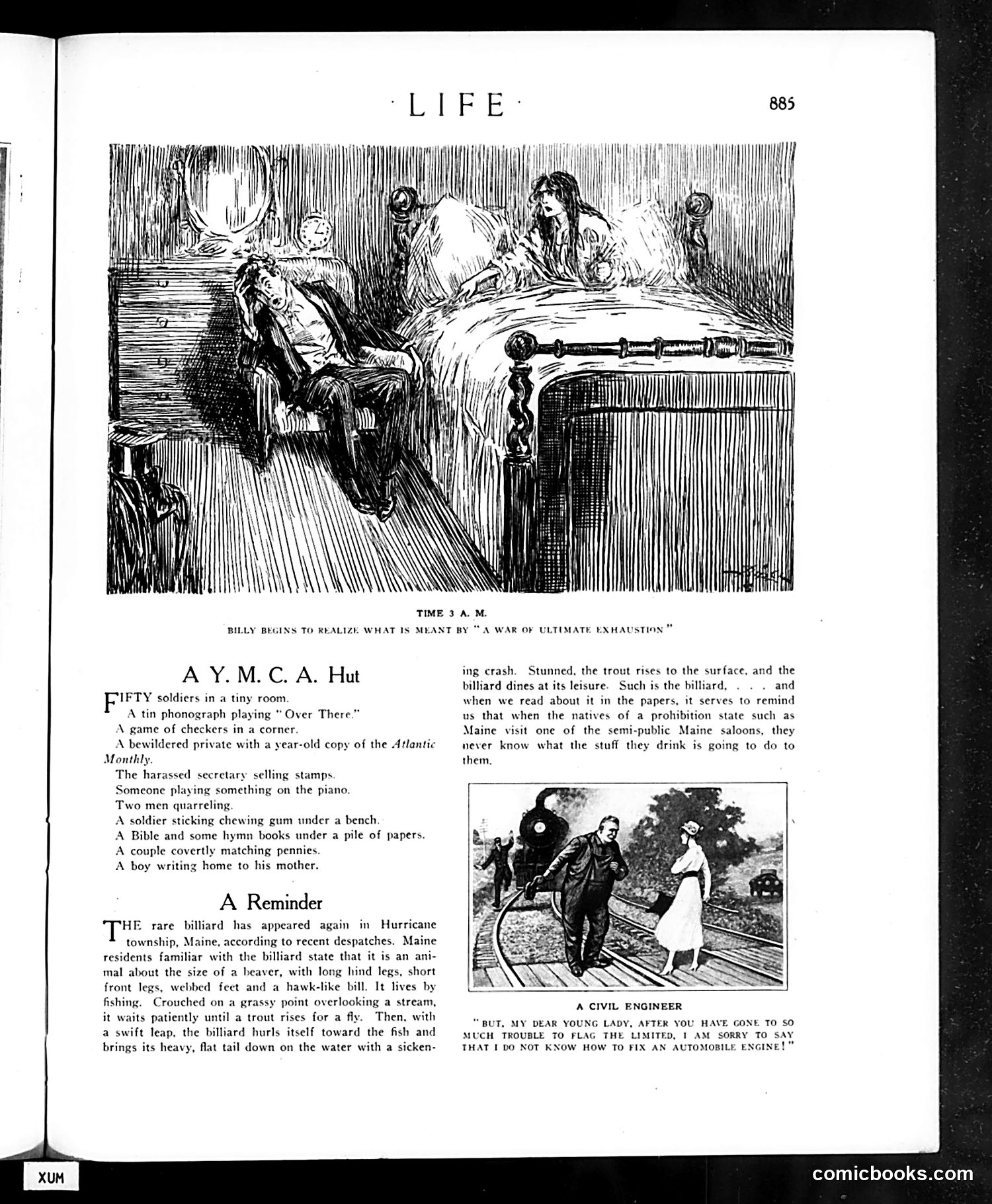
This Life magazine page contains three distinct satirical pieces: **Top cartoon**: Titled "Billy Begins to Realize What Is Meant by 'A War of Ultimate Exhaustion,'" it depicts a soldier in a cramped YMCA hut during World War I, surrounded by tedious activities (checkers, old magazines, piano playing, quarreling men). The joke is that the "war of ultimate exhaustion" isn't just about combat—it's the mind-numbing boredom and crowded conditions of soldier recreation facilities. **"A Reminder"**: Mock-scientific satire about a fictional "billiard" animal in Maine. The joke's punchline references Prohibition: the animal description is absurd enough to suggest that prohibitionists' warnings about illegal Maine liquor are equally ridiculous—you never know what you're actually drinking. **Bottom cartoon**: Shows a woman who has flagged down a train to ask a man for help fixing her car engine. His response—that despite her considerable effort to get him, he can't help—is humorous commentary on masculine incompetence and misplaced expectations.
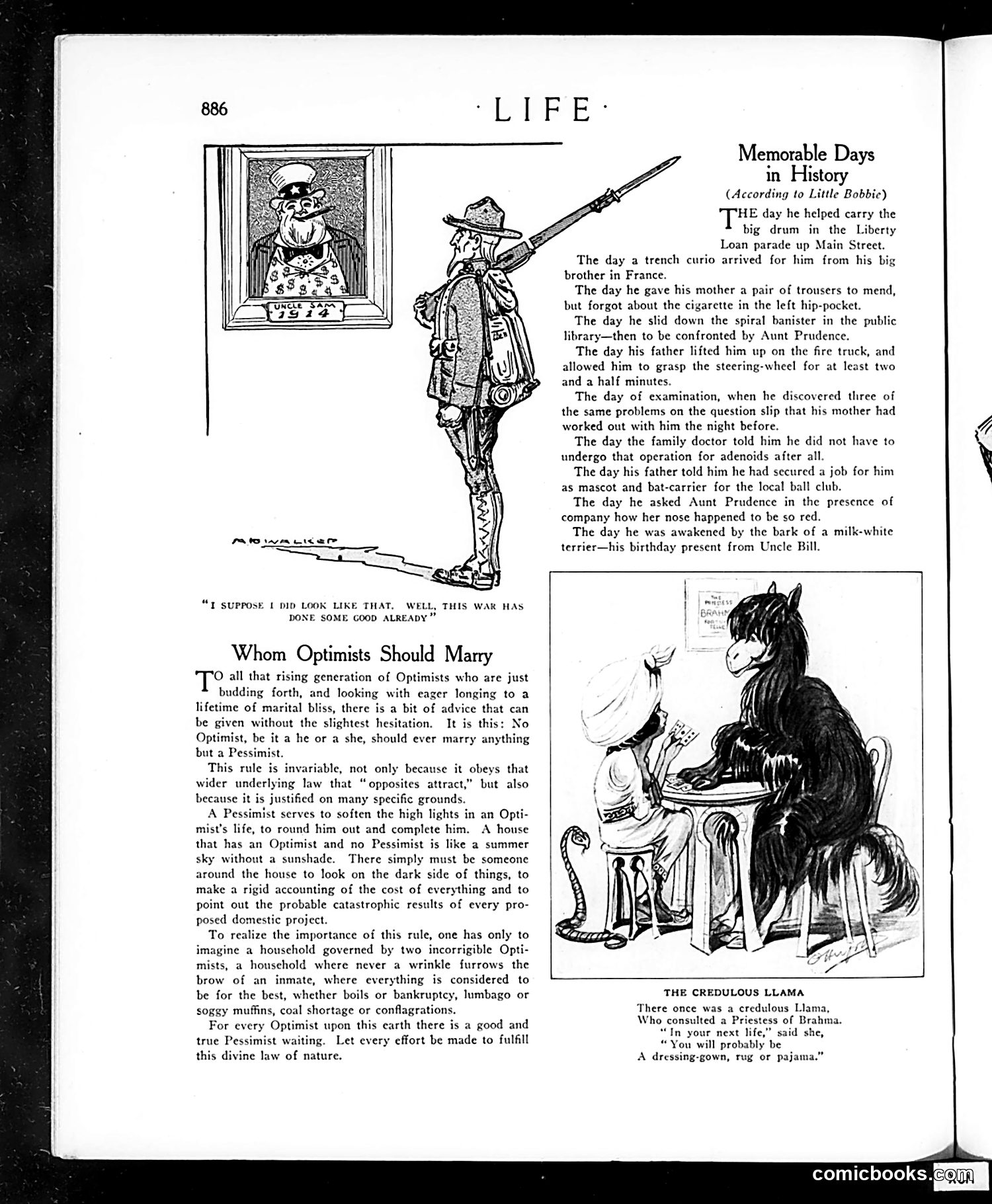
This page contains three distinct pieces of satirical content: **"Memorable Days in History"** presents a child's perspective on WWI-era American life. The anecdotes—carrying a drum in a Liberty Loan parade, receiving a trench curio from a soldier brother in France, nearly exposing cigarettes to his mother—satirize how children experienced the Great War indirectly through home-front activities and family connections to the conflict. **"Whom Optimists Should Marry"** is social commentary arguing that optimists should marry pessimists for balance. The humor lies in exaggerating the chaos of a household governed by two relentlessly cheerful optimists, unable to acknowledge any problem—whether "boils or bankruptcy"—as anything but "for the best." **"The Credulous Llama"** is a brief verse about naïveté and reincarnation, presenting a whimsical moral about gullibility. The page's illustrations support these satirical themes with period-appropriate drawings. The overall tone reflects early 20th-century American magazine humor—observational, domestic, and gentle rather than harsh.
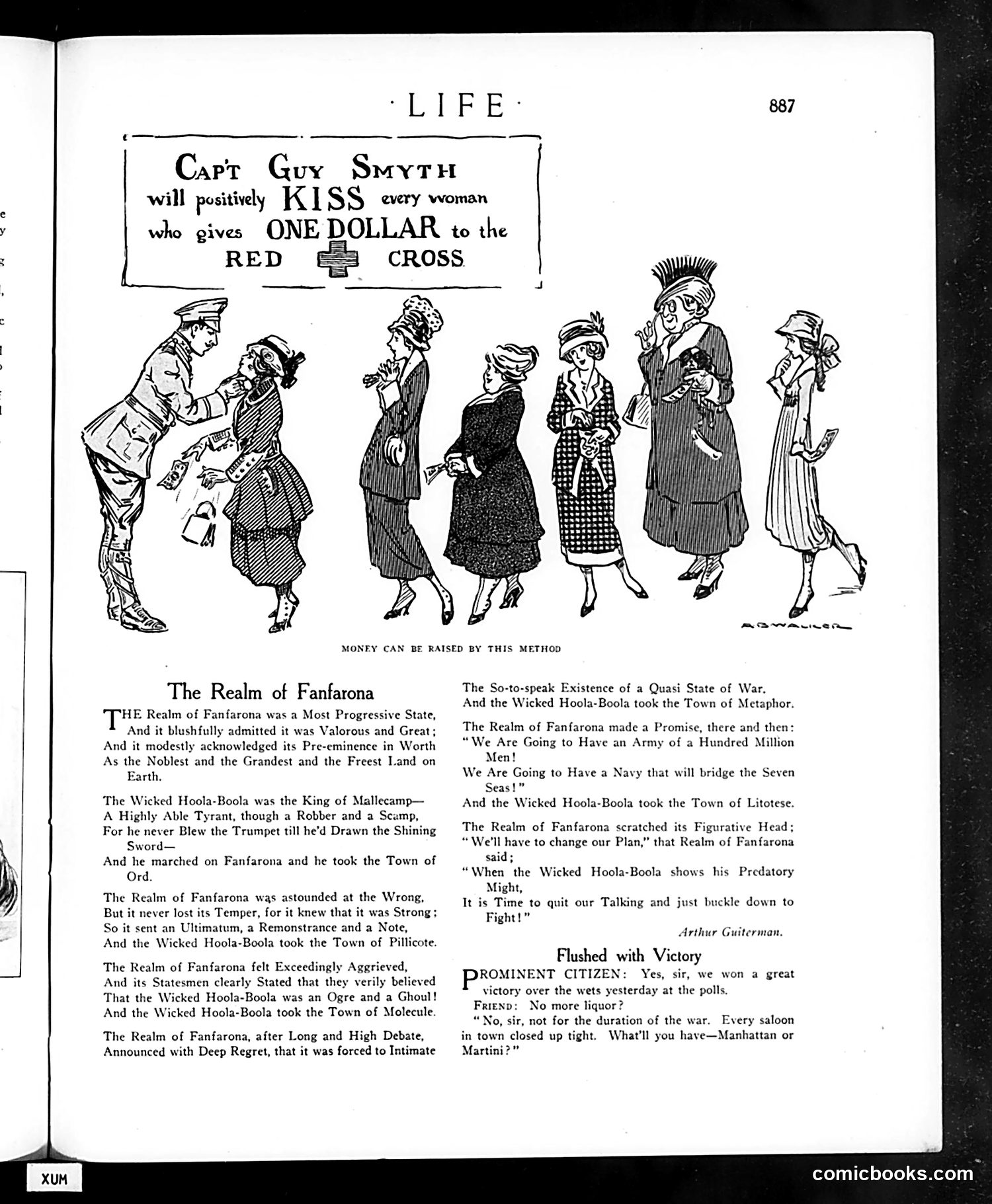
**Top Cartoon:** A wartime fundraising gimmick satirizes how charities exploit public sentiment. Captain Guy Smyth promises to kiss any woman donating a dollar to the Red Cross—a thinly veiled commentary on using celebrity appeal and romance as marketing tactics. The caption's dry humor ("Money can be raised by this method") mocks the absurdity of such incentives. **"The Realm of Fanfarona":** A verse satire by Arthur Guiterman mocks America's diplomatic hesitation before entering World War I. Fanfarona represents the U.S., confidently issuing diplomatic protests while the aggressor ("Wicked Hoola-Boola," likely Germany) ignores them and seizes territory unchecked. The poem ridicules empty threats and grandiose promises ("Hundred Million Men! A Navy...") without action—eventually forcing reluctant military engagement. **"Flushed with Victory":** A brief joke about wartime Prohibition. Despite winning "at the polls" (likely a referendum), the humorous contradiction emerges: all saloons closed anyway, making wartime sacrifice ironic for drinkers.
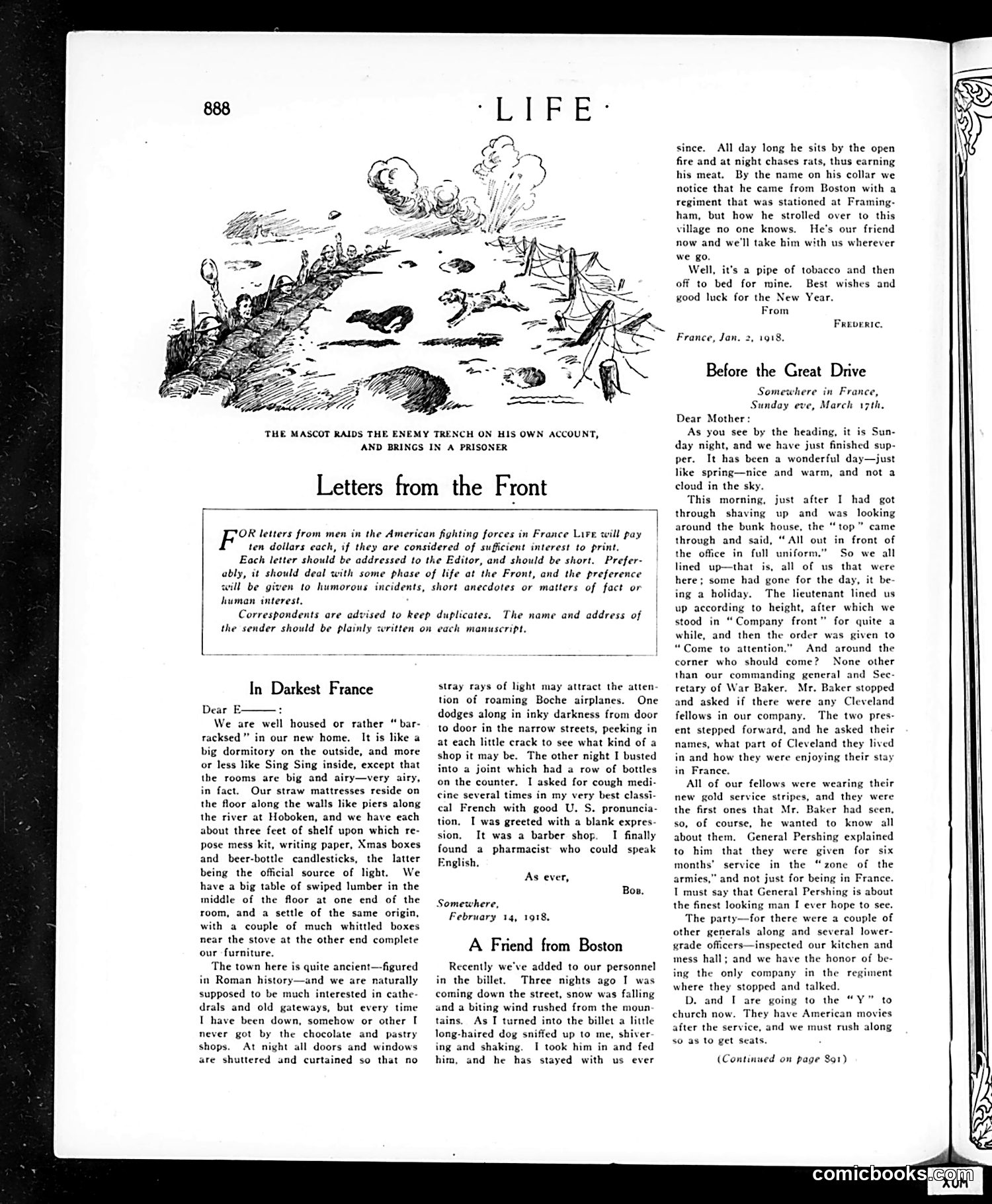
This page features **Letters from the Front**, a reader-submission section soliciting correspondence from American soldiers in France during World War I. Life offered ten dollars per published letter. The **cartoon** depicts a soldier's mascot dog raiding an enemy trench and capturing a prisoner—a humorous take on military heroics, with the small dog performing a brave soldier's duty. The **letters themselves** are personal accounts from soldiers describing daily life: barracks conditions, French villages, local customs (chocolate shops, barber shops), and human interest stories. One letter describes adopting a stray dog from Boston; another recounts pre-offensive preparations on the eve of what was likely the Spring 1918 German offensive. The satire is gentle—mocking the soldiers' occasional cultural confusion (the barber shop misidentification) and romanticizing their hardships as humorous anecdotes rather than tragedy. This reflects how American magazines of 1918 presented the war to the home front: as earnest but relatable, with touches of comedic relief rather than grim realism.
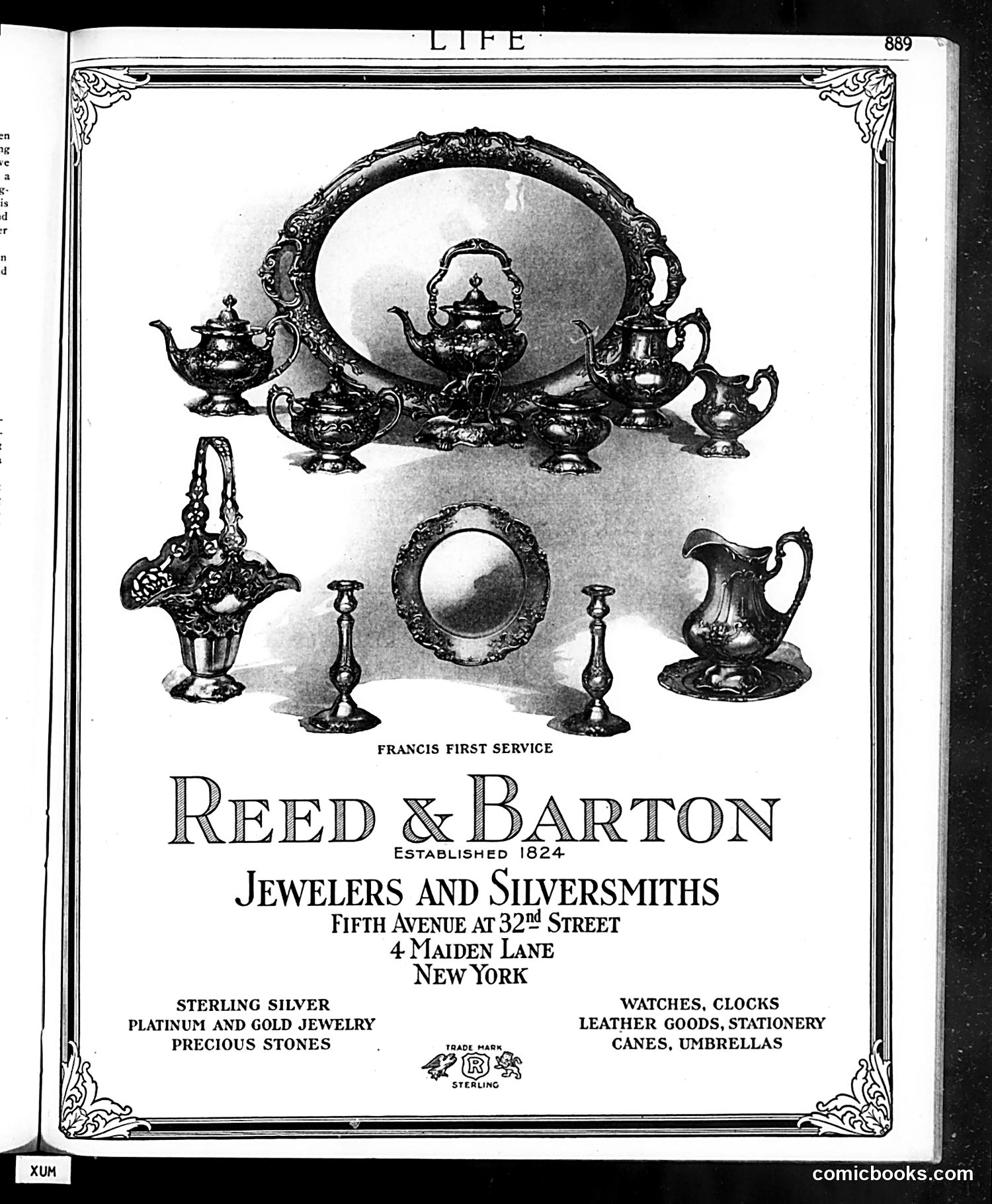
This is **not a cartoon or satirical content** — it is a **full-page advertisement** for Reed & Barton, a luxury jewelry and silverware company established in 1824. The page displays the "Francis First Service," a ornate sterling silver tea and table service set, photographed at the top. Below are complementary items: a decorative basket, candlesticks, a plate, and a pitcher, all rendered in detailed black-and-white engravings typical of high-end product advertising from this era. The text emphasizes the company's prestige, listing their Fifth Avenue and Maiden Lane locations in New York, and cataloging their wares: sterling silver, platinum, gold jewelry, precious stones, watches, clocks, and luxury accessories. This represents early 20th-century advertising aimed at wealthy consumers — there is no satirical message or political content to decode.
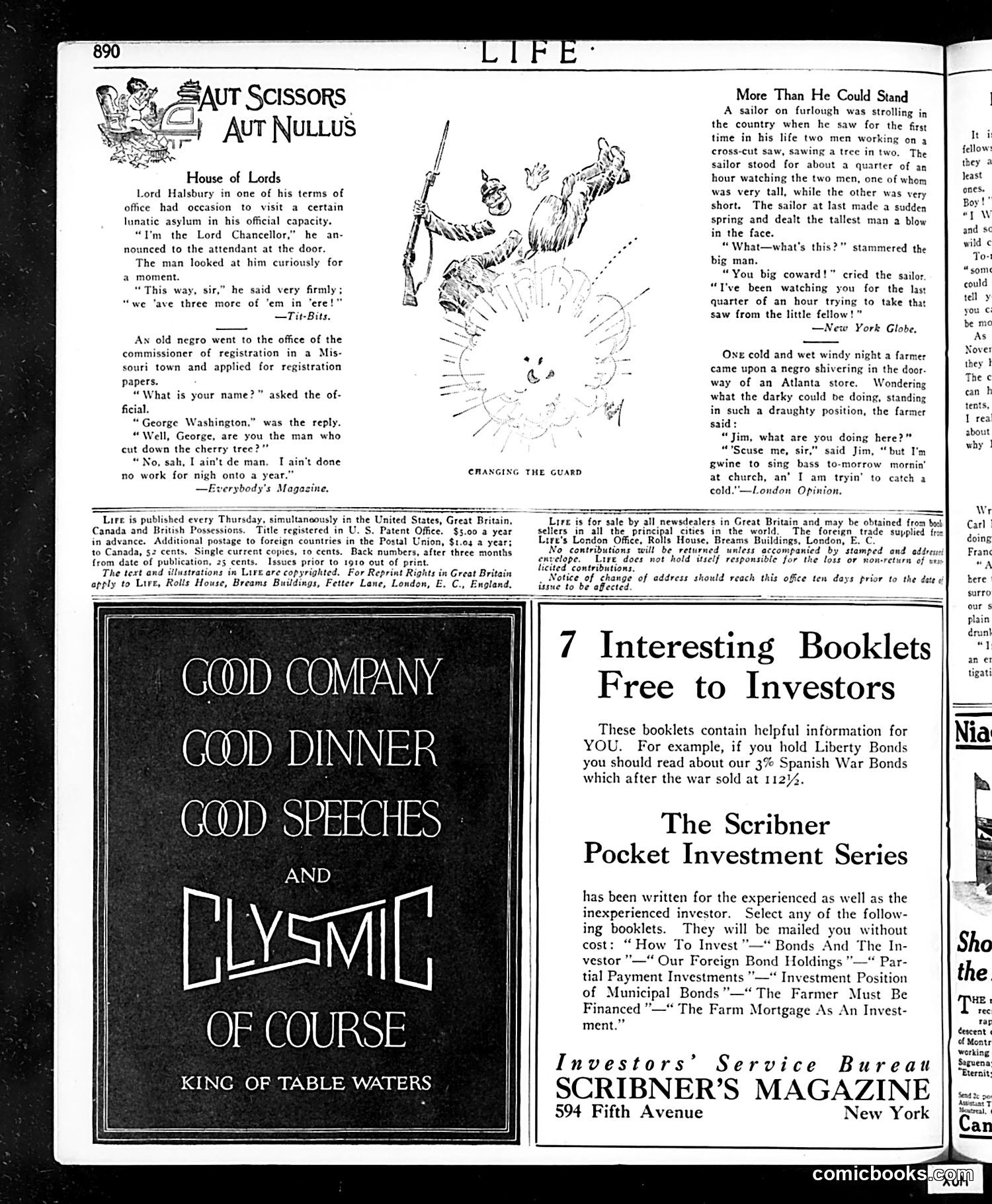
This page contains three satirical anecdotes and period advertisements, typical of *Life* magazine's humor format. **The three jokes:** 1. **"Aut Scissors Aut Nullus"**: Lord Halsbury visits a lunatic asylum and announces he's Lord Chancellor; the attendant matter-of-factly replies they already have three others claiming the same title—mocking politicians' inflated self-importance. 2. **The registration office joke**: A Black man named "George Washington" applies for voting registration. Asked if he's the man who cut down the cherry tree, he replies he hasn't done work in a year—satirizing both the cherry tree legend and racial attitudes of the era. 3. **The sailor and the saw**: A sailor punches a tall man operating a cross-cut saw, believing the short man is being exploited. The joke relies on the sailor misunderstanding how the saw works. The advertisements below promote investment booklets and Lysol mouthwash, reflecting early-20th-century marketing to affluent readers. The page reflects *Life*'s satirical but period-typical treatment of class, race, and absurdist humor.
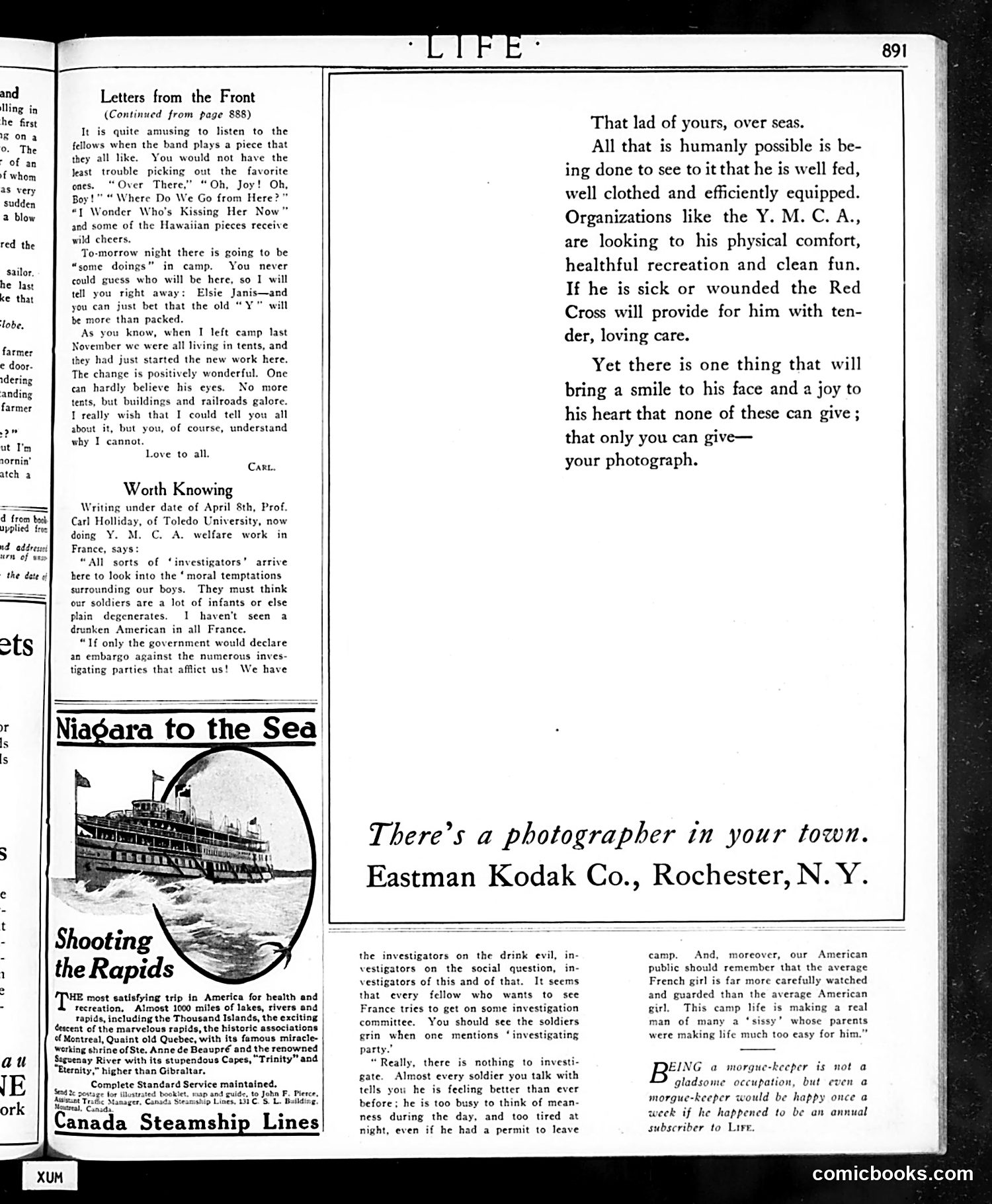
This page combines patriotic appeals with period advertising, reflecting WWI-era concerns about American soldiers overseas. **Main Content:** Letters from soldiers at the front describe camp improvements and morale-boosting entertainment (Elsie Janis, popular songs). A YMCA welfare worker (Prof. Carl Holliday) sarcastically criticizes government "investigators" sent to monitor soldiers' moral behavior—claiming they're unnecessary busybodies since soldiers are well-behaved, busy, and tired. **The Satire:** The implied joke targets Victorian-era moral panic. Officials were genuinely concerned about soldier vice (drinking, fraternization); Holliday mocks this by insisting American soldiers need no surveillance and behave better than civilians imagine. He even defends French girls as properly chaperoned. **Advertising:** - Eastman Kodak urges parents to send photographs to boost soldiers' morale - Canada Steamship Lines advertises leisure travel ("Shooting the Rapids") **Historical Context:** This reflects 1918 anxieties about soldier welfare and morality during WWI, presenting an optimistic, sanitized view of military camp life.
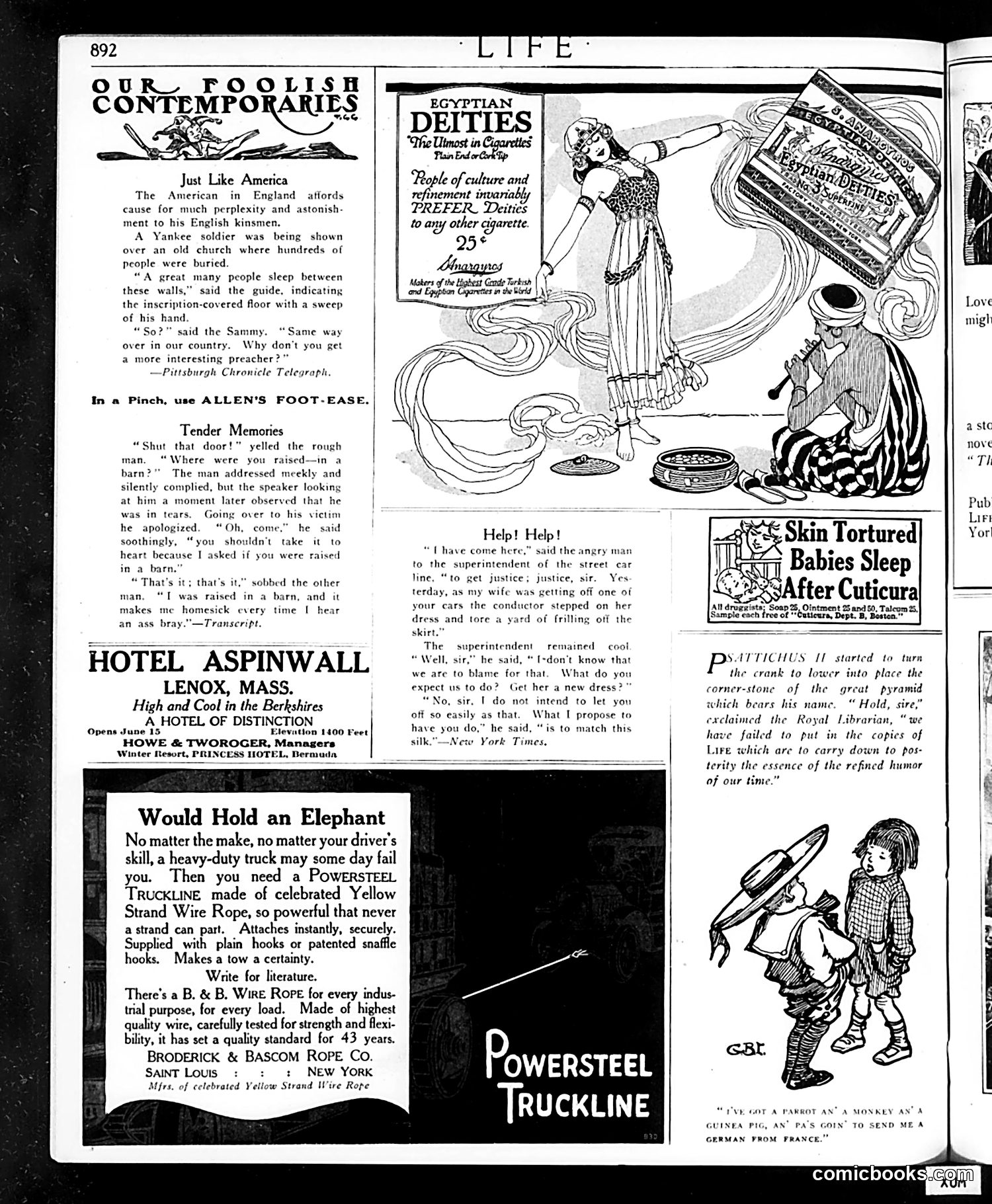
This page contains **primarily advertisements and brief humorous anecdotes** rather than political cartoons. The main satirical content is "Just Like America"—a brief joke contrasting American and English sensibilities. A Yankee soldier, shown a church where "hundreds of people sleep between these walls," responds with crude practicality: American churches have the same arrangement, so why not get a more interesting preacher? The humor mocks American directness and irreverence toward European cultural institutions. Other sections include: - "Tender Memories": A sentimental anecdote about a man raised in a barn - A complaint to a street car superintendent about a conductor damaging a passenger's dress The page is dominated by **period advertisements** for Egyptian Deities cigarettes, Allen's Foot-Ease, Hotel Aspinwall, Powersteel Truckline, and Cuticura products—typical commercial content of early 20th-century Life magazine. The humor throughout is gentle, domestic, and sentimental rather than sharply political.
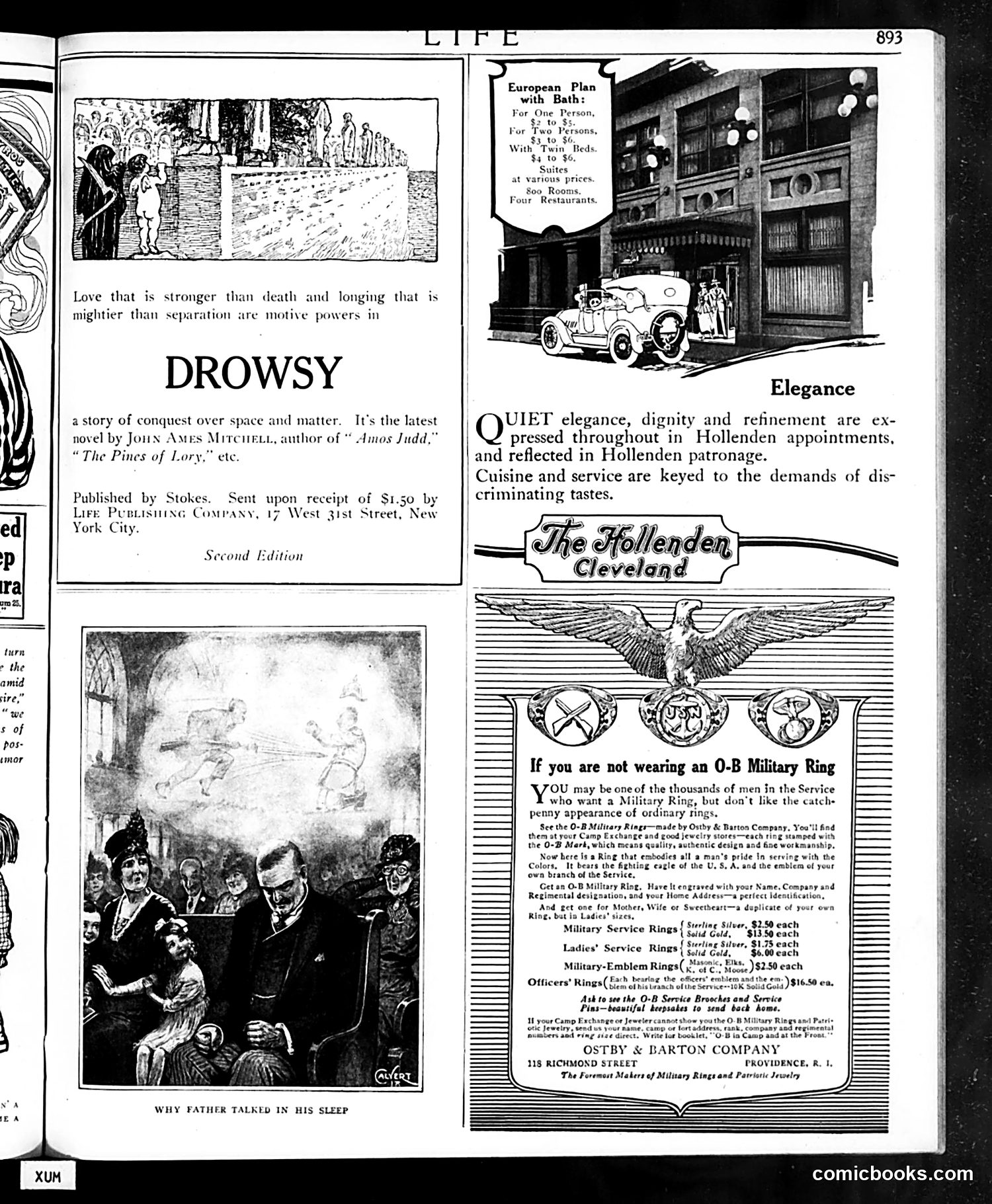
This page from *Life* magazine contains mostly **advertisements** interspersed with book promotion and a small illustration labeled "Why Father Talked in His Sleep" (bottom left). The ads target **World War I servicemen**: a military ring advertisement dominates the right side, marketing "O-B Military Rings" as quality keepsakes for soldiers to send home or wear themselves. The copy emphasizes authenticity and patriotism—rings bear the U.S. eagle and military branch emblems, available in various metals and prices. The left side advertises **"Drowsy,"** a novel by James Ames Mitchell about "conquest over space and matter," published by Stokes for $1.50. The illustration "Why Father Talked in His Sleep" appears to be a dark, satirical cartoon showing figures in what seems a domestic or fantastical scene, though details are unclear in this reproduction. The **Hollenden hotel advertisement** emphasizes "elegance" and refined dining—typical luxury hotel marketing of the era. Overall, the page reflects **wartime America**: patriotic messaging for servicemen mingles with peacetime commercial culture.
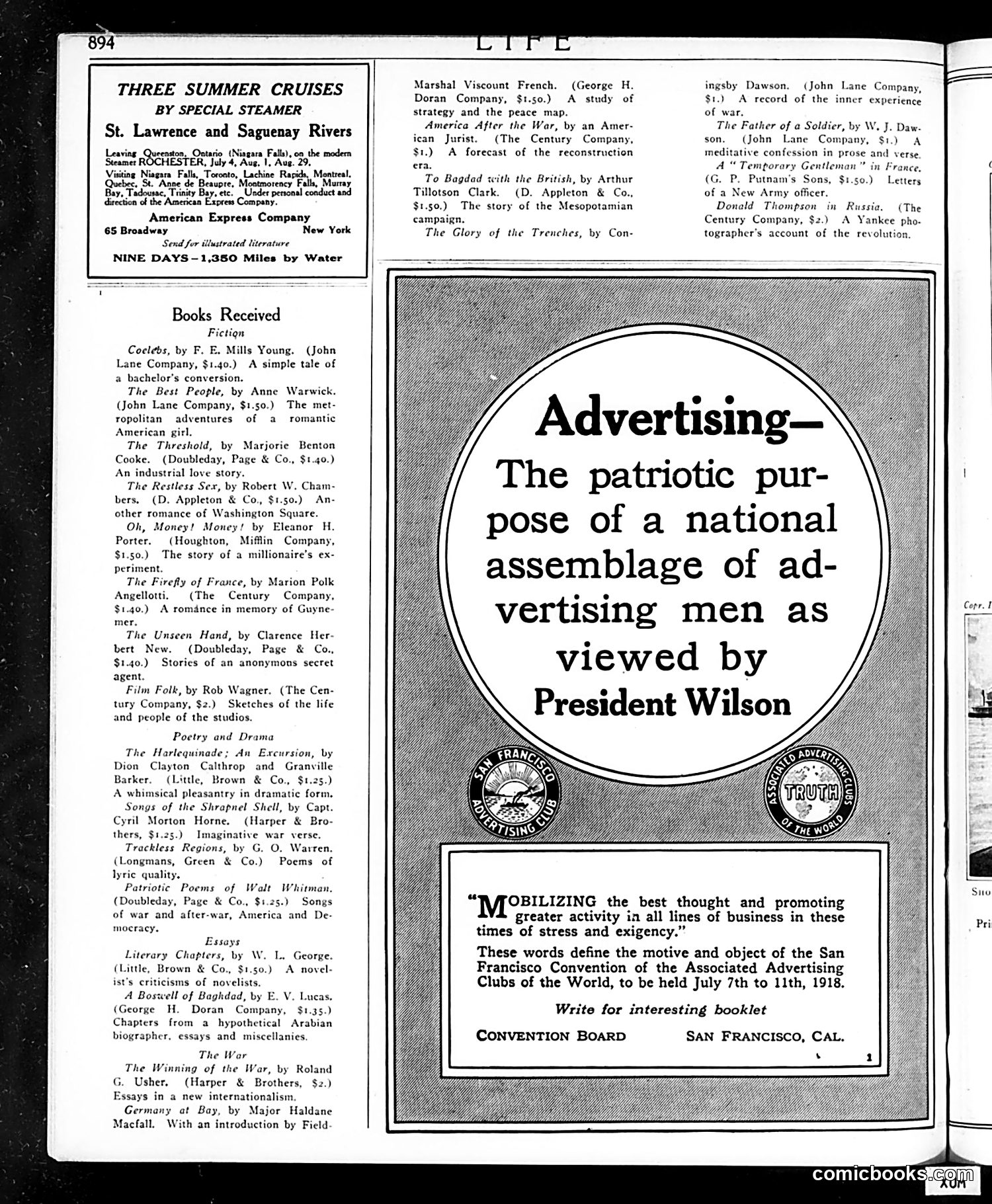
This page is primarily a **book review section and advertisements** from *Life* magazine, dated around 1918 (based on the advertising convention dates). The main visual element is a **full-page advertisement** for the San Francisco Convention of the Associated Advertising Clubs of the World (July 7-11, 1918). The ad presents a circular proclamation framed as if from **President Wilson**, claiming advertising serves the patriotic purpose of "mobilizing the best thought and promoting greater activity in all lines of business in these times of stress and exigency." **The satire**: The advertisement ironically frames commercial advertising as a patriotic wartime duty, quoting lofty language about national service. By attributing this viewpoint to President Wilson and surrounding it with official-looking seals ("Truth" and what appears to be a San Francisco seal), the ad humorously inflates the importance of advertising professionals, suggesting they're presenting self-interested business promotion as national patriotism during WWI. The book reviews listed emphasize war-related titles, reinforcing the wartime context of this jest about advertising's claimed patriotic value.
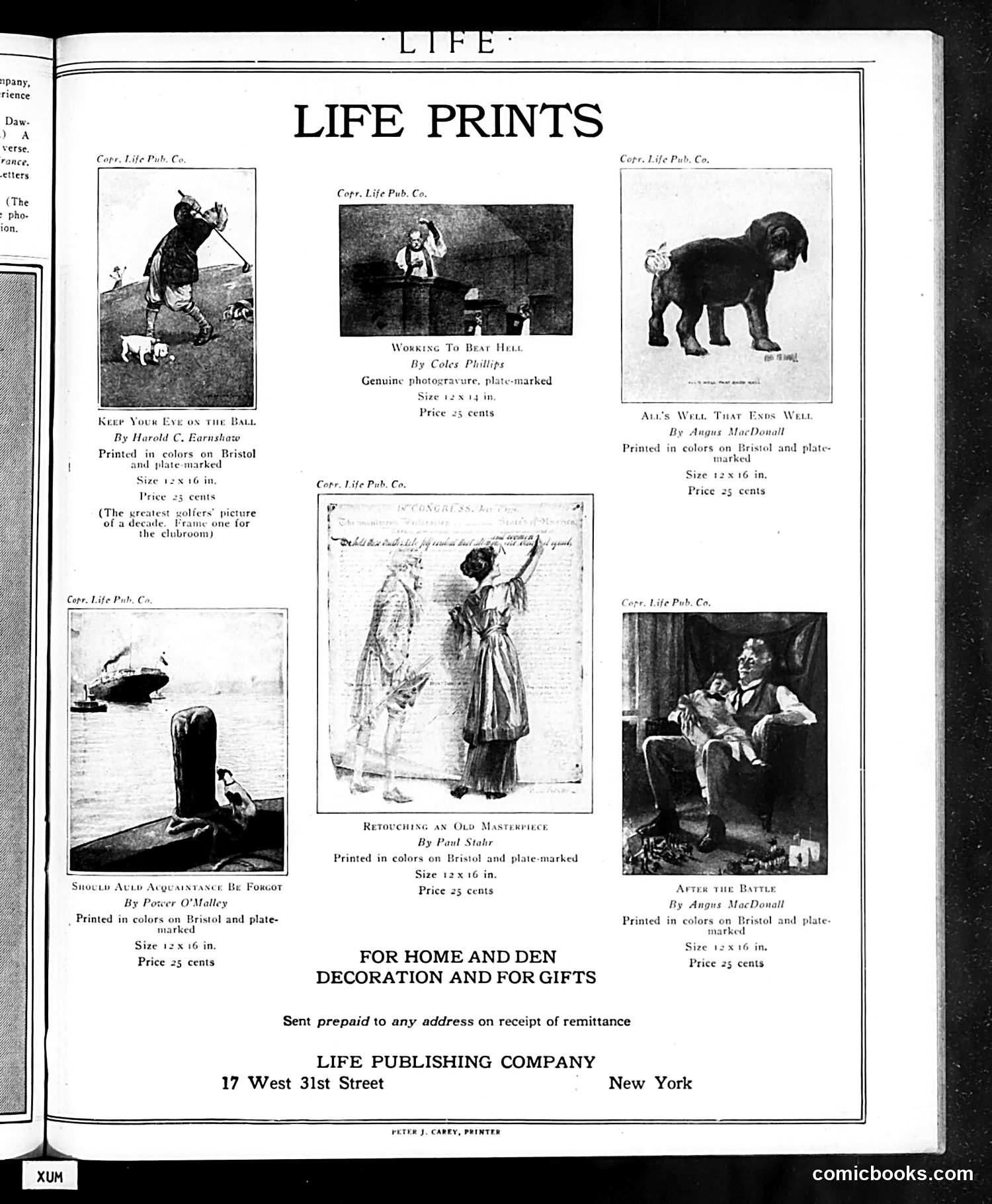
This is a **product advertisement**, not political satire. Life Publishing Company is selling decorative prints by various artists for home display, priced at 25 cents each. The page showcases six prints with titles like "Keep Your Eye on the Ball" (golf humor), "Working to Beat Hell" (work-life commentary), and "All's Well That Ends Well" (domestic scene). Artists credited include Harold Earnshaw, Coles Phillips, Paul Stahr, and Angus MacDonall. The prints appear to depict genteel domestic and leisure scenes typical of early 20th-century American middle-class life—golfing, social gatherings, and family moments. They're marketed as affordable art for "home and den decoration and for gifts," reflecting the era's commercialization of magazine content into home décor products. This represents Life magazine's business model: using its talented illustrators to create saleable merchandise beyond the publication itself.
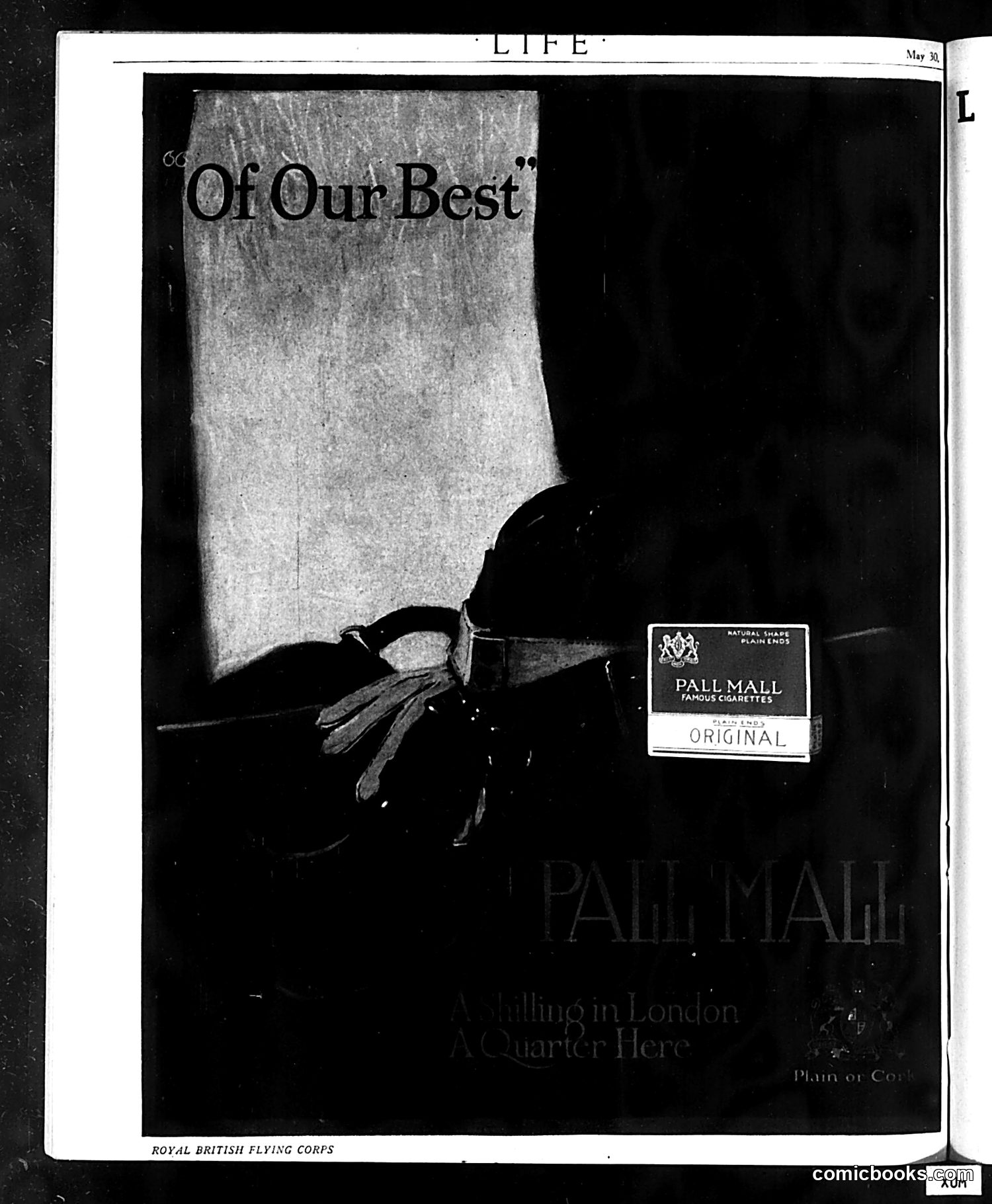
This page is primarily a **Pall Mall cigarette advertisement** rather than political satire. The image shows a silhouetted hand holding a cigarette pack against a light background, with the tagline "Of Our Best" at the top. The ad emphasizes "Original" and "Natural Shape Plain Ends" as selling points. The only non-advertising text references the "Royal British Flying Corps," suggesting this ad appeared in a publication with military readership or during a period when such references held cultural weight—likely early-to-mid 20th century. The page contains no political cartoons or satirical commentary visible. It's essentially a commercial placement in *Life* magazine's pages, using minimalist design and patriotic associations to market cigarettes to a British audience.