
Life, 1918-05-30 · page 11 of 36
Life — May 30, 1918 — page 11: what you’re looking at
What you’re looking at
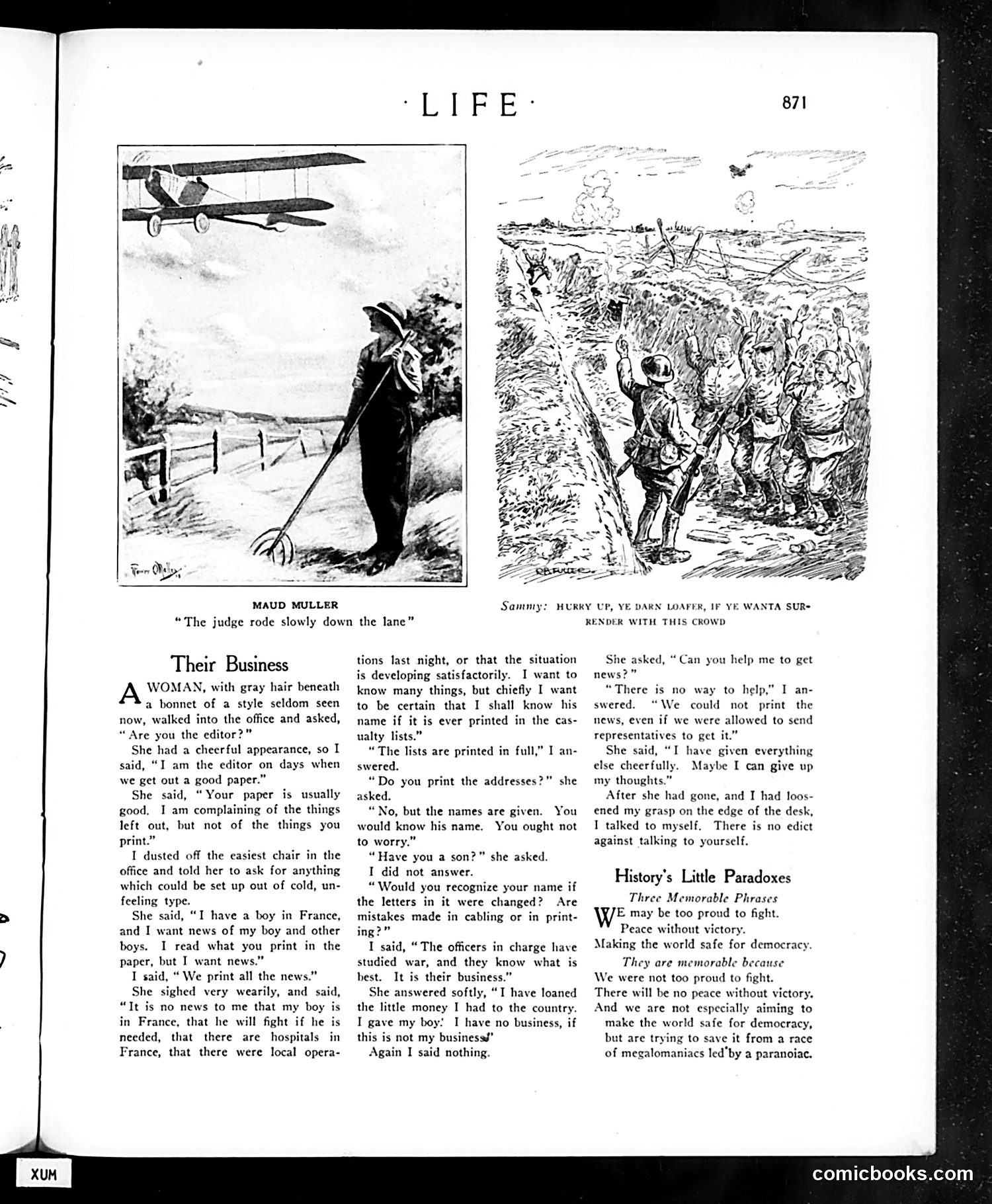
This page contains two cartoons and a short story titled "Their Business." **Left cartoon** by Maud Muller shows a man with a rake watching an airplane overhead, captioned "The judge rode slowly down the lane"—likely a playful reference to the famous poem "Maud Muller." **Right cartoon** depicts soldiers or workers addressing a crowd, with caption about "hurrying up, ye darn loafer, if ye wanna surrender with this crowd"—appearing to satirize World War I military recruitment or conscription pressure. **The story "Their Business"** concerns a newspaper editor's tense conversation with a woman seeking news about her son fighting in France. The editor refuses to print addresses or identifying details, citing military security, while the woman struggles with worry. This reflects WWI-era censorship and the emotional toll on families separated by war.
📄 Transcribed text from this page (OCR, searchable)
Machine-transcribed from the original scan — historical spelling and the odd misread are preserved.
MAUD MULLER Sammy: HURRY UP, YE DARN LOAFER, IF YE WANTA SUR- “The judge rode slowly down the lane” Their Business WOMA a bonnet of a style seldom seen now, walked into the office and asked, “Are you the editor?” She had a cheerful appearance, so I said, “I am the editor on days when we get out a good paper.” She said, “Your paper is usually good. I am complaining of the things left out, but not of the things you print.” I dusted off the easiest chair in the office and told her to ask for anything which could be set up out of cold, un- feeling type. She said, “I have a boy in France, and I want news of my boy and other boys. I read what you print in the paper, but I want news.” I said, “ We print all the news.” She sighed very wearily, and said, “Tt is no news to me that my boy in France, that he will fight if he is needed, that there are hospitals in France, that there were local opera- , with gray hair beneath tions last night, or that the situation is developing satisfactorily. I want to know many things, but chiefly I want to be certain that I shall know his name if it is ever printed in the cas- ualty lists.” “The lists are printed in full,” I an- swered, “Do you print the addresses?” she asked. “No, but the names are given. would know his name. to worry.” “Have you a son?” she asked. I did not answer. “Would you recognize your name if the letters in it were changed? Are mistakes made in cabling or in print- ing?” I said, “ The officers in charge have studied war, and they know what is best. It is their business.” She answered softly, “I have loaned the little money I had to the country. I gave my boy: I have no business, if this is not my businessd” Again I said nothing. You You ought not RENDER WITH THIS CROWD She asked, “Can you help me to get news?” “There is no way to help,” I an- swered. We could not print the news, even if we were allowed to send representatives to get She said, “I have given everything else cheerfully. Maybe I can give up my thoughts.” After she had gone, and I had loos- ened my grasp on the edge of the desk, I talked to myself. There is no edict against talking to yourself. History's Little Paradoxes Three Memorable Phrases WE may be too proud to fight. Peace without victory. Making the world safe for democracy. They are memorable because We were not too proud to fight. There will be no peace without victory. And we are not especially aiming to make the world safe for democracy, but are trying to save it from a race of megalomaniacs led’by a paranoiac. comicbooks.com