
Life, 1918-05-30 · page 17 of 36
Life — May 30, 1918 — page 17: what you’re looking at
What you’re looking at
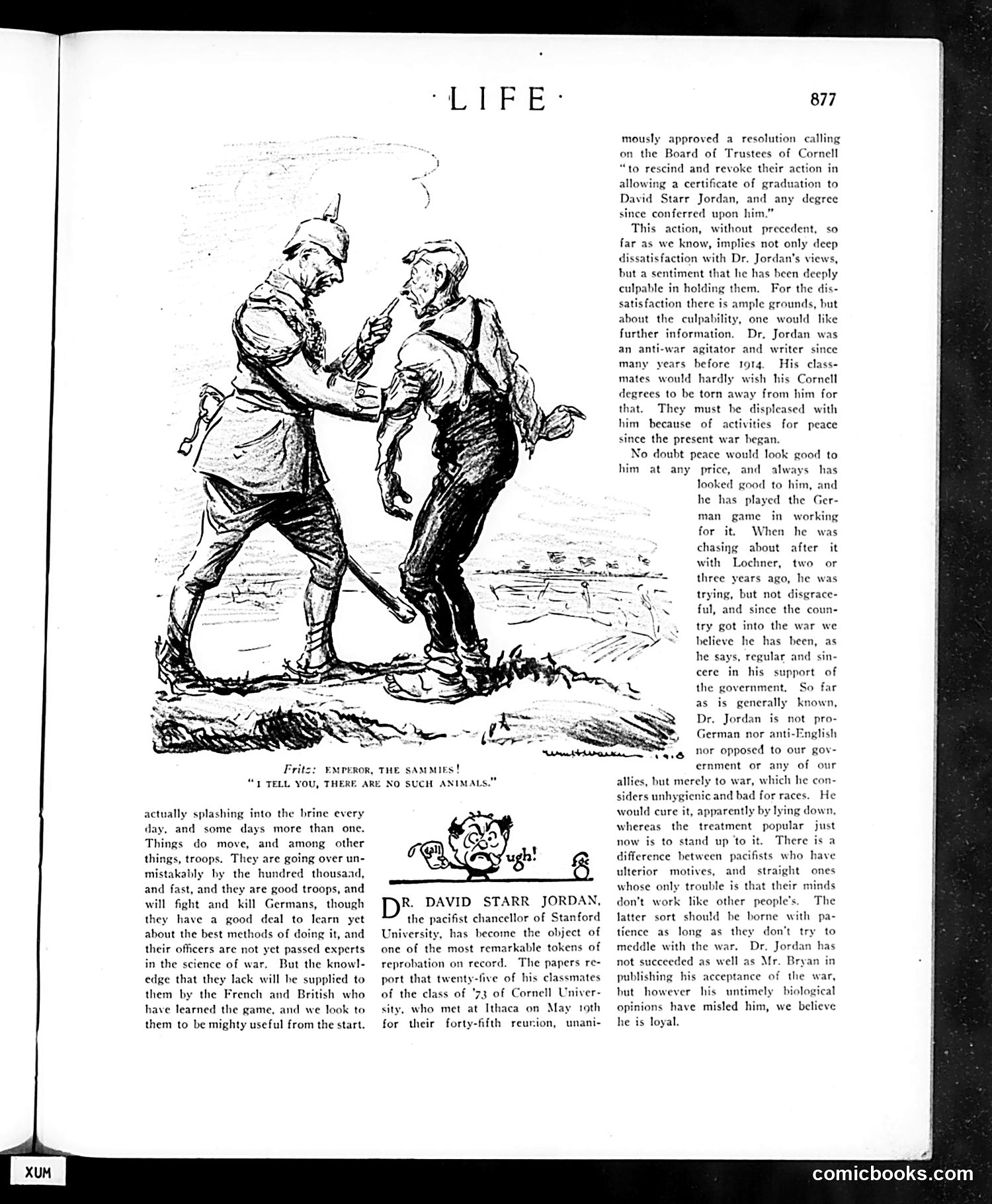
The cartoon depicts two military figures—one labeled "Fritz" (representing Germany) and one representing American forces ("the Sammies"). Fritz boasts "I tell you, there are no such animals," mocking American soldiers as inexperienced. The accompanying article addresses **David Starr Jordan**, pacifist chancellor of Stanford University. His Cornell University classmates (class of 1873) formally demanded the university revoke his degree—an unprecedented action. Their grievance: Jordan's peace activism during World War I, which the country had recently entered (1917). The magazine's stance is nuanced: it defends Jordan's right to hold pacifist views as a matter of conscience, but criticizes his wartime peace advocacy as misguided meddling. The piece distinguishes between sincere pacifists (whose "minds don't work like other people's") and those with ulterior motives, suggesting Jordan falls into the former category while remaining, ultimately, loyal to America.
📄 Transcribed text from this page (OCR, searchable)
Machine-transcribed from the original scan — historical spelling and the odd misread are preserved.
actually splashing into the brine every day, and some days more than one. Things do move, and among other things, troops. They are going over un- mistakably hy the hundred thousaad, and fast, and they are good troops, and will fight and kill Germans, though they have a good deal to learn yet about the best methods of doing it, and their officers are not yet passed experts in the science of war, But the knowl- edge that they lack will he supplied to them by the French and British who have learned the game, and we look to them to be mighty useful from the start. MPEROR, THE SAMMIES! “| TELL YOU, THERE ARE NO S IMALS.” R. DAVID STARR JORDAN, the pacifist chancellor of Stanford University, has become the object of one of the most remarkable tokens of reprobation on record. The papers re- port that twenty-five of his classmates of the class of '73 of Cornell Univer- sity, who met at Ithaca on May toth for their forty-fifth reurion, unani- mously approved a resolution calling on the Board of Trustees of Cornell “to rescind and revoke their action in allowing a certificate of graduation to David Starr Jordan, and any degree since conferred upon him.” This action, without precedent, so far as we know, implies not only deep dissatisfaction with Dr. Jordan's views, but a sentiment that he has been deeply culpable in holding them. For the dis- satisfaction there is ample grounds, but about the culpability, one would like further information. Dr, Jordan was an anti-war agitator and writer since many years before 1914. His class- mates would hardly wish his Cornell degrees to be torn away from him for that. They must be displeased with him because of activities for peace since the present war began. No doubt peace would look good to at any price, and always has looked good to him, and he has played the Ger- him man game in working for it. When he was chasing about after it with Lochner, two or three years ago, he was trying, but not disgrace- ful, and since the coun- try got into the war we believe he has been, as he says, regular and sin- cere in his support of the government. So far as is generally known, Dr. Jordan is not pro- German nor anti-English nor opposed to our gov- any of our ernment or allies, but merely to war, which he con- siders unhygienic and bad for races. He by lying down, would cure it, apparently whereas the treatment popular just now is to stand up ‘to it. There is a difference between pacifists who have ulterior motives, and straight ones whose only trouble is that their minds don’t work like other people's, The latter sort should be borne with pa- tience as long as they don't try to meddle with the war. Dr. Jordan has not succeeded as well as Mr. Bryan in publishing his acceptance of the war, but however his untimely biological opinions have misled him, we believe he is loyal. comicbooks.com