
Life, 1918-05-30 · page 28 of 36
Life — May 30, 1918 — page 28: what you’re looking at
What you’re looking at
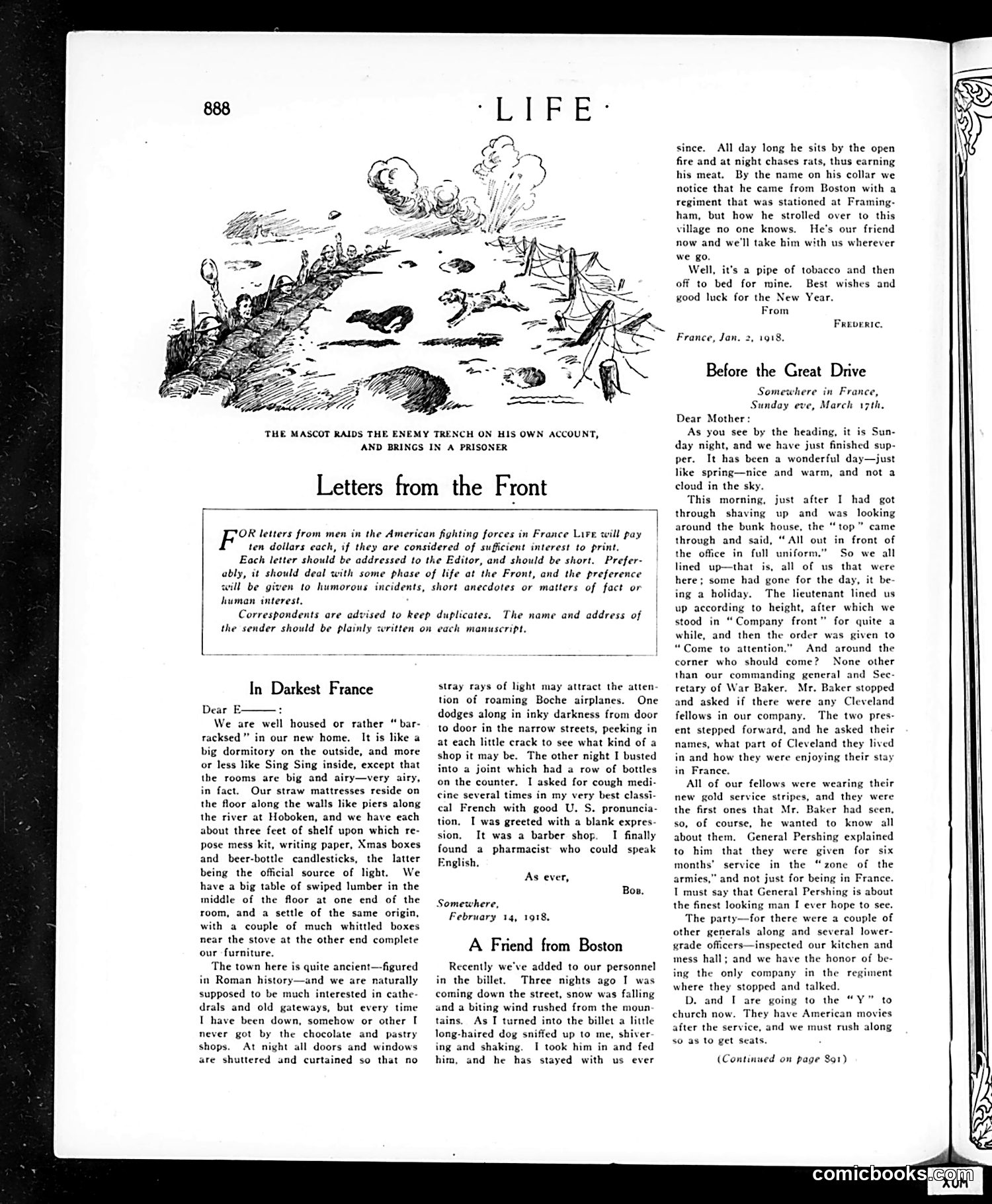
This page features **Letters from the Front**, a reader-submission section soliciting correspondence from American soldiers in France during World War I. Life offered ten dollars per published letter. The **cartoon** depicts a soldier's mascot dog raiding an enemy trench and capturing a prisoner—a humorous take on military heroics, with the small dog performing a brave soldier's duty. The **letters themselves** are personal accounts from soldiers describing daily life: barracks conditions, French villages, local customs (chocolate shops, barber shops), and human interest stories. One letter describes adopting a stray dog from Boston; another recounts pre-offensive preparations on the eve of what was likely the Spring 1918 German offensive. The satire is gentle—mocking the soldiers' occasional cultural confusion (the barber shop misidentification) and romanticizing their hardships as humorous anecdotes rather than tragedy. This reflects how American magazines of 1918 presented the war to the home front: as earnest but relatable, with touches of comedic relief rather than grim realism.
📄 Transcribed text from this page (OCR, searchable)
Machine-transcribed from the original scan — historical spelling and the odd misread are preserved.
THE MASCOT RAIDS THE ENEMY TRENCH ON HIS OWN ACCOUNT, AND BRINGS IN A PRISONER Letters from the Front OR letters from men in the American fighting forces in France Lire. will pay ten dollars each, if they are considered of suficient interest to print. Each letter should be addressed to the Editor, and should be short. Prefer ably, it should deal with some phase of life at the Front, and the preference will be given to humorous incidents, short anecdotes or matters of fact or human interest, Correspondents are advised to keep duplicates. The name and address of written on each manuscript, In Darkest France Dear E- : We are well housed or rather “ bar- racksed” in our new home. It is like a big dormitory on the outside, and more or less like Sing Sing inside, except that the rooms are big and airy—very airy, in fact. Our straw mattresses reside on the floor along the walls like piers along the river at Hoboken, and we have each about three feet of shelf upon which re- pose mess kit, writing paper, Xmas boxes and beer-bottle candlesticks, the latter being the official source of light. We have a big table of swiped lumber in the middle of the floor at one end of the room, and a settle of the same origin, with a couple of much whittled boxes near the stove at the other end complete our furniture, ‘The town here is quite ancient—figured in Roman history—and we are naturally supposed to be much interested in cathe- drals and old gateways, but every time I have been down, somehow or other [ never got by the chocolate and pastry shops. At night all doors and windows are shuttered and curtained so that no stray rays of light may attract the atten- tion of roaming Boche airplanes. One dodges along in inky darkness from door to door in the narrow streets, peeking in at each little crack to see what kind of a shop it may be. The other night I busted into a joint which had a row of bottles on the counter. I asked for cough medi- cine several times in my very best classi- cal French with good U. S. pronuncia- tion, I was greeted with a blank expres- sion, It was a barber shop. I finally found a pharmacist’ who could speak English. As ever, Bos. Somewhere, February 14, 1918, A Friend from Boston Recently we've added to our personnel in the billet. Three nights ago T was coming down the street, snow was falling and a biting wind rushed from the moun tains, As I turned into the billet a little long-haired dog sniffed up to me, shiver ing and shaking. I took him in and fed hira, and he has stayed with us ever since. All day long he sits by the open fire and at night chases rats, thus earning his meat. By the name on his collar we notice that he came from Boston with a regiment that was stationed at Framing- ham, but how he strolled over to this village no one knows. He's our friend now and we'll take him with us wherever we go. Well, it’s a pipe of tobacco and then off to bed for mine. Best wishes and good luck for the New Year. From Frevenic. France, Jan. 2, Before the Great Drive Somewhere in France, Sunday eve, March 17th. Dear Mother: As you see by the heading, it is Sun- day night, and we have just finished sup- per. It has been a wonderful day—just like spring—nice and warm, and not a cloud in the sky. This morning, just after I had got through shaving up and was looking around the bunk house, the “top” came through and said, “All out in front of the office in full uniform.” So we all lined up—that is, all of us that here; some had gone for the day, it be ing a holiday. The lieutenant lined us up according to height, after which we stood in “Company front" for quite a while, and then the order was given to “Come to attention.” And around the corner who should come? None other than our commanding general and Sec- retary of War Baker. Mr. Baker stopped and asked if there were any Cleveland fellows in our company. The two pr ent stepped forward, and he asked their names, what part of Cleveland they lived in and how they were enjoying their stay in France. All of our fellows were wearing their new gold service stripes, and they were the first ones that Mr. Baker had seen, so, of course, he wanted to know all about them. General Pershing explained to him that they were given for six months’ service in the “zone of the armies,” and not just for being in France. I must say that General Pershing is about the finest looking man I ever hope to see. The party—for there were a couple of other generals along and several lower- grade officers—inspected our kitchen and mess hall; and we have the honor of be- ing the only company in the regiment where they stopped and talked. D. and I are going to the “Y" to church now. They have American movies after the service, and we must rush along so as to get seats. 1918, were (Continued on page Sqr) comicbooksigong