
Life, 1918-05-30 · page 20 of 36
Life — May 30, 1918 — page 20: what you’re looking at
What you’re looking at
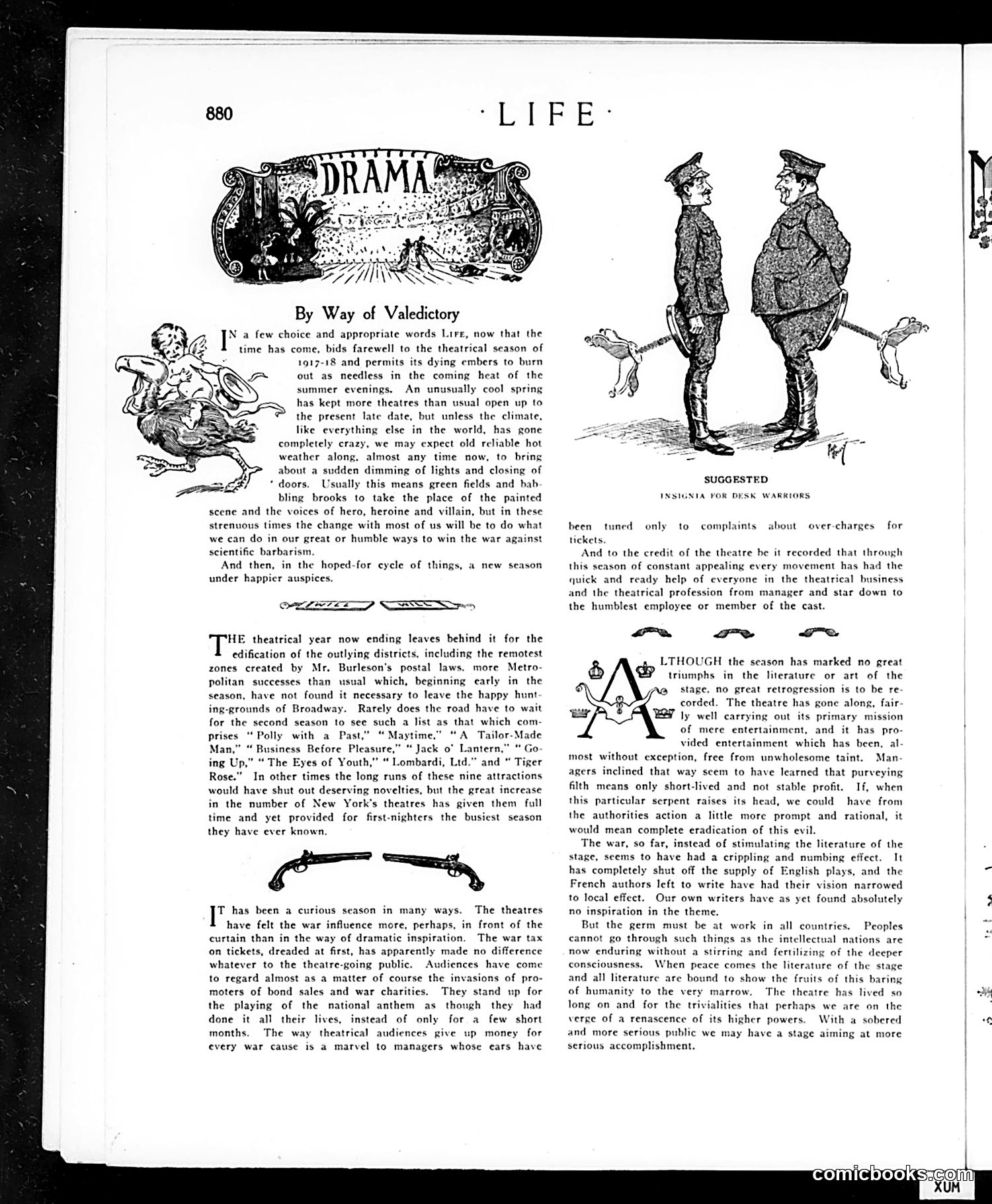
This is a theatrical review closing out Broadway's 1917-18 season during World War I. The small cartoon captioned "Suggested Insignia for Desk Warriors" depicts two military-uniformed men in conversation—likely satirizing civilians who avoided combat duty while remaining stateside. The main text celebrates that theaters stayed open longer than usual due to cool spring weather, and praises the theatrical season's productivity, noting nine successful Broadway productions. However, the author critiques the war's cultural impact: English plays dried up, and American writers produced uninspired work. The page acknowledges audiences' patriotic acceptance of war bond drives and national anthem performances. It credits the theater industry for supporting war causes generously, though some managers previously complained about ticket price increases. The overall tone is valedictory—bidding farewell to the season while expressing hope for better theatrical art post-war, suggesting the conflict has temporarily dampened creative achievement rather than inspiring it.
📄 Transcribed text from this page (OCR, searchable)
Machine-transcribed from the original scan — historical spelling and the odd misread are preserved.
By Way of Valedictory a few choice and appropriate words Lire, now that the time has come, bids farewell to the theatrical season of 1917-18 and permits its dying embers to burn out as needless in the coming heat of the summer evenings. An unusually cool spring has kept more theatres than usual open up to the present late date, but unless the climate, like everything else in the world, has gone completely crazy, we may expect old reliable hot weather along, almost any time now, to bring about a sudden dimming of lights and closing of * doors. Usually this means green fields and bab bling brooks to take the place of the painted scene and the voices of hero, heroine and villain, but in these strenuous times the change with most of us will be to do what we can do in our great or humble ways to win the war against scientific barbarism. And then, in the hoped-for cycle of things under happier auspices. ORES SSS a new season HE theatrical year now ending leaves behind it for the edification of the outlying districts, including the remotest zones created by Mr. Burleson’s postal laws. more Metro- politan successes than usual which, beginning carly in the season, have not found it necessary to leave the happy hunt ing-grounds of Broadway. Rarely does the road have to wait for the second season to see such a list as that which com- prises “Polly with a Past,” “ Maytim A. Tailor-Made Man,” “Business Before Pleasure,” "Jack 0’ Lantern,” “Go ing Up,” “ The Eyes of Youth,” “ Lombardi, Ltd.” and “ Tiger Rose.” In other times the long runs of these nine attractions would have shut out deserving novelties, but the great increase in the number of New York’s theatres has given them full time and yet provided for first-nighters the busiest season they have ever known, T has been a curious season in many ways. The theatres have felt the war influence more, perhaps, in front of the curtain than in the way of dramatic inspiration. The war tax on tickets, dreaded at first, has apparently made no difference whatever to the theatre-going public. Audiences have come to regard almost as a matter of course the invasions of pro- moters of bond sales and war charities. They stand up for the playing of the national anthem as though they had done it all their lives, instead of only for a few short months. The way theatrical audiences give up money for every war cause is a marvel to managers whose eats have SUGGESTED INSIGNIA FOR DESK WARKIORS been tuned only to complaints about over-charges for tickets. And to the credit of the theatre be it recorded that through this season of constant appealing every movement has had the quick and ready help of everyone in the theatrical business and the theatrical profession from manager and star down to the humblest employee or member of the cast. row Fo fu LTHOUGH the season has marked no great b> ASP triumpns in the Inerature or art of the Ag stage, no great retrogression is to be re corded. The theatre has gone along, fair ly well carrying out its primary mission of mere entertainment, and it has pro- vided entertainment which has been, al- most without exception, free from unwholesome taint. M agers inclined that way scem to have learned that purveying filth means only short-lived and not stable profit. If, when this particular serpent raises its head, we could have from the authorities action a little more prompt and rational, it would mean complete eradication of this evil. The war, so far, instead of stimulating the literature of the stage, seems to have had a crippling and numbing effect. It has completely shut off the supply of English plays, and the French authors left to write have had their vision narrowed to local effect. Our own writers have as yet found absolutely no inspiration in the theme. But the germ must be at work in all countries. Peoples cannot go through such things as the intellectual nations are now enduring without a stirring and fertilizing of the deeper consciousness. When peace comes the literature of the stage and all literature are bound to show the fruits of this baring of humanity to the very marrow, The theatre has lived so long on and for the trivialities that perhaps we are on the verge of a renascence of its higher powers. With a sobered and more serious public we may have a stage aiming at more serious accomplishment.