
A complete issue · 40 pages · 1918
Life — May 23, 1918
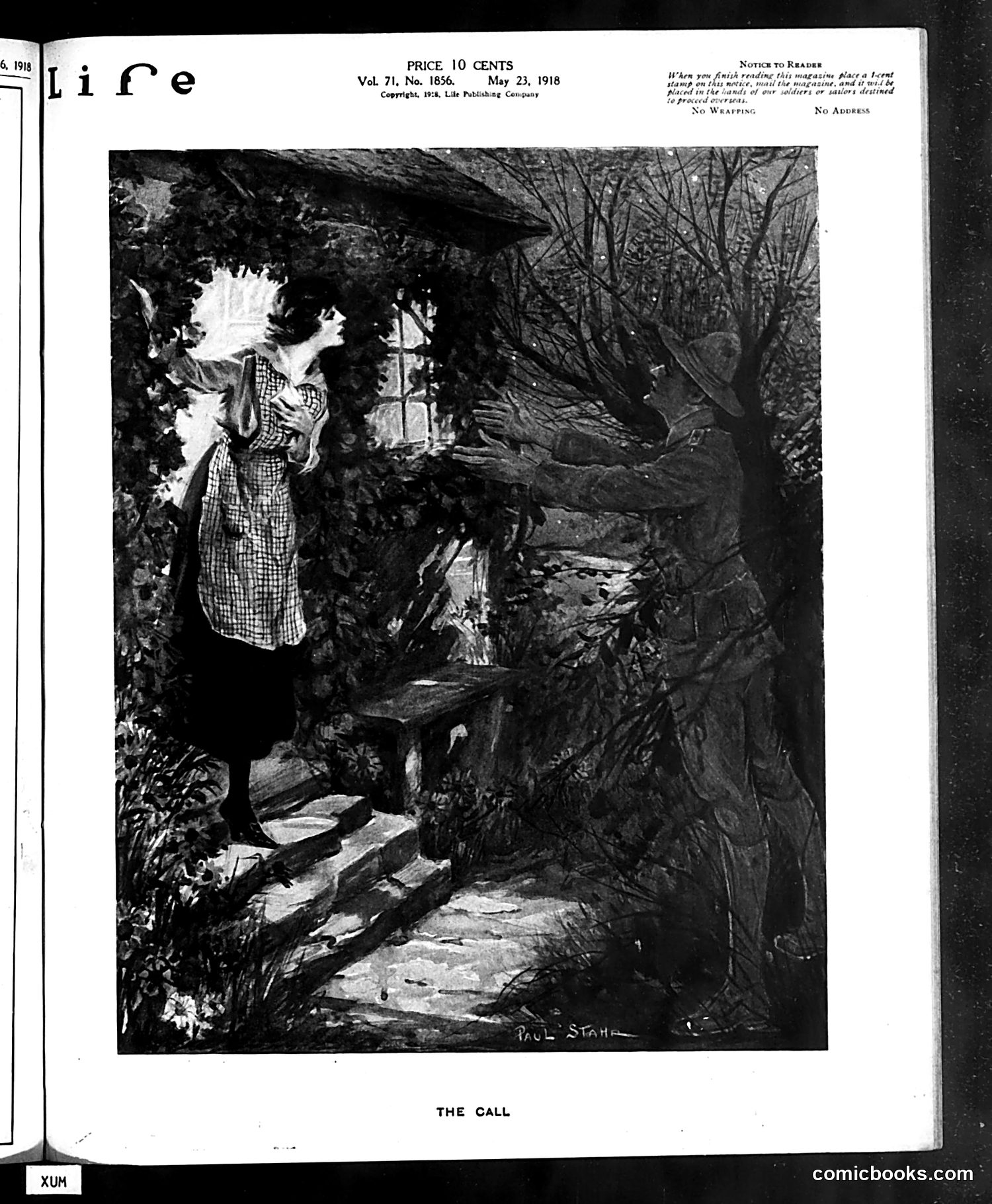
This illustration by Paul Stahl depicts two figures in a wooded setting. A woman in a checkered dress stands on the left, while a man in dark clothing reaches toward her from the right. The title "The Call" suggests a romantic or summoning theme. Given the magazine's May 1918 publication date (during World War I), this likely carries wartime significance. The "call" probably references the military draft or enlistment appeals common during this period. The woman's posture—appearing to respond or beckon—and the man's outstretched gesture suggest themes of duty, patriotism, or romantic entanglement intertwined with wartime obligation. Without additional context, the specific satirical point remains unclear, though it likely comments on how war affected civilian life and relationships.
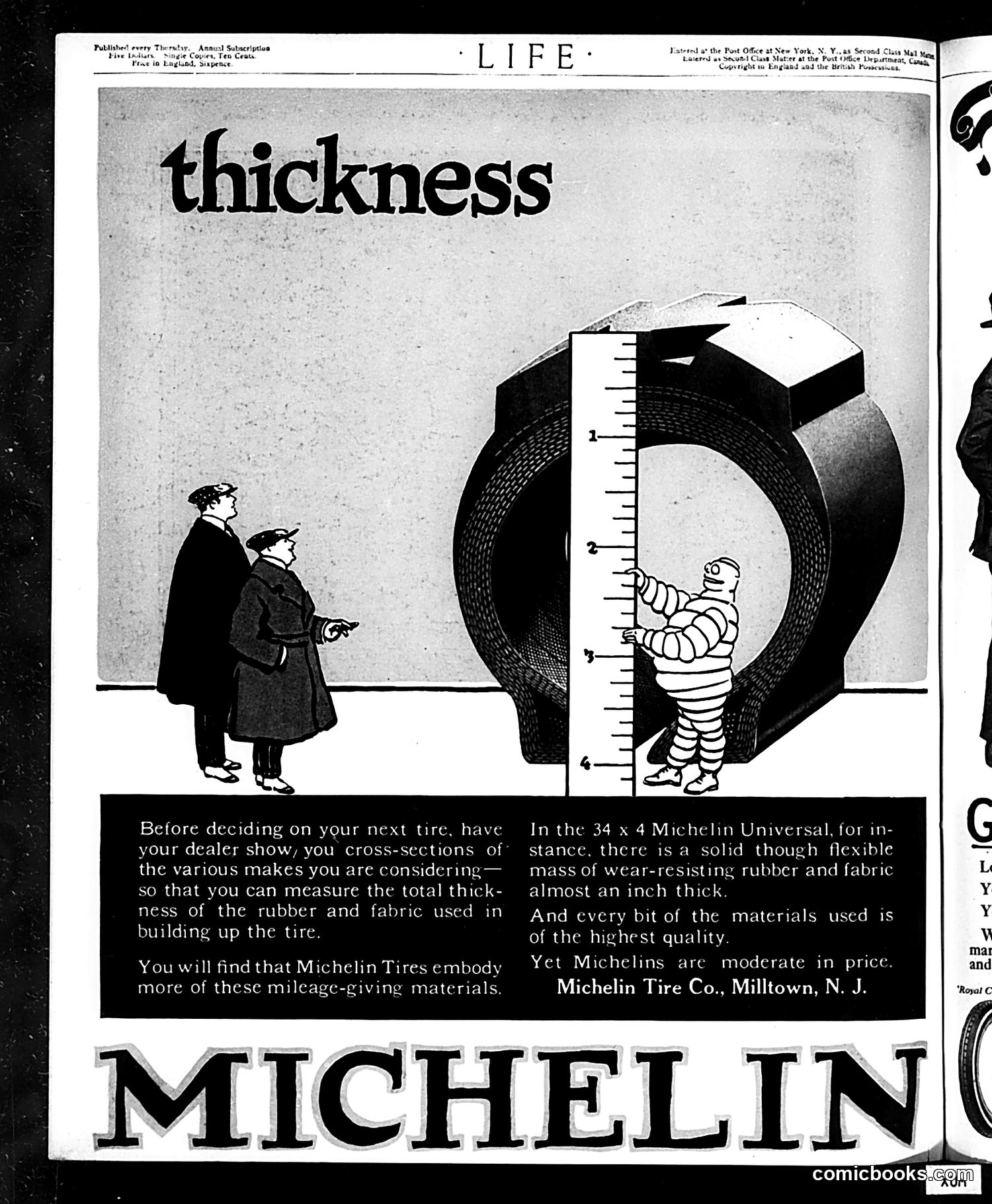
This is a straightforward **product advertisement**, not satire or political commentary. It promotes Michelin tires by emphasizing their superior construction and durability. The visual metaphor shows two men in formal attire examining a giant cross-section of a tire through a measurement scale. A bundled figure (the "Michelin Man" mascot) stands inside the tire opening, illustrating its interior thickness and quality materials. The advertisement's main argument: consumers should ask tire dealers to show cross-sections of competing brands so they can compare rubber and fabric thickness. Michelin claims their 34x4 Universal tire contains more high-quality wear-resistant materials than competitors, while remaining "moderate in price." This represents typical early-20th-century advertising strategy: technical specifications and direct brand comparison to establish product superiority.
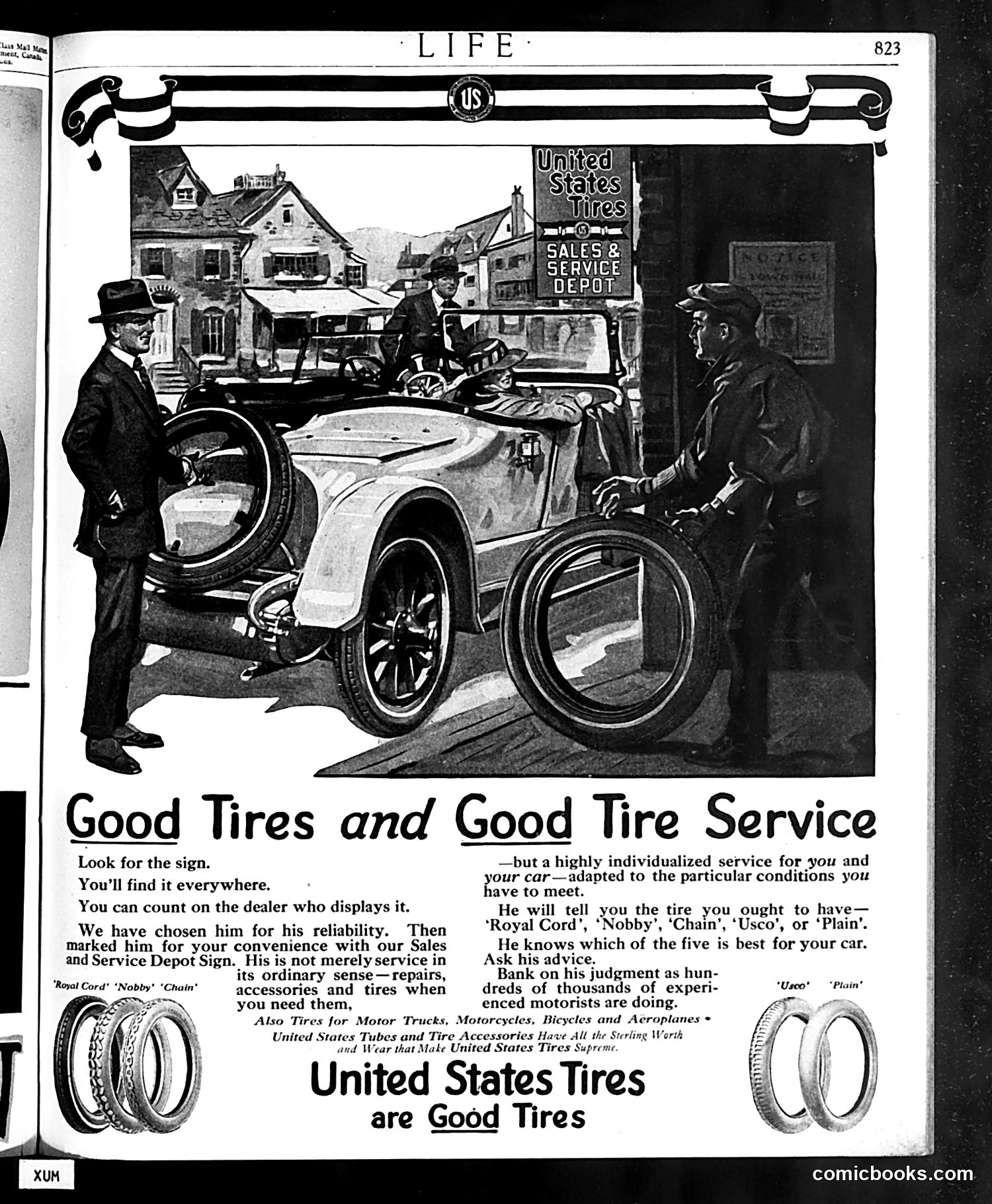
This is primarily a **United States Tires advertisement**, not a political cartoon. The page (No. 823 from Life magazine) promotes tire sales and service through a commercial message, not satire. The advertisement depicts a straightforward sales scenario: well-dressed men (likely salesmen or customers) examine tires at a "United States Tires Sales & Service Depot." The image emphasizes reliability and personalized service—the dealer will recommend appropriate tire types ('Royal Cord', 'Nobby', 'Chain', 'Usco', or 'Plain') based on individual driving conditions. The text stresses dealer trustworthiness and the company's experience serving "hundreds of thousands of experienced motorists." This is standard early 20th-century advertising copy emphasizing brand reliability rather than political or social commentary.
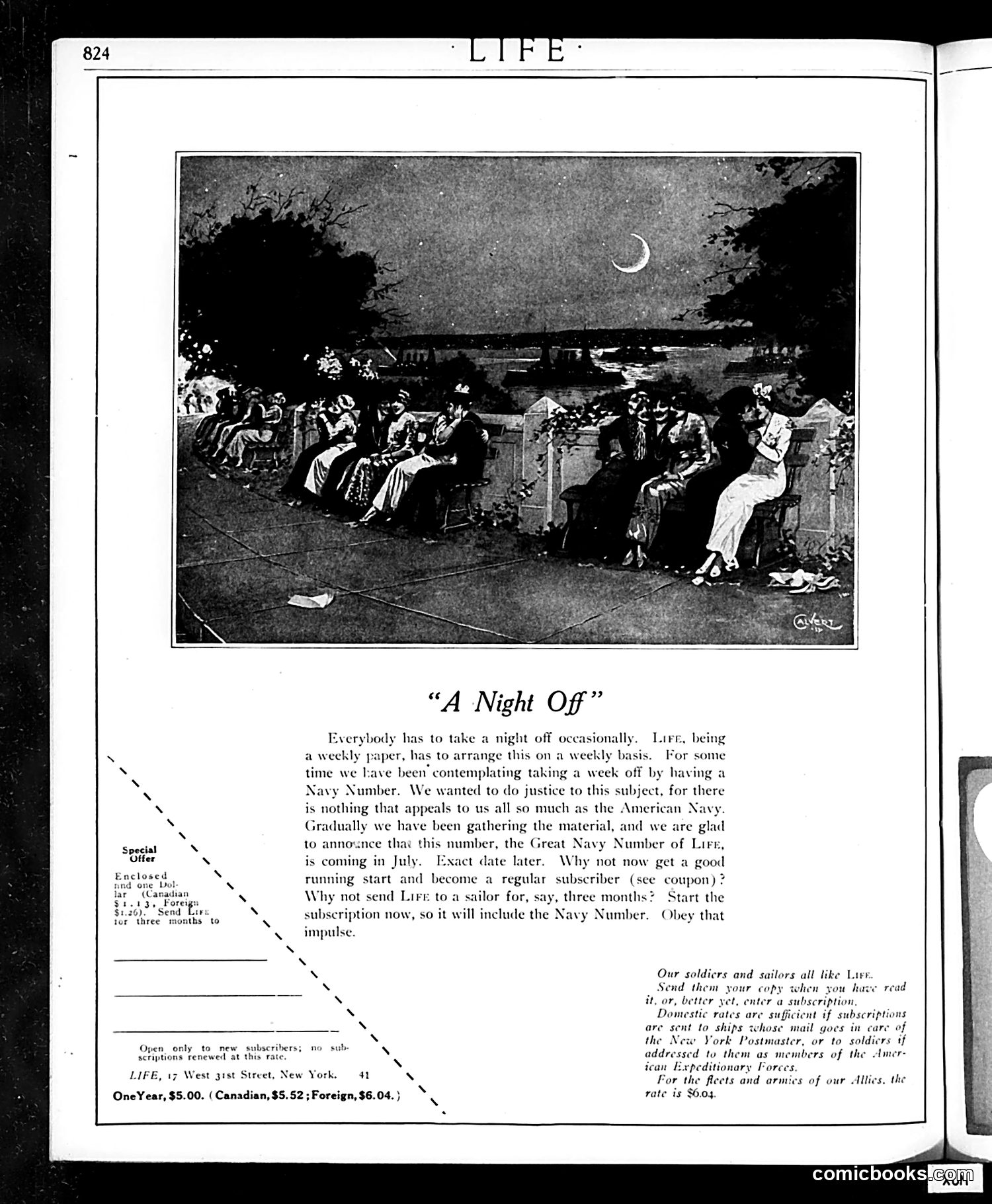
This page is primarily a **subscription advertisement for Life magazine**, not a political cartoon. The illustration depicts a nighttime outdoor social gathering of well-dressed people relaxing together under a crescent moon. The accompanying text uses this scene to pitch subscriptions, particularly targeting Navy personnel and soldiers. The advertisement emphasizes that Life magazine provides necessary leisure reading for busy professionals who need occasional breaks. It specifically encourages readers to subscribe themselves or gift subscriptions to sailors and soldiers, promoting Life as appealing entertainment for American military personnel during what appears to be the World War I era (based on references to "Navy Number" coming in July). The rates listed are one year for $5.00 domestically.
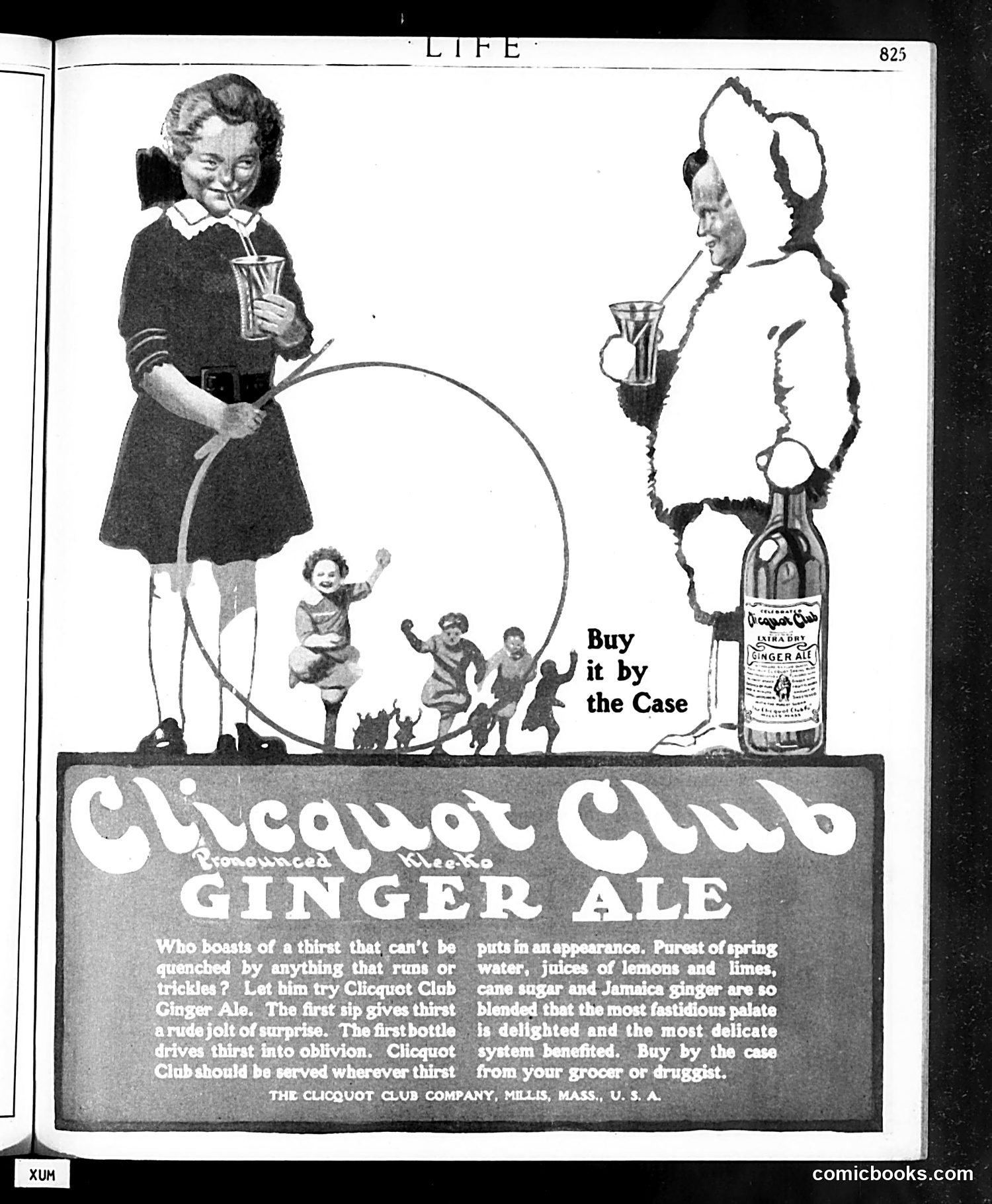
This is a product advertisement rather than political satire. It promotes Clicquot Club Ginger Ale, manufactured by The Clicquot Club Company in Mills, Massachusetts. The ad uses a playful visual metaphor: a woman holding a jump rope with children jumping through it, alongside a bottle of the beverage. The accompanying text employs humor to market the drink, claiming it quenches thirst more effectively than anything else and boasting of its ingredients—spring water, lemon juice, cane sugar, and Jamaica ginger. The phrase "Buy it by the Case" encourages bulk purchasing, likely targeting families or businesses. The overall tone appeals to thirst and refreshment, positioning the product as an essential household item of the era.
This page is **advertising, not editorial content or satire**. It's a full-page advertisement for the Packard Motor Car Company of Detroit, highlighting the company's qualities: engineering knowledge, shop experience, manufacturing facilities, factory methods, business practices, countrywide service, and organizational principles based on "Americans First." The advertisement uses a shield emblem (Packard's logo) and appeals to potential buyers by suggesting they should "ask the man who owns one"—a famous Packard slogan. The page emphasizes that 40,000 owners attest to the car's quality. There is no political cartoon or satire here; this is straightforward early 20th-century automotive marketing designed to build brand prestige and consumer confidence through claims of American excellence and craftsmanship.
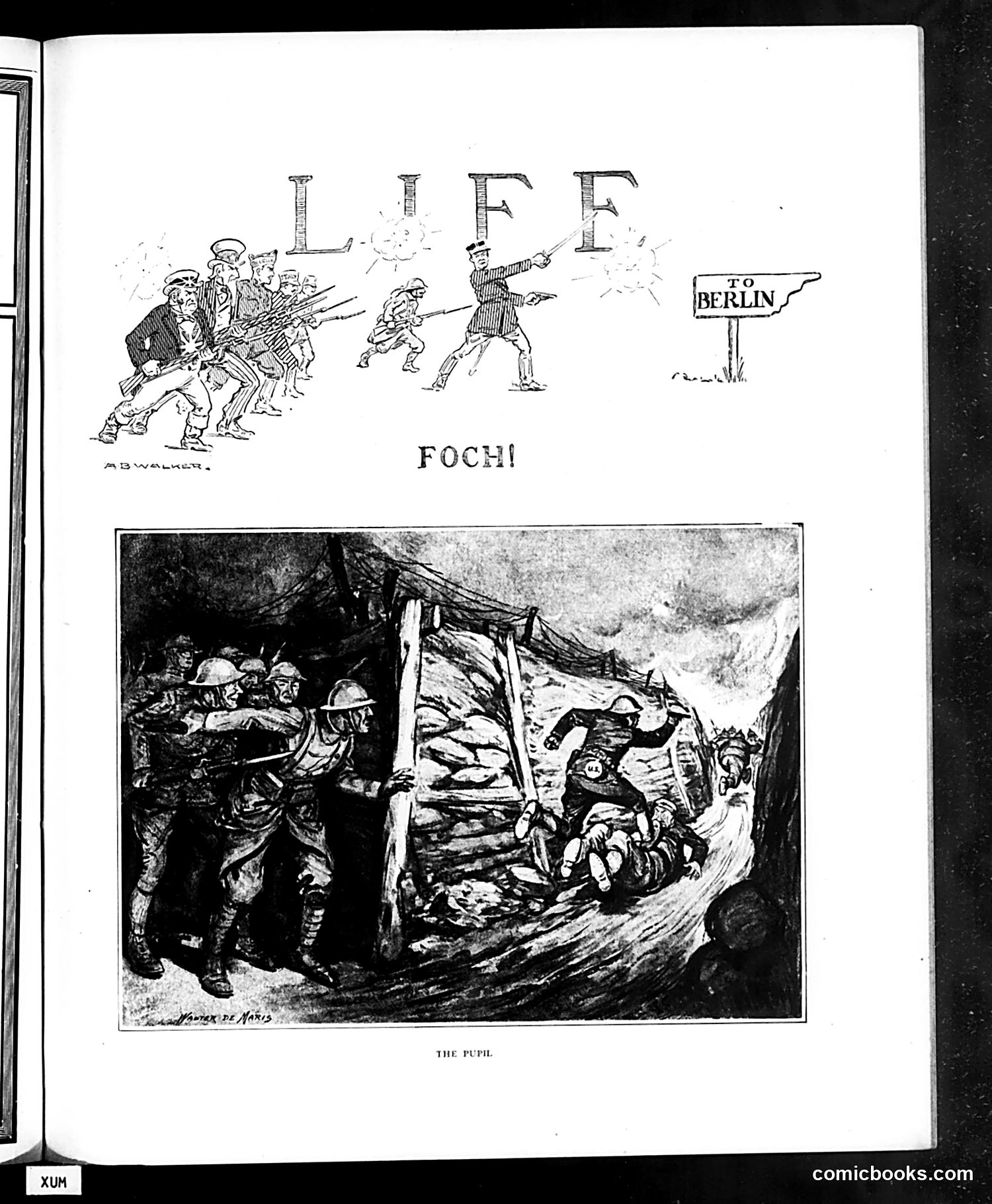
This page contains two satirical pieces about World War I: **Top cartoon** (signed "Abalmen"): Shows Allied soldiers chasing a fleeing German figure toward a signpost reading "TO BERLIN." The satire depicts the military push toward Germany's capital, likely from 1918 when Allied forces advanced on the Western Front. **Bottom illustration** (signed "James H. Nano"): Titled "The Pupil," shows soldiers in a trench or dugout. The context is unclear without additional text, but appears to depict military instruction or combat instruction within the war. Both pieces use satirical humor typical of *Life* magazine's WWI-era commentary, mocking German military efforts while celebrating Allied advancement. The overall page theme emphasizes the trajectory toward Berlin and German defeat.
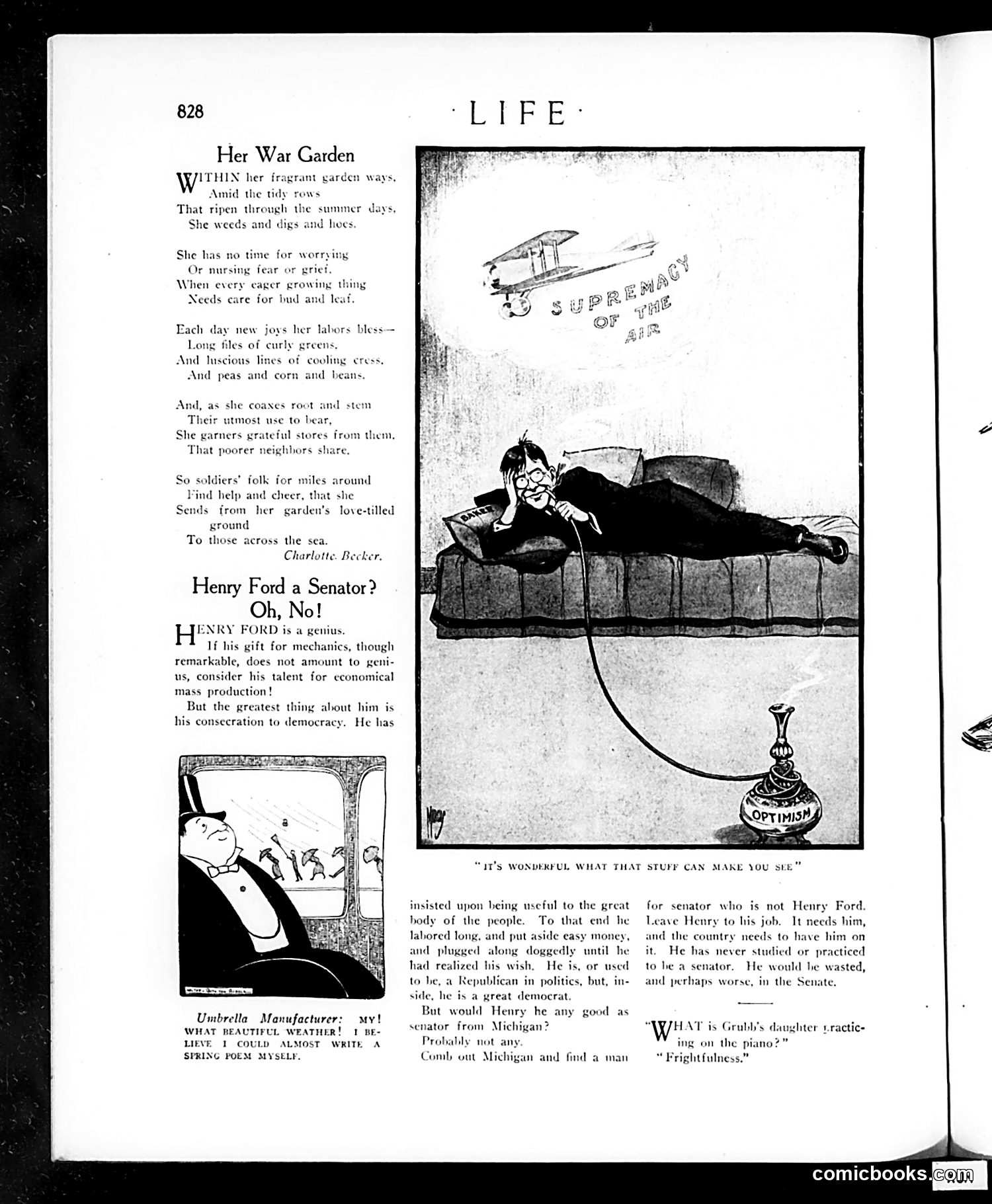
This page contains two distinct pieces: **"Her War Garden"** (left): A poem by Charlotte Becker celebrating women's home gardening efforts during wartime, presented as patriotic contribution to the war effort. **"Henry Ford a Senator? Oh, No!"** (center-right): A satirical piece questioning whether Henry Ford should become a U.S. Senator. The text acknowledges Ford's genius for manufacturing and democratic ideals, but argues he lacks the qualifications and temperament needed for political office. The cartoon depicts a caricatured figure lounging in bed with an "Optimism" bottle, suggesting overconfidence or naïveté about politics. **"Umbrella Manufacturer"** (bottom left): A brief joke about weather and umbrella sales. **"Grabby's daughter"** (bottom right): A separate joke about piano practice. The page appears from World War I era, given the war garden reference and Ford's prominence in that period.
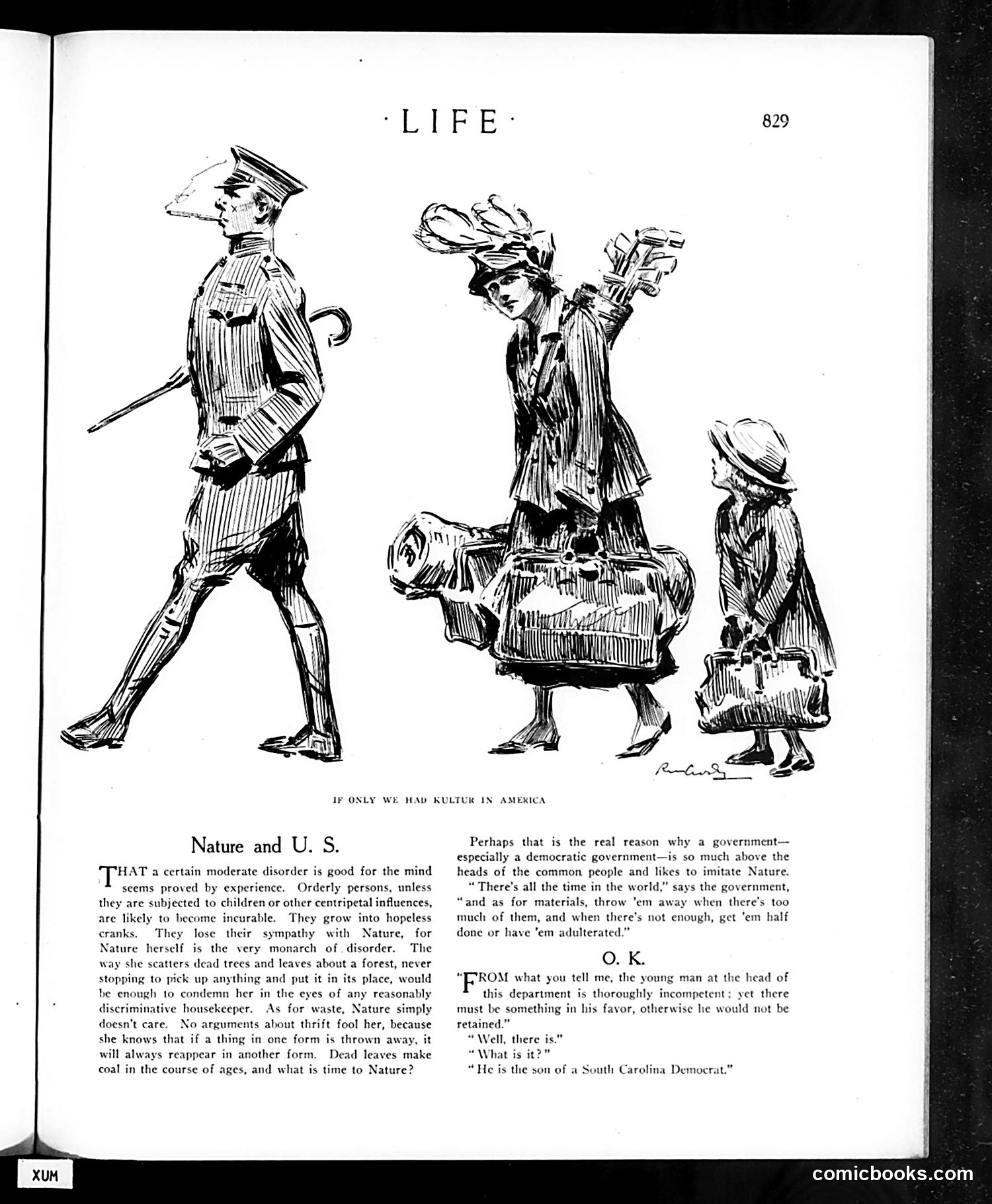
**The Cartoon:** The illustration titled "If Only We Had Kultur in America" depicts three figures carrying luggage, appearing to represent European immigrants or travelers. The visual satire mocks American cultural pretensions by contrasting "Kultur" (a German-influenced concept of high culture) with American attitudes. **The Text:** The article "Nature and U.S." criticizes Americans for losing sympathy with nature due to urban overcrowding and waste. It suggests democratic governments imitate nature's indifference to disorder. The dialogue "O.K." jokes that a young government official retains his position despite incompetence because his father is "a South Carolina Democrat"—satirizing political nepotism and patronage in early 20th-century American politics. **Overall Point:** The page critiques American materialism, poor environmental stewardship, and corruption through patronage.
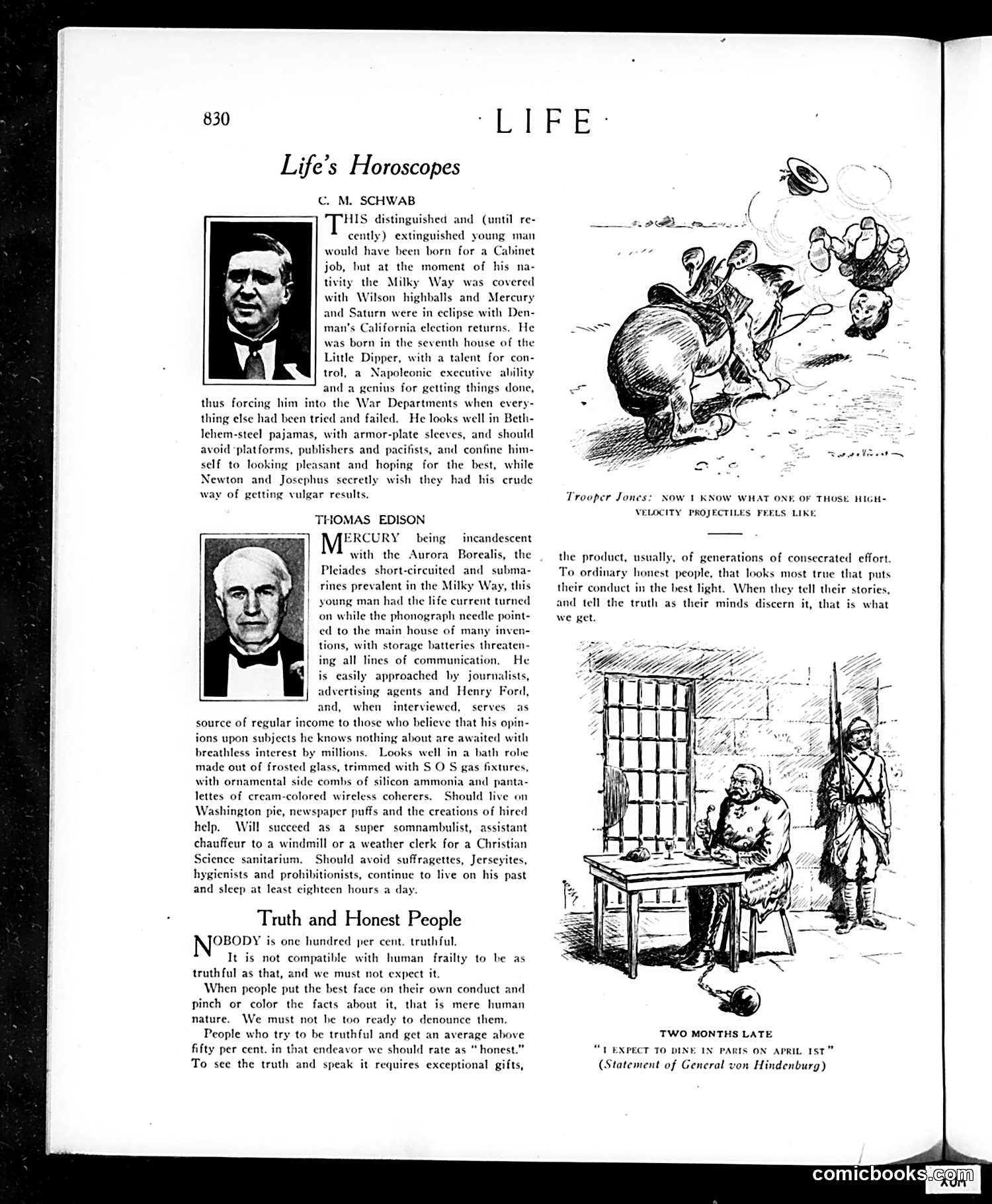
This page contains two sections: biographical sketches of prominent figures and satirical cartoons. **Top cartoon** ("Trooper Jones") depicts a soldier experiencing the shock of artillery fire—the humor derives from his shocked expression upon understanding the violent reality of warfare versus expectations. **Bottom cartoon** ("Two Months Late") shows a prisoner or detainee with guards, captioned with a statement attributed to General von Hindenburg about dining in Paris on April 1st. This references Germany's failed WWI offensive expectations—the satire mocks the gap between German military confidence and actual outcomes. The page also profiles Thomas Edison with praise for his accessibility to journalists, contrasting with a section on "Truth and Honest People" that critiques how society treats those attempting truthfulness. The overall theme appears to be wartime commentary mixed with profiles of American innovators.
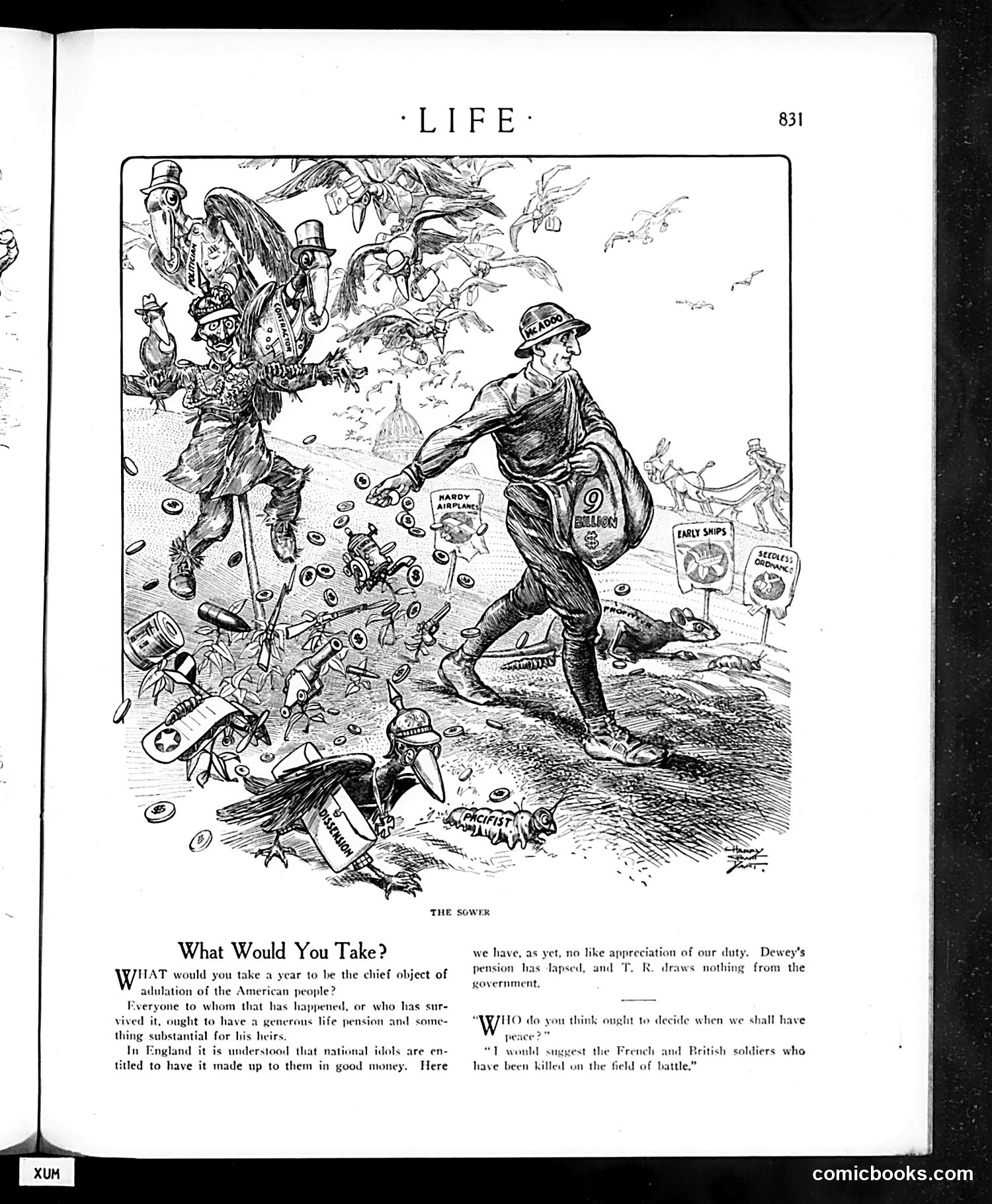
This satirical cartoon depicts a man sowing seeds labeled with various concepts (appearing to include "Hardy Airplane," "Early Ships," and "Pacifist" among others) while fantastical figures above harvest money and goods. The title "The Sower" suggests ironic commentary on American spending priorities. The accompanying text discusses pensions for war heroes and asks what the chief object of American taxation should be. One response advocates for pensions for "national idols" and references England's practice. Another, attributed to "French and British soldiers who have been killed on the field of battle," sarcastically suggests they should decide when peace comes. The cartoon appears to satirize how American tax money is distributed—between military/industrial projects and social obligations to veterans—during or after World War I.
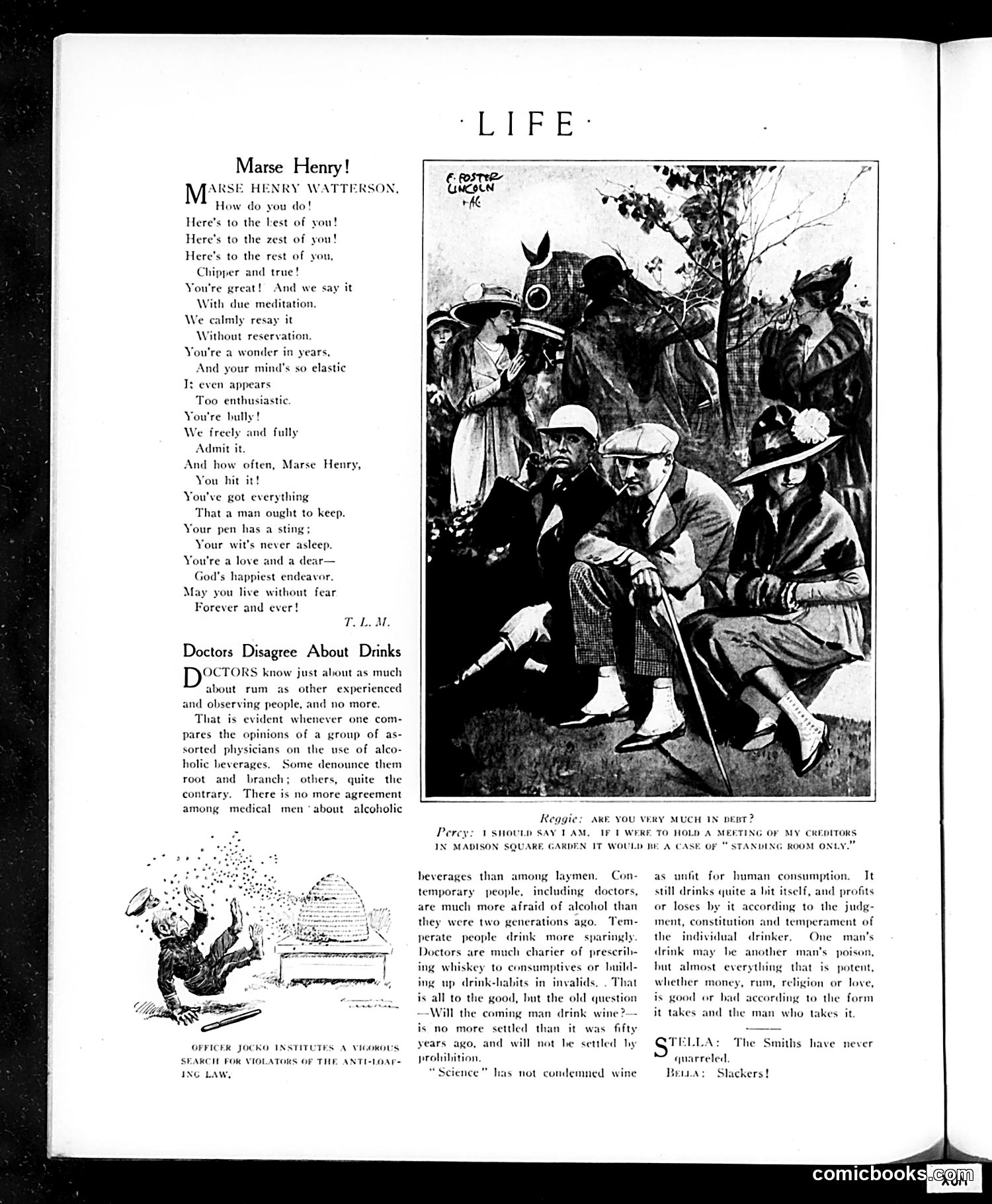
This page from *Life* magazine contains two separate items: **"Marse Henry!"** (top left) is a humorous poem celebrating someone named Henry Watterson, likely the prominent Kentucky newspaper editor and public figure. The verse praises his wit, pen, personality, and romantic appeal—a lighthearted tribute using exaggerated Southern dialect ("Marse Henry"). **"Doctors Disagree About Drinks"** (bottom) discusses medical disagreement over alcohol consumption. The accompanying illustration shows working-class men drinking, while the text notes physicians' conflicting views on whether alcohol is harmful. The piece references Prohibition-era debates about alcohol's health effects, noting doctors' varying positions contradict earlier medical consensus against drinking. The cartoon labeled "Reggie" depicts working-class figures in conversation, likely satirizing social pretension or class-conscious speech patterns.
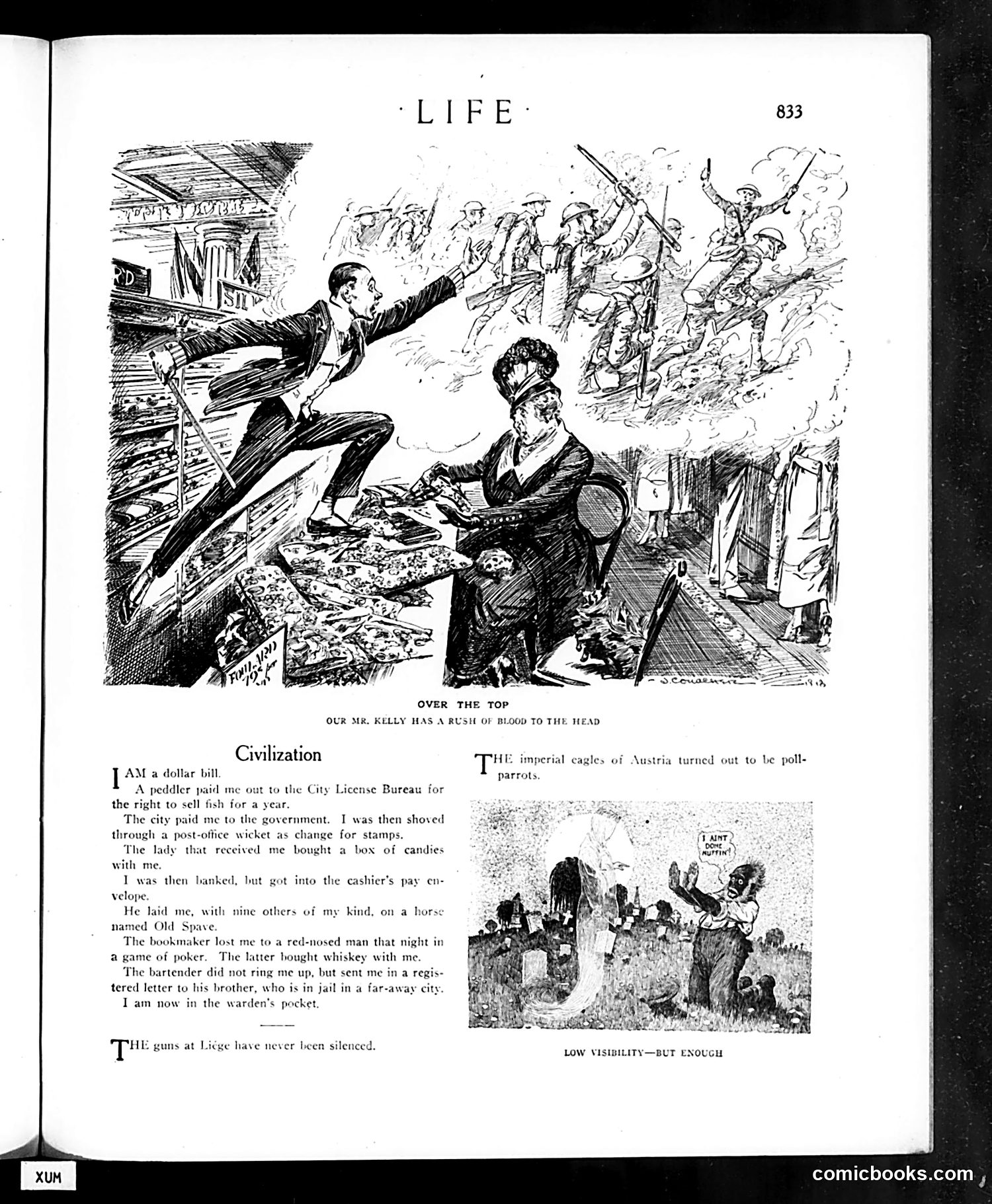
**The Top Cartoon:** This depicts a man in formal dress leaping energetically while gesturing toward soldiers in combat, with a woman seated nearby. The caption "Over the Top Has a Rush of Blood to the Head" suggests the man is experiencing excited fervor about war—literally and metaphorically. This appears to be WWI-era satire criticizing civilian enthusiasm or political leadership promoting military action while remaining safely removed from actual combat. The contrast between the gesturing figure's animation and the soldiers' reality in the background emphasizes this disconnect. **The Bottom Cartoon:** Titled "Low Visibility—But Enough," it shows what appears to be Austrian imperial eagles depicted as parrots, likely mocking Austria's military ineffectiveness or leadership during WWI. Both cartoons employ wartime satire common to Life magazine's editorial stance during the period.
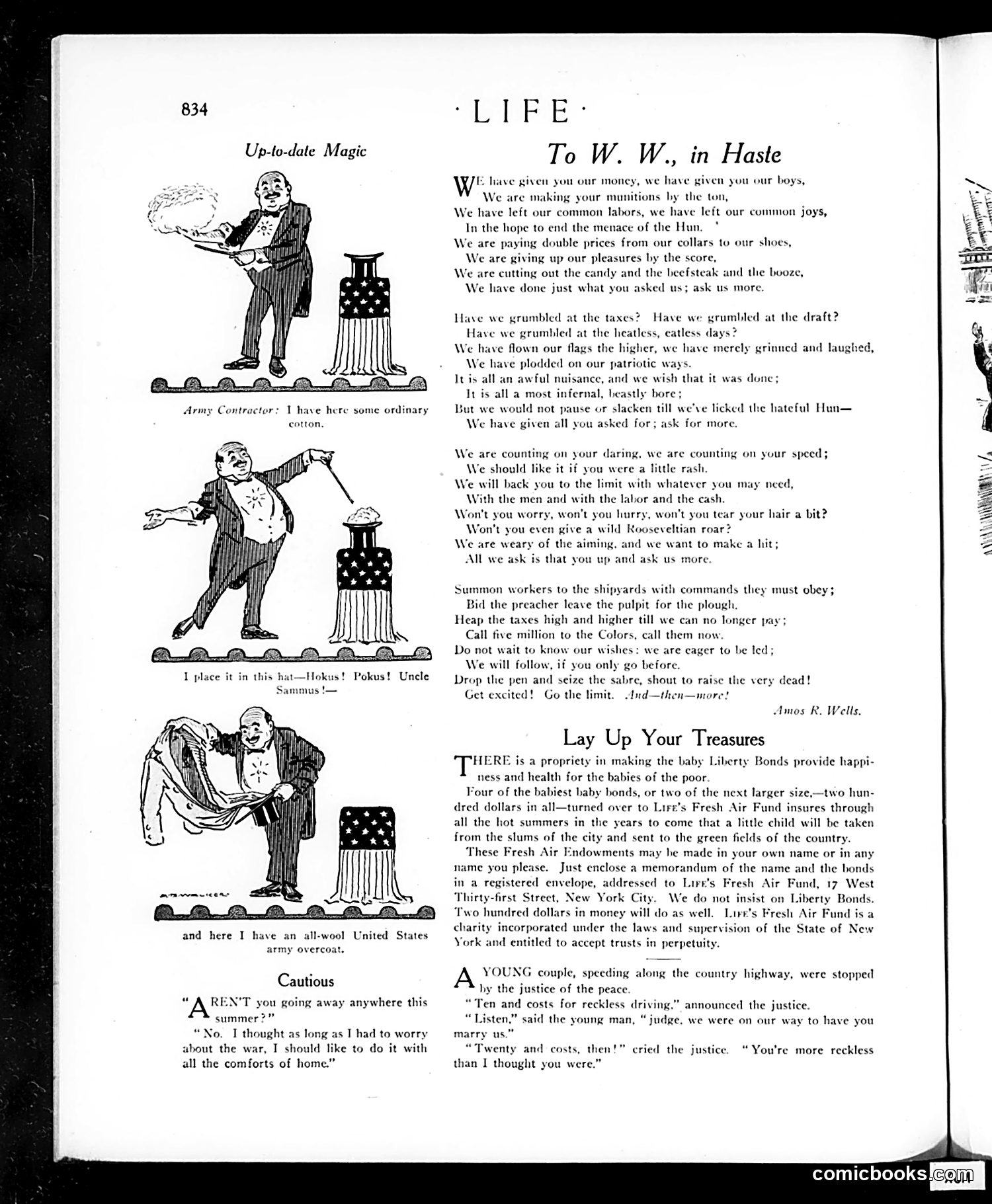
This three-panel cartoon satirizes wartime profiteering and government contracting fraud during World War I. A magician-like "Army Contractor" performs sleight-of-hand tricks, appearing to produce an "all-wool United States army overcoat" from a hat while concealing substandard materials. The visual gag depicts the contractor as a charlatan deceiving the military and soldiers about product quality. The accompanying poem "To W.W., in Haste" (author Amos R. Wells) sarcastically thanks someone—likely a government official—for accepting inflated prices, poor materials, and war profiteering while soldiers sacrifice. The satire targets the widespread scandal of contractors supplying defective equipment and uniforms to troops while enriching themselves, a documented corruption problem during WWI.
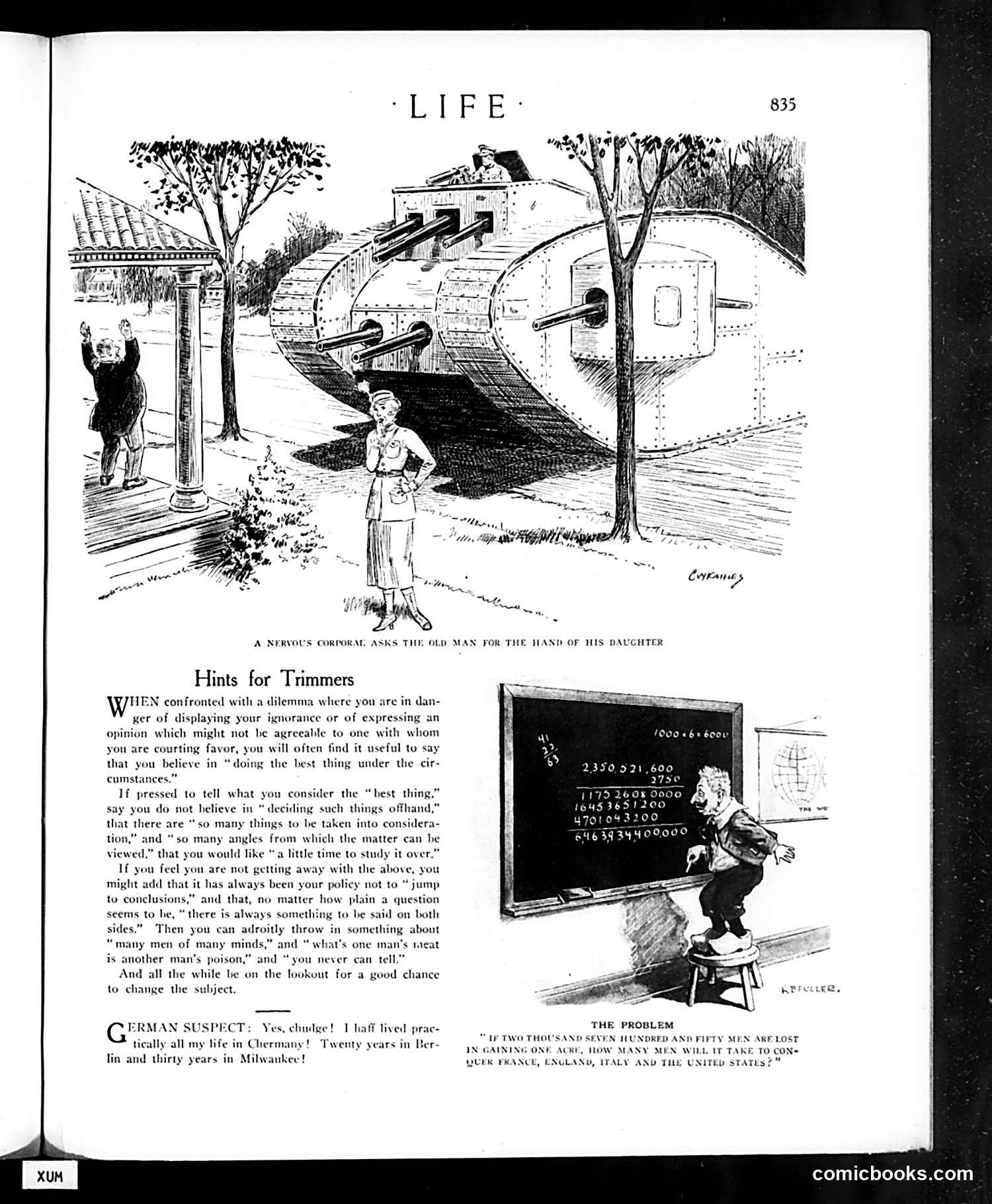
**Top Cartoon:** Depicts a futuristic military scene with a nervous officer requesting a soldier's daughter's hand in marriage, while massive armored tanks loom behind him. This appears to satirize the militarization of society and the awkwardness of pursuing personal relationships amid warfare. **"Hints for Trimmers":** Advice column mocking diplomatic evasiveness—how to avoid committing to clear positions on controversial matters by using vague language, citing multiple perspectives, and changing subjects. **"The Problem":** A math problem cartoon showing a man at a blackboard calculating military casualties across multiple nations (France, England, Italy, United States). The satire critiques the reduction of human suffering to abstract arithmetic, likely referencing World War I. The page overall mocks militarism, diplomatic dishonesty, and the dehumanizing nature of modern warfare.
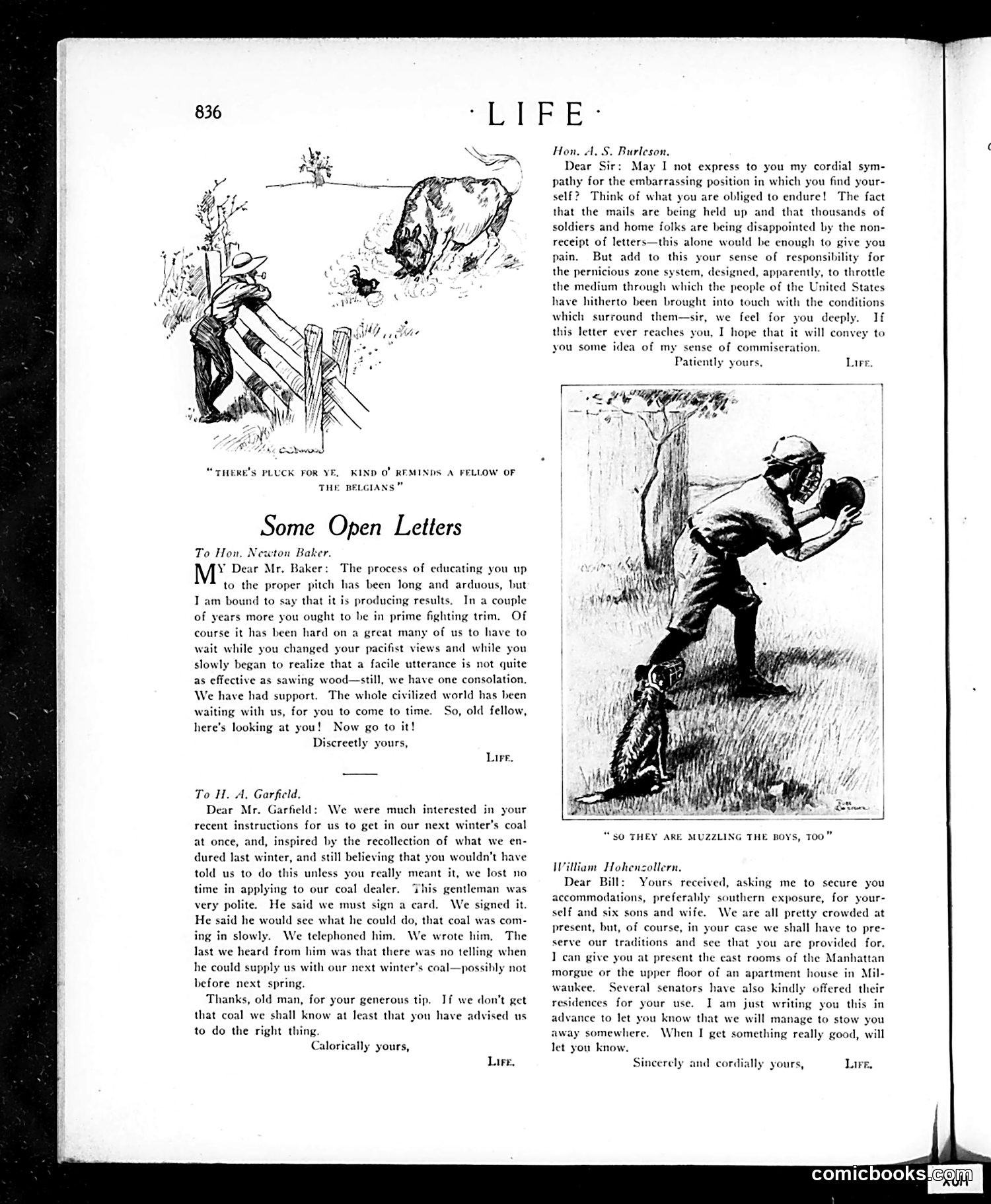
This page from Life presents three satirical "open letters" mocking WWI-era government officials. **Letter to Newton Baker** (Secretary of War): Sarcastically praises him for finally abandoning pacifism and becoming an effective wartime administrator, after initially being slow to mobilize. **Letter to H.A. Garfield** (Fuel Administrator): Mockingly thanks him for ordering Americans to stockpile coal for winter, only to find coal dealers cannot deliver—exposing the government's inability to enforce its own directives. **Letter to William Hohenzollern** (the German Kaiser): The most biting satire, offering him accommodations in America after Germany's defeat, with darkly comic suggestions of a morgue or senators' spare rooms—implying he'll be imprisoned or killed. The cartoons' reference to Belgian "pluck" evokes sympathy for Belgium's suffering under German occupation. Overall, Life ridicules government incompetence and hypocrisy while supporting the war effort.
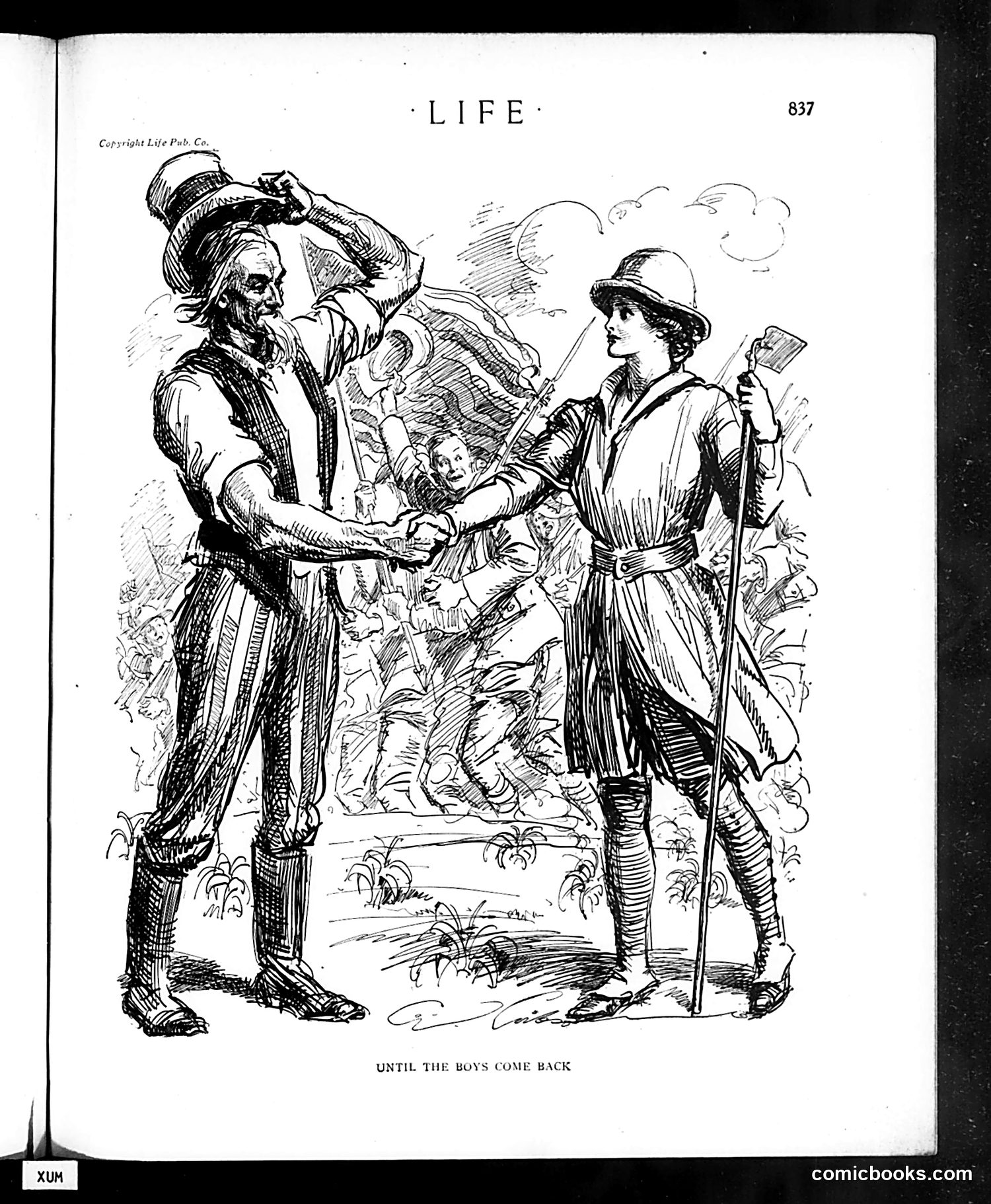
This Life magazine cartoon titled "Until the Boys Come Back" depicts a bearded man in military/work attire and a woman in a helmet holding an axe, apparently engaged in labor or construction work. There appear to be other figures in the background. The cartoon likely comments on **women entering the workforce during wartime**—when men were deployed to fight, women took over traditionally male jobs. The phrase "until the boys come back" suggests this was framed as temporary, with the implication that women would return to domestic roles once soldiers returned. The satire may mock either the novelty of female workers or societal anxiety about gender roles shifting during wartime. Without a visible date or author attribution, the precise historical moment remains unclear, though this reflects themes from WWI or WWII era publications.
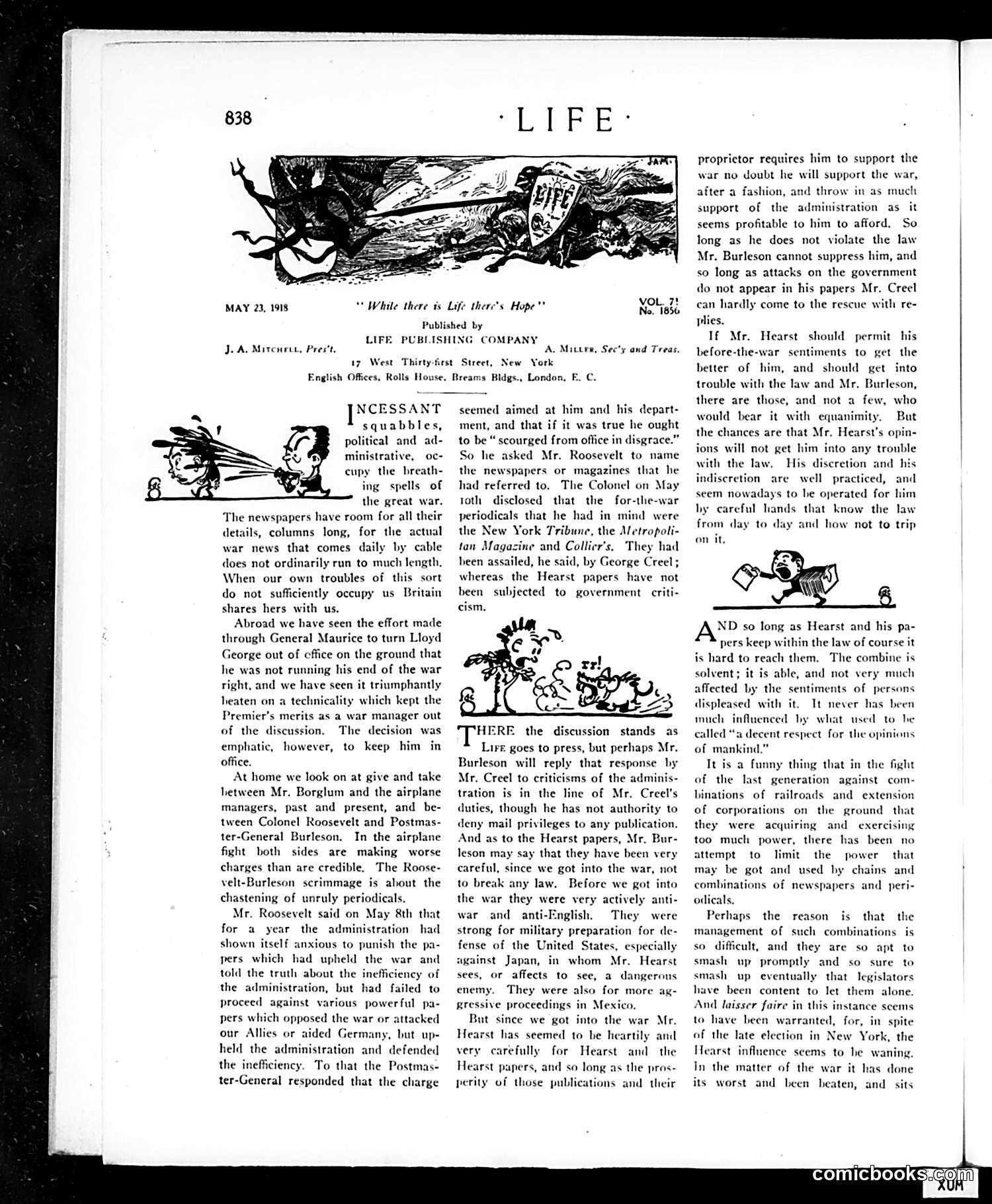
This editorial discusses tensions between the Roosevelt administration and media outlets during World War I. The cartoon (top) depicts a figure being attacked, illustrating the "squabbles" consuming wartime political attention. **The Core Dispute:** Colonel Roosevelt accused Postmaster-General Burleson of selectively punishing pro-war publications (the *Tribune*, *Metropolitan Magazine*, *Collier's*) while ignoring William Hearst's newspapers, which had previously been anti-war but now support the war effort. **The Satire:** The editorial mocks how Hearst conveniently switched from opposing war to supporting it once war became profitable for his media empire. It suggests his patriotism is cynical—he'll support whatever position benefits his business interests while staying within legal bounds. **Historical Context:** This reflects real 1918 anxieties about press freedom versus wartime censorship control, and Hearst's notorious reputation for sensationalism and opportunism.
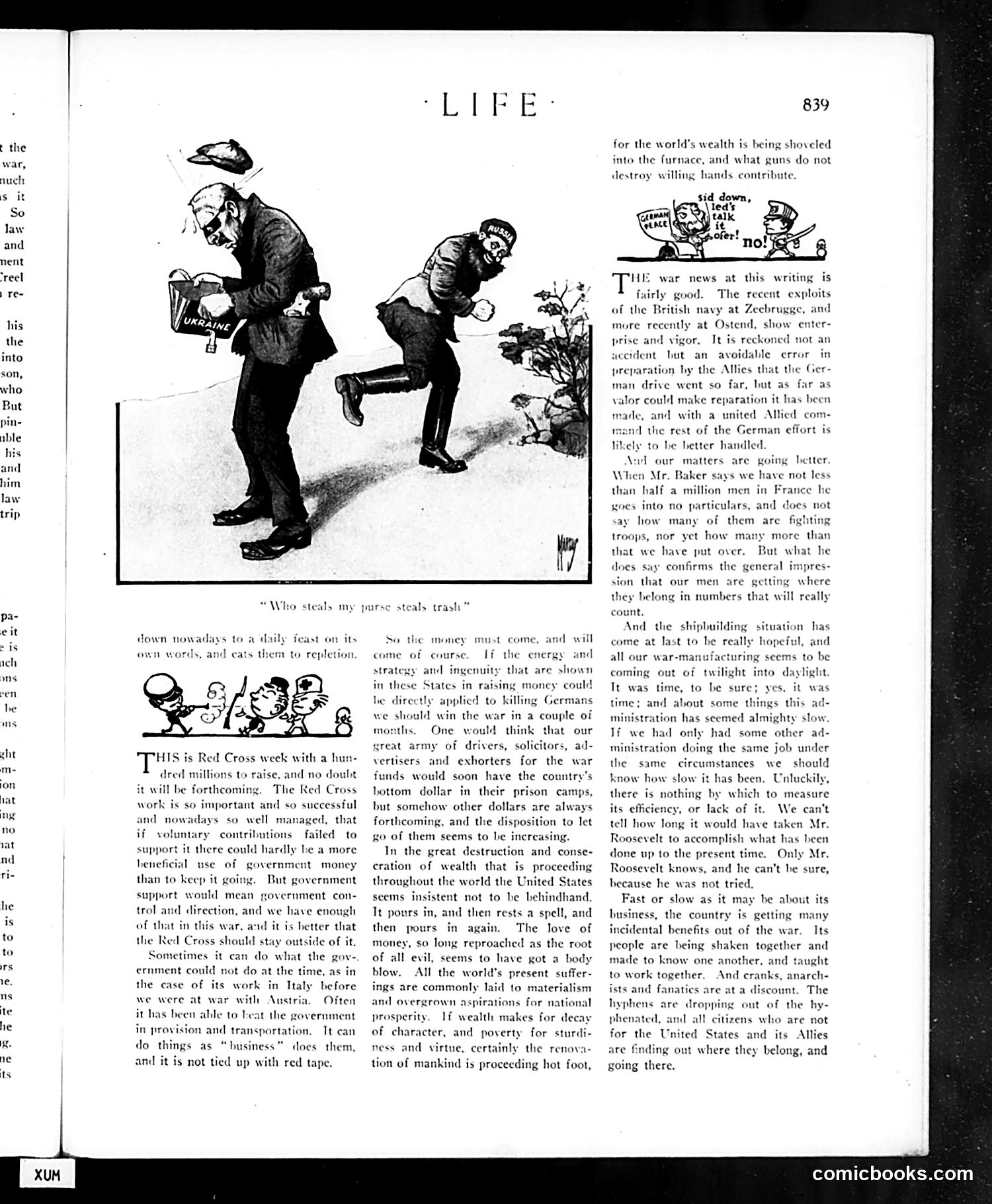
This page contains two satirical cartoons about wartime profiteering. The main illustration shows a figure labeled "Ukraine" being chased by two men stealing money from his pocket—likely representing different nations or entities exploiting Ukraine's resources during World War I. The accompanying text discusses Red Cross fundraising and U.S. war financing. The cartoons satirize how wealth circulates during wartime: money pours in for war efforts, then mysteriously reappears elsewhere, suggesting corruption or misappropriation by those managing funds. The Shakespeare quote title suggests the theft of a nation's resources ("purse") is being treated as trivial. The satire critiques how wartime necessity enables financial exploitation, with willing contributors unknowingly funding both legitimate war efforts and private enrichment by middlemen and profiteers.
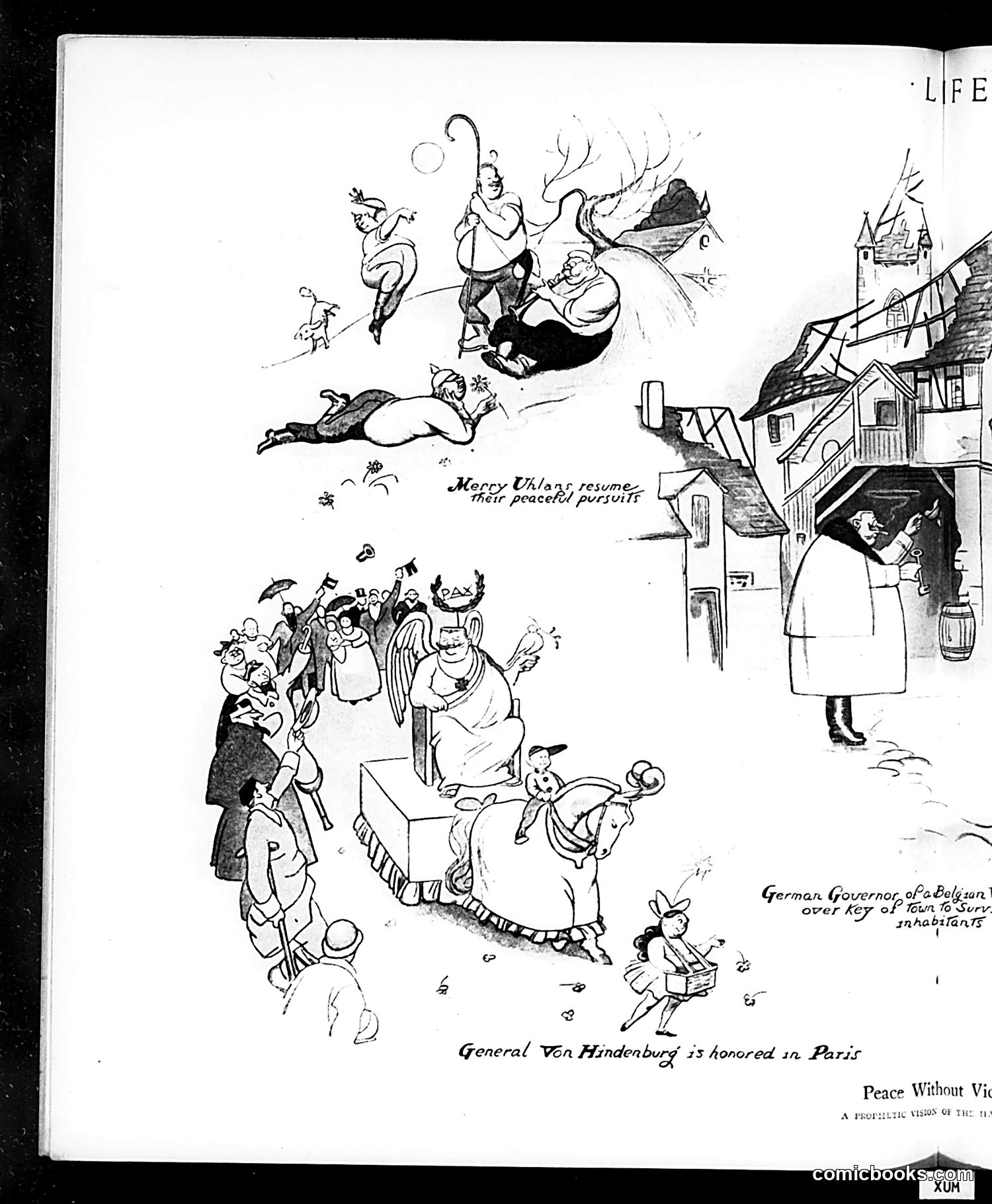
This satirical cartoon depicts post-World War I peace negotiations, likely from the early 1920s. The upper section shows "Merry Ukrains" pursuing "peaceful pursuits"—people flying, playing, and generally enjoying themselves in a fantastical scene. Below, a German Governor hands over a key to a Belgian town's inhabitants, while General Von Hindenburg is being honored in Paris. The satire appears ironic: the title "Peace Without Victory" (visible at bottom) suggests the cartoon mocks the notion of achieving genuine peace when German military leaders like Hindenburg still receive honors abroad. The contrast between the whimsical upper scene and the formal governmental ceremonies below critiques whether true peace was actually achieved, given continued deference to German military figures and ambiguous territorial resolutions.
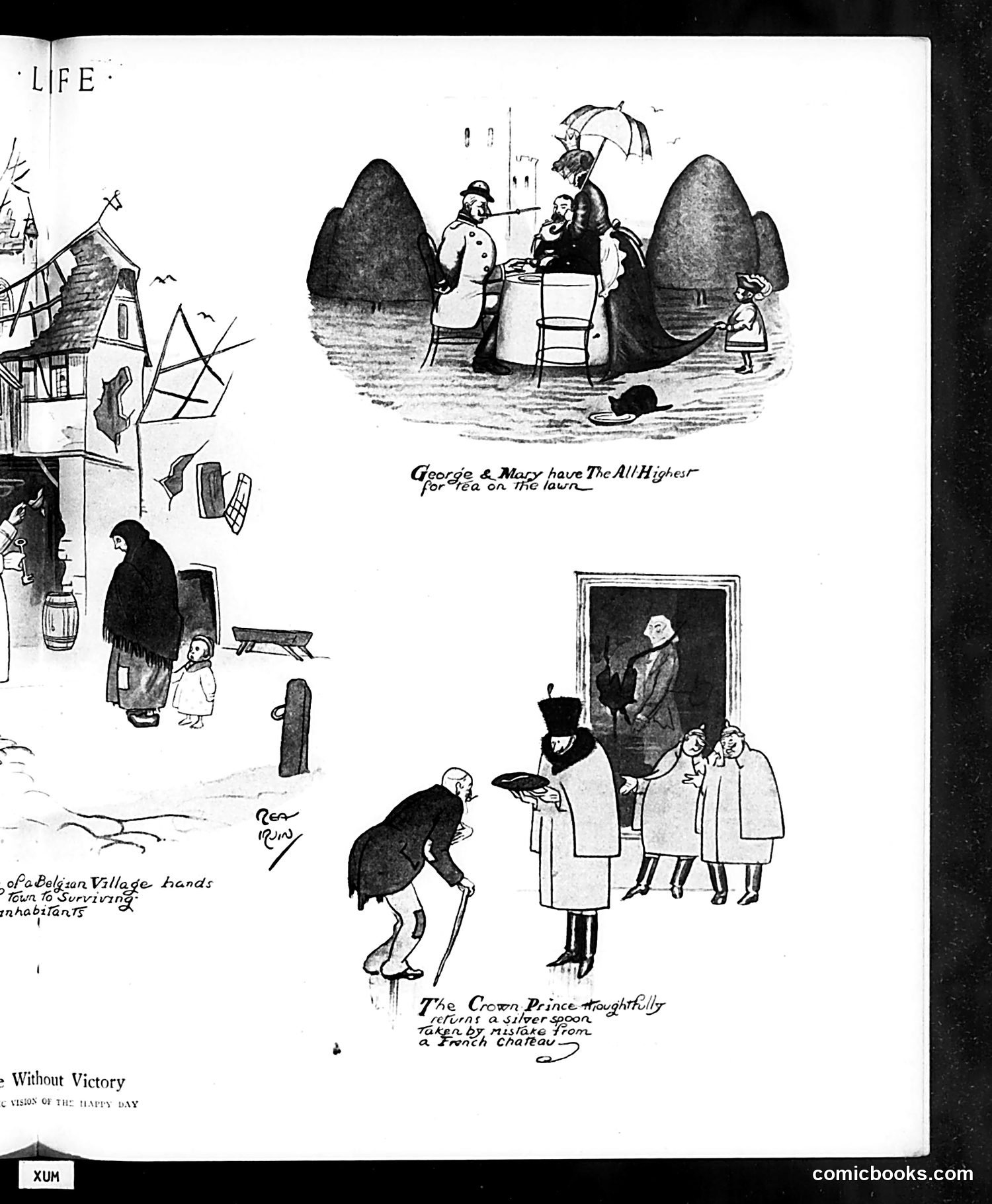
This page contains three separate satirical sketches commenting on post-World War I European conditions: The top sketch depicts "George & Mary" (likely King George V and Queen Mary of Britain) having high tea outdoors, surrounded by large dark shapes suggesting war's devastation. The left panel shows Belgian villagers returning to survive among ruins—referencing Belgium's severe wartime destruction. The bottom sketch mocks the Crown Prince (likely of Germany) being paraded before onlookers, captioned as "thoughtfully" carrying a "silver foot"—likely satirizing German military leadership's survival despite defeat, or perhaps commenting ironically on war reparations and humiliation. The overall theme appears critical of post-war conditions: the persistence of aristocratic privilege amid widespread suffering, refugee devastation, and the questionable outcomes of victory for ordinary people.
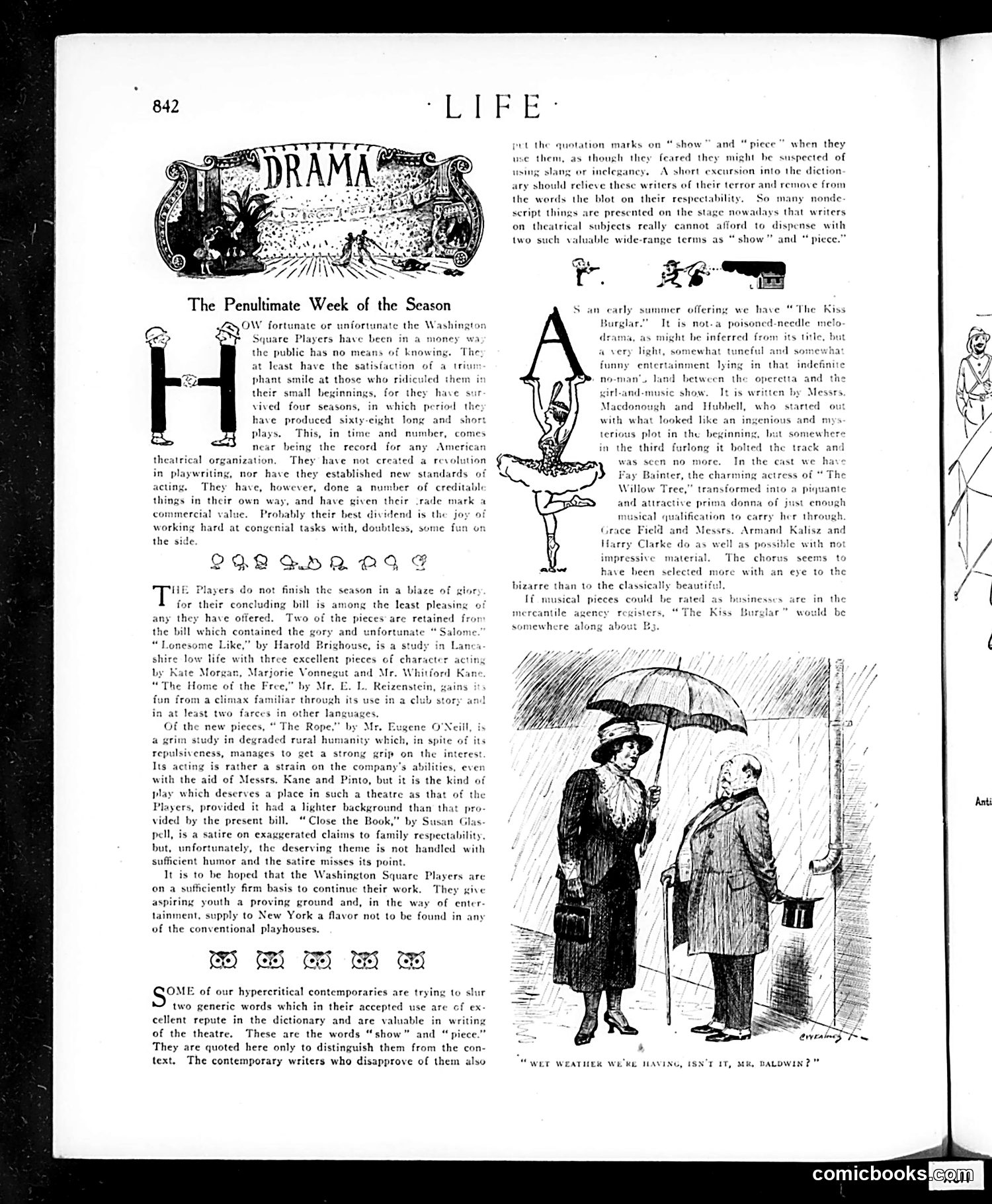
This page reviews the Washington Square Players' theatrical season. The main cartoon (bottom right) depicts two figures in rain—likely characters from one of the reviewed plays—with the caption "WET WEATHER WE'RE HAVING, ISN'T IT, MR. BALDWIN?" The article criticizes the Players' final bill as mediocre, discussing several plays including works by Harold Brighouse and Eugene O'Neill. It praises the organization for surviving four seasons and producing 68 plays, establishing themselves as a legitimate experimental theater company. A secondary editorial note debates theatrical terminology, defending critics' use of "show" and "piece" as valid descriptive terms despite contemporary disapproval. The article describes "The Kiss Burglar" as a light musical entertainment—neither quite operetta nor girl-and-music show—featuring actress Fay Bainter. The overall tone celebrates the Players' legitimacy while critiquing their current offerings as uneven.
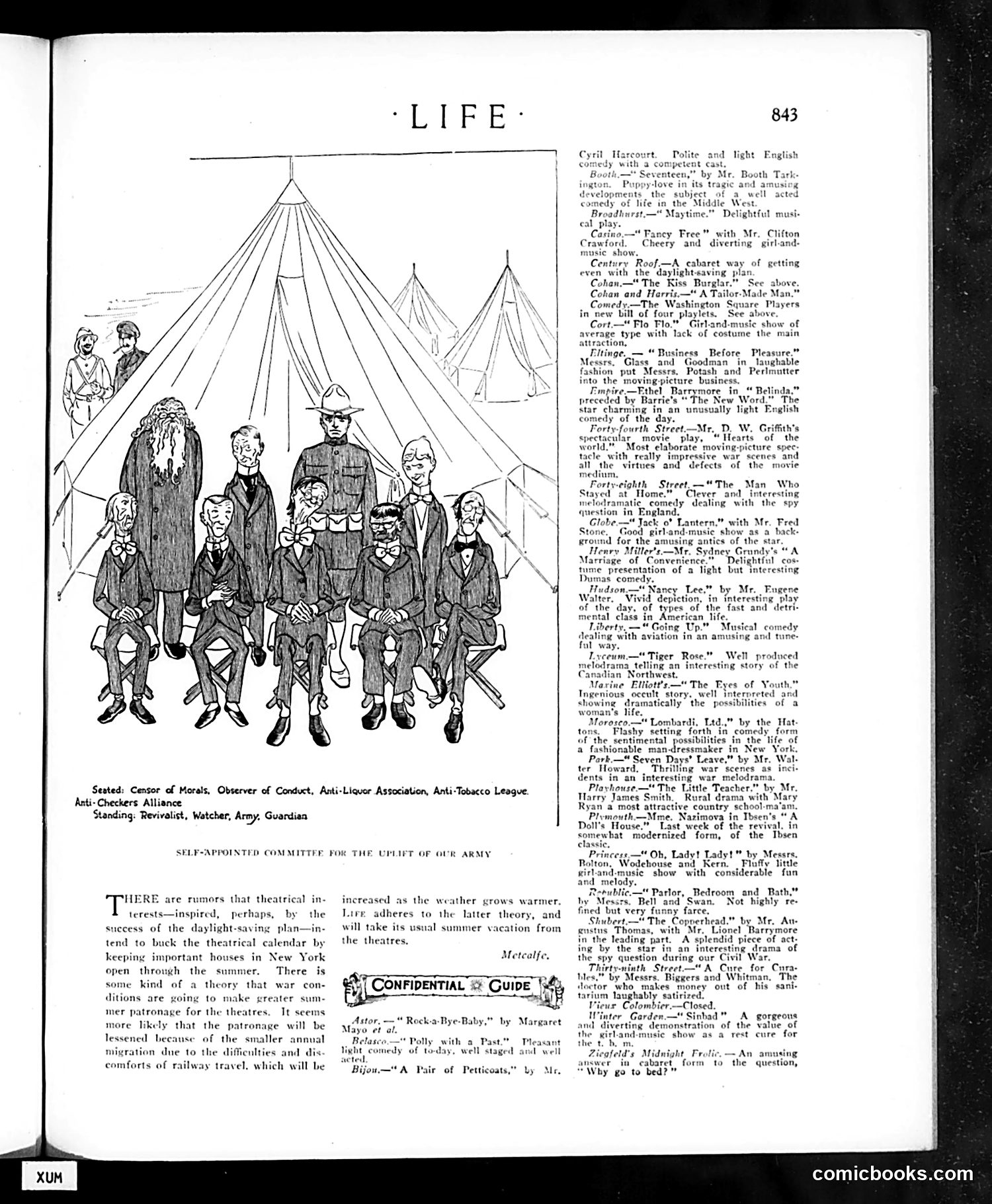
This cartoon satirizes various reform and moral-policing organizations of the era (likely WWI period) by depicting them as a self-appointed "committee" supposedly dedicated to improving the military. **The figures shown are labeled:** - Censor of Morals - Observer of Conduct - Anti-Liquor Association - Anti-Tobacco League - Anti-Checkers Alliance - Revivalist, Watcher, Army Guardian (standing) **The satire's point:** These busybody organizations, though well-intentioned, are presented as intrusive busybodies who've appointed themselves moral guardians without authority. The "Anti-Checkers Alliance" is particularly absurd—checkers being a harmless game—suggesting these groups' ridiculousness in trying to regulate every aspect of soldiers' lives. The accompanying text discusses theater closures supposedly justified by "uplifting" the army, implying these moralistic interests use patriotic cover to impose their own restrictions on public entertainment and behavior. The cartoon mocks self-righteous activism dressed up as patriotic duty.
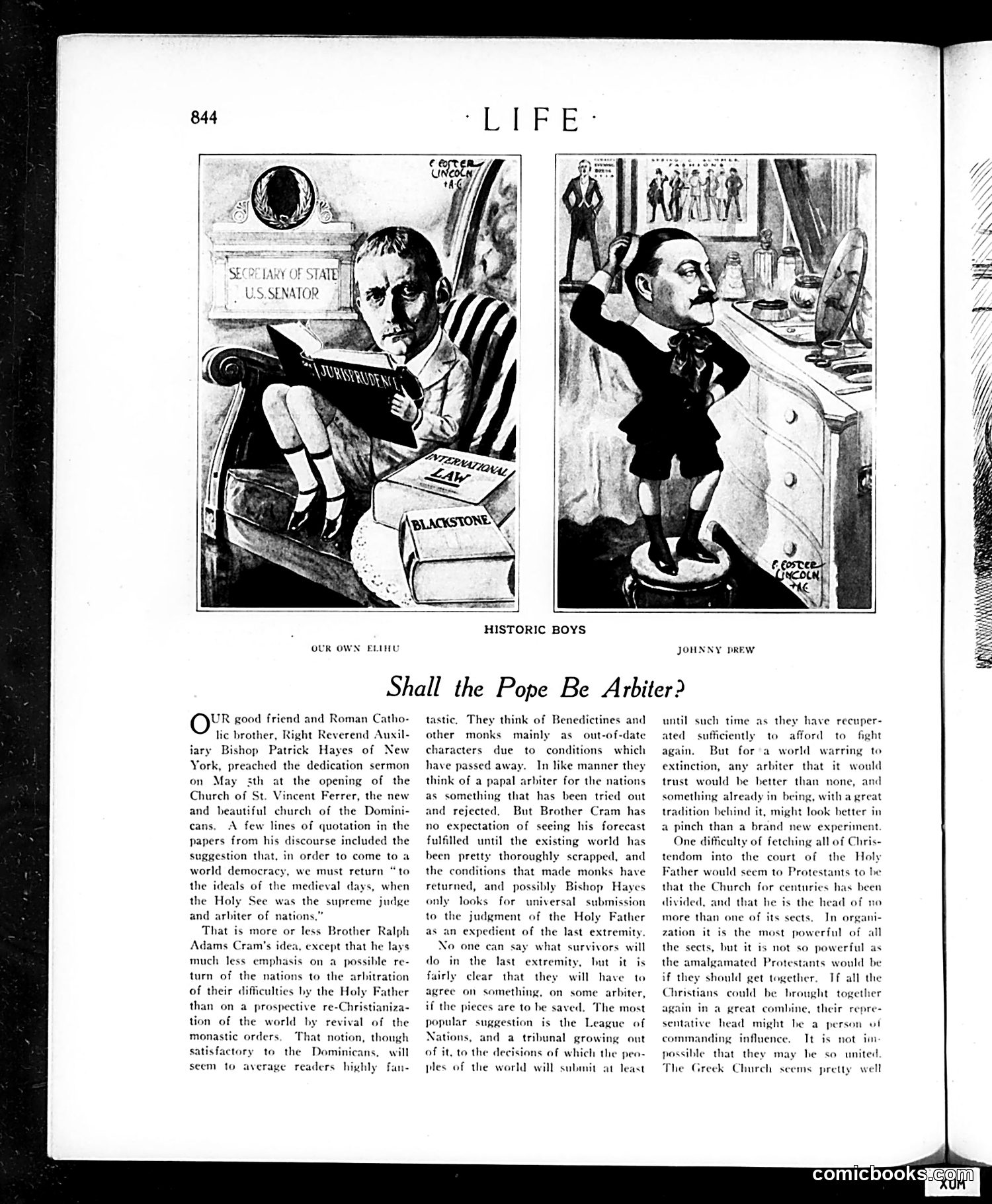
This page satirizes a proposal by Catholic Bishop Patrick Hayes of New York, who suggested that in achieving world democracy, nations should return to medieval ideals where the Pope served as supreme judge and arbiter of international disputes. The two cartoons labeled "Historic Boys" mock this notion by depicting figures studying outdated concepts: one labeled "Our Own Elihu" (likely Secretary of State Elihu Root) reads about papal authority, while "Johnny Drew" examines similarly obsolete ideas. The accompanying article ridicules the suggestion as fantastical, noting that while a papal arbiter might theoretically work as a "last extremity" solution post-war, Protestants would never accept a divided Christendom under Catholic leadership. The piece implies that modern League of Nations solutions are more realistic than reviving medieval religious authority—a sharp critique of both clerical nostalgia and post-WWI idealism about international governance.
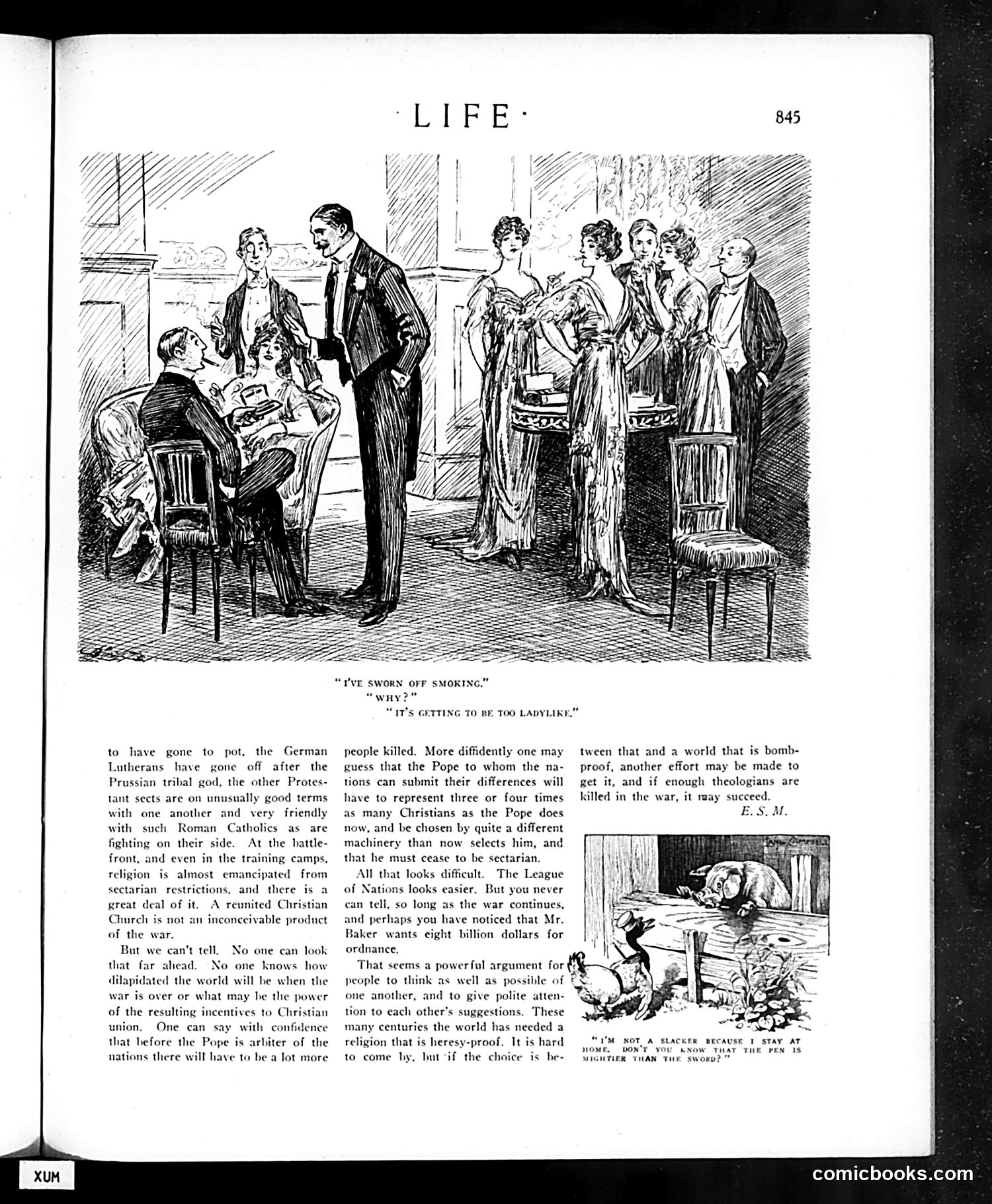
**Top Cartoon:** A social scene depicting a man claiming he's "sworn off smoking" because "it's getting to be too ladylike." The humor satirizes changing social norms during WWI—smoking, traditionally masculine, is becoming feminized as women increasingly adopt the habit, making it less desirable to men concerned with their masculine identity. **Bottom Cartoon:** A man at home claims he's "not a slacker" because "the pen is mightier than the sword," justifying his non-combat role. This mocks those avoiding military service by claiming desk work is equally patriotic. The context is WWI-era pressure on men to enlist. **Main Text:** Discusses religious unity emerging from WWI—Protestant sects and Catholics fighting together are abandoning sectarian divisions. The author argues this cooperation might produce lasting Christian union, though predicts massive casualties before any pope could mediate international disputes.
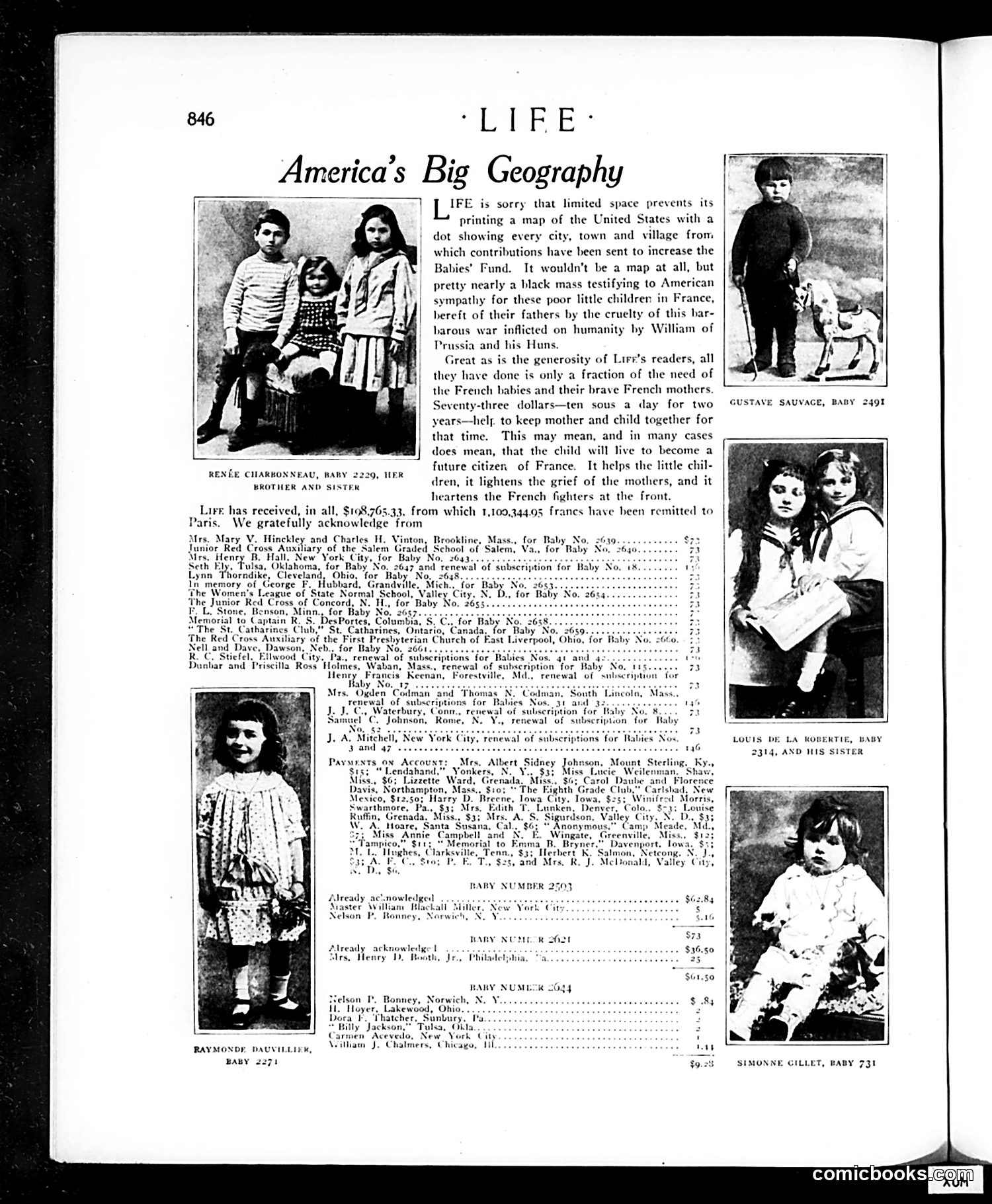
This page documents Life magazine's fundraising campaign for French war orphans during World War I. The headline "America's Big Geography" sarcastically notes that contributions arrive from so many American towns they could color an entire map of the United States. The editorial text vilifies "William of Prussia and his Huns"—a reference to Kaiser Wilhelm II and German forces—blaming them for creating these orphans through war. It appeals to readers' sympathy, explaining that $73 can support a French mother and child for two years, potentially saving the child's life and creating "a future citizen of France." The photographs show actual French children being supported by the fund (identified by name and baby number). The extensive list of donors demonstrates broad American grassroots support for war relief. This reflects early-twentieth-century American attitudes toward World War I, portraying Germans as brutal aggressors while celebrating American charitable generosity toward Allied nations, particularly France.
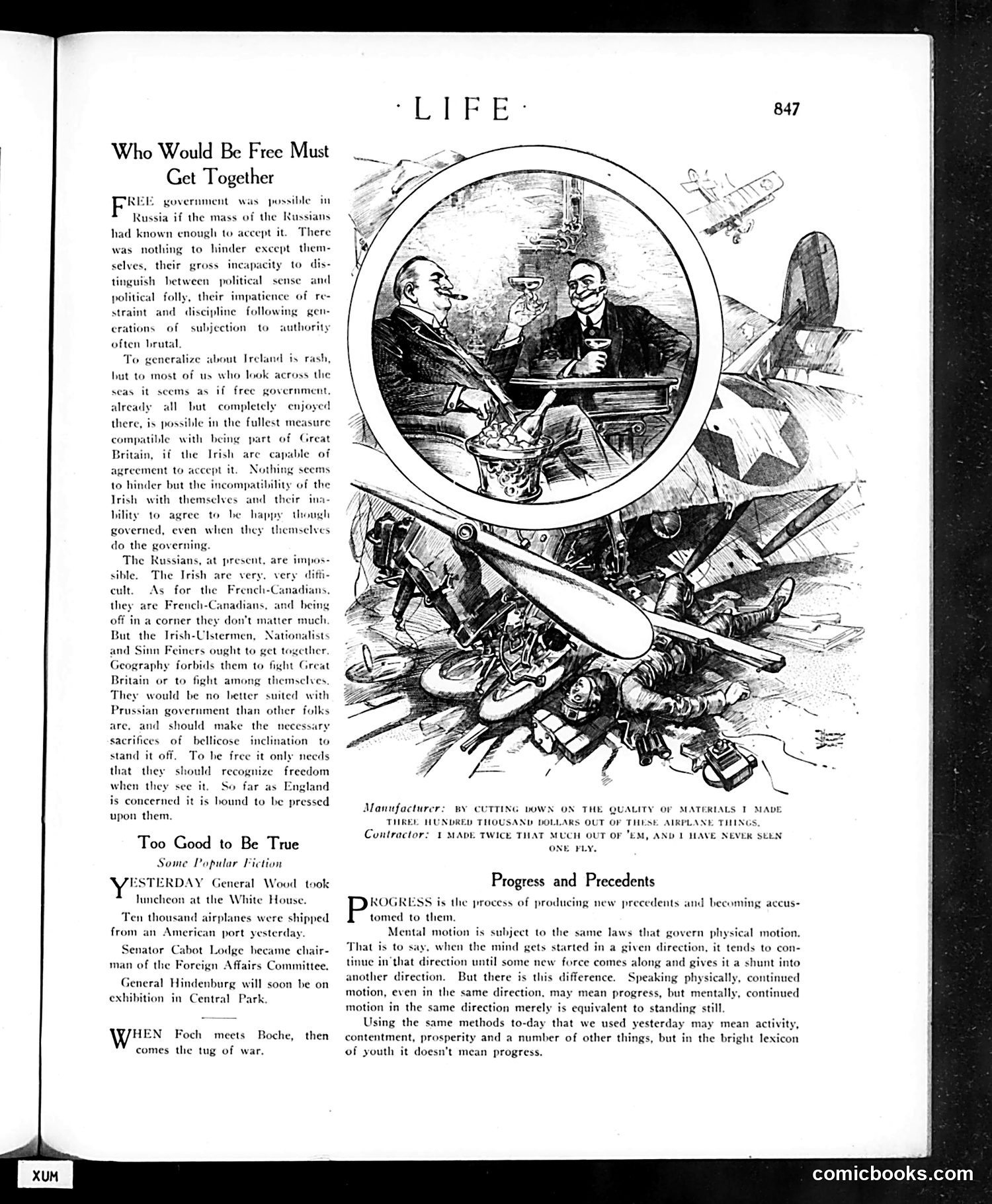
This page contains political commentary on Irish independence and post-WWI corruption. **Main Cartoon:** The circular illustration depicts three men in an airplane cabin appearing to discuss or negotiate. The caption reveals a scathing critique of wartime profiteering: a manufacturer and contractor admit to making enormous profits ($300,000 and $600,000 respectively) by cutting corners on airplane materials—with the contractor never even seeing a plane fly. This satirizes the widespread defense-contract fraud and war profiteering scandals of the WWI era. **Left Column Essay:** "Who Would Be Free Must Get Together" argues that Irish independence requires unity among fractious groups (Ulster unionists, Irish nationalists, Sinn Féiners). The author suggests geography and logic demand they cooperate rather than fight each other or Britain, comparing Irish political dysfunction to Russian and French-Canadian difficulties. **"Too Good to Be True" Section:** Brief satirical items mock implausible postwar scenarios (Hindenburg in Central Park), likely referencing actual military figures and proposals from 1918-1920.
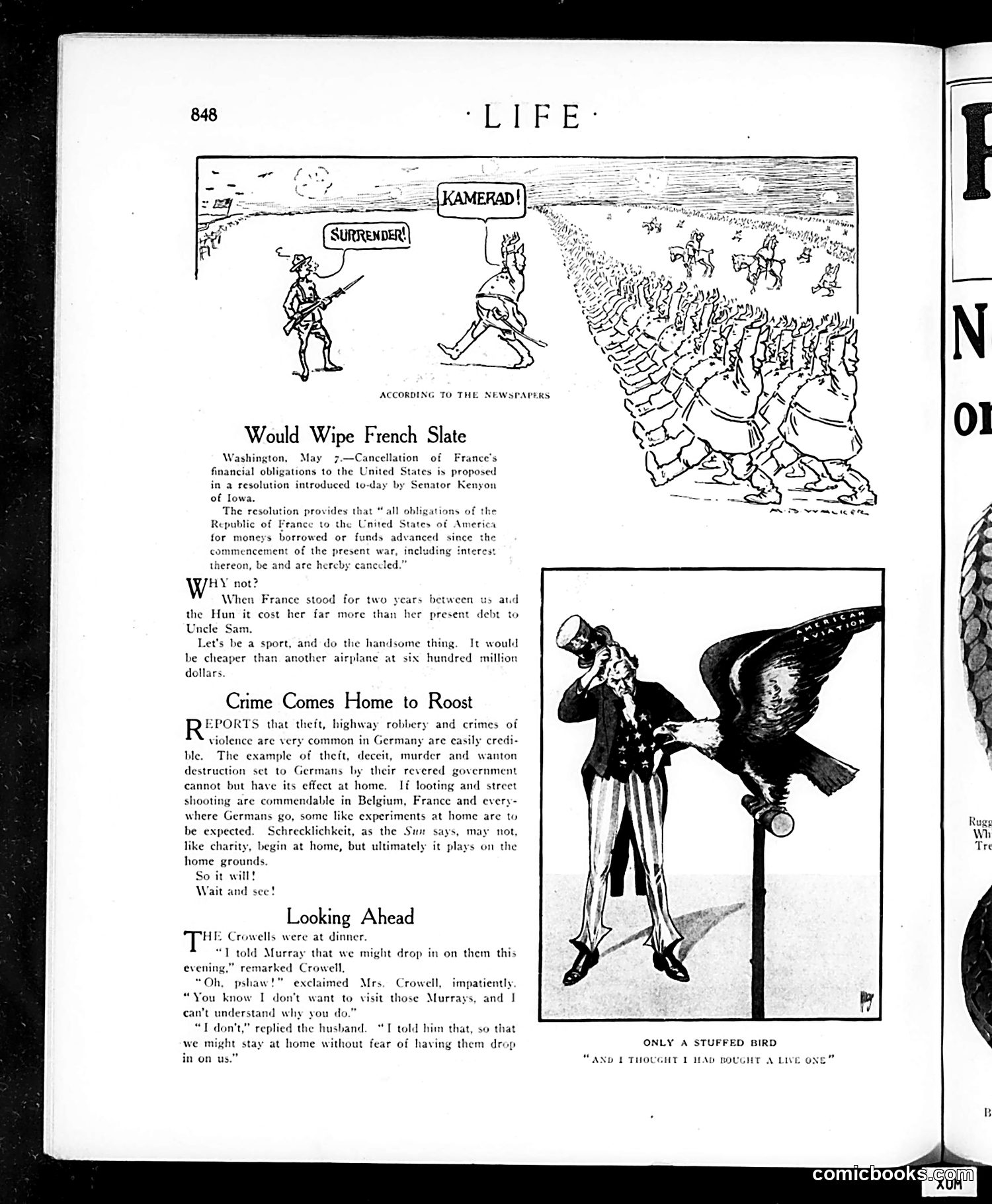
The top cartoon depicts France surrendering to Germany, with "Kamerad!" (German for "comrade"—a surrender cry) and "Surrender!" in speech bubbles. It satirizes Senator Kenyon's proposal to cancel France's WWI debts to America. The accompanying editorial argues *for* debt forgiveness: France sacrificed heavily defending against Germany for two years before America entered the war. The author suggests canceling the debt would be cheaper than building another military airplane. The middle section, "Crime Comes Home to Roost," warns that German atrocities committed in Belgium and France will inevitably produce lawlessness within Germany itself—suggesting immoral wartime conduct corrupts a nation's own society. The bottom cartoon shows a stuffed bird, captioning a domestic conversation where Mr. Crowell uses the pretext of visiting the Murrays to deter them from visiting uninvited—dark humor about avoiding social obligation. The page reflects post-WWI debates about American financial obligations to allies and anxieties about moral consequences of war.
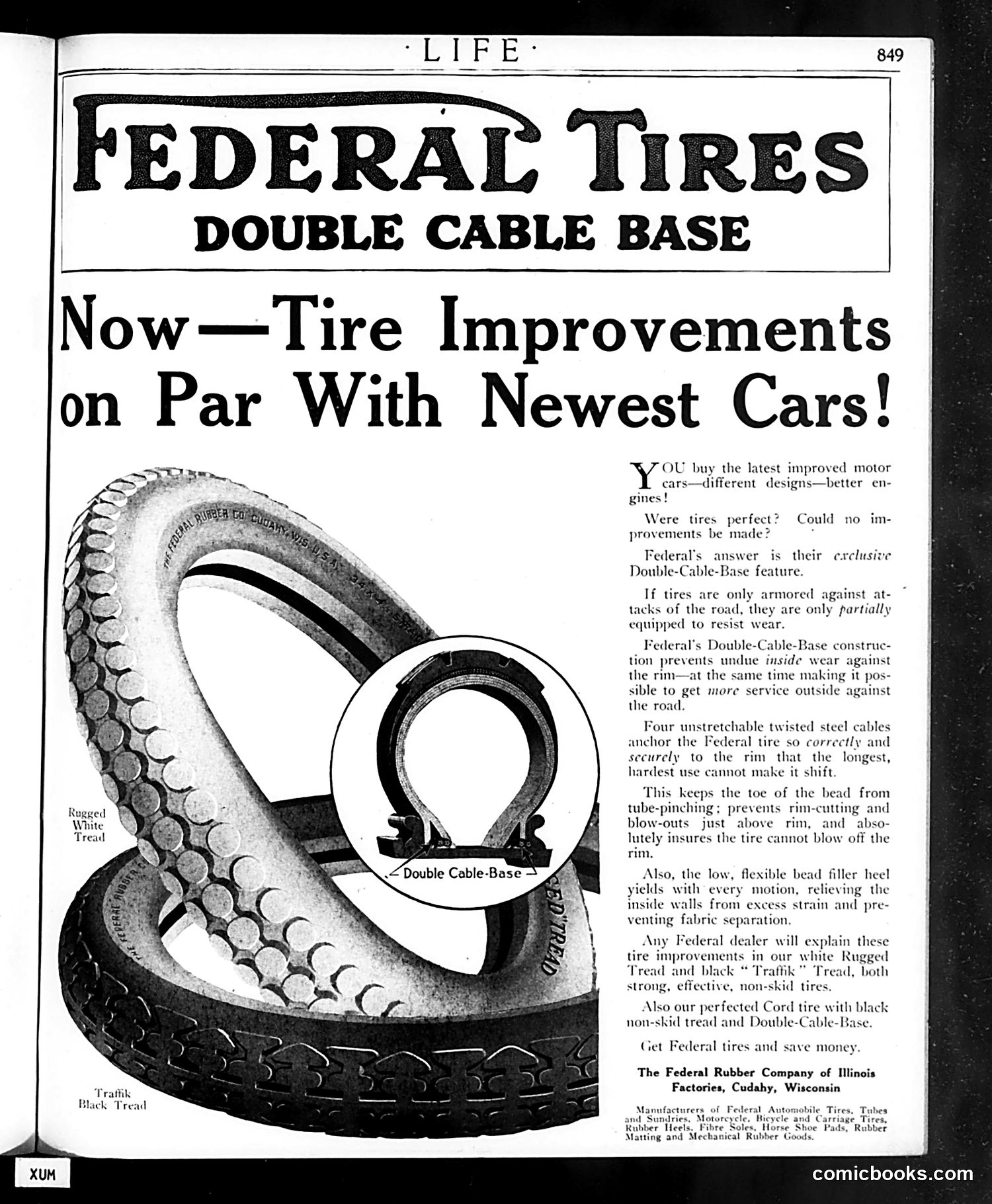
This is a **straightforward tire advertisement**, not satire or political commentary. It appeared in *Life* magazine (which published both humor and ads). Federal Rubber Company promotes their "Double-Cable-Base" tire innovation, arguing that while car designs constantly improve, tire technology had lagged behind. The ad claims their exclusive feature—four twisted steel cables anchoring the tire to the rim—prevents internal wear, blow-outs, and tire separation. The visual shows a cross-section of the tire highlighting the Double-Cable-Base technology, with labeled examples of their "Rugged White Tread" and "Traffik Black Tread" products. The pitch targets consumers who buy new cars: if you're upgrading your automobile, why not upgrade your tires too? The company manufactured multiple rubber products and operated factories in Cudahy, Wisconsin. This reflects early-20th-century automotive advertising emphasizing technical innovation as a sales angle.
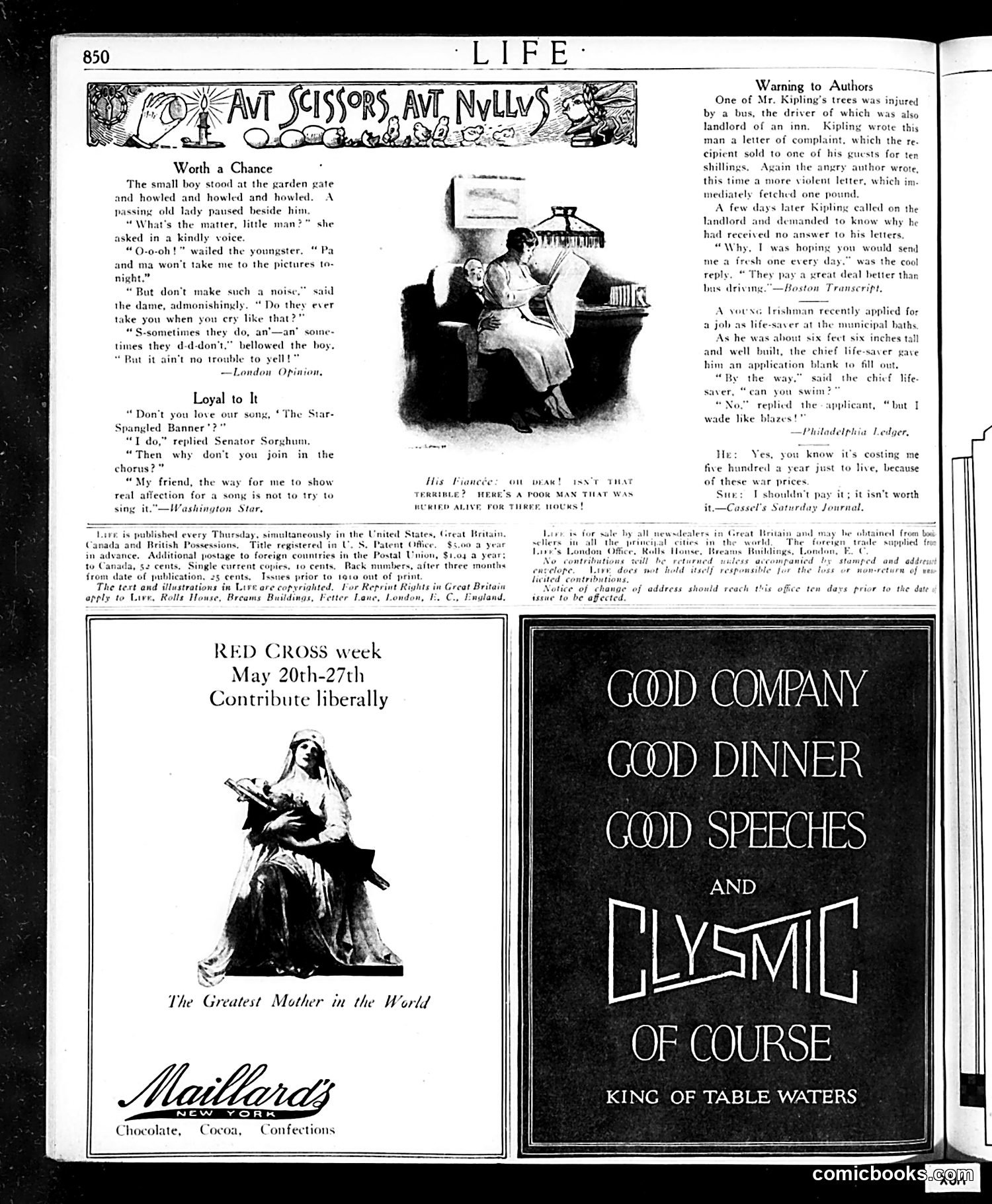
This page contains **humorous anecdotes and advertisements** rather than political cartoons. The content includes: **Comic Short Stories:** - "Worth a Chance": A child's manipulation tactic—crying loudly to pressure parents into taking him to the pictures - "Loyal to It": A senator's reluctance to sing the national anthem publicly, despite claiming patriotism - Several brief jokes about Irish immigrants, life-savers, and wartime cost-of-living complaints **The Satire:** These pieces mock everyday human behavior: parental weakness, performative patriotism, and economic grievances during wartime (the "war prices" reference suggests WWI era). **Advertisements:** - Red Cross fundraising appeal (May 20-27) - Maillard's chocolate ("The Greatest Mother in the World") - Clysmic table water ("King of Table Waters") The page is primarily **filler content**—light humor and ads typical of Life's satirical magazine format. No specific political figures are caricatured; instead, it satirizes universal human types and social pretenses.
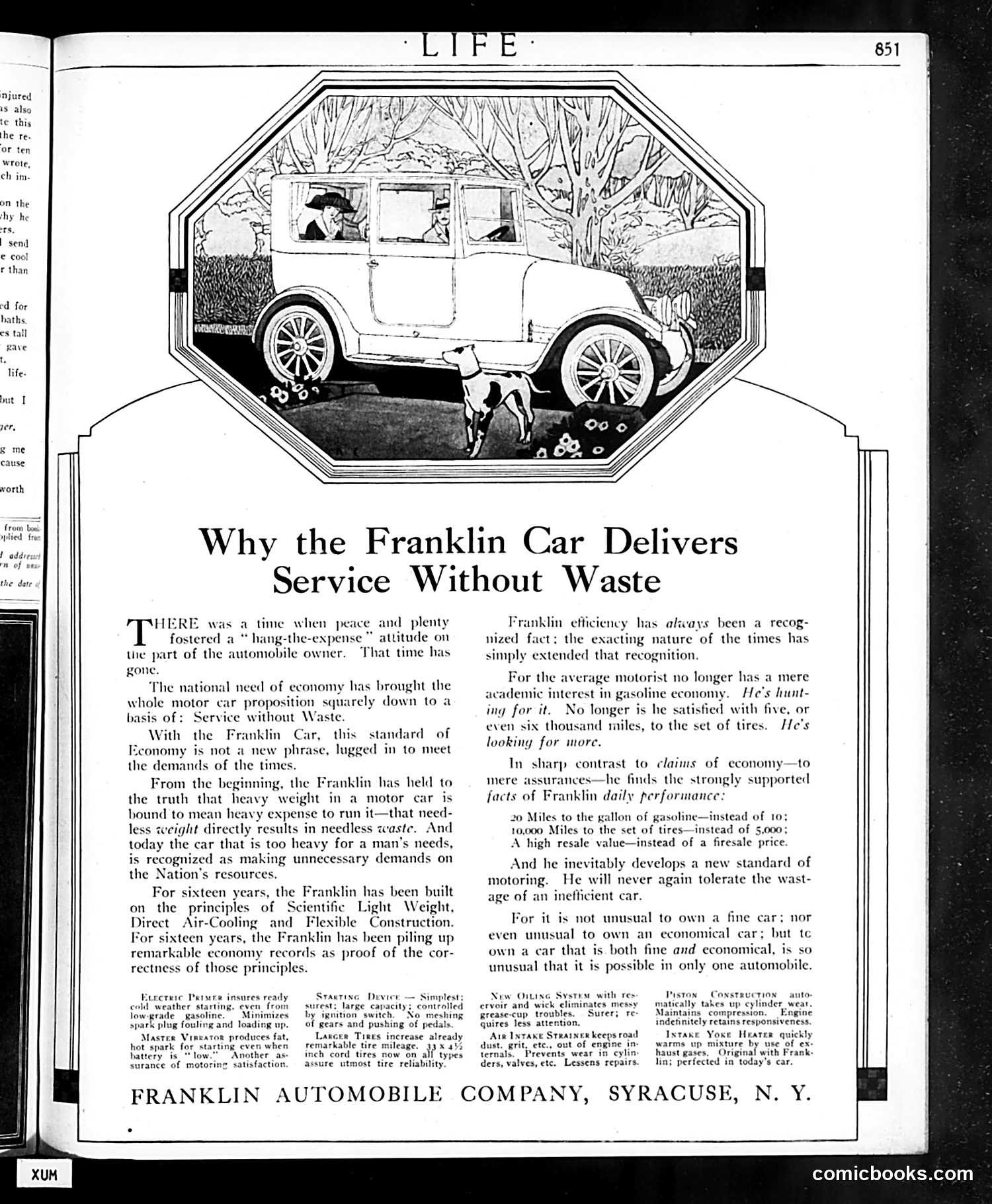
This is not satire or editorial content—it's a **full-page advertisement** for the Franklin Automobile Company of Syracuse, New York. The image shows a vintage automobile with passengers and a dog, establishing a wholesome, family-oriented brand image. The ad's entire purpose is to market the Franklin car by emphasizing **fuel economy and efficiency** as selling points during a period of national economic concern (the text references "the national need of economy"). The advertisement makes specific performance claims: 20 miles per gallon (versus 10), 10,000 miles per tire set (versus 5,000), and high resale value. It attributes these efficiencies to the car's "Scientific Light Weight, Direct Air-Cooling and Flexible Construction." The rhetorical strategy reframes economy from a luxury concern into a patriotic duty—suggesting that buying an efficient Franklin car serves "the Nation's resources." This appears to be Depression-era marketing, positioning economy as both morally necessary and achievable through their product.
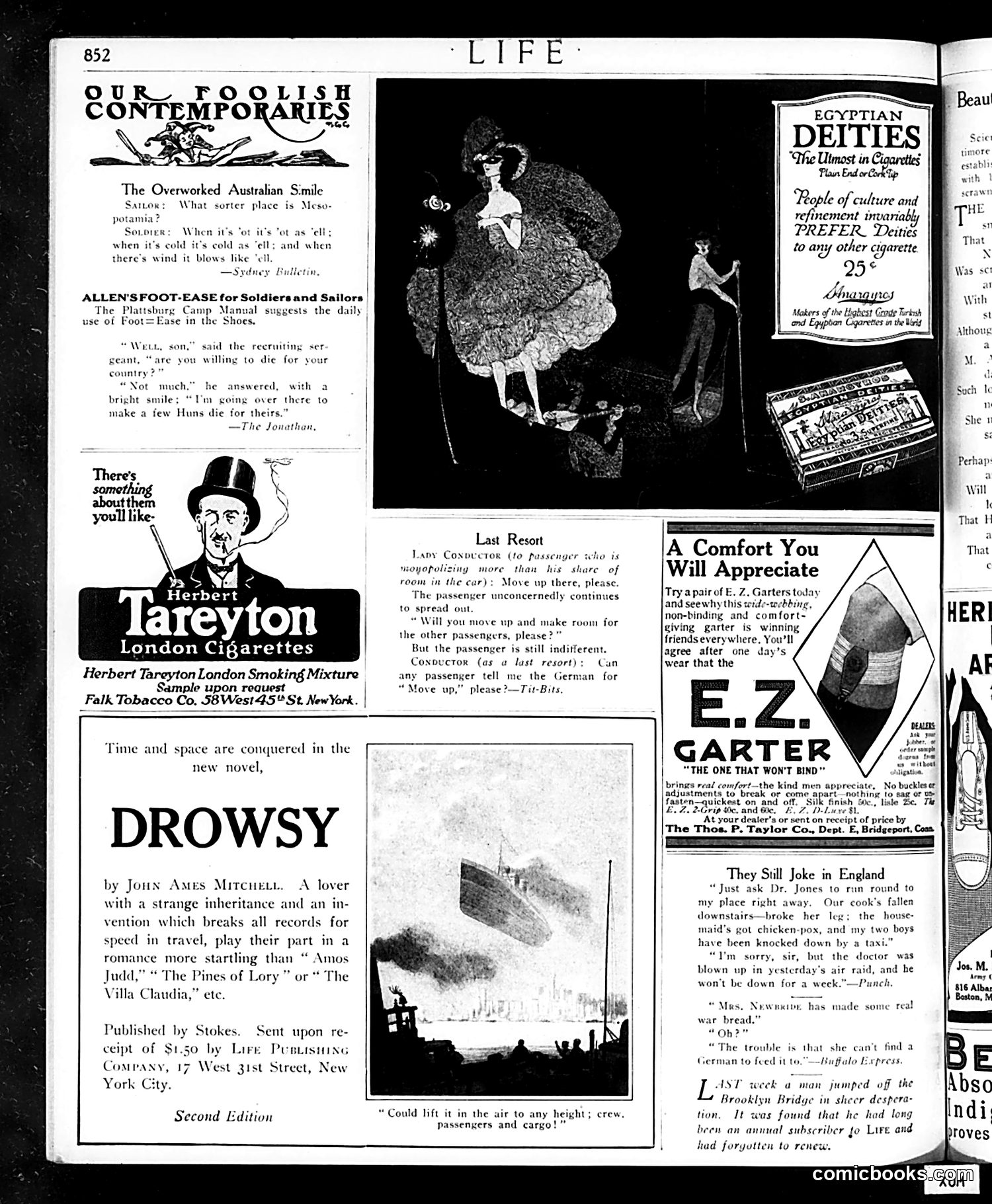
This page mixes **satirical humor with period advertisements**, primarily targeting WWI-era audiences. ## The Satire **"The Overworked Australian Simile"** mocks Australian soldiers' overuse of hyperbolic comparisons—everything in Mesopotamia is "hot as hell," "cold as hell," or "blows like hell." The joke satirizes how Australian slang relies on this single intensifier. **"Last Resort"** depicts a conductor struggling to get a hogging train passenger to move. When politeness fails, he asks if anyone knows the German command "move up"—a joke implying that Germans are better at obeying orders, reflecting WWI-era stereotypes. **"They Still Joke in England"** presents dark wartime humor: a doctor is unavailable because he was "blown up" in a raid, and a woman's homemade bread is so inedible that even feeding it to Germans (the enemy) seems cruel. ## Advertisements The page also features cigarette and garter ads typical of 1910s-1920s magazines, marketing to soldiers and working men. The overall tone balances lighthearted mockery of wartime life with period-appropriate ethnic stereotyping.
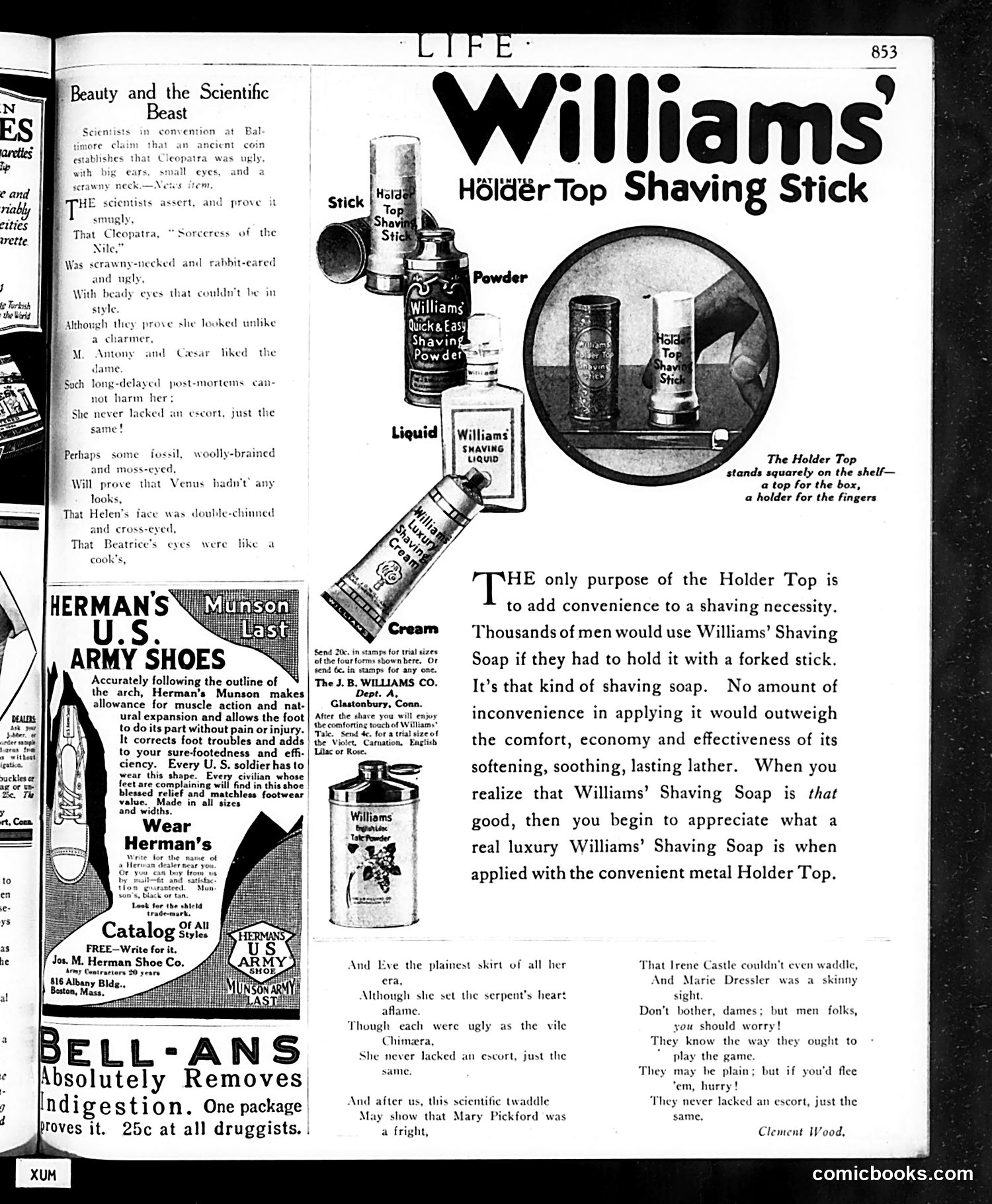
This page contains a satirical poem by Clement Wood alongside period advertisements. The verse mocks scientific claims about famous historical and contemporary women's appearances. **The Satire:** The poem challenges pseudo-scientific arguments that famous beauties—Cleopatra, Helen of Troy, Venus, Beatrice—were actually ugly. Wood's point: regardless of their actual looks, these women "never lacked an escort." He extends this to contemporary figures (Irene Castle, Marie Dressler, Mary Pickford), suggesting men care less about objective beauty than society assumes. The closing moral addresses women dismissively: don't worry about being plain—men judge women by other criteria ("the way they ought to play the game"). **Context:** This reflects early-20th-century attitudes about gender and appearance, presenting male attraction as transactional rather than aesthetic. The poem uses famous names recognizable to 1920s readers but now obscure to modern audiences. **Note:** The page is primarily advertising (Williams Shaving products, Herman's Army Shoes, Bell-Ans antacid), with the poem as filler content typical of Life magazine's format.
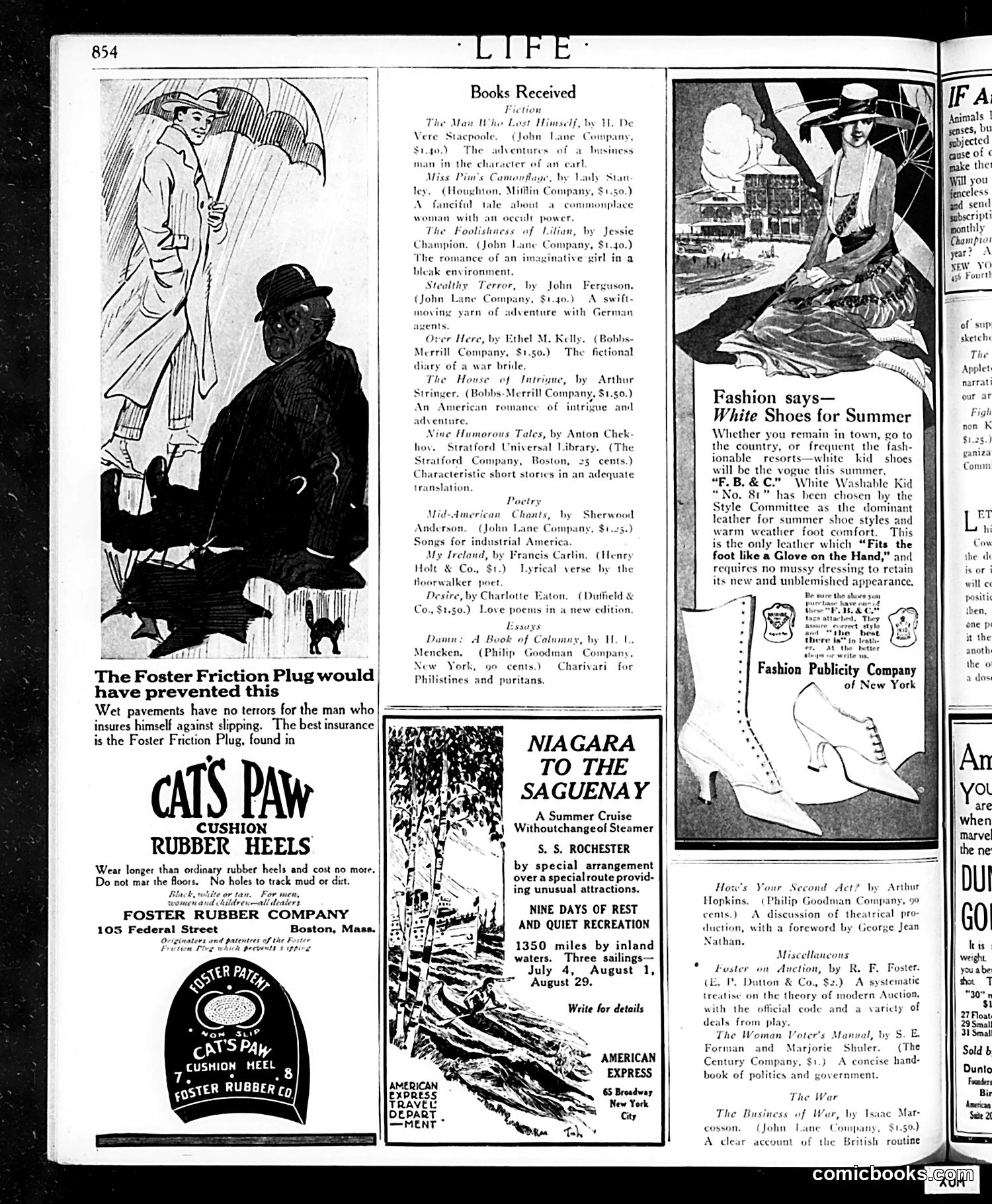
This page is primarily **advertising and book reviews**, not political satire. The main cartoon (upper left) shows a man slipping on wet pavement—illustrating the problem that Foster Friction Plug rubber heels supposedly solve. The humor is straightforward product advertising: wet pavements are dangerous, so buy these safety heels. Below is an ad for "Cat's Paw" cushion rubber heels, similarly emphasizing practical benefits (durability, cleanliness). The **"Books Received"** section lists contemporary publications, many dealing with **World War I themes** ("Over Here" about a war bride, "Stealthy Terror" with German agents), reflecting American literary concerns of the 1910s-20s era. A cruise advertisement for the S.S. Rochester and fashion coverage about white summer shoes round out the commercial content. **No significant political commentary or satire is evident** on this page—it's a straightforward mixture of practical advertising and cultural content typical of Life magazine's commercial orientation during this period.
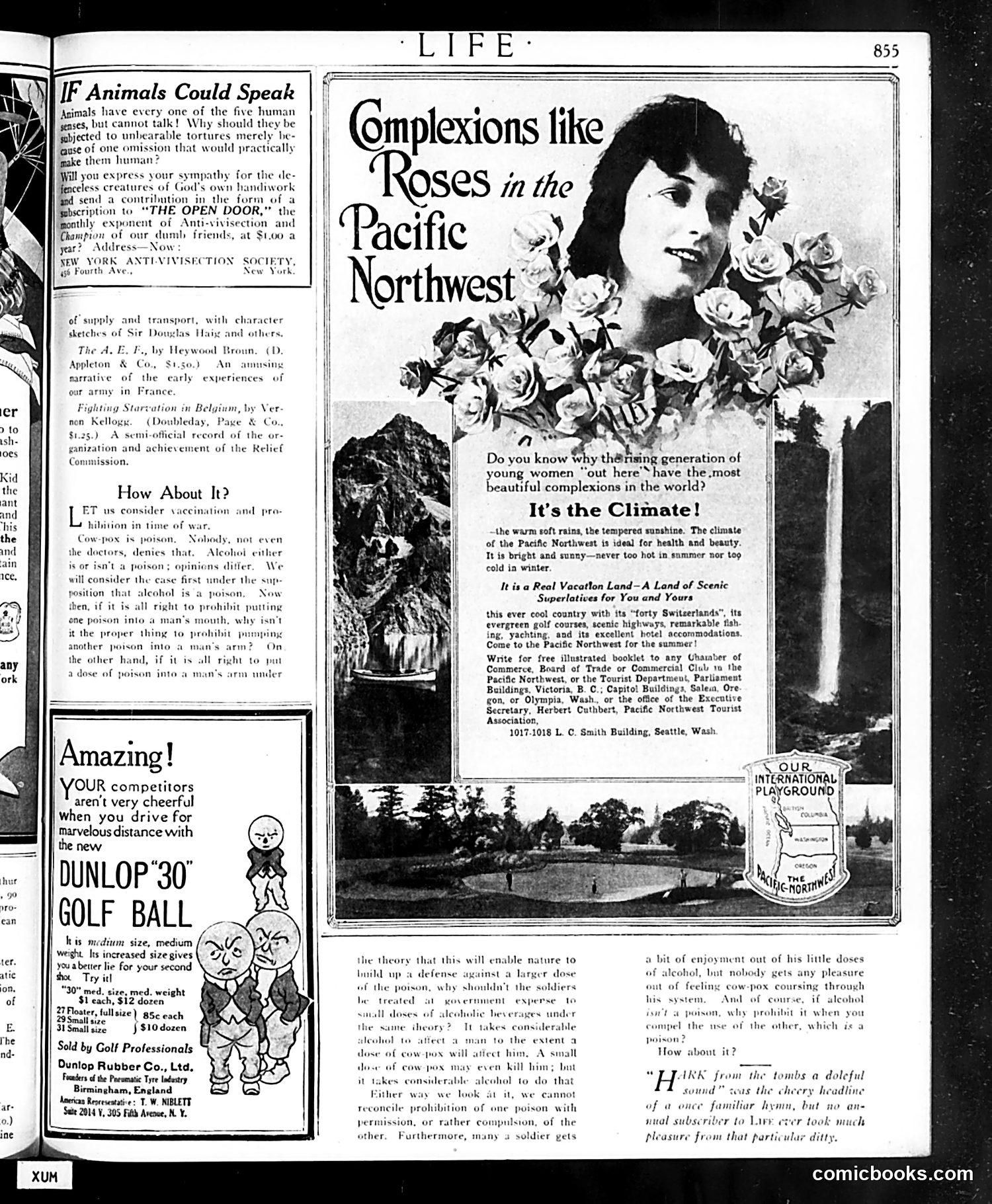
This page contains **mixed content**: advertisements, editorial pieces, and one satirical argument. The main **cartoon/argument** titled "How About It?" critiques Prohibition logic. It argues that if alcohol is a poison, the government shouldn't prohibit citizens from consuming it while simultaneously *mandating* vaccination (which introduces cowpox—presented as another poison). The piece uses reductio ad absurdum: if small poison doses build immunity (vaccination theory), why not allow small alcohol doses? If alcohol can't be prohibited on poison grounds, why can vaccination be compelled? The **context**: This appears to be WWI-era (references to soldiers, France), when mandatory vaccination was controversial and Prohibition was debated/enacted. The argument satirizes the perceived inconsistency in government health mandates. The **other content** includes: - An anti-vivisection appeal (left column) - A Pacific Northwest tourism ad (center, featuring beauty claims about climate) - A Dunlop golf ball advertisement (lower left) The page reflects early 20th-century American debates over state power, bodily autonomy, and public health policy.
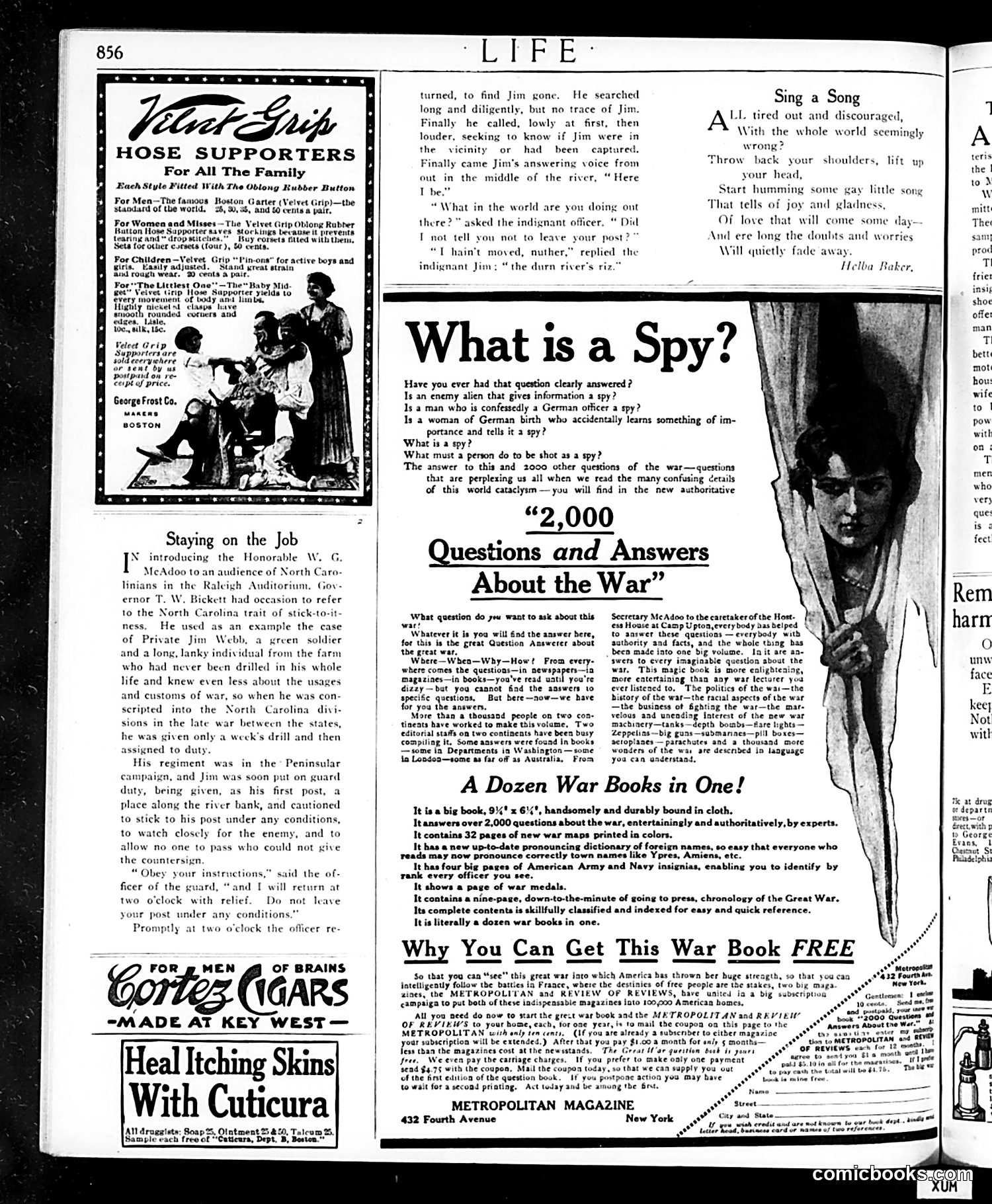
This page contains three distinct elements: **"Staying on the Job"** is a humorous anecdote about Private Jim Webb, a North Carolina farmer drafted into WWI. The joke illustrates regional stubbornness: when ordered to guard a riverbank post and not leave "under any conditions," Jim takes the instruction literally. When the officer returns to find him gone, Jim replies from the middle of the river that he "hain't moved"—the river has risen, not that he abandoned his post. The satire gently mocks rural soldiers' literalism and determination. **"What is a Spy?"** is an advertisement for a war reference book addressing WWI-era confusion about espionage law. It exploits contemporary anxiety about spies and saboteurs by promising 2,000 answers about wartime conduct. The remaining content is period **advertising** (hose supporters, cigars, skin cream). The page reflects American WWI-era concerns: military recruitment, homeland security fears, and domestic confusion about warfare rules.
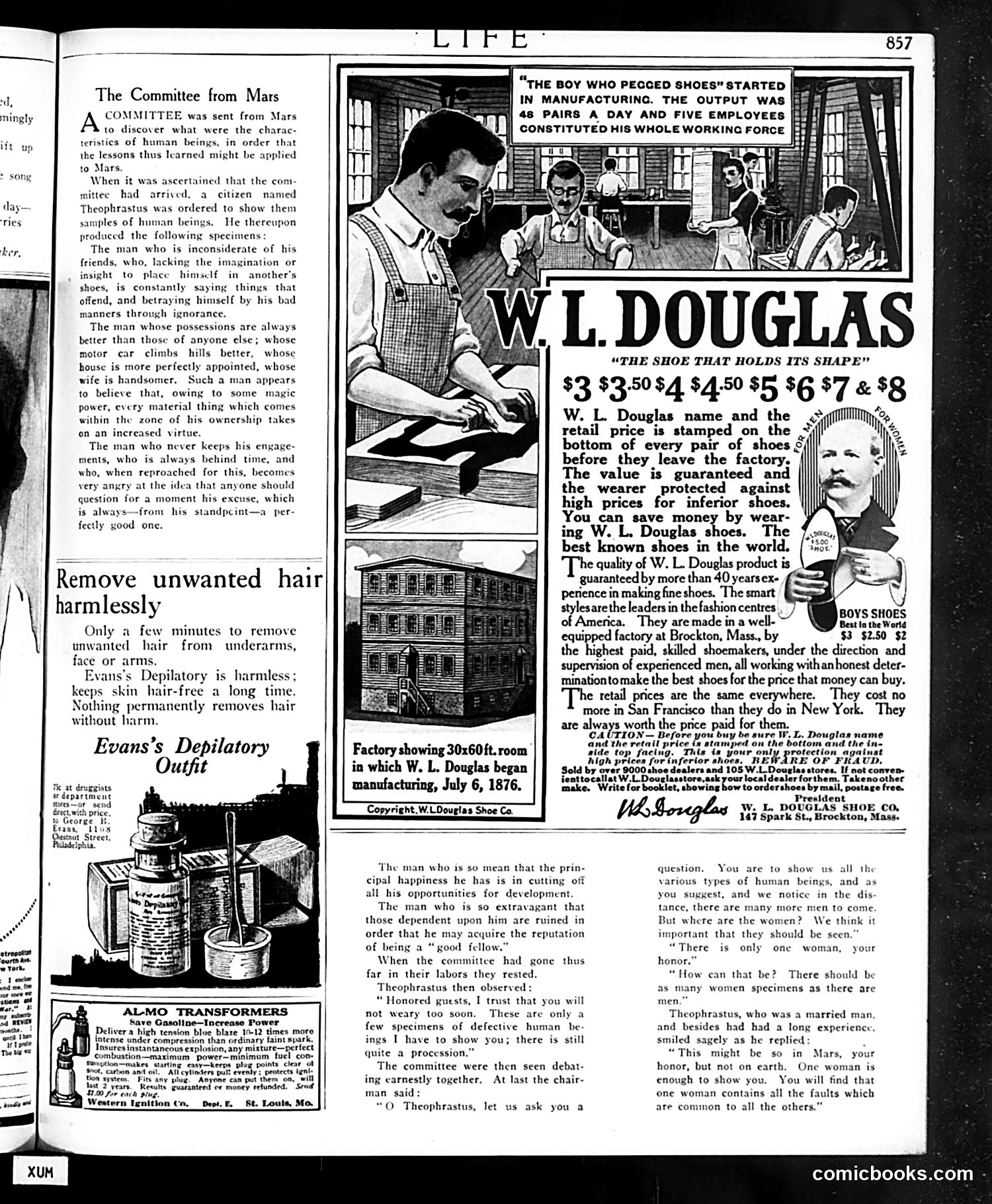
This page contains a satirical short story in *Life* magazine paired with a W.L. Douglas shoe advertisement. **The Satire:** The story presents Martian visitors studying human character flaws. Theophrastus is ordered to display "specimens" of defective humans: the inconsiderate friend, the boastful man obsessed with possessions, the chronically late person, and the stingy individual. By framing these character types as curiosities worthy of Martian observation, the satire mocks these vices as absurdly common human failings—suggesting they're so prevalent they exemplify humanity itself. The humor relies on the reader recognizing these types in their own society and social circles, creating self-aware commentary about modern manners and morality. **Context:** This reflects early 20th-century satirical tradition, where fictional aliens or foreign observers serve as mirrors to expose societal problems through exaggeration and irony. The adjacent Douglas shoe ad is unrelated advertising content typical of magazine layout from this era.
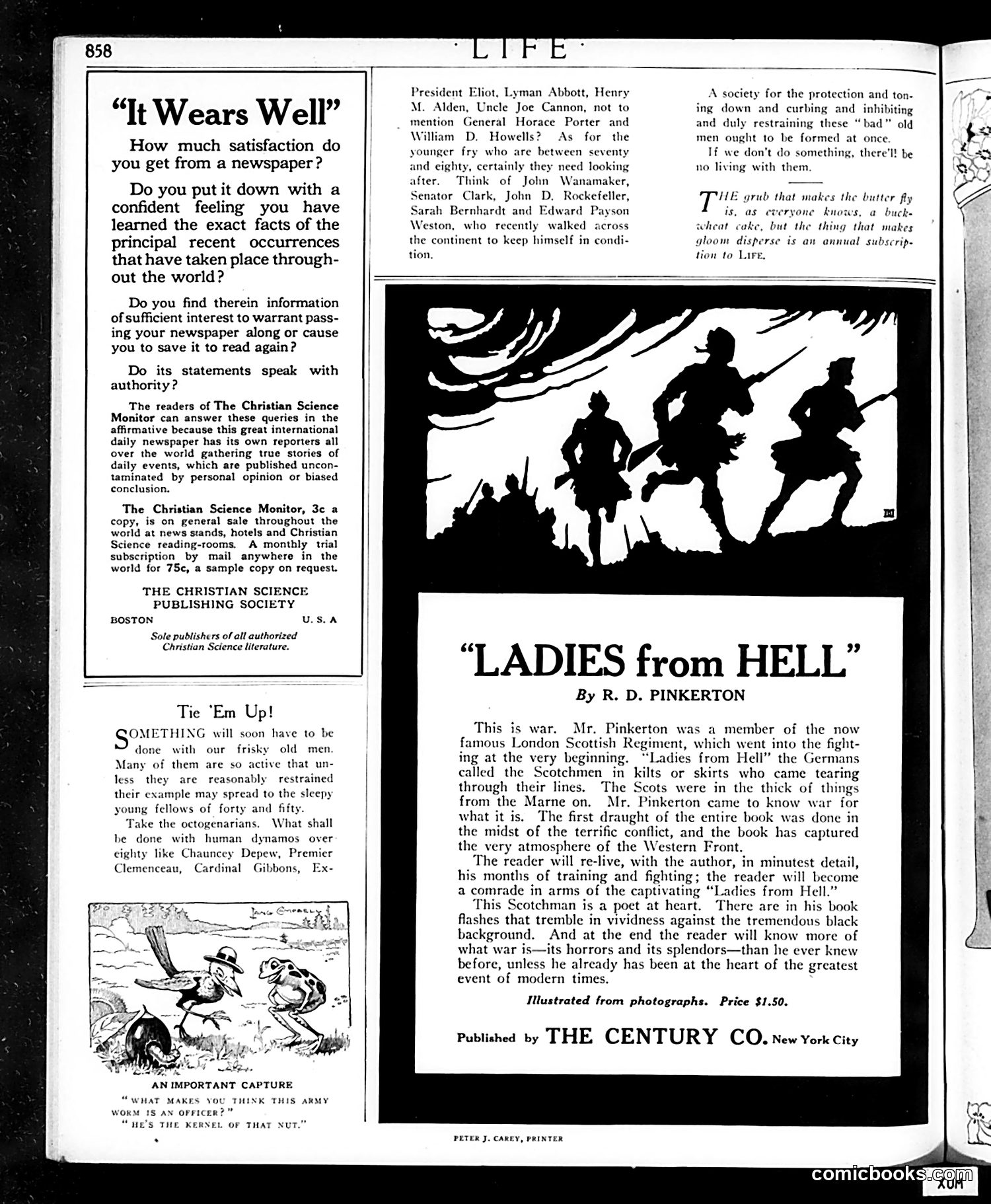
This page contains three distinct elements: **Left column**: Two advertisements—one for *The Christian Science Monitor* (promoting unbiased news reporting) and one titled "Tie 'Em Up!" A humorous piece satirizing vigorous elderly men (naming Chauncey Depew, Clemenceau, Cardinal Gibbons, John D. Rockefeller, and others) whose continued activity and influence the author jokingly suggests should be "restrained" lest younger men follow their example. The accompanying cartoon shows men in outdoor pursuit, illustrating the theme. **Right side**: An advertisement for *"Ladies from Hell"* by R.D. Pinkerton—a war memoir about the London Scottish Regiment (identifiable by their kilts, which Germans allegedly called them by this nickname). Published by Century Co., it promises firsthand accounts of WWI combat written during the conflict itself. The page primarily functions as advertising rather than political satire, though the "Tie 'Em Up!" piece contains gentle humor about generational differences and the energy of prominent American figures.
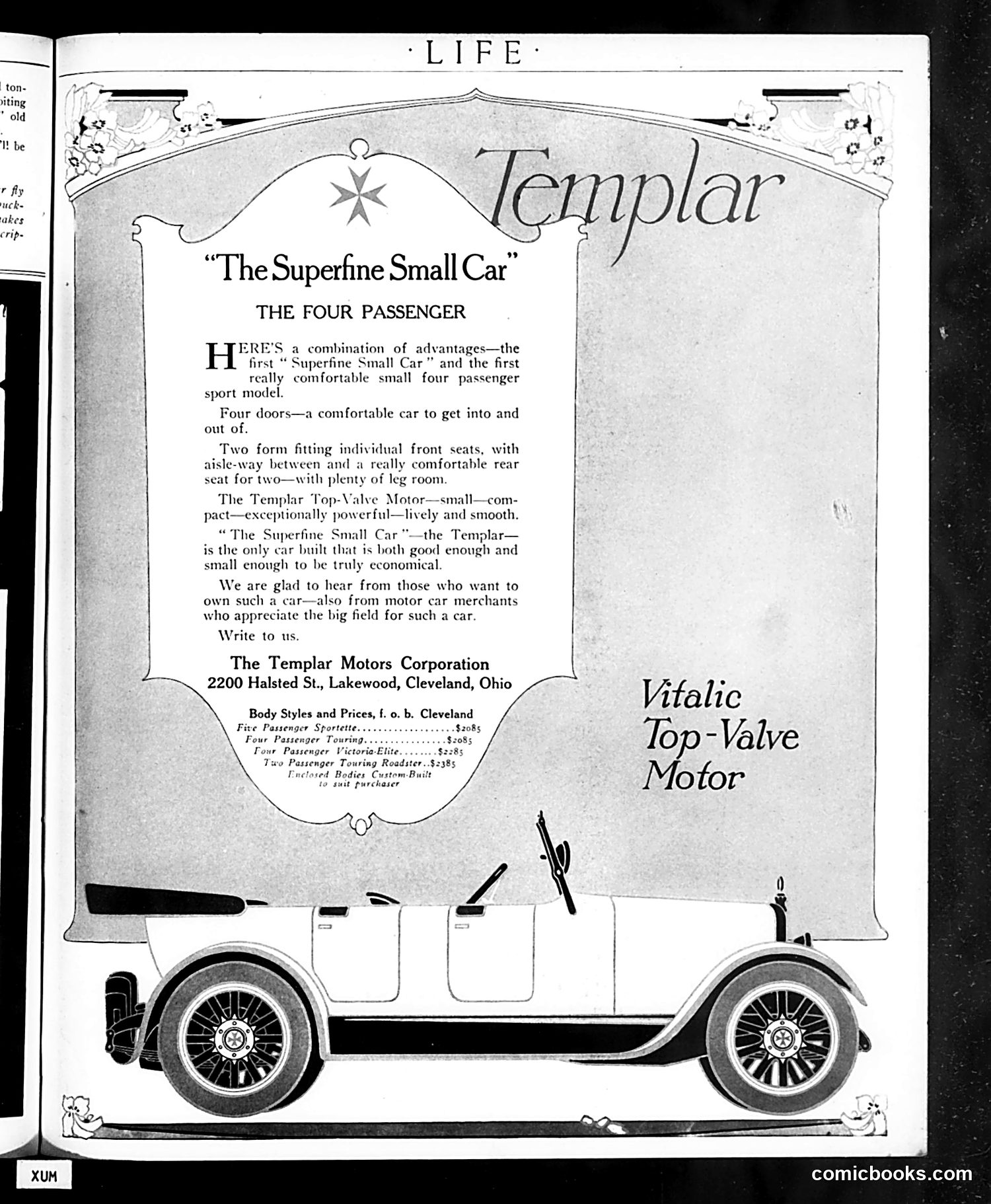
This page is primarily a **car advertisement**, not political satire. It promotes the Templar automobile—"The Superfine Small Car"—a four-passenger vehicle manufactured by Templar Motors Corporation in Cleveland, Ohio. The ad emphasizes practical features appealing to early 20th-century consumers: four doors for easy entry, comfortable individual front seats, rear legroom, and an economical top-valve motor. The text targets both individual buyers seeking an affordable, reliable car and merchants recognizing market demand for such vehicles. The illustration shows a side-view technical drawing of the Templar's chassis and body, highlighting its compact design. The decorative border and "Vitalic Top-Valve Motor" branding are typical period advertising aesthetics. There is **no political cartoon or satire present**—this is straightforward commercial marketing from the early automotive era, when small cars represented new accessibility for middle-class consumers.
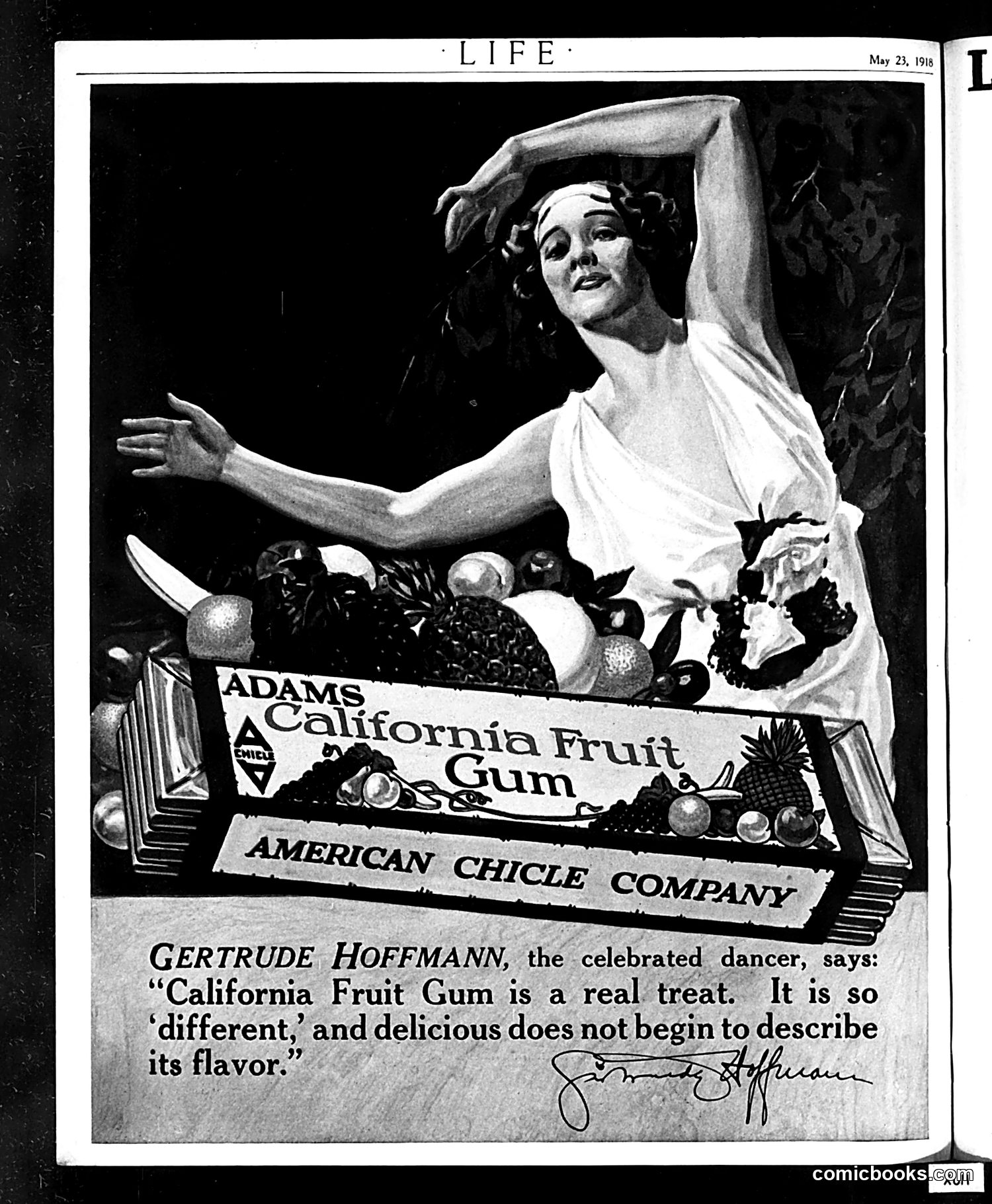
This is a **paid advertisement**, not satire or political commentary. It features Gertrude Hoffmann, a real celebrated dancer of the early 20th century, endorsing Adams California Fruit Gum for the American Chicle Company. The ad uses a classic early-1900s marketing strategy: hiring a famous entertainer to tout a consumer product's superiority. Hoffmann appears posed with theatrical flair amid illustrated fruit, lending glamour to the gum. The endorsement quote emphasizes the product's novelty ("so 'different'") and flavor—typical advertising language. This reflects 1918 consumer culture, when celebrity testimonials were persuasive sales tools. The page is primarily commercial rather than editorial content.